
Increased State of Knowledge and Extinction Risks of the Tortoise and Freshwater Turtles of Colombia

Abstract
1. Introduction
2. Materials and Methods
3. Results
4. Discussion
Author Contributions
Funding
Data Availability Statement
Acknowledgments
Conflicts of Interest
References
- Chen, C.; Wang, J.; Holyoak, M.; Lin, L.; Wang, Y. Global assessment of current extinction risks and future challenges for turtles and tortoises. Nat. Commun. 2025, 16, 7114. [Google Scholar] [CrossRef] [PubMed]
- TCC (Turtle Conservation Coalition) (Ed.) Turtles in Trouble: The World’s Most Endangered Tortoises and Freshwater Turtles—2025; IUCN SSC Tortoise and Freshwater Turtle Specialist Group, Turtle Conservancy, Turtle Survival Alliance, Turtle Conservation Fund, Re:wild, and Chelonian Research Foundation: Ojai, CA, USA, 2025; 77p. [Google Scholar]
- TTWG (Turtle Taxonomy Working Group). Turtles of the World: Annotated Checklist and Atlas of Taxonomy, Synonymy, Distribution, and Conservation Status (8th Ed). Chelon. Res. Monog. 2017, 7, 1–292. [Google Scholar] [CrossRef]
- TTWG (Turtle Taxonomy Working Group). Turtles of the World: Annotated Checklist and Atlas of Taxonomy, Synonymy, Distribution, and Conservation Status (10th Ed.). Chelon. Res. Monog. 2025, 10, 1–575. [Google Scholar]
- Congdon, J.D.; Nagle, R.D.; Kinney, O.M. Front-loading life histories: The enduring influence of juvenile growth on age, size, and reproduction of primiparous female freshwater turtles. Evol. Ecol. Res. 2018, 19, 353–364. [Google Scholar]
- Angielczyk, K.D.; Burroughs, R.W.; Feldman, C.R. Do turtles follow the rules? Latitudinal gradients in species richness, body size, and geographic range area of the world’s turtles. J. Exp. Zool. Part B Mol. Dev. Evol. 2015, 324B, 270–294. [Google Scholar] [CrossRef] [PubMed]
- Ennen, J.R.; Agha, M.; Sweat, S.C.; Matamoros, W.A.; Lovich, J.E.; Rhodin, A.G.J.; Iverson, J.B.; Hoagstrom, C.W. Turtle biogeography: Global regionalization and conservation priorities. Biol. Cons. 2020, 241, 108323. [Google Scholar] [CrossRef]
- Morales-Betancourt, M.A.; Lasso, C.A.; Páez, V.P.; Bock, B.C. (Eds.) Libro Rojo de Reptiles de Colombia (2015); Instituto de Investigación de Recursos Biológicos Alexander von Humboldt: Bogotá, Colombia, 2015; 258p. [Google Scholar]
- IUCN. IUCN Red List Categories and Criteria: Version 3.1, 2nd ed.; IUCN: Gland, Switzerland, 2012; 32p, Available online: https://portals.iucn.org/library/node/10315 (accessed on 1 July 2026).
- Páez, V.P.; Morales-Betancourt, M.A.; Lasso, C.A.; Castaño-Mora, O.V.; Bock, B.C. (Eds.) V. Biología y Conservación de las Tortugas Continentales de Colombia. Serie Editorial Recursos Hidrobiológicos y Pesqueros Continentales de Colombia; Instituto de Investigación de los Recursos Biológicos Alexander von Humboldt (IAvH): Bogotá, Colombia, 2012; 528p. [Google Scholar]
- Forero-Medina, G.; Páez, V.P.; Garcés-Restrepo, M.F.; Carr, J.L.; Giraldo, A.; Vargas-Ramírez, M. Research and conservation priorities for tortoises and freshwater turtles of Colombia. Trop. Cons. Sci. 2016, 9, 1940082916673708. [Google Scholar] [CrossRef]
- Bock, B.C.; Páez, V.P. Meta-analysis of the history of the study of the freshwater turtle and tortoise fauna of Colombia. Acta Biol. Colomb. 2017, 22, 67–76. [Google Scholar] [CrossRef]
- Páez, V.P.; Bock, B.C.; Alzate-Estrada, D.A.; Barrientos-Muñoz, K.G.; Cartagena-Otálvaro, V.M.; Echeverry-Alcendra, A.; Gómez-Rincón, M.T.; Ramírez-Gallego, C.; del Río, J.S.; Vallejo-Betancur, M.M. Turtles of Colombia: An annotated analysis of their diversity, distribution, and conservation status. Amphib. Reptile Cons. 2022, 16, 106–135. [Google Scholar] [CrossRef]
- Martínez Viloria, H.M.; Franke Ante, R.; Saldaña Pérez, P.; Cano Correa, M.; Angarita Jiménez, L.E.; García Llano, C.; Martínez Whisgman, L.; Castro, B.A.; Posada, S.; Gómez, C.; et al. Caracterización del uso y aprovechamiento de recursos hidrobiológicos en áreas protegidas del Parques Nacionales Naturales en el Caribe de Colombia. Bol. Investig. Mar. Cost. 2014, 43, 277–306. [Google Scholar]
- de Paurcq, K.; Thomas, E.; van Damme, P.; Léon-Sicard, T. Análisis de los conflictos entre comunidades locales y autoridades de conservación en Colombia. Causas y recomendaciones. Gest. Ambiente 2017, 20, 122–139. [Google Scholar] [CrossRef]
- Bernal, J.; Sudarsky, J.; Riveros, C. Illicit crop cultivation in Colombia’s national natural parks: Dynamics, drivers, and policy responses. J. Illicit Econ. Devel. 2021, 3, 22–35. [Google Scholar] [CrossRef]
- Stearns, S.C. The Evolution of Life Histories; Oxford University Press: Oxford, UK, 1992. [Google Scholar] [CrossRef]
- Thépot, D. Sex chromosomes and master sex-determining genes in turtles and other reptiles. Genes 2021, 12, 1822. [Google Scholar] [CrossRef] [PubMed]
- Cunha, F.A.G.; Fernandes, T.; Franco, J.; Vogt, R.C. Reproductive biology and hatchling morphology of the Amazon toad-headed turtle (Mesoclemmys raniceps) (Testudines: Chelidae), with notes on species morphology and taxonomy of the Mesoclemmys group. Chelon. Cons. Biol. 2019, 18, 195–209. [Google Scholar] [CrossRef]
- Forero-Medina, G.; Yusti-Muñoz, A.P.; Castaño-Mora, O.V. Distribución geográfica de las tortugas continentales de Colombia y su representación en áreas protegidas. Acta Biol. Colomb. 2014, 19, 415–426. [Google Scholar]
- Holley, J.A.; Sterli, J.; Basso, N.G. Dating the origin and diversification of Pan-Chelidae (Testudines, Pleurodira) under multiple molecular clock approaches. Contri. Zool. 2020, 89, 146–174. [Google Scholar] [CrossRef]
- Ferreira, G.S.; Bronzati, M.; Langer, M.C.; Sterli, J. Phylogeny, biogeography and diversification patterns of side-necked turtles (Testudines: Pleurodira). J. R. Soc. Open Sci. 2018, 5, 171773. [Google Scholar] [CrossRef] [PubMed]
- Armesto, O.; Acevedo, A.A.; Gallardo, A.; Franco, R. Rhinoclemmys diadimata (Mertens 1954). Inguensa, Galápago de Maracaibo. Cat. Anfibios Reptiles Colomb. 2014, 2, 47–52. [Google Scholar]
- Morales-Betancourt, M.A.; Lasso, C.A.; Rojas-Runjaic, F.J.M. Rhinoclemmys diademata. IUCN Red List Threat. Species 2024, e.T170510A1315527. [Google Scholar] [CrossRef]
- Thomson, R.C.; Spinks, P.Q.; Shaffer, H.B. A global phylogeny of turtles reveals a burst of climate-associated diversification on continental margins. Proc. Nat. Acad. Sci. USA 2021, 118, e2012215118. [Google Scholar] [CrossRef] [PubMed]
- Carr, J.L.; Moll, D.; Giraldo, A.; Garcés-Restrepo, M.F. Rhinoclemmys annulata (Gray 1860)—Brown Wood Turtle, Montañero, Bambera. Chelon. Res. Monog. 2023, 5, 123.1–123.16. [Google Scholar] [CrossRef]
- Garcés-Restrepo, M.F.; Giraldo, A.; Carr, J.L.; Brown, L.D. Turtle ectoparasites from the Pacific coastal region of Colombia. Biota Neotrop. 2013, 13, 74–79. [Google Scholar] [CrossRef]
- Cunha, F.A.; Fagundes, C.K.; Brito, E.S.; Vogt, R.C.; Maffei, F.; Pezzuti, J.; Félix-Silva, D.; Rojas-Runjaic, F.J.M.; Lasso, C.A.; Morales-Betancourt, M.A.; et al. Distribution of Chelus fimbriata and Chelus orinocensis (Testudines: Chelidae). Chelon. Cons. Biol. 2021, 20, 109–115. [Google Scholar] [CrossRef]
- Pritchard, P.C.H. Chelus fimbriata (Schneider 1783)—Matamata turtle. Chelon. Res. Monog. 2008, 5, 020.1–020.10. [Google Scholar] [CrossRef]
- Viana, P.F.; Eliana Feldberg, E.; Hiroshi Takagui, F.; Menezes, S.; Vogt, R.C.; Ezaz, T. Matamatas Chelus spp. (Testudines, Chelidae) have a remarkable evolutionary history of sex chromosomes with a long-term stable XY microchromosome system. Sci. Rep. 2022, 12, 6676. [Google Scholar] [CrossRef] [PubMed]
- Lasso, C.A.; Trujillo, F.; Morales-Betancourt, M.A.; Amaya, L.; Caballero, S.; Castañeda, B. Conservación y tráfico de la tortuga matamata, Chelus fimbriata (Schneider, 1783) en Colombia: Un ejemplo del trabajo conjunto entre el Sistema Nacional Ambiental, ONG y academia. Biota Colomb. 2018, 19, 147–159. [Google Scholar] [CrossRef]
- Vargas-Ramírez, M.; Caballero, S.; Morales-Betancourt, M.A.; Lasso, C.A.; Amaya, L.; Martínez, J.G.; das Neves Silva Viana, M.; Vogt, R.C.; Farias, I.P.; Hrbek, T.; et al. Genomic analyses reveal two species of the matamata (Testudines: Chelidae: Chelus spp.) and clarify their phylogeography. Mol. Phylogenet. Evol. 2020, 148, 106823. [Google Scholar] [CrossRef] [PubMed]
- Renteria-Moreno, L.E.; Forero-Medina, G.; Garcés-Restrepo, M.F.; Carr, J.L.; Rueda-Almonacid, J.V. Range extension of Kinosternon dunni Schmidt, 1947 (Reptilia, Testudines, Kinosternidae) in Chocó, Colombia. Check List 2012, 8, 1310–1312. [Google Scholar] [CrossRef]
- Medem, F. La distribución geográfica y ecología de los Crocodylia y Testudinata en el Departamento del Chocó. Rev. Acad. Colomb. Cienc. Exact. Fís. Nat. 1962, 11, 279–303. [Google Scholar]
- Liao, W.; Cao, S.; Jiang, Y.; Shao, W.; Zhao, L.; Yan, C. Predicting conservation status of Testudoformes under climate change using habitat models. Animals 2024, 14, 2300. [Google Scholar] [CrossRef] [PubMed]
- Hurtado-Gómez, J.P.; Vargas-Ramírez, M.; Iverson, J.B.; Joyce, W.G.; McCranie, J.R.; Paetzold, C.; Fritz, U. Diversity and biogeography of South American mud turtles elucidated by multilocus DNA sequencing (Testudines: Kinosternidae). Mol. Phylogenet. Evol. 2024, 197, 108083. [Google Scholar] [CrossRef] [PubMed]
- Camillo, C.S.; Valenzuela, N.; Johnson, S.A. Effects of semi-constant temperature on embryonic and hatchling phenotypes of six-tubercled Amazon River turtles, Podocnemis sextuberculata. J. Ther. Biol. 2022, 108, 103292. [Google Scholar] [CrossRef] [PubMed]
- Aponte-Gutiérrez, A.F.; Arbeláez, F.; Parra-Torres, M.; Forero-Medina, G. Conservación y ecología reproductiva de tres especies del género Podocnemis en la Amazonía Colombo-peruana, con participación de las comunidades indígenas de la zona. In Homenaje a Federico Medem, Aportes a la Herpetología Colombiana; Ardila Robayo, M.C., Martínez Barreto, W., Eds.; Instituto de Ciencias Naturales, Universidad Nacional de Colombia: Bogotá, Colombia, 2019; pp. 133–146. [Google Scholar]
- Pereira, A.G.; Sterli, J.; Moreira, F.R.; Schrago, C.G. Multilocus phylogeny and statistical biogeography clarify the evolutionary history of major lineages of turtles. Mol. Phylogenet. Evol. 2017, 113, 59–66. [Google Scholar] [CrossRef] [PubMed]
- Hugh-Jones, S.; Hugh-Jones, C. Fred Medem and Rhinemys rupifes. In Homenaje a Federico Medem, Aportes a la Herpetología Colombiana; Ardila Robayo, M.C., Martínez Barreto, W., Eds.; Instituto de Ciencias Naturales, Universidad Nacional de Colombia: Bogotá, Colombia, 2019; pp. 167–169. [Google Scholar]
- Rueda-Almonacid, J.V.; Carr, J.L.; Mittermeier, R.A.; Rodríguez-Mahecha, J.V.; Mast, R.B.; Vogt, R.C.; Rhodin, A.G.J.; De la Ossa-Velásquez, J.; Rueda, J.N.; Mittermeier, C.G. Las Tortugas y los Cocodrilianos de los Países Andinos del Trópico. Serie de Guías Tropicales de Campo No. 6; Editorial Panamericana, Formas e Impresos, Conservación Internacional: Bogotá, Colombia, 2007; 538p, Available online: https://iucn-tftsg.org/wp-content/uploads/file/Articles/Rueda-Almonacid_etal_2007.pdf (accessed on 1 July 2026).
- Lamar, W.W.; Medem, F. Notes on the chelid turtle Phrynops rufipes in Colombia. Salamandra 1982, 18, 305–321. [Google Scholar]
- Young-Valencia, K.; Ortega, A.F.; Botero-Botero, A. Densidad y estructura de las poblaciones de tortuga pímpano (Chelydra acutirostris Peters 1862) (Chelydridae) en las quebradas Cajones y Los Coclí, departamento del Quindío, Colombia. Rev. Biodivers. Neotrop. 2014, 4, 149–161. [Google Scholar] [CrossRef]
- Young-Valencia, K.; Ortega-Guio, A.; Botero-Botero, A. Influencia de las variables de hábitat sobre la presencia de la tortuga pímpano (Chelydra acutirostris, Peters 1862) (Chelydridae) en las quebradas Cajones y los Coclí, Quindío, Colombia. Rev. Colomb. Cienc. Anim. 2017, 9, 6–13. [Google Scholar] [CrossRef]
- Henao, L.D.; Ruiz-Palma, H.J. Estado actual de la tortuga “bache” (Chelydra serpentina acutirostris) en el Valle de Cauca. Cacería y cautiverio en la comunidad de San Cipriano, Buenaventura. In Investigación y Manejo de Fauna para la Construcción de Sistemas Sostenibles; Osoriom, H., Ed.; CIPAV: Cali, Colombia, 1996; pp. 157–160. [Google Scholar]
- Arango-Lozano, J.; Young Valencia, K.; Giraldo, A.; Botero Botero, A. Estructura etaria y morfometría poblacional de la tortuga pímpano (Chelydra acutirostris, Peters 1862) (Chelydridae) en tres afluentes del río La Vieja, departamento del Quindío, Colombia. Bol. Cient. Mus. Hist. Nat. 2017, 21, 122–137. [Google Scholar] [CrossRef]
- Gentíl, E.; De Medeiros, L.A.; Vogt, R.C.; Barnett, A.A. Biology of the Big-headed Amazon River Turtle, Peltocephalus dumerilianus (Schweigger, 1812) (Testudines, Pleurodira): The basal extant Podocnemididae species. Herpetozoa 2021, 34, 207–222. [Google Scholar] [CrossRef]
- Parra-Henao, K.D.; Páez, V.P.; Morales-Betancourt, M.A.; Lasso, C.A. A pilot study of habitat and population characteristics of the big-headed Amazon river turtle, Peltochephalus dumirilianus (Schweigger 1812), during the dry season in the Bojonawi Nature Reserve, Vichada, Colombia. Herpet. Notes 2019, 12, 1113–1120. [Google Scholar]
- Morales-Betancourt, M.A.; Lasso, C.A.; Bernal-Sierra, S.; Sepúlveda-Seguro, A.M.; Parra-Henao, K.D.; Gómez-Rincón, M.T.; Páez, V.P.; Castañeda, B.; Marín, B. VIII: Historia natural de las tortugas acuáticas de la Reserva Natural Bojonawi (Escudo Guayanés), Orinoquia, Vichada, Colombia. Serie Editorial Fauna Silvestre Neontropical. In Biodiversidad de la Reserva Natural Bojonawi, Vichada, Colombia: Río Orinoco y Planicie de Inundación; Lasso, C.A., Trujillo, F., Morales-Betancourt, M.A., Eds.; Instituto de Investigación de Recursos Biológicos Alexander von Humboldt: Bogotá, Colombia, 2020; pp. 431–453. [Google Scholar] [CrossRef]
- Gaviria-Hernández, J.; Rojas-Soto, O.; Ceballos, C.P. Distribution of the Atrato slider Trachemys medemi, future projections under climate change scenarios and conservation insights. Oryx 2026, 1–11, first view. [Google Scholar] [CrossRef]
- Gaviria-Hernández, J.; Ceballos, C.P. An approximation of the reproductive cycle of the Atrato River Slider, Trachemys medemi. Chelon. Con. Biol. 2025. ahead of print online publication. [Google Scholar] [CrossRef]
- Cuadrado-Ríos, S.; Vargas-Ramírez, M.; Kehlmaier, C.; Fritz, U. Complete mitochondrial genome and phylogenetic analysis of the Atrato slider, Trachemys medemi (Testudines, Emydidae). ZooKeys 2025, 1224, 253–260. [Google Scholar] [CrossRef] [PubMed]
- Stevenson, P.; Borda, C.; Rojas, A.; Alvarez, M. Population size, habitat choice and sexual dimorphism of the Amazonian tortoise (Geochelone denticulata) in Tinigua National Park, Colombia. Amphibia-Reptilia 2007, 28, 217–226. [Google Scholar] [CrossRef]
- Echeverry-Alcendra, A.M.; Guzmán, M.A.; Stevenson, P.; Cortés-Duque, J. Chelonoidis denticulata (Linnaeus, 1766). In V. Biología y Conservación de las Tortugas Continentales de Colombia. Serie Editorial Recursos Hidrobiológicos y Pesqueros Continentales de Colombia; Páez, V.P., Morales-Betancourt, M.A., Lasso, C.A., Castaño Mora, O.V., Bock, B.C., Eds.; Instituto de Investigación de Recursos Biológicos Alexander von Humboldt: Bogotá, Colombia, 2012; pp. 412–418. [Google Scholar]
- Castaño-Mora, O.V.; Rugeles-Lugo, M. Estudio comparativo del comportamiento de dos especies de morrocoy: Geochelone carbonaria y Geochelone denticulata y aspectos comparables de su morfología externa. Cespedasia 1981, 10, 55–122. [Google Scholar]
- Vargas-Ramírez, M.; Maran, J.; Fritz, U. Red- and yellow-footed tortoises (Chelonoidis carbonaria, C. denticulata) in South American savannahs and forests: Do their phylogeographies reflect distinct habitats? Organ. Divers. Evol. 2010, 10, 161–172. [Google Scholar] [CrossRef]
- Forero-Medina, G.; Castaño-Mora, O.V.; Montenegro, O. Abundance, population structure, and conservation of Kinosternon scorpioides albogulare on the Caribbean island of San Andrés, Colombia. Chelon. Cons. Biol. 2007, 6, 163–169. [Google Scholar] [CrossRef]
- Forero-Medina, G.; Castaño-Mora, O.V. Kinosternon scorpioides albogulare (Duméril and Bocourt 1870)—White-Throated Mud Turtle, Swanka Turtle. Chelon. Res. Monog. 2011, 5, 064.1–064.5. [Google Scholar] [CrossRef]
- Caballero, S.; Martínez, J.G.; Morales-Betancourt, M.A.; Bolaños, N.; Lasso, C.A. Genomic analyses of the scorpion mud turtle Kinosternon scorpioides) (Linnaeus, 766) in insular and continental Colombia: Evidence for multiple conservation and taxonomic units. Front. Conserv. Sci. 2022, 3, 938040. [Google Scholar] [CrossRef]
- Bedoya-Cañón, M.A.; Muñoz-Avila, J.A.; Vargas-Salinas, F. Morphology and natural history of the mud turtle Kinosternon scorpioides scorpioides in populations of northern Colombia. Herpet. Rev. 2018, 49, 210–214. [Google Scholar]
- Montes-Correa, A.C.; Saboyá-Acota, L.P.; Páez, V.P.; Renjifo, J.M. Kinosternon scorpioides (Linnaeus 1766). Tapaculo, Bisagra, Casquito, Guachupe, Pecho quebrado, Swanka. Cat. Anfibios Reptiles Colomb. 2017, 3, 17–24. [Google Scholar]
- Braga, B.; Oliveira-Bahia, V.; Ferreira, M.A.; Marques, J.R.F.; Guimarés, D.A. Gonadal development in scorpion mud turtles, Kinosternon scorpioides, in a controlled environment. Anat. Rec. 2025. online early view. [Google Scholar] [CrossRef] [PubMed]
- Ardila-Marulanda, M.; de la Ossa, V.J.; De la Ossa-Lacayo, A. Uso de quelonios continentales en el Golfo de Morrosquillo, Sucre, Colombia. Rev. Colomb. Cienc. Anim. 2016, 8, 361–367. [Google Scholar] [CrossRef]
- Mittermeier, R.A.; Vogt, R.C.; Bernhard, R.; Ferrara, C.R. Podocnemis erythrocephala (Spix 1824)—Red-headed Amazon River Turtle, Irapuca. Chelon. Res. Monog. 2015, 5, 087.1–087.10. [Google Scholar] [CrossRef]
- Michels, J.; Vargas-Ramírez, M. Red-headed Amazon River Turtles in Venezuela and Colombia: Population separation and connection along the famous route of Alexander von Humboldt. Zoology 2018, 130, 67–78. [Google Scholar] [CrossRef] [PubMed]
- Castaño-Mora, O.V.; Galvis-Peñuela, P.A.; Molano, J.G. Reproductive ecology of Podocnemis erythrocephala (Testudines: Podocnemididae) in the Lower Inírida River, Colombia. Chelon. Con. Biol. 2003, 4, 664–670. [Google Scholar]
- Morales-Betancourt, M.A.; Lasso, C.A. Chipiro Podocnemis erythrocephala (Spix, 1824). In Libro Rojo de Reptiles de Colombia (2015); Morales-Betancourt, M.A., Lasso, C.A., Páez, V.P., Bock, B.C., Eds.; Instituto de Investigación de Recursos Biológicos Alexander von Humboldt: Bogotá, Colombia, 2015; pp. 158–160. Available online: http://biblioteca.humboldt.org.co/en/biodiversity/item/905-libro-rojo-reptiles (accessed on 1 July 2026).
- Gallego-García, N.; Vargas-Ramírez, M.; Shaffer, H.B. The importance of cryptic diversity in the conservation of wide-ranging species: The red-footed tortoise Chelonoidis carbonarius in Colombia. Mol. Ecol. 2023, 32, 4531–4545. [Google Scholar] [CrossRef] [PubMed]
- Rojano, C.; Urbano Bonilla, A.; Díaz Timoté, J. Aspectos ecológicos del morrocoy (Chelonoidis carbonarius, spix 1824) en la cuenca del río Cravo Sur y otras cuencas del Orinoquia. In El Reto de Conservar y Producir: Biodiversidad y Sistemas Productivos en la Cuenca Media y Baja del Río Cravo Sur; Antelo Albertos, R., Diaz Olaya, M.R., Durán Hernández, Z., Rojano, C., Eds.; Sello Editorial Universidad Nacional Abierta y a Distancia (UNAD): Bogotá, Colombia, 2021; pp. 304–319. [Google Scholar] [CrossRef]
- Hernández-Montoya, V.; Páez, V.P.; Ceballos, C.P. Effects of temperature on sex determination and embryonic development in the Red-footed Tortoise, Chelonoidis carbonarius. Chelon. Cons. Biol. 2017, 16, 164–171. [Google Scholar] [CrossRef]
- Gaviria-Hernández, J.; Páez, V.P.; Ramírez, D.M.; Ceballos, C.P. Embryo development and sex ratios in the Red-Footed Tortoise (Chelonoidis carbonarius) at masculinizing temperatures. Chelon. Cons. Biol. 2021, 20, 71–81. [Google Scholar] [CrossRef]
- Cárdenas-Arévalo, G.; Medina-Rangel, G.F.; Castaño-Mora, O.V. Evaluación de poblaciones de Chelonoidis carbonarius y caracterización de su hábitat en el departamento del Cesar, Colombia. In Homenaje a Federico Medem, Aportes a la Herpetología Colombiana; Ardila Robayo, M.C., Martínez Barreto, W., Eds.; Instituto de Ciencias Naturales, Universidad Nacional de Colombia: Bogotá, Colombia, 2019; pp. 121–132. [Google Scholar]
- Arias Sosa, L.A.; Rodríguez-Castro, K.G.; Agudelo-González, M.H.; Ramos-Villalba, B.; Cuadrado-Ríos, S.; Brieva, C.; del Valle-Useche, C.M.; Balcero-Deaquiz, M.C.; Vargas-Ramírez, M. Mitochondrial sequencing to guide the management of endangered turtles in Colombia. Rev. Biol. Trop. 2025, 73, e60604. [Google Scholar] [CrossRef]
- Arango-Lozano, J.; Patiño, S.D.; Benítez, C.L.; Botero, B.A. New records of Kinosternon leucostomum postinguinale (Duméril and Bibron, 1851) from the Central Cordillera of Colombia. Rev. Colomb. Cienc. Anim. 2018, 10, 82–85. [Google Scholar] [CrossRef]
- Patiño-Siro, D.; Arango-Lozano, J.; Botero-Botero, A. Population structure, size and morphometry of the white-lipped mud turtle Kinosternon leucostomum postinguinale in pond systems in Quindío, central Andes of Colombia. Herpetol. Bull. 2018, 146, 25–31. [Google Scholar]
- Ceballos, C.P.; Zapata, D.; Alvarado, C.; Rincón, E. Morphology, diet, and population structure of the Southern White-lipped Mud Turtle Kinosternon leucostomum postinguinale (Testudines: Kinosternidae) in the Nus River drainage, Colombia. J. Herpetol. 2016, 50, 374–380. [Google Scholar] [CrossRef] [PubMed]
- Vogt, R.C.; Flores-Villela, O. Effects of incubation temperature on sex determination in a community of Neotropical freshwater turtles in southern Mexico. Herpetologica 1992, 48, 265–270. [Google Scholar]
- Corredor, L.G.; Kattan, G.; Galvis, R.C.A.; Amorocho, D. Tortugas del Valle del Cauca; Corporación Autónoma Regional del Valle del Cauca (CVC): Cali, Colombia, 2007; 74p. [Google Scholar]
- Giraldo, A.; Garcés-Restrepo, M.F.; Carr, J.L. Kinosternon leucostomum (Duméril y Bibron 1851). Cat. Anfibios Reptiles Colomb. 2013, 1, 45–49. [Google Scholar]
- Figueroa, I.C.; Fachín-Terán, A.; Duque, S.R. Hábitat, uso y estructura poblacional de las tortugas acuáticas Podocnemis unifilis y Podocnemis expansa (Testudines: Podocnemididae) en el resguardo Curare-Los Ingleses, La Pedrera, Amazonas, Colombia. Mundo Amaz. 2013, 4, 153–173. [Google Scholar]
- Martínez-Callejas, S.; Durán-Prieto, C.; Páez, V.P.; Trujillo, F.; Trujillo-Pérez, A. Podocnemis expansa Müller 1935. In Libro Rojo de Reptiles de Colombia (2015); Morales-Betancourt, M.A., Lasso, C.A., Páez, V.P., Bock, B.C., Eds.; Instituto de Investigación de Recursos Biológicos Alexander von Humboldt (IAvH): Bogotá, Colombia, 2015; pp. 132–136. Available online: https://www.minambiente.gov.co/documento-entidad/libro-rojo-de-reptiles-de-colombia/ (accessed on 1 July 2026).
- Valenzuela, N. Constant, shift, and natural temperature effects on sex determination in Podocnemis expansa turtles. Ecology 2001, 82, 3010–3024. [Google Scholar] [CrossRef]
- von Hildebrand, P.; Bermúdez, N.; Peñuela, M.C. La Tortuga Charapa Podocnemis Expansa en el bajo Río Caquetá, Amazonas, Colombia. Aspectos de la Biología Reproductiva y Técnicas para su Manejo; Disloque Editores Ltd.a.: Bogotá, Colombia, 1997; 152p. [Google Scholar]
- Forero-Medina, G.; Ferrara, C.R.; Vogt, R.C.; Fagundes, C.K.; Balestra, R.A.M.; Andrade, P.C.M.; Lacava, R.; Bernhard, R.; Lipman, A.J.; Lenz, A.J.; et al. On the future of the giant South American river turtle Podocnemis expansa. Oryx 2021, 55, 73–80. [Google Scholar] [CrossRef]
- Pearse, D.E.; Arndt, A.D.; Valenzuela, N.; Miller, B.A.; Cantarelli, V.; Sites, J.W., Jr. Estimating population structure under nonequilibrium conditions in a conservation context: Continent-wide population genetics of the giant Amazon river turtle, Podocnemis expansa (Chelonia; Podocnemididae). Mol. Ecol. 2006, 15, 985–1006. [Google Scholar] [CrossRef] [PubMed]
- Páez, V.P.; Bock, B.C. Factores pre y poseclosión que afectan las tasas de crecimiento de juveniles de la tortuga tericay (Podocnemis unifilis). Actual. Biol. 2004, 26, 137–151. [Google Scholar] [CrossRef]
- Bock, B.C.; Páez, V.P.; White, M.M. Genetic population structure of two threatened South American river turtle species, Podocnemis expansa and Podocnemis unifilis. Chelon. Cons. Biol. 2001, 4, 47–52. [Google Scholar]
- Cárdenas-Arévalo, G.; Gallego-García, N.; Castaño-Mora, O.V. Distribución, historia natural y estado de conservación de las tortugas continentales en el departamento de Córdoba, Colombia. In Homenaje a Federico Medem, Aportes a la Herpetología Colombiana; Ardila Robayo, M.C., Martínez Barreto, W., Eds.; Instituto de Ciencias Naturales, Universidad Nacional de Colombia: Bogotá, Colombia, 2019; pp. 99–120. [Google Scholar]
- Forero-Medina, G.; Cárdenas-Arevalo, G.; Castaño-Mora, O.V. Abundance, home range, and movement patterns of the endemic species Dahl’s Toad-Headed Turtle (Mesoclemmys dahli) in Cesar, Colombia. Chelon. Cons. Biol. 2011, 10, 228–236. [Google Scholar] [CrossRef]
- Sampedro-Marín, A.; Tobíos-Atencio, P.; Trespalacio-Solana, T. Estado de conservación de la tortuga “Carranchina” (Batrachemys dahli) en localidades del departamento de Sucre, Colombia. Rev. Colomb. Cienc. Anim. 2012, 4, 69–88. [Google Scholar] [CrossRef]
- Vargas-Ramírez, M.; Michels, J.; Castaño-Mora, O.V.; Cárdenas-Arevalo, G.; Gallego-García, N.; Fritz, U. Weak genetic divergence between the two South American toad-headed turtles Mesoclemmys dahli and M. zuliae (Testudines: Pleurodira: Chelidae). Amphibia-Reptilia 2012, 33, 373–385. [Google Scholar] [CrossRef]
- Gallego-García, N.; Forero-Medina, G.; Vargas-Ramírez, M.; Caballero, S.; Shaffer, H.B. Landscape genomic signatures indicate reduced gene flow and forest-associated adaptive divergence in an endangered neotropical turtle. Mol. Ecol. 2019, 28, 2757–2771. [Google Scholar] [CrossRef] [PubMed]
- Sepúlveda-Seguro, A.M.; Páez, V.P.; Gómez-Rincón, M.T.; Morales-Betancourt, M.A.; Lasso, C.A. Assessment of population characteristics and habitat use of Podocnemis vogli (Müller 1935) during a reproductive season at the Bojonawi Private Nature Reserve (Vichada Department, Colombia). Rev. Latinoamer. Herpetol. 2020, 3, 49–60. [Google Scholar] [CrossRef]
- Páez, V.P.; Pérez, J.; Parra, F.; Bock, B.C. An approximation to the sex determination patterns in the Savanna Side-Necked Turtle Podocnemis vogli (Podocnemididae). Chelon. Cons. Biol. 2024, 22, 175–183. [Google Scholar] [CrossRef]
- Ortiz-Moreno, M.L.; Rodríguez-Pulido, J.A. Estado del conocimiento y amenazas de la tortuga sabanera (Podocnemis vogli, Podocnemididae) en Colombia. Orinoquia 2017, 21, 26–33. [Google Scholar] [CrossRef]
- González, L.P.; Pacheco, M.A.; Escalante, A.A.; Jiménez Maldonado, A.D.; Cepeda, A.S.; Rodríguez-Fandiño, O.A.; Vargas-Ramírez, M.; Matta, N.E. Haemocystidium spp., a species complex infecting ancient aquatic turtles of the family Podocnemididae: First report of these parasites in Podocnemis vogli from the Orinoquia. Intern. J. Parasit. Parasit. Wildl. 2019, 10, 299–309. [Google Scholar] [CrossRef] [PubMed]
- Cadena, E.A.; Vanegas, R.D. A new fossil turtle ends the controversy on the occurrence of the extant genus Podocnemis Wagler, 1830 at the Miocene fauna of La Venta, Colombia. Geodiversitas 2023, 45, 127–138. [Google Scholar] [CrossRef]
- Cárdenas-Barrantes, M.; Matta, N.E.; Rodríguez-Fandiño, O.A.; Fritz, U.; Vargas-Ramírez, M. Genetic structure and loss of genetic diversity in the savannah side-necked turtle Podocnemis vogli (Testudines: Podocnemididae). Chelon. Cons. Biol. 2024, 23, 92–102. [Google Scholar] [CrossRef]
- Quintero-Corzo, A. Protocolo para el Monitoreo de la Tortuga Hicotea (Trachemys Callirostris Callirostris) en las Ciénagas de Bañó y Los Negros; Conservación Internacional Colombia: Bogotá, Colombia, 2012; 54p. [Google Scholar]
- Restrepo, A.; Piñeros, V.J.; Páez, V.P. Nest site selection by female Trachemys callirostris (Testudinata: Emydidae) in the Mompos Depression of Colombia. Chelon. Cons. Biol. 2006, 5, 249–254. [Google Scholar] [CrossRef]
- Daza, J.M.; Páez, V.P. Morphometric variation and its effect on reproductive potential in female Colombian slider turtles (Trachemys callirostris callirostris). Herpetologica 2007, 63, 125–134. [Google Scholar] [CrossRef]
- Bock, B.C.; Páez, V.P.; Daza, J.M. Trachemys callirostris (Gray 1856)—Colombian slider, jicotea, hicotea, galápago, morrocoy de agua. Chelon. Res. Monog. 2010, 5, 042.1–042.9. [Google Scholar] [CrossRef]
- Restrepo, A.; Páez, V.P.; Bock, B.C.; Daza, J.M.; Díazgranados, I. Trachemys callirostris (Gray 1856). Cat. Anfibios Reptiles Colomb. 2014, 2, 7–12. [Google Scholar]
- Vargas-Ramírez, M.; del Valle, C.; Ceballos, C.P.; Fritz, U. Trachemys medemi n. sp. from northwestern Colombia turns the biogeography of South American slider turtles upside down. J. Zool. Syst. Evol. Res. 2017, 55, 326–339. [Google Scholar] [CrossRef]
- Fritz, U.; Herrmann, H.W.; Rosen, P.C.; Auer, M.; Vargas-Ramírez, M.; Kehlmaier, C. Trachemys in Mexico and beyond: Beautiful turtles, taxonomic nightmare, and a mitochondrial poltergeist (Testudines: Emydidae). Vert. Zool. 2024, 74, 435–452. [Google Scholar] [CrossRef]
- Cuesta, E.Y.; Cetre Mosquera, Z. Riqueza de quelonios y estructura poblacional de Rhinoclemmys melanosterna (Quelonia: Geoemididae) en Managrú, municipio de Cantón de San Pablo, Chocó, Colombia. Rev. Bioetnia 2018, 15, 23–35. [Google Scholar] [CrossRef]
- Echeverri-Garcia, L.P.; Carr, J.L.; Garcés-Restrepo, M.F.; Galvis Rizo, C.A.; Giraldo, A. Rhinoclemmys melanosterna (Gray 1861). In V. Biología y Conservación de las Tortugas Continentales de Colombia. Serie Editorial Recursos Hidrobiológicos y Pesqueros Continentales de Colombia; Páez, V.P., Morales-Betancourt, M.A., Lasso, C.A., Castaño Mora, O.V., Bock, B.C., Eds.; Instituto de Investigación de Recursos Biológicos Alexander von Humboldt: Bogotá, Colombia, 2012; pp. 308–314. [Google Scholar]
- Páez, V.P.; Bock, B.C.; Cartagena-Otálvaro, V.M. Life history characteristics of the Colombian Wood Turtle, Rhinoclemmys melanosterna (Geoemydidae), in the middle Magdalena River, Colombia. Herpetol. Notes 2025, 18, 921–930. [Google Scholar]
- Dahl, G.; Medem, F. Los reptiles acuáticos de la hoya del Sinú. In Informe Sobre la Fauna Acuática del Río Sinú; Corporación Autónoma Regional de los Valles de la Magdalena y Sinú: Bogotá, Colombia, 1964; pp. 110–129. [Google Scholar]
- De la Ossa, V.J.; Pérez-Cordero, A.; Montes-Vergara, D. Subsistence hunting of Podocnemis Lewyana and Rhinoclemmys melanosterna (Testudines) in the region of the lowSan Jorge River, Caribbean, Colombia. Indian J. Sci. Technol. 2018, 11, 29. [Google Scholar] [CrossRef]
- Vargas-Ramírez, M.; Carr, J.L.; Fritz, U. Complex phylogeography in Rhinoclemmys melanostera: Conflicting mitochondrial and nuclear evidence suggests past hybridization (Testudines: Geoemydidae). Zootaxa 2013, 3670, 238–254. [Google Scholar] [CrossRef] [PubMed]
- Carr, J.L.; Giraldo, A.; Garcés-Restrepo, M.F. Rhinoclemmys nasuta. Cat. Anfibios Reptiles Colomb. 2017, 3, 43–49. [Google Scholar]
- Garcés-Restrepo, M.F.; Giraldo, A.; Carr, J.L. Variación demográfica temporal de la tortuga de río chocoana, Rhinoclemmys nasuta (Geoemydidae), en Isla Palma, Bahía Málaga, Pacífico del Valle del Cauca. Acta Biol. Colomb. 2014, 19, 489–497. [Google Scholar] [CrossRef]
- Carr, J.L.; Giraldo, A.; Garcés-Restrepo, M.F. Rhinoclemmys nasuta (Boulenger 1902). In V. Biología y Conservación de las Tortugas Continentales de Colombia. Serie Editorial Recursos Hidrobiológicos y Pesqueros Continentales de Colombia; Páez, V.P., Morales-Betancourt, M.A., Lasso, C.A., Castaño Mora, O.V., Bock, B.C., Eds.; Instituto de Investigación de Recursos Biológicos Alexander von Humboldt: Bogotá, Colombia, 2012; pp. 315–322. [Google Scholar]
- Carr, J.L.; Giraldo, A. Rhinoclemmys nasuta (Boulenger 1902)—Large-nosed wood turtle, Chocoan river turtle. Chelon. Res. Monog. 2009, 5, 034.1–034.6. [Google Scholar] [CrossRef]
- Carr, J.L.; Garcés-Restrepo, M.F.; Giraldo, A. Rhinoclemmys nasuta—(Boulenger, 1902). IUCN Red List Threat. Species 2009, in press. [Google Scholar] [CrossRef]
- Garcés-Restrepo, M.F.; Carr, J.L.; Giraldo, A. Long-term variation in survival of a neotropical freshwater turtle: Habitat and climatic influences. Diversity 2019, 11, 97. [Google Scholar] [CrossRef]
- Garcés-Restrepo, M.F.; Rivera-Domínguez, N.; Giraldo, A.; Carr, J.L. Reproductive aspects of the Chocoan River turtle (Rhinoclemmys nasuta, Geoemydidae) along the Colombian Pacific coast. Amphibia-Reptilia 2017, 38, 351–361. [Google Scholar] [CrossRef]
- Castillo-Cutiva, L.A.; Giraldo, A.; Barreto, G. Diversidad genética en una población de Rhinoclemmys nasuta (Testudines: Geoemydidae) asociada a un ambiente insular del Chocó Biogeográfico. Acta Biol. Colomb. 2014, 19, 513–519. [Google Scholar] [CrossRef]
- Ortiz, Y.C.; Restrepo, A.; Páez, V.P. Distribución potencial de Podocnemis lewyana (Reptilia: Podocnemididae) y su posible fluctuación bajo escenarios de cambio climático global. Acta Biol. Colomb. 2014, 19, 471–481. [Google Scholar] [CrossRef]
- Páez, V.P.; Bock, B.C.; Espinal-García, P.A.; Rendón-Valencia, B.H.; Alzate-Estrada, D.; Cartagena-Otálvaro, V.M.; Heppell, S.S. Life history and demographic characteristics of the Magdalena River turtle (Podocnemis lewyana): Implications for management. Copeia 2015, 103, 1058–1074. [Google Scholar] [CrossRef]
- Páez, V.P.; Bock, B.C.; Toro-Cardona, F.A.; Cartagena-Otálvaro, V.M. Lessons learned during a twelve-year monitoring project with the endangered Magdalena River turtle (Podocnemis lewyana): Hunting pressure, habitat degradation, and methodological considerations. Environ. Monit. Assess. 2024, 196, 862. [Google Scholar] [CrossRef] [PubMed]
- Alzate-Estrada, D.A.; Páez., V.P.; Cartagena-Otálvaro, V.M.; Bock, B.C. Linear home range and seasonal movements of Podocnemis lewyana in the Magdalena River, Colombia. Copeia 2020, 108, 29–38. [Google Scholar] [CrossRef]
- Páez, V.P.; Echeverri-Garcia, L.; Bock, B.C.; Bowden, R.M.; Hinestroza, L. Pre-ovulatory maternal effects on intra- and inter-population variation in sex ratios and phenotypic characteristics of the Magdalena River turtle (Podocnemis lewyana). Herpetologica 2015, 71, 196–202. [Google Scholar] [CrossRef]
- Correa, H.J.C.; Cano-Castaño, A.M.; Páez, V.P.; Restrepo, A. Reproductive ecology of the Magdalena River turtle (Podocnemis lewyana) in the Mompos Depression, Colombia. Chelon. Cons. Biol. 2010, 9, 70–78. [Google Scholar] [CrossRef]
- Bock, B.C.; Espinal-Garcia, P.A.; Silva-Macias, J.D.; Páez, V.P. Risk of nest flooding in a population of the Magdalena River turtle (Podocnemis lewyana) inhabiting the climatic equator in northern Colombia. S. Am. J. Herpet. 2021, 20, 92–99. [Google Scholar] [CrossRef]
- Lenis, C.; Vélez, I. Digeneans in Trachemys callirrostris callirostris and Podocnemis lewyana (Testudinata) from the Magdalena River, Colombia: Description of Pseudonematophila n. gen. and amendment of Nematophila Travassos, 1934 (Cladorchiidae: Schizamphistominae). Zootaxa 2011, 3095, 49–62. [Google Scholar] [CrossRef]
- Gallego-García, N.; Caballero, S.; Shaffer, H.B. Are genomic updates of well-studied species worth the investment for conservation? A case study of the critically endangered Magdalena river turtle. J. Hered. 2021, 112, 575–589. [Google Scholar] [CrossRef] [PubMed]
- Cornejo-Páramo, P.; Lira-Noriega, A.; Ramírez-Suástegui, C.; Méndez-de-la-Cruz, F.R.; Székely, T.; Urrutia, A.O.; Cortez, D. Sex determination systems in reptiles are related to ambient temperature but not to the level of climatic fluctuation. BMC Evol. Biol. 2020, 20, 103. [Google Scholar] [CrossRef] [PubMed]
- Mancini, G.; Santini, L.; Cazalis, V.; Ficetola, G.F.; Meiri, S.; Roll, U.; Silvestre, S.; Pincheira-Donoso, D.; Di Marco, M. Generation length of the world’s amphibians and reptiles. Ecography 2025, 7, e07527. [Google Scholar] [CrossRef]
- Páez, V.P.; Gallego-García, N.; Restrepo, A. Podocnemis lewyana. IUCN Red List Threat. Species 2016, e.T17823A1528580. [Google Scholar] [CrossRef]
- Ripple, W.J.; Wolf, C.; Newsome, T.M.; Hoffman, M.; Wirsing, A.J.; McCauley, D.J. Extinction risk is most acute for the world’s largest and smallest vertebrates. Proc. Nat. Acad. Sci. USA 2017, 114, 10678–10683. [Google Scholar] [CrossRef] [PubMed]
- Murray, N.J.; Keith, D.A.; Bland, L.M.; Nicholson, E.; Regan, T.J.; Rodríguez, J.P.; Bedward, M. The use of range size to assess risks to biodiversity from stochastic threats. Divers. Distrib. 2017, 23, 474–483. [Google Scholar] [CrossRef]
- Rhodin, A.G.J.; Thomson, S.; Georgalis, G.L.; Karl, H.-V.; Danilov, I.G.; Takahasi, A.; de la Fuente, M.S.; Bourque, J.R.; Delfino, M.; Bour, R.; et al. Turtles and tortoises of the world during the rise and global spread of humanity: First checklist and review of extinct Pleistocene and Holocene chelonians. Chelon. Res. Monog. 2015, 5, 000e.1–000e.66. [Google Scholar] [CrossRef]
- Caputo, F.P.; Canestrelli, D.; Boitani, L. Conserving the terecay (Podocnemis unifilis, Testudines: Pelomedusidea) through a community-based sustainable harvest of its eggs. Biol. Cons. 2005, 126, 84–92. [Google Scholar] [CrossRef]
- Bird, J.P.; Martin, R.; Reşit, H.; Akçakaya, R.; Gilroy, J.; Burfield, I.J.; Garnett, S.T.; Symes, A.; Taylor, J.; Gan, Ç.; et al. Generation lengths of the world’s birds and their implications for extinction risk. Conserv. Biol. 2020, 34, 1252–1261. [Google Scholar] [CrossRef]
- Iverson, J.B. Estimating generation time in freshwater and terrestrial turtles. Herpet. Rev. 2023, 54, 546–549. [Google Scholar]
- Clerici, N.; Armenteras, D.; Kareiva, P.; Botero, R.; Ramírez-Delgado, J.P.; Forero-Medina, G.; Ochoa, J.; Pedraza, C.; Schneider, L.; Lora, C.; et al. Deforestation in Colombian protected areas increased during post-conflict periods. Sci. Rep. 2020, 10, 4971. [Google Scholar] [CrossRef] [PubMed]
- Negret, P.J.; Maron, M.; Fuller, R.A.; Possingham, H.P.; Watson, J.E.M.; Simmonds, J.S. Deforestation and bird habitat loss in Colombia. Biol. Cons. 2021, 257, 109044. [Google Scholar] [CrossRef]
- Tomiczek, T.; García Márquez, J.; Arlinghaus, R.; Domisch, S. The spatial discrepancy between Colombian freshwater fish suitable habitats and existing protected areas. Divers. Distrib. 2026, 32, e70168. [Google Scholar] [CrossRef]
- Strayer, D.L.; Dudgeon, D. Freshwater biodiversity conservation: Recent progress and future challenges. J. N. Am. Benth. Soc. 2010, 29, 344–358. [Google Scholar] [CrossRef]
- Morales-Betancourt, M.A.; Lasso, C.A.; Trujillo, F.; de La Ossa, J.; Forrero, G.; Páez, V.P. Amenazas a las poblaciones de tortugas continentales de Colombia. In V. Biología y Conservación de las Tortugas Continentales de Colombia. Serie Editorial Recursos Hidrobiológicos y Pesqueros Continentales de Colombia; Páez, V.P., Morales-Betancourt, M.A., Lasso, C.A., Castaño Mora, O.V., Bock, B.C., Eds.; Instituto de Investigación de Recursos Biológicos Alexander von Humboldt: Bogotá, Colombia, 2012; pp. 453–492. [Google Scholar]
- Garzón, N.V.; Gutiérrez, J.C. Deterioro de Humedales en el Magdalena Medio: Una llamada para su Conservación; Fundación Alma—Instituto de Recursos Biológicos Alexander von Humboldt: Bogotá, Colombia, 2013; 145p. [Google Scholar]
- UNEP (United Nations Environment Programme). Global Mercury Assessment; United Nationals Environment Programme: Geneva, Switzerland, 2002; pp. 102–112. Available online: https://www.unep.org/globalmercurypartnership/resources/report/global-mercury-assessment-2002 (accessed on 1 July 2025).
- Güiza, L.; Aristizabal, J.D. Mercury and gold mining in Colombia: A failed state. Univ. Sci. 2013, 18, 33–49. [Google Scholar] [CrossRef]
- Zapata, L.M.; Bock, B.C.; Palacio, J.A. Mercury concentrations in tissues of Colombian slider turtles, Trachemys callirostris, from northern Colombia. Bull. Environ. Contam. Toxicol. 2014, 92, 562–566. [Google Scholar] [CrossRef] [PubMed]
- Meza Martínez, M.; de la Ossa, J.; Hernández Gómez, J.; Marrugo Negrete, J. Mercurio total en hígado de Trachemys callirostris (Gray, 1856) (Testudines: Emydidae) en tres zonas de la Mojana, Sucre-Colombia. Rev. UDCA Actual. Divulg. Cient. 2020, 23, e1239. [Google Scholar] [CrossRef]
- Zapata, L.M.; Bock, B.C.; Palacio, J.A. Podocnemis lewyana. Mercury levels. Herpet. Rev. 2014, 45, 141. [Google Scholar]
- Cuesta-Ríos, E.Y.; Valencia-Mazo, J.D.; Jiménez Ortega, A.M. Aprovechamiento de los vertebrados terrestres por una comunidad humana en bosques tropicales (Tutunendo, Chocó, Colombia). Rev. Inst. Univ. Tecnol. Chocó Investig. Biodiv. Desarr. 2007, 26, 37–43. [Google Scholar]
- Arroyave Bermúdez, F.J.; Romero Goyeneche, O.Y.; Bonilla Gómez, M.A.; Hurtado Heredia, R.G. Tráfico ilegal de tortugas continentales (Testudinata) en Colombia: Una aproximación desde el análisis de redes. Act. Biol. Colomb. 2014, 19, 381–391. [Google Scholar] [CrossRef]
- Bonilla, M.A.; Luque, N.; Cuervo, M.A.; Pinzón, M.; Vásquez, E.A. Tortugas Terrestres y de Agua Dulce de Colombia y Manejo de los Decomisos; Ministerio de Ambiente y Desarollo Sostenible and Universidad Nacional de Colombia: Bogotá, Colombia, 2012; 100p.
- Bock, B.C. ¿Uso o desarrollo sostenible? ¿Hoy o mañana? Actual. Biol. 2003, 25, i–ii. [Google Scholar] [CrossRef]
- Ramírez-Zamudio, N. Fines for illegal trade of wild fauna: A difficult to impose sanction in Colombia? Rev. Derecho 2022, 57, 133–134. [Google Scholar] [CrossRef]

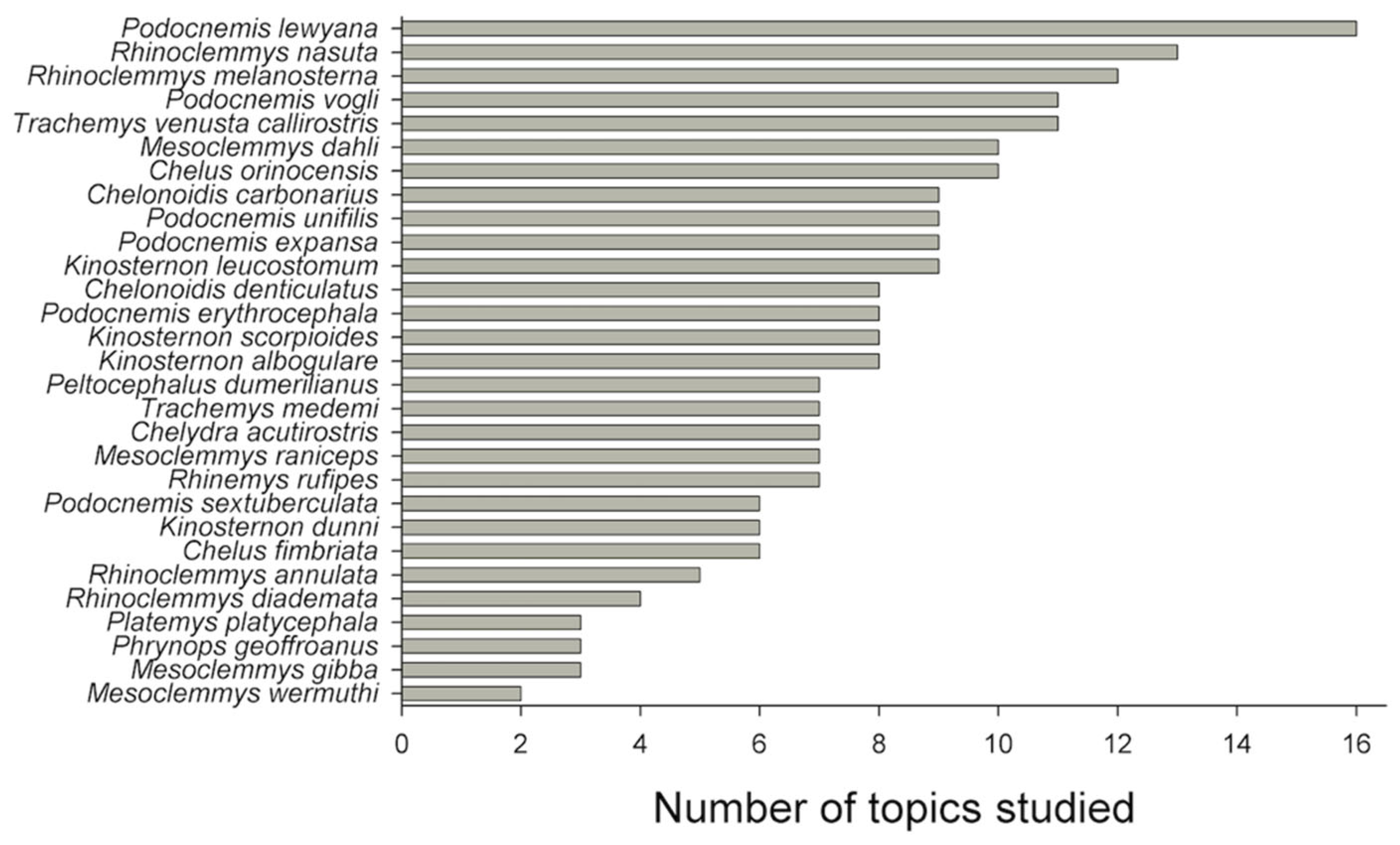


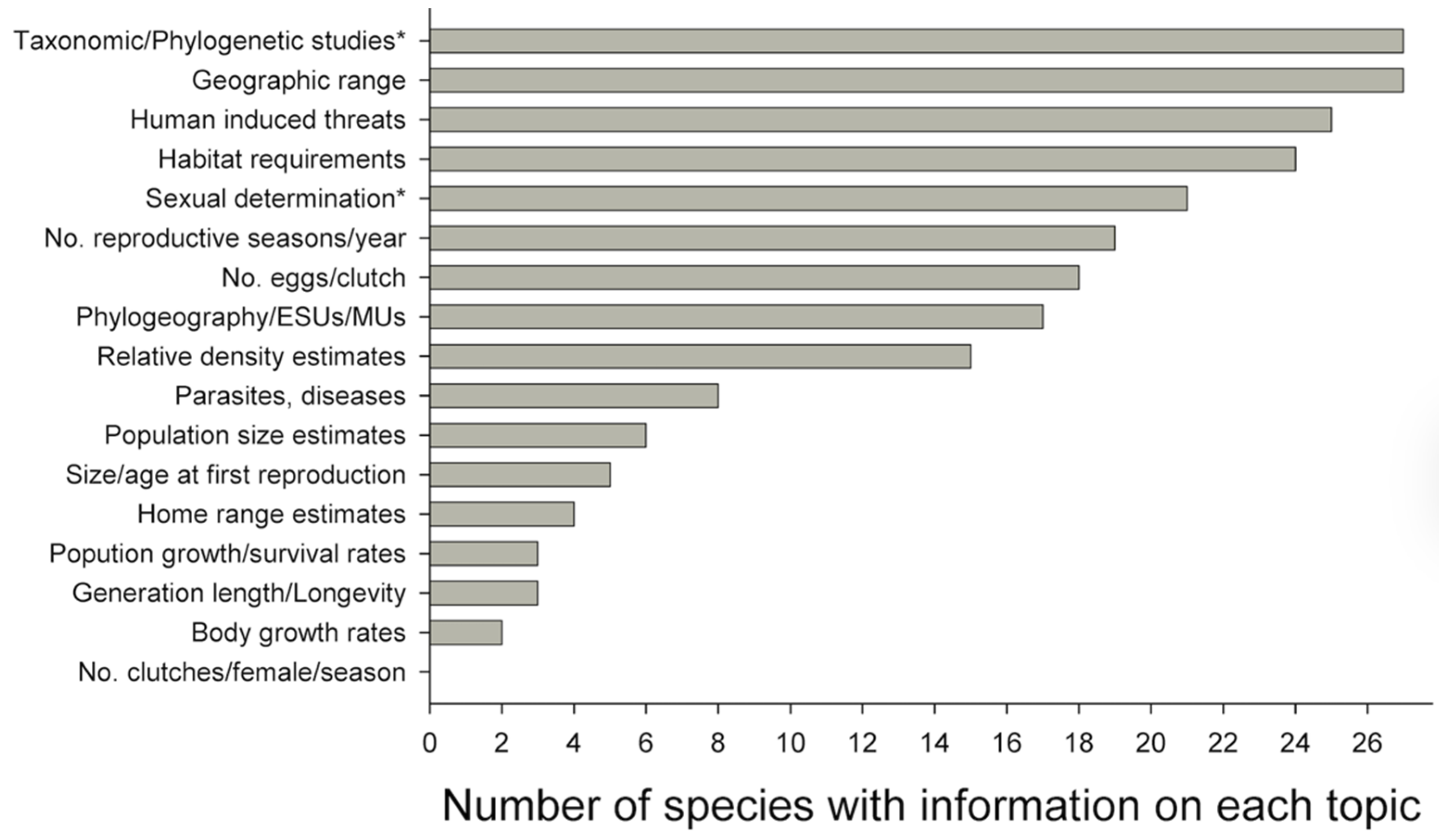
| Species | Geographic range | Population size estimates | Relative density estimates | Home range estimates | Habitat requirements | Body growth rates | Size/age at first reproduction | Generation length/Longevity | Annual population growth/survival rates | Sexual determination * | No. clutches/female/season | No. eggs/clutch | No. of reproductive seasons/year | Human induced threats | Parasites, diseases | Taxonomic/Phylogenetic studies * | Phylogeography/ESUs/MUs |
|---|---|---|---|---|---|---|---|---|---|---|---|---|---|---|---|---|---|
| Mesoclemmys wermuthi | 18 | 19 | |||||||||||||||
| Mesoclemmys gibba | 20 | 18 | 21 | ||||||||||||||
| Phrynops geoffroanus | 20 | 18 | 22 | ||||||||||||||
| Platemys platycephala | 20 | 18 | 22 | ||||||||||||||
| Rhinoclemmys diademata | 23 | 24 | 24 | 25 | |||||||||||||
| Rhinoclemmys annulata | 26 | 26 | 26 | 26 | 27 | 25 | |||||||||||
| Chelus fimbriata | 28 | 29 | 30 | 31 | 32 | 32 | |||||||||||
| Kinosternon dunni | 20 | 33 | 34 | 34 | 35 | 36 | |||||||||||
| Podocnemis sextuberculata | 20 | 37 | 38 | 38 | 38 | 39 | |||||||||||
| Rhinemys rufipes | 20 | 40 | 18 | 41 | 42 | 42 | 21 | ||||||||||
| Chelydra acutirostris | 20 | 43 | 44 | 45 | 45 | 46 | 25 | ||||||||||
| Mesoclemmys raniceps | 42 | 18 | 41 | 42 | 42 | 42 | 21 | ||||||||||
| Peltocephalus dumerilianus | 47 | 48 | 49 | 20 | 49 | 49 | 47 | ||||||||||
| Trachemys medemi | 50 | 50 | 50 | 51 | 52 | ||||||||||||
| Chelonoidis denticulatus | 20 | 53 | 54 | 18 | 55 | 55 | 54 | 56 | |||||||||
| Kinosternon albogulare | 57 | 57 | 57 | 57 | 57 | 57 | 36 | 59 | |||||||||
| Kinosternon scorpioides | 20 | 60 | 61 | 62 | 63 | 60 | 36 | 59 | |||||||||
| Podocnemis erythrocephala | 64 | 65 | 20 | 66 | 66 | 67 | 22 | 65 | |||||||||
| Chelonoidis carbonarius | 69 | 69 | 68 | 69 | 70 | 71 | 71 | 72 | 73 | ||||||||
| Kinosternon leucostomum | 74 | 75 | 76 | 77 | 78 | 79 | 27 | 36 | 36 | ||||||||
| Podocnemis expansa | 20 | 80 | 81 | 82 | 83 | 83 | 84 | 22 | 85 | ||||||||
| Podocnemis unifilis | 20 | 80 | 80 | 86 | 38 | 38 | 38 | 22 | 87 | ||||||||
| Chelus orinocensis | 56 | 49 | 49 | 49 | 49 | 30 | 49 | 32 | 32 | ||||||||
| Mesoclemmys dahli | 88 | 89 | 90 | 89 | 90 | 18 | 41 | 90 | 91 | 92 | |||||||
| Podocnemis vogli | 20 | 93 | 93 | 93 | 94 | 94 | 93 | 95 | 96 | 97 | 98 | ||||||
| Trachemys venusta callirostris | 20 | 99 | 99 | 100 | 101 | 102 | 101 | 100 | 103 | 104 | 105 | 73 | |||||
| Rhinoclemmys melanosterna | 20 | 106 | 107 | 108 | 108 | 108 | 88 | 109 | 110 | 27 | 111 | 73 | |||||
| Rhinoclemmys nasuta | 112 | 113 | 27 | 114 | 113 | 115 | 116 | 117 | 118 | 118 | 78 | 27 | 25 | 119 | |||
| Podocnemis lewyana | 120 | 121 | 122 | 123 | 121 | 121 | 121 | 121 | 121 | 124 | 125 | 121 | 126 | 127 | 22 | 128 |
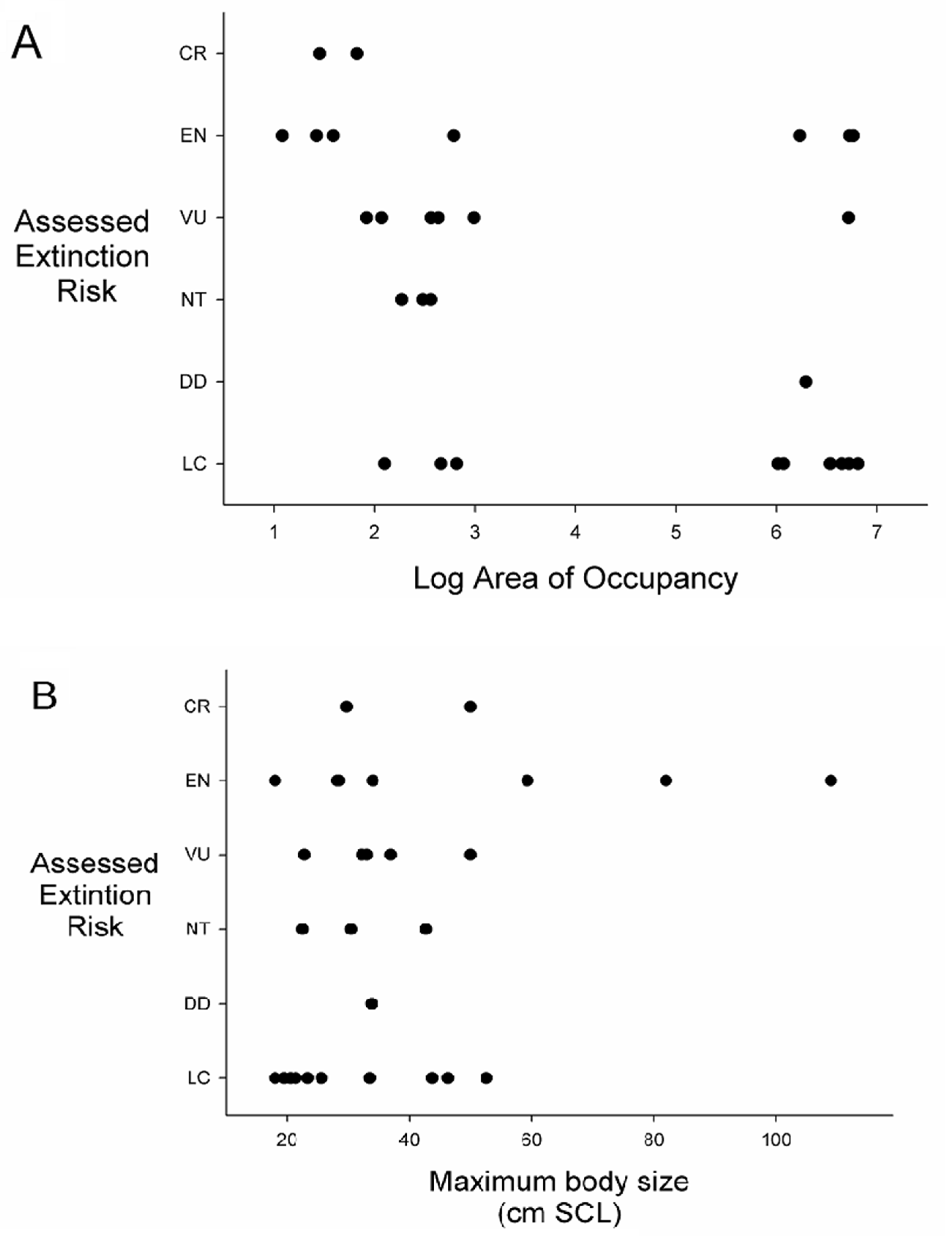
| Species | Global Status | Conservation Status Score | Criteria used to Evaluate | Colombia Status [8] | AOO | Max Size SCL cm and Sex | Included in CITES | Endemism | Adjusted Conservation Priority |
|---|---|---|---|---|---|---|---|---|---|
| Mesoclemmys dahli | CR | 5 | A2c + 4c | EN | 28,459 | F 29.7 | No | 5 | 1 |
| Podocnemis lewyana | CR | 5 | A2acd + 4acd | CR | 66,926 | F 50 | II | 5 | 1 |
| Trachemys medemi | EN | 4 | A4cd | NE | 12,113 | F 28.1 | No | 5 | 2 |
| Kinosternon dunni | EN | 4 | B2ab (ii, iii) | VU | 26,484 | M 18 | II | 5 | 2 |
| Rhinoclemmys diademata | EN | 4 | A2cde + 4cde | EN | 38,711 | F 28.5 | II | 0 | 3 |
| Podocnemis expansa | EN | 4 | A2cd + 4cd | CR | 1,706,101 | F 109 | II | 0 | 3 |
| Podocnemis sextuberculata | EN | 4 | A2ad + 4cd | DD | 614,881 | F 34 | II | 0 | 3 |
| Chelonoidis carbonarius | EN | 4 | A2cd + 4cde | VU | 5,323,930 | M 59.3 | II | 0 | 3 |
| Chelonoidis denticulatus | EN | 4 | A2bcd + 4bcd | LC | 5,799,636 | M 82 | II | 0 | 3 |
| Trachemys venusta callirostris | VU | 3 | A2bcd + 4cde | VU | 117,703 | F 33 | No | 0 | 4 |
| Rhinoclemmys nasuta | VU | 3 | A2bcd + 4bcd | NT | 83,244 | 22.8 | II | 0 | 4 |
| Peltocephalus dumerilianus | VU | 3 | A2cd + 4cd | DD | 97,845 | M 50 | II | 0 | 4 |
| Podocnemis erythrocephala | VU | 3 | A2cd + 4cd | VU | 432,578 | F 32.2 | II | 0 | 4 |
| Podocnemis unifilis | VU | 3 | A2cd + 4bcd | EN | 5,213,904 | F 50 | II | 0 | 4 |
| Podocnemis vogli | VU | 3 | A2cd + 4cd | LC | 364,561 | F 36.9 | II | 0 | 4 |
| Chelydra acutirostris | NT | 2 | A2bcd + 4bcd | LC | 363,578 | M 42.7 | No | 0 | 5 |
| Rhinoclemmys annulata | NT | 2 | A2c + 4c | LC | 302,983 | F 22.5 | II | 0 | 5 |
| Rhinoclemmys melanosterna | NT | 2 | A2c + 4cd | NT | 187,077 | F 30.4 | II | 0 | 5 |
| Mesoclemmys wermuthi | DD | 2 | NE | 1,953,977 | F 33.8 | No | 0 | 5 | |
| Chelus fimbriata | LC | 1 | LC | 1,173,941 | F 43.7 | II | 0 | 6 | |
| Chelus orinocensis | LC | 1 | NE | 1,032,210 | F 52.6 | II | 0 | 6 | |
| Mesoclemmys gibba | LC | 1 | LC | 4,445,462 | F 23.3 | No | 0 | 6 | |
| Mesoclemmys raniceps | LC | 1 | DD | 3,434,777 | F 33.5 | No | 0 | 6 | |
| Phrynops geoffroanus | LC | 1 | LC | 3,407,292 | F 46.3 | No | 0 | 6 | |
| Platemys platycephala | LC | 1 | LC | 5,283,733 | M 18 | No | 0 | 6 | |
| Rhinemys rufipes | LC | 1 | DD | 458,107 | 25.6 | No | 0 | 6 | |
| Kinosternon albogulare | LC | 1 | VU | 126,189 | M 20.5 | II | 0 | 6 | |
| Kinosternon leucostomum | LC | 1 | LC | 65,773 | M 21.4 | II | 0 | 6 | |
| Kinosternon scorpioides | LC | 1 | LC | 6,451,732 | F 19.5 | II | 0 | 6 |
Disclaimer/Publisher’s Note: The statements, opinions and data contained in all publications are solely those of the individual author(s) and contributor(s) and not of MDPI and/or the editor(s). MDPI and/or the editor(s) disclaim responsibility for any injury to people or property resulting from any ideas, methods, instructions or products referred to in the content. |
© 2026 by the authors. Licensee MDPI, Basel, Switzerland. This article is an open access article distributed under the terms and conditions of the Creative Commons Attribution (CC BY) license.
Share and Cite
Páez, V.P.; Bock, B.C. Increased State of Knowledge and Extinction Risks of the Tortoise and Freshwater Turtles of Colombia. Diversity 2026, 18, 414. https://doi.org/10.3390/d18070414
Páez VP, Bock BC. Increased State of Knowledge and Extinction Risks of the Tortoise and Freshwater Turtles of Colombia. Diversity. 2026; 18(7):414. https://doi.org/10.3390/d18070414
Chicago/Turabian StylePáez, Vivian P., and Brian C. Bock. 2026. "Increased State of Knowledge and Extinction Risks of the Tortoise and Freshwater Turtles of Colombia" Diversity 18, no. 7: 414. https://doi.org/10.3390/d18070414
APA StylePáez, V. P., & Bock, B. C. (2026). Increased State of Knowledge and Extinction Risks of the Tortoise and Freshwater Turtles of Colombia. Diversity, 18(7), 414. https://doi.org/10.3390/d18070414