
First Verified Record and Morpho-Ecological Characterization of Bunodosoma cavernatum (Cnidaria: Actiniaria) in Cartagena Bay, Colombian Caribbean



Abstract
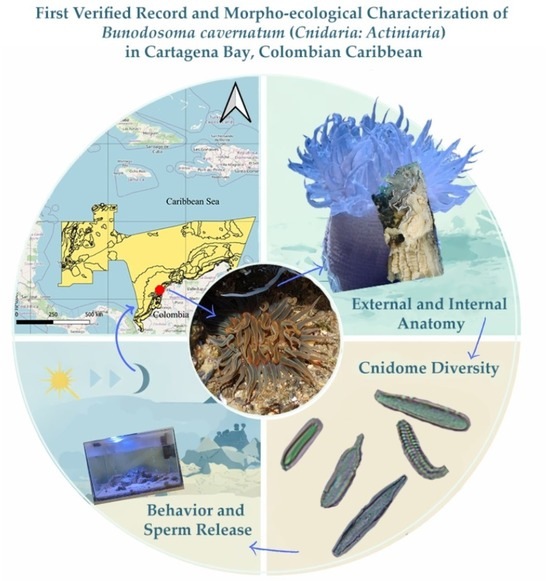
1. Introduction
2. Materials and Methods
2.1. Study Area
2.2. Specimen Collection
2.3. Estimation of Abundance and Distribution Pattern
2.4. Analysis of Associated Organisms
2.5. Material Examined
2.6. Aquarium Adaptation and Monitoring
2.7. Anatomical and Histological Processing
2.8. Characterization of the Cnidome
3. Results
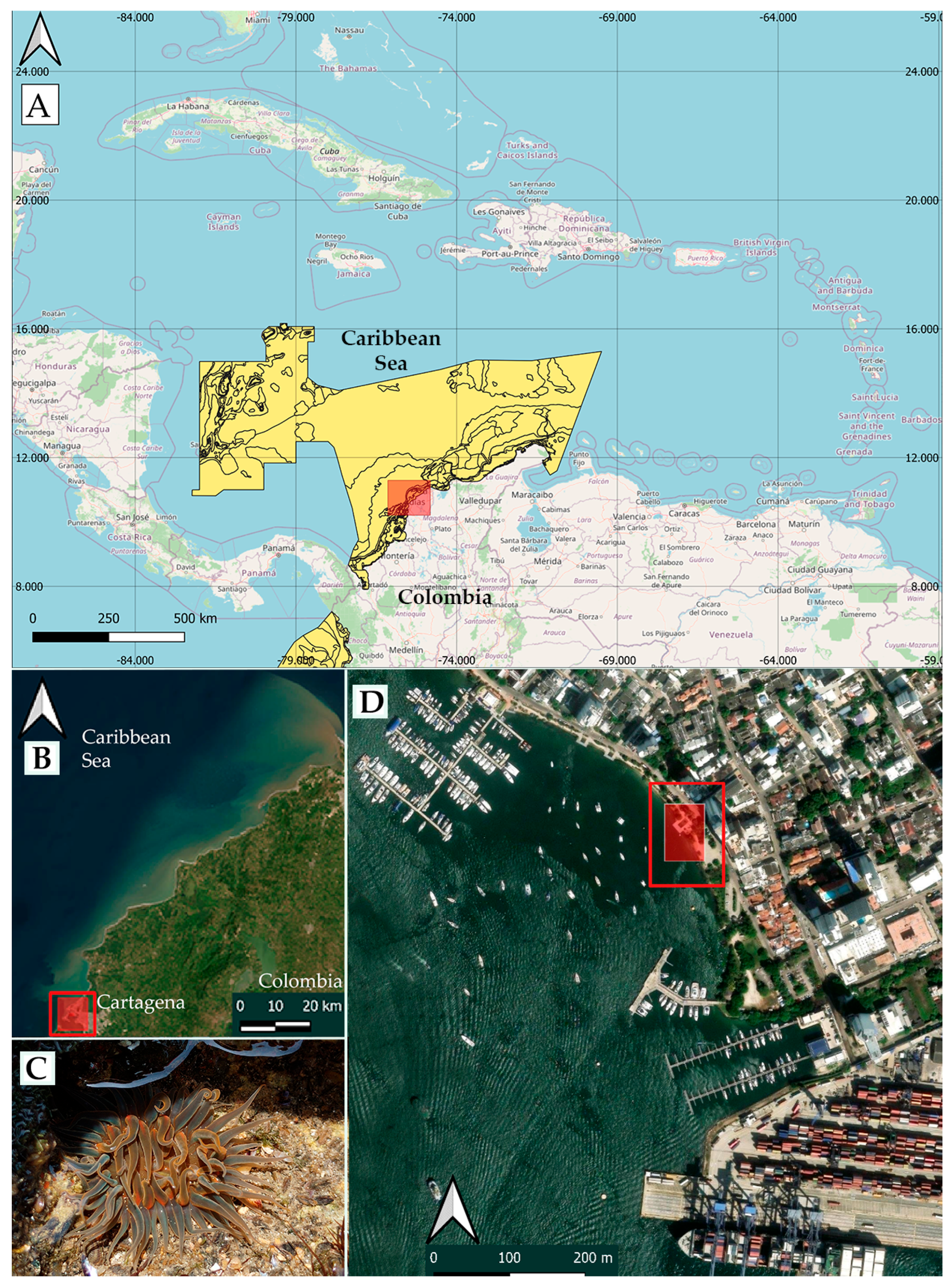
3.1. Sampling Area and Habitat
3.2. Associated Organisms
3.3. Taxonomy Account
3.4. Comparison with Similar Species
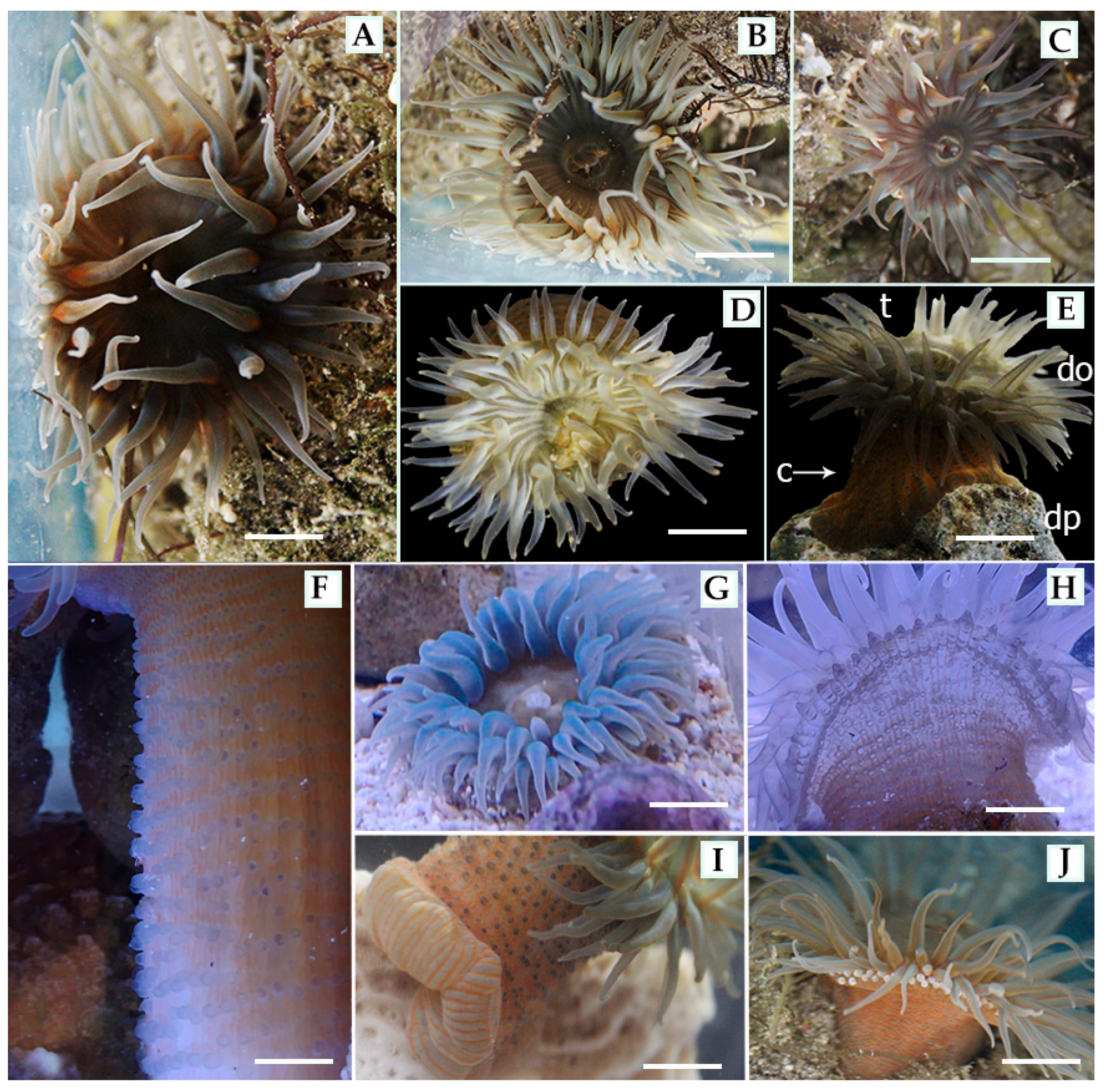
3.5. Observed External Morphology


| Characteristic | Gonzáles-Muñoz et al. [24] | Herrera-Bojorquez et al. [25] | Durán et al. [28] | Present Study |
|---|---|---|---|---|
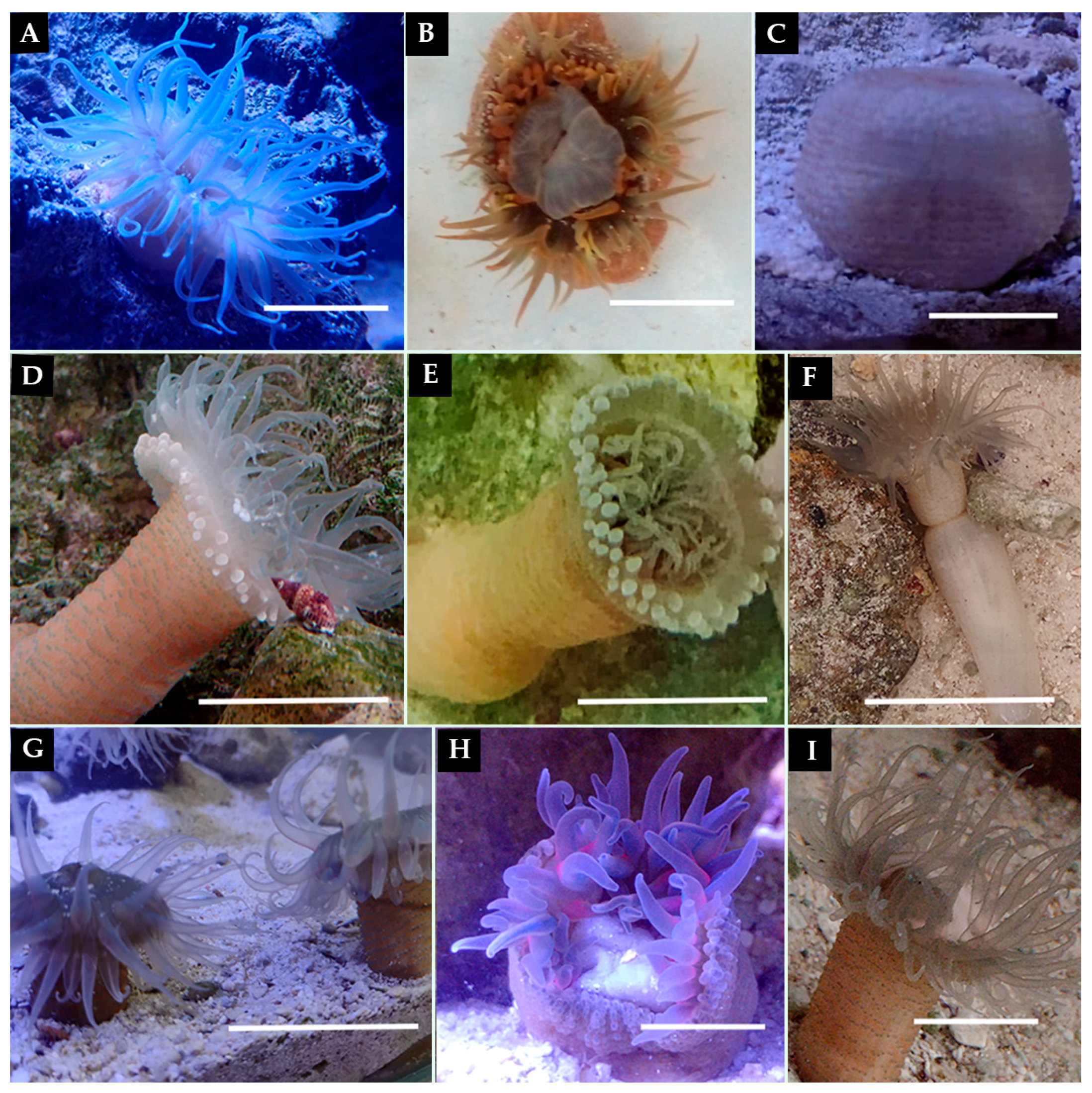
| Oral Disk | Smooth, with white or yellowish radial stripes in the endocellular spaces of the first two or three tentacular cycles (20–28 mm diameter). General color is yellowish brown, reddish or olive green. | Flat, wide and smooth (8.28 mm diameter). | Smooth (31.1 mm diameter), general color is olive green with yellow radial stripes. | Wide, smooth and soft (28–45 mm diameter). General color is light brown, translucent or olive, with transparent radial lines and V-shaped bands that are often visible at the bases of the tentacles and within the endocoelics. |
| Tentacles | Arranged hexamerically, approximately 96, smooth conical, tapered distally, internal ones longer than external ones, contractile (12.5–22.5 mm long; 82–94 tentacles). | Smooth, conical, distally narrowed, moderately long, contractile, in five cycles (71–98); internal longer than external. | Approximately 96 arranged hexamerously in five cycles; simple, conical, and smooth (7.13–17.5 mm long). | Contractile cones, longer on the inside than on the outside (96, 10–22.5 mm long). |
| Acrorhagi | Rounded endocellular acrorhagi, 80 to 100, with basitrichs and holotrichs. Olive green, reddish, orange, or yellowish on the oral side, sometimes with purple flashes. | Ring of projections (around the edge of the column) with basitrichs and holotrichs. Gray, reddish or beige; red stripe on the aboral side of internal tentacles (not in later cycles). | 48, rounded acrorhagi, with basitrichs and holotrichs. Translucent, blue, brown, or yellow, with orange or red spots. | Two rows of them, contractile, between 40 and 100. Bluish olive, light reddish or white. |
| Column | Cylindrical and rounded vesicles organized in 96 longitudinal rows (22–31 mm diameter; 20–50 mm length). Light brown, orange, reddish, yellowish, or olive green. | Rounded vesicles arranged in longitudinal rows of alternating sizes (16–44 mm long; 14–31 mm wide). Beige or gray with a dark brown or black center. | Densely covered with dark, rounded vesicles in 96 longitudinal rows (19.4–39.5 mm length). Orange or brown. | Cylindrical, large number of vesicles in 50 columns × 46 rows (50–90 transverse rows; 40–50 longitudinal rows). Reddish brown, when spread out, it is light orange with red lines and black dots on the vesicles. |
| Pedal Disk | Well developed (25.0–40 mm diameter). Light brown, orange, reddish, yellowish, or olive green. | * | Well developed (15.5–22.1 mm diameter). Pale orange or light brown. | Strong and well developed. Pale orange when relaxed and with red longitudinal lines when contracted. |
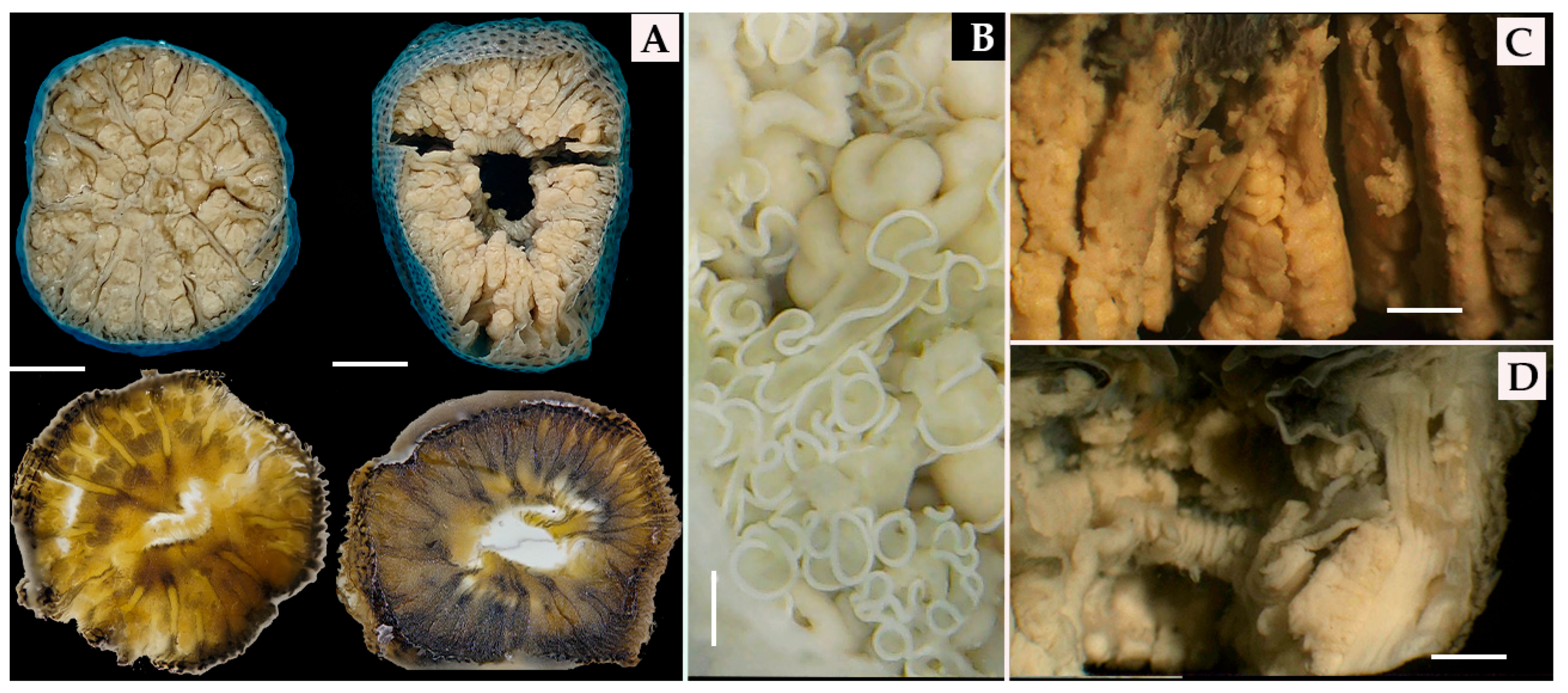
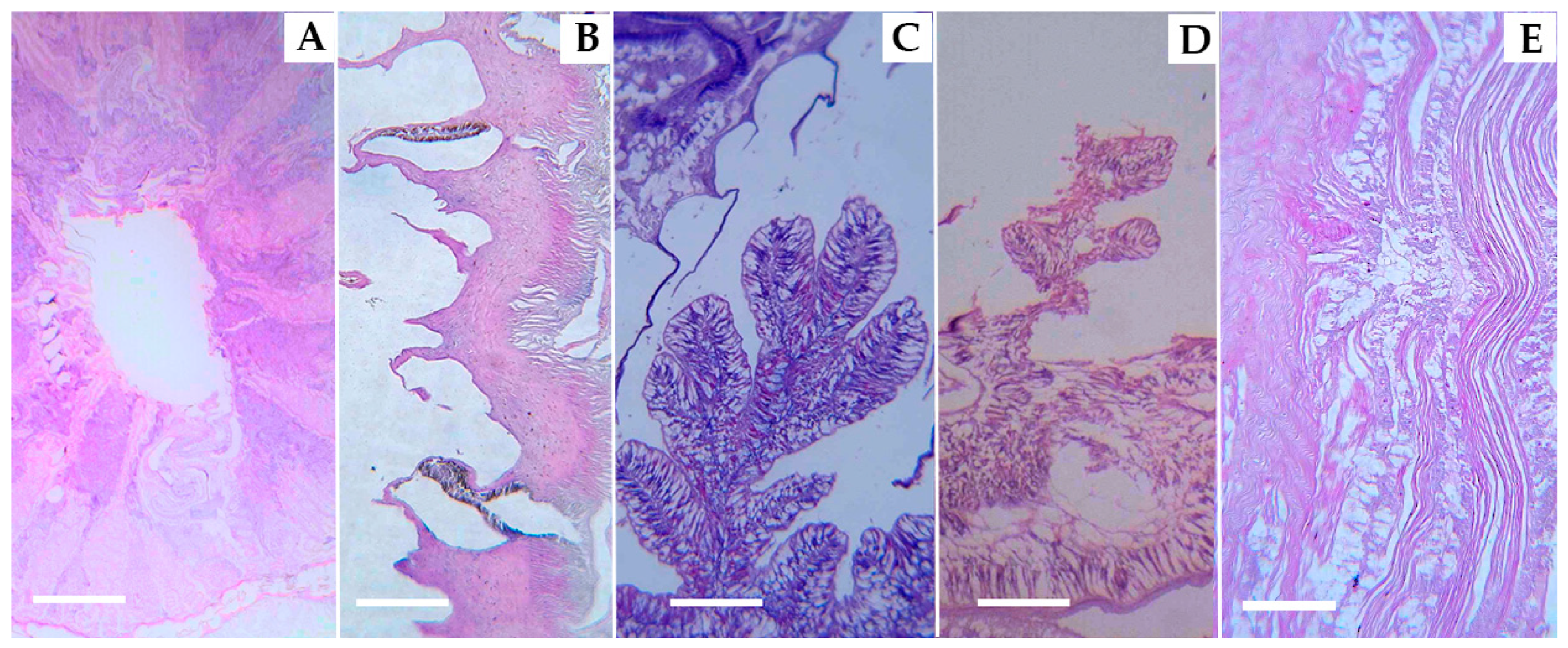
3.6. Internal Anatomy and Histology


| Structure | Gonzales-Muñoz et al. [24] | Herrera-Bojorquez et al. [25] | Present Study | |
|---|---|---|---|---|
| Mesenteries | Arranged in four hexameral cycles (48 pairs) with perfect mesenteries in first, second and third cycles, others imperfect. Same number of distal and proximal mesenteries. All mesenteries, except the directive ones, are fertile. Two pairs of directive mesenteries, each joined to a well-developed siphonoglyphs. Gonochoric. | Four hexameral in cycles (48 pairs), with perfect mesenteries in first, second and third cycles. Same number of distal mesenteries. Two pairs of directives, each joined to a well-developed siphonoglyph. | Six pairs of perfect mesenteries arranged hexamerally; two directive pairs and two imperfect pairs. Only perfect mesenteries are fertile, each joined to a well-developed siphonoglyph. | |
| Gametes | Oocytes and spermatocytes are well developed in samples collected in January and May. | Spermatocyst observed in the strongest mesenteries of first, second, and third cycles, less frequent in the directives. | Presence of oocytes. | |
| Siphonoglyphs | Well developed. | Well developed. | Well developed. | |
| Muscles | Retractors | Strong and restricted. | Strong and restricted. | Strong. |
| Parietobasilar | Well developed, with a relatively long free mesogleal nerve. | Well developed, with a relatively long free mesogleal nerve. | Well developed. | |
| Basilar | Well developed. | Well developed. | Well developed. | |
| Marginal sphincter | Endodermal, strong and circumscribed. | Endodermal, strong and circumscribed. | Endodermal, strong and circumscribed. | |
| Longitudinal | Ectodermal in tentacles. | Ectodermal in tentacles. | Ectodermal in tentacles. | |
| Zooxanthellae | Present. | Present. | Present. | |
| Cnidae | Basitrichs, microbasic b- and p-mastigophores, holotrichs and spirocysts. | Basitrichs, microbasic b- and p-mastigophores, holotrichs, and spirocysts. | Basitrichs, spirocysts, microbasic b- and p-mastigophores, holotrichs. | |
3.7. Cnidome
3.8. Behavior
3.8.1. Ethogram and Behavioral Categories
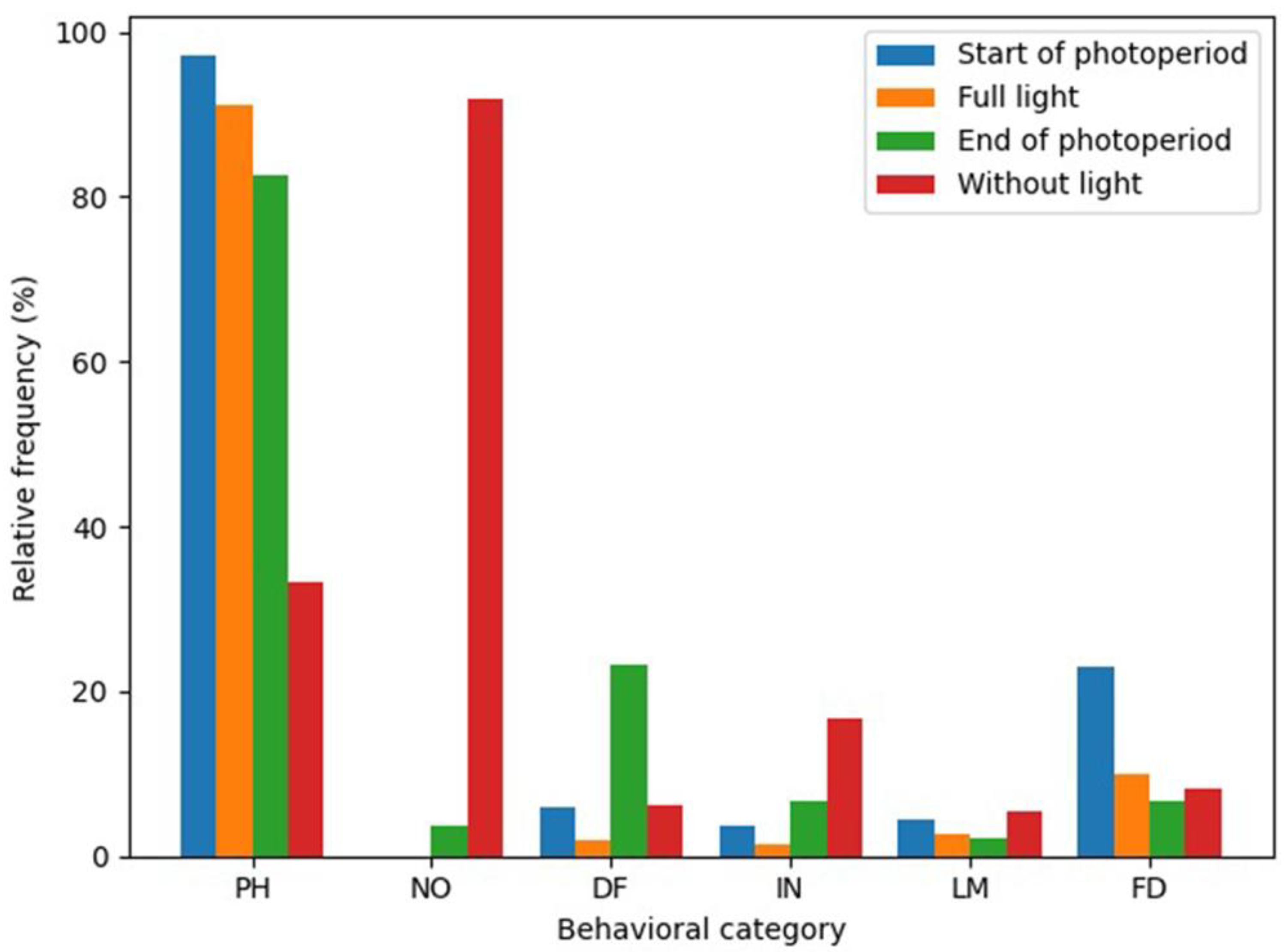
3.8.2. Diel Activity Patterns

3.8.3. Nocturnal Behavior
3.8.4. Response to Physical Stimuli, Defensive and Intraspecific Interactions
3.8.5. Feeding and Locomotion
3.9. Sperm Release

4. Discussion
4.1. Taxonomic Identity and Morphological Consistency
4.2. Tentacle Arrangement and Mesenterial Development
4.3. Internal Anatomy, Reproductive Structures and Mesenterial Stability
4.4. Cnidome Variation and Functional Implications
4.5. Coloration, Zooxanthellae and Environmental Influences
4.6. Phylogenetic Context and Morphological Plasticity
4.7. Reproductive Strategies and Gametogenesis
4.8. Sperm Morphology and Preservation
4.9. Habitat Use, Associated Fauna, and Ecological Role
4.10. Behavioral Rhythms and Sensory Responses
4.11. Acrorhagi, Defense and Ecological Plasticity
4.12. Ecological Tolerance and Implications
5. Conclusions
6. Future Insights
Author Contributions
Funding
Institutional Review Board Statement
Data Availability Statement
Acknowledgments
Conflicts of Interest
References
- Carlgren, O. A survey of the Ptychodactiaria, Corallimorpharia and Actiniaria. Kungl. Sven. Vetensk.-Akad. Handl. 1949, 1, 1–121. [Google Scholar]
- Carlgren, O. Actiniaria from North America. Ark. För Zool. 1952, 3, 373–390. [Google Scholar]
- Hedgpeth, J.W. Anthozoa: The anemones. In Fisheries Bulletin of the Fish and Wildlife Service; U.S Government Printing Office: Washington, DC, USA, 1954; pp. 285–290. Available online: https://archive.org/details/fisherybulletino55usfi/page/285/mode/1up (accessed on 15 July 2025).
- Reyes, R.R. Macroinvertebrados Asociados a las Raices de Rhizophora Mangle Linaeus, 1753 (Mangle Rojo), en la Cienaga Grande de Santa Marta y en la Bahia de Chengue y Nenguange, Caribe Colombiano. Master’s Thesis, Universidad Nacional de Colombia, Santa Marta, Colombia, 1991. Available online: https://centrodocumentacion.invemar.org.co/cgi-bin/koha/opac-detail.pl?biblionumber=273 (accessed on 10 July 2025).
- Florez, P.; Santo-Domingo, N. Cnidaria: Corales Escleractinios, Antipatarios, Anemonas, Zoantideos, Octocorales e Hidroides. In Biodiversidad del Margen Continental del Caribe Colombiano; INVEMAR, Ed.; Serie de Publicaciones Especiales 20; INVEMAR: Santa Marta, Colombia, 2010; pp. 150–178. Available online: https://www.invemar.org.co/redcostera1/invemar/docs/8868Version_Final_Libro_Invemar-ANH.pdf (accessed on 10 July 2025).
- Cordova, M.D.A. Anemonas (Cnidaria, Anthozoa, Hexacorallia: Actiniaria, Corallimorpharia, Ceriantharia y Zoanthidea) del arrecife de Madagascar, Golfo de Mexico. Licentiate Thesis, Universidad Nacional Autonoma de Mexico, Mexico City, Mexico, 2013. Available online: https://ru.dgb.unam.mx/bitstream/20.500.14330/TES01000707301/3/0707301.pdf (accessed on 18 July 2025).
- Brooker, R.M.; Feeney, W.E.; Sih, T.L.; Ferrari, M.C.O.; Chivers, D.P. Comparative diversity of anemone-associated fishes and decapod crustaceans in a Belizean coral reef and seagrass system. Mar. Biodivers. 2019, 49, 2609–2620. [Google Scholar] [CrossRef]
- Lemieux, J.; Cusson, M. Effects of habitat-forming species richness, evenness, identity, and abundance on benthic intertidal community establishment and productivity. PLoS ONE 2014, 9, e109261. [Google Scholar] [CrossRef]
- Durand, A.; Valdivia-Chavez, D.; Aramayo, V. Biodiversity and distribution of sea anemones (Cnidaria, Anthozoa, Actiniaria) in Peru. J. Mar. Biol. Assoc. UK 2024, 104, e112. [Google Scholar] [CrossRef]
- Vanwonterghem, I.; Webster, N.S. Coral reef microorganisms in a changing climate. IScience 2020, 23, 100972. [Google Scholar] [CrossRef]
- Palladino, G.; Rampelli, S.; Galiá-Camps, C.; Scicchitano, D.; Trapella, G.; Nanetti, E.; Angelini, V.; Cleo, D.; Turroni, S.; Corinaldesi, S.; et al. Plasticity of the Anemonia viridis microbiota in response to different levels of combined anthropogenic and environmental stresses. Front. Mar. Sci. 2022, 9, 956899. [Google Scholar] [CrossRef]
- Reyes, J.; Barrios, L.M. Estado actual del conocimiento de las anémonas (Cnidaria: Anthozoa) en el Caribe y Pacífico colombianos. Bol. Ecotrópica Ecosist. Trop. 1998, 33, 39–43. [Google Scholar]
- Barrios, S.L.M.; Reyes, J.O.; Navas, G.R.; Garcia, C.B. Distribución de las anemonas (Anthozoa, Actiniaria y Corallimorpharia) en el área de Santa Marta, Caribe Colombiano. Cienc. Mar. 2002, 28, 37–48. [Google Scholar] [CrossRef]
- Acosta, A.; Casas, M.; Vargas, C.A.; Camacho, J.E. Lista de Zoantharia (Cnidaria: Anthozoa) del Caribe y de Colombia. Biota Colomb. 2005, 6, 147–162. [Google Scholar]
- Manjarres, A.G. Contribucion al conocimiento de las actinias en la region de Santa Marta. Boletín Investig. Mar. Costeras 1977, 9, 141–156. [Google Scholar] [CrossRef]
- Manjarres, A.G. Nuevos encuentros de Actinias (Hexacoralia) en la region de Santa Marta, Colombia. An. Inst. Investig. Mar. Punta Betin 1978, 10, 127–132. [Google Scholar] [CrossRef]
- Lattig, P. Porifera, Cnidaria y Annelida de la Franja Superior del Talud Continental (200–500 m) del Caribe Colombiano. Ph.D. Thesis, Pontificia Universidad Javeriana, Bogotá, Colombia, 2002. Reprint in Biodiversidad del Margen Continental del Caribe Colombiano; INVEMAR, Ed.; Serie de Publicaciones Especiales 20; INVEMAR: Santa Marta, Colombia, 2010; p. 458. Available online: https://www.invemar.org.co/redcostera1/invemar/docs/8868Version_Final_Libro_Invemar-ANH.pdf (accessed on 15 July 2025).
- IDEAM; Instituto Humboldt; INVEMAR; IGAC. Memoria Tecnica. Mapa de Ecosistemas Continentales, Costeros y Marinos de Colombia (MEC), Escala 1:100.000; IDEAM: Bogotá, Colombia, 2017; 170p, Available online: https://www.andi.com.co/Uploads/MapaEcosistemas2017.pdf (accessed on 10 July 2025).
- Aldana-Dominguez, J.; Montes, C.; Martinez, M.; Medina, N.; Hahn, J.; Duque, M. Biodiversity and Ecosystem Services Knowledge in the Colombian Caribbean: Progress and Challenges. Trop. Conserv. Sci. 2017, 10, 1940082917714229. [Google Scholar] [CrossRef]
- EAFIT; CARDIQUE. Programa de Rehabilitacion y Restauracion de Ecosistemas Marinos y Costeros Degradados, Conservacion de Especies y Biodiversidad Marina de la Bahia de Cartagena. Proyecto BASIC, Convenio No. 006 de 2021; CARDIQUE: Cartagena de Indias, Colombia, 2021; Available online: https://www.andi.com.co/Uploads/ANEXO2~1_637932388430917768.PDF (accessed on 14 July 2025).
- Tosic, M.; Restrepo, J.D.; Lonin, S.; Izquierdo, A.; Martins, F. Water and sediment quality in Cartagena Bay, Colombia: Seasonal variability and potential impacts of pollution. Estuar. Coast. Shelf Sci. 2019, 216, 187–203. [Google Scholar] [CrossRef]
- Tosic, M.; Martins, F.; Lonin, S.; Izquierdo, A.; Restrepo, J.D. A practical method for setting coastal water quality targets: Harmonization of land-based discharge limits with marine ecosystem thresholds. Mar. Policy 2019, 108, 103641. [Google Scholar] [CrossRef]
- Phillips, P.J. Protozoan Symbionts from the Anemone Bunodosoma cavernata from Galveston Island, Texas. Gulf Res. Rep. 1973, 4, 186–190. [Google Scholar] [CrossRef]
- Gonzalez-Muñoz, R.; Simoes, N.; Tello-Musi, J.L.; Rodriguez, E. Sea anemones (Cnidaria, Anthozoa, Actiniaria) from coral reefs in the southern Gulf of Mexico. ZooKeys 2013, 341, 77–106. [Google Scholar] [CrossRef] [PubMed]
- Herrera-Bojorquez, L.G.; Gonzalez-Muñoz, R.; Leon-Deniz, L.V.; Arjona-Torres, G.; Sima-Alvarez, R. Sea anemones (Anthozoa: Actiniaria) from the coast of Yucatan, Mexico. Rev. Mex. Biodivers. 2020, 91, e913195. [Google Scholar] [CrossRef]
- Bosc, L.A.G. Histoire Naturelle des Crustacés Contenant leur Description et leurs Moeurs; avec Figures Dessinées, d’Après Nature; Tome 2; Deterville: Paris, France, 1801; 1–296, pls. 9–18; Available online: https://www.biodiversitylibrary.org/page/27817320 (accessed on 1 August 2025).
- Eno, A.E.; Konya, R.S.; Ibu, J.O. Biological properties of a venom extract from the sea anemone, Bunodosoma cavernata. Toxicon 1998, 36, 2013–2020. [Google Scholar] [CrossRef]
- Duran Fuentes, J.; Gracia, C.A.; Gonzalez Muñoz, R. Sea anemones (Cnidaria, Anthozoa, Actiniaria) in high sedimentation environments influenced by the Magdalena River (Colombian Caribbean). An. Acad. Bras. Ciênc. 2022, 94, e20190862. [Google Scholar] [CrossRef]
- Braga Gomez, P. Estudio de la Vicarianza en Algunas Especies de Anemonas de Mar (Cnidaria: Actiniaria) del Intermareal de Brasil y Argentina Con el Uso de Datos Morfológicos y Genéticos. Ph.D. Thesis, Universidad de Buenos Aires, Buenos Aires, Argentina, 2001. Available online: https://bibliotecadigital.exactas.uba.ar/download/tesis/tesis_n3426_BragaGomes.pdf (accessed on 10 August 2025).
- Darrigran, G.; Vilches, A.; Lgarralde, T.; Damborenea, C. Guia Para el Estudio de Macroinvertebrados. I. Metodos de Colecta y Tecnicas de Fijación; Facultad de Ciencias Naturales y Museo, Universidad Nacional de La Plata: La Plata, Argentina, 2007; ISNN 1515-9329; Available online: https://api.naturalis.fcnym.unlp.edu.ar/server/api/core/bitstreams/81dedd63-ff34-4020-8ef4-3ef5f1d28a7c/content (accessed on 10 July 2024).
- SINAC-UNA. Protocolo Nacional Para el Monitoreo Ecologico (PRONAMEC) de los Arrecifes Rocosos; Escuela de Ciencias Biologicas, Universidad Nacional (UNA): San Jose, Costa Rica, 2021. Available online: https://www.sinac.go.cr/ES/docu/ASP/Protocolo-PRONAMEC-%20Arrecifes%20Rocosos.pdf (accessed on 10 July 2024).
- Delbreek, J.C.; Sprung, J. The Reef Aquarium; Ricordea Publishing: Miami, FL, USA, 1994. [Google Scholar]
- Spano, C.; Flores, V. Staining protocol for the histological study of sea anemones (Anthozoa: Actiniaria) with recommendations for anesthesia and fixation of specimens. Lat. Am. J. Aqua. Res. 2013, 41, 1019–1024. [Google Scholar] [CrossRef]
- Estrada-Flores, E.; Peralta, L.; Rivas, P. Manual de Tecnicas Histologicas; Universidad Autónoma de Aguascalientes: Aguascalientes, Mexico, 1982; ISBN 968-463-010-7. [Google Scholar]
- Östman, C. A guideline to nematocyst nomenclature and classification, and some notes on the systematic value of nematocysts. Sci. Mar. 2000, 64, 31–46. [Google Scholar] [CrossRef]
- Östman, C.; Kultima, J.R.; Karl, R. Acontia and Mesentery Nematocysts of the Sea Anemone Metridium Senile (Linnaeus, 1761) (Cnidaria: Anthozoa). Sci. Mar. 2010, 74, 483–497. [Google Scholar] [CrossRef]
- Muscatine, L.; Lenhoff, H.M. Coelenterate Biology, Reviews and New Perspectives; Academic Press: New York, NY, USA, 1974; Available online: https://api.pageplace.de/preview/DT0400.9780323147545_A23648005/preview-9780323147545_A23648005.pdf (accessed on 20 October 2024).
- Kass-Simons, G.; Scappaticci, A.A., Jr. The behavioral and developmental physiology of nematocyst. Can. J. Zool. 2002, 80, 1772–1794. [Google Scholar] [CrossRef]
- Daly, M.; Crowley, L.M.; Larson, P.; Rodriguez, E.; Heestand Saucier, E.; Fautin, D.G. Anthopleura and the phylogeny of Actinioidea (Cnidaria: Anthozoa: Actiniaria). Org. Divers. Evol. 2017, 17, 545–564. [Google Scholar] [CrossRef]
- Gonzalez-Muñoz, R.; Simões, N.; Guerra-Castro, E.J.; Hernández-Ortíz, C.; Carrasquel, G.; Mendez, E.; Lira, C.; Rada, M.; Hernández, I.; Pauls, S.M.; et al. Sea anemones (Cnidaria: Actiniaria, Corallimorpharia, Ceriantharia, Zoanthidea) from marine shallow-water environments in Venezuela: New records and an updated inventory. Mar. Biodivers. Rec. 2016, 9, 18. [Google Scholar] [CrossRef]
- Diez, Y.L.; Campos Castro, A. Soft corals (Anthozoa: Corallimorpharia, Actinaria and Zoantharia) from southeastern of Cuba, and its distribution in Marine Protected Areas. Rev. Investig. Mar. 2016, 36, 80–93. Available online: http://hdl.handle.net/1834/9860 (accessed on 7 February 2026).
- De La Cruz-Francisco, V.; Gonzalez-Muñoz, R. Las anemonas marinas de los sistemas arrecifales de Veracruz. In Estudios Cientificos en el Corredor Arrecifal del Suroeste del Golfo de Mexico; Granados Barba, A., Ortiz-Lozano, L., Gonzalez-Gandara, C., Salas-Monreal, D., Eds.; Universidad Autonoma de Campeche: Campeche, Mexico, 2019; pp. 139–159. [Google Scholar] [CrossRef]
- Fautin, D.G. Catalog to families, genera, and species of orders Actiniaria and Corallimorpharia (Cnidaria:Anthozoa). Zootaxa 2016, 4145, 1–449. [Google Scholar] [CrossRef]
- De la Cruz Francisco, V.; Orduña Medrano, R.; Paredes Flores, J.; Vasquez, E.R.; Gonzales Gonzalez, M.; Flores Galicia, L. Una aproximacion a la floristica y faunistica de la costa rocosa El Pulpo, Cazones, Veracruz, Mexico. CICIMAR Ocean. 2017, 32, 39–58. [Google Scholar] [CrossRef]
- Valdez Peralta, H.I. Integracion de Respuestas Fisiologicas y Bioquimicas Como Indicadores de Vulnerabilidad Ambiental en la Anemona Bunodosoma cavernatum (Bosc, 1802) (Cnidaria: Anthozoa: Actinaria). Master’s Thesis, Universidad Autonoma Metropolitana, México City, Mexico, 2022. Available online: https://bindani.izt.uam.mx/concern/tesiuams/vx021f392?locale=es (accessed on 10 August 2025).
- McCommas, S.A. Biochemical genetics of the sea anemone Bunodosoma cavernata and the zoogeography of the Gulf of Mexico. Mar. Biol. 1982, 68, 169–173. [Google Scholar] [CrossRef]
- Kasschau, M.R.; Ragland, J.B.; Pinkerton, S.A.; Chen, E.C.M. Time related changed in the free amino acid pool of the Sea Anemone, Bunodosoma cavernata, during salinity stress. Comp. Biochem. Physiol. A 1984, 79, 155–159. [Google Scholar] [CrossRef]
- Excoffon, A.C. Biología Reproductiva de Algunas Especies de la Tribu Thenaria (Cnidaria: Anthozoa) en el Litoral Marplatense. Ph.D. Thesis, Universidad Nacional de Mar de Plata, Mar de Plata, Argentina, 1993. Available online: https://aquadocs.org/bitstream/handle/1834/2957/Excoffon_1993.pdf?sequence=1 (accessed on 11 August 2025).
- Konya, R.S. Blocking actions of the Sea Anemone, Bunodosoma cavernata extract on histamine and acethylcholine, induced contractile actions of the wild grasscutter and rabbit ilea. J. Appl. Sci. Environ. Manag. 2004, 6, 11–16. [Google Scholar] [CrossRef]
- Maldonado Valenciano, D. Aislamiento de un Peptido Activo de la Anemona Anthopleura Texaensis de la Costa Yucateca. Licentiate Thesis, Universidad Nacional Autonoma de Mexico, Mexico City, Mexico, 2023. Available online: https://ru.dgb.unam.mx/bitstream/20.500.14330/TES01000836361/3/0836361.pdf (accessed on 10 August 2025).
- Daly, M. Phylogeny and biogeography of Anthopleura in the North Atlantic Ocean. Hydrobiologia 2004, 530–531, 241–248. [Google Scholar] [CrossRef]
- Fautin, D.G. Hexacorallians of the World Sea Anemones, Corals, and Their Allies. In Encyclopedia of Life. «Hexacorallians of the World». Zenodo 2013. [Google Scholar] [CrossRef]
- Malakhov, V.V. Symmetry and the tentacular apparatus in Cnidaria. Russ. J. Mar. Biol. 2016, 42, 287–298. [Google Scholar] [CrossRef]
- Grebelnyi, S.D.; Ivanova, N.Y. Significance of Symmetry Features for the Classification of Anthozoa. Paleontol. J. 2023, 57, 1226–1245. [Google Scholar] [CrossRef]
- Clark, W.H.; Dewel, W.C. The structure of the gonads, gametogenesis, and sperm-egg interactions in the Anthozoa. Integr. Comp. Biol. 1974, 14, 495–510. [Google Scholar] [CrossRef]
- Rodriguez, E.; Barbeitos, M.S.; Brugler, M.R.; Crowley, L.M.; Grajales, A.; Gusmão, L.; Häussermann, V.; Reft, A.; Daly, M. Hidden among sea anemones: The first comprehensive phylogenetic reconstruction of the order Actiniaria (Cnidaria, Anthozoa, Hexacorallia) reveals a novel group of hexacorals. PLoS ONE 2014, 9, e96998. [Google Scholar] [CrossRef]
- Fautin, D.G. Structural diversity, systematics, and evolution of cnidae. Toxicon 2009, 54, 1054–1064. [Google Scholar] [CrossRef]
- Benson-Rodenbough, B.; Ross, W.E. Responses of the Euryhaline Sea Anemone Bunodosoma cavernata (Bosc) (Anthozoa, Actinaria, Actiniidae) to Osmotic Stress. Comp. Biochem. Physiol. A 1982, 72, 731–735. [Google Scholar] [CrossRef]
- Da Silva Junior, J.G.A.; Brandao, R.A.; Gomes, P.B. First record of a sea anemone of genus Bunodosoma with two oral discs: A clue to asexual reproduction? An. Acad. Bras. Ciênc. 2022, 94, e20201003. [Google Scholar] [CrossRef] [PubMed]
- Aquino, G.G.D.E.S.; Martinelli Filho, J.E.; Stampar, S.N.; Ândrade, M. Asexual budding: A reproductive strategy observed in Bunodosoma cangicum after injury. J. Nat. Hist. 2025, 59, 1417–1422. [Google Scholar] [CrossRef]
- Jennison, B.L. Reproductive biology of three species of sea anemones from The Central Atlantic Coast of Florida. Florida Sci. 1983, 46, 179–186. [Google Scholar]
- Brandão, R.; Melo, Y.; Perez, C.; Braga Gomes, P. Sexual reproductive cycle and gametogenesis in sea anemones (Cnidaria: Anthozoa): A scope review. Ocean Coast. Res. 2025, 11, 73. [Google Scholar] [CrossRef]
- Chen, C.; Soong, K.; Chen, C.A. The Smallest Oocytes among Broadcast-Spawning Actiniarians and a Unique Lunar Reproductive Cycle in a Unisexual Population of the Sea Anemone, Aiptasia pulchella (Anthozoa: Actiniaria). Zool. Stud. 2008, 47, 37–45. [Google Scholar]
- Scott, A.; Harrison, P. Broadcast spawning of two species of sea anemone, Entacmaea quadricolor and Heteractis crispa, that host anemonefish. Invertebr. Reprod. Dev. 2007, 50, 163–171. [Google Scholar] [CrossRef]
- Dewel, W.C.; Clark, W.H. An ultrastructural investigation of spermiogenesis and mature sperm in the anthozoan Bunodosoma cavernata (cnidaria). J. Ultrastruct. Res. 1972, 40, 201–220. [Google Scholar] [CrossRef]
- Dewel, W.C.; Clark, W.H. A fine structural investigation of surface specializations and the cortical reaction in eggs of the cnidarian Bunodosoma cavernata. J. Cell Biol. 1975, 60, 78–91. [Google Scholar] [CrossRef]
- Bocharova, E.S.; Kozevich, I.A. Modes of reproduction in sea anemones (Cnidaria, Anthozoa). Biol. Bull. 2011, 38, 849–860. [Google Scholar] [CrossRef]
- Bocharova, E. Reproduction of sea anemones and other hexacorals. In The Cnidaria, Past, Present and Future; Goffredo, S., Dubinsky, Z., Eds.; Springer: Berlin/Heidelberg, Germany, 2016; pp. 1–25. [Google Scholar] [CrossRef]
- Carlisle, J.F.; Murphy, G.K.; Roark, A.M. Body size and symbiotic status influence gonad development in Aiptasia pallida anemones. Symbiosis 2017, 71, 121–127. [Google Scholar] [CrossRef]
- Hinsch, G.W. Comparative ultrastructure of cnidarian sperm. Am. Zool. 1974, 14, 457–465. [Google Scholar] [CrossRef]
- Glass, B.H.; Ashey, J.; Okongwu, A.R.; Putnam, H.M.; Barott, K.L. Characterization of a sperm motility signalling pathway in a gonochoric coral suggests conservation across cnidarian sexual systems. Proc. Biol. Sci. 2023, 290, 20230085. [Google Scholar] [CrossRef] [PubMed]
- Amaral, A.; Pastrana, Y.; Pereira, C.; Valente, W.; Godoy, L. Morphological assessment of free-spawned sperm in scleractinian coral: A relationship between cell morphology and motility. Mar. Biol. 2022, 169, 136. [Google Scholar] [CrossRef]
- Chintiroglou, C.; Koukouras, A. The feeding habits of three Mediterranean sea anemone species, Anemonia viridis (Forskål), Actinia equina (Linnaeus) and Cereus pedunculatus (Pennant). Helgoländer Meeresunters 1992, 46, 53–68. [Google Scholar] [CrossRef]
- Berger, C.A.; Tarrant, A.M. Sensory Conflict Disrupts Circadian Rhythms in the Sea Anemone Nematostella vectensis. Elife 2023, 12, E81084. [Google Scholar] [CrossRef]
- Maas, A.E.; Jones, I.T.; Reitzel, A.M.; Tarrant, A.M. Daily cycle in oxygen consumption by the sea anemone Nematostella vectensis Stephenson. Biol. Open 2016, 5, 161–164. [Google Scholar] [CrossRef]
- Hendricks, W.D.; Byrum, C.A.; Meyer-Bernstein, E.L. Characterization of Circadian Behavior in the Starlet Sea Anemone, Nematostella vectensis. PLoS ONE 2012, 7, e46843. [Google Scholar] [CrossRef]
- Peres, R.; Reitzel, A.M.; Passamaneck, Y.; Afeche, S.C.; Cipolla-Neto, J.; Marques, A.C.; Martindale, M.Q. Developmental and light-entrained expression of melatonin and its relationship to the circadian clock in the sea anemone Nematostella vectensis. EvoDevo 2014, 5, 26. [Google Scholar] [CrossRef]
- Lynn, K.D.; Quintanilla-Ahumada, D.; Duarte, C.; Quijón, P.A. Artificial light at night alters the feeding activity and two molecular indicators in the plumose sea anemone Metridium senile (L.). Mar. Pollut. Bull. 2024, 202, 116352. [Google Scholar] [CrossRef]
- Sun, J.; Hamel, J.F.; Shikon, V.; Cossignani, E.F.; Mercier, A. Trophic ecology, diet and feeding behaviour of three bathyal sea anemones (Actiniaria: Cnidaria) in the Northwest Atlantic. Deep Sea Res. Part I Oceanogr. Res. Pap. 2022, 179, 103678. [Google Scholar] [CrossRef]
- López-Victoria, M.; Barrios, L.M.; Kraus, H.; Osorio, L.A. New aspects on the symbiotic relationships between the bar-eye hermit Dardanus fucosus, the tricolor anemone Calliactis tricolor and the spotted porcelain crab Porcellana sayana. Bol. Investig. Mar. Cost. 2004, 33, 233–235. [Google Scholar]
- Lam, J.; Cheng, Y.W.; Chen, W.U.; Li, H.H.; Chen, C.S.; Peng, S.E. A detailed observation of the ejection and retraction of defense tissue acontia in sea anemone (Exaiptasia pallida). PeerJ 2017, 5, e2996. [Google Scholar] [CrossRef]
- Bigger, C.H. The Acrorhagial Response in Anthopleura Krebs I: Intraspecific and Interspecific Recognition. In Coelenterate Ecology and Behavior; Mackie, G.O., Ed.; Springer: Boston, MA, USA, 1976. [Google Scholar] [CrossRef]
- Bigger, C.H. Interspecific and intraspecific acrorhagial aggressive behavior among sea anemones: A recognition of self and not-self. Biol. Bull. 1980, 159, 117–134. [Google Scholar] [CrossRef]
- Bigger, C.H. The cellular basis of the aggressive acrorhagial response of sea anemones. J. Morphol. 1982, 173, 259–278. [Google Scholar] [CrossRef] [PubMed]
- Sebens, K.P. Agonistic Behavior in the Intertidal Sea Anemone Anthopleura xanthogrammica. Biol. Bull. 1984, 166, 457–472. [Google Scholar] [CrossRef]
- Tosic, M.; Restrepo, J.D. Sustainability impacts of sediments on the estuary, ports, and fishing communities of Cartagena Bay, Colombian Caribbean. WIREs Water 2024, 11, e1709. [Google Scholar] [CrossRef]


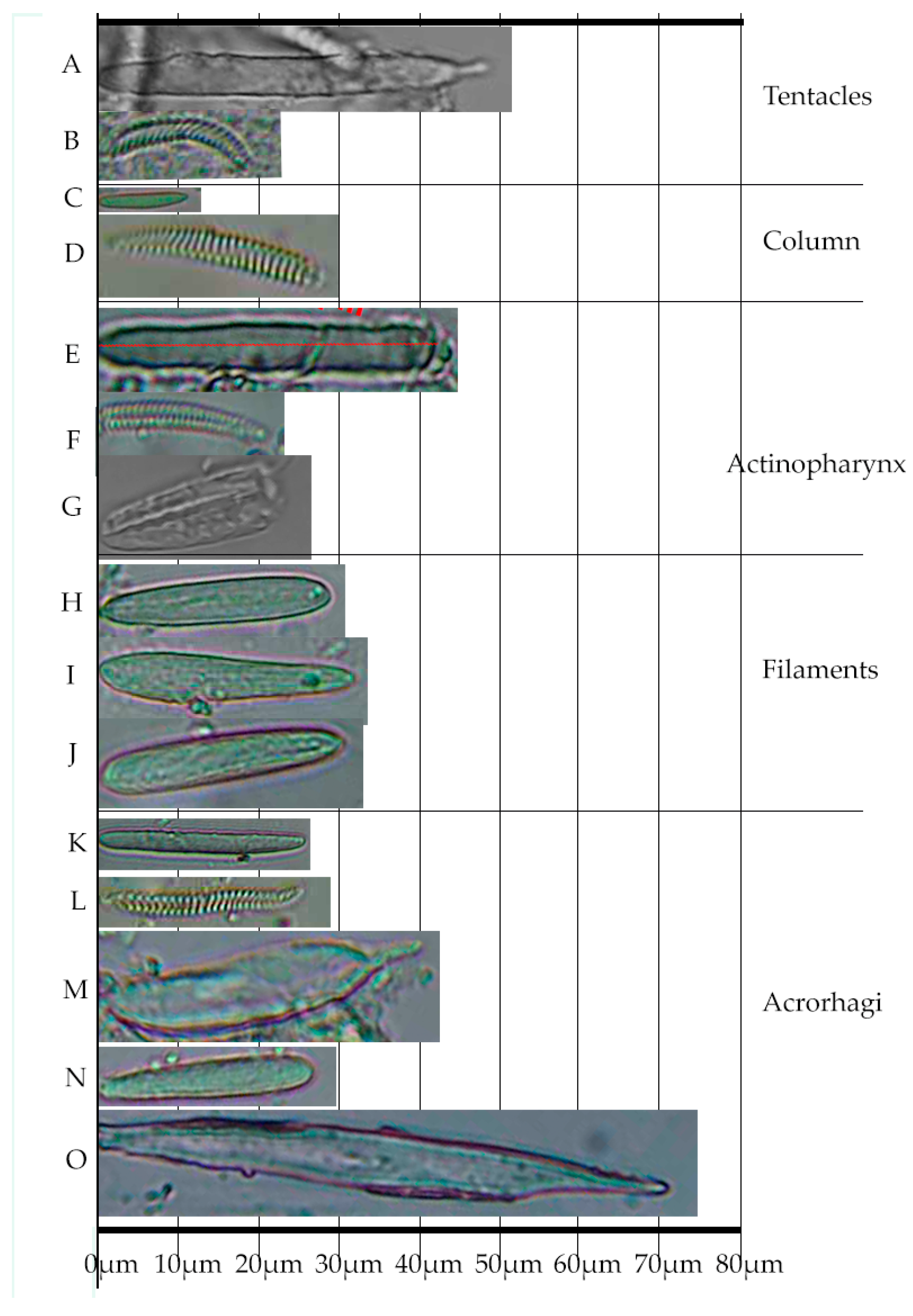
| Tissue | Cnidae | Gonzáles-Muñoz et al. [24] * | Durán et al. [28] | Present Study | Proposed Range |
|---|---|---|---|---|---|
| Tentacles | Basitrich | 10.7–29.5 ± 4.7 | 7.47–12.54 ± 2.17 | 8.68–49.5 ± 12.42 (n = 126) | 7.47–49.50 |
| 15.81–24.83 ± 1.39 | |||||
| Spirocysts | 13.2–22.60 ± 2.3 | 8.26–21.37 ± 3.33 | 9.76–27.83 ± 3.42 (n = 37) | 8.26–27.83 | |
| Actinopharynx | Basitrich | 21.0–27.2 ± 1.2 | 6.9–9.91 ± 1.13 | 6.51–50.49 ± 12.20 (n = 80) | 6.51–50.49 |
| 10.57–30.03 ± 5.52 | |||||
| Spirocysts | ** | ** | 6.51–30.21 ± 5.29 (n = 38) | 6.51– 30.21 | |
| Microbasic p-mastigophore | 16.3–21.1 ± 1.5 | 16.06–18.89 ± 1.24 | 10.74–28.83 ± 5.24 (n = 20) | 11.73–28.83 | |
| Column | Basitrich | 14.7–19.8 ± 1.2 | 7.55–9.15 ± 1.2 | 4.43–28.85 ± 7.17 (n = 62) | 4.43–28.85 |
| 20.8–28.4 ± 1.6 | 11.94–21.83 ± 2.39 | ||||
| Spirocysts | ** | ** | 8.09–25.66 ± 4.89 (n = 25) | 8.09–17.86 | |
| Acrorhagi | Basitrich | 17.2–28.8 ± 3.5 | 6.85–22.52 ± 4.3 | 2.65–27.21 ± 4.70 (n = 112) | 2.65–28.8 |
| Spirocysts | ** | 19.72–24.7 ± 2.09 | 10.72–30.28 ± 4.44 (n = 63) | 10.72–30.28 | |
| Microbasic b-mastigophore | ** | ** | 11.35–34.39 ± 6.58 (n = 32) | 11.35–36.16 | |
| Microbasic p-mastigophore | ** | ** | 8.72–36.16 ± 7.95 (n = 39) | 8.72–36.16 | |
| Holotrich | 26.6–45.1 ± 3.7 | 17.95–43.54 ± 7.25 | 28.40–79.91 ± 12.3 (n = 20) | 17.95–79.91 | |
| Filaments | Basitrich | 11.9–28.5 ± 4.7 | 9.67–16.15 ± 1.89 | 5.91–23.45 ± 3.17 (n = 68) | 5.91–28.50 |
| Microbasic b-mastigophore | 20.5–37.4 ± 4.3 | 27.7–40.58 ± 3.03 | 23.93–37.02 ± 3.23 (n = 25) | 20.50–40.58 | |
| Microbasic p-mastigophore | 14.4–23.1 ± 2.9 | 13.65–22.82 ± 1.33 | 12.54–45.89 ± 8.93 (n = 22) | 12.54–45.89 |
| Behavioral Category | Behavior Code | Description |
|---|---|---|
| Acclimatization | AC1 | Settlement and attachment to substrate post-transfer. |
| Postural States | PS1 | Basal postural state, stable, turgid column and an open oral disk with tentacles extended but not lax and non-reactive. This state is independent of photoperiod or external stimuli and represents the physiological reference condition of the organism. |
| PS2 | Column strongly contracted, body shortened and rigid, oral disk closed or partially hidden, and tentacles fully retracted. | |
| PS3 | Relaxed posture with expanded column, lax with reduced muscle tone and tentacles showing minimal or no movements. Most frequently during low stimulation in night conditions. | |
| Photoperiod-associated Behavior | PH1 | Sustained expanded posture during photoperiod, characterized by population-level synchrony following light onset. |
| PH2 | Asynchronous tentacle and oral disk retraction during photoperiod, not associated with tactile stimulation or feeding. | |
| PH3 | Rapid whole-body contraction triggered by exposure to artificial light outside the photoperiod. | |
| Nocturnal Behavior | NO1 | Full column and acrorhagi extension accompanied by slow lateral undulations. |
| NO2 | Rhythmic tentacle contractions and pulse-like column movements associated with water circulation. | |
| NO3 | Prolonged nocturnal full extension, without movements outside of stimuli. | |
| Defensive and Stress Responses | DF1 | Localized tentacle movement toward a tactile stimulus |
| DF2 | Full contraction with acrorhagi extension | |
| DF3 | Column flexion and oral disk reorientation toward stimulus | |
| DF4 | Actinopharynx eversion or regurgitation under stress | |
| Intra- and Interspecific Interactions | IN1 | Partial tentacle and column retraction upon contact with conspecifics |
| IN2 | Displacement or separation following prolonged tactile interaction | |
| Locomotion | LM1 | Pedal disk-mediated displacement through alternating expansion and contraction |
| Feeding Behavior | FD1 | Tentacle flexion and prey transfer to the oral disk |
| FD2 | Full tentacle contraction and column inflation during ingestion | |
| FD3 | Post-feeding nocturnal-like expansion within 24–48 h | |
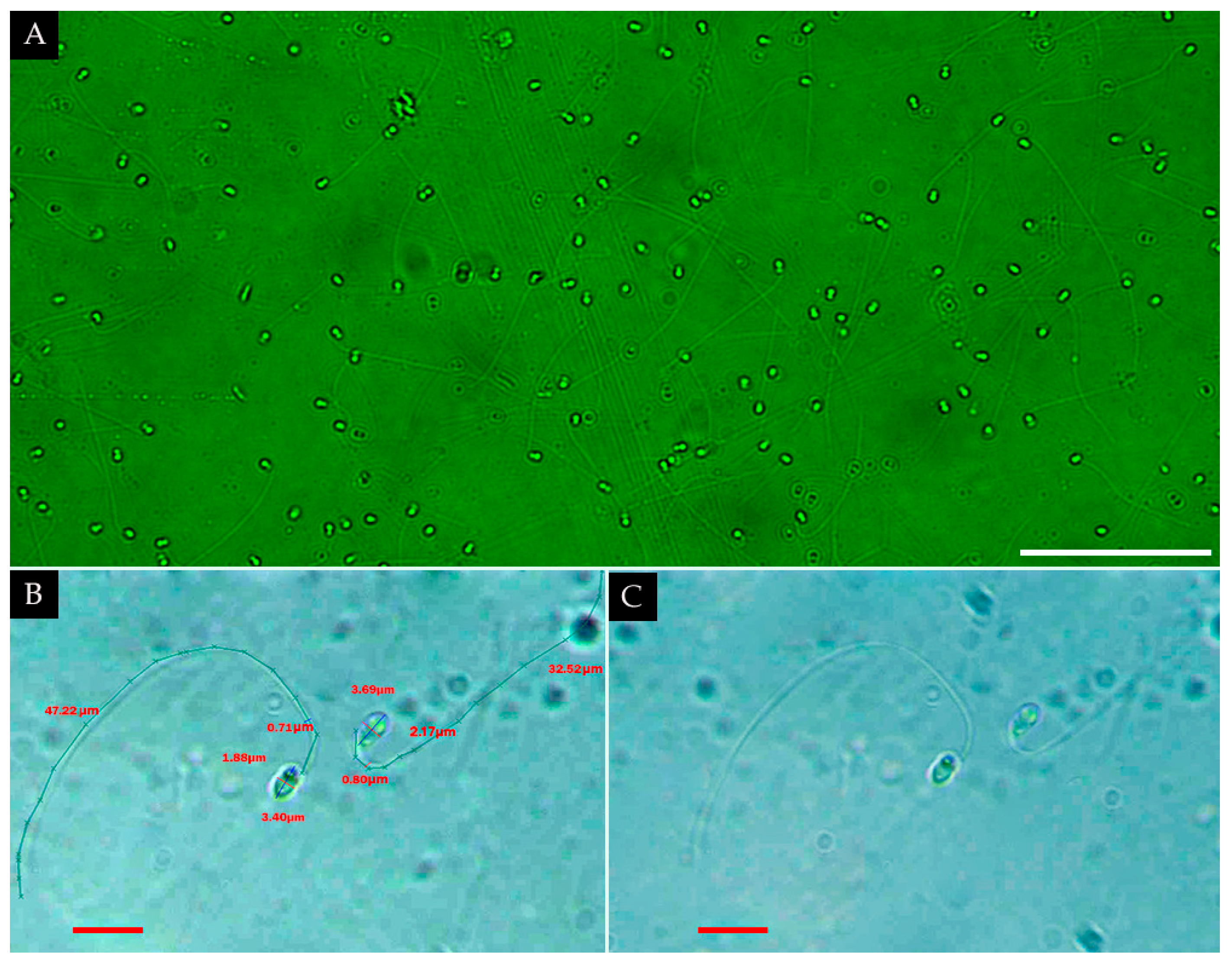
| Reproductive Behavior | RP1 | Sperm release through the relaxed oral disk |
| RP2 | Repetitive oral expansion and tentacle cycling following sperm emission |
Disclaimer/Publisher’s Note: The statements, opinions and data contained in all publications are solely those of the individual author(s) and contributor(s) and not of MDPI and/or the editor(s). MDPI and/or the editor(s) disclaim responsibility for any injury to people or property resulting from any ideas, methods, instructions or products referred to in the content. |
© 2026 by the authors. Licensee MDPI, Basel, Switzerland. This article is an open access article distributed under the terms and conditions of the Creative Commons Attribution (CC BY) license.
Share and Cite
V-Boada, M.P.; Navas-S, G.R.; Barrios, L.M. First Verified Record and Morpho-Ecological Characterization of Bunodosoma cavernatum (Cnidaria: Actiniaria) in Cartagena Bay, Colombian Caribbean. Diversity 2026, 18, 118. https://doi.org/10.3390/d18020118
V-Boada MP, Navas-S GR, Barrios LM. First Verified Record and Morpho-Ecological Characterization of Bunodosoma cavernatum (Cnidaria: Actiniaria) in Cartagena Bay, Colombian Caribbean. Diversity. 2026; 18(2):118. https://doi.org/10.3390/d18020118
Chicago/Turabian StyleV-Boada, M. Paula, Gabriel R. Navas-S, and Lina M. Barrios. 2026. "First Verified Record and Morpho-Ecological Characterization of Bunodosoma cavernatum (Cnidaria: Actiniaria) in Cartagena Bay, Colombian Caribbean" Diversity 18, no. 2: 118. https://doi.org/10.3390/d18020118
APA StyleV-Boada, M. P., Navas-S, G. R., & Barrios, L. M. (2026). First Verified Record and Morpho-Ecological Characterization of Bunodosoma cavernatum (Cnidaria: Actiniaria) in Cartagena Bay, Colombian Caribbean. Diversity, 18(2), 118. https://doi.org/10.3390/d18020118