Article

Resolving Relations Among Troublesome Species Within the Insect Pathogenic Genus Eryniopsis (Zoopagomycota: Entomophthorales)


by
Andrii P. Gryganskyi
1,*,
Tonya D. Bittner
2,†,
Donald C. Steinkraus
3 and
Ann E. Hajek
2,*
1
Biological & Nanoscale Division, AeroVironment Inc., Dayton, OH 45432-1805, USA
2
Department of Entomology, Cornell University, Ithaca, NY 14853-2601, USA
3
Department of Entomology and Plant Pathology, University of Arkansas, Fayetteville, AR 72701, USA
*
Authors to whom correspondence should be addressed.
Current address: Department of Natural Resources and the Environment, Cornell University, Ithaca, NY 14853, USA.
Diversity 2026, 18(2), 119; https://doi.org/10.3390/d18020119
Submission received: 16 December 2025 / Revised: 31 January 2026 / Accepted: 4 February 2026 / Published: 13 February 2026
(This article belongs to the Section Microbial Diversity and Culture Collections)

Abstract

The genus Eryniopsis (Division Zoopagomycota, Order Entomophthorales, Family Entomophoraceae) includes four obligate insect pathogenic species with similarities in morphology and biology but also distinct differences. A new fungal genus Rolandia Gryganskyi & Hajek is described which includes two species previously placed in the genus Eryniopsis. Molecular and morphological evidence support the creation of this new genus which now includes Rolandia caroliniana and Rolandia rhagionidarum. Species in the new genus have multiple forms of both primary and secondary conidia, some of which are epapillate.

1. Introduction

In 1888, Thaxter described 27 species in the arthropod pathogenic ‘Entomophthoreae’, all within the genus Empusa [1]. Today, all of the species he included in his monograph are in the fungal Order Entomophthorales. He placed two of these species in the subgenus Triplosporium and 15 in the subgenus Entomophthora, leaving 10 without subgeneric status. Of importance here, Empusa lampyridarum, a new species he described, was assigned to the subgenus Entomophthora and the new species Empusa caroliniana was not assigned to a subgenus. Thaxter stated that for E. lampyridarum ‘the affinities of the species are somewhat doubtful’ and E. caroliniana was ‘decidedly different from any form known to me’. It is interesting that most other species he described in this monograph do not include such statements of doubt. In 1984, the genus Eryniopsis was created to contain both species, with Eryniopsis lampyridarum as the type species [2]. However, even in 1984, the species Eryniopsis lampyridarum was called ‘troublesome’ regarding its position in the systematics within the Entomophthorales [2]. The genus Eryniopsis was named based on morphological characters, principal among these being that primary conidia are elongate [2]. More recent studies, based largely on molecular data, instead have determined that the genus “Eryniopsis is an artificial group of species with simple or basally dichotomous conidiophores, plurinucleate conidia, and elongated unitunicate conidia that were not accommodated in any other genus” [3].
At present, the genus Eryniopsis includes a total of four species: E. lampyridarum, E. caroliniana, E. longispora, and E. rhagionidarum, after E. ptychopterae and E. transitans were moved to Entomophaga [4]. Eryniopsis longispora and E. rhagionidarum are only known from Poland and Switzerland, respectively, and no DNA sequences are available for these species. In fact, sequences for the type species E. lampyridarum have not been available until now.
Some aspects of the morphology and biology of E. lampyridarum and E. caroliniana have also suggested that these species might not belong in the same genus. The genus Eryniopsis, therefore, has needed to be reconsidered since it was created in 1984 [2] and, now that sequences for the type species are available, this is possible. Our re-evaluation clarifies evolutionary affinities among species within the Entomopthoreae, showing that species within Eryniopsis do not belong in the same clade, although indeed, they are not as distantly related as species of Entomophthora.
We are testing the hypothesis that the genus Eryniopsis is not monophyletic. To test this hypothesis, we have added molecular data to previously published morphological data. Therefore, our first goal was to construct a well-resolved, two-locus phylogeny (18S and 28S) for the subfamily Entomophthoroideae to test whether the Eryniopsis genus is monophyletic and to resolve the major lineages within the subfamily. Finding lack of monophyly, we have proposed a new genus and have transferred two species into it.

2. Materials and Methods

2.1. Field Collection

Bodies of adult Chauliognathus pensylvanicus (Coleoptera: Cantharidae; the goldenrod soldier beetle) killed by Eryniopsis lampyridarum and from which conidia were being produced were collected on 3 October 2016 from West Fork, Arkansas (39.958712, −94.1503) and placed in 1.5 mL vials of CTAB (cetyltrimethylammonium bromide). These cadavers were found with mouthparts gripping inflorescences of Solidago canadensis and Symphyotrichum pilosum. The morphology and biology of this fungal pathogen have previously been described in detail [5] but no pure culture has been obtained.

2.2. Molecular Analysis

Cadavers bearing conidia that had been preserved in CTAB were vortexed and a subsample of the suspension (1 mL) was passed through a Swinnex (Millipore, Burlington, MA, USA) 10 µm filter. The filter was washed with water and the resulting suspension was centrifuged for 10 min at 14.5k rpm, which resulted in a visible pellet. The pellet was disrupted for 1 min in a BioSpec mini-bead beater (Bartlesville, OK, USA) with 0.7 mm zirconium beads and lysis buffer from a Qiagen DNeasy Mini Plant kit (Hilden, Germany). DNA was extracted using the kit protocol with 70 µL final elution volumes.
We amplified two nuclear ribosomal DNA loci: 18S (small subunit) and 28S (large subunit). We used a Qiagen PCR Core Kit and 20 µL reaction volumes with 0.2 mM of each primer and dNTPs. For 28S, primers were nu-LSU-0018-5′ [6] and nu-LSU-0805-3′ [7]. Cycling conditions were hot start of 95 °C for 5 min, denaturing steps were 1 min, and annealing steps were 1 min with an initial touchdown sequence ranging from 58 °C to 52 °C, followed by 30 cycles of annealing at 52 °C. Extensions were 72 °C for 1 min, with a final extension at 60 °C for 30 min.
For 18S, primers were SR115R [8] and NS6 [9] with hot start (5 min) and denaturing cycles at 94 °C for 50 s, with a touchdown decreasing annealing temperatures from 63 °C to 56 °C (45 s), then 27 more cycles of annealing at 56 °C. Extension times were 1.5 min at 72 °C throughout, including a final extension of 1.5 m at 72 °C.
Shrimp Alkaline Phosphatase (GE Healthcare, Arlington Heights, IL, USA) and Exonuclease I (New England Biolabs, Ipswich, MA, USA) were used for PCR cleanup at 0.1 Units SAP and 0.23 Units EXO, following manufacturer recommendations. The cleaned products were sequenced in both directions via the Sanger method at the Cornell University Biotechnology Resource Center on an ABI 3730xl (Thermo Fisher Scientific, Waltham, MA, USA).

2.3. Phylogenetic Analysis

To build a phylogenetic reconstruction of this fungal group, we created a dataset including sequences from two non-protein-coding rDNA loci (18S and 28S), with 25% of sequences generated by the authors of this study (Table 1). The sequences used for analyses belong to 47 fungal taxa (one invalid name), representing 13 genera: 29 Entomophthoroideae isolates (ingroup: genera Arthrophaga, Entomophaga, Entomophthora, Eryniopsis, Massospora, and the new genus Rolandia) and 35 isolates from other fungal lineages (outgroups). The outgroup taxa included 33 species of the closely related Erynioideae subfamily, and three distantly related families in the Entomophthorales: Batkoaceae (3 species), Neozygitaceae (6 species) and Capillidiaceae (one species). In total, the outgroup taxa represent seven genera: Batkoa, Capillidium, Erynia, Neozygites, Pandora, Strongwellsea, and Zoophthora. For the species Arthrophaga myriapodina, Batkoa major, Entomophthora muscae, Pandora kondoiensis, and Rolandia caroliniana multiple sequences were used.
The data were combined into a single matrix with two partitions: one partition for each of the loci 18S and 28S. The 18S rDNA and 28S rDNA partitions included 587 and 483 characters, respectively, for a combined data matrix of 1070 characters. The 28S sequence dataset had twelve missing records. Sequences were aligned individually for each locus using MUSCLE [10]. Alignments were visually inspected and poorly aligned columns (ambiguous and gappy regions, low-confidence sites) were trimmed manually using Mesquite 4.01 [11]. The optimized nucleotide substitution model (GTR + Γ + I) was selected using ModelTest 3.06 [12]. Maximum likelihood (ML) phylogenetic trees for each locus were estimated using Garli-2.0 [13]. To assess the influence of the missing data we ran the phylogenetic reconstruction for 28S dataset first (Supplementary Figure S1), then compared it to the tree with the combined (18S and 28S) dataset to check for congruency. To assess conflicting phylogenetic signals from the two loci, we searched for strong incongruence of the nodes by 1000 ML bootstrap replicates. Statistical support with bootstrap values ≥ 70% was recognized as significant.

3. Results

3.1. Phylogenetic Analysis

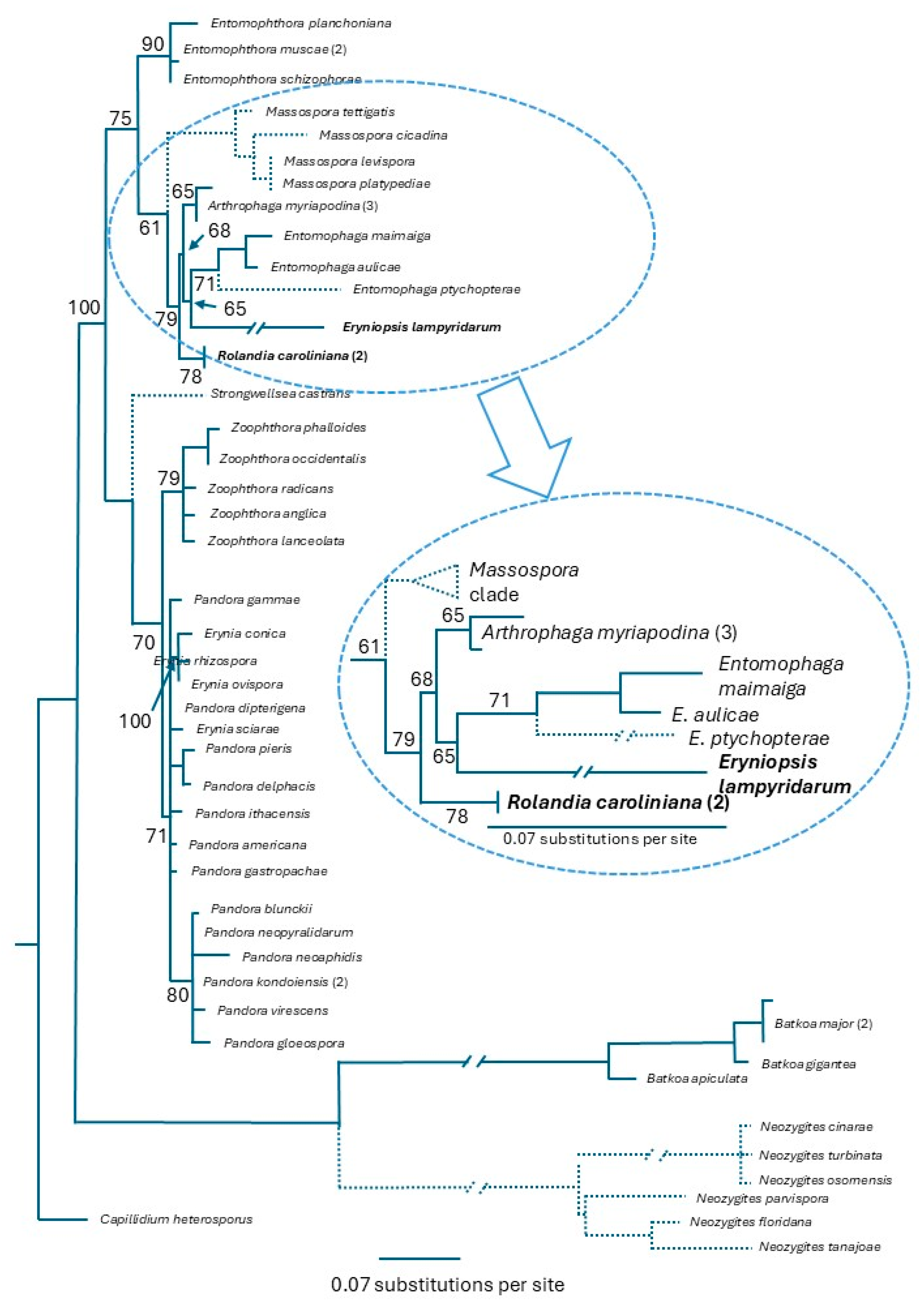
Phylogenetic reconstruction divided the studied taxa into several large groups. Two subfamilies of the family Entomophthoraceae, Erynioideae and Entomophthoroideae, group together as sister clades, while the genera Batkoa, Neozygites, and Capillidium form a well-separated basal group to the family Entomophthoraceae. With significant bootstrap support families Batkoaceae and Neozygitaceae are well separated from each other, as well as from the subfamilies Erynioideae and Entomophthoroideae within the family Entomophthoroaceae (Figure 1).
The Erynioideae subfamily has two distinct groups well separated from the rest of its clades: Zoophthora and Erynia. Pandora species are scattered on this branch without forming any distinguishable grouping. Strongwellsea castrans appears to be basal to the rest of the Erynioideae. The Entomophthoroideae subfamily also has several distinct clades: Entomophthora, Massospora, Arthrophaga, and Entomophaga, which are well separated with bootstrap values.
Species which belong to the same genera group together with significant bootstrap support, with the exceptions of the genera Pandora and Eryniopsis (the latter is illustrated as E. lampyridarum and Rolandia caroliniana). Taxonomic diversity of the genus Pandora and the need for its thorough revision based on the wide diversity of molecular data were discussed in our previous study [14].
The split genus Eryniopsis on our phylogenetic tree is part of the Entomophthoraceae family and groups with the taxa of the subfamily Entomophthoroideae. Type species of the genus Eryniopsis, Eryniopsis lampyridarum is close to the Entomophaga group, which includes Entomophaga aulicae, Entomophaga maimaiga, and Entomophaga ptychopterae (formerly Eryniopsis ptychopterae). Two specimens of Eryniopsis caroliniana, being proposed to move to Rolandia caroliniana, appear to be basal to a larger branch within the Entomophthoroideae subfamily, which includes the aforementioned taxa and three specimens of Arthrophaga myriapodina. The three Arthrophaga samples are located on the branch between Eryniopsis and Rolandia, which serves as an additional argument in favor of separation of these taxa. Division of three specimens of the genus Eryniopsis (now Eryniopsis and Rolandia) with Arthrophaga between them is well supported with significant bootstrap values, strengthening the erection of the new Rolandia genus.

3.2. Taxonomy

Generic Diagnosis:
Rolandia Gryganskyi & Hajek, gen. nov.
MycoBank No.: 861430
Etymology: Referring to Dr. Roland Thaxter, who described the type species.
Type Species: Rolandia caroliniana (Thaxter) Gryganskyi & Hajek, comb. nov.
Description: Hyphal bodies irregular, multinucleate. Conidiophores simple, unbranched or rarely forked beyond the host’s body. Unitunicate primary conidia, 4–11 nucleate, and elongate, subcylindrical to fusoid (also referred to as ovoid [15]) and of variable size; can be asymmetric. Conidial papilla can be indistinct in the ‘epapillata’ type of conidia [16]. Secondary conidia can be of two types: those similar to ovoid primaries (but smaller) or fusiform [1,15,17,18]. Secondary conidia are produced laterally from primaries with relatively short thick conidiophores. Cystidia and rhizoids lacking, while resting spores can occur. After hosts die, cadavers can be fixed in place by legs of hosts wrapping around supporting structures, such as twigs or grass blades. Obligate parasites of insects.
Morphological diagnosis of Rolandia versus Eryniopsis:
Rolandia shares with Eryniopsis multinucleate and elongate conidia and lack of cystidia but differs in that within Eryniopsis, one species produces long, tapering conidiophores (E. lampyridarum) and E. longispora produces elongate, slender conidia with conical papillae, while Rolandia species have neither of these specialized characteristics. In addition, E. lampyridarum-infected beetles die with mandibles attaching cadavers to plants, often in elevated locations. In contrast cadavers of Nematocera-killed E. longispora are held in place by rhizoids. Supplementary Table S1 presents key morphological traits among species within Eryniopsis and Rolandia.
TYPE SPECIES
Current name
Rolandia caroliniana (Thaxter) Gryganskyi & Hajek comb. nov. [MB 861431]
Basionym
Empusa caroliniana Thaxter, Mem. Boston Soc. Natl. Hist. 4: 167 (April 1888)
LECTOTYPE: FH4670; Humber. Mycotaxon 21: 259 (1984)
Obligate synonyms
Erynia caroliniana (Thaxter) Remaudiére & Hennebert Mycotaxon 11: 302 (1980)
Entomophaga caroliniana (Thaxter) Samson, H.C. Evans & Latgé Atlas of Entomopathogenic Fungi: 17 (1988)
Entomophthora caroliniana (Thaxter) Keller Sydowia, Ann. Mycol. Ser. II 31: 88 (1978)
Eryniopsis caroliniana (Thaxter) Humber Mycotaxon 21: 259 (1984)
Taxonomic synonym
Entomophthora arrenoctona Giard Bull. Sci. France et Belg. 20: 214 (1889). Synonymized in Keller Sydowia, Ann. Mycol. Ser. II 31: 88 (1978)
Distribution and hosts: North America and Europe. Found infecting adults of large Tipulidae (Diptera) (see Table 2).
ADDITIONAL SPECIES
Current name
Rolandia rhagionidarum (Keller) Gryganskyi & Hajek comb. nov. [published initially as Eryniopsis rhagionidis S. Keller [26]] [MB 861432]
Basionym
Eryniopsis rhagionidarum S. Keller. Sydowia 59(1): 97 (2007)
HOLOTYPE: ZT, Keller 93-1
Distribution and host: Fischingen, Switzerland from an unidentified species of Rhagionidae (Diptera).
Based on morphology, this species was described as being ‘closely related to E. caroliniana’, being differentiated only by the host and the number of nuclei in primary spores [26]. While hosts from R. caroliniana and R. rhagionidarum are from different dipteran families, numbers of nuclei per conidium are quite similar. Keller [26] reported that conidia of R. rhagionidarum had 7–11 nuclei per conidium and R. caroliniana had 6–7 [18], while Bałazy [15] reported that R. caroliniana has 4–10 nuclei/conidium.

4. Discussion

Phylogenetic reconstruction is congruent with our previous phylogenetic reconstruction [14], as well as with phylogenetic trees obtained by other researchers [27]. In our phylogenetic reconstruction, the genus Neozygites is grouped with the genus Batkoa, which might be the result of long branch attraction rather than a real reflection of relatedness between these two groups. Also, we consider the position of species in the the genus Massospora on the tree as uncertain because of the enormous genetic diversity of their sequences [27], especially for the 18S region. Therefore, we have excluded from our matrix 18S sequences of three Massospora species (M. levispora, M. platypediae, M. tettigatis) and both 18S and 28S of M. diceroproctae. Since the goal of this phylogenetic reconstruction was primarily to investigate and elucidate the relatedness between present and former Eryniopsis taxa rather than build the comprehensive phylogeny of the entire Entomophthorales, our phylogenetic reconstruction gave sufficient resolution to address this taxonomic issue.
The genus Eryniopsis was proposed in 1984 based on ‘primary conidia being plurinucleate (ca. 4–12 nuclei), unitunicate, and elongate (rather than globose to pyriform), produced on simple to dichotomously or monopodially branched conidiophores and forcibly discharged by papillar eversion,’ with E. lampyridarum as the type species [2]. The three species included at that time (E. lampyridarum, E. caroliniana, and E. longispora) all have elongated primary conidia, and this stands as a major difference with other species in the subfamily. In 2007, E. rhagionidarum was added, with morphology very similar to E. caroliniana [26]. Now, with 18S and 28S sequences for E. lampyridarum we can confirm that this type species differs phylogenetically from E. caroliniana (Figure 1). As E. lampyridarum is the type for Eryniopsis, we have created the new genus, Rolandia, to include R. caroliniana. Based on the morphological and biological similarity of R. rhagionidarum with R. caroliniana, R. rhagionidarum has also been transferred to Rolandia. No cultures or molecular data are available for R. rhagionidarum and molecular data are clearly necessary to further confirm and support this generic transfer.
The two species presently in Rolandia have shapes of primary conidia ranging between ovoid, subcylindrical, and fusoid, often with reduced papillae. These conidial shapes differ from primary conidia of Eryniopsis (Supplementary Table S1) as well as Entomophaga, and Arthrophaga. These three genera are the genera most closely related to Rolandia (Figure 1), demonstrating that shared characters of species within Rolandia consistently differ from the most closely related genera.
Biological and morphological characters are more complex for E. lampyridarum, where, in South Carolina, Carner [28] stated that primary conidia are elongate ovoid with minimal papillae, producing two types of secondary conidia: one type similar to primaries in shape and actively discharged while the others elongate with tapered ends and attached orthotopically via ‘slender perpendicular stalks’. Humber [2] later referred to the second type as capilliconidia. In contrast, Steinkraus et al. [5] reported that in Arkansas, primary conidia are elongate and are borne orthotropically on long thin, tapering conidiophores and these were not ejected. In Arkansas, secondary conidia were reported as smaller than primary conidia but similar in shape, although slightly more narrow than the primary conidia [5]. Secondaries in Arkansas are also produced orthotopically but on elongate conidiophores and are not actively discharged. Although the reported biologies for E. lampyridarum in South Carolina and Arkansas are not the same, this seems to be the same fungal species based on the host and distribution and other aspects of the biology (species of hosts and attachment to plants via mandibles, often in elevated locations). Unfortunately, there are no DNA samples for the strain of E. lampyridarum in South Carolina described by Carner [28], but we suggest that further comparison between samples of E. lampyridarum from these two areas, as well as across the rest of the distribution [29] is necessary.
Eryniopsis lampyridarum is well known for turning infected Chauliognathus beetles into zombies before they die; before death, infected soldier beetles grab onto inflorescences or foliage with their mandibles and stay attached (J. Francis pers. comm., [5]) Therefore, cadavers bearing conidia are not on the ground. It is common for hosts of entomophthoralean species to be attached to substrates at higher locations, although this is accomplished in different ways by different species. For Rolandia, hosts of both species are reported to sometimes die with legs wrapped around grass or twigs, but no fungal growth attaches the cadaver to the substrate. In contrast, soldier beetles killed by E. lampyridarum are attached by their mandibles and small flies killed by E. longispora are attached by rhizoids. These differences alone between the two species now in Eryniopsis suggest that further comparisons between these species are needed; do they belong in the same genus? Unfortunately, no cultures or sequences exist for E. longispora, which is only known from one national park in Poland [15,30] and is considered rare (C. Tkaczuk pers. comm.). With removal of Rolandia species from Eryniopsis, the two species that remain are quite different from each other in morphology (Supplementary Table S1). While both have multinucleate conidia, they differ significantly in the shapes and sizes of primary conidia, presence of very thin and elongated conidiophores only in E. lampyridarum, and presence of rhizoids only in E. longispora. Rolandia lampyridarum provides the only example of such long, thin conidiophores in the subfamily Entomophthoroideae. Further collections of E. longispora are necessary, especially to conduct the necessary molecular analyses to investigate the relationship between E. lampyridarum and E. longispora.
Some of the hosts listed for R. caroliniana are in the large genus Tipula (Diptera: Tipulidae) but have not been identified to species (Table 2). The first record of a host identified to species for R. caroliniana was Tipula paludosa in Switzerland [31]. This native European crane fly was subsequently also reported as the host in several other European countries as well as in New Hampshire (Table 2)—a northeastern US state where T. paludosa has become established as an invasive species [32]. Rolandia caroliniana was first described in North Carolina in 1888 [1], but since 1977 [31] it has also been reported from many countries in Europe, as well as additional locations in North America (Table 2). In agreement, an atlas of entomopathogenic fungi [33] included R. caroliniana as a ‘common fungal pathogen’ but the other species covered in this paper were not listed as being common.
Data have demonstrated that the genus Eryniopsis was not monophyletic. The new genus we propose, based on morphology and molecular data, moves two morphologically similar species from Eryniopsis into the new genus Rolandia. The remaining two species in Eryniopsis are E. lampyridarum and E. longispora. These species are quite different from each other morphologically and biologically. To further clarify the genus Eryniopsis, sequences for E. longispora must be obtained and analyzed. Molecular data for R. rhagionidarum are also necessary to further confirm our placement of this species in Rolandia. In addition, the morphology and biology of E. lampyridarum collected from Arkansas must be compared with samples of this species from North and South Carolina to compare descriptions by Thaxter [1], Steinkraus [5], and Carner [28]. Overall, we hope that future biodiversity collections will discover new species to include in each of these genera.

Supplementary Materials

The following supporting information can be downloaded at: https://www.mdpi.com/article/10.3390/d18020119/s1, Figure S1: Neighbor-joining phylogeny of 28S, showing separation of E. lampyridarum and R. caroliniana; Table S1: Key morphological traits of species within Eryniopsis and Rolandia. For all species, conidia unitunicate, conidiophores usually unbranched, and cystidia absent.

Author Contributions

Conceptualization, A.P.G. and A.E.H.; Methodology, all authors; Software, A.P.G. and T.D.B.; Formal Analysis, A.P.G.; Investigation, A.P.G., A.E.H. and T.D.B.; Resources, A.E.H., D.C.S. and A.P.G.; Data Curation, A.P.G. and T.D.B.; Writing—Original Draft Preparation, A.E.H.; Writing—Review and Editing, all authors; Visualization, A.P.G.; Project Administration, A.E.H. All authors have read and agreed to the published version of the manuscript.

Funding

This research received no external funding.

Data Availability Statement

The original contributions presented in this study are included in the article and Supplementary Materials. Further inquiries can be directed to the corresponding authors.

Acknowledgments

We thank Kathie Hodge and Siegfried Keller for assistance with choosing a name for this new genus, Cezary Tkaczuk, Jim Liebherr, Jack Whisenant, and Stuart Skeates for assistance with the paper, and Konstanze Bensch for taxonomic assistance.

Conflicts of Interest

Author Andrii P. Gryganskyi was employed by the company AeroVironment, Inc. The remaining authors declare that research was conducted in the absence of any commercial or financial relationship that could be construed as a potential conflict of interest.

References

  1. Thaxter, R. The Entomophthoreae of the United States. Mem. Boston Soc. Nat. Hist. 1888, 4, 133–201. [Google Scholar]
  2. Humber, R.A. Eryniopsis, a new genus of the Entomophthoraceae (Entomophthorales). Mycotaxon 1984, 21, 257–264. [Google Scholar] [CrossRef]
  3. Gryganskyi, A.P.; Humber, R.A.; Smith, M.E.; Hodge, K.; Huang, B.; Voigt, K.; Vilgalys, R. Phylogenetic lineages in Entomophthoromycota. Persoonia 2013, 30, 94–105. [Google Scholar] [CrossRef]
  4. Hajek, A.E.; Jensen, A.B.; Thomsen, L.; Hodge, K.T.; Eilenberg, J. Using PCR-RFLP to investigate relations among species in the entomopathogenic genera Eryniopsis and Entomophaga. Mycologia 2003, 95, 262–268. [Google Scholar] [CrossRef]
  5. Steinkraus, D.; Hajek, A.E.; Liebherr, J.K. Zombie beetles killed by Eryniopsis lampyridarum. J. Invertebr. Pathol. 2017, 148, 51–59. [Google Scholar] [CrossRef]
  6. Jensen, A.B.; Eilenberg, J. Genetic variation within the insect-pathogenic genus Entomophthora, focusing on the E. muscae complex, using PCR-RFLP of the ITS II and the LSU rDNA. Mycol. Res. 2001, 105, 307–312. [Google Scholar] [CrossRef]
  7. Kjøller, R.; Rosendahl, S. Detection of arbuscular mycorrhizal fungi (Glomales) in roots by nested PCR and SSCP (Single Stranded Conformation Polymorphism). Plant Soil 2000, 226, 189–196. [Google Scholar] [CrossRef]
  8. Spatafora, J.W.; Mitchell, T.G.; Vilgalys, R. Analysis of genes coding for small subunit rRNA sequences in studying phylogenetics of dematiaceous fungal pathogens. J. Clin. Microbiol. 2000, 33, 1322–1326. [Google Scholar] [CrossRef] [PubMed]
  9. White, T.J.; Bruns, T.; Lee, S.; Taylor, J. Amplification and direct sequencing of fungal ribosomal RNA genes for phylogenetics. In PCR Protocols: A Guide to Methods and Applications; Innis, M.A., Gelfland, D.H., Sninsky, J.J., White, T.J., Eds.; Academic Press: San Diego, CA, USA, 1990; pp. 315–322. [Google Scholar]
  10. Edgar, R.C. MUSCLE: A multiple sequence alignment method with reduced time and space complexity. BMC Bioinform. 2004, 5, 113. [Google Scholar] [CrossRef]
  11. Maddison, W.P.; Maddison, D.R. Mesquite: A Modular System for Evolutionary Analysis. 2015. Version 3.03. Available online: http://mesquiteproject.org (accessed on 30 December 2025).
  12. Posada, D.; Crandall, K.A. MODELTEST: Testing the model of DNA substitution. Bioinform. 1998, 14, 817–818. [Google Scholar] [CrossRef] [PubMed]
  13. Bazinet, A.L.; Zwickl, D.J.; Cummings, M.P. A gateway for phylogenetic analysis powered by grid computing featuring GARLI 2.0. Syst. Biol. 2014, 63, 812–818. [Google Scholar] [CrossRef]
  14. Hajek, A.E.; Gryganskyi, A.P.; Gouli, S.Y.; Bittner, T.D.; Sullivan, C.F.; Parker, B.L. Reassessing diversity of the arthropod pathogenic genus Pandora Batko (Entomophthoromycotina; Erynioideae). Diversity 2024, 16, 603. [Google Scholar] [CrossRef]
  15. Bałazy, S. Flora of Poland, Fungi Vol. 24, Entomophthorales; Polish Science Academy: Krakow, Poland, 1993. [Google Scholar]
  16. Lakon, G. Die Insektenfeinde aus der Familie der Entomophthoreen. Z. Ang. Ent. 1919, 5, 161–216. [Google Scholar] [CrossRef]
  17. Keller, S. Entomophthora gigantea sp. nov. and E. caroliniana (Thaxter) comb. nov., two pathogens of Tipula paludosa Meig. Sydowia Ann. Mycol. Ser. II 1978, 31, 87–93. [Google Scholar]
  18. Keller, S. Arthropod-pathogenic Entomophthorales of Switzerland. II. Erynia, Eryniopsis, Neozygites, Zoophthora and Tarichium. Sydowia 1991, 43, 39–122. [Google Scholar]
  19. MyCoPortal. Available online: https://mycoportal.org/portal/collections/list.php?usethes=1&taxa=183297 (accessed on 30 December 2025).
  20. Giard, A. Fragments biologiques (1) XI. Sur quelques Entomophorées. Bull. Sci. France et Belge 1888, 19, 298–309. [Google Scholar]
  21. Sosnowska, D.; Bałazy, S.; Prishchepa, L.; Mikulskaya, N. Biodiversity of arthropod pathogens in the Białowieźa forest. J. Plant Prot. Res. 2004, 44, 313–320. [Google Scholar]
  22. Neill, M.; Santamaria, S. Additions to the knowledge of entomopathogenic Entomophthorales (Fungi, Zygomycota) from Spain. Nova Hedwigia 2001, 73, 167–197. [Google Scholar] [CrossRef]
  23. Koval, E.Z. Zygomycetes. Entomophthoralean Fungi; M. Kholodny Institute of Botany NAS of Ukraine: Kyiv, Ukraine, 2007; p. 369. [Google Scholar]
  24. Wilding, N. Entomophthorales foray: 10–14 September 1982 Exeter University and Norwich. Bull. Brit. Mycol. Soc. 1983, 17, 47–49. [Google Scholar] [CrossRef]
  25. iNaturalist. Available online: https://www.inaturalist.org (accessed on 30 December 2025).
  26. Keller, S. Arthropod-pathogenic Entomophthorales from Switzerland. III. First additions. Sydowia 2007, 59, 75–113. [Google Scholar]
  27. Macias, A.M.; Geiser, D.M.; Stajich, J.E.; Łukasik, P.; Veloso, C.; Bublitz, D.C.; Berger, M.C.; Boyce, G.R.; Hodge, K.; Kasson, M.T. Evolutionary relationships among Massospora spp. (Entomophthorales), obligate pathogens of cicadas. Mycologia 2020, 112, 1060–1074. [Google Scholar] [CrossRef]
  28. Carner, G.R. Entomophthora lampyridarum, a fungal pathogen of the soldier beetle, Chauliognathus pennsylvanicus. J. Invertebr. Pathol. 1980, 36, 394–398. [Google Scholar] [CrossRef]
  29. Hajek, A.E.; Scott, K.; Sanchez-Peňa, S.; Tkaczuk, C.; Lovett, B.; Bushley, K. Annotated checklist of arthropod-pathogenic species in the Entomophthoromycotina (Fungi: Zoopagomycota) in North America. MycoKeys 2025, 114, 329–366. [Google Scholar] [CrossRef] [PubMed]
  30. Bałazy, S. New species of Entomophthoraceae from the Wielkopolski National Park. Bull. Acad. Pol. Sci., Sèr. Sci. Biol. Cl. II 1982, 29, 221–226. [Google Scholar]
  31. Keller, S. Über zwei Entomophthorosen von Tipula paludosa Meig. Bull. Schweiz. Entomolog. Gesell. 1977, 50, 277–284. [Google Scholar]
  32. Petersen, M.J. Evidence of a climatic niche shift following North American introductions of two crane flies (Diptera; genus Tipula). Biol. Invasions 2013, 15, 885–897. [Google Scholar] [CrossRef]
  33. Samson, R.A.; Evans, H.C.; Latgé, J.-P. Atlas of Entomopathogenic Fungi; Springer: Berlin/Heidelberg, Germany, 1988. [Google Scholar]
Figure 1. Maximum likelihood tree of Entomophthoraceae family with polyphyletic genus Eryniopsis (listing former member, R. caroliniana under the new generic name Rolandia). Number of included isolates in parentheses after the species name. Branches with partial data (only 18S available, no 28S for Massospora, Neozygites clades, Strongwellsea castrans, and Entomophaga ptychopterae) are shown with dotted lines. Long branches of the families Batkoaceae, Neozygitaceae, and species Eryniopsis lampyridarum and Entomophaga ptychopterae shortened to fit the page. Bootstrap values > 60 above or below corresponding nodes, except the lineages with missing data. Expected numbers of substitutions/changes per nucleotide site placed below the tree. The part of the tree in the dashed oval to the right is the same as the main tree, but enlarged 3x for better resolution of this particular part of phylogenetic reconstruction that shows the evolutionary trajectories of the genus Eryniopsis and related taxa.
Diversity 18 00119 g001
Table 1. MycoBank and GenBank accession numbers of the sequences used for phylogenetic reconstruction (sequences generated by the authors in bold).
Species, Authors, YearsAccession Numbers
MycoBankGenBank
28S
GenBank
18S
Arthrophaga myriapodina K.T. Hodge & A.E. Hajek, 2017822067MF544094, MN706590, NG_058604MF544092, MF544093, MN706566
Batkoa apiculata (Thaxt.) Humber, 1989135576EF392404DQ177437
Batkoa gigantea (S. Keller) Humber, 1989135578JX242591JX242611
Batkoa major (Thaxt.) Humber, 1989135579EF392376, EF392401EF392457, EF392547
Capillidium heterosporum (Drechsler) B. Huang & Y. Nie, 2020295472JX242593JX242613
Entomophaga aulicae (E. Reichardt) Humber, 1984106111U35394EF392542
Entomophaga maimaiga Humber, Shimazu & R.S. Soper, 1988 134249EF392395EF392556
Entomophaga ptychopterae (S. Keller & Eilenberg) A.E. Hajek & Eilenberg, 2003385283-AF052403
Entomophthora muscae (Cohn) Fresen., 1856150965DQ273772, KC404073AY635820, EF392564
Entomophthora planchoniana Cornu, 1873163373GQ285878AF353723
Entomophthora schizophorae S. Keller & Wilding, 1988134243DQ481227GQ285870
Erynia conica (Nowak.) Remaud. & Hennebert, 1980113494EF392396AF368513
Erynia ovispora (Nowak.) Nowak., 1881431637JX242601JX242620
Erynia rhizospora (Thaxt.) Remaud. & Hennebert, 1980113507EF392397AF368514
Erynia sciarae (Olive) Ben Ze’ev & R.G. Kenneth, 1982110661EF392399AF368515
Eryniopsis lampyridarum (Thaxt.) Humber, 1984106120PX700885PX698839
Massospora cicadina Peck 1878244575MH483015MH483019
Massospora levispora R.S. Soper, 1963333869MN706584-
Massospora platypediae R.S. Soper, 1974317412MH483016-
Massospora tettigatis R.S. Soper, 1974317413MN706587-
Neozygites cinarae S. Keller, 1997443155-KC822923
Neozygites floridana (Weiser & Muma) Remaud. & S. Keller, 1980113906-AY233985
Neozygites osornensis Montalva & Barta, 2013801212-KC822921
Neozygites parvispora (D.M. MacLeod & K.P. Carl) Remaud. & S. Keller, 1980113910-AF296760
Neozygites tanajoae Delalibera, Humber & A.E. Hajek, 2004487784-AY233982
Neozygites turbinata (R.G. Kenneth) Remaud. & S. Keller, 1980113911-KC822924
Pandora americana (Thaxt.) S. Keller, 2007529930EF392389EF392554
Pandora blunckii (G. Lakon ex G. Zimm.) Humber, 1989135594JX242602JX242621
Pandora delphacis (Hori) Humber, 1989135599EF392386AF368521
Pandora dipterigena (Thaxt.) Humber, 1989135600EF392380AF368522
* Pandora gammae Weiser ex Humber, 1989135603OM732269OM732268
Pandora gastropachae (Racib.) Hajek & Gryganskyi, 2024854753EF392407EF392562
Pandora gloeospora (Vuill.) Humber, 1989135604PQ038061PQ062133
Pandora ithacensis (J.P. Kramer) Hajek & Gryganskyi, 2024854754NG_071237AF351134
Pandora kondoiensis (Milner) Humber, 1989135605EF392391, JX242603AF351133, JX242622
Pandora neoaphidis (Remaud. & Hennebert) Humber, 1989135606EF392405AF052405
Pandora neopyralidarum (Ben Ze’ev) Hajek & Gryganskyi, 2024854756EF392394AF368518
Pandora pieris (Z.Z. Li & R.A. Humber) Hajek & Gryganskyi, 2024854757EF392390AF368519
Pandora virescens (Thaxt.) Hajek & Gryganskyi, 2024854747EF392393EF392555
Rolandia caroliniana (Thaxt.) Humber, 1984106119EF392387, KC146376AF368517, EF392552
Strongwellsea castrans A. Batko & Weiser, 1965339815-AF052406
Zoophthora anglica (Petch) Humber, 1989135610EF392379AF368524
Zoophthora lanceolata S. Keller, 1980116057EF392385EF392550
Zoophthora occidentalis (Thaxt.) A. Batko, 1964341185JX242604JX242623
Zoophthora phalloides A. Batko, 1966341188EF392400EF392558
Zoophthora radicans (Bref.) A. Batko, 1964341190JX242605JX242624
* Nomen invalidum.
Table 2. Distribution of Rolandia caroliniana worldwide.
LocationSourceHost *
Canada (BC)[19]Tipula sp.
Denmark[4]Tipula paludosa
France[20]Tipula paludosa
Germany[18]Tipula paludosa
Poland[15,21]Tipula or Nephrotoma sp.
Spain[22]Tipula sp.
Switzerland[17]Tipula paludosa
Ukraine[23]Tipula goriziensis
United Kingdom[24]Tipula paludosa
USA (NC)[1]Tipula sp.
USA (NH)[19]Tipula paludosa
USA (KY, PA, WV)[25]**
* The dipteran genus Tipula contains over 2000 species from around the world. The fact that not all Tipula in this table are identified to species demonstrates the difficulties in identifying species in this diverse group. In addition, it can be very difficult to identify insects to species that have hosted entomophthoralean infections, as many insect body parts needed for host identification may be absent or no longer recognizable. ** The observation records in iNaturalist database [25] do not include host identification. We only include reports that are Research Grade.
Disclaimer/Publisher’s Note: The statements, opinions and data contained in all publications are solely those of the individual author(s) and contributor(s) and not of MDPI and/or the editor(s). MDPI and/or the editor(s) disclaim responsibility for any injury to people or property resulting from any ideas, methods, instructions or products referred to in the content.