Review

Decoding Complex Traits in Goats Through Genome-Wide Association Studies: Progress, Challenges, and Perspectives


College of Coastal Agricultural Sciences, Guangdong Ocean University, Zhanjiang 524088, China
*
Author to whom correspondence should be addressed.
These authors contributed equally to this work.
Int. J. Mol. Sci. 2026, 27(7), 2945; https://doi.org/10.3390/ijms27072945
Submission received: 6 February 2026 / Revised: 12 March 2026 / Accepted: 20 March 2026 / Published: 24 March 2026

Abstract

Goats play a significant role in the global livestock industry, with breeders aiming to investigate genetic variations linked to crucial economic traits for enhancing production performance. Genome-wide association studies (GWASs) are a highly effective method for identifying the associations between complex traits or diseases and genetic variations in goat at the whole-genome level. By analyzing large datasets of goat genomes, GWASs can offer valuable insights into the identification of genetic variations related to key economic traits in goats and aid in the discovery of new genetic variants. These discoveries hold the promise of improving the efficiency of goat production by molecular breeding strategies. This study reviews the fundamental theories and developmental processes of GWAS, focusing on its role in identifying potential genetic loci or genes associated with major economic traits in goats. Additionally, it delves into the challenges involved in unraveling the genetic architecture of complex traits in goats through GWAS and investigates future opportunities for progress to advance the goat molecular breeding.

1. Introduction

Goat is an ancient and versatile creature that serves as a primary source of both meat and milk, with its domestication tracing back to the Fertile Crescent region over 10,500 years ago [1]. Currently, it has disseminated across the globe adapting to and becoming endemic in diverse regions [2]. The extensive diversity among goat breeds, while posing challenges for intensive breeding efforts, also underscores the considerable potential of goat genetic resources for future exploration and utilization. However, the goat industry’s drive to enhance production performance to meet global demand faces several challenges, such as overreliance on a single breed, inadequacies in the breeding system, and sluggish progress in goat breeding progress [3].
The myriad challenges confronting the goat breeding industry have sparked a heightened emphasis on the application of advanced breeding techniques specifically tailored for goats. Conventional methods based on phenotypic selection are increasingly inadequate for modern, large-scale breeding programs due to long generation intervals and slow genetic gains [4]. With advances in molecular technology and new biological analyses, researchers have established ways to incorporate genetic variation associated with traits into breeding at the DNA level. Nevertheless, a major hurdle remains the rapid and efficient identification of correlations between genetic variants and phenotypic traits. To some extent, precise localization of quantitative trait loci (QTLs) can help address this issue. Historically, linkage mapping—based on the analysis of parental and offspring populations—has been widely used for QTL identification [5]. However, the inherent constraint of measurability confined to select groups, coupled with the prerequisite for substantial group sizes, poses significant limitations on the advancement of link-age mapping methodologies [6]. Genome-wide association studies (GWAS) [7] are highly favored due to their precision in targeting specific genetic variants and the extensive breadth of their action across the entire genome.
GWASs have played a critical role in uncovering genetic variants influencing complex traits in goats. To data, GWASs have successfully pinpointed 51 distinct complex traits and 971 corresponding genetic signals [8], providing valuable insights into the genes and biological pathways underlying these traits in goats. They have also illuminated the complex interplay of pleiotropy and polygenic effects underlying trait variation in goats [9]. The rapid progress of GWAS in goats has been driven by continuous advances in genomic technologies. Already in 2010, the International Goat Genome Consortium (IGGC; www.goatgenome.org) (accessed on 2 December 2025) inaugurated the innovative Goat SNP50 BeadChip (Illumina Inc., San Diego, CA, USA) [10]. Subsequently, the new generation sequencing (NGS) technology triumphantly accomplished the de novo sequencing of goats, marking a significant milestone in the field of goat genomics [11]. In contrast to microarrays, which are limited to the detection of single nucleotide polymorphisms (SNPs), whole genome sequencing (WGS) offers a broader spectrum of capabilities, encompassing the identification of copy number variations and insertions, thereby offering a more comprehensive understanding of the genetic landscape [12]. Despite these technological advances, GWASs have inherent limitations. They statistically identify associations between genetic variants and phenotypes, but some variants appear significant only due to linkage disequilibrium (LD) with causal mutations and do not directly contribute to trait formation. Moreover, the majority of GWAS signals reside in non-coding regions, complicating the interpretation of their functional impact.
Empirical evidence has demonstrated the utility of GWAS in identifying trait-associated variants, and their application in goat research has grown substantially [13]. However, many studies are constrained by insufficient sample sizes and complex population stratification, often halting at the identification of statistical associations without functional validation or biological interpretation. This has, to some extent, led to inconsistencies across studies. Furthermore, genomic resources for goats remain less comprehensive than those available for model organisms and major livestock species, limiting the mapping resolution and accuracy of GWAS. Given the heterogeneity of existing GWAS in goats and the limitations of current genomic resources, a comprehensive synthesis of the literature is urgently needed. To date, however, no systematic review specifically focused on goat GWAS has been published. Therefore, this review aims to construct a systematic analytical framework to synthesize existing findings, clarify discrepancies arising from methodological differences, and evaluate how insufficient genomic resources constrain mapping accuracy and biological interpretation.
Through a meticulous search of PubMed, we identified articles on GWAS in goats, highlighting the emerging application in the field of GWAS in goat genomics. In this review, we present a comprehensive overview of the screening methodologies employed for genetic variation, fine mapping and the in-depth analysis of associated genes in goats. Additionally, we discuss the anticipated challenges and promising avenues for the utilization of GWAS in the field of goat genetics.

2. GWAS: A Successful Tool for Analyzing Goat Genomics

GWASs are a robust statistical approach that identifies significant associations between genetic variants and traits across the entire genome. The standard GWAS pipeline involves several key steps (Figure 1). The collection of samples and phenotypic data in goats is challenging, primarily in terms of high labor costs and low standardization of phenotypic recording (Figure 1A). Genotyping is typically performed via either WGS or microarrays (Figure 1B). The wide variety of goat breeds poses additional challenges, as SNP arrays optimized for commercial breeds may introduce ascertainment bias when applied to other populations. Following alignment of sequencing data to the goat reference genome, various forms of genomic variants can be identified; however, research on non-SNP variants in goats remains limited (Figure 1C). The resulting genotypic and phenotypic data undergo rigorous quality control. Given the low accuracy of phenotypic records in goats, quality control parameters require particularly careful adjustment (Figure 1D). Due to the limited variant coverage of genotyping arrays, genotype imputation is performed to infer missing genotypes (Figure 1E). Imputation accuracy in goats is highly dependent on the availability of appropriate reference panels, which are less well-established than those for cattle or pigs, posing a substantial challenge for improving genomic coverage. GWAS is then conducted using a mixed linear model (MLM) to account for population stratification, with results visualized in Manhattan and quantile-quantile (Q-Q) plots (Figure 1F). However, because many GWAS signals in goats are derived from populations with strong family structures or limited LD decay, the scope of these signals is often extensive, necessitating more extensive fine-mapping (Figure 1G). Fine-mapping aims to prioritize putative causal variants from association signals. This step is particularly critical in goats, as the extent of LD can vary considerably across breeds, further complicating the identification of truly causal variants. Finally, the lead variants identified by GWAS largely represent statistical associations and still require functional validation. Although base editing tools and massively parallel reporter assays demonstrate considerable potential for functional validation, their application in goat research remains limited (Figure 1H).

2.1. Sample Size and Sample Selection

A well-powered GWAS begins with determining an adequate sample size, as larger cohorts improve the precision and reliability of the findings. Many studies have demonstrated that an exceedingly large sample size has helped mitigate the adverse effects arising from inaccurate phenotype data, particularly the inclusion of unsuitable phenotype features or human errors during the measurement phase [14]. Moreover, for traits with low heritability (e.g., many reproductive traits), substantially larger samples are required to detect statistically significant associations [15]. For GWAS in goats, we selected animals that were as unrelated as possible, based on pedigree records or farmer knowledge [16,17]. This strategy reduces spurious associations caused by population structure and LD from recent shared ancestry [18], and it limits the masking of true trait associations by background genetic similarities among closely related individuals.
Additionally, acquiring extensive phenotypic data for goats poses significant challenges. On one hand, the multitude of goat breeds coupled with limited population sizes for each breed complicates data collection. Simultaneously, the majority of GWASs in goats have concentrated on individual breeds, with sample sizes often below 1000 animals [19,20,21]. On the other hand, collecting data on goat traits like growth, reproduction, and carcass traits requires many specialized technicians or researchers, leading to high costs and yielding limited data. In this context, machine vision technology has demonstrated remarkable capabilities, underscoring its potential to revolutionize various industries and ap-plications [22]. Qin et al. utilized the Sheep Body Size Collector (SBC) to collect phenotypic data and estimate genetic parameters related to growth traits in sheep, thereby enhancing insights into the genetic foundations of these economically significant attributes [23]. Importantly, detection of causal/functional variants among GWAS is directly correlated with the magnitude of the sample size [24], a phenomenon that has been amply illustrated through the utilization of the UK Biobank [25]. Given the inherent challenges in assembling extensive goat databases, it is prudent to prioritize data acquisition and subsequent result analysis under conditions characterized by a relatively modest sample size.

2.2. Phenotype

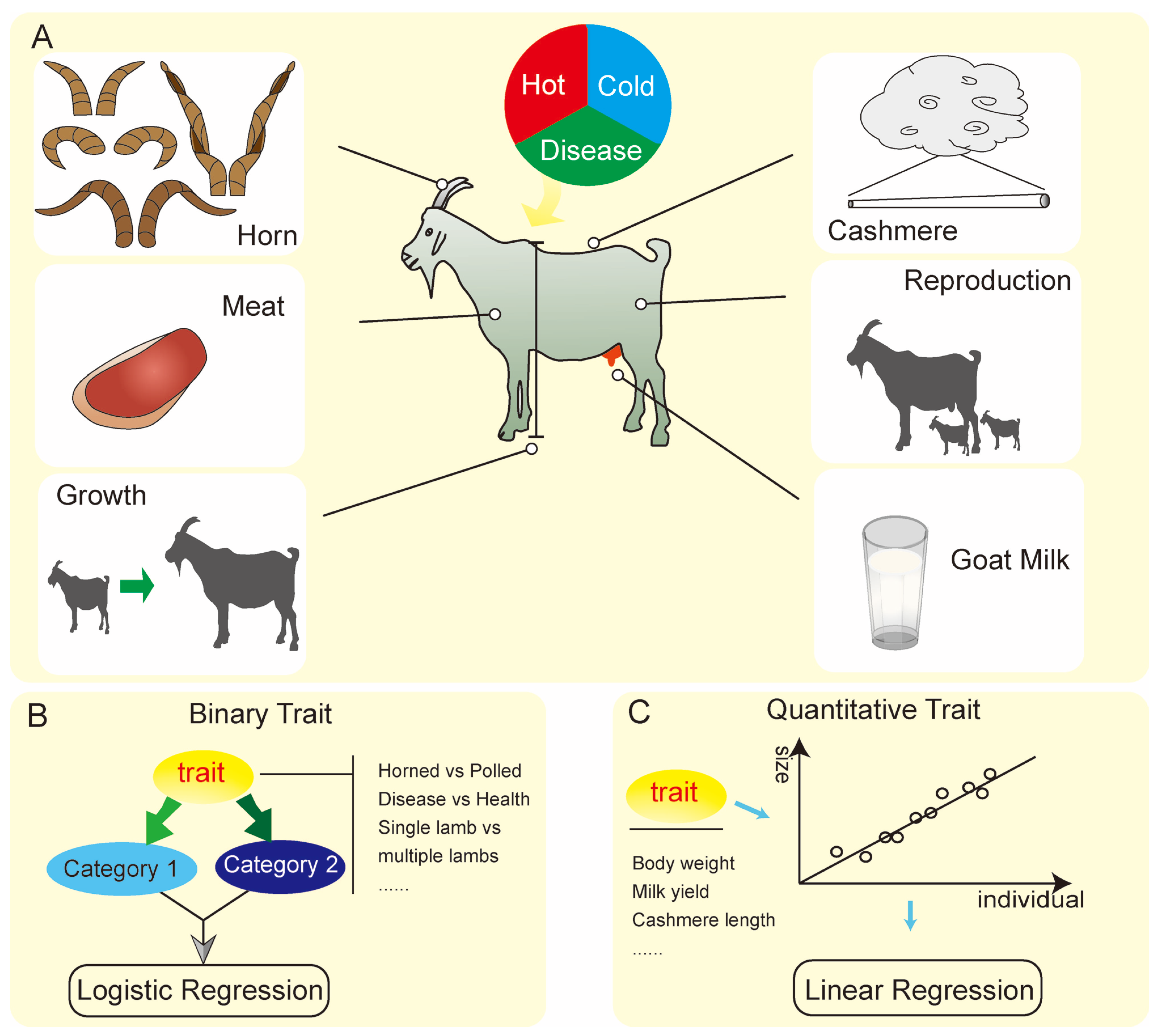
Given the disparities in goat production capabilities, we conventionally adopted distinct nomenclatures for categorizing goats into meat-producing, dairy-yielding, and cashmere-producing varieties. This categorization encompasses five fundamental traits, including growth and development, milk production, cashmere production, reproduction, and other related traits (such as disease resistance and adaptability) (Figure 2A). According to statistics, GWAS Atlas (https://ngdc.cncb.ac.cn/gwas/) (accessed on 2 December 2025) website has compiled 51 traits of goats currently studied by GWAS [26]. To translate these traits into quantifiable and discernible phenotypes, it is imperative to identify exemplary manifestations of trait expression and subsequently transform them into tangible data points. According to different characteristics, the obtained goat phenotype data can be divided into binary variables and continuous variables. Binary variables refer to phenotypes that classify individuals into two distinct categories. A common example is disease status, where animals are categorized as affected (coded as 1) or healthy (coded as 0). Statistical modeling frequently employs logistic regression as the primary analytical tool (Figure 2B). On the other hand, Continuous variables encompass phenotype data that exhibit continuity and adhere to a normal distribution pattern, with statistical models commonly adopting linear regression as the primary analytical tool (Figure 2C). In the realm of phenotype data processing, two prevalent issues arise. Firstly, outliers (phenotype values that deviate significantly from the normal distribution) are liable to emerge during the processing phase, necessitating their exclusion based on a rigorous assessment of their effect size. Secondly, in the case of samples sourced from diverse locations, the phenotype data may be contaminated by environmental influences, thus necessitating the application of a generalized linear model to disentangle and mitigate these effects.

2.3. Genotype

The success of GWAS in uncovering genotype–phenotype associations depends critically on data quality. Advances in sequencing technology have enabled the use of SNP arrays, WGS, and whole-exome sequencing (WES) to generate high-quality genotype data. In goats, the SNP array-based approach is the most widely used and has the most extensive literature, largely due to its cost-effectiveness and speed [27]. A key advantage of WGS and WES is their ability to comprehensively identify variants across the entire genome or exome. Currently, SNP-based GWAS remains the predominant method, although this may change as sequencing costs continue to decline.
The first stage of quality control requires rigorous data verification, highlighting the critical importance of confirming the consistency between the phenotype and genotype data of every individual. On one hand, it is easy to verify if the gender predicted solely from genotype data aligns with the actual gender of the corresponding individual. On the other hand, in scenarios where pedigree information records are available, data validation can be effectively facilitated by utilizing the inferred kinship relationships among individuals [28]. In addition, the handling of genotype data requires a considerably more sophisticated quality control process compared to that needed for phenotype data. The standard quality control protocols for genotype data encompass the following key steps: the elimination of SNPs exhibiting low detection rates (i.e., less than 98–99%), the exclusion of SNPs with infrequent minor allele frequencies (i.e., less than 5%), and the pruning of SNPs that manifest deviations from the Hardy–Weinberg equilibrium (i.e., p < 0.0001). These criteria were assessed using PLINK (v1.9.0) software [29].

2.4. Addressing Population Structure in Goat GWAS Through the Application of Linear Mixed Models

Population structure has serious implications for goat GWAS, which may lead to a spurious association [30]. The conventional approaches for correcting population structure primarily involved the application of genome control (GC) [31] alongside the utilization of principal component analysis (PCA) [32]. Yu et al. successfully integrated population structure and relative phylogenetic relationships of samples within a mixed model framework, resulting in the derivation of a novel MLM [33]. GWAS conducted in goats frequently incorporated kinship matrices to alleviate the confounding effects of population structure. Importantly, MLM was the most commonly used algorithmic model in goat GWAS, which incorporates kinship matrices to alleviate the confounding effects of population structure [34]. The MLM equation is expressed as:
Y = W α + X β + Z u + e
where Y is the vector of phenotypic observations, α is the effect of the SNP tested for association, W is a vector containing the SNP genotype; β is the vector of the fixed effects, X is the incidence matrices assigning observations to fixed effects; u is the vector of the remaining polygenic effect with u ~ N ( 0 , G σ u 2 ) , where G is the genomic-based relationship matrix (GRM) calculated as G = M M 2 p i ( 1 p i ) ; M is the centered genotype matrix, p i is the allele frequency at i -th SNP, and σ u 2 is the additive genetic variance of polygenic effects; Z is the incidence matrix for u ; and e is a vector of residual effects with e ~ N 0 , I σ e 2 , where I is an identity matrix and σ e 2 is the residual variance.
The incorporation of kinship matrices in MLM has been widely adopted in goat GWAS to control population stratification arising from the species’ complex breed structure and varying degrees of genetic relatedness. Due to the large number of goat breeds, GWASs often include an excess of individuals with diverse genetic backgrounds, thereby increasing computational demands [35]. This computational burden has driven the development of optimized algorithms for GWAS, as summarized in Table 1. BLINK (v1.0) software and Farm CPU (v1.2.0) software exhibited remarkable performance in mitigating false positives for traits exhibiting medium to high heritability within the goat population [36]. Although numerous GWAS models have been developed and applied in goat research, the choice of model involves inherent trade-offs among computational speed, statistical rigor, and the ability to account for the complex population structure characteristic of goat breeds. Researchers must carefully consider these factors based on the specific population and genetic background under investigation.

2.5. Bayesian GWAS

MLM introduces random effects, which can account for a large proportion of the known genetic variance. However, in GWAS, the number of markers generally far exceeds the sample size, which can lead to severe overfitting in traditional multiple linear regression. The Bayesian regression framework provides an effective solution to this issue. It incorporates prior distributions to impose statistical constraints, leading to stabilized estimation of effect sizes for all genetic markers [52]. Bayesian GWAS builds upon the linear mixed model by specifying prior distributions for all unknown parameters. A flat prior is used for the fixed effects β , and conditional on the residual variance, σ e 2 , a normal distribution with null mean and covariance matrix R σ e 2 is used for the vector of residuals, where R is a diagonal matrix. The prior assumptions for the marker effects α differ across various Bayesian methods. In BayesA, the prior assumption is that marker effects have identical and independent univariate-t distributions each with a null mean: α i | σ α i 2 ~ N ( 0 , σ α i 2 ) . The variance parameter σ α i 2 for each marker is assigned a scaled inverse chi-square prior [53]; BayesB not only permits marker effect sizes but also explicitly assumes that a proportion of markers have zero effect: α i | π , σ α i 2 ~ 0 N ( 0 , σ α i 2 ) . The parameter π denotes the prior probability of a marker having zero effect. The variance parameter σ α i 2 for each marker is assigned a scaled inverse chi-square prior. In a study on milk production traits in dairy goats, a comparison between Bayesian GWAS and traditional GWAS showed that Bayesian GWAS enhances the precision of QTL mapping [54].

2.6. Multiple Testing Corrections

In goat GWAS, population stratification is pronounced due to the species’ substantial breed diversity, making multiple testing correction a critical step for identifying significant signals. The traditional Bonferroni correction is known to be highly conservative. The calculation formula is: α a d j = α / m . Where α a d j is the adjusted significance threshold after Bonferroni correction, α is the original significance level, m is the number of independent tests performed. Although this method rigorously controls the family-wise error rate, it can lead to an inflated false negative rate a limitation that becomes more pronounced in goat studies with relatively small sample sizes. Furthermore, determining the appropriate number of independent tests ( m ) in goats is not straightforward: LD patterns vary considerably across breeds and genomic regions, and the widely used threshold of 5 × 10⁻⁸, originally derived from human data, may not be directly transferable to goats. An overly stringent threshold risks missing true associations, particularly for polygenic traits. Consequently, many goat GWASs have adopted the false discovery rate (FDR) approach, which serves as a comparatively permissive means of correction and can help mitigate false negatives [55]. However, a more lenient approach may generate an excess of candidate signals, thereby increasing the difficulty of prioritizing causal variants. Currently, goat studies often employ both methods in parallel to capture both large- and small-effect signals; alternatively, the choice of correction method can be tailored to the specific study design and prior knowledge of trait architecture.

3. GWAS Provides a New Perspective for Understanding the Quantitative Traits of Goats

Based on the latest information from the International Goat QTL Database (https://www.animalgenome.org/cgi-bin/QTLdb/CH/index) (accessed on 2 December 2025), a total of 1501 QTLs related to various goat traits have been identified [56]. QTL helps us comprehend the genetic structure of complex traits, involving multiple genes, regulatory pathways, and environmental factors. In contrast to typical QTLs that influence a single trait, certain individual QTLs also play a role in regulating multiple traits. For example, Jiang et al. identified a QTL strongly associated with udder depth, fore udder attachment and rear udder attachment in New Zealand dairy goats through a GWAS [57]. In a previous study, Megan also discovered the same QTL affecting fat yield, protein yield, and milk volume in New Zealand dairy goats via a GWAS [54]. This QTL has been consistently identified across multiple studies, supporting its reliability as a functionally important locus. However, the observed differences in associated traits may suggest the presence of either a pleiotropic gene or a cluster of tightly linked genes within this region that simultaneously influence both the anatomical basis of lactation and production performance. This QTL, closely related to milk production traits, is located on chromosome 19 (24–29 Mb) and encompasses 340 variations within a 5 Mb region. The extensive physical interval encompassed by the QTL, which harbors an abundance of genes, necessitates further refinement through fine mapping [58]. The wide physical interval of this QTL reflects a common limitation in current goat GWAS: due to the constraints of SNP chip density and reference genome completeness, the mapping resolution of these studies remains substantially inadequate. This limitation makes it difficult to determine whether the signal within this region originates from a single pleiotropic locus or from the cumulative effects of multiple adjacent loci. Furthermore, neither study explicitly reported the effect size of this QTL or its confidence interval, precluding an assessment of the variant’s actual contribution to the traits and making it impossible to evaluate whether effect estimates were inflated due to small sample sizes. Future studies involving larger, multi-breed populations are warranted to re-estimate the effect size of this locus, thereby assessing its stability across diverse genetic backgrounds and its potential value in breeding applications. This predicament profoundly illustrates the current challenges in goat QTL research: although we have repeatedly mapped important genomic regions, the path from QTL intervals to causal genes and functional mechanisms remains protracted due to insufficient mapping resolution, ambiguous effect sizes, and the lack of cross-population validation.
The expression patterns of QTLs are intricately interconnected with gene expression profiles. Furthermore, the co-localization of these QTLs with GWAS signals can help in unraveling the underlying mechanisms of non-coding variations that contribute to trait alterations [59]. Co-localization, as a determinant of whether a single variation within a locus concurrently influences both GWAS signals and expression quantitative trait loci (eQTLs), provides an effective approach for identifying potentially causal variations mapped onto the genome, generating strong association signals [60]. From a multi-omics perspective, utilizing expression genome-wide association study (eGWAS), which expands the phenotypic scope of traditional GWAS to include gene expression levels, offers a more comprehensive and nuanced examination of the intricate molecular regulatory network underlying genetic variation [61]. The integration of GWAS and eGWAS facilitates an in-depth exploration of the biological pathways underpinning genetic variation and the intricate mechanisms governing trait expression [62]. Recent research has also vali-dated the significance of integrating the aforementioned two approaches for in-depth analysis of the genetic mechanisms underlying complex traits in live-stock and poultry [63,64,65].

3.1. Modeling Genetic Effects on GWAS

The genetic variance of quantitative traits can be partitioned into additive, dominant, and epistatic effects. Additive effects refer to the effects of multiple gene loci on a quantitative trait being independent and linearly additive; Dominant effects refer to the interaction between two alleles at the same gene locus, where the phenotype of the heterozygote deviates from the average of the phenotypes of the two homozygous parents [66]; Epistatic effects refer to the irregular genetic effects resulting from interactions between different gene loci [67]. Epistatic effects are not independent but are influenced by other genomic factors, making it extremely difficult to dissect the genetic architecture of traits. In contrast, additive and dominant effects can be predicted and modeled due to their inherent regularity. The standard GWAS model estimates additive genetic effects, thereby capturing the additive component of phenotypic variation. Although a model focusing solely on dominance effects can reveal relevant genetic architectures, most current GWAS implementations do not account for them [68]. However, dominant effects are widely prevalent and play important roles in mammals. For example, Cui et al. [69] found that the dominant effect accounts for one-quarter of the genetic variance in all physiological traits in populations of pigs, rats, and mice. Studies in goats have also demonstrated the important role of dominance effects. For instance, in an investigation of a key SNP influencing milk yield and lactose percentage in Norwegian goats, the dominance effect was found to be significantly larger than the additive effect [70]. Compared to traditional models, the adoption of the additive-dominant effect model in GWAS enables the identification of dominant effect loci, which can help us better elucidate the genetic mechanisms under-lying quantitative traits [71]. However, most dominant effects also exhibit minor effects and still require rigorous functional validation to confirm their biological functions.

3.2. Heritability Estimation: From Traits to SNPs

Heritability estimates are essential for evaluating the reliability and expected success of GWAS discoveries. Heritability quantifies the proportion of phenotypic variation that can be attributed to genetic factors, as it directly determines the statistical power of GWAS to detect significant loci [72]. Theoretically, for a given sample size, traits with high heritability (e.g., growth traits) exhibit stronger genetic signals and are more readily detected by GWAS, whereas traits with low heritability (e.g., reproductive traits) have genetic signals that are submerged in environmental noise, necessitating substantially larger sample sizes to achieve comparable detection power. For instance, the heritability assessments for body weight traits of Exotic goats and Boer × Central Highland goats ranged from 0.32 to 0.45 [73] and 0.00–0.50 [74], respectively. The significant heritability result emphasizes the substantial contribution of genetic factors in determining weight traits, enhancing the precision of genes identified by GWASs. However, not all traits exhibit the expected level of heritability. The heritability estimates for reproductive traits in Arsi Bale goats and Beetle goats ranged from 0.01 to 0.13 [75] and 0.03 to 0.10 [76], respectively. GWASs for traits with low heritability exhibit considerably lower statistical power given similar sample sizes. Not only do such studies struggle to detect variants with small effects, but the few significant loci they report are also more prone to overestimated effect sizes. This may partially explain why GWAS findings for reproductive traits in goats are often highly inconsistent and difficult to replicate.
To improve signal detection for these traits, research focus has shifted from estimating overall trait heritability to quantifying the contribution of individual genetic variants (such as SNP) to phenotypic variance. Estimating SNP heritability, which quantifies the proportion of phenotypic variations attributable to SNPs, has provided profound insights into the genetic architectures underlying complex traits in goats [77]. SNP heritability can provide valuable insights: for a trait with low heritability, it indicates whether its genetic architecture is primarily composed of numerous variants with small effects that remain undetected by GWAS, or whether the trait is predominantly driven by environmental factors. This informs the subsequent strategy for GWAS—whether to focus on increasing sample size or improving the accuracy of phenotypic measurement. Various method-ologies, such as LDSC [78], SumHer [79], HEELS [80], exist for estimating SNP heritability using GWAS statistical data. SNP heritability estimation models face computational challenges similar to those encountered in GWAS. Given the close relationship between SNP variation, allele frequency, and LD, adopting a more adaptable heritability model may represent an effective strategy [81].
Beyond its utility in GWAS interpretation, heritability information—particularly SNP heritability—has direct implications for genomic selection (GS), which is increasingly being implemented in goat breeding programs. Heritability estimates serve as key inputs for predicting genomic breeding values (GEBVs), influencing the accuracy of selection and the design of reference populations. For traits with low heritability, such as reproductive traits, GS offers a promising alternative to marker-assisted selection by leveraging genome-wide markers to capture small-effect loci that individually fail to reach GWAS significance. However, the practical implementation of GS in goats is hindered by limited reference population sizes and the instability of heritability estimates across breeds and environments. Addressing these gaps will require coordinated efforts to build large, multi-breed reference populations and to develop statistical models that can accommodate both additive and non-additive genetic architectures.

3.3. GWAS Meta-Analysis

Unlike animals such as pigs and cattle, goats are typically raised without very large-scale farming systems and exhibit vast diversity in breeds and traits. This presents a challenge, as it conflicts with the GWAS requirement for large, homogeneous datasets from uniform environments. In this context, me-ta-analysis provides a viable approach to address these limitations in goat GWAS [82]. Genetic meta-analysis can be broadly divided into two categories: multi-trait meta-analysis within a specific ancestry (such as the MTAG method), and cross-ancestry meta-analysis for a single trait [83]. By integrating GWAS summary statistics of multiple single traits, MTAG effectively corrects for spurious associations and effect size biases caused by sample overlap while simultaneously enhancing statistical power. Most importantly, for traits with high genetic correlations, MTAG can identify pleiotropic loci that jointly influence multiple traits, thereby facilitating the discovery of multiple genes that collectively affect a single trait [84,85]. Multi-ancestry meta-analysis integrates summary statistics from GWAS of the same trait across diverse populations. By pooling these data, it increases the total sample size and enhances the statistical power to detect genetic associations [86]. Although recent studies have identified numerous genetic variants and candidate genes associated with traits in goats, most of these findings are based on single breeds or populations and therefore cannot be generalized to the broader goat population. In this context, employing meta-analysis to integrate multi-breed GWAS data represents a valuable strategy for enhancing the generalizability of research findings. Furthermore, a cross-species meta-analysis involving sheep, cattle, and even humans will provide new insights into the genomic evolution of mammals.

3.4. Bayesian Fine-Mapping

Although GWASs have identified numerous signals associated with goat phenotypes, most of these signals do not directly contribute to the corresponding traits and are selected largely due to LD in the region. GWAS only identifies signals that are statistically associated with phenotypes. The core challenge lies in fine-mapping these signals to pinpoint the causal variants, which is essential for elucidating their biological mechanisms. Currently, the mainstream fine-mapping methods are based on a Bayesian framework [87]. Their core premise is to integrate prior probabilities with likelihood functions to calculate and compare the posterior probabilities of individual variants, thereby inferring the causal variants [88]. The calculation formula for posterior probability is:
P M c D = P ( D | M c ) P ( M c )
The prior probability P ( M c ) is the predefined probability of a variant being causal. Common assumptions include the independent equal probability assumption and the fixed number of causal variants assumption. The likelihood function P ( D | M c ) measures how well the model Mc fits the observed data D (typically GWAS effect sizes and LD matrices). Researchers have developed several statistical fine-mapping methods, including CARMA [89], MESuSIE [90], and FINEMAP [91]. Fine-mapping has been extensively applied to identify causal variants. For example, in a GWAS of migraine using data from 967,534 individuals, fine-mapping across 102 genomic regions (encompassing 122 risk loci) identified seven variants with high posterior probability for causality [92]. In another study, a GWAS of birth weight in 3007 sheep pinpointed three causal variants within a 2.6 kb region through fine-mapping [93]. Fine-mapping, which sifts through abundant GWAS signals to pinpoint key causal variants, is an integral component of GWAS research. However, all fine-mapping methods rely on the LD between causal variants and measured SNPs, and their output depends on the preset prior probabilities. This dependence inevitably influences the results. Additionally, many candidate variants pose significant computational challenges that must be addressed.

4. GWAS Success in Enhancing Goat Breeding by Identifying Variation and Genes

GWAS in goats has identified a substantial number of trait-associated variants, providing key insights into underlying biological mechanisms (Table 2). Due to the complex nature of many goat traits, we adopted the classification framework outlined earlier to systematically summarize and categorize these GWAS findings.

4.1. Reproduction Performance

Litter size is the primary phenotype in the study of reproductive performance, characterized as a trait with low heritability that is intricately regulated by a combination of genes, each contributing subtle yet cumulative effects. GWAS is an effective method used to identify associations between genetic variation and litter size. For example, Mahmoud et al. discovered an important SNP (rs268288690) related to litter size in goats through GWAS. Notably, the mutant allelic variant (GG) of this SNP was found to exert a pronounced positive influence on enhancing litter size [49]. This SNP, situated within the confines of the GABRA5 gene, holds significant potential as a crucial molecular marker. Furthermore, we can embark on a com-prehensive analysis of the genomic regions pinpointed by GWAS, with the aim of elucidating the functional consequences of specific variations. For example, DSCAML1 gene has been demonstrated to exhibit a robust association with reproductive characteristics in Holstein cows [125] as well as dairy goats [126]. Subsequent studies have revealed that the presence of two insertion-deletions (indels) within this gene region exerts a marked influence on litter size, establishing it as a crucial genetic marker [127].
The presence of multiple nipples is a common phenotypic trait in goats, often considered a reproductive characteristic genetically intertwined with other reproductive traits. The genetic evaluation conducted by Pauline et al. [72]. pertaining to multi-nipple traits revealed a heritability estimate ranging from 0.4 to 0.44. Following this, a GWAS was undertaken to delve into the genetic underpinnings of these traits. However, no variants reached genome-wide significance. Instead, several loci displayed suggestive associations, which may warrant further investigation in larger cohorts. This proposition indicates that the manifestation of multi-nipple traits may be intricately orchestrated by a pleiotropic interplay of genetic factors, implying the involvement of multiple genes. The prevalence of multiple genes exerting subtle influences on goat reproductive traits poses a challenge in discerning major effect genes, whereas certain signals correlated with these traits and discerned through GWAS may hint at the occurrence of pivotal regulatory events [128]. It is noteworthy that our research may have inadvertently placed undue emphasis on genetic variations residing within highly significant signals or densely linked regions in the exon region. However, regulatory events frequently occur within intronic regions, as exemplified by Liu et al.’s seminal finding that transcriptional silencing phenomena frequently manifest within the introns of actively transcribed genes [129]. On the other hand, the GWAS signal located in the edge region of LD also plays an important role in trait inheritance. For example, Gazal et al. found that SNPs in genomic regions with low LD levels often explain more heritability [130].

4.2. Meat Production Performance

Our argument posits that the weight and morphological traits shaping the body structure of goats serve as tangible indicators of their meat production potential. In recent years, several GWASs have been conducted to explore the genetic architecture of the weight and morphological traits in goats. Numerous genes associated with body weight traits have been identified, including CRADD and HMGA2, among others [99]. HMGA2 orchestrates transcription processes and plays a pivotal role in modulating gene expression by inducing structural alterations within the DNA architecture [131]. Knockout studies of the HMGA2 gene in mice [132] and pigs [133] have revealed a significant reduction in body weight of about 40% compared to their genetically intact counterparts. In addition, GWAS identified a set of novel candidate genes associated with weight traits, offering avenues for further investigation, including PROM1 and FBXL3, among others [102]. Notably, PROM1 encodes the 5-domain transmembrane glycoprotein prominin-1 (CD133), playing a key role in cellular self-renewal, metabolic processes, and differentiation [134]. Recent studies have shed light on the crucial role of PROM1 in the complex structure of the retina [135]. This indicates that unraveling the causal mechanisms underlying genetic associations, when relying solely on simplistic phenotypic markers, poses a significant challenge in the realm of GWAS research. A strong genetic correlation has been observed between body shape and weight [136], exemplified by high correlation coefficients of 0.975 and 0.962 between body length and chest circumference when correlated with weight [137]. Consistent loci and candidate genes have been identified in multiple trait discoveries in GWAS research. For instance, CNTNAP5 has emerged as a promising candidate gene, exhibiting a robust association with both body weight [138] and hip cross height [139]. GWAS investigations into eight distinct body type traits in Tashi goats have revealed significant similarities in SNPs across various traits, reinforcing the aforementioned perspective [98]. Apart from improving meat production, enhancing meat quality stands as a pivotal goal in goat breeding efforts. Selionova utilized muscle protein and fat content as phenotypic markers in a GWAS, uncovering a significant association between SNPs located at rs268269710 and the quality of goat meat [34].

4.3. Milk Production Performance

A QTL located on chromosome 19 (24–29 Mb) has been identified as a crucial genomic region closely associated with milk production traits. This QTL has been identified to be associated with traits such as fat content [54], protein content [108], milk production [140], breast depth [44], and breast attachment [57] in French dairy goats, British dairy goats, and New Zealand dairy goats. Interestingly, there seems to be a potential inverse relationship between production traits and breast structure within this QTL region. One possible explanation is that these distinct trait categories might be regulated by two neighboring genes or mutational variants present in this genomic segment. Conversely, the observed morphological changes in breast structure may not necessarily correlate with milk production attributes. The quality of goat milk also holds significance in GWAS research. Guan et al. successfully identified QTLs and candidate genes pertinent to protein percentage, lactose content, and dry matter content, through a combined approach of GWAS and transcriptome analysis [19]. Notably, these findings present a notable contrast with the association results reported by Martin et al. [108]. This suggests the presence of genetic heterogeneity among different goat breeds, influenced by variations in the effects of mutations occurring at different frequencies on complex traits across populations [141]. The existence of such genetic diversity among goat breeds raises concerns about the accuracy of goat reference genomes. Hence, the development of breed-specific reference genomes in goats is a worthwhile consideration [142]. In this context, undertaking a multi-breed GWAS could potentially offer a more thorough and comprehensive strategy [143].

4.4. Cashmere Production Performance

GWAS has been progressively advancing in pinpointing specific genetic variations and candidate genes pertaining to both cashmere yield and morphology. In a study by Rong et al., utilizing comprehensive analyses involving GWAS and haplotype construction methods, four key candidate genes crucial to cashmere yield and length have been elucidated: HMX1, ADRA2C, AFAP1, and ABLIM2 [109]. Furthermore, GWAS has played a crucial role in unraveling the genetic mechanisms responsible for goat hair color. For instance, the ASIP gene has been identified as a pivotal factor influencing goat hair color [144], with the 13,420 bp duplication upstream of ASIP being deemed a necessary but not sufficient condition for this phenotype in goats [111].

4.5. Adaptability, Disease Resistance, and Unique Appearance Traits of Goats

Unraveling the genetic basis of adaptability in goats is pivotal for enhancing our comprehension of their ongoing fitness evolution amidst climate change. In a study by Li et al., the significant genetic locus of the PAPSS2 gene was identified as a marker for high-altitude adaptation in goats, through a combination of GWAS and transcriptome data analysis. Subsequent gene knockout experiments underscored the critical role of the PAPSS2 gene in cellular responses to hypoxic stress [118]. The unique horn morphology of goats is closely intertwined with their adaptability to diverse environmental conditions. In addition, the breeding of hornless goats has gained popularity among breeders due to practical reasons such as reduced injury risks and ease of handling during production. GWAS plays a vital role in breeding goat populations with hornless traits. For instance, Zhang et al. utilized GWAS to pinpoint three SNPs associated with the hornless phenotype on Chromosome 1 (Chr1:129789816, Chr1:129791507, and Chr1:129791577) [120]. In contrast to horns, the meat drape characteristic of goats offers insights into their evolutionary trajectory. Reber et al. uncovered a strong correlation signal through GWAS, linked to limb development and growth processes in goats [123]. While GWAS has made significant strides in disease research, its primary focus remains on pivotal diseases affecting goats, notably brucellosis [115].

5. Problems and Countermeasures of Goat Genetic Structure Research Based on GWAS

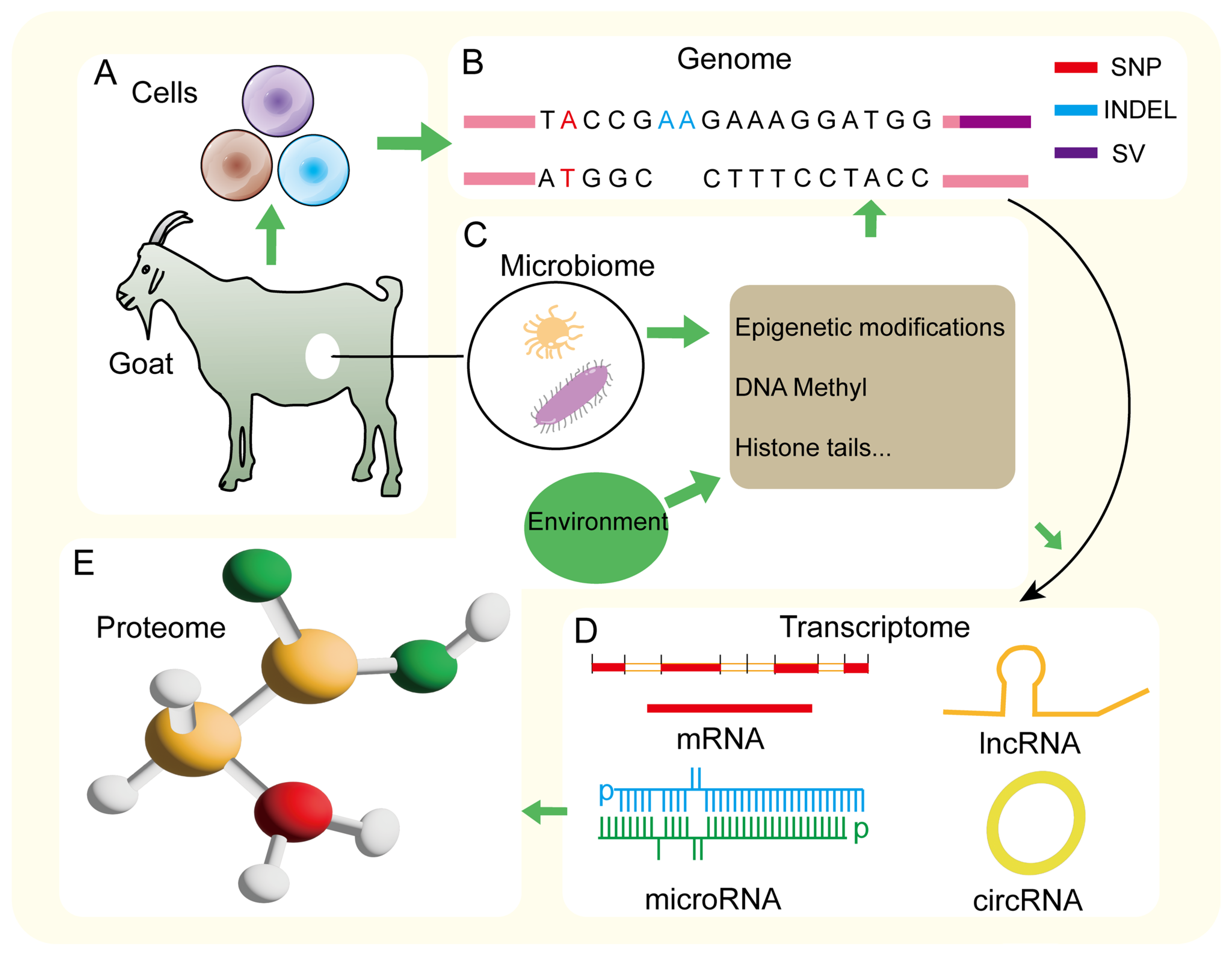
In the two decades following the groundbreaking publication of the first GWAS research article, a vast repository of thousands of relevant gene loci has been meticulously mapped across various species, encompassing humans, animals, and plants. However, the intricate biological mechanisms underlying these associated signals and phenotypic traits remain largely unexplored and inadequately elucidated. In goats, phenotypes can be conceptually categorized based on their proximity to the ultimate biological functions into terminal phenotypes (such as milk yield, growth rate, disease resistance, and other individual or population-level traits) and intermediate phenotypes (such as gene expression patterns, protein abundance, metabolite profiles, and other molecular and cellular-level traits) (Figure 3A). The genetic basis of these phenotypes ultimately originates from genomic variations (e.g., SNPs, Indels, SVs, etc.) (Figure 3B). These variations collectively form a finely regulated biological network by influencing RNA transcription, splicing, stability, and ultimately protein synthesis, modification, and function, thereby determining phenotypic manifestation (Figure 3D,E). Additionally, epigenetically regulated modifications (e.g., DNA methylation and histone modifications) induced by environmental factors, microbial interactions, and other influences directly affect the activity of the genome and transcriptome, profoundly participating in and regulating the molecular networks (Figure 3C). In addressing the elucidation of molecular mechanisms underlying complex traits in goats, integrating multiple types of omics data serves as a comprehensive and effective approach, and represents a key priority for future research.

5.1. The Integration of Diverse Genetic Variation Types Contributes to Elucidating the Heritability Missing Observed in GWAS

The convenience of detection methodologies coupled with the abundance of loci serves as the cornerstone for the prevalence of SNPs as a focal point of research. For instance, the occurrence frequency of SNPs in mammals is approximately 0.1%, highlighting their prevalence and importance in genetic studies [145]. Nonetheless, SNPs often account for merely a fraction (ranging from 2% to 15%) of genetic variability underlying many complex traits. As whole-genome sequencing technology advances, the identification of a broader spectrum of genetic variation types promises to enhance the understanding of phenotypic diversity. By virtue of their composition as amalgamations of multiple tightly linked alleles, haplotypes possess the capacity to discern associations that remain elusive to individual SNP. In their diverse GWAS in barley, Lorenz et al. found that haplotype-based GWAS showed increased efficacy in detecting QTL [146]. Copy number variation (CNV), which is closely linked to gene expression patterns and phenotypic traits, plays a crucial role in phenotypic diversity [147]. In a recent study, Huang et al. conducted a CNV-based GWAS across three ruminant species—cattle, goats, and sheep—revealing Copy Number Variation Regions (CNVRs) shared across these species exhibited greater consistency compared to SNPs [148]. While the overall impact of structural variation (SV) and short tandem repeat sequences (STRs) on complex traits remains incompletely understood, there is evidence suggesting correlations between these genetic features and the manifestation of such traits. Genomic feature analysis by Jakubosky et al. on SV and STR demonstrated a significant of these genetic elements in their association with traits identified through GWAS [149].

5.2. Multi Omics Joint Analysis Helps to Understand Genetic Structure

GWAS have successfully linked thousands of genomic loci to complex traits, yet a persistent challenge remains in elucidating the underlying causal relationship between these genes or associated loci and their corresponding phenotypic manifestations. This challenge has stimulated the development of various omics methodologies aimed at elucidating the intricacies of genetic structure. Building upon the foundation set by GWAS, a series of innovative methodologies have emerged, including Transcriptome-Wide Association Studies (TWAS) [150], epigenetics-wide association study (EWAS) [151], and proteome-wide association study (PWAS) [152], all operating within this methodological framework. TWAS integrates genetic regulation expression (GReX) with GWAS to develop a GreX model, offering insights into the potential correlation between gene expression and traits. This represents a pivotal approach for the integration of functional genomics with GWAS [153]. Mapel et al. identified a significant correlation between splicing events of SPATA16 and fertility through TWAS and co-localization analyses in bull testicular tissue [154]. Epigenetic modifications, prevalent at the transcriptome level, play pivotal roles in shaping the genetic architecture of genes. EWAS represents a methodology designed to capture epigenetic variations that are intricately associated with complex traits, offering a complementary perspective to GWAS. For instance, an EWAS by Lu et al. in mammalian systems revealed a notable correlation between the mutation status of HTT and the onset of Huntington’s disease [155]. PWAS, akin to TWAS, establishes a comprehensive genetic prediction model customized for individual proteins. In a pioneering study, Zhu et al. identified 16 novel protein biomarker candidates closely associated with pancreatic ductal adenocarcinoma (PDAC) using PWAS [156]. Expanding GWAS into other omics fields holds the potential to enhance our understanding of genetic architecture influencing phenotypic variation. Furthermore, Integrating and analyzing ex-tensive datasets across various omics domains is poised to yield more pro-found insights. For instance, Schlosser et al. combined TWAS and PWAS methodologies to compile a comprehensive list of putative causal target genes, tissues, and proteins relevant to kidney function and damage [152].

5.3. Environmental Factors Affect Complex Traits

It is widely recognized that complex traits are influenced by both genetic and environmental factors, as well as their intricate interactions (G × E) [157]. Leveraging the advancements in Mendelian randomization (MR), the identification of G × E interactions can be facilitated through the implementation of level pleiotropy tests within the MR framework. This methodology has been successfully employed in a bibliometric study conducted by the Global Lipid Genetics Alliance, aiming to reveal genetic loci underlying the complex interplay between smoking, alcohol consumption, and lipid traits [158]. The feeding environment significantly impacts the dietary preferences of goats, prompting an exploration into the intricate (G × E) effects related to dietary selection to enhance production efficiency. Walker et al. investigated the varying tendencies of goats in selecting juniper as a food source, analyzing the influence of both genetic predispositions and environmental stimuli on this specific selection behavior [159]. In addition, certain genetic signals unveiled through GWAS have the potential to impact the microbial landscape of the human body, subsequently influencing the manifestations of intricate phenotypic traits [160]. Microbiome-Wide Association Studies (MWAS) represent a powerful approach to uncover microbial signatures intricately linked to the expression of complex traits [161].

6. Perspectives of GWAS in Goat

Over the past decade, extensive GWASs on goat genomes revealed a rich array of genetic variants closely linked to diverse phenotypic traits. Firstly, the remarkable advancements in phenotype measurement technology have significantly mitigated challenges associated with quantifying intricate phenotypic traits in goats. Secondly, the evolution of sequencing methodologies has enhanced our ability to detect genetic variations within the goat genome. Lastly, improved statistical models and computational capabilities have expedited GWAS execution. Together, these advancements strongly support the use of GWAS in goat breeding. In the realm of goat genomics, fine-mapping techniques enable precise localization of QTL and SNP associated with traits identified in GWAS [162]. Meanwhile, the integration of multi-omic analyses and the investigation of gene-environment interactions (G × E) offer a promising avenue to uncover the heritability attributed to previously undetected genes. This effort may lead to a transition from GWAS to Omic-Wide Association Studies (OWAS). The growing capabilities of deep learning models in artificial intelligence (AI) are poised to expand and enhance the application and depth of GWAS. Therefore, prioritizing the development of AI-powered deep learning models tailored for enriching the scope and precision of GWAS in goats is crucial.

Author Contributions

Conceptualization, D.F., C.W. and S.-Q.G.; methodology, S.-Q.G.; investigation, D.F. and C.W.; writing—original draft preparation, D.F., C.W. and S.-Q.G.; writing—review and editing, D.F., C.W., S.-Y.H. and S.-Q.G.; visualization, D.F.; supervision, S.-Q.G.; project administration, S.-Q.G.; funding acquisition, S.-Q.G. All authors have read and agreed to the published version of the manuscript.

Funding

This article was supported by program for scientific research start-upfunds of Guangdong Ocean University (060302052406) (060302052308) and funded by the Guangdong Provincial Department of Education awarded to the College of Coastal Agricultural Sciences, Guangdong Ocean University (2024KCXTD040).

Institutional Review Board Statement

Not applicable.

Informed Consent Statement

Not applicable.

Data Availability Statement

The original contributions presented in this study are included in the article. Further inquiries can be directed to the corresponding author.

Acknowledgments

During the preparation of this manuscript, the authors used Deepseek (V.3.2) for the purposes of grammar correction, language refinement, academic phrasing and formatting assistance. The authors have reviewed and edited the output and take full responsibility for the content of this publication.

Conflicts of Interest

The authors declare no conflicts of interest.

References

  1. Daly, K.G.; Maisano Delser, P.; Mullin, V.E.; Scheu, A.; Mattiangeli, V.; Teasdale, M.D.; Hare, A.J.; Burger, J.; Verdugo, M.P.; Collins, M.J.; et al. Ancient Goat Genomes Reveal Mosaic Domestication in the Fertile Crescent. Science 2018, 361, 85–88. [Google Scholar] [CrossRef]
  2. Naderi, S.; Rezaei, H.-R.; Pompanon, F.; Blum, M.G.B.; Negrini, R.; Naghash, H.-R.; Balkız, Ö.; Mashkour, M.; Gaggiotti, O.E.; Ajmone-Marsan, P.; et al. The Goat Domestication Process Inferred from Large-Scale Mitochondrial DNA Analysis of Wild and Domestic Individuals. Proc. Natl. Acad. Sci. USA 2008, 105, 17659–17664. [Google Scholar] [CrossRef]
  3. Devendra, C. Investments on Pro-Poor Development Projects on Goats: Ensuring Success for Improved Livelihoods. Asian-Australas. J. Anim. Sci. 2013, 26, 1–18. [Google Scholar] [CrossRef] [PubMed]
  4. Johnsson, M. Genomics in Animal Breeding from the Perspectives of Matrices and Molecules. Hereditas 2023, 160, 20, Correction in Hereditas 2023, 160, 24. [Google Scholar] [CrossRef] [PubMed]
  5. Vaiman, D.; Schibler, L.; Bourgeois, F.; Oustry, A.; Amigues, Y.; Cribiu, E.P. A Genetic Linkage Map of the Male Goat Genome. Genetics 1996, 144, 279–305. [Google Scholar] [CrossRef] [PubMed]
  6. Korte, A.; Farlow, A. The Advantages and Limitations of Trait Analysis with GWAS: A Review. Plant Methods 2013, 9, 29. [Google Scholar] [CrossRef]
  7. Klein, R.J.; Zeiss, C.; Chew, E.Y.; Tsai, J.Y.; Sackler, R.S.; Haynes, C.; Henning, A.K.; SanGiovanni, J.P.; Mane, S.M.; Mayne, S.T.; et al. Complement Factor H Polymorphism in Age-Related Macular Degeneration. Science 2005, 308, 385–389. [Google Scholar] [CrossRef]
  8. Tian, D.; Wang, P.; Tang, B.; Teng, X.; Li, C.; Liu, X.; Zou, D.; Song, S.; Zhang, Z. GWAS Atlas: A Curated Resource of Genome-Wide Variant-Trait Associations in Plants and Animals. Nucleic Acids Res. 2020, 48, D927–D932. [Google Scholar] [CrossRef]
  9. Watanabe, K.; Stringer, S.; Frei, O.; Umićević Mirkov, M.; de Leeuw, C.; Polderman, T.J.C.; van der Sluis, S.; Andreassen, O.A.; Neale, B.M.; Posthuma, D. A Global Overview of Pleiotropy and Genetic Architecture in Complex Traits. Nat. Genet. 2019, 51, 1339–1348, Correction in Nat. Genet. 2020, 52, 353. [Google Scholar] [CrossRef]
  10. Tosser-Klopp, G.; Bardou, P.; Bouchez, O.; Cabau, C.; Crooijmans, R.; Dong, Y.; Donnadieu-Tonon, C.; Eggen, A.; Heuven, H.C.M.; Jamli, S.; et al. Design and Characterization of a 52K SNP Chip for Goats. PLoS ONE 2014, 9, e86227, Correction in PLoS ONE 2016, 11, e0152632. [Google Scholar] [CrossRef]
  11. Dong, Y.; Xie, M.; Jiang, Y.; Xiao, N.; Du, X.; Zhang, W.; Tosser-Klopp, G.; Wang, J.; Yang, S.; Liang, J.; et al. Sequencing and Automated Whole-Genome Optical Mapping of the Genome of a Domestic Goat (Capra hircus). Nat. Biotechnol. 2013, 31, 135–141. [Google Scholar] [CrossRef] [PubMed]
  12. Uffelmann, E.; Huang, Q.Q.; Munung, N.S.; De Vries, J.; Okada, Y.; Martin, A.R.; Martin, H.C.; Lappalainen, T.; Posthuma, D. Genome-Wide Association Studies. Nat. Rev. Methods Primers 2021, 1, 59. [Google Scholar] [CrossRef]
  13. Manolio, T.A.; Collins, F.S.; Cox, N.J.; Goldstein, D.B.; Hindorff, L.A.; Hunter, D.J.; McCarthy, M.I.; Ramos, E.M.; Cardon, L.R.; Chakravarti, A.; et al. Finding the Missing Heritability of Complex Diseases. Nature 2009, 461, 747–753. [Google Scholar] [CrossRef] [PubMed]
  14. Sahana, G.; Cai, Z.; Sanchez, M.P.; Bouwman, A.C.; Boichard, D. Invited Review: Good Practices in Genome-Wide Association Studies to Identify Candidate Sequence Variants in Dairy Cattle. J. Dairy Sci. 2023, 106, 5218–5241. [Google Scholar] [CrossRef]
  15. Tesema, Z.; Deribe, B.; Tilahun, M.; Kefale, A.; Alebachew, G.W.; Alemayehu, K.; Getachew, T.; Kebede, D.; Taye, M.; Gizaw, S. Estimation of Crossbreeding and Genetic Parameters for Reproductive Traits of Boer x Central Highland Goats in Ethiopia. PLoS ONE 2023, 18, e0291996, Correction in PLoS ONE 2025, 20, e0318864. [Google Scholar] [CrossRef]
  16. Sun, X.; Niu, Q.; Jiang, J.; Wang, G.; Zhou, P.; Li, J.; Chen, C.; Liu, L.; Xu, L.; Ren, H. Identifying Candidate Genes for Litter Size and Three Morphological Traits in Youzhou Dark Goats Based on Genome-Wide SNP Markers. Genes 2023, 14, 1183. [Google Scholar] [CrossRef]
  17. Tao, L.; He, X.Y.; Jiang, Y.T.; Lan, R.; Li, M.; Li, Z.M.; Yang, W.F.; Hong, Q.H.; Chu, M.X. Combined Approaches to Reveal Genes Associated with Litter Size in Yunshang Black Goats. Anim. Genet. 2020, 51, 924–934. [Google Scholar] [CrossRef]
  18. Barreto, F.Z.; Rosa, J.R.B.F.; Balsalobre, T.W.A.; Pastina, M.M.; Silva, R.R.; Hoffmann, H.P.; de Souza, A.P.; Garcia, A.A.F.; Carneiro, M.S. A Genome-Wide Association Study Identified Loci for Yield Component Traits in Sugarcane (Saccharum spp.). PLoS ONE 2019, 14, e0219843. [Google Scholar] [CrossRef]
  19. Guan, D.; Landi, V.; Luigi-Sierra, M.G.; Delgado, J.V.; Such, X.; Castelló, A.; Cabrera, B.; Mármol-Sánchez, E.; Fernández-Alvarez, J.; de la Torre Casañas, J.L.R.; et al. Analyzing the Genomic and Transcriptomic Architecture of Milk Traits in Murciano-Granadina Goats. J. Anim. Sci. Biotechnol. 2020, 11, 35. [Google Scholar] [CrossRef]
  20. Badia-Bringué, G.; Canive, M.; Vázquez, P.; Garrido, J.M.; Fernández, A.; Juste, R.A.; Jiménez, J.A.; González-Recio, O.; Alonso-Hearn, M. Genome-Wide Association Study Reveals Quantitative Trait Loci and Candidate Genes Associated with High Interferon-Gamma Production in Holstein Cattle Naturally Infected with Mycobacterium Bovis. Int. J. Mol. Sci. 2024, 25, 6165. [Google Scholar] [CrossRef]
  21. Lakhssassi, K.; Meneses, C.; Sarto, M.P.; Serrano, M.; Calvo, J.H. Genome-Wide Analysis Reveals That the Cytochrome P450 Family 7 Subfamily B Member 1 Gene Is Implicated in Growth Traits in Rasa Aragonesa Ewes. Animal 2023, 17, 100975. [Google Scholar] [CrossRef] [PubMed]
  22. Chen, Y.R.; Chao, K.L.; Kim, M.S. Machine Vision Technology for Agricultural Applications. Comput. Electron. Agric. 2002, 36, 173–191. [Google Scholar] [CrossRef]
  23. Gu, J.; Wang, Z.; Gao, R.; Wu, H. Cow Behavior Recognition Based on Image Analysis and Activities. Int. J. Agric. Biol. Eng. 2017, 10, 165–174. [Google Scholar]
  24. Abdellaoui, A.; Yengo, L.; Verweij, K.J.H.; Visscher, P.M. 15 Years of GWAS Discovery: Realizing the Promise. Am. J. Hum. Genet. 2023, 110, 179–194. [Google Scholar] [CrossRef]
  25. Bycroft, C.; Freeman, C.; Petkova, D.; Band, G.; Elliott, L.T.; Sharp, K.; Motyer, A.; Vukcevic, D.; Delaneau, O.; O’Connell, J.; et al. The UK Biobank Resource with Deep Phenotyping and Genomic Data. Nature 2018, 562, 203–209. [Google Scholar] [CrossRef]
  26. Liu, X.; Tian, D.; Li, C.; Tang, B.; Wang, Z.; Zhang, R.; Pan, Y.; Wang, Y.; Zou, D.; Zhang, Z.; et al. GWAS Atlas: An Updated Knowledgebase Integrating More Curated Associations in Plants and Animals. Nucleic Acids Res. 2023, 51, D969–D976. [Google Scholar] [CrossRef]
  27. Kumar, S.; Banks, T.W.; Cloutier, S. SNP Discovery through Next-Generation Sequencing and Its Applications. Int. J. Plant Genom. 2012, 2012, 831460. [Google Scholar] [CrossRef]
  28. Turner, S.; Armstrong, L.L.; Bradford, Y.; Carlson, C.S.; Crawford, D.C.; Crenshaw, A.T.; De Andrade, M.; Doheny, K.F.; Haines, J.L.; Hayes, G.; et al. Quality Control Procedures for Genome-Wide Association Studies. Curr. Protoc. Hum. Genet. 2011, 68, 1.19.1–1.19.18. [Google Scholar] [CrossRef]
  29. Purcell, S.; Neale, B.; Todd-Brown, K.; Thomas, L.; Ferreira, M.A.R.; Bender, D.; Maller, J.; Sklar, P.; de Bakker, P.I.W.; Daly, M.J.; et al. PLINK: A Tool Set for Whole-Genome Association and Population-Based Linkage Analyses. Am. J. Hum. Genet. 2007, 81, 559–575. [Google Scholar] [CrossRef]
  30. Teo, Y.Y. Common Statistical Issues in Genome-Wide Association Studies: A Review on Power, Data Quality Control, Genotype Calling and Population Structure. Curr. Opin. Lipidol. 2008, 19, 133–143. [Google Scholar] [CrossRef]
  31. Devlin, B.; Roeder, K.; Wasserman, L. Genomic Control, a New Approach to Genetic-Based Association Studies. Theor. Popul. Biol. 2001, 60, 155–166. [Google Scholar] [CrossRef]
  32. Price, A.L.; Patterson, N.J.; Plenge, R.M.; Weinblatt, M.E.; Shadick, N.A.; Reich, D. Principal Components Analysis Corrects for Stratification in Genome-Wide Association Studies. Nat. Genet. 2006, 38, 904–909. [Google Scholar] [CrossRef]
  33. Yu, J.; Pressoir, G.; Briggs, W.H.; Vroh Bi, I.; Yamasaki, M.; Doebley, J.F.; McMullen, M.D.; Gaut, B.S.; Nielsen, D.M.; Holland, J.B.; et al. A Unified Mixed-Model Method for Association Mapping That Accounts for Multiple Levels of Relatedness. Nat. Genet. 2006, 38, 203–208. [Google Scholar] [CrossRef] [PubMed]
  34. Selionova, M.; Aibazov, M.; Sermyagin, A.; Belous, A.; Deniskova, T.; Mamontova, T.; Zharkova, E.; Zinovieva, N. Genome-Wide Association and Pathway Analysis of Carcass and Meat Quality Traits in Karachai Young Goats. Animals 2023, 13, 3237. [Google Scholar] [CrossRef] [PubMed]
  35. Loh, P.-R.; Kichaev, G.; Gazal, S.; Schoech, A.P.; Price, A.L. Mixed-Model Association for Biobank-Scale Datasets. Nat. Genet. 2018, 50, 906–908. [Google Scholar] [CrossRef] [PubMed]
  36. Cebeci, Z.; Bayraktar, M.; Gokce, G. Comparison of the Statistical Methods for Genome-Wide Association Studies on Simulated Quantitative Traits of Domesticated Goats (Capra hircus L.). Small Rumin. Res. 2023, 227, 107053. [Google Scholar] [CrossRef]
  37. Nazari-Ghadikolaei, A.; Mehrabani-Yeganeh, H.; Miarei-Aashtiani, S.R.; Staiger, E.A.; Rashidi, A.; Huson, H.J. Genome-Wide Association Studies Identify Candidate Genes for Coat Color and Mohair Traits in the Iranian Markhoz Goat. Front. Genet. 2018, 9, 105. [Google Scholar] [CrossRef]
  38. Kang, H.M.; Zaitlen, N.A.; Wade, C.M.; Kirby, A.; Heckerman, D.; Daly, M.J.; Eskin, E. Efficient Control of Population Structure in Model Organism Association Mapping. Genetics 2008, 178, 1709–1723. [Google Scholar] [CrossRef]
  39. Kang, H.M.; Sul, J.H.; Service, S.K.; Zaitlen, N.A.; Kong, S.; Freimer, N.B.; Sabatti, C.; Eskin, E. Variance Component Model to Account for Sample Structure in Genome-Wide Association Studies. Nat. Genet. 2010, 42, 348–354. [Google Scholar] [CrossRef]
  40. Zhang, Z.; Ersoz, E.; Lai, C.-Q.; Todhunter, R.J.; Tiwari, H.K.; Gore, M.A.; Bradbury, P.J.; Yu, J.; Arnett, D.K.; Ordovas, J.M.; et al. Mixed Linear Model Approach Adapted for Genome-Wide Association Studies. Nat. Genet. 2010, 42, 355–360. [Google Scholar] [CrossRef]
  41. Lippert, C.; Listgarten, J.; Liu, Y.; Kadie, C.M.; Davidson, R.I.; Heckerman, D. FaST Linear Mixed Models for Genome-Wide Association Studies. Nat. Methods 2011, 8, 833–835. [Google Scholar] [CrossRef]
  42. Luigi-Sierra, M.G.; Landi, V.; Guan, D.; Delgado, J.V.; Castelló, A.; Cabrera, B.; Mármol-Sánchez, E.; Alvarez, J.F.; Gómez-Carpio, M.; Martínez, A.; et al. A Genome-Wide Association Analysis for Body, Udder, and Leg Conformation Traits Recorded in Murciano-Granadina Goats. J. Dairy Sci. 2020, 103, 11605–11617. [Google Scholar] [CrossRef] [PubMed]
  43. Zhou, X.; Stephens, M. Genome-Wide Efficient Mixed-Model Analysis for Association Studies. Nat. Genet. 2012, 44, 821–824. [Google Scholar] [CrossRef] [PubMed]
  44. Mucha, S.; Mrode, R.; Coffey, M.; Kizilaslan, M.; Desire, S.; Conington, J. Genome-Wide Association Study of Conformation and Milk Yield in Mixed-Breed Dairy Goats. J. Dairy Sci. 2018, 101, 2213–2225. [Google Scholar] [CrossRef]
  45. Segura, V.; Vilhjálmsson, B.J.; Platt, A.; Korte, A.; Seren, Ü.; Long, Q.; Nordborg, M. An Efficient Multi-Locus Mixed-Model Approach for Genome-Wide Association Studies in Structured Populations. Nat. Genet. 2012, 44, 825–830. [Google Scholar] [CrossRef] [PubMed]
  46. Korte, A.; Vilhjálmsson, B.J.; Segura, V.; Platt, A.; Long, Q.; Nordborg, M. A Mixed-Model Approach for Genome-Wide Association Studies of Correlated Traits in Structured Populations. Nat. Genet. 2012, 44, 1066–1071. [Google Scholar] [CrossRef]
  47. Shangguan, A.; Xiang, C.; Deng, Z.; Zhang, N.; Yu, M.; Zhang, F.; Suo, X.; Chen, M.; Chen, C.; Tao, H.; et al. Genome-Wide Association Study of Growth and Reproductive Traits Based on Low-Coverage Whole-Genome Sequencing in a Chubao Black-Head Goat Population. Gene 2024, 931, 148891. [Google Scholar] [CrossRef]
  48. Liu, X.; Huang, M.; Fan, B.; Buckler, E.S.; Zhang, Z. Iterative Usage of Fixed and Random Effect Models for Powerful and Efficient Genome-Wide Association Studies. PLoS Genet. 2016, 12, e1005767, Correction in PLoS Genet. 2016, 12, e1005957. [Google Scholar] [CrossRef]
  49. Mahmoudi, P.; Rashidi, A.; Nazari-Ghadikolaei, A.; Rostamzadeh, J.; Razmkabir, M.; Huson, H.J. Genome-Wide Association Study Reveals Novel Candidate Genes for Litter Size in Markhoz Goats. Front. Vet. Sci. 2022, 9, 1045589. [Google Scholar] [CrossRef]
  50. Huang, M.; Liu, X.; Zhou, Y.; Summers, R.M.; Zhang, Z. BLINK: A Package for the next Level of Genome-Wide Association Studies with Both Individuals and Markers in the Millions. GigaScience 2019, 8, giy154. [Google Scholar] [CrossRef]
  51. Jiang, L.; Zheng, Z.; Qi, T.; Kemper, K.E.; Wray, N.R.; Visscher, P.M.; Yang, J. A Resource-Efficient Tool for Mixed Model Association Analysis of Large-Scale Data. Nat. Genet. 2019, 51, 1749–1755. [Google Scholar] [CrossRef] [PubMed]
  52. Meuwissen, T.H.; Hayes, B.J.; Goddard, M.E. Prediction of Total Genetic Value Using Genome-Wide Dense Marker Maps. Genetics 2001, 157, 1819–1829. [Google Scholar] [CrossRef] [PubMed]
  53. Gianola, D.; de los Campos, G.; Hill, W.G.; Manfredi, E.; Fernando, R. Additive Genetic Variability and the Bayesian Alphabet. Genetics 2009, 183, 347–363. [Google Scholar] [CrossRef] [PubMed]
  54. Scholtens, M.; Jiang, A.; Smith, A.; Littlejohn, M.; Lehnert, K.; Snell, R.; Lopez-Villalobos, N.; Garrick, D.; Blair, H. Genome-Wide Association Studies of Lactation Yields of Milk, Fat, Protein and Somatic Cell Score in New Zealand Dairy Goats. J. Anim. Sci. Biotechnol. 2020, 11, 55. [Google Scholar] [CrossRef]
  55. Bouaziz, M.; Jeanmougin, M.; Guedj, M. Multiple Testing in Large-Scale Genetic Studies. In Data Production and Analysis in Population Genomics; Pompanon, F., Bonin, A., Eds.; Methods in Molecular Biology; Humana Press: Totowa, NJ, USA, 2012; Volume 888, pp. 213–233. [Google Scholar]
  56. Hu, Z.-L.; Park, C.A.; Wu, X.-L.; Reecy, J.M. Animal QTLdb: An Improved Database Tool for Livestock Animal QTL/Association Data Dissemination in the Post-Genome Era. Nucleic Acids Res. 2013, 41, D871–D879. [Google Scholar] [CrossRef]
  57. Jiang, A.; Ankersmit-Udy, A.; Turner, S.-A.; Scholtens, M.; Littlejohn, M.D.; Lopez-Villalobos, N.; Proser, C.G.; Snell, R.G.; Lehnert, K. A Capra hircus Chromosome 19 Locus Linked to Milk Production Influences Mammary Conformation. J. Anim. Sci. Biotechnol. 2022, 13, 4. [Google Scholar] [CrossRef]
  58. de la Chevrotière, C.; Bishop, S.C.; Arquet, R.; Bambou, J.C.; Schibler, L.; Amigues, Y.; Moreno, C.; Mandonnet, N. Detection of Quantitative Trait Loci for Resistance to Gastrointestinal Nematode Infections in Creole Goats. Anim. Genet. 2012, 43, 768–775. [Google Scholar] [CrossRef]
  59. Nicolae, D.L.; Gamazon, E.; Zhang, W.; Duan, S.; Dolan, M.E.; Cox, N.J. Trait-Associated SNPs Are More Likely to Be eQTLs: Annotation to Enhance Discovery from GWAS. PLoS Genet. 2010, 6, e1000888. [Google Scholar] [CrossRef]
  60. Hormozdiari, F.; van de Bunt, M.; Segrè, A.V.; Li, X.; Joo, J.W.J.; Bilow, M.; Sul, J.H.; Sankararaman, S.; Pasaniuc, B.; Eskin, E. Colocalization of GWAS and eQTL Signals Detects Target Genes. Am. J. Hum. Genet. 2016, 99, 1245–1260. [Google Scholar] [CrossRef]
  61. Puig-Oliveras, A.; Revilla, M.; Castello, A.; Fernandez, A.I.; Folch, J.M.; Ballester, M. Expression-Based GWAS Identifies Variants, Gene Interactions and Key Regulators Affecting Intramuscular Fatty Acid Content and Composition in Porcine Meat. Sci. Rep. 2016, 6, 31803, Correction in Sci. Rep. 2022, 12, 4902. [Google Scholar] [CrossRef]
  62. Yang, G.; Pan, Y.; Pan, W.; Song, Q.; Zhang, R.; Tong, W.; Cui, L.; Ji, W.; Song, W.; Song, B.; et al. Combined GWAS and eGWAS Reveals the Genetic Basis Underlying Drought Tolerance in Emmer Wheat (Triticum turgidum L.). New Phytol. 2024, 242, 2115–2131. [Google Scholar] [CrossRef]
  63. Zhu, D.; Shi, K.; The ChickenGTEx Consortium; Zhu, X.; Zhong, C.; Pan, Z.; Gao, Y.; Teng, J.; Lin, Q.; Li, B.; et al. Egg-Laying ChickenGTEx Resource Deciphers Context-Specific Regulatory Effects on Fertility Traits. Nat. Commun. 2025, 17, 553. [Google Scholar] [CrossRef]
  64. Zhu, X.; Li, C.; Luo, C.; Bai, Z.; Shu, D.; Chen, P.; Ren, J.; Song, R.; Fang, L.; Qu, H.; et al. Mapping the Regulatory Genetic Landscape of Complex Traits Using a Chicken Advanced Intercross Line. Nat. Commun. 2025, 16, 5841. [Google Scholar] [CrossRef]
  65. Xu, Z.; Zeng, H.; Teng, J.; Ding, X.; Li, J.; Zhang, Z. Integrating eQTL and Genome-Wide Association Studies to Uncover Additive and Dominant Regulatory Circuits in Pig Uterine Capacity. Animal 2025, 19, 101599. [Google Scholar] [CrossRef] [PubMed]
  66. Su, G.; Christensen, O.F.; Ostersen, T.; Henryon, M.; Lund, M.S. Estimating Additive and Non-Additive Genetic Variances and Predicting Genetic Merits Using Genome-Wide Dense Single Nucleotide Polymorphism Markers. PLoS ONE 2012, 7, e45293. [Google Scholar] [CrossRef] [PubMed]
  67. Minvielle, F. Dominance Is Not Necessary for Heterosis: A Two-Locus Model. Genet. Res. 1987, 49, 245–247. [Google Scholar] [CrossRef]
  68. Monir, M.M.; Zhu, J. Dominance and Epistasis Interactions Revealed as Important Variants for Leaf Traits of Maize NAM Population. Front. Plant Sci. 2018, 9, 627. [Google Scholar] [CrossRef]
  69. Cui, L.; Yang, B.; Xiao, S.; Gao, J.; Baud, A.; Graham, D.; McBride, M.; Dominiczak, A.; Schafer, S.; Aumatell, R.L.; et al. Dominance Is Common in Mammals and Is Associated with Trans-Acting Gene Expression and Alternative Splicing. Genome Biol. 2023, 24, 215. [Google Scholar] [CrossRef]
  70. Dagnachew, B.S.; Thaller, G.; Lien, S.; Ådnøy, T. Casein SNP in Norwegian Goats: Additive and Dominance Effects on Milk Composition and Quality. Genet. Sel. Evol. 2011, 43, 31. [Google Scholar] [CrossRef]
  71. Vitezica, Z.G.; Varona, L.; Legarra, A. On the Additive and Dominant Variance and Covariance of Individuals within the Genomic Selection Scope. Genetics 2013, 195, 1223–1230. [Google Scholar] [CrossRef]
  72. Martin, P.; Palhière, I.; Tosser-Klopp, G.; Rupp, R. Heritability and Genome-Wide Association Mapping for Supernumerary Teats in French Alpine and Saanen Dairy Goats. J. Dairy Sci. 2016, 99, 8891–8900, Correction in J. Dairy Sci. 2017, 100, 7750. [Google Scholar] [CrossRef] [PubMed]
  73. Hassan, M.; Sultana, S.; Iqbal, A.; Talukder, M. Estimation of Heritability, Breeding Values and Genetic Trends for Growth Traits of Exotic Goat. Int. J. Nat. Sci. 2016, 3, 7–11. [Google Scholar] [CrossRef]
  74. Tesema, Z.; Alemayehu, K.; Getachew, T.; Kebede, D.; Deribe, B.; Taye, M.; Tilahun, M.; Lakew, M.; Kefale, A.; Belayneh, N.; et al. Estimation of Genetic Parameters for Growth Traits and Kleiber Ratios in Boer × Central Highland Goat. Trop. Anim. Health Prod. 2020, 52, 3195–3205. [Google Scholar] [CrossRef] [PubMed]
  75. Kebede, T.; Haile, A.; Dadi, H.; Alemu, T. Genetic and Phenotypic Parameter Estimates for Reproduction Traits in Indigenous Arsi-Bale Goats. Trop. Anim. Health Prod. 2012, 44, 1007–1015. [Google Scholar] [CrossRef]
  76. Bangar, Y.C.; Magotra, A.; Yadav, A.S.; Chauhan, A. Estimation of Genetic Parameters for Early Reproduction Traits in Beetal Goat. Zygote 2022, 30, 279–284. [Google Scholar] [CrossRef]
  77. Wang, X.; Glubb, D.M.; O’Mara, T.A. 10 Years of GWAS Discovery in Endometrial Cancer: Aetiology, Function and Translation. eBioMedicine 2022, 77, 103895. [Google Scholar] [CrossRef]
  78. Bulik-Sullivan, B.K.; Loh, P.-R.; Finucane, H.K.; Ripke, S.; Yang, J.; Schizophrenia Working Group of the Psychiatric Genomics Consortium; Patterson, N.; Daly, M.J.; Price, A.L.; Neale, B.M. LD Score Regression Distinguishes Confounding from Polygenicity in Genome-Wide Association Studies. Nat. Genet. 2015, 47, 291–295. [Google Scholar] [CrossRef]
  79. Speed, D.; Balding, D.J. SumHer Better Estimates the SNP Heritability of Complex Traits from Summary Statistics. Nat. Genet. 2019, 51, 277–284. [Google Scholar] [CrossRef]
  80. Li, H.; Mazumder, R.; Lin, X. Accurate and Efficient Estimation of Local Heritability Using Summary Statistics and the Linkage Disequilibrium Matrix. Nat. Commun. 2023, 14, 7954. [Google Scholar] [CrossRef]
  81. Speed, D.; Hemani, G.; Johnson, M.R.; Balding, D.J. Improved Heritability Estimation from Genome-Wide SNPs. Am. J. Hum. Genet. 2012, 91, 1011–1021. [Google Scholar] [CrossRef]
  82. Defo, J.; Awany, D.; Ramesar, R. From SNP to Pathway-Based GWAS Meta-Analysis: Do Current Meta-Analysis Approaches Resolve Power and Replication in Genetic Association Studies? Brief. Bioinform. 2023, 24, bbac600. [Google Scholar] [CrossRef]
  83. Khunsriraksakul, C.; Li, Q.; Markus, H.; Patrick, M.T.; Sauteraud, R.; McGuire, D.; Wang, X.; Wang, C.; Wang, L.; Chen, S.; et al. Multi-Ancestry and Multi-Trait Genome-Wide Association Meta-Analyses Inform Clinical Risk Prediction for Systemic Lupus Erythematosus. Nat. Commun. 2023, 14, 668. [Google Scholar] [CrossRef] [PubMed]
  84. Yang, H.; Li, T.; Zhang, N.; Chen, J.; Zhang, Y.; Peng, S.; Zhou, L.; Ma, R.; Zhang, Z.; Liu, Q.; et al. Identification of Candidate Genes and Functional Pathways Associated with Body Size Traits in Hulunbuir Sheep through GWAS Analysis. Genes 2025, 16, 410. [Google Scholar] [CrossRef] [PubMed]
  85. Bolormaa, S.; Swan, A.A.; Brown, D.J.; Hatcher, S.; Moghaddar, N.; van der Werf, J.H.; Goddard, M.E.; Daetwyler, H.D. Multiple-Trait QTL Mapping and Genomic Prediction for Wool Traits in Sheep. Genet. Sel. Evol. 2017, 49, 62. [Google Scholar] [CrossRef] [PubMed]
  86. Cao, X.; Jiang, M.; Guan, Y.; Li, S.; Duan, C.; Gong, Y.; Kong, Y.; Shao, Z.; Wu, H.; Yao, X.; et al. Trans-Ancestry GWAS Identifies 59 Loci and Improves Risk Prediction and Fine-Mapping for Kidney Stone Disease. Nat. Commun. 2025, 16, 3473. [Google Scholar] [CrossRef]
  87. Li, Z.; Zhou, X. Towards Improved Fine-Mapping of Candidate Causal Variants. Nat. Rev. Genet. 2025, 26, 847–861. [Google Scholar] [CrossRef]
  88. Schaid, D.J.; Chen, W.; Larson, N.B. From Genome-Wide Associations to Candidate Causal Variants by Statistical Fine-Mapping. Nat. Rev. Genet. 2018, 19, 491–504. [Google Scholar] [CrossRef]
  89. Yang, Z.; Wang, C.; Liu, L.; Khan, A.; Lee, A.; Vardarajan, B.; Mayeux, R.; Kiryluk, K.; Ionita-Laza, I. CARMA Is a New Bayesian Model for Fine-Mapping in Genome-Wide Association Meta-Analyses. Nat. Genet. 2023, 55, 1057–1065. [Google Scholar] [CrossRef]
  90. Gao, B.; Zhou, X. MESuSiE Enables Scalable and Powerful Multi-Ancestry Fine-Mapping of Causal Variants in Genome-Wide Association Studies. Nat. Genet. 2024, 56, 170–179. [Google Scholar] [CrossRef]
  91. Benner, C.; Spencer, C.C.A.; Havulinna, A.S.; Salomaa, V.; Ripatti, S.; Pirinen, M. FINEMAP: Efficient Variable Selection Using Summary Data from Genome-Wide Association Studies. Bioinformatics 2016, 32, 1493–1501. [Google Scholar] [CrossRef]
  92. Hautakangas, H.; Kartau, J.; Palotie, A.; Pirinen, M. Fine-Mapping a Genome-Wide Meta-Analysis of 98,374 Migraine Cases Identifies 181 Sets of Candidate Causal Variants. Nat. Commun. 2026, 17, 355. [Google Scholar] [CrossRef]
  93. Li, R.; Bai, Y.; Zhao, M.; Zhang, X.; Wang, H.; Feng, B.; Zhang, S.; Zhang, H.; Ren, G.; Wang, X.; et al. Fine Mapping Genetic Variants Affecting Birth Weight in Sheep: A GWAS of 3007 Individuals Using Low-Coverage Whole Genome Sequencing. J. Anim. Sci. Biotechnol. 2025, 16, 115. [Google Scholar] [CrossRef] [PubMed]
  94. Fang, X.; Gu, B.; Chen, M.; Sun, R.; Zhang, J.; Zhao, L.; Zhao, Y. Genome-Wide Association Study of the Reproductive Traits of the Dazu Black Goat (Capra hircus) Using Whole-Genome Resequencing. Genes 2023, 14, 1960. [Google Scholar] [CrossRef] [PubMed]
  95. Al-Abri, M.; Kharousi, K.A.; Hamrashdi, A.A.; Toobi, A.G.A.; Salem, M.M.I. Genome Wide Association Analysis for Twinning Ability in Jabal Akhdar Omani Goats. Small Rumin. Res. 2023, 221, 106951. [Google Scholar] [CrossRef]
  96. Sun, X.; Jiang, J.; Wang, G.; Zhou, P.; Li, J.; Chen, C.; Liu, L.; Li, N.; Xia, Y.; Ren, H. Genome-Wide Association Analysis of Nine Reproduction and Morphological Traits in Three Goat Breeds from Southern China. Anim. Biosci. 2023, 36, 191–199. [Google Scholar] [CrossRef]
  97. Islam, R.; Liu, X.; Gebreselassie, G.; Abied, A.; Ma, Q.; Ma, Y. Genome-Wide Association Analysis Reveals the Genetic Locus for High Reproduction Trait in Chinese Arbas Cashmere Goat. Genes Genom. 2020, 42, 893–899. [Google Scholar] [CrossRef]
  98. Yang, R.; Zhou, D.; Tan, X.; Zhao, Z.; Lv, Y.; Tian, X.; Ren, L.; Wang, Y.; Li, J.; Zhao, Y.; et al. Genome-Wide Association Study of Body Conformation Traits in Tashi Goats (Capra hircus). Animals 2024, 14, 1145. [Google Scholar] [CrossRef]
  99. Easa, A.A.; Selionova, M.; Aibazov, M.; Mamontova, T.; Sermyagin, A.; Belous, A.; Abdelmanova, A.; Deniskova, T.; Zinovieva, N. Identification of Genomic Regions and Candidate Genes Associated with Body Weight and Body Conformation Traits in Karachai Goats. Genes 2022, 13, 1773. [Google Scholar] [CrossRef]
  100. Han, M.; Wang, X.; Du, H.; Cao, Y.; Zhao, Z.; Niu, S.; Bao, X.; Rong, Y.; Ao, X.; Guo, F.; et al. Genome-Wide Association Study Identifies Candidate Genes Affecting Body Conformation Traits of Zhongwei Goat. BMC Genom. 2025, 26, 37. [Google Scholar] [CrossRef]
  101. Ncube, K.T.; Dzomba, E.F.; Hadebe, K.; Soma, P.; Frylinck, L.; Muchadeyi, F.C. Carcass Quality Profiles and Associated Genomic Regions of South African Goat Populations Investigated Using Goat SNP50K Genotypes. Animals 2022, 12, 364. [Google Scholar] [CrossRef]
  102. Zhang, L.; Wang, F.; Gao, G.; Yan, X.; Liu, H.; Liu, Z.; Wang, Z.; He, L.; Lv, Q.; Wang, Z.; et al. Genome-Wide Association Study of Body Weight Traits in Inner Mongolia Cashmere Goats. Front. Vet. Sci. 2021, 8, 752746. [Google Scholar] [CrossRef]
  103. Luigi-Sierra, M.G.; Martínez, A.; Macri, M.; Delgado, J.V.; Castelló, A.; Alvarez, J.F.; Such, X.; Jordana, J.; Amills, M. Single and Longitudinal Genome-Wide Association Studies for Dairy Traits Available in Goats with Three Recorded Lactations. Anim. Genet. 2024, 55, 257–264. [Google Scholar] [CrossRef] [PubMed]
  104. Selionova, M.; Trukhachev, V.; Aibazov, M.; Sermyagin, A.; Belous, A.; Gladkikh, M.; Zinovieva, N. Genome-Wide Association Study of Milk Composition in Karachai Goats. Animals 2024, 14, 327. [Google Scholar] [CrossRef] [PubMed]
  105. Massender, E.; Oliveira, H.R.; Brito, L.F.; Maignel, L.; Jafarikia, M.; Baes, C.F.; Sullivan, B.; Schenkel, F.S. Genome-Wide Association Study for Milk Production and Conformation Traits in Canadian Alpine and Saanen Dairy Goats. J. Dairy Sci. 2023, 106, 1168–1189. [Google Scholar] [CrossRef] [PubMed]
  106. Talouarn, E.; Bardou, P.; Palhière, I.; Oget, C.; Clément, V.; VarGoats Consortium; Tosser-Klopp, G.; Rupp, R.; Robert-Granié, C. Genome Wide Association Analysis on Semen Volume and Milk Yield Using Different Strategies of Imputation to Whole Genome Sequence in French Dairy Goats. BMC Genet. 2020, 21, 19. [Google Scholar] [CrossRef]
  107. Tilahun, Y.; Gipson, T.A.; Alexander, T.; McCallum, M.L.; Hoyt, P.R. Genome-Wide Association Study towards Genomic Predictive Power for High Production and Quality of Milk in American Alpine Goats. Int. J. Genom. 2020, 2020, 6035694. [Google Scholar] [CrossRef]
  108. Martin, P.; Palhière, I.; Maroteau, C.; Bardou, P.; Canale-Tabet, K.; Sarry, J.; Woloszyn, F.; Bertrand-Michel, J.; Racke, I.; Besir, H.; et al. A Genome Scan for Milk Production Traits in Dairy Goats Reveals Two New Mutations in Dgat1 Reducing Milk Fat Content. Sci. Rep. 2017, 7, 1872, Correction in Sci. Rep. 2018, 8, 4060. [Google Scholar] [CrossRef]
  109. Rong, Y.; Wang, X.; Na, Q.; Ao, X.; Xia, Q.; Guo, F.; Han, M.; Ma, R.; Shang, F.; Liu, Y.; et al. Genome-Wide Association Study for Cashmere Traits in Inner Mongolia Cashmere Goat Population Reveals New Candidate Genes and Haplotypes. BMC Genom. 2024, 25, 658. [Google Scholar] [CrossRef]
  110. Lu, X.; Suo, L.; Yan, X.; Li, W.; Su, Y.; Zhou, B.; Liu, C.; Yang, L.; Wang, J.; Ji, D.; et al. Genome-Wide Association Analysis of Fleece Traits in Northwest Xizang White Cashmere Goat. Front. Vet. Sci. 2024, 11, 1409084. [Google Scholar] [CrossRef]
  111. Guo, J.; Sun, X.; Mao, A.; Liu, H.; Zhan, S.; Li, L.; Zhong, T.; Wang, L.; Cao, J.; Liu, G.E.; et al. A 13.42-Kb Tandem Duplication at the ASIP Locus Is Strongly Associated with the Depigmentation Phenotype of Non-Classic Swiss Markings in Goats. BMC Genom. 2022, 23, 437. [Google Scholar] [CrossRef]
  112. Wang, F.H.; Zhang, L.; Gong, G.; Yan, X.C.; Zhang, L.T.; Zhang, F.T.; Liu, H.F.; Lv, Q.; Wang, Z.Y.; Wang, R.J.; et al. Genome-Wide Association Study of Fleece Traits in Inner Mongolia Cashmere Goats. Anim. Genet. 2021, 52, 375–379. [Google Scholar] [CrossRef] [PubMed]
  113. Qiao, X.; Su, R.; Wang, Y.; Wang, R.; Yang, T.; Li, X.; Chen, W.; He, S.; Jiang, Y.; Xu, Q.; et al. Genome-Wide Target Enrichment-Aided Chip Design: A 66 K SNP Chip for Cashmere Goat. Sci. Rep. 2017, 7, 8621. [Google Scholar] [CrossRef] [PubMed]
  114. Becker, D.; Otto, M.; Ammann, P.; Keller, I.; Drögemüller, C.; Leeb, T. The Brown Coat Colour of Coppernecked Goats Is Associated with a Non-Synonymous Variant at the TYRP1 Locus on Chromosome 8. Anim. Genet. 2015, 46, 50–54, Correction in Anim. Genet. 2015, 46, 470. [Google Scholar] [CrossRef] [PubMed]
  115. Sallam, A.M.; Abou-Souliman, I.; Reyer, H.; Wimmers, K.; Rabee, A.E. New Insights into the Genetic Predisposition of Brucellosis and Its Effect on the Gut and Vaginal Microbiota in Goats. Sci. Rep. 2023, 13, 20086. [Google Scholar] [CrossRef]
  116. Estrada-Reyes, Z.M.; Tsukahara, Y.; Goetsch, A.L.; Gipson, T.A.; Sahlu, T.; Puchala, R.; Mateescu, R.G. Association Analysis of Immune Response Loci Related to Haemonchus Contortus Exposure in Sheep and Goats Using a Targeted Approach. Livest. Sci. 2019, 228, 109–119. [Google Scholar] [CrossRef]
  117. Silva, F.F.; Bambou, J.C.; Oliveira, J.A.; Barbier, C.; Fleury, J.; Machado, T.; Mandonnet, N. Genome Wide Association Study Reveals New Candidate Genes for Resistance to Nematodes in Creole Goat. Small Rumin. Res. 2018, 166, 109–114. [Google Scholar] [CrossRef]
  118. Li, C.; Wu, Y.; Chen, B.; Cai, Y.; Guo, J.; Leonard, A.S.; Kalds, P.; Zhou, S.; Zhang, J.; Zhou, P.; et al. Markhor-Derived Introgression of a Genomic Region Encompassing PAPSS2 Confers High-Altitude Adaptability in Tibetan Goats. Mol. Biol. Evol. 2022, 39, msac253. [Google Scholar] [CrossRef]
  119. Sánchez-Molano, E.; Kapsona, V.V.; Ilska, J.J.; Desire, S.; Conington, J.; Mucha, S.; Banos, G. Genetic Analysis of Novel Phenotypes for Farm Animal Resilience to Weather Variability. BMC Genet. 2019, 20, 84. [Google Scholar] [CrossRef]
  120. Zhang, F.; Liu, Q.; Gong, P.; Wang, Y.; Shi, C.; Zhu, L.; Zhao, J.; Yao, W.; Luo, J. Genome-Wide Association Study Provided Insights into the Polled Phenotype and Polled Intersex Syndrome (PIS) in Goats. BMC Genom. 2024, 25, 661. [Google Scholar] [CrossRef]
  121. Guo, J.; Jiang, R.; Mao, A.; Liu, G.E.; Zhan, S.; Li, L.; Zhong, T.; Wang, L.; Cao, J.; Chen, Y.; et al. Genome-Wide Association Study Reveals 14 New SNPs and Confirms Two Structural Variants Highly Associated with the Horned/Polled Phenotype in Goats. BMC Genom. 2021, 22, 769, Correction in BMC Genom. 2022, 23, 117. [Google Scholar] [CrossRef]
  122. Kijas, J.W.; Ortiz, J.S.; McCulloch, R.; James, A.; Brice, B.; Swain, B.; Tosser-Klopp, G. International Goat Genome Consortium Genetic Diversity and Investigation of Polledness in Divergent Goat Populations Using 52 088 SNPs. Anim. Genet. 2013, 44, 325–335. [Google Scholar] [CrossRef] [PubMed]
  123. Reber, I.; Keller, I.; Becker, D.; Flury, C.; Welle, M.; Drögemüller, C. Wattles in Goats Are Associated with the FMN1/GREM1 Region on Chromosome 10. Anim. Genet. 2015, 46, 316–320. [Google Scholar] [CrossRef] [PubMed]
  124. Mulim, H.A.; Walker, J.W.; Waldron, D.F.; Quadros, D.G.; Benfica, L.F.; de Carvalho, F.E.; Brito, L.F. Genetic Background of Juniper (Juniperus spp.) Consumption Predicted by Fecal near-Infrared Spectroscopy in Divergently Selected Goats Raised in Harsh Rangeland Environments. BMC Genom. 2024, 25, 107. [Google Scholar] [CrossRef] [PubMed]
  125. Qin, C.; Yin, H.; Zhang, X.; Sun, D.; Zhang, Q.; Liu, J.; Ding, X.; Zhang, Y.; Zhang, S. Genome-Wide Association Study for Semen Traits of the Bulls in Chinese Holstein. Anim. Genet. 2017, 48, 80–84. [Google Scholar] [CrossRef]
  126. Lai, F.-N.; Zhai, H.-L.; Cheng, M.; Ma, J.-Y.; Cheng, S.-F.; Ge, W.; Zhang, G.-L.; Wang, J.-J.; Zhang, R.-Q.; Wang, X.; et al. Whole-Genome Scanning for the Litter Size Trait Associated Genes and SNPs under Selection in Dairy Goat (Capra hircus). Sci. Rep. 2016, 6, 38096. [Google Scholar] [CrossRef]
  127. Wang, K.; Kang, Z.; Jiang, E.; Yan, H.; Zhu, H.; Liu, J.; Qu, L.; Lan, X.; Pan, C. Genetic Effects of DSCAML1 Identified in Genome-Wide Association Study Revealing Strong Associations with Litter Size and Semen Quality in Goat (Capra hircus). Theriogenology 2020, 146, 20–25. [Google Scholar] [CrossRef]
  128. Simo, J.K.; Meutchieye, F.; Wouobeng, P.; Tarekegn, G.M.; Mutai, C.; Nandolo, W.; Pelle, R.; Djikeng, A.; Manjeli, Y. Genome-Wide Association Study for the Level of Prolificacy in Cameroon’s Native Goat. J. Appl. Anim. Res. 2024, 52, 2291472. [Google Scholar] [CrossRef]
  129. Liu, N.; Lee, C.H.; Swigut, T.; Grow, E.; Gu, B.; Bassik, M.C.; Wysocka, J. Selective Silencing of Euchromatic L1s Revealed by Genome-Wide Screens for L1 Regulators. Nature 2018, 553, 228–232. [Google Scholar] [CrossRef]
  130. Gazal, S.; Finucane, H.K.; Furlotte, N.A.; Loh, P.-R.; Palamara, P.F.; Liu, X.; Schoech, A.; Bulik-Sullivan, B.; Neale, B.M.; Gusev, A.; et al. Linkage Disequilibrium-Dependent Architecture of Human Complex Traits Shows Action of Negative Selection. Nat. Genet. 2017, 49, 1421–1427, Correction in Nat. Genet. 2019, 51, 1295. [Google Scholar] [CrossRef]
  131. Mansoori, B.; Mohammadi, A.; Ditzel, H.J.; Duijf, P.H.G.; Khaze, V.; Gjerstorff, M.F.; Baradaran, B. HMGA2 as a Critical Regulator in Cancer Development. Genes 2021, 12, 269. [Google Scholar] [CrossRef]
  132. Su, L.; Deng, Z.; Leng, F. The Mammalian High Mobility Group Protein AT-Hook 2 (HMGA2): Biochemical and Biophysical Properties, and Its Association with Adipogenesis. Int. J. Mol. Sci. 2020, 21, 3710. [Google Scholar] [CrossRef]
  133. Chung, J.; Zhang, X.; Collins, B.; Sper, R.B.; Gleason, K.; Simpson, S.; Koh, S.; Sommer, J.; Flowers, W.L.; Petters, R.M.; et al. High Mobility Group A2 (HMGA2) Deficiency in Pigs Leads to Dwarfism, Abnormal Fetal Resource Allocation, and Cryptorchidism. Proc. Natl. Acad. Sci. USA 2018, 115, 5420–5425. [Google Scholar] [CrossRef] [PubMed]
  134. Li, Z. CD133: A Stem Cell Biomarker and Beyond. Exp. Hematol. Oncol. 2013, 2, 17. [Google Scholar] [CrossRef] [PubMed]
  135. Puertas-Neyra, K.; Coco-Martin, R.M.; Hernandez-Rodriguez, L.A.; Gobelli, D.; Garcia-Ferrer, Y.; Palma-Vecino, R.; Tellería, J.J.; Simarro, M.; de la Fuente, M.A.; Fernandez-Bueno, I. Clinical Exome Analysis and Targeted Gene Repair of the c.1354dupT Variant in iPSC Lines from Patients with PROM1-Related Retinopathies Exhibiting Diverse Phenotypes. Stem Cell Res. Ther. 2024, 15, 192. [Google Scholar] [CrossRef] [PubMed]
  136. Mulhall, S.A.; Sleator, R.D.; Evans, R.D.; Berry, D.P.; Twomey, A.J. Impact on Prime Animal Beef Merit from Breeding Solely for Lighter Dairy Cows. J. Dairy Sci. 2024, 107, 8150–8156. [Google Scholar] [CrossRef]
  137. Hengwei, Y.; Raza, S.H.A.; Wang, S.; Khan, R.; Ayari-Akkari, A.; El Moneim Ahmed, D.A.; Ahmad, I.; Shaoib, M.; Abd El-Aziz, A.H.; Rahman, S.U.; et al. The Growth Curve Determination and Economic Trait Correlation for Qinchuan Bull Population. Anim. Biotechnol. 2023, 34, 2649–2656. [Google Scholar] [CrossRef]
  138. Vanvanhossou, S.F.U.; Scheper, C.; Dossa, L.H.; Yin, T.; Brügemann, K.; König, S. A Multi-Breed GWAS for Morphometric Traits in Four Beninese Indigenous Cattle Breeds Reveals Loci Associated with Conformation, Carcass and Adaptive Traits. BMC Genom. 2020, 21, 783. [Google Scholar] [CrossRef]
  139. Chen, Q.; Huang, B.; Zhan, J.; Wang, J.; Qu, K.; Zhang, F.; Shen, J.; Jia, P.; Ning, Q.; Zhang, J.; et al. Whole-Genome Analyses Identify Loci and Selective Signals Associated with Body Size in Cattle. J. Anim. Sci. 2020, 98, skaa068. [Google Scholar] [CrossRef]
  140. Martin, P.; Palhière, I.; Maroteau, C.; Clément, V.; David, I.; Klopp, G.T.; Rupp, R. Genome-Wide Association Mapping for Type and Mammary Health Traits in French Dairy Goats Identifies a Pleiotropic Region on Chromosome 19 in the Saanen Breed. J. Dairy Sci. 2018, 101, 5214–5226. [Google Scholar] [CrossRef]
  141. Wojcik, G.L.; Graff, M.; Nishimura, K.K.; Tao, R.; Haessler, J.; Gignoux, C.R.; Highland, H.M.; Patel, Y.M.; Sorokin, E.P.; Avery, C.L.; et al. Genetic Analyses of Diverse Populations Improves Discovery for Complex Traits. Nature 2019, 570, 514–518. [Google Scholar] [CrossRef]
  142. Czech, B.; Frąszczak, M.; Mielczarek, M.; Szyda, J. Identification and Annotation of Breed-Specific Single Nucleotide Polymorphisms in Bos taurus Genomes. PLoS ONE 2018, 13, e0198419. [Google Scholar] [CrossRef]
  143. Kim, J.J.; Vitale, D.; Otani, D.V.; Lian, M.M.; Heilbron, K.; 23andMe Research Team; Iwaki, H.; Lake, J.; Solsberg, C.W.; Leonard, H.; et al. Multi-Ancestry Genome-Wide Association Meta-Analysis of Parkinson’s Disease. Nat. Genet. 2024, 56, 27–36. [Google Scholar] [CrossRef] [PubMed]
  144. Martin, P.M.; Palhière, I.; Ricard, A.; Tosser-Klopp, G.; Rupp, R. Genome Wide Association Study Identifies New Loci Associated with Undesired Coat Color Phenotypes in Saanen Goats. PLoS ONE 2016, 11, e0152426, Correction in PLoS ONE 2017, 12, e0186029. [Google Scholar] [CrossRef] [PubMed]
  145. O’Brien, S.J.; Menotti-Raymond, M.; Murphy, W.J.; Nash, W.G.; Wienberg, J.; Stanyon, R.; Copeland, N.G.; Jenkins, N.A.; Womack, J.E.; Marshall Graves, J.A. The Promise of Comparative Genomics in Mammals. Science 1999, 286, 458–462+479–481. [Google Scholar] [CrossRef] [PubMed]
  146. Lorenz, A.J.; Hamblin, M.T.; Jannink, J.-L. Performance of Single Nucleotide Polymorphisms versus Haplotypes for Genome-Wide Association Analysis in Barley. PLoS ONE 2010, 5, e14079. [Google Scholar] [CrossRef]
  147. Stranger, B.E.; Forrest, M.S.; Dunning, M.; Ingle, C.E.; Beazley, C.; Thorne, N.; Redon, R.; Bird, C.P.; de Grassi, A.; Lee, C.; et al. Relative Impact of Nucleotide and Copy Number Variation on Gene Expression Phenotypes. Science 2007, 315, 848–853. [Google Scholar] [CrossRef]
  148. Huang, Y.; Li, Y.; Wang, X.; Yu, J.; Cai, Y.; Zheng, Z.; Li, R.; Zhang, S.; Chen, N.; Asadollahpour Nanaei, H.; et al. An Atlas of CNV Maps in Cattle, Goat and Sheep. Sci. China Life Sci. 2021, 64, 1747–1764. [Google Scholar] [CrossRef]
  149. Jakubosky, D.; D’Antonio, M.; Bonder, M.J.; Smail, C.; Donovan, M.K.R.; Young Greenwald, W.W.; Matsui, H.; D’Antonio-Chronowska, A.; Stegle, O.; Smith, E.N.; et al. Properties of Structural Variants and Short Tandem Repeats Associated with Gene Expression and Complex Traits. Nat. Commun. 2020, 11, 2927. [Google Scholar] [CrossRef]
  150. Wainberg, M.; Sinnott-Armstrong, N.; Mancuso, N.; Barbeira, A.N.; Knowles, D.A.; Golan, D.; Ermel, R.; Ruusalepp, A.; Quertermous, T.; Hao, K.; et al. Opportunities and Challenges for Transcriptome-Wide Association Studies. Nat. Genet. 2019, 51, 592–599. [Google Scholar] [CrossRef]
  151. Rakyan, V.K.; Down, T.A.; Balding, D.J.; Beck, S. Epigenome-Wide Association Studies for Common Human Diseases. Nat. Rev. Genet. 2011, 12, 529–541. [Google Scholar] [CrossRef]
  152. Schlosser, P.; Zhang, J.; Liu, H.; Surapaneni, A.L.; Rhee, E.P.; Arking, D.E.; Yu, B.; Boerwinkle, E.; Welling, P.A.; Chatterjee, N.; et al. Transcriptome- and Proteome-Wide Association Studies Nominate Determinants of Kidney Function and Damage. Genome Biol. 2023, 24, 150. [Google Scholar] [CrossRef]
  153. Gamazon, E.R.; Wheeler, H.E.; Shah, K.P.; Mozaffari, S.V.; Aquino-Michaels, K.; Carroll, R.J.; Eyler, A.E.; Denny, J.C.; Nicolae, D.L.; Cox, N.J.; et al. A Gene-Based Association Method for Mapping Traits Using Reference Transcriptome Data. Nat. Genet. 2015, 47, 1091–1098. [Google Scholar] [CrossRef] [PubMed]
  154. Mapel, X.M.; Kadri, N.K.; Leonard, A.S.; He, Q.; Lloret-Villas, A.; Bhati, M.; Hiltpold, M.; Pausch, H. Molecular Quantitative Trait Loci in Reproductive Tissues Impact Male Fertility in Cattle. Nat. Commun. 2024, 15, 674, Correction in Nat. Commun. 2024, 15, 1506. [Google Scholar] [CrossRef]
  155. Lu, A.T.; Narayan, P.; Grant, M.J.; Langfelder, P.; Wang, N.; Kwak, S.; Wilkinson, H.; Chen, R.Z.; Chen, J.; Bawden, C.S.; et al. DNA Methylation Study of Huntington’s Disease and Motor Progression in Patients and in Animal Models. Nat. Commun. 2020, 11, 4529. [Google Scholar] [CrossRef] [PubMed]
  156. Zhu, J.; Wu, K.; Liu, S.; Masca, A.; Zhong, H.; Yang, T.; Ghoneim, D.H.; Surendran, P.; Liu, T.; Yao, Q.; et al. Proteome-Wide Association Study and Functional Validation Identify Novel Protein Markers for Pancreatic Ductal Adenocarcinoma. GigaScience 2024, 13, giae012. [Google Scholar] [CrossRef] [PubMed]
  157. Rao, D.C.; Sung, Y.J.; Winkler, T.W.; Schwander, K.; Borecki, I.; Cupples, L.A.; Gauderman, W.J.; Rice, K.; Munroe, P.B.; Psaty, B.M.; et al. Multiancestry Study of Gene-Lifestyle Interactions for Cardiovascular Traits in 610 475 Individuals from 124 Cohorts: Design and Rationale. Circ. Cardiovasc. Genet. 2017, 10, e001649. [Google Scholar] [CrossRef]
  158. Zhu, X.; Yang, Y.; Lorincz-Comi, N.; Li, G.; Bentley, A.R.; de Vries, P.S.; Brown, M.; Morrison, A.C.; Rotimi, C.N.; Gauderman, W.J.; et al. An Approach to Identify Gene-Environment Interactions and Reveal New Biological Insight in Complex Traits. Nat. Commun. 2024, 15, 3385. [Google Scholar] [CrossRef]
  159. Walker, J.W.; Quadros, D.G.; Rector, M.F. The Interaction of Genes and Environment on Percent of Juniper in the Diet of Goats Divergently Selected for High or Low Juniper Consumption. Animal 2024, 18, 101198. [Google Scholar] [CrossRef]
  160. Abdul-Aziz, M.A.; Cooper, A.; Weyrich, L.S. Exploring Relationships between Host Genome and Microbiome: New Insights from Genome-Wide Association Studies. Front. Microbiol. 2016, 7, 1611. [Google Scholar] [CrossRef]
  161. Zhao, L. The Gut Microbiota and Obesity: From Correlation to Causality. Nat. Rev. Microbiol. 2013, 11, 639–647. [Google Scholar] [CrossRef]
  162. Chen, S.-Y.; Gloria, L.S.; Pedrosa, V.B.; Doucette, J.; Boerman, J.P.; Brito, L.F. Unraveling the Genomic Background of Resilience Based on Variability in Milk Yield and Milk Production Levels in North American Holstein Cattle through Genome-Wide Association Study and Mendelian Randomization Analyses. J. Dairy Sci. 2024, 107, 1035–1053. [Google Scholar] [CrossRef]
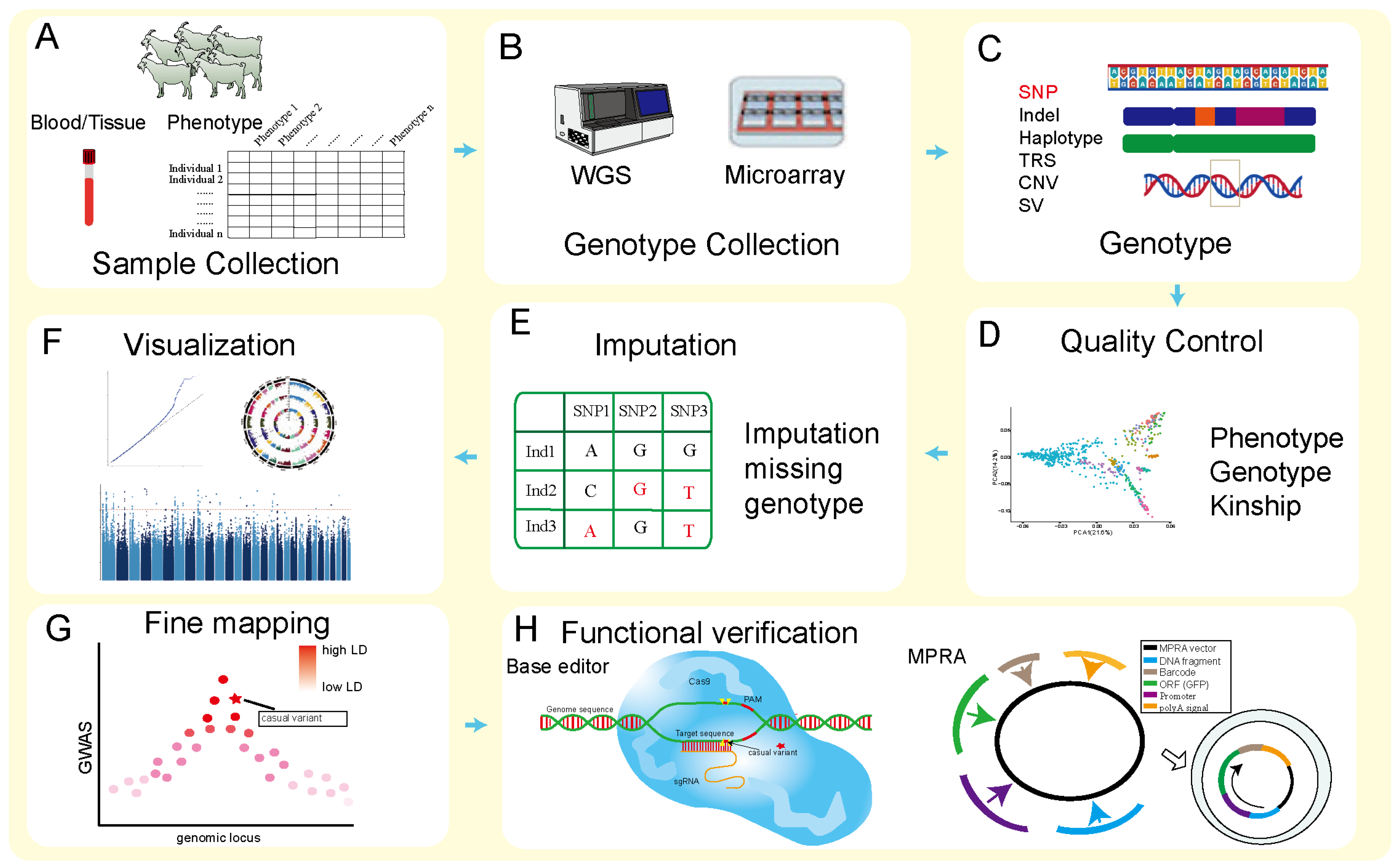
Figure 1. The comprehensive experimental methodology outlining the general procedure for conducting GWAS in goats. (A) Blood sample collection for goat samples. (B) Sequencing and genotyping through WGS and microarray. (C) Processing genotype data to obtain various types of genetic variations. TRS: Tandom repeats sequencing. Indel: Insertion-deletion. CNV: Copy number variation. SV: structure variation. SNP: single nucleotide polymorphism. (D) The obtained genotype data requires quality control. (E) Correlation analysis between genotype data after quality control and collected phenotype data using statistical models. (F) Visualization of GWAS results using software such as R (v4.4.2). (G) We need to fine mapping the correlated signals and explore the causal variation mechanism through Mendelian randomization combined with co localization analysis. LD: Linkage Disequilibrium. (H) We can perform functional validation through base editing and MPRA methods. PAM: Protospacer Adja-cent Motif. sgRNA: single guide RNA. MPRA: massively parallel reporter as-say. ORF: Open Reading Frame.
Ijms 27 02945 g001
Figure 2. Investigating the diverse phenotypic traits of goats and the corresponding processing methodologies within the framework of GWAS. (A) Phenotypic classification of goats. On the left-hand side, are horn traits, meat pro-duction and quality traits, and growth and development traits; On the right-hand side, are cashmere production and quality traits, reproductive traits, milk production and quality traits; The above displays the resistance traits of goats to cold or hot environments and diseases. (B) The presence or absence of goat horns, as well as the strength of reproductive ability and other binary traits, are generally analyzed utilizing logistic regression in GWAS. (C) Linear regression method is used for GWAS analysis of quantitative traits such as body weight, milk production, and cashmere production.
Ijms 27 02945 g002
Figure 3. The biological mechanisms at the multi-omics level that influence trait expression in goats. (A) Goat phenotypes are classified into terminal phenotypes and intermediate phenotypes. (B) Genomic variation is the basis for trait expression. (C) Epigenetic modifications caused by microbial and environmental regulation affect gene expression. (D) At the transcriptome level, non-coding RNAs (such as miRNA, circRNA, and lncRNA) affect protein translation by regulating mRNA expression. (E) Proteomic level.
Ijms 27 02945 g003
Table 1. Progress in GWAS-related statistical models.
ModelApplication of GoatTimeAuthor
BreedNumberTraitRef.
MLMDairy goat208Milk production[36]2006[33]
EMMAMarkhoz goat228Cashmere[37]2008[38]
EMMAX2010[39]
Compressed LMM2010[40]
Fast LMM2011[41]
GEEMAMurciano-Granadina goat825Body conformation[42]2012[43]
MLMMDairy goat2381Milk yield and conformation[44]2012[45]
MTMM2012[46]
Farm CPUChubao black-head goat500Growth and reproduction[47]2016[48]
BLINKMarkhoz goat136litter size at birth and weaning[49]2019[50]
Fast GWA2019[51]
—: Missing data.
Table 2. List of diverse traits dissected via GWAS in goat.
TraitBreedSample NumberSignificant Marker CountRef.
Litter sizeMarkhoz goat1364[49]
Litter sizeDazu black goat15018[94]
Litter sizeYouzhou black goat2061[16]
Litter sizeJabal Akhdar
Omani goat
728[95]
Litter sizeThree breeds33617[96]
Litter sizeArbas cashmere goat3616[97]
Eight Body conformationTashi goat155385[98]
WeightKarachai goat28711[34]
Seven body conformation7
Body weightKarachai goat2695[99]
Seven body conformation60
Body conformationZhongwei goat240342[100]
CarcassSouth African goat7340[101]
Body weightInner Mongolia cashmere goat192021[102]
Milk productionMurciano-Granadina goats66019[103]
Milk qualityKarachai goat16743[104]
Udder conformationDazu black goat15010[94]
Milk productionAlpine, Saanen goat1707146[105]
Udder conformation10
Udder conformationNew Zealand goat105827[57]
Milk yield traitFrench dairy goat1114457[106]
Milk productionAmerican Alpine Goat7230,594[107]
Milk yield and somatic cell scoreNew Zealand dairy goat373243[54]
Seven milk productionMurciano-Granadina goat82224(QTL)[19]
Milk yieldSaanen, Toggenburg, Alpine23812[44]
Udder conformation4023
Milk production traitFrench dairy goat22092(QTL)[108]
Supernumerary teatAlpine, Saanen goat 225417[72]
Cashmere yieldInner Mongolia cashmere goat40428[109]
Cashmere morphology123
Cashmere morphologyNorthwest Xizang White Cashmere Goat539151[110]
Cashmere yield60
Coat colorJintang black goat65660[111]
Cashmere morphologyInner Mongolia Cashmere goat19278[112]
Cashmere yield52
Coat colorMarkhoz goat228116[37]
Cashmere morphology31
Cashmere diameterCashmere goat43626 (QTL)[113]
Coat colorValais Blacknecked and Coppernecked goat453[114]
Brucellosis infectionDamascus goat9610[115]
Haemonchus contortus infectionMultiple breed1442[116]
Gastrointestinal nematode infectionCreole goat1827[117]
AdaptionTibetan and other goat156250[118]
ResilienceUK dairy goat10,6207[119]
PollednessSaanen dairy goat1063[120]
PollednessJintang black goat4514[121]
PollednessAustralian goat17510[122]
WattleSwiss goat3412[123]
Juniper consumptionBoer × Spanish and Angora711571[124]
Disclaimer/Publisher’s Note: The statements, opinions and data contained in all publications are solely those of the individual author(s) and contributor(s) and not of MDPI and/or the editor(s). MDPI and/or the editor(s) disclaim responsibility for any injury to people or property resulting from any ideas, methods, instructions or products referred to in the content.