


Anticancer Potential of Lacticaseibacillus rhamnosus in Colorectal Cancer—A Systematic Review of In Vitro Cell Culture Evidence
 , , , , , , ,
Abstract
1. Introduction
2. Materials and Methods
2.1. Eligibility Criteria
2.1.1. Inclusion Criteria
- Investigate probiotics, postbiotics, or bioactive compounds derived from Lacticaseibacillus rhamnosus/Lactobacillus rhamnosus.
- Address colorectal cancer as the target disease model.
- Report at least one relevant anticancer outcome, such as cell proliferation, apoptosis, cell cycle arrest, or tumor growth inhibition.
- Original peer-reviewed research articles using laboratory-based (in vitro) CRC cell models.
- Published from inception up to 30 June 2025.
- Articles published in English. Articles in other languages may be included if a reliable English translation is available.
- Studies combining Lacticaseibacillus rhamnosus/Lactobacillus rhamnosus with prebiotics are included, provided that the probiotic effect is a core focus.
- Studies that contain both in vitro and in vivo components are included only if the in vitro data are clearly separated and independently extractable.
- Studies involving combinations of different Lactobacillus species with Lacticaseibacillus rhamnosus will be included only if the outcomes for them are reported separately and can be independently extracted.
2.1.2. Exclusion Criteria
- Studies will be excluded if Lacticaseibacillus rhamnosus/Lactobacillus rhamnosus is not used as part of the intervention.
- Rely solely on in vivo animal models, human clinical trials, or observational studies without an in vitro component.
- Not included if studies do not involve probiotics, postbiotics, or bioactive microbial compounds derived from Lacticaseibacillus rhamnosus/Lactobacillus rhamnosus.
- Investigate cancers other than colorectal cancer.
- If it includes non-peer-reviewed sources, such as conference abstracts, editorials, dissertations, or grey literature.
- Published in languages other than English, with no available English translation.
- Assess Lacticaseibacillus rhamnosus/Lactobacillus rhamnosus in combination with non-dietary or pharmacological therapies (e.g., chemotherapeutics, radiation, herbal extracts), unless the effect of Lacticaseibacillus rhamnosus/Lactobacillus rhamnosus is evaluated independently and reported separately.
- Lack relevant control groups or appropriate experimental design controls.
- Do not report cell proliferation, apoptosis, tumor suppression, or other anticancer mechanisms as an outcome of their study.
- Present in vitro and in vivo results in a combined or inseparable manner, preventing accurate extraction of in vitro findings.
- Studies published after 30 June 2025.
2.2. Study Selection Process
2.3. Data Extraction and Synthesis of Evidence
2.4. Quality Assessment (Risk of Bias)
2.5. Study Registration and Reporting
3. Results
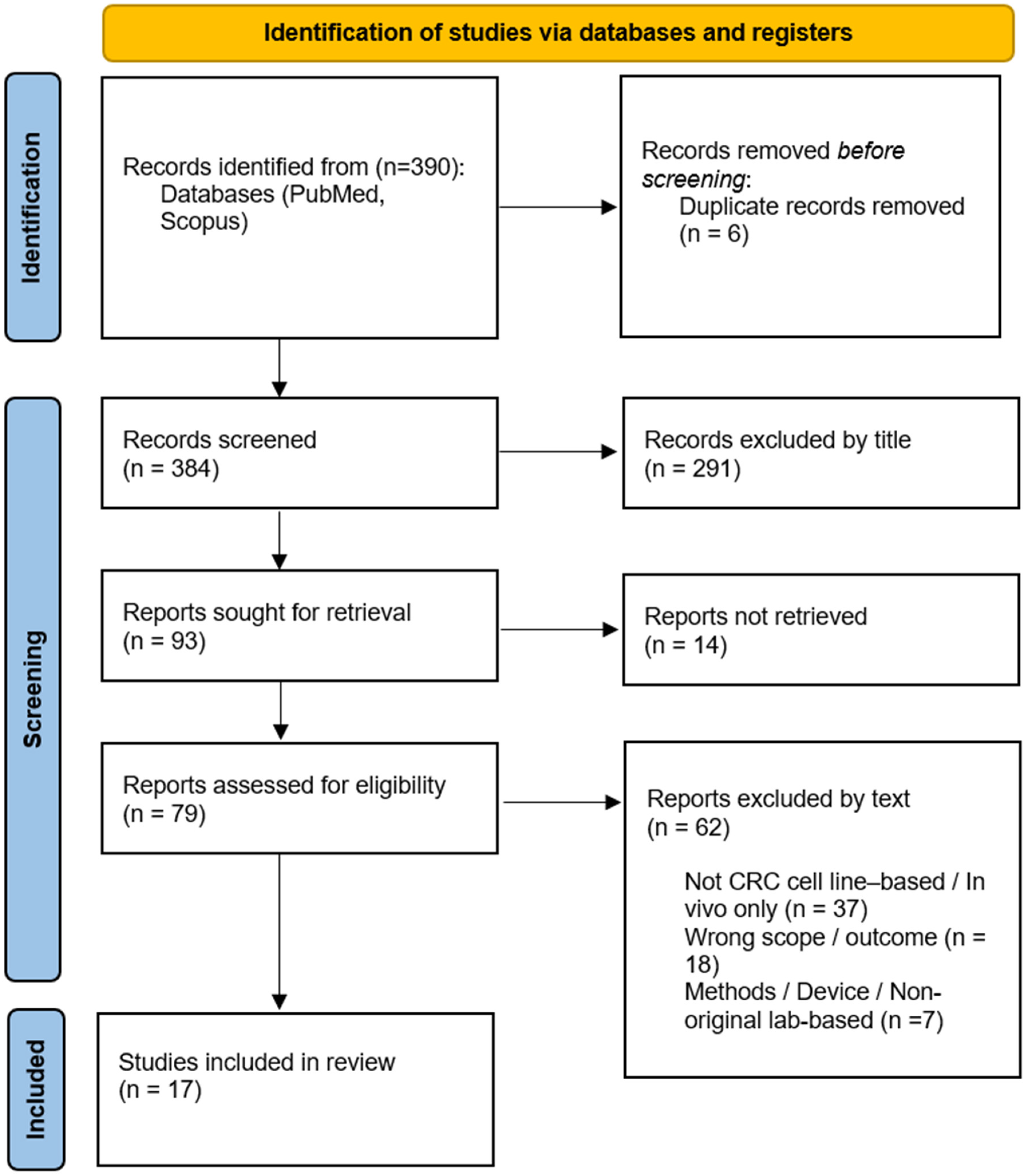
3.1. Literature Search and Study Selection
3.2. Summary of Experimental Design and Methods of Studies Included
- Assays and Outcome Measures Used to Evaluate Anticancer Effects: MTT/CCK-8/AlamarBlue (viability/proliferation) [12,17,19,20,22,23,24]; Annexin V/PI, AO/EB staining (apoptosis) [8,12,16,17,19,24]; flow cytometry cell-cycle analysis; caspase activity assays and Western blot/qRT-PCR for pathway proteins [8,12,19,24]; invasion/migration and MMP-9 zymography [15].
- Under the predefined criteria, full-text articles were assessed for eligibility. Studies were excluded if they did not specifically evaluate L. rhamnosus in an in vitro CRC model with relevant anticancer endpoints. Excluded studies involved those describing 3D drug-testing platforms [26], biomaterial-based drug delivery systems [27], a device development smart capsule study [28], and organ-on-chip models without probiotic intervention or CRC cell-line anticancer assessment [29]. In total, 62 full-text articles were excluded for not meeting the specified experimental design requirements.
3.3. Anticancer Mechanism of L. rhamnosus
3.3.1. Inhibition of Cancer Cell Growth
3.3.2. Suppression of Metastatic Potential
3.3.3. Disruption of Cellular Metabolism and Microenvironment
3.3.4. Selective Cytotoxicity and Translational Potential
3.4. Comparative Effectiveness of the Probiotic Formulations
3.5. Vote Counting Synthesis of Anticancer Mechanisms of L. rhamnosus
3.6. Summary of the Results
4. Discussion
4.1. Limitations
4.2. Prospects
5. Conclusions
Supplementary Materials
Author Contributions
Funding
Institutional Review Board Statement
Informed Consent Statement
Data Availability Statement
Acknowledgments
Conflicts of Interest
Abbreviations
| CFSs | Cell-free supernatants; |
| CRC | Colorectal cancer; |
| EPSs | Exopolysaccharides; |
| LGG | L. rhamnosus GG; |
| LNP | Lipid nanoparticle; |
| LR | L. rhamnosus. |
References
- Owens, J.A.; Saeedi, B.J.; Naudin, C.R.; Hunter-Chang, S.; Barbian, M.E.; Eboka, R.U.; Askew, L.; Darby, T.M.; Robinson, B.S.; Jones, R.M. Lactobacillus Rhamnosus GG Orchestrates an Antitumor Immune Response. Cell Mol. Gastroenterol. Hepatol. 2021, 12, 1311–1327. [Google Scholar] [CrossRef]
- Keyhani, G.; Mahmoodzadeh Hosseini, H.; Salimi, A. Effect of Extracellular Vesicles of Lactobacillus Rhamnosus GG on the Expression of CEA Gene and Protein Released by Colorectal Cancer Cells. Iran. J. Microbiol. 2022, 14, 90–96. [Google Scholar] [CrossRef]
- Lu, S.; Xu, J.; Zhao, Z.; Guo, Y.; Zhang, H.; Jurutka, P.W.; Huang, D.; Cao, C.; Cheng, S. Dietary Lactobacillus Rhamnosus GG Extracellular Vesicles Enhance Antiprogrammed Cell Death 1 (Anti-PD-1) Immunotherapy Efficacy against Colorectal Cancer. Food Funct. 2023, 14, 10314–10328. [Google Scholar] [CrossRef]
- Hadad, S.E.; Hazmi, B.A.; Alhebshi, A.; Aldahlawi, A.M.; Bassam, R.A. Lactobacillus Rhamnosus Enhances the Immunological Antitumor Effect of 5-Fluorouracil against Colon Cancer. Pak. J. Biol. Sci. 2019, 22, 597–606. [Google Scholar] [CrossRef]
- Gao, G.; Shen, S.; Zhang, T.; Zhang, J.; Huang, S.; Sun, Z.; Zhang, H. Lacticaseibacillus Rhamnosus Probio-M9 Enhanced the Antitumor Response to Anti-PD-1 Therapy by Modulating Intestinal Metabolites. EBioMedicine 2023, 91, 104533. [Google Scholar] [CrossRef]
- Zhang, J.; Zhang, P.; Li, S.; Yu, T.; Lai, X.; He, Y. Study on the Effect and Mechanism of Lacticaseibacillus Rhamnosus AFY06 on Inflammation-Associated Colorectal Cancer Induced by AOM/DSS in Mice. Front. Microbiol. 2024, 15, 1382781. [Google Scholar] [CrossRef]
- Sepehr, A.; Aghamohammad, S.; Ghanavati, R.; Talebi, M.; Pourshafie, M.R.; Rohani, M. Role of Native Probiotic Lactobacillus Species via TGF-β Signaling Pathway Modulation in CRC. Iran. Biomed. J. 2024, 28, 168–178. [Google Scholar] [CrossRef]
- Kim, B.-K.; Yoon, Y.-S.; Ryu, Y.; Chung, M.-J. Probiotic-Derived P8 Protein Induce Apoptosis via Regulation of RNF152 in Colorectal Cancer Cells. Am. J. Cancer Res. 2021, 11, 746–759. [Google Scholar]
- Avcı, E.; Avcı, G.A. Effect of New Bioactive Substances Obtained from Possible Probiotic Bacteria on miRNA Expression by in Vitro Cocultivation in Colorectal Cancer Cells. Int. J. Environ. Health Res. 2025, 35, 3713–3722. [Google Scholar] [CrossRef]
- Erfanian, N.; Tavakoli, T.; Mahdiabadi, M.A.; Nasseri, S.; Safarpour, H.; Fakharian, T.; Namaei, M.H. Gut Microbiota Dysbiosis and the Anti-Inflammatory Effects of Probiotic-Derived Cell-Free Supernatants in HT-29 Cells: Insights into Early Stage Colorectal Cancer. Lett. Appl. Microbiol. 2025, 78, ovaf060. [Google Scholar] [CrossRef]
- Orlando, A.; Refolo, M.G.; Messa, C.; Amati, L.; Lavermicocca, P.; Guerra, V.; Russo, F. Antiproliferative and Proapoptotic Effects of Viable or Heat-Killed Lactobacillus Paracasei IMPC2.1 and Lactobacillus Rhamnosus GG in HGC-27 Gastric and DLD-1 Colon Cell Lines. Nutr. Cancer 2012, 64, 1103–1111. [Google Scholar] [CrossRef]
- Si, W.; Liang, H.; Bugno, J.; Xu, Q.; Ding, X.; Yang, K.; Fu, Y.; Weichselbaum, R.R.; Zhao, X.; Wang, L. Lactobacillus Rhamnosus GG Induces cGAS/STING- Dependent Type I Interferon and Improves Response to Immune Checkpoint Blockade. Gut 2022, 71, 521–533. [Google Scholar] [CrossRef]
- Pahumunto, N.; Teanpaisan, R. Anti-Cancer Properties of Potential Probiotics and Their Cell-Free Supernatants for the Prevention of Colorectal Cancer: An In Vitro Study. Probiotics Antimicrob. Proteins 2023, 15, 1137–1150. [Google Scholar] [CrossRef]
- An, B.C.; Ahn, J.Y.; Kwon, D.; Kwak, S.H.; Heo, J.Y.; Kim, S.; Ryu, Y.; Chung, M.J. Anti-Cancer Roles of Probiotic-Derived P8 Protein in Colorectal Cancer Cell Line DLD-1. Int. J. Mol. Sci. 2023, 24, 9857. [Google Scholar] [CrossRef]
- Escamilla, J.; Lane, M.A.; Maitin, V. Cell-Free Supernatants from Probiotic Lactobacillus Casei and Lactobacillus Rhamnosus GG Decrease Colon Cancer Cell Invasion in Vitro. Nutr. Cancer 2012, 64, 871–878. [Google Scholar] [CrossRef]
- An, B.C.; Hong, S.; Park, H.J.; Kim, B.-K.; Ahn, J.Y.; Ryu, Y.; An, J.H.; Chung, M.J. Anti-Colorectal Cancer Effects of Probiotic-Derived P8 Protein. Genes 2019, 10, 624. [Google Scholar] [CrossRef]
- Aziz Mousavi, S.M.A.; Mirhosseini, S.A.; Rastegar Shariat Panahi, M.; Mahmoodzadeh Hosseini, H. Characterization of Biosynthesized Silver Nanoparticles Using Lactobacillus Rhamnosus GG and Its In Vitro Assessment Against Colorectal Cancer Cells. Probiotics Antimicrob. Proteins 2020, 12, 740–746. [Google Scholar] [CrossRef]
- Erfanian, N.; Safarpour, H.; Tavakoli, T.; Mahdiabadi, M.A.; Nasseri, S.; Namaei, M.H. Investigating the Therapeutic Potential of Bifidobacterium Breve and Lactobacillus Rhamnosus Postbiotics through Apoptosis Induction in Colorectal HT-29 Cancer Cells. Iran. J. Microbiol. 2024, 16, 68–78. [Google Scholar] [CrossRef]
- Amin, M.; Navidifar, T.; Saeb, S.; Barzegari, E.; Jamalan, M. Tumor-Targeted Induction of Intrinsic Apoptosis in Colon Cancer Cells by Lactobacillus Plantarum and Lactobacillus Rhamnosus Strains. Mol. Biol. Rep. 2023, 50, 5345–5354. [Google Scholar] [CrossRef]
- Budu, O.; Banciu, C.D.; Soica, C.; Lighezan, D.F.; Milan, A.; Prodea, A.; Mioc, A.; Mioc, M.; Mardale, G.; Sima, L. Lacticaseibacillus Rhamnosus—A Promising Tool for Colorectal Cancer Treatment. Process 2023, 11, 781. [Google Scholar] [CrossRef]
- Salek, S.; Moazamian, E.; Mohammadi Bardbori, A.; Shamsdin, S.A. Anticancer Effect of a Combinatorial Treatment of 5-Fluorouracil and Cell Extract of Some Probiotic Lactobacilli Strains Isolated from Camel Milk on Colorectal Cancer Cells. Folia Microbiol. 2025, 70, 1051–1065. [Google Scholar] [CrossRef]
- Avci, G.A.; Yilmaz, Ü.İ.; Avci, E. Efficacy of Probiotics, Paraprobiotics, and Postbiotics in Colorectal Cancer Cell Line and Their Role in Immune Response. Rev. Assoc. Med. Bras. 2024, 70, e20240226. [Google Scholar] [CrossRef]
- Viana, R.; Rocha, A.C.; Sousa, A.P.; Ferreira, D.; Fernandes, R.; Almeida, C.; Pais, P.J.; Baylina, P.; Pereira, A.C. Exploring the Potential Protective Effect of Probiotics in Obesity-Induced Colorectal Cancer: What Insights Can In Vitro Models Provide? Appl. Sci. 2024, 14, 951. [Google Scholar] [CrossRef]
- Lee, Y.-J.; Kim, J.H.; Kim, T.Y.; Park, H.H.; Kim, M.E.; Park, S.-H.; Sin, S.-I.; Chung, J.H.; Park, K.-Y. Impact of Brown Rice Cultivated with Deep-Sea Mineral Fertiliser on Colon Cancer in Vitro and in Vivo Studies. Food Res. Int. 2025, 218, 116894. [Google Scholar] [CrossRef]
- Sheth, V.H.; Shah, N.P.; Jain, R.; Bhanushali, N.; Bhatnagar, V. Development and Validation of a Risk-of-Bias Tool for Assessing in Vitro Studies Conducted in Dentistry: The QUIN. J. Prosthet. Dent. 2024, 131, 1038–1042. [Google Scholar] [CrossRef]
- Yau, J.N.N.; Adriani, G. Three-Dimensional Heterotypic Colorectal Cancer Spheroid Models for Evaluation of Drug Response. Front. Oncol. 2023, 13, 1148930. [Google Scholar] [CrossRef]
- Qiu, L.; Shen, R.; Wei, L.; Xu, S.; Xia, W.; Hou, Y.; Cui, J.; Qu, R.; Luo, J.; Cao, J.; et al. Designing a Microbial Fermentation-Functionalized Alginate Microsphere for Targeted Release of 5-ASA Using Nano Dietary Fiber Carrier for Inflammatory Bowel Disease Treatment. J. Nanobiotechnol. 2023, 21, 344. [Google Scholar] [CrossRef] [PubMed]
- Nejati, S.; Wang, J.; Sedaghat, S.; Balog, N.K.; Long, A.M.; Rivera, U.H.; Kasi, V.; Park, K.; Johnson, J.S.; Verma, M.S.; et al. Smart Capsule for Targeted Proximal Colon Microbiome Sampling. Acta Biomater. 2022, 154, 83–96. [Google Scholar] [CrossRef] [PubMed]
- Siwczak, F.; Loffet, E.; Kaminska, M.; Koceva, H.; Mahe, M.M.; Mosig, A.S. Intestinal Stem Cell-on-Chip to Study Human Host-Microbiota Interaction. Front. Immunol. 2021, 12, 798552. [Google Scholar] [CrossRef]
- Salemi, R.; Vivarelli, S.; Ricci, D.; Scillato, M.; Santagati, M.; Gattuso, G.; Falzone, L.; Libra, M. Lactobacillus Rhamnosus GG Cell-Free Supernatant as a Novel Anti-Cancer Adjuvant. J. Transl. Med. 2023, 21, 195. [Google Scholar] [CrossRef] [PubMed]
- Zhao, J.; Liao, Y.; Wei, C.; Ma, Y.; Wang, F.; Chen, Y.; Zhao, B.; Ji, H.; Wang, D.; Tang, D. Potential Ability of Probiotics in the Prevention and Treatment of Colorectal Cancer. Clin. Med. Insights Oncol. 2023, 17, 11795549231188225. [Google Scholar] [CrossRef] [PubMed]
- Gai, Z.; Dong, Y.; Xu, F.; Zhang, J.; Yang, Y.; Wang, Y. Changes in the Gut Microbiota Composition of Healthy Young Volunteers after Administration of Lacticaseibacillus Rhamnosus LRa05: A Placebo-Controlled Study. Front. Nutr. 2023, 10, 1105694. [Google Scholar] [CrossRef] [PubMed]
- Huang, F.; Li, S.; Chen, W.; Han, Y.; Yao, Y.; Yang, L.; Li, Q.; Xiao, Q.; Wei, J.; Liu, Z.; et al. Postoperative Probiotics Administration Attenuates Gastrointestinal Complications and Gut Microbiota Dysbiosis Caused by Chemotherapy in Colorectal Cancer Patients. Nutrients 2023, 15, 356. [Google Scholar] [CrossRef] [PubMed]
- Thomsen, M.; Vemuri, R.; Huygens, F.; Clarke, S.; Vitetta, L. An Exploratory Study of a Multi-Species Probiotic Formulation and Markers of Health in a Real-World Oncological Cohort in the Time of Covid. Inflammopharmacology 2024, 32, 2317–2335. [Google Scholar] [CrossRef]
- Zhong, L.; Zhang, X.; Covasa, M. Emerging Roles of Lactic Acid Bacteria in Protection against Colorectal Cancer. World J. Gastroenterol. 2014, 20, 7878–7886. [Google Scholar] [CrossRef]
- Sánchez, B.; Delgado, S.; Blanco-Míguez, A.; Lourenço, A.; Gueimonde, M.; Margolles, A. Probiotics, Gut Microbiota, and Their Influence on Host Health and Disease. Mol. Nutr. Food Res. 2017, 61, 1600240. [Google Scholar] [CrossRef]
- Gao, C.; Ganesh, B.P.; Shi, Z.; Shah, R.R.; Fultz, R.; Major, A.; Venable, S.; Lugo, M.; Hoch, K.; Chen, X.; et al. Gut Microbe-Mediated Suppression of Inflammation-Associated Colon Carcinogenesis by Luminal Histamine Production. Am. J. Pathol. 2017, 187, 2323–2336. [Google Scholar] [CrossRef]

| Author & Year | Cell Line | Methodology | Outcome | Results |
|---|---|---|---|---|
| Kim et al. (2021) [8] | DLD-1, HCT 116 |
|
|
|
| Avcı et al. (2025) [9] | HT-29, Caco-2 |
|
|
|
| Erfanian et al. (2025) [10] | HT-29 |
|
|
|
| Orlando et al. (2012) [11] | HGC-27, DLD-1 |
|
|
|
| Si et al., 2022 [12] | HT-29, Caco-2 |
|
|
|
| Pahumunto et al., 2023 [13] | Caco-2, HIEC-6 |
|
|
|
| An et al., 2023. [14] | DLD-1 |
|
|
|
| Escamilla et al., 2012 [15] | HCT-116 |
|
|
|
| An et al., 2019 [16] | DLD-1 |
|
|
|
| Aziz Mousavi et al. 2020 [17] | HT-29 |
|
|
|
| Erfanian et al., 2024 [18] | HT-29 |
|
|
|
| Amin et al., 2023 [19] | Caco-2 |
|
|
|
| Budu et al., 2023 [20] | HaCaT, HT-29 and HCT-116 |
|
|
|
| Salek, S., et al. (2024) [21] | HT-29, |
|
|
|
| Avci, G.A., et al. (2024) [22] | Caco-2 |
|
|
|
| Viana, R., et al. (2024) [23] | Caco-2 |
|
|
|
| Lee, Y.-J., et al. (2025) [24] | HT-29 HCT-116 |
|
|
|
| Anticancer Mechanism | Studies Supporting Effect (n) | Percentage (n/N) |
|---|---|---|
| Reduced cancer cell proliferation/viability | 13 | 76.5% |
| Apoptosis induction | 10 | 58.8% |
| Cell cycle arrest | 4 | 23.5% |
| Inhibition of Migration/invasion | 3 | 17.6% |
| Modulation of oncogenic signaling pathways (Wnt/β-catenin, p53, p21, Cyclin B1/Cdk1) | 3 | 17.6% |
| Immune/inflammatory modulation | 5 | 29.4% |
| Mitochondrial dysfunction/ROS-mediated apoptosis | 3 | 17.6% |
| Selective cytotoxicity | 4 | 23.5% |
Disclaimer/Publisher’s Note: The statements, opinions and data contained in all publications are solely those of the individual author(s) and contributor(s) and not of MDPI and/or the editor(s). MDPI and/or the editor(s) disclaim responsibility for any injury to people or property resulting from any ideas, methods, instructions or products referred to in the content. |
© 2026 by the authors. Licensee MDPI, Basel, Switzerland. This article is an open access article distributed under the terms and conditions of the Creative Commons Attribution (CC BY) license.
Share and Cite
Shajahan, A.N.B.; Vakhariya, S.M.; Abedi, M.M.; Fatima, S.N.; Khadeeja, L.; Nazari Fard, E.H.; Shajahan, A.; Samuel, V.P.; Bernhardt, G.V.; Srinivasamurthy, S.K. Anticancer Potential of Lacticaseibacillus rhamnosus in Colorectal Cancer—A Systematic Review of In Vitro Cell Culture Evidence. Int. J. Mol. Sci. 2026, 27, 2944. https://doi.org/10.3390/ijms27072944
Shajahan ANB, Vakhariya SM, Abedi MM, Fatima SN, Khadeeja L, Nazari Fard EH, Shajahan A, Samuel VP, Bernhardt GV, Srinivasamurthy SK. Anticancer Potential of Lacticaseibacillus rhamnosus in Colorectal Cancer—A Systematic Review of In Vitro Cell Culture Evidence. International Journal of Molecular Sciences. 2026; 27(7):2944. https://doi.org/10.3390/ijms27072944
Chicago/Turabian StyleShajahan, Arshiya Nasreen Bint, Sakina Mustafa Vakhariya, Malak Moones Abedi, Syeda Nishaat Fatima, Liyan Khadeeja, Elham Hassan Nazari Fard, Abshina Shajahan, Vijaya Paul Samuel, Grisilda Vidya Bernhardt, and Suresh Kumar Srinivasamurthy. 2026. "Anticancer Potential of Lacticaseibacillus rhamnosus in Colorectal Cancer—A Systematic Review of In Vitro Cell Culture Evidence" International Journal of Molecular Sciences 27, no. 7: 2944. https://doi.org/10.3390/ijms27072944
APA StyleShajahan, A. N. B., Vakhariya, S. M., Abedi, M. M., Fatima, S. N., Khadeeja, L., Nazari Fard, E. H., Shajahan, A., Samuel, V. P., Bernhardt, G. V., & Srinivasamurthy, S. K. (2026). Anticancer Potential of Lacticaseibacillus rhamnosus in Colorectal Cancer—A Systematic Review of In Vitro Cell Culture Evidence. International Journal of Molecular Sciences, 27(7), 2944. https://doi.org/10.3390/ijms27072944

