Hemp (Cannabis sativa L.) Phytochemicals and Their Potential in Agrochemical, Cosmetic, and Food Industries: A Review


Abstract
1. Introduction
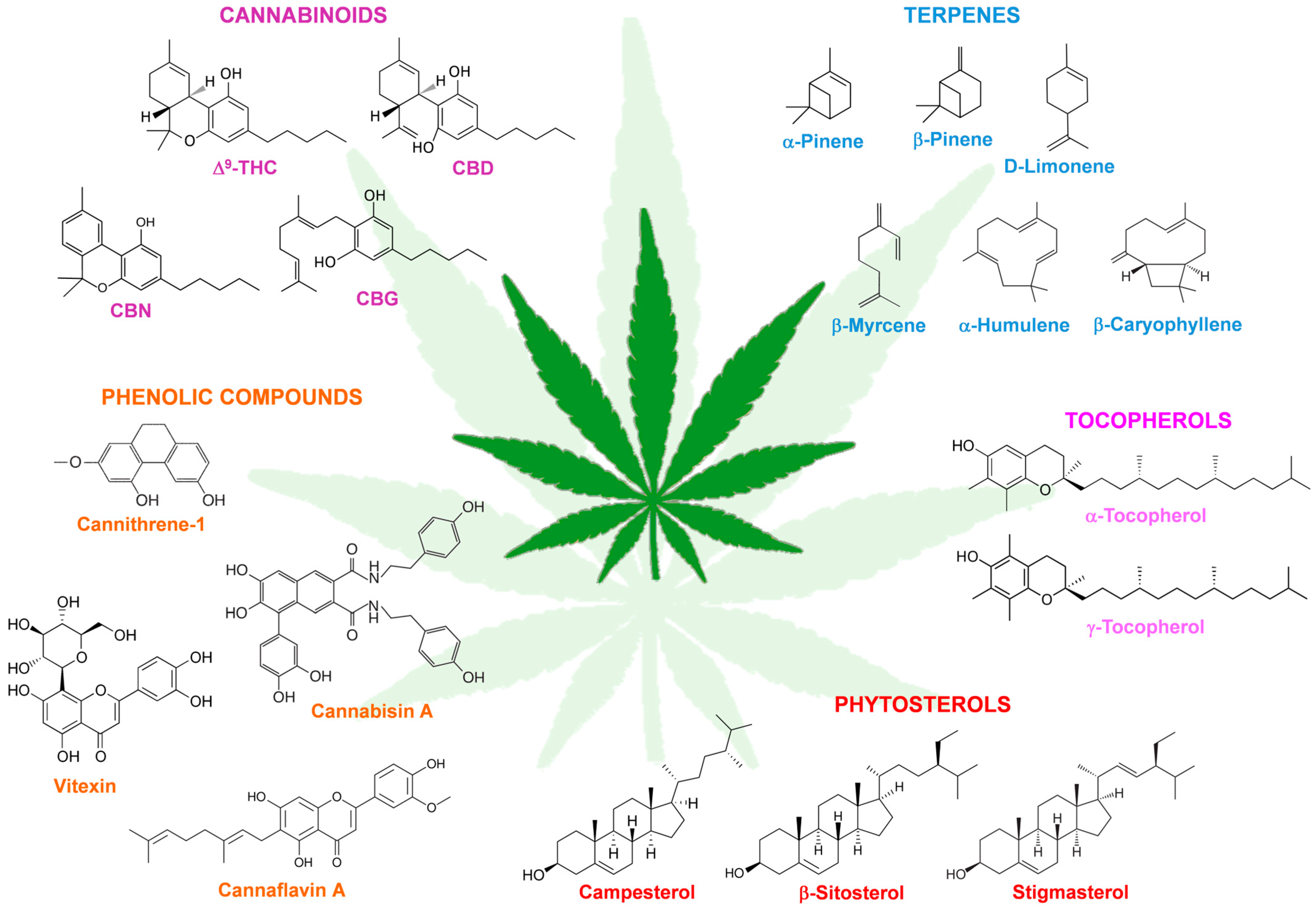
2. Phytochemical Profile
2.1. Cannabinoids
2.2. Terpenes
2.3. Phenolic Compounds
2.4. Other Phytochemicals
3. Biopesticides
3.1. Biopesticides Based on Purified Hemp Phytochemicals

| Treatment | Target Organism | Effect | Ref. |
|---|---|---|---|
| Insects harmful to plants | |||
| 1% CBD or 1% THC sprayed on cabbage leaves | Cabbage butterfly (Pieris brassicae) | 2–3 times less eggs deposited on cabbage leaves sprayed with 1% THC than on those sprayed with 1% CBD | [32] |
| 0.01, 0.1, 1 mM, and 2 mM CBD incorporated into the artificial diet | Tobacco hornworm (Manduca sexta) | No effects at CBD ≤ 1 mM 20% smaller size, 2.2-times lower weight, and 60% lower larval survival rate at 2 mM CBD | [33] |
| 0.001%, 0.01%, 0.1%, and 1.0% CBDA or CBGA painted on the surface or incorporated into the artificial diet | Cabbage looper (Trichoplusia ni) | No effects at CBDA and CBGA < 0.1% Decreased larval survival and growth at CBDA and CBGA ≥ 0.1% and 100% larval mortality at 1.0% CBDA | [34] |
| 5%, 10%, and 15% CBD incorporated into the artificial diet | Fall armyworm (Spodoptera frugiperda) | Dose-dependent inhibition of consumption and growth No effect on digestibility and conversion efficiency | [35] |
| Insects harmful to stored products | |||
| 15, 45, and 90 mg mL−1 CBD oil (3%) sprayed on wheat, corn, and rice seeds | Flou beetle (Tribolium confusum) Saw-toothed grain beetle (Oryzaephilus surinamensis) Meal moth (Plodia interpunctella) | 17–100%, 17–93%, and 26–83% larval mortality for T. confusum on wheat, corn, and rice seeds, respectively 17–100%, 36–96%, and 67–100% larval mortality for O. surinamensis on wheat, corn, and rice seeds, respectively 16–76%, 13–60%, and 33–63% larval mortality for P. interpunctella on wheat, corn, and rice seeds, respectively | [36] |
3.2. Biopesticides Based on Hemp Essential Oil
| Cultivar/Tissue | Composition | Target Organism | Effect | Ref. |
|---|---|---|---|---|
| Insects harmful to humans | ||||
| EO from hemp inflorescences | 46.5–58.7% monoterpenes (2.2–4.0% α-pinene, 17.1–27.5% myrcene, and 14.0–17.0% limonene) and 35.6–48.6% sesquiterpenes (6.2–7.6% β-caryophyllene and 2.6–2.9% α-humulene) | Yellow fever mosquito (Aedes aegypti) | Biting deterrent activity comparable to N,N-diethyl-meta-toluamide LC50 = 21.8–27.5 ppm and LC90 = 38.7–38.9 ppm | [38] |
| EO from hemp inflorescences of cv. Futura 75 | 37.9% monoterpenes (7.8% α-pinene, 11.3% myrcene, and 7.6% terpinolene), 47.7% sesquiterpenes (21.4% β-caryophyllene and 7.1% α-humulene), and 11.4% cannabinoids (11.1% CBD) | Southern house mosquito (Culex quinquefasciatus) Housefly (Musca domestica) | LC50 = 124.5 μL L−1 and LC90 = 199.1 μL L−1 for C. quinquefasciatus larvae LD50 = 122.1 μg adult−1 and LD90 = 212.9 μg adult−1 for M. domestica adults | [40] |
| EO from hemp leaves of cv. Futura 75 | 5.3% monoterpenes (2.0% α-pinene and 0.9% myrcene), 75.0% sesquiterpenes (26.1% β-caryophyllene and 8.9% α-humulene), and 10.2% cannabinoids (10.0% CBD) | LC50 = 152.3 μL L−1 and LC90 = 410.3 μL L−1 for C. quinquefasciatus larvae LD50 = 305.2 μg adult−1 and LD90 = 428.7 μg adult−1 for M. domestica adults | ||
| EO from hemp inflorescences of cv. Felina 32 | 54.2% monoterpenes (16.4% α-pinene, 14.2% myrcene, and 9.6% terpinolene), 45.6% sesquiterpenes (23.8% β-caryophyllene and 8.3% α-humulene), and 0.1% CBD | Southern house mosquito (C. quinquefasciatus) Housefly (M. domestica) | LC50 = 252.5 μL L−1 and LC90 = 700.9 μL L−1 for C. quinquefasciatus larvae LD50 = 43.3 μg adult−1 and LD90 = 213.5 μg adult−1 for M. domestica adults | [41] |
| EO from hemp inflorescences of cv. Kompolti in pure form and as nanoemulsion | 60.0% monoterpenes (16.9% α-pinene, 6.7% β-pinene, 18.9% myrcene, 4.4% limonene, and 8.1% terpinolene), 37.7% sesquiterpenes (20.4% β-caryophyllene and 6.1% α-humulene), and 0.2% CBD | Southern house mosquito (C. quinquefasciatus) | LC30 = 35.5 ppm, LC50 = 56.8 ppm, LC90 = 142.3 ppm, and natality reduced by 40.4% at LC30 dose for the pure form LC30 = 46.8 ppm, LC50 = 72.2 ppm, LC90 = 207.2 ppm, and natality reduced by 45.1% at LC30 dose for the nanoemulsion | [42] |
| EOs from hemp inflorescences of cv. Felina 32 | 44.3% monoterpenes (15.1% α-pinene and 11.8% myrcene), 54.6% sesquiterpenes (34.8% β-caryophyllene and 11.4% α-humulene), and 0.1% cannabinoids | Asian malaria mosquito (Anopheles stephensi) African malaria mosquito (Anopheles gambiae) | 82.7% and 100% mortality in larvae and pupae, respectively, of A. stephensi at 100 ppm 91.1% and 84.9% mortality in larvae and pupae, respectively, of A. gambiae at 100 ppm | [43] |
| EO from female hemp inflorescences of cv. Carmagnola Selezionata (CS) | 68.3% monoterpenes (11.4% α-pinene, 24.3% myrcene, and 13.5% terpinolene), 29.1% sesquiterpenes (19.3% β-caryophyllene and 6.4% α-humulene), and 0.2% cannabinoids | 90.2% and 94.2% mortality in larvae and pupae, respectively, of A. stephensi at 100 ppm 91.6% and 79.6% mortality in larvae and pupae, respectively, of A. gambiae at 100 ppm | ||
| EO from male hemp inflorescences of cv. Carmagnola Selezionata (CS) | 28.2% monoterpenes (8.0% α-pinene and 10.6% myrcene) and 71.8% sesquiterpenes (47.2% β-caryophyllene and 15.1% α-humulene) | 89.8% and 90.5% mortality in larvae and pupae, respectively, of A. stephensi at 100 ppm 89.8% and 79.7% mortality in larvae and pupae, respectively, of A. gambiae at 100 ppm | ||
| Hemp EO purchased from Assocanapa (Torino, Italy) | 58.6% monoterpenes (7.7% α-pinene, 22.9% myrcene, and 12.0% terpinolene) and 39.0% sesquiterpenes (18.7% β-caryophyllene and 6.2% α-humulene) | Asian tiger mosquito (Aedes albopictus) Freshwater bladder snail (Physella acuta) | LC50 = 301.560 μL L−1, LC90 = 693.999 μL L−1, and 81.97% mortality at 500 μL L−1 for A. albopictus larvae LC50 = 35.370 μL L−1, LC90 = 46.691 μL L−1, and 100% mortality at 100 μL L−1 for P. acuta adults | [44] |
| Insects harmful to animals | ||||
| EO from hemp inflorescences of cv. Felina 32 | 54.2% monoterpenes (16.4% α-pinene, 14.2% myrcene, and 9.6% terpinolene), 45.6% sesquiterpenes (23.8% β-caryophyllene and 8.3% α-humulene), and 0.1% CBD | Poultry red mite (Dermanyssus gallinae) Camel tick (Hyalomma dromedarii) | LC50 = 47.1 μg mL−1 and LC90 = 493 μg mL−1 for D. gallinae adults LC50 = 73 μg mL−1, LC90 = 517 μg mL−1, and egg hatching rate reduced by 90% at 50 μg mL−1 for H. dromedarii larvae | [45] |
| Hemp EO obtained from Canapse | 1.246% α-pinene, 5.5975% myrcene, 16.2067% γ-elemene, 7.0382% α-humulene, 5.2006% alloaromadendrene, 7.8595% selina-3,7(11)-diene, 10.0128% (E)-dauca-4(11),7-diene, and 14.1597% caryophyllene oxide | Cat flea (Ctenocephalides felis felis) | 100% mortality at 200, 400, and 1600 µg cm−2 at egg, larval, and pupal stages, respectively 90% mortality at 2000 µg cm−2 at adult stage | [46] |
| EO from hemp leaves | 23.45% myrcene, 16.24% limonene, and 16.64% β-caryophyllene | Varroa mite (Varroa destructor) | 64.48%, 85.71%, and 95.4% acaricidal activity at 5%, 10%, and 15% EO, respectively | [47] |
| Insects harmful to plants | ||||
| EO from hemp leaves of cv. Futura 75 | 5.3% monoterpenes (2.0% α-pinene and 0.9% myrcene), 75.0% sesquiterpenes (26.1% β-caryophyllene and 8.9% α-humulene), and 10.2% cannabinoids (10.0% CBD) | Tobacco cutworm (Spodoptera littoralis) | LC50 = 112.8 μL L−1 and LC90 = 221.5 μL L−1 | [40] |
| EO from hemp inflorescences of cv. Futura 75 | 37.9% monoterpenes (7.8% α-pinene and 11.3% myrcene), 47.7% sesquiterpenes (21.4% β-caryophyllene, 7.1% α-humulene, and 7.6% terpinolene), and 11.4% cannabinoids (11.1% CBD) | LC50 = 65.8 μL L−1 and LC90 = 89.3 μL L−1 | ||
| EO form hemp inflorescences of cv. Felina 32 | 54.2% monoterpenes (16.4% α-pinene, 14.2% myrcene, and 9.6% terpinolene), 45.6% sesquiterpenes (23.8% β-caryophyllene and 8.3% α-humulene), and 0.1% CBD | Tobacco cutworm (Spodoptera littoralis) Potato-peach aphid (Myzus persicae) | LC50 = 152.3 μL L−1 and LC90 = 313.1 μL L−1 for S. littoralis larvae LD50 = 3.5 μg adult−1 and LD90 = 6.2 μg adult−1 for M. persicae | [41] |
| EO form hemp inflorescences of cvs. Beniko, Bialobrzeskie and Silesia | 9.76% α-pinene, 18.45% myrcene, 6.38% ocimene, 7.40 terpinolene, and 35.58% β-caryophyllene | Foxglove aphid (Aulacorthum solani) Two spotted spider mite (Tetranychus urticae) | 23.87%, 57.33%, and 100.00% mortality at 0.02, 0.05 and 0.10% EO, respectively, for A. solani 71.14%, 79.80%, and 98.72% mortality at 0.02, 0.05, and 0.10% EO, respectively, for T. urticae | [48] |
3.3. Biopesticides Based on Hemp Extracts
| Cultivar/Tissue | Composition | Target Organism | Effect | Ref. |
|---|---|---|---|---|
| Insects harmful to humans | ||||
| 1.2–100 ppm methanolic extract from hemp leaves of cv. Tango Kush | CBD as the most abundant compound | Pyrethroid-susceptible (PS) and pyrethroid-resistant (PR) strains of yellow fever mosquito (Aedes aegypti) | LC50 = 4.3 and 4.4 μL L−1 for PR and PS strain, respectively | [56] |
| Pathogens harmful to plants | ||||
| 0.19–100 mg mL−1 ethanolic extract from hemp inflorescences of cv. Cherry Dwarf | 0.692% CBD, 0.196% THC, 0.186% nerolidol 2, 0.167% neryl acetate, 0.133% nerolidol 1, 0.105% α-bisabolene, 0.082% CBN, 0.081% β-bisabolene, 0.061% α-caryophyllene, 0.046% β-caryophyllene, and 0.045% limonene | Pseudomonas syringae pv. tomato, P. syringae pv. tabaci, Erwinia carotovora | 81.6% and 100% growth inhibition at 3.13 and 6.5 mg L−1 extract, respectively, for P. syringae pv. tomato 97% and 100% growth inhibition at 3.13 and 12.5 mg L−1 extract, respectively, for P. syringae pv. tabaci 100% growth inhibition at 12.5 mg L−1 extract and less than 50% inhibition at lower concentrations for E. carotovora | [57] |
| 5–20% ethanolic extract from lateral hemp inflorescences of cv. Futura 75 | 1.55 mg mL−1 flavonoids, 149.65 mg mL−1 polyphenols, 0.8 mg mL−1 CBD, and 0.4 mg mL−1 CBDA | Alternaria alternata, Botrytis cinerea, Colletotrichum coccodes, Fusarium avenaceum, Fusarium culmorum, Fusarium graminearum, Fusarium oxysporum, Fusarium sporotrichioides, Trichoderma koningii | Up to 75.42–84.79% growth inhibition for A. alternata, B. cinerea, C. coccodes, and T. koningii at 20% extract Up to 38.80–72.95% growth inhibition for F. avenaceum, F. culmorum, F. graminearum, F. oxysporum, and F. sporotrichioides at 20% extract Mycelium pigment disappearance and modification of the mycelium structure, altered intensity of fungal sporulation | [58] |
| Insects harmful to stored products | ||||
| 0.5–2.0% ethanolic extract from hemp inflorescences of cv. Helena | 2.29 mg g−1 total tannins, 4.44 mg g−1 total flavonoids, and 4.71 mg g−1 total phenolics (0.286 mg g−1 ferulic acid, 0.753 mg g−1 isovitexin, 0.287 mg g−1 rutin, 0.512 mg g−1 catechin, and 0.460 mg g−1 luteolin) | Indian meal moth (Plodia interpunctella) | Up to −79% female fecundity, +68% larval mortality, +37% mean developmental duration, and −81% emerged moths after feeding seeds treated with 2.0% extract | [59] |
4. Cosmetics
4.1. Skin Aging
4.2. Skin Moisture
4.3. Skin Hyperpigmentation
4.4. Hair Growth
| Treatment | Target Tissue | Effect | Ref. |
|---|---|---|---|
| Skin aging | |||
| 2 μM THC or CBD in DMSO | Human neonatal foreskin fibroblasts (CCD-1064Sk) treated for 1 h with 25 μM concentration of hydrogen peroxide | Maintenance of normal cell and nucleus morphology Increase in cell viability through the regulation of proteins involved in cell cycle and senescence Maintenance of the ECM through the increase in the collagen, elastin, hyaluronan synthase levels and decrease in the metalloproteinase levels | [70] |
| 2 μM THC or 2 μM CBD in combination with 500 μM metformin, 10 μM triacetylresveratrol (TRSV), or 5 μM rapamycin in DMSO | Human neonatal foreskin fibroblasts (CCD-1064Sk) treated for 1 h with 25 μM concentration of hydrogen peroxide | Amelioration of nuclear architecture, downregulation of cell growth inhibitors, upregulation of pro-longevity sirtuins, CB1 and CB2 receptors, and collagen and elastin in CBD+TRSV and THC+TRSV treatments | [72] |
| 0.16, 0.8 and 4 μM CBD or CBD derivatives S-88745 and S-91253 in aqueous solution | Human foreskin fibroblasts (HFF-1) damaged by UV radiation | 61.2%, 89.8%, and 93.6% ROS decrease at 0.8 μM CBD, S-88745 and S-91253, respectively 53%, 64%, and 61.4% apoptosis inhibition at 0.16 μM CBD, and 4 μM S-88745 and S-91253, respectively 27.7%, 19.0%, and 40.8% collagen increase at 4 μM CBD, and 0.16 μM S-88745 and S-91253, respectively 38.8%, 17.9%, and 63% elastin increase at 0.16 μM CBD, S-88745 and S-91253, respectively 26.7% fibronectin increase at 0.16 μM S-91253 | [74] |
| 10 mg L−1 CBD or 10 mg L−1 CBD + 10 mg L−1 eicosapentaenoic acid (EPA) for keratinocyte cells Topical cream containing 0.1% CBD + 0.1% EPA for skin tissue and clinical study | Human keratinocyte cells (HaCaT) damaged by UVB exposure Human skin tissue damaged by UVB exposure Clinical study on thirty-four female subjects aged between 45 and 65 years | Decrease in the production of prostaglandin E2 and interleukin-8 both in keratinocyte cells and skin tissue Increase in cell viability and restoration of normal ECM architecture in skin tissue Disappearance of wrinkles, and improvement in skin elasticity, skin hydration, firmness, and clear reduction in aging signs in the female subjects | [75] |
| Skin moisture | |||
| 1% CBD in aqueous solution | Seven-week-old male HR-1 hairless mice | Increase in dermal water content Increase in gene expression and protein level of aquaporin-3 (AQP3) | [79] |
| 2.5% CBD w/w in petrolatum | 8–9-week-old male nude rats (RH-FOXN1RNU) irradiated with UVA or UVB | Decrease in phospholipase A2 activity and lysophospholipid content Increase in phosphatidylserine and phosphatidylethanolamine content Increase in sphingomyelinase activity and increase in ceramide content | [82] |
| Hydrogel containing 0.5% or 1%: magnetically stirred hemp extract (MAE) (130.0, 42.5, and 8.1 mg g−1 CBD, TPC, and TFC, respectively) or ultrasound assisted hemp extract (UAE) (150.0, 51.3, and 10.4 mg g−1 CBD, TPC, and TFC, respectively) | Forearm skin of fifteen 28–36-year-old volunteers washed with 1% sodium lauryl sulfate (SLS) | Restoration of the skin moisture measured before washing with 1% SLS after treatment with 0.5% MAE or UAE hydrogel 5% and 10% increase in skin moisture compared to that measured before washing with 1% SLS after treatment with 1.0% MAE and 1.0% UAE hydrogel, respectively Rebuilding of the skin hydrolipid barrier damaged by washing with 1% SLS | [77] |
| Skin hyperpigmentation | |||
| 0.0256, 0.128, and 0.64 μM CBD, or CBD derivatives S-88745 and S-91253 in aqueous solution | Murine melanoma cells (B16F10) treated with α-melanocyte stimulating hormone (α-MSH) | Decrease in melanin content Inhibition of tyrosinase activity | [74] |
| 2.5 and 5.0 μg mL−1 CBD, CBG, CBN, or CBC in DMSO | Murine melanoma cells (B16F10) treated with α-MSH | 45.14%, 29.76%, and 34.14% decrease in melanin release at 5.0 μg mL−1 CBD, CBG, and CBN, respectively 67.87%, 61.25%, and 60.59% decrease in melanin content at 5.0 μg mL−1 CBD, CBG, and CBN, respectively | [87] |
| 50, 100, and 200 μg mL−1 CBD, CBG, CBN, or CBC in DMSO | Commercial mushroom tyrosinase and tyrosinase from murine melanoma cells | Inhibition of mushroom tyrosinase activity at 100 and 200 μg mL−1 CBG, CBN, and CBC Inhibition of murine tyrosinase activity at 50 and 200 μg mL−1 CBN | |
5, 10, 50, and 100 μM CBD or CBG in 60% ethanol | Commercial tyrosinase | Up to 38.36% and 86.84% decrease in mushroom tyrosinase activity for CBD and CBG, respectively | [67] |
| 10–150 μM CBD-based thiosemicarbazone analogs in DMSO | Commercial mushroom tyrosinase | IC50 > 100 μM for CBD IC50 ranging between 22.41 and 42.16 μM for the thiosemicarbazone analogs | [88] |
| Hair growth | |||
| 2 and 20 μM THC | Human hair follicles from women undergoing face-lift surgery | Dose-dependent inhibition of hair shaft elongation Suppression of hair follicle keratinocyte proliferation Increase in keratinocyte apoptosis and premature catagen development | [92] |
| 0.1 and 10 μM CBD | Human hair follicles Outer root sheath keratinocytes | Increase in hair shaft elongation in hair follicles treated with 0.1 μM CBD Decrease in hair shaft elongation in hair follicles treated with 10 μM CBD Downregulation of cytokine genes in keratinocytes treated with 0.1 μM CBD Activation of the TRPV4 receptor in keratinocytes treated 10 μM CBD | [93] |
| Hemp oil formulation containing inflorescence extract (10.78% CBD and 0.21% THC) applied at a dose of 3–4 mg day−1 CBD | Twenty-eight males and seven females with androgenetic alopecia | 74.1% and 55.2% hair count increase in the temporal area of men and women, respectively, treated with 3–4 mg day−1 CBD for six months 120.1% and 64.9% hair count increase in the vertex area of men and women, respectively, treated with 3–4 mg day−1 CBD for six months | [96] |
| Hemp oil formulation containing whole plant extract (60% CBD, 12.63% CBDV, 3.71% THCV, 0.86% CBG, and 0.18% THC) applied at a dose of 33 mg day−1 hemp extract | Fifteen males and sixteen females with androgenetic alopecia | 246% and 127% hair count increase in men and women, respectively, treated with 33 mg day−1 extract for six months | [97] |
5. Foods and Dietary Supplements
| Region | Hemp Seed Foods | THC Limit in Hemp Seed Foods | CBD-Infused Foods | THC Limit in CBD-Infused Foods | Ref. |
|---|---|---|---|---|---|
| US | Allowed (GRAS) | No federal limit | Not federally allowed | — | [99,106] |
| EU | Allowed | ≤3 mg kg−1 for hemp seeds and flour and ≤7.5 mg kg−1 for hemp seed oil | Classified as novel foods (no products approved yet) | No explicit legal limit | [100,107] |
| UK | Allowed | No explicit legal limit | Classified as novel foods | 70 μg day−1 | [101] |
| Canada | Allowed | ≤10 μg g−1 | Not allowed | — | [102] |
| Australia | Allowed | ≤5 mg kg−1 for hemp seeds and flour, ≤0.2 mg kg−1 for hemp seed beverages, and ≤10 mg kg−1 for hemp seed oil | Not allowed | — | [103] |
| Japan | Allowed | ≤10 ppm for hemp seed oil, ≤1 ppm for edibles and powder, and ≤0.1 ppm for aqueous solutions | Not allowed | — | [104] |
| China | Limited (no legal authorization) | No explicit law limit | Not allowed | — | [105] |
5.1. Hemp Seeds
5.1.1. Oil
| Hemp Seed Oil | Phytochemicals | Other Compounds | Ref. |
|---|---|---|---|
| Hemp seed oil provided by Botanica Nutrients (Seville, Spain) | 1905.07 mg kg−1 β-sitosterol, 505.69 mg kg−1 campesterol, 142.80 mg kg−1 Δ5-avenasterol, 100.23 mg kg−1 stigmasterol, and 2793.73 mg kg−1 total sterols 3.22 mg 100 g−1 α-tocopherol, 0.81 mg 100 g−1 β-tocopherol, 73.38 mg 100 g−1 γ-tocopherol, 2.87 mg 100 g−1 δ-tocopherol, and 80.28 mg 100 g−1 total tocopherols | 55.05% linoleic acid, 16.70% α-linolenic acid, 3.40% γ-linolenic acid, and 75.46% total PUFA 3.5 ω-6:ω-3 ratio 167.59 mg kg−1 phytol, 80.52 mg kg−1 squalene, and 43.35 mg kg−1 waxes | [112] |
| Hemp seed oil extracted from seeds of cv. Fedora | 530.4 mg kg−1 β-sitosterol, 117.4 mg kg−1 campesterol, 72.6 mg kg−1 Δ5-avenasterol, and 28.2 mg kg−1 stigmasterol 21 mg GAE kg−1 TPC | 56.08% linoleic acid, 14.89% α-linolenic acid, 3.03% γ-linolenic, and 75. 03% total PUFA 3.9 ω-6:ω-3 ratio | [113] |
| Hemp seed oils extracted from seeds of cv. USO-31 | 80.76–90.75% β-sitosterol, 6.20–14.19% campesterol, and 2.88–5.05% stigmasterol 39.19–49.31 mg kg−1 α-tocopherol and 770.08–967.05 mg kg−1 γ-tocopherol 9.60–61.00 mg kg−1 total carotenoids 33.59–51.42 mg GAE kg−1 TPC 41.15–71.51 mg kg−1 CBD and 68.66–113.92 mg kg−1 CBN | 56.85–58.04% linoleic acid, 15.68–15.86% α-linolenic acid, 2.99–4.09% γ-linolenic acid, and 75.66–78.34% total PUFA 3.81–3.91 ω-6:ω-3 ratio 12.80–125.51 mg kg−1 chlorophyll a and 14.55–23.29 mg kg−1 chlorophyll b | [114] |
| Hemp seed oil provided by Oil Seed Extractions Limited (Ashburton, New Zealand) | 2.78 mg 100 g−1 α-tocopherol and 56.41 mg 100 g−1 γ-tocopherol 188.23 mg GAE 100 g−1 TPC and 19.50 mg QRC 100 g−1 TFC | 56.85% linoleic acid, 18.76% α-linolenic acid, and 4.76% γ-linolenic acid 3.29 ω-6:ω-3 ratio 75.21 mg kg−1 total chlorophyll content | [115] |
| Hemp seed oils extracted from seeds purchased from a local market (Karai, Iran) | 7.90–43.22 mg kg−1 α-tocopherol, 792.86–892.60 mg kg−1 γ-tocopherol, 31.85–35.48 mg kg−1 δ-tocopherol, and 832.61–971.30 mg kg−1 total tocopherols | 55.07–55.30% linoleic acid, 18.09–18.50% α-linolenic acid, 0.60–1.01% γ-linolenic acid, and 74.2–74.4% total PUFA 2.97–3.05 ω-6:ω-3 ratio | [116] |
Thirteen commercial hemp seed oils | 14.6–53.0 mg kg−1 α-tocopherol, 594–967 mg kg−1 γ-tocopherol, and 19.6–50.3 mg kg−1 δ-tocopherol 2.53–33.93 mg kg−1 total carotenoids 4.25–91.60 mg kg−1 CBDA, 0.0–22.2 mg kg−1 CBD, 0.0–5.0 mg kg−1 THCA, and 0.0–5.29 mg kg−1 THC Terpenes including α-pinene, β-pinene, myrcene, limonene, and (Z)-β-ocimene | 38.48–52.16% linoleic acid, 11.02–17.40% α-linolenic acid, 0.98–4.43% γ-linolenic acid, and 52.59–70.38% total PUFA 2.60–3.67 ω-6:ω-3 ratio | [117] |
| Four commercial hemp seed oils from Italy and four from Extra-European countries | 345.14–813.8 mg kg−1 campesterol, 1510–4010 mg kg−1 β-sitosterol, 50.10–247.5 mg kg−1 stigmasterol, and 2199–5891 mg kg−1 total sterols 0.35–7.76 mg 100 g−1 α-tocopherol, 0.37–0.58 mg 100 g−1 β-tocopherol, 62.53–101.32 mg 100 g−1 γ-tocopherol, 1.40–3.51 mg 100 g−1 δ-tocopherol, and 65.50–111.80 mg 100 g−1 total tocopherols 1.78–2.61 μg g−1 carotenoids | 24.9–52.2 μg g−1 chlorophyll a and 9.9–24.2 μg g−1 chlorophyll b 21.92–122.20 mg kg−1 total alcohols | [119] |
| Hemp seed oil extracted from seeds of cv. Finola | 19.74 mg kg−1 α-tocopherol, 0.64 mg kg−1 β-tocopherol, 91.57 mg kg−1 γ-tocopherol, 2.09 mg kg−1 δ-tocopherol, and 114.04 mg kg−1 total tocopherols 267.5 mg GAE 100 g−1 TPC, 2780.4 mg QRC 100 g−1 TFC, 29.744 μg 100 g−1 naringenin, 10.157 μg 100 g−1 epicatechin, 5.284 μg 100 g−1 catechin, 6.501 μg 100 g−1 kaempferol-3-O-glucoside, 3.908 μg 100 g−1 quercetin-3-O-rutinoside, and 3.434 μg 100 g−1 kaempferol-3-O-rutinoside | [121] |
5.1.2. Flour
5.2. Inflorescences and Leaves
5.2.1. Hemp-Infused Foods
| Supplemented Food | Effect on Phytochemicals | Other Effects | Ref. |
|---|---|---|---|
| Beer made by adding fresh hemp inflorescences from cvs. Futura 75 and Uso 31 at the beginning on the threshes, at the end of boiling, and at the end of whirlpooling | Decrease in ethyl hexanoate from 11.7% in control beer to 10.2% in hemp beer, ethyl octanoate from 32.2% to 24.7%, and total non-terpene volatiles from 88.1% to 84.0% Increase in myrcene from 5.6% in the control to 9.8% in the hemp beer, and total monoterpenes from 6.1% to 10.3%. | [133] | |
| Three beers (3%, 6%, and 9% alcohol) made by adding dried hemp inflorescences from cv. Wife during the maturation phase (dry hemping) | Increase in total monoterpenes from 0.42 mg L−1 in control beer to 5.36, 6.12, and 6.62 mg L−1 in hemp beer with 3%, 6%, and 9% alcohol, respectively Increase in total sesquiterpenes from 0.42 mg L−1 in control beer to 1.03, 0.73, and 1.09 mg L−1 in hemp beer with 3%, 6%, and 9% alcohol, respectively CBDA at 44.5, 15.3, and 11.45 ng mL−1 in hemp beer with 3%, 6%, and 9% alcohol, respectively | [134] | |
| Beer made by adding dried hemp inflorescences at the beginning of the boiling phase or at the end of fermentation (dry hemping) | Increase in the polyphenol content from 188 mg L−1 in control beer to 339 and 272 mg L−1 in hemp beer with hemp inflorescences added during the boiling phase or after fermentation, respectively | Increase in specific gravity, real extract, original extract, apparent extract, alcohol, and color in hemp beers Higher score and drinkability for hemp beers compared to control beer | [135] |
| Liqueur made by macerating hemp inflorescences from cvs. Futura 75 and Uso 31 in ethyl alcohol | Volatiles including 38.8% α-pinene, 28.0% myrcene, 12.4% β-pinene, 5.8% β-caryophyllene, 5.5% limonene, 9.5% total sesquiterpenes, and 90.4% total monoterpenes | [133] | |
| Twenty-three teas made by infusion of hemp leaves and/or inflorescences | 30.3%, 3.6%, 1.3%, 0.6%, and 20% transfer of CBDA, THCA, CBD, THC, and total cannabinoids, respectively, from dried inflorescences to teas Up to 112,000, 311, 1970, 64, and 126,307 μg L−1 CBDA, THCA, CBD, THC, and total cannabinoids, respectively, in teas | [136] | |
| Two hemp teas made by infusion of hemp inflorescences from cv. Tsiza and CBD therapy | Up to 84%, 28%, 4.1%, 1.9%, 99%, 98%, 20%, and 2.4% transfer of CBDA, THCA, CBD, THC, orientin, vitexin, cannflavin B, and cannflavin A, respectively, from dried inflorescences to teas Up to 93%, 99%, 68%, 63%, 99%, 99%, 79%, and 50% transfer of CBDA, THCA, CBD, THC, orientin, vitexin, cannflavin B, and cannflavin A, respectively, from dried inflorescences to teas with cream Up 7366, 33, 893, 14, 338, 106, 16, and 2.9 μg CBDA, THCA, CBD, THC, orientin, vitexin, cannflavin B, and cannflavin A, respectively, per cup (250 mL) of tea Up to 8201, 79, 39,854, 665, 392, 105, 63, and 63 μg CBDA, THCA, CBD, THC, orientin, vitexin, cannflavin B, and cannflavin A, respectively, per cup (250 mL) of tea with cream | [138] | |
| Bread made with rice flour replaced with 1%, 2%, 3%, 4%, and 5% powder of dried hemp inflorescences from cv. Futura 75 | Increase in TPC from 0.22 mg GAE g−1 in control bread to 0.30, 0.41, 0.44, 0.58, and 0.65 mg GAE g−1 in bread added with 1%, 2%, 3%, 4%, and 5% inflorescences, respectively Increase in TFC from 0.03 mg QE g−1 in control bread to 0.06, 0.08, 0.10, 0.13, and 0.16 mg QE g−1 in bread added with 1%, 2%, 3%, 4%, and 5% inflorescences, respectively Increase in TAA (DPPH) from 1.12 μM TE g−1 in control bread to 1.66, 2.08, 2.38, 2.92, and 3.23 μM TE g−1 in bread added with 1%, 2%, 3%, 4%, and 5% inflorescences, respectively Increase in TAA (FRAP) from 1.25 μM TE g−1 in control bread to 1.25, 1.60, 2.09, 2.27, and 3.00 μM TE g−1 in bread added with 1%, 2%, 3%, 4%, and 5% inflorescences, respectively | Increase in bread volume, pH, browning, springiness, and chewiness Decrease in crumb lightness and hardness High acceptability for the appearance of all hemp-infused breads High acceptability for the aroma and texture only for breads infused with 1% and 2% hemp inflorescences | [139] |
5.2.2. CBD-Infused Foods and CBD Supplements
6. Conclusions
Funding
Data Availability Statement
Conflicts of Interest
References
- Ren, G.; Zhang, X.; Li, Y.; Ridout, K.; Serrano, M.L.; Yang, Y.; Liu, A.; Ravikanth, G.; Nawaz, M.A.; Mumtaz, A.S.; et al. Large-Scale Whole-Genome Resequencing Unravels the Domestication History of Cannabis sativa. Sci. Adv. 2021, 7, eabg2286. [Google Scholar]
- Fordjour, E.; Manful, C.F.; Sey, A.A.; Javed, R.; Pham, T.H.; Thomas, R.; Cheema, M. Cannabis: A Multifaceted Plant with Endless Potentials. Front. Pharmacol. 2023, 14, 1200269. [Google Scholar] [CrossRef] [Scilit]
- Visković, J.; Zheljazkov, V.D.; Sikora, V.; Noller, J.; Latković, D.; Ocamb, C.M.; Koren, A. Industrial Hemp Agronomy and Utilization: A Review. Agronomy 2023, 13, 931. [Google Scholar]
- Ahmed, A.T.M.F.; Islam, M.Z.; Mahmud, M.S.; Sarker, M.E.; Islam, M.R. Hemp as a Potential Raw Material toward a Sustainable World: A Review. Heliyon 2022, 8, e08753. [Google Scholar] [CrossRef] [Scilit]
- Radwan, M.M.; Chandra, S.; Gul, S.; ElSohly, M.A. Cannabinoids, Phenolics, Terpenes and Alkaloids of Cannabis. Molecules 2021, 26, 2774. [Google Scholar] [CrossRef] [Scilit]
- Hanuš, L.O.; Hod, Y. Terpenes/Terpenoids in Cannabis: Are They Important? Med. Cannabis Cannabinoids 2020, 3, 25–60. [Google Scholar] [CrossRef] [Scilit] [PubMed]
- McPartland, J.M.; Sheikh, Z. A Review of Cannabis sativa-Based Insecticides, Miticides, and Repellents. J. Entomol. Zool. Stud. 2018, 6, 1288–1299. [Google Scholar]
- Gupta, A.K.; Talukder, M. Cannabinoids for Skin Diseases and Hair Regrowth. J. Cosmet. Dermatol. 2021, 20, 2703–2711. [Google Scholar] [CrossRef] [Scilit] [PubMed]
- Cerino, P.; Buonerba, C.; Cannazza, G.; D’Auria, J.; Ottoni, E.; Fulgione, A.; Di Stasio, A.; Pierri, B.; Gallo, A. A Review of Hemp as Food and Nutritional Supplement. Cannabis Cannabinoid Res. 2021, 6, 19–27. [Google Scholar] [CrossRef] [Scilit] [PubMed]
- Andre, C.M.; Hausman, J.-F.; Guerriero, G. Cannabis sativa: The Plant of the Thousand and One Molecules. Front. Plant Sci. 2016, 7, 19. [Google Scholar] [CrossRef] [Scilit]
- Pollastro, F.; Minassi, A.; Fresu, L.G. Cannabis Phenolics and Their Bioactivities. Curr. Med. Chem. 2018, 25, 1160–1185. [Google Scholar] [CrossRef] [Scilit]
- Ross, S.A.; Mehmedic, Z.; Murphy, T.P.; ElSohly, M.A. GC–MS Analysis of the Total Δ9-THC Content of Both Drug- and Fiber-Type Cannabis Seeds. J. Anal. Toxicol. 2000, 24, 715–717. [Google Scholar] [CrossRef] [Scilit]
- Pattnaik, F.; Nanda, S.; Mohanty, S.; Dalai, A.K.; Kumar, V.; Ponnusamy, S.K.; Naik, S. Cannabis: Chemistry, Extraction and Therapeutic Applications. Chemosphere 2022, 289, 133012. [Google Scholar] [CrossRef] [Scilit]
- Legare, C.A.; Raup-Konsavage, W.M.; Vrana, K.E. Therapeutic Potential of Cannabis, Cannabidiol, and Cannabinoid-Based Pharmaceuticals. Pharmacology 2022, 107, 131–149. [Google Scholar] [CrossRef] [Scilit] [PubMed]
- Nachnani, R.; Raup-Konsavage, W.M.; Vrana, K.E. The Pharmacological Case for Cannabigerol. J. Pharmacol. Exp. Ther. 2021, 376, 204–212. [Google Scholar] [CrossRef] [Scilit]
- Beleggia, R.; Iannucci, A.; Menga, V.; Quitadamo, F.; Suriano, S.; Citti, C.; Pecchioni, N.; Trono, D. Impact of Chitosan-Based Foliar Application on the Phytochemical Content and the Antioxidant Activity in Hemp (Cannabis sativa L.) Inflorescences. Plants 2023, 12, 3692. [Google Scholar] [CrossRef] [Scilit] [PubMed]
- Sicignano, M.; Beleggia, R.; del Piano, L.; Enotrio, T.; Suriano, S.; Raimo, F.; Trono, D. Effect of Combining Organic and Inorganic Fertilizers on Hemp Growth and Phytochemical Accumulation. Plants 2025, 14, 519. [Google Scholar] [CrossRef] [Scilit] [PubMed]
- Irakli, M.; Tsaliki, E.; Kalivas, A.; Kleisiaris, F.; Sarrou, E.; Cook, C.M. Effect of Genotype and Growing Year on the Nutritional, Phytochemical, and Antioxidant Properties of Industrial Hemp (Cannabis sativa L.) Seeds. Antioxidants 2019, 8, 491. [Google Scholar] [CrossRef] [Scilit]
- Slatkin, D.J.; Doorenbos, N.J.; Harris, L.S.; Masoud, A.N.; Quimby, M.W.; Schiff, P.L. Chemical Constituents of Cannabis sativa L. Root. J. Pharm. Sci. 1971, 60, 1891–1892. [Google Scholar] [CrossRef] [Scilit]
- Kirby, J.; Keasling, J.D. Biosynthesis of Plant Isoprenoids: Perspectives for Microbial Engineering. Annu. Rev. Plant Biol. 2009, 60, 335–355. [Google Scholar] [CrossRef] [Scilit]
- Nuutinen, T. Medicinal Properties of Terpenes Found in Cannabis sativa and Humulus lupulus. Eur. J. Med. Chem. 2018, 157, 198–228. [Google Scholar] [CrossRef] [Scilit]
- López, M.D.; Pascual-Villalobos, M.J. Mode of Inhibition of Acetylcholinesterase by Monoterpenoids and Implications for Pest Control. Ind. Crops Prod. 2010, 31, 284–288. [Google Scholar] [CrossRef] [Scilit]
- Vogt, T. Phenylpropanoid Biosynthesis. Mol. Plant 2010, 3, 2–20. [Google Scholar] [CrossRef] [Scilit] [PubMed]
- Werz, O.; Seegers, J.; Schaible, A.M.; Weinigel, C.; Barz, D.; Koeberle, A.; Allegrone, G.; Pollastro, F.; Zampieri, L.; Grassi, G.; et al. Cannflavins from Hemp Sprouts Target mPGES-1 and 5-LOX. PharmaNutrition 2014, 2, 53–60. [Google Scholar] [CrossRef] [Scilit]
- O’Croinin, C.; Garcia Guerra, A.; Doschak, M.R.; Löbenberg, R.; Davies, N.M. Therapeutic Potential and Predictive Pharmaceutical Modeling of Stilbenes in Cannabis sativa. Pharmaceutics 2023, 15, 1941. [Google Scholar] [CrossRef] [Scilit]
- Chen, T.; Hao, J.; He, J.; Zhang, J.; Li, Y.; Liu, R.; Li, L. Cannabisin B Induces Autophagic Cell Death by Inhibiting the AKT/mTOR Pathway and S-Phase Cell Cycle Arrest in HepG2 Cells. Food Chem. 2013, 138, 1034–1041. [Google Scholar] [CrossRef] [Scilit]
- Cerrato, A.; Aita, S.E.; Cannazza, G.; Capriotti, A.L.; Cavaliere, C.; Citti, C.; Bosco, C.D.; Gentili, A.; Montone, C.M.; Paris, R.; et al. Evaluation of the Carotenoid and Fat-Soluble Vitamin Profile of Industrial Hemp Inflorescence by Liquid Chromatography Coupled to Mass Spectrometry and Photodiode-Array Detection. J. Chromatogr. A 2023, 1692, 463838. [Google Scholar] [CrossRef] [Scilit]
- Shahidi, F.; de Camargo, A.C. Tocopherols and Tocotrienols in Common and Emerging Dietary Sources: Occurrence, Applications and Health Benefits. Int. J. Mol. Sci. 2016, 17, 1745. [Google Scholar] [CrossRef] [Scilit]
- Frankowski, J.; Przybylska-Balcerek, A.; Graczyk, M.; Niedziela, G.; Sieracka, D.; Stuper-Szablewska, K. The Effect of Mineral Fertilization on the Content of Bioactive Compounds in Hemp Seeds and Oil. Molecules 2023, 28, 4870. [Google Scholar] [CrossRef] [Scilit]
- Poli, A.; Marangoni, F.; Corsini, A.; Manzato, E.; Marrocco, W.; Martini, D.; Medea, G.; Visioli, F. Phytosterols, Cholesterol Control and Cardiovascular Disease. Nutrients 2021, 13, 2810. [Google Scholar] [CrossRef] [Scilit]
- Anjali; Kumar, S.; Korra, T.; Thakur, R.; Arutselvan, R.; Kashyap, A.S.; Nehela, Y.; Chaplygin, V.; Minkina, T.; Keswani, C. Role of Plant Secondary Metabolites in Defence and Transcriptional Regulation in Response to Biotic Stress. Plant Stress 2023, 8, 100–154. [Google Scholar] [CrossRef] [Scilit]
- Rothschild, M.; Fairbairn, J.W. Ovipositing Butterfly (Pieris brassicae L.) Distinguishes Between Aqueous Extracts of Two Cannabis sativa L. Strains and THC and CBD. Nature 1980, 286, 56–59. [Google Scholar]
- Park, S.H.; Staples, S.K.; Gostin, E.L.; Smith, J.P.; Vigil, J.J.; Seifried, D.; Kinney, C.; Pauli, C.S.; Heuvel, B.D.V. Contrasting Roles of Cannabidiol as an Insecticide and Rescuing Agent for Ethanol-Induced Death in the Tobacco Hornworm Manduca sexta. Sci. Rep. 2019, 9, 10481. [Google Scholar] [CrossRef] [Scilit]
- Stack, G.M.; Snyder, S.I.; Toth, J.A.; Quade, M.A.; Crawford, J.L.; McKay, J.K.; Jackowetz, J.N.; Wang, P.; Philippe, G.; Hansen, J.L.; et al. Cannabinoids Function in Defense Against Chewing Herbivores in Cannabis sativa L. Hortic. Res. 2023, 10, uhad207. [Google Scholar] [CrossRef] [Scilit]
- Abendroth, J.A.; Gondhalekar, A.D.; Scharf, M.E.; Couture, J.J. Cannabidiol Reduces Fall Armyworm (Spodoptera frugiperda) Growth by Reducing Consumption and Altering Detoxification and Nutritional Enzyme Activity in a Dose-Dependent Manner. Arthropod-Plant Interact. 2023, 17, 195–204. [Google Scholar] [CrossRef] [Scilit]
- Mantzoukas, S.; Ntoukas, A.; Lagogiannis, I.; Kalyvas, N.; Eliopoulos, P.; Poulas, K. Larvicidal Action of Cannabidiol Oil and Neem Oil against Three Stored Product Insect Pests: Effect on Survival Time and Progeny. Biology 2020, 9, 321. [Google Scholar] [CrossRef] [Scilit]
- Koch, S.D. Insecticidal Property of Cannabidiol: CBD Disrupts Exoskeleton Development of Tobacco Hornworm (Manduca sexta). Master’s Thesis, Colorado State University, Fort Collins, CO, USA, 2020. [Google Scholar]
- Wanas, A.; Radwan, M.M.; Chandra, S.; Lata, H.; Mehmedic, Z.; Ali, A.; Baser, K.H.C.; Demirci, B.; ElSohly, M. Chemical Composition of Volatile Oils of Fresh and Air-Dried Buds of Cannabis chemovars, Their Insecticidal and Repellent Activities. Nat. Prod. Commun. 2020, 15, 1–7. [Google Scholar] [CrossRef] [Scilit]
- Moore, S.; Debboun, M. History of Insect Repellents. In Insect Repellents: Principles, Methods, and Uses; Debboun, M., Frances, S., Strickman, D., Eds.; CRC Press: Boca Raton, FL, USA, 2007. [Google Scholar]
- Benelli, G.; Pavela, R.; Lupidi, G.; Nabissi, M.; Petrelli, R.; Ngahang Kamte, S.L.; Cappellacci, L.; Fiorini, D.; Sut, S.; Dall’Acqua, S.; et al. The Crop-Residue of Fiber Hemp cv. Futura 75: From a Waste Product to a Source of Botanical Insecticides. Environ. Sci. Pollut. Res. Int. 2018, 25, 10515–10525. [Google Scholar] [CrossRef] [Scilit] [PubMed]
- Benelli, G.; Pavela, R.; Petrelli, R.; Cappellacci, L.; Santini, G.; Fiorini, D.; Sut, S.; Dall’Acqua, S.; Canale, A.; Maggi, F. The Essential Oil from Industrial Hemp (Cannabis sativa L.) By-Products as an Effective Tool for Insect Pest Management in Organic Crops. Ind. Crops Prod. 2018, 122, 308–315. [Google Scholar] [CrossRef] [Scilit]
- Mazzara, E.; Spinozzi, E.; Maggi, F.; Petrelli, R.; Fiorini, D.; Scortichini, S.; Perinelli, D.; Bonacucina, G.; Ricciardi, R.; Pavela, R.; et al. Hemp (Cannabis sativa cv. Kompolti) Essential Oil and Its Nanoemulsion: Prospects for Insecticide Development and Impact on Non-Target Microcrustaceans. Ind. Crops Prod. 2023, 203, 117161. [Google Scholar] [CrossRef] [Scilit]
- Rossi, P.; Cappelli, A.; Marinelli, O.; Valzano, M.; Pavoni, L.; Bonacucina, G.; Petrelli, R.; Pompei, P.; Mazzara, E.; Ricci, I.; et al. Mosquitocidal and Anti-Inflammatory Properties of Essential Oils Obtained from Monoecious, Male and Female Hemp Inflorescences and Their Encapsulation in Nanoemulsions. Molecules 2020, 25, 3451. [Google Scholar] [CrossRef] [Scilit]
- Bedini, S.; Flamini, G.; Cosci, F.; Ascrizzi, R.; Benelli, G.; Conti, B. Cannabis sativa and Humulus lupulus Essential Oils as Novel Control Tools Against the Invasive Mosquito Aedes albopictus and Fresh Water Snail Physella acuta. Ind. Crops Prod. 2016, 85, 318–323. [Google Scholar] [CrossRef] [Scilit]
- Tabari, M.A.; Khodashenas, A.; Maryam, J.; Petrelli, R.; Cappellacci, L.; Nabissi, M.; Maggi, F.; Pavela, R.; Youssefi, M.R. Acaricidal Properties of Cannabis sativa Essential Oil Against Dermanyssus gallinae and Hyalomma dromedarii. Ind. Crops Prod. 2020, 147, 112238. [Google Scholar] [CrossRef] [Scilit]
- Soares, E.F.M.S.; Carlos, D.F.L.P.; Epifanio, N.M.M.; Coumendouros, K.; Cid, Y.P.; Chaves, D.S.A.; Campos, D.R. Insecticidal Activity of Cannabis sativa Essential Oil Against Immature and Adult Ctenocephalides felis felis. Braz. J. Vet. Parasitol. 2023, 32, e015122. [Google Scholar] [CrossRef] [Scilit]
- Raza, M.F.; Hyder, M.; Zhao, C.; Li, W. GC–MS Analysis and Evaluation of Essential Oils as Volatile Biopesticides: Assessing Their Acaricidal Potential Against Varroa destructor. Agriculture 2024, 14, 940. [Google Scholar] [CrossRef] [Scilit]
- Górski, R.; Sobieralski, K.; Siwulski, M. The Effect of Hemp Essential Oil on Mortality of Aulacorthum solani Kalt. and Tetranychus urticae Koch. Ecol. Chem. Eng. S 2016, 23, 505–511. [Google Scholar] [CrossRef] [Scilit]
- Lucia, A.; Audino, P.G.; Seccacini, E.; Licastro, S.; Zerba, E.; Masuh, H. Larvicidal Effect of Eucalyptus grandis Essential Oil and Turpentine and Their Major Components on Aedes aegypti Larvae. J. Am. Mosq. Control Assoc. 2007, 23, 299–303. [Google Scholar] [CrossRef] [Scilit]
- Traboulsi, A.F.; Taoubi, K.; El-Haj, S.; Bessiere, J.M.; Rammal, S. Insecticidal Properties of Essential Plant Oils Against Culex pipiens molestus. Pest Manag. Sci. 2002, 58, 491–495. [Google Scholar] [CrossRef] [Scilit] [PubMed]
- Chohan, T.A.; Chohan, T.A.; Mumtaz, M.Z.; Alam, M.W.; ud Din, S.; Naseer, I.; Riaz, A.; Naseem, T.; Iftikhar, A.; Najaf Ali, D.E.; et al. Insecticidal Potential of α-Pinene and β-Caryophyllene Against Myzus persicae and Their Impacts on Gene Expression. Phyton 2023, 92, 1943–1954. [Google Scholar] [CrossRef] [Scilit]
- Costa, L.T.M.; Rocha, B.L.; Teixeira, C.C.; Martins, H.C.; Silveira, M.C.A.; Albuquerque, B.; Cangussu, A.S.R.; He, P.; Aguiar, R.W.S.; Maia, A.M.S.; et al. Preparation of β-Myrcene-Chitosan Nanoparticles and Their Uptake and Toxicity in Aedes aegypti Larvae. Insects 2024, 15, 998. [Google Scholar] [CrossRef] [Scilit] [PubMed]
- Menezes, I.O.; Scherf, J.R.; Martins, A.O.B.P.B.; Ramos, A.G.B.; Quintans, J.S.S.; Coutinho, H.D.M.; Ribeiro-Filho, J.; de Menezes, I.R.A. Biological Properties of Terpinolene Evidenced by In Silico, In Vitro and In Vivo Studies: A Systematic Review. Phytomedicine 2021, 93, 153768. [Google Scholar] [CrossRef] [Scilit]
- Jankowska, M.; Rogalska, J.; Wyszkowska, J.; Stankiewicz, M. Molecular Targets for Components of Essential Oils in the Insect Nervous System—A Review. Molecules 2018, 23, 34. [Google Scholar] [CrossRef] [Scilit]
- McPartland, J.M.; Di Marzo, V.; De Petrocellis, L.; Mercer, A.; Glass, M. Cannabinoid Receptors Are Absent in Insects. J. Comp. Neurol. 2001, 436, 423–429. [Google Scholar] [CrossRef] [Scilit] [PubMed]
- Martínez Rodríguez, E.J.; Phelan, P.L.; Canas, L.; Acosta, N.; Rakotondraibe, H.L.; Piermarini, P.M. Larvicidal Activity of Hemp Extracts and Cannabidiol against the Yellow Fever Mosquito Aedes aegypti. Insects 2024, 15, 517. [Google Scholar] [CrossRef] [Scilit] [PubMed]
- Kanyairita, G.G.; Mortley, D.G.; Collier, W.E.; Fagbodun, S.; Mweta, J.M.; Uwamahoro, H.; Dowell, L.T.; Mukuka, M.F. An In Vitro Evaluation of Industrial Hemp Extracts against the Phytopathogenic Bacteria Erwinia carotovora, Pseudomonas syringae pv. tomato, and Pseudomonas syringae pv. tabaci. Molecules 2024, 29, 5902. [Google Scholar] [CrossRef] [Scilit]
- Kursa, W.; Jamiołkowska, A.; Wyrostek, J.; Kowalski, R. Attempts to Use Hemp (Cannabis sativa L. var. sativa) Inflorescence Extract to Limit the Growth of Fungi Occurring in Agricultural Crops. Appl. Sci. 2024, 14, 1680. [Google Scholar] [CrossRef] [Scilit]
- Prvulović, D.; Gvozdenac, S.; Latković, D.; Peić Tukuljac, M.; Sikora, V.; Kiprovski, B.; Mišan, A.; Chrysargyris, A.; Tzortzakis, N.; Ovuka, J. Phytotoxic and Insecticidal Activity of Industrial Hemp (Cannabis sativa L.) Extracts Against Plodia interpunctella Hübner—A Potential Sunflower Grain Protectant. Agronomy 2023, 13, 2456. [Google Scholar] [CrossRef] [Scilit]
- Pereira, V.; Figueira, O.; Castilho, P.C. Flavonoids as Insecticides in Crop Protection—A Review of Current Research and Future Prospects. Plants 2024, 13, 776. [Google Scholar] [CrossRef] [Scilit]
- Pavela, R. Insecticidal Properties of Phenols on Culex quinquefasciatus Say and Musca domestica L. Parasitol. Res. 2011, 109, 1547–1553. [Google Scholar] [CrossRef] [Scilit]
- Rodriguez, A.; Beato, M.; Usseglio, V.; Camina, J.; Zygadlo, J.; Dambolena, J.; Zunino, M. Phenolic Compounds as Controllers of Sitophilus zeamais: Structure–Activity Relationship. J. Stored Prod. Res. 2022, 99, 102038. [Google Scholar]
- Gautam, S.; Samiksha; Chimni, S.S.; Arora, S.; Sohal, S.K. Toxic Effects of Purified Phenolic Compounds from Acacia nilotica against Common Cutworm. Toxicon 2021, 203, 22–29. [Google Scholar] [CrossRef] [Scilit] [PubMed]
- Tóth, K.F.; Ádám, D.; Bíró, T.; Oláh, A. Cannabinoid Signaling in the Skin: Therapeutic Potential of the “C(ut)annabinoid” System. Molecules 2019, 24, 918. [Google Scholar] [CrossRef] [Scilit]
- Tassaneesuwan, N.; Thammarat, C.; Khongkow, P. Safety and potential effects of cannabidiol on skin cells. J. Health Sci. Med. Res. 2023, 41, 2023919. [Google Scholar] [CrossRef] [Scilit]
- Maghfour, J.; Rietcheck, H.; Szeto, M.D.; Rundle, C.W.; Sivesind, T.E.; Dellavalle, R.P.; Lio, P.; Dunnick, C.A.; Fernandez, J.; Yardley, H. Tolerability profile of topical cannabidiol and palmitoylethanolamide: A compilation of single-centre randomized evaluator-blinded clinical and in vitro studies in normal skin. Clin. Exp. Dermatol. 2021, 46, 1518–1529. [Google Scholar] [CrossRef] [Scilit]
- Luz-Veiga, M.; Mendes, A.; Tavares-Valente, D.; Amorim, M.; Conde, A.; Pintado, M.E.; Moreira, H.R.; Azevedo-Silva, J.; Fernandes, J. Exploring cannabidiol (CBD) and cannabigerol (CBG) safety profile and skincare potential. Int. J. Mol. Sci. 2024, 25, 12224. [Google Scholar] [CrossRef] [Scilit]
- Lodzki, M.; Godin, B.; Rakou, L.; Mechoulam, R.; Gallily, R.; Touitou, E. Cannabidiol—Transdermal delivery and anti-inflammatory effect in a murine model. J. Control. Release 2003, 93, 377–387. [Google Scholar] [CrossRef] [Scilit]
- Russell-Goldman, E.; Murphy, G.F. The Pathobiology of Skin Aging: New Insights into an Old Dilemma. Am. J. Pathol. 2020, 190, 1356–1369. [Google Scholar] [CrossRef] [Scilit]
- Gerasymchuk, M.; Robinson, G.I.; Groves, A.; Haselhorst, L.; Nandakumar, S.; Stahl, C.; Kovalchuk, O.; Kovalchuk, I. Phytocannabinoids Stimulate Rejuvenation and Prevent Cellular Senescence in Human Dermal Fibroblasts. Cells 2022, 11, 3939. [Google Scholar] [CrossRef] [Scilit] [PubMed]
- Li, F.; Zhi, J.; Zhao, R.; Sun, Y.; Wen, H.; Cai, H.; Chen, W.; Jiang, X.; Bai, R. Discovery of Matrix Metalloproteinase Inhibitors as Anti-Skin Photoaging Agents. Eur. J. Med. Chem. 2024, 267, 116152. [Google Scholar] [CrossRef] [Scilit] [PubMed]
- Gerasymchuk, M.; Robinson, G.I.; Kovalchuk, O.; Kovalchuk, I. The Effects of Nutrient Signaling Regulators in Combination with Phytocannabinoids on the Senescence-Associated Phenotype in Human Dermal Fibroblasts. Int. J. Mol. Sci. 2022, 23, 8804. [Google Scholar] [CrossRef] [Scilit] [PubMed]
- Cummings, N.E.; Lamming, D.W. Regulation of Metabolic Health and Aging by Nutrient-Sensitive Signaling Pathways. Mol. Cell Endocrinol. 2017, 455, 13–22. [Google Scholar] [CrossRef] [Scilit]
- Chen, X.; Su, J.; Wang, R.; Hao, R.; Fu, C.; Chen, J.; Li, J.; Wang, X. Structural Optimization of Cannabidiol as Multifunctional Cosmetic Raw Materials. Antioxidants 2023, 12, 314. [Google Scholar] [CrossRef] [Scilit] [PubMed]
- Cohen, G.; Jakus, J.; Portillo, M.; Gvirtz, R.; Ogen-Shtern, N.; Silberstein, E.; Ayzenberg, T.; Rozenblat, S. In Vitro, Ex Vivo, and Clinical Evaluation of Anti-Aging Gel Containing EPA and CBD. J. Cosmet. Dermatol. 2023, 22, 3047–3057. [Google Scholar] [CrossRef] [Scilit]
- Kim, H.H.; Cho, S.; Lee, S.; Kim, K.H.; Cho, K.H.; Eun, H.C.; Chung, J.H. Photoprotective and Anti-Skin-Aging Effects of Eicosapentaenoic Acid in Human Skin In Vivo. J. Lipid Res. 2006, 47, 921–930. [Google Scholar] [CrossRef] [Scilit]
- Zagórska-Dziok, M.; Bujak, T.; Ziemlewska, A.; Nizioł-Łukaszewska, Z. Positive Effects of Cannabis sativa Herb Extracts on Skin Cells and Cannabinoid-Based Hydrogels. Molecules 2021, 26, 802. [Google Scholar] [CrossRef] [Scilit]
- Michailidis, D.; Angelis, A.; Nikolaou, P.E.; Mitakou, S.; Skaltsounis, A.L. Exploitation of Vitis vinifera, Foeniculum vulgare, Cannabis sativa and Punica granatum By-Product Seeds as Dermo-Cosmetic Agents. Molecules 2021, 26, 731. [Google Scholar] [CrossRef] [Scilit]
- Ikarashi, N.; Shiseki, M.; Yoshida, R.; Tabata, K.; Kimura, R.; Watanabe, T.; Kon, R.; Sakai, H.; Kamei, J. Cannabidiol Application Increases Cutaneous Aquaporin-3 and Exerts a Skin Moisturizing Effect. Pharmaceuticals 2021, 14, 879. [Google Scholar] [CrossRef] [Scilit] [PubMed]
- Patel, R.; Kevin Heard, L.; Chen, X.; Bollag, W.B. Aquaporins in the Skin. Adv. Exp. Med. Biol. 2017, 969, 173–191. [Google Scholar]
- Ikarashi, N.; Kon, R.; Kaneko, M.; Mizukami, N.; Kusunoki, Y.; Sugiyama, K. Relationship between Aging-Related Skin Dryness and Aquaporins. Int. J. Mol. Sci. 2017, 18, 1559. [Google Scholar] [CrossRef] [Scilit] [PubMed]
- Łuczaj, W.; Domingues, M.D.R.; Domingues, P.; Skrzydlewska, E. Changes in Lipid Profile of Keratinocytes from Rat Skin Exposed to Chronic UVA or UVB Radiation and Topical Application of Cannabidiol. Antioxidants 2020, 9, 1178. [Google Scholar] [CrossRef] [Scilit]
- Litvinko, N.M.; Skorostetskaya, L.A.; Gerlovsky, D.O. The Interaction of Phospholipase A2 with Oxidized Phospholipids at the Lipid–Water Surface with Different Structural Organization. Chem. Phys. Lipids 2018, 211, 44–51. [Google Scholar] [CrossRef] [Scilit]
- Narangifard, A.; den Hollander, L.; Wennberg, C.L.; Lundborg, M.; Lindahl, E.; Iwai, I.; Han, H.; Masich, S.; Daneholt, B.; Norlén, L. Human Skin Barrier Formation Takes Place via a Cubic-to-Lamellar Lipid Phase Transition as Analyzed by Cryo-Electron Microscopy and EM Simulation. Exp. Cell Res. 2018, 366, 139–151. [Google Scholar] [CrossRef] [Scilit] [PubMed]
- Li, Q.; Fang, H.; Dang, E.; Wang, G. The Role of Ceramides in Skin Homeostasis and Inflammatory Skin Diseases. J. Dermatol. Sci. 2020, 97, 2–8. [Google Scholar] [CrossRef] [Scilit] [PubMed]
- Iozumi, K.; Hoganson, G.E.; Pennella, R.; Everett, M.A.; Fuller, B.B. Role of Tyrosinase as the Determinant of Pigmentation in Cultured Human Melanocytes. J. Investig. Dermatol. 1993, 100, 806–811. [Google Scholar] [CrossRef] [Scilit]
- Gaweł-Beben, K.; Czech, K.; Luca, S.V. Cannabidiol and Minor Phytocannabinoids: A Preliminary Study to Assess Their Anti-Melanoma, Anti-Melanogenic, and Anti-Tyrosinase Properties. Pharmaceuticals 2023, 16, 648. [Google Scholar] [CrossRef] [Scilit] [PubMed]
- Peretz, E.; Ashkenazi, N.; Musa, S. Cannabidiol-Based Thiosemicarbazones: A Preliminary Study Evaluating Their Anti-Tyrosinase Properties. Molecules 2025, 30, 1291. [Google Scholar] [CrossRef] [Scilit]
- Phasha, V.; Senabe, J.; Ndzotoyi, P.; Okole, B.; Fouche, G.; Chuturgoon, A. Review on the Use of Kojic Acid—A Skin-Lightening Ingredient. Cosmetics 2022, 9, 64. [Google Scholar] [CrossRef] [Scilit]
- Del Río, C.; Millán, E.; García, V.; Appendino, G.; DeMesa, J.; Muñoz, E. The Endocannabinoid System of the Skin: A Potential Approach for the Treatment of Skin Disorders. Biochem. Pharmacol. 2018, 157, 122–133. [Google Scholar] [CrossRef] [Scilit]
- Gupta, A.K.; Talukder, M. A Cannabinoid Hairy-Tale: Hair Loss or Hair Gain? J. Cosmet. Dermatol. 2022, 21, 6653–6660. [Google Scholar]
- Telek, A.; Bíró, T.; Bodó, E.; Tóth, B.I.; Borbíró, I.; Kunos, G.; Paus, R. Inhibition of Human Hair Follicle Growth by Endo- and Exocannabinoids. FASEB J. 2007, 21, 3534–3541. [Google Scholar] [CrossRef] [Scilit]
- Szabó, I.L.; Lisztes, E.; Béke, G.; Tóth, K.F.; Paus, R.; Oláh, A.; Bíró, T. Cannabidiol as a Differential Modulator of Human Hair Growth. J. Investig. Dermatol. 2020, 140, 484–488. [Google Scholar] [CrossRef] [Scilit]
- Szabó, I.L.; Herczeg-Lisztes, E.; Szegedi, A.; Nemes, B.; Paus, R.; Bíró, T.; Szöllősi, A.G. TRPV4 Is Expressed in Human Hair Follicles and Inhibits Hair Growth In Vitro. J. Investig. Dermatol. 2019, 139, 1385. [Google Scholar] [CrossRef] [Scilit]
- Muller, C.; Morales, P.; Reggio, P.H. Cannabinoid Ligands Targeting TRP Channels. Front. Mol. Neurosci. 2019, 11, 487. [Google Scholar] [CrossRef] [Scilit] [PubMed]
- Smith, G.L.; Satino, J. Hair Regrowth with Cannabidiol-Rich Hemp Extract: A Case Series. Cannabis 2021, 4, 53–59. [Google Scholar] [PubMed]
- Smith, G.L. Hair Regrowth with Novel Hemp Extract: A Case Series. Int. J. Trichology 2023, 15, 18–24. [Google Scholar]
- Li, H.L. The Origin and Use of Cannabis in Eastern Asia: Linguistic–Cultural Implications. Econ. Bot. 1974, 28, 293–301. [Google Scholar] [CrossRef] [Scilit]
- U.S. Food & Drug Administration. FDA Responds to Three GRAS Notices for Hemp Seed-Derived Ingredients for Use in Human Food. Available online: https://www.fda.gov/food/hfp-constituent-updates/fda-responds-three-gras-notices-hemp-seed-derived-ingredients-use-human-food (accessed on 12 August 2025).
- European Union. Commission Regulation (EU) 2023/915 of 25 April 2023 on Maximum Levels for Certain Contaminants in Food and Repealing Regulation (EC) No 1881/2006. EUR-Lex 2023. Available online: https://eur-lex.europa.eu/legal-content/en/TXT/?uri=CELEX%3A32023R0915 (accessed on 12 August 2025).
- Food Standards Agency. Cannabidiol (CBD) Guidance. Available online: https://www.food.gov.uk/business-guidance/cannabidiol-cbd (accessed on 14 January 2026).
- Government of Canada. Hemp and the Hemp Industry Frequently Asked Questions. Available online: https://www.canada.ca/en/health-canada/services/drugs-medication/cannabis/producing-selling-hemp/about-hemp-canada-hemp-industry/frequently-asked-questions.html (accessed on 14 January 2026).
- Queensland Government. Low THC Hemp Foods. Available online: https://www.qld.gov.au/health/staying-healthy/food-pantry/food-safety-for-consumers/food-warnings-and-advice/low-thc-hemp-foods (accessed on 14 January 2026).
- Japan Ministry of Health, Labor and Welfare. The Act Amending the Cannabis Control Act and the Narcotics and Psychotropic Substances. Control Act Will Come into Effect on March 1, 2025. Available online: https://www.mhlw.go.jp/stf/newpage_43079.html (accessed on 14 January 2026).
- Bartončíková, M.; Lapčíková, B.; Lapčík, L.; Valenta, T. Hemp-Derived CBD Used in Food and Food Supplements. Molecules 2023, 28, 8047. [Google Scholar] [CrossRef] [Scilit]
- U.S. Food & Drug Administration. FDA Regulation of Cannabis and Cannabis-Derived Products, Including Cannabidiol (CBD). 2024. Available online: https://www.fda.gov/news-events/public-health-focus/fda-regulation-cannabis-and-cannabis-derived-products-including-cannabidiol-cbd#relatedinfo:~:text=10.%20Is%20it%20legal%2C%20in%20interstate%20commerce%2C%20to%20sell%20a%20food%20(including%20any%20animal%20food%20or%20feed)%20to%20which%20THC%20or%20CBD%20has%20been%20added%3F (accessed on 28 July 2025).
- European Commission. EU Novel Food Status Catalogue. Food and Feed Information Portal Database. Available online: https://ec.europa.eu/food/food-feed-portal/screen/novel-food-catalogue/search (accessed on 12 August 2025).
- Mygdalia, A.; Panoras, I.; Vazanelli, E.; Tsaliki, E. Nutritional and Industrial Insights into Hemp Seed Oil: A Value-Added Product of Cannabis sativa L. Seeds 2025, 4, 5. [Google Scholar] [CrossRef] [Scilit]
- Callaway, J.C. Hempseed as a Nutritional Resource: An Overview. Euphytica 2004, 140, 65–72. [Google Scholar] [CrossRef] [Scilit]
- Crescente, G.; Piccolella, S.; Esposito, A.; Scognamiglio, M.; Fiorentino, A.; Pacifico, S. Chemical Composition and Nutraceutical Properties of Hempseed: An Ancient Food with Actual Functional Value. Phytochem. Rev. 2018, 17, 733–749. [Google Scholar] [CrossRef] [Scilit]
- Galasso, I.; Russo, R.; Mapelli, S.; Ponzoni, E.; Brambilla, I.M.; Battelli, G.; Reggiani, R. Variability in Seed Traits in a Collection of Cannabis sativa L. Genotypes. Front. Plant Sci. 2016, 7, 688. [Google Scholar] [CrossRef] [Scilit] [PubMed]
- Montserrat-de la Paz, S.; Marín-Aguilar, F.; García-Giménez, M.D.; Fernández-Arche, M.A. Hemp (Cannabis sativa L.) Seed Oil: Analytical and Phytochemical Characterization of the Unsaponifiable Fraction. J. Agric. Food Chem. 2014, 62, 1105–1110. [Google Scholar] [CrossRef] [Scilit]
- Siano, F.; Moccia, S.; Picariello, G.; Russo, G.L.; Sorrentino, G.; Di Stasio, M.; La Cara, F.; Volpe, M.G. Comparative Study of Chemical and Biochemical Characteristics and ATR-FTIR Analysis of Seeds, Oil and Flour of the Edible ‘Fedora’ Hemp Cultivar. Molecules 2019, 24, 83. [Google Scholar] [CrossRef] [Scilit] [PubMed]
- Aiello, A.; Pizzolongo, F.; Scognamiglio, G.; Romano, A.; Masi, P.; Romano, R. Effects of Supercritical and Liquid Carbon Dioxide Extraction on Hemp (Cannabis sativa L.) Seed Oil. Int. J. Food Sci. Technol. 2020, 55, 2472–2480. [Google Scholar]
- Teh, S.-S.; Birch, J. Physicochemical and Quality Characteristics of Cold-Pressed Hemp, Flax and Canola Seed Oils. J. Food Compos. Anal. 2013, 30, 26–31. [Google Scholar] [CrossRef] [Scilit]
- Rezvankhah, A.; Emam-Djomeh, Z.; Safari, M.; Askari, G.; Salami, M. Investigation on the Extraction Yield, Quality and Thermal Properties of Hempseed Oil During Ultrasound-Assisted Extraction: A Comparative Study. J. Food Process. Preserv. 2018, 42, e13766. [Google Scholar] [CrossRef] [Scilit]
- Tura, M.; Mandrioli, M.; Valli, E.; Gallina Toschi, T. Quality Indexes and Composition of 13 Commercial Hemp Seed Oils. J. Food Compos. Anal. 2023, 117, 105112. [Google Scholar] [CrossRef] [Scilit]
- Simopoulos, A.P. The Importance of the Ratio of Omega-6/Omega-3 Fatty Acids. Biomed. Pharmacother. 2002, 56, 365–379. [Google Scholar] [CrossRef] [Scilit]
- Blasi, F.; Tringaniello, C.; Verducci, G.; Cossignani, L. Bioactive Minor Components of Italian and Extra-European Hemp Seed Oils. LWT–Food Sci. Technol. 2022, 158, 113167. [Google Scholar] [CrossRef] [Scilit]
- Vezza, T.; Canet, F.; de Marañón, A.M.; Bañuls, C.; Rocha, M.; Víctor, V.M. Phytosterols: Nutritional Health Players in Obesity Management. Antioxidants 2020, 9, 1266. [Google Scholar] [CrossRef] [Scilit]
- Smeriglio, A.; Galati, E.M.; Monforte, M.T.; Lanuzza, F.; D’Angelo, V.; Circosta, C. Polyphenolic Compounds and Antioxidant Activity of Cold-Pressed Hemp Seed Oil from ‘Finola’ Cultivar. Phytother. Res. 2016, 30, 1298–1307. [Google Scholar]
- Dugo, L.; Russo, M.; Cacciola, F.; Mandolfino, F.; Salafia, F.; Vilmercati, A.; Fanali, C.; Casale, M.; De Gara, L.; Dugo, P.; et al. Determination of the Phenol and Tocopherol Content in Italian High-Quality Extra-Virgin Olive Oils Using LC-MS and Multivariate Data Analysis. Food Anal. Methods 2020, 13, 1027–1041. [Google Scholar] [CrossRef] [Scilit]
- Es-Sai, B.; Wahnou, H.; Benayad, S.; Rabbaa, S.; Laaziouez, Y.; El Kebbaj, R.; Limami, Y.; Duval, R.E. Gamma-Tocopherol: A Comprehensive Review of Its Antioxidant, Anti-Inflammatory, and Anticancer Properties. Molecules 2025, 30, 653. [Google Scholar] [CrossRef] [Scilit]
- Liang, J.; Aachary, A.A.; Thiyam-Holländer, U. Hemp Seed Oil: Minor Components and Oil Quality. Lipid Technol. 2015, 27, 231–233. [Google Scholar] [CrossRef] [Scilit]
- Crupi, P.; Faienza, M.F.; Naeem, M.Y.; Corbo, F.; Clodoveo, M.L.; Muraglia, M. Overview of the Potential Beneficial Effects of Carotenoids on Consumer Health and Well-Being. Antioxidants 2023, 12, 1069. [Google Scholar] [CrossRef] [Scilit] [PubMed]
- Lindekamp, N.; Triesch, N.; Rohn, S.; Weigel, S. Quantification of Sixteen Cannabinoids in Hemp Seed Edible Oils and the Influence of Thermal Processing on Cannabinoid Contents and Profiles. Food Addit. Contam. Part A 2024, 41, 550–562. [Google Scholar] [CrossRef] [Scilit]
- Bonacci, S.; Di Stefano, V.; Sciacca, F.; Buzzanca, C.; Virzì, N.; Argento, S.; Melilli, M.G. Hemp Flour Particle Size Affects the Quality and Nutritional Profile of the Enriched Functional Pasta. Foods 2023, 12, 774. [Google Scholar] [CrossRef] [Scilit]
- Capcanari, T.; Covaliov, E.; Negoiţa, C.; Siminiuc, R.; Chirsanova, A.; Reşitca, V.; Ţurcanu, D. Hemp Seed Cake Flour as a Source of Proteins, Minerals and Polyphenols and Its Impact on the Nutritional, Sensorial and Technological Quality of Bread. Foods 2023, 12, 4327. [Google Scholar] [CrossRef] [Scilit] [PubMed]
- Axentii, M.; Stroe, S.-G.; Codiňa, G.G. Development and Quality Evaluation of Rigatoni Pasta Enriched with Hemp Seed Meal. Foods 2023, 12, 1774. [Google Scholar] [CrossRef] [Scilit]
- Mikulec, A.; Kowalski, S.; Sabat, R.; Skoczylas, Ł.; Tabaszewska, M.; Wywrocka-Gurgul, A. Hemp Flour as a Valuable Component for Enriching Physicochemical and Antioxidant Properties of Wheat Bread. LWT–Food Sci. Technol. 2019, 102, 164–172. [Google Scholar] [CrossRef] [Scilit]
- Sciacca, F.; Virzì, N.; Pecchioni, N.; Melilli, M.G.; Buzzanca, C.; Bonacci, S.; Di Stefano, V. Functional End-Use of Hemp Seed Waste: Technological, Qualitative, Nutritional and Sensorial Characterization of Fortified Bread. Sustainability 2023, 15, 12899. [Google Scholar] [CrossRef] [Scilit]
- Korus, A.; Gumul, D.; Krystyjan, M.; Juszczak, L.; Korus, J. Evaluation of the Quality, Nutritional Value and Antioxidant Activity of Gluten-Free Biscuits Made from Corn–Acorn Flour or Corn–Hemp Flour Composites. Eur. Food Res. Technol. 2017, 243, 1429–1438. [Google Scholar] [CrossRef] [Scilit]
- Ascrizzi, R.; Iannone, M.; Cinque, G.; Marianelli, A.; Pistelli, L.; Flamini, G. “Hemping” the Drinks: Aromatizing Alcoholic Beverages with a Blend of Cannabis sativa L. Flowers. Food Chem. 2020, 325, 126909. [Google Scholar] [CrossRef] [Scilit]
- Cárdenas-Pinto, S.; Gazaleh, J.E.; Budner, D.; Keene, S.; Dhoble, L.R.; Sharma, A.; Pearson, B.; Jia, Z.; Zhang, B.; Thompson-Witrick, K.A. Influence of Ethanol Concentration on the Extraction of Cannabinoid and Volatile Compounds for Dry-Hemped Beer. Beverages 2024, 10, 65. [Google Scholar] [CrossRef] [Scilit]
- Habschied, K.; Jokić, S.; Aladić, K.; Šplajt, I.; Krstanović, V.; Mastanjević, K. Addition of Industrial Hemp (Cannabis sativa L.) Dry Inflorescence in Beer Production. Appl. Sci. 2025, 15, 624. [Google Scholar] [CrossRef] [Scilit]
- Triesch, N.; Vijayakumar, N.; Weigel, S.; These, A. Cannabinoid Content in Hemp Teas and Their Transfer into Infusions. Food Addit. Contam. Part A 2023, 40, 890–901. [Google Scholar] [CrossRef] [Scilit]
- EFSA. Panel on Contaminants in the Food Chain (CONTAM). Scientific Opinion on the Risks for Human Health Related to the Presence of Tetrahydrocannabinol (THC) in Milk and Other Food of Animal Origin. EFSA J. 2015, 13, 4141. [Google Scholar]
- Maly, M.; Benes, F.; Binova, Z.; Hajslova, J. Tea Prepared from Dried Cannabis: What Do We Drink? J. Agric. Food Chem. 2024, 72, 21254–21265. [Google Scholar] [CrossRef] [Scilit] [PubMed]
- Pecyna, A.; Buczaj, A.; Różyło, R.; Kobus, Z. Physical and Antioxidant Properties of Innovative Gluten-Free Bread with Hemp Inflorescence. Appl. Sci. 2023, 13, 4889. [Google Scholar] [CrossRef] [Scilit]
- McGregor, I.S.; Cairns, E.A.; Abelev, S.; Cohen, R.; Henderson, M.; Couch, D.; Arnold, J.C.; Gauld, N. Access to Cannabidiol without a Prescription: A Cross-Country Comparison and Analysis. Int. J. Drug Policy 2020, 85, 102935. [Google Scholar] [CrossRef] [Scilit]
- Corroon, J.; Phillips, J.A. A Cross-Sectional Study of Cannabidiol Users. Cannabis Cannabinoid Res. 2018, 3, 152–161. [Google Scholar] [CrossRef] [Scilit] [PubMed]
- Fortin, D.; Di Beo, V.; Massin, S.; Bisiou, Y.; Carrieri, P.; Barré, T. Reasons for Using Cannabidiol: A Cross-Sectional Study of French Cannabidiol Users. J. Cannabis Res. 2021, 3, 46. [Google Scholar] [CrossRef] [Scilit]
- Weissgerber, A.; Hermanns-Clausen, M.; Lamy, E. Over-the-Counter CBD Products in Germany: Consumption Patterns and Health Effects. Front. Pharmacol. 2025, 16, 1571025. [Google Scholar] [CrossRef] [Scilit] [PubMed]
- MacDonald, S.; Harrison, M.; Heinrich, K. Analysis of CBD Products (2022–23). FSA Research and Evidence. Available online: https://science.food.gov.uk/article/123685-analysis-of-cbd-products-2022-23 (accessed on 10 July 2025).
- Bonn-Miller, M.O.; Loflin, M.J.E.; Thomas, B.F.; Marcu, J.P.; Hyke, T.; Vandrey, R. Labeling Accuracy of Cannabidiol Extracts Sold Online. JAMA 2017, 318, 1708–1709, Correction in JAMA 2017, 318, 2142. https://doi.org/10.1001/jama.2017.18218. [Google Scholar] [CrossRef] [Scilit]

| Supplemented Food | Effect on Phytochemicals | Other Effects | Ref. |
|---|---|---|---|
| Pasta made with semolina replaced with 5%, 7.5%, and 10% flour from hemp seed cake sieved at 530 mm (Hemp 1_5, Hemp 1_7.5, and Hemp 1_10, respectively) and 236 mm (Hemp 2_5, Hemp 2_7.5, and Hemp 2_10, respectively) | Increase in TPC from 1.11 mg GAE g−1 in control to 2.50, 4.25, 4.92, 1.95, 2.76, and 4.21 mg GAE g−1 in Hemp 1_5, Hemp 1_7.5, Hemp 1_10, Hemp 2_5, Hemp 2_7.5, and Hemp 2_10, respectively Increase in TAA (DPPH) from 1.14 mmol TE 100 g−1 in control to 2.30, 3.08, 3.86, 2.08, 2.65, and 3.14 mmol TE 100 g−1 Hemp 1_5, Hemp 1_7.5, Hemp 1_10, Hemp 2_5, Hemp 2_7.5, and Hemp 2_10, respectively | Increase in optimal cooking time, water absorption, adhesiveness, and browning Increase in mono- and polyunsaturated fatty acid, total amino acid, and mineral content High acceptability for Hemp 2_7.5 and low for Hemp 1_10 | [127] |
| Pasta made with wheat flour replaced with 5%, 10%, 15%, and 20% (HSM_5, HSM_10, HSM_15, and HSM_20, respectively) flour from hemp seed cake | Increase in TPC from 13.34 mg GAE g−1 in control to 16.12, 16.68, 17.02, and 18.14 mg GAE g−1 in HSM_5, HSM_10, HSM_15, and HSM_20, respectively Increase in TAA (DPPH) from 18.48% inhibition in control to 21.57%, 22.06%, 24.16%, and 24.00% inhibition in HSM_5, HSM_10, HSM_15, and HSM_20, respectively | Increase in dough strength and viscosity and decrease in elasticity Increase in browning of pasta during desiccation Increase in optimal cooking time and cooking loss and decrease in water absorption and swelling Increase in protein, fat, and ash content and decrease in carbohydrate content High acceptability for HSM_5 and low for HSM_20 | [129] |
| Bread made with wheat flour replaced with 15%, 30%, and 50% (WH15, WH30, and WH50, respectively) partially defatted hemp seed flour | Increase in TPC from 256.43 mg GAE kg−1 in control to 563.63, 604.32, and 673.59 mg GAE kg−1 in WH15, WH30, and WH50, respectively Increase in TAA (DPPH) from 294.25 mg TE kg−1 in control to 676.36, 772.72, and 895.67 mg TE kg−1 in WH15, WH30, and WH50, respectively Increase in total phenolic compounds detected by HPLC from 206.10 mg kg−1 in control to 362.96, 566.94, and 754.43 mg kg−1 in WH15, WH30, and WH50, respectively | Decrease in bread volume and crumb lightness and increase in crumb browning and hardness Decrease in cohesiveness, gumminess, chewiness and resilience of crumb during storage Increase in protein content High acceptability for WH15 and low for WH50 | [130] |
| Bread made with wheat flour replaced with 5%, 10%, 15%, 20%, 30%, and 40% (HCB5, HCB10, HCB15, HCB20, HCB30, and HCB40, respectively) flour from hemp seed cake | Increase in TPC from 148.25 mg GAE kg−1 in control to 182.35, 216.17, 225.84, 256.43, 308.97, and 354.85 mg GAE kg−1 in HCB5, HCB10, HCB15, HCB20, HCB30, and HCB40, respectively Increase in TAA (DPPH) from 228.25 mg TE kg−1 in control to 318.58, 377.85, 393.86, 452.47, 534.18, and 627.55 mg TE kg−1 in HCB5, HCB10, HCB15, HCB20, HCB30, and HCB40, respectively | Increase in baking loss and browning and decrease in volume and porosity Decrease in hardness, gumminess, and chewiness in HCB5 and HCB10 and increase in HCB20, HCB30, and HCB40 Increase in protein and fiber content and decrease in carbohydrate content Good acceptability for all fortified bread | [128] |
| Bread made with semolina replaced with 5%, 7.5%, and 10% flour from hemp seed cake sieved at 530 mm (Hemp 1_5, Hemp 1_7.5, and Hemp 1_10, respectively) and 236 mm (Hemp 2_5, Hemp 2_7.5, and Hemp 2_10, respectively) | Increase in TPC from 0.54 mg GAE g−1 in control to 0.73, 1.22, 1.73, 0.98, 1.11, and 1.64 mg GAE g−1 in Hemp 1_5, Hemp 1_7.5, Hemp 1_10, Hemp 2_5, Hemp 2_7.5, and Hemp 2_10, respectively Increase in TAA (DPPH) from 20.20% in control to 28.02%, 38.64%, 46.27%, 22.90%, 34.35%, and 42.08% in Hemp 1_5, Hemp 1_7.5, Hemp 1_10, Hemp 2_5, Hemp 2_7.5, and Hemp 2_10, respectively | Decrease in development time and dough strength Decrease in bread volume and height and increase in crumb and crust browning Increase in α-linolenic and amino acid content Good acceptability for all fortified bread | [131] |
| Biscuits made with corn flour replaced with 20%, 40%, and 60% (H20, H40, and H60, respectively) hemp seed flour | Increase in TPC from 0.87 mg catechin g−1 in control to 1.23, 1.65, and 2.12 mg catechin g−1 in H20, H40 and H60, respectively Increase in TAA (ABTS) from 15.10 mmol TE kg−1 in control to 22.10, 32.58, and 43.76 mmol TE kg−1 in H20, H40 and H60, respectively | Increase in water and oil absorption and swelling Decrease in biscuit volume and increase in biscuit hardness and browning Increase in protein, fat, fiber, and mineral content and decrease in carbohydrate content High acceptability for H20 and low for H40 and H60 | [132] |
Disclaimer/Publisher’s Note: The statements, opinions and data contained in all publications are solely those of the individual author(s) and contributor(s) and not of MDPI and/or the editor(s). MDPI and/or the editor(s) disclaim responsibility for any injury to people or property resulting from any ideas, methods, instructions or products referred to in the content. |
© 2026 by the author. Licensee MDPI, Basel, Switzerland. This article is an open access article distributed under the terms and conditions of the Creative Commons Attribution (CC BY) license.
Share and Cite
Trono, D. Hemp (Cannabis sativa L.) Phytochemicals and Their Potential in Agrochemical, Cosmetic, and Food Industries: A Review. Int. J. Mol. Sci. 2026, 27, 1146. https://doi.org/10.3390/ijms27031146
Trono D. Hemp (Cannabis sativa L.) Phytochemicals and Their Potential in Agrochemical, Cosmetic, and Food Industries: A Review. International Journal of Molecular Sciences. 2026; 27(3):1146. https://doi.org/10.3390/ijms27031146
Chicago/Turabian StyleTrono, Daniela. 2026. "Hemp (Cannabis sativa L.) Phytochemicals and Their Potential in Agrochemical, Cosmetic, and Food Industries: A Review" International Journal of Molecular Sciences 27, no. 3: 1146. https://doi.org/10.3390/ijms27031146
APA StyleTrono, D. (2026). Hemp (Cannabis sativa L.) Phytochemicals and Their Potential in Agrochemical, Cosmetic, and Food Industries: A Review. International Journal of Molecular Sciences, 27(3), 1146. https://doi.org/10.3390/ijms27031146