Article

Phylogenetic Relationships and Structural Conservation of blaOXA-48-like Carbapenemase in Multispecies Clinical Strains from an Intensive Care Unit in Pakistan


by
Zeb Hussain
1,2,*,
Ambreen Fatima
3,
Asad Karim
4,
Muhammad Jahanzaib
4,
Muhammad Sameer Qureshi
1 and
Asma Naim
2
1
Department of Clinical Laboratory Sciences, Dow Institute of Medical Technology, Dow University of Health Sciences, Karachi 75280, Pakistan
2
Department of Microbiology, University of Karachi, Karachi 75270, Pakistan
3
Department of Pathology, Dow International Medical College, Dow University of Health Sciences, Karachi 75280, Pakistan
4
Jamil-UR-Rehman Centre for Genome Research, Dr. Panjwani Centre for Molecular Medicine & Drug Research, International Center for Chemical and Biological Sciences, University of Karachi, Karachi 75270, Pakistan
*
Author to whom correspondence should be addressed.
Int. J. Mol. Sci. 2026, 27(12), 5391; https://doi.org/10.3390/ijms27125391
Submission received: 7 May 2026 / Revised: 9 June 2026 / Accepted: 10 June 2026 / Published: 15 June 2026
(This article belongs to the Special Issue Bioinformatics of Gene Regulations and Structure–2025)

Abstract

The global dissemination of carbapenem resistance is predominantly facilitated by plasmid-mediated carbapenemase genes, notably blaOXA-48-like genes. A comprehensive understanding of their evolutionary relationships and structural conservation is essential for monitoring their spread and informing therapeutic strategies. This study aimed to investigate the phylogenetic relationships and structural conservation of blaOXA-48-like carbapenemase genes in multiple Gram-negative bacterial species. We analysed blaOXA-48-like carbapenemase sequences obtained from a hospital in Pakistan and compared them with globally reported variants retrieved from GenBank. Carbapenemase gene sequences (blaOXA-48-like, blaNDM, and blaVIM) were analyzed using maximum-likelihood phylogenetics (MEGA11, Tamura–Nei model, 1000 bootstrap replicates). Comparative global sequences were retrieved from GenBank. Structural modeling of blaOXA-48-like genes was performed using SWISS-MODEL Workspace with the template PDB 3HBR, followed by validation using GMQE, QMEANDisCo, and Ramachandran plot analyses. Phylogenetic analysis revealed a tight clustering of blaOXA-48-like genes across A. baumannii, K. pneumoniae, and E. meningoseptica, showing high similarity to globally distributed plasmid-associated sequences. Structural modeling demonstrated strong conservation of the enzyme, with preserved catalytic residues (Ser70, Lys73, Ser118, Trp157, and Tyr211) and minimal structural deviation (RMSD < 0.3 Å). blaOXA-48-like carbapenemases exhibit strong phylogenetic conservation and structural stability across species and regions, consistent with the horizontal dissemination of blaOXA-48-like genes across bacterial hosts. These findings indicate that blaOXA-48-like carbapenemases have high evolutionary stability.

1. Introduction

Carbapenem-resistant Gram-negative bacteria constitute a significant threat to global public health, primarily due to the rapid spread of carbapenemase enzymes that degrade last-resort β-lactam antibiotics [1,2]. Among these, class D β-lactamase blaOXA-48-like enzymes have emerged as the predominant resistance mechanism, particularly within Enterobacterales and increasingly among non-fermenting Gram-negative pathogens [3,4]. Since its initial identification, the blaOXA-48-like gene has demonstrated substantial epidemiological success, largely because of its association with highly transmissible plasmids and its ability to confer resistance while imposing relatively low fitness costs on the bacterial host [5,6]. Unlike other carbapenemases, such as KPC or NDM, blaOXA-48-like enzymes exhibit a distinct hydrolytic profile characterized by efficient carbapenem hydrolysis with limited activity against extended-spectrum cephalosporins [7,8]. This biochemical property often results in under-recognition in routine diagnostic settings, thereby facilitating its silent dissemination in clinical settings. The global expansion of blaOXA-48-like genes has been extensively documented across Europe, the Middle East, Asia, and Africa, with an increasing prevalence in South Asian healthcare systems, including Pakistan, where the antimicrobial resistance (AMR) burden remains high [9,10]. A key driver of blaOXA-48-like dissemination is its frequent localization on mobile genetic elements, particularly conjugative plasmids such as IncL/M-type backbones [11,12]. These plasmids enable horizontal gene transfer (HGT) across diverse bacterial species, including clinically significant pathogens such as Klebsiella pneumoniae and Acinetobacter baumannii and emerging opportunistic pathogens such as Elizabethkingia meningoseptica [13,14]. The capacity for interspecies gene transfer has expanded the ecological niche of blaOXA-48-like genes beyond traditional Enterobacterales, reinforcing its role as a globally circulating resistance determinant in humans [15,16].
While epidemiological and molecular surveillance studies have documented the prevalence and dissemination of blaOXA-48-like genes, fewer studies have integrated phylogenetic reconstruction with structural analysis to elucidate their evolutionary stability and functional conservation [17,18]. Phylogenetic methodologies offer insights into the relatedness of gene variants across geographic and ecological boundaries, facilitating the identification of transmission pathways and clonal expansion events [19,20]. However, phylogenetic similarity alone does not necessarily indicate functional equivalence, particularly in enzymes, where minor sequence variations can alter substrate specificity or inhibitor susceptibility. In this context, structural biology provides a critical complementary perspective, enabling the evaluation of the three-dimensional protein architecture, active site configuration, and catalytic residue conservation [21,22]. The blaOXA-48 enzyme belongs to class D β-lactamases and is characterized by a conserved active-site serine residue and a unique carbamylated lysine that is essential for its catalytic activity [21,23]. High-resolution crystallographic studies (e.g., PDB: 3HBR) have elucidated the structural framework of OXA-48, revealing a compact fold and a substrate-binding pocket that accommodates carbapenems. Importantly, the preservation of key catalytic residues, such as Ser70, Lys73, Ser118, Trp157, and Tyr211, is critical for maintaining the enzymatic function [24,25]. Despite the increasing number of reports on blaOXA-48-like variants, the extent to which these variants exhibit structural conservation across different bacterial hosts and geographic regions remains insufficiently explored. Understanding whether global dissemination is accompanied by structural divergence or conservation is essential for predicting the long-term effectiveness of β-lactamase inhibitors and guiding drug design strategies [26,27].
Moreover, linking structural stability to phylogenetic clustering can provide deeper insights into the evolutionary pressures that shape resistance gene persistence [28,29]. The clinical relevance of this question is further amplified in high-risk environments, such as intensive care units (ICUs), where antibiotic selection pressure, invasive procedures, and critically ill patient populations create optimal conditions for the emergence and spread of multidrug-resistant (MDR) organisms [30,31]. In such settings, the coexistence of multiple carbapenemase genes, combined with the potential for plasmid exchange, accelerates the evolution of complex resistance phenotypes in bacteria [32]. Therefore, this study aimed to integrate phylogenetic and structural analyses to investigate the evolutionary relationships and molecular conservation of blaOXA-48-like carbapenemases identified in multispecies clinical strains. By comparing locally derived sequences with globally reported variants and modeling their three-dimensional structures, we sought to elucidate the patterns of cross-species dissemination, assess the degree of structural conservation within the enzyme, and explore the implications of these findings for AMR surveillance and therapeutic targeting. This combined approach provides a comprehensive framework for understanding the persistence and global success of blaOXA-48-like carbapenemases in contemporary clinical settings.

2. Results

2.1. Phylogenetic Relationships of Carbapenemase Genes

Maximum-likelihood phylogenetic analysis of carbapenemase gene sequences revealed strong clustering of blaOXA-48-like variants across multiple bacterial species, including A. baumannii, K. pneumoniae, and E. meningoseptica. The constructed trees demonstrated that the strains in this study were closely related to globally reported sequences retrieved from GenBank, indicating a shared evolutionary lineage.
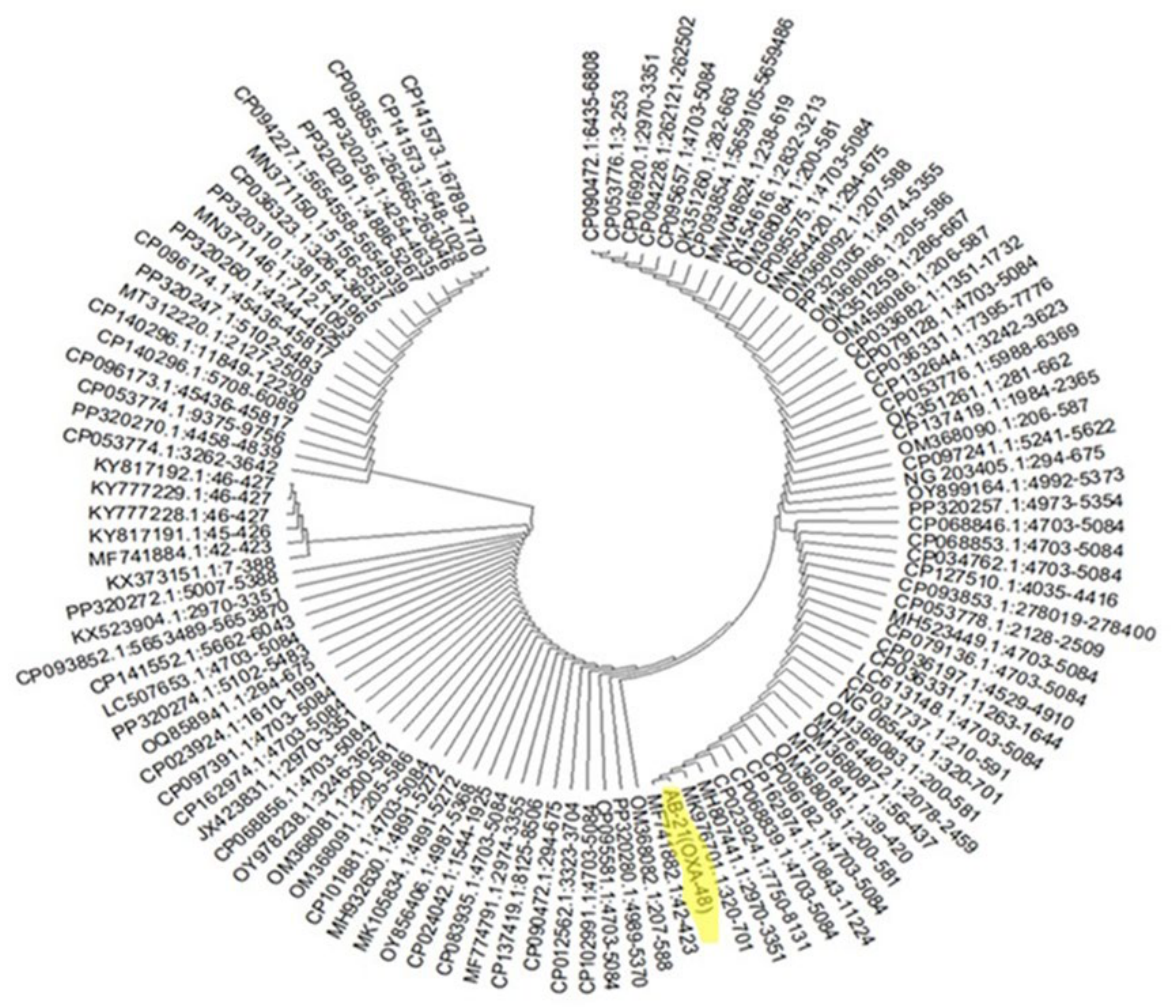
Notably, blaOXA-48-like sequences derived from A. baumannii clustered within clades predominantly composed of Enterobacterales-associated plasmid sequences. For example, the sequence from isolate AB-21 showed close phylogenetic proximity to K. pneumoniae plasmid sequences reported from Canada and Europe, suggesting probable plasmid-mediated HGT across species boundaries, as shown in Figure 1.
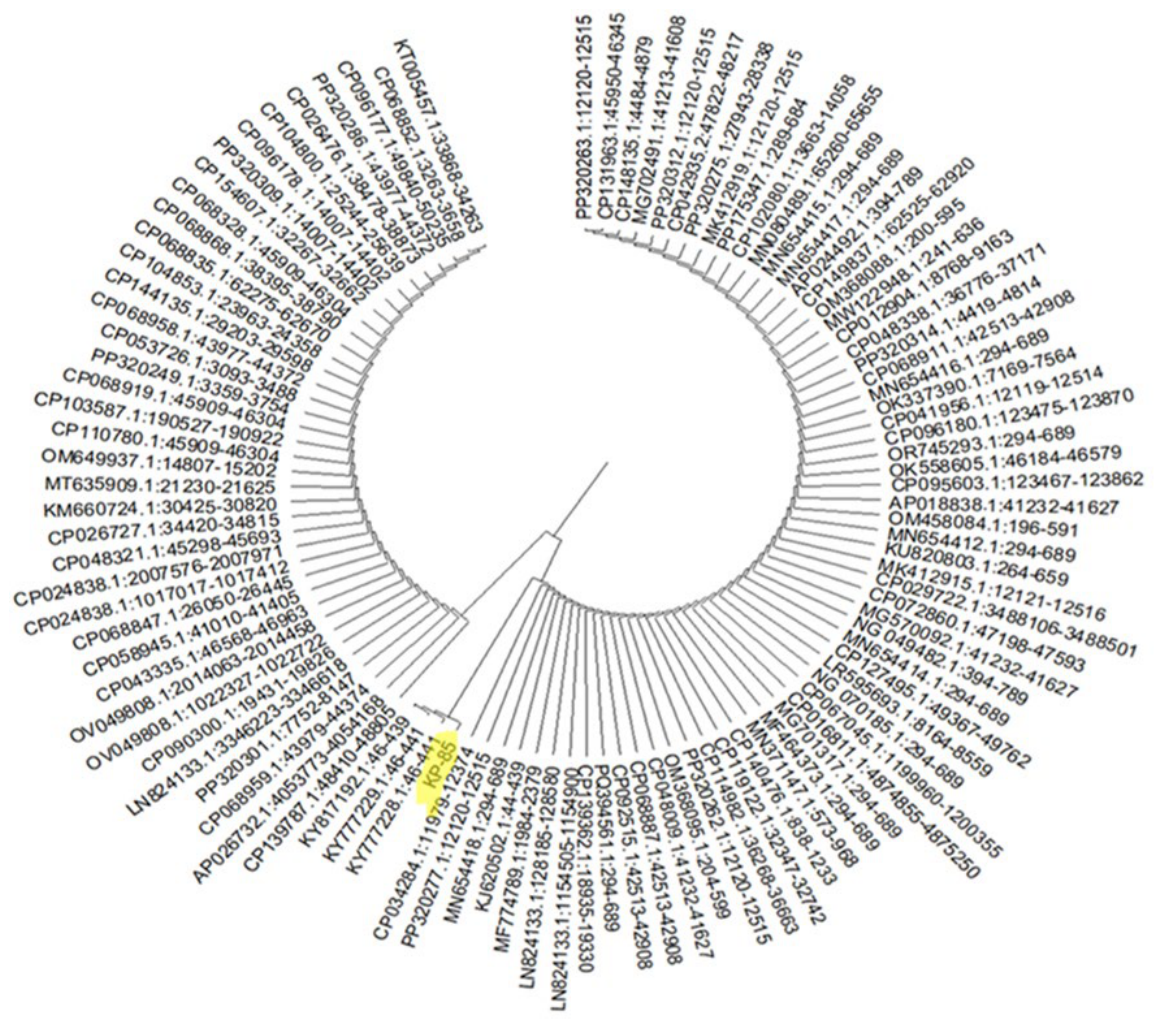
Similarly, blaOXA-48-like sequences from K. pneumoniae strains were closely grouped with strains originating from the Middle East and South Asia, reflecting regional dissemination with global connectivity as shown in Figure 2. In contrast, sequences from E. meningoseptica did not form a distinct lineage but clustered within Enterobacterales-associated clades (Figures S1 and S2), further supporting the interspecies acquisition of resistance genes. Phylogenetic analysis of blaNDM genes demonstrated broader clustering across environmental and clinical strains (Figure S3), including those derived from wildlife and environmental reservoirs. This pattern highlights the One Health dimension of AMR, where resistance determinants circulate across clinical, environmental, and animal domains expanded phylogenetic analyses are shown in Supplementary Figures S4–S7.

2.2. Global Comparative Analysis and Evidence of Horizontal Gene Transfer

Comparative analysis incorporating global reference sequences revealed that the blaOXA-48-like genes identified in this study exhibited high sequence similarity (>99%) with internationally reported plasmid-borne variants. These sequences were from Europe, Asia, and the Middle East, indicating extensive interregional dissemination. A total of 15 carbapenemase gene sequences were identified across multispecies clinical strains, predominantly blaOXA-48-like variants, along with blaNDM, blaVIM, and blaIMP genes (Table 1).
The clustering patterns observed in the phylogenetic trees suggest that blaOXA-48-like genes are not confined to specific bacterial lineages but are associated with mobile genetic elements that are capable of cross-species transmission. In particular, the presence of nearly identical sequences across taxonomically distinct species is consistent with possible HGT; however, plasmid-mediated transfer requires confirmation by plasmid profiling or whole genome sequencing. Furthermore, the absence of species-specific clustering of blaOXA-48-like genes indicates that evolutionary pressures favor gene mobility over host specialization, contributing to the persistence and expansion of this resistance determinant in diverse ecological niches.

2.3. Sequence Conservation and Multiple Sequence Alignment

Multiple sequence alignments of blaOXA-48-like nucleotide sequences revealed remarkable conservation across all strains, with only minor single-nucleotide polymorphisms (SNPs). Importantly, these variations were confined to nonfunctional regions and did not affect the catalytic domains.
A conserved nucleotide motif corresponding to the enzyme’s active-site region was identified in all sequences, indicating the functional stability of the carbapenemase gene (Figure S8). Multiple sequence alignment of the Sanger-sequenced blaOXA-48-like PCR amplicons showed a high degree of conservation across the investigated strains, with only minor nucleotide variations. These partial sequences were used for sequence confirmation and fragment-based phylogenetic comparison rather than for full-length protein translation. Therefore, no inference regarding the full-length amino acid size was made from the ~438 bp amplicons.
The conserved nucleotide patterns observed within the amplified region support the identity and high sequence conservation of blaOXA-48-like genes among the studied strains. No major disruptive changes were observed within the sequenced fragment.
At the amino acid level, all key catalytic residues were strictly conserved across strains, including: Ser70, Lys73, Ser118, Trp157, and Tyr211. No truncations, frameshifts, or deleterious mutations were detected, confirming the integrity of the encoded enzymes.

2.4. Conservation Analysis of OXA β-Lactamase Genes

Multiple sequence alignment (MSA) of the OXA 48 gene sequences of OXA-48 β-lactamase bacterial strains in BioEdit software was performed using Clustal W version. Compatibility showed some commonality, as well as disagreement of particular nucleotides and amino acids that were specific to each isolate. All sequences shared common nucleotide patterns, particularly in the 5′ and middle coding regions. For example, in all sequences, there was a stretch containing the GATATCGCCGCTTGG and nearly no variation. The repeated CGT, GCG, and TGG were also observed in all sequences. The findings indicate that even though there are sequence divergences, OXA β-lactamase genes have retained some areas by evolution to maintain some functional roles, as shown in Figure S8.

2.5. Structural Modeling of blaOXA-48-like Enzyme

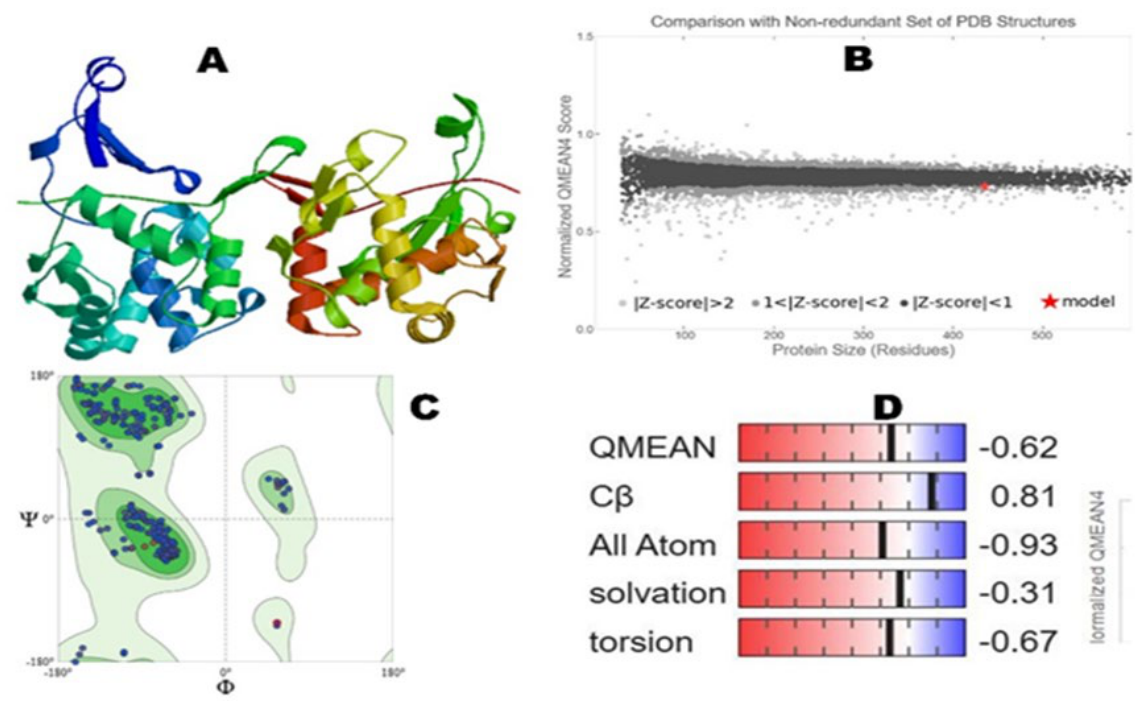
Homology modeling of the blaOXA-48-like enzyme using the SWISS-MODEL platform demonstrated high structural similarity to the reference crystal structure (PDB: 3HBR). The generated model exhibited a GMQE score of approximately 0.85, indicating strong model reliability. Superimposition of the modeled structure with the template revealed minimal deviation, with a root mean square deviation (RMSD) of less than 0.3 Å, confirming near-identical three-dimensional conformation (Figure 3). The enzyme retained its characteristic class D β-lactamase fold, including the conserved active-site architecture essential for catalytic activity.

2.6. Structural Validation and Active-Site Conservation

Structural validation using Ramachandran plot analysis showed that more than 90% of the residues were located in the favored regions, with no residues in the disallowed regions, confirming the excellent stereochemical quality of the model (Figure 3). A detailed inspection of the active site demonstrated the complete conservation of catalytic residues, including nucleophilic Ser70 and carbamylated Lys73, which are critical for β-lactam hydrolysis. The spatial orientations of these residues remained unchanged compared to those of the reference structure.
These findings indicate that structural conservation is maintained despite phylogenetic diversity, suggesting that the functional activity of blaOXA-48-like enzymes remains stable across different bacterial hosts.

2.7. Functional Implications of Structural Conservation

The absence of structural variation in the active site suggests that the blaOXA-48-like enzymes retain consistent catalytic efficiency and substrate-binding characteristics across strains. This structural stability likely contributes to the persistence and global success of this resistance determinant in the Enterobacteriaceae. The conserved active-site architecture indicates that resistance is primarily maintained through dissemination of the blaOXA-48-like gene, differences in expression levels, and co-occurrence with additional resistance determinants, rather than through major structural changes in the enzyme. These findings indicate that resistance is primarily driven by gene dissemination, differential expression levels, and co-occurrence with other resistance determinants.

3. Discussion

This study offers a comprehensive phylogenetic and structural examination of blaOXA-48-like carbapenemases found in clinical strains from multiple species, emphasizing their evolutionary stability and widespread dissemination in clinical settings. Phylogenetic analysis revealed that the blaOXA-48-like sequences identified in this study were closely related to globally reported variants, reinforcing the idea that these resistance genes belong to a highly conserved and widely distributed gene pool [11,33]. A significant finding was the lack of species-specific grouping in the phylogenetic trees, where blaOXA-48-like sequences from A. baumannii, K. pneumoniae, and E. meningoseptica were mixed with sequences from various geographic locations. This pattern strongly indicates that HGT is the main mechanism behind the spread of blaOXA-48-like genes, rather than clonal expansion within a single bacterial lineage [34,35]. The association of blaOXA-48-like genes with plasmid-mediated mobility further underscores their ability to rapidly spread between species, especially in high-risk environments such as intensive care units (ICUs) [36]. The phylogenetic clustering of blaNDM sequences with strains from the environment and wildlife further highlights the One Health aspect of AMR, emphasizing the interconnectedness of clinical, environmental, and animal reservoirs of resistance-associated genes [37,38]. These findings suggest that resistance genes circulating in hospital settings may originate from or be continuously exchanged with other ecological niches. At the structural level, homology modeling showed a high degree of conservation in the blaOXA-48-like enzyme, with minimal deviation from the reference crystal structure (PDB ID: 3HBR). The preservation of key catalytic residues, including Ser70, Lys73, Ser118, Trp157, and Tyr211, indicates that the enzymatic function of blaOXA-48-like remains stable across different bacterial strains and host species. The low RMSD values and favorable Ramachandran plot distribution further confirmed the structural integrity and reliability of the modeled protein. The combined phylogenetic and structural findings suggest that the success of blaOXA-48-like carbapenemases is not driven by structural diversification but by genetic mobility and efficient dissemination mechanisms. Unlike other resistance determinants that evolve through frequent mutations affecting substrate specificity, blaOXA-48-like enzymes appear to maintain a conserved functional core while spreading across diverse bacterial taxa. This evolutionary stability has important implications for managing AMR. The conserved active-site architecture suggests that blaOXA-48-like enzymes remain predictable molecular targets for inhibitor design, although their widespread distribution and frequent co-occurrence with other carbapenemases (e.g., blaNDM) may limit their therapeutic effectiveness in clinical settings. Furthermore, the detection of blaOXA-48-like genes in non-traditional hosts, such as E. meningoseptica, expands the known host range of this resistance determinant, indicating that opportunistic pathogens may serve as additional reservoirs of carbapenemase genes. This highlights the importance of continuous molecular surveillance to monitor emerging transmission pathways. Overall, this study underscores that the persistence and global success of blaOXA-48-like carbapenemases are primarily attributable to their structural conservation and horizontal dissemination, rather than adaptive structural evolution. The integration of phylogenetic and structural approaches provides a comprehensive framework for understanding the dynamics of AMR at the genetic and molecular levels.
One limitation of the present study is that 16S rRNA gene sequencing was not performed for species-level confirmation. However, species identification was strengthened by subculture of stored strains followed by MALDI-TOF MS prime confirmation, in addition to the initial biochemical and API-based identification. Future studies using 16S rRNA gene sequencing or whole-genome sequencing would provide further genotypic confirmation and allow detailed strain-level comparison and characterization of mobile genetic elements.

4. Materials and Methods

4.1. Study Design, Source of Strains, and Species Identification

The present study included carbapenem-resistant Gram-negative clinical strains recovered from patients with ventilator-associated pneumonia (VAP) at a tertiary-care hospital in Karachi, Pakistan, between July 2022 and January 2023. These isolates were obtained from clinical respiratory specimens and selected for molecular confirmation, phylogenetic comparison, and structural analysis of carbapenemase genes.
A total of 20 representative carbapenem-resistant strains were included in the final analysis, comprising 11 A. baumannii, 7 K. pneumoniae, and 2 E. meningoseptica strains. The strains were selected based on the carbapenem resistance profile, species representation, and availability of stored cultures for further molecular analysis.
Initial identification was performed using standard microbiological procedures, including colony morphology, Gram staining, and routine biochemical testing, followed by API 20E and API 20NE systems, according to the manufacturer’s instructions. To strengthen species-level identification, stored cultures were subcultured to obtain pure colonies, which were subsequently re-confirmed using matrix-assisted laser desorption/ionization time-of-flight mass spectrometry (MALDI-TOF MS). Only strains with reliable species-level identifications were included in the final analysis.
Publicly available GenBank sequences were not used as the study specimens. These sequences were used only as comparative reference sequences for phylogenetic analysis. An overview of the methodological workflow is presented in Supplementary Figure S9.

4.2. Antimicrobial Susceptibility Testing

Antimicrobial susceptibility testing (AST) was performed as part of the phenotypic characterization of the selected Gram-negative clinical strains. Susceptibility to β-lactams, carbapenems, aminoglycosides, fluoroquinolones, and other clinically relevant antimicrobial agents was assessed using standard laboratory procedures according to Clinical and Laboratory Standards Institute (CLSI) guidelines. Minimum inhibitory concentrations (MICs) for carbapenem antibiotics were determined where applicable, and results were interpreted using current CLSI breakpoints.
Strains showing non-susceptibility to at least one agent in three or more antimicrobial categories were classified as multidrug-resistant (MDR). Carbapenem-resistant strains were selected for further molecular screening of carbapenemase genes, including blaOXA-48-like, blaNDM, blaVIM, blaIMP, and blaKPC. The AST profile was used only for phenotypic characterization and selection of representative strains for downstream molecular, phylogenetic, and structural analyses [16].

4.3. PCR Detection of Carbapenemase Genes

All 20 strains were screened for the blaOXA-48-like, blaNDM, blaVIM, blaIMP, and blaKPC carbapenemase genes. Genomic DNA was extracted using a commercial kit (Qiagen, Hilden, Germany) according to the manufacturer’s protocol. PCRs were performed in 25 µL reactions with 50 ng template DNA, 0.2 µM primers, 200 µM dNTPs, 2.5 µL 10× buffer, 1.5 mM MgCl2, and 1 U Taq polymerase (Thermo Fisher Scientific, Vilnius, Lithuania). Cycling included denaturation at 94 °C for 4 min; 35 cycles of 94 °C for 60 s, annealing for 40 s, 72 °C for 50 s; and a final 72 °C for 5 min. The primer details are presented in Supplementary Table S1 [39]. Amplicons were analyzed on 1.5% agarose gels with Gel Red and a 100 bp DNA ladder. Negative and positive controls were included in each experiment.

4.4. Sanger Sequencing and Sequencing Confirmation

PCR-positive amplicons of carbapenemase genes were purified using the Gene JET PCR Purification Kit (Thermo Fisher Scientific, Vilnius, Lithuania)according to the manufacturer’s instructions. Purified PCR products were subjected to Sanger sequencing using the same forward and reverse primers used for PCR amplification.
The obtained forward and reverse sequence reads were checked for chromatogram quality, trimmed to remove low-quality regions, and assembled to generate consensus sequences. The resulting sequences were compared with reference sequences available in the NCBI GenBank database using NCBI BLASTn web server (National Center for Biotechnology Information, Bethesda, MD, USA) to confirm gene identity. Sequences showing high similarity with known carbapenemase genes were considered confirmed.
The confirmed partial carbapenemase gene sequences were used for downstream multiple sequence alignment and phylogenetic analysis. The sequence lengths reported in Table 1 represent PCR-amplified partial gene fragments and not full-length coding sequences.

4.5. Phylogenetic Analysis of Carbapenemase Genes

We assessed the global relatedness of carbapenemase genes from our strains by analyzing their PCR-amplified sequences. Representative blaVIM, blaOXA-48-like, and blaNDM amplicons from our strains were Sanger sequenced in both directions, then aligned to GenBank reference sequences. Alignments were performed using Clustal Omega v1.2.4 (EMBL-EBI), and maximum-likelihood phylogenetic trees were built with MEGA version 11.0.13 using the Tamura–Nei model. Branch support was measured using 1000 bootstrap replicates, and nodes with values ≥ 70% were considered robust. The trees include GenBank accession numbers, source organisms, and countries for references. This allowed for a comparison of the genes of our ICU strains with those of global sources. Figure 1 and Figure 2 (see Section 2) show representative trees for OXA-48-like genes. Additional trees are shown in the Supplementary Materials (Figures S1–S7). We interpreted the clustering patterns to infer clonality and possible HGT.

4.6. Homology Modeling of OXA-48

To evaluate the structural conservation of the blaOXA-48-like enzyme, we constructed a homology model based on a blaOXA-48-like reference crystal structure. A blaOXA-48-like gene from one of our strains was used (amino acid sequence derived from PCR product sequencing). The sequence was submitted to SWISS-MODEL Workspace (SIB Swiss Institute of Bioinformatics, Basel, Switzerland), with the blaOXA-48-like crystal structure (PDB 3HBR, 1.9 Å resolution) as the template. Model quality was assessed using SWISS-MODEL’s GMQE and QMEANDisCo global scores and the local distance difference test (lDDT) for structural accuracy. The model was visualized in PyMOL v2.5 (Schrödinger LLC, New York, NY, USA)and superimposed on the 3HBR template to examine rmsd and active-site alignment. Key catalytic residues (notably the class D β-lactamase motif Ser70–Lys73 and other active-site residues) were examined for positional conservation. A Ramachandran plot was generated (using PROCHECK v3.5.4to evaluate the backbone dihedral angles, and the proportion of residues in the favored versus disallowed regions was recorded as a measure of stereochemical quality. In addition, component-wise quality metrics (per-residue error estimates) were reviewed. Figure 3 (Section 2) shows the homology model and validation analyses.

5. Conclusions

This study demonstrates that blaOXA-48-like carbapenemases exhibit strong phylogenetic clustering and high structural conservation across multiple clinical species. The close relationship between these sequences and globally reported variants confirms their widespread dissemination via HGT, particularly through plasmid-mediated mechanisms.
Structural analysis revealed the preservation of the catalytic architecture, indicating that these enzymes maintain functional stability, despite their broad distribution across diverse bacterial hosts. This suggests that the persistence of blaOXA-48-like carbapenemases is primarily driven by gene mobility rather than structural adaptations.
The integration of phylogenetic and structural analyses highlights the importance of molecular surveillance in understanding the dynamics of AMR. These findings provide valuable insights into the evolutionary behavior of blaOXA-48-like enzymes and support their continued relevance as targets for therapeutic interventions and the development of inhibitors.

Supplementary Materials

The following supporting information can be downloaded at: https://www.mdpi.com/article/10.3390/ijms27125391/s1. Reference [39] is cited in the supplementary materials.

Author Contributions

Conceptualization, Z.H. and A.N.; methodology, Z.H. and A.N.; software, Z.H. and A.K.; validation, A.N., A.F., A.K. and M.S.Q.; formal analysis, Z.H.; investigation, Z.H.; resources, A.N., A.F., A.K. and M.S.Q.; data curation, A.N., A.F., A.K., M.S.Q. and M.J.; writing—original draft preparation, Z.H.; writing—review and editing, Z.H., A.N. and A.K.; visualization, A.K., M.J. and Z.H.; supervision, A.N. and A.K.; project administration, A.N.; funding acquisition, Z.H. and A.N. All authors have read and agreed to the published version of the manuscript.

Funding

This research received no external funding.

Institutional Review Board Statement

The study was conducted in accordance with the Declaration of Helsinki and approved by the Institutional Review Board of Dow University of Health Sciences, Karachi (Ref: IRB-2353-DUHS/APPROVAL/2021/709).

Informed Consent Statement

Patient consent was waived owing to the use of de-identified clinical data.

Data Availability Statement

The original contributions presented in this study are included in the article/Supplementary Materials. Further inquiries can be directed to the corresponding author.

Conflicts of Interest

The authors declare no conflicts of interest.

References

  1. Mestrovic, T.; Naghavi, M.; Aguilar, G.R.; Weaver, N.D.; Swetschinski, L.R.; Wool, E.E.; Araki, D.T.; Hayoon, A.G.; Han, C.; Ikuta, K.S.; et al. The burden of bacterial antimicrobial resistance in the WHO Eastern Mediterranean Region 1990–2021: A cross-country systematic analysis with forecasts to 2050. Lancet Public Health 2025, 10, e955–e970. [Google Scholar] [CrossRef] [Scilit]
  2. World Health Organization. Global Antibiotic Resistance Surveillance Report 2025: WHO Global Antimicrobial Resistance and Use Surveillance System (GLASS); World Health Organization: Geneva, Switzerland, 2025. [Google Scholar]
  3. Peirano, G.; Pitout, J.D. Rapidly spreading Enterobacterales with OXA-48-like carbapenemases. J. Clin. Microbiol. 2025, 63, e01515-24. [Google Scholar] [CrossRef] [Scilit]
  4. Miftode, I.L.; Radu, V.D.; Jigoranu, R.A.; Leca, D.A.; Prepeliuc, C.S.; Pasare, M.A.; Miftode, R.S.; Grigoriu, M.G.; Parângă, T.G.; Miftode, E.G. Novel insights into carbapenem resistance: Mechanisms, diagnostics, and future directions. Antibiotics 2026, 15, 270. [Google Scholar] [CrossRef] [Scilit]
  5. Hossain, H.; Ali, M.H.; Ahmad, T.; Sayeed, S.S.; Sakib, M.A.; Brishty, K.A.; Saleh, M.S.; Hosen, M.M.; Ahmed, S.; Ahmed, S.; et al. Mobile Genetic Elements as Central Drivers of Antimicrobial Resistance: Molecular Mechanisms, Evolutionary Ecology, One Health Implications and Control Strategies. Antibiotics 2026, 15, 418. [Google Scholar] [CrossRef] [Scilit]
  6. Sastre-Dominguez, J.; Rodera-Fernandez, P.; DelaFuente, J.; Martínez-González, S.; Quesada, S.; Valencoso-Requena, M.; Calvo-Villamañán, A.; Costas, C.; Fuentes-Hernández, A.; Santos-Lopez, A.; et al. Plasmids promote antimicrobial resistance through insertion sequence-mediated gene inactivation. Nat. Microbiol. 2026, 11, 976–992. [Google Scholar] [CrossRef] [Scilit]
  7. Nermont, R.; Oueslati, S.; Aumont-Nicaise, M.; Retailleau, P.; Iorga, B.I.; Naas, T. Improved hydrolysis of piperacillin by OXA-48-like R214G variants, a selective advantage under piperacillin-tazobactam exposure. Antimicrob. Agents Chemother. 2026, 70, e01267-25. [Google Scholar] [CrossRef] [Scilit]
  8. Diab, A.A.; Jalal, D.; Fadel, Y.M.; Samir, O.; Shalaby, L.; Elanany, M.; Abo-Elmaaty, S.A.; Aziz, R.K.; Sayed, A.A.; Hassan, M.G. Limits of rapid diagnostics: Genomic and structural insights into OXA-48–like mediated carbapenem resistance in Escherichia coli. Front. Microbiol. 2026, 17, 1790597. [Google Scholar] [CrossRef] [Scilit]
  9. Naveed, S.; Hanif, F.; Usman, J.; Irfan, R.; Furqan, W.; Ullah, A.N. Emergence of OXA-48-like Genes in Carbapenem-Resistant Klebsiella Pneumoniae at a Tertiary Care Hospital in Pakistan. Pak. Armed Forces Med. J. 2025, 75, 1224. [Google Scholar] [CrossRef] [Scilit]
  10. Muneer, F.; Raj, N.; Das, A.; Singh, V.; Sen, M.; Agarwal, J. The Rising Menace: Carbapenem-Resistant Klebsiella pneumoniae in a Tertiary Care Center and Co-dominance of blaNDM, blaOXA-48 Along with the Emergence of blaVIM. Cureus 2025, 17, e94303. [Google Scholar] [CrossRef] [Scilit]
  11. Baffert, Y.; Fraikin, N.; Makhloufi, Y.; Baltenneck, J.; Val, M.E.; Dedieu-Berne, A.; Degosserie, J.; Iorga, B.I.; Bogaerts, P.; Gueguen, E.; et al. Genetic determinants of pOXA-48 plasmid maintenance and propagation in Escherichia coli. Nat. Commun. 2025, 16, 7734. [Google Scholar] [CrossRef] [Scilit]
  12. White, R.T.; Thornley, C.N.; Bloomfield, M.; Dyet, K.; Elvy, J.; Perez, H.; Hardaker, A.; Harrington, M.; Jackson, S.; Kelly, M.; et al. Integration of blaOXA-48 into a Col156 plasmid drove a carbapenem-resistant Escherichia coli ST131 outbreak in New Zealand: Global genomic evidence for the gene’s multilayered dissemination. Drug Resist. Updates 2025, 84, 101327. [Google Scholar] [CrossRef] [Scilit]
  13. Alvisi, G.; Curtoni, A.; Fonnesu, R.; Piazza, A.; Signoretto, C.; Piccinini, G.; Sassera, D.; Gaibani, P. Epidemiology and genetic traits of carbapenemase-producing enterobacterales: A global threat to human health. Antibiotics 2025, 14, 141. [Google Scholar] [CrossRef] [Scilit]
  14. Jasim, S.A.; Mohammed, J.S.; Roopashree, R.; Alshahrani, M.Y.; Sharma, A.; Sharma, A.; Asliddin, S.; Beig, M. Unraveling the global landscape of Elizabethkingia antibiotic resistance: A systematic review and meta-analysis. PLoS ONE 2025, 20, e0323313. [Google Scholar] [CrossRef] [Scilit]
  15. Chuang, C.; Kao, T.C.; Juan, C.H.; Chou, S.H.; Ho, Y.C.; Liu, S.Y.; Huang, Y.R.; Ho, H.L.; Lin, Y.T. Clinical characteristics of patients who acquired Gram-negative bacteria during ceftazidime-avibactam therapy. Infect. Dis. Ther. 2025, 14, 1027–1042. [Google Scholar] [CrossRef] [Scilit]
  16. Hussain, Z.; Naim, A.; Fatima, A.; Karim, A.; Uddin, F.; Shams, S. Distribution of MBL and serine-β-lactamase-producing pathogens in ventilator-associated pneumonia: Insights into MDR and XDR strains. Iran. J. Microbiol. 2025, 17, 761. [Google Scholar] [CrossRef] [Scilit]
  17. Hou, J.; Liu, J.; Guo, M.; Li, J.; Qin, C.; Zhang, G. Whole-genome sequencing reveals the genomic characterization and evolution of carbapenem-resistant Klebsiella pneumoniae in Gansu, China. Front. Cell. Infect. Microbiol. 2026, 16, 1749978. [Google Scholar] [CrossRef] [Scilit]
  18. Huang, Y.S.; Zhou, H. Breakthrough advances in beta-lactamase inhibitors: New synthesized compounds and mechanisms of action against drug-resistant bacteria. Pharmaceuticals 2025, 18, 206. [Google Scholar] [CrossRef] [Scilit]
  19. Sherry, N.L.; Lee, J.Y.; Giulieri, S.G.; Connor, C.H.; Horan, K.; Lacey, J.A.; Lane, C.R.; Carter, G.P.; Seemann, T.; Egli, A.; et al. Genomics for antimicrobial resistance—Progress and future directions. Antimicrob. Agents Chemother. 2025, 69, e01082-24. [Google Scholar] [CrossRef] [Scilit]
  20. van Dorp, L.; Balloux, F. Phylogenetics for Genomic Epidemiology. In Molecular Epidemiology for Infectious Diseases: An Introduction to Understanding and Interpreting Molecular Epidemiology; Springer Nature Switzerland: Cham, Switzerland, 2025; pp. 67–97. [Google Scholar]
  21. Blake, K.S.; Kumar, H.; Loganathan, A.; Williford, E.E.; Diorio-Toth, L.; Xue, Y.P.; Tang, W.K.; Campbell, T.P.; Chong, D.D.; Angtuaco, S.; et al. Sequence-structure-function characterization of the emerging tetracycline destructase family of antibiotic resistance enzymes. Commun. Biol. 2024, 7, 336. [Google Scholar] [CrossRef] [Scilit]
  22. Bonnin, R.A.; Jousset, A.B.; Jacquemin, A.; Emeraud, C.; Girlich, D.; Naas, T.; Dortet, L. Genetic diversity, biochemical properties, epidemiology, and detection methods of IMP-and VIM-type carbapenemases. Clin. Microbiol. Rev. 2025, 38, e00129-23. [Google Scholar] [CrossRef] [Scilit]
  23. Carnevale, M.C.; Palacios, A.R.; Hinchliffe, P.; Delmonti, J.; Drusin, S.I.; Moreno, D.M.; Bonomo, R.A.; Spencer, J.; Vila, A.J. Active site loops of membrane-anchored metallo-β-lactamases from environmental bacteria determine cephalosporinase activity. Antimicrob. Agents Chemother. 2025, 69, e01918-24. [Google Scholar] [CrossRef] [Scilit]
  24. Nelson, R.G.; Rosowsky, A. Dicyclic and tricyclic diaminopyrimidine derivatives as potent inhibitors of cryptosporidium parvum dihydrofolate reductase: Structure-activity and structure-selectivity correlations. Antimicrob. Agents Chemother. 2002, 46, 940. [Google Scholar] [CrossRef]
  25. Carcione, D.; Brigante, G.; Carducci, A.; Intra, J.; Ambretti, S.; Campanile, F.; Arcari, G.; Mancini, N.; Cattaneo, D.; Gona, F.; et al. Cefepime and New Cefepime/Beta-Lactamase Inhibitor Combination for the Treatment of Gram-Negative Bacteria: Chemical Structure and Mechanism of Action, Microbiological Target, Clinical Use and PK/PD Characteristics. Pharmaceuticals 2026, 19, 283. [Google Scholar] [CrossRef] [Scilit]
  26. Grossman, J.M.; Thompson, D.K. Clinically Significant Carbapenemases in Gram-Negative Pathogens: Molecular Diversity and Advances in β-Lactamase Inhibitor Therapy. Antibiotics 2026, 15, 413. [Google Scholar] [CrossRef] [Scilit]
  27. Bientz, L.; Nermont, R.; Emeraud, C.; Naas, T.; Bonnin, R.A.; Dortet, L. Emergence and characterization of new OXA-181 variants in France: OXA-1181, OXA-1201, OXA-1205, OXA-1207, and OXA-1226. Microbiol. Spectr. 2026, 14, e00489-26. [Google Scholar] [CrossRef] [Scilit]
  28. Tonkin-Hill, G.; Ruis, C.; Bentley, S.D.; Lythgoe, K.A.; Bryant, J.M. Within-host bacterial evolution and the emergence of pathogenicity. Nat. Microbiol. 2025, 10, 1829–1840. [Google Scholar] [CrossRef] [Scilit]
  29. Wu, X.; Han, X.; Zhu, L.; Pi, N.; Li, Y.; Xiang, R. A Novel Metallo-β-Lactamase AMM-1 from Alteromonas mangrovi Reveals a Cryptic Environmental Reservoir of Carbapenem Resistance. Microb. Biotechnol. 2025, 18, e70191. [Google Scholar] [CrossRef] [Scilit]
  30. George, N.A.; Pan, D.; Silva, L.; Baggaley, R.F.; Irizar, P.; Divall, P.; Al-Oraibi, A.; Khan, D.P.; Martin, C.A.; Nazareth, J.; et al. The prevalence and risk of mortality associated with antimicrobial resistance within nosocomial settings—A global systematic review and meta-analysis of over 20,000 patients. EClinicalMedicine 2025, 87, 103384. [Google Scholar] [CrossRef] [Scilit]
  31. Woh, P.Y.; Zhang, X. The burden of ESKAPE pathogen-related hospital-acquired infections: Clinical and financial perspective from a systematic review. J. Hosp. Infect. 2025, 162, 377–385. [Google Scholar] [CrossRef] [Scilit]
  32. Melinte, V.; Radu, M.A.; Văcăroiu, M.C.; Mîrzan, L.; Holban, T.S.; Ileanu, B.V.; Cismaru, I.M.; Gheorghiță, V. Epidemiology of carbapenem-Resistant Klebsiella Pneumoniae Co-Producing MBL and OXA-48-like in a romanian tertiary hospital: A call to action. Antibiotics 2025, 14, 783. [Google Scholar] [CrossRef] [Scilit]
  33. Didelot, X. Phylogenetic Methods for Genome-Wide Association Studies in Bacteria. In Bacterial Pangenomics: Methods and Protocols; Springer US: New York, NY, USA, 2021; pp. 205–220. [Google Scholar]
  34. Pandey, M.K.; Mukhopadhyay, K. Plasmid-borne multidrug resistance genes in environmental isolates from hospital effluent: Implications for resistance dissemination. Sci. Total Environ. 2026, 1015, 181407. [Google Scholar]
  35. Liu, J.; Ni, H.B.; Yu, M.Y.; Qin, S.Y.; Elsheikha, H.M.; Peng, P.; Guo, L.; Xie, L.H.; Liang, H.R.; Lei, C.C.; et al. Comprehensive profiling of antibiotic resistance, virulence genes, and mobile genetic elements in the gut microbiome of Tibetan antelopes. Msystems 2026, 11, e01443-25. [Google Scholar] [CrossRef] [Scilit]
  36. Hussain, Z.; Farooqui, F.; Ibrahim, A.; Baig, S. Patients and Surfaces: Integrated Clinical–Environmental Surveillance of MDR Gram-Negative Bacteria in Critical-Care Units (Karachi, 2024–2025). Microorganisms 2025, 13, 2762. [Google Scholar] [CrossRef] [Scilit]
  37. Ramirez-Plascencia, H.H.; Colima-Fausto, A.G.; Licona-Lasteros, K.C.; Díaz-Zaragoza, M.; Cazarez-Navarro, G.; Macias-Barragan, J.G.; Rodriguez-Preciado, S.Y. Presence of Microorganisms in the Environment: One Health Approach. Microorganisms 2025, 13, 2435. [Google Scholar] [CrossRef] [Scilit]
  38. Hernando-Amado, S.; Coque, T.M.; Baquero, F.; Martínez, J.L. Defining and combating antibiotic resistance from One Health and Global Health perspectives. Nat. Microbiol. 2019, 4, 1432–1442. [Google Scholar] [CrossRef] [Scilit]
  39. Poirel, L.; Walsh, T.R.; Cuvillier, V.; Nordmann, P. Multiplex PCR for detection of acquired carbapenemase genes. Diagn. Microbiol. Infect. Dis. 2011, 70, 119–123. [Google Scholar] [CrossRef] [Scilit]
Figure 1. Maximum-likelihood phylogenetic tree (circular dendrogram) of blaOXA-48 of A. baumannii isolate AB-21 (PZ201986) vs. world-wide blaOXA-48-producing A. baumannii and Enterobacterales. The tree was constructed by means of aligned blaOXA-48 like sequences with the Tamura–Nei model with 1000 bootstrap replicates. Bootstrap values 70% are displayed on the large branches. Sequences generated in this study are highlighted in yellow.
Ijms 27 05391 g001
Figure 2. Circular dendrogram of blaOXA-48-like sequences from K. pneumoniae isolate KP-85 (PZ234370) and global strains, demonstrating clustering with internationally reported plasmid-associated sequences. Sequences generated in this study are highlighted in yellow.
Ijms 27 05391 g002
Figure 3. Quality assessment and structural modeling of the predicted OXA-48-like protein model. (A) Three-dimensional ribbon representation of the predicted protein model, colored from the N-terminus to the C-terminus. (B) QMEAN comparison plot showing the position of the predicted model in relation to a non-redundant set of experimentally solved protein structures deposited in the Protein Data Bank. (C) Ramachandran plot showing the distribution of backbone dihedral angles, with most residues located in favored or allowed regions, indicating acceptable stereochemical quality. (D) QMEAN component-wise quality score plot showing the global and component-level quality parameters of the predicted model.
Ijms 27 05391 g003
Table 1. Characteristics of carbapenemase gene sequences identified in multispecies clinical strains.
S. No.Isolate IDBacterial SpeciesGene DetectedPCR Amplicon Length (bp)GenBank Accession No.Status
1KP-04K. pneumoniaeblaOXA-48-like~438PZ224593Confirmed
2KP-92K. pneumoniaeblaOXA-48-like~438PZ234371Confirmed
3KP-85K. pneumoniaeblaOXA-48-like~438PZ234370Confirmed
4KP-81K. pneumoniaeblaOXA-48-like~438PZ234369Confirmed
5EK-83E. meningosepticablaOXA-48-like~438PZ234368Confirmed
6EK-61E. meningosepticablaOXA-48-like~438Not yet assignedAccession number pending
7AB-56A. baumanniiblaOXA-48-like~438PZ228821Confirmed
8AB-46A. baumanniiblaOXA-48-like~438PZ224592Confirmed
9AB-43A. baumanniiblaOXA-48-like~438PZ204738Confirmed
10AB-21A. baumanniiblaOXA-48-like~438PZ201986Confirmed
11AB-57A. baumanniiblaNDM~621PZ204737Confirmed
12AB-04A. baumanniiblaOXA-48-like~438PZ023851Confirmed
13AB-04A. baumanniiblaVIM~390Not yet assignedAccession number pending
14AB-40A. baumanniiblaOXA-48-like~438Not yet assignedAccession number pending
15AB-40A. baumanniiblaIMP~232Not yet assignedAccession number pending
Note: Some strains harbored multiple carbapenemase genes and are therefore listed more than once. The listed sequence lengths represent Sanger-sequenced PCR amplicons/partial gene fragments used for molecular confirmation and phylogenetic comparison. They do not represent full-length carbapenemase coding sequences.
Disclaimer/Publisher’s Note: The statements, opinions and data contained in all publications are solely those of the individual author(s) and contributor(s) and not of MDPI and/or the editor(s). MDPI and/or the editor(s) disclaim responsibility for any injury to people or property resulting from any ideas, methods, instructions or products referred to in the content.