Article

Haplotype GWAS in Colorectal Cancer Patients with a Family History of Gastric or Prostate Cancer

1
Department of Oncology, Södersjukhuset, 11833 Stockholm, Sweden
2
Department of Clinical Science and Education, Karolinska Institutet, 11833 Stockholm, Sweden
3
Department of Urology, Södersjukhuset, 11833 Stockholm, Sweden
4
Division of Surgery, Department of Clinical Science Intervention and Technology (CLINTEC), Karolinska Institutet, 17177 Stockholm, Sweden
5
Department of Upper Abdominal Diseases, Karolinska University Hospital, 17166 Stockholm, Sweden
6
Department of Molecular Medicine and Surgery, Karolinska Institutet, 17177 Stockholm, Sweden
7
Department of Clinical Genetics, Karolinska University Hospital, 17166 Stockholm, Sweden
8
Dr. S Krishnamurthi Centre for Research and Education in Cancer, Cachar Cancer Hospital and Research Centre, Silchar 788015, India
*
Authors to whom correspondence should be addressed.
Int. J. Mol. Sci. 2026, 27(1), 547; https://doi.org/10.3390/ijms27010547
Submission received: 28 November 2025 / Revised: 26 December 2025 / Accepted: 31 December 2025 / Published: 5 January 2026
(This article belongs to the Special Issue Genetic and Epigenetic Analyses in Cancer)

Abstract

Previous haplotype Genome Wide Association Studies (GWASs) have suggested several rare loci with a shared increased risk of colorectal, gastric, and prostate cancer. This study aimed to find out more about markers specifically addressing the shared risk of colorectal and gastric cancer, as well as the shared risk of colorectal and prostate cancer. One analysis used 426 colorectal cancer cases with gastric cancer, with no prostate cancer cases in their families, and another analysis used 324 colorectal cancer cases with prostate cancer but no gastric cancer among relatives. The computational program PLINK v1.07 was used for the analysis and for the calculation of corresponding ORs, standard errors, and 95% confidence intervals (CI). The study found support for the loci from previous studies and many new loci with a shared risk of colorectal cancer and gastric cancer. There were no significant loci from the second analysis for a shared risk of colorectal and prostate cancer. Altogether, more than 100 new loci with a shared risk of colorectal cancer and gastric cancer were suggested. A shared risk of colorectal and prostate cancer at some loci could not be ruled out. Haplotype GWAS has again demonstrated its ability to find rare risk loci mostly associated with coding genes.

1. Introduction

Colorectal cancer (CRC) sometimes occurs in a familial setting, and today several genes are known to be associated with an increased risk of CRC [1]. The high-risk genes have also been considered causing genetic syndromes, with an increased risk of not only CRC but also many other cancers, such as in Lynch Syndrome or Familial Adenomatous Polyposis Coli (FAP) syndromes, caused by mutations in the DNA mismatch repair genes (MLH1, MSH2, MSH6, and PMS2) and the APC or MUTYH genes, respectively [1]. Less frequent mutations occur in genes such as SMAD4, BMPRIA, STK11, and PTEN, which are also known to cause CRC and other cancers in the context of cancer syndromes [1]. However, the known high-risk syndromes do not explain all familial CRC, and other syndromes are possible, conceivably with a relatively moderate increased risk [2].
Common diseases are suggested to be caused by an interplay between predisposing genetic variants in low-risk genes and environmental factors, as in the concept of complex disease [3]. To date, Genome Wide Association Studies (GWASs) have therefore been used to identify common genetic loci associated with an increased risk of CRC, as well as other common disorders [4,5,6,7]. Many GWASs on CRC have been published and have identified more than 200 independent risk associations [8,9]. Studies examining pleiotropy across multiple cancer-associated loci have searched for shared genetic risk loci for common mechanisms of cancer development and progression in malignancy [10]. If the increased risk is modest, these genes are still associated with multiple tumors and could constitute low-risk syndromes.
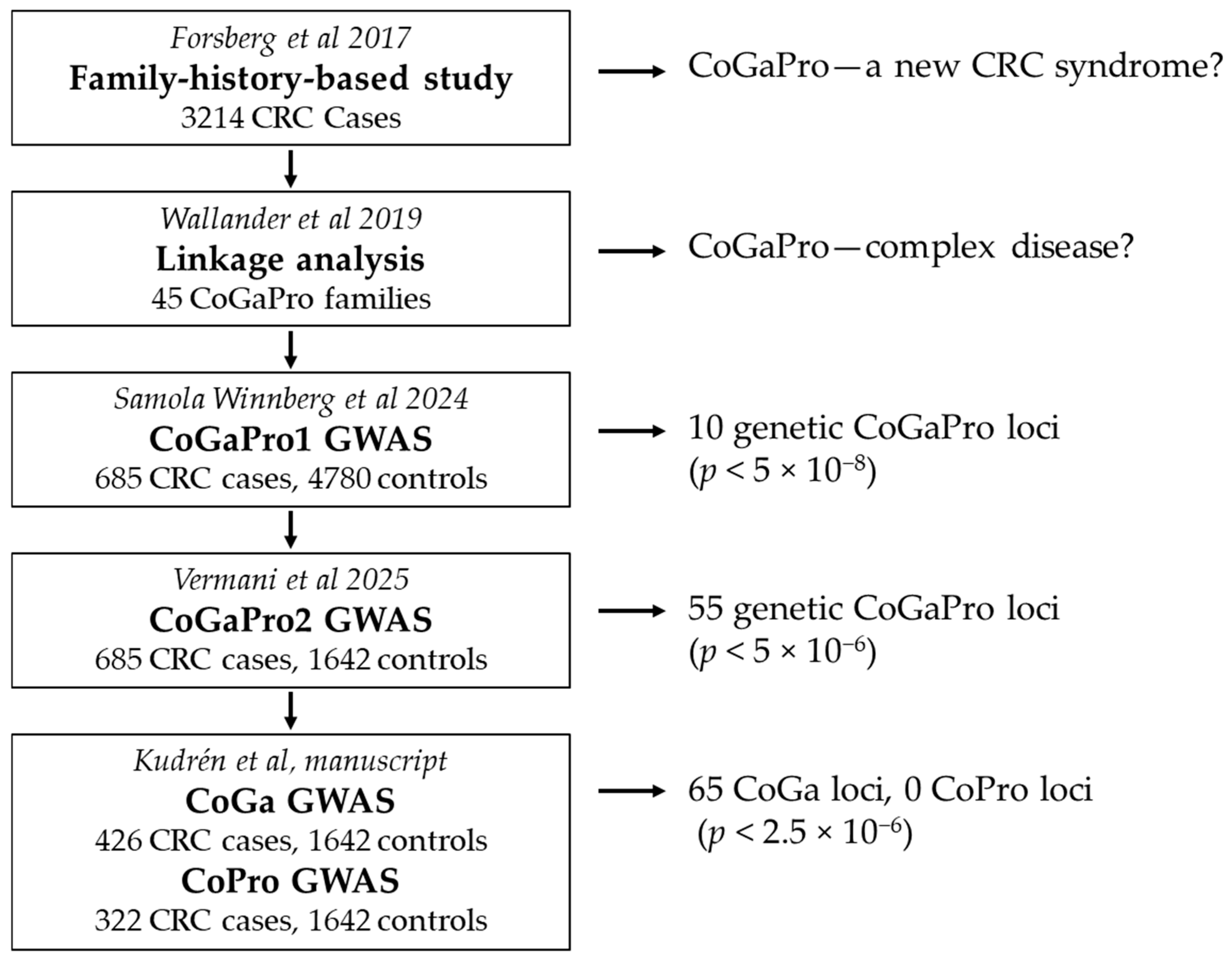
We have published a series of studies on a hypothetical CRC syndrome with a shared risk of colorectal, gastric, and prostate cancer (Figure 1). A first study suggested familial colorectal cancer associated with a possible increased risk for other tumors, primarily gastric and prostate cancer [11]. Linkage analysis in families with colorectal, gastric, and/or prostate cancer was undertaken to study the pattern of inheritance in the underlying hypothetical syndrome. This analysis did not suggest any high-penetrant disease-associated locus, and instead, a complex disease for this putative low-risk syndrome was suggested [12]. To test this hypothesis, first, a haplotype genome-wide association study (GWAS) was conducted involving CRC patients who had gastric and/or prostate cancer among their relatives (CoGaPro1) [13]. That study used healthy, unrelated Swedish twins as controls. The result gave support for 10 risk loci, all with known coding cancer genes, associated with an increased risk of colorectal and possibly also gastric and prostate cancer [13]. Since another cohort of controls, better matched geographically, and genotyped with the same chip, was available, it was possible to perform a second haplotype GWAS (CoGaPro2) using the same cases and new controls [14]. The ten loci from the first study were confirmed, and another 50 (ORs 1.4–6.5) were suggested, many with known coding cancer genes. The study first suggested that the association with multiple tumors could not define whether the increased risk beyond CRC concerned one or several CRC syndromes [11]. Since the current hypothesis is a complex disease with numerous risk loci, it is possible that some loci confer a shared risk for some tumors, while other loci mostly confirm a shared risk for other tumors. Thus, each low-risk syndrome locus could, in fact, constitute its own syndrome related to the specific mechanisms acting at that precise locus. Thus, to find out more about the suggested low-risk syndrome of shared risk loci, a third study was designed to again use haplotype GWAS and subsets of the same CRC cohort as before (Figure 1). However, this time, CRC cases with gastric cancer and no prostate cancer cases in their families were used in one analysis, and CRC cases with prostate cancer but no gastric cancer in their families were used in a second analysis. Both analyses used the same controls as in CoGaPro2. The aim was to find out if the results could give more information about shared risk loci and genes among these three cancer types. The resulting risk loci were to be compared to the results from our previous haplotype studies in CRC.

2. Results

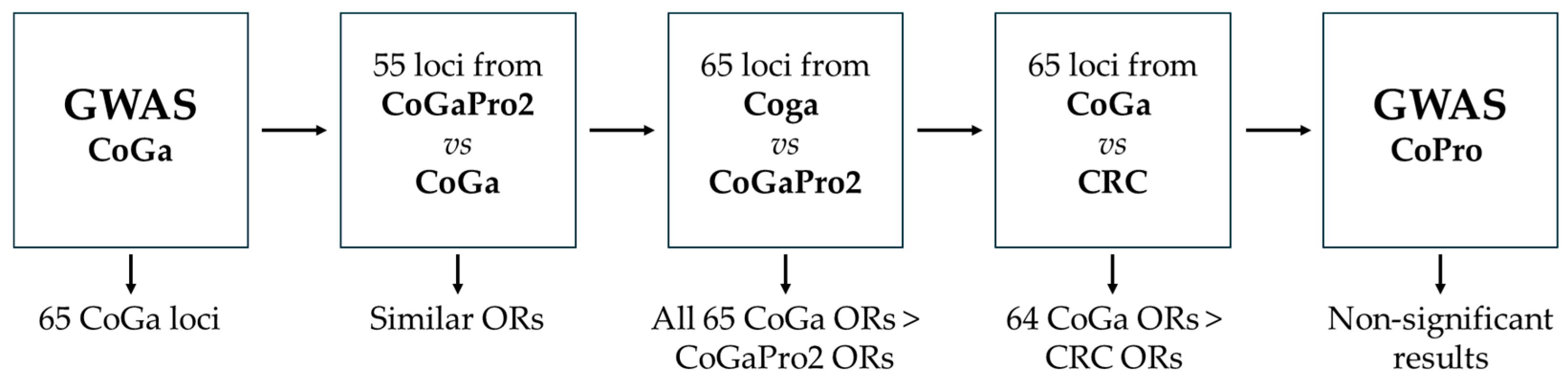
A sliding window (1–25) haplotype GWAS was conducted using 426 CRC cases with gastric cancer (and no prostate cancer) in the relatives and 1642 healthy controls (Supplementary Tables S1–S23). After this GWAS, the results were compared to previous GWASs for more information on the risks (ORs) in this and in the previous studies (Figure 2). All haplotype results are presented in Supplementary Tables with the following columns: NSNP, number of SNPs; NHAP, number of haplotypes in the window; BP1, first base pair in haplotype; BP1, last base pair in haplotype; SNP1, first SNP in haplotype; SNP2, last SNP in haplotype; F, frequency; OR, odds ratio; Stat, squared T statistics in Wald; and P, p-value.

2.1. GWAS CoGa (Figure 2)

A total of 65 haplotypes in 62 loci had significant p-values, defined as p < 2.5 × 10⁻⁶, with ORs from 1.48 to 7.39 (Table 1, Supplementary Table S24). Out of these 65 haplotypes, 46 had 1 to 6 coding genes, and many had non-coding genes, RNA genes, or pseudogenes, between the first and last positions.
Two loci, on chromosome 2 (DOCK10) and chromosome 9 (FCN2, FCN1), suggested in CoGaPro1 (Supplementary Table S25), and twelve haplotypes at eleven loci, suggested in CoGaPro2 (Supplementary Table S26), were the same in CoGa (indicated with * in Table 1). Ten of these eleven loci involved the following genes: CDK15, CROCC2-SNED1, TLR2-RNF175-SFRP2, WWC2, RELN, ZMYM5-ZMYM2, KLF12, SKAP1, CABLES2, and MIR630.

2.2. CoGaPro2 vs. CoGa (Figure 2)

Since the analysis in the CoGaPro2 study and the CoGa analysis used the same micro-chip for genotyping, the same controls, and partly the same cases (those with prostate cancer had been removed), it was possible to compare all specific haplotypes suggested in CoGaPro2 to find out how the new selection of cases influenced the result in the CoGa study. The 55 haplotypes in the CoGaPro2 study were now compared to the same haplotypes in the CoGa study (Supplementary Table S27). ORs were similar in the two studies, ranging from 1.34 to 5.98 in the CoGaPro2 and from 1.35 to 6.52 in the CoGa analysis. ORs were higher in CoGaPro2 compared to CoGa at 32 haplotypes and lower in CoGaPro2 at 22 haplotypes (Supplementary Table S27). Haplotypes at four loci showed ORs in the CoGaPro2 study that were at least twice as high as the same loci in the CoGa study (Supplementary Table S27).

2.3. CoGa vs. CoGaPro2 (Figure 2)

The CoGa results were expected to present loci with higher OR at loci associated with CRC and gastric cancer. Thus, all haplotypes in CoGa were now compared to the same haplotypes in CoGaPro2 (Supplementary Table S28). Indeed, all 65 haplotypes in CoGa demonstrated higher ORs (range 1.48–7.39), and most with lower p-values compared to the same haplotypes in the CoGaPro2 study (range 1.19–4.47) (Supplementary Table S28).

2.4. CoGa vs. CRC (Figure 2)

Since the ORs relate to an increased risk of CRC, and we had used the full cohort of 2663 CRC cases, and the same controls in a previous study [15], we also compared the results in CoGa to those of the CRC study. All 65 haplotypes could be identified, sometimes with a slightly different length (Supplementary Table S29). For all but one locus on chromosome 9 (FGD3, SUSD3), haplotype ORs were higher (range 1.48–7.39) in the CoGa Study, compared to in the CRC Study (range 1.18–2.65) (Supplementary Table S29). Five haplotypes were statistically significant also in the CRC GWAS, two on chromosome 2, CDK15, and one with no gene on 2q36.1, and a further one locus on chromosome 20 (LAMA5) with three haplotypes (Supplementary Table S29).

2.5. GWAS CoPro (Figure 2)

Finally, another sliding window haplotype GWAS was conducted using 324 CRC cases with prostate cancer, but no gastric cancer in their families, and 1642 healthy controls. No statistically significant results were obtained in this analysis (Supplementary Tables S30–S52).

3. Discussion

This study is the third GWAS published on hypothetical cancer syndromes associated with CRC, gastric, and/or prostate cancer. The three studies have all investigated what types of familial cancers carry a high risk of developing CRC. The first two studies suggested loci where a family history of both gastric and prostate cancer was associated with a risk of CRC. The two loci (DOCK10 and FCN1-FCN2) replicated from CoGaPro1, and the 11 loci replicated from CoGaPro2 (CDK15, CROCC2-SNED1, TLR2-RNF175-SFRP2, WWC2, RELN, ZMYM5-ZMYM2, KLF12, SKAP1, CABLES2, and MIR630) gave further support for these genes being associated with a risk of CRC and gastric cancer. Many of the genes related to colorectal cancer, and even gastric cancer, have been published. One study identified cfDNA methylation biomarkers detectable in blood, reflecting tumor-derived signals from gastric cancer, such as DOCK10 [16]. CDK15 was shown to be involved in CRC progression in the β-catenin signaling pathway [17]. The SFRP2 gene has been published several times in relation to both CRC and gastric cancer [18]. Studies have suggested the RELN pathway to be involved in gastric as well as colorectal carcinogenesis [19,20]. Krüppel-like factor 12 (KLF12) is a transcription factor that plays a role in normal kidney development, and KLF12 is frequently elevated in esophageal adenocarcinoma and has been reported to promote gastric cancer progression and also to be involved in colorectal cancer [21]. SKAP1 promotes cell proliferation and invasion and is associated with poor prognosis in colorectal cancer. The gene has also been suggested to represent a biomarker and therapeutic target in gastric cancer to regulate cellular functions through JAK1/PI3K/AKT signaling [22].
Although only 13 loci were replicated in this third study, it does not exclude any of the loci suggested in the previous studies, since in the comparison of the loci in CoGaPro2 and CoGa, ORs were similar for all haplotypes, except at four loci, where the ORs were much lower in the CoGa study. Those loci were CNTNAP2, one locus without a gene on chromosome 6, CDH13, and ASIC2. The fact that ORs became much lower at these loci when CRC cases with a family history of prostate cancer were removed suggested that those four loci/genes were candidates for a risk of prostate cancer as well and needed to be investigated in further studies. The CNTNAP2 gene was identified as a fragile site, and although fragile sites are not traditional mutational targets in cancer, they do exhibit loss of expression in multiple tumor types, suggesting that they may also function as tumor suppressors [23]. CDH13 encodes T-cadherin, which belongs to the cadherin superfamily, which has a wide array of biological functions [24]. CDH13 is highly conserved among species, indicating evolutionary importance [25]. Under oxidative stress, the overexpression of T-cadherin protects against endothelial cell apoptosis [26]. While T-cadherin promotes angiogenesis, loss of function is associated with several cancers, including prostate and colorectal cancer [24]. Germline mutations in CDH1, coding for the related protein E-cadherin, are associated with a well-described cancer syndrome, including hereditary diffuse gastric cancer [27]. ASIC2 encodes a protein with the same name, which belongs to a family of acid-sensitive ion channels (ASICs). There are four ASIC genes and seven proteins. The majority of cancer research has been on ASIC1, whereas the roles of ASIC2 and ASIC3 have been explored in only a limited number of studies, but they seem related to acidification of the tumor microenvironment [28,29].
All 65 haplotypes in the CoGa study demonstrated higher ORs compared to the same haplotypes in the CoGaPro2 study, as expected. The fact that ORs became higher after removing cases with a family history of prostate cancer supported the association of a risk of CRC, as well as gastric cancer. Interestingly, six loci/haplotypes had ORs at least twice as high as those in the CoGaPro2 study. These were on chromosome 1 (TRIT1-MYCL-MFSD2A-CAP1), also on chromosome 1 (KIAA0040-TNR), on chromosome 12 (CCND2), chromosome 17 (RAP1GAP2), chromosome 18 (TGIF1), and on chromosome 22 (SCUBE1). It was recently reported that several tagging SNPs and haplotypes in TRIT1 were significantly associated with a risk and clinicopathological features of gastric cancer in a Chinese population [30]. The other three genes in that haplotype, MYCL, MFSD2A, and CAP1, have also been suggested in gastric carcinogenesis [31,32,33]. CCND2 expression was suggested to be an independent prognostic factor for overall survival in patients with gastric cancer [34]. TGIF1, a transcriptional corepressor involved in breast and lung cancer, has also been suggested to promote colorectal cancer through activating Wnt/β-catenin signaling [35]. SCUBE1 is a novel mammalian EGF-related protein that has been suggested as a potential new biomarker for gastric cancer [36].
The 65 haplotypes from the CoGa study were also compared to those from a previous GWAS of all CRC cases. The fact that the ORs for all but one locus were higher in the CoGa study further supported the hypothesis that the selection of cases based on a family history of gastric cancer was relevant and that there are loci associated with a risk of both CRC and gastric cancer.
The haplotype GWAS conducted on 324 CRC cases with prostate cancer in their families and 1642 healthy controls did not result in any statistically significant results. However, since prostate cancer is common in the population, the selection of CRC cases based on a family history of at least one case of prostate cancer in the family probably was not strict enough to result in a relevant selection of cases. Thus, it was more difficult to obtain significant results. Still, many genes were suggested in this GWAS, even with non-significant p-values. Some of them were already published in relation to prostate cancer (Supplementary Table S53). PUM1 encodes the RNA-binding protein Pumilio-1, which is highly conserved. It is highly expressed in many cancers, including prostate cancer, and is correlated with reduced survival. PUM1 mediates translational repression of CDKN1B [37]. KCNN3, which encodes a potassium calcium-activated channel, is a tumor-suppressor gene that has been observed to be downregulated in prostate cancer [38,39]. CCT3 encodes one of eight subunits of chaperons, which catalyze the folding of proteins in cell division, proliferation, and apoptosis. Increased expression is associated with prostate cancer and other cancers [40]. LEF1 regulates the expression of the androgen receptor and is associated with the invasive ability of prostate cancer [41]. RREB1 promotes prostate cancer by activating the transcription of SNHG4, which promotes DNA damage repair, the cell cycle, and resistance to the androgen-receptor antagonist enzalutamide [42]. CSMD1 is one of several genes that are typically overexpressed in monocytes in prostate cancer and has been suggested as a biomarker differentiating prostate cancer from benign prostatic hyperplasia [43]. However, the gene has also been suggested as a tumor suppressor in other cancers [44,45]. DLC1 regulates E-cadherin and suppresses highly metastatic prostate cancer cell invasion by modulating the Rho pathway. Overexpression of DLC1 markedly suppresses proliferation and cell cycle progression [46,47]. TNFRSF10C is one of the most frequently deleted loci in prostate cancer and other cancers as well. In prostate cancer, very often the gene is either hemizygously deleted or has its promoter CGI hypermethylated [48]. The gene is a receptor inducing tumor apoptosis in multiple malignancies [49,50]. NRG1 encodes the protein neuroligin-1. Protein levels are elevated, both in serum and in tumor tissue, in castration-resistant prostate cancer. High neuroligin levels also correlate with high levels of prostate-specific antigen (PSA) and Gleason grading, both associated with more aggressive disease, suggesting that NRG1 could be a marker for predicting progression of prostate cancer [51]. TMEM64 downregulates the expression of Wnt3a, leading to less activation of the β-catenin-dependent signaling pathway. That pathway, and Wnt signaling otherwise, affects the tumor microenvironment and promotes therapy resistance [52]. DEPTOR is a tumor suppressor gene. The protein binds to mTORC1 and mTORC2 complexes and blocks their activities, and thereby suppresses protein synthesis, cell growth, proliferation, and survival [53]. SAMHD1 has recently been identified as associated with prostate cancer, with rare mutations carrying a very high risk [54,55].
Overall, the first two studies on this hypothetical syndrome gave support for several loci with a shared risk for CRC, gastric, and prostate cancer. The present study, focusing only on CRC cases with either gastric or prostate cancer in their family members, found new loci with a shared risk for CRC and gastric cancer, and even, possibly, prostate cancer. In the end, it was suggested that the risk of CRC, gastric, and prostate cancer differs at different loci. An obvious limitation of this and the previous studies is that only CRC cases were available for study. A putative risk of gastric and/or prostate cancer and even other tumor types in CRC patients, as well as their relatives, motivates further studies. The family histories of all CRC cases in all studies include many more tumors, and in total, the number of tumors reported in this study was 505 gastric, 139 breast, 69 gynecological, 71 lung, 56 bladder, 56 leukemia/lymphoma, 36 CNS, 22 kidney, 21 pancreatic, 10 gall bladder, and 330 unspecified tumors. The absolute risk at these loci is of interest. Most of the published GWAS CRC loci are common and mostly with ORs below two. However, at most loci suggested in our haplotype studies, rare loci and higher ORs were found. The first study had ORs > 3, the second had ORs > 6, and, in this third study, ORs > 7 were seen. It will be important to replicate these results to determine the risk at some of these loci to find out the risk for CRC, gastric, and prostate, as well as other cancers. Thus, these results need to be confirmed in larger studies, and in other populations, including patients with other cancer types for study.

4. Materials and Methods

4.1. Cases and Controls for GWAS

Cases were selected as a part of a multi-center study, the Colorectal Cancer Low-risk study, with newly diagnosed CRC patients from the middle of Sweden between 2004 and 2009 [11]. Detailed information regarding cancer occurrences in the family, comprising first- and second-degree relatives and cousins, was recorded. Based on family history and the pathology and molecular testing for microsatellite instability (MSI), known cases of FAP and Lynch syndrome were excluded from the study. The selection criterion for the patients to be included in this study was having at least one case of gastric or prostate cancer among close relatives. In total, 426 cases fulfilling this criterion were genotyped and included as cases in one analysis. The relatives of these CRC cases had various cancers in different locations, with gastric cancer as the most common malignancy, and with other various types of cancer except prostate cancer. One other GWAS analysis used 324 CRC cases with at least one case of prostate cancer and no gastric cancer cases among the relatives. In total, 1642 controls from the low-risk study were used for the analysis (536 spouses of the cases, and 1106 healthy blood donors from the same geographical region). The demographics of cases are shown in Table 2. No information was obtained for control persons.

4.2. Genotyping, Quality Control, and Haplotype GWAS

DNA was extracted from blood using standard procedures in the lab. The genotyping for both cases and controls was performed at the Centre for Inherited Disease Research at Johns Hopkins University, US, using the Illumina Infinium® OncoArray-500K, Illumina, Inc., San Diego, CA, USA [56]. The first QC was performed within the CORECT study [57], and a second QC was performed at Karolinska Institutet [15]. For the haplotype GWAS analysis, to examine the association between one single SNP, or a haplotype, and cancer risk, a logistic regression model was employed using a sliding window approach. The computational program PLINK v1.07 was used for the analysis and for the calculation of corresponding OR, standard errors, and 95% confidence intervals (CI) [58]. The following parameters were applied while using PLINK v1.07: “hap-logistic” (haplotype logistic regression analysis), “hap-window 1–25” (sliding window sizes 1 to 25), and default settings, which included haplotypes phasing with the E-M algorithm, omnibus association test, and minor haplotype frequency of 0.01. No adjustment was made for age or sex.
PLINK estimated haplotype frequencies for all possible haplotypes in each window through statistical inference, employing the expectation-maximization likelihood algorithm [59,60]. This method was used to estimate maximum likelihood when data were incomplete or hidden. In our case, the hidden data were the actual haplotypes, which could not be identified since although genotypes were known, the chromosome-phasing was not. The p-value criteria generally used for statistical significance in GWAS has been p < 5 × 10⁻⁸ [61]. However, since in haplotype analysis, the same SNP was tested in all possible haplotypes involved using 1–25 SNPs at a time, where the SNP would occur first, second, third, etc., as the window slides, it meant that all those tests concern the same locus and were not considered independent tests, which needed to be corrected for. It also meant that, theoretically, since all SNPs were chosen to have at least two alleles, the maximum possible number of haplotypes including the same SNP (locus) was 250. The number of possible haplotypes (based on the sample set of cases and controls) was specified for each window and rarely exceeded 50. Therefore, a p-value criterion for statistical significance of p < 2.5 × 10⁻⁶ was used for this study. Each SNP was tested multiple times for each value of the specific SNP. Thus, if all SNPs had two possible genotypes, in total, 250 possible haplotypes were generated, analyzing first only one SNP, then two SNPs, then three, and up to 25 SNPs. This approach generated several haplotypes representing the same unique haplotype varying in lengths from 1 to 25 SNPs. This meant that, depending on the variability of SNPs within these different haplotypes, the number of haplotypes generated for each SNP varied. For example, the first significant locus at chromosome 1 is described in Table 3 below (Supplementary Table S1). There were several haplotypes of varying lengths, which could be defined as parts of three unique haplotypes (Table 3). Only one fulfilled our criterion for statistical significance (in box); this one and what likely were parts of the same haplotype are all in bold, a second haplotype marked with *, and a third haplotype marked with ** (Table 3).

Supplementary Materials

Supporting Information can be downloaded at: https://zenodo.org/records/18054099 (accessed on 26 December 2025).

Author Contributions

Conceptualization, A.L.; methodology, L.V. and A.L.; software, L.V.; validation, L.V. and A.L.; formal analysis, L.V., D.K., L.W. and A.L.; investigation, L.V., D.K., L.W. and A.L.; resources, A.L.; data curation, L.V. and A.L.; writing—original draft preparation, L.V., D.K., L.W. and A.L.; writing—review and editing, L.V., D.K., L.W., J.S.W., M.L., C.L. and A.L.; visualization, L.V., D.K., L.W. and A.L.; supervision, M.L. and A.L.; project administration, A.L.; funding acquisition, A.L. All authors have read and agreed to the published version of the manuscript.

Funding

Open access funding was provided by Karolinska Institutet. This research was funded by grants from the Swedish Research Council (2019-01441), the Swedish Cancer Society (23 2778 Pj), and the Cancer Research Funds of Radiumhemmet (221223). Financial support was also provided by the regional agreement on medical training and clinical research (ALF) between the Stockholm County Council and Karolinska Institutet (RS2022-0674).

Institutional Review Board Statement

The study was conducted in accordance with the Declaration of Helsinki. The study was approved by the regional research ethics committees in Stockholm (Stockholms Regionala Etikprövningsnämnd, reg no 02-489) and Uppsala (Uppsala Regionala Etikprövningsnämnd, reg no 03-114).

Informed Consent Statement

Written informed consent was obtained from all subjects involved in the study.

Data Availability Statement

Access to the data is controlled. Variants that fulfill our selection criteria can be found in the Supplemental Tables. However, Swedish laws and regulations prohibit the release of individual and personally identifying data. Therefore, the whole dataset cannot be made publicly available. The data that support the findings of this study are available from the corresponding authors upon a reasonable request.

Acknowledgments

Colorectal Transdisciplinary Study (CORECT): The content of this manuscript does not necessarily reflect the views or policies of the National Cancer Institute or any of the collaborating centers in the CORECT Consortium, nor does mention of trade names, commercial products, or organizations imply endorsement by the US Government or the CORECT Consortium.

Conflicts of Interest

The authors declare no conflicts of interest.

Abbreviations

The following abbreviations are used in this manuscript:
BPBase pair
CHRChromosome
CIConfidence interval
CNSCentral nervous system
CRCColorectal cancer
DNADeoxyribonucleic acid
FAPFamilial adenomatous polyposis
GWASGenome-wide association study
HFHaplotype frequency
MSIMicrosatellite instability
OROdds ratio
PSAProstate-specific antigen
SNPSingle-nucleotide polymorphism

References

  1. Valle, L.; de Voer, R.M.; Goldberg, Y.; Sjursen, W.; Försti, A.; Ruiz-Ponte, C.; Caldés, T.; Garré, P.; Olsen, M.F.; Nordling, M.; et al. Update on genetic predisposition to colorectal cancer and polyposis. Mol. Asp. Med. 2019, 69, 10–26. [Google Scholar] [CrossRef] [PubMed]
  2. Olkinuora, A.P.; Peltomäki, P.T.; Aaltonen, L.A.; Rajamäki, K. From APC to the genetics of hereditary and familial colon cancer syndromes. Hum. Mol. Genet. 2021, 30, R206–R224. [Google Scholar] [CrossRef]
  3. Lindblom, A.; Zhou, X.L.; Liu, T.; Liljegren, A.; Skoglund, J.; Djureinovic, T. Colorectal cancer as a complex disease: Defining at-risk subjects in the general population—A preventive strategy. Expert. Rev. Anticancer. Ther. 2004, 4, 377–385. [Google Scholar] [CrossRef]
  4. Michailidou, K.; Lindström, S.; Dennis, J.; Beesley, J.; Hui, S.; Kar, S.; Lemacon, A.; Soucy, P.; Glubb, D.; Rostamianfar, A.; et al. Association analysis identifies 65 new breast cancer risk loci. Nature 2017, 551, 92–94. [Google Scholar] [CrossRef] [PubMed]
  5. Law, P.J.; Timofeeva, M.; Fernandez-Rozadilla, C.; Broderick, P.; Studd, J.; Fernandez-Tajes, J.; Farrington, S.; Svinti, V.; Palles, C.; Orlando, G.; et al. Association analyses identify 31 new risk loci for colorectal cancer susceptibility. Nat. Commun. 2019, 10, 2154. [Google Scholar] [CrossRef]
  6. Dadaev, T.; Saunders, E.J.; Newcombe, P.J.; Anokian, E.; Leongamornlert, D.A.; Brook, M.N.; Cieza-Borrella, C.; Mijuskovic, M.; Wakerell, S.; Olama, A.A.A.; et al. Fine-mapping of prostate cancer susceptibility loci in a large meta-analysis identifies candidate causal variants. Nat. Commun. 2018, 9, 2256. [Google Scholar] [CrossRef] [PubMed]
  7. Kuchenbaecker, K.B.; Ramus, S.J.; Tyrer, J.; Lee, A.; Shen, H.C.; Beesley, J.; Lawrenson, K.; McGuffog, L.; Healey, S.; Lee, J.M.; et al. Identification of six new susceptibility loci for invasive epithelial ovarian cancer. Nat. Genet. 2015, 47, 164–171. [Google Scholar] [CrossRef]
  8. Tenesa, A.; Dunlop, M.G. New insights into the aetiology of colorectal cancer from genome-wide association studies. Nat. Rev. Genet. 2009, 10, 353–358. [Google Scholar] [CrossRef]
  9. Chen, Z.; Guo, X.; Tao, R.; Huyghe, J.R.; Law, P.J.; Fernandez-Rozadilla, C.; Ping, J.; Jia, G.; Long, J.; Li, C.; et al. Fine-mapping analysis including over 254,000 East Asian and European descendants identifies 136 putative colorectal cancer susceptibility genes. Nat. Commun. 2024, 15, 3557. [Google Scholar] [CrossRef]
  10. Fehringer, G.; Kraft, P.; Pharoah, P.D.; Eeles, R.A.; Chatterjee, N.; Schumacher, F.R.; Schildkraut, J.M.; Lindstrom, S.; Brennan, P.; Bickeboller, H.; et al. Cross-Cancer Genome-Wide Analysis of Lung, Ovary, Breast, Prostate, and Colorectal Cancer Reveals Novel Pleiotropic Associations. Cancer Res. 2016, 76, 5103–5114. [Google Scholar] [CrossRef]
  11. Forsberg, A.; Keranen, A.; von Holst, S.; Picelli, S.; Papadogiannakis, N.; Ghazi, S.; Lindblom, A. Defining New Colorectal Cancer Syndromes in a Population-based Cohort of the Disease. Anticancer. Res. 2017, 37, 1831–1835. [Google Scholar] [CrossRef]
  12. Wallander, K.; Liu, W.; von Holst, S.; Thutkawkorapin, J.; Kontham, V.; Forsberg, A.; Lindblom, A.; Lagerstedt-Robinson, K. Genetic analyses supporting colorectal, gastric, and prostate cancer syndromes. Genes. Chromosomes Cancer 2019, 58, 775–782. [Google Scholar] [CrossRef]
  13. Samola Winnberg, J.; Vermani, L.; Liu, W.; Soller, V.; Thutkawkorapin, J.; Lindblad, M.; Lindblom, A. A genome-wide association study in Swedish colorectal cancer patients with gastric- and prostate cancer in relatives. Hered. Cancer Clin. Pr. 2024, 22, 25. [Google Scholar] [CrossRef] [PubMed]
  14. Vermani, L.; Samola Winnberg, J.; Liu, W.; Soller, V.; Sjödin, T.; Lindblad, M.; Lindblom, A. A Haplotype GWAS in Syndromic Familial Colorectal Cancer. Int. J. Mol. Sci. 2025, 26, 817. [Google Scholar] [CrossRef]
  15. Liu, W.; Mahdessian, H.; Helgadóttir, H.; Zhou, X.; Thutkawkorapin, J.; Jiao, X.; The Swedish Low-risk Colorectal Cancer Study Group; Wolk, A.; Lindblom, A. Colorectal cancer risk susceptibility loci in a Swedish population. Mol. Carcinog. 2022, 61, 288–300. [Google Scholar] [CrossRef] [PubMed]
  16. Ren, J.; Lu, P.; Zhou, X.; Liao, Y.; Liu, X.; Li, J.; Wang, W.; Wang, J.; Wen, L.; Fu, W.; et al. Genome-Scale Methylation Analysis of Circulating Cell-Free DNA in Gastric Cancer Patients. Clin. Chem. 2022, 68, 354–364. [Google Scholar] [CrossRef]
  17. Huang, C.; Du, R.; Jia, X.; Liu, K.; Qiao, Y.; Wu, Q.; Yao, N.; Yang, L.; Zhou, L.; Liu, X.; et al. CDK15 promotes colorectal cancer progression via phosphorylating PAK4 and regulating beta-catenin/MEK-ERK signaling pathway. Cell Death Differ. 2022, 29, 14–27. [Google Scholar] [CrossRef]
  18. Nagasaka, T.; Tanaka, N.; Cullings, H.M.; Sun, D.S.; Sasamoto, H.; Uchida, T.; Koi, M.; Nishida, N.; Naomoto, Y.; Boland, C.R.; et al. Analysis of fecal DNA methylation to detect gastrointestinal neoplasia. J. Natl. Cancer Inst. 2009, 101, 1244–1258. [Google Scholar] [CrossRef]
  19. Serrano-Morales, J.M.; Vázquez-Carretero, M.D.; Peral, M.J.; Ilundáin, A.A.; Garcia-Miranda, P. Reelin-Dab1 signaling system in human colorectal cancer. Mol. Carcinog. 2017, 56, 712–721. [Google Scholar] [CrossRef] [PubMed]
  20. Dohi, O.; Takada, H.; Wakabayashi, N.; Yasui, K.; Sakakura, C.; Mitsufuji, S.; Naito, Y.; Taniwaki, M.; Yoshikawa, T. Epigenetic silencing of RELN in gastric cancer. Int. J. Oncol. 2010, 36, 85–92. [Google Scholar]
  21. Kim, S.H.; Park, Y.Y.; Cho, S.N.; Margalit, O.; Wang, D.; DuBois, R.N. Krüppel-Like Factor 12 Promotes Colorectal Cancer Growth through Early Growth Response Protein 1. PLoS ONE 2016, 11, e0159899. [Google Scholar] [CrossRef]
  22. Zhu, L.; Yu, Q.; Li, Y.; Zhang, M.; Peng, Z.; Wang, S.; Quan, Z.; Gao, D. SKAP1 Is a Novel Biomarker and Therapeutic Target for Gastric Cancer: Evidence from Expression, Functional, and Bioinformatic Analyses. Int. J. Mol. Sci. 2023, 24, 11870. [Google Scholar] [CrossRef]
  23. Smith, D.I.; Zhu, Y.; McAvoy, S.; Kuhn, R. Common fragile sites, extremely large genes, neural development and cancer. Cancer Lett. 2006, 232, 48–57. [Google Scholar] [CrossRef]
  24. Rubina, K.; Maier, A.; Klimovich, P.; Sysoeva, V.; Romashin, D.; Semina, E.; Tkachuk, V. T-Cadherin (CDH13) and Non-Coding RNAs: The Crosstalk Between Health and Disease. Int. J. Mol. Sci. 2025, 26, 6127. [Google Scholar] [CrossRef]
  25. Philippova, M.; Joshi, M.B.; Kyriakakis, E.; Pfaff, D.; Erne, P.; Resink, T.J. A guide and guard: The many faces of T-cadherin. Cell Signal 2009, 21, 1035–1044. [Google Scholar] [CrossRef]
  26. Kyriakakis, E.; Philippova, M.; Joshi, M.B.; Pfaff, D.; Bochkov, V.; Afonyushkin, T.; Erne, P.; Resink, T.J. T-cadherin attenuates the PERK branch of the unfolded protein response and protects vascular endothelial cells from endoplasmic reticulum stress-induced apoptosis. Cell Signal 2010, 22, 1308–1316. [Google Scholar] [CrossRef] [PubMed]
  27. Decourtye-Espiard, L.; Godwin, T.; Guilford, P. Hereditary diffuse gastric cancer: The evolution of a cancer syndrome. J. R. Soc. N. Z. 2025, 55, 2636–2651. [Google Scholar] [CrossRef] [PubMed]
  28. Wan, X.; Zhou, L. Research progress of ASIC family in tumors. Exp. Cell Res. 2025, 450, 114681. [Google Scholar] [CrossRef] [PubMed]
  29. Bødtkjer, E.; Pedersen, S.F. The Acidic Tumor Microenvironment as a Driver of Cancer. Annu. Rev. Physiol. 2020, 82, 103–126. [Google Scholar] [CrossRef]
  30. Chen, S.; Zheng, Z.; Tang, J.; Lin, X.; Wang, X.; Lin, J. Association of polymorphisms and haplotype in the region of TRIT1, MYCL1 and MFSD2A with the risk and clinicopathological features of gastric cancer in a southeast Chinese population. Carcinogenesis 2013, 34, 1018–1024. [Google Scholar] [CrossRef]
  31. Qin, P.; Wang, H.; Zhang, F.; Huang, Y.; Chen, S. Targeted silencing of MYCL1 by RNA interference inhibits migration and invasion of MGC-803 gastric cancer cells. Cell Biochem. Funct. 2019, 37, 266–272. [Google Scholar] [CrossRef]
  32. Zhang, B.; Wang, C.M.; Wu, H.X.; Wang, F.; Chai, Y.Y.; Hu, Y.; Wang, B.J.; Yu, Z.; Xia, R.H.; Xu, R.H.; et al. MFSD2A potentiates gastric cancer response to anti-PD-1 immunotherapy by reprogramming the tumor microenvironment to activate T cell response. Cancer Commun. 2023, 43, 1097–1116. [Google Scholar] [CrossRef]
  33. Wang, W.H.; Chen, S.K.; Huang, H.C.; Juan, H.F. Proteomic Analysis Reveals That Metformin Suppresses PSMD2, STIP1, and CAP1 for Preventing Gastric Cancer AGS Cell Proliferation and Migration. ACS Omega 2021, 6, 14208–14219. [Google Scholar] [CrossRef] [PubMed]
  34. Shi, H.; Han, J.; Yue, S.; Zhang, T.; Zhu, W.; Zhang, D. Prognostic significance of combined microRNA-206 and CyclinD2 in gastric cancer patients after curative surgery: A retrospective cohort study. Biomed. Pharmacother. 2015, 71, 210–215. [Google Scholar] [CrossRef]
  35. Wang, J.L.; Qi, Z.; Li, Y.H.; Zhao, H.M.; Chen, Y.G.; Fu, W. TGFβ induced factor homeobox 1 promotes colorectal cancer development through activating Wnt/β-catenin signaling. Oncotarget 2017, 8, 70214–70225. [Google Scholar] [CrossRef] [PubMed]
  36. Mentese, A.; Fidan, E.; Sumer, A.U.; Karahan, S.C.; Sonmez, M.; Altay, D.U.; Kavgaci, H.; Alver, A. Is SCUBE 1 a new biomarker for gastric cancer? Cancer Biomark. 2012, 11, 191–195. [Google Scholar] [CrossRef] [PubMed]
  37. Li, X.; Yang, J.; Chen, X.; Cao, D.; Xu, E.Y. PUM1 represses CDKN1B translation and contributes to prostate cancer progression. J. Biomed. Res. 2021, 35, 371–382. [Google Scholar] [CrossRef]
  38. Liu, X.; Wei, L.; Zhao, B.; Cai, X.; Dong, C.; Yin, F. Low expression of KCNN3 may affect drug resistance in ovarian cancer. Mol. Med. Rep. 2018, 18, 1377–1386. [Google Scholar] [CrossRef]
  39. Hashemi Karoii, D.; Bavandi, S.; Djamali, M.; Abroudi, A.S. Exploring the interaction between immune cells in the prostate cancer microenvironment combining weighted correlation gene network analysis and single-cell sequencing: An integrated bioinformatics analysis. Discov. Oncol. 2024, 15, 513. [Google Scholar] [CrossRef]
  40. Temiz, E.; Koyuncu, İ.; Şahin, E. CCT3 suppression prompts apoptotic machinery through oxidative stress and energy deprivation in breast and prostate cancers. Free Radic. Biol. Med. 2021, 165, 88–99. [Google Scholar] [CrossRef]
  41. Li, Y.; Wang, L.; Zhang, M.; Melamed, J.; Liu, X.; Reiter, R.; Wei, J.; Peng, Y.; Zou, X.; Pellicer, A.; et al. LEF1 in androgen-independent prostate cancer: Regulation of androgen receptor expression, prostate cancer growth, and invasion. Cancer Res. 2009, 69, 3332–3338. [Google Scholar] [CrossRef]
  42. Dong, Q.; Qiu, H.; Piao, C.; Li, Z.; Cui, X. LncRNA SNHG4 promotes prostate cancer cell survival and resistance to enzalutamide through a let-7a/RREB1 positive feedback loop and a ceRNA network. J. Exp. Clin. Cancer Res. 2023, 42, 209. [Google Scholar] [CrossRef]
  43. Enikeeva, K.; Korobeynikov, V.; Sharifyanova, Y.; Akramova, E.; Shmelkova, P.; Gainullinsmalla, C.D.; Kalimullina, L.; Pavlov, V. Single-Cell Profiling of Mononuclear Cells Identifies Transcriptomics Signatures Differentiating Prostate Cancer From Benign Prostatic Hyperplasia. Genes. Chromosomes Cancer 2025, 64, e70051. [Google Scholar] [CrossRef]
  44. Berglund, A.; Yamoah, K.; Eschrich, S.A.; Falahat, R.; Mulé, J.J.; Kim, S.; Matta, J.; Dutil, J.; Ruiz-Deya, G.; Ortiz Sanchez, C.; et al. Epigenome-wide association study of prostate cancer in African American men identified differentially methylated genes. Cancer Med. 2024, 13, e70044. [Google Scholar] [CrossRef]
  45. Sun, P.C.; Uppaluri, R.; Schmidt, A.P.; Pashia, M.E.; Quant, E.C.; Sunwoo, J.B.; Gollin, S.M.; Scholnick, S.B. Transcript map of the 8p23 putative tumor suppressor region. Genomics 2001, 75, 17–25. [Google Scholar] [CrossRef]
  46. Tripathi, V.; Popescu, N.C.; Zimonjic, D.B. DLC1 induces expression of E-cadherin in prostate cancer cells through Rho pathway and suppresses invasion. Oncogene 2014, 33, 724–733. [Google Scholar] [CrossRef]
  47. Gong, H.; Chen, K.; Zhou, L.; Jin, Y.; Chen, W. Deleted in liver cancer 1 suppresses the growth of prostate cancer cells through inhibiting Rho-associated protein kinase pathway. Asian J. Urol. 2023, 10, 50–57. [Google Scholar] [CrossRef]
  48. Cheng, Y.; Kim, J.W.; Liu, W.; Dunn, T.A.; Luo, J.; Loza, M.J.; Kim, S.T.; Zheng, S.L.; Xu, J.; Isaacs, W.B.; et al. Genetic and epigenetic inactivation of TNFRSF10C in human prostate cancer. Prostate 2009, 69, 327–335. [Google Scholar] [CrossRef]
  49. Zhang, E.; Shiori, F.; Zhang, M.; Wang, P.; He, J.; Ge, Y.; Song, Y.; Shan, L. Establishment of Novel Prostate Cancer Risk Subtypes and A Twelve-Gene Prognostic Model. Front. Mol. Biosci. 2021, 8, 676138. [Google Scholar] [CrossRef]
  50. Ruiz de Almodóvar, C.; López-Rivas, A.; Redondo, J.M.; Rodríguez, A. Transcriptional regulation of the TRAIL-R3 gene. Vitam. Horm. 2004, 67, 51–63. [Google Scholar] [CrossRef]
  51. Li, S.; Zhao, W.; Wang, D.; Chen, L.; Feng, Y.; Sun, P. Neuregulin-1 correlates to early castration-resistant prostate cancer after prostate cancer patients receiving androgen deprivation therapy. J. Cancer 2025, 16, 3261–3269. [Google Scholar] [CrossRef]
  52. Moon, Y.H.; Lim, W.; Jeong, B.C. Transmembrane protein 64 modulates prostate tumor progression by regulating Wnt3a secretion. Oncol. Lett. 2019, 18, 283–290. [Google Scholar] [CrossRef]
  53. Chen, X.; Xiong, X.; Cui, D.; Yang, F.; Wei, D.; Li, H.; Shu, J.; Bi, Y.; Dai, X.; Gong, L.; et al. DEPTOR is an in vivo tumor suppressor that inhibits prostate tumorigenesis via the inactivation of mTORC1/2 signals. Oncogene 2020, 39, 1557–1571. [Google Scholar] [CrossRef]
  54. Pavlovich, C.P.; Wei, J.; Gielzak, M.; Shi, Z.; Tran, H.; Ashworth, A.; Lilly Zheng, S.; Walsh, P.C.; Luo, J.; Helfand, B.T.; et al. Confirmation of BIK and SAMHD1 as Prostate Cancer Susceptibility Genes. Prostate 2025, 85, 1556–1561. [Google Scholar] [CrossRef] [PubMed]
  55. Mitchell, J.; Camacho, N.; Shea, P.; Stopsack, K.H.; Joseph, V.; Burren, O.S.; Dhindsa, R.S.; Nag, A.; Berchuck, J.E.; O’Neill, A.; et al. Assessing the contribution of rare protein-coding germline variants to prostate cancer risk and severity in 37,184 cases. Nat. Commun. 2025, 16, 1779. [Google Scholar] [CrossRef] [PubMed]
  56. Infinium OncoArray-500K BeadChip. Available online: https://emea.illumina.com/content/dam/illumina-marketing/documents/products/datasheets/datasheet_oncoarray500k.pdf (accessed on 6 November 2025).
  57. Schmit, S.L.; Edlund, C.K.; Schumacher, F.R.; Gong, J.; Harrison, T.A.; Huyghe, J.R.; Qu, C.; Melas, M.; Van Den Berg, D.J.; Wang, H.; et al. Novel Common Genetic Susceptibility Loci for Colorectal Cancer. J. Natl. Cancer Inst. 2019, 111, 146–157. [Google Scholar] [CrossRef]
  58. Purcell, S.; Neale, B.; Todd-Brown, K.; Thomas, L.; Ferreira, M.A.; Bender, D.; Maller, J.; Sklar, P.; de Bakker, P.I.; Daly, M.J.; et al. PLINK: A tool set for whole-genome association and population-based linkage analyses. Am. J. Hum. Genet. 2007, 81, 559–575. [Google Scholar] [CrossRef]
  59. Excoffier, L.; Slatkin, M. Maximum-likelihood estimation of molecular haplotype frequencies in a diploid population. Mol. Biol. Evol. 1995, 12, 921–927. [Google Scholar] [CrossRef] [PubMed]
  60. Purcell, S. PLINK (1.07) Documentation; Harvard University: Cambridge, MA, USA, 2010. [Google Scholar]
  61. Dudbridge, F.; Gusnanto, A. Estimation of significance thresholds for genomewide association scans. Genet. Epidemiol. 2008, 32, 227–234. [Google Scholar] [CrossRef]
Figure 1. A study of family history across 3214 CRC patients suggested a putative new syndrome where the subject had an increased risk of CRC and other cancers, primarily gastric and prostate cancer [11]. Next, linkage analysis, used in 45 families who possibly have this putative syndrome, was undertaken without any suggested loci, and therefore, a complex rather than monogenic disease was suggested [12]. Therefore, a series of GWASs was undertaken to find out if the selection of CRC cases with a family history of gastric and/or prostate cancer suggested several loci [13,14]. Finally, in the current study, CRC cases with either gastric or prostate cancer were used for the study.
Ijms 27 00547 g001
Figure 2. A haplotype GWAS using 426 CRC cases with gastric cancer (and no prostate cancer) in their families resulted in 65 significant loci. A previous study, CoGaPro2, had suggested 55 loci, and those 55 had similar ORs in the current study. The 65 loci from the current study were also compared to the same loci in the CoGaPro2 study, and all 65 loci had improved ORs in the current study. The 65 loci were also compared to the same loci in the first haplotype GWAS using all unselected CRC cases and all CRC cases, but one locus was improved in the current study of selected cases. The haplotype GWAS on 322 CRC cases with prostate (but no gastric) cancer in their families did not result in any significant loci.
Ijms 27 00547 g002
Table 1. Haplotypes with p < 2.5 × 10⁻⁶ found in the CoGa Study.
CHRBP1BP2HFORStatp-ValueGenes
1p34.240258993405137100.023.5423.51.28 × 10−6TRIT1, MYCL, MFSD2A, CAP1
1q23.31619762341621609200.014.3922.32.36 × 10−6OLFML2B, NOS1AP
1q25.11751358291753390210.014.4127.91.30 × 10−7KIAA0040, TNR
2p25.3295608531082150.023.9624.96.01 × 10−7
2p2142494273427082670.052.2223.31.36 × 10−6EML4, COX7A2L, KCNG3
2p1277360561776700720.014.8724.76.54 × 10−7LRRTM4
2p1278945755790962430.023.8423.71.13 × 10−6
2q33.12026889072028397680.024.0326.13.28 × 10−7* CDK15
2q36.12227856452228773840.062.1324.57.58 × 10−7
2q36.22258485792260232940.052.1023.51.22 × 10−6 * DOCK10
2q37.32418797022419435750.052.1622.52.09 × 10−6* CROCC2, SNED1
3p24.130547439306251230.042.3222.22.46 × 10−6
3p22.238737643388308930.023.2322.71.91 × 10−6SCN10A
4q1254556087546577900.015.1422.22.45 × 10−6LNX1
4q13.163250043633455700.022.9825.15.33 × 10−7
4q28.31376572711378089280.014.2826.62.47 × 10−7
4q31.31546057451548072010.013.9724.19.03 × 10−7* TLR2, RNF175, SFRP2
4q34.31830270221830817800.032.9322.81.84 × 10−6TENM3
4q35.11839381191842156750.015.9824.28.62 × 10−7 * WWC2
5q13.167317114674304470.081.8822.32.34 × 10−6
5q21.21031435321032537640.032.9523.51.25 × 10−6
5q35.21739709891740508060.015.0824.28.69 × 10−7
5q35.21747687311748362800.014.6623.61.17 × 10−6
6p25.1515906452658530.121.7523.01.62 × 10−6LYRM4, FARS2
6p21.145705079457957430.023.6424.86.35 × 10−7*
7p21.3914671792356620.033.1822.52.14 × 10−6
7p15.128891257289035160.033.2324.96.06 × 10−7
7q11.2270082913701371650.023.2624.47.69 × 10−7AUTS2
7q11.2271279081714828230.042.2422.42.19 × 10−6CALN1
7q21.1389107084893779470.033.4628.59.35 × 10−8
7q22.11031628471032223060.024.5129.26.55 × 10−8 * RELN
7q31.311200735731204082520.014.7927.41.69 × 10−7KCND2
7q36.31587266551588453840.111.8323.31.41 × 10−6DYNC2I1, VIPR2
8q24.31408762511409240760.032.7722.22.43 × 10−6TRAPPC9
9q22.3195772228958546950.331.4822.22.42 × 10−6FGD3, SUSD3
9q34.31377628571378504600.014.9529.45.90 × 10−8* FCN2, FCN1
10q22.380462677804917310.023.1123.41.30 × 10−6
10q25.31150497101151196400.014.3423.61.21 × 10−6
11q23.31175254201176539550.023.5022.22.49 × 10−6DSCAML1
11q23.31176904001177227420.032.5825.15.42 × 10−7FXYD2, FXYD6-FXYD2, FXYD6
12p13.32438469643977660.024.0522.52.05 × 10−6CCND2
12q24.211154321751154535350.052.6027.41.67 × 10−7
12q24.331295482111296314930.023.3122.52.11 × 10−6TMEM132D
13q12.1120407151206862720.022.8123.41.29 × 10−6* ZMYM5, ZMYM2
13q22.174316318743476730.071.9122.32.29 × 10−6* KLF12
14q24.167989097680563900.014.2626.42.74 × 10−7TMEM229B, PLEKHH1, PIGH
14q24.273458661734712570.151.7122.52.07 × 10−6ZFYVE1
15q11.225037506251023920.042.6626.13.28 × 10−7SNRPN
15q25.181357747814540210.042.3725.93.65 × 10−7CFAP161, IL16
17p13.3279701328851460.017.3923.91.03 × 10−6RAP1GAP2
17p13.1824366185587280.014.5023.99.90 × 10−7ODF4, KRBA2, RPL26, RNF222, NDEL1, MYH10
17p1214317939143620030.052.3327.91.27 × 10−7
17q21.3246348384463555500.023.1022.71.86 × 10−6* SKAP1
17q2254427831547495580.023.9322.91.72 × 10−6ANKFN1, NOG
18p11.31334485134716400.015.4322.81.84 × 10−6TGIF1
18q22.267322660674321410.141.6822.42.20 × 10−6DOK6
20q13.3154984064551093040.032.5922.52.14 × 10−6CASS4, RTF2, GCNT7, FAM209A, FAM209B
20q13.3360926223609273490.671.5524.19.36 × 10−7LAMA5
20q13.3360929539609300930.671.5323.11.55 × 10−6LAMA5
20q13.3360938228609383100.671.5322.52.08 × 10−6LAMA5
20q13.3360964857609666860.651.5224.09.47 × 10−7* CABLES2
20q13.3360970675609734320.651.5022.62.03 × 10−6 * CABLES2
20q13.3361628970616461080.023.2923.41.30 × 10−6BHLHE23
21q21.224274393244620020.032.8226.52.60 × 10−7 * MIR6130
22q13.243596125436290890.014.5722.32.39 × 10−6SCUBE1
CHR—Chromosome and karyotype band. BP1 and BP2—First and last position in the haplotype (GRCh37). HF—Haplotype frequency in sample. OR—Odds ratio. Stat—Z value from Wald test. * Haplotype previously identified in the CoGaPro2 study.
Table 2. Demographics of the CRC cases in the GWAS.
CRC Cases with Gastric Cancer in Their Families
Family:83, 21, and 322 cases with one, two, or no relatives with CRC
Sex:213 women and 213 men
Age:13 early-onset (<50), 413 late-onset (≥50)
Location:47 caecum, 242 left colon, 137 right colon
Stage:60 Dukes A, 138 Dukes B, 104 Dukes C, and 124 Dukes D
CRC Cases with Prostate Cancer in their Families
Family:62, 26, and 236 cases with one, two, or no relatives with CRC
Sex:142 women and 182 men
Age:23 early-onset, 301 late-onset
Location:43 caecum, 201 left colon, 50 right colon, 19 unknown
Stage:43 Dukes A, 96 Dukes B, 87 Dukes C, 35 Dukes D, and 53 unknowns
Table 3. Haplotypes for the first significant haplotype in the results.
HapBP1BP2HaplotypeFORStatp
64025899340288051AGA0.301.183.994.58 × 10−2
84025899340290277AGAG0.291.184.154.16 × 10−2
104025899340302463AGAGC0.281.204.712.99 × 10−2
114025899340303627AGAGCG0.281.204.952.61 × 10−2
124025899340306898AGAGCGA0.281.225.491.91 × 10−2
144025899340316155AGAGCGAG0.281.225.721.68 × 10−2
144025899340324210AGAGCGAGA0.281.225.701.70 × 10−2
144025899340362066AGAGCGAGAC0.281.225.851.55 × 10−2
154025899340364803AGAGCGAGACC0.271.204.822.82 × 10−2
154025899340383552AGAGCGAGACCC0.261.236.351.17 × 10−2
184025899340389420AGAGCGAGACCCG0.061.455.362.07 × 10−2
194025899340395169AGAGCGAGACCCGA0.041.596.101.35 × 10−2
244025899340433771AGAGCGAGACCCGAG0.022.276.161.31 × 10−2
244025899340433771GAGGCGAGACCCGAG *0.051.454.054.42 × 10−2
244025899340435999AGAGCGAGACCCGAGG0.012.315.501.90 × 10−2
244025899340435999GAGGCGAGACCCGAGG *0.051.504.872.73 × 10−2
224025899340437923AGAGCGAGACCCAAGGA0.141.358.204.20 × 10−3
224025899340437923GAGACGAGACCCAAAGG **0.030.573.894.86 × 10−2
214025899340458920AGAGCGAGACCCAAGGAA0.131.4311.308.00 × 10−4
194025899340499302AGAGCGAGACCCAAGGAAA0.022.6015.807.00 × 10−5
194025899340504550AGAGCGAGACCCAAGGAAAA0.023.2320.406.00 × 10−6
194025899340513710AGAGCGAGACCCAAGGAAAAA0.023.5423.501.00 × 10−6
204025899340543019AGAGCGAGACCCAAGGAAAAAA0.023.3921.204.00 × 10−6
194025899340547950AGAGCGAGACCCAAGGAAAAAAG0.023.4621.903.00 × 10−6
194025899340547950GAGACGAGACCCAAAGGAGAGAA **0.020.464.303.81 × 10−2
From Supplementary Table S1. There were three possible unique haplotypes. One unique haplotype, all variants in bold, only one statistically significant in box, a second unique haplotype marked with *, and a third unique haplotype marked with **; Hap—number of unique haplotypes for the window; BP1, BP2—base pair of first and last SNP in the haplotype; F—estimated frequency of the number of haplotypes in the sample (cases and controls); OR—odds ratio; Stat—Z value from Wald test; pp-value.
Disclaimer/Publisher’s Note: The statements, opinions and data contained in all publications are solely those of the individual author(s) and contributor(s) and not of MDPI and/or the editor(s). MDPI and/or the editor(s) disclaim responsibility for any injury to people or property resulting from any ideas, methods, instructions or products referred to in the content.