Limited Microvascular Remodelling Occurs in the Aged Human Hippocampus in Obstructive Sleep Apnoea

 , ,
, ,
Abstract
1. Introduction
2. Results
2.1. Descriptive Statistics
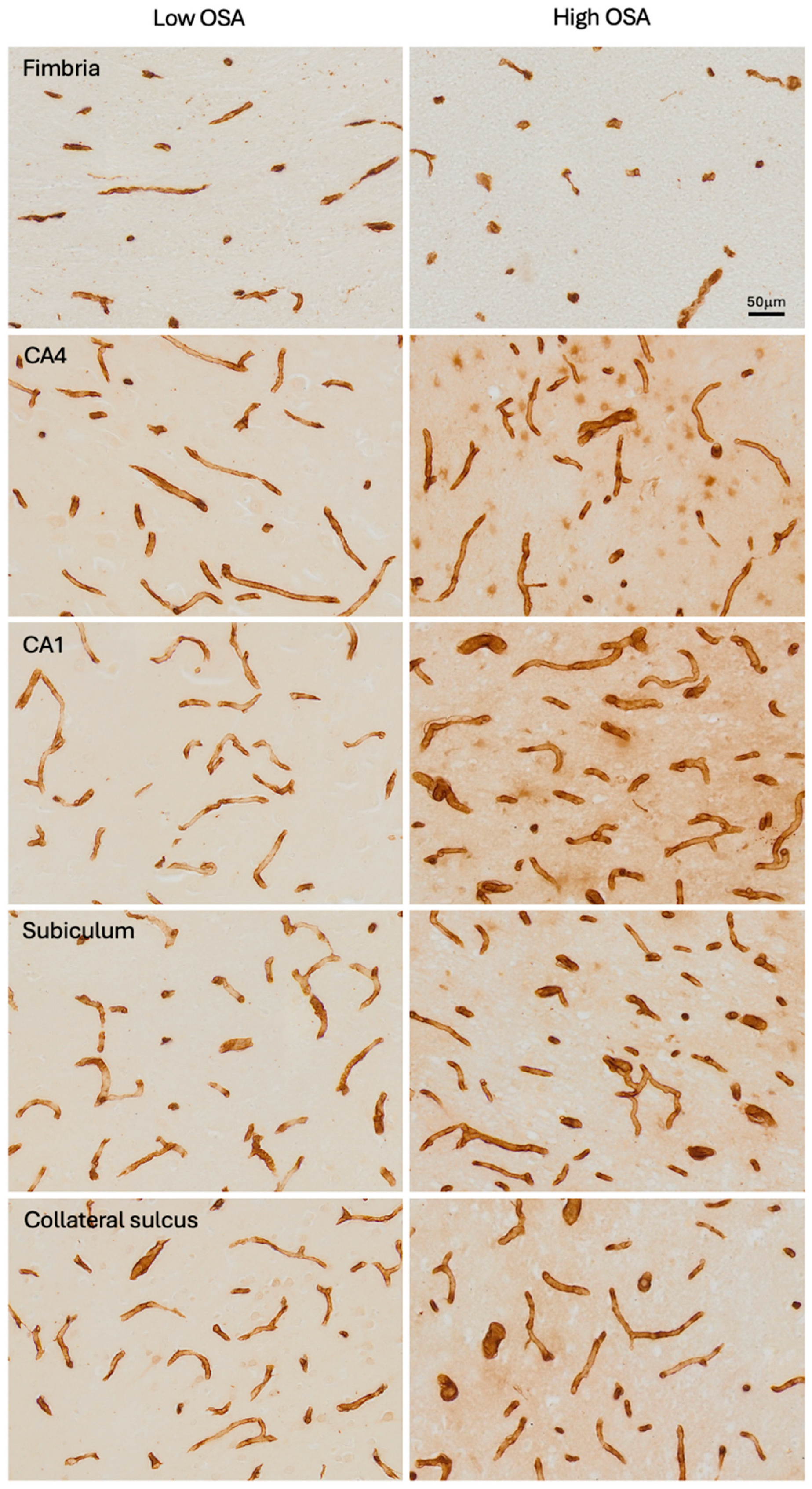
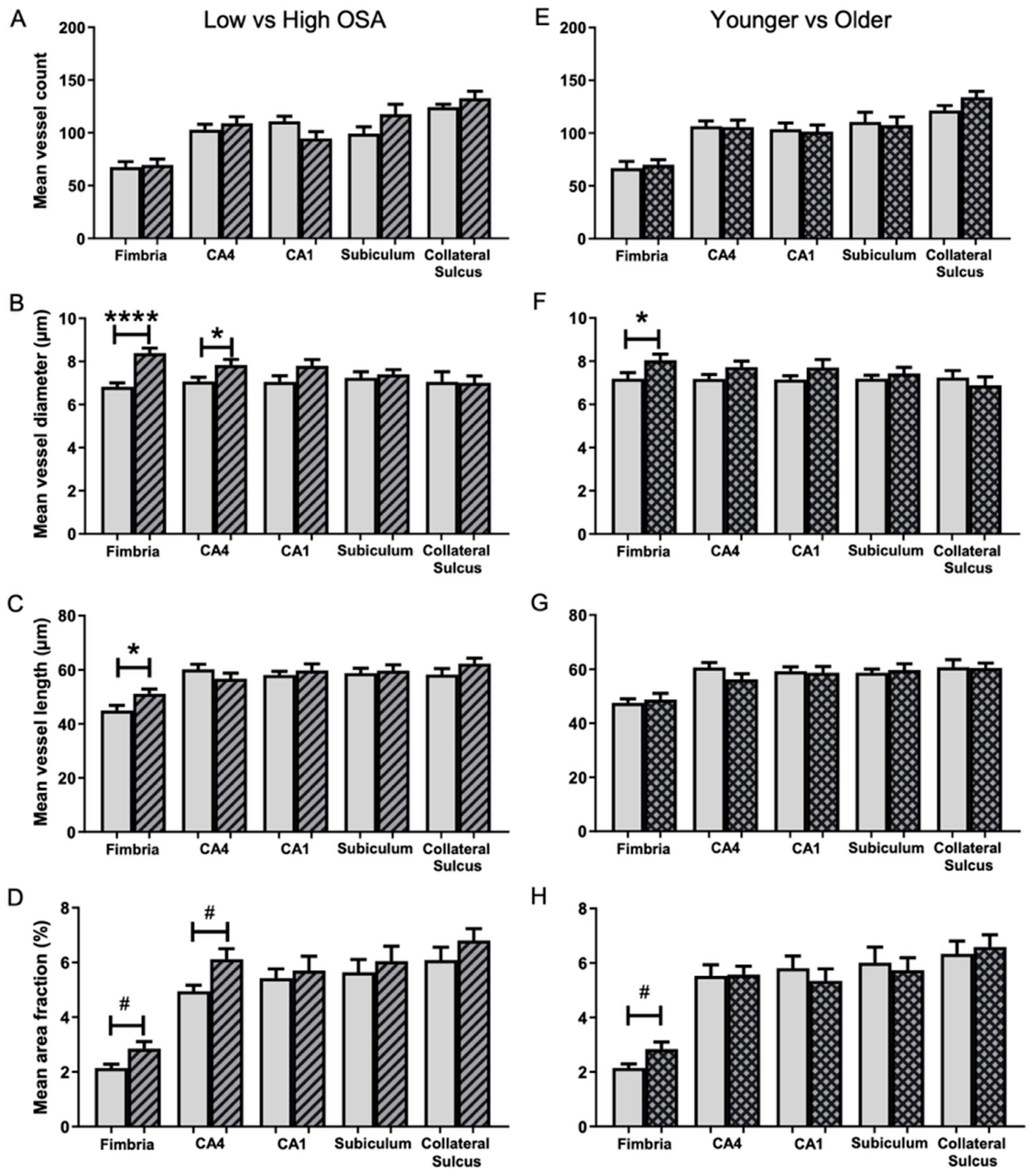
2.2. Association Between OSA Severity and Microvascular Parameters
2.3. Association of Age with Microvascular Parameters
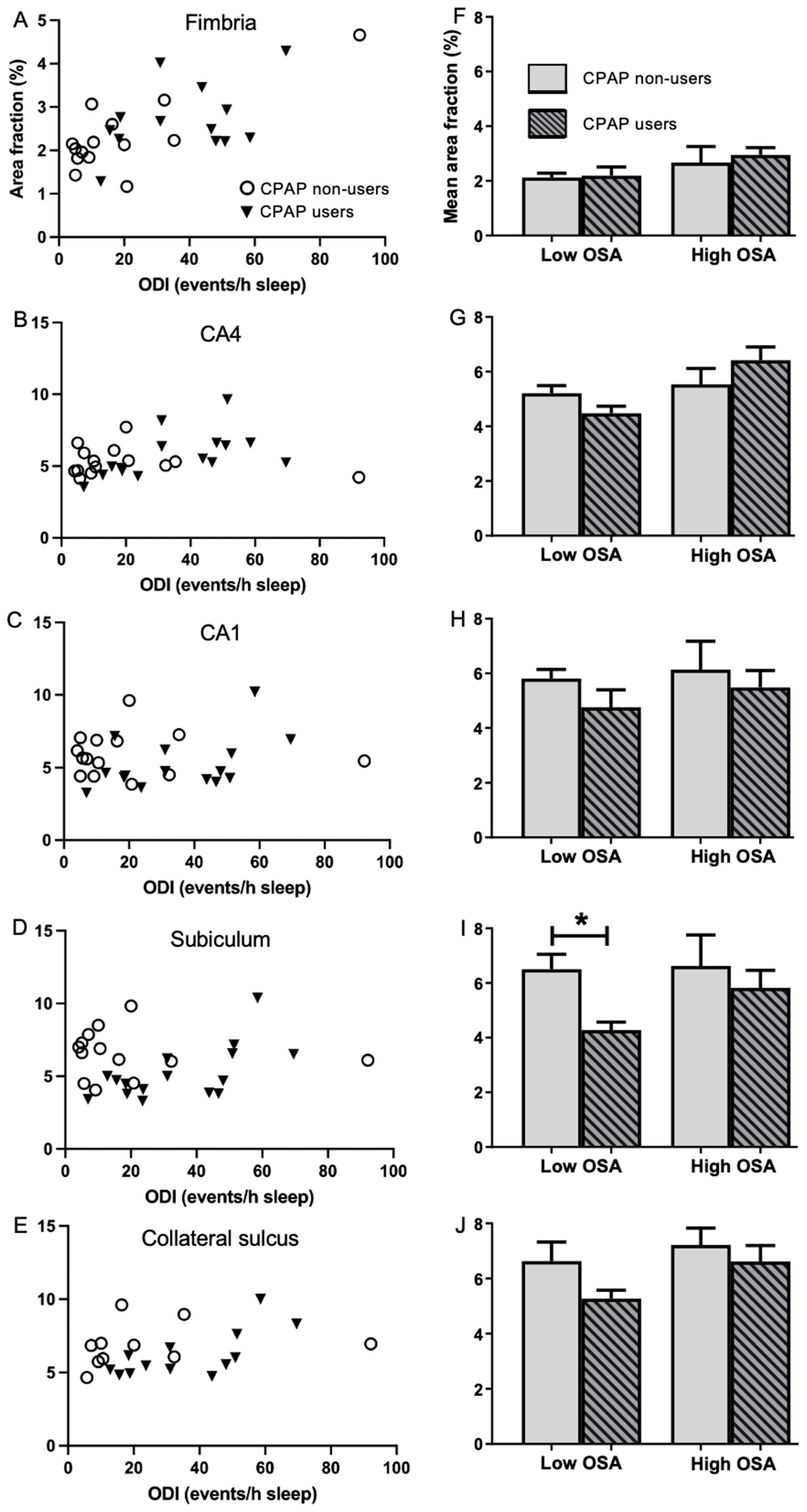
2.4. Association of Regular CPAP Use with Area Fraction
3. Discussion
4. Materials and Methods
4.1. OSA Diagnosis
4.2. Study Samples
4.3. Immunohistochemistry
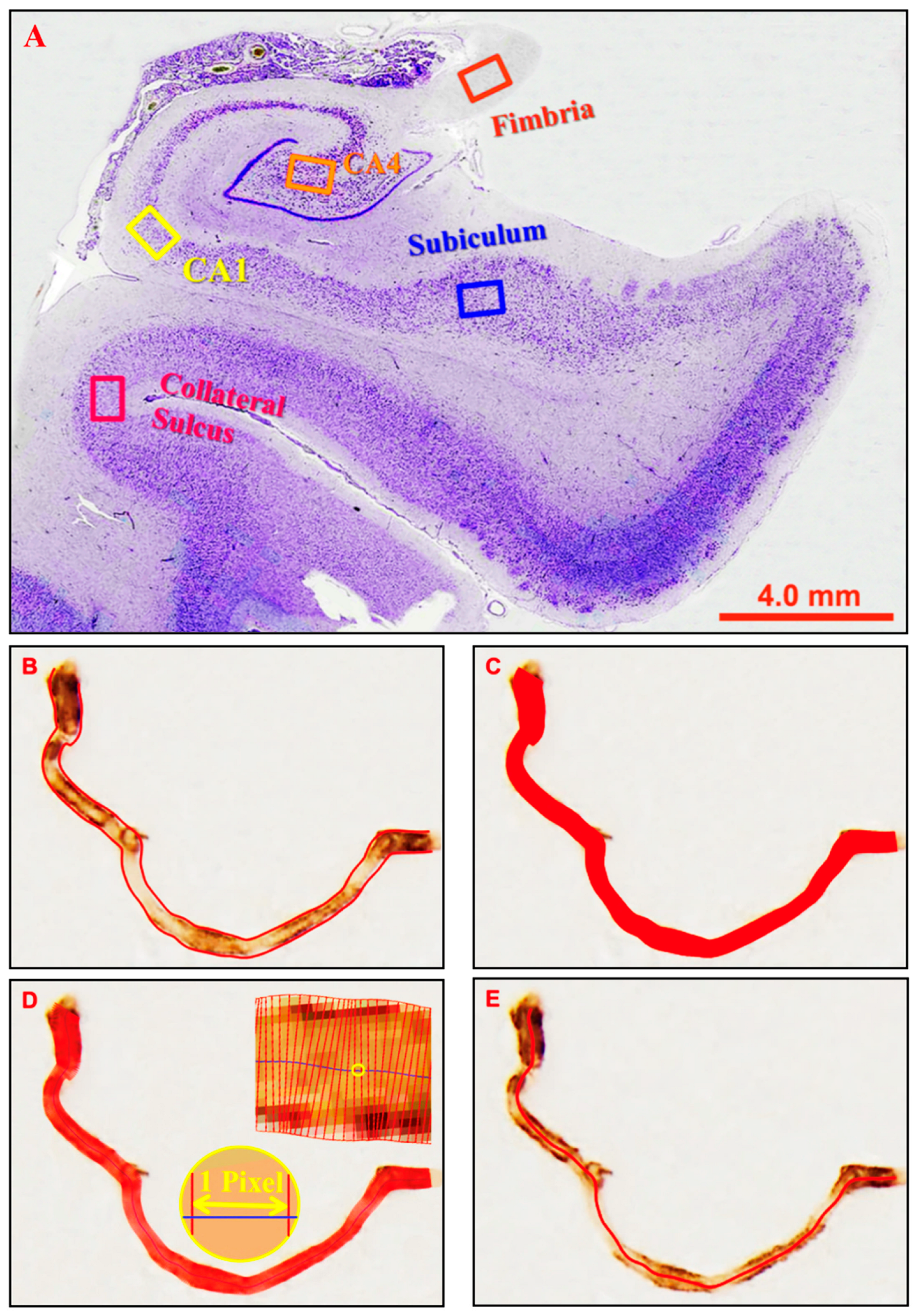
4.4. Histological Analysis of Hippocampal Microvasculature
4.5. Statistical Analysis
5. Conclusions
Author Contributions
Funding
Institutional Review Board Statement
Informed Consent Statement
Data Availability Statement
Acknowledgments
Conflicts of Interest
Abbreviations
References
- Dempsey, J.A.; Veasey, S.C.; Morgan, B.J.; O’Donnell, C.P. Pathophysiology of sleep apnea. Physiol. Rev. 2010, 90, 47–112. [Google Scholar] [CrossRef] [PubMed]
- Yadollahi, A.; Giannouli, E.; Moussavi, Z. Sleep apnea monitoring and diagnosis based on pulse oximetry and tracheal sound signals. Med. Biol. Eng. Comput. 2010, 48, 1087–1097. [Google Scholar] [CrossRef] [PubMed]
- Azagra-Calero, E.; Espinar-Escalona, E.; Barrera-Mora, J.M.; Llamas-Carreras, J.M.; Solano-Reina, E. Obstructive sleep apnea syndrome (OSAS). Review of the literature. Med. Oral Patol. Oral Cir. Bucal 2012, 17, e925–e929. [Google Scholar] [CrossRef] [PubMed]
- Malhotra, A.; White, D.P. Obstructive sleep apnoea. Lancet 2002, 360, 237–245. [Google Scholar] [CrossRef]
- O’Connor, C.; Thornley, K.S.; Hanly, P.J. Gender differences in the polysomnographic features of obstructive sleep apnea. Am. J. Respir. Crit. Care Med. 2000, 161, 1465–1472. [Google Scholar] [CrossRef]
- Goyal, A.; Wachinou, A.P.; Imler, T.; Solelhac, G.; Joshi, A.; Agodokpessi, G.; Preux, P.M.; Heinzer, R. Obesity, obstructive sleep Apnea, and cardiometabolic risk: A comparative analysis of population-Based cohorts in Switzerland, India, and Benin. Sleep Breath. 2025, 29, 346. [Google Scholar] [CrossRef]
- Osorio, R.S.; Martinez-Garcia, M.A.; Rapoport, D.M. Sleep apnoea in the elderly: A great challenge for the future. Eur. Respir. J. 2022, 59, 2101649. [Google Scholar] [CrossRef]
- Sonmez, I.; Vo Dupuy, A.; Yu, K.S.; Cronin, J.; Yee, J.; Azarbarzin, A. Unmasking obstructive sleep apnea: Estimated prevalence and impact in the United States. Respir. Med. 2025, 248, 108348. [Google Scholar] [CrossRef]
- Sullivan, C.E.; Issa, F.G.; Berthon-Jones, M.; Eves, L. Reversal of obstructive sleep apnoea by continuous positive airway pressure applied through the nares. Lancet 1981, 1, 862–865. [Google Scholar] [CrossRef]
- Caporale, M.; Palmeri, R.; Corallo, F.; Muscara, N.; Romeo, L.; Bramanti, A.; Marino, S.; Lo Buono, V. Cognitive impairment in obstructive sleep apnea syndrome: A descriptive review. Sleep Breath. 2021, 25, 29–40. [Google Scholar] [CrossRef]
- Owen, J.E.; BenediktsdOttir, B.; Gislason, T.; Robinson, S.R. Neuropathological investigation of cell layer thickness and myelination in the hippocampus of people with obstructive sleep apnea. Sleep 2019, 42, zsy199. [Google Scholar] [CrossRef] [PubMed]
- Micaux, J.; Troudi Habibi, A.; Mauconduit, F.; Noulhiane, M. Hypoxia’s Impact on Hippocampal Functional Connectivity: Insights from Resting-State fMRI Studies. Brain Sci. 2025, 15, 643. [Google Scholar] [CrossRef] [PubMed]
- Akyüz, E.; Aslan, F.Ş. Role of the Hippocampus in Cognition. In The Human Hippocampus: Development, Neuroanatomy, Neurophysiology, Neuropathology and Surgery; Turgut, M., Acer, N., Turgut, A.T., Di Rocco, C., Eds.; Springer Nature: Cham, Switzerland, 2025; pp. 205–214. [Google Scholar]
- Durtette, A.; Dargent, B.; Gierski, F.; Barbe, C.; Deslee, G.; Perotin, J.M.; Henry, A.; Launois, C. Impact of continuous positive airway pressure on cognitive functions in adult patients with obstructive sleep apnea: A systematic review and meta-analysis. Sleep Med. 2024, 123, 7–21. [Google Scholar] [CrossRef] [PubMed]
- Sapkota, A.; Halder, S.K.; Milner, R. Hypoxia-induced vascular remodeling responses in the brain are much more robust than other organs. Microvasc. Res. 2023, 148, 104517. [Google Scholar] [CrossRef]
- Boero, J.A.; Ascher, J.; Arregui, A.; Rovainen, C.; Woolsey, T.A. Increased brain capillaries in chronic hypoxia. J. Appl. Physiol. 1999, 86, 1211–1219. [Google Scholar] [CrossRef]
- Bogorad, M.I.; DeStefano, J.G.; Linville, R.M.; Wong, A.D.; Searson, P.C. Cerebrovascular plasticity: Processes that lead to changes in the architecture of brain microvessels. J. Cereb. Blood Flow Metab. 2019, 39, 1413–1432. [Google Scholar] [CrossRef]
- Kanaan, A.; Farahani, R.; Douglas, R.M.; Lamanna, J.C.; Haddad, G.G. Effect of chronic continuous or intermittent hypoxia and reoxygenation on cerebral capillary density and myelination. Am. J. Physiol. Regul. Integr. Comp. Physiol. 2006, 290, R1105–R1114. [Google Scholar] [CrossRef]
- Lim, D.C.; Brady, D.C.; Soans, R.; Kim, E.Y.; Valverde, L.; Keenan, B.T.; Guo, X.; Kim, W.Y.; Park, M.J.; Galante, R.; et al. Different cyclical intermittent hypoxia severities have different effects on hippocampal microvasculature. J. Appl. Physiol. 2016, 121, 78–88. [Google Scholar] [CrossRef]
- Guan, Y.; Gu, Y.; Shao, H.; Ma, W.; Li, G.; Guo, M.; Shao, Q.; Li, Y.; Liu, Y.; Wang, C.; et al. Intermittent hypoxia protects against hypoxic-ischemic brain damage by inducing functional angiogenesis. J. Cereb. Blood Flow Metab. 2023, 43, 1656–1671. [Google Scholar] [CrossRef]
- Zhang, R.H.; Zhao, W.; Shu, L.P.; Wang, N.; Cai, Y.H.; Yang, J.K.; Zhou, J.B.; Qi, L. Obstructive sleep apnea is associated with coronary microvascular dysfunction: A systematic review from a clinical perspective. J. Sleep Res. 2020, 29, e13046. [Google Scholar] [CrossRef]
- He, M.; Han, X.; Wu, H.; Huang, W. Choroidal thickness changes in obstructive sleep apnea syndrome: A systematic review and meta-analysis. Sleep Breath. 2016, 20, 369–378. [Google Scholar] [CrossRef]
- Jayakumar, K.; Bansal, S.; Markan, A.; Agarwal, A.; Bansal, R.; Mahajan, S.; Agrawal, R.; Gupta, V. Reversibility of retinochoroidal vascular alteration in patients with obstructive sleep apnea after continuous positive air pressure and surgical intervention. Indian J. Ophthalmol. 2021, 69, 1850–1855. [Google Scholar] [CrossRef] [PubMed]
- Bartsch, T.; Döhring, J.; Reuter, S.; Finke, C.; Rohr, A.; Brauer, H.; Deuschl, G.; Jansen, O. Selective neuronal vulnerability of human hippocampal CA1 neurons: Lesion evolution, temporal course, and pattern of hippocampal damage in diffusion-weighted MR imaging. J. Cereb. Blood Flow Metab. 2015, 35, 1836–1845. [Google Scholar] [CrossRef] [PubMed]
- Kirino, T. Delayed neuronal death. Neuropathology 2000, 20, 95–97. [Google Scholar] [CrossRef] [PubMed]
- West, M.J.; Coleman, P.D.; Flood, D.G.; Troncoso, J.C. Differences in the pattern of hippocampal neuronal loss in normal ageing and Alzheimer’s disease. Lancet 1994, 344, 769–772. [Google Scholar] [CrossRef]
- Chételat, G.; Fouquet, M.; Kalpouzos, G.; Denghien, I.; De La Sayette, V.; Viader, F.; Mézenge, F.; Landeau, B.; Baron, J.C.; Eustache, F. Three-dimensional surface mapping of hippocampal atrophy progression from MCI to AD and over normal aging as assessed using voxel-based morphometry. Neuropsychologia 2008, 46, 1721–1731. [Google Scholar] [CrossRef]
- Gozal, D.; Daniel, J.M.; Dohanich, G.P. Behavioral and anatomical correlates of chronic episodic hypoxia during sleep in the rat. J. Neurosci. 2001, 21, 2442–2450. [Google Scholar] [CrossRef]
- Gozal, E.; Gozal, D.; Pierce, W.M.; Thongboonkerd, V.; Scherzer, J.A.; Sachleben, L.R., Jr.; Brittian, K.R.; Guo, S.Z.; Cai, J.; Klein, J.B. Proteomic analysis of CA1 and CA3 regions of rat hippocampus and differential susceptibility to intermittent hypoxia. J. Neurochem. 2002, 83, 331–345. [Google Scholar] [CrossRef]
- Fung, S.J.; Xi, M.C.; Zhang, J.H.; Yamuy, J.; Sampogna, S.; Tsai, K.L.; Lim, V.; Morales, F.R.; Chase, M.H. Eszopiclone prevents excitotoxicity and neurodegeneration in the hippocampus induced by experimental apnea. Sleep 2009, 32, 1593–1601. [Google Scholar] [CrossRef]
- Wen, J.; Li, C.; Sun, Z.; Wang, C.; Zhang, J.; Guan, X.; Xu, X.; Wisniewski, T.; Ge, Y. Hippocampal subfields in aging: Sex-specific trajectories in structure and hemodynamics. Neuroimage 2025, 317, 121343. [Google Scholar] [CrossRef]
- Mamelak, M. The Alzheimer’s Disease Brain, Its Microvasculature, and NADPH Oxidase. J. Alzheimer’s Dis. 2024, 99, S109–S118. [Google Scholar] [CrossRef]
- Bernetti, C.; D’Andrea, V.; Buoso, A.; Barbalace, I.; Greco, F.; Pilato, F.; Calandrelli, R.; Di Lazzaro, V.; Zobel, B.B.; Mallio, C.A. Arterial Spin Labeling MRI in Alzheimer’s Disease: A Systematic Review of Cerebral Perfusion Biomarkers. J. Neuroimaging 2025, 35, e70035. [Google Scholar] [CrossRef]
- Burke, M.J.; Nelson, L.; Slade, J.Y.; Oakley, A.E.; Khundakar, A.A.; Kalaria, R.N. Morphometry of the hippocampal microvasculature in post-stroke and age-related dementias. Neuropathol. Appl. Neurobiol. 2014, 40, 284–295. [Google Scholar] [CrossRef] [PubMed]
- Harik, S.; Hritz, M.; LaManna, J. Hypoxia-induced brain angiogenesis in the adult rat. J. Physiol. 1995, 485, 525–530. [Google Scholar] [CrossRef] [PubMed]
- Farre, R.; Almendros, I.; Martinez-Garcia, M.A.; Gozal, D. Experimental Models to Study End-Organ Morbidity in Sleep Apnea: Lessons Learned and Future Directions. Int. J. Mol. Sci. 2022, 23, 14430. [Google Scholar] [CrossRef]
- Farre, R.; Montserrat, J.M.; Gozal, D.; Almendros, I.; Navajas, D. Intermittent Hypoxia Severity in Animal Models of Sleep Apnea. Front. Physiol. 2018, 9, 1556. [Google Scholar] [CrossRef] [PubMed]
- Han, W.; Song, Y.; Rocha, M.; Shi, Y. Ischemic brain edema: Emerging cellular mechanisms and therapeutic approaches. Neurobiol. Dis. 2023, 178, 106029. [Google Scholar] [CrossRef]
- Sadanandan, J.; Thomas, S.; Mathew, I.E.; Huang, Z.; Blackburn, S.L.; Tandon, N.; Lokhande, H.; McCrea, P.D.; Bresnick, E.H.; Dash, P.K.; et al. Key epigenetic and signaling factors in the formation and maintenance of the blood-brain barrier. eLife 2024, 12, RP86978. [Google Scholar] [CrossRef]
- Thomas, S.; Chandran, C.; Ahirwar, L.K.; Harmanci, A.O.; Chathathayil, S.M.; Alkayed, N.J.; Dienel, A.C.; Blackburn, S.L.; McBride, D.W.; Peeyush, K.T. Epigenetic Reactivation of CNS Endothelial Developmental Programs Triggers Adult Brain Angiogenesis, Promotes Post-Stroke Revascularization and Neuronal Regeneration. bioRxiv 2025, 15, 670554. [Google Scholar] [CrossRef]
- Bankhead, P.; Scholfield, C.N.; McGeown, J.G.; Curtis, T.M. Fast retinal vessel detection and measurement using wavelets and edge location refinement. PLoS ONE 2012, 7, e32435. [Google Scholar] [CrossRef]



| Low OSA | High OSA | p Value | |
|---|---|---|---|
| Number of patients | 15 | 16 | |
| Gender | M = 7, F = 8 | M = 8, F = 8 | |
| CPAP users | Y = 6, N = 9 | Y = 11, N = 5 | |
| Mean age at death (years) | 66.0 ± 2.8 | 68.2 ± 1.7 | 0.589 |
| Mean time lived after OSA diagnosis (years) | 8.6 ± 1.2 | 6.8 ± 1.7 | 0.397 |
| Mean BMI (kg/m2) | 27.8 ± 1.0 (n = 14) | 30.6 ± 2.1 (n = 13) | 0.410 |
| Mean ODI (events/h sleep) | 10.3 ± 1.3 | 42.4 ± 4.9 | 0.001 |
| Parameter | Region | OSA Severity | CPAP Use | Age |
|---|---|---|---|---|
| Vessel count | − | − | − | − |
| Vessel diameter | Fimbria |  | − | |
| CA4 | | − | − | |
| Vessel length | Fimbria | | − | − |
| Area fraction (%) | Fimbria | | − | |
| CA4 | | − | − | |
| Subiculum | − |  | − |
= Increased; = Decreased; − = No change.| Blocking (3 h) | Primary (16.5 h) | Secondary (4 h) | Tertiary (3 h) | |
|---|---|---|---|---|
| 1% BSA | Yes | Yes | Yes | Yes |
| 4% Goat serum | Yes | Yes | Yes | |
| 10% Triton X-100 | Yes | Yes | ||
| 1% Ethanolamine | Yes | |||
| Rabbit anti-collagen IV (Abcam Ab6586; Abcam Limited, London, UK) | 1:20,000 | |||
| Goat anti-rabbit IgG (Vector BA-1000; Vector Laboratories, Newark, CA, USA) | 1:300 | |||
| SB-HRP (GE Healthcare RPN 1051; GE Healthcare UK Ltd., Little Chalfont, UK) | 1:300 |
Disclaimer/Publisher’s Note: The statements, opinions and data contained in all publications are solely those of the individual author(s) and contributor(s) and not of MDPI and/or the editor(s). MDPI and/or the editor(s) disclaim responsibility for any injury to people or property resulting from any ideas, methods, instructions or products referred to in the content. |
© 2025 by the authors. Licensee MDPI, Basel, Switzerland. This article is an open access article distributed under the terms and conditions of the Creative Commons Attribution (CC BY) license (https://creativecommons.org/licenses/by/4.0/).
Share and Cite
Xu, C.; Owen, J.E.; Gislason, T.; Benediktsdottir, B.; Ye, J.; Robinson, S.R. Limited Microvascular Remodelling Occurs in the Aged Human Hippocampus in Obstructive Sleep Apnoea. Int. J. Mol. Sci. 2025, 26, 12040. https://doi.org/10.3390/ijms262412040
Xu C, Owen JE, Gislason T, Benediktsdottir B, Ye J, Robinson SR. Limited Microvascular Remodelling Occurs in the Aged Human Hippocampus in Obstructive Sleep Apnoea. International Journal of Molecular Sciences. 2025; 26(24):12040. https://doi.org/10.3390/ijms262412040
Chicago/Turabian StyleXu, Cuicui, Jessica E. Owen, Thorarinn Gislason, Bryndis Benediktsdottir, Jiming Ye, and Stephen R. Robinson. 2025. "Limited Microvascular Remodelling Occurs in the Aged Human Hippocampus in Obstructive Sleep Apnoea" International Journal of Molecular Sciences 26, no. 24: 12040. https://doi.org/10.3390/ijms262412040
APA StyleXu, C., Owen, J. E., Gislason, T., Benediktsdottir, B., Ye, J., & Robinson, S. R. (2025). Limited Microvascular Remodelling Occurs in the Aged Human Hippocampus in Obstructive Sleep Apnoea. International Journal of Molecular Sciences, 26(24), 12040. https://doi.org/10.3390/ijms262412040