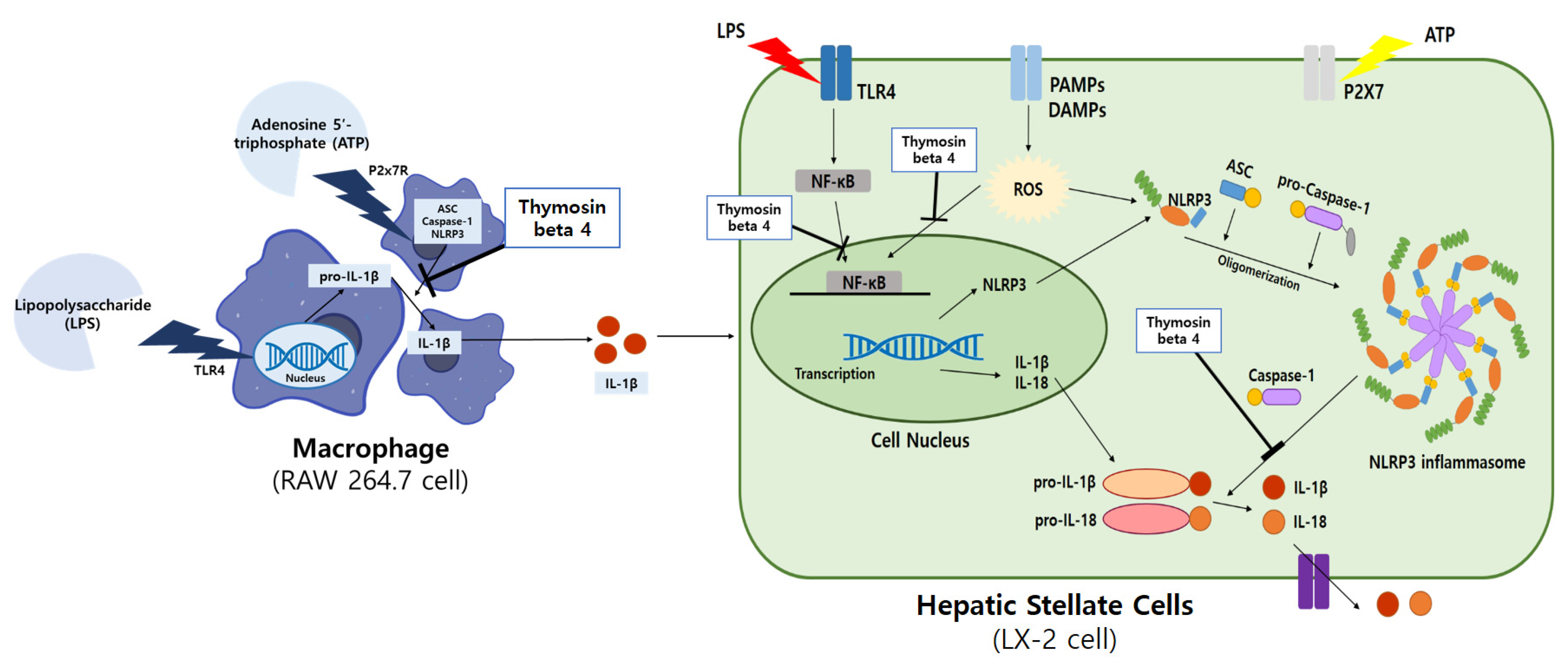
Thymosin Beta 4 Inhibits LPS and ATP-Induced Hepatic Stellate Cells via the Regulation of Multiple Signaling Pathways


Abstract
Share and Cite
Choi, J.; Cho, Y.; Choi, H.; Lee, S.; Han, H.; Lee, J.; Kwon, J. Thymosin Beta 4 Inhibits LPS and ATP-Induced Hepatic Stellate Cells via the Regulation of Multiple Signaling Pathways. Int. J. Mol. Sci. 2023, 24, 3439. https://doi.org/10.3390/ijms24043439
Choi J, Cho Y, Choi H, Lee S, Han H, Lee J, Kwon J. Thymosin Beta 4 Inhibits LPS and ATP-Induced Hepatic Stellate Cells via the Regulation of Multiple Signaling Pathways. International Journal of Molecular Sciences. 2023; 24(4):3439. https://doi.org/10.3390/ijms24043439
Chicago/Turabian StyleChoi, Jihye, Yunsang Cho, Hwal Choi, Sangmin Lee, Hyeju Han, Jeonghyeon Lee, and Jungkee Kwon. 2023. "Thymosin Beta 4 Inhibits LPS and ATP-Induced Hepatic Stellate Cells via the Regulation of Multiple Signaling Pathways" International Journal of Molecular Sciences 24, no. 4: 3439. https://doi.org/10.3390/ijms24043439
APA StyleChoi, J., Cho, Y., Choi, H., Lee, S., Han, H., Lee, J., & Kwon, J. (2023). Thymosin Beta 4 Inhibits LPS and ATP-Induced Hepatic Stellate Cells via the Regulation of Multiple Signaling Pathways. International Journal of Molecular Sciences, 24(4), 3439. https://doi.org/10.3390/ijms24043439