Review

The Functions of Chloroplastic Ascorbate in Vascular Plants and Algae

Laboratory for Molecular Photobioenergetics, Institute of Plant Biology, Biological Research Centre, Temesvári krt 62, H-6726 Szeged, Hungary
Int. J. Mol. Sci. 2023, 24(3), 2537; https://doi.org/10.3390/ijms24032537
Submission received: 21 December 2022 / Revised: 17 January 2023 / Accepted: 24 January 2023 / Published: 28 January 2023
(This article belongs to the Special Issue Sensing, Regulation, and Signalling of Ascorbate in Plants)

Abstract

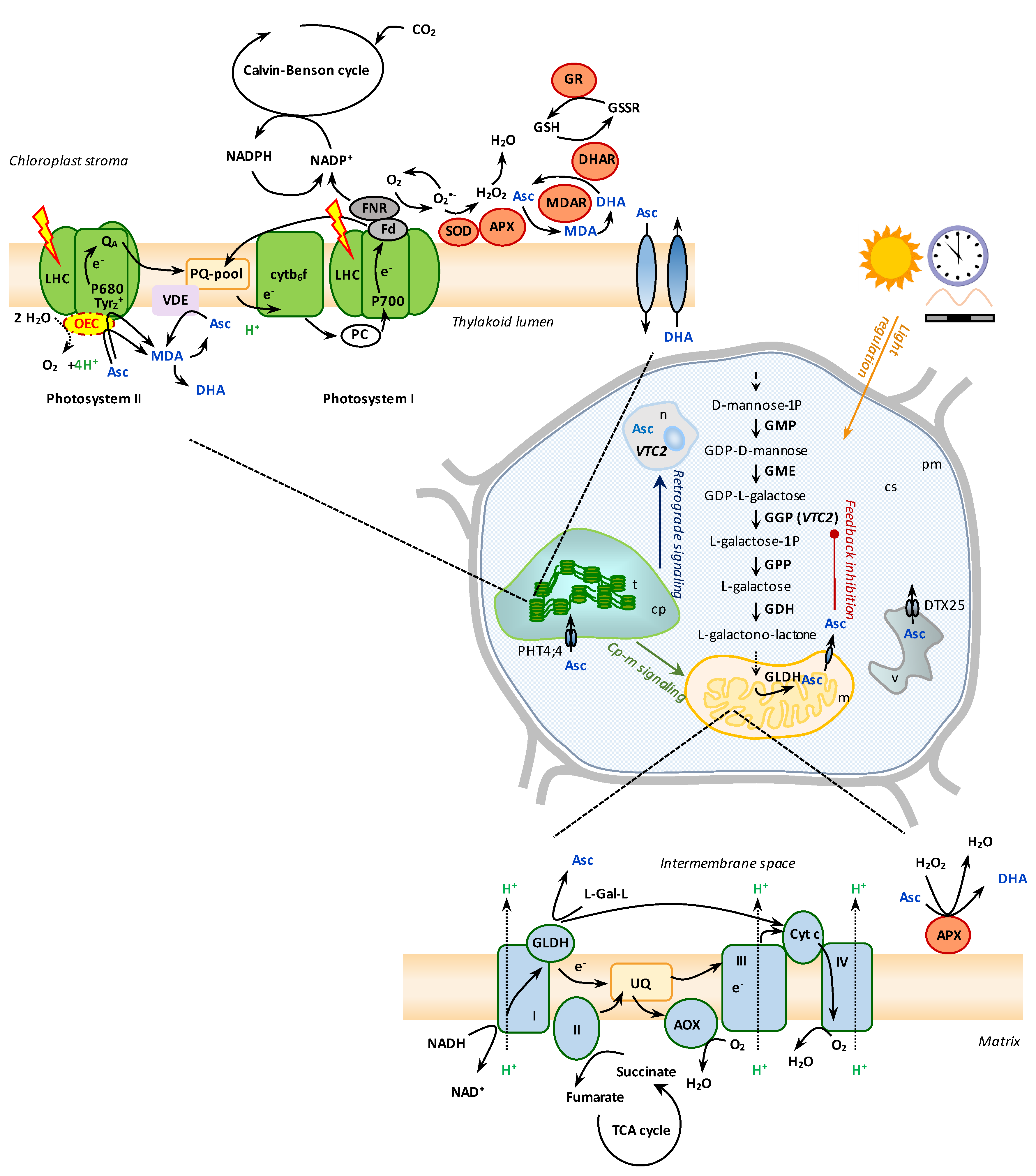
Ascorbate (Asc) is a multifunctional metabolite essential for various cellular processes in plants and animals. The best-known property of Asc is to scavenge reactive oxygen species (ROS), in a highly regulated manner. Besides being an effective antioxidant, Asc also acts as a chaperone for 2-oxoglutarate-dependent dioxygenases that are involved in the hormone metabolism of plants and the synthesis of various secondary metabolites. Asc also essential for the epigenetic regulation of gene expression, signaling and iron transport. Thus, Asc affects plant growth, development, and stress resistance via various mechanisms. In this review, the intricate relationship between Asc and photosynthesis in plants and algae is summarized in the following major points: (i) regulation of Asc biosynthesis by light, (ii) interaction between photosynthetic and mitochondrial electron transport in relation to Asc biosynthesis, (iii) Asc acting as an alternative electron donor of photosystem II, (iv) Asc inactivating the oxygen-evolving complex, (v) the role of Asc in non-photochemical quenching, and (vi) the role of Asc in ROS management in the chloroplast. The review also discusses differences in the regulation of Asc biosynthesis and the effects of Asc on photosynthesis in algae and vascular plants.
Keywords: ascorbate; non-photochemical quenching; oxygen-evolving complex; photosynthesis; photosystem II; reactive oxygen species; vitamin C ascorbate; non-photochemical quenching; oxygen-evolving complex; photosynthesis; photosystem II; reactive oxygen species; vitamin C