You are currently viewing a new version of our website. To view the old version click .
International Journal of Molecular Sciences
  • Review
  • Open Access

22 February 2011

Accounting for Large Amplitude Protein Deformation during in Silico Macromolecular Docking

,
and
1
LABIS, Genoscope, CEA, 2 rue Gaston Cremieux, F-91057 Evry Cedex, France
2
MTI, INSERM UMR-S 973, Paris Diderot-Paris 7 University, Bât Lamarck, 35 rue Hélène Brion, F-75205 Paris Cedex 13, France
3
LBT-UPR 9080 CNRS, IBPC, 13 rue Pierre et Marie Curie, F-75005 Paris, France
*
Author to whom correspondence should be addressed.
This article belongs to the Special Issue Advances in Molecular Recognition

Abstract

Rapid progress of theoretical methods and computer calculation resources has turned in silico methods into a conceivable tool to predict the 3D structure of macromolecular assemblages, starting from the structure of their separate elements. Still, some classes of complexes represent a real challenge for macromolecular docking methods. In these complexes, protein parts like loops or domains undergo large amplitude deformations upon association, thus remodeling the surface accessible to the partner protein or DNA. We discuss the problems linked with managing such rearrangements in docking methods and we review strategies that are presently being explored, as well as their limitations and success.

1. Introduction

Macromolecular docking methods aim at predicting the three-dimensional (3D) structure of protein-protein or protein-DNA complexes starting from the coordinates of their components taken in a so-called unbound form. The unbound form may come from the structural databank PDB, in which case it represents the structure of the component alone or in association with another partner. It can also be reconstructed from proteins with homologous sequences and known structure.
In the post-genomic context, docking methods are being developed as a complement to experimental approaches, in order to determine the structure of the macromolecular assemblies that rule the cell life. Knowing the 3D structure of complexes involved in biological processes is necessary for unraveling the mechanism of these processes. In addition, it opens the way to the discovery of new drugs that will enhance or hinder the association. For example, commonly used antibiotics like streptomycin or erythromycin disturb the interactions between ribosome subunits and messenger or transfer RNA of bacteria. In that way protein synthesis is interrupted, which is lethal to the bacteria.
However, a great part of the macromolecular complexes fall out of the reach of experimental methods for high resolution structure resolution, such as X-ray crystallography or nuclear magnetic resonance (NMR). This may be due to their size or to their instability. Besides, the huge number of putative or known complexes involved in biological processes renders necessary the conjunction between structural biology and theoretical tools, provided that the latter reach sufficient levels of accuracy and rapidity. This creates high expectation for the development of macromolecular docking methods.
The field has rapidly progressed since the first docking attempts were performed in 1978 [1], as testified by the results of the CAPRI experiment [27]. CAPRI (Critical Assessment of PRotein Interactions, http://www.ebi.ac.uk/msd-srv/capri) challenges modeling groups, involved in the development of macromolecular docking programs, to predict the structure of protein-protein or protein-nucleic acid complexes. The target complexes have experimentally determined but yet unreleased 3D structure. Evaluation is performed on a common basis and the disclosed successes or failures permit to delineate the methodological issues that can be considered solved and those that still need to be improved. The nearly ten years and already twenty three CAPRI rounds have testified increasing quality of the predicted complex structures in spite of the increasing difficulty of the prediction targets.
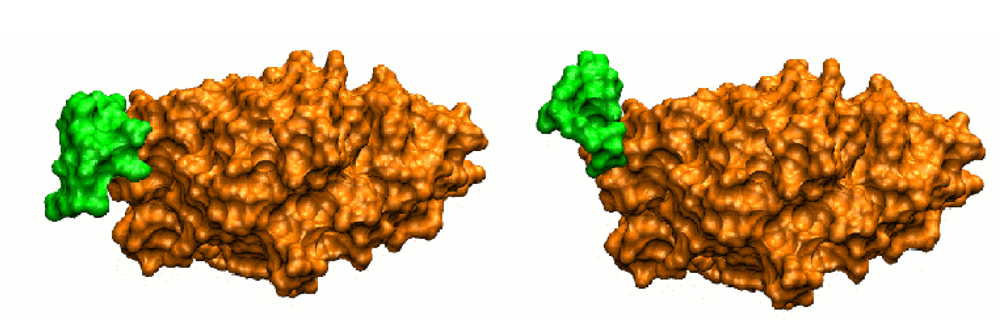
Issues related to general macromolecular docking methods or flexible docking have been reviewed in full detail in several highly interesting publications [814]. The present contribution focuses on cases where the docking methods still fail to predict the correct geometry of the complex, or at least where potential success cannot be anticipated with certainty. Such cases most frequently occur when the interface of at least one of the partner proteins largely differs between its bound and its unbound forms. This corresponds to situations where the surface that eventually will bind the partner gets remodelled during association (Figure 1), in a process referred to as induced fit. In these cases, neglecting the flexibility during the first phases of the docking simulation can result in the near-native geometry of association not even being sampled. The review first presents the methodological issues associated with taking flexibility into account during docking simulations, followed by an overview of the current knowledge on protein flexibility. Finally, the principal strategies for flexible docking are detailed, with a particular emphasis on the methods aiming at predicting high amplitude conformational changes during macromolecular assembly.
Figure 1. Surface view of actin in its unbound form (left, PDB code 1IJJ) or in complex with deoxyribonuclease I (right, PDB code 1ATN). The two forms differ by the conformation of a short flexible loop, represented in green, which interacts with deoxyribonuclease I in the bound form. The surface accessible to the partner is completely remodeled between the bound and the unbound forms (after Figure 2 of [15]).

2. The Flexible Docking Problem

Typical docking protocols are composed of three ingredients: a representation for the macromolecules (resolution, degrees of freedom for conformational space exploration), a method for searching the available conformational space and a scoring function able to distinguish the correct solution from every other generated structure of the complex.
Searching the possible geometries of binary protein-protein complexes requires the exploration of at least six degrees of freedom, three translations and three rotations. This level of exploration is sufficient as long as the structural modifications of each partner that accompany their association are of limited amplitude (movements of short side-chains, low amplitude deformations of the backbone). The use of low resolution representation with smooth interface, tolerating a certain degree of interpenetration, can then implicitly account for these changes. It is assumed that the protein will eventually perform the small amplitude interface rearrangement that is necessary to optimize the steric and electrostatic complementarity at the interface. As a matter of fact, recent docking programs often follow this assumption in the first phase of a multi-stage strategy [16]. The protein representation can then consist of surface descriptors [17], discretized representations [18,19] or rigid coarse grain models [20,21]. It is accompanied by crude scoring functions, like statistical potential for amino acid-amino acid interaction [21], grid-based estimation of surface contacts [19,22], interaction energy terms limited to electrostatics and van der Waals [20]. At this stage of the docking process, detailed steric complementarity is not necessary for the geometry (position/orientation) of the complex to be considered for further refinement. As a result, while the low resolution search eliminates a huge part of possible geometries of association, it often generates many false positive solutions, i.e., highly ranked predicted structures that are distinct from the near native structure. Recent evaluation showed that for cases with limited overall partner flexibility, when geometries close to the native complex structure pass the first phase, they can be distinguished from the false positive solutions during the second stage, i.e., when small amplitude deformations of the main chain and side chains are explicitly explored [2127]. In what follows, we will refer to that stage as flexible refinement.
The nature of the problem completely changes when the interface of one component protein gets remodeled during association. The interacting surface may become partially or totally unaccessible to its partner when the protein is in the unbound form. Such cases represent about a quarter of the CAPRI prediction targets and a fifth of non-redundant protein-protein complexes with known unbound form of the interaction partners (benchmark 4.0, [28]). In extreme situations, the spatial arrangement of amino acids characterizing the interface only forms when a loop refolds or when a domain modifies its position or orientation. It is therefore impossible to detect the correct association geometry during a rigid body search phase, even when working at low resolution or with a smooth interface. In addition, even if a geometry close to the native one is retained by chance in spite of incorrect interface, it cannot be expected to be improved during the refinement phase. As already mentioned, the refinement phase generally introduces spatial limitation for the relative position/orientation of the two partners, while the route towards the correct geometry of association would necessitate the separation of the partners to allow loop refolding or domain repositioning. Such cases can only be solved if flexibility is considered from the beginning of the docking process.
This formally transforms a search problem with six degrees of freedom into a search problem with 3N degrees of freedom, where N represents the total number of atoms in the system. The presently available computer resources can account for such high number of degrees of freedom, for example during numerical MD simulations, but the conformational space explored by these simulations is limited by the simulation time. Since the largest amplitude internal moves are also those that take more time to be sampled, such methods appear unsuitable to the docking search problem, which requires high velocity. This makes it necessary to reduce the search dimensionality. Section 3 displays the strategies that have been developed to address this challenge, based on the growing knowledge of the characteristics of protein flexibility. It is useful to present some elements of this knowledge for the understanding of flexible search strategies, and this is done in Section 2.2.

2.1. Flexible Refinement

What characterizes the flexible refinement stage is that it deals with already formed complex structures resulting from the search stage of docking. The process then allows only small spatial adjustments of the global geometry in terms of the six rigid body degrees of freedom. It concentrates on the explicit account of internal degrees of freedom that are responsible for surface adjustments. The spatial limitation of the search together with the fact that the number of refined structures is reduced with respect to the first phase of exhaustive search make it possible to introduce some degree of internal flexibility in the exploration. The task remains however difficult. Searching the side chain conformations that optimize the interface is computationally expensive for protein-protein complexes, where the interfaces of both partners need to be simultaneously optimized in combination with small amplitude rigid body adjustments. Side chain rotamer libraries, gathering the conformations most frequently found in known protein structures, can be used with benefit in the process [29]. While the conformation of particular side chains in the bound form does not necessarily coincide with a rotamer, the use of discrete side chain representations can be justified in preliminary search phases. The group of Camacho has shown for 39 protein test cases that the bound conformation of key side chains is frequently visited during molecular dynamics simulations of the free form of the protein. [30,31]. Sophisticated algorithms have been developed for predicting the rotamer combinations that best fit a fixed backbone. However, when searching rotamer libraries in conjunction with backbone repositioning in docking programs, it is convenient to use Monte Carlo simulations, which are also well adapted to directly sampling the dihedral angles in internal variable representation [21,22,32]. The use of molecular dynamics (MD) simulation for side chain final refinement, sometimes with explicit solvent representation, is now commonly encountered due to increased computational facilities.
Protein backbone refinement has been introduced only recently in the systematic docking programs. It is however at the heart of the information-driven docking program HADDOCK developed by the group of Bonvin [33,34]. This program initially performs a rough positioning of the two partners relative to each other, based on the satisfaction of a set of interaction restraints derived from experimental data (NMR, biochemical data). A particularity of the method is that the restraints are not attributed to specific residue pairs, with each residue belonging to a different partner, but rather that they concern pre-defined groups of residues for each partner, hence the term “ambiguous restraints”. After these restraints are satisfied, the protocol can concentrate on the refinement stage, which is performed in two steps, first using MD simulations in internal coordinates with side chain and backbone flexibility limited to the interface regions, then using cartesian coordinate MD simulations in explicit solvent environment.
With the progress of computational performance and algorithmic development, methods that combine side chain conformational search, ligand repositioning and main chain limited structural adjustment are emerging [24,35,36]. Erlich et al. [37] have emphasized the necessity of simultaneously taking into account these three levels of conformational search or adjustment to achieve successful docking refinement.

2.2. Characteristics of Protein Flexibility

Although proteins are generally characterized by well defined tertiary structures, they undergo structural fluctuations at biologically relevant temperatures. Part of these movements can be described by high frequency, small amplitude fluctuations of the atoms around their equilibrium position (harmonic fluctuations). However, a large part of the movements (up to 80%) can be accounted for by a few modes of deformation that involve concerted atomic motions. Such directions of deformation can be accessed by several methods, including normal mode analysis or principal component analysis of structural ensembles [38]. For example, Dobbins et al. [39] have shown that in 35% of the proteins they studied, the direction of the observed conformational change could be correctly described by a single low-frequency normal mode. The ensembles may be composed of MD snapshots or structures obtained in different conditions and environments by X-ray crystallography or NMR.
Large amplitude fluctuations of protein structures often present biological importance. They have been shown in various occasions to play a role in catalytic reactions, in molecular assembly or in specific ligand recognition. Concerted movements can present a strong harmonic character, generally with low frequency fluctuations. In this case, they can be addressed by simple analytic functions during docking calculations, as shown in the next section. Alternatively, when the concerted movements involve main chain refolding, the protein structure explores various conformational substates separated by energy barriers with small to large amplitudes. Generating and exploring these substates then becomes highly time consuming, which is not compatible with a docking search process. In those cases, it is useful to consider another characteristic of protein flexibility, which is its anisotropy. At the residue level, protein display large variations in fluctuation amplitudes [40,41]. Interestingly, Sacquin-Mora and Lavery [42,43] have shown that among the residues that present high degrees of rigidity, several are key residues involved in catalytic activity or in the stabilization of the overall 3D structure. Rigid residues can also be found at the frontier between domains or at the extremity of loops, where they constitute hinge points between protein regions. As a matter of fact, interface remodeling in interacting protein most often results from the movement of loops or domains that move independently from an almost rigid protein core. For the proteins that fall in this category, it is possible to restrain the search to the flexible regions during the docking search phase, as shown in the next section. Several web servers are devoted to the detection of flexible protein segments that may be involved in interface remodeling during docking. ElNemo [38] ( http://www.igs.cnrs-mrs.fr/elnemo/) and HingeProt [44] ( http://bioinfo3d.cs.tau.ac.il/HingeProt/hingeprot.html) are based on the analysis of low frequency normal modes calculated from elastic networks, while ProFlex [45] ( http://www.bch.msu.edu/kuhn/software/proflex/) relies on a three-dimensional constraint counting algorithm. StoneHinge [46] is a consensus method between the two approaches.
The two types of deformation that have been described above can be put in correspondence with two complementary views of protein structural adjustments upon interaction. In the induced-fit interpretation, the protein modifies its internal conformation due to its exposition to the field of its partner [47]. In the structural ensemble interpretation, all conformational substates a protein can occupy coexist in solution, and the partner will select the substate that allows optimal surface fit [48].

4. Conclusions

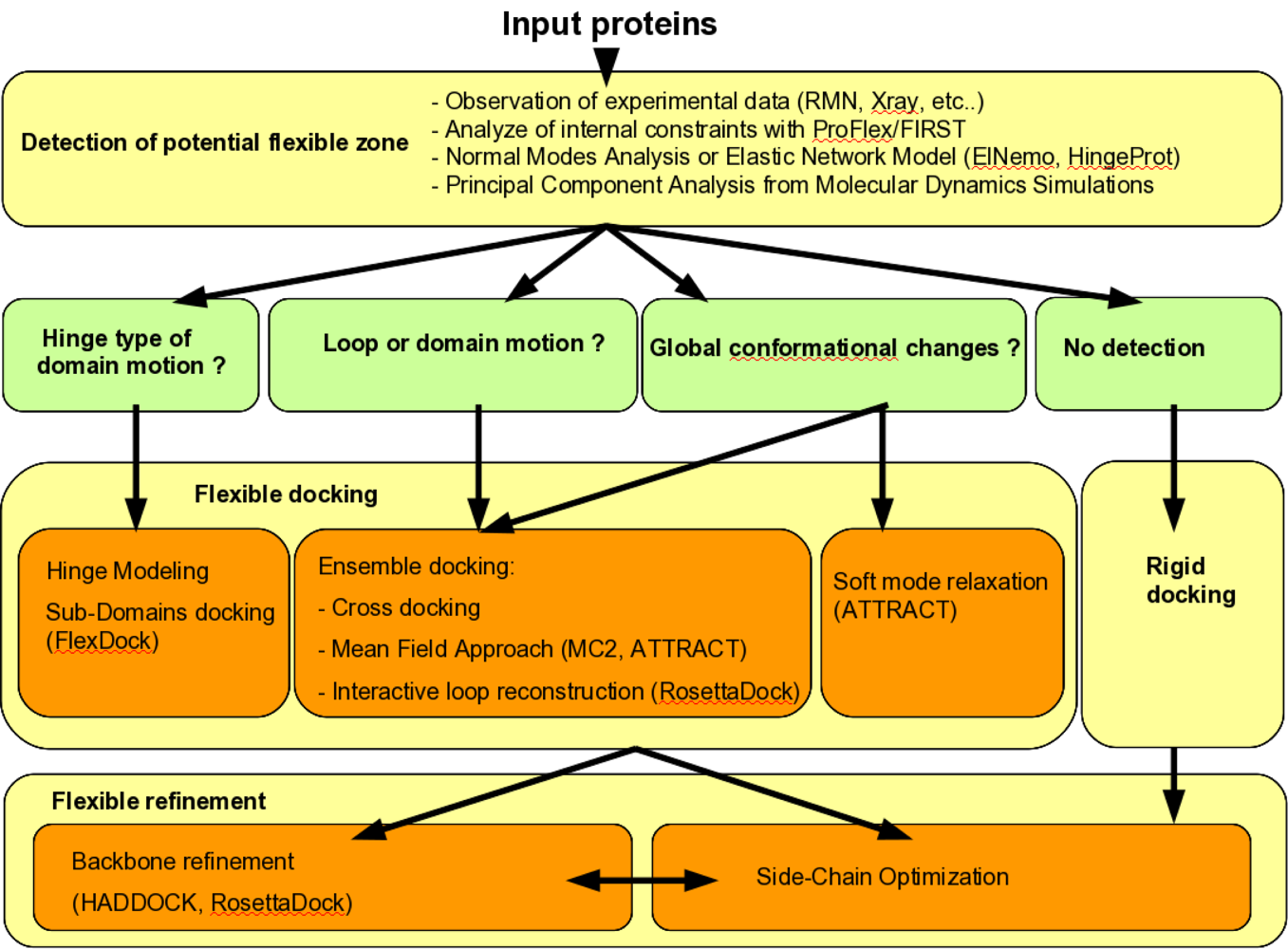
Taking protein flexibility into account in docking protocols is a highly challenging methodological problem, where combined levels of search and refinement need to be integrated, from low resolution and high amplitude movements to atomic relaxation of side chains and backbones. Innovative solutions have been proposed during recent years at each of these levels, which announce in the near future the release of fully flexible docking programs capable of handling every type of flexibility, for example solving all the “difficult” docking cases of the protein-protein benchmark. Such programs may consist of a modular workflow with automatic or user-input decision steps concerning the level of flexibility (local or global), the method to be employed, the pre-generation of conformer ensembles. An example of such workflow is presented in Figure 6. Further understanding of the mechanism of protein deformations, as well as ongoing investigations on the characteristics of protein-protein interfaces, will be useful to improve the efficiency of flexible docking algorithms.
Figure 6. Workflow of strategies that decide which flexible docking methods have to be used.

References

  1. Wodak, SJ; Janin, J. Computer analysis of protein-protein interaction. J. Mol. Biol 1978, 124, 323–342. [Google Scholar]
  2. Janin, J; Henrick, K; Moult, J; Eyck, LT; Sternberg, MJE; Vajda, S; Vakser, I; Wodak, SJ. of PRedicted Interactions, C.A.. CAPRI: A Critical Assessment of PRedicted Interactions. Proteins 2003, 52, 2–9. [Google Scholar]
  3. Mendez, R; Leplae, R; Maria, LD; Wodak, SJ. Assessment of blind predictions of protein-protein interactions: current status of docking methods. Proteins 2003, 52, 51–67. [Google Scholar]
  4. Janin, J. Assessing predictions of protein-protein interaction: the CAPRI experiment. Protein Sci 2005, 14, 278–283. [Google Scholar]
  5. Mendez, R; Leplae, R; Lensink, MF; Wodak, SJ. Assessment of CAPRI predictions in rounds 3–5 shows progress in docking procedures. Proteins 2005, 60, 150–169. [Google Scholar]
  6. Lensink, MF; Mndez, R; Wodak, SJ. Docking and scoring protein complexes: CAPRI 3rd Edition. Proteins 2007, 69, 704–718. [Google Scholar]
  7. Lensink, MF; Wodak, SJ. Docking and scoring protein interactions: CAPRI 2009. Proteins 2010, 78, 3073–3084. [Google Scholar]
  8. Bonvin, AMJJ. Flexible protein-protein docking. Curr. Opin. Struct. Biol 2006, 16, 194–200. [Google Scholar]
  9. Andrusier, N; Mashiach, E; Nussinov, R; Wolfson, HJ. Principles of flexible protein-protein docking. Proteins 2008, 73, 271–289. [Google Scholar]
  10. Ritchie, DW. Recent progress and future directions in protein-protein docking. Curr. Protein Pept. Sci 2008, 9, 1–15. [Google Scholar]
  11. Zacharias, M. Accounting for conformational changes during protein-protein docking. Curr. Opin. Struct. Biol 2010, 20, 180–186. [Google Scholar]
  12. Saladin, A; Prévost, C. Protein-Protein Docking. In Protein-Protein Complexes Analysis, Modeling and Drug Design; Zacharias, M, Ed.; Imperial College Press: London, UK, 2010; pp. 147–181. [Google Scholar]
  13. Zacharias, M. Scoring and Refinement of Predicted Protein-Protein Complexes. In Protein-Protein Complexes Analysis, Modeling and Drug Design; Zacharias, M, Ed.; Imperial College Press: London, UK, 2010; pp. 236–271. [Google Scholar]
  14. Pons, C; Grosdidier, S; Solernou, A; Pérez-Cano, L; Fernàndez-Recio, J. Present and future challenges and limitations in protein-protein docking. Proteins 2010, 78, 95–108. [Google Scholar]
  15. Bastard, K; Prévost, C. Recent Research Advances in Structural BioInformatics. In Flexible Macromolecular Docking: An Overview of Recent Progress; de Brevern, AG, Ed.; Research Signpost: Trivandrum, India, 2007; pp. 249–274. [Google Scholar]
  16. Vajda, S; Kozakov, D. Convergence and combination of methods in protein-protein docking. Curr. Opin. Struct. Biol 2009, 19, 164–170. [Google Scholar]
  17. Norel, R; Lin, SL; Wolfson, HJ; Nussinov, R. Shape complementarity at protein-protein interfaces. Biopolymers 1994, 34, 933–940. [Google Scholar]
  18. Ritchie, DW; Kemp, GJ. Protein docking using spherical polar Fourier correlations. Proteins 2000, 39, 178–194. [Google Scholar]
  19. Katchalski-Katzir, E; Shariv, I; Eisenstein, M; Friesem, AA; Aflalo, C; Vakser, IA. Molecular surface recognition: determination of geometric fit between proteins and their ligands by correlation techniques. Proc. Natl. Acad. Sci. USA 1992, 89, 2195–2199. [Google Scholar]
  20. Zacharias, M. Protein-protein docking with a reduced protein model accounting for side-chain flexibility. Protein Sci 2003, 12, 1271–1282. [Google Scholar]
  21. Schueler-Furman, O; Wang, C; Baker, D. Progress in protein-protein docking: atomic resolution predictions in the CAPRI experiment using RosettaDock with an improved treatment of side-chain flexibility. Proteins 2005, 60, 187–194. [Google Scholar]
  22. Fernández-Recio, J; Totrov, M; Abagyan, R. ICM-DISCO docking by global energy optimization with fully flexible side-chains. Proteins 2003, 52, 113–117. [Google Scholar]
  23. Król, M; Tournier, AL; Bates, PA. Flexible relaxation of rigid-body docking solutions. Proteins 2007, 68, 159–169. [Google Scholar]
  24. Wang, C; Bradley, P; Baker, D. Protein-protein docking with backbone flexibility. J. Mol. Biol 2007, 373, 503–519. [Google Scholar]
  25. Andrusier, N; Nussinov, R; Wolfson, HJ. FireDock: Fast interaction refinement in molecular docking. Proteins 2007, 69, 139–159. [Google Scholar]
  26. Kozakov, D; Hall, DR; Beglov, D; Brenke, R; Comeau, SR; Shen, Y; Li, K; Zheng, J; Vakili, P; Paschalidis, IC; Vajda, S. Achieving reliability and high accuracy in automated protein docking: ClusPro, PIPER, SDU, and stability analysis in CAPRI rounds 13–19. Proteins 2010, 78, 3124–3130. [Google Scholar]
  27. Noy, E; Goldblum, A. Flexible protein-protein docking based on Best-First search algorithm. J. Comput. Chem 2010, 31, 1929–1943. [Google Scholar]
  28. Hwang, H; Vreven, T; Janin, J; Weng, Z. Protein-protein docking benchmark version 4.0. Proteins 2010, 78, 3111–3114. [Google Scholar]
  29. Jackson, RM; Gabb, HA; Sternberg, MJ. Rapid refinement of protein interfaces incorporating solvation: application to the docking problem. J. Mol. Biol 1998, 276, 265–285. [Google Scholar]
  30. Kimura, SR; Brower, RC; Vajda, S; Camacho, CJ. Dynamical view of the positions of key side chains in protein-protein recognition. Biophys. J 2001, 80, 635–642. [Google Scholar]
  31. Rajamani, D; Thiel, S; Vajda, S; Camacho, CJ. Anchor residues in protein-protein interactions. Proc. Natl. Acad. Sci. USA 2004, 101, 11287–11292. [Google Scholar]
  32. Bastard, K; Thureau, A; Lavery, R; Prévost, C. Docking macromolecules with flexible segments. J. Comput. Chem 2003, 24, 1910–1920. [Google Scholar]
  33. Dominguez, C; Boelens, R; Bonvin, AMJJ. HADDOCK: A protein-protein docking approach based on biochemical or biophysical information. J. Am. Chem. Soc 2003, 125, 1731–1737. [Google Scholar]
  34. de Vries, SJ; van Dijk, ADJ; Krzeminski, M; van Dijk, M; Thureau, A; Hsu, V; Wassenaar, T; Bonvin, AMJJ. HADDOCK versus HADDOCK: New features and performance of HADDOCK2.0 on the CAPRI targets. Proteins 2007, 69, 726–733. [Google Scholar]
  35. May, A; Zacharias, M. Protein-ligand docking accounting for receptor side chain and global flexibility in normal modes: Evaluation on kinase inhibitor cross docking. J. Med. Chem 2008, 51, 3499–3506. [Google Scholar]
  36. Mashiach, E; Nussinov, R; Wolfson, HJ. FiberDock: Flexible induced-fit backbone refinement in molecular docking. Proteins 2010, 78, 1503–1519. [Google Scholar]
  37. Ehrlich, LP; Nilges, M; Wade, RC. The impact of protein flexibility on protein-protein docking. Proteins 2005, 58, 126–133. [Google Scholar]
  38. Suhre, K; Sanejouand, YH. ElNemo: A normal mode web server for protein movement analysis and the generation of templates for molecular replacement. Nucleic Acids Res 2004, 32, W610–W614. [Google Scholar]
  39. Dobbins, SE; Lesk, VI; Sternberg, MJE. Insights into protein flexibility: The relationship between normal modes and conformational change upon protein-protein docking. Proc. Natl. Acad. Sci. USA 2008, 105, 10390–10395. [Google Scholar]
  40. Navizet, I; Cailliez, F; Lavery, R. Probing protein mechanics: residue-level properties and their use in defining domains. Biophys. J 2004, 87, 1426–1435. [Google Scholar]
  41. Sacquin-Mora, S; Lavery, R. Modeling the mechanical response of proteins to anisotropic deformation. Chemphyschem 2009, 10, 115–118. [Google Scholar]
  42. Sacquin-Mora, S; Laforet, E; Lavery, R. Locating the active sites of enzymes using mechanical properties. Proteins 2007, 67, 350–359. [Google Scholar]
  43. Lavery, R; Sacquin-Mora, S. Protein mechanics: A route from structure to function. J. Biosci 2007, 32, 891–898. [Google Scholar]
  44. Emekli, U; Schneidman-Duhovny, D; Wolfson, HJ; Nussinov, R; Haliloglu, T. HingeProt: Automated prediction of hinges in protein structures. Proteins 2008, 70, 1219–1227. [Google Scholar]
  45. Jacobs, DJ; Rader, AJ; Kuhn, LA; Thorpe, MF. Protein flexibility predictions using graph theory. Proteins 2001, 44, 150–165. [Google Scholar]
  46. Keating, KS; Flores, SC; Gerstein, MB; Kuhn, LA. StoneHinge: Hinge prediction by network analysis of individual protein structures. Protein Sci 2009, 18, 359–371. [Google Scholar]
  47. Koshland, DE. Application of a Theory of Enzyme Specificity to Protein Synthesis. Proc. Natl. Acad. Sci. USA 1958, 44, 98–104. [Google Scholar]
  48. Kumar, S; Ma, B; Tsai, CJ; Sinha, N; Nussinov, R. Folding and binding cascades: Dynamic landscapes and population shifts. Protein Sci 2000, 9, 10–19. [Google Scholar]
  49. May, A; Zacharias, M. Accounting for global protein deformability during protein-protein and protein-ligand docking. Biochim. Biophys. Acta 2005, 1754, 225–231. [Google Scholar]
  50. Grunberg, R; Leckner, J; Nilges, M. Complementarity of structure ensembles in protein-protein binding. Structure 2004, 12, 2125–2136. [Google Scholar]
  51. Mustard, D; Ritchie, DW. Docking essential dynamics eigenstructures. Proteins 2005, 60, 269–274. [Google Scholar]
  52. Smith, GR; Sternberg, MJE; Bates, PA. The relationship between the flexibility of proteins and their conformational states on forming protein-protein complexes with an application to protein-protein docking. J. Mol. Biol 2005, 347, 1077–1101. [Google Scholar]
  53. Chaudhury, S; Gray, JJ. Conformer selection and induced fit in flexible backbone protein-protein docking using computational and NMR ensembles. J. Mol. Biol 2008, 381, 1068–1087. [Google Scholar]
  54. Ritchie, DW; Venkatraman, V. Ultra-fast FFT protein docking on graphics processors. Bioinformatics 2010, 26, 2398–2405. [Google Scholar]
  55. Cortés, J; Siméon, T; de Angulo, VR; Guieysse, D; Remaud-Siméon, M; Tran, V. A path planning approach for computing large-amplitude motions of flexible molecules. Bioinformatics 2005, i116–i125. [Google Scholar]
  56. Regad, L; Martin, J; Nuel, G; Camproux, AC. Mining protein loops using a structural alphabet and statistical exceptionality. BMC Bioinforma 2010, 11, 75. [Google Scholar] [Green Version]
  57. Shehu, A; Clementi, C; Kavraki, LE. Modeling protein conformational ensembles: from missing loops to equilibrium fluctuations. Proteins 2006, 65, 164–179. [Google Scholar]
  58. Mandell, DJ; Kortemme, T. Backbone flexibility in computational protein design. Curr. Opin. Biotechnol 2009, 20, 420–428. [Google Scholar]
  59. Bastard, K; Prévost, C; Zacharias, M. Accounting for loop flexibility during protein-protein docking. Proteins 2006, 62, 956–969. [Google Scholar]
  60. Loriot, S; Sachdeva, S; Bastard, K; Prévost, C; Cazals, F. On the Characterization and Selection of Diverse Conformational Ensembles, with Applications to Flexible Docking. IEEE/ACM Trans.Comput. Biol. Bioinf 2011, 8, 487–498. [Google Scholar]
  61. Schneidman-Duhovny, D; Inbar, Y; Nussinov, R; Wolfson, HJ. Geometry-based flexible and symmetric protein docking. Proteins 2005, 60, 224–231. [Google Scholar]
  62. Ben-Zeev, E; Kowalsman, N; Ben-Shimon, A; Segal, D; Atarot, T; Noivirt, O; Shay, T; Eisenstein, M. Docking to single-domain and multiple-domain proteins: Old and new challenges. Proteins 2005, 60, 195–201. [Google Scholar]
  63. Inbar, Y; Benyamini, H; Nussinov, R; Wolfson, HJ. Prediction of multimolecular assemblies by multiple docking. J. Mol. Biol 2005, 349, 435–447. [Google Scholar]
  64. Schneidman-Duhovny, D; Nussinov, R; Wolfson, HJ. Automatic prediction of protein interactions with large scale motion. Proteins 2007, 69, 764–773. [Google Scholar]
  65. Inbar, Y; Benyamini, H; Nussinov, R; Wolfson, HJ. Combinatorial docking approach for structure prediction of large proteins and multi-molecular assemblies. Phys. Biol 2005, 2, S156–S165. [Google Scholar]
  66. van Dijk, ADJ; de Vries, SJ; Dominguez, C; Chen, H; Zhou, HX; Bonvin, AMJJ. Data-driven docking: HADDOCK’s adventures in CAPRI. Proteins 2005, 60, 232–238. [Google Scholar]
  67. Karaca, E; Melquiond, ASJ; de Vries, SJ; Kastritis, PL; Bonvin, AMJJ. Building macromolecular assemblies by information-driven docking: Introducing the HADDOCK multibody docking server. Mol. Cell Proteomics 2010, 9, 1784–1794. [Google Scholar]
  68. Saladin, A; Fiorucci, S; Poulain, P; Prévost, C; Zacharias, M. PTools: An opensource molecular docking library. BMC Struct. Biol 2009, 9, 27. [Google Scholar]
  69. Mandell, DJ; Coutsias, EA; Kortemme, T. Sub-angstrom accuracy in protein loop reconstruction by robotics-inspired conformational sampling. Nat. Methods 2009, 6, 551–552. [Google Scholar]
  70. Saladin, A; Amourda, C; Poulain, P; Férey, N; Baaden, M; Zacharias, M; Delalande, O; Prévost, C. Modeling the early stage of DNA sequence recognition within RecA nucleoprotein filaments. Nucleic Acids Res 2010, 38, 6313–6323. [Google Scholar]
Article Metrics

Citations

Article Access Statistics

Multiple requests from the same IP address are counted as one view.