


Abstract
A convenient mild protocol for oxidation of highly hindered electron rich benz- hydrols using DDQ / PbO2 has been developed.
Introduction
Ortho-oxygenated acetophenones serve as attractive synthons for the preparation of condensed ben- zenoids via McMurry’s coupling [1]. In that light, the ortho-substituted benzophenones could provide more complex polyaromatics. For example, pentamethoxy-diphenylmethanone (2) and similarly substituted benzophenones could lead to useful synthons for fullerenes. Most benzophenones are conveniently obtainable by oxidation of the corresponding benzhydrols by pyridinium chlorochromate (PCC) and other oxidants. During our synthesis of some bioactive oxygen heterocycles, we required some substituted benzophenones. We attempted their preparation by oxidation of the corresponding benzhy- drols. However, conventional oxidation of a hindered benzhydrol like 1 with various strong and mild oxidising agents did not yield the desired compound 2. Realising that this may be due to the steric crowding present in the substrate 1, we attempted the oxidation with dichlorodicynoquinone (DDQ) as the oxidant. DDQ is a well-known dehydrogenating reagent [2] and is known to oxidise various substrates such as chromans [3], steroidal [4] and hindered alcohols [5] as well as simple benhydrols. This prompted us to investigate its efficacy for the oxidation of the benzhydrols with three or four oxygenated substituents in ortho positions. This provided an efficient oxidation protocol of highly hindered benzhydrols to the corresponding benzophenones. The present communication deals with the same.
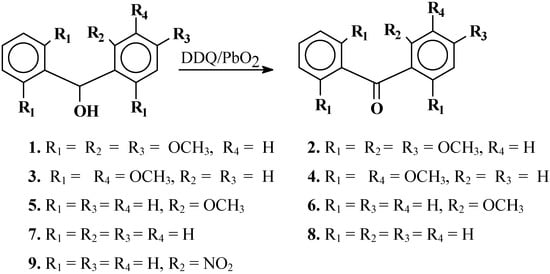
Scheme 1.
Results and Discussion
Benzhydrols 1 and 3 were reacted with DDQ (1.05 eq.) in refluxing dry benzene. The oxidation was complete within one hour giving the products 2 and 4 respectively (Scheme 1) in high yields. The reaction mechanism can be rationalised based on the strong hydride abstracting potential of DDQ, which leads to oxidation, presumably, by vicinal dehydrogenation. Thus, initially the hydride transfer takes place from the benzylic carbon of the substrate leading to a stable carbocation. Subsequently, elimination of a proton from the benzylic hydroxyl group leads to the formation of benzophenones, while DDQ is reduced to quinhydrol DDHQ. It was envisaged that the regeneration of DDQ in situ by the oxidation of its reduced product, DDHQ would make the protocol catalytic with respect to DDQ. The reported method for carrying out the same with HClO4/H2SO4 in HOAc [6] was inappropriate due to the strong acidic conditions. Since the present method was effective in benzene, it was necessary to find a suitable co-oxidant, which would work in an aprotic solvent. To this end, PbO2 seemed potentially attractive although PbO2 as such does not oxidise benzhydrols to benzophenones. It was gratifying to find that a catalytic amount of DDQ (0.25 molar equivalent) with one equivalent of PbO2 (Scheme 2) was sufficient for the oxidation of the benzhydrols to the benzophenones. The reaction proceeded smoothly even at room temperature in good yields without the formation of any side products. Compound 1 was oxidised to 2 in 89% yield. Similarly, 2,6,2',5'-tetramethoxydiphenylmethanol (3) yielded the corresponding benzophenone 4 in 75% yield and the benzhydrol 2-methoxydiphenyl-methanol 5 was oxidised to 6 in low yield (37%) after 24 hr. However, oxidation of simple unsubsti-tuted benzhydrols like 7 was less satisfactory, giving the benzophenone 8 in only 50% yield even after 48 h with an equivalent amount of DDQ. No noticeable reaction was observed with 2-nitrodiphenylmethanol (9).
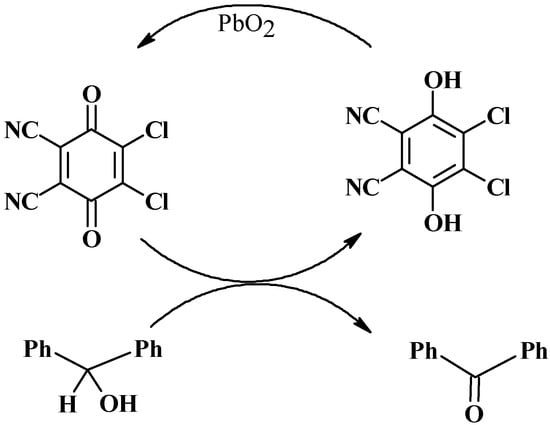
Scheme 2.
The above results indicated that the presence of electron rich substitutions like alkoxy groups (do- nor groups) in the ortho- or para-positions plays an important role in the oxidation yield. This supports the mechanism proposed earlier. The benzylic cationic intermediate presumably generated in the reaction could be stabilised by the resonance stabilising effect of electron rich substituents. Therefore, oxi- dation of 1 gave the highest yield although it is highly crowded due to four alkoxy groups in the ortho- positions. The benzhydrol 7 without such effect gave the lowest yield. Expectedly, when an electron withdrawing group like the -NO2 group was present in the ortho-position there was no reaction, sup- porting the above mechanism.
Conclusion
A convenient and mild protocol for oxidation of electron rich benzhydrols using catalytic amount of DDQ has been developed. This method is especially appealing for sterically crowded substrates furnishing the corresponding benzophenones, which are useful synthons and are otherwise difficult to obtain by conventional methods.
Experimental
General
All melting points are uncorrected. The IR (KBr) spectra were scanned with a Perkin-Elmer spec- trophotometer model 783 and only the pertinent absorption bands are mentioned. The 1H NMR spectra were recorded with a Bruker AC 200 spectrometer (200 MHz) in CDCl3. The UV spectra were recorded in MeOH using a Shimadzu Graphicord UV-Visible 240 spectrophotometer. The mass spectra (70 eV) were obtained with a Shimadzu GCMS-QP1000A mass spectrometer. All the compounds were purified by column or thin layer chromatography on silica gel.
Typical procedure of oxidation of benzhydrols
2,4,6,2',6'-Pentamethoxybenzophenone (2)
A mixture of 1 (100 mg), DDQ (20 mg) and PbO2 (140 mg) in dry benzene (20 ml) was stirred for 24 h at room temperature. The reaction was monitored by TLC (CHCl3). On completion of the reaction, the catalyst was filtered off and the solvent removed under reduced pressure. The crude product was purified by preparative TLC (silica gel, pet. ether/EtOAc 9:1) to furnish 2 as a colourless solid, yield 89 mg (89%); m.p. 150°C (benzene); IR (KBr): ν 1680, 1600 cm-1; UV: λmax 332 nm; MS (m/z): 332 (M+); 1H NMR: 3.6 (s, 6H, 2 x OCH3), 3.62 (s, 6H, 2 x OCH3), 3.75 (s, 3H, OCH3), 6.0 (s, 2H, ArH), 6.5 (d, J = 9 Hz, 2H, ArH), 7.15 (t, J = 9 Hz, 1H, ArH); (Found: C, 65.3 ; H, 6.5; C18H20O6; requires C, 65.05; H, 6.07 %).
2,6,2',5'-Tetramethoxybenzophenone (4)
Following the above procedure 3 (300 mg) was oxidized with DDQ (50 mg) and PbO2 (230 mg) to give 4 as colourless solid , yield 224 mg (75%); m.p. 98°C (lit. [7] 97-98°C), IR (KBr): ν 1675, 1600 cm-1; UV: λmax 302 nm; MS (m/z): 302 (M+); 1H NMR: 3.6 (s, 3H, OCH3), 3.75 (s, 6H, 2 x OCH3), 3.8 (s, 3H, OCH3), 6.4 - 7.4 (m, 6H, ArH)
2-Methoxybenzophenone (6)
Following the above procedure 5 (200 mg) was oxidized with DDQ (50 mg) and PbO2 (230 mg) to give 6 as colourless liquid, yield 73 mg (37%); thick liquid (lit.[8] 35-36°C), IR (film): ν 1666, 1598 cm-1; UV: λmax 250 nm; MS (m/z): 212 (M+); 1H NMR: 3.71 (s, 3H, OCH3), 6.9-7.6 (m, 8H, ArH), 7.85 (m, 1H, ArH).
Benzophenone (8)
Following the above procedure 7 (180 mg) was oxidized with DDQ (200 mg) and PbO2 (230 mg). 8 was obtained as colourless solid (48 h), yield 50%; m.p. 48°C; IR (KBr): ν 1680, 1600 cm-1; UV: λmax 252 nm; -1H NMR: 7.45 (m, 4H, ArH), 7.7 (m, 6H, ArH).
Acknowledgements
We express our sincere thanks to Dr. S. K. Nayak and Dr. A. D. Deshpande for providing the benzhydrols.
References and Notes
- Banerji, A.; Nayak, S. K. J. Chem. Soc., Chem. Commun. 1991, 1432.
- Walker, D.; Hiebert, J. D. Chem. Rev. 1967, 67, 153. [PubMed]
- Cardillio, G.; Cricchio, R.; Merlini, L. Tetrahedron 1968, 24, 4825.
- Iwamura, J.; Hirao, N. Tetrahedron Lett. 1973, 2447.
- (a) Müller, P.; Rocek, J. J. Am. Chem. Soc. 1971, 94, 2716. ; (b) Stoos, F.; Rocek, J. J. Am. Chem. Soc. 1972, 94, 2719.
- Kim, K. H.; Grunewald, G. L. Org. Prep. Proced. Int. 1976, 8, 141.
- Deshpande, A. D. Ph.D. Thesis, University of Bombay, Bombay, 1992.
- Khan, M. K. A.; Morgan, K. J. J. Chem. Soc. 1964, 2579.
- Samples Availability: Available from the authors.
© 2000 by MDPI (http://www.mdpi.org). Reproduction is permitted for noncommercial purposes.