


Abstract
The kinetics of reactions of dehydrogenation of polycyclic naphthenes (cyclohexane, decalin, bicyclohexyl, ortho-, meta-, and para-isomers of perhydroterphenyl) is modeled on the basis of a formal comparison of kinetic equations of the 1st and 2nd orders based on real experimental data. It is shown that the reaction of the 1st order is predominating in the series of cyclohexane–bicyclohexyl–perhydroparatherphenyl. For all other substrates, the probability of describing the reaction in accordance with the equation of the 2nd order increases markedly, and for trans-decalin it becomes the predominant form of describing the kinetics of the reaction.
1. Introduction
The modern transport systems are based on oil and gas fuel, the widespread use of which contributes significantly to air and environmental pollution. In this regard, many alternative solutions have been proposed recently to replace or modify conventional fuels aimed at reducing the environmental footprint. One of the most well-known concepts is the use of hydrogen gas as fuel and its combustion in an internal combustion engine or fuel cell. One of the reasons that hinder the practical implementation of this approach is the lack of modern systems capable of providing compact storage of hydrogen and its transportation, since hydrogen under normal conditions is a flammable gas. It is shown [1,2,3,4,5,6,7,8,9,10] that systems based on liquid organic hydrogen carriers (LOHC), in particular, polycyclic hydrocarbons (PH), are a safe and economical way of storing and transporting hydrogen. However, the efficiency of PH-based systems largely depends on the development of a highly active, selective, and stable catalyst. At the same time, analysis of the literature shows that the difficulty of achieving the equilibrium due to the reversible nature of the dehydrogenation reaction of polycyclic naphthenes causes great differences in the description of kinetic mechanisms, as well as the determination of the order of these reactions. Among the studied substrates, the kinetics of dehydrogenation is understood only for cyclohexane, in the description of which the 1st reaction order is established [11,12,13,14,15]. There is no reliable information in the literature for more complex naphthenic substrates. At the same time, understanding the kinetics of reactions helps to choose the right conditions for their implementation. This contributes to an increase in the efficiency of using LOHC for the purposes of storage and release of hydrogen. This work is devoted to kinetic modeling of reactions of hydrogen production by dehydrogenation of polycyclic naphthenes with different degrees of condensation (cyclohexane, bicyclohexyl, cis- and trans-isomers of decalin, ortho-, meta-, and para-isomers of perhydroterphenyl) at 300–340 °C and atmospheric pressure.
2. Results and Discussion
Analysis of the experimental data obtained showed that the products of complete hydrogenation of aromatic hydrocarbons used in this work (benzene, C6H6; naphthalene, C10H8; biphenyl, C12H10; ortho-, meta-, and para-isomers of terphenyl, C18H14) are the corresponding naphthenic substrates (cyclohexane, C6H12; decalin, C10H18; bicyclohexyl, C12H22; ortho-, meta-, and para-isomers of perhydroterphenyl, C18H32). At the same time, steric cis- and trans-isomers are formed for decalin and isomers of perhydroterphenyl during the formation of final polycyclic naphthenes, the quantitative ratio between the isomers is indicated in Table 1. It was also established that the rate of formation of trans-isomers exceeds the rate of formation of cis-isomers, as well as the preceding intermediate products of the reaction [8,9,10].

Table 1.
Comparison of steric isomers of decalin and perhydroterphenyl (C is the content in the mixture).
It is known that the catalytic reaction consists of a number of successive stages, such as adsorption, desorption, diffusion, dissociation, and the reaction itself. The reversible reactions of hydrogenation of polycyclic aromatic substrates with a different extent of condensation and the reactions of dehydrogenation of the corresponding polycyclic naphthenic molecules represent multi-stage processes with a general scheme: X-H2n ↔ X + H2n. Since there are no objectively developed criteria for comparing the kinetics of such different substrates, the determination of the kinetic model of the reaction requires numerous experiments to establish the contribution of each of the components. At the same time, a formal comparison method is known, which is based on the selection of the kinetic equation that best corresponds to the experimental data obtained [16]. In this work, the values of the rate constant were determined by substituting experimental data of the substrate concentration dependence into the kinetic equations of the 1st and 2nd orders, most typical for the naphthene dehydrogenation reaction (Table 2).
Table 2.
Rate constant equations (C—concentrations of substrates; Co—initial; C—current).
Common features for the calculated values of the rate constants k(I) and k(II) were determined using the Pearson linear correlation coefficient (RI and RII) [17]:
where M denotes the mathematical expectation.
RX,Y = (M[X,Y] − M[X] × M[Y])/((√(M[X2] − (M[X])2) × (√M[Y2] − (M[Y])2))
Table 3 shows the parameters of cyclohexane dehydrogenation on a 3 Pt/C catalyst. The values of the correlation coefficients calculated on the basis of the data presented in Table 3 are equal to RI = 0.9558 and RII = 0.7717, respectively. The ratio between the values of RI/RII = 1.24 indicates an obvious advantage in describing the kinetics of the cyclohexane dehydrogenation reaction using the 1st order equation, compared with the 2nd order equation, which is consistent with the literature data [6,7,8].
Table 3.
Parameters for the reaction of cyclohexane dehydrogenation (LHSV = 1 h−1, P = 1 atm).
Figure 1 shows the temperature dependences of the dehydrogenation conversion of the investigated polycyclic naphthenic substrates on a 3 Pt/C catalyst. It is obvious that the presence of steric isomers with an increase in the condensation degree of the naphthenic substrates under study leads to an increase in the number of reaction routes compared with the hydrogenation process and, accordingly, to a difference in the characters of the temperature dependences of the dehydrogenation conversion. Thus, in the case of decalin, the conversion in the cis-isomer dehydrogenation in the temperature range 300–340 °C approaches the maximum values, while the highest conversion of trans-decalin in this range barely reaches 70%. At the same time, the calculation of the equilibrium constants of all elementary acts occurring during the dehydrogenation of decalin and perhydroterphenyl indicates that the cis-isomer has a tendency to transition to a more stable trans-isomer over the entire temperature range under study [18,19]. Taking into account the cis-trans transition during dehydrogenation of decalin, this leads to a decrease in the overall reaction rate and affects the completeness of hydrogen release. Because of the smaller differences in the structure of cis- and trans-conformations from linear-jointed molecules of perhydroterphenyl, dehydrogenation curves for their ortho-, meta-, and para-isomers in the investigated range of temperatures differ not so much [9,10].
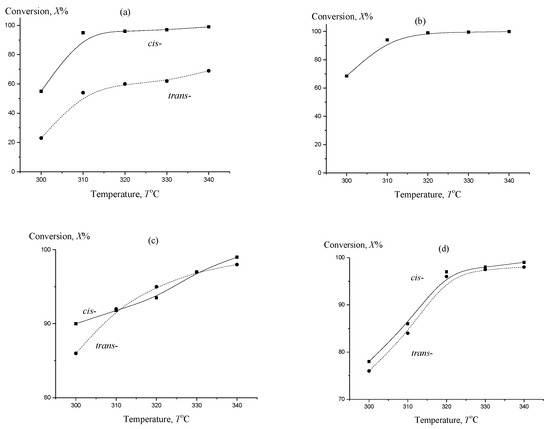
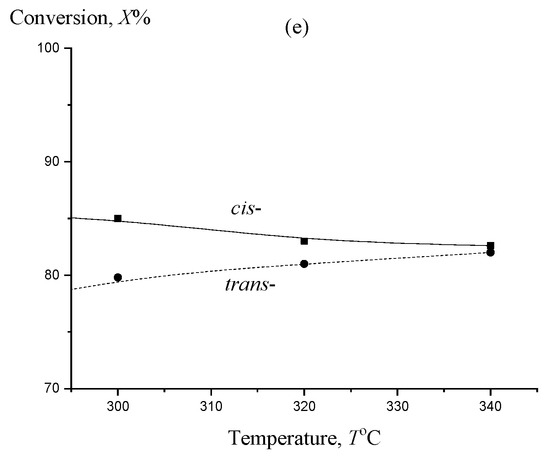
Figure 1.
Temperature dependences of the dehydrogenation conversion of decalin: (a) bicyclohexyl; (b) perhydro-para-terphenyl; (c) perhydro-meta-terphenyl; (d) and perhydro-orto-terphenyl; (e) LHSV = 1 h−1, P = 1 atm, t = 1 h.
Table 4 shows the values of the rate constants for the dehydrogenation of the studied polycyclic naphthenes calculated on the basis of equations given in Table 2. The values of the calculated correlation coefficients for each of the substrates are given in Table 5.
Table 4.
Parameters for dehydrogenation of naphthenic substrates (LHSV = 1 h−1, P = 1 atm).
Table 5.
Empirical values of correlation analysis.
From the data given in Table 5, it can be seen that for all substrates, the values RI and RII calculated using the rate constants have signs of a strong correlation dependence: [RXY] > 0.7. At the same time, it is also clear that for all substrates studied in the work, the correlation coefficient RI, when describing the reaction kinetics using the 1st order equation, is higher than when describing the reaction kinetics using the 2nd order equation. This indicates the similarity of the mechanisms of dehydrogenation within the groups under consideration. In particular, for all the studied substrates, a predominantly terminal character of dehydrogenation was observed, when first of all the terminal cyclohexane cycles participated in the reaction and only then the cycles associated with them [4,5]. The exceptions are trans-decalin and, to a lesser extent, cis- and trans-isomers of perhydro-orto-therphenyl.
In the series of cyclohexane–bicyclohexyl–perhydro-para-therphenyl, there is an obvious predominance of the reaction of the 1st order. In the case of condensed decalin cycles, the presence of the cis-trans transition complicates the description of reactions: if the cis-isomer demonstrates features belonging to the group with the 1st reaction order, then for trans-decalin, the equation of the 2nd order becomes the predominant form of describing the reaction kinetics. This is probably due to the excessive accumulation of the trans-isomer from the cis-isomer during the dehydrogenation reaction [15].
For linearly connected molecules of perhydroterphenyl isomers, the effect of the cis-trans transition also occurs, but not as strong as for decalin. Thus, for cis-perhydro-para-terphenyl, there is an obvious predominance of the reaction of the 1st order. For trans-perhydro-para-therphenyl, the probability of the reaction scenario in accordance with the 1st and 2nd order equations is noticeably leveled, but unlike trans-decalin, some prevalence of the 1st order reaction remains. For meta- and ortho-isomers, this ratio is preserved, but the difference between the description of the reaction using the 1st and 2nd order equations is even more leveled, especially for perhydro-ortho-terphenyl, for which side condensation reactions into cyclic triphenylene derivatives were detected during dehydrogenation [20].
3. Materials and Methods
3.1. Methods of Conducting Catalytic Dehydrogenation Reactions
For the dehydrogenation reaction, substrates obtained by complete hydrogenation of the corresponding commercial aromatic hydrocarbons were used: benzene, 99.5% (Acros Organics, Geel, Belgium), biphenyl, 99% (Acros Organics), as well as a mixture of terphenyl isomers of the Santowax-R brand (11.03 wt. % o-C18H14, 59.22 wt. % m-C18H14 and 29.75 wt. % p-C18H14). Hydrogenation was carried out in a high-pressure autoclave PARR-5500 (Moline, IL, USA) with an internal volume of 600 mL at a temperature of 180 °C and a pressure of 70 atm. The reaction mass obtained after hydrogenation was carefully separated from the catalyst and analyzed. For dehydrogenation, substrates were used which had a selectivity for the main product of at least 99.5% and did not contain products of side reactions [9,10]. The completeness of the reaction was determined chromatographically.
The substrates completely saturated with hydrogen, i.e., the naphthenic compounds prepared by exhaustive hydrogenation of the aromatic substrates, were used for dehydrogenation, which was carried out in a flow-through catalytic reactor (LHSV = 1 h−1, P = 1 atm, t = 1 h). All communications of the setup were thermostated at temperatures of 90–120 °C. Saturated substrates in the liquid state were fed into the reactor using a high-pressure pump of the HPP 5001 type. At the exit of the reactor, hydrogen and reaction products were separated. Sampling for analysis was carried out every hour of the reaction.
A prepared sample of 3 wt. % Pt/C [14] was used as a catalyst for both hydrogenation and dehydrogenation reactions. Platinum was dispersed onto the surface of a carbon carrier of Sibunit (Omsk, Russia, bulk density = 0.62 g/cm3) by incipient wetness impregnation of the carrier with an aqueous solution of [H2PtCl6] (wt. % Pt = 36.3%) in accordance with the procedure [14]. The specific surface area of the catalyst was SBET = 304 m2/g, the average particle size of Pt d(Pt) = 2–3 nm, the dispersion of Pt D = 49%, and the average pore size R = 4 nm. The catalyst was activated immediately before the reaction at a temperature of 320 °C in a hydrogen flow of 30 mL/min for 2 h.
3.2. Chromatographic Analysis
The products of hydrogenation and dehydrogenation reactions were analyzed using a CrystaLlux-4000M chromatograph with a flame-ionization detector using a ZB-5 (Phenomenex, Torrance, CA, USA) and TR-FFAP capillary columns (Thermo Scientific, Waltham, MA, USA). The analysis was performed in a programmable mode of 70–220 °C at a heating rate of 6 °C/min. For more detailed identification of semi-hydrogenated products and reaction by-products, separate liquid samples were analyzed using a FOCUS DSQ II chromate-mass-spectrometer (Thermo Fisher Scientific, Waltham, MA, USA) with a TR-5MS capillary column (Thermo, Waltham, MA, USA). The conversion in hydrogenation and dehydrogenation (X) was calculated by the formula: X = (c0 − c)/c0 × 100%, where c0 and c are the initial and final concentrations of the substrate.
The selectivity (S) was calculated by the formula: S(i) = ∑ c(i)/∑ c(k) × 100%, where ∑ c(i) and ∑ c(k) are the sums of concentrations of a group of products and all the products, respectively.
4. Conclusions
Thus, the modeling of the kinetics of dehydrogenation reactions of polycyclic naphthenes (cyclohexane, decalin, bicyclohexyl, ortho-, meta-, and para-isomers of perhydroterphenyl) demonstrates that their features are determined by the structure, configuration, and degree of condensation. The use of the modeling method based on a formal comparison of kinetic equations has shown that for all polycyclic naphthenic substrates studied, the equation of the 1st order best corresponds to the experimental data obtained. In the series of cyclohexane–bicyclohexyl–perhydro-para-terphenyl, the signs of the reaction of the 1st order are predominant. For all other substrates, the probability of a reaction scenario in accordance with the 1st and 2nd order equations is noticeably leveled. For trans-decalin, the predominant form of describing the reaction kinetics is the 2nd order equation, which is apparently due to the excessive accumulation of the trans-isomer via isomerization of the cis-isomer during the dehydrogenation reaction.
Author Contributions
Conceptualization, L.M.K.; methodology, A.N.K.; investigation, A.N.K.; writing—original draft preparation, L.M.K.; writing—review and editing, L.M.K. All authors have read and agreed to the published version of the manuscript.
Funding
This work was supported by the N.D. Zelinsky Institute of Organic Chemistry (Program for supporting scientific schools).
Institutional Review Board Statement
Not applicable.
Informed Consent Statement
Not applicable.
Data Availability Statement
Not applicable.
Conflicts of Interest
The authors declare no conflict of interest.
Sample Availability
Not applicable.
References
- Bourane, A.; Elanany, M.; Pham, T.V.; Katikaneni, S.P. An overview of organic liquid phase hydrogen carriers. Int. J. Hydrogen Energy 2016, 41, 23075. [Google Scholar] [CrossRef]
- Biniwale, R.B.; Rayalu, S.; Devotta, S.; Ichikawa, M. Chemical hydrides: A solution to high capacity hydrogen storage and supply. Int. J. Hydrogen Energy 2008, 33, 360. [Google Scholar] [CrossRef]
- Cooper, B.H.; Donnis, B.B.L. Aromatic saturation of distillates: An overview. Appl. Catal. A Gen. 1996, 137, 203. [Google Scholar] [CrossRef]
- Stanislaus, A.; Cooper, B.H. Aromatic hydrogenation catalysis: A review. Catal. Rev. Sci. Eng. 1994, 36, 75. [Google Scholar] [CrossRef]
- Geburtig, D.; Preuster, P.; Bosmann, A.; Muller, K.; Wasserscheid, P. Chemical utilization of hydrogen from fluctuating energy sources-Catalytic transfer hydrogenation from charged liquid organic hydrogen carrier systems. Int. J. Hydrogen Energy 2016, 41, 1010. [Google Scholar] [CrossRef] [Green Version]
- Gleichweit, C.; Amende, M.; Höfert, O.; Xu, T.; Späth, F.; Brückner, N.; Wasserscheid, P.; Libuda, J.; Steinrück, H.P.; Papp, C. Surface reactions of dicyclohexylmethane on Pt (111). J. Phys. Chem. C 2015, 119, 20299. [Google Scholar] [CrossRef]
- Hodoshima, S.; Hiroshi, A.; Shigeki, T.; Yasukazu, S. Catalytic decalin dehydrogenation/naphthalene hydrogenation pair as a hydrogen source for fuel-cell vehicle. Int. J. Hydrogen Energy 2003, 28, 1255. [Google Scholar] [CrossRef]
- Kustov, L.M.; Kalenchuk, A.N.; Bogdan, V.I. Systems for accumulation, storage and release of hydrogen. Rus. Chem. Rev. 2020, 89, 897. [Google Scholar] [CrossRef]
- Kalenchuk, A.N.; Bogdan, V.I.; Dunaev, S.F.; Kustov, L.M. Influence of steric factors on reversible reactions of hydrogenation-dehydrogenation of polycyclic aromatic hydrocarbons on a Pt/C catalyst in hydrogen storage systems. Fuel 2020, 280, 118625. [Google Scholar] [CrossRef]
- Kalenchuk, A.N.; Bogdan, V.I.; Dunaev, S.F.; Kustov, L.M. Dehydrogenation of Polycyclic Naphthenes on a Pt/C Catalyst for hydrogen storage in liquid organic hydrogen carriers. Fuel Proc. Tech. 2018, 169, 94. [Google Scholar] [CrossRef]
- Parker, D.H.; Pettiette-Hall, C.L.; Li, Y.; McIver, R.T.; Hemminger, J.C. Kinetic study of the initial stages of dehydrogenation of cyclohexane on the Pt(111) surface. J. Phys. Chem. 1992, 96, 1888. [Google Scholar] [CrossRef]
- Pettiette-Hall, C.; Land, D.P.; McIver, R.T.; Hemminger, J.C. Identification of multiple steps in the dehydrogenation of cyclic C6 hydrocarbons to benzene on Pt(111). J. Am. Chem. Soc. 1991, 113, 2755. [Google Scholar] [CrossRef]
- Herz, R.K.; Gillispie, W.D.; Petersen, E.E.; Somorjai, G.A. The structure sensitivity of cyclohexane dehydrogenation and hydrogenolysis catalyzed by platinum single crystals at atmospheric pressure. J. Catal. 1981, 67, 371. [Google Scholar] [CrossRef] [Green Version]
- Kalenchuk, A.N.; Bogdan, V.I.; Dunaev, S.F.; Kustov, L.M. Effect of surface hydrophilization on Pt/Sibunite catalytic activity in bicyclohexyl dehydrogenation in hydrogen storage application. Int. J. Hydrogen Energy 2018, 43, 6191. [Google Scholar] [CrossRef]
- Kalenchuk, A.N.; Smetneva, D.N.; Bogdan, V.I.; Kustov, L.M. Kinetics of decalin dehydrogenation on Pt/C catalyst. Rus. Chem. Bull. Int. Ed. 2015, 64, 2642. [Google Scholar] [CrossRef]
- Eremin, V.V.; Kargov, S.I.; Uspenskaya, I.A.; Kuzmenko, N.E.; Lunin, V.V. The Fundamentals of Physical Chemistry. Theory and Tasks. M: Examen. 2005. Available online: https://moodle.kstu.ru>mod/book/tool/print/index.php (accessed on 20 February 2022).
- Rodgers, J.L.; Nicewander, W.A. Thirteen ways to look at the correlation coefficient. Am. Stat. 1988, 42, 59. [Google Scholar] [CrossRef]
- Weitkamp, A.W. Stereochemistry and mechanism of Hydrogenation of naphthalenes on transition metal catalysts and conformational analysis of the products. Adv. Catal. 1968, 18, 1. [Google Scholar]
- Wang, B.; Goodman, D.W.; Froment, G.F. Kinetic modeling of pure hydrogen production from decalin. J. Catal. 2008, 253, 229. [Google Scholar] [CrossRef]
- Kustov, L.M.; Kalenchuk, A.N.; Dunaev, S.F.; Bogdan, V.I. Effect of Isomerization on the performance of aromatic hydrogen storage systems with different condensation extents. Mend. Commun. 2019, 29, 25. [Google Scholar] [CrossRef]
Publisher’s Note: MDPI stays neutral with regard to jurisdictional claims in published maps and institutional affiliations. |
© 2022 by the authors. Licensee MDPI, Basel, Switzerland. This article is an open access article distributed under the terms and conditions of the Creative Commons Attribution (CC BY) license (https://creativecommons.org/licenses/by/4.0/).