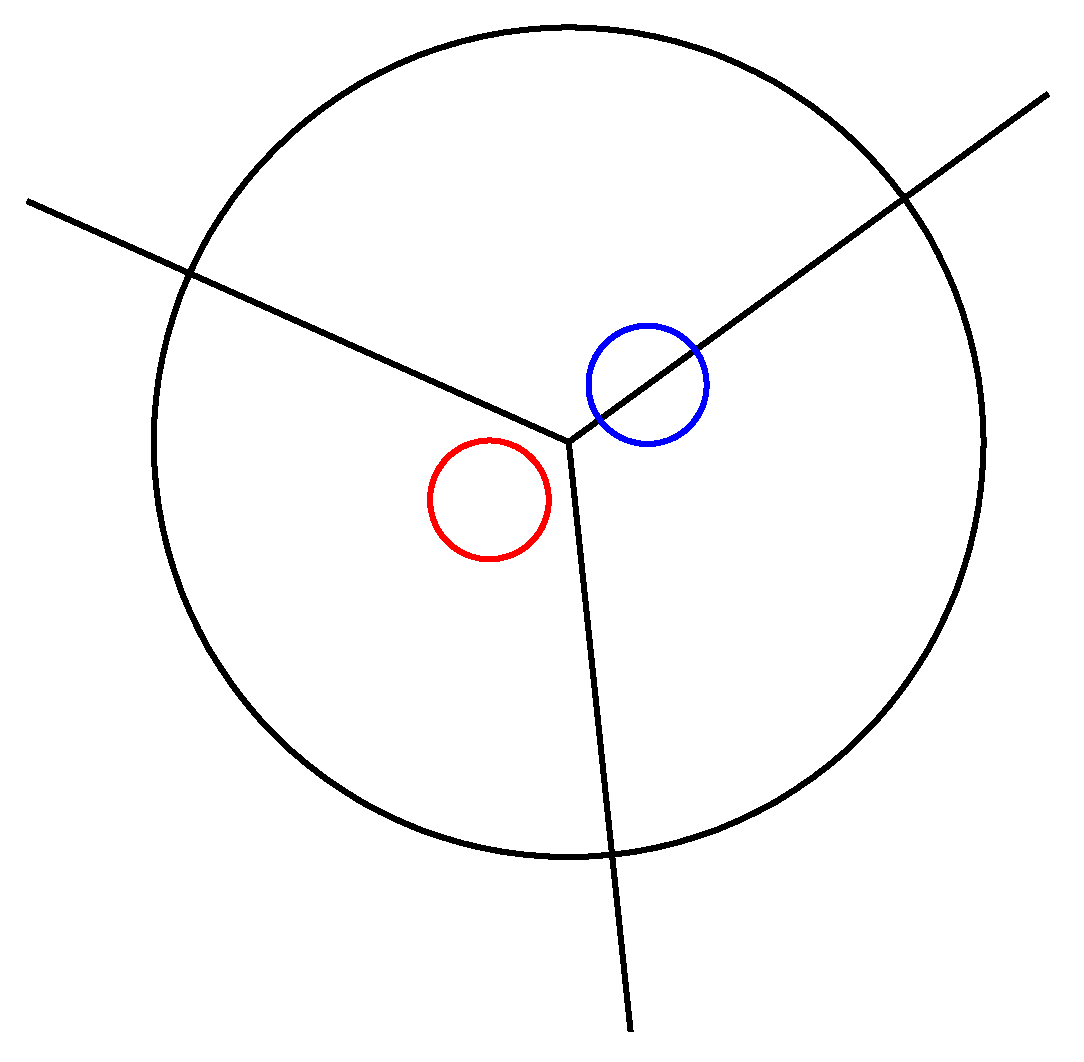
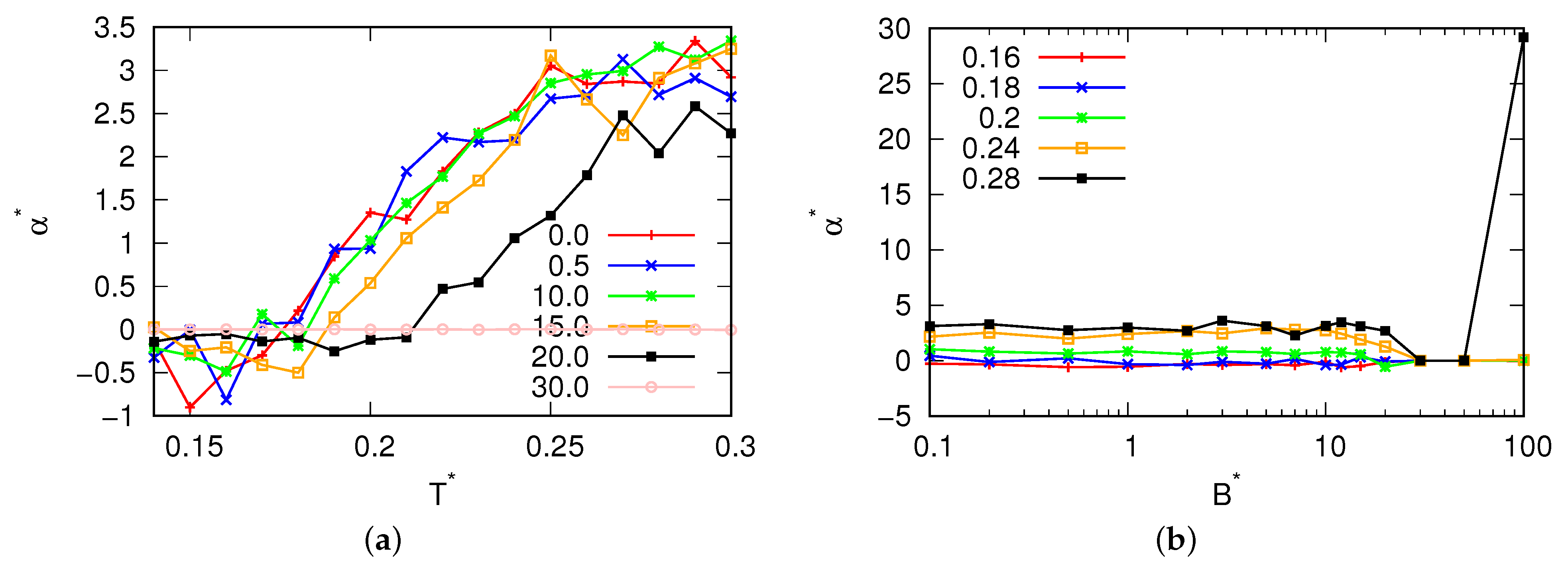
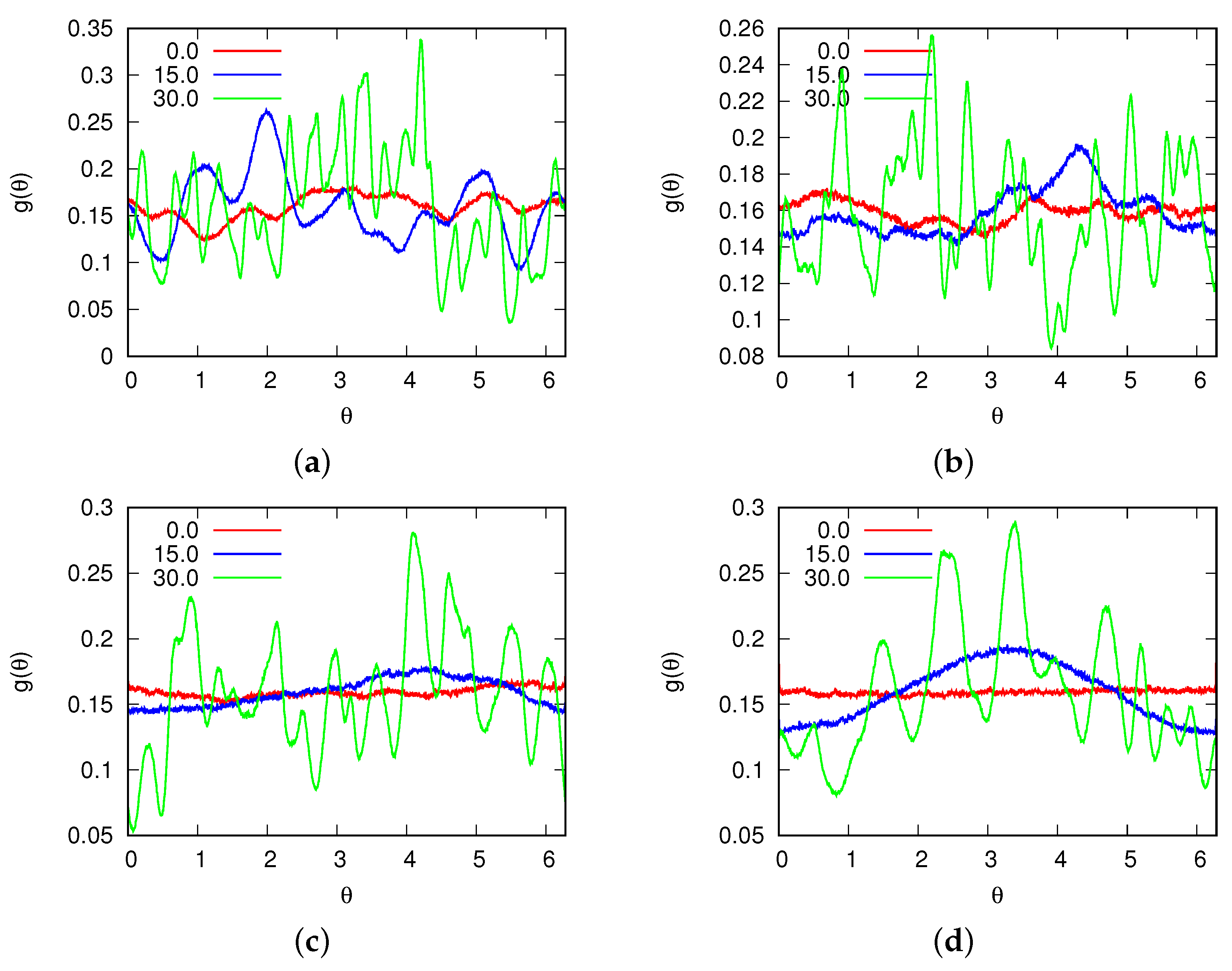
The Magnetic Field Freezes the Mercedes–Benz Water Model


Abstract
1. Introduction
2. The Model
3. Molecular Dynamics
4. Results and Discussion
5. Conclusions
Funding
Institutional Review Board Statement
Data Availability Statement
Conflicts of Interest
References
- Brini, E.; Fennell, C.J.; Fernandez-Serra, M.; Hribar-Lee, B.; Luksic, M.; Dill, K.A. How Water’s Properties Are Encoded in Its Molecular Structure and Energies. Chem. Rev. 2017, 117, 12385–12414. [Google Scholar] [CrossRef] [Scilit] [PubMed]
- Gallo, P.; Amann-Winkel, K.; Angell, C.A.; Anisimov, M.A.; Caupin, F.; Chakravarty, C.; Lascaris, E.; Loerting, T.; Panagiotopoulos, A.Z.; Russo, J.; et al. Water: A Tale of Two Liquids. Chem. Rev. 2016, 116, 7463–7500. [Google Scholar] [CrossRef] [Scilit] [PubMed]
- Bartlett, J.T.; Heuval, A.P.v.; Mason, B.J. The growth of ice crystals in an electric field. Z. Angew. Math. Phys. 1963, 14, 599. [Google Scholar] [CrossRef] [Scilit]
- Choi, E.-M.; Yoon, Y.-H.; Lee, S.; Kang, H. Freezing Transition of Interfacial Water at Room Temperature under Electric Fields. Phys. Rev. Lett. 2005, 95, 085701. [Google Scholar] [CrossRef] [Scilit] [PubMed]
- Aragones, J.L.; MacDowell, L.G.; Siepmann, J.I.; Vega, C. Phase Diagram of Water under an Applied Electric Field. Phys. Rev. Lett. 2011, 107, 155702. [Google Scholar] [CrossRef] [Scilit] [PubMed]
- Wang, Y.; Wei, H.; Li, Z. Effect of magnetic field on the physical properties of water. Results Phys. 2018, 8, 262. [Google Scholar] [CrossRef] [Scilit]
- Pang, X.; Deng, B. Investigation of changes in properties of water under the action of a magnetic field. Sci. China Ser. G-Phys. Mech. Astron. 2008, 51, 1621–1632. [Google Scholar] [CrossRef] [Scilit]
- Chibowski, E.; Szczes, A. Magnetic water treatmente—A review of the latest approaches. Chemosphere 2018, 203, 54. [Google Scholar] [CrossRef] [Scilit]
- Chang, K.-T.; Weng, C.-I. The effect of an external magnetic field on the structure of liquid water using molecular dynamics simulation. J. Appl. Phys. 2006, 100, 043917. [Google Scholar] [CrossRef] [Scilit]
- Jorgensen, W.L.; Chandrasekhar, J.; Madura, J.D.; Impey, R.W.; Klein, M.L. Comparison of simple potential functions for simulating liquid water. J. Chem. Phys. 1983, 79, 926. [Google Scholar] [CrossRef] [Scilit]
- Nezbeda, I. Simple short-ranged models of water and their application. A review. J. Mol. Liq. 1997, 73–74, 317. [Google Scholar] [CrossRef] [Scilit]
- Guillot, B. A reappraisal of what we have learnt during three decades of computer simulations on water. J. Mol. Liq. 2002, 101, 219. [Google Scholar] [CrossRef] [Scilit]
- Vega, C.; Abascal, J.L.F.; Conde, M.M.; Aragones, J.L. What ice can teach us about water interactions: A critical comparison of the performance of different water models. Faraday Discuss 2009, 141, 251. [Google Scholar] [CrossRef] [Scilit]
- Fujimoto, S.; Yu, Y.-X. Effect of electrolyte concentration on DNA A-B conformational transition. An unrestrained molecular dynamics simulation study. Chin. Phys. B 2010, 19, 088701. [Google Scholar] [CrossRef] [Scilit]
- Fonseca, B.; Freeman, C.L.; Collins, M.J. Conformational analysis and water dynamics: A molecular dynamics study on the survival of a beta-lactoglobulin peptide in the archaeological record. Chem. Phys. 2022, 561, 111602. [Google Scholar] [CrossRef] [Scilit]
- Vishnyakov, A.; Weathers, T.; Hosangadi, A.; Chiew, Y.C. Molecular models for phase equilibria of alkanes with air components and combustion products I. Alkane mixtures with nitrogen, CO2 and water. Fluid Phase Equilibria 2020, 514, 112553. [Google Scholar] [CrossRef] [Scilit]
- Silverstein, K.A.T.; Haymet, A.D.J.; Dill, K.A. A Simple Model of Water and the Hydrophobic Effect. J. Am. Chem. Soc. 1998, 120, 3166. [Google Scholar] [CrossRef] [Scilit]
- Ben-Naim, A. Statistical Mechanics of “Waterlike” Particles in Two Dimensions. I. Physical Model and Application of the Percus–Yevick Equation. J. Chem. Phys. 1971, 54, 3682. [Google Scholar] [CrossRef] [Scilit]
- Ben-Naim, A. Statistical mechanics of water-like particles in two-dimensions. Mol. Phys. 1972, 24, 705. [Google Scholar] [CrossRef] [Scilit]
- Southall, N.T.; Dill, K.A. The Mechanism of Hydrophobic Solvation Depends on Solute Radius. J. Phys. Chem. B 2000, 104, 1326. [Google Scholar] [CrossRef] [Scilit]
- Silverstein, K.A.T.; Haymet, A.D.J.; Dill, K.A. Hydrophobicity in a simple model of water: Entropy penalty as a sum of competing terms via full, angular expansion. J. Chem. Phys. 2001, 114, 6303. [Google Scholar] [CrossRef] [Scilit]
- Dias, C.L.; Hynninen, T.; Ala-Nissila, T.; Foster, A.S.; Karttunen, M. Hydrophobicity within the three-dimensional Mercedes-Benz model: Potential of mean force. J. Chem. Phys. 2011, 134, 065106. [Google Scholar] [CrossRef] [Scilit] [PubMed]
- Williamson, C.H.; Hall, J.R.; Fennell, C.J. Two-dimensional molecular simulations using rose potentials. J. Mol. Liq. 2017, 228, 11. [Google Scholar] [CrossRef] [Scilit]
- Urbic, T. The electric field changes the anomalous properties of the Mercedes Benz water model. Phys. Chem. Chem. Phys. 2023, 25, 4987. [Google Scholar] [CrossRef] [Scilit] [PubMed]
- Hribar, B.; Southall, N.T.; Vlachy, V.; Dill, K.A. How Ions Affect the Structure of Water. J. Am. Chem. Soc. 2002, 124, 12302. [Google Scholar] [CrossRef] [Scilit]
- Berendsen, H.J.C.; Postma, J.P.M.; van Gunsteren, W.F.; Di Nola, A.; Haak, J.R. Molecular dynamics with coupling to an external bath. J. Chem. Phys. 1984, 81, 3684. [Google Scholar] [CrossRef] [Scilit]
- Hansen, J.P.; McDonald, I.R. Theory of Simple Liquids; Academic Press: London, UK, 1986. [Google Scholar]
- Frenkel, D.; Smit, B. Molecular Simulation: From Algorithms to Applications; Academic Press: New York, NY, USA, 2000. [Google Scholar]



Disclaimer/Publisher’s Note: The statements, opinions and data contained in all publications are solely those of the individual author(s) and contributor(s) and not of MDPI and/or the editor(s). MDPI and/or the editor(s) disclaim responsibility for any injury to people or property resulting from any ideas, methods, instructions or products referred to in the content. |
© 2023 by the author. Licensee MDPI, Basel, Switzerland. This article is an open access article distributed under the terms and conditions of the Creative Commons Attribution (CC BY) license (https://creativecommons.org/licenses/by/4.0/).
Share and Cite
Urbic, T. The Magnetic Field Freezes the Mercedes–Benz Water Model. Entropy 2023, 25, 1618. https://doi.org/10.3390/e25121618
Urbic T. The Magnetic Field Freezes the Mercedes–Benz Water Model. Entropy. 2023; 25(12):1618. https://doi.org/10.3390/e25121618
Chicago/Turabian StyleUrbic, Tomaz. 2023. "The Magnetic Field Freezes the Mercedes–Benz Water Model" Entropy 25, no. 12: 1618. https://doi.org/10.3390/e25121618
APA StyleUrbic, T. (2023). The Magnetic Field Freezes the Mercedes–Benz Water Model. Entropy, 25(12), 1618. https://doi.org/10.3390/e25121618