


Abstract
Recently, Schmid and Spekkens studied the quantum contextuality in terms of state discrimination. By dealing with the minimum error discrimination of two quantum states with identical prior probabilities, they reported that quantum contextual advantage exists. Meanwhile, if one notes a striking observation that the selection of prior probability can affect the quantum properties of the system, it is necessary to verify whether the quantum contextual advantage depends on the prior probabilities of the given states. In this paper, we consider the minimum error discrimination of two states with arbitrary prior probabilities, in which both states are pure or mixed. We show that the quantum contextual advantage in state discrimination may depend on the prior probabilities of the given states. In particular, even though the quantum contextual advantage always exists in the state discrimination of two nonorthogonal states with nonzero prior probabilities, the quantum contextual advantage depends on prior probabilities in the state discrimination of two states.
1. Introduction
Quantum contextuality is an essential concept that reveals the nonclassicality of quantum mechanics. Kochen and Specker [1] proved that quantum mechanics could not be described using a deterministic hidden variable model independent of the measurement. Later, Spekkens [2] defined noncontextuality by introducing a noncontextual ontological model, which is based on an operational theory.
State discrimination is to figure out what the given state is. The problem can be clarified as follows. First, a sender prepares a state with a specific prior probability. Next, the sender sends the state to the receiver, and the receiver determines what the state is. In the state discrimination, there are many strategies such as minimum error discrimination (MED) [3,4,5,6,7,8,9,10,11,12,13,14,15], unambiguous discrimination [16,17,18,19,20,21,22,23], discrimination with a fixed error [24,25,26,27] etc. In particular, the MED is the optimal measurement strategy that minimizes the average error probability. In the MED, a general solution exists for two quantum states [3] but a general solution to more than two quantum states does not exist. Nevertheless, state discrimination is used in wide application of quantum information processing [28,29,30,31,32,33,34].
Schmid and Spekkens [35] investigated noncontextuality in terms of state discrimination. They studied noncontextuality by considering the minimum error discrimination of two nonorthogonal pure quantum states with identical prior probabilities. They found that the maximum success probability(guessing probability) of the minimum error discrimination in the noncontextual model is lower than that in the quantum model. In other words, quantum contextual advantage, which the preparation-noncontextual model cannot achieve, exists in the MED of two pure qubit states with identical prior probabilities. Therefore, state discrimination may be a valuable tool for quantum contextual advantage that noncontextual ontological models cannot achieve.
According to a recent investigation, the selection of prior probability can affect the quantum properties of the system [36,37]. Therefore, it is necessary to verify whether the quantum contextual advantage depends on the prior probabilities of the given states when the MED of two pure quantum states with arbitrary prior probabilities is considered. Furthermore, it should be determined whether the quantum contextual advantage occurs in the MED of two mixed quantum states with arbitrary prior probabilities.
Therefore, in this study, we investigated the dependence of quantum contextual advantage on the prior probabilities of the given states by considering the MED of two pure(mixed) quantum states with arbitrary prior probabilities. As a result, we showed that the quantum contextual advantage exists regardless of nonzero prior probabilities in MED of two nonorthogonal pure qubit states. However, we observed that in the MED of two nonorthogonal mixed qubit states, the quantum contextual advantage depends on nonzero prior probabilities.
2. Preliminaries
2.1. Quantum Theory and Discrimination between Two Mixed Qubit States
In the quantum theory, a state of a two-level system(or qubit state) is expressed by a density operator in two-dimensional complex Hilbert space . A measurement performed on the qubit system is expressed using a positive operator-valued measure(POVM) that consists of positive semidefinite operators on satisfying . Here, is the identity operator on . In addition, when a measurement is performed on qubit state prepared in the qubit system, the probability of obtaining the measurement outcome corresponding to is expressed as , according to Born’s rule.
Now, let us consider the case where using measurement , one discriminates two qubit states and of the qubit state ensemble ,
where is the probability that the qubit state is prepared and is a pure qubit state satisfying . Please note that the mixed states and , which will be used throughout this paper, can be understood as the outputs of the quantum channel with white noise for the state inputs and . When is a measurement for detecting , the probability that the given state can be correctly guessed becomes
The MED of is to maximize . Based on the Helstrom bound [3], the maximum of can be expressed as follows:
where
In the region of , the optimal success probability can be determined by guessing the given state as without a measurement [38]. However, within the region of , cannot be obtained without measurements. The optimal measurement consists of two orthogonal rank-one projectors mapping onto eigenspaces of [3].
2.2. Operational Theory and Preparation-Noncontextual Ontological Model
Let us understand the quantum theory from the perspective of operational theory, to explain preparations and measurements through primitive laboratory operations. In the operational theory, when every measurement to two preparations and provides the identical statistics, and are operationally equivalent [2,35], i.e.,
where is the probability that the measurement outcome is k when measurement is performed on preparation . We use to represent the preparation of a quantum system corresponding to a density operator . Therefore, every preparation of a quantum system, expressed by an identical density operator, is operationally equivalent.
Now, let us briefly explain the ontological model of the operational theory. In the operational theory, every system of an ontological model has an ontic state space revealing its physical properties. Furthermore, the preparation and measurement of the system are described by the epistemic state and being a set of response functions, which satisfy the following relations:
The probability that the measurement outcome is k, when measurement is performed on preparation , is expressed as follows:
where and are the epistemic state and the response function, respectively, corresponding to preparation and measurement . We use to describe the response functions corresponding to the measurement , where is the pure qubit state orthogonal to . If experiments of state preparations ,, and measurements are expressed by an ontological model, the model should produce the following relations:
The ontological model, which assigns an identical epistemic state to two operationally equivalent preparations, is called preparation noncontextual [2,35]. In this work, we consider a preparation-noncontextual ontological model to describe the preparation of the system. For instance, the preparation of the mixed qubit state , defined in Equation (1), is operationally equivalent to the preparation of the qubit system where pure qubit state and maximally mixed state are prepared with the probabilities of and , respectively. Therefore, the preparation noncontextuality implies that
As another example, preparation of the maximally mixed state is operationally equivalent to the preparation of a qubit system where two orthogonal states and are prepared with identical probabilities. Then, preparation noncontextuality indicates that
Because, in preparation-noncontextual model, is , from Equations (8) and (10) we can obtain the following relations [2,35]:
where and are the supports of the epistemic state and response function , respectively, i.e.,
Considering outcome-determinism of Equation (11), we obtain
Equation (13) represents the expressions to ideal confusability of two pure states in the preparation-noncontextual model.
Equations (10) and (13) hold in two arbitrary states and . Therefore, the preparation-noncontextual model of two pure orthogonal qubit states and , which describe experiments to state preparations and and measurement , should produce the following relations:
If in the MED of , the optimal measurement is rank-one projective. Therefore, if the maximum success probability achievable in the preparation-noncontextual model is higher than , the measurement that provides the maximum success probability satisfies Equation (14), i.e.,
where is the measurement providing the maximum of over all possible measurements with two outcomes .
3. Results
In this section, we consider the preparation-noncontextual model that reproduces the statistics of Equations (8) and (15).
First, let us consider a case discriminating two preparations and provided by probabilities of and , respectively, using measurement with two outcomes . When the outcome k of indicates the detection of , the probability that the given preparation is guessed correctly can be expressed as follows:
where the second equality is obtained using the relation of and the constraints of the response functions on Equation (6). Let the maximum of be denoted as . The following lemma provides the upper bound of .
Lemma 1.
has an upper bound, expressed as follows:
Proof.
Suppose that is the measurement providing . For any ontic state , the inequality of holds and using Equation (16) we obtain the following inequalities:
where the first three equalities are derived using preparation noncontextuality and Equation (11), and the final equality is obtained by Equation (13). Therefore, the above inequality (17) holds. □
Now, let us investigate the relationship between and . It may be observed that within the region of , a nonzero gap between and exists, as follows:
where the inequality holds because of Lemma 1 and the equality holds because of the Helstrom bound of Equation (3). Therefore, in the case of discrimination of two pure qubit states such as , the quantum contextual advantage, which means that is higher than , exists regardless of nonzero prior probabilities. The following theorem summarizes the result.
Theorem 1.
For the MED of two pure qubit states and with , the quantum contextual advantage exists regardless of the nonzero prior probabilities of and .
Let us now consider a situation discriminating two preparations and given by probabilities of and using measurement with two outcomes . When the outcome k of indicates the detection of , the probability that the given preparation is guessed correctly can be expressed as follows:
where the second equality holds using Equation (9). Let us denote the maximum of as . The following lemma provides an upper bound for .
Lemma 2.
When , has the following upper bound:
where
Proof.
We can see that defined in Equation (4) is higher than defined in Equation (22), that is, . In addition, it should be noted that when one guesses the given preparation as without measurement, the success probability becomes the prior probability and we can see that is higher than or equal to , i.e.,
When is equal to or higher than , becomes due to Lemma 2 and Equation (24). Then, we can obtain the following relations:
where
is the boundary between regions of and . We can easily see that is always higher than , i.e.,
Now, let us analyze the property of the quantum contextual advantage in state discrimination of two mixed qubit states, in terms of r. First, we can see that in the interval of , it holds that
and the quantum contextual advantage occurs. However, we can observe that in the region of , it holds that
and the quantum contextual advantage does not exist. This implies that in , the quantum contextual advantage depends on nonzero prior probabilities of two mixed qubit states. Figure 1 shows the behavior of and in terms of at . In the Figure 1, we can see that is lower than or equal to for , but is higher than for . Moreover, we can observe that is lower than or equal to for , but is higher than for . The following theorem summarizes our results.
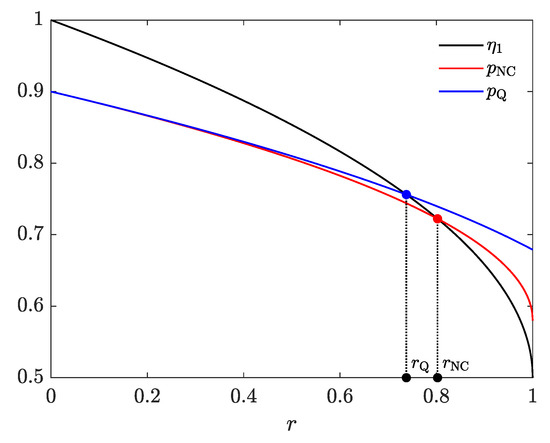
Figure 1.
Behavior of and for . (blue) is lower than or equal to (black) for , but is higher than for . (red) is lower than or equal to for , but is higher than for .
Theorem 2.
For the MED of two mixed qubit states and given by Equation (1), the occurrence of quantum contextuality depends on the nonzero prior probabilities of and .
4. Conclusions
In this work, we investigated quantum contextuality, a critical concept revealing the nonclassicality of quantum mechanics. Noncontextuality was recently studied in terms of state discrimination, which showed that quantum contextual advantage, which a preparation-noncontextual model cannot achieve, exists in the MED of two pure qubit states with identical prior probabilities. However, it should be emphasized that a recent investigation tells us that the selection of prior probability could affect the quantum properties of the system. Therefore, it is necessary to check whether the quantum contextual advantage depends on the prior probabilities of given states.
Therefore, in this study, we analyzed the dependence of the quantum contextual advantage on the prior probabilities of given states by considering the MED of two pure(mixed) quantum states with arbitrary prior probabilities. We found that the quantum contextual advantage occurs regardless of nonzero prior probabilities in MED of two nonorthogonal pure qubit states. However, we observed that the quantum contextual advantage depends on nonzero prior probabilities in MED of two nonorthogonal mixed qubit states. It shows an interesting behavior of the quantum contextual advantage in the MED. Therefore, it should be verified whether quantum contextual advantage exists in other state discrimination types.
Author Contributions
Conceptualization, J.S. and D.H.; Investigation, J.S.; Methodology, D.H.; Supervision and Critical advice Y.K.; Writing—first draft, J.S.; Revision, Y.K. All authors have read and agreed to the published version of the manuscript.
Funding
This work is supported by the Basic Science Research Program through the National Research Foundation of Korea (NRF) funded by the Ministry of Education, Science and Technology (NRF2018R1D1A1B07049420) and Institute of Information and Communications Technology Planning and Evaluation (IITP) grant funded by the Korean government (MSIT) (No. 2020001343, Artificial Intelligence Convergence Research Center (Hanyang University ERICA)). D.H. acknowledges support from the National Research Foundation of Korea (NRF) grant funded by the Korean government (Ministry of Science and ICT) (NRF2020M3E4A1080088).
Institutional Review Board Statement
Not applicable.
Informed Consent Statement
Not applicable.
Conflicts of Interest
The authors declare no conflict of interest.
Abbreviations
The following abbreviations are used in this manuscript:
| MED | Minimum error discrimination |
References
- Kochen, S.; Specker, E.P. The Problem of Hidden Variables in Quantum Mechanics. J. Math. Mech. 1967, 17, 59–87. [Google Scholar] [CrossRef]
- Spekkens, R.W. Contextuality for preparations, transformations, and unsharp measurements. Phys. Rev. A 2005, 71, 052108. [Google Scholar] [CrossRef] [Green Version]
- Helstrom, C.W. Quantum detection and estimation theory. J. Stat. Phys. 1969, 1, 231–252. [Google Scholar] [CrossRef] [Green Version]
- Holevo, A.S. Probabilistic and Statistical Aspects of Quantum Theory; North-Holland: Amsterdam, The Netherlands, 1982. [Google Scholar]
- Bae, J. Structure of minimum-error quantum state discrimination. New J. Phys. 2013, 15, 073037. [Google Scholar] [CrossRef] [Green Version]
- Ha, D.; Kwon, Y. Complete analysis for three-qubit mixed-state discrimination. Phys. Rev. A 2013, 87, 062302. [Google Scholar] [CrossRef] [Green Version]
- Yuen, H.P.; Kennedy, R.S.; Lax, M. Optimum testing of multiple hypotheses in quantum detection theory. IEEE Trans. Inf. Theory 1975, 21, 125–134. [Google Scholar] [CrossRef]
- Barnett, S.M. Minimum-error discrimination between multiply symmetric states. Phys. Rev. A 2001, 64, 030303. [Google Scholar] [CrossRef]
- Chou, C.L.; Hsu, L.Y. Minimum-error discrimination between symmetric mixed quantum states. Phys. Rev. A 2003, 68, 042305. [Google Scholar] [CrossRef] [Green Version]
- Andersson, E.; Barnett, S.M.; Gilson, C.R.; Hunter, K. Minimum-error discrimination between three mirror-symmetric states. Phys. Rev. A 2002, 65, 052308. [Google Scholar] [CrossRef] [Green Version]
- Chou, C.L. Minimum-error discrimination among mirror-symmetric mixed quantum states. Phys. Rev. A 2004, 70, 062316. [Google Scholar] [CrossRef]
- Bae, J.; Hwang, W.-Y.; Han, Y.-D. No-Signaling Principle Can Determine Optimal Quantum State Discrimination. Phys. Rev. Lett. 2011, 107, 170403. [Google Scholar] [CrossRef] [Green Version]
- Bae, J.; Kim, D.-G.; Kwek, L.-C. Structure of Optimal State Discrimination in Generalized Probabilistic Theories. Entropy 2016, 18, 39. [Google Scholar] [CrossRef] [Green Version]
- Ha, D.; Kwon, Y. Discriminating N-qudit states using geometric structure. Phys. Rev. A 2014, 90, 022320. [Google Scholar] [CrossRef]
- Kim, J.; Ha, D.; Kwon, Y. Uniqueness of Minimax Strategy in View of Minimum Error Discrimination of Two Quantum States. Entropy 2019, 21, 671. [Google Scholar] [CrossRef] [Green Version]
- Ivanovic, I.D. How to differentiate between non-orthogonal states. Phys. Lett. A 1987, 123, 257–259. [Google Scholar] [CrossRef]
- Dieks, D. Overlap and distinguishability of quantum states. Phys. Lett. A 1988, 126, 303–306. [Google Scholar] [CrossRef]
- Peres, A. How to differentiate between non-orthogonal states. Phys. Lett. A 1988, 128, 19. [Google Scholar] [CrossRef]
- Jaeger, G.; Shimony, A. Optimal distinction between two non-orthogonal quantum states. Phys. Lett. A 1995, 197, 83–87. [Google Scholar] [CrossRef]
- Bergou, J.A. Optimal Unambiguous Discrimination of Pure Quantum States. Phys. Rev. Lett. 2012, 108, 250502. [Google Scholar] [CrossRef] [Green Version]
- Ha, D.; Kwon, Y. Analysis of optimal unambiguous discrimination of three pure quantum states. Phys. Rev. A 2015, 91, 062312. [Google Scholar] [CrossRef]
- Ha, D.; Kwon, Y. A minimal set of measurements for qudit-state tomography based on unambiguous discrimination. Quant. Inf. Process. 2018, 17, 232. [Google Scholar] [CrossRef]
- Namkung, M.; Kwon, Y. Understanding of Various Type of Unambiguous Discrimination in View of Coherence Distribution. Entropy 2020, 22, 1422. [Google Scholar] [CrossRef]
- Fiurášek, J.; Ježek, M. Optimal discrimination of mixed quantum states involving inconclusive results. Phys. Rev. A 2003, 67, 012321. [Google Scholar] [CrossRef] [Green Version]
- Herzog, U. Optimal state discrimination with a fixed rate of inconclusive results: Analytical solutions and relation to state discrimination with a fixed error rate. Phys. Rev. A 2012, 86, 032314. [Google Scholar] [CrossRef] [Green Version]
- Bagan, E.; Muñoz-Tapia, R.; Olivares-Rentería, G.A.; Bergou, J.A. Optimal discrimination of quantum states with a fixed rate of inconclusive outcomes. Phys. Rev. A 2012, 86, 040303. [Google Scholar] [CrossRef] [Green Version]
- Ha, D.; Kwon, Y. An optimal discrimination of two mixed qubit states with a fixed rate of inconclusive results. Quant. Inf. Process. 2017, 16, 273. [Google Scholar] [CrossRef] [Green Version]
- Bennett, C.H. Quantum cryptography using any two nonorthogonal states. Phys. Rev. Lett. 1992, 68, 3121. [Google Scholar] [CrossRef] [PubMed]
- Bergou, J.A.; Feldman, E.; Hillery, M. Extracting Information from a Qubit by Multiple Observers: Toward a Theory of Sequential State Discrimination. Phys. Rev. Lett. 2013, 111, 100501. [Google Scholar] [CrossRef] [PubMed] [Green Version]
- Namkung, M.; Kwon, Y. Optimal sequential state discrimination between two mixed quantum states. Phys. Rev. A 2017, 96, 022318. [Google Scholar] [CrossRef]
- Namkung, M.; Kwon, Y. Sequential state discrimination of coherent states. Sci. Rep. 2018, 8, 16915. [Google Scholar] [CrossRef] [Green Version]
- Namkung, M.; Kwon, Y. Analysis of Optimal Sequential State Discrimination for Linearly Independent Pure Quantum States. Sci. Rep. 2018, 8, 6515. [Google Scholar] [CrossRef] [PubMed] [Green Version]
- Namkung, M.; Kwon, Y. Almost minimum error discrimination of N-ary weak coherent states by Jaynes-Cummings Hamiltonian dynamics. Sci. Rep. 2019, 9, 19664. [Google Scholar] [CrossRef] [Green Version]
- Namkung, M.; Kwon, Y. Generalized sequential state discrimination for multiparty QKD and its optical implementation. Sci. Rep. 2020, 10, 8247. [Google Scholar] [CrossRef] [PubMed]
- Schmid, D.; Spekkens, R.W. Contextual Advantage for State Discrimination. Phys. Rev. X 2018, 8, 011015. [Google Scholar] [CrossRef] [Green Version]
- Ha, D.; Kwon, Y. Quantum nonlocality without entanglement: Explicit dependence on prior probabilities of nonorthogonal mirror-symmetric states. NPJ Quant. Inf. 2021, 7, 81. [Google Scholar] [CrossRef]
- Ha, D.; Kim, J.S. Quantum nonlocality without entanglement depending on nonzero prior probabilities in optimal unambiguous discrimination. Sci. Rep. 2021, 11, 17695. [Google Scholar] [CrossRef]
- Hunter, K. Measurement does not always aid state discrimination. Phys. Rev. A 2003, 68, 012306. [Google Scholar] [CrossRef] [Green Version]
Publisher’s Note: MDPI stays neutral with regard to jurisdictional claims in published maps and institutional affiliations. |
© 2021 by the authors. Licensee MDPI, Basel, Switzerland. This article is an open access article distributed under the terms and conditions of the Creative Commons Attribution (CC BY) license (https://creativecommons.org/licenses/by/4.0/).