


Abstract
In this paper, we present a low-complexity coding strategy to encode (compress) finite-length data blocks of Gaussian vector sources. We show that for large enough data blocks of a Gaussian asymptotically wide sense stationary (AWSS) vector source, the rate of the coding strategy tends to the lowest possible rate. Besides being a low-complexity strategy it does not require the knowledge of the correlation matrix of such data blocks. We also show that this coding strategy is appropriate to encode the most relevant Gaussian vector sources, namely, wide sense stationary (WSS), moving average (MA), autoregressive (AR), and ARMA vector sources.
1. Introduction
The rate distortion function (RDF) of a source provides the minimum rate at which data can be encoded in order to be able to recover them with a mean squared error (MSE) per dimension not larger than a given distortion.
In this paper, we present a low-complexity coding strategy to encode (compress) finite-length data blocks of Gaussian N-dimensional vector sources. Moreover, we show that for large enough data blocks of a Gaussian asymptotically wide sense stationary (AWSS) vector source, the rate of our coding strategy tends to the RDF of the source. The definition of AWSS vector process can be found in ([1] (Definition 7.1)). This definition was first introduced for the scalar case N = 1 (see ([2] (Section 6)) or [3]), and it is based on the Gray concept of asymptotically equivalent sequences of matrices [4].
A low-complexity coding strategy can be found in [5] for finite-length data blocks of Gaussian wide sense stationary (WSS) sources and in [6] for finite-length data blocks of Gaussian AWSS autoregressive (AR) sources. Both precedents deal with scalar processes. The low-complexity coding strategy presented in this paper generalizes the aforementioned strategies to Gaussian AWSS vector sources.
Our coding strategy is based on the block discrete Fourier transform (DFT), and therefore, it turns out to be a low-complexity coding strategy when the fast Fourier transform (FFT) algorithm is used. Specifically, the computational complexity of our coding strategy is , where n is the length of the data blocks. Besides being a low-complexity strategy, it does not require the knowledge of the correlation matrix of such data blocks.
We show that this coding strategy is appropriate to encode the most relevant Gaussian vector sources, namely, WSS, moving average (MA), autoregressive (AR), and ARMA vector sources. Observe that our coding strategy is then appropriate to encode Gaussian vector sources found in the literature, such as the corrupted WSS vector sources considered in [7,8] for the quadratic Gaussian CEO problem.
The paper is organized as follows. In Section 2, we obtain several new mathematical results on the block DFT, and we present an upper bound for the RDF of a complex Gaussian vector. In Section 3, using the results given in Section 2, we present a new coding strategy based on the block DFT to encode finite-length data blocks of Gaussian vector sources. In Section 4, we show that for large enough data blocks of a Gaussian AWSS vector source, the rate of our coding strategy tends to the RDF of the source. In Section 5, we show that our coding strategy is appropriate to encode WSS, MA, AR, and ARMA vector sources. In Section 6, conclusions and numerical examples are presented.
2. Preliminaries
2.1. Notation
In this paper , , , and are the set of positive integers, the set of integers, the set of real numbers, and the set of complex numbers, respectively. The symbol ⊤ denotes transpose and the symbol ∗ denotes conjugate transpose. and are the spectral and the Frobenius norm, respectively. denotes the smallest integer higher than or equal to x. E stands for expectation, ⊗ is the Kronecker product, and , , denote the eigenvalues of an Hermitian matrix A arranged in decreasing order. is the set of real n-dimensional (column) vectors, denotes the set of complex matrices, is the zero matrix, denotes the identity matrix, and is the Fourier unitary matrix, i.e.,
where is the imaginary unit.
If for all , then denotes the block diagonal matrix with blocks given by , where is the Kronecker delta.
and denote the real part and the imaginary part of a complex number, respectively. If , then and are the real matrices given by and with and , respectively.
If , then denotes the real -dimensional vector given by
If for all , then is the -dimensional vector given by
Finally, if is a (complex) random N-dimensional vector for all , denotes the corresponding (complex) random N-dimensional vector process.
2.2. New Mathematical Results on the Block DFT
We first give a simple result on the block DFT of real vectors.
Lemma 1.
Let . Consider for all . Suppose that is the block DFT of , i.e.,
Then the two following assertions are equivalent:
- 1.
- .
- 2.
- for all and .
Proof.
See Appendix A. □
We now give three new mathematical results on the block DFT of random vectors that are used in Section 3.
Theorem 1.
Consider . Let be a random N-dimensional vector for all . Suppose that is given by Equation (1). If , then
and
Proof.
See Appendix B. □
Theorem 2.
Let and be as in Theorem 1. Suppose that is real. If , then
Proof.
See Appendix C. □
Lemma 2.
Let and be as in Theorem 1. If , then
- 1.
- .
- 2.
- .
- 3.
- .
Proof.
See Appendix D. □
2.3. Upper Bound for the RDF of a Complex Gaussian Vector
In [9], Kolmogorov gave a formula for the RDF of a real zero-mean Gaussian N-dimensional vector with positive definite correlation matrix , namely,
where denotes trace and is a real number satisfying
If , an optimal coding strategy to achieve is to encode separately, where with U being a real orthogonal eigenvector matrix of (see ([6] (Corollary 1))). Observe that in order to obtain U, we need to know the correlation matrix . This coding strategy also requires an optimal coding method for real Gaussian random variables. Moreover, as , if , then from Equation (4) we obtain
We recall that can be thought of as the minimum rate (measured in nats) at which can be encoded (compressed) in order to be able to recover it with an MSE per dimension not larger than D, that is:
where denotes the estimation of .
The following result gives an upper bound for the RDF of a complex zero-mean Gaussian N-dimensional vector (i.e., a real zero-mean Gaussian -dimensional vector).
Lemma 3.
Consider . Let z be a complex zero-mean Gaussian N-dimensional vector. If is a positive definite matrix, then
Proof.
We divide the proof into three steps:
Step 1: We prove that is a positive definite matrix. We have
and
Consider , and suppose that . We only need to show that . As is a positive definite matrix and
we obtain , or equivalently .
Step 2: We show that . We have , where and . Applying ([10] (Corollary 1)), we obtain
3. Low-Complexity Coding Strategy for Gaussian Vector Sources
In this section (see Theorem 3), we present our coding strategy for Gaussian vector sources. To encode a finite-length data block of a Gaussian N-dimensional vector source , we compute the block DFT of () and we encode separately with for all (see Figure 1).
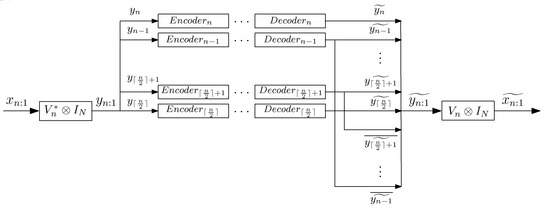
Figure 1.
Proposed coding strategy for Gaussian vector sources. In this figure, () denotes the optimal encoder (decoder) for the Gaussian N-dimensional vector with .
We denote by the rate of our strategy. Theorem 3 also provides an upper bound of . This upper bound is used in Section 4 to prove that our coding strategy is asymptotically optimal whenever the Gaussian vector source is AWSS.
In Theorem 3 denotes the matrix , where .
Theorem 3.
Consider . Let be a random N-dimensional vector for all . Suppose that is a real zero-mean Gaussian vector with a positive definite correlation matrix (or equivalently, ). Let be the random vector given by Equation (1). If , then
where
Moreover,
Proof.
We divide the proof into three steps:
Step 1: We show that . From Lemma 1, for all , and with . We encode separately (i.e., if n is even, we encode separately, and if n is odd, we encode separately) with
and
Let with
where for all , and for all . Applying Lemma 1 yields . As is unitary and is unitarily invariant, we have
Consequently,
Step 2: We prove that . From Equations (3) and (5), we obtain
and applying Theorem 2 and Equation (5) yields
From Lemma 3, we have
As
we obtain
Step 3: We show Equation (8).
As is a positive definite matrix (or equivalently, is Hermitian and for all ), is Hermitian. Hence, is Hermitian for all , and therefore, is also Hermitian. Consequently, is Hermitian, and applying Equations (3) and (11), we have that is a positive definite matrix.
Let be an eigenvalue decomposition (EVD) of , where U is unitary. Thus, and .
Since is Hermitian and is a positive definite matrix, is also a positive definite matrix.
In Equation (12), is written in terms of . can be written in terms of and by using Lemma 2 and Equations (9) and (10).
As our coding strategy requires the computation of the block DFT, its computational complexity is whenever the FFT algorithm is used. We recall that the computational complexity of the optimal coding strategy for is since it requires the computation of , where is a real orthogonal eigenvector matrix of . Observe that such eigenvector matrix also needs to be computed, which further increases the complexity. Hence, the main advantage of our coding strategy is that it notably reduces the computational complexity of coding . Moreover, our coding strategy does not require the knowledge of . It only requires the knowledge of , with .
It should be mentioned that Equation (7) provides two upper bounds for the RDF of finite-length data blocks of a real zero-mean Gaussian N-dimensional vector source . The greatest upper bound in Equation (7) was given in [11] for the case in which the random vector source is WSS, and therefore, the correlation matrix of the Gaussian vector, , is a block Toeplitz matrix. Such upper bound was first presented by Pearl in [12] for the case in which the source is WSS and . However, neither [11] nor [12] propose a coding strategy for .
4. Optimality of the Proposed Coding Strategy for Gaussian AWSS Vector Sources
In this section (see Theorem 4), we show that our coding strategy is asymptotically optimal, i.e., we show that for large enough data blocks of a Gaussian AWSS vector source , the rate of our coding strategy, presented in Section 3, tends to the RDF of the source.
We begin by introducing some notation. If is a continuous and -periodic matrix-valued function of a real variable, we denote by the block Toeplitz matrix with blocks given by
where is the sequence of Fourier coefficients of X:
If and are matrices for all , we write when the sequences and are asymptotically equivalent (see ([13] (p. 5673))), that is, and are bounded and
The original definition of asymptotically equivalent sequences of matrices was given by Gray (see ([2] (Section 2.3)) or [4]) for .
We now review the definition of the AWSS vector process given in ([1] (Definition 7.1)). This definition was first introduced for the scalar case N = 1 (see ([2] (Section 6)) or [3]).
Definition 1.
Let , and suppose that it is continuous and -periodic. A random N-dimensional vector process is said to be AWSS with asymptotic power spectral density (APSD) X if it has constant mean (i.e., for all and .
We recall that the RDF of is defined as .
Theorem 4.
Let be a real zero-mean Gaussian AWSS N-dimensional vector process with APSD X. Suppose that . If , then
Proof.
We divide the proof into two steps:
To finish the proof, we only need to show that
Let be the block circulant matrix with blocks defined in ([13] (p. 5674)), i.e.,
Observe that
Consequently, as the Frobenius norm is unitarily invariant, we have
Therefore,
Observe that the integral formula in Equation (13) provides the value of the RDF of the Gaussian AWSS vector source whenever . An integral formula of such an RDF for any can be found in ([15] (Theorem 1)). It should be mentioned that ([15] (Theorem 1)) generalized the integral formulas previously given in the literature for the RDF of certain Gaussian AWSS sources, namely, WSS scalar sources [9], AR AWSS scalar sources [16], and AR AWSS vector sources of finite order [17].
5. Relevant AWSS Vector Sources
WSS, MA, AR, and ARMA vector processes are frequently used to model multivariate time series (see, e.g., [18]) that arise in any domain that involves temporal measurements. In this section, we show that our coding strategy is appropriate to encode the aforementioned vector sources whenever they are Gaussian and AWSS.
It should be mentioned that Gaussian AWSS MA vector (VMA) processes, Gaussian AWSS AR vector (VAR) processes, and Gaussian AWSS ARMA vector (VARMA) processes are frequently called Gaussian stationary VMA processes, Gaussian stationary VAR processes, and Gaussian stationary VARMA processes, respectively (see, e.g., [18]). However, they are asymptotically stationary but not stationary, because their corresponding correlation matrices are not block Toeplitz.
5.1. WSS Vector Sources
In this subsection (see Theorem 5), we give conditions under which our coding strategy is asymptotically optimal for WSS vector sources.
We first recall the well-known concept of WSS vector process.
Definition 2.
Let , and suppose that it is continuous and -periodic. A random N-dimensional vector process is said to be WSS (or weakly stationary) with PSD X if it has constant mean and .
Theorem 5.
Let be a real zero-mean Gaussian WSS N-dimensional vector process with PSD X. Suppose that (or equivalently, for all ). If , then
Proof.
Applying ([1] (Lemma 3.3)) and ([1] (Theorem 4.3)) yields . Theorem 5 now follows from ([14] (Proposition 3)) and Theorem 4. □
Theorem 5 was presented in [5] for the case (i.e., just for WSS sources but not for vector WSS sources).
5.2. VMA Sources
In this subsection (see Theorem 6), we give conditions under which our coding strategy is asymptotically optimal for VMA sources.
We start by reviewing the concept of VMA process.
Definition 3.
A real zero-mean random N-dimensional vector process is said to be MA if
where , , are real matrices, is a real zero-mean random N-dimensional vector process, and for all with Λ being a real positive definite matrix. If there exists such that for all , then is called a VMA(q) process.
Theorem 6.
Let be as in Definition 3. Assume that , with and for all , is the sequence of Fourier coefficients of a function , which is continuous and -periodic. Suppose that is stable (that is, is bounded). If is Gaussian and , then
Moreover, for all .
Proof.
We divide the proof into three steps:
Step 1: We show that for all . From ([15] (Equation (A3))) we have that . Consequently,
Step 2: We prove the first equality in Equation (17). Applying ([15] (Theorem 2)), we obtain that is AWSS. From Theorem 4, we only need to show that . We have
5.3. VAR AWSS Sources
In this subsection (see Theorem 7), we give conditions under which our coding strategy is asymptotically optimal for VAR sources.
We first recall the concept of VAR process.
Definition 4.
A real zero-mean random N-dimensional vector process is said to be AR if
where , , are real matrices, is a real zero-mean random N-dimensional vector process, and for all with Λ being a real positive definite matrix. If there exists such that for all , then is called a VAR(p) process.
Theorem 7.
Let be as in Definition 4. Assume that , with and for all , is the sequence of Fourier coefficients of a function , which is continuous and -periodic. Suppose that is stable and for all . If is Gaussian and , then
Moreover, for all .
Proof.
We divide the proof into three steps:
Step 2: We prove the first equality in Equation (18). Applying ([15] (Theorem 3)), we obtain that is AWSS. From Theorem 4, we only need to show that . Applying ([1] (Theorem 4.3)) yields
Step 3: We show that for all . This can be directly obtained from Equation (12). □
Theorem 7 was presented in [6] for the case of (i.e., just for AR sources but not for VAR sources).
5.4. VARMA AWSS Sources
In this subsection (see Theorem 8), we give conditions under which our coding strategy is asymptotically optimal for VARMA sources.
We start by reviewing the concept of VARMA process.
Definition 5.
A real zero-mean random N-dimensional vector process is said to be ARMA if
where and , , are real matrices, is a real zero-mean random N-dimensional vector process, and for all with Λ being a real positive definite matrix. If there exists such that for all and for all , then is called a VARMA(p,q) process (or a VARMA process of (finite) order (p,q)).
Theorem 8.
Let be as in Definition 5. Assume that , with and for all , is the sequence of Fourier coefficients of a function which is continuous and -periodic. Suppose that , with and for all , is the sequence of Fourier coefficients of a function which is continuous and -periodic. Assume that and are stable, and for all . If is Gaussian and , then
Moreover, for all .
Proof.
We divide the proof into three steps:
Step 1: We show that for all . From ([15] (Appendix D)) and ([1] (Lemma 4.2)), we have that . Consequently,
Step 2: We prove the first equality in Equation (19). Applying ([15] (Theorem 3)), we obtain that is AWSS. From Theorem 4, we only need to show that . Applying ([1] (Theorem 4.3)) yields
Step 3: We show that for all . This can be directly obtained from Equation (12). □
6. Numerical Examples
We first consider four AWSS vector processes, namely, we consider the zero-mean WSS vector process in ([20] (Section 4)), the VMA(1) process in ([18] (Example 2.1)), the VAR(1) process in ([18] (Example 2.3)), and the VARMA(1,1) process in ([18] (Example 3.2)). In ([20] (Section 4)), and the Fourier coefficients of its PSD X are
and with . In ([18] (Example 2.1)), , is given by
for all , and
In ([18] (Example 2.3)), , for all , and and are given by Equations (20) and (21), respectively. In ([18] (Example 3.2)), ,
for all , and for all .
Figure 2, Figure 3, Figure 4 and Figure 5 show and with and for the four vector processes considered, by assuming that they are Gaussian. The figures bear evidence of the fact that the rate of our coding strategy tends to the RDF of the source.
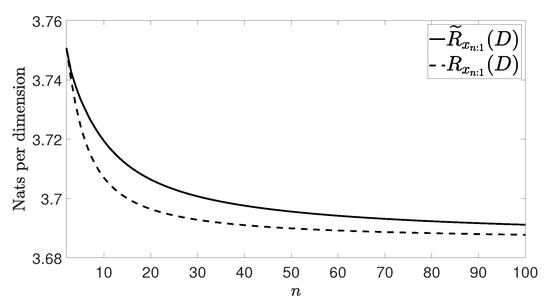
Figure 2.
Considered rates for the wide sense stationary (WSS) vector process in ([20] (Section 4)).
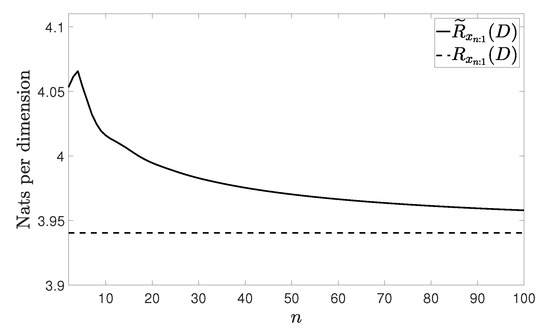
Figure 3.
Considered rates for the VMA(1) process in ([18] (Example 2.1)).
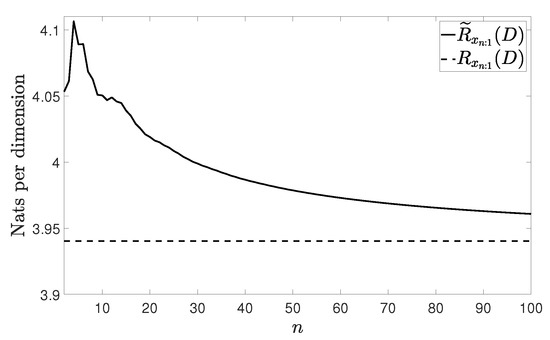
Figure 4.
Considered rates for the VAR(1) process in ([18] (Example 2.3)).
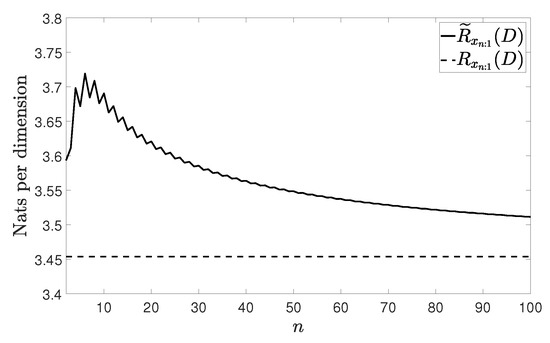
Figure 5.
Considered rates for the VARMA(1,1) process in ([18] (Example 3.2)).
We finish with a numerical example to explore how our method performs in the presence of a perturbation. Specifically, we consider a perturbed version of the WSS vector process in ([20] (Section 4)) (Figure 6). The correlation matrices of the perturbed process are
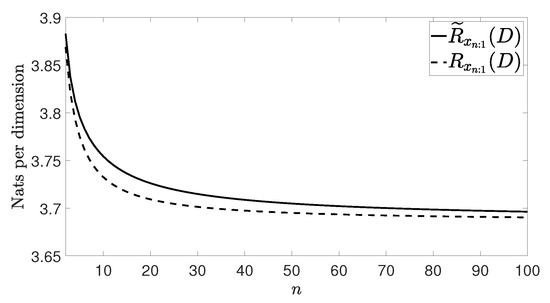
Figure 6.
Considered rates for the perturbed WSS vector process with D = 0.001.
7. Conclusions
The computational complexity of coding finite-length data blocks of Gaussian N-dimensional vector sources can be reduced by using the low-complexity coding strategy presented here instead of the optimal coding strategy. Specifically, the computational complexity is reduced from to , where n is the length of the data blocks. Moreover, our coding strategy is asymptotically optimal (i.e., the rate of our coding strategy tends to the RDF of the source) whenever the Gaussian vector source is AWSS and the considered data blocks are large enough. Besides being a low-complexity strategy, it does not require the knowledge of the correlation matrix of such data blocks. Furthermore, our coding strategy is appropriate to encode the most relevant Gaussian vector sources, namely, WSS, MA, AR, and ARMA vector sources.
Author Contributions
Authors are listed in order of their degree of involvement in the work, with the most active contributors listed first. J.G.-G. conceived the research question. All authors proved the main results and wrote the paper. All authors have read and approved the final manuscript.
Funding
This work was supported in part by the Spanish Ministry of Economy and Competitiveness through the CARMEN project (TEC2016-75067-C4-3-R).
Conflicts of Interest
The authors declare no conflict of interest.
Appendix A. Proof of Lemma 1
Proof.
(1) ⇒(2) We have
for all and .
(2)⇒(1) Since is a unitary matrix and
for all and , we conclude that
for all . □
Appendix B. Proof of Theorem 1
Proof.
Fix . Let and be an eigenvalue decomposition (EVD) of and , respectively. We can assume that the eigenvector matrices U and W are unitary. We have
and consequently,
for all . Therefore, since
Appendix C. Proof of Theorem 2
Proof.
Fix . Since
we obtain
where with . Fix , and consider a real eigenvector corresponding to with . Let be an EVD of , where U is real and orthogonal. Then
where with for all and . Consequently,
Therefore, to finish the proof we only need to show that . Applying ([5] (Equations (14) and (15))) yields
□
References
- Gutiérrez-Gutiérrez, J.; Crespo, P.M. Block Toeplitz matrices: Asymptotic results and applications. Found. Trends Commun. Inf. Theory 2011, 8, 179–257. [Google Scholar] [CrossRef]
- Gray, R.M. Toeplitz and circulant matrices: A review. Found. Trends Commun. Inf. Theory 2006, 2, 155–239. [Google Scholar] [CrossRef]
- Ephraim, Y.; Lev-Ari, H.; Gray, R.M. Asymptotic minimum discrimination information measure for asymptotically weakly stationary processes. IEEE Trans. Inf. Theory 1988, 34, 1033–1040. [Google Scholar] [CrossRef]
- Gray, R.M. On the asymptotic eigenvalue distribution of Toeplitz matrices. IEEE Trans. Inf. Theory 1972, IT-18, 725–730. [Google Scholar] [CrossRef]
- Gutiérrez-Gutiérrez, J.; Zárraga-Rodríguez, M.; Insausti, X. Upper bounds for the rate distortion function of finite-length data blocks of Gaussian WSS sources. Entropy 2017, 19, 554. [Google Scholar] [CrossRef]
- Gutiérrez-Gutiérrez, J.; Zárraga-Rodríguez, M.; Villar-Rosety, F.M.; Insausti, X. Rate-Distortion function upper bounds for Gaussian vectors and their applications in coding AR sources. Entropy 2018, 20, 399. [Google Scholar] [CrossRef]
- Viswanathan, H.; Berger, T. The quadratic Gaussian CEO problem. IEEE Trans. Inf. Theory 1997, 43, 1549–1559. [Google Scholar] [CrossRef]
- Torezzan, C.; Panek, L.; Firer, M. A low complexity coding and decoding strategy for the quadratic Gaussian CEO problem. J. Frankl. Inst. 2016, 353, 643–656. [Google Scholar] [CrossRef]
- Kolmogorov, A.N. On the Shannon theory of information transmission in the case of continuous signals. IRE Trans. Inf. Theory 1956, IT-2, 102–108. [Google Scholar] [CrossRef]
- Neeser, F.D.; Massey, J.L. Proper complex random processes with applications to information theory. IEEE Trans. Inf. Theory 1993, 39, 1293–1302. [Google Scholar] [CrossRef]
- Gutiérrez-Gutiérrez, J.; Zárraga-Rodríguez, M.; Insausti, X.; Hogstad, B.O. On the complexity reduction of coding WSS vector processes by using a sequence of block circulant matrices. Entropy 2017, 19, 95. [Google Scholar] [CrossRef]
- Pearl, J. On coding and filtering stationary signals by discrete Fourier transforms. IEEE Trans. Inf. Theory 1973, 19, 229–232. [Google Scholar] [CrossRef]
- Gutiérrez-Gutiérrez, J.; Crespo, P.M. Asymptotically equivalent sequences of matrices and Hermitian block Toeplitz matrices with continuous symbols: Applications to MIMO systems. IEEE Trans. Inf. Theory 2008, 54, 5671–5680. [Google Scholar] [CrossRef]
- Gutiérrez-Gutiérrez, J. A modified version of the Pisarenko method to estimate the power spectral density of any asymptotically wide sense stationary vector process. Appl. Math. Comput. 2019, 362, 124526. [Google Scholar] [CrossRef]
- Gutiérrez-Gutiérrez, J.; Zárraga-Rodríguez, M.; Crespo, P.M.; Insausti, X. Rate distortion function of Gaussian asymptotically WSS vector processes. Entropy 2018, 20, 719. [Google Scholar] [CrossRef]
- Gray, R.M. Information rates of autoregressive processes. IEEE Trans. Inf. Theory 1970, IT-16, 412–421. [Google Scholar] [CrossRef]
- Toms, W.; Berger, T. Information rates of stochastically driven dynamic systems. IEEE Trans. Inf. Theory 1971, 17, 113–114. [Google Scholar] [CrossRef]
- Reinsel, G.C. Elements of Multivariate Time Series Analysis; Springer: Berlin/Heidelberg, Germany, 1993. [Google Scholar]
- Gutiérrez-Gutiérrez, J.; Crespo, P.M. Asymptotically equivalent sequences of matrices and multivariate ARMA processes. IEEE Trans. Inf. Theory 2011, 57, 5444–5454. [Google Scholar] [CrossRef]
- Gutiérrez-Gutiérrez, J.; Iglesias, I.; Podhorski, A. Geometric MMSE for one-sided and two-sided vector linear predictors: From the finite-length case to the infinite-length case. Signal Process. 2011, 91, 2237–2245. [Google Scholar] [CrossRef]
© 2019 by the authors. Licensee MDPI, Basel, Switzerland. This article is an open access article distributed under the terms and conditions of the Creative Commons Attribution (CC BY) license (http://creativecommons.org/licenses/by/4.0/).