


Microplastics and Kidneys: An Update on the Evidence for Deposition of Plastic Microparticles in Human Organs, Tissues and Fluids and Renal Toxicity Concern

 , , , , , , ,
  , ,
, , 
Abstract
:1. Introduction
2. Evidence of Microplastics in Human
2.1. Neonatal and Gynecological System
2.2. Respiratory and Gastrointestinal Systems
2.3. Cardiovascular System
2.4. Body Fluids
2.5. Correlation between MPs and Diseases
3. Microplastics Effects on Kidney Tissues and Cells
4. Conclusions
Author Contributions
Funding
Conflicts of Interest
References
- Zhang, Q.; Xu, E.G.; Li, J.; Chen, Q.; Ma, L.; Zeng, E.Y.; Shi, H. A Review of Microplastics in Table Salt, Drinking Water, and Air: Direct Human Exposure. Environ. Sci. Technol. 2020, 54, 3740–3751. [Google Scholar] [CrossRef]
- Napper, I.E.; Thompson, R.C. Release of synthetic microplastic plastic fibres from domestic washing machines: Effects of fabric type and washing conditions. Mar. Pollut. Bull. 2016, 112, 39–45. [Google Scholar] [CrossRef]
- Le, L.-T.; Nguyen, K.-Q.N.; Nguyen, P.-T.; Duong, H.C.; Bui, X.-T.; Hoang, N.B.; Nghiem, L.D. Microfibers in laundry wastewater: Problem and solution. Sci. Total Environ. 2022, 852, 158412. [Google Scholar] [CrossRef]
- Nolasco Cruz, J.; Donjuan Martínez, K.; López Ávila, J.J.; Pérez Hernández, I.; Castellanos Villalobos, M.L. Recovery of plastic waste through its thermochemical degradation: A review. Environ. Monit. Assess. 2023, 195, 1166. [Google Scholar] [CrossRef] [PubMed]
- Zhang, Q.; Zhao, Y.; Du, F.; Cai, H.; Wang, G.; Shi, H. Microplastic Fallout in Different Indoor Environments. Environ. Sci. Technol. 2020, 54, 6530–6539. [Google Scholar] [CrossRef]
- Ahmad, M.; Chen, J.; Khan, M.T.; Yu, Q.; Phairuang, W.; Furuuchi, M.; Ali, S.W.; Nawab, A.; Panyametheekul, S. Sources, analysis, and health implications of atmospheric microplastics. Emerg. Contam. 2023, 9, 100233. [Google Scholar] [CrossRef]
- Cox, K.D.; Covernton, G.A.; Davies, H.L.; Dower, J.F.; Juanes, F.; Dudas, S.E. Human Consumption of Microplastics. Environ. Sci. Technol. 2019, 53, 7068–7074, Erratum in: Environ. Sci. Technol. 2020, 54, 10974. [Google Scholar] [CrossRef]
- Huang, Z.; Hu, B.; Wang, H. Analytical methods for microplastics in the environment: A review. Environ. Chem. Lett. 2023, 21, 383–401. [Google Scholar] [CrossRef] [PubMed]
- Rahman, A.; Sarkar, A.; Yadav, O.P.; Achari, G.; Slobodnik, J. Potential human health risks due to environmental exposure to nano- and microplastics and knowledge gaps: A scoping review. Sci. Total Environ. 2021, 757, 143872. [Google Scholar] [CrossRef] [PubMed]
- Ramsperger, A.F.R.M.; Narayana, V.K.B.; Gross, W.; Mohanraj, J.; Thelakkat, M.; Greiner, A.; Schmalz, H.; Kress, H.; Laforsch, C. Environmental exposure enhances the internalization of microplastic particles into cells. Sci. Adv. 2020, 6, eabd1211. [Google Scholar] [CrossRef]
- Ragusa, A.; Svelato, A.; Santacroce, C.; Catalano, P.; Notarstefano, V.; Carnevali, O.; Papa, F.; Rongioletti, M.C.A.; Baiocco, F.; Draghi, S.; et al. Plasticenta: First evidence of microplastics in human placenta. Environ. Int. 2021, 146, 106274. [Google Scholar] [CrossRef] [PubMed]
- Braun, T.; Ehrlich, L.; Henrich, W.; Koeppel, S.; Lomako, I.; Schwabl, P.; Liebmann, B. Detection of Microplastic in Human Placenta and Meconium in a Clinical Setting. Pharmaceutics 2021, 13, 921. [Google Scholar] [CrossRef] [PubMed]
- Ragusa, A.; Notarstefano, V.; Svelato, A.; Belloni, A.; Gioacchini, G.; Blondeel, C.; Zucchelli, E.; De Luca, C.; D’Avino, S.; Gulotta, A.; et al. Raman Microspectroscopy Detection and Characterisation of Microplastics in Human Breastmilk. Polymers 2022, 14, 2700. [Google Scholar] [CrossRef]
- Ragusa, A.; Matta, M.; Cristiano, L.; Matassa, R.; Battaglione, E.; Svelato, A.; De Luca, C.; D’Avino, S.; Gulotta, A.; Rongioletti, M.C.A.; et al. Deeply in Plasticenta: Presence of Microplastics in the Intracellular Compartment of Human Placentas. Int. J. Environ. Res. Public. Health 2022, 19, 11593. [Google Scholar] [CrossRef] [PubMed]
- Zhu, L.; Zhu, J.; Zuo, R.; Xu, Q.; Qian, Y.; An, L. Identification of microplastics in human placenta using laser direct infrared spectroscopy. Sci. Total Environ. 2023, 856 Pt 1, 159060. [Google Scholar] [CrossRef]
- Jenner, L.C.; Rotchell, J.M.; Bennett, R.T.; Cowen, M.; Tentzeris, V.; Sadofsky, L.R. Detection of microplastics in human lung tissue using μFTIR spectroscopy. Sci. Total. Environ. 2022, 831, 154907. [Google Scholar] [CrossRef]
- Amato-Lourenço, L.F.; Carvalho-Oliveira, R.; Júnior, G.R.; Dos Santos Galvão, L.; Ando, R.A.; Mauad, T. Presence of airborne microplastics in human lung tissue. J. Hazard. Mater. 2021, 416, 126124. [Google Scholar] [CrossRef]
- Horvatits, T.; Tamminga, M.; Liu, B.; Sebode, M.; Carambia, A.; Fischer, L.; Püschel, K.; Huber, S.; Fischer, E.K. Microplastics detected in cirrhotic liver tissue. EBioMedicine 2022, 82, 104147. [Google Scholar] [CrossRef]
- Leslie, H.A.; van Velzen, M.J.M.; Brandsma, S.H.; Vethaak, A.D.; Garcia-Vallejo, J.J.; Lamoree, M.H. Discovery and quantification of plastic particle pollution in human blood. Environ. Int. 2022, 163, 107199. [Google Scholar] [CrossRef]
- Yang, Y.; Xie, E.; Du, Z.; Peng, Z.; Han, Z.; Li, L.; Zhao, R.; Qin, Y.; Xue, M.; Li, F.; et al. Detection of Various Microplastics in Patients Undergoing Cardiac Surgery. Environ. Sci. Techno. 2023, 57, 10911–10918. [Google Scholar] [CrossRef]
- Pironti, C.; Notarstefano, V.; Ricciardi, M.; Motta, O.; Giorgini, E.; Montano, L. First Evidence of Microplastics in Human Urine, a Preliminary Study of Intake in the Human Body. Toxics 2022, 11, 40. [Google Scholar] [CrossRef] [PubMed]
- Khan, A.; Jia, Z. Recent insights into uptake, toxicity, and molecular targets of microplastics and nanoplastics relevant to human health impacts. iScience 2023, 26, 106061. [Google Scholar] [CrossRef] [PubMed]
- Noonan, M.J.; Grechi, N.; Mills, C.L.; de AM MFerraz, M. Microplastics analytics: Why we should not underestimate the importance of blank controls. Microplast. Nanoplast. 2023, 3, 17. [Google Scholar] [CrossRef] [PubMed]
- Chen, C.; Liu, F.; Quan, S.; Chen, L.; Shen, A.; Jiao, A.; Qi, H.; Yu, G. Microplastics in the Bronchoalveolar Lavage Fluid of Chinese Children: Associations with Age, City Development, and Disease Features. Environ. Sci. Technol. 2023, 57, 12594–12601. [Google Scholar] [CrossRef]
- Li, Z.; Wang, J.; Gao, X.; Du, J.; Sui, H.; Wu, J.; Zhong, Y.; Liang, B.; Huang, Y.; Ye, R.; et al. Investigation of Microplastics (≥10 μm) in Meconium by Fourier Transform Infrared Microspectroscopy. Toxics 2023, 11, 310. [Google Scholar] [CrossRef]
- Ibrahim, Y.S.; Tuan Anuar, S.; Azmi, A.A.; Wan Mohd Khalik, W.M.A.; Lehata, S.; Hamzah, S.R.; Ismail, D.; Ma, Z.F.; Dzulkarnaen, A.; Zakaria, Z.; et al. Detection of microplastics in human colectomy specimens. JGH Open 2020, 5, 116–121. [Google Scholar] [CrossRef]
- Wu, D.; Feng, Y.; Wang, R.; Jiang, J.; Guan, Q.; Yang, X.; Wei, H.; Xia, Y.; Luo, Y. Pigment microparticles and microplastics found in human thrombi based on Raman spectral evidence. J. Adv. Res. 2023, 49, 141–150. [Google Scholar] [CrossRef]
- Rotchell, J.M.; Jenner, L.C.; Chapman, E.; Bennett, R.T.; Bolanle, I.O.; Loubani, M.; Sadofsky, L.; Palmer, T.M. Detection of microplastics in human saphenous vein tissue using μFTIR: A pilot study. PLoS ONE 2023, 18, e0280594. [Google Scholar] [CrossRef]
- Montano, L.; Giorgini, E.; Notarstefano, V.; Notari, T.; Ricciardi, M.; Piscopo, M.; Motta, O. Raman Microspectroscopy evidence of microplastics in human semen. Sci. Total Environ. 2023, 901, 165922. [Google Scholar] [CrossRef]
- Guan, Q.; Jiang, J.; Huang, Y.; Wang, Q.; Liu, Z.; Ma, X.; Yang, X.; Li, Y.; Wang, S.; Cui, W.; et al. The landscape of micron-scale particles including microplastics in human enclosed body fluids. J. Hazard. Mater. 2023, 442, 130138. [Google Scholar] [CrossRef]
- Liu, S.; Liu, X.; Guo, J.; Yang, R.; Wang, H.; Sun, Y.; Chen, B.; Dong, R. The Association Between Microplastics and Microbiota in Placentas and Meconium: The First Evidence in Humans. Environ. Sci. Technol. 2022. [Google Scholar] [CrossRef] [PubMed]
- Chen, Q.; Gao, J.; Yu, H.; Su, H.; Yang, Y.; Cao, Y.; Zhang, Q.; Ren, Y.; Hollert, H.; Shi, H.; et al. An emerging role of microplastics in the etiology of lung ground glass nodules. Environ. Sci. Eur. 2022, 34, 25. [Google Scholar] [CrossRef]
- Prata, J.C. Airborne microplastics: Consequences to human health? Environ. Pollut. 2018, 234, 115–126. [Google Scholar] [CrossRef] [PubMed]
- Lu, W.; Li, X.; Wang, S.; Tu, C.; Qiu, L.; Zhang, H.; Zhong, C.; Li, S.; Liu, Y.; Liu, J.; et al. New Evidence of Microplastics in the Lower Respiratory Tract: Inhalation through Smoking. Environ. Sci. Technol. 2023, 57, 8496–8505. [Google Scholar] [CrossRef]
- Yan, Z.; Liu, Y.; Zhang, T.; Zhang, F.; Ren, H.; Zhang, Y. Analysis of Microplastics in Human Feces Reveals a Correlation between Fecal Microplastics and Inflammatory Bowel Disease Status. Environ. Sci. Technol. 2022, 56, 414–421. [Google Scholar] [CrossRef]
- Andres, M.A.; Jimenez, K.R.; Peter Grassart, H. Collateral effects of microplastic pollution on aquatic microorganisms: An ecological perspective. TrAC Trends Anal. Chem. 2019, 112, 234–240. [Google Scholar] [CrossRef]
- Fournier, E.; Ratel, J.; Denis, S.; Leveque, M.; Ruiz, P.; Mazal, C.; Amiard, F.; Edely, M.; Bezirard, V.; Gaultier, E.; et al. Exposure to polyethylene microplastics alters immature gut microbiome in an infant in vitro gut model. J. Hazard. Mater. 2023, 443 Pt B, 130383. [Google Scholar] [CrossRef]
- Li, Z.; Xu, T.; Peng, L.; Tang, X.; Chi, Q.; Li, M.; Li, S. Polystyrene nanoplastics aggravates lipopolysaccharide-induced apoptosis in mouse kidney cells by regulating IRE1/XBP1 endoplasmic reticulum stress pathway via oxidative stress. J. Cell. Physiol. 2023, 238, 151–164. [Google Scholar] [CrossRef]
- Tang, Y.; Zhao, R.; Pu, Q.; Jiang, S.; Yu, F.; Yang, Z.; Han, T. Investigation of nephrotoxicity on mice exposed to polystyrene nanoplastics and the potential amelioration effects of DHA-enriched phosphatidylserine. Sci. Total Environ. 2023, 892, 164808. [Google Scholar] [CrossRef]
- Deng, Y.; Zhang, Y.; Lemos, B.; Ren, H. Tissue accumulation of microplastics in mice and biomarker responses suggest widespread health risks of exposure. Sci. Rep. 2017, 7, 46687. [Google Scholar] [CrossRef]
- Wang, Y.L.; Lee, Y.H.; Hsu, Y.H.; Chiu, I.J.; Huang, C.C.; Huang, C.C.; Chia, Z.C.; Lee, C.P.; Lin, Y.F.; Chiu, H.W. The Kidney-Related Effects of Polystyrene Microplastics on Human Kidney Proximal Tubular Epithelial Cells HK-2 and Male C57BL/6 Mice. Environ. Health Perspect. 2021, 129, 57003. [Google Scholar] [CrossRef] [PubMed]
- Meng, X.; Zhang, J.; Wang, W.; Gonzalez-Gil, G.; Vrouwenvelder, J.S.; Li, Z. Effects of nano- and microplastics on kidney: Physicochemical properties, bioaccumulation, oxidative stress and immunoreaction. Chemosphere 2022, 288 Pt 3, 132631. [Google Scholar] [CrossRef] [PubMed]
- Meng, X.; Yin, K.; Zhang, Y.; Wang, D.; Lu, H.; Hou, L.; Zhao, H.; Xing, M. Polystyrene microplastics induced oxidative stress, inflammation and necroptosis via NF-κB and RIP1/RIP3/MLKL pathway in chicken kidney. Toxicology 2022, 478, 153296. [Google Scholar] [CrossRef]
- Goodman, K.E.; Hua, T.; Sang, Q.A. Effects of Polystyrene Microplastics on Human Kidney and Liver Cell Morphology, Cellular Proliferation, and Metabolism. ACS Omega. 2022, 7, 34136–34153. [Google Scholar] [CrossRef] [PubMed]
- Chen, Y.C.; Chen, K.F.; Lin, K.A.; Chen, J.K.; Jiang, X.Y.; Lin, C.H. The nephrotoxic potential of polystyrene microplastics at realistic environmental concentrations. J. Hazard. Mater. 2022, 427, 127871. [Google Scholar] [CrossRef] [PubMed]
- Sun, X.; Zhang, W.; Wang, Y.; Zhang, Y.; Liu, X.; Shi, X.; Xu, S. Combined exposure to di(2-ethylhexyl) phthalate and polystyrene microplastics induced renal autophagy through the ROS/AMPK/ULK1 pathway. Food Chem. Toxicol. 2023, 171, 113521. [Google Scholar] [CrossRef]
- Zou, H.; Chen, Y.; Qu, H.; Sun, J.; Wang, T.; Ma, Y.; Yuan, Y.; Bian, J.; Liu, Z. Microplastics Exacerbate Cadmium-Induced Kidney Injury by Enhancing Oxidative Stress, Autophagy, Apoptosis, and Fibrosis. Int. J. Mol. Sci. 2022, 23, 14411. [Google Scholar] [CrossRef]
- Xiong, X.; Gao, L.; Chen, C.; Zhu, K.; Luo, P.; Li, L. The microplastics exposure induce the kidney injury in mice revealed by RNA-seq. Ecotoxicol. Environ. Saf. 2023, 256, 114821. [Google Scholar] [CrossRef]
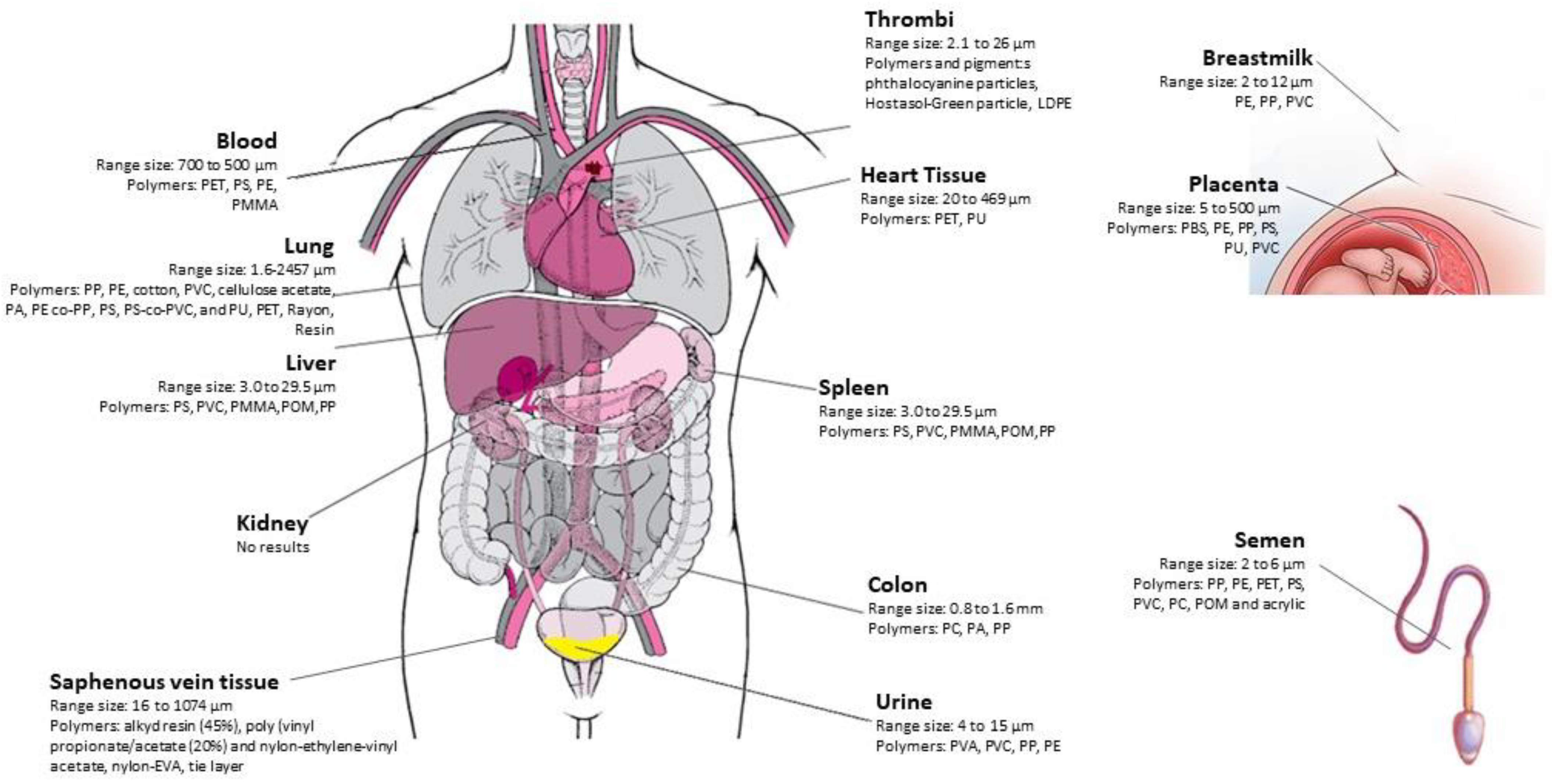

| Author, Year | Tissue/Fluid | Method Analysis | N° Samples/ N° Patients | N°/% Particles | Particles Size Range | Polymers/Pigments |
|---|---|---|---|---|---|---|
| Neonatal and gynecologic systems | ||||||
| Ragusa A., 2021 [11] | Placenta | µRaman spectroscopy | 6 placentas, 3 samples for each placenta (from the maternal side, the fetal side and the chorioamniotic membranes) | 12 MPs detected in the placentas of 4 women | From 5 to 10 μm in size | 3 PP 9 pigments (Phthalocyanine, Violanthrone, Diiron trioxide etc.) |
| Braun T., 2021 [12] | Placenta and meconium (acquired from cesarean breech deliveries) and maternal stool post-partum | µFTIR | 3 placenta samples 2 meconium 2 maternal stool post partum | 5 samples resulting positive at the screening for MPs | MPs > 50 µm | More identified: PE, PP, PS, PU, |
| Ragusa A., 2022 [14] | Placenta | Electron microscopy with dual energy dispersive X-ray spectroscopy detectors | 10 placenta samples | Presence of particles compatible with MPs inside all the different compartments of villi of all placenta samples analyzed | From 2.1 to 18.5 µm | Not specified |
| Ragusa, A. 2022. [13] | Breastmilk | Raman Microspectroscopy | 34 breastmilk samples | 58 MPs identified | From 2 to 12 µm; 47% from 4–9 µm | MPs were composed of PE 38%, PVC 21% and PP 17%. |
| Zhu L., 2023 [15] | Placenta | LD-IR spectroscopy | 17 placenta samples | MPs were detected in all placenta samples; 11 polymer types were identified | From 20 to 307 μm, and 80.29% < 100 μm | PVC, 43%, PP, 14.5%, and PBS 10.9%. |
| Li Z., 2023 [25] | Meconium | Ultra-depth three-dimensional microscope and µFTIR | 37 meconium samples but only 16 meconium samples were pretreated and analyzed | We did not detect MPs in any of the 16 meconium samples | / | Not identified |
| Pneumological and Gastrointestinal studies | ||||||
| Amato-Lourenço L.F., 2021 [17] | Lung | µRaman spectroscopy | 20 pulmonary tissue samples | 31 synthetic polymer particles (87.5% and fibres 12.5%) 5 natural polymer particles | Synthetic polymer particles from 1.60 to 5.56 µm, natural polymer particles from 1.98 to 5.42 µm | PP (35.1%), PE (24.3%); cotton (16.2%); PVC and cellulose acetate (5.4%); PA, PE co-PP, PS, PS-co-PVC and PU (2.7%) |
| Jenner, L.C., 2022 [16] | Lung | μFTIR | 13 lung tissue samples | 39 MPs were identified within 11 of the 13-lung tissue samples | Length from 12–2475 μm, width from 4–88 μm | 12 polymer types were identified: PP 23%), PET (18%) and resin (15%) |
| Ibrahim YS, 2020 [26] | Colon | μFTIR | Colectomy samples were obtained from 11 adults (9 from colorectal cancer 2 colon normal) | All samples had evidence of MPs with an average count of 331 per individual or 28.1 15.4 particles per g of colon tissue | Fibers from 0.8 to 1.6 mm | 90% PC, 50% PA, 40% PP. |
| Cardiovascular studies | ||||||
| Wu D., 2022 [27] | Thrombi | μRaman spectroscopy | 26 thrombi | 16 thrombi contained a total of 87 identified particles | 2.1 to 26.0 μm | 21 phthalocyanine particles 1 Hostasol-Green particle, 1 LDPE MPs; iron compounds and metallic oxides |
| Yang, Y., 2023 [20] | Heart tissue | LD-IR | 15 cardiac surgery patients: 6 pericardia tissue samples, 6 epicardial adipose tissues, 11 pericardial adipose tissues, 3 myocardia 5 left atrial appendages, 7 pairs of pre- and postoperative venous blood samples | MPs can be detected in all five types of samples. | 20 to 469 μm | 9 types of MPs were identified: PET (77%) and PU (12%) |
| Rotchell J.M., 2023 [28] | Saphenous vein tissue | μFTIR | 5 saphenous vein tissue samples | A total of 20 MP particles were identified within 4 of the 5 human saphenous vein tissue samples | Length from 16–1074 μm, and a width from 7–300 μm | 5 polymer types were identified, of irregular shape (90%), with alkyd resin (45%), poly (vinyl propionate/acetate (20%) and nylon-ethylene-vinyl acetate, nylon-EVA, tie layer (20%) |
| Body fluid studies | ||||||
| Leslie H.A., 2022 [19] | Blood | Double shot pyrolysis–gas chromatography/mass spectrometry | 22 blood samples from 22 healthy volunteers | 77% of donors (n = 17 out of 22) carried a quantifiable mass of plastic particles in their blood | 700 and 500 nm | PET 50%, PS 36%, PE 23%, PMMA 5% |
| Pironti C., 2022 [21] | Urine | μRaman spectroscopy | 6 urine samples of six volunteers | MPs were found in four of all the analyzed samples | 4–15 µm | PVA and PVC in 1 female sample PP and PE in 3 male samples |
| Montano L., 2023 [29] | Semen | μRaman spectroscopy. | 10 semen samples | 16 pigmented microplastic fragments | 2 to 6 μm | PP, PE, PET, PS, PVC, PC, POM and acrylic |
| Guan Q, 2023 [30] | Enclosed body fluids | μRaman spectroscope | 104 patiens: 4 categories of body fluids, -whole blood, -cerebrospinal fluid - Two main pathological body fluids (effusions and cyst fluids) | Totally 23 MPs were detected in a total of 702 microparticles | 19.66 to 103.27 µm | Nine kinds of MPs including: PP, PS, PTFE, PVB, PA, LDPE, PEAA, PSAN and PVA |
| Evidence of possible interaction with disease | ||||||
| Liu S., 2022 [31] | Placenta and meconium | LD-IR | 18 placentas 12 meconium samples | 800 particles | From 20−500 μm (50–60% 20–50 μm) | 16 types of MPs were detected in all samples. PA and PU accounted for greater than 78% of the total |
| Chen, Q., 2022 [32] | Lung | μFTIR | 100 human lung tissues samples (including GGNs and adjacent normal tissues in patients with pulmonary GGN) | Microfibers have been found in 29 tumor and 23 normal tissues; among the detected microfibers, 24 were MPs (36.92%) | >1000 μm in length, 50% for MPs in tumor tissue, 63% for MPs in normal tissue; the widths of MPs 30–50 μm in tumor tissue, accounting for 56.25%, while <30 μm and 30–50 μm in normal tissue are both 37.5% | Cotton (which accounts for 39.47% and 51.85% of all detected microfibers in tumor and in normal tissues); rayon (constitutes 26.32% and 18.52% of tumor and normal tissues). PS (for 10.53% of tumor and 11.11% of normal tissues) |
| Horvatits, T., 2022 [18] | Liver (6 patients with liver cirrhosis and 5 individuals without underlying liver disease.) -Kidney -Spleen | Fluorescent microscopy and Raman spectroscopy | 17 samples: 11 liver, 3 kidney and 3 spleen samples | 102 MP particles; significant concentrations were detected in liver tissue samples of patients with cirrhosis | 3.0 to 29.5 µm | PS, PVC, PMMA, POM and PP |
| Author/Year | Type of Study | Conditioning Type and Time | Method Analysis | Results | Conclusion |
|---|---|---|---|---|---|
| Deng Y, 2017 [40] | In vivo study: 75 five-week-old male mice | 2 types of PS microspheres (diameters 5 μm and 20 μm)
| Fluorescence spectroscopy |
| Effects on energy metabolism, lipid metabolism, oxidative stress and neurotoxic responses |
| Wang YL, 2021 [41] |
| HK-2 cells 2 lm luorescent yellow-green PS-MPs at concentrations of 0.025, 0.05, 0.1, 0.2, 0.4, or 0:8 lg = mL for 120 min or at a concentration of 0:8 lg = mL for 0, 5, 10, 30 or 60 min |
| In vitro study: higher levels of mitochondrial ROS and the mitochondrial protein Bad. Higher ER stress and markers of inflammation. Cells exposed to PS-MPs had higher protein levels of LC3 and Beclin 1. PS-MPs also had changes in phosphorylation of mitogen-activated protein kinase (MAPK) and protein kinase B (AKT)/mitogen-activated protein kinase (mTOR) signaling pathways. In vivo study: PS-MPs accumulated and the treated mice had more histopathological lesions in the kidneys and higher levels of ER stress, inflammatory markers and autophagy-related proteins in the kidneys after PS-MPs treatment | Mitochondrial dysfunction, ER stress, inflammation and autophagy; long-term PS-MPs exposure may be a risk factor for kidney health |
| Meng X, 2022 [42] | In vivo study: 65 mice were weighed and randomly divided into five group | PS-NPs (50 nm) and PSMPs (300 nm, 600 nm and 4 μm) and deionized water by gavage; 24 h exposure |
|
| PS-NPs and PS-MPs bioaccumulated in the kidneys, and the aggregation PS-MPs exacerbated their biotoxicity; the PS-NPs and PS-MPs caused mice weight loss, increased their death rate, significantly alternated several biomarkers and resulted in histological damage of the kidney; PS-NPs- and PS-MPs- induced oxidative stress and inflammation |
| Zou H, 2022 [47] | In vivo study: mice | Mice were treated with Cadmium (50 mg/L) and/or 5 µm MPs (10 mg/L) for 90 days | Transmission electron microscopy
| Tubular injury
| MPs exacerbated Cd-induced kidney injury. MPs aggravated Cd-induced kidney injury by enhancing oxidative stress, autophagy, apoptosis and fibrosis |
| Goodman KE, 2022 [44] | In vitro study: Human embryonic kidney 293 cells (HEK 293) | HEK 293 treated with 5 and 100 μg/mL PS-MPs |
|
| Threse morphological, metabolic, proliferative changes and cellular stress, indicate the potential undesirable effects of MPs on human health |
| Meng X, 2022 [43] | In vivo study: 120 chicken (1-day-old randomly assigned to 4 groups. | PS-MPs (1, 10, 100 mg/L) for six weeks, with 1 mg/L |
|
| This study was the first to show that oral intake of PS-MPs induced inflammation and necroptosis in chicken kidney and the differences in damage were linked to the concentration of PS-MPs |
| Chen YC, 2022 [45] | In vitro study: human embryonic kidney 293 (HEK29) | The HEK293 cells were treated with PSMPs (3–300 ng/mL) for 24 h. |
| PSMPs can:
| These results demonstrated that environmental exposure to PSMPs may lead to an increased risk of renal disease |
| Xiong XI, 2023 [48] | In vivo study: C57Bl/6 J mice (3 weeks old; male) | H2O, 80 nm, 5 µm, and 0.5 µm groups according to the diameter of MPs. |
|
| These data provide new evidence and potential research for investigating the harm of MPs to kidney of mammals and even humans |
| Sun x, 2023 [46] | In vitro study: Human kidney embryonic cells (HEK29)
| 4 groups: the control, DEHP, MPs, and DEHP + MPs group
|
|
| The combined exposure to DEHP and PS-MPs caused oxidative stress and activated the AMPK/ULK1 pathway, thereby inducing renal autophagy |
Disclaimer/Publisher’s Note: The statements, opinions and data contained in all publications are solely those of the individual author(s) and contributor(s) and not of MDPI and/or the editor(s). MDPI and/or the editor(s) disclaim responsibility for any injury to people or property resulting from any ideas, methods, instructions or products referred to in the content. |
© 2023 by the authors. Licensee MDPI, Basel, Switzerland. This article is an open access article distributed under the terms and conditions of the Creative Commons Attribution (CC BY) license (https://creativecommons.org/licenses/by/4.0/).
Share and Cite
La Porta, E.; Exacoustos, O.; Lugani, F.; Angeletti, A.; Chiarenza, D.S.; Bigatti, C.; Spinelli, S.; Kajana, X.; Garbarino, A.; Bruschi, M.; et al. Microplastics and Kidneys: An Update on the Evidence for Deposition of Plastic Microparticles in Human Organs, Tissues and Fluids and Renal Toxicity Concern. Int. J. Mol. Sci. 2023, 24, 14391. https://doi.org/10.3390/ijms241814391
La Porta E, Exacoustos O, Lugani F, Angeletti A, Chiarenza DS, Bigatti C, Spinelli S, Kajana X, Garbarino A, Bruschi M, et al. Microplastics and Kidneys: An Update on the Evidence for Deposition of Plastic Microparticles in Human Organs, Tissues and Fluids and Renal Toxicity Concern. International Journal of Molecular Sciences. 2023; 24(18):14391. https://doi.org/10.3390/ijms241814391
Chicago/Turabian StyleLa Porta, Edoardo, Ottavia Exacoustos, Francesca Lugani, Andrea Angeletti, Decimo Silvio Chiarenza, Carolina Bigatti, Sonia Spinelli, Xhuliana Kajana, Andrea Garbarino, Maurizio Bruschi, and et al. 2023. "Microplastics and Kidneys: An Update on the Evidence for Deposition of Plastic Microparticles in Human Organs, Tissues and Fluids and Renal Toxicity Concern" International Journal of Molecular Sciences 24, no. 18: 14391. https://doi.org/10.3390/ijms241814391
APA StyleLa Porta, E., Exacoustos, O., Lugani, F., Angeletti, A., Chiarenza, D. S., Bigatti, C., Spinelli, S., Kajana, X., Garbarino, A., Bruschi, M., Candiano, G., Caridi, G., Mancianti, N., Calatroni, M., Verzola, D., Esposito, P., Viazzi, F., Verrina, E., & Ghiggeri, G. M. (2023). Microplastics and Kidneys: An Update on the Evidence for Deposition of Plastic Microparticles in Human Organs, Tissues and Fluids and Renal Toxicity Concern. International Journal of Molecular Sciences, 24(18), 14391. https://doi.org/10.3390/ijms241814391

