



sensors-logo

Journal Browser

Journal Browser

Advanced Blockchain Technologies for Next-Generation Sensor Networks: Security, Privacy, and Scalability Solutions

A special issue of Sensors (ISSN 1424-8220). This special issue belongs to the section "Sensor Networks".

Deadline for manuscript submissions: 20 May 2026 | Viewed by 1136

Special Issue Editor


E-Mail Website
Guest Editor
1. Department of Theoretical and Applied Sciences, eCampus University, Via Isimbardi 10, 22060 Novedrate, CO, Italy
2. Department of Political Sciences, Communication and International Relations, University of Macerata, Via Crescimbeni, 62100 Macerata, Italy
3. Department of Information and Communication Systems Security, V. N. Karazin Kharkiv National University, 4 Svobody Sq., 61022 Kharkiv, Ukraine
Interests: blockchain technology and decentralized systems; zero-knowledge proof technologies (zk-SNARKs, zk-STARKs); post-quantum cryptography and security protocols; IoT security and privacy-preserving technologies; biometric authentication and digital forensics; applied cryptography and information security; artificial intelligence in cybersecurity
Special Issues, Collections and Topics in MDPI journals

Special Issue Information

Dear Colleagues,

Background and History

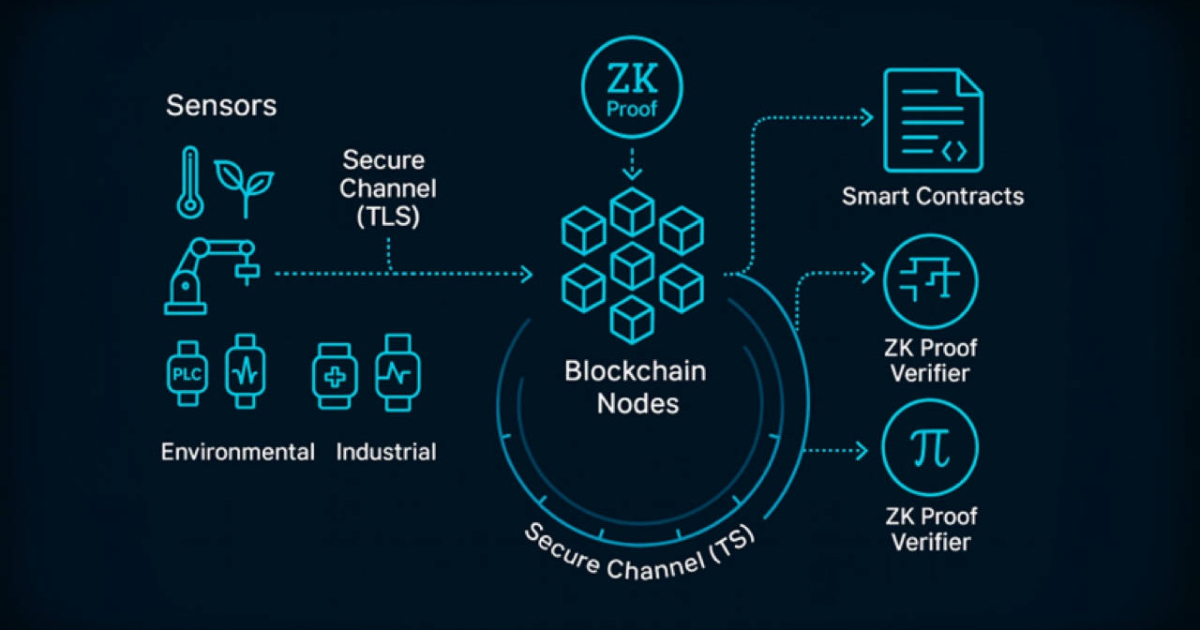
The convergence of blockchain technology and sensor networks represents one of the most promising paradigms in modern distributed computing. As the Internet of Things (IoT) continues to expand exponentially, traditional centralized approaches to sensor data management face unprecedented challenges with regard to security, privacy, scalability, and trust. Blockchain technology offers revolutionary solutions by providing decentralized, tamper-proof, and transparent mechanisms for sensor data collection, verification, and storage.

Aim and Scope

This Special Issue aims to showcase cutting-edge research at the intersection of blockchain technology and sensor networks. We seek contributions that address fundamental challenges, including secure data aggregation, privacy-preserving analytics, lightweight consensus mechanisms for resource-constrained devices, zero-knowledge proof applications, and novel cryptographic protocols specifically designed for sensor network environments.

Cutting-edge Research Focus

We are particularly interested in innovative approaches leveraging advanced cryptographic techniques such as homomorphic encryption, zero-knowledge proofs (zk-SNARKs/zk-STARKs), post-quantum cryptography, and novel consensus mechanisms including DAG-based solutions. Research addressing real-world applications in smart cities, industrial IoT, healthcare monitoring, environmental sensing, and critical infrastructure protection is especially welcome.

Topics of Interest:

  • Novel blockchain architectures optimized for sensor networks.
  • Lightweight cryptographic protocols for resource-constrained IoT devices.
  • Privacy-preserving data aggregation and analytics solutions.
  • Zero-knowledge proof applications in sensor data verification.
  • Post-quantum security mechanisms for long-term sensor network protection.
  • Decentralized consensus protocols for large-scale sensor deployments.
  • Smart contracts for automated sensor network management.
  • Biometric authentication and digital identity solutions for sensor networks.
  • Performance evaluation and comparative studies of blockchain-enabled sensor systems.

Dr. Oleksandr Kuznetsov
Guest Editor

Manuscript Submission Information

Manuscripts should be submitted online at www.mdpi.com by registering and logging in to this website. Once you are registered, click here to go to the submission form. Manuscripts can be submitted until the deadline. All submissions that pass pre-check are peer-reviewed. Accepted papers will be published continuously in the journal (as soon as accepted) and will be listed together on the special issue website. Research articles, review articles as well as short communications are invited. For planned papers, a title and short abstract (about 250 words) can be sent to the Editorial Office for assessment.

Submitted manuscripts should not have been published previously, nor be under consideration for publication elsewhere (except conference proceedings papers). All manuscripts are thoroughly refereed through a single-blind peer-review process. A guide for authors and other relevant information for submission of manuscripts is available on the Instructions for Authors page. Sensors is an international peer-reviewed open access semimonthly journal published by MDPI.

Please visit the Instructions for Authors page before submitting a manuscript. The Article Processing Charge (APC) for publication in this open access journal is 2600 CHF (Swiss Francs). Submitted papers should be well formatted and use good English. Authors may use MDPI's English editing service prior to publication or during author revisions.

Keywords

  • blockchain technology
  • sensor networks
  • IoT security
  • zero-knowledge proofs
  • post-quantum cryptography
  • decentralized consensus
  • privacy-preserving protocols
  • smart contracts
  • biometric authentication
  • distributed ledger technology

Benefits of Publishing in a Special Issue

  • Ease of navigation: Grouping papers by topic helps scholars navigate broad scope journals more efficiently.
  • Greater discoverability: Special Issues support the reach and impact of scientific research. Articles in Special Issues are more discoverable and cited more frequently.
  • Expansion of research network: Special Issues facilitate connections among authors, fostering scientific collaborations.
  • External promotion: Articles in Special Issues are often promoted through the journal's social media, increasing their visibility.
  • Reprint: MDPI Books provides the opportunity to republish successful Special Issues in book format, both online and in print.

Further information on MDPI's Special Issue policies can be found here.

Published Papers (2 papers)

Order results
Result details
Select all
Export citation of selected articles as:

Research

22 pages, 6452 KB  
Article
Blockchain-Enabled Uncertainty-Aware Passive Wi-Fi Localization for Secure Critical Infrastructure Sensor Networks
by Dmytro Prokopovych-Tkachenko, Oleksandr Galushchenko, Olga Torstensson, Volodymyr Zvieriev, Saltanat Adilzhanova and Edison Pignaton de Freitas
Sensors 2026, 26(9), 2797; https://doi.org/10.3390/s26092797 - 30 Apr 2026
Viewed by 310
Abstract
Passive Wi-Fi localization for critical-infrastructure security operations centers (SOCs) faces three interconnected limitations. First, many existing methods produce single-point coordinate estimates without calibrated uncertainty, making them unsuitable for automated SOC response. Second, localization pipelines often lack an evidentiary chain of custody, limiting reliable [...] Read more.
Passive Wi-Fi localization for critical-infrastructure security operations centers (SOCs) faces three interconnected limitations. First, many existing methods produce single-point coordinate estimates without calibrated uncertainty, making them unsuitable for automated SOC response. Second, localization pipelines often lack an evidentiary chain of custody, limiting reliable post-incident auditability. Third, SOC automation cannot safely rely on uncalibrated confidence values because erroneous high-impact actions and missed escalations carry asymmetric operational costs. This study presents a Blockchain-Enabled Uncertainty-Aware Passive Wi-Fi Localization framework for heterogeneous sensor networks composed of stationary sensors, mobile receivers, and UAV-assisted collection nodes. Instead of producing a single coordinate estimate, the method derives a posterior spatial distribution with calibrated uncertainty from monitor-mode observations, including RSSI aggregates, management/control frame features, channel occupancy indicators, and receiver logs. The framework combines three tightly coupled components: (i) Bayesian coordinate estimation with robust loss functions and range-dependent error modeling; (ii) uncertainty calibration that converts posterior confidence into operational SOC response modes (AUTO, VERIFY, and OBSERVE) via empirical coverage metrics and reliability diagrams; and (iii) a permissioned evidentiary logging layer that anchors integrity-relevant metadata and policy labels on-chain while keeping raw telemetry off-chain for tamper-evident auditability and scalability. The coupling between layers is explicit: calibrated confidence scores govern smart-contract gating conditions, and smart-contract policy thresholds feed back into the calibration stage. Field validation shows that localization performance degrades markedly beyond approximately 40 m, indicating a practical boundary for confident automated action. The proposed framework integrates passive sensing, uncertainty-aware localization, and blockchain-based evidentiary trust for secure critical-infrastructure sensor networks. Its key contributions are: (1) a posterior-distribution-based passive localization pipeline; (2) empirical coverage metrics for calibrating SOC response thresholds; (3) a hybrid on-chain/off-chain architecture linking localization outputs to a permissioned ledger; and (4) field validation establishing the 40 m operational validity boundary. Full article
Show Figures

Figure 1

21 pages, 790 KB  
Article
Performance Evaluation of zk-SNARK Protocols for Privacy-Preserving Sensor Data Verification: A Systematic Benchmarking Study
by Oleksandr Kuznetsov, Yelyzaveta Kuznetsova, Gulzat Ziyatbekova, Yuliia Kovalenko and Rostyslav Palahusynets
Sensors 2026, 26(8), 2486; https://doi.org/10.3390/s26082486 - 17 Apr 2026
Viewed by 402
Abstract
The proliferation of sensor networks in critical infrastructure, healthcare monitoring, and smart city applications demands robust privacy-preserving mechanisms for data verification. Zero-knowledge succinct non-interactive arguments of knowledge (zk-SNARKs) offer a promising cryptographic primitive that enables data integrity verification without revealing sensitive sensor readings. [...] Read more.
The proliferation of sensor networks in critical infrastructure, healthcare monitoring, and smart city applications demands robust privacy-preserving mechanisms for data verification. Zero-knowledge succinct non-interactive arguments of knowledge (zk-SNARKs) offer a promising cryptographic primitive that enables data integrity verification without revealing sensitive sensor readings. However, the practical feasibility of deploying zk-SNARKs in resource-constrained sensor network environments remains insufficiently characterized. This paper presents a systematic benchmarking study of the Groth16 zk-SNARK protocol across eight representative circuit types spanning six orders of magnitude in computational complexity, from basic arithmetic operations (1 constraint) to ECDSA signature verification (1,510,185 constraints). Using an automated open-source benchmarking framework built on the Circom-snarkjs toolchain, we conducted 160 statistically controlled measurements (20 iterations per circuit) with cold/warm separation, collecting proof generation time, verification time, proof size, memory consumption, and witness generation overhead. Our results demonstrate that Groth16 proofs maintain a constant size of 804.7±1.7 bytes and near-constant verification time of 0.662±0.032 s regardless of circuit complexity, with coefficients of variation below 5% across all circuit types. Proof generation time exhibits sub-linear scaling (α=0.256, R2=0.608), with statistically significant differences between circuit categories confirmed by one-way ANOVA (F=355.0, p<1079, η2=0.94). We identify three operational deployment tiers for sensor network architectures and estimate energy budgets for battery-powered devices. These findings provide actionable guidance for the design of privacy-preserving data verification systems in next-generation sensor networks. Full article
Show Figures

Figure 1

Back to TopTop