



Journal Menu
► ▼ Journal Menu-
- Pathogens Home
- Aims & Scope
- Editorial Board
- Reviewer Board
- Topical Advisory Panel
- Instructions for Authors
- Special Issues
- Topics
- Sections & Collections
- Article Processing Charge
- Indexing & Archiving
- Editor’s Choice Articles
- Most Cited & Viewed
- Journal Statistics
- Journal History
- Journal Awards
- Conferences
- Editorial Office
Journal Browser
► ▼ Journal BrowserNeed Help?
Announcements
25 March 2026
Prof. Dr. Moriya Tsuji Appointed Editor-in-Chief of Pathogens
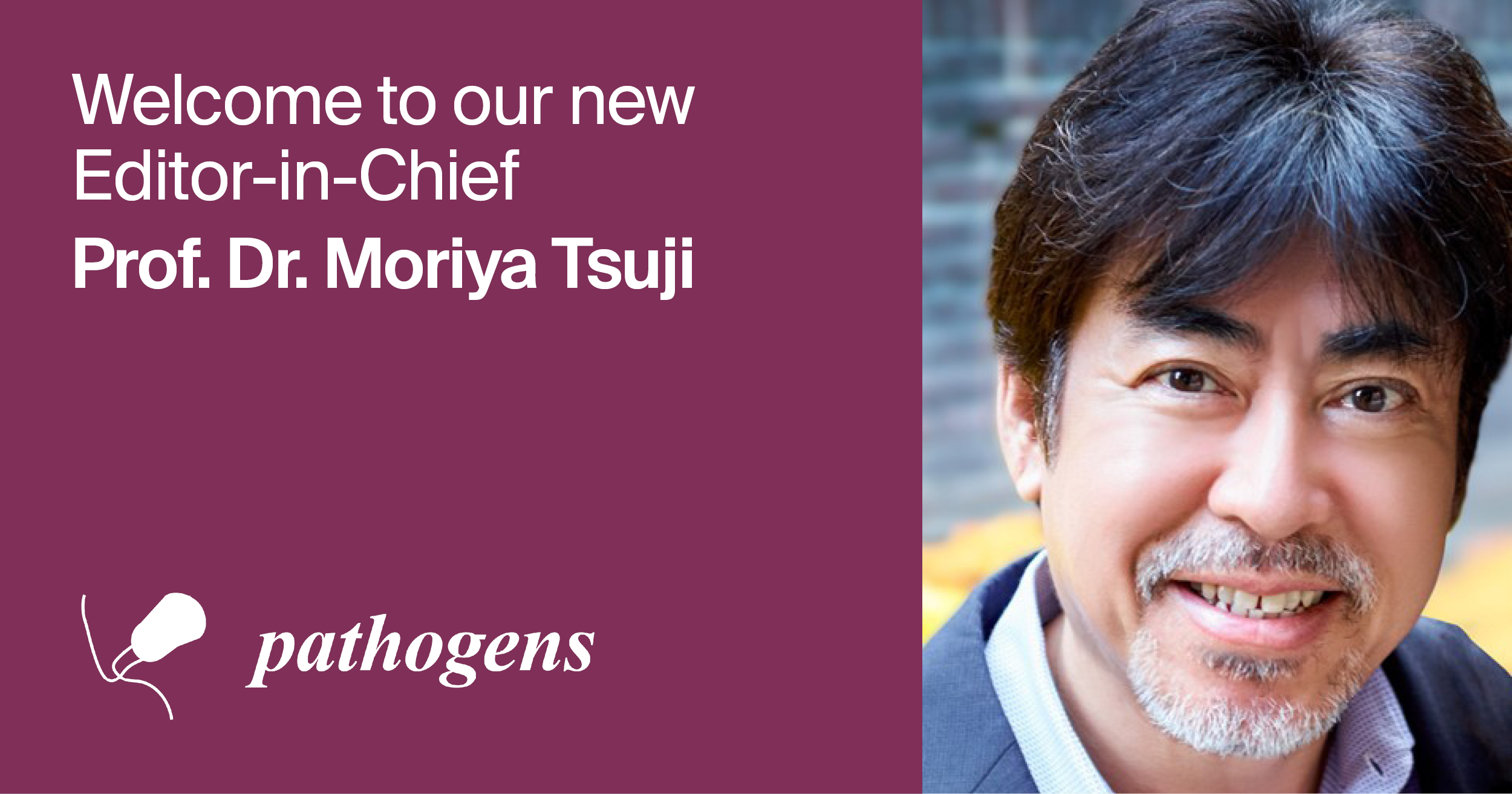
We are pleased to announce the appointment of Prof. Dr. Moriya Tsuji as the new Editor-in-Chief of Pathogens (ISSN: 2076-0817).
Name: Prof. Dr. Moriya Tsuji
Affiliation: School of Engineering Medicine, Texas A&M University, 2121 West Holcombe Blvd., Suite 1007, Houston, TX 77030, USA
Interests: vaccines, adjuvant, humanized mice, NKT cells, malaria, HIV, cancer
Prof. Dr. Moriya Tsuji was a Professor of Medicine in the Division of Infectious Diseases, Department of Medicine, at Columbia University Irving Medical Center. He also held a professorship at the Aaron Diamond AIDS Research Center prior to his move in March 2026 to the School of Engineering Medicine at Texas A&M University in Houston, Texas, USA.
Prof. Dr. Tsuji received his MD degree in 1983 from The Jikei University School of Medicine in Tokyo, Japan, and his PhD in immunology in 1987 from the Faculty of Medicine at the University of Tokyo. He is widely recognized as a leader in the development of humanized mouse models that recapitulate the human immune system, as well as an expert in T cell–mediated immunity against infectious diseases and cancer, and in the development of glycolipid-based vaccine adjuvants.
Prof. Dr. Tsuji has authored over 160 peer-reviewed publications in leading journals, including Nature, Nature Medicine, The Journal of Experimental Medicine, The Journal of Clinical Investigation, and Proceedings of the National Academy of Sciences of the United States of America. In 2021, he was elected as a Fellow of the American Society of Tropical Medicine and Hygiene (FASTMH). He has served on several prominent advisory bodies, including the Vaccine Science Portfolio Advisory Council (VSPAC) of the PATH Malaria Vaccine Initiative (2008–2012) and the Malaria Vaccine Consultation Group (MVCG) of NIAID/NIH (2010–2012). In addition, he served as a founding roster member of the Immunity and Host Defense (IHD) study section at NIAID/NIH from 2003 to 2008. Since 2015, he has been an International Advisory Member of the International Immunological Memory and Vaccine Forum (IIMVF).
The following is a short Q&A with Prof. Dr. Moriya Tsuji, who shared his vision for the journal with us, as well as his views on the research area and open access publishing:
1. What motivated you to express interest in this role?
I have been involved with several MDPI journals for many years. I joined the Editorial Board of Biomolecules around 2015–2016 and have also served on the boards of a number of other MDPI journals. Through this work, I have become familiar with MDPI’s editorial processes and standards.
I have also followed the development of Pathogens over time and have found many of its articles to be both informative and relevant to the field. The journal’s scope aligns well with my research interests.
Although I initially hesitated because of my current workload, I decided to accept the invitation, as I see this as an opportunity to contribute to the journal’s continued development. Pathogens already has a strong foundation, and I believe there is room to further strengthen its impact by bringing in leading researchers, encouraging high-quality submissions, and maintaining rigorous peer review. I would be glad to support these efforts.
More broadly, I think it is important for journals like Pathogens to continue supporting and disseminating solid scientific work, especially at a time when research in infectious diseases is facing increasing challenges, including funding limitations and shifting priorities.
2. How do you see this research field evolving in the coming years?
Research on pathogens and infectious diseases will remain central to addressing global health challenges. At the same time, the field is undergoing notable shifts, particularly in funding landscapes and regional research priorities, which are likely to influence both the direction and pace of scientific progress.
In this evolving environment, scientific journals have an especially important role in sustaining momentum within the field. Journals such as Pathogens can provide a critical platform for disseminating new findings, fostering interdisciplinary collaboration, and supporting the continued growth of the research community.
In particular, it will be important to actively support early-career investigators and to ensure that the journal remains a compelling venue for innovative and impactful work. By upholding rigorous peer-review standards while promoting high-quality contributions, Pathogens is well positioned to further strengthen its standing as a respected journal in the field.
3. What is your vision for the journal moving forward?
My vision for Pathogens is to further establish the journal as a leading venue for high-quality, mechanistic, and translational research in pathogen biology and infectious diseases. As the field evolves, the journal should prioritize studies that bridge fundamental discovery with clinical relevance, including work that leverages advanced human-relevant model systems and innovative therapeutic approaches.
Maintaining rigorous and efficient peer review will be essential to ensure both scientific quality and a positive author experience. At the same time, the journal should remain accessible and attractive to emerging investigators, while encouraging interdisciplinary contributions that reflect the increasingly integrative nature of the field.
By focusing on scientific rigor, translational impact, and community engagement, Pathogens can continue to strengthen its position as a respected and influential journal.
4. What are your views on the future of open access publishing?
Open access publishing has become an essential component of the modern scientific ecosystem. By removing paywalls, it enables broader and more equitable access to research findings, allowing investigators, clinicians, and institutions around the world to engage with new knowledge more readily and to build upon it.
At the same time, the financial model underpinning open access—particularly article processing charges—can create challenges, especially for researchers working in resource-limited settings or without dedicated funding support. It will therefore be important for publishers and funding bodies to develop transparent, fair, and flexible mechanisms to ensure that the ability to publish is not constrained by financial considerations.
Looking ahead, I expect open access to continue expanding in both scope and influence. If coupled with rigorous editorial standards and thoughtful policies, it has the potential to serve as a truly inclusive platform that accelerates scientific exchange and fosters global collaboration.
