
Sustainable Metal Recovery from E-Waste: Advanced Technologies, Resource Efficiency, and Circular Perspectives

A topical collection in Minerals (ISSN 2075-163X). This collection belongs to the section "Mineral Processing and Extractive Metallurgy".

Viewed by 696

Editors


E-Mail Website
Collection Editor
Research Centre for Health & Life Sciences, Coventry University, Coventry CV1 5FB, UK
Interests: bio-hydrometallurgy; circular economy; environmental microbiology; recycling of strategic materials; bio-chemical process
Special Issues, Collections and Topics in MDPI journals

E-Mail Website
Collection Editor
School of Science, Edith Cowan University, Joondalup, WA 6027, Australia
Interests: biomining; industrial ecology; sustainable mining; resource recovery

E-Mail Website
Collection Editor
LACOR–PPGE3M, Federal University of Rio Grande do Sul, Porto Alegre 90040-060, RS, Brazil
Interests: materials recycling; waste electrical and electronic waste; metals recycling; hydrometallurgy; pyrometallurgy; waste management
Special Issues, Collections and Topics in MDPI journals

Topical Collection Information

Dear Colleagues,

With the global demand for metals steadily increasing and primary resources rapidly depleting, the recovery of valuable metals from secondary sources such as electronic waste (e-waste) has become a critical global priority. This urgency is underscored by the fact that over 50 million tonnes of e-waste are generated annually worldwide, yet less than 20% is formally recycled. Addressing this growing challenge in a sustainable manner has garnered international attention, including from the United Nations.

This Topical Collection focuses on sustainable technologies for metal recovery from e-waste, providing an alternative to conventional, high-temperature, energy-intensive, and polluting chemical processes. Sustainable methods, encompassing mechanical, hydrometallurgical, bio-hydrometallurgical, pyrometallurgical, and hybrid approaches, aim to recover metals with minimal environmental impact, lower chemical consumption, energy efficiency, and improved economic viability.

We welcome contributions covering a wide range of strategies for the selective and efficient extraction of base, precious, critical, and strategic metals from diverse forms of e-waste. Topics of interest include, but are not limited to:

  • Innovative leaching agents and green solvents;
  • more sustainable thermal processes;
  • more efficient mechanical processes;
  • Process intensification and reactor designs;
  • Integration of machine learning and digital tools for process optimization;
  • Techno-economic analysis and life cycle assessments;
  • Case studies on scaling up sustainable methods.

Dr. Fatemeh Pourhossein
Dr. Homayoun Fathollahzadeh
Dr. Hugo Marcelo Veit
Collection Editors

Manuscript Submission Information

Manuscripts should be submitted online at www.mdpi.com by registering and logging in to this website. Once you are registered, click here to go to the submission form. All submissions that pass pre-check are peer-reviewed. Accepted papers will be published continuously in the journal (as soon as accepted) and will be listed together on the collection website. Research articles, review articles as well as short communications are invited. For planned papers, a title and short abstract (about 250 words) can be sent to the Editorial Office for assessment.

Submitted manuscripts should not have been published previously, nor be under consideration for publication elsewhere (except conference proceedings papers). All manuscripts are thoroughly refereed through a single-blind peer-review process. A guide for authors and other relevant information for submission of manuscripts is available on the Instructions for Authors page. Minerals is an international peer-reviewed open access monthly journal published by MDPI.

Please visit the Instructions for Authors page before submitting a manuscript. The Article Processing Charge (APC) for publication in this open access journal is 2400 CHF (Swiss Francs). Submitted papers should be well formatted and use good English. Authors may use MDPI's English editing service prior to publication or during author revisions.

Keywords

  • critical raw materials
  • e-waste
  • waste management
  • resource recovery
  • sustainable processes
  • metal recovery

Published Papers (1 paper)

2026

14 pages, 1843 KB  
Article
Sustainable Pathways for the Efficient Recovery of Copper (Cu) from Waste Printed Circuit Boards (WPCBs)
by Mahsa Pourmohammad, Josep Oliva, Hernan Anticoi, Carlos Hoffmann Sampaio, César Valderrama, José Luis Cortina and Mònica Reig
Minerals 2026, 16(5), 513; https://doi.org/10.3390/min16050513 - 13 May 2026
Viewed by 206
Abstract
Waste printed circuit boards (WPCBs) account for approximately 3%–6% of electrical and electronic equipment (WEEE) and contain high concentrations of valuable metals such as copper, often at levels higher than those in natural ores. Consequently, WPCB recycling represents an important opportunity for resource [...] Read more.
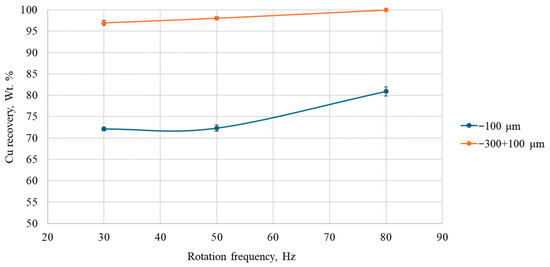
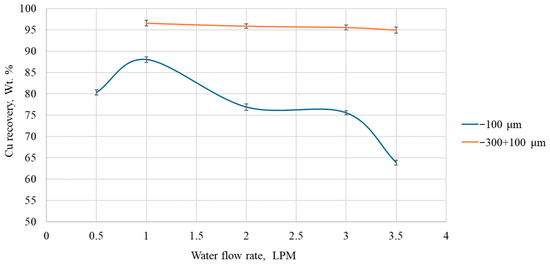
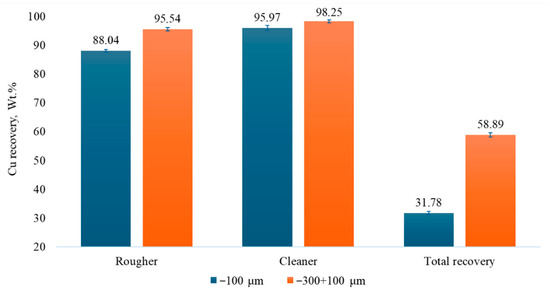
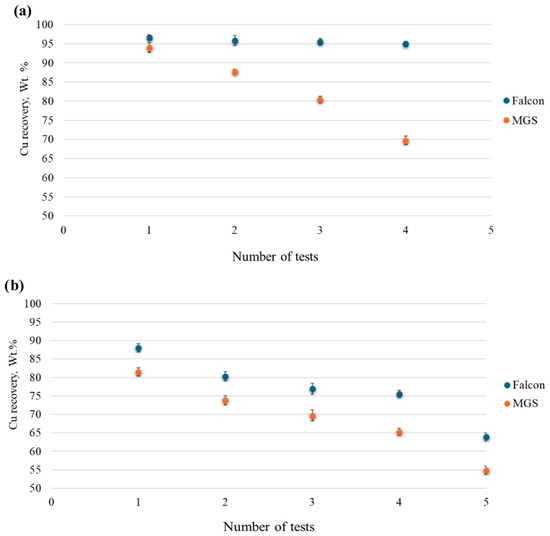
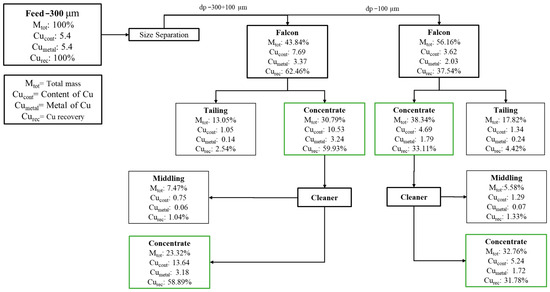
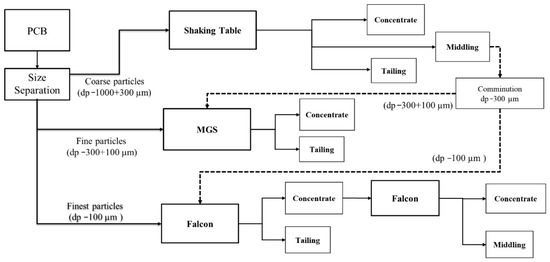
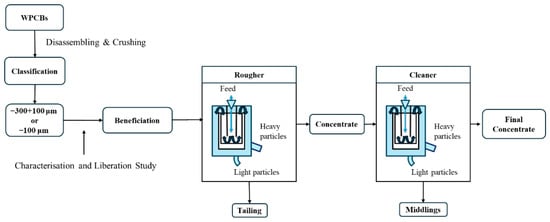
Waste printed circuit boards (WPCBs) account for approximately 3%–6% of electrical and electronic equipment (WEEE) and contain high concentrations of valuable metals such as copper, often at levels higher than those in natural ores. Consequently, WPCB recycling represents an important opportunity for resource recovery through urban mining and supports the transition toward a circular economy. This study investigates the application of a Falcon centrifugal concentrator for the gravity separation of metallic and non-metallic fractions from WPCBs, with a focus on fine particles below 300 μm. Despite its potential, this method has received little attention, particularly in research. Optimal operating conditions were identified as 80 Hz rotation frequency and 1 LPM water flow rate for particles −100 μm, and 30 Hz rotation frequency and 3 LPM water flow rate for particles in the −300 + 100 μm range. Under these conditions, copper recovery reached 98.25% with Cu content of 10.34% for the coarse fraction and 95.97% with Cu content of 4.47% for the fine fraction after a cleaner stage. The results demonstrate that Falcon gravity concentration is an efficient technique for recovering fine metallic particles and outperforms the multi-gravity separator (MGS). A sustainable beneficiation flowsheet is proposed to enhance metal recovery and reduce environmental impacts. Full article
Show Figures

Figure 1

Back to TopTop