


Journal Menu
► ▼ Journal MenuJournal Browser
► ▼ Journal BrowserNeed Help?
Announcements
28 May 2026
Journal of Risk and Financial Management | Interview with Prof. Dr. Thanasis Stengos–Event Chair of the 2nd International Online Conference on Risk and Financial Management: Revisiting AI and Machine Learning Techniques in Finance and Economics (IOCRF 2026)
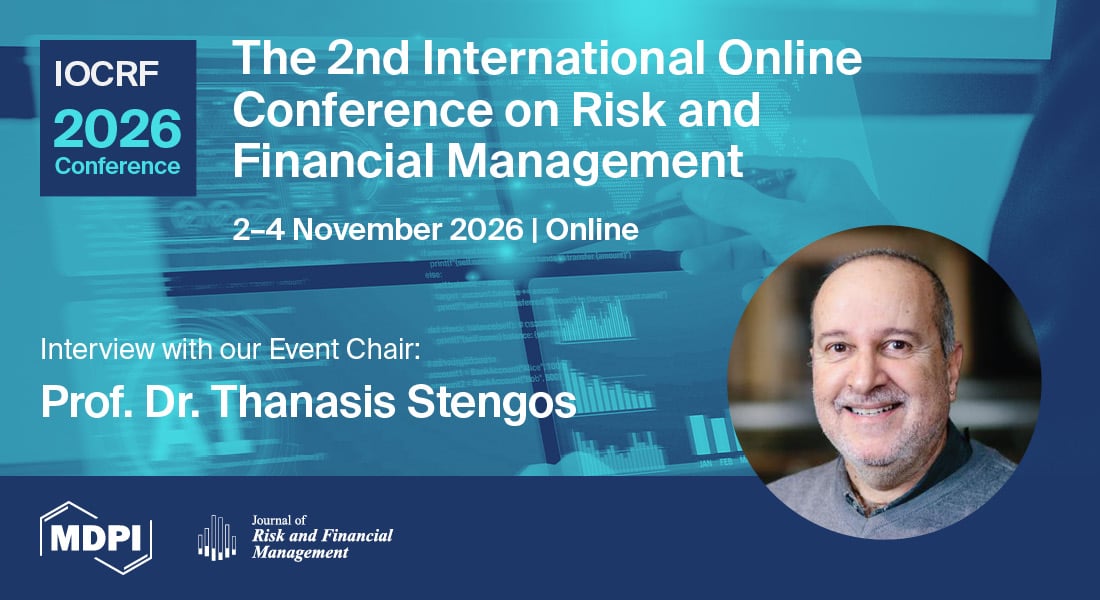
We recently had the opportunity to interview Prof. Dr. Thanasis Stengos, Event Chair of the 2nd International Online Conference on Risk and Financial Management: Revisiting AI and Machine Learning Techniques in Finance and Economics (IOCRF 2026), which will take place online from 2 to 4 November 2026.
In this interview, he shares insights into his research, the inspiration behind the conference theme, and the growing role of AI and machine learning in finance and economics. He also highlights the key benefits of attending IOCRF 2026, including access to emerging research, networking opportunities, and a collaborative environment for scholars at all career stages.
1. Could you please start by introducing yourself?
My name is Thanasis Stengos and I am a Professor at the University of Guelph, in Canada. My main research interests are in nonparametric methods and nonlinear modeling with applications in many areas of economics, including economic growth, empirical environmental economics and empirical finance, applied demand analysis and economic history. I joined the Department of Economics at the University of Guelph in 1984 and I have been a visitor at the London School of Economics, Queen's University, The European University Institute, the University of Cyprus, the University of Bologna at Rimini and Istanbul Bilgi University over the years. I have in many journals including the Review of Economic Studies, European Economic Review, International Economic Review, Economic Journal, Journal of Monetary Economics, Journal of Econometrics, The Review of Economic and Statistics, Journal of Applied Econometrics, Journal of Business and Economic Statistics and Journal of Economic Growth. I have served as in the editorial boards of many journals, and I am currently the Editor-in-Chief of JRFM and the Journal of Economic Asymmetries.
2. Could you introduce your current research direction and provide an update on your progress?
My current research focusses on investigating ways of combining models within a Model Averaging Framework to achieve predictive improvements in the context of contaminated data. In particular:
- Existing Model Averaging techniques use criteria that are only designed to work in the context of linear models and even there they do not account for data contamination that is prevalent in the main areas where these criteria have been applied, namely growth empirics;
- The introductions of certain types of nonlinear models, such as threshold and king regression models falls outside the scope of the standard existing methods and I am currently working in finding ways to deal with such an issue;
- The context of threshold type models within a data contamination framework will find a lot of use in empirical econometric applications, especially in economic growth and environmental and energy economics where the models lend themselves to nonlinear structures and are subject to measurement data errors.
3. Could you briefly reflect on the key opportunities that led you to pursue an academic career? Which experience has had the most profound impact on you?
The main reason behind pursuing an academic career is curiosity and the fact that research can lead one in many new and unsuspected directions. In addition, it is the opportunity to be in an environment that is intellectually vibrant and a constant source of being challenged at every stage of one’s career by peers and students alike. It is an environment that keeps you constantly on your toes trying to absorb the developments in your field that sometimes are occurring at extremely fast paces, especially in the last few years. Trying to keep up with the new technologies and methods and being able to use these to confront old problems, that before appeared to be insurmountably difficult to pursue, is one of the most rewarding experiences in academia.
4. What was the primary goal or inspiration for establishing this year's IOCRF theme?
IOCFM2026 offers a unique conceptual focus on research tools that will play a big role in future research in all fields. The developments in artificial intelligence and the attempts to fruitfully integrate them in theoretical models, applied approaches, and cross-disciplinary perspectives will shape how research is conducted in the future. The conference will bring together scholars working on different areas of applied economics and finance from diverse methodological perspectives creating a rare space for dialog. Moreover, the conference is closely connected to the Journal of Risk and Financial Management, which places a strong emphasis on the quality and methodological rigor of submissions, welcoming contributions even on complex or controversial topics, and prioritizing evidence-based evaluation over preconceived ideas.
5. Why should someone make the decision to attend IOCRF2026? What will they gain that they can't get elsewhere?
Attending the conference can provide several important benefits:
- An inclusive environment where different perspectives are welcomed, as long as they are grounded in methodological rigor and supported by empirical evidence;
- Access to new findings before they are published;
- Mentoring and networking for early career researchers and giving feedback and critical discussion, which often shape the next stages of a study;
- It is also important to emphasize that attending the conference is free, something that would be very attractive to young researchers who typically have no research support to finance conference participation from external grants and research support. This is especially true for participants from developing countries. It is worth noting that conference registration in conventional fees can run into the hundreds of dollars.
6. Do you have any message for the participants, young scholars, and future practitioners of IOCRF2026?
My hope is that IOCRF2026 will be a stimulating and collaborative environment where researchers at all career stages, but especially those in the early stages, feel encouraged to share, debate, and refine their ideas. I hope it will foster new collaborations, particularly international and interdisciplinary ones, and provide a supportive forum in which early career scholars can receive constructive feedback from more experienced colleagues.
7. Could you summarize your wishes and expectations for IOCRF2026 in a few words?
I hope that the conference offers an inclusive environment where different perspectives are welcomed, as long as they are grounded in methodological rigor and supported by empirical evidence in various diverse areas of finance and applied economics.
Introduction of IOCRF 2026
Conference date: 2–4 November 2026;
Deadline for abstract submission: 6 July 2026;
Deadline for registration: 27 October 2026;
Conference Chair: Prof. Dr. Thanasis Stengos (Department of Economics and Finance, University of Guelph, Canada).
For more details, please visit https://sciforum.net/event/IOCRF2026.
For any inquiries regarding the event, please contact iocrf2026@mdpi.com.
