




Conferences
Upcoming Journal Conferences (0)
No conferences found for the selection.Upcoming MDPI Conferences (4)

Shanghai, China
We invite you to submit your abstract and participate in the upcoming Symmetry 2027—The 6th International Conference on Symmetry, organized by MDPI Symmetry (ISSN 2073-8994, IF: 2.2). The conference will be held from 25 to 28 June 2027 in Shanghai, China.
We invite you to join us in Shanghai for what promises to be an enriching exchange of ideas and knowledge. Together, let us continue to unravel the mysteries of symmetry and its profound impact on our understanding of the natural world.
Event Chairs
Prof. Dr. Chengping Shen (Fudan University, China)
Prof. Dr. Jie Yang (Shanghai Jiao Tong University, China)
Prof. Dr. Sergei Odintsov (Institute of Space Sciences (IEEC-CSIC), Spain)
The Topics of Interest
S1. Particle Physics and Nuclear Physics
S2. Theoretical and Mathematical Physics, Astrophysics and Cosmology
S3. Computer Science, Artificial Intelligence and Interdisciplinary Applications
S4. General Topics in Symmetry
Important Dates
Deadline for Abstract Submission: 26 February 2027
Abstract Acceptance Notification: 25 March 2027
Deadline for Early Bird Registration: 17 April 2027
Deadline for Covering Author Registration: 24 April 2027
Guide for Authors
To submit your abstract, please click the following link:  .
.
To register for the event, please click the following link:  .
.
For details regarding abstract submission, poster and slide submission, and publication opportunities, please refer to the “Instructions for Authors” section: https://sciforum.net/event/symmetry2027?section=#instructions.
For more information, please click to the following link: https://sciforum.net/event/symmetry2027.
For any inquiries regarding the event, please contact icsymmetry@mdpi.com.
Please feel free to share information about this conference with your colleagues and students. We look forward to receiving your submissions and learning about your research at Symmetry 2027!
Hangzhou, China
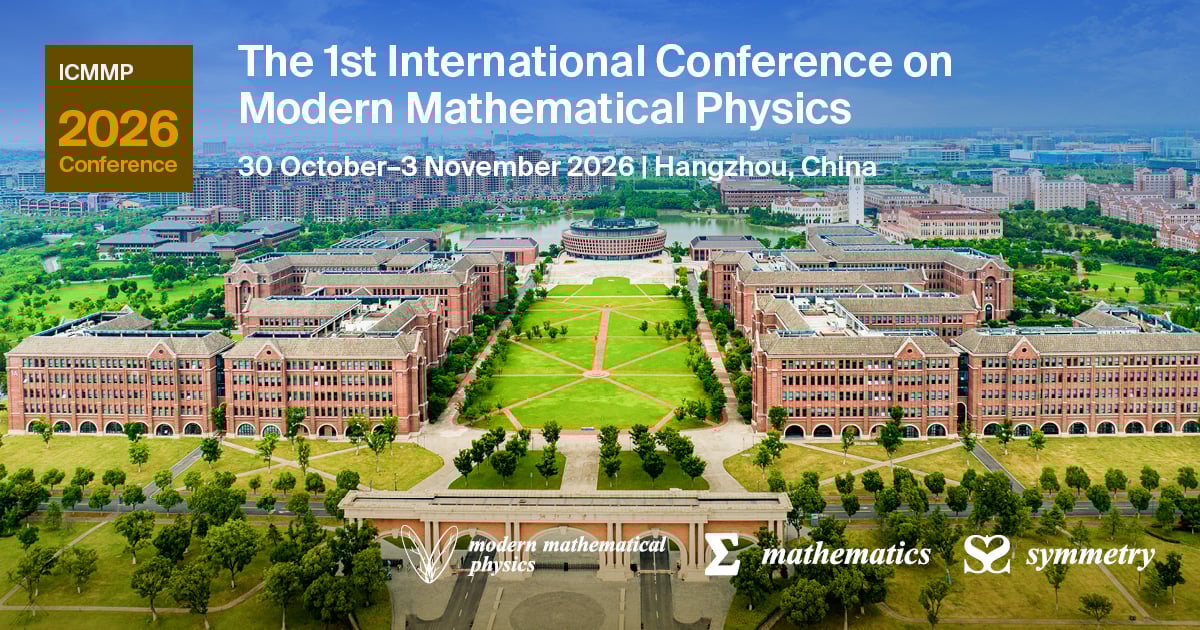
We would like to invite you to attend the 1st International Conference on Modern Mathematical Physics, jointly organized by the Institute for Advanced Study in Physics of Zhejiang University, the Innovation Academy for Precision Measurement Science and Technology of the Chinese Academy of Sciences, MDPI and MDPI's open access journals Modern Mathematical Physics (ISSN: 3024-5034), Symmetry (ISSN: 2073-8994, IF: 2.2) and Mathematics (ISSN: 2227-7390, IF: 2.3). We are also grateful for the support of the Commission on Academic Exchange of the Chinese Physical Society.
This event will take place from 30 October to 3 November 2026 in Hangzhou, China, and aims to bring together leading researchers and experts from around the world to explore the latest developments in modern mathematical physics.
Late Poster Submission
Researchers who missed the abstract submission deadline may still have the opportunity to present their work at ICMMP 2026 through the late poster submission option, which is currently open. We warmly welcome interested researchers to submit their poster abstracts through the submission system.
Submit here: https://sciforum.net/submissions/ICMMP2026/link/1
Honorary Chair
Prof. Dr. Changpu Sun, China Academy of Engineering Physics, Beijing, China
Executive Chairs
Prof. Dr. Haiqing Lin, Zhejiang University, Hangzhou, China
Prof. Dr. Xiwen Guan, University of Chinese Academy of Sciences, Wuhan, China
Prof. Dr. Murray Batchelor, Australian National University, Canberra, Australia
Chair of the Program Committee
Prof. JianXin Lu, University of Science and Technology of China, China
Plenary Speakers
Prof. Augusto Smerzi, Shenzhen Technology University (SZTU), China
Prof. Michael Berry, University of Bristol, UK
Prof. Piljin Yi, Korea Institute for Advanced Study, Korea
Prof. Thierry Giamarchi, University of Geneva, Switzerland
Prof. Yupeng Wang, Institute of Physics, Chinese Academy of Sciences, China
Keynote Speakers
Prof. Benjamin Doyon, King’s College London, UK
Prof. Chi-Ming Chang, Tsinghua University, China
Prof. Haiqing Lin, Zhejiang University, China
Prof. Murray Batchelor, Australian National University, Australia
Prof. Qiongyi He, Peking University, China
Prof. Roberta Citro, University of Salerno, Italy
Prof. Ruben Minasian, Université Paris-Saclay, France
Prof. Rudolf A. Roemer, University of Warwick, UK
Prof. Sameer Murthy, King’s College London, UK
Prof. Shizhong Zhang, The University of Hong Kong, China
Prof. Tomaz Prosen, University of Ljubljana, Slovenia
Prof. Urs Schreiber, New York University Abu Dhabi, UAE
Prof. Yunfeng Jiang, Southeast University, China
The Topics of Interest
S1. Quantum Field Theory, String & Brane Theory, and Gravitation
S2. Condensed Matter Physics and Statistical Physics
S3. Quantum Information and Quantum metrology
S4. Atomic, Molecular, and Optical Physics
S5. Nonlinear Dynamics and Computational Physics
Important Dates
Early Bird Registration Deadline: 26 September 2026
Covering Author Registration Deadline: 10 October 2026
Guide for Authors
To register for this event, please visit here: https://sciforum.net/registration/ICMMP2026
For details regarding abstract submission, poster submission, and publication opportunities, please refer to the “Instructions for Authors” Section: https://sciforum.net/event/ICMMP2026/instructions-for-authors
For any enquiries regarding this event, please contact icmmp2026@mdpi.com
We look forward to seeing you at the 1st International Conference on Modern Mathematical Physics.
Bucharest, Romania
Mark Your Calendars!
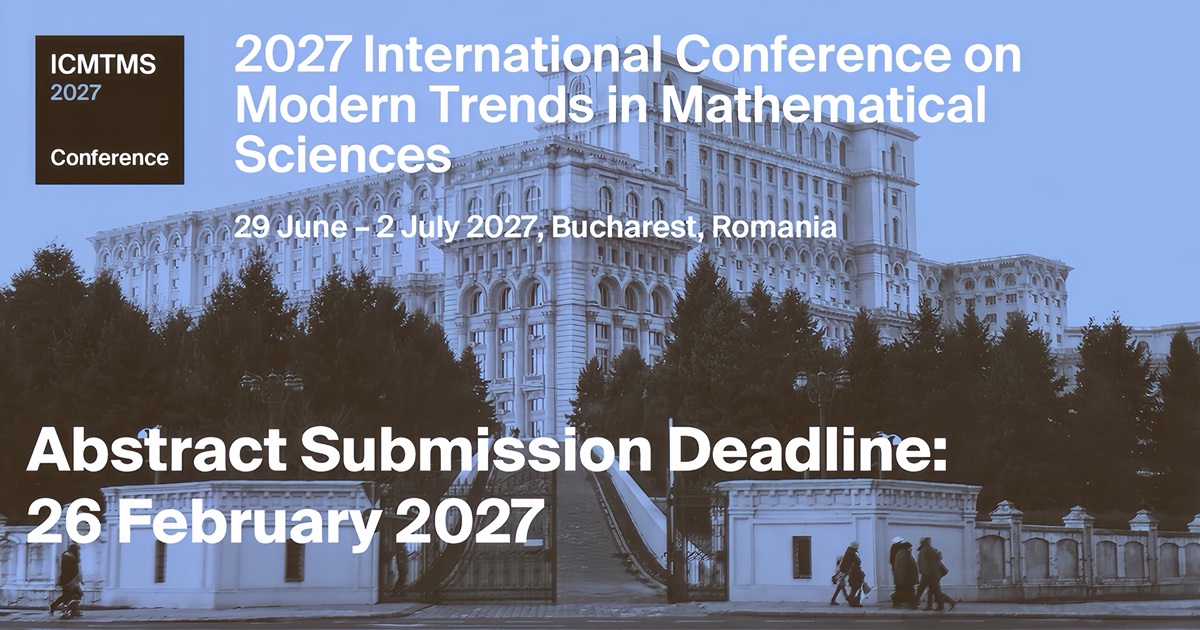
We invite researchers, academics, and professionals working in mathematics and its interdisciplinary applications to submit abstracts to the 2027 International Conference on Modern Trends in Mathematical Sciences (ICMTMS 2027), taking place from 29 June to 2 July 2027 in Bucharest, Romania.
Organized by MDPI and the open access journals Mathematics (ISSN: 2227-7390, IF: 2.3) and Axioms (ISSN: 2075-1680, IF: 1.5), this in-person conference will bring together leading researchers from around the world to discuss recent advances in mathematical sciences and their applications across diverse disciplines. ICMTMS 2027 aims to foster scientific exchange, collaboration, and innovation by connecting fundamental mathematical research with emerging interdisciplinary challenges.
Event Chairs
Prof. Dr. Francisco Chiclana, De Montfort University, UK
Prof. Dr. Michel Chipot, University of Zurich, Switzerland
Prof. Dr. Ion Mihai, University of Bucharest, Romania
Prof. Dr. Andrea De Gaetano, Italian National Research Council (CNR), Italy
Session Topics
S1. Algebra, Geometry, Topology, and Logic with Applications
S2. Mathematical Analysis
S3. Statistics and Operational Research
S4. Mechanics and Mathematical Physics
S5. Mathematics, Computer Science, and Artificial Intelligence
S6. Applied Mathematics
Abstract Submission
Do not miss this opportunity to present your latest research and engage with experts from across the mathematical sciences community.

Abstract Submission Deadline: 26 February 2027
Find out more about the instructions for authors here:
https://sciforum.net/event/ICMTMS2027/instructions-for-authors
Register Early!
Take advantage of early-bird registration rates and secure your place at this premier international gathering of mathematical scientists.

Early Bird Registration Deadline: 17 April 2027
Please feel free to share information about this conference with your colleagues, collaborators, and students.
We look forward to welcoming you to Bucharest, Romania, for four days of inspiring discussions, scientific exchange, and networking opportunities.
The Organizing Committee
2027 International Conference on Modern Trends in Mathematical Sciences (ICMTMS 2027)
icmtms@mdpi.com

Online
We cordially invite you to attend IOCFF 2027, a virtual event organized by MDPI Fractal and Fractional (ISSN: 2504-3110, Impact Factor: 3.5). It will take place online from 27 to 29 September 2027, CEST.
Conference Chair
Prof. Dr. Carlo Cattani, University of Tuscia, Italy
The Topics of Interest
S1. Advances in Fractional Calculus and Fractional Differential Operators
S2. Numerical and Computational Methods for Fractional Models
S3. Fractional Dynamics and Complex Systems
S4. Fractal Geometry, Complexity and Nonlinear Phenomena
S5. Fractional Calculus in Artificial Intelligence and Data Science
S6. Fractional Calculus in Engineering and Physical Sciences
Important Dates
Deadline for Abstract Submission: 24 May 2027
Notification of Acceptance: 28 June 2027
Deadline for Registration: 20 September 2027
Guide for Authors
To submit your abstract, please use the following link: 
To register for the event, please click on the following link: 
For details regarding Abstract Submission, Poster and Slide Submission, and Publication Opportunities, please refer to the “Instructions for Authors” section of the following website:
https://sciforum.net/event/IOCFF2027/instructions-for-authors
For any enquiries regarding the event, please contact iocff@mdpi.com.
We look forward to seeing you at IOCFF 2027.
Upcoming Partner Conferences (2)

Binghamton, NY, USA
The 2026 Conference on Complex Systems, a flagship international conference of the Complex Systems Society, will be held in Binghamton, New York, USA in October 2026. Binghamton possesses a long history of creativity and innovation. The Greater Binghamton area has historically been regarded as "the Valley of Opportunity", attracting influxes of immigrants (especially from Europe) since the mid-1800s, which has contributed to the region's rich and diverse culture and demographics. It is the birthplace of IBM (International Business Machines), Link Flight Simulator, McIntosh Laboratory, and a number of other pioneering ventures, fostering a spirit of ingenuity that continues to thrive. Located at the confluence of the Susquehanna river (one of the oldest rivers in the world) and the Chenango river, the region boasts stunning natural beauty and offers ample opportunities for outdoor recreation, from hiking and biking to fishing and kayaking. In particular, in mid-October, when CCS 2026 is held, one can witness the Binghamton area’s renowned and breathtaking fall foliage. Furthermore, a vibrant arts and culture scene flourishes here, with numerous galleries, theaters, and music venues providing enriching experiences. CCS 2026 will be held primarily in person on the main campus of Binghamton University, with an online participation option via Zoom.

Erice, Italy
The ESGCO meeting takes place every two years, gathering biomedical engineers together with physicists, physiologists and medical doctors in a highly interdisciplinary environment that is ideal for promoting the fields of cardiovascular and cardiopulmonary signal processing and system physiology within the biomedical community.
The theme of the ESGCO2026 conference will be "Complex Networks of Cardiovascular and Physiological Oscillations", encompassing a wide range of topics ranging from basic research of cardiovascular oscillations to the clinical application of cardiovascular and cardiorespiratory signals analysis tools. A challenge will be organized, focused on the characterization of cardiovascular and cerebrovascular control in patients with orthostatic intolerance.
Topics
- Network physiology;
- Cardiovascular, cardiorespiratory, cerebrovascular interactions;
- Brain–heart interactions;
- Heart rate variability;
- Cardiac dynamics;
- Linear and nonlinear time series analysis;
- Multivariate and multiscale modelling;
- Information theory;
- Complexity;
- Monitoring devices;
- Biomedical signal processing.
