


Encyclopedia 2026, 6(9), 203; https://doi.org/10.3390/encyclopedia6090203 - 15 Sep 2026
Viewed by 225
Abstract
►
Show Figures
Professional education asks learners to act under consequential uncertainty while judgment and professional identity are still developing. Scholarship on emotion, identity formation, reflection, psychological safety, ethics, and agency has expanded, yet these literatures seldom explain how affectively charged experience becomes accountable professional action.
[...] Read more.
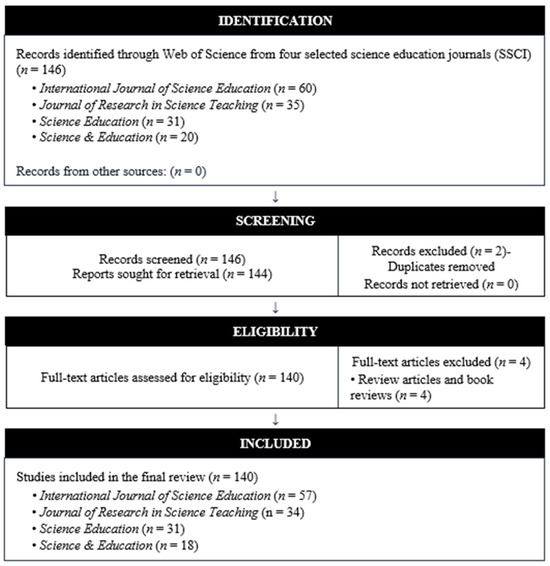
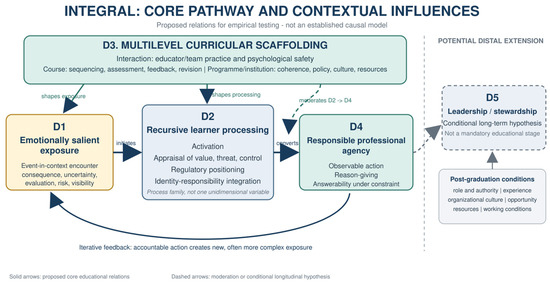
Professional education asks learners to act under consequential uncertainty while judgment and professional identity are still developing. Scholarship on emotion, identity formation, reflection, psychological safety, ethics, and agency has expanded, yet these literatures seldom explain how affectively charged experience becomes accountable professional action. This critical integrative review develops INTEGRAL (INTegrated Emotional Growth for Responsible Agency and Leadership), a cross-professional framework for health sciences and engineering education. A purposive, theory-led synthesis of 47 peer-reviewed sources was assembled through targeted searches, citation tracing, abductive construct comparison, negative-case analysis, and contrastive examination of two consequential professional fields; the retained corpus comprised 25 health-sciences sources, 13 engineering sources, and 9 cross-disciplinary, general-education, or methodological sources. Because the iterative search was not an exhaustive database export, no valid total-hit denominator was generated, and this reporting boundary is stated explicitly. INTEGRAL distinguishes event-in-context exposure (D1) from learner appraisal and identity-relevant processing (D2). Structured curricular scaffolding (D3) is specified as a multilevel configuration that shapes the exposure learners encounter, influences early processing, and moderates whether D2 becomes observable, reason-giving, accountable action under constraint (D4). Leadership and stewardship (D5) are repositioned as a conditional long-term extension rather than a mandatory stage. The framework is theoretical, identifies rival explanations and disconfirmation conditions, and derives testable propositions and multi-source indicators without treating adversity as inherently beneficial or emotional display as competence.
Full article
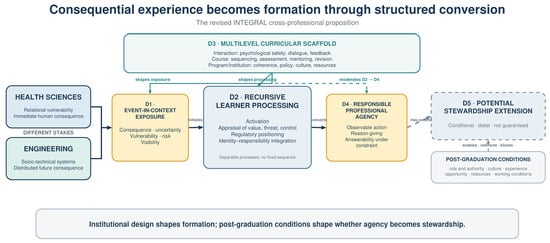
Graphical abstract