

Advances in Sustainable Feed for Livestock: Impacts on Nutrition and Food Quality

A special issue of Animals (ISSN 2076-2615). This special issue belongs to the section "Animal Nutrition".

Deadline for manuscript submissions: 31 March 2026 | Viewed by 984

Special Issue Editors


E-Mail Website
Guest Editor
Formative Sciences in Animal Husbandry and Food Industry Department, University of Agronomic Sciences and Veterinary Medicine of Bucharest, 59 Marasti Blvd., District 1, Bucharest, Romania
Interests: biotechnology; animal nutrition; food chemistry; food safety; food quality; meat; eggs; milk; broilers; layers; calf; nutrition; welfare

E-Mail Website
Guest Editor
Feed and Food Quality Department, National Research and Development Institute for Animal Biology and Nutrition, 077015 Balotesti, Romania
Interests: feed additives; by-products; bioactive compounds; polyphenols; antioxidant potential; nutritional quality; lipid quality of animal products; antioxidant status; food quality; poultry nutrition; functional foods
Special Issues, Collections and Topics in MDPI journals

E-Mail Website
Guest Editor
1. Faculty of Food Engineering, Stefan cel Mare University of Suceava, 720229 Suceava, Romania
2. Integrated Center for Research, Development and Innovation in Advanced Materials, Nanotechnologies, and Distributed Systems for Fabrication and Control (MANSiD), Ştefan cel Mare University of Suceava, 720229 Suceava, Romania
3. Mountain Economy Center (CE-MONT), “Costin C. Kiriţescu” National Institute of Economic Researches (INCE), Romanian Academy, 725700 Vatra Dornei, Romania
Interests: food rheology; food texture; antioxidant activity; food composition; bioactive compounds; functional foods; physical treatments
Special Issues, Collections and Topics in MDPI journals

Special Issue Information

Dear Colleagues,

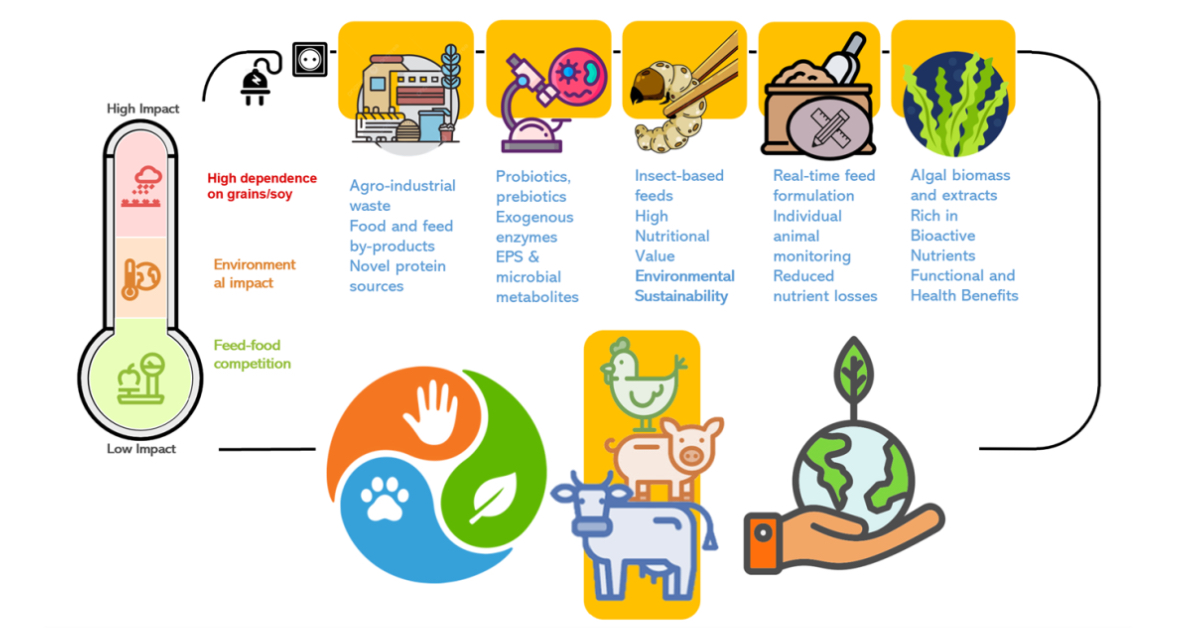
The global intensification of livestock production has raised urgent concerns regarding environmental sustainability, resource competition, and food system resilience. Feed, representing a significant input in animal agriculture, is actively shaping both the environmental footprint of production systems and the nutritional quality of animal-derived foods. Conventional feed ingredients, such as cereal grains and soybean meal, are increasingly criticized for their contribution to deforestation, land and water use, greenhouse gas emissions, and competition with human food resources. Importantly, the feed composition also influences the nutritional profile, functional properties, and safety of animal products.

In response, sustainable feeding strategies are gaining popularity, aiming to reduce the environmental impacts while maintaining or enhancing animal performance and the quality of animal products. Innovations include the use of alternative feed resources such as agro-industrial by-products, food chain co-products, microalgae, insect meal, and microbial biomass, along with precision nutrition approaches and circular economy models. The current developments are increasingly being supported by system-level tools, including lifecycle assessments, nutrient modeling, and omics-based analyses.

This Special Issue will highlight recent advances in sustainable livestock feed, focusing on novel ingredients, physiological responses, and the impacts on product quality. By integrating animal nutrition, environmental science, and the quality assessment of animal products, this collection aims to bring together multidisciplinary perspectives that support the transition toward more resilient, efficient, and health-conscious livestock systems. All types of papers related to the topic will be considered.

Dr. Daniela-Mihaela Grigore
Dr. Petru Alexandru Vlaicu
Dr. Mădălina Ungureanu-Iuga
Guest Editors

Manuscript Submission Information

Manuscripts should be submitted online at www.mdpi.com by registering and logging in to this website. Once you are registered, click here to go to the submission form. Manuscripts can be submitted until the deadline. All submissions that pass pre-check are peer-reviewed. Accepted papers will be published continuously in the journal (as soon as accepted) and will be listed together on the special issue website. Research articles, review articles as well as short communications are invited. For planned papers, a title and short abstract (about 250 words) can be sent to the Editorial Office for assessment.

Submitted manuscripts should not have been published previously, nor be under consideration for publication elsewhere (except conference proceedings papers). All manuscripts are thoroughly refereed through a single-blind peer-review process. A guide for authors and other relevant information for submission of manuscripts is available on the Instructions for Authors page. Animals is an international peer-reviewed open access semimonthly journal published by MDPI.

Please visit the Instructions for Authors page before submitting a manuscript. The Article Processing Charge (APC) for publication in this open access journal is 2400 CHF (Swiss Francs). Submitted papers should be well formatted and use good English. Authors may use MDPI's English editing service prior to publication or during author revisions.

Keywords

  • agro-industrial by-products
  • macroalgae
  • insect meal
  • microbial biomass
  • nutrition
  • feed
  • meat quality
  • egg quality
  • circular economy
  • environmental sustainability

Benefits of Publishing in a Special Issue

  • Ease of navigation: Grouping papers by topic helps scholars navigate broad scope journals more efficiently.
  • Greater discoverability: Special Issues support the reach and impact of scientific research. Articles in Special Issues are more discoverable and cited more frequently.
  • Expansion of research network: Special Issues facilitate connections among authors, fostering scientific collaborations.
  • External promotion: Articles in Special Issues are often promoted through the journal's social media, increasing their visibility.
  • Reprint: MDPI Books provides the opportunity to republish successful Special Issues in book format, both online and in print.

Further information on MDPI's Special Issue policies can be found here.

Published Papers (2 papers)

Order results
Result details
Select all
Export citation of selected articles as:

Research

16 pages, 286 KB  
Article
Fermented Rapeseed Meal Improves Growth Performance, Antioxidant Capacity, and Intestinal Morphology of Broilers by Enhancing Nutritional Value and Reducing Antinutritional Factors
by Yinghao Liu, Shuzhen Li, Xing Chen, Xinyi Zhai, Aijuan Zheng, Zhimin Chen, Jiang Chen, Zhiheng Zou and Guohua Liu
Animals 2026, 16(3), 429; https://doi.org/10.3390/ani16030429 - 29 Jan 2026
Viewed by 172
Abstract
This study evaluated changes in nutritional components and antinutritional factors in rapeseed meal before and after microbial fermentation. It further investigated the enhancements in its nutritional value and the growth-promoting effects of fermented rapeseed meal on broiler chickens. A total of 180 one-day-old [...] Read more.
This study evaluated changes in nutritional components and antinutritional factors in rapeseed meal before and after microbial fermentation. It further investigated the enhancements in its nutritional value and the growth-promoting effects of fermented rapeseed meal on broiler chickens. A total of 180 one-day-old male Arbor Acres (AA) broilers were randomly allocated into 3 treatment groups, with 6 replicates per group and 10 birds per replicate. The broilers were fed a basal diet (CON), a diet with 5% soybean meal (SBM) replaced by RSM (RSM-5), or a diet with 5% SBM replaced by FRSM (FRSM-5). The date of the experiment was 28 June 2025. The results showed that FRSM improves protein quality and reduces the levels of antinutritional factors, including glucosinolates (GSL), phytic acid (PA), and condensed tannins (CT), compared with unfermented RSM. Additionally, FRSM enhances antioxidant capacity in vitro, significantly enhancing the scavenging rates of 2,2-diphenyl-1-picrylhydrazyl (DPPH) radicals, hydroxyl radicals (•OH), and superoxide anion radicals (O2). In the broiler feeding trial, the FRSM-5 group had significantly higher average daily gain (ADG) during the periods of 22–42 d and 1–42 d (p < 0.05), along with a significantly lower feed to gain ratio (F/G) (p < 0.05), compared with the CON and RSM-5 groups. Compared to the CON group, the FRSM-5 group showed a significantly higher slaughter rate (SR), full eviscerated rate (FER), and breast muscle rate (BMR) (p < 0.05), whereas the RSM-5 group had significantly lower SR and FER (p < 0.05). The activities of glutathione peroxidase (GSH-Px), superoxide dismutase (SOD), and total antioxidant capacity (T-AOC) in the serum and liver of the FRSM-5 group were significantly higher than those in the CON and RSM-5 groups (p < 0.05), and the serum immunoglobulin (IgA, IgG, and IgM) levels were significantly elevated (p < 0.05). Furthermore, compared with the CON and RSM-5 groups, the FRSM-5 group exhibited a significant increase in duodenal villus height (VH) (p < 0.05), a significant reduction in duodenal crypt depth (CD) (p < 0.05), and a consequent significant increase in the VH/CD (p < 0.05). In conclusion, microbial fermentation effectively enhances the nutritional value of RSM by improving its nutrient composition and reducing antinutritional factors. Replacing 5% SBM with FRSM in broiler diets significantly improves growth performance, enhances antioxidant capacity and immune function, and optimizes intestinal morphological structure, thereby replacing part of the soybean meal in broiler diets. Full article
27 pages, 912 KB  
Article
Grape Stalks as a Sustainable Feed Supplement for Dairy Cows: A Preliminary In Vivo Study on Milk Microbiota and Cheese Quality
by Giulia Dallavalle, Giorgia Secchi, Andrea Mancini, Nicola Cologna, Urska Vrhovsek, Andrea Angeli, Eugenio Aprea, Jessica Zambanini, Pavel Solovyev, Luana Bontempo, Emanuela Betta, Franco Biasioli, Thomas Zanon and Elena Franciosi
Animals 2026, 16(3), 388; https://doi.org/10.3390/ani16030388 - 26 Jan 2026
Viewed by 289
Abstract
In the Trentino Alto Adige region, disposal of grape stalks (GS) represents a major cost for wineries, despite their content of phenolic and tannin-rich compounds with potential functional value in ruminant nutrition. This study evaluated whether dietary GS supplementation could influence milk microbiota [...] Read more.
In the Trentino Alto Adige region, disposal of grape stalks (GS) represents a major cost for wineries, despite their content of phenolic and tannin-rich compounds with potential functional value in ruminant nutrition. This study evaluated whether dietary GS supplementation could influence milk microbiota and cheese quality, supporting local circular-economy strategies. GS from three red cultivars (L-GS, CS-GS, M-GS) were dried, milled, and assessed for safety; their average total polyphenol content was approximately 15 g/kg DM. 3 Holstein cows underwent a 7-week trial consisting of alternating control (CTRL) and GS-supplemented periods (2% DM). Weekly milk samples (n = 21) and corresponding mini-cheeses (n = 21) were analyzed. GS supplementation did not affect milk coliforms (2.3–2.5 log CFU/mL), while total mesophilic counts were significantly lower in M-GS (2.8 ± 0.46 log CFU/mL) than in CTRL (4.5 ± 0.71; p < 0.05). Acinetobacter dominated the milk microbiota but decreased from 34.0% in CTRL to 18.0% in L-GS. Cheese total polyphenols were highest in CS-GS (224 ± 34 mg/kg). 1H-NMR and VOCs profiling indicated cultivar-dependent shifts in carbohydrate-related metabolites and short-chain fatty acids. Overall, GS supplementation subtly modulated cheese biochemical and aromatic traits without impairing technological performance, supporting the valorization of winery by-products within integrated dairy-viticulture systems. Full article
Show Figures

Figure 1

Back to TopTop