

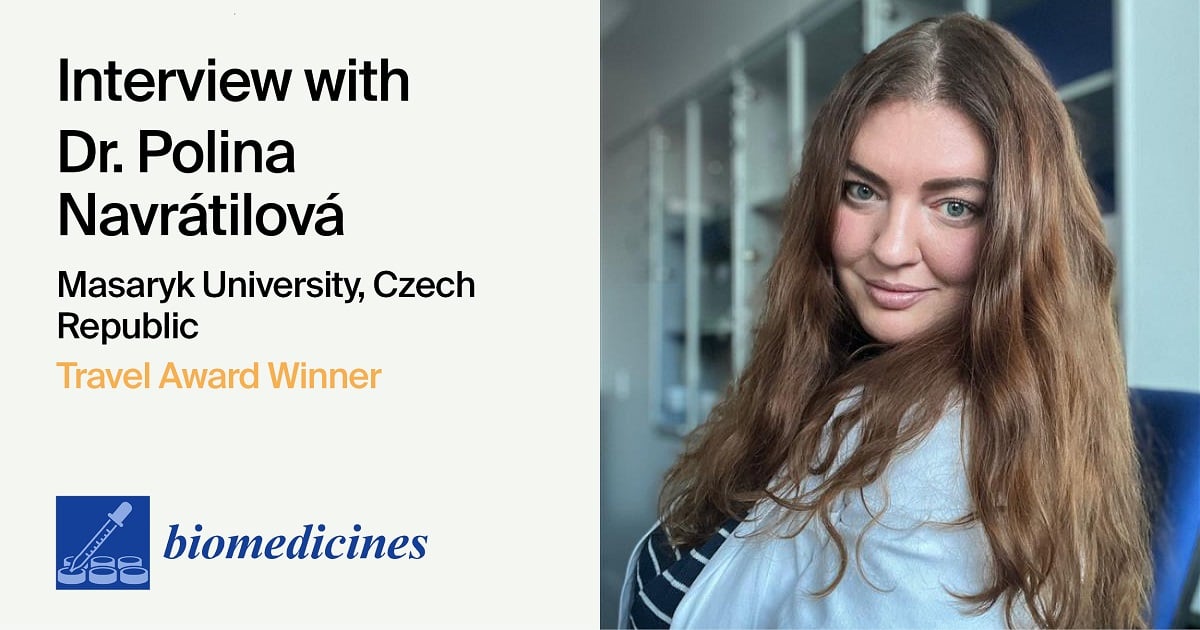
Interview with Dr. Polina Navrátilová—Winner of the Biomedicines Travel Award
The journal Biomedicines (ISSN: 2227-9059) is proud to present the winner of the Biomedicines 2026 Travel Award—Dr. Polina Navrátilová.
Dr. Polina Navrátilová is a researcher at the Faculty of Medicine of Masaryk University, where her research focuses on cellular responses to metal nano- and microparticles released from orthopaedic implants. Her work primarily addresses the local biological effects of metallic debris on surrounding tissue cells (osteoblasts and chondrocytes), as well as changes in the behavior of immune cells, especially macrophages, when exposed to foreign particles.
She defended her PhD thesis in pathological physiology in 2025. In her dissertation, she demonstrated the cytotoxic properties of implant-derived metallic debris and, further, showed that certain metals, such as molybdenum, may exert beneficial effects on immune activity and support tissue healing.
Currently, she is continuing this line of research, with an emphasis on developing strategies to mitigate the cytotoxicity of implant-derived metal particles and ions. Her present work explores the use of targeted supplementation approaches aimed at limiting the intracellular uptake of toxic metals and thereby reducing the associated biological risks for patients with orthopaedic implants.
An interview with Dr. Polina Navrátilová can be found below:
1. How did you feel after winning this award?
I was incredibly happy that the expert committee recognized my work and that I was selected as the recipient of the Biomedicines Travel Award. I am really excited to use this support to participate in one of the largest European conferences focused on biomaterials research.
2. Which conference do you plan to attend with this award? How do you expect attending this conference to expand your international collaboration or enhance your academic influence?
Thanks to this award, I plan to attend the 35th Annual Conference of the European Society for Biomaterials, which will take place in September 2026 in Antwerp, Belgium. For me, as an early career researcher, it is both a great opportunity and an honor to be able to present my work to leading experts in the field.
The European Society for Biomaterials represents a large and active scientific community, and I look forward to meeting its members. I hope that participating in this conference will help me establish new international collaborations and strengthen connections between researchers working on biomaterial design and fabrication and those in the biological and clinical sciences. Such interdisciplinary cooperation is essential for advancing the field, including areas such as implantology.
3. As a winner, how do you view the role of open access journals (such as Biomedicines) in academic communication? Would you consider reviewing or contributing to Biomedicines in the future?
From my perspective, open access journals are essential today, as they enable researchers to share their findings and progress with a broad scientific community. One of the main challenges, however, is the financial aspect. Not all institutions are able to support open access publishing, which can limit the selection of journals that authors can realistically consider for their work.
Nevertheless, I see open access as a highly valuable tool for transparent and accessible academic communication, and I would certainly consider contributing to or reviewing for such journals in the future.
4. Do you have any other suggestions on how academic journals and publishers can further support young researchers and academics?
I really appreciate that MDPI offers prizes such as the Travel Award and Best Thesis Award. For young researchers, this kind of recognition is highly motivating and confirms that their work is valued within the scientific community. It can help strengthen their enthusiasm and encourage them to continue pursuing their research goals.
In addition, I believe that journals and publishers can further support early career scientists by promoting, for example, mentorship opportunities, reviewer training programs, and expanded networking platforms and events that connect young researchers with established scientists, industry partners, and interdisciplinary collaborators.
5. Would you like to share a few words for the journal?
I would like to sincerely thank Biomedicines and MDPI for this award and for their ongoing support of early career researchers, both academically and financially.