
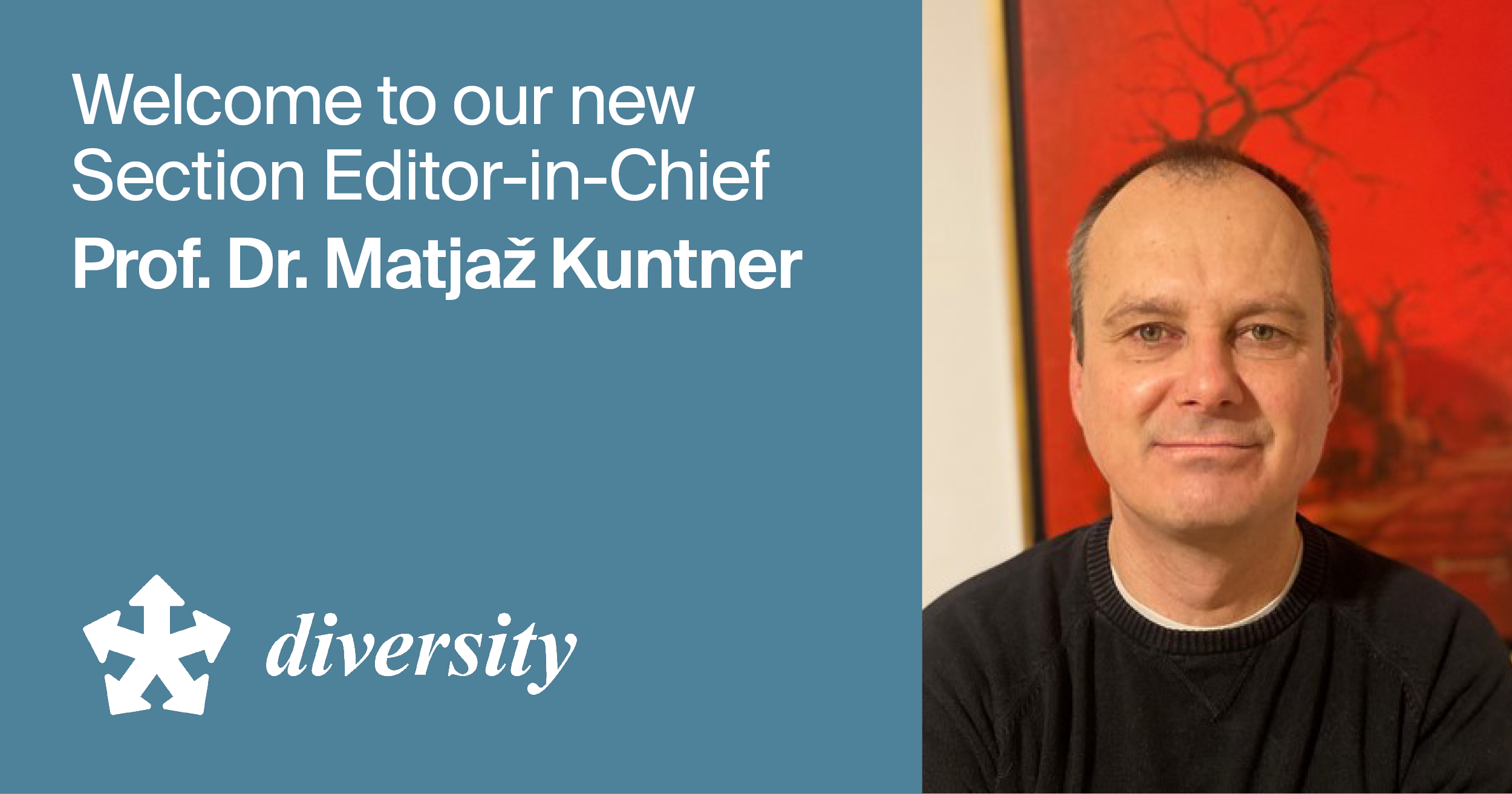
Prof. Dr. Matjaž Kuntner Appointed Section Editor-in-Chief of Section “Phylogeny and Evolution” in Diversity
We are pleased to announce the appointment of Prof. Dr. Matjaž Kuntner as the new Section Editor-in-Chief of the “Phylogeny and Evolution” Section in Diversity (ISSN: 1424-2818).
Prof. Dr. Matjaž Kuntner is a senior research scientist at the National Institute of Biology and at the Research Centre of the Slovenian Academy of Sciences and Arts (ZRC SAZU), both in Slovenia, Professor of Zoology at the University of Ljubljana (Slovenia), a research associate at the Smithsonian Institution (USA), and a visiting professor at Hubei University (China). He mentors graduate students in Slovenia and China. Prof. Dr. Kuntner is the author of 180 scientific publications and serves as the Editor-in-Chief of Frontiers in Arachnid Science and as a Section Editor-in-Chief of Diversity.
The following is a short Q&A with Prof. Dr. Matjaž Kuntner, who shared his vision for the journal with us as well as his views on the current state of the field:
1. Could you briefly introduce your main research areas and achievements?
My research focuses on spider systematics, ranging from targeted species discovery and integrative taxonomy to phylogenetic analyses of morphological, behavioral, and molecular data, as well as biogeographic and phylogeographic analyses and phylogenomics. I also investigate interspecific and intraspecific (intersexual) coevolutionary patterns and their drivers, with an emphasis on interactions between sexual and natural selection in spiders, for example through studies of the causes and evolutionary consequences of extreme sexual size dimorphism, web gigantism, sexually antagonistic behaviors and morphologies, and kleptoparasitism. In addition, I study spider ecology, species and clade distributions, biotic responses to global change, and the utility of DNA barcoding as a tool for species and higher-taxon identification.
2. What appealed to you about the journal that made you want to take on the role of Section Editor-in-Chief?
I have worked with Diversity over the past several years, and as a strong proponent of open access publishing and rapid scientific dissemination, I fully support this publishing model. Among the journal’s many Sections, the one most closely aligned with my expertise is “Phylogeny and Evolution”.
3. What is your vision for the journal and the Section?
My vision for Diversity and, in particular, for the “Phylogeny and Evolution” Section is to further strengthen its role as a rigorous, integrative, and inclusive platform for evolutionary research across scales of biological organization. I see the Section as a venue that actively promotes modern evolutionary thinking by welcoming studies that combine morphology, behavior, ecology, genomics, and biogeography, as well as methodological and conceptual advances in phylogenetics and comparative biology.
I would like the Section to encourage hypothesis-driven research, robust data integration, and transparent analytical workflows, while remaining open to both empirical and theoretical contributions. Importantly, I see a strong potential for Diversity to further position itself as a forum for biodiversity-relevant evolutionary research that informs taxonomy, conservation, and our understanding of global change. Maintaining high scientific standards, efficient editorial handling, and constructive peer review will be central to achieving this goal.
4. What do you think of the development of open access in the publishing field?
I view the development of open access publishing as one of the most important and positive transformations in modern science. Open access greatly enhances the visibility, accessibility, and societal impact of scientific research, allowing results to reach not only specialists but also researchers in resource-limited settings, decision-makers, educators, and the broader public.
At the same time, the continued success of open access depends on maintaining rigorous editorial standards, transparency, and fairness in peer review, as well as on responsible publishing practices by journals and publishers alike. When implemented well, open access accelerates scientific progress, fosters collaboration, and aligns scientific publishing with the principles of openness and reproducibility. I therefore strongly support this model and see Diversity as playing an important role in shaping its future development.
We wish Prof. Dr. Matjaž Kuntner every success in his new position, and we look forward to his contributions to the journal.