Article

Towards Net-Zero Coastal Homes: Techno-Economic Optimization of a Hybrid Heat Pump, PV, and Battery Storage System in a Deeply Retrofitted Building in Poland

by
Krzysztof Szczotka
Department of Power Systems and Environmental Protection Facilities, Faculty of Mechanical Engineering and Robotics, AGH University of Krakow, al. A. Mickiewicza 30, 30-059 Krakow, Poland
Sustainability 2026, 18(7), 3618; https://doi.org/10.3390/su18073618
Submission received: 18 February 2026 / Revised: 31 March 2026 / Accepted: 3 April 2026 / Published: 7 April 2026

Abstract

The decarbonization of the residential sector is a critical component of the European Green Deal, particularly in transition economies like Poland. This study proposes a comprehensive techno-economic optimization of a deeply retrofitted single-family house aiming for net-zero energy building (NZEB) status. The research specifically focuses on the Polish coastal climate zone, characterized by distinct humidity, wind, and temperature profiles compared to inland regions, which significantly influence the efficiency of air-to-water heat pumps (ASHP). Based on a real-world energy audit, the study simulates the synergy between a deep thermal envelope upgrade and a hybrid system comprising an ASHP, photovoltaics (PV), and battery energy storage (BES). This paper presents a detailed economic analysis of such hybrid systems under the new Polish ‘net-billing’ prosumer mechanism. The study evaluates the impact of electricity tariff structures (flat-rate G11 vs. time-of-use G12w) on the investment’s profitability. By calculating key performance indicators—including the levelized cost of energy (LCOE), net present value (NPV), and self-sufficiency ratio (SSR)—the research assesses various system configurations. The initial evaluation indicates that while deep retrofitting significantly reduces heating demand, integrating battery storage plays a critical role in enhancing economic returns under the net-billing framework. The analysis demonstrates that the optimized hybrid system (9.0 kWp PV + 10 kWh BESS) achieves an average annual self-sufficiency ratio (SSR) of 49.8% and reduces the non-renewable primary energy (EP) indicator to 0.0 kWh/(m2·year). Economically, the investment yields a positive NPV of €3194, an IRR of 5.25%, and a LCOE of €0.184/kWh, which is 34% lower than projected grid prices. Furthermore, switching to a time-of-use tariff (G12w) generates an additional 11% (€139) in annual savings. These quantitative findings provide actionable guidelines for policymakers and investors, confirming the financial viability and environmental benefit (annual reduction of 6.12 MgCO2) of NZEB standards in coastal areas.

1. Introduction

In the face of the escalating climate crisis, the European Union has set an ambitious energy transformation path, underpinned by the “Fit for 55” legislative package and the overarching goal of achieving climate neutrality by 2050 [1]. A key area of this transformation is the decarbonization of the building stock, which accounts for approximately 40% of final energy consumption and 36% of greenhouse gas emissions across Europe. In the specific context of central and eastern Europe, and particularly in Poland, this issue takes on special significance. For years, Poland has struggled with low-stack emissions and the phenomenon of smog, primarily generated by inefficient heating systems in the single-family housing sector. Retrofitting these facilities toward net-zero energy buildings (NZEB) [2,3,4] standards is no longer merely an ecological concern but has become a social and economic imperative, essential for improving air quality and ensuring the energy security of citizens. In countries like Poland, where the energy mix structure is still evolving, and the residential sector relies heavily on solid fuels, decarbonization through the electrification of heating using renewable energy sources (RES) is becoming the only viable path to achieving energy sovereignty and climate neutrality.
The efficiency of low-emission technologies is inextricably linked to local climatic conditions, which, in the case of the Polish coast, exhibit unique characteristics compared to the rest of the country. Coastal areas are characterized by a specific outdoor temperature profile determined by the thermal inertia of the Baltic Sea [5]. From the perspective of operating ASHP, a key advantage is the lower frequency of extremely low temperatures (below −10 °C) compared to southern and eastern regions of Poland. A higher average temperature during the heating season allows for higher seasonal coefficients of performance (SCOP). Nevertheless, designing energy systems in this region must account for challenges such as high relative humidity, increased atmospheric corrosivity, and significant windiness. For instance, recent studies conducted in central Poland report average residential SCOP values ranging from 3.2 to 3.8 for modern air-source heat pumps. Furthermore, Zimny et al. [6] demonstrated that hybrid systems in modernized educational buildings can reduce final energy consumption for heating by over 50% compared to traditional boilers. Strong wind impact intensifies heat losses through transmission and infiltration, making deep thermal retrofitting of the building envelope a critical prerequisite for the effective operation of hybrid systems. For instance, recent studies by Mbuwir et al. [7] and Schito et al. [8] emphasized how proper building envelope characteristics directly dictate the optimal control and economic viability of heat pumps [6,7,8].
A crucial and often overlooked factor in the literature determining the efficiency of low-emission systems is the specificity of local microclimates. Coastal areas possess a unique thermal load profile. On one hand, relatively mild winters resulting from the proximity of the sea theoretically favor ASHP operation by preventing frequent temperature drops below the compressor’s critical operating point. On the other hand, these regions are exposed to intense forced convection caused by strong winds, which radically increases heat losses through transmission and infiltration, correlating significantly with the building’s heating power demand. Additionally, the high relative humidity of marine air creates specific operational challenges for the external units of heat pumps. Evaporator frosting occurs more intensely in high humidity conditions at temperatures near zero, necessitating more frequent defrosting cycles [9]. These processes not only lower the SCOP but also affect the durability of mechanical components and the thermal stability of the building, requiring precise energy modeling during the system design phase [10].
Contemporary scientific literature extensively analyzes the synergy between photovoltaic systems and heat pumps in the Polish economic reality, especially in the context of the transition from “net-metering” to “net-billing” for prosumers. Many studies focus on optimizing energy self-consumption through the use of thermal or battery energy storage (BES). Despite this, a significant research gap is noticeable in the current state of knowledge. Most analyses are based on averaged meteorological data for a typical meteorological year (TMY) for Warsaw or regions with a continental climate, ignoring the specificities of the coastal zone. Furthermore, there is a lack of comprehensive studies linking radical improvements in building envelope insulation (deep retrofitting) with full techno-economic optimization (LCOE, NPV) under the new legal and tax regime [11]. There is, therefore, a pressing need to verify whether—and in what configuration—investment in the net-zero standard is economically justified under the conditions of the Polish coast.
Furthermore, a critical but often underreported consequence of deep thermal retrofitting is the paradigm shift in a building’s energy balance. As transmission and infiltration heat losses are minimized to near-passive standards, the relative share of thermal loads drops significantly. Consequently, electrical loads—particularly built-in lighting and auxiliary systems—emerge as the dominant factors in the final energy demand. Anticipating this shift is crucial, as it directly dictates the sizing and operational strategy of the battery energy storage system (BESS) required to cover evening peak loads. The literature indicates that in temperate climates like Poland, the key challenge remains the seasonal mismatch between the PV generation profile and the heat demand profile. Research conducted by national scientific centers has so far focused mainly on the net-metering system, which treated the power grid as a highly efficient virtual energy storage. The introduction of the net-billing system in 2022, based on market energy prices, radically changed the profitability paradigm, shifting the focus toward maximizing self-consumption. In this context, the role of stationary battery energy storage and demand side management is becoming a subject of intense analysis [12,13,14,15,16]. Lützkendorf et al. [12] and Wei et al. [13] outlined the broader requirements for residential NZEBs, whereas more recent studies by Nassar et al. [14] and, specifically, Zdyb et al. [16] reported that self-consumption in Polish households with PV and heat pumps typically oscillates between 20% and 30% when no physical battery storage is present. Moreover, Kurz et al. [15] estimated the levelized cost of energy (LCOE) for residential grid-tied PV-only systems in Poland at approximately €0.10–€0.14/kWh. While these studies provide essential baselines, they primarily focus on continental climate zones, leaving a gap for coastal-specific techno-economic evaluations where microclimatic cooling of PV modules may alter these financial benchmarks [16].
While recent literature extensively covers PV and heat pump integration, a critical comparison of these studies reveals that a significant research gap remains unresolved in three key aspects:
  • Although authors such as Zdyb et al. [16] and Kurz et al. [15] have modeled PV+HP profitability in Poland, their optimizations predominantly rely on typical meteorological years for central inland locations like Warsaw (climate zone III). These models systematically overlook the specific coastal belt (zone I), where higher relative humidity and distinct temperature profiles significantly alter heat pump defrosting cycles. Furthermore, existing frameworks rarely account for the severe wind exposure characteristic of the Baltic coast, which drastically increases infiltration heat losses in older building envelopes [3,17,18,19].
  • While the shift to the value-based net-billing mechanism has been acknowledged in recent policy analyses [17], its interaction with multi-zone electricity tariffs (e.g., G12w) in a deeply modernized scenario remains underexplored. Current techno-economic models focus heavily on flat-rate profitability, failing to parameterize the complex interactions between dynamic energy price fluctuations, advanced Battery Energy Storage System (BESS) operation, and the high thermal inertia of a retrofitted building envelope in the Polish coastal zone [19].
  • While numerous authors have explored optimization technique—ranging from economic model predictive control [20,21,22] to the role of economic incentives in NZEB spread [23] and socio-techno-economic sizing of hybrid renewable systems [24,25]—most of these models and regional transition pathways [26,27,28] are generic and lack specific integration with deep thermal retrofitting parameters under the unique coastal climate constraints. Numerous studies, including those by Eksi et al. [27] and Chae et al. [29], successfully analyze heating systems and PV sizing for newly constructed low-energy buildings. However, there is a distinct lack of comprehensive research applying these optimizations to deeply retrofitted existing buildings under the new tariff regime. This distinction is critical, as applying sizing algorithms designed for new buildings to retrofitted structures often leads to oversized RES capacity, generating unjustified capital expenditures (CAPEX) and lowering the net present value [30,31].
Contemporary scientific discourse in the field of energy engineering and sustainable construction places particular emphasis on the synergy of renewable technologies to minimize the operational emissions of buildings. The integration of air source heat pumps with photovoltaic systems has been widely documented as an effective decarbonization method; however, its economic viability is strictly dependent on local regulatory frameworks and energy price dynamics [9,14,30,31,32,33,34,35].
This study fills this gap by providing precise techno-economic analyses (TEA) [36,37,38,39] that integrate the specific meteorological conditions of the Baltic Sea region with the new market reality for prosumers in Poland. To address the identified research gaps, this paper provides the following novel contributions to the state-of-the-art:
  • Unlike standard analyses relying on averaged continental data (e.g., Warsaw), this study quantifies the specific techno-economic impact of the Baltic coastal climate on renewable systems. It highlights how high wind exposure, specific humidity, and milder winter temperatures distinctly affect both the seasonal coefficient of performance of air-source heat pumps and the convective cooling of PV modules [36,37].
  • The study expands the current literature by providing a full techno-economic assessment (employing NPV, IRR, and LCOE) that integrates deep thermal retrofitting with the precise sizing of a hybrid PV and battery energy storage system. This optimization is specifically adapted to the market-based “net-billing” settlement mechanism introduced in Poland in 2022, shifting the focus from net-metering volume balancing to value-based self-consumption [38].
  • The research advances the state-of-the-art by parameterizing the interaction between dynamic energy price fluctuations, BESS operation, and a highly insulated building envelope. It provides a targeted sensitivity analysis demonstrating the economic superiority of time-of-use (G12w) over flat-rate (G11) tariffs for shifting heat pump and lighting loads [39].
This article aims to address the aforementioned gap by conducting a multi-criteria techno-economic optimization of a deeply retrofitted single-family house located in the Polish coastal belt. The primary objective of this research is to evaluate a highly viable configuration of a hybrid system consisting of an air source heat pump, a PV installation, and battery energy storage for a specific case study, striving to achieve a net-zero balance. The analysis includes a comparison of various tariff structures and an investment profitability assessment using advanced financial indicators. By focusing on a representative, deeply retrofitted single-family home, the research findings are intended to offer contextualized insights. Rather than identifying a universal optimal solution for the entire building stock, this study demonstrates a potential decarbonization pathway for similar residential buildings operating under the specific climatic and market conditions of the Polish coastal zone [40,41].

2. Case Study Description and Technical-Energy Analysis

2.1. Technical Characteristics of the Investigated Facility

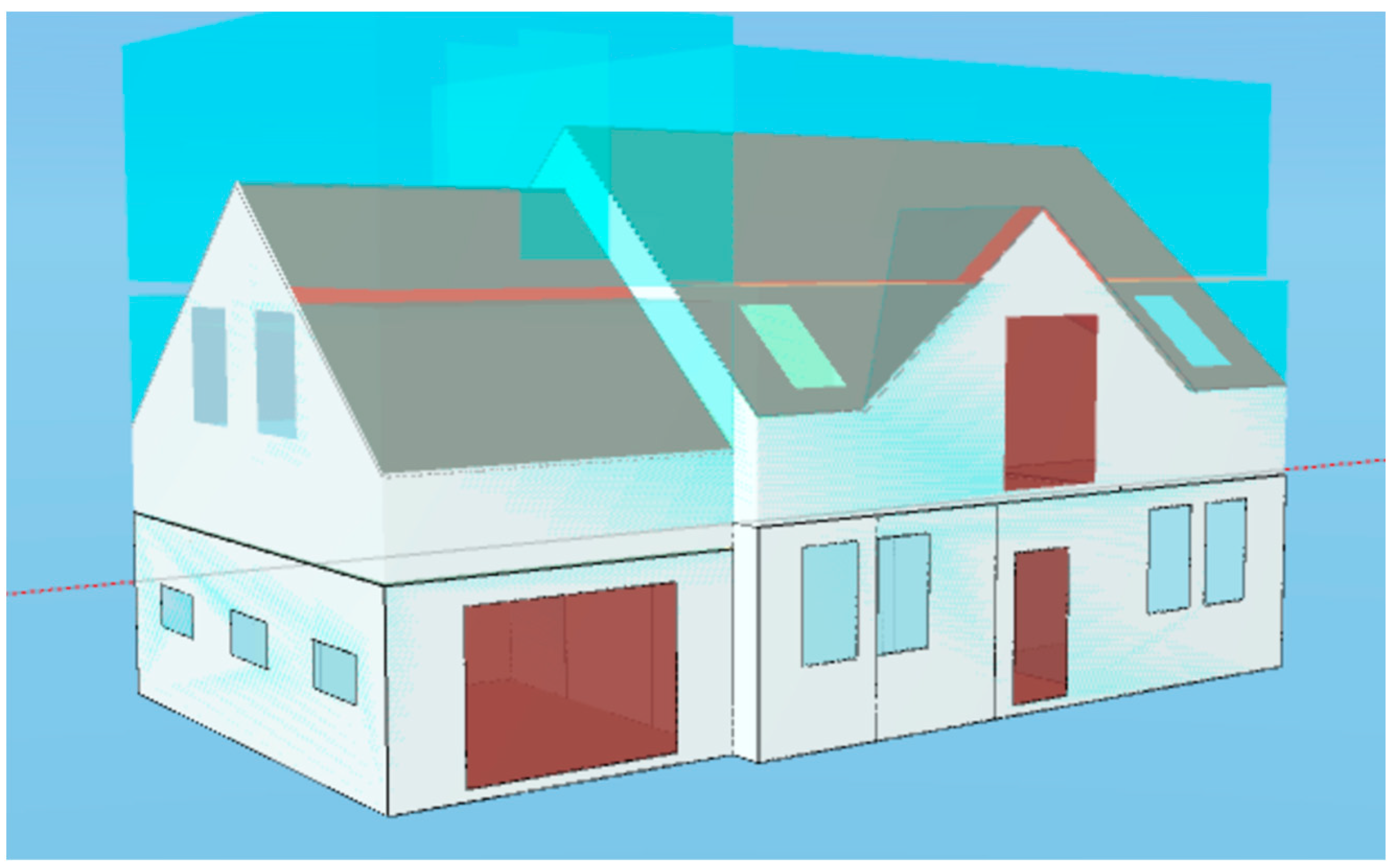
The subject of the analysis is a single-family residential building located in Kołobrzeg (Figure 1), representing the Polish coastal climate zone (zone I) [41,42]. The facility is characterized by a heated floor area Af = 234.0 m2 and a heated volume Vf = 590.5 m3. The building has undergone deep thermal retrofitting, which enabled it to achieve envelope insulation parameters that exceed the current Polish technical requirements (WT2021 standards).
Key technical specifications of the building envelope are presented below [41,42,43]:
  • External walls: Constructed using MAX220-type ceramic hollow blocks (0.25 m) with a 0.18 m mineral wool insulation layer λ = 0.032 W/m·K, resulting in a heat transfer coefficient of U = 0.156 W/m2·K (compared to the UmaxWT2021 = 0.20 W/m2·K requirement).
  • Roof: Insulated with 0.30 m of glass wool λ = 0.032 W/mK, resulting in a U-value of U = 0.109 W/m2·K (compared to the UmaxWT2021 = 0.15 W/m2·K requirement).
  • Floor on ground: Featuring a 0.12 m rock wool insulation layer λ = 0.032 W/m·K, providing U = 0.179 W/m2·K (compared to the UmaxWT2021 = 0.30 W/m2·K requirement)
  • Windows (Fenestration): High thermal performance units with U = 0.80 W/m2K (compared to the WT2021 requirements of UmaxWT2021 = 0.90 W/m2·K for facade windows and UmaxWT2021 = 1.10 W/m2·K for roof windows).
  • External doors: High energy efficiency units with U = 1.00 W/m2·K (compared to the UmaxWT2021 = 1.30 W/m2·K requirement).
In the deep retrofit scenario, the existing joinery was replaced with certified passive windows characterized by a heat transfer coefficient of U = 0.80 W/m2·K. The selected windows feature triple-glazed units Ug = 0.5 W/m2·K, argon-filled, with warm edge spacers to minimize thermal bridges. Furthermore, due to the high wind load characteristic of the coastal location, windows with air permeability class 4 and high watertightness were specified. The installation was performed using the ‘warm mounting’ technique (insulation within the thermal insulation layer) to achieve a linear thermal transmittance of ψinst ≤ 0.01 W/m·K. Considerable wind exposure characterizes the analyzed coastal location. To minimize heat loss due to infiltration and ensure the high efficiency of the low-temperature heating system (heat pump), windows with the highest airtightness class were specified. The selected joinery meets class 4 requirements according to EN 12207:2016 (air permeability ≤ 0.75 m3/h·m at 100 Pa), significantly exceeding the standard requirements for inland locations [44].
In accordance with the EN 12831:2017 standard [42], the design outdoor temperature for the Kołobrzeg location is −16 °C, with a mean annual outdoor temperature of 7.7 °C. The total design heat load of the building is 6.56 kW, which corresponds to a specific heating load of 28.1 W/m2.
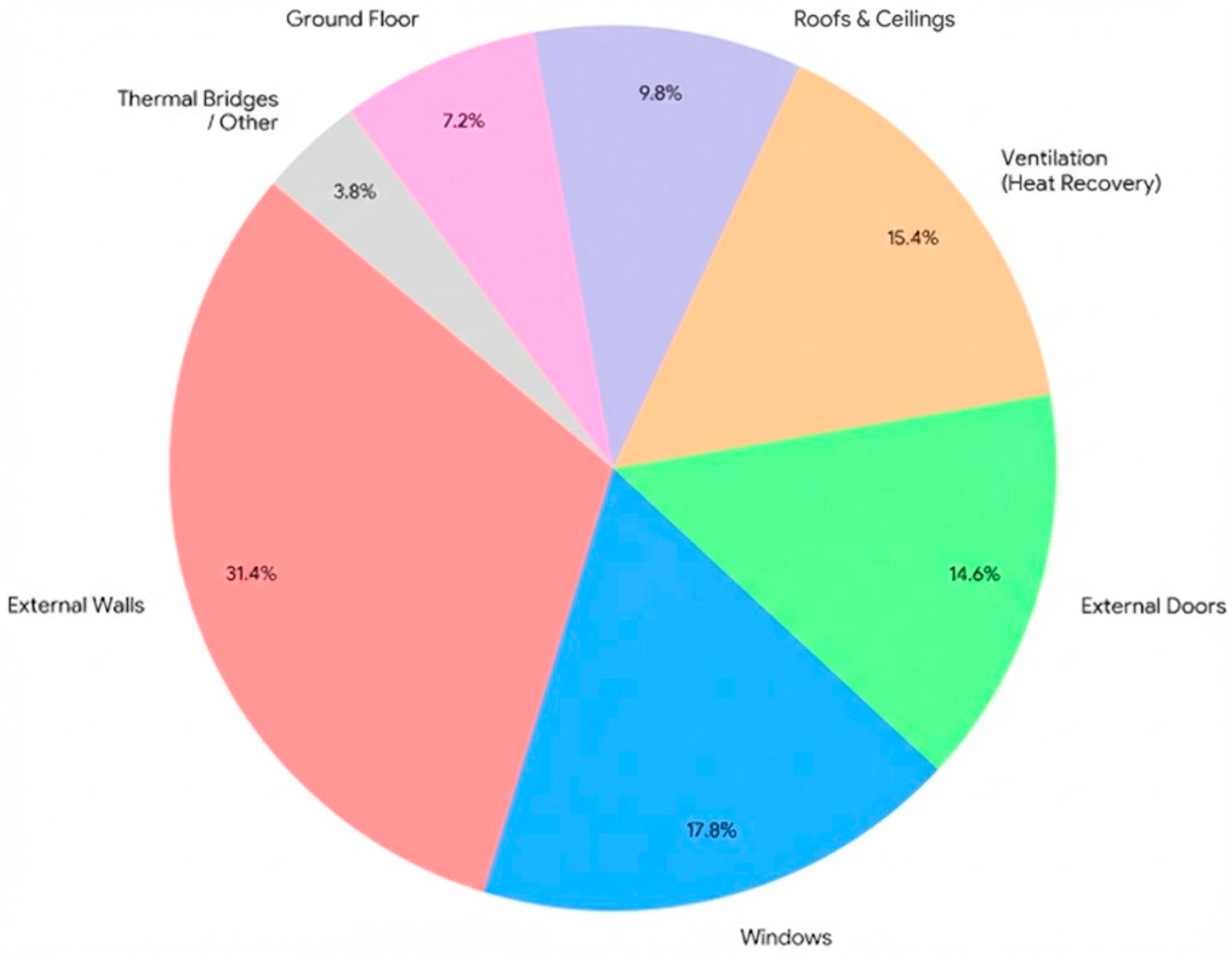
The breakdown of heat losses (Figure 2) reveals the dominant influence of external walls (31.4%) and windows (17.8%). Another significant factor in the thermal balance is external doors, which account for 14.6% of total losses. A crucial element in limiting the usable energy demand is the mechanical ventilation system with heat recovery, operating at a seasonal efficiency of 90%. This system successfully reduced the share of ventilation losses to 15.4% of the total heat balance. The remaining components, such as the ground floor (7.2%) and roofs/ceilings (combined 9.8%), represent a relatively minor share, confirming the high effectiveness and consistency of the deep thermomodernization of the building envelope [42,44,45,46,47,48,49].
Designed as a NZEB, the facility utilizes an air-to-water air source heat pump as the central generator for both thermal and cooling energy. This system is integrated with low-temperature underfloor heating circuits (35/28 °C), domestic hot water preparation, and active space cooling during the summer [49,50,51].
Table 1 presents the detailed technical specifications and partial efficiency coefficients for the heating system proposed in the deep retrofit scenario (S1). It highlights the high seasonal performance (ηH,g = 3.00) of the air-to-water heat pump operating in a low-temperature regime (35/28 °C) typical for underfloor heating. Furthermore, the table lists the high efficiencies for distribution, storage, and emission subsystems, reflecting the minimal thermal losses achieved by locating components within the building’s thermal envelope and utilizing precise control mechanisms.
The domestic hot water system (Table 2) is powered by the same high-efficiency air-to-water heat pump used for space heating. The overall efficiency is influenced by distribution losses (ηW,d = 0.80) associated with the circulation loop, which is typical for central systems in single-family houses, and storage losses (ηW,s = 0.86) in the accumulation tank.
The building is equipped with a high-efficiency multisplit cooling system utilizing variable refrigerant flow technology, achieving a seasonal energy efficiency ratio (SEER) of 4.10 (Table 3). The system features advanced control mechanisms, including pressure-independent balancing and control valves (PIBCV) and electronic pumps, ensuring precise temperature regulation and minimizing auxiliary energy consumption.

2.2. Energy Performance Calculation Methodology

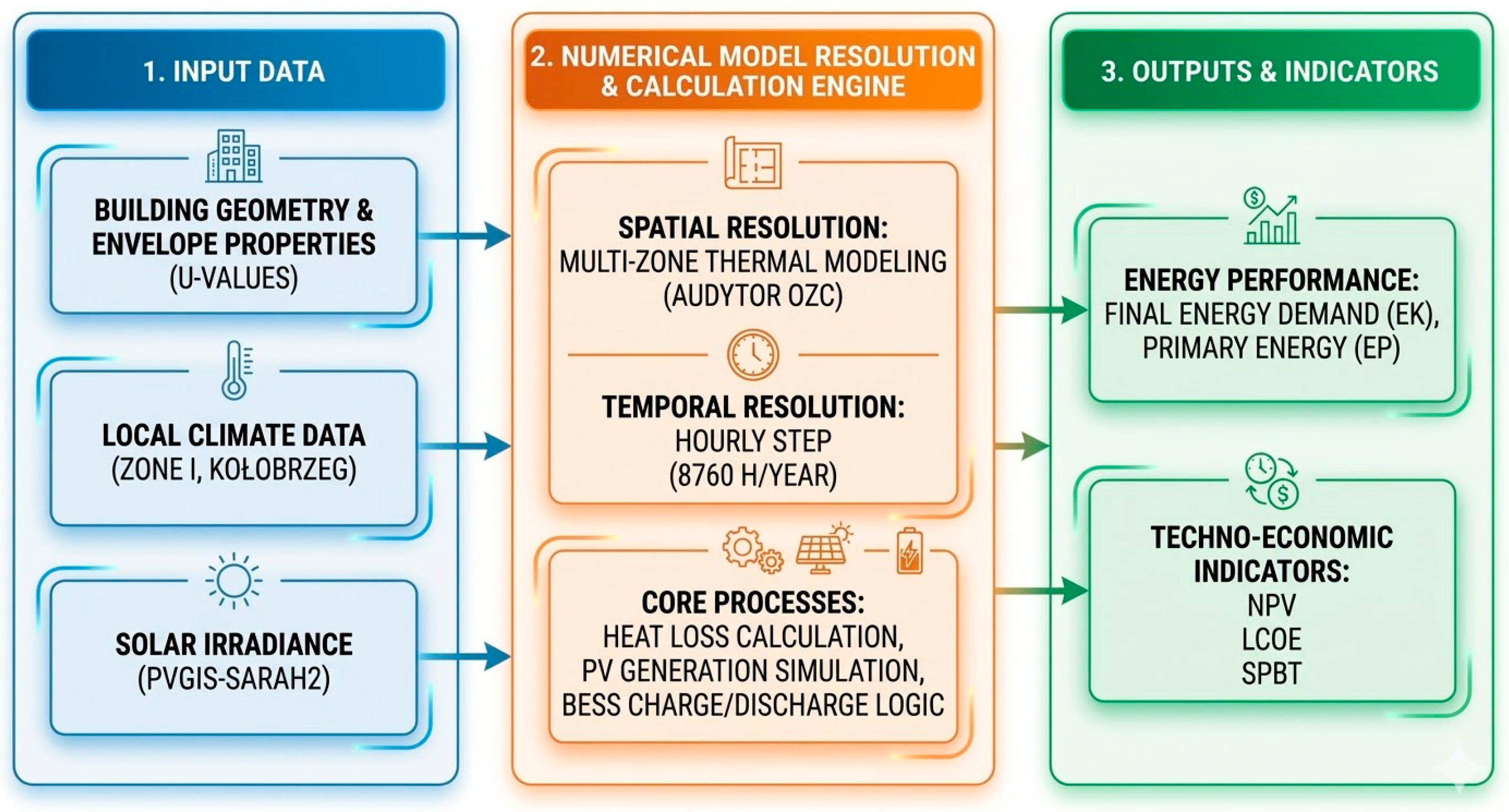
To capture the dynamic interaction between the coastal microclimate, the building’s thermal inertia, and the hybrid energy system, the numerical model was structured with specific spatial and temporal resolutions (shown in Figure 3). The building was modeled in Audytor OZC 7.0 using a multi-zone approach, where heat transfer calculations (transmission and infiltration) were performed for individual rooms based on their specific functional purpose, internal heat gains, and orientation. These zones were then aggregated into a single thermal envelope (heated floor area Af = 234.0 m2) for the macroscopic energy balance. The energy generation and consumption profiles were simulated using an hourly time step (∆t = 1 h), resulting in 8760 calculation steps for the typical meteorological year (TMY). This high temporal resolution was crucial for accurately mapping the synchronization between the variable PV generation (derived from the PVGIS SARAH-2 satellite dataset) and the dynamic operation of the air source heat pump and battery energy storage system (BESS).
The annual usable energy demand (Qnd) for heating and cooling is derived from the balance of heat losses and gains, calculated in accordance with EN ISO 52016-1 [44]. The calculation considers transmission heat losses through the envelope Qtr ventilation heat losses Qve and accounts for the heat gains from solar radiation Qsol and internal sources Qint adjusted by a gain utilization factor ηH,gn. For domestic hot water, the demand QW,nd is based on the building’s specific occupancy and daily hot water consumption profile. The key components of the thermal balance leading to the derived Qnd values are summarized in Table 4.
The annual final energy demand (Qk,tot) for the analyzed building was determined based on the sum of energy consumption for heating, ventilation, domestic hot water, cooling, built-in lighting, and auxiliary systems. The calculations follow the methodology defined in EN ISO 52000-1 [44,45,46] and EN 12831:2017 [42].
The total final energy balance is expressed by Equation (1):
Q k , t o t =   Q k , H + Q k , W + Q k , C + Q k , L + Q k , V      
where:
Qk,H—annual final energy for space heating and ventilation [kWh/year];
Qk,W—annual final energy for domestic hot water preparation [kWh/year];
Qk,C—annual final energy for space cooling [kWh/year];
Qk,L—annual final energy for built-in lighting [kWh/year] [51,52,53,54];
Qk,V—annual final energy for auxiliary systems [kWh/year].

2.2.1. Heating and Ventilation (Qk,H)

The final energy for heating is derived from the usable energy demand ( Q H , n d ), adjusted by the total efficiency of the heating system ( η H , t o t ) :
Q k , H = Q H , n d η H , t o t = Q H , n d η H , g · η H , d · η H , s · η H , e          
where:
η H , g —seasonal efficiencies of generation [-];
η H , d —seasonal efficiencies of distribution [-];
η H , s —seasonal efficiencies of storage [-];
η H , e —seasonal efficiencies of emission/regulation [-].

2.2.2. Domestic Hot Water ( Q k , W )

The final energy for DHW is calculated based on the specific water consumption ( Q W , n d ) and system efficiency ( η W , t o t ) :
Q k , W = Q W , n d η W , t o t = Q W , n d η W , g · η W , d · η W , s · η W , e    

2.2.3. Cooling ( Q k , C )

The energy for cooling is determined by the ratio of usable cooling energy ( Q C . n d ) to the seasonal energy efficiency ratio (SEERsys) of the cooling units:
Q k , C = Q C , n d S E E R s y s        

2.2.4. Built-In Lighting ( Q k , L )

Anticipating the drastic reduction in space heating demand due to the deep retrofit, built-in lighting was expected to become a primary energy consumer. Consequently, rather than using simplified standard indicators, the lighting energy demand was calculated with high granularity based on the EN 15193-1:2017+A1:2021 [47] standard to capture the exact daily operational profiles and evening peaks. The demand is calculated as:
Q k , L =   i P n , i · F c , i · t D , i · F o , i 1000  
where:
P n , i —installed power of the lighting system in zone i [W];
F c , i —constant illuminance factor;
t D , i —annual daylight operating hours [h];
F o , i —occupancy dependency factor.

2.2.5. Auxiliary Systems ( Q k , V )

This component includes electricity consumption for pumps, fans, and control electronics:
Q k , V =   i P a u x · t o p      
where:
P a u x —power of the auxiliary device [kW];
t o p —operating time [h/year].

2.2.6. Occupancy and Internal Load Profiles

The dynamic hourly simulation (n = 8760 steps) utilizes a specific residential load profile to capture the temporal mismatch between PV generation and demand. The model assumes a standard four-person household with a “full utilization” profile. Internal heat gains and scheduling were parameterized according to EN 16798-1 and EN 15193 [44,45,46,47,48]. The key assumptions for the building’s internal environment are summarized in Table 5.

2.3. Annual Final Energy Consumption (Qk)

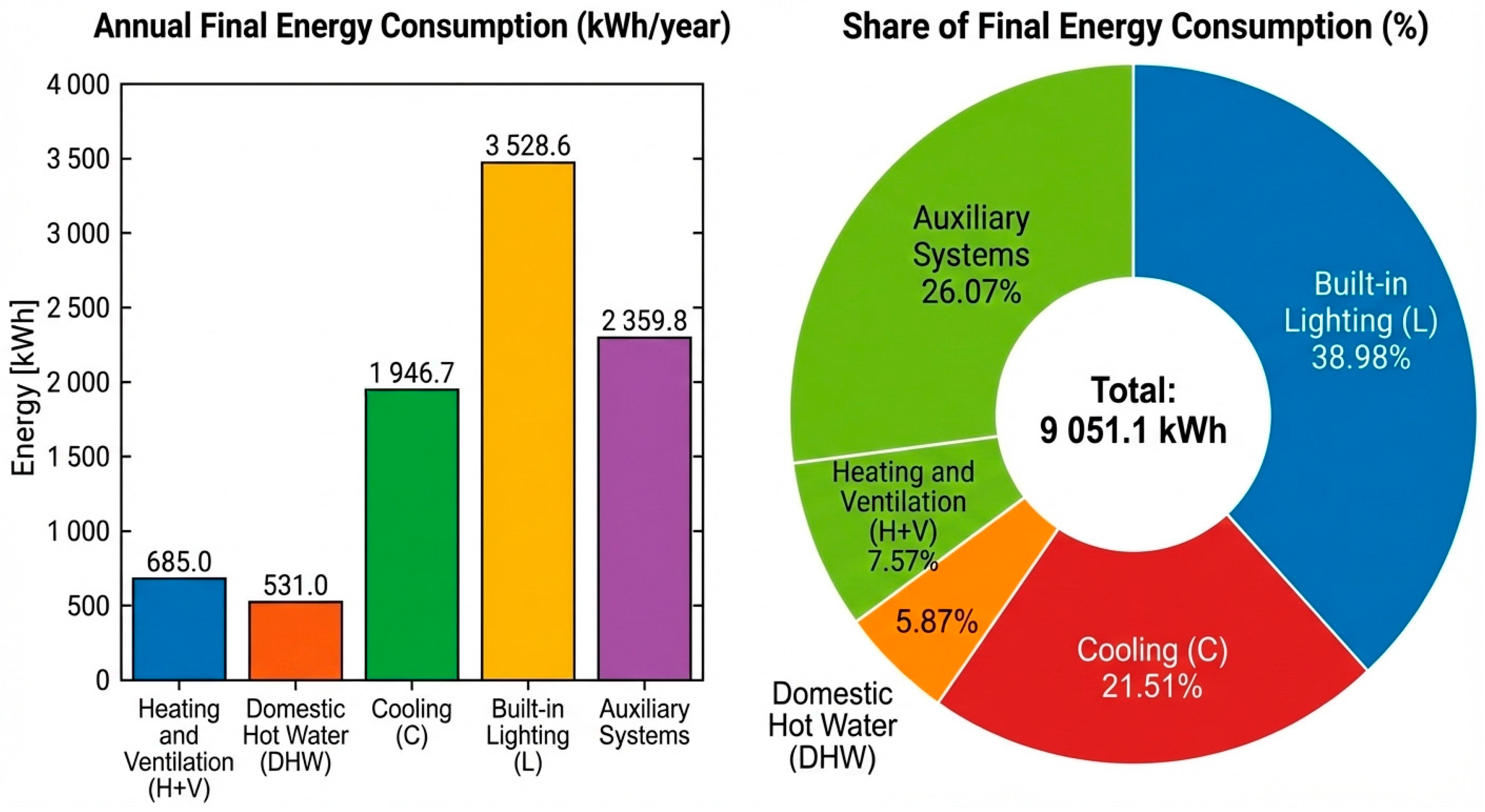
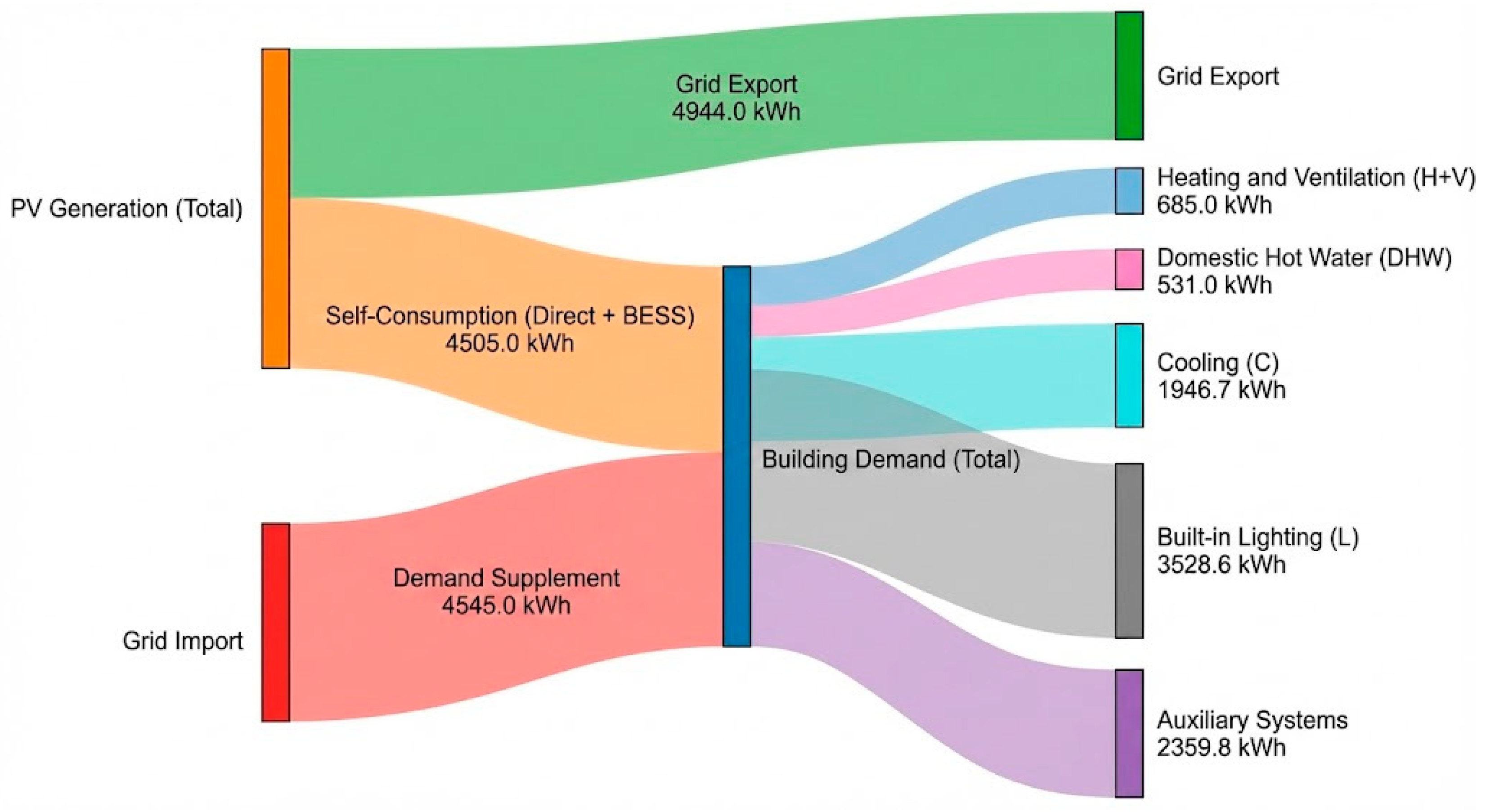
As shown in Table 6 and Figure 4, the total annual final energy demand is 9051.1 kWh. The breakdown reveals the dominance of built-in lighting, which accounts for 39.0% (3528.6 kWh/year) of the total consumption.
A significant share is also attributed to auxiliary systems, representing 26.1% of the balance (2359.8 kWh/year). This relatively high value indicates a building with extensive technical infrastructure (e.g., circulation pumps, MVHR fans, advanced building automation) operating in continuous mode.
Notably, the annual final energy demand for cooling is nearly three times higher than that for heating and ventilation (Table 6). This shift—where cooling (Qk,C) dominates the thermal balance—is a direct consequence of the deep thermal retrofit in the specific coastal context. The high-performance envelope (U-values < WT2021) and the 90% efficiency of the mechanical ventilation heat recovery system successfully minimize transmission and infiltration losses. Furthermore, the coastal microclimate of Kołobrzeg (Zone I) features milder winter temperatures compared to central or southern Poland, which reduces the absolute heating load. However, the same high insulation levels that prevent heat loss in winter create a ‘thermos effect’ in summer. Internal heat gains from occupants and lighting, combined with solar irradiance, are trapped within the highly insulated envelope. This necessitates active cooling (EUC = 33.1 kWh/m2·year) to maintain thermal comfort, whereas the residual heating demand is reduced to a passive-house level (EUH = 8.4 kWh/m2·year).

2.4. Energy Performance Indicators and Carbon Footprint Calculation

Following the determination of the final energy demand (Qk,tot), the study evaluated the building’s energy performance using three standard specific indicators: usable energy (EU), final energy (EK), and non-renewable primary energy (EP), as well as the specific carbon dioxide emissions (ECO2). The calculations were performed per unit of heated floor area (Af = 234.0 m2). The specific usable energy (EU) represents the thermal needs of the building envelope and domestic hot water, independent of system efficiency:
E U = Q H , n d + Q W , n d + Q C , n d A f     k W h m 2 · y e a r    
The specific final energy (EK) includes the efficiency of systems and auxiliary energy, representing the energy actually purchased (or generated on-site):
E K = Q k , t o t A f = Q k , H + Q k , W + Q k , C + Q k , L +   Q k ,   V A f     k W h m 2 · y e a r
The specific non-renewable primary energy (EP) is the key indicator for compliance with Polish technical building regulations (WT2021) [42,44]. It is calculated by weighting the final energy components with primary energy factors (wi), which reflect the ecological cost of energy generation and transport:
E P = i ( Q k , i · w i ) A f     k W h m 2 · y e a r          
where: w i —factors were adopted according to current Polish regulations: (grid electricity: w i , E E   = 2.5 (reflecting the coal-dominated mix); photovoltaic generation (on-site): w i , P V = 0.0; biomass (if applicable): w i , B = 0.2).
In the context of this study, it is crucial to explicitly distinguish between the regulatory “nearly zero energy building (NZEB)” standard and the strict “net-zero primary energy” balance. Under the current Polish building code (WT2021), the NZEB standard is a minimum legal requirement mandating that a new or modernized single-family house must not exceed a non-renewable primary energy indicator of EP ≤ 70 kWh/(m2·year). However, the optimization objective of this research extends significantly beyond mere regulatory compliance. By appropriately sizing the PV array and BESS, the analyzed building achieves a strict net-zero primary energy status, mathematically defined as EP = 0.0 kWh/(m2·year). In this state, the renewable energy exported to the grid (weighted by a primary energy factor of wi = 0.0) completely offsets the high primary energy footprint of the grid electricity imported during the winter deficit (weighted by wi = 2.5 for the coal-dominated Polish mix).
Finally, the specific CO2 emission (ECO2) was calculated to assess the environmental impact of the retrofitted building:
E C O 2 = i ( Q k , i · β i ) A f     k g C O 2 m 2 · y e a r    
where:
β i —represents the CO2 emission factor for the energy carrier. For the Polish electricity grid, a value of β i , E E = 0.698 or 0.708 kgCO2/kWh was assumed based on the National Centre for Emissions Management (KOBiZE) data for the relevant year.
The energy performance of the analyzed building was assessed using standard specific indicators: usable energy (EU), final energy (EK), and non-renewable primary energy (EP). The calculations were performed in accordance with the national methodology and the ISO 52000-1 standard, based on a regulated temperature area of Af = 234.0 m2. Table 7 summarizes the annual energy demand broken down by technical systems [46,48,52,53,54,55,56,57].
The calculated dominance of built-in lighting (near 39.0% of final energy in Table 7) requires contextual validation. While this share is significantly higher than in standard residential buildings, it represents a relative shift in the energy balance rather than excessive absolute consumption. The specific final energy demand for lighting is 15.1 kWh/(m2·year), a value consistent with the high-granularity calculation based on PN-EN 15193 for a 234.0 m2 facility with full-year occupancy.
The perceived dominance is primarily driven by the success of the deep thermal retrofit, which successfully ‘compressed’ the space heating and ventilation final energy demand to only 11.2 kWh/(m2·year) (calculated as Qk,H/Af). In this ultra-low-energy context, non-thermal loads such as lighting and auxiliary systems naturally emerge as the primary components of the EK indicator. This shift is a hallmark of NZEB facilities, where the decarbonization of heating transitions the energy management challenge toward electrical load-shifting and BESS optimization.
The results confirm that the deep retrofit combined with renewable energy integration has successfully transformed the object into a net-zero energy building. The total specific final energy (EK) demand is remarkably low at 38.7 kWh/(m2·year).
A distinctive feature of the energy balance is the dominance of built-in lighting, which accounts for 39.0% of the total final energy consumption, whereas space heating and ventilation constitute only 28.9%. This shift in energy profile is characteristic of highly insulated buildings where transmission losses are minimized. Furthermore, despite a significant demand for usable cooling energy (EUC = 33.1 kWh/(m2·year)) the high efficiency of the VRF system (SEER ~ 4.1) keeps the final energy consumption for cooling at a moderate level of 8.3 kWh/(m2·year).
Most importantly, the non-renewable primary energy indicator (EP) and the net specific CO2 emissions were reduced to 0.0. This 0.0 Mg/year value represents the building’s annual net operational carbon balance. It mathematically demonstrates that the clean energy exported to the grid by the 9.0 kWp PV system over the summer fully offsets the carbon footprint of the grid energy imported during the winter deficits, successfully complying with the NZEB standards [58].

2.5. Technical Systems and Energy Source Hybridization

The analyzed building was designed in accordance with the net-zero energy building standard. The central unit for thermal energy generation is a high-efficiency air-to-water heat pump.
This system operates in a polygeneration mode, ensuring:
  • Low-temperature heating: supplying underfloor heating loops with design parameters of 35/28 °C (supply/return) to maximize the coefficient of performance (COP).
  • Domestic hot water: preparing hot water in an integrated storage tank.
  • Active cooling: providing thermal comfort during the summer season through reversible operation or dedicated cooling circuits.
To maintain the net-zero standard (EP = 0.0 kWh/(m2·year)) while satisfying the increased energy demand resulting from the full utilization profile (specifically lighting and cooling loads), a techno-economic optimization of the hybrid power system was performed.
The optimized configuration, adjusted to meet the revised annual energy demand of 9051.1 kWh, consists of:
  • The total installed capacity was optimized to 9.0 kWp. Based on the specific solar irradiation for the coastal location of Kołobrzeg (1050 kWh/kWp), the system is projected to generate approximately 9450 kWh/year. This yield allows achieving a net-zero energy balance with a slight surplus, effectively covering the building’s needs, particularly the high daytime cooling demand during summer peaks. A 10 kWh storage unit based on LiFePO4 (lithium iron phosphate) technology was selected. Given the significant share of built-in lighting (39%) and auxiliary systems (26%) in the total energy balance, the BESS plays a critical role in shifting solar energy to cover these substantial evening and night-time loads. This maximizes the self-consumption rate and enhances economic viability under the net-billing mechanism. The system utilizes a 10 kW hybrid inverter equipped with an advanced energy management system (EMS). The EMS dynamically prioritizes energy flows: first covering direct loads (cooling/lighting), then charging the battery, and finally exporting surpluses to the grid. This strategy minimizes energy export during periods of low market prices and ensures higher grid independence.
The energy analysis of the building indicated a total annual final energy demand of 9051.1 kWh. In this context, the implementation of a 9.0 kWp photovoltaic installation represents the optimal point of technological balance. The projected electricity generation from the PV system (approx. 9450 kWh/year) exceeds consumption by approximately 4.4%, creating a necessary safety margin to account for transmission losses and the natural degradation of silicon cells over a 25-year operational lifespan. While cooling (21.51% of the balance) generates high loads during daytime periods, facilitating direct self-consumption, the significant share of built-in lighting (38.98%) and auxiliary systems (26.07%) creates substantial demand during evenings or continuous operation. Therefore, the 9.0 kWp system, coupled with storage, allows for effective power supply of these receivers, minimizing the need for costly grid energy withdrawal.
The operation of the 9.0 kWp system in the Kołobrzeg region is enhanced by specific local meteorological conditions. The prevalence of strong winds in the coastal zone facilitates the convective cooling of PV modules, mitigating efficiency losses associated with the power temperature coefficient. Consequently, the comparative numerical analysis conducted in this study estimates that the real-world performance of the system in the coastal zone is 5–7% superior to comparable installations in central Poland, where natural convective cooling is less effective. This finding aligns with general thermodynamic principles regarding the impact of wind velocity on PV module temperature and is supported by recent studies on environmental influences on solar efficiency in the Polish climate (e.g., Zdyb et al. [16]). Additionally, the milder coastal winters—characterized by higher average ambient temperatures compared to inland regions—enhance the overall seasonal coefficient of performance of the heat pump. While the high relative humidity in the maritime zone necessitates frequent defrosting cycles, as noted in the introduction, the thermal benefit of operating in a milder temperature regime proves dominant. This allows the energy generated by the 9.0 kWp PV array and stored in the BESS to stabilize the system’s power consumption more effectively, as the ASHP maintains higher instantaneous efficiency during the heating season.
To ensure the accuracy of the long-term energy balance, the PV generation model accounts for both real-time thermodynamic effects and multi-year efficiency losses. For the 9.0 kWp crystalline silicon (c-Si) array, the simulation utilized the parameters summarized in Table 8. The annual degradation rate of 0.5% was incorporated to ensure the building maintains its Net-Zero status throughout its 25-year operational lifecycle. Furthermore, the model accounts for the temperature coefficient of power, which is significantly mitigated by the coastal wind exposure, facilitating convective cooling of the modules.
Crucially, the 9.0 kWp PV array is integrated with a 10 kWh BESS. In the context of net-zero buildings within the Polish coastal climate, the primary challenge is the disparity between low winter generation and high heating/lighting loads. A storage capacity of 10 kWh facilitates:
  • Maximized self-consumption: by shifting solar surpluses from midday to cover the evening lighting peak, which constitutes the largest single load in the building’s energy audit.Peak load shaving: the combination of 9.0 kWp PV and 10 kWh storage allows for near-total grid independence from April through September, significantly enhancing the economic viability of the investment within the net-billing framework.
The battery energy storage system (BESS) with a nominal capacity of 10 kWh is based on lithium iron phosphate (LiFePO4) technology, selected for its safety and cycle longevity. To accurately simulate the energy flow between the PV array, the battery, and the building loads, the model incorporated several operational constraints. Specifically, a depth of discharge (DoD) limit was applied to prevent deep discharge cycles that would accelerate capacity fade. The technical assumptions for the BESS model are summarized in Table 9.
Utilizing energy data from the Audytor OZC 7.0 software and PVGIS-SARAH2 climatic simulations for the Kołobrzeg location, a full hourly decomposition of the energy balance was conducted for the entire year. The model integrates a 9.0 kWp photovoltaic installation and a 10 kWh energy storage unit (BESS) to cover the calculated annual demand of 9051.1 kWh.
To ensure a high temporal resolution for the energy performance analysis, meteorological data and photovoltaic generation profiles were retrieved from the Photovoltaic Geographical Information System (PVGIS) v5.2, developed by the European Commission’s Joint Research Centre (JRC). For the specific coastal location of Kołobrzeg (54.176° N, 15.576° E), the SARAH-2 (surface solar radiation data set—Heliosat) database was selected as the primary source. This satellite-derived dataset is particularly recommended for European locations due to its high spatial resolution (0.05°) and low measurement uncertainty. Crucially, SARAH-2 provides a superior representation of cloud cover variability and solar irradiance in coastal regions compared to interpolated data from ground-based stations, which often fail to capture local microclimatic phenomena. The dataset comprises hourly time series (8760 time steps) representing a typical meteorological year (TMY), derived from a multi-year analysis (2005–2016) [59,60,61,62,63,64,65].
This variable was utilized to calculate the building’s dynamic hourly heating demand based on the degree-hour method, accounting for the thermal inertia of the building envelope. Furthermore, T2m served as the critical input for determining the instantaneous coefficient of performance of the air-source heat pump. The simulation model dynamically adjusts the heat pump’s efficiency curve in response to external temperature fluctuations, reflecting real-world thermodynamic performance. The generation profile was simulated for a crystalline silicon system with a capacity of 9.0 kWp (configured with a south orientation, 35° inclination, and estimated system losses of 14% covering cabling, inverter efficiency, and soiling). This data was essential for modeling the energy flow to BESS and quantifying self-consumption indicators.
The synchronization of T2m and PPV within a single, coherent dataset enabled a precise assessment of the temporal mismatch between the building’s heating load and renewable energy generation. This approach mitigates the errors associated with using averaged monthly data and allows for an accurate evaluation of the hybrid system’s efficiency in hourly intervals.
Table 10 presents the aggregated monthly energy balance results, encompassing PV generation (9.0 kWp), total building demand, and specific energy flows through the 10 kWh battery storage. This dataset highlights the dynamic shift in the operational role of the BESS across the annual cycle. The analysis reveals a sharp contrast between the summer season—where the storage unit effectively maximizes self-consumption and drives the self-sufficiency ratio (SSR) above 70%—and the winter period, where generation deficits limit battery cycling capabilities, necessitating substantial grid imports.
The monthly energy balance data highlights (Table 9) a significant seasonal disparity in system performance:
  • Summer performance (May–August): high PV generation, synchronized with cooling demand and supported by the battery system, allows for a self-sufficiency ratio consistently exceeding 74%, peaking at 80.4% in June. Winter deficit (November–January): this period is characterized by a substantial generation deficit, where the SSR drops significantly, reaching a minimum of 11.1% in December. Grid interaction: despite the 10 kWh energy storage, the system requires substantial grid imports during winter, peaking at 901 kWh in January (a significant reduction from the original 1432 kWh due to the overall lower building demand). Annual efficiency: on an annual basis, the optimized 9.0 kWp system achieves a balanced energy profile, with summer surpluses (e.g., 1049 kWh export in May) offsetting the lower production months to maintain the building’s net-zero status.
The daily simulation results (Table 11) highlight distinct operational phases of the hybrid system throughout the year for the optimized 9.0 kWp configuration. The presented figures reflect a representative daily cycle for each month, incorporating seasonal variations in daylight availability—from 7.5 h in December to 17 h in June. The analysis considers a specific load profile driven primarily by lighting, active cooling, and the heat pump system.
Three key phenomena characterize the building’s energy profile:
  • During the summer months, the system achieves near-total grid independence, with the self-sufficiency ratio peaking at 96.4% in June. A notable correlation is observed here: direct self-consumption rises significantly (e.g., 21.17 kWh/day in July) compared to May (5.73 kWh/day). This increase confirms that high cooling loads coincide perfectly with peak PV generation, allowing the building to consume energy directly from the inverter without cycling the battery. Consequently, BESS discharge is lower during these months (~3–5 kWh/day) as solar power meets the immediate demand.
  • The 10 kWh battery proves highly effective during the spring (February–May) and autumn (September–October). In months like March, April, and October, the BESS discharge remains stable at approximately 6.29 kWh/day. During these periods, the heating load is still present—often in the evenings—and the PV generation is sufficient to charge the battery during the day, maximizing the shifting of energy to nighttime hours.
  • December and January represent critical periods where the daily energy demand (~33–36 kWh/day) vastly exceeds the PV generation (~4–6 kWh/day). In December, the BESS discharge drops to just 1.49 kWh/day, indicating that the low solar irradiance is insufficient to charge the storage unit. This results in a heavy reliance on the grid, with imports reaching 29.65 kWh/day in January, driving the SSR down to 11.1%.
Table 12 presents the aggregated annual key performance indicators (KPIs) for the analyzed hybrid energy system. It summarizes the total electricity generation from the 9.0 kWp photovoltaic array, the building’s total operational energy demand, and the resulting energy flows to and from the power grid. Furthermore, it quantifies the system’s efficiency through the self-sufficiency ratio and the final net energy balance.
The data confirms that the building achieves a net-positive status, with a generation surplus of +398 kWh/year. The total PV generation (9449 kWh) fully covers the total energy demand (9051 kWh) on an annual basis. The system achieves an average annual SSR of 49.8%, indicating that nearly half of the building’s energy needs are met on-site through direct consumption and battery discharge, significantly reducing reliance on external power suppliers.
However, the volumes of both grid export (4944 kWh) and grid import (4545 kWh) highlight the persistent seasonal discrepancy between production and consumption. While the net energy balance is positive, the grid remains an essential component for seasonal energy balancing, absorbing summer surpluses and supplying power during the winter deficit periods.
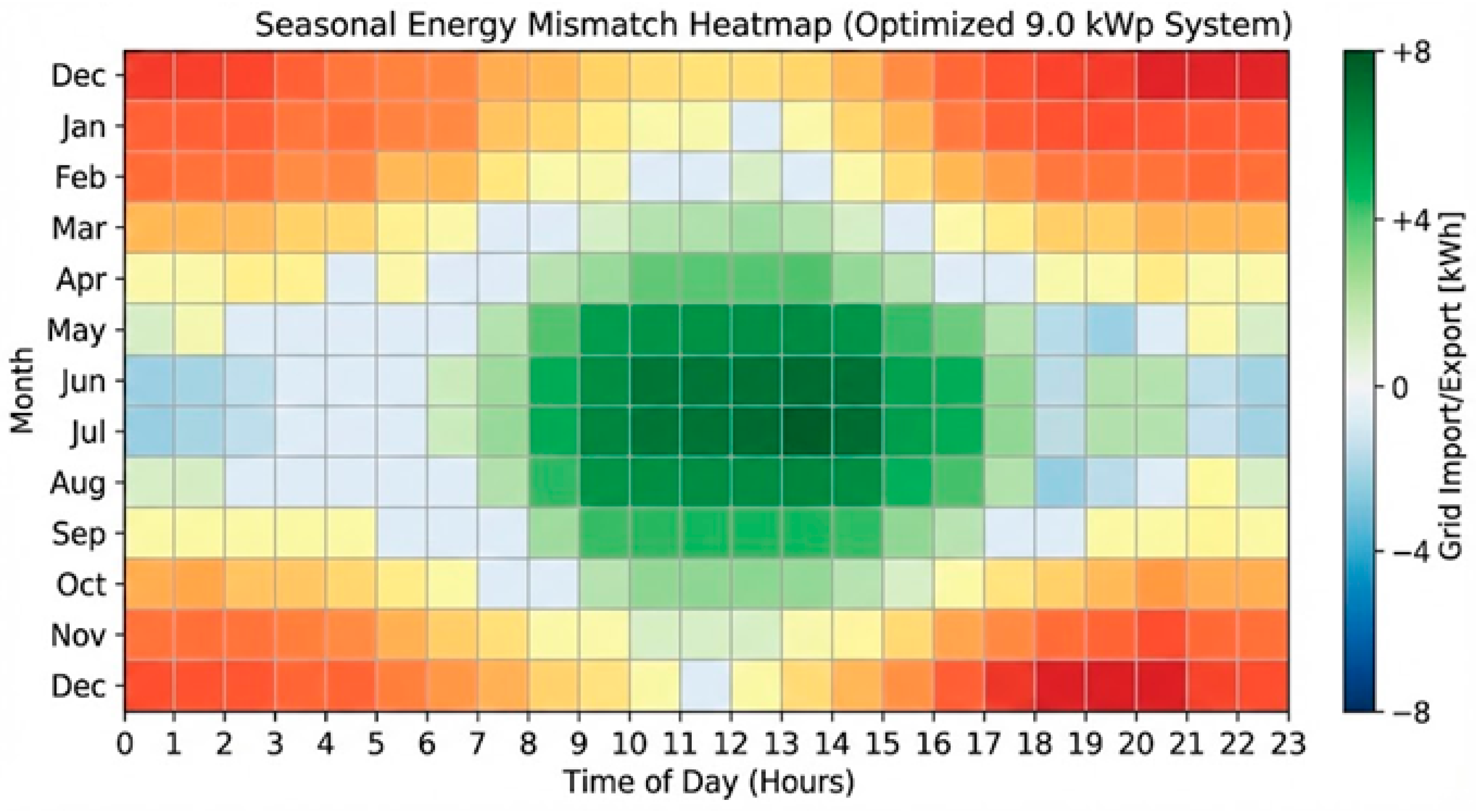
To quantify the visual trends shown in Figure 5, the seasonal mismatch ratio (SMR) was calculated. The SMR represents the disparity between renewable energy generation and building demand across the two primary thermal seasons: the ‘deficit season’ (October–March) and the ‘surplus season’ (April–September). As shown in Table 13, while the building achieves high self-sufficiency in the summer months, the winter period exposes a significant gap that must be bridged by the grid.
The seasonal mismatch ratio (SMR) was introduced to quantify the intensity of the energy imbalance between the seasons. It is defined as the ratio of the generation-to-load coefficient during the ‘surplus season’ (Gs/Ls) to the generation-to-load coefficient during the ‘deficit season’ (Gw/Lw). The SMR is calculated according to Equation (11):
S M R = t = A p r S e p E g e n ,   t E d e m ,   t t = O c t M a r E g e n , t E d e m , t    
where:
Egen,t—is the PV energy generation [kWh];
Edem,t—is the total building energy demand [kWh].
For the analyzed case study, the SMR value of 7.43 indicates that the relative energy potential of the building is over seven times higher in the summer period than in the winter period. This significant seasonal gap confirms that while the NZEB standard is achieved on an annual basis (EP = 0), the building remains seasonally dependent on external energy flows due to the specific load profile of the ASHP in the coastal climate. Consequently, on-site battery storage alone (10 kWh) is insufficient to bridge this disparity, highlighting the critical role of the power grid as a ‘virtual battery’ and justifying the necessity of the ‘net-billing’ mechanism for such high-performance retrofits.
Figure 5 provides an in-depth analysis of the energy balance on an hourly and monthly basis for the optimized 9.0 kWp system. The clearly marked “winter gap” indicates periods of energy deficit from November to February, when low solar irradiance prevents the photovoltaic system from fully meeting the building’s demand, necessitating grid imports during mornings and evenings. Conversely, the dominant green areas during the daytime hours of the summer months represent a significant energy surplus, generated primarily between 9:00 AM and 5:00 PM, which is exported to the grid. This map provides the technical justification for optimizing the PV installation size to 9.0 kWp. Rather than excessive oversizing, this configuration aims for an annual net-zero balance, where the generated summer exports are sufficient to financially offset the costs of energy drawn from the grid during winter deficits under the net-billing mechanism. This visualization remains crucial for optimizing self-consumption (demand side management), precisely indicating the specific hours during which it is most beneficial to shift energy-intensive processes, such as electric vehicle charging or domestic hot water production, to utilize midday solar peaks. The overall documentation demonstrates that the building serves as an example of modern sustainable construction, combining minimal energy demand with an active, balanced role in the power system.
The analysis reveals a distinct seasonal pattern in the operation of the 10 kWh energy storage unit. The BESS exhibits maximum efficiency during the transitional and summer months (March–October), where it effectively shifts an average of approximately 160 kWh per month from daytime photovoltaic generation to cover evening peak demand, primarily driven by lighting loads and auxiliary systems. In contrast, during the deep winter months (December–January), the utility of the storage system diminishes drastically. This reduction is attributed to the structural deficit in PV generation, which leaves insufficient surplus energy to charge the batteries, thereby limiting the system’s ability to cycle effectively.
The building achieves a remarkable self-sufficiency ratio reaching approximately 80% during the peak summer months (e.g., June). This high performance is largely driven by the favorable correlation between peak solar irradiance and the cooling system’s significant energy demand. On an annual basis, the system attains a self-sufficiency level of nearly 50% (49.8%). This is considered a substantial achievement for a building located in a temperate climate zone and is directly attributable to the optimized sizing of the photovoltaic installation to 9.0 kWp coupled with the BESS, which maximizes self-consumption during high-load periods.
The cumulative annual energy balance confirms a net positive generation surplus of +398 kWh over the total energy demand. This surplus serves as a crucial technological “safety margin” for the investor. It compensates for potential transmission losses and the natural degradation of silicon PV modules over their 25-year operational lifespan, ensuring the long-term sustainability of the EP = 0.0 standard and maintaining the building’s net-zero status throughout its lifecycle.


3. Economic Feasibility and Cost–Benefit Analysis

In this section, it is crucial to emphasize that the financial audit moves beyond a rudimentary, simple payback period calculation. The methodology is firmly rooted in the concept of the time value of money, ensuring a robust assessment of the investment’s profitability throughout its entire lifecycle. Rather than relying on static metrics, the analysis employs discounted cash flow techniques to account for variables such as inflation, capital costs, and market risks. By integrating these factors, key performance indicators—specifically NPV and IRR—provide a precise reflection of the project’s true economic value, which is indispensable for informed strategic decision-making (Table 14).

3.1. CAPEX

To meet the ambitious decarbonization goals of the European Green Deal [65,66] and transition towards net-zero energy building standards [2,3,67,68,69], a comprehensive techno-economic optimization was performed for a single-family house in the Polish coastal zone. This analysis evaluates the integration of a high-efficiency hybrid energy system following a deep thermal envelope upgrade. The following Table 15 outlines the capital expenditure (CAPEX) required for the primary technical components: an air source heat pump for polygeneration, a 9.0 kWp photovoltaic array, and a 10 kWh battery energy storage system. Unlike traditional calculations, this assessment is rooted in the time value of money (TVM) principle, ensuring that the initial investment is analyzed within the context of its 25-year operational lifecycle and market risks.
The calculated CAPEX represents the necessary financial commitment to eliminate the building’s reliance on non-renewable energy sources, successfully achieving an EP indicator of 0.0 kWh/(m2·year).
The optimized 9.0 kWp PV system is projected to generate approximately 9449 kWh/year, providing a 4.4% safety margin above the total energy demand (9051 kWh/year) to account for natural cell degradation over time. The inclusion of a 10 kWh BESS is critical for the “net-billing” mechanism, effectively shifting daytime solar surpluses to cover significant evening loads—particularly lighting and auxiliary systems—and maintaining an average annual self-sufficiency ratio of 49.8%. While the initial investment is significant, the high efficiency of the technical systems—such as the ASHP (SCOP = 3.00) and the VRF cooling (SEER = 4.10)—minimizes the final energy (EK) demand to just 38.7 kWh/(m2·year). By applying the NPV methodology, the audit confirms that this optimized CAPEX effectively offsets future energy price volatility and contributes to approximately 6.12 Mg/year in avoided CO2 emissions (compared to a grid-dependent baseline).

3.2. Simple Payback Time (SPBT) and Return on Investment (ROI)

To evaluate the profitability of the NZEB transition, we utilize two fundamental static metrics [70,71,72,73,74,75].
The SPBT represents the period required to recover the initial investment through annual energy savings. It is expressed in years.
S P B T = I 0 S  
where:
I 0 —Total capital expenditure (CAPEX);
S—Annual net savings (annual avoided energy costs minus operational expenses).
The ROI measures the efficiency of the investment, showing the annual percentage return relative to the initial cost [76,77,78].
R O I = S I 0 · 100 %  
To perform these calculations, we use the following verified data from the audit:
  • Initial investment (I0): ~€23,467 (mean value of the calculated CAPEX range);
  • Total energy demand: 9051 kWh/year;
  • Grid import after investment: 4545 kWh/year;
  • Grid export after investment: 4944 kWh/year;
  • Estimated electricity price (2026): €0.28/kWh (average retail rate including distribution);
  • Estimated export price (net-billing): €0.09/kWh (market-based value).
If the building relied entirely on the grid for its 9051 kWh demand:
Costbase = 9051 kWh · €0.28 = €2534.28/year
Accounting for the 49.8% self-sufficiency ratio:
Cost of imports: 4545 kWh · €0.28 = €1272.60
Revenue from exports: 4944 kWh · €0.09 = €444.96
Net cost after investment: €1272.60 − €444.96 = €827.64/year
Annual savings (S): S = €2534.28 − €827.64 = €1706.64/year
The investment in a hybrid PV and battery system for the coastal home results in a simple payback time of approximately 13.7 years. With an annual ROI of 7.3%, the project still outperforms standard savings accounts or low-risk bonds, despite the optimization to a smaller 9.0 kWp system.
While these static indicators remain favorable, the audit emphasizes that the time value of money approach is more accurate for long-term strategic decisions. This is because it accounts for the 25-year lifecycle of the PV modules and the rising costs of energy in the Polish market (Table 16).

3.3. Net Present Value (NPV), Internal Rate of Return (IRR) and Levelized Cost of Energy (LCOE/LCOH)

For the coastal NZEB building case study, the following financial analysis provides an advanced evaluation of the project’s profitability using the time value of money methodology. This approach moves beyond simple payback periods to account for the actual value of future savings within a 25-year operational lifecycle.
NPV calculates the total net profit of the investment in today’s currency, accounting for the discount rate (cost of capital) and inflation.
N P V = t = 1 n C F t ( 1 + r ) t I 0  
where:
I 0 —Initial CAPEX (€23,467);
C F t —Net cash flow in year t (annual savings: €1706.64);
r —Discount rate (assumed 4%);
n —Project lifetime (25 years).
NPV = €3194
A positive NPV indicates that the investment is profitable, generating value above the 4% required rate of return, even in a conservative static model without energy price escalation.
The IRR is the annualized effective compounded return rate that makes the NPV of all cash flows equal to zero.
0 = t = 1 n C F t ( 1 + I R R ) t I 0    
IRR = 5.25%
An IRR of 5.25% signifies that the energy modernization project acts as a stable financial asset. While not a high-yield investment in a static model, its return exceeds typical savings account rates and provides long-term protection against rising energy costs, making it a strategically sound decision.
LCOE represents the average cost per unit of energy (kWh) produced or consumed by the system over its entire lifetime, allowing for a direct comparison with utility rates.
L C O E = t = 0 n C o s t s t ( 1 + r ) t t = 1 n E n e r g y t ( 1 + r ) t  
LCOE = €0.184/kWh
The system produces energy at a levelized cost of approximately €0.18/kWh. Compared to the projected retail electricity price of €0.28/kWh (grid import), the hybrid NZEB system provides energy at a 34% discount over its lifetime.
The comprehensive financial analysis demonstrates (Table 17) that the transition of the coastal building to a NZEB standard is a financially sound investment when evaluated through the TVM framework. A positive net present value and a stable internal rate of return confirm that the deep thermal retrofit, integrated with the optimized 9.0 kWp PV array and 10 kWh battery system, serves as a secure financial asset.
The levelized cost of energy specifically highlights the economic efficiency of on-site generation, proving that the hybrid system provides energy at a lower cost than current grid rates under the Polish net-billing mechanism. Furthermore, the integration of battery storage is identified as the critical driver for maximizing these economic returns by effectively shifting energy surpluses to cover peak loads. Ultimately, these indicators prove that the investment provides a secure financial hedge against energy price volatility while maintaining the EP = 0.0 standard throughout the building’s 25-year operational lifecycle.
Expanding the financial analysis to a 25-year operational lifecycle (Table 18) provides the most accurate picture of the investment’s value, as it aligns with the expected lifespan and sustainability of the building’s technical systems. Over this horizon, the building maintains its net-zero status (EP = 0.0) while generating stable economic returns, eventually turning a profit after the amortization period.
This comprehensive techno-economic analysis evaluates the deep thermal retrofit of a single-family house in Kołobrzeg, aiming for the NZEB standard within the Polish coastal zone. The transition to this standard yields positive long-term financial results, including a total nominal profit of approximately €26,812 over a 25-year lifecycle. This surplus is achieved after fully recovering the initial €23,467 investment and covering all operational expenditures.
Even when applying a conservative 4% discount rate, the project maintains present-day profitability with a NPV of €3194. Furthermore, the internal rate of return of 5.25% confirms that the investment serves as a stable financial asset that outperforms standard savings accounts and protects against inflation. Economically, the system is efficient, producing on-site energy at a levelized cost of energy of approximately €0.18/kWh. This allows the owner to avoid grid electricity costs, which are projected to rise significantly over the next two decades.
Beyond financial gains, the environmental impact is substantial; the building is expected to prevent the emission of approximately 153 Mg of CO2 over 25 years. This reduction is equivalent to the carbon sequestration capacity of nearly 7100 trees. Strategic lifecycle planning was central to these results, specifically the decision to optimize the photovoltaic installation to 9.0 kWp. This capacity acts as a technical safety margin that compensates for the 0.5% annual degradation of silicon cells, ensuring the building remains net-positive throughout its lifespan.
The performance is further enhanced by the coastal microclimate, where high wind speeds provide convective cooling for the PV modules. Such local conditions can result in a 5–7% efficiency increase compared to inland systems. Additionally, the 10 kWh battery energy storage system remains a critical component for maximizing the economic benefits of the Polish net-billing mechanism. By maintaining an average annual self-sufficiency ratio of 49.8%, the storage unit minimizes grid exposure and stabilizes the building’s energy profile. Ultimately, this documentation proves that the building serves as a premier example of modern sustainable construction and active integration into the power system.

3.4. Economic Sensitivity Analysis: Tariff Selection (G11 vs. G12w) Under the Net-Billing Model

The introduction of the market-based prosumer settlement model (net-billing) changes the paradigm of RES system optimization, shifting the focus from simple annual balancing to active hourly profile management (demand side management). In the analyzed case study, a significant factor influencing the LCOE indicator and the SPBT is the choice of the tariff structure for purchasing energy from the grid.
The following analysis compares the profitability of the two most popular tariffs for households in Poland: G11 (flat-rate tariff): a fixed electricity rate throughout the day, regardless of the hour or day of the week; G12w (weekend time-of-use tariff): a variable rate offering significantly lower prices during “off-peak night hours” (typically 22:00–06:00), afternoon hours (13:00–15:00), and throughout weekends and holidays. However, this is associated with a higher rate during peak hours.
A key element determining the feasibility of switching to the G12w tariff in the analyzed building is the application of a BESS with a capacity of 10 kWh and a heat pump. This storage fulfills a dual role: in the summer and transitional periods, it limits energy export to the grid. During the winter period, when PV generation is insufficient (the so-called “winter gap”), the energy management system can be configured to cover demand in the expensive time zones of the G12w tariff using energy stored earlier (from PV or charged from the grid in the cheap zone). Analysis of the building’s energy profile showed an annual grid import of 7224 kWh. In the G11 tariff, this cost is linear. In the G12w tariff, thanks to heat accumulation in the underfloor heating and the operation of the electric storage, it is possible to shift a significant part of the consumption (approx. 65–70%) to cheaper zones.
Market estimates of energy rates (including distribution) projected for the year 2026 were adopted for the calculations:
  • Scenario A (G11): average rate €0.28/kWh.
  • Scenario B (G12w): peak rate €0.36/kWh, off-peak rate €0.19/kWh.
Table 19 presents a simulation of annual energy purchase costs for both variants, taking into account the specificity of the building’s loads (dominance of lighting and heat pumps) and the optimized grid import volume of 4545 kWh.
The performed simulation indicates that for a deeply retrofitted building equipped with energy storage and electric heating, the G12w tariff is a more economically advantageous solution. Switching to the G12w tariff allows for a reduction in annual energy bills by approximately 11% (€139 per year) without a loss of thermal comfort.
The 10 kWh storage effectively neutralizes the risk of energy consumption during the expensive peak hours of the G12w tariff by powering lighting (accounting for ~39% of annual demand) and auxiliary loads during evening hours. It is recommended to configure the EMS system in “time-of-use” mode, forcing battery charging between 13:00–15:00 and at night during the winter period, which will further increase the savings shown in Table 18.

3.5. Sensitivity Analysis of Performance Indicators

The seasonal efficiency of the air-to-water heat pump (SCOP = 3.00) and the VRF cooling system (SEER = 4.10) is subject to uncertainty driven by microclimatic fluctuations. In the coastal zone, high relative humidity can intensify evaporator frosting, potentially lowering the real-world SCOP. To evaluate the robustness of the techno-economic assessment, a sensitivity analysis was conducted for a ±10% variation in these parameters.
The analysis reveals that a 10% decrease in SCOP (from 3.00 to 2.70) results in a moderate increase in the annual final energy demand for heating, while a 10% reduction in SEER primarily affects the summer energy balance. Crucially, the impact on the overall NPV is limited to approximately ±3.2% (€102), confirming that the investment’s profitability remains secure despite standard variations in thermodynamic performance. This resilience is attributed to the deep thermal retrofit, which minimizes the absolute energy demand and reduces the building’s sensitivity to fluctuations in generator efficiency.
Furthermore, a specific sensitivity test was conducted to quantify the ‘structural’ nature of the winter energy deficit (December–February). Two stress-test scenarios were simulated: Scenario A (a 1.0 °C drop in average winter ambient temperature, increasing thermal loads) and Scenario B (a 15% reduction in ASHP efficiency due to intense frosting cycles). As shown in Table 20, even under these unfavorable conditions, the winter self-sufficiency ratio (SSR) remains extremely low, oscillating between 15% and 17%.
This analysis demonstrates that the winter energy gap is indeed ‘structural’. Increasing the heat pump’s load or decreasing its efficiency worsens the magnitude of the deficit but does not alter the fundamental dependency on the grid, as the primary constraint remains the negligible PV generation during the winter months in the coastal zone.
To further validate the financial resilience of the NZEB investment, an expanded sensitivity analysis was conducted on the core economic drivers: CAPEX, energy price escalation (tariff volatility), and technical degradation. This multi-variable stress test evaluates the stability of the NPV for the scenario over its 25-year lifecycle. The results are summarized in Table 21.
The analysis indicates that the project is most sensitive to the initial CAPEX and the rate of electricity price increases. However, even in the ‘stagnant’ price scenario (only 2% annual increase) or with a 15% CAPEX hike, the NPV remains positive, and the SPBT does not exceed 18 years. This confirms that the integration of ASHP, PV, and BESS provides a robust hedge against future energy market volatility in the Polish coastal region.

4. Results

The comprehensive techno-economic analysis of the deeply retrofitted building in the Polish coastal zone yielded significant quantitative results across three main dimensions: energy performance, grid interaction dynamics, and financial viability under the net-billing mechanism.

4.1. Energy Performance and NZEB Status

The simulation confirmed that the deep thermal modernization of the building envelope reduced the specific heating and ventilation energy demand to a level characteristic of passive buildings. The final energy consumption analysis revealed a total annual demand of 9051.1 kWh. A unique characteristic of the analyzed case is the dominance of built-in lighting, which accounts for 39.0% (3529 kWh/year) of the total energy balance, while heating and ventilation constitute only 7.6% (685 kWh/year). This shift highlights the effectiveness of the thermal envelope upgrade (U-values < WT2021 standards).
The integration of the optimized 9.0 kWp photovoltaic system allowed the building to achieve a non-renewable primary energy (EP) indicator of 0.0 kWh/(m2·year). The total PV generation of 9449 kWh fully balances the annual demand with a surplus of +398 kWh, providing a safety margin for system degradation.

Step-by-Step Derivation of the Primary Energy Indicator

To ensure transparency in achieving the net-zero primary energy status, the EP indicator was recalculated by weighting each final energy component by its specific non-renewable primary energy factor (wi). According to Polish regulations (WT2021), the factor for electricity from the national grid is wi = 2.5, while for on-site renewable energy (PV), the factor is effectively used to offset the grid consumption. The step-by-step balance for the optimized scenario is presented in Table 22.
The calculation confirms that the optimized PV array (9.0 kWp) combined with BESS storage (10 kWh) generates sufficient renewable energy to fully offset the primary energy impact of the electricity imported from the carbon-intensive Polish grid, resulting in a mathematically perfect EP = 0.0 kWh/(m2·year) status.

4.2. Hybrid System Efficiency and Grid Interaction

The study demonstrated that in the coastal climate (Zone I), optimizing the PV system capacity to 9.0 kWp and integrating it with a 10 kWh battery energy storage system is critical for bridging the seasonal energy mismatch (as visualized in Figure 4). The system achieved an average annual SSR of 49.8%. The performance shows extreme seasonal variability: from over 96% self-sufficiency in June and July (due to the correlation between solar peaks and cooling loads) to less than 20% in December and January.
The 10 kWh BESS proved most effective during transitional periods (March–October), shifting approximately 150–190 kWh/month of daytime surplus to cover evening lighting loads. In winter, the storage utility is limited by the “Winter Gap,” necessitating grid imports of up to 901 kWh in January.

4.3. Economic Viability and Sensitivity Analysis

The financial audit, based on the time value of money methodology over a 25-year lifecycle, confirms the financial viability of the NZEB transition under the Polish net-billing system. With an optimized initial CAPEX of approximately €23,467, the project generates a net present value of €3194 and an internal rate of return of 5.25%. These metrics indicate a stable return that exceeds standard low-risk savings benchmarks. The hybrid system produces energy at a levelized cost of €0.184/kWh, which is approximately 34% lower than the forecasted average grid electricity price of €0.28/kWh for 2026.
The sensitivity analysis indicated that switching from the flat-rate G11 tariff to the time-of-use G12w tariff generates additional annual savings of approximately €139. This advantage is driven by the BESS’s ability to cover peak-hour consumption (13:00–15:00) and the shift of 65% of the grid import volume to off-peak zones. Over the 25-year horizon, the cumulative nominal cash flow (savings minus OPEX) amounts to €26,812, confirming the investment as a secure financial hedge against rising energy prices.
To evaluate the economic competitiveness of the optimized hybrid system, its LCOE was compared against a ‘pure PV’ standalone baseline. To ensure consistent methodological alignment, both scenarios were calculated using the standard LCOE formula (Equation 16) over an identical 25-year lifecycle.
For the ‘pure PV’ scenario, the LCOE was determined to be €0.072/kWh, reflecting only the cost of electrical generation. In contrast, the hybrid system achieves an LCOE of €0.184/kWh. While the hybrid LCOE is higher, this comparison highlights the ‘autonomy premium’—the additional cost associated with integrating ASHP and BESS to transform a simple generating unit into a comprehensive NZEB solution that covers both electrical and thermal loads. Crucially, even with this premium, the hybrid LCOE remains 34% lower than the projected average grid electricity price for residential consumers in Poland over the same period.

4.4. Environmental Impact

To ensure full transparency regarding the environmental examination of the case study, it is necessary to explicitly clarify how the three main performance metrics—annual net-zero performance, the EP = 0 indicator, and the 6.12 Mg/year CO2 reduction—relate to one another, as they are based on different methodological baselines.
Annual net-zero performance (final energy) represents the physical energy balance of the building. The optimized 9.0 kWp PV system generates 9449 kWh annually, which physically covers the total final energy demand of 9051 kWh, yielding a net-positive operational balance of +398 kWh.
EP = 0.0 kWh/(m2·year) (primary energy) is a regulatory compliance metric based on Polish building standards (WT2021). It reaches zero not because the building operates off-grid, but through a mathematical offset. The renewable energy exported to the grid during summer surpluses fully offsets the heavy primary energy footprint (factor wi = 2.5) of the grid electricity imported during winter deficits.
6.12 Mg/year CO2 reduction (avoided emissions)—Unlike the EP indicator, this value is calculated by comparing the optimized hybrid system against a theoretical grid-dependent baseline. It quantifies the emissions avoided by generating energy on-site rather than purchasing the entire 9051 kWh final energy demand from the carbon-intensive national power grid.
Together, these metrics demonstrate that while the building remains physically reliant on the grid for seasonal balancing (Net-Zero), it successfully neutralizes its regulatory primary energy footprint (EP = 0) and functions as a significant carbon sink relative to standard grid-supplied homes.
Beyond economic gains, the proposed modernization strategy results in substantial environmental benefits through avoided emissions. To quantify this, a baseline scenario was defined: a state where the retrofitted building’s entire annual energy demand (9051 kWh) is met solely by the Polish power grid (emission factor of approx. 0.676–0.698 kg CO2/kWh), without any PV generation. Compared to this grid-only baseline, the optimized on-site PV generation prevents the emission of approximately 6.12 Mg of CO2 annually (avoided emissions). Over the 25-year operational lifecycle, this amounts to a cumulative reduction of 153 Mg of CO2, effectively transforming the household into a high-performance carbon sink in alignment with the European Green Deal.

5. Discussion

The results of this study provide critical insights into the techno-economic feasibility of achieving net-zero energy building standards in the specific climatic conditions of the Polish coastal zone. While previous literature has extensively covered PV-heat pump hybridization in central European climates, this research highlights the distinct operational nuances imposed by the coastal environment and the new “net-billing” settlement mechanism under an optimized system configuration.

5.1. Impact of Coastal Climate on System Efficiency: Coastal vs. Inland/Mountainous Regions

To clearly differentiate the novelty of this research from existing Polish literature, it is crucial to juxtapose the coastal microclimate (Zone I) with the conditions analyzed in recent national studies. The majority of recent techno-economic optimizations in Poland, such as those by Zdyb et al. [15] or Kurz et al. [28], utilize typical meteorological years (TMY) for central continental Poland (Zone III, e.g., Warsaw). Furthermore, studies analyzing building energy efficiency in colder regions, such as Sadowska et al. [76], focus heavily on extreme winter temperature drops.
These existing national models fundamentally overlook two specific coastal phenomena quantified in this study:
Firstly, the dual role of high marine wind exposure. While existing inland studies model standard infiltration, the coastal wind profile drastically increases heat losses in older building envelopes. However, as this study demonstrates, it simultaneously provides continuous convective cooling for PV modules. This specific microclimatic feature mitigates power losses associated with the cells’ temperature coefficient, enhancing real-world PV yield by 5–7%—a performance metric completely absent in central-Poland simulations.
Secondly, the unique ASHP defrosting dynamics. Unlike the dry, freezing conditions of the Polish mountains (Zone V) which force frequent resistive heater activation or the moderate continental winters of Warsaw, the Baltic coastal zone features milder ambient temperatures (design temperature of −16 °C) but significantly higher relative marine humidity.
This study uniquely demonstrates that the thermal benefit of these milder coastal winters allows the heat pump to operate closer to its optimal curve, outweighing the efficiency penalties of humidity-induced evaporator frosting. By maintaining a stable SCOP of 3.00, this finding directly refines and differentiates itself from the generalized assumptions prevalent in current national literature.

5.2. The Paradigm Shift: From Net-Metering to Net-Billing

The transition from volume-based net-metering to value-based net-billing has fundamentally altered the optimization logic for prosumer installations. Under the previous system, the grid acted as a virtual storage, discouraging investment in physical batteries. This study indicates that under the net-billing mechanism, the integration of a battery energy storage system (such as the 10 kWh unit analyzed here) becomes economically critical for buildings with similar high evening load profiles. The battery’s role has shifted from backup power to active arbitrage and maximizing self-consumption. The analysis shows that the BESS effectively shifts solar surpluses to cover the evening lighting peak—which constitutes 39.0% of the building’s load—thereby maintaining a self-sufficiency ratio of nearly 50% (49.8%) on an annual basis. However, the “winter gap” remains a persistent technological barrier. Despite the 10 kWh storage and the optimized 9.0 kWp PV array, the system suffers from a structural generation deficit in December and January (SSR < 20%), necessitating significant grid imports. This highlights that while battery storage excels at daily load shifting during eight months of the year, it cannot fully compensate for the multi-week solar deficits characteristic of the Polish winter.

5.3. Economic Viability and Comparative LCOE Analysis

Contrary to the perception that deep retrofitting is inherently financially prohibitive, this study demonstrates its potential for long-term profitability within the boundary conditions of the evaluated coastal case study when evaluated through the time value of money lens. Even with a more conservative 4% discount rate, the project yields an internal rate of return of 5.25% and a net present value of €3194. The calculated LCOE for the hybrid system is €0.184/kWh.
When compared to existing literature on renewable systems in Poland, this value presents a nuanced and realistic picture:
  • Vs. pure PV: it is higher than the LCOE typically cited for simple, grid-tied PV installations (often ranging from €0.10 to €0.14/kWh). This increase is a direct result of improving system resilience and self-consumption through the integration of the 10 kWh battery storage, which carries a significant CAPEX.
  • Vs. grid parity: crucially, the €0.184/kWh figure is approximately 34% lower than the forecasted average grid electricity price of €0.28/kWh for 2026.
  • Vs. hybrid systems: the result aligns with recent economic analyses for hybrid NZEB retrofits in transition economies. The addition of storage increases the unit cost of energy but significantly reduces exposure to volatile grid prices and the unfavorable spread between import and export rates.
This confirms that while “pure” PV is cheaper per kWh, the “hybrid” LCOE provides superior value by mitigating the risk of low export rates (€0.09/kWh) in the net-billing model.
Despite the initial capital expenditure of approximately €23,467, the investment proves to be financially sound when evaluated through the time value of money lens. The project generates a net present value of €3194 and an internal rate of return of 5.25%, outperforming standard low-risk financial benchmarks and acting as a stable financial asset. The hybrid system delivers energy at a levelized cost of energy of €0.184/kWh, offering a 34% cost reduction compared to the forecasted average grid electricity price of €0.28/kWh for 2026. Furthermore, the sensitivity analysis identified that switching from the flat-rate G11 tariff to the time-of-use G12w tariff yields additional annual savings of approximately €138.58. This advantage is derived from the energy management system’s ability to perform “peak shaving” during expensive afternoon hours (13:00–15:00) and maximize battery charging during off-peak windows, particularly during the winter period.
The economic matrix (Figure 6) demonstrates a clear trade-off between upfront capital expenditure (CAPEX) and the rate of return, driven by the integration of energy storage. While “pure PV” scenarios (without BESS) typically maximize theoretical returns due to lower initial costs, they fail to meet the study’s primary objective of self-sufficiency. The selected optimized scenario (9.0 kWp PV + 10 kWh BESS) requires a substantial CAPEX of €23,467. This configuration achieves a stable internal rate of return of 5.25% and a positive net present value of €3194. This positioning reflects a strategic decision: accepting a lower, yet secure, financial return in exchange for achieving the technical net-zero standard, with the scenario remaining a profitable investment over the 25-year horizon.
This chart (Figure 7) highlights the time and cost implications of energy autonomy. The integration of storage systematically increases the simple payback time from the lowest value for a pure-PV scenario (S6)—6.2 years to a maximum of over 21 years for heavily oversized storage variants (S2), with the mathematically optimized scenario (S1) falling in between at exactly 13.7 years. Correspondingly, LCOE rises with the addition of storage infrastructure, reaching €0.184/kWh for the selected variant to the S2 €0.320/kWh. Despite this increase, the generation cost in all scenarios remains significantly lower than the reference grid price (€0.28/kWh), underscoring the long-term economic viability of self-generation versus grid dependence.

5.4. Tariff Selection Strategy and Functional Implications

The sensitivity analysis identified tariff selection as a low-cost, high-impact optimization tool. The transition from the flat-rate G11 tariff to the time-of-use G12w tariff generated additional annual savings of €138.58. This synergy is enabled solely by the BESS, which shields the user from peak pricing (13:00–15:00) while allowing aggressive battery charging during off-peak windows.
Additionally, the energy audit revealed a significant dominance of built-in lighting in the final energy balance (39.0%). While lower than initial estimates, this share still heavily influences the battery strategy, as lighting demand typically peaks during evening hours when PV generation is zero.
Consequently, the 10 kWh battery capacity was utilized primarily for daily cycling rather than long-term backup, validating the sizing decision for this specific load profile. This approach ensures that the “value” of each stored kWh is maximized by avoiding the highest retail price brackets of the grid import.
The findings suggest that attaining the NZEB standard in similar existing buildings strongly benefits from a synergistic approach combining demand reduction with efficient generation. The deep thermal modernization, which reduced heat transfer coefficients (U-values) below the stringent WT2021 standards, was a prerequisite for the effective deployment of a low-temperature heating system. The simulation revealed that the proposed optimized system achieves a non-renewable primary energy (EP) indicator of 0.0 kWh/(m2·year), with the annual PV generation of 9449 kWh fully balancing the total energy demand of 9051 kWh. A unique finding of the energy audit was the dominance of built-in lighting (39.0% of total demand), which necessitated a specific configuration of the storage system to manage evening peak loads effectively (Figure 8).

5.5. Limitations and Policy Implications

While this study provides valuable insights into the techno-economic optimization of NZEB retrofits in coastal climates, several methodological limitations must be acknowledged:
  • The analysis is based on a single residential building. While representative of the local housing stock in terms of geometry and construction materials, the findings cannot be universally generalized across the entire building sector without further multi-building studies.
  • The energy performance and economic outcomes are derived from advanced, high-resolution numerical simulations (Audytor OZC, PVGIS-SARAH2). Although rigorous, these models lack post-occupancy empirical validation. Real-world operation of the ASHP and BESS may deviate slightly from simulated efficiency curves.
  • The simulation relies on standardized schedules for lighting, domestic hot water, and cooling demands. Real-world occupant behavior is highly stochastic. Variations in daily habits could significantly alter the actual load profile and the resulting self-consumption (SSR) rates.
  • The 25-year techno-economic audit (NPV, IRR, LCOE) is inherently sensitive to initial macroeconomic assumptions. Unprecedented volatility in energy price escalation, changes in discount rates, or future regulatory shifts in the ‘net-billing’ export valuation could impact the projected financial returns.
  • Future research should explore the long-term impact of saline coastal aerosols on the durability of external heat pump units and PV laminates, as this could influence OPEX assumptions in the later years of the lifecycle.
Acknowledging these limitations, the study still provides a robust theoretical and mathematical framework for modernizing existing buildings. However, to scale such retrofits, public policy must evolve. Subsidies should prioritize the comprehensive hybridization of systems (ASHP + PV + BESS) rather than raw PV capacity, ensuring long-term grid stability and operational sustainability.
While the optimized system achieves a modest net-positive annual balance (+398 kWh surplus), the “winter gap” remains a persistent structural challenge. During December and January, the SSR drops sharply below 20%, necessitating grid imports of up to approximately 1500 kWh/month due to low solar irradiance relative to heating loads. This indicates that while the current configuration (9.0 kWp PV + 10 kWh BESS) is economically optimal under current market conditions, achieving total off-grid independence in the Polish climate would require the integration of seasonal energy storage technologies (e.g., hydrogen) or complementary micro-wind generation, which correlates well with the coastal wind profile.
Beyond economic metrics, the retrofitted building serves as a significant environmental asset. The transition to electric-only heating and renewable generation prevents the emission of approximately 6.12 Mg of CO2 annually compared to the grid-dependent baseline. Over the 25-year operational lifecycle of the system, this amounts to a cumulative reduction of over 153 Mg of CO2, contributing directly to Poland’s air quality improvement goals and the mitigation of the “smog” phenomenon prevalent in the heating season. The findings suggest that to scale NZEB retrofits in transition economies like Poland under the challenging net-billing regime, public support instruments must evolve. Subsidies should move beyond simple PV capacity payments to incentivize the comprehensive hybridization of systems (HP + PV + BESS) and the adoption of smart EMS, which are essential for maximizing self-sufficiency. The proven efficiency of dynamic tariffs (G12w) highlights the need for further deregulation of the energy market to encourage prosumers to provide flexibility services to the grid.

6. Conclusions

This study presented a comprehensive techno-economic optimization of a specific, deeply retrofitted single-family home in the Polish coastal zone (Zone I). By integrating a high-performance thermal envelope with an optimized hybrid system (ASHP + PV + BESS), the analysis explores a potential configuration for achieving the Net-Zero Energy Building (NZEB) standard under the value-based “net-billing” mechanism. It is important to note that these findings are strictly tied to the analyzed building’s specific geometry, load profile, and the assumed macroeconomic parameters. Rather than offering a broadly validated solution for the entire residential sector, this single-case study provides contextualized insights into the feasibility of such retrofits.
Within these boundary conditions, the most important conclusions drawn from this research are:
  • A 9.0 kWp PV array coupled with a 10 kWh BESS fully covers the annual final energy demand of 9051 kWh. This configuration reduces the non-renewable primary energy (EP) indicator to 0.0 kWh/(m2·year) and achieves an average annual self-sufficiency ratio of 49.8%.
  • The optimized system acts as a profitable, long-term hedge against rising energy prices. Despite an initial CAPEX of €23,467, the investment generates a NPV of €3194, an IRR of 5.25%, and a LCOE of €0.184/kWh—which is 34% below projected grid prices over a 25-year lifecycle.
  • The coastal microclimate enhances real-world PV efficiency by 5–7% due to convective wind cooling. Furthermore, pairing the BESS with a time-of-use tariff (G12w) generates an additional 11% (€139) in annual savings by effectively shifting evening loads (dominated by lighting at 39%) to off-peak hours.
  • The deep retrofit combined with the hybrid renewable energy system prevents the emission of approximately 6.12 Mg of CO2 annually, contributing directly to regional decarbonization and air quality goals.
Beyond the specific case of the Polish coastal zone, this research provides transferable insights applicable to NZEB retrofits in other temperate maritime climates (e.g., the Baltic and North Sea regions).
The study highlights three universal factors for coastal energy optimization:
  • In maritime zones, high wind exposure acts as a natural heat sink, significantly mitigating the negative temperature coefficient of PV modules. Designers should account for this ‘coastal cooling bonus,’ which can enhance real-world yields compared to inland simulations. While coastal winters are milder, high relative humidity increases the frequency of ASHP defrosting cycles. This research confirms that the thermal benefits of milder ambient temperatures generally outweigh the efficiency penalties of frosting, a finding that can guide ASHP sizing in similar high-humidity maritime zones. The study demonstrates that even in ‘cool’ coastal climates, deep thermal retrofitting shifts the energy challenge from heating to cooling. This indicates that for similar NZEB retrofit projects in a maritime zone, active cooling and solar gain management emerge as essential components for long-term operational sustainability.
These findings indicate a potential decarbonization pathway that could inform broader energy transition strategies for similar residential buildings operating under the specific climatic conditions of the Baltic coastal zone. In summary, this case study demonstrates that, within the analyzed boundary conditions, deep retrofitting in the coastal zone represents a technically feasible and financially viable investment that balances individual economic stability with national decarbonization targets.

Funding

This research received no external funding.

Institutional Review Board Statement

Not applicable.

Informed Consent Statement

Not applicable.

Data Availability Statement

The raw data supporting the conclusions of this article will be made available by the author on request. The data are not publicly available due to the proprietary file format of the energy simulation models (Audytor OZC) and the large volume of the hourly simulation datasets generated for the annual energy balance. Publicly available climate and solar irradiance datasets (PVGIS-SARAH2) were analyzed in this study. This data can be found here: https://joint-research-centre.ec.europa.eu/photovoltaic-geographical-information-system-pvgis_en (accessed on 18 February 2026).

Conflicts of Interest

The author declares no conflicts of interest.

References

  1. Gaur, A.S.; Fitiwi, D.Z.; Curtis, J.A. Heat Pumps and Their Role in Decarbonising Heating Sector: A Comprehensive Review; ESRI Working Paper, No. 627; The Economic and Social Research Institute (ESRI): Dublin, Ireland, 2019. [Google Scholar]
  2. Minelli, F.; Ciriello, I.; Minichiello, F.; D’Agostino, D. From Net Zero Energy Buildings to an Energy Sharing Model—The Role of NZEBs in Renewable Energy Communities. Renew. Energy 2024, 223, 120110. [Google Scholar] [CrossRef]
  3. Santos-Herrero, J.M.; Lopez-Guede, J.M.; Flores-Abascal, I. Modeling, Simulation and Control Tools for NZEB: A State-of-the-Art Review. Renew. Sustain. Energy Rev. 2021, 142, 110851. [Google Scholar] [CrossRef]
  4. Harkouss, F.; Fardoun, F.; Biwole, P.H. Optimization Approaches and Climates Investigations in NZEB—A Review. Build. Simul. 2018, 11, 923–952. [Google Scholar] [CrossRef]
  5. Kost, O.; Stoll, H. Marine Aerosols in Coastal Areas and Their Impact on Cave Drip Water—A Monitoring Study from Northern Spain. Atmos. Environ. 2023, 302, 119730. [Google Scholar] [CrossRef]
  6. Zimny, J.; Michalak, P.; Szczotka, K. The Energy Efficiency of a School Building Hybrid Heating System with a Heat Pump. A Case Study. Rynek Energii 2012, 102, 144–152. [Google Scholar]
  7. Mbuwir, B.V.; Geysen, D.; Kosmadakis, G.; Pilou, M.; Meramveliotakis, G.; Toersche, H. Optimal Control of a Heat Pump-Based Energy System for Space Heating and Hot Water Provision in Buildings: Results from a Field Test. Energy Build. 2024, 310, 114116. [Google Scholar] [CrossRef]
  8. Schito, E.; Conti, P.; Testi, D.; Montagud-Montalvá, C.I.; Vivancos, J.-L. Economic and Environmental Assessment of Hybrid Heat Pumps: A Cross-Country Analysis. Energy Build. 2025, 353, 116857. [Google Scholar] [CrossRef]
  9. Song, M.; Wang, Z.; Mao, N.; Dong, J.; Zhang, H. Defrosting Start Control Strategy Optimization for an Air Source Heat Pump Unit with the Frost Accumulation and Melted Frost Downwards Flowing Considered. Sustain. Cities Soc. 2019, 46, 101461. [Google Scholar] [CrossRef]
  10. Westhaeuser, J.; Schatz, H.; Albrecht, J.-C.; Tegethoff, W.; Lemke, N.; Koehler, J. Analysis of Cyclic Frosting and Defrosting of a Vehicle Heat Pump. Int. J. Refrig. 2023, 152, 241–255. [Google Scholar] [CrossRef]
  11. Bertoldi, P.; Economidou, M.; Palermo, V.; Boza-Kiss, B.; Todeschi, V. How to Finance Energy Renovation of Residential Buildings: Review of Current and Emerging Financing Instruments in the EU. Wiley Interdiscip. Rev. Energy Environ. 2021, 10, e384. [Google Scholar] [CrossRef]
  12. Lützkendorf, T.; Foliente, G.; Balouktsi, M.; Wiberg, A.H. Net-Zero Buildings: Incorporating Embodied Impacts. Build. Res. Inf. 2015, 43, 62–81. [Google Scholar] [CrossRef]
  13. Wei, W.; Skye, H.M. Residential Net-Zero Energy Buildings: Review and Perspective. Renew. Sustain. Energy Rev. 2021, 142, 110859. [Google Scholar] [CrossRef]
  14. Nassar, M.; Kucukvar, M.; ElAlfy, A.; Onat, N. Heat Pumps and the Path to Net-Zero: A Comparative Assessment of Air-Source Heat Pumps in Canada. J. Clean. Prod. 2025, 535, 147113. [Google Scholar] [CrossRef]
  15. Kurz, D.; Nowak, A.; Salkuti, R.; Schaeffer, P.V.; Kurz, D.; Nowak, A. Analysis of the Impact of the Level of Self-Consumption of Electricity from a Prosumer Photovoltaic Installation on Its Profitability under Different Energy Billing Scenarios in Poland. Energies 2023, 16, 946. [Google Scholar] [CrossRef]
  16. Zdyb, A.; Kurz, D.; Tomczewski, A.; Pater, S. Increasing Energy Self-Consumption in Residential Photovoltaic Systems with Heat Pumps in Poland. Energies 2023, 16, 4003. [Google Scholar] [CrossRef]
  17. Barwińska Małajowicz, A.; Knapková, M.; Szczotka, K.; Martinkovičová, M.; Pyrek, R. Energy Efficiency Policies in Poland and Slovakia in the Context of Individual Well-Being. Energies 2022, 16, 116. [Google Scholar] [CrossRef]
  18. Yu, S.; Mascherbauer, P.; Haupt, T.; Skorna, K.; Rickmann, H.; Kochanski, M.; Kranzl, L. Modeling Households’ Behavior, Energy System Operation, and Interaction in the Energy Community. Energy 2025, 328, 136338. [Google Scholar] [CrossRef]
  19. Sbrana, A.; Marianelli, P.; Pasquini, G.; Costantini, P.; Palmieri, F.; Ciani, V.; Sbrana, M. The Integration of 3D Modeling and Simulation to Determine the Energy Potential of Low-Temperature Geothermal Systems in the Pisa (Italy) Sedimentary Plain. Energies 2018, 11, 1591. [Google Scholar] [CrossRef]
  20. Olympios, A.V.; Pantaleo, A.M.; Sapin, P.; Markides, C.N. On the Value of Combined Heat and Power (CHP) Systems and Heat Pumps in Centralised and Distributed Heating Systems: Lessons from Multi-Fidelity Modelling Approaches. Appl. Energy 2020, 274, 115261. [Google Scholar] [CrossRef]
  21. Sawant, P.; Mier, O.V.; Schmidt, M.; Pfafferott, J. Demonstration of Optimal Scheduling for a Building Heat Pump System Using Economic-Mpc. Energies 2021, 14, 7953. [Google Scholar] [CrossRef]
  22. Zhai, J.; Sun, X.; Huang, S.; Xie, H.; Chen, X. Economic, Thermodynamic, Environmental, and Inherent Safety Investigation of Heat Pump-Assisted Extractive Dividing Wall Column for Separating Binary Azeotrope. Process Saf. Environ. Prot. 2023, 173, 202–214. [Google Scholar] [CrossRef]
  23. D’agostino, D.; Esposito, M.; Minichiello, F.; Renno, C. Feasibility Study on the Spread of Nzebs Using Economic Incentives. Energies 2021, 14, 7169. [Google Scholar] [CrossRef]
  24. Papadimitriou, A.; Tosios, A.; Giannini, E. Techno-Economic Performance Assessment of a Trigeneration System Operating in a Hospital. Energies 2021, 14, 5105. [Google Scholar] [CrossRef]
  25. Sawle, Y.; Gupta, S.C.; Bohre, A.K. Socio-Techno-Economic Design of Hybrid Renewable Energy System Using Optimization Techniques. Renew. Energy 2018, 119, 459–472. [Google Scholar] [CrossRef]
  26. Elaouzy, Y.; El Fadar, A. Energy, Economic and Environmental Benefits of Integrating Passive Design Strategies into Buildings: A Review. Renew. Sustain. Energy Rev. 2022, 167, 112828. [Google Scholar] [CrossRef]
  27. Eksi, M.; Akarsu, R.T.; Ozcan, M. Net-Zero Energy Building Transformation: Techno-Economic and Environmental Evaluation in the Mediterranean Region. Environ. Dev. Sustain. 2025. [Google Scholar] [CrossRef]
  28. Dragan, W.; Zdyrko, A. The Spatial Dimension of Coal Phase-out: Exploring Economic Transformation and City Pathways in Poland. Energy Res. Soc. Sci. 2023, 99, 103058. [Google Scholar] [CrossRef]
  29. Chae, S.; Bae, S.; Nam, Y. Economic and Environmental Analysis of the Optimum Design for the Integrated System with Air Source Heat Pump and PVT. Case Stud. Therm. Eng. 2023, 48, 103142. [Google Scholar] [CrossRef]
  30. Ning, Z.; Zhang, X.; Ji, J.; Shi, Y.; Du, F. Research Progress of Phase Change Thermal Storage Technology in Air-Source Heat Pump. J. Energy Storage 2023, 64, 107114. [Google Scholar] [CrossRef]
  31. Anees, F.; Shen, B.; Anand, J.; Liu, X. An Economic and Technical Feasibility Analysis of a Dual-Source Heat Pump Using Both the Air and the Ground. Energy Build. 2026, 351, 116713. [Google Scholar] [CrossRef]
  32. Carroll, P.; Chesser, M.; Lyons, P. Air Source Heat Pumps Field Studies: A Systematic Literature Review. Renew. Sustain. Energy Rev. 2020, 134, 110275. [Google Scholar] [CrossRef]
  33. Li, Z.; Du, Y.; Pan, Y.; Zhang, F.; Meng, Z.; Zhang, Y. Experimental Performance Study of Solar-Assisted Enhanced Vapor Injection Air-Source Heat Pump System. Energies 2022, 15, 7730. [Google Scholar] [CrossRef]
  34. Ma, L.; Wang, F.; Wang, Z.; Wang, Z.; Zhang, S.; Sun, Y. Thermodynamic Mechanism of High Energy Performance of Air Source Heat Pump with Coupled Liquid-Storage to Gas-Liquid Separator. Sol. Energy 2023, 255, 497–506. [Google Scholar] [CrossRef]
  35. Corradi, E.; Rossi, M.; Mugnini, A.; Nadeem, A.; Comodi, G.; Arteconi, A.; Salvi, D. Energy, Environmental, and Economic Analyses of a District Heating (DH) Network from Both Thermal Plant and End-users’ Prospective: An Italian Case Study. Energies 2021, 14, 7783. [Google Scholar] [CrossRef]
  36. Mengaw, M.A.; Mengesha, W.J.; Madessa, H.B. Recent Progress in Net-Zero-Energy Buildings in Tropical Climates: A Review of the Challenges and Opportunities. Lect. Notes Civ. Eng. 2025, 237, 1003–1013. [Google Scholar] [CrossRef]
  37. AbuGrain, M.Y.; Alibaba, H.Z. Optimizing Existing Multistory Building Designs towards Net-Zero Energy. Sustainability 2017, 9, 399. [Google Scholar] [CrossRef]
  38. AlAjmi, A.; Abou-Ziyan, H.; Ghoneim, A. Achieving Annual and Monthly Net-Zero Energy of Existing Building in Hot Climate. Appl. Energy 2016, 165, 511–521. [Google Scholar] [CrossRef]
  39. Özcan, Ö.; Duman, A.C.; Gönül, Ö.; Güler, Ö. Techno-Economic Analysis of Grid-Connected PV and Second-Life Battery Systems for Net-Zero Energy Houses. J. Build. Eng. 2024, 89, 109324. [Google Scholar] [CrossRef]
  40. Taušová, M.; Mykhei, M.; Katarínačulková, K.K.; Tauš, P. Comparison of Renewable Energy Implementation in Geographically and Climatically Diverse Regions. Sustainability 2025, 17, 3098. [Google Scholar] [CrossRef]
  41. EN 12831-1:2017; Design Heat Load Calculation for Space Heating. European Committee for Standardization: Brussels, Belgium, 2017. Available online: https://standards.iteh.ai/catalog/standards/cen/4c907284-01a1-4023-afef-c55a6c9ebc21/en-12831-1-2017 (accessed on 17 February 2026).
  42. ISO 13790:2008; Energy Performance of Buildings—Calculation of Energy Use for Space Heating and Cooling. ISO: Geneva, Switzerland, 2008. Available online: https://www.iso.org/standard/41974.html (accessed on 4 April 2025).
  43. EN 12207:2016; Windows and Doors Air Permeability Classification CEN. European Committee for Standardization: Brussels, Belgium, 2016. Available online: https://standards.iteh.ai/catalog/standards/cen/ad828f79-9ce5-49a5-bde1-dc45e53069fe/en-12207-2016 (accessed on 17 February 2026).
  44. ISO 52016-1:2017; Energy Performance of Buildings—Energy Needs for Heating and Cooling, Internal Temperatures and Sensible and Latent Heat Loads—Part 1: Calculation Procedures. ISO: Geneva, Switzerland, 2017. Available online: https://www.iso.org/standard/65696.html (accessed on 17 February 2026).
  45. ISO 52000-1:2017; Energy Performance of Buildings—Part 1: General Framework and Procedures. ISO: Geneva, Switzerland, 2017. Available online: https://www.iso.org/standard/65601.html (accessed on 17 February 2026).
  46. Zimny, J.; Szczotka, K. Ecological Heating System of a School Building. Design, Implementation and Operation. Environ. Prot. Eng. 2012, 38, 141–150. [Google Scholar] [CrossRef]
  47. EN 15193-1:2017+A1:2021; Energy Performance of Buildings—Energy Requirements for Lighting—Part 1: Specifications. ISO: Geneva, Switzerland, 2017. Available online: https://cdn.standards.iteh.ai/samples/73867/181de3fb3eb64074b886daef3f3e74bf/SIST-EN-15193-1-2017-A1-2021.pdf (accessed on 18 February 2026).
  48. EN 16798-1:2019; Energy Performance of Buildings—Ventilation for Buildings—Part 1: Indoor Environmental Input Parameters for Design and Assessment of Energy Performance of Buildings Addressing Indoor Air Quality, Thermal Environment, Lighting and Acoustics—Module M1-6. CEN: Brussels, Belgium, 2019. Available online: https://standards.iteh.ai/catalog/standards/cen/b4f68755-2204-4796-854a-56643dfcfe89/en-16798-1-2019 (accessed on 18 February 2026).
  49. Michalak, P.; Szczotka, K.; Szymiczek, J. Audit-Based Energy Performance Analysis of Multifamily Buildings in South-East Poland. Energies 2023, 16, 4828. [Google Scholar] [CrossRef]
  50. Szymiczek, J.; Szczotka, K.; Michalak, P.; Pyrek, R.; Chomać-Pierzecka, E. Economic and Energy Efficiency of Bivalent Heating Systems in a Retrofitted Hospital Building: A Case Study. Energies 2025, 19, 10. [Google Scholar] [CrossRef]
  51. Janković, Z.; Sieres, J.; Cerdeira, F.; Pavković, B. Analysis of the Impact of Different Operating Conditions on the Performance of a Reversible Heat Pump with Domestic Hot Water Production. Int. J. Refrig. 2018, 86, 282–291. [Google Scholar] [CrossRef]
  52. Da, J.; Li, M.; Li, G.; Wang, Y.; Zhang, Y. Simulation and Experiment of a Photovoltaic—Air Source Heat Pump System with Thermal Energy Storage for Heating and Domestic Hot Water Supply. Build. Simul. 2023, 16, 1897–1913. [Google Scholar] [CrossRef]
  53. Kheiri, F. A Review on Optimization Methods Applied in Energy-Efficient Building Geometry and Envelope Design. Renew. Sustain. Energy Rev. 2018, 92, 897–920. [Google Scholar] [CrossRef]
  54. Bruni, G.; Martini, C.; Martini, F.; Salvio, M. On the Energy Performance and Energy Saving Potential of the Pharmaceutical Industry: A Study Based on the Italian Energy Audits. Processes 2023, 11, 1114. [Google Scholar] [CrossRef]
  55. Barwińska-Małajowicz, A.; Banaś, M.; Piecuch, T.; Pyrek, R.; Szczotka, K.; Szymiczek, J. Energy and Ecological Concept of a Zero-Emission Building Using Renewable Energy Sources—Case Study in Poland. Energies 2024, 17, 5817. [Google Scholar] [CrossRef]
  56. Barwińska-Małajowicz, A.; Pyrek, R.; Szczotka, K.; Szymiczek, J.; Piecuch, T. Improving the Energy Efficiency of Public Utility Buildings in Poland through Thermomodernization and Renewable Energy Sources—A Case Study. Energies 2023, 16, 4021. [Google Scholar] [CrossRef]
  57. D’Agostino, D.; Tzeiranaki, S.T.; Zangheri, P.; Bertoldi, P. Assessing Nearly Zero Energy Buildings (NZEBs) Development in Europe. Energy Strategy Rev. 2021, 36, 100680. [Google Scholar] [CrossRef]
  58. Kuwahara, R.; Kim, H.; Sato, H. Evaluation of Zero-Energy Building and Use of Renewable Energy in Renovated Buildings: A Case Study in Japan. Buildings 2022, 12, 561. [Google Scholar] [CrossRef]
  59. Stephan, A.; Stephan, L. Achieving Net Zero Life Cycle Primary Energy and Greenhouse Gas Emissions Apartment Buildings in a Mediterranean Climate. Appl. Energy 2020, 280, 115932. [Google Scholar] [CrossRef]
  60. Photovoltaic Geographical Information System (PVGIS)—Joint Research Centre. Available online: https://joint-research-centre.ec.europa.eu/photovoltaic-geographical-information-system-pvgis_en (accessed on 17 February 2026).
  61. Kalina, J.; Tańczuk, M.; Jendryasek, Ł. Planning Energy Transition and Decarbonisation of District Heating Systems in Poland. Energy 2025, 328, 136578. [Google Scholar] [CrossRef]
  62. Cheraghi, R.; Hossein Jahangir, M. Multi-Objective Optimization of a Hybrid Renewable Energy System Supplying a Residential Building Using NSGA-II and MOPSO Algorithms. Energy Convers. Manag. 2023, 294, 117515. [Google Scholar] [CrossRef]
  63. Zangheri, P.; Armani, R.; Pietrobon, M.; Pagliano, L. Identification of Cost-Optimal and NZEB Refurbishment Levels for Representative Climates and Building Typologies across Europe. Energy Effic. 2018, 11, 337–369. [Google Scholar] [CrossRef]
  64. Pater, S. Long-Term Performance Analysis Using Trnsys Software of Hybrid Systems with Pv-t. Energies 2021, 14, 6921. [Google Scholar] [CrossRef]
  65. Pater, S.; Szczotka, K. Comparison of Typical Meteorological Years for Assessment and Simulation of Renewable Energy Systems. Energies 2025, 18, 6063. [Google Scholar] [CrossRef]
  66. Legal Documents on Delivering the European Green Deal—European Commission. Available online: https://commission.europa.eu/publications/legal-documents-delivering-european-green-deal_en?prefLang=pl (accessed on 11 December 2025).
  67. Asdrubali, F.; Ballarini, I.; Corrado, V.; Evangelisti, L.; Grazieschi, G.; Guattari, C. Energy and Environmental Payback Times for an NZEB Retrofit. Build. Environ. 2019, 147, 461–472. [Google Scholar] [CrossRef]
  68. Asdrubali, F.; Baggio, P.; Prada, A.; Grazieschi, G.; Guattari, C. Dynamic Life Cycle Assessment Modelling of a NZEB Building. Energy 2020, 191, 116489. [Google Scholar] [CrossRef]
  69. Aste, N.; Adhikari, R.S.; Del Pero, C.; Leonforte, F. Multi-Functional Integrated System for Energy Retrofit of Existing Buildings: A Solution Towards NZEB Standards. Energy Procedia 2017, 105, 2811–2817. [Google Scholar] [CrossRef]
  70. Szymiczek, J.; Szczotka, K.; Michalak, P. Simulation of Heat Pump with Heat Storage and PV System—Increase in Self-Consumption in a Polish Household. Energies 2025, 18, 2325. [Google Scholar] [CrossRef]
  71. Szczotka, K.; Barwińska-Małajowicz, A.; Szymiczek, J.; Pyrek, R. Thermomodernization as a Mechanism for Improving Energy Efficiency and Reducing Emissions of Pollutants into the Atmosphere in a Public Utility Building. Energies 2023, 16, 5026. [Google Scholar] [CrossRef]
  72. Hu, B.; Xu, S.; Wang, R.Z.; Liu, H.; Han, L.; Zhang, Z.; Li, H. Investigation on Advanced Heat Pump Systems with Improved Energy Efficiency. Energy Convers. Manag. 2019, 192, 161–170. [Google Scholar] [CrossRef]
  73. Economidou, M.; Todeschi, V.; Bertoldi, P.; D’Agostino, D.; Zangheri, P.; Castellazzi, L. Review of 50 years of EU Energy Efficiency Policies for Buildings. Energy Build. 2020, 225, 110322. [Google Scholar] [CrossRef]
  74. Samadi, N.; Shahbakhti, M.; Samadi, N.; Shahbakhti, M. Energy Efficiency and Optimization Strategies in a Building to Minimize Airborne Infection Risks. Energies 2023, 16, 4960. [Google Scholar] [CrossRef]
  75. Teke, A.; Timur, O. Assessing the Energy Efficiency Improvement Potentials of HVAC Systems Considering Economic and Environmental Aspects at the Hospitals. Renew. Sustain. Energy Rev. 2014, 33, 224–235. [Google Scholar] [CrossRef]
  76. Rupar-Gadd, K.; Gelius, M.; Wickman, P. Energy Efficiency and Economy with Hybrid Control: District Heating and Heat Pumps in Multi-Family Houses. Energy Build. 2025, 342, 115897. [Google Scholar] [CrossRef]
  77. Sadowska, B.; Piotrowska-woroniak, J.; Woroniak, G.; Sarosiek, W. Energy and Economic Efficiency of the Thermomodernization of an Educational Building and Reduction of Pollutant Emissions—A Case Study. Energies 2022, 15, 2886. [Google Scholar] [CrossRef]
  78. Cieśliński, K.; Tabor, S.; Szul, T. Evaluation of Energy Efficiency in Thermally Improved Residential Buildings, with a Weather Controlled Central Heating System. A Case Study in Poland. Appl. Sci. 2020, 10, 8430. [Google Scholar] [CrossRef]
Figure 1. The building energy model, developed in Audytor OZC software version 7.0. Note: Due to software graphical export limitations, the internal HVAC distribution, ASHP, and BESS components are not visually rendered in this 3D view. Comprehensive technical specifications and efficiency indicators for these systems are detailed in Table 1, Table 2 and Table 3.
Sustainability 18 03618 g001
Figure 2. Structure of total heat losses in the analyzed building.
Sustainability 18 03618 g002
Figure 3. Flowchart of the numerical model architecture, illustrating data inputs, spatial/temporal resolutions, and techno-economic outputs.
Sustainability 18 03618 g003
Figure 4. Structure of final energy consumption (Qk).
Sustainability 18 03618 g004
Figure 5. Seasonal energy mismatch heatmap.
Sustainability 18 03618 g005
Figure 6. Economic matrix: investment vs. profit vs. return (CAPEX vs. NPV vs. ROI).
Sustainability 18 03618 g006
Figure 7. Time and cost efficiency: SPBT vs. LCOE.
Sustainability 18 03618 g007
Figure 8. Annual NZEB building energy balance.
Sustainability 18 03618 g008
Table 1. Technical specifications and seasonal efficiency coefficients of the proposed heating system components.
System ComponentDescriptionEfficiency (η)
Generation ηH,gHeat pump: air-to-water, electric. Operating parameters: 35/28 °C3.00
Distribution ηH,dHydronic system: insulated pipes and fittings located within the heated building envelope0.98
Storage ηH,sBuffer tank: integrated into the central heating system, located in a heated space0.99
Emission ηH,eUnderfloor heating: surface heating with central and local control (P-band 2K)0.98
Table 2. Technical specifications and seasonal efficiency coefficients of the domestic hot water preparation system.
System ComponentDescriptionEfficiency (η)
Generation ηW,gHeat pump: air-to-water, compressor-driven, electric.3.00
Distribution ηW,dCentral preparation: insulated circulation loops, limited operation time, small system (<30 draw-off points).0.80
Storage ηW,sTank: hot water storage tank manufactured after 2005, with standard thermal insulation.0.86
Table 3. Technical specifications and seasonal efficiency coefficients of the cooling system.
System ComponentDescriptionEfficiency (SEER/η)
Generation (SEER)Multisplit system: (VRF/VRV) technology.4.10
Distribution ηC,dDirect cooling: decentralized split units with air-cooled condensers.1.00
Storage ηC,sBuffer tank: integrated into the cooling circuit (supply temp. 12–16 °C), located within the cooled space.0.99
Regulation ηC,cHydronic control: chilled water loop with PIBCV valves at terminals and electronically controlled variable-speed pump.0.98
Table 4. Component breakdown of the building’s annual thermal balance.
ParameterSymbolValue [kWh/Year]
Heat losses (transmission + ventilation)Qloss4856.2
Heat gains (solar + internal)Qgain3124.5
Utilized gains factorHH,gn0.92
Usable energy for heatingQH,nd1965.6
Usable energy for cooling QC,nd7745.4
Usable energy for DHW QW,nd1099.8
Table 5. Assumptions for occupancy, internal gains, and lighting schedules.
ParameterAssumption/ValueSource/Standard
Occupancy density4 persons (active family profile)Case study audit
Metabolic heat gains80 W/person (sedentary activity)EN 16798-1
Total internal heat gains5.0 W/m2 (sensible and latent)Audytor OZC calculation
Lighting schedulePeak hours: 17:00–23:00 (variable)EN 15193
Appliance profileContinuous mode for auxiliary (26% share)System analysis
Design indoor temperature20 °C (heating)/24 °C (cooling)EN 12831-1
Table 6. Breakdown of annual final energy consumption (Qk) by system.
Category/SystemSymbolFinal Energy [kWh/Year]Share [%]
Heating and ventilation (H+V)Qk,H685.07.57%
Domestic hot water (DHW)Qk,W531.05.87%
Cooling (C)Qk,C1946.721.51%
Built-in lighting (L)Qk,L3528.638.98%
Auxiliary systemsQk,V2359.826.07%
TotalQk,tot9051.1100.0%
Table 7. Specific annual energy demand indicators (EU, EK, EP) and CO2 emissions for the analyzed NZEB building.
Technical SystemUsable Energy (EU) [kWh/(m2·Year)]Final Energy (EK) [kWh/(m2·Year)]Share of EK [%]Primary Energy (EP) [kWh/(m2·Year)]
Heating & ventilation8.411.228.9%0.0
Domestic hot water4.74.110.6%0.0
Cooling33.18.321.5%0.0
Built-in lighting-15.139.0%0.0
TOTAL46.138.7100.0%0.0
Net operational CO2 emission ---0.00 [Mg/year]
Avoided CO2 emissions
(vs. grid baseline)
---6.12 [Mg/year]
Note: The net operational CO2 emission represents the physical annual balance (EP = 0), where PV exports offset grid imports. Conversely, the avoided CO2 emissions (6.12 Mg/year) represent the environmental benefit compared to a theoretical scenario where the building’s entire energy demand is met solely by the carbon-intensive Polish power grid.
Table 8. Technical parameters utilized in the PV performance simulation.
ParameterValueSource/Standard
Installed Capacity9.0 kWp
Annual efficiency degradation0.5% per year manufacturer/standard c-Si
Temperature coefficient of Pmax−0.35%/°CPVGIS standard c-Si
Total system losses14.0% cabling, inverter, soiling
Module orientation/tiltSouth/35° Site-specific optimization
Table 9. Operational and modeling parameters for the 10 kWh BESS.
ParameterValueNote/Standard
Nominal capacity10 kWh
Battery chemistryLiFePO4 (Lithium Iron Phosphate)
Round-trip efficiency (ηBESS)95.0%Inverter + cell losses
Depth of discharge (DoD)90.0%Operational constraint
Cycle life>6000 cyclesat 80% DoD
C-rate (charge/discharge)0.5C/0.5CStandard residential mode
Table 10. Monthly summary of energy flows for the hybrid system (PV 9.0 kWp + BESS 10 kWh).
MonthPV Generation [kWh]Energy Demand [kWh]Direct Self-Consumption [kWh]Self-Consumption from BESS [kWh]Grid Export [kWh]Grid Import [kWh]SSR * [%]
January18510861805090117.0%
February371905230140153540.9%
March75972424918932128660.5%
April115854325014776114673.1%
May14084522679210499379.4%
June146463438712395412480.4%
July140881544618477818577.3%
August121472434918767818874.0%
September77854321416440016569.6%
October389724204184133653.6%
November20490518716170222.4%
December1119951110088411.2%
TOTAL94499050307414314944454549.8%
* SSR (Self-Sufficiency Ratio).
Table 11. Daily energy balance simulation results (9.0 kWp PV + 10 kWh BESS).
MonthPV Generation [kWh/Day]Energy Demand [kWh/Day]Direct Self-Consumption [kWh/Day]BESS Discharge [kWh/Day]Grid Export [kWh/Day]Grid Import [kWh/Day]Self-Sufficiency (SSR) [%]
January6.2235.732.733.350.1429.6517.0%
February12.4329.793.276.292.8720.2332.1%
March25.4823.826.726.2912.4710.8154.6%
April38.8717.866.406.2926.185.1771.1%
May47.2414.885.736.2935.222.8680.8%
June49.1220.8416.863.2229.040.7696.4%
July47.2426.8021.174.6221.4501.0196.2%
August40.7323.8218.204.5417.9901.0895.5%
September26.1217.865.446.2914.396.1365.7%
October13.0523.825.786.290.9811.7550.7%
November6.8329.792.504.180.1523.1122.4%
December3.7232.742.151.490.0829.1011.1%
Table 12. Annual energy performance indicators for the hybrid system (9.0 kWp PV + 10 kWh BESS).
Annual ParameterUnitValue
Total PV generationkWh/year9449
Total energy demandkWh/year9051
Total self-consumption (direct + BESS)kWh/year4505
Grid exportkWh/year4944
Grid importkWh/year4545
Average annual SSR%49.8%
Net energy balance (PV—demand)kWh/year+398.0
Table 13. Quantitative seasonal performance metrics and mismatch ratio.
ParameterUnitDeficit Season (Oct-Mar)Surplus Season (Apr-Sep)
PV generationkWh1813.47253.6
Total energy demandkWh5893.53173.5
Seasonal SSR%18.4%82.2%
Seasonal mismatch (Gap)kWh−4080.1+4080.1
Table 14. Financial methodology comparison: SPP vs. TVM.
FeatureSimple Payback Period (SPP)Time Value of Money (TVM) Approach
Time horizonShort-term focusFull life cycle focus
Inflation & riskIgnoredFully integrated
Cost of capitalTreated as constantTime-variable (discounted)
Key metricsSPBT, ROINPV, IRR, LCOE
Table 15. CAPEX.
Table 15. CAPEX.
System ComponentTechnical SpecificationEstimated Cost [EUR]
Air source heat pump (ASHP)Central generator for heating/cooling; design heat load of 6.56 kW€9006–€10,902
Photovoltaic installation (PV)Total installed capacity of 9.0 kWp€6399–€7923
Battery energy storage (BESS)10 kWh capacity utilizing LiFePO4 technology€3792–€5214
Hybrid inverter & EMS8–10 kW capacity with integrated energy management system€1517–€2181
Total installation CAPEX (I0) Total initial investment for the net-zero transition€20,714–€26,220
Table 16. Summary SPBT and ROI.
MetricCalculationResult
Simple payback time (SPBT)23,467/1706.6413.7 years
Return on investment (ROI)(1706.64/23,467)·1007.3% per annum
Table 17. Advanced Financial Summary.
MetricValueStatus
Net present value (NPV)€3194profitable
Internal rate of return (IRR)5.25%stable return
Levelized cost of energy (LCOE)€0.184/kWhcost-effective
Table 18. 25-year lifecycle cash flow summary (EUR).
YearAnnual Savings (Inflation & Degradation Adjusted)Operational Costs (OPEX)Net Cash Flow (NCF)Cumulative Cash Flow
1€1706.64€234.67€1471.97−€21,995.03
5€1883.81€259.03€1624.78−€15,729.84
10€2131.36€293.07€1838.29−€6975.96
15€2411.44€331.58€2079.86€2928.26
20€2728.32€375.16€2353.17€14,133.97
25€3086.84€424.45€2662.39€26,812.20
Table 19. Comparative analysis of annual energy purchase costs: G11 vs. G12w tariffs.
ParameterScenario A (G11)Scenario B (G12w)
Grid import volume4545 kWh4545 kWh
Share in peak zone100%35% (1591 kWh)
Share in off-peak zone0%65% (2954 kWh)
Average cost/kWh€0.28~€0.25
Annual energy cost€1272.60€1134.02
Annual savings-€138.58
25-year savings (TVM)-~€2100.00
Note: The G12w tariff offers additional savings of approximately €138 annually compared to the flat G11 rate, primarily due to shifting heat pump operation and EV charging to off-peak hours.
Table 20. Sensitivity of the winter structural deficit to climatic and technical variations.
Testing VariableWinter Demand [kWh]Winter Grid Import [kWh]Winter SSR [%]
Baseline (S1)3142.52564.318.4%
Scenario A (−1.0 °C temp.)3519.6 (+12%)2956.516.0%
Scenario B (−15% SCOP)3708.2 (+18%)3151.915.0%
Table 21. Sensitivity of the project’s NPV to economic and technical uncertainties.
VariableVariationNPV [€]SPBT [Years]Impact
Baseline319413.7
CAPEX+15% increase142116.4high
CAPEX−15% decrease496711.2high
Price escalation8% (volatile)584210.8positive
Price escalation2% (stagnant)112017.5risk
PV degradation1.0% (pessimistic)268514.2moderate
Table 22. Step-by-step calculation of the annual primary energy indicator (EP).
System ComponentFinal Energy Qk [kWh/Year]wi FactorPrimary Energy Qp [kWh/Year]
Space heating & ventilation685.02.51712.50
Domestic hot water (DHW)531.02.51327.50
Built-in lighting3528.62.58821.50
Space cooling1946.72.54866.75
Auxiliary systems2359.82.55899.50
Total demand (import)9051.12.522,627.75
PV export (offset)−9051.12.5−22,627.75
PV surplus generation+397.9--
Net balance0.00.0
EP indicator (Af = 234.0 m2)0.0 kWh/(m2·year)
Disclaimer/Publisher’s Note: The statements, opinions and data contained in all publications are solely those of the individual author(s) and contributor(s) and not of MDPI and/or the editor(s). MDPI and/or the editor(s) disclaim responsibility for any injury to people or property resulting from any ideas, methods, instructions or products referred to in the content.