
Dermatologic Perspectives on Primary Cutaneous Lymphomas: Clinicopathologic Spectrum, Molecular Insights, and Evolving Treatment Paradigms

 , , , ,
Abstract
1. Introduction
2. Classification and Clinicopathologic Spectrum
2.1. Cutaneous T-Cell Lymphomas
2.2. Primary Cutaneous B-Cell Lymphomas
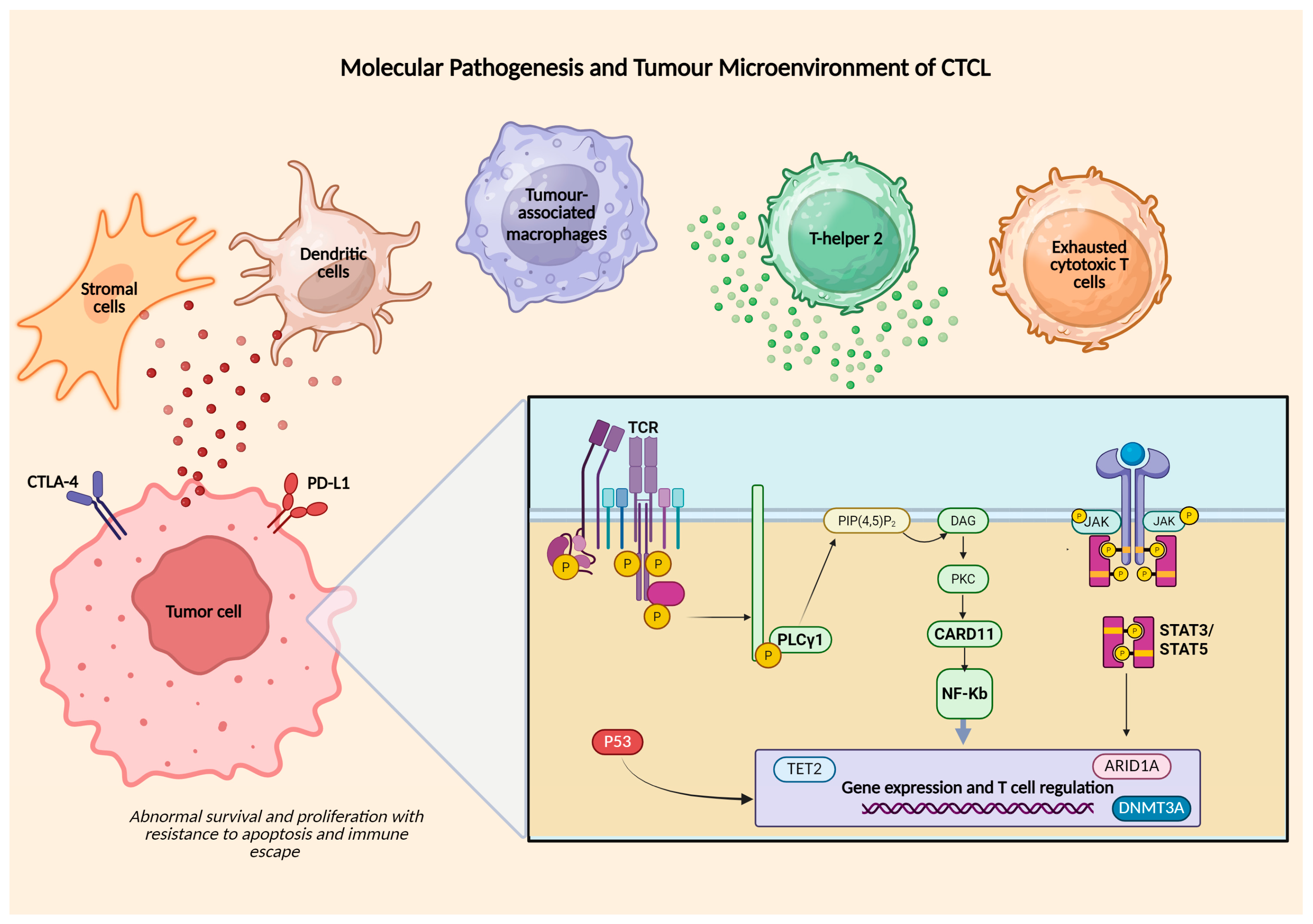
3. Molecular Pathogenesis and Tumour Microenvironment
3.1. Molecular Pathogenesis of CTCLs
3.2. Molecular Pathogenesis of PCBCLs
4. Diagnosis and Staging: A Dermatologic Approach
4.1. Clinical Assessment and Imaging
4.2. Histopathology, Immunophenotyping, and Molecular Studies
4.3. Staging and Prognostic Stratification
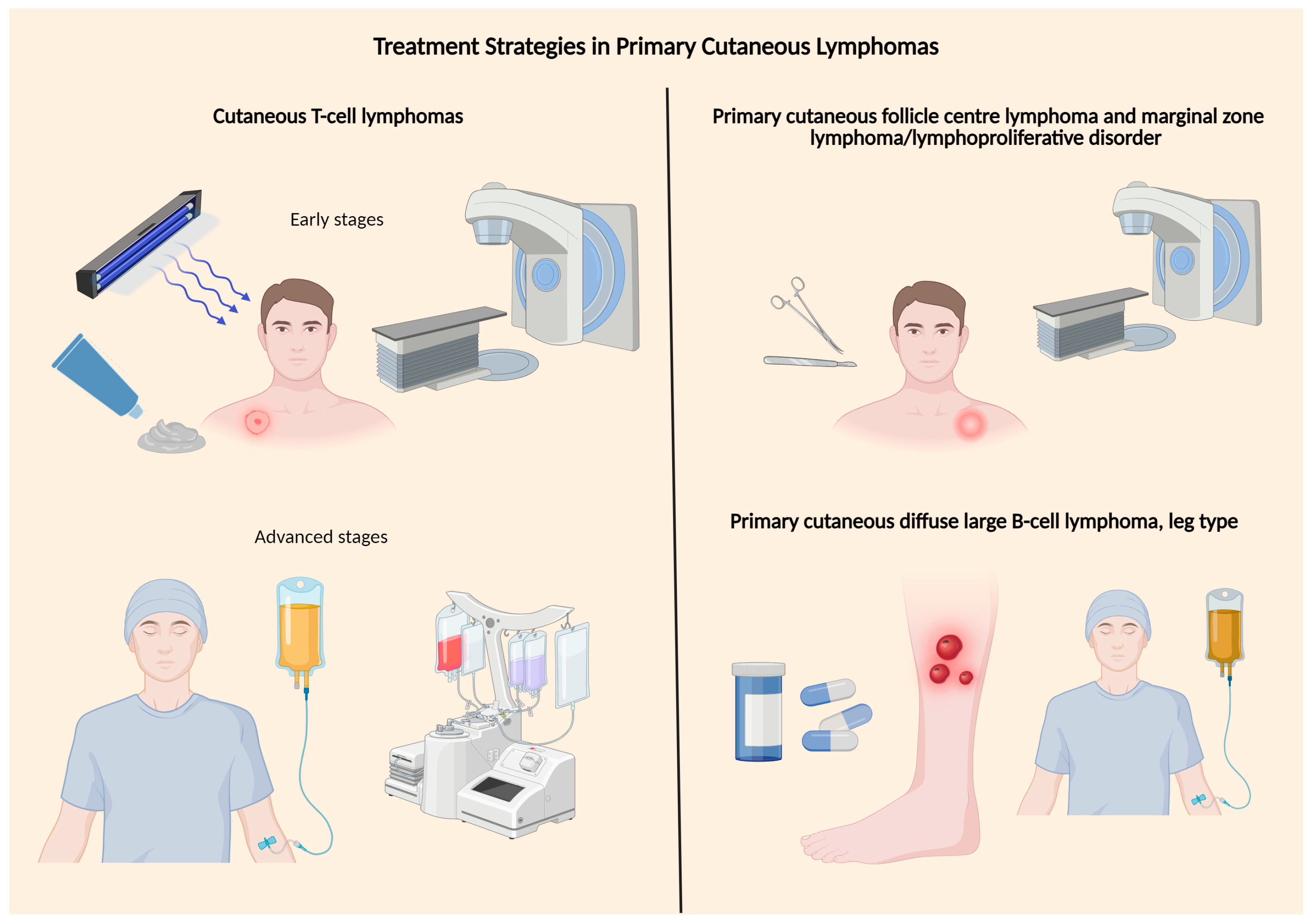
5. Therapeutic Strategies
5.1. Therapeutic Strategies in CTCLs
5.2. Therapeutic Strategies in PCBCLs
6. Discussion
7. Methods
8. Conclusions
Supplementary Materials
Author Contributions
Funding
Institutional Review Board Statement
Informed Consent Statement
Data Availability Statement
Conflicts of Interest
References
- Willemze, R.; Cerroni, L.; Kempf, W.; Berti, E.; Facchetti, F.; Swerdlow, S.H.; Jaffe, E.S. The 2018 update of the WHO-EORTC classification for primary cutaneous lymphomas. Blood 2019, 133, 1703–1714, Erratum in Blood 2019, 134, 1112. [Google Scholar] [CrossRef]
- Campo, E.; Jaffe, E.S.; Cook, J.R.; Quintanilla-Martinez, L.; Swerdlow, S.H.; Anderson, K.C.; Brousset, P.; Cerroni, L.; de Leval, L.; Dirnhofer, S.; et al. The International Consensus Classification of Mature Lymphoid Neoplasms: A report from the Clinical Advisory Committee. Blood 2022, 140, 1229–1253, Erratum in Blood 2023, 141, 437. [Google Scholar] [CrossRef]
- Hristov, A.C.; Tejasvi, T.; Wilcox, R.A. Cutaneous B-cell lymphomas: 2023 update on diagnosis, risk-stratification, and management. Am. J. Hematol. 2023, 98, 1326–1332. [Google Scholar] [CrossRef]
- Barbati, Z.R.; Charli-Joseph, Y. Unveiling Primary Cutaneous B-Cell Lymphomas: New Insights into Diagnosis and Treatment Strategies. Cancers 2025, 17, 1202. [Google Scholar] [CrossRef]
- Hristov, A.C.; Tejasvi, T.; Wilcox, R.A. Cutaneous T-cell lymphomas: 2021 update on diagnosis, risk-stratification, and management. Am. J. Hematol. 2021, 96, 1313–1328. [Google Scholar] [CrossRef]
- García-Díaz, N.; Piris, M.Á.; Ortiz-Romero, P.L.; Vaqué, J.P. Mycosis Fungoides and Sézary Syndrome: An Integrative Review of the Pathophysiology, Molecular Drivers, and Targeted Therapy. Cancers 2021, 13, 1931. [Google Scholar] [CrossRef] [PubMed]
- Krenitsky, A.; Klager, S.; Hatch, L.; Sarriera-Lazaro, C.; Chen, P.L.; Seminario-Vidal, L. Update in Diagnosis and Management of Primary Cutaneous B-Cell Lymphomas. Am. J. Clin. Dermatol. 2022, 23, 689–706. [Google Scholar] [CrossRef] [PubMed]
- Walia, R.; Yeung, C.C.S. An Update on Molecular Biology of Cutaneous T Cell Lymphoma. Front. Oncol. 2020, 9, 1558. [Google Scholar] [CrossRef] [PubMed]
- Laurent, C.; Cook, J.R.; Yoshino, T.; Quintanilla-Martinez, L.; Jaffe, E.S. Follicular lymphoma and marginal zone lymphoma: How many diseases? Virchows Archiv. 2023, 482, 149–162. [Google Scholar] [CrossRef]
- Alaggio, R.; Amador, C.; Anagnostopoulos, I.; Attygalle, A.D.; Araujo, I.B.O.; Berti, E.; Bhagat, G.; Borges, A.M.; Boyer, D.; Calaminici, M.; et al. The 5th edition of the World Health Organization Classification of Haematolymphoid Tumours: Lymphoid Neoplasms. Leukemia 2022, 36, 1720–1748, Correction in Leukemia 2023, 37, 1944–1951. [Google Scholar] [CrossRef]
- Pulitzer, M. Cutaneous T-cell Lymphoma. Clin. Lab. Med. 2017, 37, 527–546. [Google Scholar] [CrossRef]
- Olsen, E.; Vonderheid, E.; Pimpinelli, N.; Willemze, R.; Kim, Y.; Knobler, R.; Zackheim, H.; Duvic, M.; Estrach, T.; Lamberg, S.; et al. Revisions to the staging and classification of mycosis fungoides and Sézary syndrome: A proposal of the International Society for Cutaneous Lymphomas (ISCL) and the cutaneous lymphoma task force of the European Organization of Research and Treatment of Cancer (EORTC). Blood 2007, 110, 1713–1722. [Google Scholar] [CrossRef] [PubMed]
- Kempf, W.; Pfaltz, K.; Vermeer, M.H.; Cozzio, A.; Ortiz-Romero, P.L.; Bagot, M.; Olsen, E.; Kim, Y.H.; Dummer, R.; Pimpinelli, N.; et al. EORTC, ISCL, and USCLC consensus recommendations for the treatment of primary cutaneous CD30-positive lymphoproliferative disorders: Lymphomatoid papulosis and primary cutaneous anaplastic large-cell lymphoma. Blood 2011, 118, 4024–4035. [Google Scholar] [CrossRef] [PubMed]
- Phillips, D.; Matusiak, M.; Gutierrez, B.R.; Bhate, S.S.; Barlow, G.L.; Jiang, S.; Demeter, J.; Smythe, K.S.; Pierce, R.H.; Fling, S.P.; et al. Immune cell topography predicts response to PD-1 blockade in cutaneous T cell lymphoma. Nat. Commun. 2021, 12, 6726. [Google Scholar] [CrossRef]
- Khodadoust, M.S.; Rook, A.H.; Porcu, P.; Foss, F.; Moskowitz, A.J.; Shustov, A.; Shanbhag, S.; Sokol, L.; Fling, S.P.; Ramchurren, N.; et al. Pembrolizumab in Relapsed and Refractory Mycosis Fungoides and Sézary Syndrome: A Multicenter Phase II Study. J. Clin. Oncol. 2020, 38, 20–28. [Google Scholar] [CrossRef]
- Jones, C.L.; Degasperi, A.; Grandi, V.; Amarante, T.D.; Genomics England Research Consortium; Mitchell, T.J.; Nik-Zainal, S.; Whittaker, S.J. Spectrum of mutational signatures in T-cell lymphoma reveals a key role for UV radiation in cutaneous T-cell lymphoma. Sci. Rep. 2021, 11, 3962. [Google Scholar] [CrossRef] [PubMed]
- Guglielmo, A.; Zengarini, C.; Agostinelli, C.; Motta, G.; Sabattini, E.; Pileri, A. The Role of Cytokines in Cutaneous T Cell Lymphoma: A Focus on the State of the Art and Possible Therapeutic Targets. Cells 2024, 13, 584. [Google Scholar] [CrossRef]
- Pileri, A.; Morsia, E.; Zengarini, C.; Torre, E.; Goteri, G.; Quaglino, P.; Pimpinelli, N.; Paulli, M.; Pileri, S.A.; Zinzani, P.L.; et al. Epidemiology of cutaneous T-cell lymphomas: State of the art and a focus on the Italian Marche region. Eur. J. Dermatol. 2023, 33, 360–367. [Google Scholar] [CrossRef]
- Liu, Z.; Wu, X.; Hwang, S.T.; Liu, J. The Role of Tumor Microenvironment in Mycosis Fungoides and Sézary Syndrome. Ann. Dermatol. 2021, 33, 487–496. [Google Scholar] [CrossRef]
- Zhang, Y.; LeWitt, T.M.; Louissaint, A.; Guitart, J.; Zhou, X.A.; Choi, J. Disease-Defining Molecular Features of Primary Cutaneous B-Cell Lymphomas: Implications for Classification and Treatment. J. Investig. Dermatol. 2023, 143, 189–196. [Google Scholar] [CrossRef]
- Pham-Ledard, A.; Beylot-Barry, M.; Barbe, C.; Leduc, M.; Petrella, T.; Vergier, B.; Martinez, F.; Cappellen, D.; Merlio, J.-P.; Grange, F. High Frequency and Clinical Prognostic Value of MYD88 L265P Mutation in Primary Cutaneous Diffuse Large B-Cell Lymphoma, Leg-Type. JAMA Dermatol. 2014, 150, 1173–1179. [Google Scholar] [CrossRef] [PubMed]
- Zhou, X.A.; Louissaint, A.; Wenzel, A.; Yang, J.; Martinez-Escala, M.E.; Moy, A.P.; Morgan, E.A.; Paxton, C.N.; Hong, B.; Andersen, E.F.; et al. Genomic Analyses Identify Recurrent Alterations in Immune Evasion Genes in Diffuse Large B-Cell Lymphoma, Leg Type. J. Investig. Dermatol. 2018, 138, 2365–2376. [Google Scholar] [CrossRef]
- Scarisbrick, J.J.; Quaglino, P.; Prince, H.M.; Papadavid, E.; Hodak, E.; Bagot, M.; Servitje, O.; Berti, E.; Ortiz-Romero, P.; Stadler, R.; et al. The PROCLIPI international registry of early-stage mycosis fungoides identifies substantial diagnostic delay in most patients. Br. J. Dermatol. 2019, 181, 350–357. [Google Scholar] [CrossRef]
- D’Onghia, M.; Mendonça-Sanches, M.; Erasti, M.; Cartocci, A.; Calabrese, L.; Sirchio, A.; Tognetti, L.; Batsikosta, A.; Lazzi, S.; Suppa, M.; et al. Non-Invasive Imaging Including Line-Field Confocal Optical Coherence Tomography (LC-OCT) for Diagnosis of Cutaneous Lymphomas. Cancers 2024, 16, 3608. [Google Scholar] [CrossRef]
- Gibbs, J.; Ma, S.; Kim, A.; Seminario-Vidal, L.; Sokol, L.; Zhang, H.; Sagatys, E.; Chen, P.; Messina, J.L. Utility of flow cytometry and gene rearrangement analysis in tissue and blood of patients with suspected cutaneous T-cell lymphoma. Oncol. Rep. 2020, 45, 349–358. [Google Scholar] [CrossRef]
- Latzka, J.; Assaf, C.; Bagot, M.; Cozzio, A.; Dummer, R.; Guenova, E.; Gniadecki, R.; Hodak, E.; Jonak, C.; Klemke, C.D.; et al. EORTC consensus recommendations for the treatment of mycosis fungoides/Sézary syndrome—Update 2023. Eur. J. Cancer 2023, 195, 113343. [Google Scholar] [CrossRef]
- Agar, N.S.; Wedgeworth, E.; Crichton, S.; Mitchell, T.J.; Cox, M.; Ferreira, S.; Robson, A.; Calonje, E.; Stefanato, C.M.; Wain, E.M.; et al. Survival Outcomes and Prognostic Factors in Mycosis Fungoides/Sézary Syndrome: Validation of the Revised International Society for Cutaneous Lymphomas/European Organisation for Research and Treatment of Cancer Staging Proposal. J. Clin. Oncol. 2010, 28, 4730–4739. [Google Scholar] [CrossRef]
- Geller, S.; Lebowitz, E.; Pulitzer, M.P.; Horwitz, S.M.; Moskowitz, A.J.; Dusza, S.; Myskowski, P.L. Outcomes and prognostic factors in African American and black patients with mycosis fungoides/Sézary syndrome: Retrospective analysis of 157 patients from a referral cancer center. J. Am. Acad. Dermatol. 2020, 83, 430–439. [Google Scholar] [CrossRef] [PubMed]
- Giordano, A.; Pagano, L. The Treatment of Advanced-Stage Mycosis Fungoides and Sezary Syndrome: A Hematologist’s Point of View. Mediterr. J. Hematol. Infect. Dis. 2022, 14, e2022029. [Google Scholar] [CrossRef]
- Duvic, M.; Talpur, R.; Ni, X.; Zhang, C.; Hazarika, P.; Kelly, C.; Chiao, J.H.; Reilly, J.F.; Ricker, J.L.; Richon, V.M.; et al. Phase 2 trial of oral vorinostat (suberoylanilide hydroxamic acid, SAHA) for refractory cutaneous T-cell lymphoma (CTCL). Blood 2007, 109, 31–39. [Google Scholar] [CrossRef] [PubMed]
- Scarisbrick, J.J.; Prince, H.M.; Vermeer, M.H.; Quaglino, P.; Horwitz, S.; Porcu, P.; Stadler, R.; Wood, G.S.; Beylot-Barry, M.; Pham-Ledard, A.; et al. Cutaneous Lymphoma International Consortium Study of Outcome in Advanced Stages of Mycosis Fungoides and Sézary Syndrome: Effect of Specific Prognostic Markers on Survival and Development of a Prognostic Model. J. Clin. Oncol. 2015, 33, 3766–3773. [Google Scholar] [CrossRef]
- Mehta-Shah, N.; Horwitz, S.M.; Ansell, S.; Ai, W.Z.; Barnes, J.; Barta, S.K.; Clemens, M.W.; Dogan, A.; Fisher, K.; Goodman, A.M.; et al. NCCN Guidelines Insights: Primary Cutaneous Lymphomas, Version 2.2020. J. Natl. Compr. Cancer Netw. 2020, 18, 522–536. [Google Scholar] [CrossRef] [PubMed]
- Trautinger, F.; Knobler, R.; Willemze, R.; Peris, K.; Stadler, R.; Laroche, L.; D’Incan, M.; Ranki, A.; Pimpinelli, N.; Ortiz-Romero, P.; et al. EORTC consensus recommendations for the treatment of mycosis fungoides/Sézary syndrome. Eur. J. Cancer 2006, 42, 1014–1030. [Google Scholar] [CrossRef]
- Kim, Y.H.; Bagot, M.; Pinter-Brown, L.; Rook, A.H.; Porcu, P.; Horwitz, S.M.; Whittaker, S.; Tokura, Y.; Vermeer, M.; Zinzani, P.L.; et al. Mogamulizumab versus vorinostat in previously treated cutaneous T-cell lymphoma (MAVORIC): An international, open-label, randomised, controlled phase 3 trial. Lancet Oncol. 2018, 19, 1192–1204, Correction in Lancet Oncol. 2018, 19, e581. [Google Scholar] [CrossRef]
- Lessin, S.R.; Duvic, M.; Guitart, J.; Pandya, A.G.; Strober, B.E.; Olsen, E.A.; Hull, C.M.; Knobler, E.H.; Rook, A.H.; Kim, E.J.; et al. Topical Chemotherapy in Cutaneous T-cell Lymphoma. JAMA Dermatol. 2013, 149, 25–32. [Google Scholar] [CrossRef]
- Alexander-Savino, C.V.; Chung, C.G.; Gilmore, E.S.; Carroll, S.M.; Poligone, B. Randomized Mechlorethamine/Chlormethine Induced Dermatitis Assessment Study (MIDAS) Establishes Benefit of Topical Triamcinolone 0.1% Ointment Cotreatment in Mycosis Fungoides. Dermatol. Ther. 2022, 12, 643–654. [Google Scholar] [CrossRef] [PubMed]
- Stuver, R.; Moskowitz, A.J. Therapeutic Advances in Relapsed and Refractory Peripheral T-Cell Lymphoma. Cancers 2023, 15, 589. [Google Scholar] [CrossRef] [PubMed]
- Guenova, E.; Ortiz-Romero, P.L.; Poligone, B.; Querfeld, C. Mechanism of action of chlormethine gel in mycosis fungoides. J. Eur. Acad. Dermatol. Venereol. 2023, 37, 1739–1748. [Google Scholar] [CrossRef]
- Duvic, M.; Hymes, K.; Heald, P.; Breneman, D.; Martin, A.G.; Myskowski, P.; Crowley, C.; Yocum, R.C.; Bexarotene Worldwide Study Group. Bexarotene Is Effective and Safe for Treatment of Refractory Advanced-Stage Cutaneous T-Cell Lymphoma: Multinational Phase II-III Trial Results. J. Clin. Oncol. 2001, 19, 2456–2471. [Google Scholar] [CrossRef]
- Zic, J.A.; Stricklin, G.P.; Greer, J.P.; Kinney, M.C.; Shyr, Y.; Wilson, D.C.; King, L.E., Jr. Long-term follow-up of patients with cutaneous T-cell lymphoma treated with extracorporeal photochemotherapy. J. Am. Acad. Dermatol. 1996, 35, 935–945. [Google Scholar] [CrossRef]
- Knobler, R.; Duvic, M.; Querfeld, C.; Straus, D.; Horwitz, S.; Zain, J.; Foss, F.; Kuzel, T.; Campbell, K.; Geskin, L. Long-term follow-up and survival of cutaneous T-cell lymphoma patients treated with extracorporeal photopheresis. Photodermatol. Photoimmunol. Photomed. 2012, 28, 250–257. [Google Scholar] [CrossRef]
- Quaglino, P.; Knobler, R.; Fierro, M.T.; Savoia, P.; Marra, E.; Fava, P.; Bernengo, M.G. Extracorporeal photopheresis for the treatment of erythrodermic cutaneous T-cell lymphoma: A single center clinical experience with long-term follow-up data and a brief overview of the literature. Int. J. Dermatol. 2013, 52, 1308–1318. [Google Scholar] [CrossRef]
- Cho, A.; Jantschitsch, C.; Knobler, R. Extracorporeal Photopheresis—An Overview. Front. Med. 2018, 5, 236. [Google Scholar] [CrossRef] [PubMed]
- Whittaker, S.J.; Demierre, M.F.; Kim, E.J.; Rook, A.H.; Lerner, A.; Duvic, M.; Scarisbrick, J.; Reddy, S.; Robak, T.; Becker, J.C.; et al. Final Results From a Multicenter, International, Pivotal Study of Romidepsin in Refractory Cutaneous T-Cell Lymphoma. J. Clin. Oncol. 2010, 28, 4485–4491. [Google Scholar] [CrossRef]
- Piekarz, R.L.; Frye, R.; Turner, M.; Wright, J.J.; Allen, S.L.; Kirschbaum, M.H.; Zain, J.; Prince, H.M.; Leonard, J.P.; Geskin, L.J.; et al. Phase II Multi-Institutional Trial of the Histone Deacetylase Inhibitor Romidepsin As Monotherapy for Patients With Cutaneous T-Cell Lymphoma. J. Clin. Oncol. 2009, 27, 5410–5417. [Google Scholar] [CrossRef]
- Olsen, E.A.; Kim, Y.H.; Kuzel, T.M.; Pacheco, T.R.; Foss, F.M.; Parker, S.; Frankel, S.R.; Chen, C.; Ricker, J.L.; Arduino, J.M.; et al. Phase IIB Multicenter Trial of Vorinostat in Patients With Persistent, Progressive, or Treatment Refractory Cutaneous T-Cell Lymphoma. J. Clin. Oncol. 2007, 25, 3109–3115. [Google Scholar] [CrossRef]
- Mann, B.S.; Johnson, J.R.; Cohen, M.H.; Justice, R.; Pazdur, R. FDA Approval Summary: Vorinostat for Treatment of Advanced Primary Cutaneous T-Cell Lymphoma. Oncologist 2007, 12, 1247–1252. [Google Scholar] [CrossRef]
- Iyer, S.P.; Huen, A.; Ai, W.Z.; Jagadeesh, D.; Lechowicz, M.J.; Okada, C.; Feldman, T.A.; Ghione, P.; Alderuccio, J.P.; Champion, R.; et al. Safety and efficacy of tenalisib in combination with romidepsin in patients with relapsed/refractory T-cell lymphoma: Results from a phase I/II open-label multicenter study. Haematologica 2023, 109, 209–219. [Google Scholar] [CrossRef] [PubMed]
- Ford, J.G.; Koh, M.J.; Lenart, A.W.; MacVicar, C.; Chopra, K.; Meharwal, A.; Sorial, M.N.; Merrill, M.; Rider, A.B.; Sohani, A.R.; et al. Real-world evidence of duvelisib and romidepsin in relapsed/refractory peripheral and cutaneous T-cell lymphomas. Blood Adv. 2025, 9, 4286–4305, Erratum in Blood Adv. 2026, 10, 660. [Google Scholar] [CrossRef]
- Huen, A.; Haverkos, B.M.; Zain, J.; Radhakrishnan, R.; Lechowicz, M.J.; Devata, S.; Korman, N.J.; Pinter-Brown, L.; Oki, Y.; Barde, P.J.; et al. Phase I/Ib Study of Tenalisib (RP6530), a Dual PI3K δ/γ Inhibitor in Patients with Relapsed/Refractory T-Cell Lymphoma. Cancers 2020, 12, 2293. [Google Scholar] [CrossRef] [PubMed]
- Carlo-Stella, C.; Delarue, R.; Scarfo, L.; Barde, P.J.; Nair, A.; Locatelli, S.L.; Morello, L.; Magagnoli, M.; Vakkalanka, S.; Viswanadha, S.; et al. A First-in-human Study of Tenalisib (RP6530), a Dual PI3K δ/γ Inhibitor, in Patients with Relapsed/Refractory Hematologic Malignancies: Results from the European Study. Clin. Lymphoma Myeloma Leuk. 2020, 20, 78–86. [Google Scholar] [CrossRef]
- Horwitz, S.M.; Koch, R.; Porcu, P.; Oki, Y.; Moskowitz, A.; Perez, M.; Myskowski, P.; Officer, A.; Jaffe, J.D.; Morrow, S.N.; et al. Activity of the PI3K-δ,γ inhibitor duvelisib in a phase 1 trial and preclinical models of T-cell lymphoma. Blood 2018, 131, 888–898. [Google Scholar] [CrossRef]
- Duvic, M.; Tetzlaff, M.T.; Gangar, P.; Clos, A.L.; Sui, D.; Talpur, R. Results of a Phase II Trial of Brentuximab Vedotin for CD30 + Cutaneous T-Cell Lymphoma and Lymphomatoid Papulosis. J. Clin. Oncol. 2015, 33, 3759–3765. [Google Scholar] [CrossRef]
- Ferreira, S.; Fernandes, I.; Cabral, R.; Lima, M. Tratamento do Linfoma Cutâneo Primário de Células Grandes Anaplásicas com Brentuximab Vedotina: A Propósito de Dois Casos Clínicos. J. Port. Soc. Dermatol. Venereol. 2021, 79, 53–56. [Google Scholar] [CrossRef]
- Prince, H.M.; Kim, Y.H.; Horwitz, S.M.; Dummer, R.; Scarisbrick, J.; Quaglino, P.; Zinzani, P.L.; Wolter, P.; Sanches, J.A.; Ortiz-Romero, P.L.; et al. Brentuximab vedotin or physician’s choice in CD30-positive cutaneous T-cell lymphoma (ALCANZA): An international, open-label, randomised, phase 3, multicentre trial. Lancet 2017, 390, 555–566. [Google Scholar] [CrossRef]
- Horwitz, S.M.; Scarisbrick, J.J.; Dummer, R.; Whittaker, S.; Duvic, M.; Kim, Y.H.; Quaglino, P.; Zinzani, P.L.; Bechter, O.; Eradat, H.; et al. Randomized phase 3 ALCANZA study of brentuximab vedotin vs physician’s choice in cutaneous T-cell lymphoma: Final data. Blood Adv. 2021, 5, 5098–5106, Erratum in Blood Adv. 2024, 8, 2243. [Google Scholar] [CrossRef]
- Walker, C.J.; Donnelly, E.D.; Moreira, J.; Mehta, J.; Mittal, B.B.; Choi, J.; Zhou, X.A.; Guitart, J.; Pro, B. Pembrolizumab and palliative radiotherapy in 2 cases of refractory mycosis fungoides. JAAD Case Rep. 2021, 7, 87–90. [Google Scholar] [CrossRef]
- Cowan, R.A.; Scarisbrick, J.J.; Zinzani, P.L.; Nicolay, J.P.; Sokol, L.; Pinter-Brown, L.; Quaglino, P.; Iversen, L.; Dummer, R.; Musiek, A.; et al. Efficacy and safety of mogamulizumab by patient baseline blood tumour burden: A post hoc analysis of the MAVORIC trial. J. Eur. Acad. Dermatol. Venereol. 2021, 35, 2225–2238. [Google Scholar] [CrossRef] [PubMed]
- Fernández-Guarino, M.; Ortiz, P.; Gallardo, F.; Llamas-Velasco, M. Clinical and Real-World Effectiveness of Mogamulizumab: A Narrative Review. Int. J. Mol. Sci. 2024, 25, 2203. [Google Scholar] [CrossRef] [PubMed]
- Scarisbrick, J.J.; Kim, Y.H.; Whittaker, S.J.; Wood, G.S.; Vermeer, M.H.; Prince, H.M.; Quaglino, P. Prognostic factors, prognostic indices and staging in mycosis fungoides and Sézary syndrome: Where are we now? Br. J. Dermatol. 2014, 170, 1226–1236. [Google Scholar] [CrossRef] [PubMed]
- Dumont, M.; Battistella, M.; Ram-Wolff, C.; Bagot, M.; de Masson, A. Diagnosis and Treatment of Primary Cutaneous B-Cell Lymphomas: State of the Art and Perspectives. Cancers 2020, 12, 1497. [Google Scholar] [CrossRef]
- Grange, F.; Beylot-Barry, M.; Courville, P.; Maubec, E.; Bagot, M.; Vergier, B.; Souteyrand, P.; Machet, L.; Dalac, S.; Esteve, E.; et al. Primary Cutaneous Diffuse Large B-Cell Lymphoma, Leg Type. Arch. Dermatol. 2007, 143, 1144–1150. [Google Scholar] [CrossRef]
- Lucioni, M.; Fraticelli, S.; Neri, G.; Feltri, M.; Ferrario, G.; Riboni, R.; Paulli, M. Primary Cutaneous B-Cell Lymphoma: An Update on Pathologic and Molecular Features. Hemato 2022, 3, 318–340. [Google Scholar] [CrossRef]
- Vitiello, P.; Sica, A.; Ronchi, A.; Caccavale, S.; Franco, R.; Argenziano, G. Primary Cutaneous B-Cell Lymphomas: An Update. Front. Oncol. 2020, 10, 651. [Google Scholar] [CrossRef] [PubMed]
- Villasenor-Park, J.; Chung, J.; Kim, E.J. Cutaneous B-Cell Lymphomas. Hematol. Oncol. Clin. N. Am. 2024, 38, 1111–1131. [Google Scholar] [CrossRef]
- Beylot-Barry, M.; Mermin, D.; Maillard, A.; Bouabdallah, R.; Bonnet, N.; Duval-Modeste, A.B.; Mortier, L.; Ingen-Housz-Oro, S.; Ram-Wolff, C.; Barete, S.; et al. A Single-Arm Phase II Trial of Lenalidomide in Relapsing or Refractory Primary Cutaneous Large B-Cell Lymphoma, Leg Type. J. Investig. Dermatol. 2018, 138, 1982–1989. [Google Scholar] [CrossRef]
- Di Raimondo, C.; Abdulla, F.R.; Zain, J.; Querfeld, C.; Rosen, S.T. Rituximab, lenalidomide and pembrolizumab in refractory primary cutaneous diffuse large B-cell lymphoma, leg type. Br. J. Haematol. 2019, 187, e79–e82. [Google Scholar] [CrossRef]
- Moore, D.C.; Soni, A.C.; Hu, B.; Smith, E.T.; Levine, J.; Moyo, T.K.; Jacobs, R.; Ghosh, N.; Park, S.I. Rituximab, lenalidomide, and ibrutinib in relapsed/refractory primary cutaneous diffuse large B-cell lymphoma, leg type. Br. J. Haematol. 2022, 196, e30–e33. [Google Scholar] [CrossRef]
- Pang, A.; Au-Yeung, R.; Leung, R.Y.Y.; Kwong, Y.L. Addictive response of primary cutaneous diffuse large B cell lymphoma leg type to low-dose ibrutinib. Ann. Hematol. 2019, 98, 2433–2436. [Google Scholar] [CrossRef] [PubMed]
- Fox, L.C.; Yannakou, C.K.; Ryland, G.; Lade, S.; Dickinson, M.; Campbell, B.A.; Prince, H.M. Molecular Mechanisms of Disease Progression in Primary Cutaneous Diffuse Large B-Cell Lymphoma, Leg Type during Ibrutinib Therapy. Int. J. Mol. Sci. 2018, 19, 1758. [Google Scholar] [CrossRef] [PubMed]
- Al Dhafiri, M.; Sicre de Fontbrune, F.; Marinho, E.; Deschamps, L.; Di-Lucca, J.; Crickx, B.; Descamps, V. Effectiveness of lenalidomide in relapsed primary cutaneous diffuse large B-cell lymphoma, leg type. Clin. Case Rep. 2019, 7, 964–967. [Google Scholar] [CrossRef] [PubMed]



| Conceptual Domain | Integrated Insight | Clinical Relevance/Decision Point |
|---|---|---|
| Classification and clinicopathologic spectrum | WHO–EORTC/WHO5/ICC consolidate PCL as entities distinct from systemic lymphomas with secondary skin involvement and clarify borderline lymphoproliferative disorders. | Correct entity assignment prevents overtreatment of indolent disorders and ensures prompt escalation for aggressive variants (e.g., transformed CTCL, PCDLBCL-LT). |
| CTCL phenotypes and disease compartments (MF/SS) | MF and SS represent a spectrum in which skin and blood compartments can behave differently; variants carry distinct prognostic implications. | Treatment selection and response assessment should consider the dominant compartment (skin vs. blood), pace of progression, and symptom burden. |
| CTCL molecular drivers and clonal evolution | Recurrent alterations (TCR/JAK–STAT/PI3K, epigenetic dysregulation) converge on survival advantage, clonal heterogeneity, and adaptive resistance, rather than acting as isolated events. | Explains heterogeneous depth/durability of responses and supports combination/sequence strategies rather than prolonged monotherapy. |
| Tumour microenvironment and immune evasion (CTCL) | Th2/Treg skewing, exhausted cytotoxic infiltrates, macrophage enrichment, and checkpoint expression define an immunosuppressive niche; immune topography correlates with immunotherapy responsiveness. | Provides rationale for immune-based therapy but also explains primary resistance, compartment discordance, and “flare/pseudoprogression” during checkpoint blockade. |
| PCBCL biological spectrum and risk stratification | Indolent PCBCLs are often antigen-driven with restricted profiles; PCDLBCL-LT is driven by MYD88/CD79B–BCR/NF-κB dependence plus immune-escape features. | Guides intensity: local control for indolent subtypes vs. systemic, biology-driven approaches for PCDLBCL-LT and careful distinction from PCFCL with large-cell morphology. |
| Diagnosis: standards vs. adjunctive tools | The gold standard remains clinicopathologic correlation with adequate biopsies and immunophenotyping; flow cytometry is standard for SS; imaging/molecular tools can support challenging cases. | Non-invasive imaging and high-throughput clonotype sequencing are adjunctive/emerging, useful in selected centres but not replacements for histology and formal staging. |
| Staging and prognostic stratification | TNMB remains the cornerstone for MF/SS; additional clinical/lab factors refine risk; diagnostic delay persists as a major issue in early MF. | Reinforces the need for structured dermatologic algorithms, repeat biopsies when needed, and compartment-aware staging to guide therapy and monitoring. |
| Therapeutic principles in CTCLs | Most established options are cytostatic/immunomodulatory with frequent partial responses; toxicity and resistance constrain durability; no single therapy reliably cures advanced CTCLs. | Supports sequential, response-adapted management prioritising tolerability early and strategic escalation/combination in advanced disease. |
| Therapeutic principles in PCBCL | Indolent PCBCLs benefit from iterative local strategies; PCDLBCL-LT increasingly uses immune- and pathway-directed combinations, though evidence is often from small cohorts. | Highlights the need for multidisciplinary planning and biologically informed salvage strategies; underscores limits of generalisability and need for prospective validation. |
| Unmet needs and translation to practice | Biomarker integration, longitudinal monitoring, and practical deployment of molecular tools remain underdeveloped despite rapidly expanding datasets. | Priority areas: validated predictive biomarkers, monitoring across compartments (skin/blood), and standardised workflows to translate profiling into routine care. |
Disclaimer/Publisher’s Note: The statements, opinions and data contained in all publications are solely those of the individual author(s) and contributor(s) and not of MDPI and/or the editor(s). MDPI and/or the editor(s) disclaim responsibility for any injury to people or property resulting from any ideas, methods, instructions or products referred to in the content. |
© 2026 by the authors. Licensee MDPI, Basel, Switzerland. This article is an open access article distributed under the terms and conditions of the Creative Commons Attribution (CC BY) license.
Share and Cite
Crespi, O.; Rosset, F.; Santaniello, U.; Pala, V.; Sarda, C.; Accorinti, M.; Quaglino, P.; Ribero, S. Dermatologic Perspectives on Primary Cutaneous Lymphomas: Clinicopathologic Spectrum, Molecular Insights, and Evolving Treatment Paradigms. Lymphatics 2026, 4, 11. https://doi.org/10.3390/lymphatics4010011
Crespi O, Rosset F, Santaniello U, Pala V, Sarda C, Accorinti M, Quaglino P, Ribero S. Dermatologic Perspectives on Primary Cutaneous Lymphomas: Clinicopathologic Spectrum, Molecular Insights, and Evolving Treatment Paradigms. Lymphatics. 2026; 4(1):11. https://doi.org/10.3390/lymphatics4010011
Chicago/Turabian StyleCrespi, Orsola, François Rosset, Umberto Santaniello, Valentina Pala, Cristina Sarda, Martina Accorinti, Pietro Quaglino, and Simone Ribero. 2026. "Dermatologic Perspectives on Primary Cutaneous Lymphomas: Clinicopathologic Spectrum, Molecular Insights, and Evolving Treatment Paradigms" Lymphatics 4, no. 1: 11. https://doi.org/10.3390/lymphatics4010011
APA StyleCrespi, O., Rosset, F., Santaniello, U., Pala, V., Sarda, C., Accorinti, M., Quaglino, P., & Ribero, S. (2026). Dermatologic Perspectives on Primary Cutaneous Lymphomas: Clinicopathologic Spectrum, Molecular Insights, and Evolving Treatment Paradigms. Lymphatics, 4(1), 11. https://doi.org/10.3390/lymphatics4010011