
Structural Insights into the Redox Potential of Curcumin Derivatives in Litopenaeus vannamei

 , and
, and
Abstract
1. Introduction
2. Results
2.1. Bioactivity in CUR Derivatives
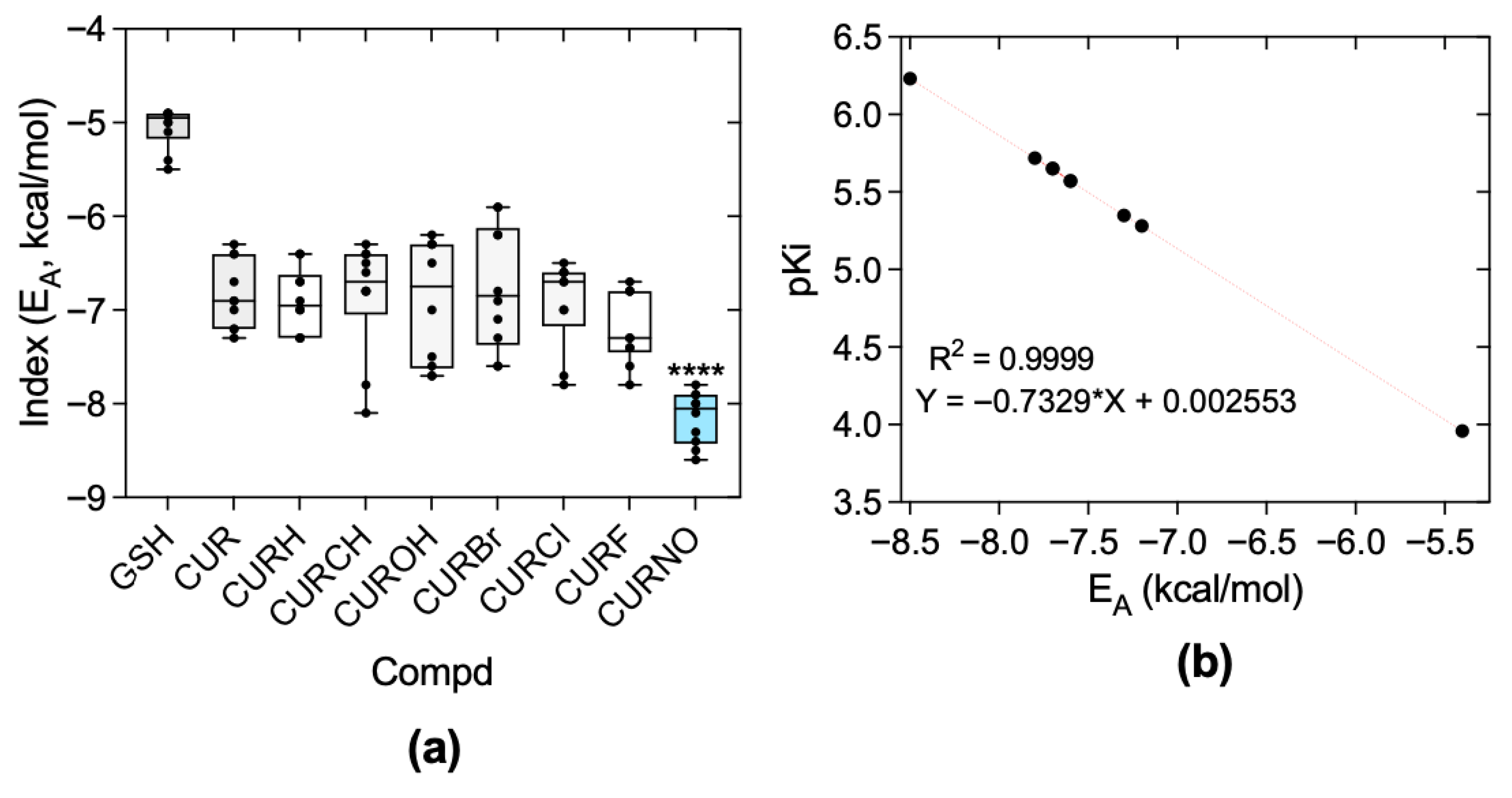
2.2. Correlation Between EA vs. pKi
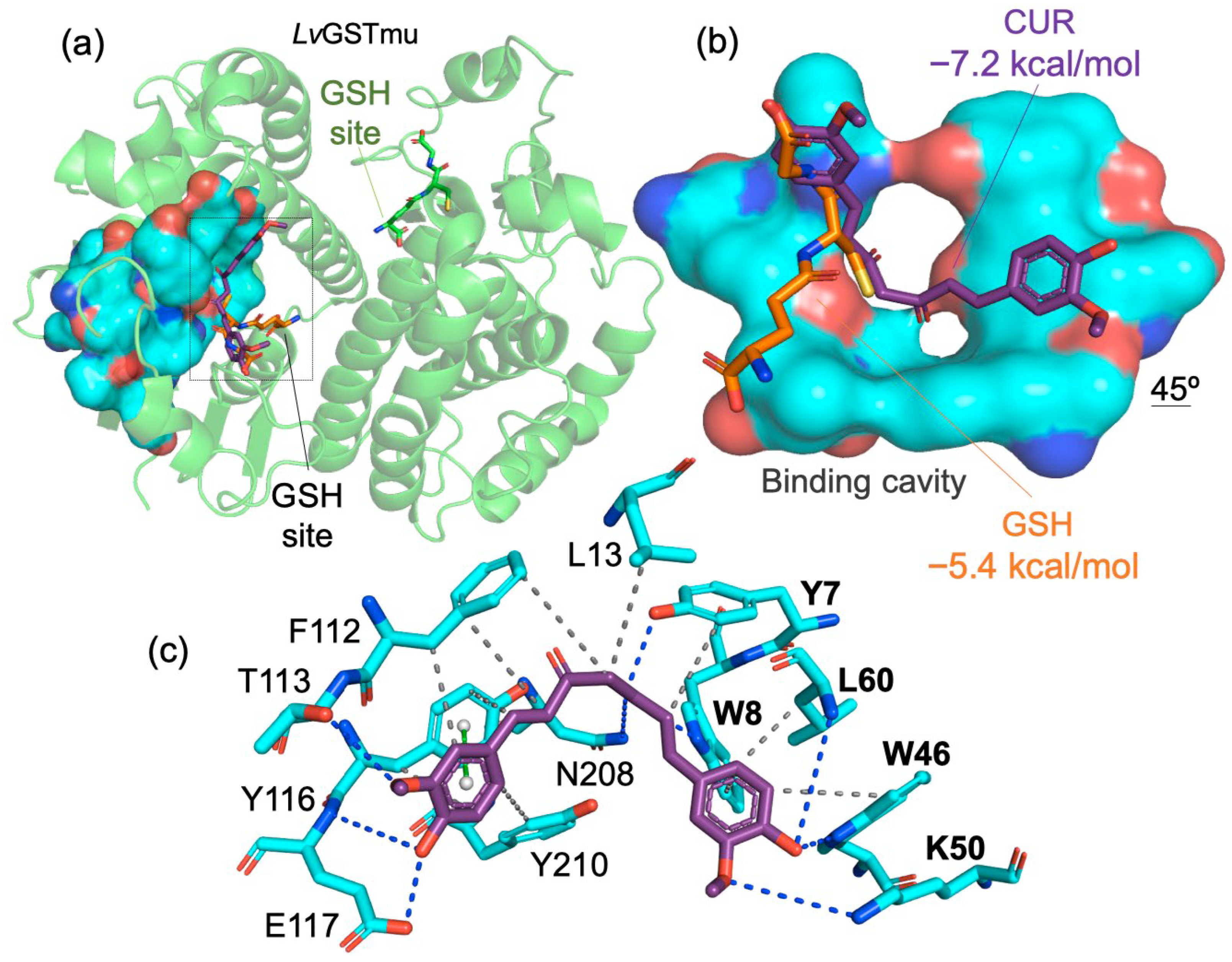
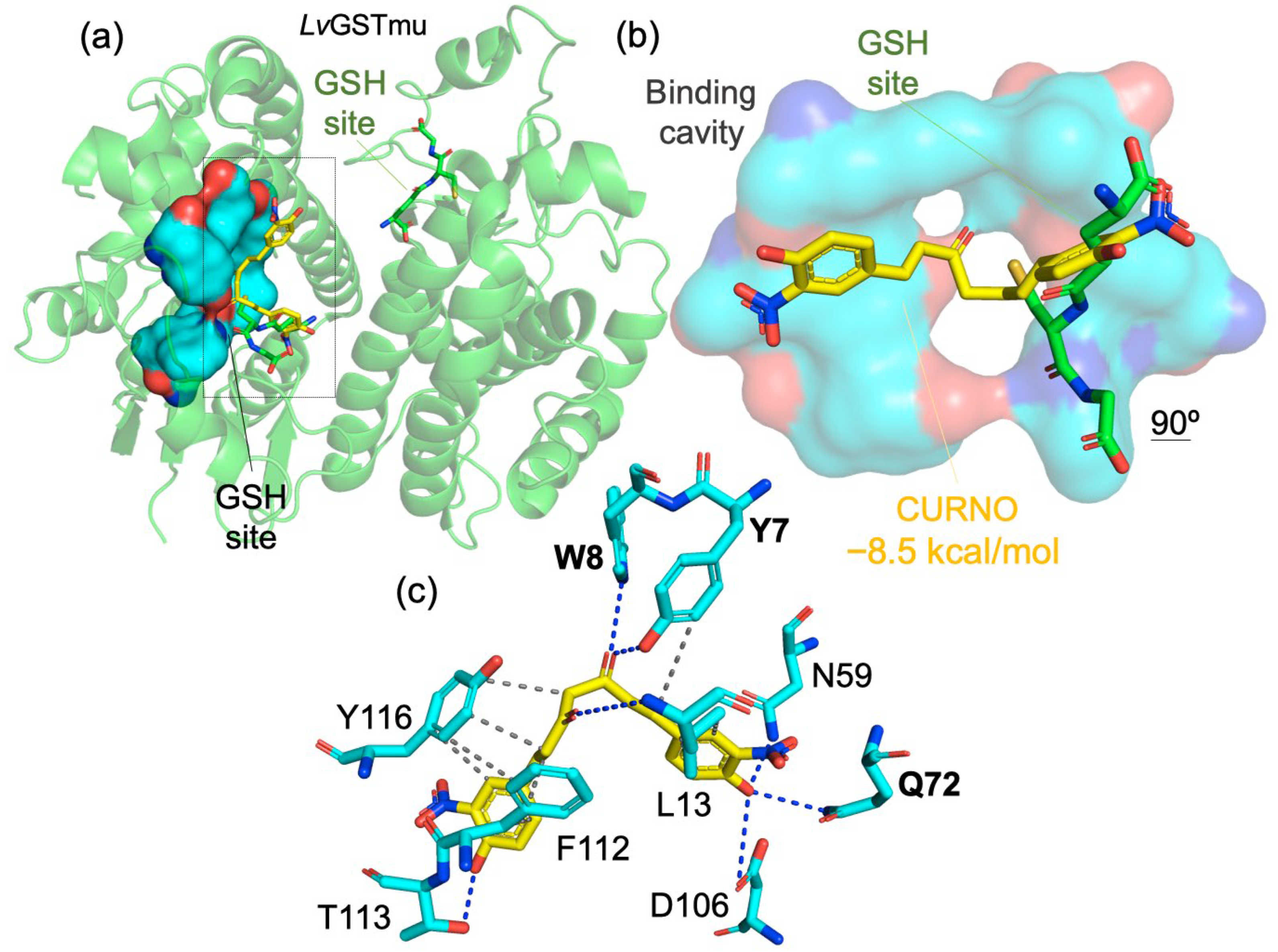
2.3. Comparative Analysis Between GSH (Co-Crystallized) and CUR (Comparative Control)
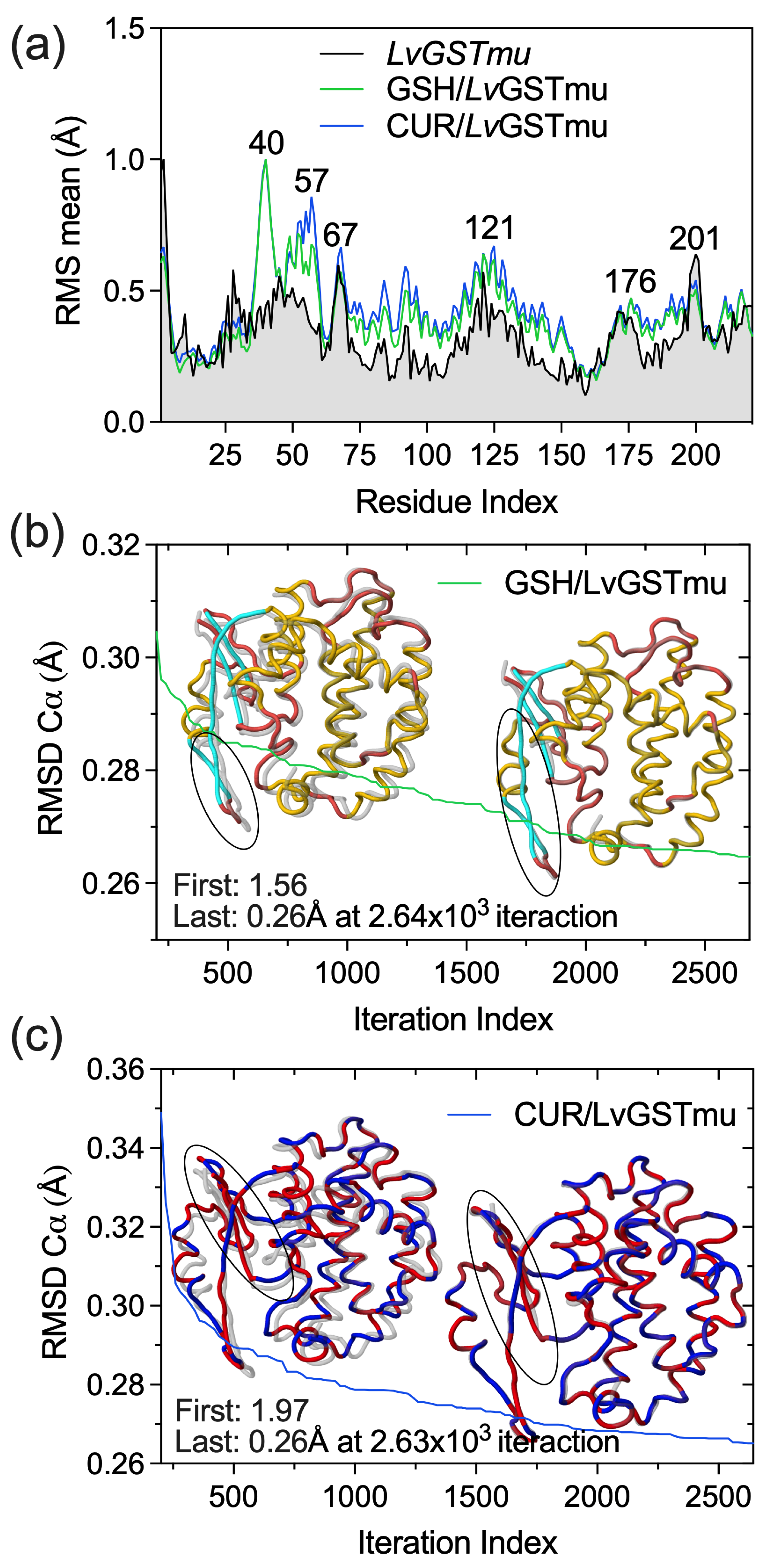
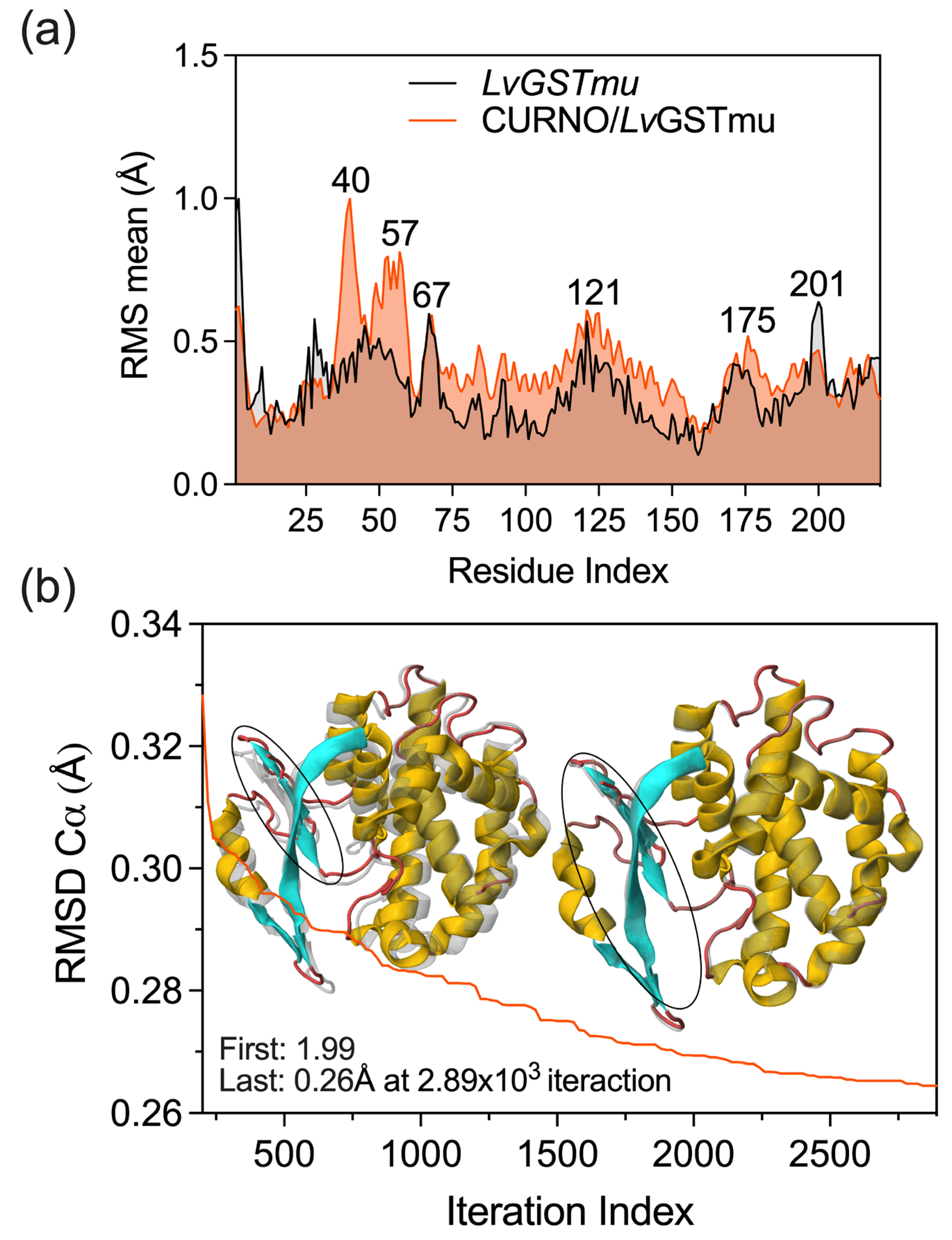
2.4. NMA-Based Dynamic
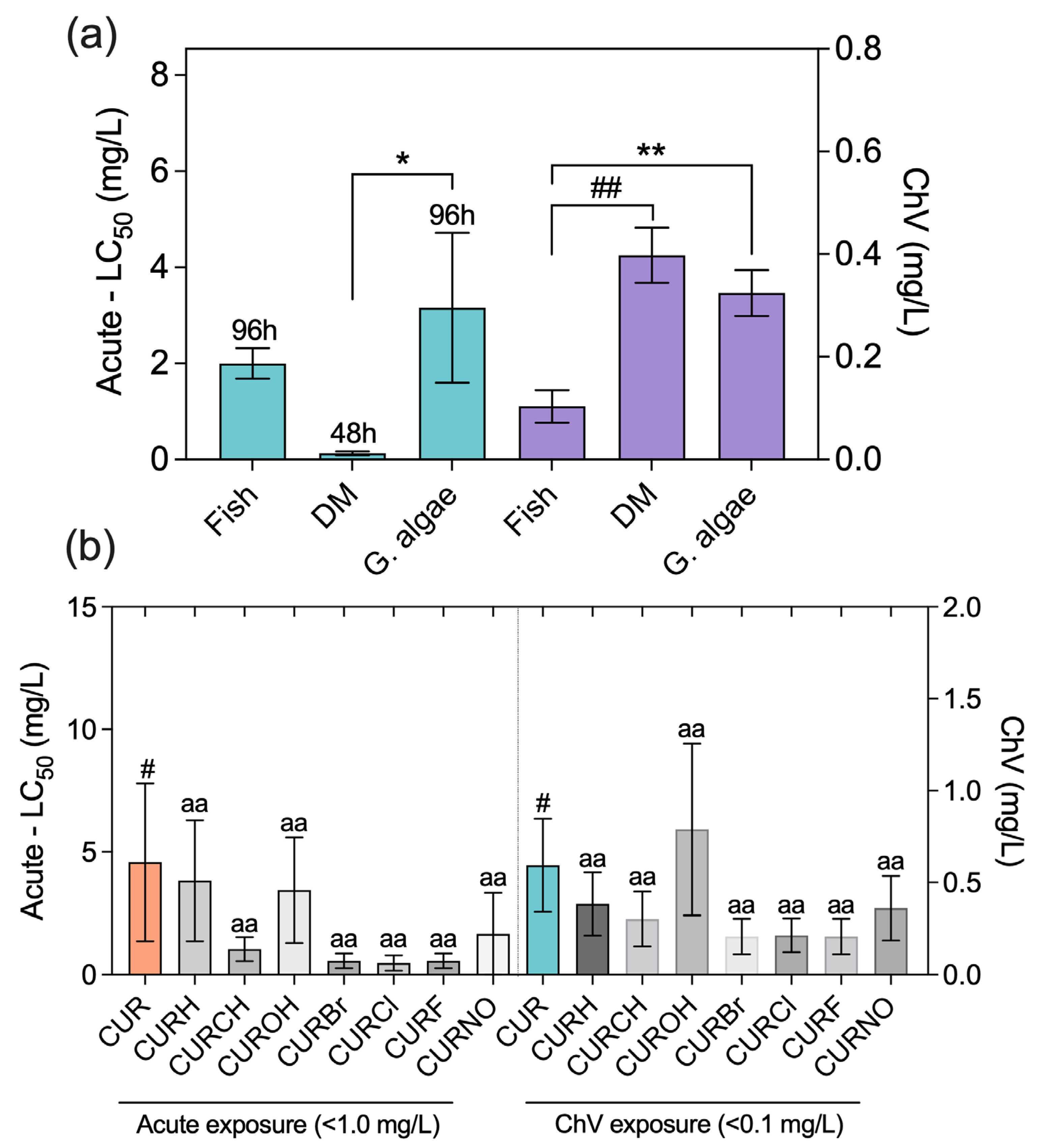
2.5. Ecotoxicological Analysis
3. Discussion
3.1. Inhibition Potential vs. Selectivity
3.2. Behavior of Biochemical Interactions via LvGSTmu
3.3. Molecular Dynamics (NMA-Mode)
3.4. Exposure Acute and ChV Analysis
4. Materials and Methods
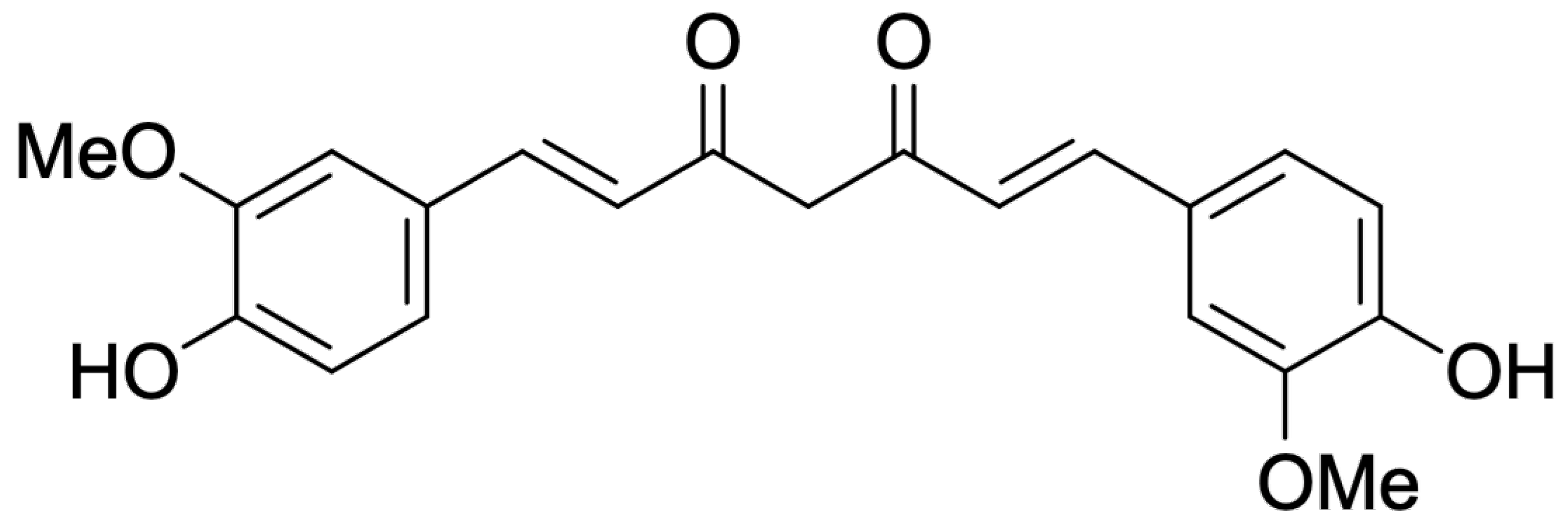
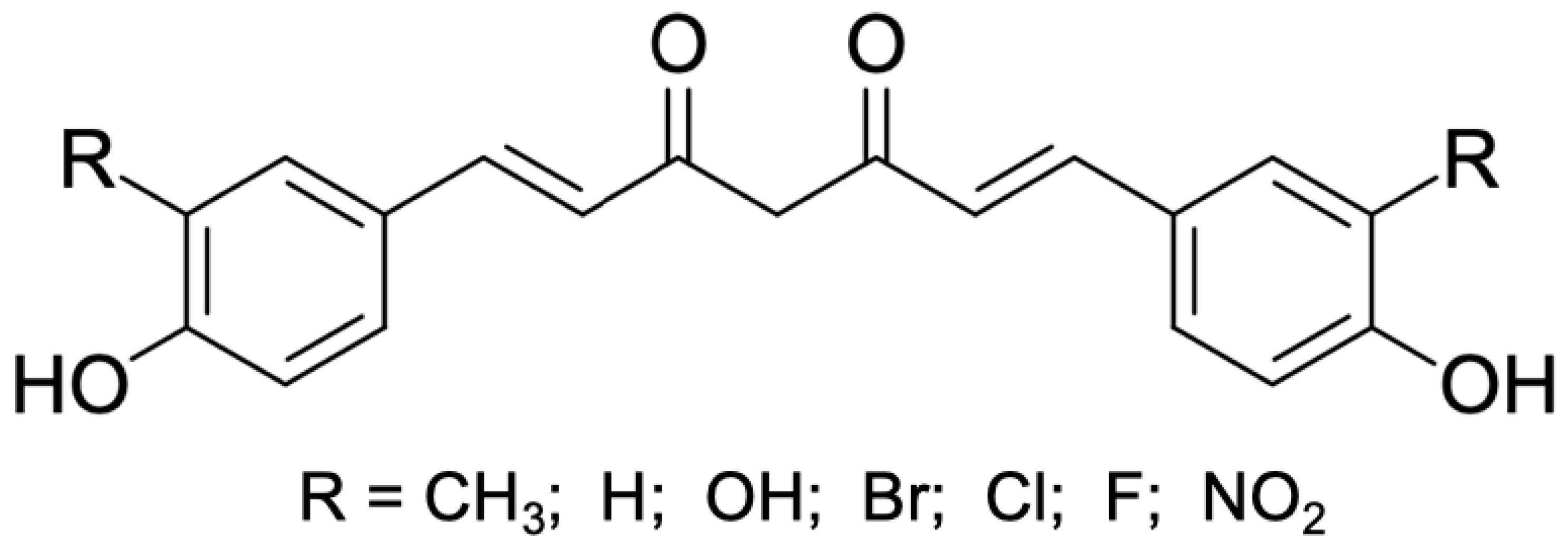
4.1. Curcumin Derivatives Analyzed
4.2. PASS Online Predictions of Biological Activity
4.3. Ecotoxicological Analysis
BCFBAF Analysis
4.4. Statistical Analysis
4.5. Molecular Docking Simulations
4.5.1. Ligand Preparation and Optimization
4.5.2. Obtaining and Preparation of Protein Structures
4.5.3. General Docking Procedures
4.6. NMA-Model Molecular Dynamics
5. Conclusions
Supplementary Materials
Author Contributions
Funding
Institutional Review Board Statement
Informed Consent Statement
Data Availability Statement
Acknowledgments
Conflicts of Interest
Abbreviations
| WSSV | White Spot Syndrome Virus |
| QSAR | Quantitative Structure–Activity Relationship |
| MMFF94 | Merck Molecular Force Field 94 |
| LvGSTmu | Glutathione S-Transferase from shrimp L. vannamei |
| PDB | Protein Data Bank |
| NOS | Nitric oxide scavenger |
| ROS | Reactive oxygen species |
| GST | Glutathione S-Transferase |
| GSH | Glutathione (co-crystallized) |
| CUR | Curcumin |
| NMA | Normal Mode Analysis |
| EA | Affinity energy |
| RMSD | Root Mean Square Deviation |
| ChV | Chronic Toxicity |
| BCF | Bioconcentration factors |
| DM | Daphnia magna |
| BAF | Bioaccumulation factors |
| logKow | Octanol-water partition coefficient |
| nP | non-persistent |
| P | Persistent |
| vP | Very persistent |
| NOEC | No observed effect concentrations |
| LOEC | Lowest observed effect concentrations |
| LC50 | Lethal concentration |
| EC50 | Effective concentration |
| NMA | Multilevel Neighborhoods of Atoms |
| PASS | Prediction of Activity Spectra for Substances |
| pKi | Negative logarithm of the inhibition constant |
Appendix A

| Compd | Inter. Type | Residues/Distances (Å) |
|---|---|---|
| CURH | Hydrophobic | Y7 (4.70), A12 (4.71), L13 (4.76), K43 (4.12), L60 (3.77), F112 (4.77), F112 (3.38), F112 (3.53), Y116 (3.58), Y116 (4.03), Y116 (3.54), Y116 (3.67), E117 (3.93) |
| H-bond | Y7 (3.46), W8 (4.06), W46 (1.92), K50 (3.08), L60 (3.96), T113 (3.04), N208 (3.46) | |
| π-Stacking | W8 (5.43) | |
| CUROH | Hydrophobic | Y7 (4.64), A12 (4.47), L13 (4.93), L13 (3.93), L60 (3.53), F112 (3.90), F112 (4.17), F112 (3.44), Y116 (3.60), Y116 (4.12), Y210 (4.63) |
| H-bond | Y7 (2.32), W8 (3.59), K43 (1.82), W46 (2.54), T113 (3.56), T113 (3.68), E117 (3.82), E117 (3.17), Y210 (3.44) | |
| π-Stacking | W8 (4.93), Y116 (3.87) | |
| CURBr | Hydrophobic | Y7 (4.94), W8 (4.19), W46 (4.61), L60 (3.36), F112 (3.67), F112 (3.62), Ty116 (4.39), Ty116 (3.70), Ty116 (4.13), Ty116 (3.61) |
| H-bond | Y7 (2.42), W46 (2.35), K50 (2.36), T113 (2.00) | |
| CURCl | Hydrophobic | Y7 (4.20), W8 (3.94), L13 (4.49), W46 (4.77), L60 (3.67), F112 (4.97), F112 (4.54), F112 (3.96), F112 (3.45), Y116 (3.73), Y116 (3.70), Y210 (4.88) |
| H-bond | Y7 (1.82), W8 (3.41), L13 (3.80), W46 (2.47), K50 (2.44), L60 (3.95), E117 (3.58), E117 (2.81), E117 (4.32), N208 (3.75) | |
| π-Stacking | Y116 (3.99) | |
| CURF | Hydrophobic | Y7 (4.39), W8 (4.92), L13 (4.87), L60 (3.82), F112 (4.85), F112 (4.62), F112 (3.65), Y116 (3.63), Y116 (3.65), Y116 (3.74), Y116 (3.93), E117 (4.80) |
| H-bond | Y7 (1.97), W8 (3.90), W46 (1.99), K50 (2.96), E117 (3.87), E117 (2.23), N208 (3.83) | |
| π-Stacking | W8 (5.35) | |
| Halogen bond | T113 (3.66) |
References
- Rameshthangam, P.; Ramasamy, P. Antioxidant and Membrane Bound Enzymes Activity in WSSV-Infected Penaeus Monodon Fabricius. Aquaculture 2006, 254, 32–39. [Google Scholar] [CrossRef] [Scilit]
- Zheng, X.; Yang, J.; Xu, F.; Zhou, Q.; Sun, C.; Wang, A.; Wan, J.; Li, J.; Liu, B. Effect of WSSV Infection on Immunity, Intestinal Microbial Composition and Its Derived Metabolites Synthesis in Procambarus clarkii. Aquac. Rep. 2025, 44, 103055. [Google Scholar] [CrossRef] [Scilit]
- Fan, J.; Li, B.; Hong, Q.; Yan, Z.; Yang, X.; Lu, K.; Chen, G.; Wang, L.; Chen, Y. A Glutathione Peroxidase Gene from Litopenaeus vannamei Is Involved in Oxidative Stress Responses and Pathogen Infection Resistance. Int. J. Mol. Sci. 2022, 23, 567. [Google Scholar] [CrossRef] [Scilit]
- Valavanidis, A.; Vlahogianni, T.; Dassenakis, M.; Scoullos, M. Molecular Biomarkers of Oxidative Stress in Aquatic Organisms in Relation to Toxic Environmental Pollutants. Ecotoxicol. Environ. Saf. 2006, 64, 178–189. [Google Scholar] [CrossRef] [Scilit]
- Sheehan, D.; Meade, G.; Foley, V.M.; Dowd, C.A. Structure, Function and Evolution of Glutathione Transferases: Implications for Classification of Non-Mammalian Members of an Ancient Enzyme Superfamily. Biochem. J. 2001, 360, 1–16. [Google Scholar] [CrossRef]
- Ma, W.; Zeng, W.; Zhang, D.; Zhou, Y.; Huang, Y.; Hong, Y. Oxidative Stress in Aquaculture: Pathogenic Mechanisms and Preventive Strategies in Farmed Aquatic Animals. Curr. Issues Mol. Biol. 2025, 47, 873. [Google Scholar] [CrossRef] [Scilit]
- Urošević, M.; Nikolić, L.; Gajić, I.; Nikolić, V.; Dinić, A.; Miljković, V. Curcumin: Biological Activities and Modern Pharmaceutical Forms. Antibiotics 2022, 11, 135. [Google Scholar] [CrossRef] [Scilit] [PubMed]
- Musarra-Pizzo, M.; Pennisi, R.; Ben-Amor, I.; Mandalari, G.; Sciortino, M.T. Antiviral Activity Exerted by Natural Products against Human Viruses. Viruses 2021, 13, 828. [Google Scholar] [CrossRef] [Scilit] [PubMed]
- Priyadarsini, K.I. Chemical and Structural Features Influencing the Biological Activity of Curcumin. Curr. Pharm. Des. 2013, 19, 2093–2100. [Google Scholar] [CrossRef] [Scilit] [PubMed]
- He, Y.; Yue, Y.; Zheng, X.; Zhang, K.; Chen, S.; Du, Z. Curcumin, Inflammation, and Chronic Diseases: How Are They Linked? Molecules 2015, 20, 9183–9213. [Google Scholar] [CrossRef] [Scilit]
- Anand, P.; Thomas, S.G.; Kunnumakkara, A.B.; Sundaram, C.; Harikumar, K.B.; Sung, B.; Tharakan, S.T.; Misra, K.; Priyadarsini, I.K.; Rajasekharan, K.N.; et al. Biological Activities of Curcumin and Its Analogues (Congeners) Made by Man and Mother Nature. Biochem. Pharmacol. 2008, 76, 1590–1611. [Google Scholar] [CrossRef] [Scilit] [PubMed]
- Goel, A.; Aggarwal, B.B. Curcumin, the Golden Spice From Indian Saffron, Is a Chemosensitizer and Radiosensitizer for Tumors and Chemoprotector and Radioprotector for Normal Organs. Nutr. Cancer 2010, 62, 919–930. [Google Scholar] [CrossRef] [Scilit] [PubMed]
- Priyadarsini, K.I. The Chemistry of Curcumin: From Extraction to Therapeutic Agent. Molecules 2014, 19, 20091–20112. [Google Scholar] [CrossRef] [Scilit] [PubMed]
- Hewlings, S.J.; Kalman, D.S. Curcumin: A Review of Its Effects on Human Health. Foods 2017, 6, 92. [Google Scholar] [CrossRef] [Scilit] [PubMed]
- Gupta, S.C.; Patchva, S.; Aggarwal, B.B. Therapeutic Roles of Curcumin: Lessons Learned from Clinical Trials. AAPS J. 2013, 15, 195–218. [Google Scholar] [CrossRef] [Scilit] [PubMed]
- Nelson, K.M.; Dahlin, J.L.; Bisson, J.; Graham, J.; Pauli, G.F.; Walters, M.A. The Essential Medicinal Chemistry of Curcumin. J. Med. Chem. 2017, 60, 1620–1637. [Google Scholar] [CrossRef] [Scilit]
- Yallapu, M.M.; Jaggi, M.; Chauhan, S.C. Curcumin Nanoformulations: A Future Nanomedicine for Cancer. Drug Discov. Today 2012, 17, 71–80. [Google Scholar] [CrossRef] [Scilit]
- Kocaadam, B.; Şanlier, N. Curcumin, an Active Component of Turmeric (Curcuma longa), and Its Effects on Health. Crit. Rev. Food Sci. Nutr. 2017, 57, 2889–2895. [Google Scholar] [CrossRef] [Scilit]
- Zhao, C.; Liu, Z.; Liang, G. Promising Curcumin-Based Drug Design: Mono-Carbonyl Analogues of Curcumin (MACs). Curr. Pharm. Des. 2013, 19, 2114–2135. [Google Scholar] [CrossRef] [Scilit]
- Khayatan, D.; Razavi, S.M.; Arab, Z.N.; Hosseini, Y.; Niknejad, A.; Momtaz, S.; Abdolghaffari, A.H.; Sathyapalan, T.; Jamialahmadi, T.; Kesharwani, P.; et al. Superoxide Dismutase: A Key Target for the Neuroprotective Effects of Curcumin. Mol. Cell. Biochem. 2024, 479, 693–705. [Google Scholar] [CrossRef] [Scilit] [PubMed]
- Chen, B.; He, Q.; Chen, C.; Lin, Y.; Xiao, J.; Pan, Z.; Li, M.; Li, S.; Yang, J.; Wang, F.; et al. Combination of Curcumin and Catalase Protects against Chondrocyte Injury and Knee Osteoarthritis Progression by Suppressing Oxidative Stress. Biomed. Pharmacother. 2023, 168, 115751. [Google Scholar] [CrossRef] [Scilit]
- Adeseko, C.J.; Fabuyi, F.S. Computational Evaluation of Pharmacokinetics, Potential Bioactive Compounds Targets of Glutathione S-Transferases against Deleterious Effects of MSG: The Health Benefits of Turmeric (Curcuma longa L.). Plant Cell Biotechnol. Mol. Biol. 2025, 26, 111–125. [Google Scholar] [CrossRef] [Scilit]
- Yang, H.; Du, Z.; Wang, W.; Song, M.; Sanidad, K.; Sukamtoh, E.; Zheng, J.; Tian, L.; Xiao, H.; Liu, Z.; et al. Structure–Activity Relationship of Curcumin: Role of the Methoxy Group in Anti-Inflammatory and Anticolitis Effects of Curcumin. J. Agric. Food Chem. 2017, 65, 4509–4515. [Google Scholar] [CrossRef] [Scilit] [PubMed]
- Mackay, D.; Fraser, A. Bioaccumulation of Persistent Organic Chemicals: Mechanisms and Models. Environ. Pollut. 2000, 110, 375–391. [Google Scholar] [CrossRef] [Scilit] [PubMed]
- Dearden, J.C. The History and Development of Quantitative Structure-Activity Relationships (QSARs). Int. J. Quant. Struct.-Prop. Relatsh. 2016, 1, 1–44. [Google Scholar] [CrossRef] [Scilit]
- Anand, P.; Kunnumakkara, A.B.; Newman, R.A.; Aggarwal, B.B. Bioavailability of Curcumin: Problems and Promises. Mol. Pharm. 2007, 4, 807–818. [Google Scholar] [CrossRef] [Scilit]
- Arnot, J.A.; Gobas, F.A. A Review of Bioconcentration Factor (BCF) and Bioaccumulation Factor (BAF) Assessments for Organic Chemicals in Aquatic Organisms. Environ. Rev. 2006, 14, 257–297. [Google Scholar] [CrossRef] [Scilit]
- Sanderson, H. Probabilistic Hazard Assessment of Environmentally Occurring Pharmaceuticals Toxicity to Fish, Daphnids and Algae by ECOSAR Screening. Toxicol. Lett. 2003, 144, 383–395. [Google Scholar] [CrossRef] [Scilit] [PubMed]
- Arnot, J.A.; Meylan, W.; Tunkel, J.; Howard, P.H.; Mackay, D.; Bonnell, M.; Boethling, R.S. A Quantitative Structure-Activity Relationship for Predicting Metabolic Biotransformation Rates for Organic Chemicals in Fish. Environ. Toxicol. Chem. 2009, 28, 1168–1177. [Google Scholar] [CrossRef] [Scilit]
- Arnot, J.A.; Gobas, F.A.P.C. A Generic QSAR for Assessing the Bioaccumulation Potential of Organic Chemicals in Aquatic Food Webs. QSAR Comb. Sci. 2003, 22, 337–345. [Google Scholar] [CrossRef] [Scilit]
- Kelly, B.C.; Sun, J.M.; McDougall, M.R.R.; Sunderland, E.M.; Gobas, F.A.P.C. Development and Evaluation of Aquatic and Terrestrial Food Web Bioaccumulation Models for Per- and Polyfluoroalkyl Substances. Environ. Sci. Technol. 2024, 58, 17828–17837. [Google Scholar] [CrossRef] [Scilit] [PubMed]
- Arnot, J.A.; Toose, L.; Armitage, J.M.; Embry, M.; Sangion, A.; Hughes, L. A Weight of Evidence Approach for Bioaccumulation Assessment. Integr. Environ. Assess. Manag. 2023, 19, 1235–1253. [Google Scholar] [CrossRef] [Scilit] [PubMed]
- Rand, G.M. (Ed.) Fundamentals of Aquatic Toxicology: Effects, Environmental Fate, and Risk Assessment, 2nd ed.; CRC Press: Boca Raton, FL, USA, 2020; ISBN 978-1-003-07536-3. [Google Scholar]
- Ghorpade-Aher, J.; Saxena, A.; Inamdar, M.; Thakre, A.; Sinha, D.; Thesiya, T. QSAR Model for Aquatic Toxicity Estimates Using Machine Learning. In Advances in Communication and Applications; Patnaik, L.M., Ravikumar, G.K., Prasad, N.H., Eds.; Lecture Notes in Electrical Engineering; Springer Nature: Singapore, 2025; Volume 1398, pp. 387–398. ISBN 978-981-96-4678-4. [Google Scholar]
- Pizzo, F.; Lombardo, A.; Brandt, M.; Manganaro, A.; Benfenati, E. A New Integrated in Silico Strategy for the Assessment and Prioritization of Persistence of Chemicals under REACH. Environ. Int. 2016, 88, 250–260. [Google Scholar] [CrossRef] [Scilit]
- Moghadam, H.; Sourinejad, I.; Johari, S.A. Dietary Turmeric, Curcumin and Nanoencapsulated Curcumin Can Differently Fight against Salinity Stress in Pacific White Shrimp Penaeus Vannamei Boone, 1931. Aquac. Res. 2022, 53, 3127–3139. [Google Scholar] [CrossRef] [Scilit]
- Song, L.; Li, M.; Feng, C.; Sa, R.; Hu, X.; Wang, J.; Yin, X.; Qi, C.; Dong, W.; Yang, J. Protective Effect of Curcumin on Zebrafish Liver under Ethanol-Induced Oxidative Stress. Comp. Biochem. Physiol. Part C Toxicol. Pharmacol. 2022, 258, 109360. [Google Scholar] [CrossRef] [Scilit]
- Tuong, D.T.C.; Moniruzzaman, M.; Smirnova, E.; Chin, S.; Sureshbabu, A.; Karthikeyan, A.; Min, T. Curcumin as a Potential Antioxidant in Stress Regulation of Terrestrial, Avian, and Aquatic Animals: A Review. Antioxidants 2023, 12, 1700. [Google Scholar] [CrossRef] [Scilit]
- Tugcu, G.; Sipahi, H.; Charehsaz, M.; Aydın, A.; Saçan, M.T. Computational Toxicology of Pharmaceuticals. In Cheminformatics, QSAR and Machine Learning Applications for Novel Drug Development; Elsevier: Amsterdam, The Netherlands, 2023; pp. 519–537. ISBN 978-0-443-18638-7. [Google Scholar]
- Gao, J.; Zhao, J.; Chen, X.; Wang, J. A Review on in Silico Prediction of the Environmental Risks Posed by Pharmaceutical Emerging Contaminants. Environ. Monit. Assess. 2023, 195, 1535. [Google Scholar] [CrossRef] [Scilit]
- Grillo-Avila, D.; Antón-Pardo, M.; Armengol, J.; Puche, E.; Carballeira, R.; Moratalla-López, J.; Palacios-Abella, J.F.; López, I.; Crettaz Minaglia, M.C.; Amador, P.; et al. Effects of the Herbicide Bentazone on the Structure of Plankton and Benthic Communities Representative of Mediterranean Coastal Wetlands: A Mesocosm Experiment. Hydrobiologia 2025, 852, 2709–2728. [Google Scholar] [CrossRef] [Scilit]
- Tkaczyk, A.; Bownik, A.; Dudka, J.; Kowal, K.; Ślaska, B. Daphnia Magna Model in the Toxicity Assessment of Pharmaceuticals: A Review. Sci. Total Environ. 2021, 763, 143038. [Google Scholar] [CrossRef] [Scilit]
- Glowienke, S.; Onken, U.; Elhajouji, A.; Muthusamy, S.; Sangana, R.; Martus, H.-J.; Bedman, T.; Hartmann, A. Genotoxicity Evaluation of a Valsartan-Related Complex N-Nitroso-Impurity. Regul. Toxicol. Pharmacol. 2022, 134, 105245. [Google Scholar] [CrossRef] [Scilit] [PubMed]
- Han, J.; Yang, D.; Hall, D.R.; Liu, J.; Sun, J.; Gu, W.; Tang, S.; Alharbi, H.A.; Jones, P.D.; Krause, H.M.; et al. Toxicokinetics of Brominated Azo Dyes in the Early Life Stages of Zebrafish (Danio rerio) Is Prone to Aromatic Substituent Changes. Environ. Sci. Technol. 2020, 54, 4421–4431. [Google Scholar] [CrossRef] [Scilit]
- Salvatore, M.M.; Pappalardo, C.; Suarez, E.G.P.; Salvatore, F.; Andolfi, A.; Gesuele, R.; Galdiero, E.; Libralato, G.; Guida, M.; Siciliano, A. Ecotoxicological and Metabolomic Investigation of Chronic Exposure of Daphnia magna (Straus, 1820) to Yttrium Environmental Concentrations. Aquat. Toxicol. 2024, 276, 107117. [Google Scholar] [CrossRef] [Scilit]
- Zhu, J.; Huang, M.; Liu, C.; Wang, J.; Zou, L.; Yang, F.; Zhu, R. Curcumin Protects against Fenvalerate-Induced Neurotoxicity in Zebrafish (Danio rerio) Larvae through Inhibition of Oxidative Stress. Ecotoxicol. Environ. Saf. 2023, 264, 115484. [Google Scholar] [CrossRef] [Scilit]
- Boya, B.R.; Lee, J.-H.; Choi, J.-M.; Lee, J. Impact of Halogenation on Scaffold Toxicity Assessed Using HD-GEM Machine Learning Model. Brief. Bioinform. 2025, 26, bbaf347. [Google Scholar] [CrossRef] [Scilit]
- Jayaprakasha, G.K.; Jaganmohan Rao, L.; Sakariah, K.K. Antioxidant Activities of Curcumin, Demethoxycurcumin and Bisdemethoxycurcumin. Food Chem. 2006, 98, 720–724. [Google Scholar] [CrossRef] [Scilit]
- Falade, V.A.; Adelusi, T.I.; Adedotun, I.O.; Abdul-Hammed, M.; Lawal, T.A.; Agboluaje, S.A. In Silico Investigation of Saponins and Tannins as Potential Inhibitors of SARS-CoV-2 Main Protease (Mpro). Silico Pharmacol. 2021, 9, 9. [Google Scholar] [CrossRef] [Scilit] [PubMed]
- Al-Zaqri, N.; Pooventhiran, T.; Rao, D.J.; Alsalme, A.; Warad, I.; Thomas, R. Structure, Conformational Dynamics, Quantum Mechanical Studies and Potential Biological Activity Analysis of Multiple Sclerosis Medicine Ozanimod. J. Mol. Struct. 2021, 1227, 129685. [Google Scholar] [CrossRef] [Scilit]
- Lagunin, A.; Stepanchikova, A.; Filimonov, D.; Poroikov, V. PASS: Prediction of Activity Spectra for Biologically Active Substances. Bioinformatics 2000, 16, 747–748. [Google Scholar] [CrossRef] [Scilit]
- Filimonov, D.A.; Lagunin, A.A.; Gloriozova, T.A.; Rudik, A.V.; Druzhilovskii, D.S.; Pogodin, P.V.; Poroikov, V.V. Prediction of the Biological Activity Spectra of Organic Compounds Using the Pass Online Web Resource. Chem. Heterocycl. Comp. 2014, 50, 444–457. [Google Scholar] [CrossRef] [Scilit]
- Hansch, C. Quantitative Structure-Activity Relationships and the Unnamed Science. Acc. Chem. Res. 1993, 26, 147–153. [Google Scholar] [CrossRef] [Scilit]
- Filimonov, D.; Poroikov, V.; Borodina, Y.; Gloriozova, T. Chemical Similarity Assessment through Multilevel Neighborhoods of Atoms: Definition and Comparison with the Other Descriptors. J. Chem. Inf. Comput. Sci. 1999, 39, 666–670. [Google Scholar] [CrossRef] [Scilit]
- Filimonov, D.A.; Zakharov, A.V.; Lagunin, A.A.; Poroikov, V.V. QNA-Based ‘Star Track’ QSAR Approach. SAR QSAR Environ. Res. 2009, 20, 679–709. [Google Scholar] [CrossRef] [Scilit]
- Pereira, A.C.M.; Sánchez-Ortíz, B.L.; de Melo, E.L.; da Silva Hage-Melim, L.I.; Borges, R.S.; Hu, X.; Carvalho, J.C.T. Perillyl Alcohol Decreases the Frequency and Severity of Convulsive-like Behavior in the Adult Zebrafish Model of Acute Seizures. Naunyn-Schmiedeberg’s Arch. Pharmacol. 2021, 394, 1177–1190. [Google Scholar] [CrossRef] [Scilit]
- Furuhama, A.; Hasunuma, K.; Aoki, Y. Interspecies Quantitative Structure–Activity Relationships (QSARs) for Eco-Toxicity Screening of Chemicals: The Role of Physicochemical Properties. SAR QSAR Environ. Res. 2015, 26, 809–830. [Google Scholar] [CrossRef] [Scilit]
- U.S. Environmental Protection Agency. Ecological Structure—Activity Relationships Program (ECOSAR) Operation Manual v2.2. Available online: https://www.epa.gov/tsca-screening-tools/ecological-structure-activity-relationships-program-ecosar-operation-manual (accessed on 13 March 2026).
- Netzeva, T.I.; Pavan, M.; Worth, A.P. Review of (Quantitative) Structure–Activity Relationships for Acute Aquatic Toxicity. QSAR Comb. Sci. 2008, 27, 77–90. [Google Scholar] [CrossRef] [Scilit]
- Comber, M.H.I.; Walker, J.D.; Watts, C.; Hermens, J. Quantitative Structure-activity Relationships for Predicting Potential Ecological Hazard of Organic Chemicals for Use in Regulatory Risk Assessments. Environ. Toxicol. Chem. 2003, 22, 1822–1828. [Google Scholar] [CrossRef] [Scilit] [PubMed]
- de Sousa, D.S.; Gomes, A.O.C.V.; Roberto, C.H.A.; Belarmino, A.B.; da Silva Mendes, F.R.; Marinho, M.M.; de Lima-Neto, P.; Marinho, G.S. Ligand and Structure-Based Toxicological Assessment of (Thio)Semicarbazones on Cholinesterases. J. Comput. Aided Mol. Des. 2026, 40, 40. [Google Scholar] [CrossRef] [Scilit] [PubMed]
- Kamerlin, N.; Delcey, M.G.; Manzetti, S.; van der Spoel, D. Toward a Computational Ecotoxicity Assay. J. Chem. Inf. Model. 2020, 60, 3792–3803. [Google Scholar] [CrossRef] [Scilit]
- de Sousa, D.S.; de Oliveira, V.M.; Gomes, A.O.C.V.; da Silva Mendes, F.R.; Marinho, M.M.; de Lima-Neto, P.; Marinho, G.S. Computational Investigation of Behavioral Toxicity Syndromes (BTS) of Synthetics Halosubstituted Semicarbazones. In Silico Pharmacol. 2025, 13, 152. [Google Scholar] [CrossRef] [Scilit]
- Roveri, V.; Guimarães, L.L.; Toma, W.; Correia, A.T. Occurrence and Ecological Risk Assessment of Pharmaceuticals and Cocaine in a Beach Area of Guarujá, São Paulo State, Brazil, under the Influence of Urban Surface Runoff. Environ. Sci. Pollut. Res. 2020, 27, 45063–45075. [Google Scholar] [CrossRef] [Scilit] [PubMed]
- Finizio, A.; Di Nica, V.; Rizzi, C.; Villa, S. A Quantitative Structure-Activity Relationships Approach to Predict the Toxicity of Narcotic Compounds to Aquatic Communities. Ecotoxicol. Environ. Saf. 2020, 190, 110068. [Google Scholar] [CrossRef] [Scilit]
- Reuschenbach, P.; Silvani, M.; Dammann, M.; Warnecke, D.; Knacker, T. ECOSAR Model Performance with a Large Test Set of Industrial Chemicals. Chemosphere 2008, 71, 1986–1995. [Google Scholar] [CrossRef] [Scilit]
- Rogiers, V.; Benfenati, E.; Bernauer, U.; Bodin, L.; Carmichael, P.; Chaudhry, Q.; Coenraads, P.J.; Cronin, M.T.D.; Dent, M.; Dusinska, M.; et al. The Way Forward for Assessing the Human Health Safety of Cosmetics in the EU—Workshop Proceedings. Toxicology 2020, 436, 152421. [Google Scholar] [CrossRef] [Scilit] [PubMed]
- Roncaglioni, A.; Lombardo, A.; Benfenati, E. The VEGAHUB Platform: The Philosophy and the Tools. Altern. Lab. Anim. 2022, 50, 121–135. [Google Scholar] [CrossRef] [Scilit]
- Laxmi, K. Characterization of Ligand N′-[(1E)-1-Phenylethylidene]-1,3-Benzothiazole-2-Carbohydrazide by Using Marvin Sketch 20.8 Software. Orient. J. Chem. 2022, 38, 77–84. [Google Scholar] [CrossRef] [Scilit]
- Cheng, A.; Best, S.A.; Merz, K.M.; Reynolds, C.H. GB/SA Water Model for the Merck Molecular Force Field (MMFF). J. Mol. Graph. Model. 2000, 18, 273–282. [Google Scholar] [CrossRef] [Scilit]
- Snyder, H.D.; Kucukkal, T.G. Computational Chemistry Activities with Avogadro and ORCA. J. Chem. Educ. 2021, 98, 1335–1341. [Google Scholar] [CrossRef] [Scilit]
- Goodsell, D.S.; Zardecki, C.; Di Costanzo, L.; Duarte, J.M.; Hudson, B.P.; Persikova, I.; Segura, J.; Shao, C.; Voigt, M.; Westbrook, J.D.; et al. RCSB Protein Data Bank: Enabling Biomedical Research and Drug Discovery. Protein Sci. 2020, 29, 52–65. [Google Scholar] [CrossRef] [Scilit] [PubMed]
- Juárez-Martínez, A.B.; Sotelo-Mundo, R.R.; Rudiño-Piñera, E. Crystal Structure of a Class-Mu Glutathione S-Transferase from Whiteleg Shrimp Litopenaeus vannamei: Structural Changes in the Xenobiotic Binding H-Site May Alter the Spectra of Molecules Bound. J. Biochem. Mol. Toxicol. 2017, 31, e21838. [Google Scholar] [CrossRef] [Scilit]
- De Sousa, D.S.; Moreira de Oliveira, V.; Silva Marinho, E.; Sandra Brito Salmito-Vanderley, C.; Silva Marinho, G. Insights of Potential Action with Acyclovir Analogs for the Control of White Spot Syndrome Virus (WSSV): Molecular Dynamics and Ecotoxicological Analysis Approach. Microb. Pathog. 2025, 208, 107955. [Google Scholar] [CrossRef] [Scilit]
- de Oliveira, V.M.; da Rocha, M.N.; Roberto, C.H.A.; Lucio, F.N.M.; Marinho, M.M.; Marinho, E.S.; de Morais, S.M. Insights of Structure-Based Virtual Screening and MPO-Based SAR Analysis of Berberine-Benzimidazole Derivatives against Parkinson Disease. J. Mol. Struct. 2024, 1302, 137453. [Google Scholar] [CrossRef] [Scilit]
- Callil-Soares, P.H.; Biasi, L.C.K.; Pessoa Filho, P.D.A. Effect of Preprocessing and Simulation Parameters on the Performance of Molecular Docking Studies. J. Mol. Model. 2023, 29, 251. [Google Scholar] [CrossRef] [Scilit]
- Silva, J.; Esmeraldo Rocha, J.; da Cunha Xavier, J.; Sampaio de Freitas, T.; Douglas Melo Coutinho, H.; Nogueira Bandeira, P.; Rodrigues de Oliveira, M.; Nunes da Rocha, M.; Machado Marinho, E.; de Kassio Vieira Monteiro, N.; et al. Antibacterial and Antibiotic Modifying Activity of Chalcone (2E)-1-(4′-Aminophenyl)-3-(4-Methoxyphenyl)-Prop-2-En-1-One in Strains of Staphylococcus Aureus Carrying NorA and MepA Efflux Pumps: In Vitro and in Silico Approaches. Microb. Pathog. 2022, 169, 105664. [Google Scholar] [CrossRef] [Scilit]
- Belarmino, A.B.; de Sousa, D.S.; Henrique Alexandre Roberto, C.; Moreira de Oliveira, V.; Nunes da Rocha, M.; Rogenio da Silva Mendes, F.; Machado Marinho, M.; Marques da Fonseca, A.; Silva Marinho, G. Ligand-Based Analysis of the Antifungal Potential of Phytosterols and Triterpenes Isolated from Cryptostegia Grandiflora against Candida auris FKBP12. Steroids 2024, 209, 109453. [Google Scholar] [CrossRef] [Scilit]
- Morris, G.M.; Huey, R.; Lindstrom, W.; Sanner, M.F.; Belew, R.K.; Goodsell, D.S.; Olson, A.J. AutoDock4 and AutoDockTools4: Automated Docking with Selective Receptor Flexibility. J. Comput. Chem. 2009, 30, 2785–2791. [Google Scholar] [CrossRef] [Scilit] [PubMed]
- Morris, G.M.; Goodsell, D.S.; Halliday, R.S.; Huey, R.; Hart, W.E.; Belew, R.K.; Olson, A.J. Automated Docking Using a Lamarckian Genetic Algorithm and an Empirical Binding Free Energy Function. J. Comput. Chem. 1998, 19, 1639–1662. [Google Scholar] [CrossRef] [Scilit]
- Shityakov, S.; Förster, C. In Silico Predictive Model to Determine Vector-Mediated Transport Properties for the Blood–Brain Barrier Choline Transporter. Adv. Appl. Bioinform. Chem. 2014, 7, 23–36. [Google Scholar] [CrossRef] [Scilit] [PubMed]
- Yusuf, D.; Davis, A.M.; Kleywegt, G.J.; Schmitt, S. An Alternative Method for the Evaluation of Docking Performance: RSR vs RMSD. J. Chem. Inf. Model. 2008, 48, 1411–1422. [Google Scholar] [CrossRef] [Scilit]
- Morris, G.M.; Huey, R.; Olson, A.J. Using AutoDock for Ligand-Receptor Docking. Curr. Protoc. Bioinform. 2008, 24, 8.14.1–8.14.40. [Google Scholar] [CrossRef] [Scilit] [PubMed]
- da Rocha, M.N.; da Fonseca, A.M.; Dantas, A.N.M.; dos Santos, H.S.; Marinho, E.S.; Marinho, G.S. In Silico Study in MPO and Molecular Docking of the Synthetic Drynaran Analogues Against the Chronic Tinnitus: Modulation of the M1 Muscarinic Acetylcholine Receptor. Mol. Biotechnol. 2024, 66, 254–269. [Google Scholar] [CrossRef] [Scilit]
- do Nascimento Gonçalves, C.; da Rocha, M.N.; Marinho, E.S. In Silico Identification of Benzamide-Based Aryl Halides as EGFR Inhibitors: Multi-Ligand ADMET, Pharmacophore Mapping, and Target Prediction. In Silico Res. Biomed. 2026, 2, 100164. [Google Scholar] [CrossRef] [Scilit]
- Lopéz-Blanco, J.R.; Garzón, J.I.; Chacón, P. iMod: Multipurpose Normal Mode Analysis in Internal Coordinates. Bioinformatics 2011, 27, 2843–2850. [Google Scholar] [CrossRef] [Scilit] [PubMed]
- Kovacs, J.A.; Chacón, P.; Abagyan, R. Predictions of Protein Flexibility: First-Order Measures. Proteins Struct. Funct. Bioinform. 2004, 56, 661–668. [Google Scholar] [CrossRef] [Scilit] [PubMed]
- Pinheiro, N.A.P.; Romão, I.C.; Alves, A.M.B.; Siqueira, S.M.C.; de Menezes, J.E.S.A.; Marinho, E.S.; Ferreira, M.K.A.; Marinho, M.M.; de Sousa Magalhães, H.; de Castro Gomes, A.F.; et al. Serotonergic Neuromodulation of Natural Products Isoreserpine and Isoreserpiline in Adult Zebrafish: An in Silico and In Vivo Investigation. Chem. Biodivers. 2026, 23, e01738. [Google Scholar] [CrossRef] [Scilit] [PubMed]
- López-Blanco, J.R.; Aliaga, J.I.; Quintana-Ortí, E.S.; Chacón, P. iMODS: Internal Coordinates Normal Mode Analysis Server. Nucleic Acids Res. 2014, 42, W271–W276. [Google Scholar] [CrossRef] [Scilit] [PubMed]


| Activity | CUR | CURH | CURCH | CUROH | CURBr | CURCl | CURF | CURNO |
|---|---|---|---|---|---|---|---|---|
| Reductant | 0.86 ± 0.003 | 0.91 ± 0.003 | 0.95 ± 0.002 | 0.92 ± 0.003 | 0.62 ± 0.010 | 0.62 ± 0.010 | 0.62 ± 0.010 | 0.92 ± 0.003 |
| Antimutagenic | 0.81 ± 0.004 | 0.79 ± 0.004 | 0.76 ± 0.002 | 0.81 ± 0.004 | 0.42 ± 0.020 | 0.52 ± 0.014 | 0.46 ± 0.017 | 0.37 ± 0.027 |
| GST substrate | 0.18 ± 0.087 | 0.80 ± 0.003 | 0.80 ± 0.002 | 0.83 ± 0.001 | 0.93 ± 0.002 | 0.85 ± 0.003 | 0.74 ± 0.004 | 0.78 ± 0.004 |
| GST M substrate | 0.77 ± 0.003 | 0.80 ± 0.002 | 0.60 ± 0.005 | 0.82 ± 0.002 | 0.57 ± 0.007 | 0.65 ± 0.004 | 0.75 ± 0.003 | 0.80 ± 0.002 |
| GST A substrate | 0.78 ± 0.004 | 0.88 ± 0.004 | 0.80 ± 0.009 | 0.82 ± 0.005 | 0.87 ± 0.004 | 0.87 ± 0.004 | 0.77 ± 0.012 | 0.90 ± 0.003 |
| GST P substrate | 0.18 ± 0.096 | 0.84 ± 0.004 | 0.81 ± 0.002 | 0.84 ± 0.001 | 0.81 ± 0.002 | 0.81 ± 0.002 | 0.82 ± 0.002 | 0.83 ± 0.001 |
| Free radical scavenger | 0.76 ± 0.003 | 0.67 ± 0.004 | 0.68 ± 0.004 | 0.71 ± 0.004 | 0.46 ± 0.013 | 0.50 ± 0.010 | 0.44 ± 0.014 | 0.62 ± 0.005 |
| Chemopreventive | 0.69 ± 0.007 | 0.65 ± 0.004 | 0.61 ± 0.004 | 0.66 ± 0.004 | 0.32 ± 0.034 | 0.37 ± 0.026 | 0.36 ± 0.027 | 0.37 ± 0.025 |
| Oxygen scavenger | 0.65 ± 0.013 | 0.68 ± 0.008 | 0.68 ± 0.008 | 0.66 ± 0.011 | 0.54 ± 0.039 | 0.53 ± 0.039 | 0.441 ± 0.014 | 0.46 ± 0.064 |
| Antioxidant | 0.61 ± 0.004 | 0.63 ± 0.004 | 0.61 ± 0.004 | 0.74 ± 0.004 | 0.44 ± 0.009 | 0.47 ± 0.008 | 0.45 ± 0.009 | 0.49 ± 0.007 |
| NOS * | 0.27 ± 0.011 | 0.30 ± 0.006 | 0.26 ± 0.015 | 0.29 ± 0.009 | 0.21 ± 0.040 | 0.21 ± 0.040 | 0.21 ± 0.040 | 0.24 ± 0.021 |
| Peroxidase inhibitor | 0.55 ± 0.032 | 0.60 ± 0.025 | 0.26 ± 0.073 | 0.74 ± 0.003 | 0.46 ± 0.013 | 0.61 ± 0.005 | 0.16 ± 0.113 | 0.41 ± 0.015 |
| Complex | Energy (kcal/moL) | Ki (M) | pKi | RMSD (Å) |
|---|---|---|---|---|
| GSH/LvGSTMu | −5.4 | 1.09 × 10⁻⁴ | 3.96 | 1.960 |
| CUR */LvGSTMu | −7.2 | 5.24 × 10⁻⁶ | 5.28 | 0.789 |
| CURH/LvGSTMu | −7.3 | 4.43 × 10⁻⁶ | 5.35 | 1.391 |
| CURCH/LvGSTMu | −7.8 | 1.90 × 10⁻⁶ | 5.72 | 1.745 |
| CUROH/LvGSTMu | −7.7 | 2.25 × 10⁻⁶ | 5.65 | 1.155 |
| CURBr/LvGSTMu | −7.6 | 2.67 × 10⁻⁶ | 5.57 | 1.662 |
| CURCl/LvGSTMu | −7.7 | 2.25 × 10⁻⁶ | 5.65 | 1.733 |
| CURF/LvGSTMu | −7.6 | 2.67 × 10⁻⁶ | 5.57 | 1.924 |
| CURNO/LvGSTMu | −8.5 | 5.83 × 10⁻⁷ | 6.23 | 1.081 |
| Compd | Inter. Type | Residues Distances (Å) |
|---|---|---|
| GSH | H-bond | Y7 (3.82), W8 (1.15), K43 (4.00), W46 (2.19), L60 (4.23), Q72 (3.38), Q72 (2.15), S73 (1.73), K74 (3.61) |
| Salt bridge | K50 (3.83), K74 (3.61) | |
| CUR | Hydrophobic | Y7 (4.27), Y7 (4.50), W8 (4.22), L13 (4.67), W46A (4.79), L60 (3.55), F112 (4.95), F112 (4.81), F112 (3.74), Y116 (3.63), Y116 (3.93), Y210 (4.84) |
| H-bond | Y7 (2.13), W8 (3.25), W46 (2.20), K50 (3.77), L60 (4.29), T113A (3.29), E117 (3.83), E117 (2.64), N208 (3.55) | |
| π-Stacking | Y116A (4.20) |
| Compd | Inter. Type | Residues Distances (Å) |
|---|---|---|
| GSH | H-bond | Y7 (3.82), W8 (1.15), K43 (4.00), W46 (2.19), L60 (4.23), Q72 (3.38), Q72 (2.15), S73 (1.73), K74 (3.61) |
| Salt bridge | K50 (3.83), K74 (3.61) | |
| CURNO | Hydrophobic | Tyr7 (4.73), Leu13 (3.77), Leu13 (4.08), Phe112 (3.48), Phe112 (3.49), Tyr116 (4.38), Tyr116 (3.61), Tyr116 (3.70), Tyr116 (4.30) |
| H-bond | Tyr7 (1.77), Trp8 (3.21), Leu13 (4.06), Asn59 (2.48), Gln72 (2.84), Asp106 (3.10), Thr113 (2.02) |
| Classification | Acute Toxicity | ChV * Toxicity |
|---|---|---|
| Not harmful | LC50/EC50 > 100 | ChV > 100 |
| Harmful | 10 < LC50/EC50 < 100 | 1 < ChV < 10 |
| Toxic | 1 < LC50/EC50 < 10 | 0.1 < ChV < 1 |
| Very toxic | LC50/EC50 < 1 | ChV < 0.1 |
Disclaimer/Publisher’s Note: The statements, opinions and data contained in all publications are solely those of the individual author(s) and contributor(s) and not of MDPI and/or the editor(s). MDPI and/or the editor(s) disclaim responsibility for any injury to people or property resulting from any ideas, methods, instructions or products referred to in the content. |
© 2026 by the authors. Licensee MDPI, Basel, Switzerland. This article is an open access article distributed under the terms and conditions of the Creative Commons Attribution (CC BY) license.
Share and Cite
de Sousa, D.S.; Melo Lima, J.M.L.d.; Salmito-Vanderley, C.S.B.; Marinho, E.S. Structural Insights into the Redox Potential of Curcumin Derivatives in Litopenaeus vannamei. Drugs Drug Candidates 2026, 5, 24. https://doi.org/10.3390/ddc5020024
de Sousa DS, Melo Lima JMLd, Salmito-Vanderley CSB, Marinho ES. Structural Insights into the Redox Potential of Curcumin Derivatives in Litopenaeus vannamei. Drugs and Drug Candidates. 2026; 5(2):24. https://doi.org/10.3390/ddc5020024
Chicago/Turabian Stylede Sousa, Damião Sampaio, João Miguel Lopes de Melo Lima, Carminda Sandra Brito Salmito-Vanderley, and Emmanuel Silva Marinho. 2026. "Structural Insights into the Redox Potential of Curcumin Derivatives in Litopenaeus vannamei" Drugs and Drug Candidates 5, no. 2: 24. https://doi.org/10.3390/ddc5020024
APA Stylede Sousa, D. S., Melo Lima, J. M. L. d., Salmito-Vanderley, C. S. B., & Marinho, E. S. (2026). Structural Insights into the Redox Potential of Curcumin Derivatives in Litopenaeus vannamei. Drugs and Drug Candidates, 5(2), 24. https://doi.org/10.3390/ddc5020024