Abstract
Oxidative stress, caused by an imbalance between the production of reactive oxygen species and endogenous antioxidant capacity, is a key etiological factor in numerous pathologies, including neurodegenerative and cardiovascular diseases. The limited clinical efficacy of conventional antioxidants is primarily due to their insufficient accumulation within the mitochondria, the main site of intracellular ROS generation. This article reviews the design and application of Mitochondria-Targeted Antioxidants, which represent a major advance in precision medicine. The design of these compounds involves linking an antioxidant “payload” to a lipophilic cation, such as the triphenylphosphonium group. This positive charge leverages the negative electrochemical gradient across the inner mitochondrial membrane to drive the antioxidant into the organelle. This mechanism allows the drug to reach concentrations over 100 times higher than non-targeted alternatives. The discussion encompasses the structure-activity analysis of the carrier, the payload (e.g., quinone derivatives), and the linker, which determine optimal subcellular partitioning and scavenging efficiency. Preclinical data highlight the therapeutic potential of this approach, showing strong neuroprotection in models of Parkinson’s and Alzheimer’s diseases, as well as improved outcomes in cardiovascular and ocular health. By restoring redox balance specifically within the mitochondria, these targeted therapies offer a more effective way to treat chronic oxidative damage.
1. Introduction: The Case for Precision Antioxidant Therapy
1.1. Oxidative Stress and Disease
Oxidative stress arises when there is an imbalance between the production and accumulation of reactive oxygen species (ROS) and the capacity of biological systems to detoxify or repair the resulting damage. ROS such as superoxide radicals (O2•−), hydrogen peroxide (H2O2), hydroxyl radicals (•OH), and singlet oxygen (1O2) are naturally produced as by-products of oxygen metabolism. Despite their potential for damage, they are essential for physiological processes like cell signaling, apoptosis, immunity, and cellular differentiation. Under homeostatic conditions, their concentrations are precisely regulated to maintain redox balance. However, environmental stressors like radiation, pollutants, and heavy metals can trigger excessive ROS production. This overwhelms endogenous antioxidant defenses, leading to the cellular damage characteristic of oxidative stress [1].
Excessive production of ROS and reactive nitrogen species (RNS) damages lipids, proteins, and nucleic acids, leading to a loss of cellular function. This redox imbalance disrupts mitochondrial activity and impairs protein homeostasis, eventually triggering cell death through apoptosis or necrosis. These molecular disturbances drive the development of numerous chronic conditions, ranging from cancer and diabetes to cardiovascular diseases (CVDs). They can also lead to neurodegenerative conditions such as Alzheimer’s, Parkinson’s, and amyotrophic lateral sclerosis. Furthermore, sustained oxidative stress accelerates biological aging by promoting telomere attrition and genomic instability, thereby linking redox dysregulation to both degenerative and age-related pathologies [1,2,3].
Non-targeted antioxidants, such as vitamins C and E and glutathione precursors, have long been used to treat oxidative damage. However, their clinical efficacy has often been inconsistent, with numerous studies—particularly in neurodegenerative and metabolic disorders—reporting negligible or controversial benefits. A major drawback is that these antioxidants cannot accumulate within the mitochondria. This prevents them from scavenging ROS at the primary site of generation and necessitates a targeted approach [4]. To overcome this limitation, researchers have developed mitochondria-targeted antioxidant (MTA) systems. These systems neutralize ROS directly at their site of origin, a concept that defines the next generation of precision therapies.
1.2. The Mitochondrion: The Epicenter of Cellular ROS Production
Mitochondria are the primary source of intracellular ROS. They produce O2•− during electron transport as well as through enzymes such as lipoxygenases (LOX) and cyclooxygenases (COX), which are involved in arachidonic acid metabolism. Furthermore, ROS production is driven by endothelial and inflammatory cell activity. While these organelles contain intrinsic antioxidant systems, their scavenging capacity is often insufficient to offset the excessive ROS levels generated under pathological conditions [1]. Beyond their metabolic role, mitochondria are increasingly recognized as central mediators of inflammation and immune regulation. Oxidative stress can activate damage-associated molecular patterns, particularly mitochondrial DNA, or promote inflammasome activation, thereby influencing the differentiation and function of immune cells and modulating inflammatory responses [5]. Although other enzymatic systems such as nicotinamide adenine dinucleotide phosphate (NADPH) oxidases or peroxisomal oxidases can contribute to cellular ROS generation, the mitochondrion remains the predominant source under most physiological and pathological conditions. Analyzing the electron transport chain (ETC) and its redox dynamics is crucial for elucidating ROS formation and establishing the foundation for MTA-based interventions [5,6].
ROS form through sequential one-electron reductions of oxygen and function as both essential redox mediators and potential inducers of oxidative damage. The primary mitochondrial ROS, O2•−, is predominantly formed at Complex I under conditions of high protonmotive force (Δp), elevated NADH/NAD+ and Ubiquinol/Ubiquinone (CoQH2/CoQ) ratios, and sufficient oxygen availability. In contrast, when mitochondria are actively producing adenosine triphosphate (ATP)—resulting in lower Δp and NADH/NAD+ levels—O2•− generation decreases significantly [7].
Mitochondrial ROS (mtROS) serve a dual role: they are major contributors to oxidative injury in numerous pathologies, yet they are also essential for redox signaling. MtROS coordinate retrograde communication between mitochondria, the cytosol, and the nucleus, influencing gene expression, stress adaptation, and immune regulation. In immune cells, controlled mtROS levels sustain macrophage and T-cell activation, whereas dysregulated production promotes chronic inflammation, autoimmunity, and tumorigenesis [8].
Collectively, these findings highlight ROS generation as an intrinsic mitochondrial function essential for cellular adaptation and stress resistance-complementary to, and as vital as, ATP production itself [7,8,9]. Given the central role of mitochondria in ROS generation and redox homeostasis, the precise delivery of antioxidants to the mitochondrial compartment represents a promising strategy to mitigate oxidative damage.
1.3. The Concept of Mitochondria-Targeted Antioxidants
To overcome the limited efficacy of conventional antioxidants, which fail to reach the principal sites of ROS production, a class of MTAs has been developed. These compounds consist of antioxidant molecules conjugated to lipophilic cations, which leverage the negative mitochondrial membrane potential (Δψm) to accumulate specifically within the organelle. Among the various carriers, the triphenylphosphonium cation (TPP+) has been most widely used due to its stability, positive charge, and ability to drive electrophoretic uptake across the inner mitochondrial membrane (IMM) [10].
Numerous antioxidant moieties have been linked to TPP+, giving rise to derivatives such as mitochondria-targeted ubiquinone (mitoquinone, MitoQ), mitochondria-targeted Tempo (MitoTEMPO), plastoquinonyl-decyl-triphenylphosphonium (Skulachev Ions, SkQ1), and mitochondria-targeted vitamin E (MitoVitE). These molecules localize primarily at the inner mitochondrial membrane, where they directly scavenge ROS and modulate redox balance. Preclinical studies have demonstrated their ability to reduce mitochondrial oxidative damage and alter redox signaling in models of metabolic, cardiovascular, and neoplastic diseases [10,11]. This family of compounds represents a key advancement in precision antioxidant therapy, establishing the foundation for rational design approaches that optimize mitochondrial targeting, redox performance, and therapeutic efficacy.
This article aims to provide a comprehensive overview of the rational design, molecular mechanisms, and therapeutic potential of MTAs as a precision approach to counteract oxidative stress.
2. The Molecular Architecture: Principles of Rational Design
2.1. The Triphenylphosphonium Cation
The suitability of the TPP+ scaffold in the design of mitochondria-targeted drugs stems from its unique physicochemical properties, which enable selective accumulation. Although it is permanently positively charged, it exhibits sufficient lipophilicity to penetrate biological membranes. This allows the molecule to move via passive diffusion through lipid bilayers while being electrophoretically attracted to the negative mitochondrial matrix. Consequently, TPP+ achieves highly predictable, organelle-specific uptake. For these reasons, it remains the most widely used delivery vector in both experimental and clinical research [12,13].
Structurally, TPP+ consists of a quaternary phosphonium center shielded by aromatic phenyl rings, which disperse the positive charge over a large hydrophobic surface, thereby weakening its interaction with the aqueous phase. This significantly reduces the energy losses associated with desolvation and allows the cation to penetrate directly through phospholipid bilayers without the need for carrier proteins. The combination of charge dispersion and high lipophilicity allows TPP+ to accumulate in response to the Δψm. This process follows the Nernst equation, where every 61.5 mV of potential difference at 37 °C drives a tenfold increase in intramitochondrial TPP+ levels [14,15].
After crossing the plasma membrane, TPP+-linked molecules undergo sequential accumulation. The process begins with the plasma membrane potential, which drives modest enrichment within the cytosol. The molecules are then drawn into the mitochondria by the much larger electrochemical gradient across the inner mitochondrial membrane. Under physiological conditions, this gradient can generate intramitochondrial concentrations from 100- to 1000-fold higher than those in the extracellular space. A substantial portion of these molecules then sequesters into the lipid phase of the inner mitochondrial membrane, where hydrophobic interactions stabilize their localization [16].
Beyond its favorable uptake profile, TPP+ is widely used because it remains stable in biological environments, and combines hydrophilic and lipophilic properties. Furthermore, it is easy to synthesize and incorporate into various drug conjugates. The scaffold exhibits very low non-specific reactivity with cellular components and does not absorb or emit light in the visible or near-infrared range, which prevents interference with optical assays. Importantly, the TPP+ allows for versatile chemical modification at its alkyl substituent, including covalent conjugation to diverse bioactive molecules, without compromising mitochondrial targeting efficiency. Such flexibility enables the rational design of mitochondria-directed drug conjugates [17]. Collectively, these traits show that TPP+ is an ideal vector because its physicochemical properties align perfectly with the requirements for mitochondrial accumulation. In drug design, this balance between charge dispersion, lipophilicity, and mobility defines the efficiency of delivery [15,17].
2.2. The Antioxidant Payload: Chemical Determinants of Function
Once delivered to the mitochondria, the biological activity of an MTA is determined by its antioxidant payload rather than the targeting vector. In the original MitoQ studies, Murphy demonstrated that the cytoprotective effect comes specifically from the ubiquinol head group because protection was lost in mitochondria unable to reduce MitoQ despite normal TPP-dependent uptake [12]. Subsequent research has confirmed this across various TPP-based conjugates, establishing that while TPP+ serves as the delivery vehicle, the nature of the conjugated payload ultimately dictates the overall therapeutic outcome [18].
At the molecular level, antioxidant payloads neutralize reactive species primarily through two pathways: Hydrogen Atom Transfer (HAT) or Single Electron Transfer (SET). Phenolic scaffolds favor HAT, as their O-H groups can directly donate a hydrogen atom to a radical, forming a resonance-stabilized phenoxyl intermediate. Conversely, scaffolds with greater electron-donating capacity typically follow SET-based quenching [19]. For phenolic payloads, reactivity correlates with the ease of O–H bond cleavage and the stability of the resulting phenoxyl radical, whereas SET-based systems depend on their overall redox potential and the capacity to delocalize charge upon oxidation [20].
In low-dielectric environments such as the IMM, the formation of charge-separated intermediates incurs a high Born-energy penalty. Because this hydrophobic context raises the energy barrier for charged species, proton-coupled oxidation is energetically favored owing to its charge-neutrality [21]. For phenolic scaffolds, which oxidize without generating a separated charge, this physicochemical environment inherently promotes charge-neutral proton-coupled electron transfer (PCET)/HAT pathways rather than stepwise electron transfer [12,21].
Substituent effects strongly influence how readily the antioxidant payload can donate a hydrogen atom. Experimental analyses of substituted phenols show that electron-donating groups in the ortho or para positions facilitate hydrogen transfer by stabilizing the resulting radical intermediate. Conversely, electron-withdrawing groups at these same positions destabilize the radical and suppress reactivity. These trends are even more pronounced in catechol-type scaffolds. In these systems, two adjacent •OH groups allow for intramolecular hydrogen bonding, which provides additional stabilization and makes hydrogen removal easier than in monophenols [22]. Because this relationship is predictable, the reactivity of the payload can be precisely tuned simply through the choice of substituents.
Some antioxidant payloads undergo reversible redox cycling rather than being consumed after a single reaction. Quinone/hydroquinone systems are prototypical examples of this behavior. When suitable reduction pathways are present (e.g., the mitochondrial respiratory chain and NQO1), endogenous systems can regenerate the reduced form and thereby help sustain activity. This regenerative behavior has been observed in several quinone-based antioxidants and can confer prolonged functional action through endogenous recycling [23].
The spatial localization of antioxidant payloads within the IMM critically affects their effectiveness. MtROS are primarily formed near membrane sites accessible to oxygen, specifically at or close to the lipid-water interface. Consequently, payloads positioned in this region are ideally placed to intercept radicals before chain propagation. Conversely, burying the redox headgroup deep in the hydrophobic core, or insufficient membrane insertion due to excessive polarity, lowers encounter frequency and diminishes scavenging efficiency [7]. Taken together, these structure-reactivity and biophysical principles form the foundation for rational payload design.
2.3. The Linker Chain
In MTAs, the TPP+ is connected to the antioxidant headgroup through a flexible carbon chain, known as the linker. The linker’s length defines the balance between lipophilicity and mobility. Longer alkyl linkers allow deeper insertion into the inner mitochondrial membrane, resulting in stronger binding and more efficient uptake. In contrast, shorter linkers restrict access to lipid peroxidation sites, thereby reducing antioxidant protection. Therefore, rational linker design is essential to optimize both mitochondrial targeting and redox performance [12].
In addition to conventional alkyl linkers, polyethylene glycol (PEG) chains have been investigated. Uno et al. showed that substituting the hydrophobic alkyl chain with a short PEG linker decreases overall lipophilicity while still maintaining efficient, Δψm-dependent uptake into mitochondria. Within the organelle, PEG linkers minimize non-specific adsorption to the inner membrane, improving aqueous solubility and increasing cargo exposure to the mitochondrial matrix. However, their higher hydrophilicity slightly slows membrane permeation compared to alkyl linkers [24].
Extending the alkyl linker can enhance mitochondrial uptake, but at the cost of higher lipophilicity, which may disturb the inner membrane environment. Excessive hydrophobicity favors non-specific lipid interactions and proton leakage, partly uncoupling oxidative phosphorylation. This can lead to mitochondrial depolarization and cytotoxicity, especially in metabolically active cells such as platelets. Finding the right linker length is therefore crucial to maintain effective targeting without compromising mitochondrial function [25].
In some TPP+ conjugates, the linker is designed to be cleaved inside mitochondria, enabling controlled release of the active molecule. For instance, the TPP–malonate monoester with an undecyl chain accumulates in a ΔΨm-dependent manner and is hydrolyzed by mitochondrial esterases to release malonate, which inhibits succinate dehydrogenase and limits ROS generation. Shorter, less hydrophobic linkers showed poor uptake and slower cleavage, confirming that optimal linker length and lipophilicity are essential for efficient mitochondrial delivery [26].
In summary, MTA design requires a strategic balance between three key components: the TPP+ carrier, the antioxidant head group, and the linker. Each element governs how effectively the compound reaches the mitochondria, its behavior within the membrane, and its potency in mitigating oxidative stress. Ultimately, the synergy between these components determines both the efficacy and safety of the molecule.
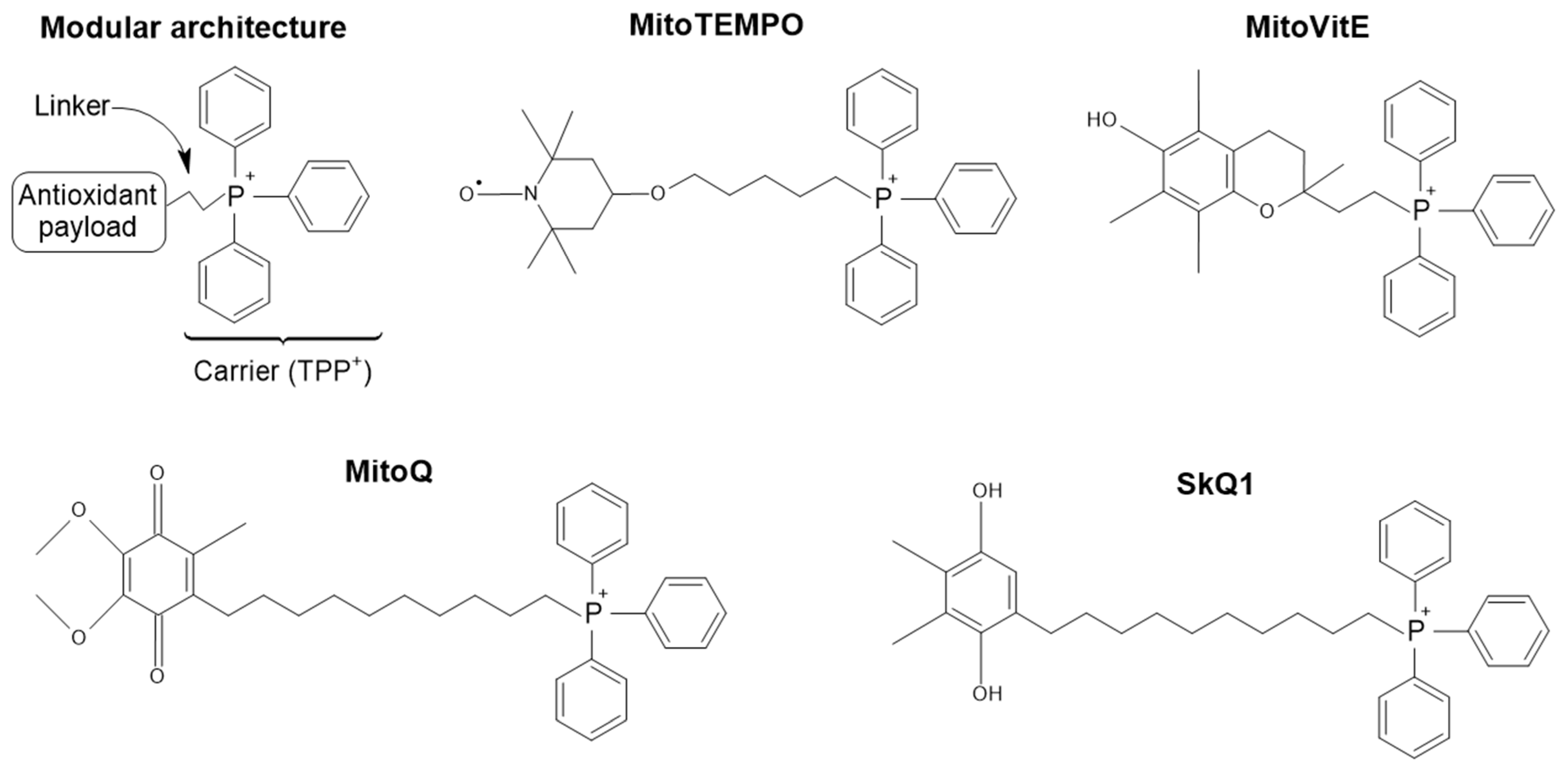
While Figure 1 summarizes representative molecular architectures of MTAs [10,27], Table 1 compiles quantitative structure–activity relationship (SAR) data for quinone-based compounds. These metrics, derived from concentration-dependent redox switching, provide an experimental framework for evaluating MTA performance [28,29,30].
Figure 1.
Modular architecture and representative chemical structures of MTAs.
Table 1.
Quantitative structure-activity relationship (SAR) metrics for representative mitochondria-targeted quinone antioxidants, integrating functional redox window analyses (oxidized forms) with intrinsic chain-breaking kinetic potency measurements (reduced forms) [28,29,30]. MitoQ—Mitoquinone; SkQ1—Skulachev quinone 1; TPP+—Triphenylphosphonium; MitoQH2/SkQ1H2—reduced, dihydro forms of MitoQ/SKQ1; SAR—Structure-Activity Relationship; LO2•—Lipid Peroxyl Radical.
The figure illustrates the modular organization of MTAs into a TPP+ carrier, a linker, and an antioxidant payload, facilitating interpretation of carrier-, linker-, and payload-dependent structure-activity relationships. Representative MTAs include nitroxide-based (MitoTEMPO), phenolic vitamin E-derived (MitoVitE), ubiquinone-based (MitoQ), and plastoquinone-based (SkQ1) payloads [10,27].
3. The First Generation: Mitoquinone as a Proof of Concept
3.1. Structure and Synthesis
MitoQ was the first mitochondria-targeted antioxidant to successfully translate the conceptual framework of mitochondrial delivery into a synthetic, bioavailable compound. It is capable of accumulating at therapeutically meaningful concentrations within the IMM [31]. Its molecular architecture utilizes a modular strategy: a redox-active ubiquinone moiety—resembling the headgroup of endogenous coenzyme Q10—is covalently attached to a ten-carbon aliphatic linker terminating in a TPP+ cation [32,33].
This arrangement serves several interdependent purposes. First, the ubiquinone headgroup retains the capacity for two-electron reduction to the hydroquinone. Second, the decyl linker provides the optimal balance between hydrophobicity, membrane partitioning, and molecular flexibility (as discussed in Section 2.3). Finally, the TPP+ moiety enables electrophoretic uptake driven by the steep negative potential across the IMM [34]. The TPP+ group itself is critical; its charge is delocalized over three aromatic rings, which facilitates rapid membrane permeation and provides the lipophilicity required to anchor the molecule within the IMM [35].
The synthesis of MitoQ proceeds through the preparation of a decyl-TPP+ intermediate, typically derived from the alkylation of triphenylphosphine with 1-bromodecane. This is followed by nucleophilic substitution with a suitably activated 4,5-dimethoxy-2-methyl benzoquinone derivative. The reaction sequence yields a stable mesylate or chloride salt of MitoQ, which displays excellent shelf stability and compatibility with oral or parenteral administration [16]. Once delivered to cells, MitoQ undergoes rapid passive diffusion across the plasma membrane. Due to the TPP+ driving force, it localizes preferentially to the mitochondria, becoming enriched by several hundred-fold relative to the cytosol. The molecule embeds within the lipid core of the inner membrane, orienting the quinone headgroup toward the matrix. This positioning enables interaction with mitochondrial electron carriers and ensures that redox cycling occurs precisely at the principal sites of ROS generation. Taken together, the structural elegance of MitoQ, its redox-active quinone, optimally tuned linker, and electrophoretically targeted cation established it as the archetype for modern mitochondria-directed therapeutics [11].
3.2. The Redox Cycling Mechanism
The functional behavior of MitoQ in biological systems is governed by its highly efficient redox cycling within mitochondria. Upon accumulation in the inner mitochondrial membrane, oxidized MitoQ is rapidly reduced to the hydroquinone form (MitoQH2) by complex II (succinate dehydrogenase). Importantly, this process proceeds without interfering with proton pumping or ATP production [36]. The resulting hydroquinone is a potent electron donor that neutralizes O2•−, H2O2, peroxynitrite (ONOO−), and lipid-derived radicals. By doing so, it effectively halts the propagation of oxidative damage within the mitochondrial membrane [37]. During ROS scavenging, MitoQH2 is reoxidized to the quinone form, which can be continuously recycled by complex II through repeated cycles of reduction and oxidation. This regenerative capacity allows MitoQ to function in a quasi-catalytic manner. Consequently, submicromolar concentrations exert substantial antioxidant effects because the molecule is recycled rather than consumed [32].
A critical consequence of this redox cycling is the suppression of lipid peroxidation, particularly in cardiolipin-rich regions of the IMM. Cardiolipin is uniquely susceptible to oxidative damage, and its peroxidation destabilizes respiratory supercomplexes, promotes cytochrome c dissociation, and initiates both apoptotic and ferroptotic pathways. By interrupting lipid peroxidation at its earliest stages, MitoQ preserves membrane integrity, maintains respiratory chain organization, and supports sustained mitochondrial function [38]. In parallel, MitoQ reduces oxidative injury to mitochondrial DNA (mtDNA) and matrix enzymes. This protection helps stabilize the mitochondrial membrane potential, attenuates the pathological activation of the mitochondrial permeability transition pore, and blocks downstream cell death signaling. Although MitoQ acts predominantly as an antioxidant, its semiquinone intermediate can donate electrons to oxygen and generate O2•− under specific conditions. This occurs at high concentrations or in environments with exceptionally high electron flux [39]. This context-dependent pro-oxidant behavior has been observed in certain cancer models and appears to be linked to elevated rates of semiquinone formation under conditions of enhanced mitochondrial respiration. Overall, the redox cycling mechanism of MitoQ represents a sophisticated interplay between targeted mitochondrial delivery, controlled quinone-hydroquinone interconversion, and precise modulation of mtROS metabolism [40].
3.3. Therapeutic Evaluation and Limitation
The preclinical and clinical evaluation of MitoQ demonstrates a broad spectrum of beneficial actions across diseases driven by mitochondrial oxidative stress, yet also reveals mechanistic complexities and limitations that define its therapeutic potential. In animal and human studies, MitoQ improves endothelial function, reduces myocardial ischemia–reperfusion injury, and preserves dopaminergic neuron integrity. Furthermore, it attenuates hepatic steatosis and inflammation, while improving mitochondrial dysfunction associated with metabolic and neurodegenerative disorders [41]. Its capacity to reduce mitochondrial ROS, inhibit lipid peroxidation, and stabilize mitochondrial bioenergetics has been repeatedly validated across diverse tissues, including cardiomyocytes, neurons, hepatocytes, reproductive cells, and immune cells. In platelets, for example, MitoQ lowers mtROS levels and decreases activation and aggregation. However, these benefits are reversed at excessively high concentrations [42]. Early-phase clinical trials in humans confirm that MitoQ is orally bioavailable, well tolerated, and capable of reaching mitochondrial compartments in multiple tissues without inducing significant adverse effects at therapeutic doses.
Despite these strengths, several limitations have emerged. High concentrations of MitoQ can depolarize mitochondria, induce apoptosis, or disrupt oxidative phosphorylation, indicating a narrow therapeutic window in certain cell types. In cancer models, the compound exhibits antiproliferative effects that appear largely independent of its antioxidant activity. Notably, both MitoQ and its redox-inactive analogue, dimethyl-mitoquinone (DM-MitoQ), inhibit ATP production, suppress mitochondrial respiration, and impair tumor cell viability [43]. These findings suggest that mitochondrial accumulation and the disruption of bioenergetic pathways, rather than ROS scavenging alone, play critical roles in its antitumor activity. Furthermore, MitoQ and DM-MitoQ both inhibit the mitochondrial chaperone Trap1, a key regulator of the metabolic switch between glycolysis and oxidative phosphorylation. This indicates that mitochondrial protein interactions contribute to biological effects previously attributed solely to antioxidant activity [44]. The differential hydrophobicity of MitoQ and DM-MitoQ also complicates mechanistic interpretation because variations in membrane partitioning may produce distinct bioenergetic consequences. For these reasons, many earlier studies that interpreted MitoQ’s effects as purely antioxidant are now recognized as incomplete. Researchers now emphasize the necessity of redox-inactive controls to distinguish antioxidant-dependent from antioxidant-independent mechanisms [45].
Toxicological studies further indicate that supraphysiological doses of MitoQ can induce renal and hepatic stress in rodents, although such concentrations vastly exceed those used in human trials [46]. Nevertheless, these findings underscore the need for careful dosing. They highlight the risk that excessive mitochondrial accumulation of TPP+-conjugated molecules may disrupt membrane potential and oxidative phosphorylation. Taken together, the evidence positions MitoQ as both a powerful mitochondria-targeted antioxidant and a context-dependent modulator of mitochondrial function. Its therapeutic utility ultimately depends on precise control of dose, tissue distribution, and mechanistic context. Understanding these dual roles is essential for interpreting MitoQ’s effects. Furthermore, this knowledge is vital for guiding the development of next-generation mitochondria-targeted therapeutics designed to separate redox activity from mitochondrial bioenergetic modulation [10].
4. The Second Generation: Optimizing Efficacy with the Skulachev Ions
4.1. From Ubiquinone to Plastoquinone
SkQ are mitochondria-targeted antioxidants consisting of a plastoquinone redox core conjugated to the lipophilic TPP+ cation. The advent of MTAs began with compounds such as MitoQ, in which ubiquinone was conjugated to the lipophilic cation TPP+. However, Vladimir P. Skulachev and colleagues proposed replacing ubiquinone with plastoquinone (PQ) as the quinone head group in order to enhance mitochondrial membrane targeting and redox efficiency. This approach led to the synthesis of Skulachev ions, most notably SkQ1. At nanomolar concentrations, SkQ1 exhibits potent antioxidant activity across various environments, including aqueous solutions, lipid bilayers, isolated mitochondria, and intact cells.
While SkQ1 operates via the same quinone/hydroquinone redox cycling mechanism as MitoQ, plastoquinone differs from ubiquinone in its redox behavior. In particular, SkQ1 is efficiently reduced by the respiratory chain, whereas the oxidation of its reduced form (SkQH2) proceeds more slowly, resulting in greater stability of the antioxidant state and a wider separation between antioxidant and pro-oxidant concentrations. As a consequence, the “window” between antioxidant and pro-oxidant activity for SkQ1 is markedly broader than that observed for MitoQ [47]. This difference reflects not only improved partitioning of plastoquinone-based conjugates into the mitochondrial inner membrane but also more favorable redox kinetics of the plastoquinone core. Enhanced membrane affinity positions SkQ1 in close proximity to critical lipid targets, particularly cardiolipin, enabling effective inhibition of cardiolipin peroxidation and attenuation of ROS-driven mitochondrial damage.
Thus, the transition from ubiquinone to plastoquinone can be regarded as a defining feature of the “second generation” of MTAs Rather than representing a purely structural modification, this substitution confers mechanistically meaningful advantages, including increased redox stability, reduced propensity for pro-oxidant redox cycling, and improved biological efficacy. These features underscore the importance of the quinone redox core in determining both antioxidant performance and safety, and they provide a basis for the rational design of future mitochondria-targeted antioxidants that balance efficient ROS scavenging with controlled redox behavior [47]. A detailed comparison of MitoQ and SkQ1 is provided in Table 2.
Table 2.
Comparison of Mitoq and SkQ1. MitoQ—mitoquinone; SkQ1—plastoquinonyl-decyl-triphenylphosphonium; Octanol:PBS—octanol–phosphate-buffered saline partition coefficient; μM—micromolar concentration; ETC—electron transport chain; ROS—reactive oxygen species; TPP+—triphenylphosphonium cation.
4.2. Structure–Activity Relationships in SkQ Antioxidants
4.2.1. Diversity and Permeability of SkQ Analogs
In 2007, SkQ1 was synthesized and shown to effectively prevent various degenerative processes and extend lifespan in multiple organisms at nanomolar concentrations. To build on this success, several analogs were developed. One notable derivative is SkQR1, in which the TPP+ was replaced by rhodamine 19, a fluorescent mitochondrial dye. SkQR1 exhibits even stronger antioxidant and protective effects than SkQ1 in cellular and in vivo models, particularly in kidney and brain ischemia. Beyond differences in antioxidant potency, the rhodamine-based SkQR1 offers an important methodological advantage arising from its intrinsic fluorescence. This property enables direct visualization of mitochondrial accumulation and provides an internal control for assessing membrane potential–dependent uptake, which is not possible with non-fluorescent SkQ analogs. As a result, SkQR1 serves not only as a highly effective mitochondria-targeted antioxidant but also as a functional probe for studying mitochondrial heterogeneity and dynamics in living cells, thereby strengthening the mechanistic interpretation of structure–activity relationships within the SkQ family [29,52].
Among the Skulachev ion derivatives (SkQs), structural diversity arising from variations in the cationic head group and linker length directly dictates their biophysical properties. Differences in membrane permeability and mitochondrial accumulation strongly influence their antioxidant performance. Experimental studies on model membranes demonstrated that permeability of these cations decreases in the order SkQR1 > SkQ1 > SkQ3 > MitoQ, with SkQ2M, SkQ4, and SkQ5 showing considerably lower permeability. The rhodamine-containing SkQR1 and the phosphonium-based SkQ1 generate nearly Nernstian diffusion potentials across bilayer membranes, indicating high transmembrane mobility and efficient mitochondrial targeting.
Regarding the antioxidant and prooxidant balance, SkQ1 displays the broadest therapeutic window, with a 32-fold difference between antioxidant and prooxidant concentrations (25–800 nM). While SkQ3 exhibits lower antioxidant efficiency—requiring higher concentrations to achieve similar effects—the activity of SkQR1 comparable to, or even exceeds, that of SkQ1. In contrast, compounds with less hydrophobic linkers, such as SkQ5, are less effective; this highlights the critical role of hydrophobicity in membrane localization and redox activity.
Biological assays have confirmed that SkQR1 and SkQ1 are the most potent antioxidants of the series. They are capable of preventing mitochondrial oxidative damage, cardiolipin peroxidation, and ROS-induced apoptosis at extremely low (picomolar to femtomolar) concentrations. Their protective efficacy follows the order SkQR1 > SkQ1 > SkQ3, whereas analogues lacking the quinone moiety (e.g., C12TPP) remain largely inactive. Collectively, these observations indicate that subtle structural modifications within the SkQ family—particularly in the cationic head and linker—profoundly influence mitochondrial targeting, membrane permeability, and overall antioxidant efficiency [29].
4.2.2. Bioenergic Modulation and Mild Uncoupling
Beyond their antioxidant properties, several SkQ analogues—particularly those based on rhodamine 19—display distinctive bioenergetic behavior that further differentiates them within the SkQ family. SkQR1, which replaces the TPP+ headgroup with rhodamine 19, permeates membranes more efficiently than SkQ1 and acts as a mitochondria-targeted mild uncoupler.
Unlike TPP+-based SkQs, which require endogenous free fatty acids for protonophorous activity, rhodamine-19 conjugates like SkQR1 (and its quinone-free analogue C12R1) can mediate proton transport independently. Because their uptake is driven by the Δψm, the resulting decrease in voltage inherently limits further accumulation. This creates a self-limiting uncoupling effect. This behavior manifests as a moderate, partial stimulation of respiration that does not inhibit the respiratory chain or impair yeast cell growth, distinguishing these agents from classical uncouplers like carbonyl cyanide p-trifluoromethoxyphenylhydrazon (FCCP). SkQR1 accumulates efficiently in mitochondria across diverse biological systems and has demonstrated protective activity in models of brain and kidney ischemia. These protective effects may partially arise from this controlled uncoupling mode. Together, these findings highlight that modifying the cationic carrier—particularly through rhodamine-based structures—can endow SkQ derivatives with a unique balance of antioxidant action and regulated protonophoric activity, expanding their therapeutic potential [53].
4.2.3. Novel and Naturally Derived Carriers
Another relevant analogue is SkQ3, a conjugate of methylplastoquinone and TPP+. Despite its structural similarity to SkQ1, SkQ3 possesses distinct functional characteristics.
In studies using isolated rat heart mitochondria and the yeast Dipodascus magnusii, SkQ3 exhibited potent antioxidant activity at very low concentrations, reducing oxidative stress while preserving mitochondrial integrity. Notably, unlike SkQ1 and MitoQ, SkQ3 does not display pro-oxidant activity even at higher concentrations, which significantly enhances its therapeutic potential. Its uncoupling effect depends on interactions with endogenous fatty acids, which supports mitochondrial respiration without inducing excessive depolarization. Comparative studies reveal that SkQ3 provides robust protection that matches or exceeds that of SkQ1 and MitoQ, while lacking their concentration-dependent drawbacks. These properties—along with its structural stability and the absence of reactive isoforms—position SkQ3 as a highly promising candidate for mitigating oxidative stress [54].
Because TPP+ and rhodamine are synthetic cations, researchers developed new analogs using natural penetrating cations derived from plant alkaloids. These include berberine and palmatine, resulting in SkQBerb and SkQPalm. These compounds consist entirely of natural components yet retain efficient mitochondrial targeting and antioxidant activity comparable to SkQ1. In both isolated mitochondria and living cells, their antioxidant action is driven by the PQ moiety, as the berberine and palmatine components are not reduced. Interestingly, the reduced forms of SkQBerb and SkQPalm exhibit stronger radical-scavenging activity than SkQ1. Furthermore, their lower pro-oxidant activity expands the safety window for these molecules. While they exhibit mild inhibitory effects at micromolar concentrations, SkQBerb and SkQPalm represent a promising direction for developing safer, naturally derived MTA [55].
4.2.4. Pro-Oxidant Variants and Strategic Modifications
While most modifications aim to enhance protection, the derivative SkBQ—a benzoquinone conjugate—was designed to evaluate how the absence of substituents on the quinone ring affects redox behavior. Unlike the PQ- and toluquinone-based analogues (SkQ1 and SkQT1), SkBQ carries no substituents at positions 2, 3, or 5 of the aromatic ring. This structural simplification shifts its functional profile significantly: SkBQ displays much lower antioxidant and markedly higher prooxidant activity in isolated mitochondria. While SkBQ is reduced by complex III and decreases membrane potential, it fails to protect cells from H2O2–induced apoptosis. Instead, it acts predominantly as a mitochondria-targeted pro-oxidant. These findings suggest that the absence of electron-donating substituents on the quinone ring enhances redox reactivity, flipping the compound’s role from protector to generator of ROS. Consequently, SkBQ represents a promising candidate for further investigation as a potential anticancer agent, particularly for tumors such as prostate cancer that are sensitive to mitochondrial oxidative stress [56].
Further refinement focused on combining PQ with alternative penetrating cations. Utilizing rhodamine-19, berberine, and palmatine led to the creation of SkQR1, SkQBerb, and SkQPalm. These compounds effectively accumulate in mitochondria, where their reduced forms inhibit lipid peroxidation at nanomolar concentrations. SkQR1 stands out as the most potent, acting at sub-nanomolar levels. Beyond antioxidant effects, these compounds exhibited mild uncoupling properties. They induce fatty acid–mediated proton transport across mitochondrial membranes—a process facilitated by the adenine nucleotide translocator. Notably, SkQR1 and its analog C12R1 also displayed fatty acid–independent proton conductivity, attributed to the protonation–deprotonation dynamics of the rhodamine residue. This dual mechanism of antioxidant protection and selective mild uncoupling is believed to underlie their exceptional efficacy against oxidative stress.
Collectively, these findings reinforce that strategic modification of both the quinone payload and the cationic carrier can fine-tune redox behavior, mitochondrial accumulation, and safety profile. Such multifunctional derivatives—particularly those incorporating natural alkaloid cations or rhodamine-based moieties—represent promising leads for the development of next-generation MTA and mild uncouplers with therapeutic potential in oxidative stress-related disorders and aging [57].
Chemical modifications within the SkQ family—ranging from changes in the cationic carrier to alterations of the quinone core—yield a wide spectrum of biological properties. Variants containing rhodamine or natural alkaloid cations show enhanced mitochondrial permeability, strong antioxidant action, and, in some cases, self-limiting mild uncoupling. TPP+-based analogues, such as SkQ1, provide a broad therapeutic window, while simplified benzoquinone derivatives shift toward pronounced prooxidant behavior with potential anticancer applications. Collectively, these derivatives demonstrate how targeted adjustments to both the redox-active moiety and the carrier group can precisely modulate mitochondrial accumulation, redox balance, and bioenergetic effects. The structural variations and functional profiles of the SkQ series are summarized in Table 3.
Table 3.
Summary of Structure-Activity Relationships (SAR) and Biological Profiles of Skulachev Ion (SkQ) Derivatives. H2O2—hydrogen peroxide; SAR—structure-activity relationship; TPP+—triphenylphosphonium cation.
5. In Silico and Computational Insights: Predicting and Understanding Activity
In silico approaches have emerged as invaluable tools in the study of MTAs. These methods enable rapid prediction of the biological activity of chemical compounds and facilitate the identification of underlying antioxidant mechanisms at the molecular level, while simultaneously reducing the time and cost associated with experimental investigations [58]. Such techniques facilitate the analysis of molecular redox properties, the prediction of radical stability, and evaluation of ROS-scavenging efficiency [59].
Common applications of these in silico methodologies include the rational design of novel compounds with optimized antioxidant activity and the evaluation of how structural modifications impact redox behavior. Furthermore, computational tools help identify potential reactive sites within molecular frameworks. Integrating these approaches with experimental studies allow for efficient development of MTAs that exhibit both high potency and selectivity toward specific cellular organelles [60].
Importantly, in silico approaches have already contributed to both the discovery and optimization of mitochondrial-targeted antioxidants. Computational studies have been particularly valuable in elucidating the structure–property relationships of classical MTAs, such as MitoQ and SkQ1, guiding rational modifications of linker length, redox-active moieties, and overall lipophilicity [61,62]. Notably, quantum chemical calculations have also identified non-mitochondrial antioxidants, including polyphenolic compounds like luteolin and isorhamnetin, as promising scaffolds [63]. These compounds provide opportunities for further optimization toward mitochondrial targeting, illustrating how in silico methods can inform the design of both established and emerging antioxidants.
5.1. Predicting Membrane Interaction with Molecular Dynamics
Molecular dynamics (MD) simulations have become an indispensable tool for exploring how MTAs interact with biological membranes at the atomic level. The IMM possesses a unique lipid composition—rich in cardiolipin and phosphatidylethanolamine—which creates a physicochemical environment that strongly influences how cationic and lipophilic antioxidants partition, orient, and diffuse within the bilayer [38]. While experimental techniques such as fluorescence spectroscopy and nuclear magnetic resonance (NMR) provide valuable insights, MD simulations enable the direct observation of molecular events underlying membrane association, insertion, and stabilization over nanosecond-to-microsecond timescales [64].
In a typical MD setup, a model lipid bilayer (e.g., 1-palmitoyl-2-oleoyl-sn-glycero-3-phosphocholine (POPC), 1-palmitoyl-2-oleoyl-sn-glycero-3-phosphoethanolamine (POPE), or cardiolipin-enriched membrane) is constructed and solvated in explicit water with counterions to neutralize the system. The antioxidant molecule—frequently containing a TPP+ moiety for mitochondrial targeting—is positioned near the membrane surface [38]. Using classical force fields such as Chemistry at Harvard Macromolecular Mechanics (CHARMM), Assisted Model Building with Energy Refinement (AMBER), or Groningen Machine for Chemical Simulations (GROMOS), the system undergoes energy minimization, equilibration, and production runs under physiological temperature and pressure conditions. Additionally, recent advances in coarse-grained approaches, such as the Multi-scale Analysis of Reacting and Interacting Systems (MARTINI) force field, allow for the simulation of larger systems over longer timescales, improving statistical robustness [65].
Several key parameters extracted from these simulations help quantify and predict membrane affinity and behavior. The free energy of insertion (ΔGinsertion) provides a thermodynamic measure of the compound’s propensity to embed into the Bilayer [66,67]. The depth of insertion and orientation angle indicate how the molecule aligns relative to the membrane normal-factors that strongly influence accessibility to ROS and redox centers [60]. Additionally, radial distribution functions (RDFs) reveal local interactions with lipids, water, and ions, while membrane structural parameters (e.g., area per lipid, bilayer thickness, and order parameters) reflect the compound’s perturbative effect on membrane organization [65]. Collectively, these descriptors inform on both the efficacy and safety of potential MTAs.
Studies have already demonstrated the power of MD in rational MTA design. Simulations of classical TPP+-based antioxidants, such as MitoQ and SkQ1, reveal that their phosphonium headgroups typically reside near the interfacial region, while their hydrophobic tails penetrate deeply into the lipid core [60,68]. This orientation maximizes electrostatic anchoring while preserving membrane integrity. Variations in alkyl chain length or redox-active moieties (e.g., ubiquinone vs. PQ) modulate insertion depth and diffusion coefficients, correlating with experimentally observed differences in antioxidant efficacy and mitochondrial accumulation [38,69]. Such structure-property relationships, accessible through MD, have guided the synthesis of optimized analogues with enhanced bioavailability and reduced toxicity. Overall, MD simulations have provided clear insights into how specific structural features of MTAs—such as the length and flexibility of the alkyl linker, the position of the TPP+ group, and the properties of the redox-active head—affect membrane insertion depth, molecular orientation, and lateral diffusion within the IMM. Importantly, these findings have guided the rational optimization of MTA structures, helping to achieve an effective balance between efficient mitochondrial accumulation and minimal disruption of membrane integrity [10,28].
Despite these successes, current MD studies face limitations. The timescales accessible to conventional simulations, typically <1 μs, may not capture slow diffusion or conformational transitions relevant to biological function [70]. Furthermore, accurate parameterization of complex molecules—especially those with delocalized charge, conjugated aromatic systems, or redox-active centers—remains challenging [60].
5.2. Quantum Chemical Prediction of Antioxidant Potential
Quantum chemical calculations are essential tools for predicting the antioxidant potential of chemical compounds, particularly MTA. These methods enable the analysis of the redox properties of molecules at the atomic level, providing detailed insights into radical scavenging mechanisms and the stability of the resulting radical species [71,72]. Such approaches allow for the systematic evaluation of a compound’s ability to neutralize ROS, thereby supporting the rational design of more effective antioxidants.
The most common technique in this field is Density Functional Theory (DFT). DFT allows researchers to determine key molecular parameters associated with antioxidant activity, including bond dissociation enthalpies (BDE), ionization potentials (IP), and electron affinities (EA) [73]. BDE values are primarily used to assess a molecule’s propensity to donate a hydrogen atom via the HAT mechanism, whereas IP and EA provide information relevant to SET pathways. Additionally, frontier molecular orbital analysis—specifically identifying the Highest Occupied Molecular Orbital (HOMO) and Lowest Unoccupied Molecular Orbital (LUMO)—helps pinpoint the most reactive sites within a molecule [74].
Another important aspect is the consideration of environmental effects through the use of solvation models. In polar environments (e.g., aqueous media), Radical Adduct Formation (RAF) often dominates, whereas HAT and SET mechanisms are generally favored in lipid-rich environments [71]. Supplementary reactivity indices, such as electron-donating and electron-accepting capacities (ω− and ω+), enable quantitative evaluation of the potential for electron transfer reactions, further refining predictions of antioxidant activity [72].
Quantum chemical studies have demonstrated that compounds like luteolin and isorhamnetin exhibit significant antioxidant activity, driven primarily by HAT and SET mechanisms. Specifically, •OH groups at defined positions serve as primary reactive centers that determine radical scavenging sites. Analysis indicates that isorhamnetin may possess slightly higher antioxidant potential than luteolin in aqueous environments due to lower BDE values [75]. Similar observations were made for other polyphenolic structures, where differences in spin density distribution influenced the dominant reaction mechanism in aqueous versus lipidic media [74]. These findings underscore the importance of quantum chemical calculations in analyzing structure–activity relationships and guiding the design of compounds with enhanced antioxidant efficacy.
Importantly, although luteolin and isorhamnetin are not inherently mitochondria-targeted, their well-characterized redox behavior and accessible hydroxyl groups make them promising candidates for further functionalization, for instance by conjugation with mitochondrial-targeting moieties [76]. In this way, these compounds provide valuable model systems for illustrating how quantum chemical methods can guide the adaptation of existing antioxidants toward mitochondrial applications.
From a broader perspective, quantum chemical calculations have not only clarified the antioxidant activity of known MTAs but have also helped identify new, promising antioxidant scaffolds [77]. By revealing dominant reaction mechanisms (HAT, SET, and RAF) and pinpointing reactive functional groups, DFT studies support rational structural modifications aimed at enhancing redox efficiency under mitochondrial-like conditions.
The application of quantum chemical methods thus provides valuable mechanistic and structural insights; however, these predictions are subject to certain limitations. The accuracy of the results depends on the choice of functional, basis set, and solvation model, and therefore computational data should, whenever possible, be complemented with experimental validation [72].
5.3. Integrating Molecular Dynamics, Quantum Mechanics, and Machine Learning in Drug Design
A promising complement to MD and quantum mechanics (QM) methods is the use of machine learning (ML). At present, ML is not routinely applied in the real-world development of MTAs. However, it is increasingly used at early research stages as a supportive tool to predict key molecular properties and to accelerate screening and structural optimization, thereby reducing computational and experimental costs. For example, ML models trained on data from MD simulations have been applied to predict ΔG. This approach enabled the estimation of ΔG without the need for computationally expensive enhanced sampling simulations, significantly speeding up the structural optimization process. This is particularly relevant for MTAs, where ΔG is a key parameter describing a compound’s ability to penetrate and remain stably localized within lipid membranes [78]. In another study, Brocke et al. (2019) [79] used implicit membrane modeling combined with ML to predict the permeation coefficient (logPm). This parameter is commonly used in MTA design and provides information about a molecule’s ability to cross lipid membranes. The use of ML for logPm prediction enables faster and more efficient prioritization and optimization of structural features, such as linker length and the nature of functional groups, compared to traditional computational approaches [79]. ML is also applied in the assessment of redox properties. Kichev et al. (2023) [80] used ML models to predict the relationship between molecular structure and redox potential, allowing chemical variants to be ranked without performing costly QM calculations for each structure. This approach is especially important for MTAs, as redox properties directly determine their antioxidant activity [80].
Summarizing, ML has strong potential to support the development of MTAs by accelerating the prediction of ΔG, membrane permeation, and redox properties. By complementing traditional MD and QM approaches, ML can improve early-stage candidate prioritization and enable more efficient structural optimization. However, despite these promising results, ML-based approaches are not yet routinely applied in MTA design and require further validation. Further studies, larger and more diverse datasets, and better integration of ML with MD, QM, and experimental approaches are needed before these methods can be widely and reliably applied in the design of mitochondrial-targeted antioxidants.
6. Therapeutic Potential: From Chemical Structure to Biological Effect
Mitochondria are increasingly recognized as promising pharmacological targets due to their essential cellular functions and the central role of mitochondrial damage in various diseases [81]. Endogenous antioxidant systems are often insufficient under oxidative stress, leading to lipid, DNA, and protein damage. MTAs are designed to selectively accumulate within mitochondria, restore redox balance, and maintain cellular function. Beyond selective mitochondrial accumulation, ideal MTAs should also exhibit favorable oral bioavailability, preferential uptake in organs most vulnerable to oxidative damage (such as heart, brain, liver, and muscle), effective protection of mitochondrial structures, recyclability to their active antioxidant form within mitochondria, and clinical efficacy at safe, non-toxic concentrations [82]. However, clinical translation remains limited by poor bioavailability and insufficient preclinical and clinical evidence [83]. MTAs modulate redox balance, ETC activity, and ATP production, with therapeutic effects depending on disease type, stage, and dosage. Appropriate doses reduce mtROS and confer protection, whereas excessive doses may impair ETC function and exacerbate oxidative damage, as shown in models of Parkinson’s disease, traumatic brain injury, CVDs, and cancer [83]. Supporting its broader therapeutic potential, a systematic review and meta-analysis by Braakhuis et al. found that MitoQ supplementation significantly reduced nitrotyrosine levels and increased mitochondrial membrane potential, suggesting benefits in alleviating oxidative stress associated with aging [84]. In particular, MitoQ is distinguished by high bioavailability, and numerous prior studies have reported its potential therapeutic benefits [85]. Despite the lack of approval by the U.S. Food and Drug Administration (FDA) as a therapeutic agent, many studies are currently registered to investigate the effects of MitoQ across a range of diseases and clinical conditions, including multiple sclerosis, schizophrenia spectrum disorders, preeclampsia, and sickle cell anemia [86]. The summary in Table 4 focuses on ongoing clinical trials that are currently in the recruitment phase, active, or slated to begin in the near future.
Table 4.
Summary of ongoing and upcoming clinical trials investigating the effects of MitoQ across various clinical conditions [86].
6.1. Neuroprotection: Alzheimer’s and Parkinson’s Disease
Neurodegenerative diseases are characterized by progressive neuronal loss and share common mechanisms involving mitochondrial dysfunction and oxidative stress [10]. Mitochondria are the primary source of intracellular ROS and are highly vulnerable to oxidative damage, leading to impaired ATP production, calcium dysregulation, and apoptosis. This creates a self-perpetuating cycle of oxidative stress and mitochondrial damage that accelerates cellular dysfunction [10]. With aging, mitochondrial quality control declines, contributing to disorders such as Parkinson’s and Alzheimer’s disease [87].
Parkinson’s disease affects approximately 1% of individuals over 60 and primarily targets dopaminergic neurons in the substantia nigra, which are particularly sensitive to oxidative stress due to their dependence on oxidative phosphorylation [10]. Pathogenic mechanisms include α-synuclein aggregation, environmental inhibition of Complex I, and mutations in mitophagy-related genes (e.g., PINK1, Parkin), all contributing to mitochondrial failure and neuronal death [10]. Loss of PINK1 or Parkin function impairs mitophagy, leading to accumulation of dysfunctional mitochondria and enhanced release of mitochondrial damage-associated molecular patterns (mitoDAMPs). These molecules activate inflammatory signaling via the cyclic GMP-AMP synthase-stimulator of interferon genes (cGAS-STING) pathway, which triggers type I interferon responses, and the NOD-like receptor family pyrin domain containing 3 (NLRP3) inflammasome, promoting caspase-1 activation and pro-inflammatory cytokine release. Mutations in DJ-1, an autosomal recessively inherited PD gene, disrupt mitochondrial morphology and antioxidant defenses, further promoting ROS accumulation and mitochondrial fragmentation. Alterations in mitochondrial polymerase gamma (POLG), the primary mtDNA polymerase responsible for replication and repair of mtDNA, compromise mtDNA integrity, resulting in defective respiratory chain function and heightened neuronal vulnerability [88].
Current therapies are largely symptomatic, and non-targeted antioxidants show limited efficacy due to inadequate mitochondrial delivery. MTAs, with improved pharmacokinetics and selective mitochondrial accumulation, show preclinical promise, but clinical validation is limited [4,89]. MTAs—such as MitoQ, MitoVitE, MitoTEMPO, ginsenosides, and curcumin—demonstrate preclinical efficacy in restoring mitochondrial function, reducing ROS, and protecting neurons [90].
According to a study by Xi et al., MitoQ exerts neuroprotective effects in Parkinson’s disease models by promoting mitofusin 2 (Mfn2)-dependent mitochondrial fusion, stabilizing morphology, reducing ROS, and preventing neuronal apoptosis. Its activity involves peroxisome proliferator-activated receptor gamma coactivator 1α (PGC-1α) activation, which enhances mitochondrial integrity and dopaminergic neuron survival [91]. Similarly, Solesio et al. [45] in 2013 showed that MitoQ prevents 6-hydroxydopamine (6-OHDA) induced mitochondrial fragmentation and apoptosis through inhibition of Drp1 and Bax translocation. These findings indicate that MitoQ acts via redox-dependent modulation of mitochondrial dynamics. Despite consistent preclinical protection against neuronal loss and behavioral deficits, clinical trials have failed to demonstrate efficacy—likely due to late-stage administration and lack of sensitive biomarkers—emphasizing the need to target earlier disease stages [45].
Alzheimer’s disease, the leading cause of dementia, is characterized by progressive cognitive decline, mitochondrial dysfunction, oxidative stress, and impaired mitochondrial dynamics. These alterations increase ROS production, disrupt energy metabolism, and promote neuronal degeneration [92,93]. Mitochondrial bioenergetic deficits reduce ATP availability, impairing synaptic transmission and neuronal resilience. Dysfunctional mitochondria also release pro-apoptotic factors that accelerate neuronal death. Altered mitochondrial dynamics compromise mitophagy, leading to the accumulation of damaged organelles and exacerbation of neurodegenerative processes. Mitochondria-driven neuroinflammation, including NLRP3 inflammasome and cGAS-STING pathway activation, further amplifies disease progression [92,93]. Alzheimer’s disease involves amyloid-β plaques and hyperphosphorylated tau tangles, which impair synaptic function and trigger neuronal loss. Mitochondrial impairment and oxidative stress occur early in the disease course, preceding overt neurodegeneration [94]. Conventional antioxidants (e.g., vitamins D, C, and E, coenzyme Q10, melatonin) have shown inconsistent effects due to poor mitochondrial penetration [93].
MTAs such as SkQ1, MitoQ, and SS31 protect neuronal mitochondria from amyloid-β-induced toxicity by preventing mitochondrial depolarization, reducing oxidative damage, and improving synaptic function and memory in experimental Alzheimer’s disease models [95]. Manczak et al. demonstrated that MitoQ and SS31 preserve mitochondrial structure, increase expressions of mitochondrial fission genes, decrease expression of fusion genes and redox-related gene expression, and enhance neurite outgrowth in amyloid-β-treated neurons [95]. Likewise, Loshchenova et al. reported that SkQ1 reduces mtDNA deletions and delays cognitive decline in OXYS rats, while improving mitochondrial structure and function, decreasing amyloid-β accumulation and tau hyperphosphorylation, and enhancing synaptic integrity. These neuroprotective effects are closely linked to restored mitochondrial redox balance and bioenergetic stability, preventing oxidative and metabolic cascades leading to neuronal degeneration [96,97]. Although mitochondrial therapies demonstrate consistent preclinical promise, clinical progress remains limited. Further elucidation of mitochondrial homeostasis mechanisms and optimization of targeted drug delivery are crucial for translating these findings into effective mitochondria-based treatments that preserve neuronal and cognitive function [4,94,98].
6.2. Ocular Diseases: Dry Eye Disease and Uveitis
MTAs are increasingly being investigated for their therapeutic potential in ocular diseases, including dry eye disease (DED), retinopathy, glaucoma, uveitis, and conjunctivitis [99].
DED is the most prevalent ocular surface disorder, characterized by chronic inflammation and oxidative stress. Mitochondrial dysfunction plays a role in DED pathogenesis, manifested through excessive ROS production, mitochondrial apoptosis, mtDNA damage, and the activation of innate immune pathways such as NLRP3 and cGAS-STING, which perpetuate inflammation. Environmental stressors, tear hyperosmolarity, and aging exacerbate mitochondrial oxidative stress, further compromising corneal epithelial integrity and tear film stability [100]. Mitochondrial dysfunction—manifested through excessive ROS production, apoptosis, and sustained inflammatory signaling—plays a role in its pathogenesis. Consequently, targeting mitochondrial damage has emerged as a promising therapeutic strategy for managing DED [100]. The mitochondria-targeted antioxidant SkQ1 has been shown to enhance tear film stability and antioxidant defense, protecting ocular tissues from ROS-induced apoptosis and inflammation. Through these mechanisms, SkQ1 helps maintain ocular surface integrity and alleviates DED symptoms [101].
According to Brzheskiy et al., Visomitin eye drops containing SkQ1 significantly improved both the clinical signs and symptoms of DED, reducing corneal damage and alleviating discomfort, thereby demonstrating both efficacy and safety [102]. Huang et al. demonstrated that SkQ1 nanoparticles effectively scavenged mitochondrial ROS, inhibited mtDNA oxidation, and blocked NLRP3 inflammasome activation, thereby reducing ocular inflammation and protecting against DED [103]. Future research should focus on the rational design of next-generation antioxidants with improved bioavailability and targeted delivery, as well as on the identification of oxidative stress biomarkers for early diagnosis and optimized treatment of ocular surface diseases [104].
Autoimmune uveitis is a severe ocular inflammatory disorder driven by retinal-specific autoantigens, such as recoverin, leading to chorioretinitis, disruption of the blood-retinal barrier, and progressive visual dysfunction [105]. Oxidative stress is a driver of this pathology. In experimental autoimmune uveitis, retinal damage arises from both innate and adaptive immune responses, with Toll-like receptor (TLR) activation and cytokine release promoting oxidative stress, alongside mitochondrial dysfunction and oxidative injury. Early experimental autoimmune uveitis shows mtDNA damage and protein downregulation, a mechanism similarly observed in sympathetic ophthalmia, leading to photoreceptor oxidative damage [105]. In a study by Chistyakov et al., conjunctival administration of SkQ1-containing mitochondria-targeted antioxidant eye drops in a recoverin-induced experimental autoimmune uveitis model markedly suppressed ocular inflammation by preventing increases in tumor necrosis factor α (TNF-α), interleukin-6 (IL-6), and prostaglandin E (PGE2), while preserving retinal structure and electrophysiological function [105]. These findings highlight the therapeutic potential of SkQ1 as MTA for preventing and treating ROS-mediated ocular inflammatory diseases, although further studies are needed to confirm its efficacy and safety [106].
6.3. Cardiovascular Diseases
Emerging evidence from animal models indicates that MTA can modulate mtROS production, offering a promising strategy to prevent or mitigate cardiac dysfunction and other CVDs [107]. Mitochondrial dysfunction, characterized by impaired calcium handling, increased ROS production, and reduced ATP synthesis, is a contributor to conditions such as heart failure, ischemia–reperfusion injury, diabetic cardiomyopathy, and peripheral arterial disease [108]. Excessive ROS generated by mitochondrial complexes I and III can damage mtDNA, lipids, and proteins, leading to a vicious cycle of mitochondrial dysfunction and chronic sterile inflammation that drives cardiovascular pathology. mtDNA mutations and release of mtDNA as DAMPs activate pattern recognition receptors, inducing inflammatory signaling that contributes to atherosclerosis, endothelial dysfunction, and myocardial injury [109].
MitoQ has demonstrated significant cardioprotective and therapeutic effects across various CVDs, including ischemic heart disease, cardiac hypertrophy, hypertension, endothelial dysfunction, and cardiotoxicity induced by endotoxins, doxorubicin, and cocaine [110]. According to Graham et al., treatment with MitoQ10 significantly reduced systolic blood pressure, improved endothelial nitric oxide bioavailability, and attenuated cardiac hypertrophy in young stroke-prone spontaneously hypertensive rats, with accumulation observed in both vascular and cardiac tissues, highlighting its potential to mitigate mitochondrial-specific oxidative damage [111]. MTAs show promise in treating CVDs, including hypertension-induced left ventricular hypertrophy, by effectively reversing metabolic remodeling, stimulating fatty acid metabolism, and improving mitochondrial function. The superior efficacy of Mito- over its non-targeted underscores the therapeutic potential of precisely targeting mitochondrial oxidative stress in the myocardium [112]. Furthermore, recent evidence indicates that decreasing mtROS in aged cardiomyocytes may exert protective antiarrhythmic effects by preserving calcium homeostasis [113]. In aged rat hearts, treatment resulted in notable structural and functional improvements, primarily through reduction of ROS production in left ventricular cardiomyocytes, thereby alleviating cardiac contractile dysfunction [114]. However, despite these encouraging preclinical findings, translation into clinical practice remains limited, restricting broader application and contributing to the relatively low number of clinical studies in this area [115].
6.4. Epilepsy
Epilepsy is a neurological disorder affecting approximately 50 million individuals worldwide and is characterized by recurrent seizures. Its etiology includes genetic and structural abnormalities as well as metabolic and mitochondrial dysfunction [116]. Mitochondrial impairment links oxidative stress, defective energy metabolism, and neuronal injury, with seizure-induced mitochondrial ROS driving mtDNA damage, oxidative phosphorylation defects, and dysregulated mitochondrial quality control, thereby promoting apoptosis, neuroinflammation, and epileptogenesis [117].
Current management relies primarily on antiseizure drugs, though resistance is common, highlighting the need for alternative strategies such as surgery, neuromodulation, or dietary therapies. Targeting mitochondrial oxidative stress offers a promising therapeutic approach in epilepsy [118]. Antioxidants, including vitamin E, melatonin, coenzyme Q10, and polyphenols, have demonstrated potential to reduce seizure frequency and severity in preclinical and clinical studies [116].
Compounds such as antioxidants and mitochondria-targeted agents have shown potential in mitigating mitochondrial dysfunction and its role in epileptogenesis. These emerging strategies constitute a new direction in epilepsy therapy, aiming to target the underlying mechanisms of neuronal hyperexcitability and offering more effective, mitochondria-centered treatments for people with epilepsy [119]. MitoQ treatment has been associated with beneficial outcomes, including improvement of cognitive function and attenuation of epilepsy-related neuronal impairments, highlighting its positive impact in experimental models of epilepsy [117].
In Angelman syndrome, a disorder associated with epileptic pathology, MitoQ alleviated memory impairments by lowering O2•− production and suppressing neuronal apoptosis [120]. These findings underscore the potential of MTAs as neuroprotective therapies for epilepsy and its associated comorbidities. Nevertheless, further well-designed preclinical and clinical studies are required to establish the efficacy, safety, and therapeutic applicability of MTAs in the treatment of epilepsy [117].
6.5. Cancer
Mitochondria are central to cancer pathogenesis as major intracellular sources of ROS, which regulate redox signaling involved in tumor initiation, progression, and metastasis. Dysregulated mtROS production, coupled with impaired detoxification, drives metabolic reprogramming, therapy resistance, and activation of redox-sensitive pathways in cancer cells [121]. Altered mitochondrial function, exemplified by the Warburg effect, increases ROS, contributing to nuclear DNA damage, impaired oxidative phosphorylation, and oncogenic signaling via mitogen-activated protein kinase/extracellular signal-regulated kinase (MAPK/ERK) and nuclear factor kappa-light-chain-enhancer of activated B cells (NF-κB). Mitochondrial O2•− generation specifically promotes proliferation of KRAS-mutant lung cancer cells through MAPK/ERK signaling. The anticancer activity of MTAs involves multiple mechanisms, including mitochondrial membrane permeabilization via the permeability transition pore complex, activation of proapoptotic BH3 proteins, and disruption of metabolic pathways such as glycolysis, glutamine catabolism, pyruvate dehydrogenase, and lactate dehydrogenase [83]. MTAs selectively accumulate in mitochondria and mitigate oxidative damage, making them attractive for both cancer prevention and therapy. Among MTAs, SkQ1 has emerged as the most promising, demonstrating anticancer effects at nanomolar concentrations across multiple preclinical models [83].
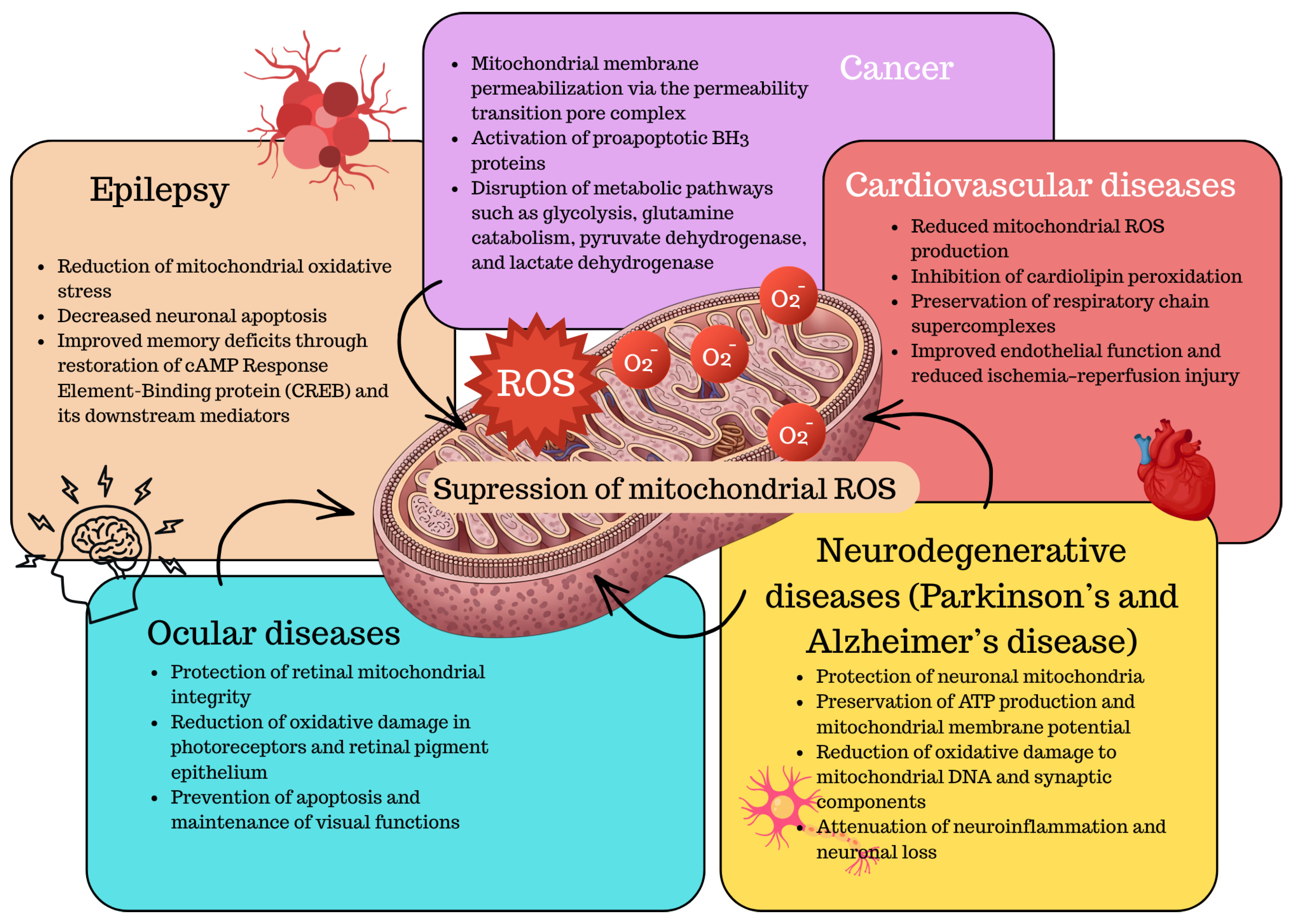
According to a study by Titova et al., SkQ1, a conjugate of decyl-triphenylphosphonium cation and plastoquinone, inhibited the growth of fibrosarcoma HT1080 and rhabdomyosarcoma RD cells in vitro and reduced RD tumor growth in xenograft mice without affecting primary human fibroblasts. Its anticancer effects at low nanomolar concentrations were mediated by prolonged mitosis, apoptosis, and cell cycle disruption, partly via inactivation of Aurora kinases [122]. Dietary supplementation with SkQ1 (5 nmol/kg per day) suppressed spontaneous tumor development in p53-/- mice, inhibited proliferation of HCT116/p53-/- and SiHa cells, and increased survival of tumor-bearing animals. However, MTA effects can vary depending on tumor type and metabolic state, with some studies reporting tumor-promoting outcomes, emphasizing the need for careful evaluation [123]. A summary of the mechanisms and therapeutic effects of MTA across cancer and other described diseases is presented in Figure 2.
Figure 2.
Therapeutic Benefits of MTA Across Multiple Medical Contexts [10,83,88,95,109,117]. ATP—Adenosine Triphosphate; DNA—Deoxyribonucleic Acid; ROS—Reactive Oxygen Species.
7. Conclusions
MTAs represent a rationally designed strategy to address oxidative stress through selective delivery of redox-active compounds to mitochondria, the primary intracellular source of reactive oxygen species. This review highlights that the biological activity of MTAs is governed by the interplay between the cationic carrier, antioxidant payload, and linker architecture, which together determine mitochondrial accumulation, membrane localization, and redox behavior. Preclinical and computational studies support the therapeutic potential of MTAs in experimental models of neurodegenerative, cardiovascular, and ocular diseases; however, available clinical evidence remains limited and heterogeneous. Further progress will depend on improved structure–activity understanding, careful dose optimization, and well-designed clinical studies to define therapeutic windows, safety profiles, and disease-specific applicability.
Author Contributions
Conceptualization, K.B., J.C., K.H., K.K., N.K. (Natalia Krupińska), N.K. (Natalia Kustosik), K.L., W.L. and A.W.; Writing—original draft preparation, K.B., J.C., K.H., K.K., N.K. (Natalia Krupińska), N.K. (Natalia Kustosik), K.L., W.L. and A.W.; Writing—review and editing, K.B., J.C., K.H., K.K., N.K. (Natalia Krupińska), N.K. (Natalia Kustosik), K.L., W.L. and A.W.; Visualization, K.B., J.C., K.H., K.K., N.K. (Natalia Krupińska), N.K. (Natalia Kustosik), K.L., W.L. and A.W.; Supervision, E.M., J.R. and B.F.; Project administration, E.M., J.R. and B.F.; Funding acquisition, E.M., J.R. and B.F. All authors have read and agreed to the published version of the manuscript.
Funding
This research received no external funding.
Institutional Review Board Statement
Not applicable.
Informed Consent Statement
Not applicable.
Data Availability Statement
No new data were created or analyzed in this study. Data sharing is not applicable to this article.
Conflicts of Interest
The authors declare no conflicts of interest.
Abbreviations
The following abbreviations are used in this manuscript:
| Arc | Activity-regulated Cytoskeleton-associated Protein |
| ATP | Adenosine Triphosphate |
| BDE | Bond Dissociation Enthalpies |
| CaMKIV | Calcium/Calmodulin-dependent protein kinase IV |
| cGAS-STING | Cyclic GMP-AMP synthase—Stimulator of Interferon Genes |
| CoQ | Coenzyme Q/Ubiquinone |
| CoQH2 | Ubiquinol |
| COX | Cyclooxygenases |
| CREB | cAMP Response Element-Binding protein |
| CVDs | Cardiovascular Diseases |
| DAMPs | Damage-Associated Molecular Patterns |
| DED | Dry Eye Disease |
| DFT | Density Functional Theory |
| DM-MitoQ | Dimethyl-Mitoquinone |
| EA | Electron Affinities |
| ETC | Electron Transport Chain |
| FCCP | Carbonyl Cyanide p-Trifluoromethoxyphenylhydrazon |
| FDA | Food and Drug Administration |
| HAT | Hydrogen Atom Transfer |
| HOMO | Highest Occupied Molecular Orbital |
| H2O2 | Hydrogen Peroxide |
| IL-6 | Interleukin-6 |
| IMM | Inner Mitochondrial Membrane |
| IP | Ionization potentials |
| logPm | Logarithm of the membrane permeation coefficient |
| LO2• | Lipid Peroxyl Radical |
| LOX | Lipoxygenases |
| LUMO | Lowest Unoccupied Molecular Orbital |
| MAPK/ERK | Mitogen-Activated Protein Kinase/Extracellular Signal-Regulated Kinase |
| MD | Molecular Dynamics |
| Mfn2 | Mitofusin 2 |
| MitoDAMPs | Mitochondrial Damage-Associated Molecular Patterns |
| MitoQ | Mitochondria-Targeted Ubiquinone, Mitoquinone |
| MitoTEMPO | Mitochondria-Targeted Tempo |
| MitoVitE | Mitochondria-Targeted Vitamin E |
| ML | Machine Learning |
| mPTP | Mitochondrial Permeability Transition Pore |
| MTA | Mitochondria-Targeted Antioxidants |
| Mt DNA | Mitochondrial DNA |
| mtROS | Mitochondrial Reactive Oxygen Species |
| NADPH | Nicotinamide Adenine Dinucleotide Phosphate |
| NF-κB | Nuclear Factor Kappa-Light-Chain-Enhancer of Activated B Cells |
| NLRP3 | NOD-like receptor family pyrin domain containing 3 |
| NMR | Nuclear Magnetic Resonance |
| •OH | Hydroxyl radicals |
| 1O2 | Singlet oxygen |
| O2•− | Superoxide |
| ONOO− | Peroxynitrite |
| PCET | Proton-Coupled Electron Transfer |
| PEG | Polyethylene Glycol |
| PGC-1λ | Peroxisome proliferator-activated receptor gamma coactivator |
| PGE2 | Prostaglandin E |
| PKA | Protein kinase A |
| POLG | Polymerase gamma |
| POPC | 1-palmitoyl-2-oleoyl-sn-glycero-3-phosphocholine |
| POPE | 1-palmitoyl-2-oleoyl-sn-glycero-3-phosphoethanolamine |
| PQ | Plastoquinone |
| QM | Quantum Mechanics |
| RAF | Radical Adduct Formation |
| RDF | Radial Distribution Function |
| RNS | Reactive Nitrogen Species |
| ROS | Reactive Oxygen Species |
| SAR | Structure–Activity Relationship |
| SET | Single Electron Transfer |
| SkQs | Skulachev ion derivatives |
| SkQ1 | Plastoquinonyl-Decyl-Triphenylphosphonium |
| TLR | Toll-like Receptor |
| TNF-α | Tumor necrosis factor α |
| TPP+ | Triphenylphosphonium |
| 6-OHDA | 6-hydroxydopamine |
| Δp | Protonmotive force |
| Δψm | Mitochondrial Membrane Potential |
References
- Pizzino, G.; Irrera, N.; Cucinotta, M.; Pallio, G.; Mannino, F.; Arcoraci, V.; Squadrito, F.; Altavilla, D.; Bitto, A. Oxidative Stress: Harms and Benefits for Human Health. Oxid. Med. Cell. Longev. 2017, 2017, 8416763. [Google Scholar] [CrossRef]
- Yang, J.; Luo, J.; Tian, X.; Zhao, Y.; Li, Y.; Wu, X. Progress in Understanding Oxidative Stress, Aging, and Aging-Related Diseases. Antioxidants 2024, 13, 394. [Google Scholar] [CrossRef]
- Barnham, K.J.; Masters, C.L.; Bush, A.I. Neurodegenerative diseases and oxidative stress. Nat. Rev. Drug Discov. 2004, 3, 205–214. [Google Scholar] [CrossRef] [PubMed]
- Banerjee, P.; Saha, I.; Sarkar, D.; Maiti, A.K. Contributions and Limitations of Mitochondria-Targeted and Non-Targeted Antioxidants in the Treatment of Parkinsonism: An Updated Review. Neurotox. Res. 2022, 40, 847–873. [Google Scholar] [CrossRef] [PubMed]
- Xu, X.; Pang, Y.; Fan, X. Mitochondria in oxidative stress, inflammation and aging: From mechanisms to therapeutic advances. Signal Transduct. Target. Ther. 2025, 10, 190. [Google Scholar] [CrossRef] [PubMed]
- Abdelazim, A.M.; Abomughaid, M.M. Oxidative stress: An overview of past research and future insights. All Life 2024, 17, 2316092. [Google Scholar] [CrossRef]
- Murphy, M.P. How mitochondria produce reactive oxygen species. Biochem. J. 2009, 417, 1–13. [Google Scholar] [CrossRef] [PubMed] [PubMed Central]
- Weinberg, S.E.; Chandel, N.S. Mitochondria reactive oxygen species signaling in immune responses. Immunity 2025, 58, 1904–1921. [Google Scholar] [CrossRef]
- Palma, F.R.; Gantner, B.N.; Sakiyama, M.J.; Kayzuka, C.; Shukla, S.; Lacchini, R.; Cunniff, B.; Bonini, M.G. ROS production by mitochondria: Function or dysfunction? Oncogene 2023, 43, 295–303. [Google Scholar] [CrossRef]
- Fields, M.; Marcuzzi, A.; Gonelli, A.; Celeghini, C.; Maximova, N.; Rimondi, E. Mitochondria-Targeted Antioxidants, an Innovative Class of Antioxidant Compounds for Neurodegenerative Diseases: Perspectives and Limitations. Int. J. Mol. Sci. 2023, 24, 3739. [Google Scholar] [CrossRef]
- Rondeau, J.D.; Lipari, S.; Mathieu, B.; Beckers, C.; Van de Velde, J.A.; Mignion, L.; Morais, M.D.S.; Kreuzer, M.; Colauzzi, I.; Capeloa, T.; et al. Mitochondria-targeted antioxidant MitoQ radiosensitizes tumors by decreasing mitochondrial oxygen consumption. Cell Death Discov. 2024, 10, 514. [Google Scholar] [CrossRef]
- Murphy, M.P.; Smith, R.A. Targeting antioxidants to mitochondria by conjugation to lipophilic cations. Annu. Rev. Pharmacol. Toxicol. 2007, 47, 629–656. [Google Scholar] [CrossRef]
- Ong, H.C.; Coimbra, J.T.S.; Ramos, M.J.; Xing, B.; Fernandes, P.A.; García, F. Beyond the TPP+ “gold standard”: A new generation mitochondrial delivery vector based on extended PN frameworks. Chem. Sci. 2023, 14, 4126–4133. [Google Scholar] [CrossRef] [PubMed] [PubMed Central]
- Ross, M.F.; Kelso, G.F.; Blaikie, F.H.; James, A.M.; Cochemé, H.M.; Filipovska, A.; Da Ros, T.; Hurd, T.R.; Smith, R.A.J.; Murphy, M.P. Lipophilic triphenylphosphonium cations as tools in mitochondrial bioenergetics and free radical biology. Biochemistry 2005, 70, 222–230. [Google Scholar] [CrossRef]
- Murphy, M.P. Targeting lipophilic cations to mitochondria. Biochim. Biophys. Acta—Bioenerg. 2008, 1777, 1028–1031. [Google Scholar] [CrossRef]
- Zielonka, J.; Joseph, J.; Sikora, A.; Hardy, M.; Ouari, O.; Vasquez-Vivar, J.; Cheng, G.; Lopez, M.; Kalyanaraman, B. Mitochondria-Targeted Triphenylphosphonium-Based Compounds: Syntheses, Mechanisms of Action, and Therapeutic and Diagnostic Applications. Chem. Rev. 2017, 117, 10043–10120. [Google Scholar] [CrossRef] [PubMed] [PubMed Central]
- Cheng, X.; Feng, D.; Lv, J.; Cui, X.; Wang, Y.; Wang, Q.; Zhang, L. Application Prospects of Triphenylphosphine-Based Mitochondria-Targeted Cancer Therapy. Cancers 2023, 15, 666. [Google Scholar] [CrossRef] [PubMed]
- Ishkaeva, R.A.; Salakhieva, D.V.; Garifullin, R.; Alshadidi, R.; Laikov, A.V.; Yergeshov, A.A.; Kamalov, M.I.; Abdullin, T.I. A new triphenylphosphonium-conjugated amphipathic cationic peptide with improved cell-penetrating and ROS-targeting properties. Curr. Res. Pharmacol. Drug Discov. 2022, 4, 100148. [Google Scholar] [CrossRef] [PubMed] [PubMed Central]
- Platzer, M.; Kiese, S.; Tybussek, T.; Herfellner, T.; Schneider, F.; Schweiggert-Weisz, U.; Eisner, P. Radical Scavenging Mechanisms of Phenolic Compounds: A Quantitative Structure-Property Relationship (QSPR) Study. Front. Nutr. 2022, 9, 35445057. [Google Scholar] [CrossRef] [PubMed] [PubMed Central]
- Alov, P.; Tsakovska, I.; Pajeva, I. Computational Studies of Free Radical-Scavenging Properties of Phenolic Compounds. Curr. Top. Med. Chem. 2015, 15, 85–104. [Google Scholar] [CrossRef] [PubMed] [PubMed Central]
- Tyburski, R.; Liu, T.; Glover, S.D.; Hammarström, L. Proton-Coupled Electron Transfer Guidelines, Fair and Square. J. Am. Chem. Soc. 2021, 143, 560–576. [Google Scholar] [CrossRef] [PubMed]
- Charlton, N.C.; Mastyugin, M.; Török, B.; Török, M. Structural Features of Small Molecule Antioxidants and Strategic Modifications to Improve Potential Bioactivity. Molecules 2023, 28, 1057. [Google Scholar] [CrossRef] [PubMed] [PubMed Central]
- Cores, Á.; Carmona-Zafra, N.; Clerigué, J.; Villacampa, M.; Menéndez, J.C. Quinones as Neuroprotective Agents. Antioxidants 2023, 12, 1464. [Google Scholar] [CrossRef]
- Uno, S.; Harkiss, A.H.; Chowdhury, R.; Caldwell, S.T.; Prime, T.A.; James, A.M.; Gallagher, B.; Prudent, J.; Hartley, R.C.; Murphy, M.P. Incorporating a Polyethyleneglycol Linker to Enhance the Hydrophilicity of Mitochondria-Targeted Triphenylphosphonium Constructs. ChemBioChem 2023, 24, e202200774. [Google Scholar] [CrossRef] [PubMed] [PubMed Central]
- Montecino-Garrido, H.; Sepúlveda, M.; Méndez, D.; Monroy-Cárdenas, M.; Alfaro, S.; González-Avendaño, M.; Caballero, J.; Urra, F.A.; Araya-Maturana, R.; Fuentes, E. Assessing mitochondria-targeted acyl hydroquinones on the mitochondrial platelet function and cytotoxic activity: Role of the linker length. Free Radic. Biol. Med. 2023, 208, 26–36. [Google Scholar] [CrossRef] [PubMed]
- Prag, H.A.; Kula-Alwar, D.; Pala, L.; Caldwell, S.T.; Beach, T.E.; James, A.M.; Saeb-Parsy, K.; Krieg, T.; Hartley, R.C.; Murphy, M.P. Selective Delivery of Dicarboxylates to Mitochondria by Conjugation to a Lipophilic Cation via a Cleavable Linker. Mol. Pharm. 2020, 17, 3526–3540. [Google Scholar] [CrossRef] [PubMed] [PubMed Central]
- Nahar, N.; Sohag, S.U. Advancements in mitochondrial-targeted antioxidants: Organelle-specific drug delivery for disease management. Adv. Redox Res. 2025, 17, 100142. [Google Scholar] [CrossRef]
- Smith, R.A.; Murphy, M.P. Mitochondria-targeted antioxidants as therapies. Discov. Med. 2011, 11, 106–114. [Google Scholar] [PubMed]
- Skulachev, V.P.; Anisimov, V.N.; Antonenko, Y.N.; Bakeeva, L.E.; Chernyak, B.V.; Erichev, V.P.; Filenko, O.F.; Kalinina, N.I.; Kapelko, V.I.; Kolosova, N.G.; et al. An attempt to prevent senescence: A mitochondrial approach. Biochim. Biophys. Acta 2009, 178, 437–461. [Google Scholar] [CrossRef] [PubMed]
- Roginsky, V.A.; Tashlitsky, V.N.; Skulachev, V.P. Chain-breaking antioxidant activity of reduced forms ofmitochondria-targeted quinones, a novel type of geroprotectors. Aging 2009, 1, 481–489. [Google Scholar] [CrossRef] [PubMed] [PubMed Central]
- Tauskela, J.S. MitoQ—A mitochondria-targeted antioxidant. IDrugs 2007, 10, 399–412. [Google Scholar] [PubMed]
- Cheng, G.; Karoui, H.; Hardy, M.; Kalyanaraman, B. Redox-crippled MitoQ potently inhibits breast cancer and glioma cell proliferation: A negative control for verifying the antioxidant mechanism of MitoQ in cancer and other oxidative pathologies. Free Radic. Biol. Med. 2023, 205, 175–187. [Google Scholar] [CrossRef] [PubMed] [PubMed Central]
- James, A.M.; Sharpley, M.S.; Manas, A.-R.B.; Frerman, F.E.; Hirst, J.; Smith, R.A.J.; Murphy, M.P. Interaction of the Mitochondria-targeted Antioxidant MitoQ with Phospholipid Bilayers and Ubiquinone Oxidoreductases. J. Biol. Chem. 2007, 282, 14708–14718. [Google Scholar] [CrossRef] [PubMed]
- Fedor, J.G.; Jones, A.J.Y.; Di Luca, A.; Kaila, V.R.I.; Hirst, J. Correlating kinetic and structural data on ubiquinone binding and reduction by respiratory complex I. Proc. Natl. Acad. Sci. USA 2017, 114, 12737–12742. [Google Scholar] [CrossRef] [PubMed] [PubMed Central]
- Kulkarni, C.A.; Fink, B.D.; Gibbs, B.E.; Chheda, P.R.; Wu, M.; Sivitz, W.I.; Kerns, R.J. A Novel Triphenylphosphonium Carrier to Target Mitochondria without Uncoupling Oxidative Phosphorylation. J. Med. Chem. 2021, 64, 662–676. [Google Scholar] [CrossRef] [PubMed] [PubMed Central]
- Botting, K.J.; Skeffington, K.L.; Allison, B.J.; Brain, K.L.; Itani, N.; Beck, C.; Logan, A.; Murray, A.J.; Murphy, M.P.; Giussani, D.A. Translatable mitochondria-targeted protection against programmed cardiovascular dysfunction. Sci. Adv. 2020, 6, eabb1929. [Google Scholar] [CrossRef]
- Doughan, A.K.; Dikalov, S.I. Mitochondrial redox cycling of mitoquinone leads to superoxide production and cellular apoptosis. Antioxid. Redox Signal. 2007, 9, 1825–1836. [Google Scholar] [CrossRef] [PubMed]
- Paradies, G.; Paradies, V.; Ruggiero, F.M.; Petrosillo, G. Role of Cardiolipin in Mitochondrial Function and Dynamics in Health and Disease: Molecular and Pharmacological Aspects. Cells 2019, 8, 728. [Google Scholar] [CrossRef] [PubMed] [PubMed Central]
- Williamson, J.; Hughes, C.M.; Cobley, J.N.; Davison, G.W. The mitochondria-targeted antioxidant MitoQ, attenuates exercise-induced mitochondrial DNA damage. Redox Biol. 2020, 36, 101673. [Google Scholar] [CrossRef] [PubMed] [PubMed Central]
- Liu, S.; Liu, J.; Wang, Y.; Deng, F.; Deng, Z. Oxidative Stress: Signaling Pathways, Biological Functions, and Disease. Medcomm 2025, 6, e70268. [Google Scholar] [CrossRef]
- Pang, M.; Wang, S.; Shi, T.; Chen, J. Overview of MitoQ on prevention and management of cardiometabolic diseases: A scoping review. Front. Cardiovasc. Med. 2025, 12, 1506460. [Google Scholar] [CrossRef] [PubMed] [PubMed Central]
- Méndez, D.; Arauna, D.; Fuentes, F.; Araya-Maturana, R.; Palomo, I.; Alarcón, M.; Sebastián, D.; Zorzano, A.; Fuentes, E. Mitoquinone (MitoQ) Inhibits Platelet Activation Steps by Reducing ROS Levels. Int. J. Mol. Sci. 2020, 21, 6192. [Google Scholar] [CrossRef]
- Gottwald, E.M.; Duss, M.; Bugarski, M.; Haenni, D.; Schuh, C.D.; Landau, E.M.; Hall, A.M. The targeted anti-oxidant MitoQ causes mitochondrial swelling and depolarization in kidney tissue. Physiol. Rep. 2018, 6, e13667. [Google Scholar] [CrossRef]
- Yoon, N.G.; Lee, H.; Kim, S.-Y.; Hu, S.; Kim, D.; Yang, S.; Hong, K.B.; Lee, J.H.; Kang, S.; Kim, B.-G.; et al. Mitoquinone Inactivates Mitochondrial Chaperone TRAP1 by Blocking the Client Binding Site. J. Am. Chem. Soc. 2021, 143, 19684–19696. [Google Scholar] [CrossRef] [PubMed]
- Solesio, M.E.; Prime, T.A.; Logan, A.; Murphy, M.P.; Arroyo-Jimenez, M.d.M.; Jordán, J.; Galindo, M.F. The mitochondria-targeted anti-oxidant MitoQ reduces aspects of mitochondrial fission in the 6-OHDA cell model of Parkinson’s disease. Biochim. Biophys. Acta—Mol. Basis Dis. 2013, 1832, 174–182. [Google Scholar] [CrossRef] [PubMed]
- Gane, E.J.; Weilert, F.; Orr, D.W.; Keogh, G.F.; Gibson, M.; Lockhart, M.M.; Frampton, C.M.; Taylor, K.M.; Smith, R.A.; Murphy, M.P. The mitochondria-targeted anti-oxidant mitoquinone decreases liver damage in a phase ii study of hepatitis c patients. Liver Int. 2010, 30, 1019–1026. [Google Scholar] [CrossRef] [PubMed]
- Antonenko, Y.N.; Avetisyan, A.V.; Bakeeva, L.E.; Chernyak, B.V.; Chertkov, V.A.; Domnina, L.V.; Ivanova, O.Y.; Izyumov, D.S.; Khailova, L.S.; Klishin, S.S.; et al. Mitochondria-targeted plastoquinone derivatives as tools to interrupt execution of the aging program. Cationic plastoquinone derivatives: Synthesis and in vitro studies. Biochemistry 2008, 73, 1273–1287. [Google Scholar] [CrossRef] [PubMed]
- Kelso, G.F.; Porteous, C.M.; Coulter, C.V.; Hughes, G.; Porteous, W.K.; Ledgerwood, E.C.; Smith, R.A.J.; Murphy, M.P. Selective Targeting of a Redox-active Ubiquinone to Mitochondria within Cells: Antioxidant and antiapoptotic properties. J. Biol. Chem. 2001, 276, 4588–4596. [Google Scholar] [CrossRef] [PubMed]
- Asin-Cayuela, J.; Manas, A.-R.B.; James, A.M.; Smith, R.A.; Murphy, M.P. Fine-tuning the hydrophobicity of a mitochondria-targeted antioxidant. FEBS Lett. 2004, 571, 9–16. [Google Scholar] [CrossRef] [PubMed]
- Skulachev, V.P.; Antonenko, Y.N.; Cherepanov, D.A.; Chernyak, B.V.; Izyumov, D.S.; Khailova, L.S.; Klishin, S.S.; Korshunova, G.A.; Lyamzaev, K.G.; Pletjushkina, O.Y.; et al. Prevention of cardiolipin oxidation and fatty acid cycling as two antioxidant mechanisms of cationic derivatives of plastoquinone (SkQs). Biochim. Biophys. Acta—Bioenerg. 2010, 1797, 878–889. [Google Scholar] [CrossRef] [PubMed]
- Severin, F.F.; Severina, I.I.; Antonenko, Y.N.; Rokitskaya, T.I.; Cherepanov, D.A.; Mokhova, E.N.; Vyssokikh, M.Y.; Pustovidko, A.V.; Markova, O.V.; Yaguzhinsky, L.S.; et al. Penetrating cation/fatty acid anion pair as a mitochondria-targeted protonophore. Proc. Natl. Acad. Sci. USA 2009, 107, 663–668. [Google Scholar] [CrossRef] [PubMed] [PubMed Central]
- Izyumov, D.S.; Domnina, L.V.; Nepryakhina, O.K.; Avetisyan, A.V.; Golyshev, S.A.; Ivanova, O.Y.; Korotetskaya, M.V.; Lyamzaev, K.G.; Pletjushkina, O.Y.; Popova, E.N.; et al. Mitochondria as source of reactive oxygen species under oxidative stress. Study with novel mitochondria-targeted antioxidants—The “Skulachev-ion” derivatives. Biochemistry 2010, 75, 123–129. [Google Scholar] [CrossRef]
- Antonenko, Y.N.; Avetisyan, A.V.; Cherepanov, D.A.; Knorre, D.A.; Korshunova, G.A.; Markova, O.V.; Ojovan, S.M.; Perevoshchikova, I.V.; Pustovidko, A.V.; Rokitskaya, T.I.; et al. Derivatives of Rhodamine 19 as Mild Mitochondria-targeted Cationic Uncouplers. J. Biol. Chem. 2011, 286, 17831–17840. [Google Scholar] [CrossRef] [PubMed] [PubMed Central]
- Rogov, A.G.; Goleva, T.N.; Aliverdieva, D.A.; Zvyagilskaya, R.A. SkQ3 Exhibits the Most Pronounced Antioxidant Effect on Isolated Rat Liver Mitochondria and Yeast Cells. Int. J. Mol. Sci. 2024, 25, 1107. [Google Scholar] [CrossRef] [PubMed] [PubMed Central]
- Lyamzaev, K.G.; Pustovidko, A.V.; Simonyan, R.A.; Rokitskaya, T.I.; Domnina, L.V.; Ivanova, O.Y.; Severina, I.I.; Sumbatyan, N.V.; Korshunova, G.A.; Tashlitsky, V.N.; et al. Novel mitochondria-targeted antioxidants: Plastoquinone conjugated with cationic plant alkaloids berberine and palmatine. Pharm. Res. 2011, 28, 2883–2895. [Google Scholar] [CrossRef] [PubMed]
- Vyssokikh, M.Y.; Chernyak, B.V.; Domnina, L.V.; Esipov, D.S.; Ivanova, O.Y.; Korshunova, G.A.; Symonyan, R.A.; Skulachev, M.V.; Zinevich, T.V.; Skulachev, V.P. SkBQ—Prooxidant addressed to mitochondria. Biochemistry 2013, 78, 1366–1370. [Google Scholar] [CrossRef] [PubMed]
- Chernyak, B.V.; Antonenko, Y.N.; Domnina, L.V.; Ivanova, O.Y.; Lyamzaev, K.G.; Pustovidko, A.V.; Rokitskaya, T.I.; Severina, I.I.; Simonyan, R.A.; Trendeleva, T.A.; et al. Novel Penetrating Cations for Targeting Mitochondria. Curr. Pharm. Des. 2013, 19, 2795–2806. [Google Scholar] [CrossRef] [PubMed]
- Parise, A.; De Simone, B.C.; Marino, T.; Toscano, M.; Russo, N. Quantum Mechanical Predictions of the Antioxidant Capability of Moracin C Isomers. Front. Chem. 2021, 9, 666647. [Google Scholar] [CrossRef] [PubMed]
- Wang, Y.; Li, C.; Li, Z.; Moalin, M.; Hartog, G.J.M.D.; Zhang, M. Computational Chemistry Strategies to Investigate the Antioxidant Activity of Flavonoids—An Overview. Molecules 2024, 29, 2627. [Google Scholar] [CrossRef]
- Fujishima, M.A.T.; Silva, N.D.S.R.d.; Ramos, R.D.S.; Ferreira, E.F.B.; dos Santos, K.L.B.; Silva, C.H.T.d.P.d.; da Silva, J.O.; Rosa, J.M.C.; dos Santos, C.B.R. An Antioxidant Potential, Quantum-Chemical and Molecular Docking Study of the Major Chemical Constituents Present in the Leaves of Curatella americana Linn. Pharmaceuticals 2018, 11, 72. [Google Scholar] [CrossRef] [PubMed] [PubMed Central]
- Fock, E.M.; Parnova, R.G. Protective Effect of Mitochondria-Targeted Antioxidants against Inflammatory Response to Lipopolysaccharide Challenge: A Review. Pharmaceutics 2021, 13, 144. [Google Scholar] [CrossRef]
- Broome, S.C.; Woodhead, J.S.T.; Merry, T.L. Mitochondria-Targeted Antioxidants and Skeletal Muscle Function. Antioxidants 2018, 7, 107. [Google Scholar] [CrossRef] [PubMed] [PubMed Central]
- Rudrapal, M.; Rakshit, G.; Singh, R.P.; Garse, S.; Khan, J.; Chakraborty, S. Dietary Polyphenols: Review on Chemistry/Sources, Bioavailability/Metabolism, Antioxidant Effects, and Their Role in Disease Management. Antioxidants 2024, 13, 429. [Google Scholar] [CrossRef] [PubMed] [PubMed Central]
- Villalaín, J. Location and interaction of idebenone and mitoquinone in a membrane similar to the inner mitochondrial membrane. Comparison with ubiquinone. Free Radic. Biol. Med. 2024, 222, 211–222. [Google Scholar] [CrossRef] [PubMed]
- Ljubič, M.; Perdih, A.; Borišek, J. All-Atom Simulations Reveal the Effect of Membrane Composition on the Signaling of the NKG2A/CD94/HLA-E Immune Receptor Complex. J. Chem. Inf. Model. 2024, 64, 9374–9387. [Google Scholar] [CrossRef] [PubMed]
- Vähäheikkilä, M.; Peltomaa, T.; Róg, T.; Vazdar, M.; Pöyry, S.; Vattulainen, I. How cardiolipin peroxidation alters the properties of the inner mitochondrial membrane? Chem. Phys. Lipids 2018, 214, 15–23. [Google Scholar] [CrossRef]
- Cui, Y.; Zhao, T.; Wang, H.; Wang, X.; Wang, D.; Zhang, Y. Molecular dynamics simulation of the transmembrane transport process of reactive species under the synergistic effect of plasma oxidation and an electric field. Free Radic. Biol. Med. 2023, 208, 372–383. [Google Scholar] [CrossRef] [PubMed]
- Sheu, S.-S.; Nauduri, D.; Anders, M.W. Targeting antioxidants to mitochondria: A new therapeutic direction. Biochim. Biophys. Acta—Mol. Basis Dis. 2006, 1762, 256–265. [Google Scholar] [CrossRef]
- Apostolova, N.; Victor, V.M. Molecular Strategies for Targeting Antioxidants to Mitochondria: Therapeutic Implications. Antioxid. Redox Signal. 2015, 22, 686–729. [Google Scholar] [CrossRef] [PubMed]
- Tyagi, V.; Vasquez-Montes, V.; Freites, J.A.; Kyrychenko, A.; Tobias, D.J.; Ladokhin, A.S. Effects of Cardiolipin on the Conformational Dynamics of Membrane-Anchored Bcl-xL. Int. J. Mol. Sci. 2021, 22, 9388. [Google Scholar] [CrossRef] [PubMed]
- Shalaby, M.A.; Fahim, A.M.; Rizk, S.A. Antioxidant activity of novel nitrogen scaffold with docking investigation and correlation of DFT stimulation. RSC Adv. 2023, 13, 14580–14593. [Google Scholar] [CrossRef]
- Tzankova, D.; Kuteva, H.; Mateev, E.; Stefanova, D.; Dzhemadan, A.; Yordanov, Y.; Mateeva, A.; Tzankova, V.; Kondeva-Burdina, M.; Zlatkov, A.; et al. Synthesis, DFT Study, and In Vitro Evaluation of Antioxidant Properties and Cytotoxic and Cytoprotective Effects of New Hydrazones on SH-SY5Y Neuroblastoma Cell Lines. Pharmaceuticals 2023, 16, 1198. [Google Scholar] [CrossRef]
- Zheng, X.; Du, Y.; Chai, Y.; Zheng, Y. A DFT−Based Mechanism Analysis of the Cyclodextrin Inclusion on the Radical Scavenging Activity of Apigenin. Antioxidants 2023, 12, 2018. [Google Scholar] [CrossRef]
- Spiegel, M.; Gamian, A.; Sroka, Z. A Statistically Supported Antioxidant Activity DFT Benchmark—The Effects of Hartree–Fock Exchange and Basis Set Selection on Accuracy and Resources Uptake. Molecules 2021, 26, 5058. [Google Scholar] [CrossRef] [PubMed]
- Ogunyemi, B.T. Quantum chemical insights into the antioxidant mechanisms of luteolin and isorhamnetin: Elucidating structure-reactivity relationships, pharmacokinetics, and toxicity for therapeutic potential. Commun. Phys. Sci. 2025, 12, 1081–1093. [Google Scholar] [CrossRef]
- de Aguiar, A.S.N.; de Carvalho, L.B.R.; Gomes, C.M.; Castro, M.M.; Martins, F.S.; Borges, L.L. Computational Insights into the Antioxidant Activity of Luteolin: Density Functional Theory Analysis and Docking in Cytochrome P450 17A1. Pharmaceuticals 2025, 18, 410. [Google Scholar] [CrossRef]
- Mahmoudi, S.; Dehkordi, M.M.; Asgarshamsi, M.H. Density functional theory studies of the antioxidants—A review. J. Mol. Model. 2021, 27, 271. [Google Scholar] [CrossRef] [PubMed]
- Biriukov, D.; Vácha, R. Pathways to a Shiny Future: Building the Foundation for Computational Physical Chemistry and Biophysics in 2050. ACS Phys. Chem. Au 2024, 4, 302–313. [Google Scholar] [CrossRef] [PubMed] [PubMed Central]
- Brocke, S.A.; Degen, A.; MacKerell, A.D.; Dutagaci, B.; Feig, M. Prediction of Membrane Permeation of Drug Molecules by Combining an Implicit Membrane Model with Machine Learning. J. Chem. Inf. Model. 2019, 59, 1147–1162. [Google Scholar] [CrossRef] [PubMed Central]
- Kichev, I.; Borislavov, L.; Tadjer, A.; Stoyanova, R. Machine Learning Prediction of the Redox Activity of Quinones. Materials 2023, 16, 6687. [Google Scholar] [CrossRef] [PubMed] [PubMed Central]
- Zinovkin, R.A.; Zamyatnin, A.A. Mitochondria-Targeted Drugs. Curr. Mol. Pharmacol. 2019, 12, 202–214. [Google Scholar] [CrossRef] [PubMed] [PubMed Central]
- Yang, Y.; Karakhanova, S.; Hartwig, W.; D’HAese, J.G.; Philippov, P.P.; Werner, J.; Bazhin, A.V. Mitochondria and Mitochondrial ROS in Cancer: Novel Targets for Anticancer Therapy. J. Cell. Physiol. 2016, 231, 2570–2581. [Google Scholar] [CrossRef]
- Jiang, Q.; Yin, J.; Chen, J.; Ma, X.; Wu, M.; Liu, G.; Yao, K.; Tan, B.; Yin, Y. Mitochondria-Targeted Antioxidants: A Step towards Disease Treatment. Oxidative Med. Cell. Longev. 2020, 2020, 8837893. [Google Scholar] [CrossRef] [PubMed] [PubMed Central]
- Braakhuis, A.J.; Nagulan, R.; Somerville, V. The Effect of MitoQ on Aging-Related Biomarkers: A Systematic Review and Meta-Analysis. Oxidative Med. Cell. Longev. 2018, 2018, 8575263. [Google Scholar] [CrossRef] [PubMed] [PubMed Central]
- Piscianz, E.; Tesser, A.; Rimondi, E.; Melloni, E.; Celeghini, C.; Marcuzzi, A. MitoQ Is Able to Modulate Apoptosis and Inflammation. Int. J. Mol. Sci. 2021, 22, 4753. [Google Scholar] [CrossRef] [PubMed] [PubMed Central]
- Clinical Trials. Available online: https://clinicaltrials.gov/ct2/results?recrs=&cond=&term=mitoq&cntry=&state=&city=&dist= (accessed on 1 January 2026).
- Macdonald, R.; Barnes, K.; Hastings, C.; Mortiboys, H. Mitochondrial abnormalities in Parkinson’s disease and Alzheimer’s disease: Can mitochondria be targeted therapeutically? Biochem. Soc. Trans. 2018, 46, 891–909. [Google Scholar] [CrossRef] [PubMed]
- Borsche, M.; Pereira, S.L.; Klein, C.; Grünewald, A. Mitochondria and Parkinson’s Disease: Clinical, Molecular, and Translational Aspects. J. Park. Dis. 2021, 11, 45–60. [Google Scholar] [CrossRef] [PubMed] [PubMed Central]
- Bloem, B.R.; Okun, M.S.; Klein, C. Parkinson’s disease. Lancet 2021, 397, 2284–2303. [Google Scholar] [CrossRef] [PubMed]
- Zhou, M.; Zheng, M.; Liang, S.; Li, M.; Ma, J.; Zhang, S.; Song, X.; Hu, Y.; Lyu, Y.; Ou, X.; et al. Inherent potential of mitochondria-targeted interventions for chronic neurodegenerative diseases. Neural Regen. Res. 2025, 21, 1409–1427. [Google Scholar] [CrossRef] [PubMed] [PubMed Central]
- Xi, Y.; Feng, D.; Tao, K.; Wang, R.; Shi, Y.; Qin, H.; Murphy, M.P.; Yang, Q.; Zhao, G. MitoQ protects dopaminergic neurons in a 6-OHDA induced PD model by enhancing Mfn2-dependent mitochondrial fusion via activation of PGC-1α. Biochim. Biophys. Acta 2018, 1864, 2859–2870. [Google Scholar] [CrossRef] [PubMed]
- Choi, E.-H.; Kim, M.-H.; Park, S.-J. Targeting Mitochondrial Dysfunction and Reactive Oxygen Species for Neurodegenerative Disease Treatment. Int. J. Mol. Sci. 2024, 25, 7952. [Google Scholar] [CrossRef] [PubMed] [PubMed Central]
- Eratne, D.; Loi, S.M.; Farrand, S.; Kelso, W.; Velakoulis, D.; Looi, J.C. Alzheimer’s disease: Clinical update on epidemiology, pathophysiology and diagnosis. Australas. Psychiatry 2018, 26, 347–357. [Google Scholar] [CrossRef] [PubMed]
- Lanzillotta, C.; Di Domenico, F.; Perluigi, M.; Butterfield, D.A. Targeting Mitochondria in Alzheimer Disease: Rationale and Perspectives. CNS Drugs 2019, 33, 957–969. [Google Scholar] [CrossRef] [PubMed] [PubMed Central]
- Manczak, M.; Mao, P.; Calkins, M.J.; Cornea, A.; Reddy, A.P.; Murphy, M.P.; Szeto, H.H.; Park, B.; Reddy, P.H. Mitochondria-Targeted Antioxidants Protect Against Amyloid-β Toxicity in Alzheimer’s Disease Neurons. J. Alzheimer’s Dis. 2010, 20, S609–S631. [Google Scholar] [CrossRef] [PubMed] [PubMed Central]
- Loshchenova, P.S.; Sinitsyna, O.I.; Fedoseeva, L.A.; Stefanova, N.A.; Kolosova, N.G. Influence of Antioxidant SkQ1 on Accumulation of Mitochondrial DNA Deletions in the Hippocampus of Senescence-Accelerated OXYS Rats. Biochemistry 2015, 80, 596–603. [Google Scholar] [CrossRef]
- Stefanova, N.A.; Muraleva, N.A.; Maksimova, K.Y.; Rudnitskaya, E.A.; Kiseleva, E.; Telegina, D.V.; Kolosova, N.G. An antioxidant specifically targeting mitochondria delays progression of Alzheimer’s disease-like pathology. Aging 2016, 8, 2713–2733. [Google Scholar] [CrossRef] [PubMed] [PubMed Central]
- Grünewald, A.; Kumar, K.R.; Sue, C.M. New insights into the complex role of mitochondria in Parkinson’s disease. Prog. Neurobiol. 2019, 177, 73–93. [Google Scholar] [CrossRef] [PubMed]
- Mapuskar, K.A.; London, B.; Zacharias, Z.R.; Houtman, J.C.; Allen, B.G. Immunometabolism in the Aging Heart. J. Am. Heart Assoc. 2025, 14, e039216. [Google Scholar] [CrossRef] [PubMed] [PubMed Central]
- Ouyang, W.; Yan, D.; Hu, J.; Liu, Z. Multifaceted mitochondrial as a novel therapeutic target in dry eye: Insights and interventions. Cell Death Discov. 2024, 10, 398. [Google Scholar] [CrossRef] [PubMed] [PubMed Central]
- Zernii, E.Y.; Gancharova, O.S.; Baksheeva, V.E.; Golovastova, M.O.; Kabanova, E.I.; Savchenko, M.S.; Tiulina, V.V.; Sotnikova, L.F.; Zamyatnin, A.A., Jr.; Philippov, P.P.; et al. Mitochondria-Targeted Antioxidant SkQ1 Prevents Anesthesia-Induced Dry Eye Syndrome. Oxid. Med. Cell. Longev. 2017, 2017, 9281519. [Google Scholar] [CrossRef] [PubMed] [PubMed Central]
- Brzheskiy, V.V.; Efimova, E.L.; Vorontsova, T.N.; Alekseev, V.N.; Gusarevich, O.G.; Shaidurova, K.N.; Ryabtseva, A.A.; Andryukhina, O.M.; Kamenskikh, T.G.; Sumarokova, E.S.; et al. Results of a Multicenter, Randomized, Double-Masked, Placebo-Controlled Clinical Study of the Efficacy and Safety of Visomitin Eye Drops in Patients with Dry Eye Syndrome. Adv. Ther. 2015, 32, 1263–1279. [Google Scholar] [CrossRef] [PubMed] [PubMed Central]
- Huang, B.; Zhang, N.; Qiu, X.; Zeng, R.; Wang, S.; Hua, M.; Li, Q.; Nan, K.; Lin, S. Mitochondria-targeted SkQ1 nanoparticles for dry eye disease: Inhibiting NLRP3 inflammasome activation by preventing mitochondrial DNA oxidation. J. Control. Release 2024, 365, 1–15. [Google Scholar] [CrossRef] [PubMed]
- Bu, J.; Liu, Y.; Zhang, R.; Lin, S.; Zhuang, J.; Sun, L.; Zhang, L.; He, H.; Zong, R.; Wu, Y.; et al. Potential New Target for Dry Eye Disease—Oxidative Stress. Antioxidants 2024, 13, 422. [Google Scholar] [CrossRef] [PubMed] [PubMed Central]
- Chistyakov, D.V.; Tiulina, V.V.; Gancharova, O.S.; Baksheeva, V.E.; Goriainov, S.V.; Shebardina, N.G.; Ivlev, V.A.; Komarov, S.V.; Shevelyova, M.P.; Tikhomirova, N.K.; et al. Targeting Oxidative Stress and Inflammation in the Eye: Insights from a New Model of Experimental Autoimmune Uveitis. Int. J. Mol. Sci. 2024, 25, 12910. [Google Scholar] [CrossRef] [PubMed] [PubMed Central]
- Neroev, V.V.; Archipova, M.M.; Bakeeva, L.E.; Fursova, A.Z.; Grigorian, E.N.; Grishanova, A.Y.; Iomdina, E.N.; Ivashchenko, Z.N.; Katargina, L.A.; Khoroshilova-Maslova, I.P.; et al. Mitochondria-targeted plastoquinone derivatives as tools to interrupt execution of the aging program. Age-related eye disease. SkQ1 returns vision to blind animals. Biochemistry 2008, 73, 1317–1328. [Google Scholar] [CrossRef] [PubMed]
- Peoples, J.N.; Saraf, A.; Ghazal, N.; Pham, T.T.; Kwong, J.Q. Mitochondrial dysfunction and oxidative stress in heart disease. Exp. Mol. Med. 2019, 51, 1–13. [Google Scholar] [CrossRef] [PubMed] [PubMed Central]
- Qiu, Y.; Chang, S.; Zeng, Y.; Wang, X. Advances in Mitochondrial Dysfunction and Its Role in Cardiovascular Diseases. Cells 2025, 14, 1621. [Google Scholar] [CrossRef] [PubMed] [PubMed Central]
- Yang, J.; Guo, Q.; Feng, X.; Liu, Y.; Zhou, Y. Mitochondrial Dysfunction in Cardiovascular Diseases: Potential Targets for Treatment. Front. Cell Dev. Biol. 2022, 10, 841523. [Google Scholar] [CrossRef] [PubMed] [PubMed Central]
- Kim, H.K.; Han, J. Mitochondria-Targeted Antioxidants for the Treatment of Cardiovascular Disorders. Mitochondrial Dyn. Cardiovasc. Med. 2017, 982, 621–646. [Google Scholar] [CrossRef] [PubMed]
- Graham, D.; Huynh, N.N.; Hamilton, C.A.; Beattie, E.; Smith, R.A.; Cochemé, H.M.; Murphy, M.P.; Dominiczak, A.F. Mitochondria-Targeted Antioxidant MitoQ10 Improves Endothelial Function and Attenuates Cardiac Hypertrophy. Hypertension 2009, 54, 322–328. [Google Scholar] [CrossRef] [PubMed]
- Potnuri, A.G.; Purushothaman, S.; Saheera, S.; Nair, R.R. Mito-targeted antioxidant prevents cardiovascular remodelling in spontaneously hypertensive rat by modulation of energy metabolism. Clin. Exp. Pharmacol. Physiol. 2021, 49, 35–45. [Google Scholar] [CrossRef] [PubMed]
- Olgar, Y.; Billur, D.; Tuncay, E.; Turan, B. MitoTEMPO provides an antiarrhythmic effect in aged-rats through attenuation of mitochondrial reactive oxygen species. Exp. Gerontol. 2020, 136, 110961. [Google Scholar] [CrossRef] [PubMed]
- Olgar, Y.; Degirmenci, S.; Durak, A.; Billur, D.; Can, B.; Kayki-Mutlu, G.; Arioglu-Inan E, E.; Turan, B. Aging related functional and structural changes in the heart and aorta: MitoTEMPO improves aged-cardiovascular performance. Exp. Gerontol. 2018, 110, 172–181. [Google Scholar] [CrossRef] [PubMed]
- Bou-Teen, D.; Kaludercic, N.; Weissman, D.; Turan, B.; Maack, C.; Di Lisa, F.; Ruiz-Meana, M. Mitochondrial ROS and mitochondria-targeted antioxidants in the aged heart. Free Radic. Biol. Med. 2021, 167, 109–124. [Google Scholar] [CrossRef] [PubMed]
- Ji, D.; Mylvaganam, S.; Chander, P.R.; Tarnopolsky, M.; Murphy, K.; Carlen, P. Mitochondria and oxidative stress in epilepsy: Advances in antioxidant therapy. Front. Pharmacol. 2025, 15, 1505867. [Google Scholar] [CrossRef] [PubMed] [PubMed Central]
- Yang, N.; Guan, Q.-W.; Chen, F.-H.; Xia, Q.-X.; Yin, X.-X.; Zhou, H.-H.; Mao, X.-Y. Antioxidants Targeting Mitochondrial Oxidative Stress: Promising Neuroprotectants for Epilepsy. Oxidative Med. Cell. Longev. 2020, 2020, 6687185. [Google Scholar] [CrossRef] [PubMed Central]
- Moos, W.H.; Faller, D.V.; Glavas, I.P.; Kanara, I.; Kodukula, K.; Pernokas, J.; Pernokas, M.; Pinkert, C.A.; Powers, W.R.; Sampani, K.; et al. Epilepsy: Mitochondrial connections to the ‘Sacred’ disease. Mitochondrion 2023, 72, 84–101. [Google Scholar] [CrossRef] [PubMed]
- Santini, E.; Turner, K.L.; Ramaraj, A.B.; Murphy, M.P.; Klann, E.; Kaphzan, H. Mitochondrial Superoxide Contributes to Hippocampal Synaptic Dysfunction and Memory Deficits in Angelman Syndrome Model Mice. J. Neurosci. 2015, 35, 16213–16220. [Google Scholar] [CrossRef] [PubMed] [PubMed Central]
- Xie, W.; Koppula, S.; Kale, M.B.; Ali, L.S.; Wankhede, N.L.; Umare, M.D.; Upaganlawar, A.B.; Abdeen, A.; Ebrahim, E.E.; El-Sherbiny, M.; et al. Unraveling the nexus of age, epilepsy, and mitochondria: Exploring the dynamics of cellular energy and excitability. Front. Pharmacol. 2024, 15, 1469053. [Google Scholar] [CrossRef] [PubMed] [PubMed Central]
- Kalyanaraman, B.; Cheng, G.; Hardy, M.; Ouari, O.; Bennett, B.; Zielonka, J. Teaching the basics of reactive oxygen species and their relevance to cancer biology: Mitochondrial reactive oxygen species detection, redox signaling, and targeted therapies. Redox Biol. 2018, 15, 347–362. [Google Scholar] [CrossRef] [PubMed] [PubMed Central]
- Titova, E.; Shagieva, G.; Ivanova, O.; Domnina, L.; Domninskaya, M.; Strelkova, O.; Khromova, N.; Kopnin, P.; Chernyak, B.; Skulachev, V.; et al. Mitochondria-targeted antioxidant SkQ1 suppresses fibrosarcoma and rhabdomyosarcoma tumour cell growth. Cell Cycle 2018, 17, 1797–1811. [Google Scholar] [CrossRef] [PubMed] [PubMed Central]
- Agapova, L.S.; Chernyak, B.V.; Domnina, L.V.; Dugina, V.B.; Efimenko, A.Y.; Fetisova, E.K.; Ivanova, O.Y.; Kalinina, N.I.; Khromova, N.V.; Kopnin, B.P.; et al. Mitochondria-targeted plastoquinone derivatives as tools to interrupt execution of the aging program. Inhibitory effect of SkQ1 on tumor development from p53-deficient cells. Biochemistry 2008, 73, 1300–1316. [Google Scholar] [CrossRef] [PubMed]
Disclaimer/Publisher’s Note: The statements, opinions and data contained in all publications are solely those of the individual author(s) and contributor(s) and not of MDPI and/or the editor(s). MDPI and/or the editor(s) disclaim responsibility for any injury to people or property resulting from any ideas, methods, instructions or products referred to in the content. |
© 2026 by the authors. Licensee MDPI, Basel, Switzerland. This article is an open access article distributed under the terms and conditions of the Creative Commons Attribution (CC BY) license.