Review

Notes on the Physiopathology of the Kinin-Mediated Angioedema Associated with Angiotensin-Converting Enzyme Inhibition


by
François Marceau
Centre de Recherche du CHU de Québec-Université Laval, Québec, QC G1V 4G2, Canada
Drugs Drug Candidates 2026, 5(2), 25; https://doi.org/10.3390/ddc5020025
Submission received: 24 February 2026 / Revised: 8 April 2026 / Accepted: 11 April 2026 / Published: 17 April 2026
(This article belongs to the Special Issue Therapeutic Protease and Peptidase Inhibitors)

Abstract

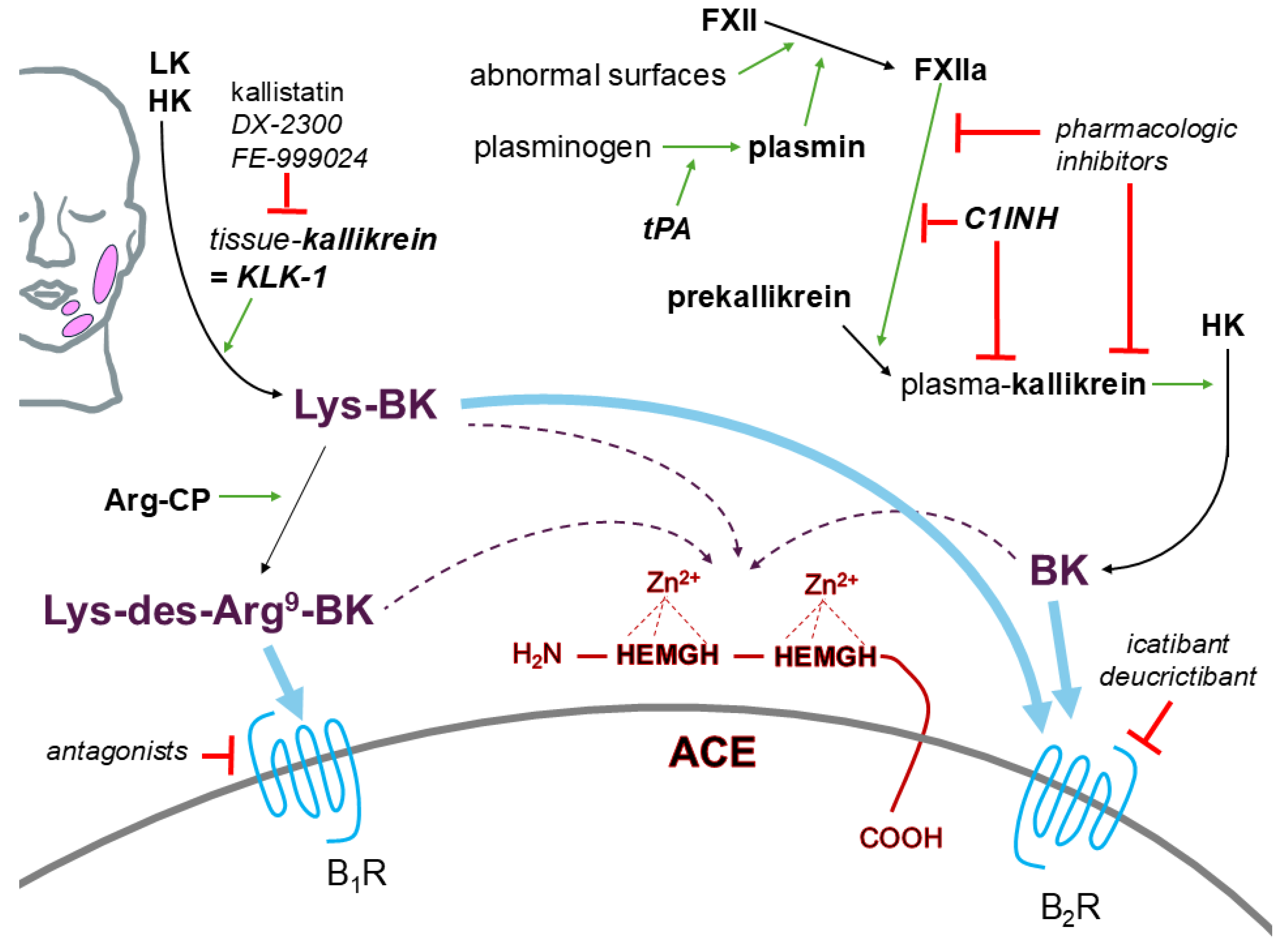
Angiotensin-converting enzyme (ACE) inhibitors (ACEis) are one of the most successful drug classes for the treatment of hypertension and the prevention of its cardiovascular complications. ACE activates the pressor hormone angiotensin but also inactivates the vasodilator peptide bradykinin (BK). A rare side effect of ACEis, angioedema (AE), has been proposed to result from pro-inflammatory effects of BK. Novel considerations are offered in this debate: (1) the bradykinin B2 receptor antagonist icatibant has had an inconsistent effect on ACEi-associated AE, but its potency and duration of action are much inferior to those of a novel nonpeptide antagonist of this receptor, deucrictibant. (2) Tissue kallikrein (KLK-1) is an effective kininogenase, particularly abundant in the salivary glands, possibly related to orofacial presentation of ACEi-induced AE. (3) The strongly regulated human kinin B1 receptor, optimally responsive to Lys-des-Arg9-BK, is functionally compartmentalized with KLK-1 which produces Lys-BK from kininogens. Chronic treatment with ACEi drugs in laboratory animals induces the expression of vascular B1R that mediates vasodilation. Therefore, ACEi-AE may be largely or completely initiated by KLK-1. Inhibitors of this protease or combined antagonists of both kinin receptor subtypes may be useful for the management of this condition.
Keywords: angiotensin converting-enzyme inhibitors; angioedema; bradykinin; bradykinin B1 receptor; bradykinin B2 receptor; kallikreins angiotensin converting-enzyme inhibitors; angioedema; bradykinin; bradykinin B1 receptor; bradykinin B2 receptor; kallikreins