
Review

Theoretical Positioning of TContext: A Comparative Analysis of a Contextual VR Platform for Fire Hazard Recognition

by
Tauqeer Faiz
1,2,*,
Mark Kit Tsun Tee
2 and
Abdullah Al Mahmud
3
1
Faculty of Engineering and Computer Science, University of Wollongong in Dubai, Dubai P.O. Box 20183, United Arab Emirates
2
Faculty of Engineering, Computing and Science, Swinburne University of Technology Sarawak Campus, Kuching 93350, Malaysia
3
Centre for Design Innovation, Swinburne University of Technology, Melbourne 3122, Australia
*
Author to whom correspondence should be addressed.
Virtual Worlds 2026, 5(3), 46; https://doi.org/10.3390/virtualworlds5030046 (registering DOI)
Submission received: 15 July 2026 / Revised: 12 September 2026 / Accepted: 16 September 2026 / Published: 20 September 2026

Abstract

True-Context (TContext) is a gamified VR platform for fire hazard recognition; empirical evidence shows it outperforms non-contextual VR delivery, but its theoretical positioning relative to established learning frameworks remains unarticulated. This study examined TContext against thirteen learning frameworks to: (1) assess the degree of theoretical alignment between TContext’s design and each framework’s prescriptions; (2) identify significant gaps; and (3) derive design recommendations to strengthen TContext’s theoretical completeness and future development. Using qualitative document analysis of the published TContext corpus and the canonical literature on thirteen learning frameworks, the study examined alignment, divergence, and potential integration. We coded each framework using a directed content analysis approach, then analyzed six cross-framework themes (social/collaborative mediation, individualization/adaptivity, reflective/metacognitive processing, learner agency, transfer/longitudinal validation, and design-inferred versus measured-outcome evidence) to identify recurring patterns. The analysis produced 52 documented strengths and 44 limitations. TContext aligned most strongly with ELT, CLT, CTML, LM-GM, and Constructivism; moderately with FT, Gamification of Learning, LBD, and DT; partially with TPACK and LPS; and least with SDL and Social Constructivism. Four persistent cross-framework gaps emerged: the absence of collaborative learning affordances, the lack of adaptive personalization, the lack of longitudinal retention measurement, and constrained learner agency within pre-scripted scenarios, along with seven targeted design recommendations to address each gap. TContext emerges as a novel multi-framework integrative model whose three core constructs, Contextual Embeddedness, Temporal Stratification, and Distributed Awareness, are not collectively anticipated by any existing framework. Future research should test the recommendations, measure longitudinal retention, and validate the model cross-culturally beyond the UAE.

1. Introduction

The proliferation of virtual reality (VR) in educational and safety training contexts has produced a diverse landscape of immersive learning systems, with varying theoretical grounding. Many VR-based interventions report empirical learning gains without situating them within an explicit theoretical framework [1,2]. As a result, the evidence confirms effectiveness without explaining the mechanisms through which VR produces learning or clarifying which existing theoretical frameworks the system supports, extends, or challenges. True-Context (TContext), the contextual VR platform developed and validated by Faiz, Tee, and Al Mahmud [3,4,5], represents a significant step toward theoretically grounded immersive safety education. Instantiated as the FireGuard VR game for residential fire hazard recognition, True-Context was developed through a three-phase research program: a needs-assessment survey of 149 Dubai and Sharjah residents (Phase 1), a framework design and expert validation study (Phase 2), and a pre-test–post-test experimental evaluation (Phase 3). Phase 3 empirically demonstrated that True-Context’s contextual condition produced significantly higher hazard recognition gains than a non-contextual VR condition delivering the same content without temporal and situational embedding. Despite this empirical foundation, the theoretical positioning of TContext within the broader landscape of learning frameworks remains largely unaddressed. This matters for two reasons. First, theoretical positioning determines whether True-Context’s contributions are understood as domain-specific findings or as generalizable principles applicable to other hazard recognition and immersive learning contexts. Second, comparing it with established frameworks can identify underaddressed design dimensions and create a roadmap for iterative improvement. This paper conducts a systematic comparative analysis of TContext against established learning theories and frameworks: Constructivism, Experiential Learning Theory (ELT), Gamification of Learning (GoL), Learning by Doing (LBD), Flow Theory (FT), Learning Mechanics–Game Mechanics (LM-GM), Cognitive Theory of Multimedia Learning (CTML), Design Thinking (DT), Learning through Problem Solving (LPS), Scientific Discovery Learning (SDL), Social Constructivism, Cognitive Load Theory (CLT), and Technological Pedagogical Content Knowledge (TPACK). For each framework, the analysis identifies how True-Context’s documented design features and empirical outcomes align with or deviate from the framework’s theoretical prescriptions, producing a structured strengths-and-limitations assessment. This paper is guided by three research questions:
RQ1: To what extent does TContext’s design architecture align with the prescriptions of established learning frameworks?
RQ2: What are the significant theoretical gaps and limitations of TContext relative to each of these frameworks?
RQ3: What design recommendations emerge from the comparative analysis to strengthen TContext’s theoretical completeness and practical generalizability?

2. Background: True-Context Framework

True-Context operationalizes the TContext computational learning model, which integrates three theoretical constructs not previously combined in a single fire safety training architecture: Contextual Embeddedness (hazards embedded within recognizable domestic environments), Temporal Stratification (hazard states progressing from T0 dormancy to T3 full ignition), and Distributed Awareness (simultaneous multi-hazard monitoring across spatial locations and sensory modalities). These constructs were synthesized from Situated Learning Theory [6], Situation Awareness Theory [7], and Distributed Cognition Theory [8]. Implemented as the FireGuard VR game on consumer-grade Meta Quest head-mounted displays [2], TContext enables 6DoF spatial navigation, teleportation-based room transitions, object inspection, and real-time audio-visual feedback. Learners navigated a gamified residential environment in which hazards were embedded within dynamic situational and temporal cues, as described in the framework. Training lasted 10–15 min, followed by a scenario-based assessment requiring hazard-identification judgments across kitchen, living room, electrical, mechanical, and emergency sub-categories. The shorter training duration relative to the non-contextual condition, combined with its higher cognitive demand, was a deliberate design feature: contextual, scenario-driven learning enables faster and deeper schema formation than passive reading. The experimental evaluation involved 80 participants divided between a contextual (TContext) and a non-contextual VR condition. The contextual group improved from pre-test to post-test on the hazard recognition assessment, whereas the non-contextual group showed slight improvement. System Usability Scale scores and engagement, motivation, and immersion ratings were consistently higher for the True-Context condition. The TContext results carry several implications beyond the specific measurement outcomes. First, it provides empirical justification for the contextual learning hypothesis: it is not immersion per se, but contextual realism—that is, the embedding of hazards within recognizable, evolving domestic situations—that drives enhanced hazard identification. A VR environment that merely repositions brochures in three-dimensional space delivers no transformative pedagogical value. Second, the TContext platform directly addresses the five barriers identified in Phase 1: it is accessible via consumer hardware without employer or government sponsorship; its 10–15 min sessions eliminate the ‘duration’ complaint; its digital delivery removes location and time constraints; multilingual audio support can be embedded to address language barriers; and scalable deployment means multiple residents can train simultaneously without resource competition. Third, the real-time feedback architecture, through immediate audio confirmation of correct and incorrect hazard judgments, closes the feedback deficit identified as a key limitation of conventional group workshops.
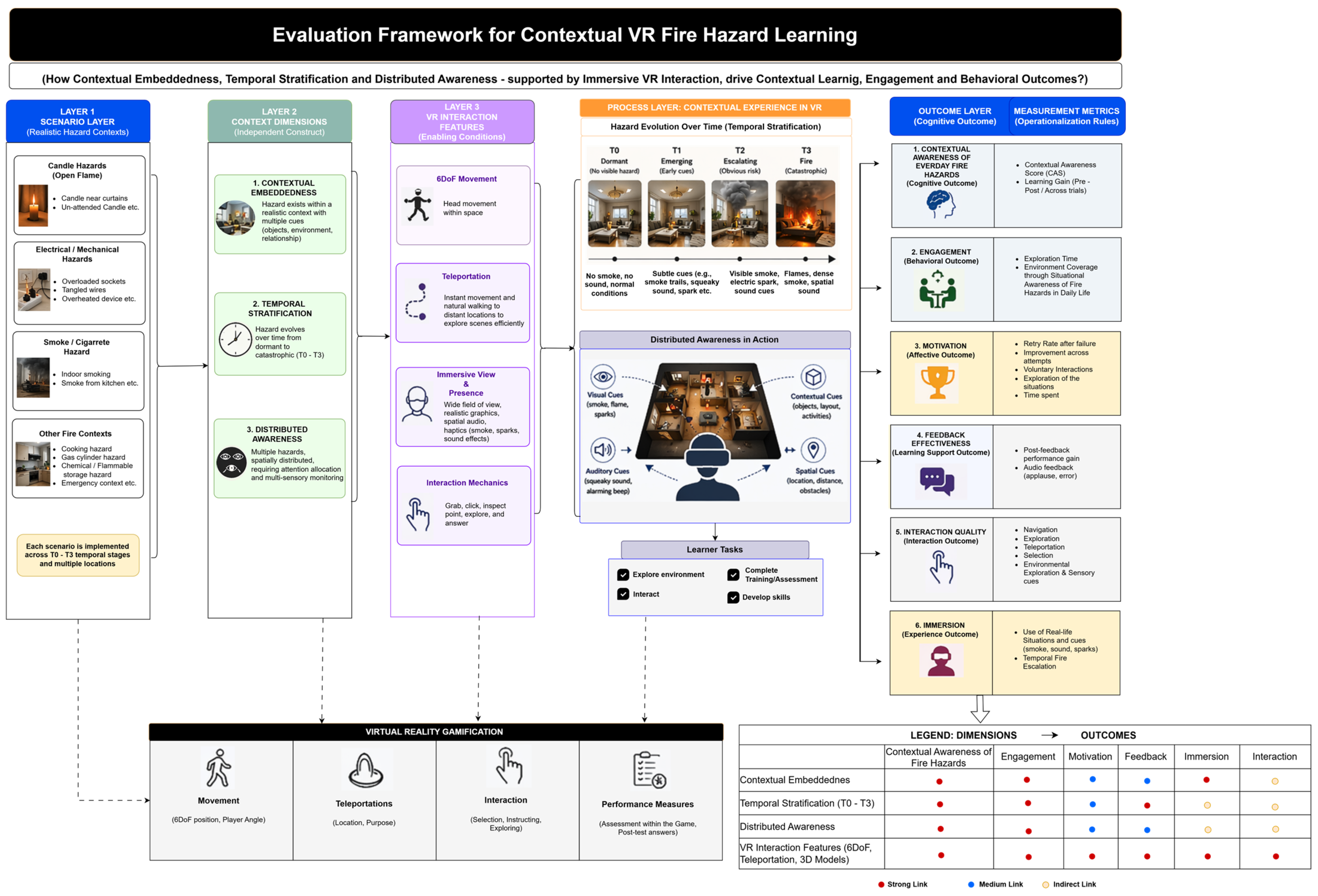
Figure 1 shows the enhanced TContext framework. The TContext consists of five layers. Layer 1 is the scenario layer, which grounds the learning experience in realistic contexts such as candle hazards, electrical and mechanical hazards, smoke/cigarette hazards, etc. The second layer introduces three independent constructs that together form a conceptual structure for contextual learning in this domain. Contextual Embeddedness [9], Temporal Stratification [10] and Distributed Awareness [11] are the constructs placed in Layer 2 of the TContext framework. Layer 3 specifies the enabling conditions through which learners engage with contextual hazard environments, including 6DoF movement, teleportation, immersive sensory feedback, and interaction mechanics that support inspection, risk assessment, and decision-making within the virtual space [12]. The Process layer (Layer 4) clarifies how these features combine to produce contextual learning in practice. Fire escalation from T0 to T3 is not simply a visual effect; it is the learning mechanism through which learners move from perceiving environmental elements to understanding what those elements mean and projecting where the situation is heading. Distributed awareness in action focuses on how learners manage and process multiple sources of information within the virtual environment. Learners must integrate visual, auditory, and spatial cues simultaneously, which demands continuous shifting and prioritization. As hazards may appear in different locations and forms, users must allocate their attention dynamically while maintaining awareness of the overall environment. This process also involves managing cognitive load as learners balance multiple stimuli without becoming overwhelmed. Learner tasks follow a three-stage sequence: environmental exploration and observation, training and hazard awareness development, and risk-level decision-making. This sequence supports the experiential learning cycle by requiring active interaction, reflection, and problem-solving at each stage rather than passive content consumption followed by a comprehensive check. The outcome layer (Layer 5) extends this methodological precision to the assessment of learning itself. Rather than measuring a single composite score, it operationalizes six distinct outcomes: contextual awareness of everyday hazards, engagement, motivation, feedback effectiveness, interaction quality, and immersion. This profile-based approach, anchored in behavioral indicators such as retry rate, hazard identification accuracy with contextual reasoning, and the number of simultaneously missed hazards, provides a richer and more behaviorally grounded account of learning than satisfaction scales or single-item recall tests [13]. The dashed arrows indicate mapping relationships between the framework layers and the corresponding VR gamification components.
Phase 3 results establish TContext as an empirically validated platform. The following analysis builds on this foundation to assess its theoretical breadth.

3. Methodology

3.1. Research Design

This study adopts an interpretive qualitative research paradigm [14]. It employs a post-hoc theoretical positioning design to examine the TContext platform systematically against thirteen established learning theories and educational frameworks drawn from the VR educational literature. A theoretical comparative analysis approach was selected over experimental, survey-based, or quasi-experimental alternatives because the research problem is interpretive in nature: it requires the systematic alignment of documented design features and empirical outcomes of a completed technology platform against theoretical prescriptions drawn from multiple disciplinary traditions, rather than the generation of new empirical data through primary data collection. Creswell and Creswell [14] characterize the interpretivist paradigm as appropriate when the intent is to understand the meaning that individuals or communities ascribe to a social or technological phenomenon, and when research questions seek to identify how an artefact or practice relates to the theoretical structures that are held to govern it. TContext was developed and validated empirically across three phases, and the present analysis addresses the subsequent question of where that validated platform sits within the learning-theoretical landscape governing immersive, gamified educational technology design. The recognized gap in the VR educational technology field further supports this design choice. Doğan et al. [15] document that a prevalent absence of a robust theoretical framework characterizes the majority of VR educational studies and that this absence may pose impediments to the widespread adoption of VR within educational paradigms, given the pivotal role of learning and teaching theories in guiding pedagogical processes. Addressing this gap with a completed and validated platform requires a design that moves systematically across multiple theoretical frameworks while remaining anchored in documented evidence, a requirement best served by qualitative thematic synthesis rather than quantitative meta-analysis or experimental comparison [16]. The source corpus comprises: (1) the three published TContext research articles [3,4,5], which provide comprehensive coverage of the TContext evaluation framework, design architecture, and comparative literature analysis, and (2) the primary texts of the learning frameworks under examination.

3.2. Framework Selection Criteria

The twelve frameworks selected for this comparative analysis are systematically grounded in an evidence-based, PRISMA-compliant review of learning theories and approaches applied to VR-based education. Marougkas et al. [17] conducted a systematic review of the learning theories, approaches, and methodologies connected to the use of VR systems for educational and tutoring purposes, following the PRISMA guidelines [18] and [19] procedures for systematic reviews. The review examined 4162 publications retrieved from the Scopus database, spanning the decade from 2012 to 2022, and applied rigorous inclusion and exclusion criteria to retain only studies that incorporated immersive VR in classroom educational contexts, reported measurable learning outcomes, and adopted at least one verifiable educational theory or approach. Seventeen studies met the full inclusion criteria, from which 12 distinct learning theories and educational approaches were identified: constructivism learning [20,21], experiential learning [22], the gamification of learning [23,24], John Dewey’s theory of learning by doing [25], flow theory [26], the Cognitive Theory of Multimedia Learning (CTML) [27], design thinking (DT) [28], learning through problem solving (LPS) [29], scientific discovery learning (SDL) [30,31], social constructivism [21,32], cognitive load theory (CLT) [33,34], and the Technological Pedagogical Content Knowledge Framework (TPACK) from Koehler et al. [35]. All twelve of these literature-reviewed frameworks are directly incorporated into the comparative analysis, providing the framework selection with a systematic empirical foundation derived from peer-reviewed VR educational research rather than an ad-hoc theoretical judgment. The thirteenth framework, Learning Mechanics–Game Mechanics (LM-GM) [36], was additionally included because TContext is a gamified serious game platform and LM-GM provides the only framework in the selection that offers a systematic methodology for mapping individual game mechanics to specific learning objectives within serious game design, a function not covered by any of the twelve frameworks identified by Marougkas et al. [17]. The selection therefore achieves both empirical comprehensiveness, derived from a PRISMA-compliant systematic review of the VR education literature, and domain specificity, through the supplementary inclusion of a serious game design framework that addresses TContext’s gamification architecture at the level of its technical design detail.
Constructivism [20,21] and Experiential Learning Theory [22] were selected because TContext’s foundational design principle, embedding fire hazards within authentic residential environments, so that learners construct knowledge through direct contextual engagement rather than passive reception, is philosophically rooted in constructivist epistemology and structurally mirrors Kolb’s four-stage experiential cycle. Learning by Doing [25] was included because TContext operationalizes purposeful action in a meaningful environment as its primary pedagogical mechanism, directly enacting Dewey’s insistence that genuine learning emerges from experience rather than symbolic instruction. Learning through Problem Solving [29] completes the first dimension, selected because TContext presents fire hazard recognition as an authentic, context-dependent judgment task requiring environmental inference and multi-hazard analysis, characteristics that correspond directly to Jonassen’s conception of ill-structured problem-solving as the highest-order form of meaningful learning. Flow Theory [26] and the Gamification of Learning framework [24] were selected to address the motivational and engagement dimension, given TContext’s deliberate challenge-skill calibration architecture, wherein the T0–T3 temporal escalation model and the 7/10 progression threshold are explicitly designed to sustain the focused, absorbed engagement that flow theory prescribes, and its incorporation of scoring mechanics, performance thresholds, and audio-visual feedback as motivational design elements that necessitate evaluation against a framework theorizing how game elements function within educational contexts [23]. Scientific Discovery Learning (SDL) [31] was selected as an educational approach explicitly documented by [17] in VR educational contexts, identified in one qualifying study [30] and defined as an approach that accentuates the significance of hands-on learning experiences to explore and discover scientific concepts within immersive environments. SDL’s emphasis on learner-driven inquiry and iterative hypothesis-correction aligns partially with TContext’s retry mechanism and self-directed spatial navigation within the VR scenario environment. However, its core requirement for learner-generated problem definition also reveals a critical structural gap in TContext’s pre-scripted scenario architecture, making SDL a theoretically productive framework for surfacing design limitations not visible through constructivist or experiential lenses alone. Social Constructivism [21] was selected based on its identification as a VR-relevant theoretical framework by Marougkas et al. [17], documented in one qualifying study [32], with VR characterized as a tool capable of facilitating social constructivist learning experiences by enabling learners to participate in immersive, interactive environments that foster social interaction, collaborative knowledge construction, and peer dialogue in real time. Its inclusion is also justified by its direct relevance to TContext’s most consequential design gap: the complete absence of peer-mediated dialogue and collaborative knowledge construction, which [21] identifies as the primary mechanism through which higher cognitive functions develop. Including Social Constructivism therefore serves both as a theoretical positioning instrument and as a means of identifying the single most significant direction for future platform development, a dual function consistent with this review’s analytical objectives. Cognitive Load Theory [33,34] and the Cognitive Theory of Multimedia Learning [27] address the cognitive architecture and media design dimension: TContext’s interaction design decisions, including teleportation navigation, progressive hazard staging, and session duration constraints, are directly interpretable as strategies for managing intrinsic, extraneous, and germane cognitive load, while its deliberate use of synchronized visual and auditory hazard cues constitutes a multimedia learning architecture whose effectiveness is governed by CTML’s dual-channel, limited-capacity, and active-processing principles. The integrated design and technology knowledge dimension is addressed by Learning Mechanics–Game Mechanics [36], Design Thinking [28], and TPACK [35]: LM-GM provides a systematic mapping methodology for assessing whether each of TContext’s game mechanics serves a corresponding learning objective; Design Thinking offers a framework for evaluating the rigor and completeness of the three-phase research program, including community survey, expert-validated framework design, and experimental evaluation, which structurally mirrors the empathize-define-ideate-prototype-test cycle; and TPACK provides the only framework in the selection that explicitly theorizes the intersection of domain-specific fire safety content knowledge, constructivist-gamification pedagogical knowledge, and consumer-grade VR technological knowledge as the basis for effective technology-integrated instruction.

3.3. Coding Procedure Across the Thirteen Frameworks

The coding process for TContext followed a two-level, hybrid deductive-inductive procedure. At Level 1, each of the thirteen frameworks was treated separately using a directed content analysis approach [37]. We extracted each framework’s core prescriptions from its canonical primary sources and used them as the initial coding categories. TContext’s documented design features and Phase 3 empirical outcomes were then examined against each prescription and classified as a strength, where a feature or outcome fulfilled or extended the prescription, or a gap, where TContext partially fulfilled, contradicted, or did not address it. Each classification was also tagged by its evidentiary basis, distinguishing items grounded in a measured Phase 3 outcome (for example, hazard recognition accuracy, SUS score, or engagement/immersion ratings) from items inferred from a documented design feature in the absence of a corresponding measured outcome. At Level 2, a best-fit framework synthesis [38] was applied across all thirteen frameworks to identify recurring cross-framework themes. A priori set of six themes (social/collaborative mediation, individualization/adaptivity, reflective/metacognitive processing, learner agency and openness of inquiry, transfer and longitudinal validation, and design-inferred versus measured outcome evidence) was drawn from the learning sciences literature and used to map every Level 1 strength and gap deductively and the themes are categorized into key T1–T6 as shown in Table 1. Items that did not fit an existing theme were reviewed for the possible addition of a new emergent theme, consistent with the inductive refinement step built into best-fit framework synthesis. The following theme keys emerged during the synthesis.
The strengths-and-limitations analysis does not claim definitive completeness; future empirical studies may confirm, refute, or extend the classifications made here.

3.4. Limitations

The study carries four principal limitations that constrain the scope and generalizability of its findings. First, the analysis is grounded in TContext as designed and evaluated in a specific sociocultural context, namely residential fire safety education in the United Arab Emirates, and the theoretical alignments and gaps identified here may not apply to VR educational platforms deployed in different subject domains, cultural settings, target populations, or development stages. Second, the thematic synthesis procedure is inherently interpretive and subject to analyst judgment, particularly in cases where TContext partially addresses a theoretical prescription; different analysts applying the same four-step procedure to the same evidence base may reach different classification decisions at the margin, a limitation acknowledged by Thomas and Harden [16] as intrinsic to all forms of qualitative synthesis. Third, this analysis does not generate new empirical data, and all claims about the effectiveness of TContext’s design elements are derived from the existing three-phase research corpus; the present study cannot confirm, refute, or supplement those findings, and the analytical value of the comparative matrix is therefore contingent on the methodological validity of the primary phases. Fourth, while the thirteen frameworks selected provide comprehensive coverage of the VR educational theory landscape as evidenced by Marougkas et al. [17], the selection cannot claim to be exhaustive; emerging frameworks in embodied cognition, situated learning [39], and distributed cognition [8] may offer additional theoretical perspectives on TContext that were not addressed in the present review, and that may constitute productive directions for future theoretical positioning work.
Further, one researcher conducted the initial coding. Consequently, we could not calculate inter-rater reliability. To strengthen coding consistency, the researcher conducted a second coding cycle after an interval, maintained an audit trail of coding decisions, and reviewed ambiguous cases against the operational definitions. Nevertheless, the lack of independent coding remains a methodological limitation, and future work should validate the six-theme framework with independent researchers or an external expert panel.

4. Results: Comparative Analysis and Consolidated Matrix

4.1. Overview

The comparative analysis across frameworks produced 52 documented strengths and 44 documented limitations of TContext. Table 2 presents the full consolidated matrix. Section 4.2, Section 4.3, Section 4.4, Section 4.5, Section 4.6, Section 4.7, Section 4.8, Section 4.9, Section 4.10, Section 4.11 and Section 4.12 provide narrative analysis for each framework. Section 5 presents cross-framework synthesis.

4.2. Constructivism

Constructivism [20,21] posits that learners actively build knowledge through direct engagement with their environment rather than passively receiving transmitted information. TContext is among the strongest available instantiations of this principle in the fire safety domain. By embedding hazards in familiar residential settings, the platform ensures learners construct knowledge through contextual engagement rather than abstraction. The T0–T3 temporal escalation model operationalizes Vygotsky’s zone of proximal development by progressively increasing complexity, allowing learners to build increasingly sophisticated hazard-recognition schemas across the training session. This correspondence is partial rather than a full operationalization of the ZPD construct: Vygotsky’s model centers on socially mediated scaffolding by a more knowledgeable other, a mechanism that TContext’s current single-user, non-adaptive design does not implement.
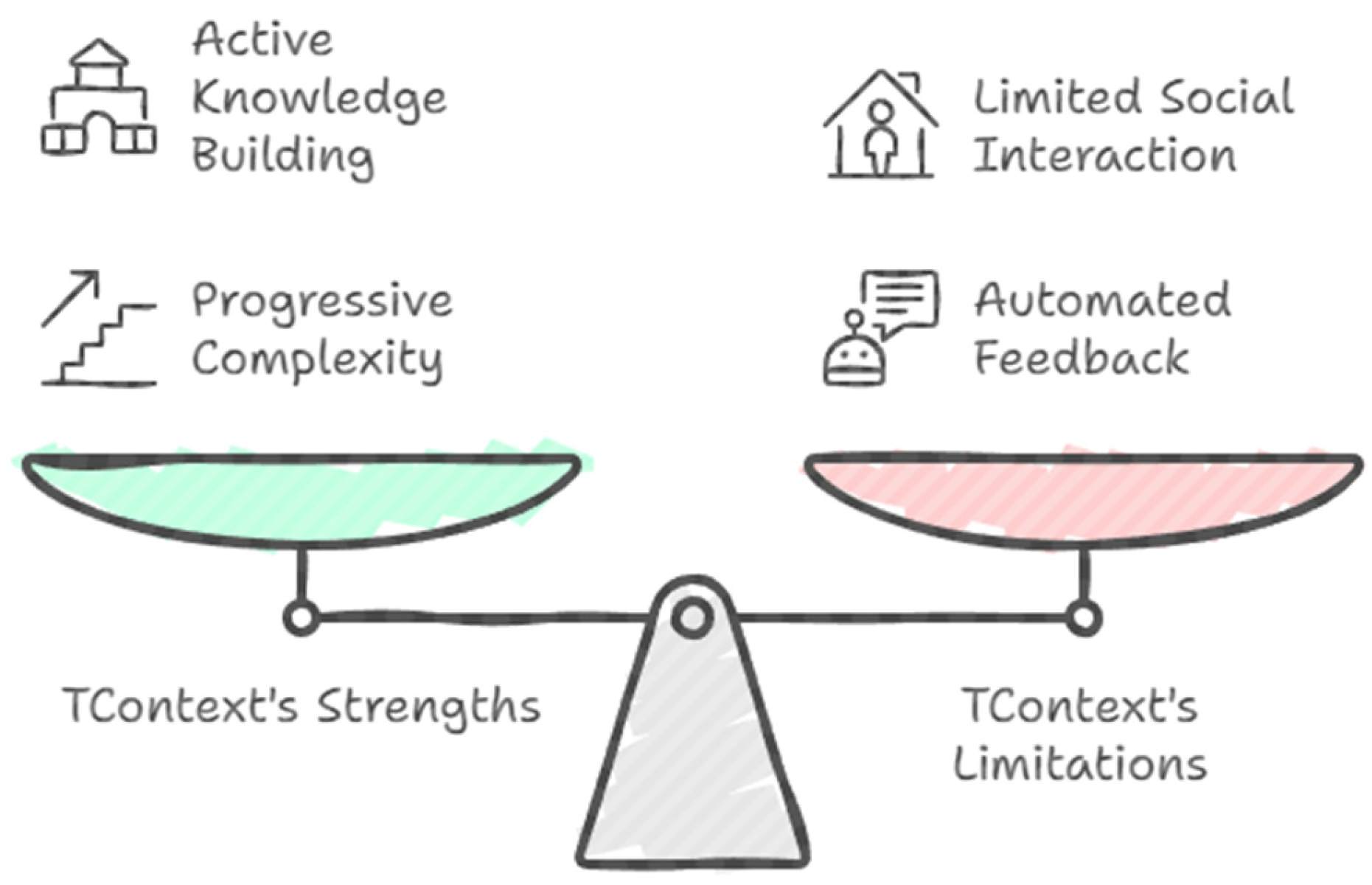
Figure 2 highlights the strengths and limitations of TContext. TContext is a single-user platform, which limits its engagement with social constructivism’s foundational claim that knowledge construction is inherently dialogic. Vygotsky’s concept of the more knowledgeable other is absent: the only corrective signal is the game’s automated audio feedback, which is considerably less nuanced than expert guidance or peer collaboration. Future versions incorporating facilitator-led debriefing modes or collaborative multi-user hazard scenarios would address this theoretical gap. A cross-reading of Table 2 shows that some theme keys appear on both sides of the Constructivism row. T1 is coded as a strength because immediate audio-visual feedback mirrors corrective dialogue with a knowledgeable agent, but it is also coded as a limitation because it lacks peer interaction and collaborative sense-making. Similarly, T2 is coded as a strength in the temporal escalation model’s scaffolding function, but also as a limitation because scaffolding is not individually adapted to each learner. This overlap indicates that TContext partially, rather than fully, satisfies the theoretical requirement associated with each theme: the platform provides a structural analogue to the underlying mechanism, such as dialogic correction or progressive scaffolding, without the mechanism’s complete substantive form, such as genuine peer dialogue or learner-specific adaptation. Noticeably, the co-occurrence signals a partial or proxy fulfilment of the theoretical prescription. This pattern recurs across several frameworks in this analysis.

4.3. Experiential Learning Theory

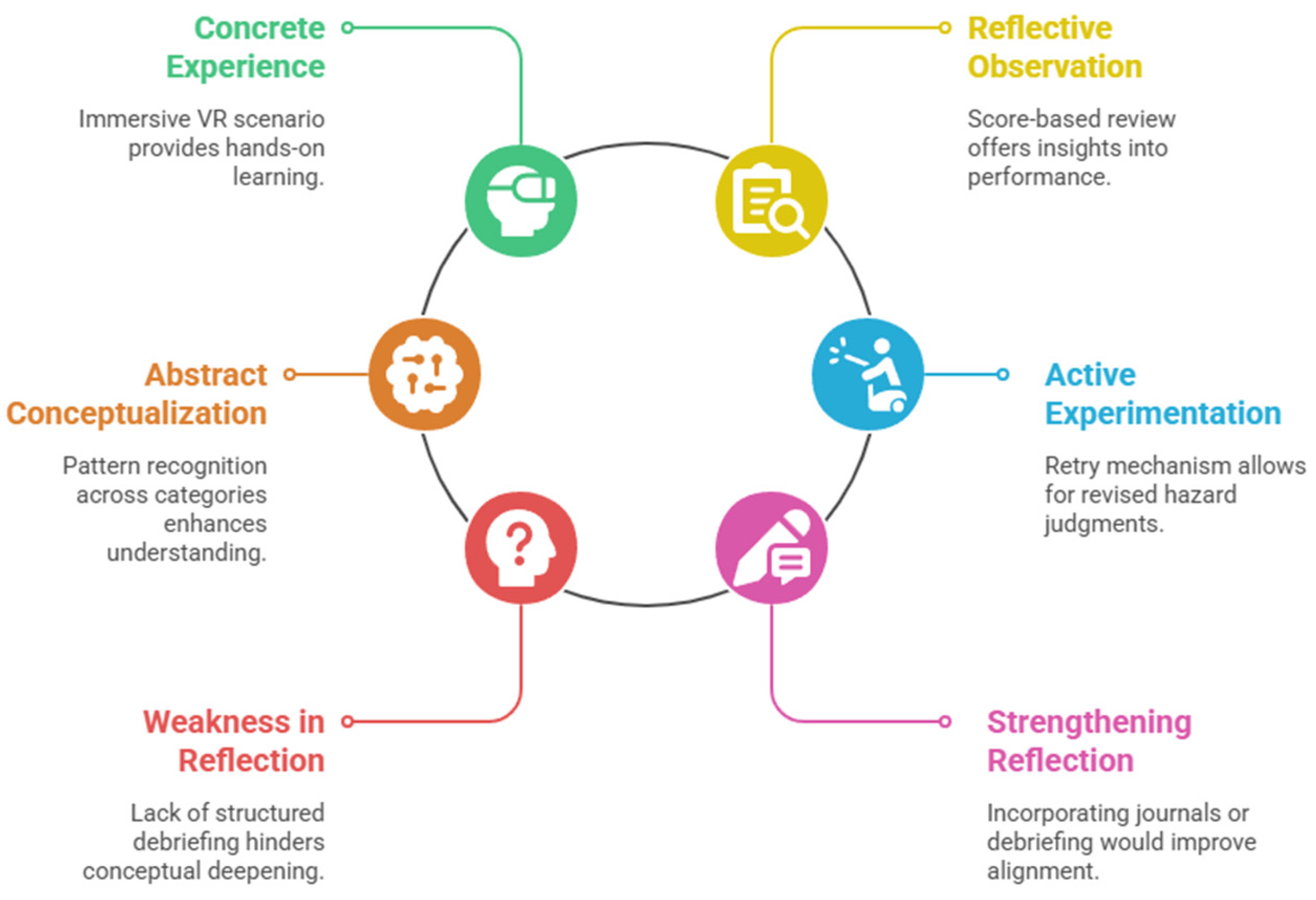
Kolb’s Experiential Learning Theory [22] describes a four-stage cycle: concrete experience, reflective observation, abstract conceptualization, and active experimentation. TContext’s structural design maps with notable precision onto this cycle. The immersive VR scenario constitutes the concrete experience; the score-based post-scenario review provides reflective observation; score-pattern recognition across categories supports abstract conceptualization; and the retry mechanism enables active experimentation with revised hazard judgments.
The critical weakness relative to ELT is the absence of a dedicated reflective observation stage. Kolb’s framework requires structured reflection, but TContext provides only binary feedback (correct/incorrect audio signal) without a debriefing component that prompts learners to articulate what they observed, why they misjudged a scenario, or how their understanding has shifted. This gap is particularly significant for durable skill transfer: without systematic reflection, the experiential cycle may produce performance improvement without accompanying conceptual deepening. Incorporating a post-session reflective journal, guided debriefing, or scenario replay-with-commentary feature would substantially strengthen TContext’s alignment with ELT. Figure 3 illustrates the alignment of TContext with Kolb’s experiential learning theory.
The theme keys T3 (Reflective/Metacognitive Processing) and T5 (Transfer/Longitudinal Validation) appear as both advantages and limitations. T3 is coded as a strength through the structural mapping of TContext’s scenario-review-retry cycle onto Kolb’s four stages. Still, it is also coded as a limitation because the reflective observation and abstract conceptualization remain underdeveloped, lacking a structured debriefing or journaling mechanism. T5 follows a comparable pattern: scenario diversity is credited with broadening experiential breadth, while the absence of tested transfer to real-world behavior is flagged as a limitation. This dual coding suggests that TContext engages the relevant theoretical construct at a structural or design level but has not yet provided the empirical or procedural depth the construct ultimately requires. In other words, the platform’s architecture gestures toward reflective processing and transfer, but has not fully operationalized either.

4.4. Gamification of Learning

TContext employs several core gamification elements: point scoring, minimum performance thresholds for progression (7/10), audio feedback for correct and incorrect decisions, and progressive hazard complexity across scenario categories. These features collectively support the motivational functions that gamification theory [23,24] ascribes to goal-setting, feedback, and challenge, as evidenced by the five Phase 3 participants who voluntarily retried training after failing to meet the threshold.
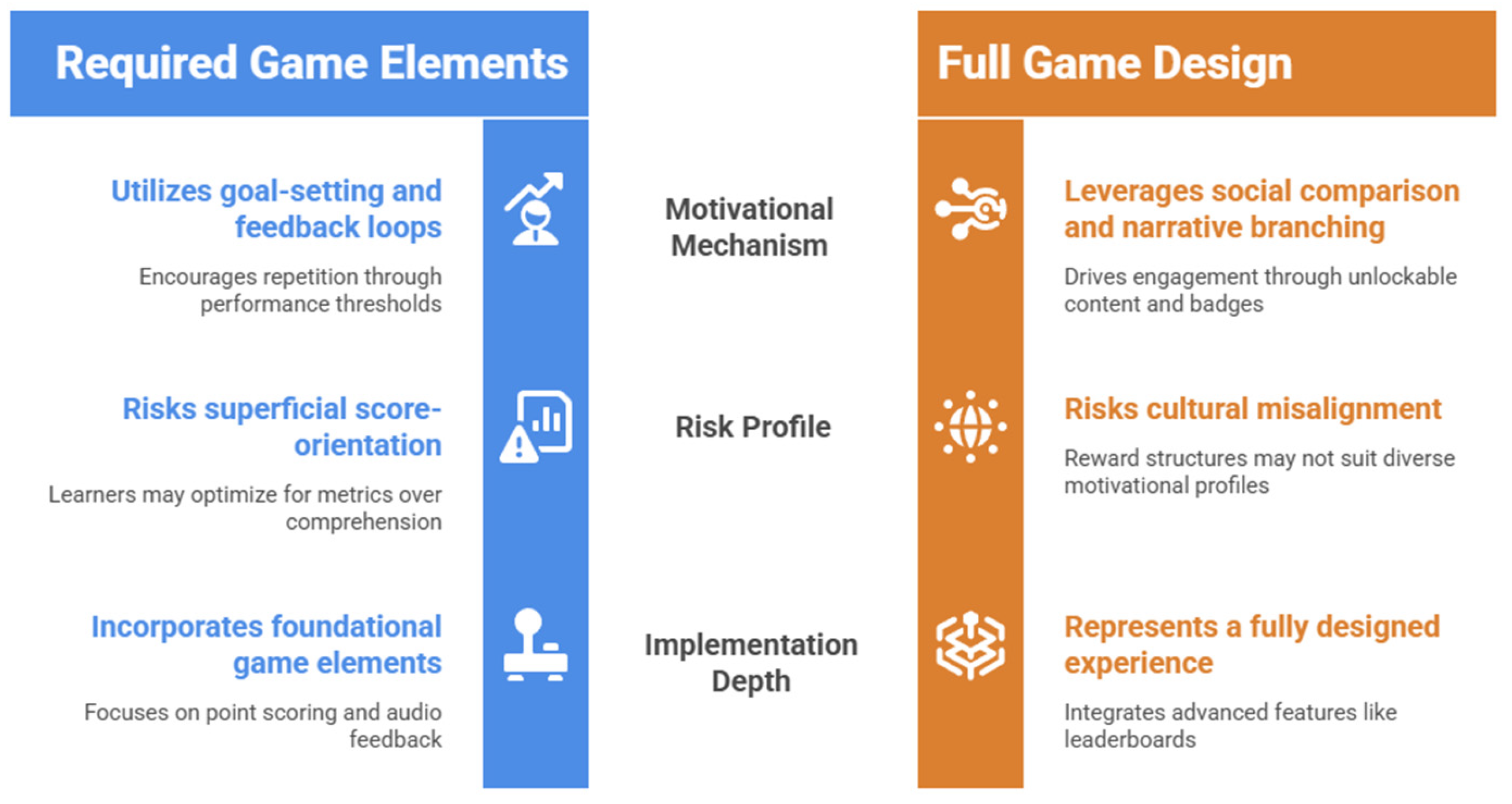
TContext’s current design lacks more advanced elements of gamification theory, including leaderboards, social comparison, badges, narrative branching, and unlockable content. Deterding et al. (2011) [24] distinguish between game elements and game design: TContext includes basic game elements but does not constitute a fully designed game experience. The risk of superficial gamification is that score-orientation may displace genuine hazard comprehension, with learners optimizing performance metrics rather than building transferable situational awareness. Additionally, the current reward structure does not differentiate between cultural groups whose motivational profiles may respond differently to competitive or achievement-based mechanics. Figure 4 outlines the required vs. full-game design approach for educational content.
In the Gamification of Learning, T2 in Table 2 is coded as a strength because the challenge calibration embedded in the 7/10 pass threshold is credited with sustaining motivation, and as a limitation because the reward structure lacks cultural differentiation across TContext’s diverse user base. This overlap indicates that while TContext’s gamification layer succeeds in calibrating challenge at a general level, it does not yet extend this calibration to account for individual or group-level variation among learners, a more granular form of adaptivity that the theme is intended to capture.

4.5. Learning by Doing

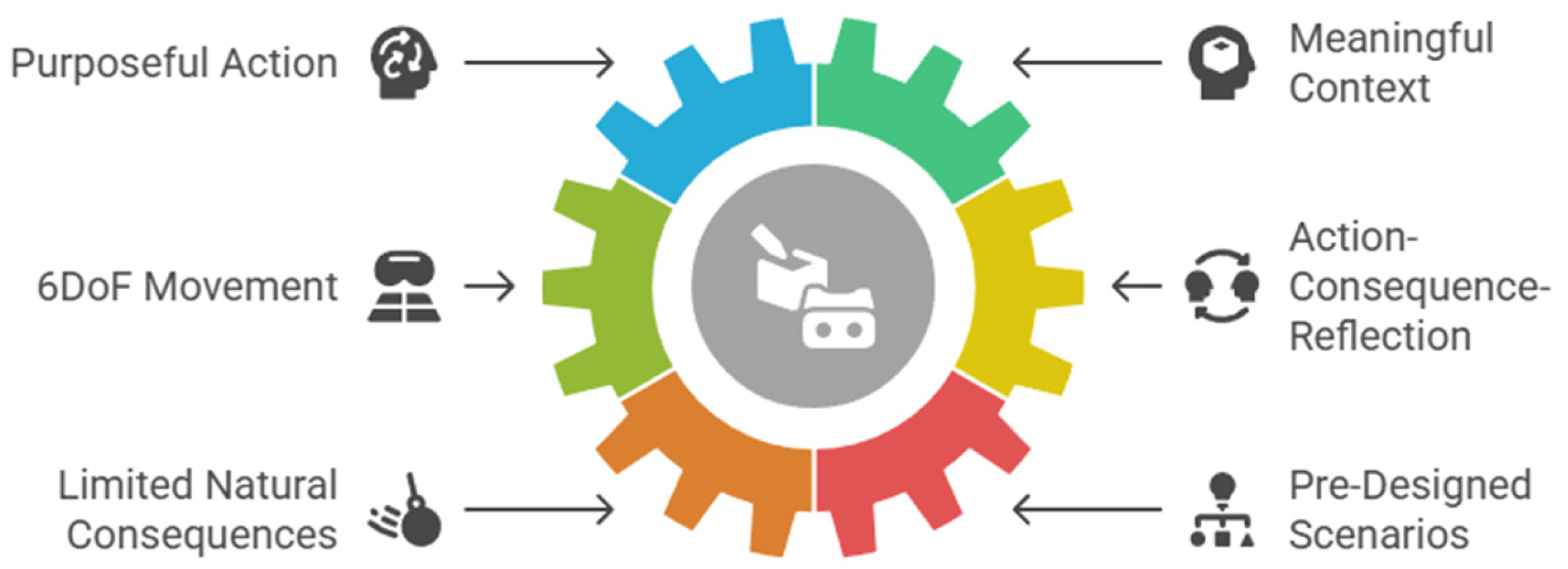
John Dewey’s educational philosophy holds that genuine learning occurs through purposeful action in a meaningful context, not through passive reception of authoritative content [25]. TContext is explicitly aligned with this principle: fire hazard recognition is structured as a series of purposeful investigative actions in a realistic domestic environment. The 6DoF movement capability enables learners to inspect object relationships through physical navigation, enacting Dewey’s insistence on agency in the inquiry process. The training-then-assessment sequence mirrors Dewey’s action-consequence-reflection cycle. TContext’s alignment with Dewey is limited in two important respects. First, Dewey’s emphasis on natural consequences requires learners to experience the actual outcomes of their actions; in a VR simulation, failing to identify a hazard carries no physical consequence, which may reduce the motivational power of consequence-based learning. Second, Dewey valued open-ended inquiry and learner-directed problem formulation, whereas TContext presents pre-designed scenarios with fixed escalation scripts. Learners respond to designer-defined problems rather than identifying and formulating their own. Introducing a free-exploration mode in which learners can navigate residential environments and annotate hazards without pre-defined prompts would move TContext closer to Dewey’s ideal. Figure 5 presents TContext’s alignment with Learning by Doing theory.
For Learning by Doing, the theme keys T4 (Learner Agency/Openness of Inquiry) and T5 (Transfer/Longitudinal Validation) overlap in Table 2. T4 is credited as a strength in the 6DoF movement and interaction mechanics that embody learner agency during object inspection. Yet, it is also identified as a limitation because the structured scenario sequence constrains open-ended inquiry and learner-directed problem formulation. T5 shows a parallel pattern: the training-then-assessment sequence is credited with mirroring Dewey’s problem-action-consequence cycle, while the absence of empirical verification of skill transfer to real fire emergencies is flagged as a limitation. This suggests that TContext enacts Dewey’s principles at the level of in-session interaction, while falling short of the more open-ended and externally validated forms of agency and transfer that Dewey’s philosophy ultimately calls for.

4.6. Flow Theory

Flow Theory [26] describes an optimal experience state characterized by complete absorption in a challenging activity, with skills matched to task demands. TContext’s challenge-skill architecture is structured to maintain flow conditions: hazards begin at a baseline low-risk state (T0) and escalate progressively, providing increasing challenge as learner competence develops within a session. The 7/10 pass threshold prevents both boredom (no consequence for trivially easy performance) and anxiety (failure is recoverable through retry). Phase 3 engagement and immersion ratings, collected separately from the System Usability Scale (SUS), were elevated for the contextual condition; taken together with the SUS usability findings, these self-report measures are directionally consistent with flow-state theorizing, though they were not collected using a validated flow-specific instrument (e.g., the Flow State Scale) and should be interpreted as indirect rather than confirmatory evidence.
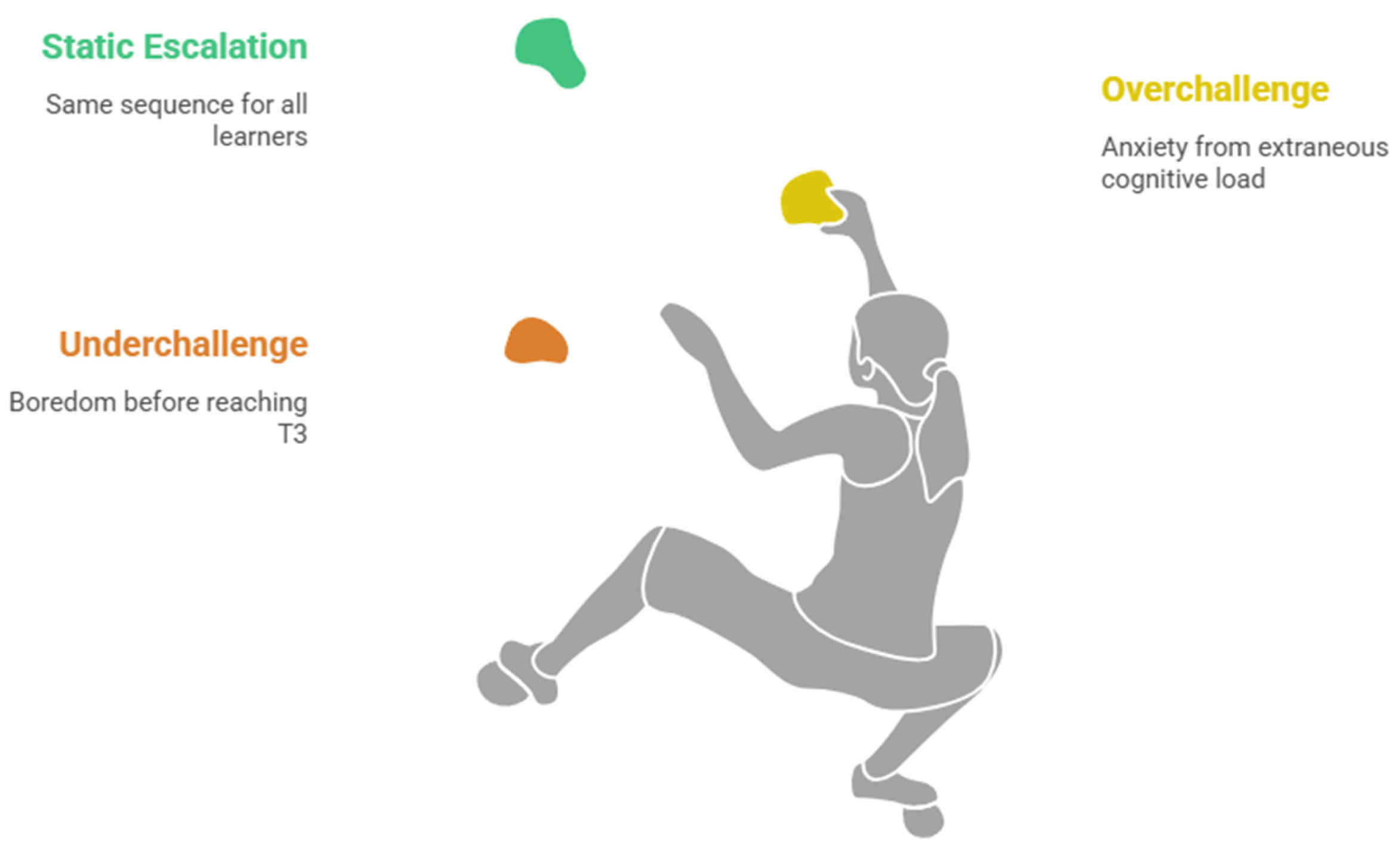
The primary theoretical gap relative to flow is the absence of real-time adaptive challenges. Csikszentmihalyi’s model requires that the challenge level be dynamically matched to individual skill; TContext presents all learners with the same escalation sequence regardless of individual performance profiles. Learners who rapidly identify early T0-T1 cues may experience underchallenge before reaching the T3 stage, potentially exiting the flow channel into boredom. Conversely, VR novices may experience extraneous cognitive load from navigating the environment itself, pushing them into the anxiety zone before encountering the pedagogical content. An adaptive scenario-selection algorithm that responds to per-item accuracy in real time would substantially strengthen TContext’s flow architecture. Figure 6 highlights the challenges identified in TContext.
In the Flow Theory, theme keys T2 (Individualization/Adaptivity) and T6 (Design Inferred versus Measured-outcome Evidence) appear as both strengths and limitations. T2 is coded as a strength in the T0 to T3 escalation model and the 7/10 threshold, which are described as maintaining challenge progression. Even so, it is also coded as a limitation because challenge level is not dynamically adapted to individual performance in real time. T6 shows a similar pattern: engagement and immersion ratings are treated as indirect evidence consistent with flow. At the same time, the absence of a validated flow-specific instrument is simultaneously noted as a limitation. This overlap reflects a distinction between design intent and empirical confirmation: TContext’s architecture is designed with flow principles in mind, and its outcome data are broadly consistent with those principles, but neither the adaptivity nor the flow state itself has been directly measured or dynamically implemented.

4.7. Learning Mechanics–Game Mechanics (LM-GM)

The LM-GM framework [36] provides a mapping methodology for aligning game mechanics with specific learning objectives, operationalizing the principle that game elements should serve pedagogical functions rather than be included solely for entertainment value. TContext achieves demonstrably intentional LM-GM alignment: object inspection mechanics support hazard-identification learning objectives; temporal escalation mechanics support anticipatory-reasoning learning objectives; teleportation supports attentional distribution; and score-threshold mechanics support persistence and self-regulation.
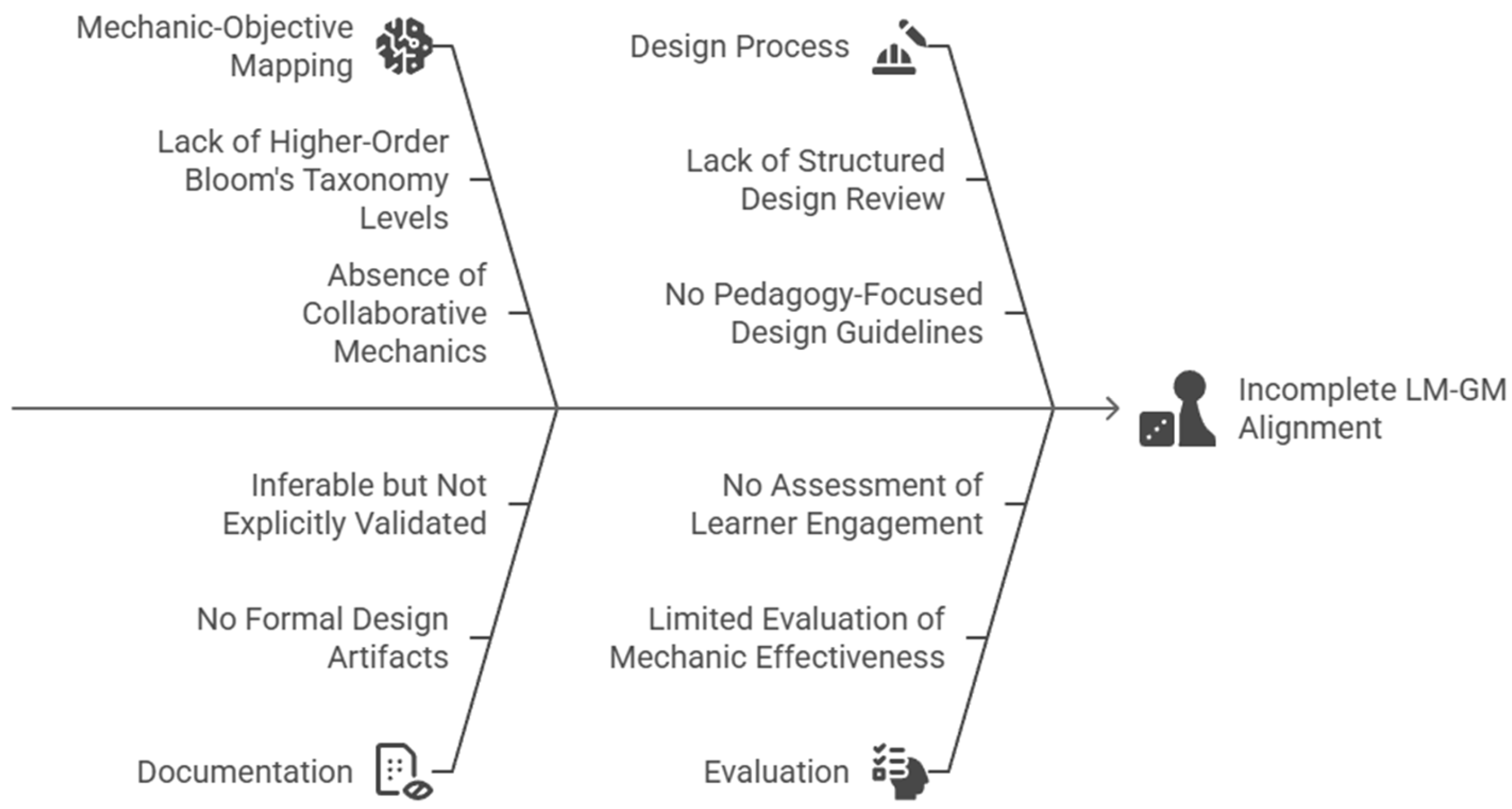
The theoretical limitation is that TContext’s LM-GM alignment was not documented as a formal design artefact using Arnab et al.’s notation system, making it inferable but not explicitly validated. Higher-order Bloom’s taxonomy levels (synthesis and evaluation, Levels 5–6) are not represented in the current mechanic-objective mapping: TContext targets application and analysis but does not require learners to generate novel hazard scenarios or evaluate alternative mitigation strategies. Collaborative game mechanics for social learning objectives are absent. A formal LM-GM design review and documentation exercise would strengthen TContext’s pedagogical auditability. Figure 7 provides an overview of the TContext enhancement.
For LM-GM, the theme key T6 (Design Inferred versus Measured-outcome Evidence) appears as both an advantage and a disadvantage. The mapping between individual game mechanics and learning objectives, such as object inspection supporting hazard identification, is coded as a strength. In contrast, the same mapping is coded as a limitation because it was not formally documented using an established notation system. This indicates that the alignment between TContext’s mechanics and its learning objectives is analytically inferable from the design but has not been substantiated through a formal, auditable design artefact, a distinction between design-level coherence and documented validation.

4.8. Cognitive Theory of Multimedia Learning (CTML)

Mayer’s CTML [27] specifies twelve design principles for organizing visual and auditory information to support learning through dual-channel cognitive processing. TContext’s multimedia design is broadly compliant with CTML’s most important principles. The dual-channel architecture is explicitly employed: visual hazard cues (smoke particle effects, electrical sparks, proximity relationships) and auditory cues (fan sounds, electrical buzz, feedback tones) are presented through separate but synchronized channels. Temporal and spatial contiguity principles are satisfied by co-locating audio and visual information within the same 3D environment. The 10–15-min session duration respects cognitive load constraints implied by limited channel capacity.
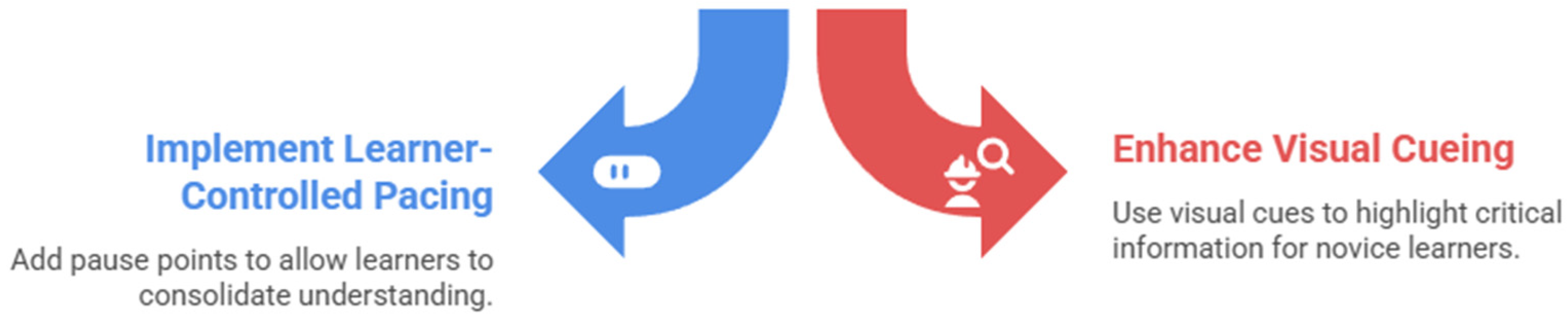
TContext’s alignment with CTML is imperfect in two areas. The segmenting principle, which prescribes learner-controlled pacing between content segments, is not formally implemented: hazard escalation proceeds at a fixed rate without explicit pause points where learners can consolidate their understanding before the scenario advances. The signalling principle, which requires explicit visual or verbal highlighting of the most critical information, is partially applied through audio feedback but not through systematic visual cueing of the key relationships that make a scenario hazardous (for example, a visible directional arrow or glow effect drawing attention to the proximity between a candle and a curtain for novice learners). Figure 8 depicts TContext’s design alignment with Mayer’s CTML.
The theme key T2 (Individualization/Adaptivity) recurs on both sides in CTML. The 10–15-min session duration is coded as a strength for respecting cognitive load limits, while the absence of learner-controlled segmenting and the incomplete application of the signalling principle for novice learners are coded as limitations. This overlap suggests that TContext manages cognitive load reasonably well at an aggregate, session level, but does not yet adapt its pacing or attentional cues to individual learner needs, which is the more fine-grained form of load management that CTML’s segmenting and signalling principles prescribe.

4.9. Design Thinking

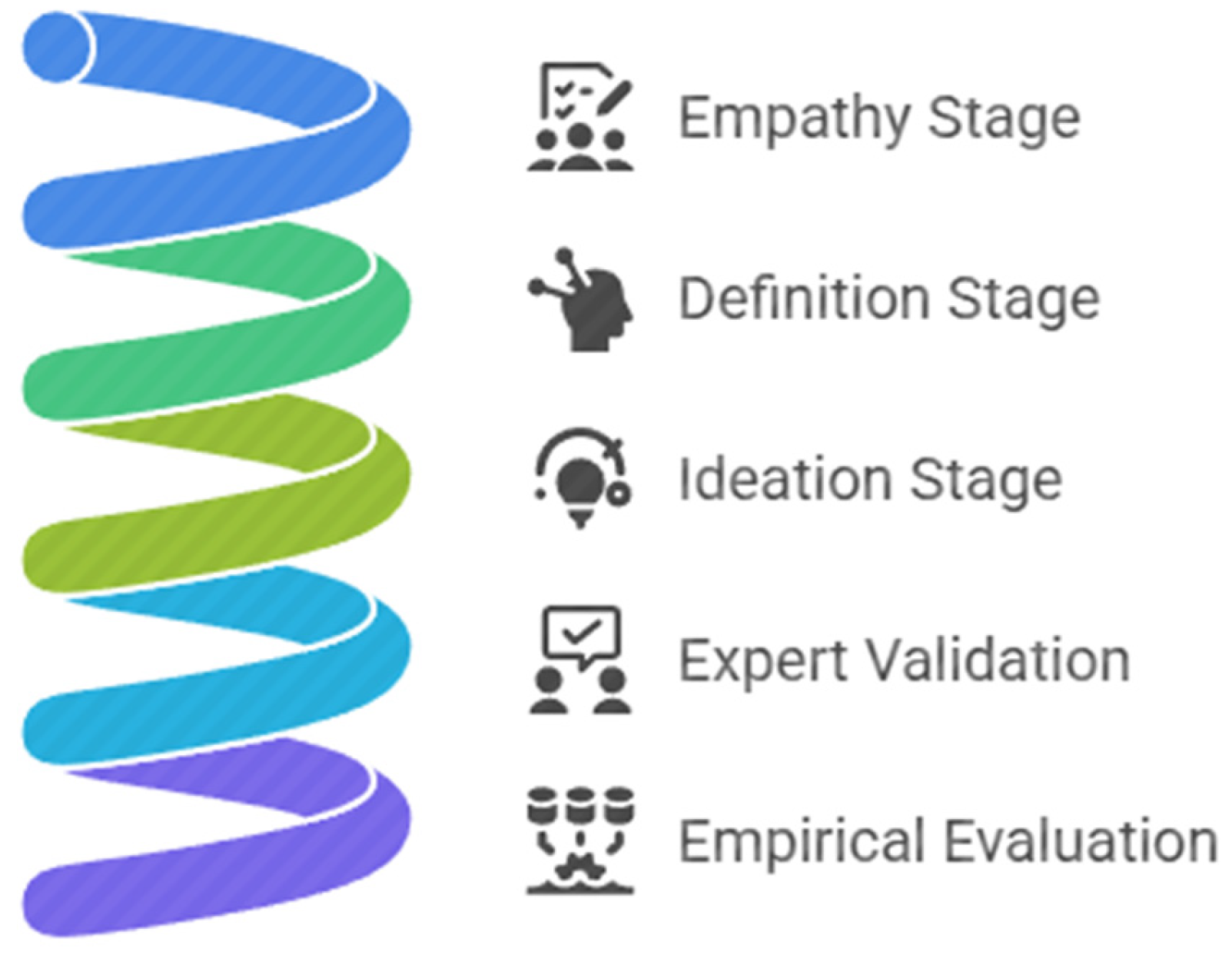
Design Thinking (DT) [28] is a human-centred innovation methodology characterized by iterative cycles of empathy, definition, ideation, prototyping, and testing. The three-phased TContext research program mirrors this methodology with notable fidelity. Phase 1 operationalized the empathy stage through a community survey that grounded the design in documented training failures reported by residents. The five literature-derived design gaps specified in Phase 2 constitute the definition stage. The FireGuard framework development represents ideation, expert validation constitutes a test cycle, and Phase 3 empirical evaluation operationalizes the testing stage at scale.
Design Thinking’s principle of early failure through multiple low-fidelity prototypes is not explicitly documented in the TContext research corpus. The design moved directly from a conceptual framework to a functional VR prototype, which is common in technology-intensive projects but diverges from design thinking’s emphasis on rapid, low-cost iteration. User co-design, in which target users contribute to scenario selection and interaction design, was absent: Phase 1 identified user needs but did not involve users as co-designers. Post-deployment iteration based on real-world usage data has not yet been conducted, leaving the design thinking cycle effectively open. Figure 9 maps the TContext research program design process.
DT Theme keys T1 (Social/Collaborative Mediation) and T5 (Transfer/Longitudinal Validation) overlap as strengths and limitations. T1 is credited with describing the Phase 1 survey as directly empathizing with residents’ training failures; it is also flagged as a limitation because residents did not participate as co-designers and no re-emphasizing phase returned to user needs after testing. T5 follows a similar pattern: the three-phased research design is credited with mirroring the design thinking cycle, while the absence of post-deployment iteration and the incomplete double-diamond cycle are noted as limitations. This pattern indicates that TContext’s development process incorporated user input and an iterative structure early on, but did not sustain that engagement through later, ongoing cycles of co-design and revision.

4.10. Learning Through Problem Solving (LPS)

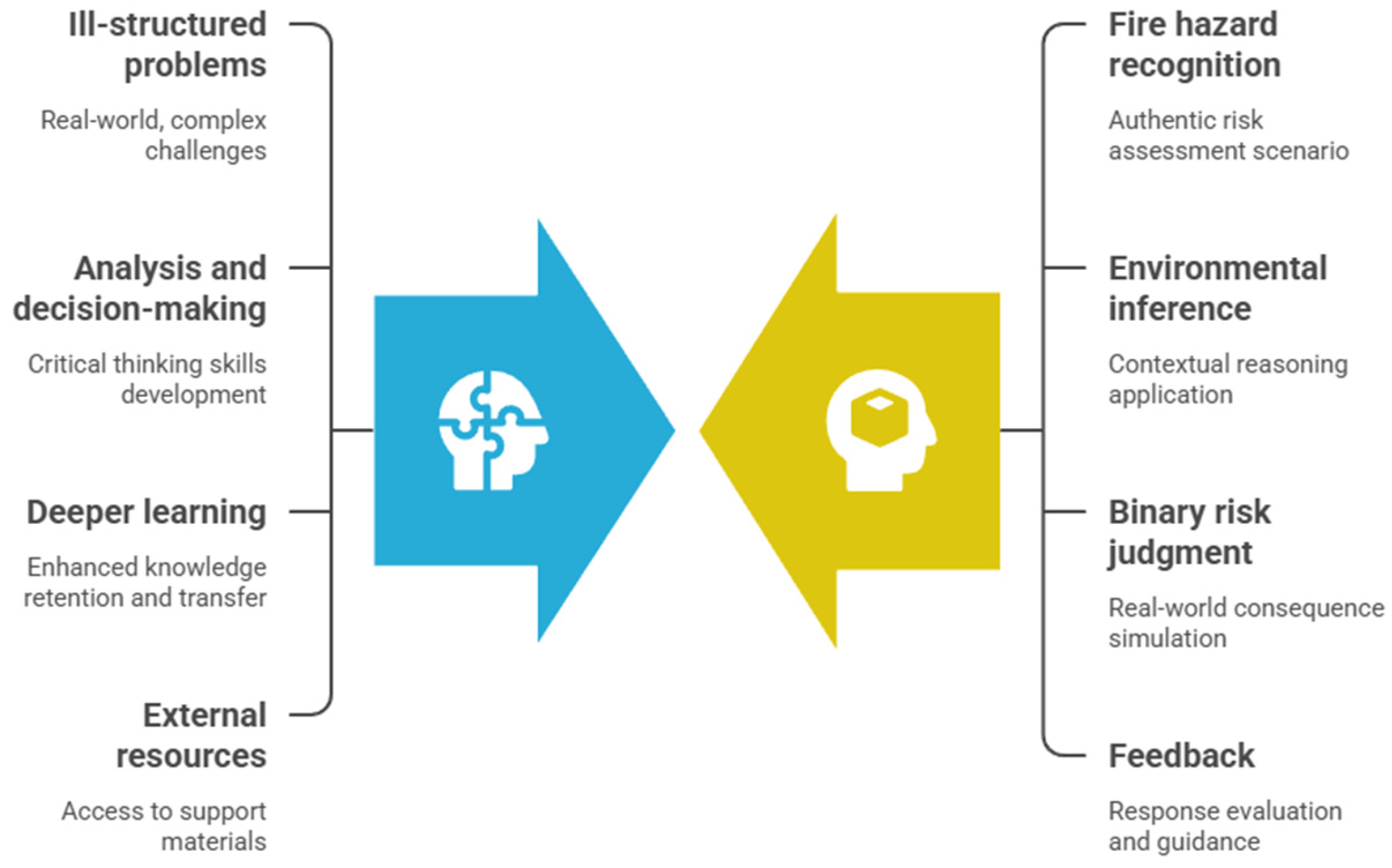
Jonassen’s Learning through Problem Solving framework [29] holds that authentic, ill-structured problems that require analysis and decision-making produce deeper, more transferable learning than well-defined exercises. TContext presents fire hazard recognition as an authentically ill-structured problem: learners must determine whether a given residential configuration constitutes a risk, requiring environmental inference and contextual reasoning rather than fact retrieval. The binary risk-judgment format mirrors Jonassen’s prescription for problems with real-world consequences. The distributed awareness construct introduces multi-hazard problem decomposition, a higher-order LPS cognitive demand.
TContext diverges from LPS in the bounded nature of its problem space. Designers set all problem boundaries; learners respond to pre-specified scenarios rather than formulating their own problem definitions. Jonassen’s ill-structured problem framework emphasizes genuine problem ownership, in which learners identify what is problematic about a situation rather than merely responding to a designer-designated hazard cue. Additionally, LPS frameworks often incorporate access to external resources (manuals, expert consultation, peer discussion) during task performance. TContext offers feedback on correct/incorrect responses but declines to provide expert or peer consultation. Figure 10 summarizes the enhancement through authentic problem-solving.
The authentic, ill-defined nature of the hazard-judgment task and the multi-hazard decomposition requirements are coded as strengths, while the designer-set problem boundaries and the predictable escalation script are coded as limitations for constraining genuine problem ownership, appearing in T4 (Learner Agency/Openness of Inquiry) as overlap. This intersection suggests that TContext presents problems with authentic characteristics but does not extend learner agency to the point of allowing learners to define or bound the problem themselves, which is the fuller expression of openness of inquiry that Jonassen’s framework describes.

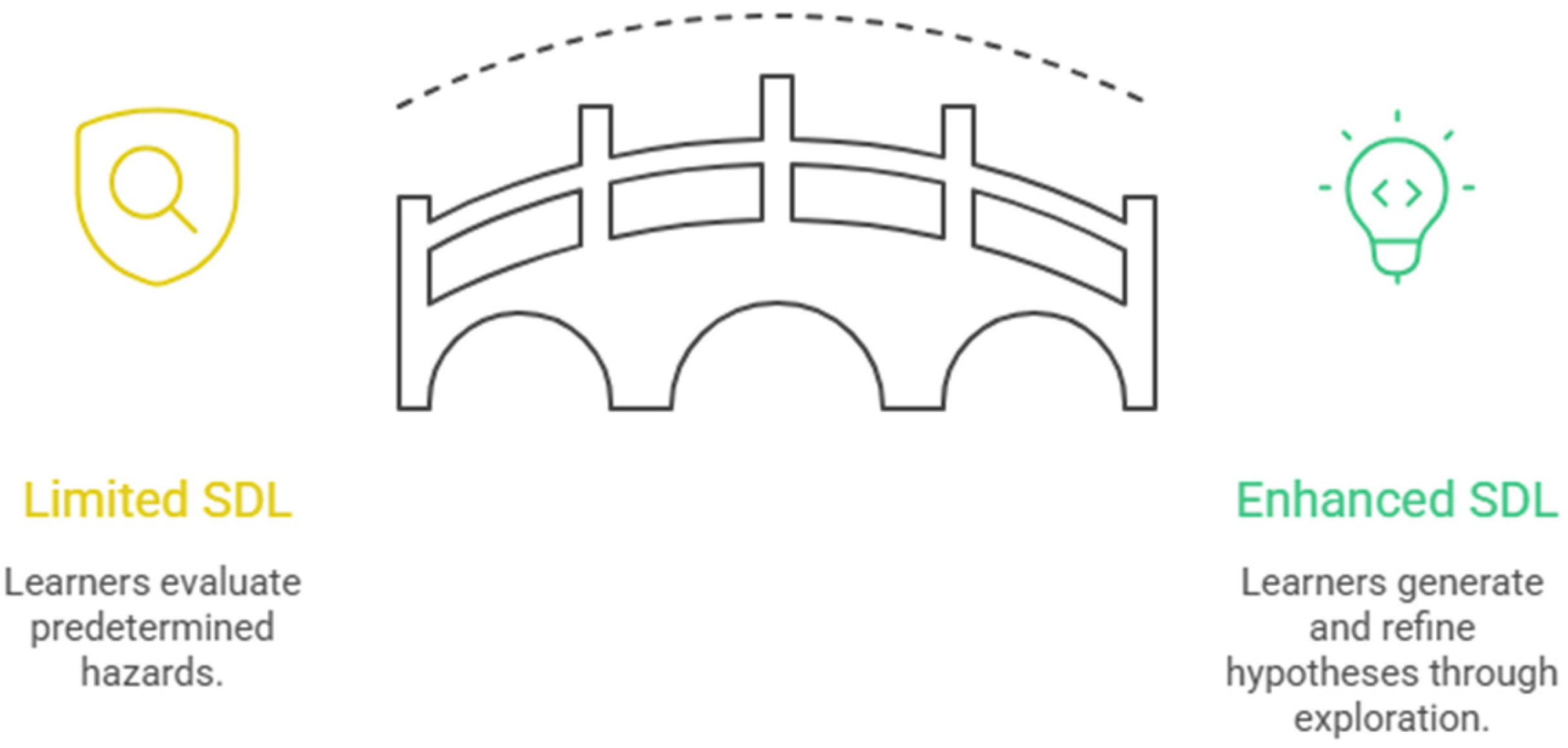
4.11. Scientific Discovery Learning (SDL)

TContext’s alignment with SDL [30,31] is nonetheless constrained in several respects. Learners respond to hazard cues predetermined by the system designers rather than formulating their own hypotheses about where risk might be located, which departs from SDL’s foundational requirement that learners generate, rather than merely evaluate, candidate explanations. The structured T0–T3 escalation sequence further limits learner autonomy, since the system sets the pace and direction of exploration rather than the learner’s investigative choices. TContext also does not provide a hypothesis-generation or prediction interface through which learners could articulate an expectation before receiving feedback, a mechanism that SDL treats as central to genuine discovery. Finally, pure discovery approaches of this kind carry a recognized risk of cognitive overload for novice learners when they are not accompanied by worked examples or other forms of instructional guidance, a risk that TContext’s current design does not explicitly mitigate. Figure 11 highlights the TContext from limited to enhanced discovery learning.
Learners can navigate the residential environment in a self-directed sequence, inspecting objects and rooms in whatever order they choose, which affords exploratory freedom consistent with SDL’s emphasis on learner-driven inquiry. The retry mechanism further supports SDL’s trial-and-refinement process: learners who receive an incorrect judgment can re-engage with the scenario and test a revised hazard assessment, approximating the hypothesis-correction cycle central to discovery-based learning. The multisensory, contextually embedded cues distributed across kitchen, electrical, mechanical, and emergency scenarios also support inductive pattern discovery, allowing learners to build an understanding of hazard indicators through direct engagement with a stimulus-rich environment rather than through direct instruction. T4 (Learner Agency/Openness of inquiry) is coded as a strength, with self-directed spatial exploration and inductive discovery of hazard patterns noted; however, it is also coded as a limitation because learners respond to designer-specified cues rather than generating their own hypotheses, and the structured escalation sequence controls the pace of exploration. T3 shows a related pattern: the retry mechanism is credited with enabling iterative hypothesis-correction, while the absence of a hypothesis-generation or prediction interface is flagged as a limitation. TContext supports exploratory behavior and iterative correction within a bounded structure, without extending to the learner-initiated hypothesis formation that SDL, in its fuller form, requires.

4.12. Social Constructivism

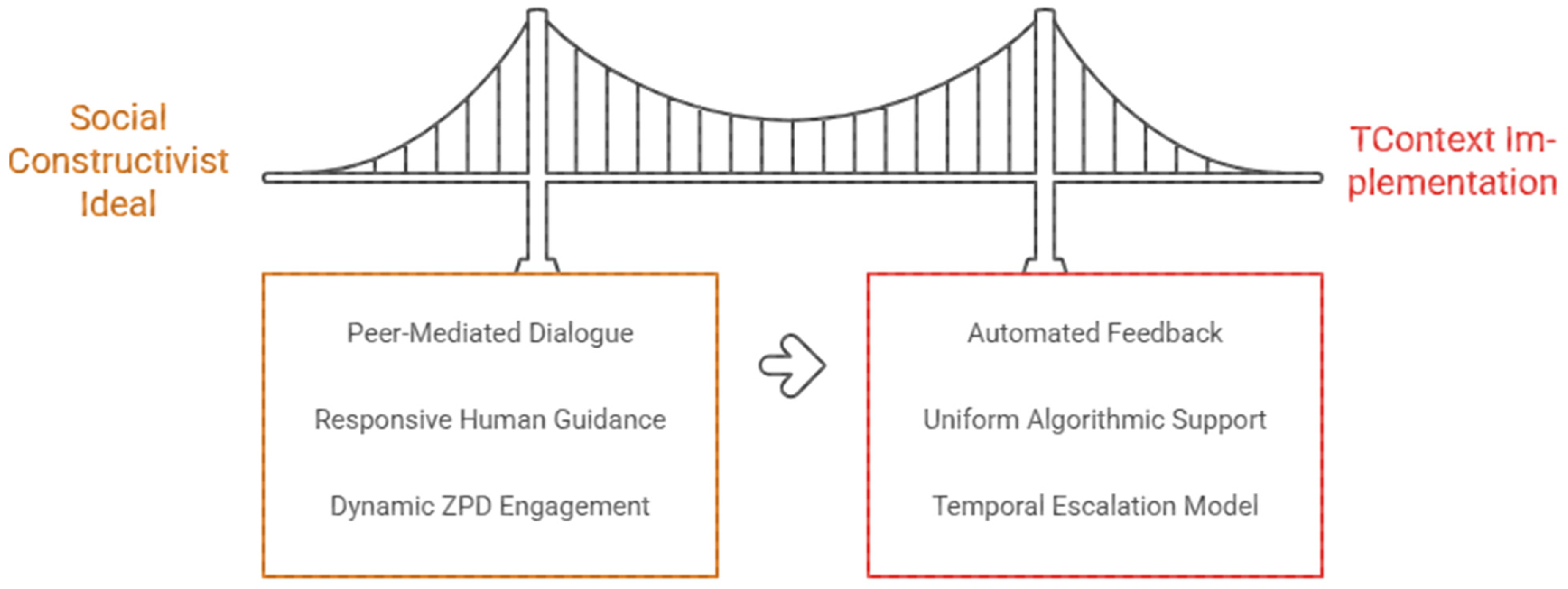
TContext’s divergence from Social Constructivism [21] is more pronounced than for most other frameworks examined in this analysis. As a single-user platform, TContext does not accommodate peer-mediated dialogue or collaborative knowledge construction, both of which Vygotsky treats as the primary mechanism for developing higher cognitive functions. The automated feedback the system provides, while functionally useful, cannot replicate the nuanced, responsive scaffolding a more knowledgeable other can offer in response to a learner’s specific misunderstanding. No shared meaning-making or intersubjective sense-making mechanism is present, since learners do not negotiate understanding with another person during the training experience. Additionally, TContext does not address the cultural and linguistic diversity of its user base in the United Arab Emirates through differentiated social scaffolding, leaving a further gap between the platform’s uniform feedback design and the socially and culturally responsive guidance that Social Constructivism envisions.
Vygotsky’s Social Constructivism holds that higher cognitive functions develop through social interaction, with a more knowledgeable other guiding the learner through a zone of proximal development that lies just beyond the learner’s current independent capability. TContext engages this framework at a structural level. The platform’s immediate audio-visual feedback after each hazard judgment functions as algorithmically mediated scaffolding, offering corrective guidance that partially substitutes for the role of a more knowledgeable other within the zone of proximal development. The T0–T3 temporal escalation model reinforces this alignment by progressively increasing hazard complexity, structurally mirroring the ZPD’s requirement that challenge be calibrated just beyond the learner’s current level of independent competence, so that each stage builds on the capability established at the previous one. Theme keys T1 (Social/Collaborative Mediation) and T2 (Individualization/Adaptivity) each appear as both a strength and a limitation, with T1 showing the most extensive overlap in the consolidated matrix. T1 is credited where immediate audio-visual feedback is interpreted as algorithmically mediated scaffolding within the zone of proximal development. It is also identified as a limitation in several areas, including the absence of peer-mediated dialogue, automated feedback’s inability to replicate a more knowledgeable human other, and the lack of differentiated social scaffolding for TContext’s culturally diverse user base. T2 follows a comparable pattern in the escalation model’s calibration of challenge relative to the learner’s capability, contrasted with the same automated scaffolding’s inability to adapt to individual or cultural variation. This overlap suggests that TContext’s single-user, algorithmically mediated design can approximate certain functions of socially mediated scaffolding but cannot substitute for the interpersonal and culturally responsive dimensions that Vygotsky’s theory considers central to higher cognitive development. Figure 12 illustrates the alignment between the two theories.

4.13. Cognitive Load Theory (CLT)

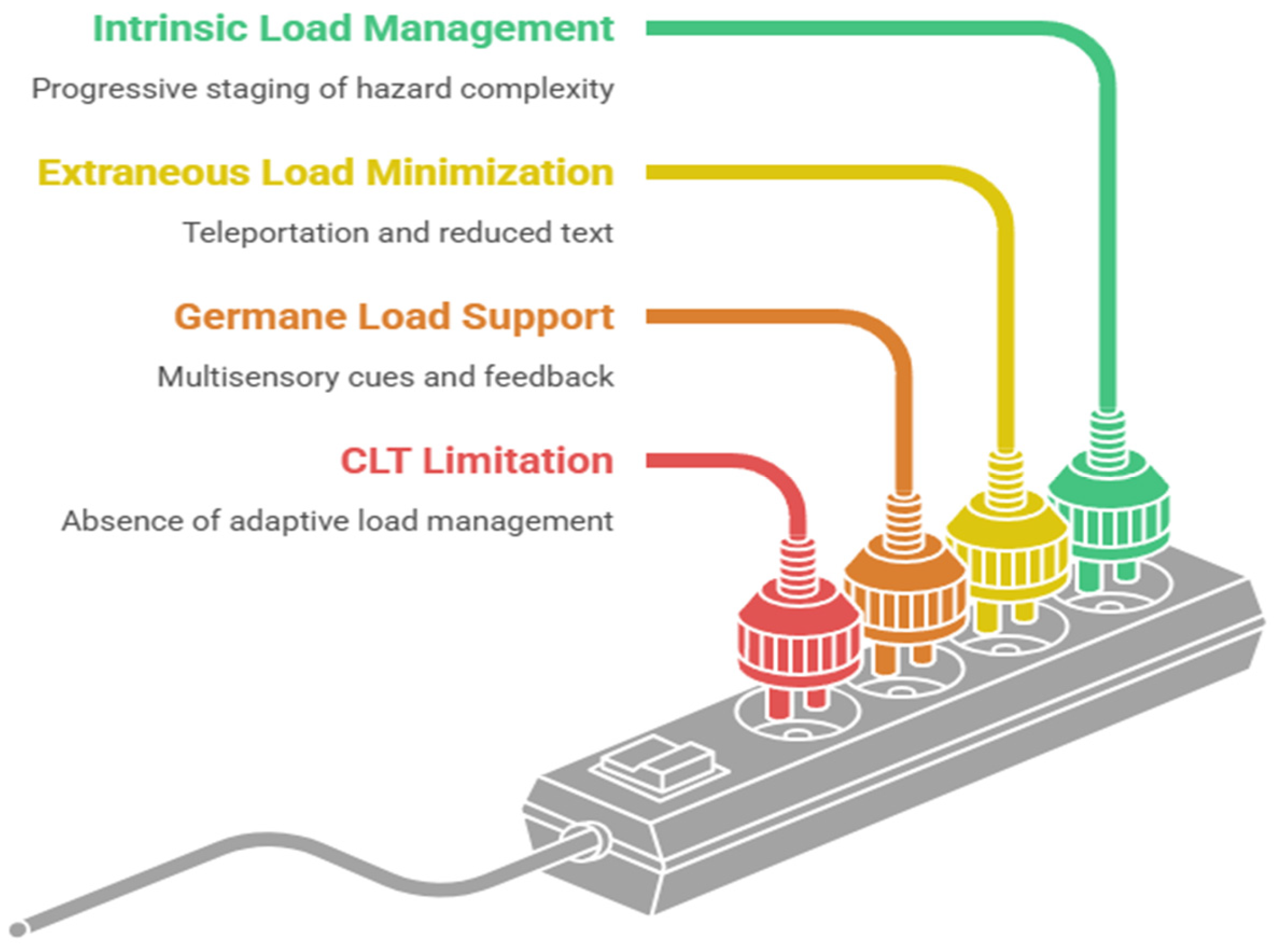
The CLT [33,34] distinguishes three forms of cognitive load: intrinsic (the complexity of the content itself), extraneous (complexity arising from poor instructional design), and germane (cognitive effort devoted to schema formation). TContext’s design demonstrates deliberate attention to all three. T0–T3 progressive staging manages intrinsic load by introducing hazard complexity incrementally. Extraneous load is minimized through teleportation navigation (eliminating physical movement overhead) and reduced on-screen text in the contextual condition. The combination of multisensory cues, immediate feedback, and scene progression appears to support germane load by making hazard-chain structure cognitively legible.
The theoretical limitation relative to CLT is the absence of adaptive load management. CLT predicts working memory overload when intrinsic and extraneous loads combine to exceed individual capacity, but TContext neither measures nor responds to individual load indicators. VR novices may experience extraneous load from hardware familiarization that the current design does not account for. The distributed awareness tasks, requiring simultaneous monitoring of multiple hazards across rooms, may exceed working memory capacity for participants with low prior knowledge. The current design provides no simplified introductory mode for this population. Future versions could incorporate CLT’s element interactivity principle by offering single-hazard practice modes before multi-hazard assessment. Figure 13 provides an overview of Cognitive Load Management in TContext.
T2 (Individualization/Adaptivity) recurs extensively on both sides. Several design features, including teleportation navigation, temporal staging, and the constrained single-session design, are coded as strengths for managing intrinsic and extraneous load. In contrast, the absence of adaptive load management for learners showing signs of overload is coded as a limitation. This overlap indicates that TContext manages cognitive load effectively at the level of overall session design but does not yet respond to load in real time for individual learners, a distinction between static, designed-in load management and dynamic, learner-responsive load management.

4.14. TPACK Framework

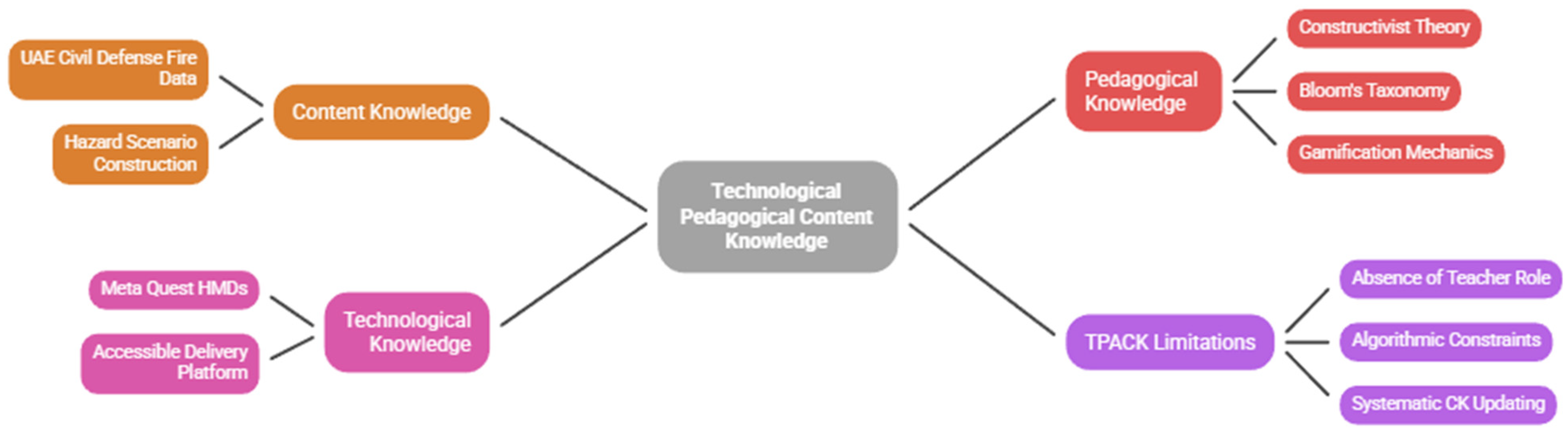
The Technological Pedagogical Content Knowledge framework [35] describes the intersection of content knowledge (CK), pedagogical knowledge (PK), and technological knowledge (TK) as the basis for effective technology-integrated teaching. TContext integrates strongly across all three domains. Content knowledge is evident in the use of UAE Civil Defence fire incident data to construct hazard scenarios that accurately reflect residential fire causation. Pedagogical knowledge is demonstrated through explicit grounding in constructivist theory, targeted application of Bloom’s taxonomy, and the use of gamification mechanics. Technological knowledge is evidenced in the deliberate choice of consumer-grade Meta Quest HMDs as an accessible, affordable delivery platform.
TContext’s TPACK limitations centre on the absence of a teacher or facilitator role. TPACK was developed to characterize the knowledge that teachers need to integrate technology into instructional practice; it presupposes a human pedagogical agent who makes context-sensitive decisions about how content, pedagogy, and technology interact. TContext embeds all PCK decisions within the system itself, supporting scalable autonomous deployment but limiting the framework’s instructional sensitivity to individual learner states to what can be encoded algorithmically. TPACK also emphasizes ongoing reassessment of content knowledge as contexts change: TContext’s UAE-specific CK requires systematic updating as fire incident profiles, building types, and residential demographics evolve. Figure 14 presents the TContext’s TPACK limitations.
T2 is coded as a strength for choosing accessible, scalable consumer-grade hardware, but also as a limitation because TContext does not fully exploit VR’s capabilities for adaptive instruction and does not incorporate emerging technologies such as eye-tracking or biometric sensing. T5 shows a related pattern: the temporal escalation model reflects deep domain knowledge of fire incident development. In contrast, the UAE-specific content knowledge is flagged as needing reassessment when the platform is deployed in different cultural settings. This overlap suggests that TContext’s current technological and content choices suit its original context and hardware generation but have not yet been extended to accommodate either individual adaptivity or cross-context transferability, both of which TPACK treats as integral to sustained technology-integrated instruction.

5. Discussion

5.1. Cross-Framework Synthesis: Where TContext Is Strongest

Across the thirteen frameworks examined, TContext’s theoretical alignment falls into four tiers. The first tier, comprising Experiential Learning Theory, Cognitive Load Theory (CLT), the Cognitive Theory of Multimedia Learning (CTML), Learning Mechanics–Game Mechanics (LM-GM), and Constructivism, shows the closest correspondence between TContext’s architecture and each framework’s core prescriptions. The ELT alignment is structurally evident in the scenario-review-retry cycle mapped onto Kolb’s four stages (Section 4.3); the CLT alignment is demonstrated through progressive T0–T3 staging and teleportation navigation that manage intrinsic and extraneous load (Section 4.13); the CTML alignment is operationalized through a deliberate dual-channel, spatially and temporally contiguous multimedia architecture (Section 4.8); the LM-GM alignment is traceable through the explicit mapping between individual game mechanics and specific learning objectives (Section 4.7); and the Constructivism alignment is evident in TContext’s embedding of hazards within authentic residential contexts and its progressive scaffolding of complexity (Section 4.2). The second tier, comprising Flow Theory, Gamification of Learning, Learning by Doing, and Design Thinking, shows moderate alignment: TContext’s challenge-skill calibration, gamification mechanics, purposeful-action design, and three-phase research process each mirror core elements of these frameworks, but each also lacks a substantive component the framework requires, respectively real-time adaptive difficulty, advanced social or competitive game elements, natural (non-simulated) consequences, and completion of the iterative co-design and post-deployment testing cycle (Section 4.4, Section 4.5 and Section 4.6 and Section 4.9). The third tier, comprising TPACK and Learning through Problem Solving (LPS), shows partial alignment: TContext integrates content, pedagogical, and technological knowledge and presents an authentically ill-structured hazard-judgment task, but both frameworks presuppose elements TContext does not yet provide, namely a human facilitator role and access to external consultation during task performance (Section 4.10 and Section 4.14). The fourth tier, comprising Scientific Discovery Learning (SDL) and Social Constructivism, shows the weakest alignment. TContext’s self-directed navigation and retry mechanism only partially enact SDL’s requirement for learner-generated hypotheses, since hazard cues remain designer-specified and the escalation sequence is system-controlled rather than learner-paced (Section 4.11); and as a single-user platform, TContext cannot satisfy Social Constructivism’s foundational claim that higher cognitive functions develop through peer-mediated dialogue, leaving this framework’s central mechanism, the more knowledgeable other, only weakly approximated by automated feedback (Section 4.12). Taken together, TContext instantiates individual constructivism, cognitive-architecture-oriented, and mechanics-oriented frameworks more fully than the frameworks that require social mediation or learner-generated inquiry.

5.2. Cross-Framework Synthesis: Persistent Gaps

Four persistent theoretical gaps emerge across multiple frameworks. First, the absence of social and collaborative learning is flagged as a limitation relative to Constructivism (social learning), Flow Theory (shared flow states), Gamification (leaderboards, social comparison), LPS (peer consultation), TPACK (the teacher role), LM-GM (collaborative game mechanics), and, most acutely, Social Constructivism, whose foundational claim that higher cognitive functions develop first between people is directly contradicted by TContext’s single-user architecture. TContext is a solitary learning experience in a domain where community-level preparedness ultimately depends on collective action. The omission of collaborative affordances is the single most consequential theoretical gap, recurring across seven of the thirteen frameworks examined. It echoes a broader pattern documented in the wider multi-user VR learning literature [46]. Second, the absence of adaptive personalization is flagged relative to CLT (adaptive load management), Flow Theory (dynamic challenge calibration), Constructivism (zone of proximal development matching), CTML (segmenting and signalling for individual differences), and SDL (scaffolded guidance to prevent misconception formation among novice learners), a gap consistent with recent findings that personalized interaction remains an underdeveloped area across VR training [47]. TContext delivers a uniform experience to all learners regardless of prior knowledge, gaming familiarity, or performance within a session. Given the demographic diversity of the target population, spanning multiple nationalities, education levels, age groups, and VR experience levels, adaptive personalization is not merely a theoretical refinement but a practical equity requirement. Third, the absence of long-term retention and behavioral transfer measurement is flagged relative to ELT (the full experiential cycle), Gamification (sustained engagement), LBD (real-world consequence), LPS (transfer to authentic problems), CLT (durable schema formation), Design Thinking (post-deployment iteration and the incomplete double-diamond cycle), and TPACK (reassessment of content knowledge across contexts and cultures). This gap mirrors a wider pattern in VR safety training research, where a systematic review and meta-analysis found that only a minority of studies incorporated long-term retention measurements [48]. Phase 3 measurements were immediate post-test assessments. Whether TContext produces retained hazard recognition ability after weeks or months, or whether improved VR performance translates into changed behaviour in real domestic settings, remains unknown. Fourth, a constrained form of learner agency recurs as a gap relative to Learning by Doing (learner-directed problem formulation), LPS (genuine problem ownership), SDL (learner-generated hypotheses and self-paced discovery), and Design Thinking (user co-design and participatory iteration). Across these frameworks, TContext consistently presents pre-scripted, designer-bounded scenarios rather than open-ended tasks that learners define or pace themselves. This pattern indicates that TContext enacts active, hands-on engagement within a structure it does not yet permit learners to shape, a distinction between guided doing and self-directed inquiry that recurs throughout the analysis.
TContext is implemented on consumer-grade VR hardware, while proposed future extensions include adaptive learner profiling and collaborative scenarios. These features may require collecting, storing, or exchanging interaction logs, performance records, learner profiles, and possibly peer-to-peer training data. Although a detailed security analysis is beyond the scope of this study, future versions of the platform should acknowledge how such data are handled, where they are stored, who can access them, and what safeguards are required to protect learner privacy. This issue is especially relevant because personalization and collaboration, identified above as major directions for theoretical improvement, may introduce new privacy and security risks if learner analytics, behavioral traces, or shared scenario data are not governed transparently [49].

5.3. TContext as a Multiple-Framework Integrative Model

One key finding of this analysis is that TContext cannot be adequately characterized by reference to any single theoretical framework. It is most accurately described as a multi-framework integrative model: a design that deliberately or implicitly draws on principles from multiple frameworks without fully instantiating any one of them. This is not necessarily a weakness; it may reflect the inherent complexity of immersive, gamified, contextual safety education, which engages cognitive, motivational, experiential, technological, and social learning dimensions simultaneously. The TContext model’s three core constructs, i.e., Contextual Embeddedness, Temporal Stratification, and Distributed Awareness, do not map onto any single existing framework. Contextual Embeddedness draws on Situated Learning Theory and Constructivism. Temporal Stratification extends Endsley’s Situation Awareness levels and aligns with ELT’s concrete experience stage. Distributed Awareness draws on distributed cognition and CLT’s concept of element interactivity. The novelty of TContext lies precisely in combining these constructs into a unified instructional architecture that no prior framework has attempted in the fire safety domain. This conclusion is reinforced, not weakened, by the weakest-alignment tier: neither SDL’s learner-generated discovery process nor Social Constructivism’s peer-mediated dialogue anticipates a system that combines contextual embedding, staged temporal escalation, and distributed multi-hazard monitoring within a single-user, designer-scripted architecture.

5.4. Design Recommendations

Based on the cross-framework analysis, the following design recommendations are proposed for future iterations of TContext: Each recommendation below is derived directly from the coded gaps documented in Table 2 and synthesized in Section 5.2. Based on Table 2 and the T1 to T6 coding schema, the design recommendations are developed.
Collaborative Scenario Mode: Introduce a multi-user scenario mode in which pairs or small groups of learners jointly navigate a hazardous residential environment, debate risk assessments, and coordinate emergency responses. This would address the social learning gaps flagged relative to Constructivism, LPS, and TPACK.
Post-Scenario Structured Debriefing: Add a guided reflective component after each scenario that shows learners a replay of their navigation path, incorrect identifications, and the contextual cues they missed. This addresses the ELT reflective observation gap and supports CLT’s germane load formation.
Adaptive Challenge Algorithm: Implement real-time difficulty adaptation based on per-item accuracy: learners who achieve consistently high scores advance to compressed T0–T3 windows; learners with high error rates receive additional T0–T3 practice with augmented signalling cues. This addresses gaps in Flow Theory and CLT adaptive load management.
Longitudinal Retention Assessment: Extend the evaluation design to include 4-week and 12-week follow-up assessments using the same hazard identification instrument, combined with a home walkthrough behavioral observation task. This is necessary to validate TContext’s alignment with the long-term outcomes implied by ELT, LBD, and LPS.
Participatory Co-Design and Post-Deployment Iteration: Establish a structured mechanism for residents to contribute to scenario selection and interaction design and conduct a post-deployment review cycle that returns to community fire safety needs after real-world use. This addresses the Design Thinking gaps relative to user co-design and the incomplete double-diamond cycle.
Learner Hypothesis-Generation Interface: Introduce an optional interface prompting learners to state an expected hazard judgment before receiving system feedback, paired with lightweight worked-example guidance for novices. This addresses the SDL gaps relative to learner-generated inquiry and the risk of cognitive overload in pure discovery designs.
Formal LM-GM Documentation: Produce a formal LM-GM mapping document for the FireGuard system, specifying the pedagogical function of each game mechanic using Lim et al. [36] notation. This would strengthen theoretical auditability and guide future mechanic additions toward higher-order Bloom objectives.

6. Conclusions

This review compares the TContext fire hazard recognition VR platform against thirteen established learning theories and frameworks. The analysis identified 52 documented strengths and 44 documented limitations, organized into a consolidated strengths-and-limitations matrix and a four-tier cross-framework synthesis that may clarify TContext’s theoretical positioning. TContext appears most closely aligned with Experiential Learning Theory, Constructivism, Cognitive Load Theory, the Cognitive Theory of Multimedia Learning, and Learning Mechanics–Game Mechanics, which seems consistent with the platform’s origins in constructivist and cognitive design traditions. Its alignment appears more moderate with Flow Theory, Gamification of Learning, Learning by Doing, and Design Thinking, and partial with TPACK and Learning through Problem Solving. Scientific Discovery Learning and Social Constructivism appear to be the frameworks where TContext’s current design is least developed, since both call for learner-generated inquiry or peer-mediated dialogue that a single-user, designer-scripted platform is not yet positioned to support.
Four persistent gaps also emerge from the analysis and seem worth noting. Collaborative and social learning affordances appear largely absent, a gap raised in relation to Constructivism, Flow Theory, Gamification, LPS, TPACK, LM-GM, and, perhaps most notably, Social Constructivism. Adaptive personalization also appears limited, a concern echoed across CLT, Flow Theory, Constructivism, CTML, and SDL. Longitudinal evidence of retention and behavioral transfer is not yet available, a gap relevant to ELT, Gamification, Learning by Doing, LPS, CLT, Design Thinking, and TPACK. Finally, learner agency appears somewhat constrained by the platform’s pre-scripted scenario design, a pattern that recurs across Learning by Doing, LPS, SDL, and Design Thinking.
These findings may carry some dual significance. For the design community, they could offer a general improvement roadmap for TContext, one that appears grounded in theoretical considerations rather than broad best practice alone; the seven proposed recommendations, spanning collaborative scenario design, structured debriefing, adaptive difficulty, longitudinal assessment, participatory co-design with post-deployment iteration, and a learner hypothesis-generation interface, are intended to address these gaps in a targeted way. For the research community, the analysis suggests that TContext may function as a multi-framework integrative model that extends beyond any single theoretical tradition, which could be seen as a modest theoretical contribution. The TContext model’s combination of Contextual Embeddedness, Temporal Stratification, and Distributed Awareness does not appear to be fully anticipated by any of the thirteen frameworks examined, including the weakest-alignment tier of SDL and Social Constructivism, suggesting it may represent a comparatively new theoretical construct for designing immersive safety education.
Future research should empirically test the design recommendations proposed in Section 5.4, with particular priority given to longitudinal retention studies, collaborative scenario evaluation, and adaptive difficulty implementation. Cross-cultural validation of TContext in residential fire safety contexts beyond the UAE would further establish its generalisability and situate it within the broader movement toward integrating immersive technologies into fire and rescue training [50].

Author Contributions

Conceptualization, T.F., M.K.T.T. and A.A.M.; methodology, T.F., M.K.T.T. and A.A.M.; validation, T.F., M.K.T.T. and A.A.M.; formal analysis, T.F.; investigation, T.F.; resources, M.K.T.T. and A.A.M.; data curation, T.F.; writing—original draft preparation, T.F.; writing—review and editing, T.F., M.K.T.T. and A.A.M.; visualization, T.F.; supervision, M.K.T.T. and A.A.M.; project administration, Mak Kit Tsun Tee and T.F.; funding acquisition, T.F.. All authors have read and agreed to the published version of the manuscript.

Funding

This research received no external funding. The APC was funded by the corresponding author.

Institutional Review Board Statement

Not applicable.

Informed Consent Statement

Not applicable.

Data Availability Statement

All data supporting the findings of this study are contained within this article and the publications cited herein. No new datasets were generated or analyzed during the current study. The coding framework and associated coding data used in the comparative analysis are available from the corresponding author upon request.

Acknowledgments

This research was conducted with the support of the Swinburne University of Technology Sarawak Campus fee-waiver postgraduate scholarship.

Conflicts of Interest

The authors declare no conflict of interest.

References

  1. Tao, G.; Garrett, B.; Taverner, T.; Cordingley, E.; Sun, C. Immersive virtual reality health games: A narrative review of game design. J. Neuroeng. Rehabil. 2021, 18, 31. [Google Scholar] [CrossRef] [Scilit] [PubMed]
  2. Faiz, T.; Tsun, M.T.K.; Mahmud, A.A.; Sim, K.Y. A Scoping Review on Hazard Recognition and Prevention Using Augmented and Virtual Reality. Computers 2024, 13, 307. [Google Scholar] [CrossRef] [Scilit]
  3. Faiz, T.; Tsun, M.T.K.; Mahmud, A.A. Does Contextual Learning Matter in Fire Hazard Recognition Awareness Campaigns? Front. Virtual Real. 2025, 6, 1638300. [Google Scholar] [CrossRef] [Scilit]
  4. Tsun, M.T.K.; Faiz, T.; Mahmud, A.A. Bridging the Fire Safety Awareness Training Gaps: Survey Findings from Dubai and Sharjah Emirates. Indian. J. Inf. Sources Serv. 2025, 16, 324–337. [Google Scholar] [CrossRef] [Scilit]
  5. Faiz, T.; Tee Kit Tsun, M.; Al Mahmud, A. Enhancing fire hazard recognition through contextual virtual reality learning: A game design approach. Interact. Learn. Environ. 2026, 1–30. [Google Scholar] [CrossRef] [Scilit]
  6. Lave, J.; Wenger, E. Situated Learning: Legitimate Peripheral Participation; Cambridge University Press: Cambridge, UK, 1991. [Google Scholar]
  7. Endsley, M.; Endsley, M.R. Toward a Theory of Situation Awareness in Dynamic Systems. Hum. Factors J. Hum. Factors Ergon. Soc. 1995, 37, 32–64. [Google Scholar] [CrossRef] [Scilit]
  8. Hutchins, E. Cognition in the Wild; The MIT Press: Cambridge, MA, USA, 1995; p. xviii, 381. [Google Scholar]
  9. Reddy, P.J.K.; Revathy, K. Contextual learning. In Digital Skill Development for Industry 4.0; Auerbach Publications: Boca Raton, FL, USA, 2024; pp. 83–104. [Google Scholar]
  10. Kelly, S.D. Temporal awareness. In Phenomenology and Philosophy of Mind; Clarendon Press: Oxford, UK, 2005; pp. 222–234. [Google Scholar]
  11. Hollan, J.; Hutchins, E.; Kirsh, D. Distributed cognition: Toward a new foundation for human-computer interaction research. ACM Trans. Comput.-Hum. Interact. 2000, 7, 174–196. [Google Scholar] [CrossRef] [Scilit]
  12. Muffato, V.; Mazzella di Bosco, M.; Zuzzi, S.; Pellegrini, D.; Meneghetti, C. Fire safety training for workers: An investigation into how learning modalities in VR relate to performance and self-evaluations. Front. Psychol. 2026, 17, 1740985. (In English) [Google Scholar] [CrossRef] [Scilit] [PubMed]
  13. Miller, A.L.; Lambert, A.D. Open-Ended Survey Questions: Item Nonresponse Nightmare or Qualitative Data Dream? Surv. Pract. 2014, 7. [Google Scholar] [CrossRef] [Scilit]
  14. Creswell, J.W.; Creswell, J.D. Research Design: Qualitative, Quantitative, and Mixed Methods Approaches; SAGE Publications: Thousand Oaks, CA, USA, 2014. [Google Scholar]
  15. Doğan, E.; Şahin, F.; Şahin, Y.L.; Kobak, K.; Okur, M.R. Enhancing clinical law education through immersive virtual reality: A flow experience perspective. Learn. Instr. 2024, 94, 101989. [Google Scholar] [CrossRef] [Scilit]
  16. Thomas, J.; Harden, A. Methods for the thematic synthesis of qualitative research in systematic reviews. BMC Med. Res. Methodol. 2008, 8, 45. [Google Scholar] [CrossRef] [Scilit] [PubMed]
  17. Marougkas, A.; Troussas, C.; Krouska, A.; Sgouropoulou, C. Virtual Reality in Education: A Review of Learning Theories, Approaches and Methodologies for the Last Decade. Electronics 2023, 12, 2832. [Google Scholar] [CrossRef] [Scilit]
  18. Moher, D.; Liberati, A.; Tetzlaff, J.; Altman, D.; Moher, D.; Liberati, A.; Tetzlaff, J.; Altman, D.G.; The PRISMA Group. Preferred Reporting Items for Systematic Reviews and Meta-Analyses: The PRISMA Statement. J. Clin. Epidemiol. 2009, 62, 1006–1012. [Google Scholar] [CrossRef] [Scilit] [PubMed]
  19. Kitchenham, B. Procedures for Performing Systematic Reviews; Keele University: Keele, UK, 2004; Volume 33. [Google Scholar]
  20. Piaget, J. The Origin of Intelligence in Children; International Universities Press, Inc.: New York, NY, USA, 1952; Available online: https://www.scirp.org/reference/referencespapers?referenceid=2284793 (accessed on 17 June 2026). [CrossRef] [Scilit]
  21. Vygotsky, L.S. Mind in Society: The Development of Higher Psychological Processes; Harvard University Press: Cambridge, MA, USA, 1978; Volume 86. [Google Scholar]
  22. Kolb, D. Experiential Learning: Experience as The Source of Learning and Development; Prentice Hall: Hoboken, NJ, USA, 1984; Volume 1. [Google Scholar]
  23. Hamari, J.; Koivisto, J.; Sarsa, H. Does Gamification Work?—A Literature Review of Empirical Studies on Gamification. In Proceedings of the 2014 47th Hawaii International Conference on System Sciences, Waikoloa, HI, USA, 6–9 January 2014; pp. 3025–3034. [Google Scholar]
  24. Deterding, S.; Dixon, D.; Khaled, R.; Nacke, L. From Game Design Elements to Gamefulness: Defining Gamification. In Proceedings of the 15th International Academic MindTrek Conference: Envisioning Future Media Environments, Tampere, Finland, 29–30 September 2011; Volume 11, pp. 9–15. [Google Scholar]
  25. Dewey, J. Experience and Education. Kappa Delta Pi 1938. [Online]. Available online: https://dn720204.ca.archive.org/0/items/experienceeducat00dewe_0/experienceeducat00dewe_0.pdf (accessed on 17 June 2026).
  26. Csikszentmihalyi, M. Flow: The Psychology of Optimal Experience. 1990. Available online: https://www.researchgate.net/publication/224927532_Flow_The_Psychology_of_Optimal_Experience (accessed on 17 June 2026).
  27. Mayer, R. The Past, Present, and Future of the Cognitive Theory of Multimedia Learning. Educ. Psychol. Rev. 2024, 36, 8. [Google Scholar] [CrossRef] [Scilit]
  28. Brown, T. Design Thinking. Harv. Bus. Rev. 2008, 86, 84–92, 141. [Google Scholar] [PubMed]
  29. Jonassen, D.H. Toward a design theory of problem solving. Educ. Technol. Res. Dev. 2000, 48, 63–85. [Google Scholar] [CrossRef] [Scilit]
  30. Sedlák, M.; Šašinka, Č.; Stachoň, Z.; Chmelík, J.; Doležal, M. Collaborative and individual learning of geography in immersive virtual reality: An effectiveness study. PLoS ONE 2022, 17, e0276267. (In English) [Google Scholar] [CrossRef] [Scilit] [PubMed]
  31. de Jong, T.; van Joolingen, W. Scientific Discovery Learning with Computer Simulations of Conceptual Domains. Rev. Educ. Res. 1998, 68, 179–201. [Google Scholar] [CrossRef]
  32. Southgate, E.; Smith, S.P.; Cividino, C.; Saxby, S.; Kilham, J.; Eather, G.; Scevak, J.; Summerville, D.; Buchanan, R.; Bergin, C. Embedding immersive virtual reality in classrooms: Ethical, organisational and educational lessons in bridging research and practice. Int. J. Child-Comput. Interact. 2019, 19, 19–29. [Google Scholar] [CrossRef] [Scilit]
  33. Sweller, J. Cognitive load during problem solving: Effects on learning. Cogn. Sci. 1988, 12, 257–285. [Google Scholar] [CrossRef] [Scilit]
  34. Sweller, J.; Van Merrienboer, J.J.G.; Paas, F. Cognitive Architecture and Instructional Design: 20 Years Later. Educ. Psychol. Rev. 2019, 31, 261–292. [Google Scholar] [CrossRef] [Scilit]
  35. Koehler, M.; Mishra, P.; Akcaoglu, M.; Rosenberg, J. The Technological Pedagogical Content Knowledge Framework for Teachers and Teacher Educators; Springer: New York, NY, USA, 2013. [Google Scholar]
  36. Lim, T.; Carvalho, M.B.; Bellotti, F.; Arnab, S.; De Freitas, S.; Louchart, S.; Suttie, N.; Berta, R.; De Gloria, A. The LM-GM Framework for Serious Games Analysis; University of Pittsburgh: Pittsburgh, PA, USA, 2015. [Google Scholar]
  37. Hsieh, H.F.; Shannon, S.E. Three approaches to qualitative content analysis. Qual. Health Res. 2005, 15, 1277–1288. [Google Scholar] [CrossRef] [Scilit] [PubMed]
  38. Carroll, C.; Booth, A.; Cooper, K. A worked example of “best fit” framework synthesis: A systematic review of views concerning the taking of some potential chemopreventive agents. BMC Med. Res. Methodol. 2011, 11, 29. [Google Scholar] [CrossRef] [Scilit] [PubMed]
  39. Lave, J.; Wenger, E. Learning in doing: Social, cognitive, and computational perspectives. Situated Learn. Legitimate Peripher. Particip. 1991, 10, 109–155. [Google Scholar] [CrossRef] [Scilit]
  40. Jackson, S.A.; Marsh, H. Development and validation of a scale to measure optimal experience: The Flow State Scale. J. Sport. Exerc. Psychol. 1996, 18, 17–35. [Google Scholar] [CrossRef] [Scilit]
  41. Arnab, S.; Lim, T.; Carvalho, M.; Bellotti, F.; Freitas, S.; Louchart, S.; Suttie, N.; Berta, R.; De Gloria, A. Mapping learning and game mechanics for serious games analysis: Mapping learning and game mechanics. Br. J. Educ. Technol. 2014, 46, 391–411. [Google Scholar] [CrossRef] [Scilit]
  42. Johansson-Sköldberg, U.; Woodilla, J.; Çetinkaya, M. Design Thinking: Past, Present and Possible Futures. Creat. Innov. Manag. 2013, 22, 121–146. [Google Scholar] [CrossRef] [Scilit]
  43. Bruner, J.S. The act of discovery. Harv. Educ. Rev. 1961, 31, 21–32. [Google Scholar]
  44. Mayer, R.E. Should There Be a Three-Strikes Rule Against Pure Discovery Learning? Am. Psychol. 2004, 59, 14–19. [Google Scholar] [CrossRef] [Scilit] [PubMed]
  45. McLeod, S. Vygotsky’s Theory of Cognitive Development. 2024. Available online: https://zenodo.org/records/15680745 (accessed on 10 June 2026).
  46. Wehrmann, F.; Zender, R. A Systematic Review of Cooperation in Multi-User Virtual Reality Learning Environments. J. Comput. Assist. Learn. 2025, 41, e70112. [Google Scholar] [CrossRef] [Scilit]
  47. Li, T.; Zhu, Y.; Liang, H.-N.; Wang, Y. Adapting to the User: A Systematic Review of Personalized Interaction in VR. arXiv 2025. [Google Scholar] [CrossRef] [Scilit]
  48. Scorgie, D.; Feng, Z.; Paes, D.; Parisi, F.; Yiu, T.W.; Lovreglio, R. Virtual reality for safety training: A systematic literature review and meta-analysis. Saf. Sci. 2024, 171, 106372. [Google Scholar] [CrossRef] [Scilit]
  49. Garrido, G.; Nair, V.; Song, D. SoK: Data Privacy in Virtual Reality. Proc. Priv. Enhancing Technol. 2024, 2024, 21–40. [Google Scholar] [CrossRef] [Scilit]
  50. Hancko, D.; Majlingova, A.; Kačíková, D. Integrating Virtual Reality, Augmented Reality, Mixed Reality, Extended Reality, and Simulation-Based Systems into Fire and Rescue Service Training: Current Practices and Future Directions. Fire 2025, 8, 228. [Google Scholar] [CrossRef] [Scilit]
Figure 1. True-Context Framework.
Virtualworlds 05 00046 g001
Figure 2. TContext strengths and limitations with respect to Constructivism.
Virtualworlds 05 00046 g002
Figure 3. TContext’s alignment with Kolb’s Experiential Learning Theory.
Virtualworlds 05 00046 g003
Figure 4. Gamification Approach for Training Design.
Virtualworlds 05 00046 g004
Figure 5. TContext’s alignment with Dewey’s Philosophy.
Virtualworlds 05 00046 g005
Figure 6. TContext’s Flow Theory Challenges.
Virtualworlds 05 00046 g006
Figure 7. Enhancing LM-GM Alignment in TContext.
Virtualworlds 05 00046 g007
Figure 8. Alignment of TContext’s design with Mayer’s CTML.
Virtualworlds 05 00046 g008
Figure 9. TContext Research Program Design Process.
Virtualworlds 05 00046 g009
Figure 10. Enhancing Learning Through Authentic Problem Solving.
Virtualworlds 05 00046 g010
Figure 11. TContext Transitions from Limited SDL To Enhanced Discovery Learning.
Virtualworlds 05 00046 g011
Figure 12. TContext Alignment with Social Constructivism.
Virtualworlds 05 00046 g012
Figure 13. Cognitive Load Management in TContext.
Virtualworlds 05 00046 g013
Figure 14. Technological Pedagogical Content Knowledge Framework.
Virtualworlds 05 00046 g014
Table 1. Theme name and keys.
Theme NameTheme Key
Social/Collaborative MediationT1
Individualization/AdaptivityT2
Reflective/Metacognitive ProcessingT3
Learner Agency/Openness of inquiryT4
Transfer/Longitudinal ValidationT5
Design Inferred vs. Measured-outcome EvidenceT6
Table 2. Consolidated strengths and limitations of TContext against learning frameworks.
FrameworkStrengths of TContextLimitations of TContext
Constructivism [20,21]1. TContext embeds hazards in familiar domestic settings, fulfilling constructivism’s demand that knowledge is built through direct experience in context (T4).
2. Learners construct mental models by navigating authentic residential fire scenarios rather than receiving symbolic instruction (T4).
3. The T0–T3 temporal escalation model scaffolds knowledge construction progressively, mirroring the zone of proximal development (T2).
4. Immediate audio-visual feedback mirrors social constructivism’s emphasis on corrective dialogue with a knowledgeable agent (T1).
1. TContext does not accommodate social constructivism’s peer-interaction requirement; all learning is solitary (T1).
2. Scaffolding is uniform rather than individually adapted to each learner’s prior knowledge level (T2).
3. No collaborative scenario mode; group sense-making, central to Vygotskian approaches, is absent (T1).
Experiential Learning Theory (ELT) [22]1. TContext’s structure maps directly onto Kolb’s cycle: concrete experience (VR exploration), reflective observation (post-scenario review), abstract conceptualization (score-based pattern recognition), and active experimentation such as retry attempts (T3).
2. Retry functionality enables iterative cycling through the experiential loop within a single session (T3).
3. Multisensory cues (smoke visuals, electrical spark sounds) enrich the concrete experience stage beyond what passive media can provide (T6).
4. Scenario diversity across kitchen, living room, electrical, and emergency contexts broadens experiential breadth (T5).
5. TContext’s pre-test/post-test experimental design operationalizes ELT’s requirement for empirical validation of learning gain through the full experiential cycle, demonstrating that contextual VR engagement produces measurable improvement over non-contextual delivery (T6).
1. The reflective observation stage is underdeveloped; TContext provides score feedback but no structured debriefing or journaling mechanism (T3).
2. Abstract conceptualization is implicit; TContext does not prompt learners to articulate transferable principles after scenario completion (T3).
3. Transfer to real-world behavior beyond the VR session is untested, a known weakness in all short-cycle experiential designs (T5).
Gamification of Learning [24]1. TContext employs core game mechanics: point scoring, progressive hazard levels, success/failure audio feedback, and minimum performance thresholds for progression (T6).
2. Gamification sustains motivation through challenge calibration; the 7/10 pass threshold creates goal-directed persistence evidenced by five voluntary retries (T2, T6).
3. Score visibility and immediate feedback operationalize reinforcement without extrinsic rewards alone, aligning with self-determination theory within gamification (T3).
4. Narrative residential context converts abstract safety knowledge into meaningful, story-embedded decision points (T4).
1. TContext lacks advanced gamification elements such as social comparison, badges, or unlockable content that sustain long-term engagement (T1).
2. The gamification layer is not culturally differentiated; reward structures may carry different motivational salience across TContext’s diverse user base (T2).
3. Risk of performance focus displacing genuine learning: learners may optimize for scoring rather than genuine hazard comprehension (T4).
Learning by Doing (LBD) [25]1. TContext operationalizes Dewey’s core principle: fire hazard learning is structured as purposeful action in a realistic environment, not passive reception (T4).
2. Six-degrees-of-freedom (6DoF) movement enables learners to physically inspect object relationships (e.g., candle proximity to the curtain) as an act of doing (T4).
3. Interaction mechanics requiring selection and risk-status assessment of objects embody Dewey’s insistence on learner agency in the inquiry process (T4).
4. The training-then-assessment sequence mirrors Dewey’s problem-action-consequence cycle (T3, T5).
1. TContext’s virtual actions carry no physical consequences; Dewey’s emphasis on natural consequences is attenuated in simulation (T3).
2. The structured scenario sequence constrains open-ended inquiry; Dewey’s progressive education favors learner-directed problem formulation, which TContext does not support (T4).
3. Skill transfer to actual fire emergency actions is not empirically verified (T5).
Flow Theory (FT) [26]1. TContext’s challenge-skill balance is structured through the T0–T3 escalation model: hazards begin non-threatening and escalate, maintaining challenge progression (T2).
2. The 7/10 minimum score threshold prevents boredom from trivially easy tasks and anxiety from overwhelming difficulty (T2).
3. Phase 3 SUS data confirming high engagement and immersion scores indicate that TContext consistently evokes flow-state conditions (T6).
4. Temporal pressure inherent in escalating hazard scenarios creates focused attention characteristic of flow (T4).
1. TContext does not dynamically adapt challenge level to individual performance in real time; learners with markedly different skill levels receive identical scenario difficulty (T2).
2. Flow measurement in TContext is indirect (SUS and engagement scales); dedicated flow measurement instruments (e.g., Flow State Scale) were not deployed (T6).
3. Repeated retry sessions may reduce novelty and therefore reduce flow propensity across multiple uses (T5).
4. TContext does not incorporate dedicated flow measurement instruments such as the Flow State Scale [40]; relying solely on SUS and general engagement scales provides indirect evidence of flow, limiting the precision of flow-based design evaluation and iteration (T6).
Learning Mechanics–Game Mechanics (LM-GM) [36,41]1. TContext demonstrates explicit LM-GM alignment: the game mechanic of object inspection maps to the learning mechanic of hazard identification; temporal escalation maps to anticipatory reasoning (T6).
2. Score progression mechanics are linked to contextual awareness outcomes, not merely task completion, strengthening the pedagogical function of game design (T6).
3. Teleportation as an attentional allocation mechanic directly serves the distributed awareness learning construct (T4).
4. 6DoF serves spatial cognition and multi-angle hazard inspection as a mapped mechanic-mechanic pair (T4).
1. The LM-GM mapping in TContext was not formally documented as a design artefact; alignment is inferable but not explicitly validated against the Arnab et al. framework [41] (T6).
2. Higher-order mechanics for synthesis and evaluation-level outcomes (Bloom Levels 5–6) are absent; TContext targets application and analysis only (T3).
3. Collaborative game mechanics that support social learning objectives are not present (T1).
Cognitive Theory of Multimedia Learning (CTML) [27]1. TContext uses dual-channel presentation: visual (3D environments, escalating fire cues, smoke particle effects) and auditory (electrical buzz, smoke fan sounds, feedback tones) channels are deliberately separated to exploit both cognitive channels (T6).
2. Temporal and spatial contiguity principles are satisfied: audio cues are synchronized with the visual hazard events they describe (T6).
3. TContext’s 10–15-min training sessions respect the cognitive load limits implied by CTML’s limited channel capacity principle (T2).
4. Scenario-based organization reduces split attention; related visual and auditory elements are co-presented within the same 3D space (T6).
5. TContext’s gamified scenario structure avoids the seductive details effect; all multimedia elements such as fire visuals, audio cues, and hazard escalation animations serve direct pedagogical functions aligned with fire hazard learning objectives, with no decorative or irrelevant media present (T6).
1. TContext does not comply with CTML’s segmenting principle in a structured way; hazard sequences are not explicitly chunked with learner-controlled pace breaks (T2).
2. On-screen text was present, creating a potential redundancy effect (T2).
3. CTML’s signalling principle is partially applied; not all critical hazard relationships are explicitly highlighted for novice learners (T2).
Design Thinking (DT) [28,42]1. TContext’s three-phased research design (survey, framework, experiment) mirrors design thinking’s empathize-define-ideate-prototype-test cycle (T5).
2. Phase 1 survey directly empathized with Dubai/Sharjah residents’ training failures, producing user-centred design requirements (T1).
3. Phase 2 expert validation with eight domain experts operationalized the test phase of design thinking and produced iterative refinements (T6).
4. Modular scenario architecture (kitchen, living room, electrical, emergency) supports iterative redesign of individual components without system-wide rebuilds (T5).
1. The design thinking principle of early failure is not explicitly documented (T6).
2. User co-design (participatory design) was absent; residents did not contribute to scenario selection or interaction design (T1).
3. Post-deployment iteration based on real-world use data has not yet been conducted, leaving the design thinking cycle incomplete (T5).
4. No explicit re-emphasizing phase was conducted during the evaluation in TContext. Design Thinking’s iterative double diamond cycle requires returning to user needs after testing to validate that design solutions continue to align with evolving community fire safety requirements [28] (T1, T5).
Learning through Problem Solving (LPS) [29]1. TContext presents each hazard scenario as an authentic, ill-defined problem: learners must determine whether a given environmental configuration constitutes a risk, requiring analysis rather than recall (T4).
2. The binary risk-judgment structure mirrors LPS problem formats with real-world consequences, grounding the problem in learners’ actual domestic environments (T5).
3. Distributed awareness tasks require simultaneous multi-hazard problem decomposition, a higher-order LPS cognitive demand (T4).
4. Feedback after incorrect identification supports metacognitive reflection on problem-solving errors (T3).
1. TContext does not support open-ended problem formulation; all problem boundaries are set by designers, limiting authentic problem ownership (T4).
2. Ill-structured problem features are constrained; hazard scenarios follow a predictable escalation script, reducing the genuine ambiguity central to LPS (T4).
3. No external resource access (manuals, peers, expert consultation) is available during task performance, which LPS frameworks often incorporate (T1).
Scientific Discovery Learning (SDL) [31,43]1. TContext’s VR environment affords self-directed spatial exploration; learners navigate and inspect objects in their chosen sequence, partially enacting SDL’s principle of learner-driven inquiry and discovery within authentic domestic contexts (T4).
2. The retry mechanism enables iterative hypothesis-correction cycles analogous to SDL’s trial-and-refinement process; learners who receive incorrect feedback can re-engage with the scenario to test revised hazard judgments (T3).
3. Multisensory, contextually embedded cues across kitchen, electrical, mechanical, and emergency scenarios enable inductive discovery of hazard patterns, supporting SDL’s principle that learners discover underlying rules through direct engagement with stimulus-rich environments (T4).
1. TContext hazard scenarios are reviewed by HCI experts; learners respond to designated hazard cues rather than formulating their own hypotheses about environmental risk, directly contradicting SDL’s foundational requirement for learner-generated inquiry and self-directed problem definition [43] (T4).
2. The structured T0–T3 escalation sequence controls the pace and direction of exploration; SDL requires learner autonomy over the discovery trajectory and the sequencing of inquiry steps [31] (T4).
3. No hypothesis-generation or prediction interface is provided; SDL typically requires learners to explicitly state expected outcomes before receiving feedback, a cognitive step that deepens knowledge construction through prediction-error learning [44] (T3, T4).
4. Pure discovery approaches carry significant risk of cognitive overload for novice learners without worked examples or instructional guidance;
TContext provides binary feedback but lacks scaffolded example demonstrations that SDL research identifies as essential for preventing misconception formation (T2).
Social Constructivism [21]1. TContext’s immediate audio-visual feedback partially enacts the role of a More Knowledgeable Other (MKO) by providing corrective guidance after each hazard judgment, offering a form of algorithmically mediated scaffolding within the ZPD (T1).
2. The T0–T3 temporal escalation operationalizes a form of systemic scaffolding by progressively increasing hazard complexity, structurally mirroring the Zone of Proximal Development (ZPD)’s requirement that challenge be calibrated just beyond the learner’s current independent capability (T2).
1. TContext is a single-user platform; peer-mediated dialogue and collaborative knowledge construction through social interaction are absent, directly violating Social Constructivism’s foundational claim that all higher cognitive functions arise first between people before being internalized (T1).
2. Automated audio-visual feedback cannot replicate the nuanced, responsive scaffolding of a human MKO (More Knowledge Other); the system delivers binary correct/incorrect signals rather than the dialogic, context-sensitive support that Vygotsky identifies as the mechanism through which the ZPD is bridged [45] (T1, T2).
3. No shared meaning-making or intersubjective sense-making mechanisms exist; fire preparedness is inherently a community-level concern requiring collective interpretation of domestic risks; nevertheless, TContext’s solitary architecture forecloses this dimension entirely (T1).
4. The cultural and linguistic diversity of TContext’s UAE target population is not addressed through differentiated social scaffolding; Social Constructivism emphasizes that cultural tools and language are the primary mediators of cognitive development, requiring culturally responsive interaction design that goes beyond multilingual audio narration (T1, T2).
Cognitive Load Theory (CLT) [33,34]1. TContext’s 10–15-min scenario sessions contain extraneous cognitive load by limiting irrelevant environmental complexity (T2).
2. Teleportation eliminates physical navigation overhead, freeing working memory for hazard-recognition processing (T2).
3. Temporal staging (T0 to T3) manages intrinsic load by sequencing hazard complexity progressively rather than presenting fully developed fires immediately (T2).
4. Audio-visual feedback provides immediate load-efficient error correction without requiring learners to hold error states in working memory (T3).
5. TContext’s single-session constrained design (10–15 min) aligns with the element interactivity principle; by limiting per-session exposure to one residential context, the platform prevents element interactivity from escalating beyond working memory capacity before learners have formed foundational hazard schemas (T2).
1. Distributed awareness tasks, requiring simultaneous multi-hazard monitoring, may exceed working memory capacity for VR novices or lower-literacy learners (T2).
2. TContext does not include adaptive load management; intrinsic load is not dynamically reduced for learners showing signs of cognitive overload (T2).
3. Prior VR unfamiliarity among some participants constitutes extraneous load that was not measured or controlled in Phase 3 (T6).
TPACK Framework [35]1. TContext achieves strong integration across all three TPACK domains: fire safety content knowledge, constructivist-gamification pedagogical knowledge, and VR-HMD technological knowledge (T6).
2. Temporal escalation model (T0–T3) reflects deep domain (content) knowledge of how real fire incidents develop, fulfilling the CK component (T5).
3. Gamification mechanics and contextual scenario structure demonstrate deliberate pedagogical knowledge (PK) embedded in design rather than added post hoc (T6).
4. Consumer-grade Meta Quest HMDs demonstrate technology knowledge (TK) choices aligned with accessibility and scalability constraints (T2).
1. TContext does not fully exploit VR’s unique capabilities for collaborative learning or adaptive instruction (T1, T2).
2. Content knowledge (CK) is UAE-specific; TPACK requires ongoing reassessment when TContext is deployed in different fire hazard contexts or cultural settings (T5).
3. TContext does not include a teacher/facilitator role, which TPACK typically addresses; all PCK decisions are embedded in the system rather than negotiated with an educator (T1).
4. TContext’s technological knowledge (TK) component does not encompass emerging VR capabilities such as eye-tracking, biometric sensing, or adaptive haptic feedback, which represent the current frontier of immersive instructional technology; TPACK’s TK dimension requires ongoing re-assessment as these technologies become accessible on consumer platforms (T2).
Disclaimer/Publisher’s Note: The statements, opinions and data contained in all publications are solely those of the individual author(s) and contributor(s) and not of MDPI and/or the editor(s). MDPI and/or the editor(s) disclaim responsibility for any injury to people or property resulting from any ideas, methods, instructions or products referred to in the content.