Article

Perception and Embodiment for Motion-Scaled Virtual Hands

1
Department of Computer Science, Graduate School of Systems Design, Tokyo Metropolitan University, 6-6 Asahigaoka, Hino 191-0065, Tokyo, Japan
2
Department of Mechanical Engineering and System Design, Graduate School of Science and Engineering, Saitama University, 255 Shimo-Okubo, Sakura-ku, Saitama City 338-8570, Saitama Prefecture, Japan
*
Author to whom correspondence should be addressed.
Virtual Worlds 2026, 5(3), 29; https://doi.org/10.3390/virtualworlds5030029
Submission received: 9 May 2026 / Revised: 20 June 2026 / Accepted: 23 June 2026 / Published: 29 June 2026

Abstract

Virtual reality (VR) provides a flexible platform for investigating human perception of augmented bodily abilities. While motion scaling of virtual limbs has been explored in previous studies, psychophysical detection thresholds and embodiment have rarely been examined together, and direct comparisons between motion enlargement and reduction remain limited. In this study, we systematically manipulated the motion gain of a virtual hand in an immersive VR environment and evaluated both detection thresholds for deviations from unity gain and embodiment, including the sense of ownership and agency. Fifteen participants took part in the experiment. The results showed that the 50% detection thresholds for motion gain were 1.18 for motion expansion and 0.86 for motion shrinkage. These detection thresholds were approximately symmetric about the unity gain. In contrast, embodiment ratings showed an asymmetric decline, with ownership and agency decreasing more steeply for motion shrinkage than for motion expansion. Perceptual detection and subjective embodiment therefore exhibited both consistency and divergence: the onset of significant degradation in ownership and agency occurred near the perceptual detection range, whereas beyond these thresholds, embodiment declined asymmetrically. These findings provide quantitative guidance for designing motion-scaled body augmentation in VR, highlighting the importance of considering not only detectability but also the direction-dependent robustness of embodiment.

1. Introduction

Virtual reality (VR) enables users to experience enhanced or augmented bodily abilities by flexibly transforming their movements in immersive environments. In particular, motion scaling of virtual limbs can naturally extend users’ reach and movement range, providing intuitive and often enjoyable interaction experiences [1,2,3,4,5,6].
VR technology has become a powerful platform for investigating human perception and motor control, owing to its high level of immersion and interactivity [7,8]. In the real world, visual perception of one’s limbs naturally corresponds to motor control over them. In contrast, VR environments can intentionally disrupt this sensory correspondence, enabling researchers to precisely manipulate or dissociate the relationship between visual information and actual movement.
Previous studies have examined how such manipulations of limbs influence users’ sense of embodiment by altering the appearance [7,9,10,11], number [12,13,14], and motion [15] of virtual hands. These manipulations effectively modulate the integration of visual and proprioceptive cues related to the upper limbs. Moreover, research has shown that when faced with sensorimotor discrepancies, the human rapidly adapts and compensates to maintain coherent body perception and stable motor control [16,17].
Numerous studies on bodily redirection have investigated techniques for making virtual walking spaces appear larger than the physical space available to the user [18,19,20,21,22,23,24,25,26]. These studies typically manipulate locomotion paths or visual feedback such that users can traverse a virtually expansive landscape within a limited physical area. Steinicke et al. [21] highlighted the importance of investigating detection thresholds in motion scaling within virtual environments. While redirected walking techniques have been extensively studied for locomotion and rotational manipulations, relatively few studies have investigated motion scaling [1,2,3,4,5,6] and position offsetting [27,28,29] of the upper limbs. Further, some existing works have primarily focused on gain amplification [1,2,3]. This limitation is notable, as shrinkage may impose different constraints on sensorimotor integration compared to expansion.
One possible reason why motion shrinkage has received less attention is that its applications in VR are less immediately apparent. Motion expansion is intuitively beneficial, as it allows users to achieve enlarged perceptual effects with smaller physical movements, thereby providing enhanced and efficient interaction. In contrast, motion shrinkage has been shown to be advantageous for fine manipulation in robotics [30,31,32,33], suggesting that similar benefits may be realized in VR for tasks requiring precision. Furthermore, because motion shrinkage effectively increases the required physical effort relative to the perceived motion, it may be useful for designing controlled experimental conditions, such as inducing physical load or fatigue.
The studies most closely related to ours are those of Zenner and Krüger [4], Esmaeili et al. [5], and Hartfill et al. [6]. In the work by Zenner and Krüger [4], virtual hand movements defined in a polar coordinate system were manipulated using gain factors applied along the depth directions and the corresponding detection thresholds were identified through psychophysical experiments. Along the rotation directions, they manipulated the angle offsets. Esmaeili et al. [5] investigated detection thresholds for motion gain of a virtual arm using the method of constant stimuli. They reported that detection thresholds varied depending on the direction of hand movement and suggested that task type, such as reaching tasks and gamified tasks, may also influence these thresholds. Hartfill et al. [6] focused specifically on gain reduction and estimated detection thresholds using a psychophysical staircase method. Their results indicated that detection thresholds differed significantly depending on the direction of hand movement. In contrast, the present study is distinguished by its focus not only on detection thresholds but also on embodiment.
In studies of motion scaling, perceptual detection thresholds are important because they represent the limits within which users can operate a virtual body without becoming aware of the gain manipulation. However, considering the high adaptability of humans [16,17], it may be acceptable for users to become aware of such manipulations. In such cases, the quality of embodiment becomes a more critical factor.
Embodiment is often discussed in terms of multiple components, including the sense of ownership, agency, and self-location [15,34,35,36]. In the context of the present study, where participants manipulate a virtual hand while remaining seated, the sense of ownership and agency are of primary importance. Even when the motion gain exceeds perceptual detection thresholds, its use may still be acceptable in certain applications, provided that the degradation in these embodiment measures remains within an acceptable range.
A similar experimental framework was employed in the authors’ previous work [37], in which perceptual thresholds for virtual hand motion gain were investigated in a user study with ten participants. This study extends that work by enabling the joint examination of both perceptual thresholds and embodiment within a unified experimental setup.
To the best of our knowledge, no prior study has simultaneously examined both detection thresholds and embodiment within a single experimental framework. To address this gap, the present study quantitatively measures perceptual detection thresholds for changes in the motion gain of virtual hands using the psychophysical method of constant stimuli, together with subjective measures of embodiment. In addition to estimating detection thresholds, we are particularly interested in how embodiment changes when the motion gain exceeds these thresholds.
We hypothesize that the degradation of embodiment differs between motion expansion and shrinkage. Perceptual detection of motion gain is thought to be mediated by discrepancies between visual information and proprioceptive signals [20,38]. Similarly, the emergence of embodiment toward a virtual hand, particularly the sense of agency, is strongly influenced by the consistency between motor predictions and the sensory consequences of self-generated movements, as well as the integration of visual and motor information [39,40,41,42,43]. These considerations suggest that the detection of gain manipulation and bodily awareness may rely, at least in part, on shared underlying mechanisms. Previous studies have shown that motion shrinkage is more readily detected than motion expansion [5,18,21]. Based on this asymmetry, we expect that changes in embodiment will also differ between expansion and shrinkage conditions. The present study therefore contributes both a quantitative comparison of detection thresholds and the first direct examination of how embodiment changes under motion expansion and shrinkage within the same experimental framework.

2. Materials and Methods

2.1. Apparatus and VR Environment

The experiment was conducted using a head-mounted display (Meta Quest 3, Meta Platforms Inc., Menlo Park, CA, USA). Meta Quest 3 was selected because it provides markerless hand tracking function and has been reported to achieve sufficient spatial accuracy for interactive VR applications [44,45]. The virtual environment was developed using Unity 2020.3.35f1 (Unity Software Inc., San Francisco, CA, USA).
To allow participants to focus exclusively on the perception of hand movement, only computer-generated graphics (CG) of the forearm and hand (from the elbow down) were displayed within the field of view, minimizing extraneous visual information. The same hand CG model was used in our previous study [37,46].
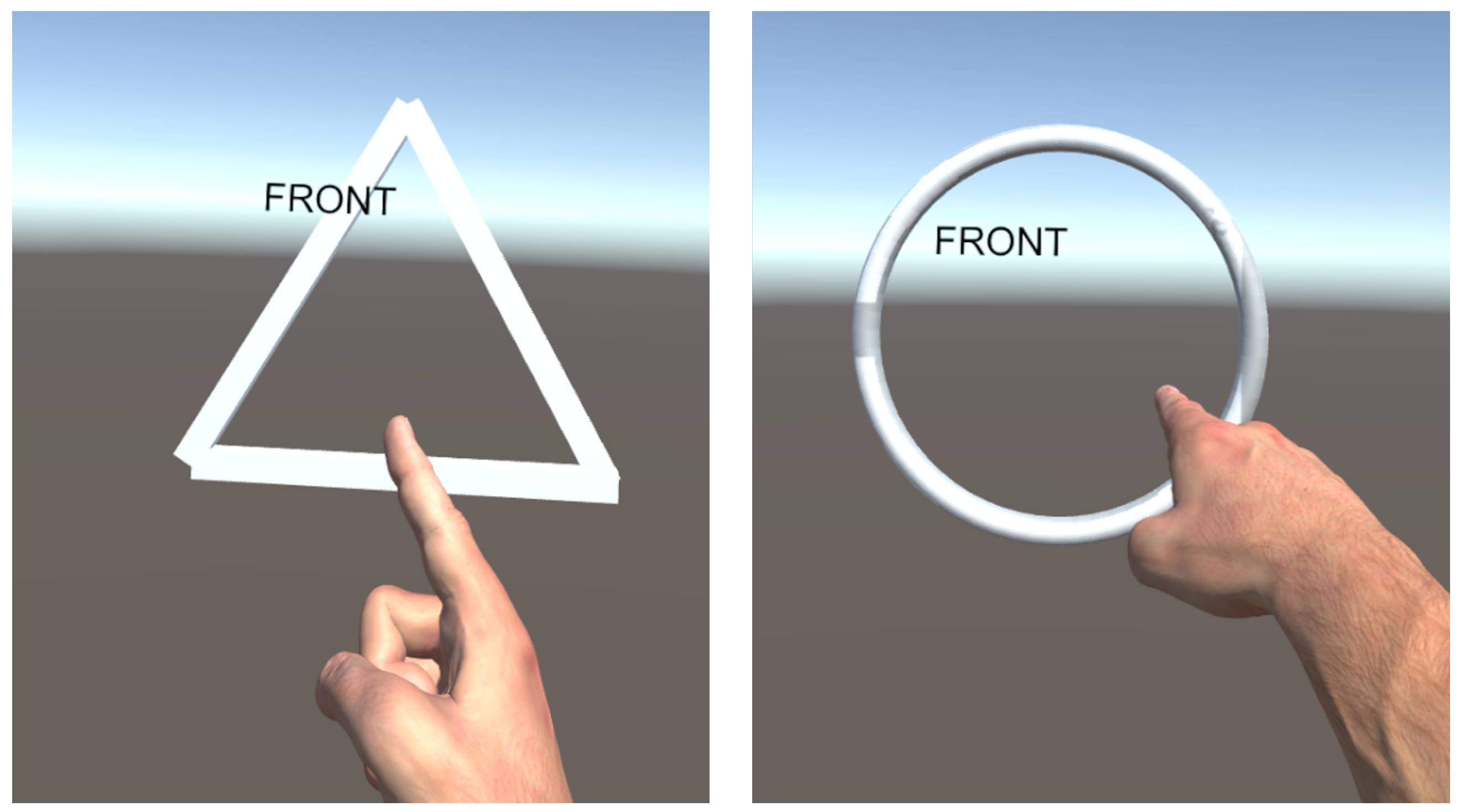
To ensure consistent hand movements across participants, a visual guide was presented in each trial, consisting of either an equilateral triangle (side length: 30 cm) or a circle (radius: 15 cm), as shown in Figure 1. These figures were selected to include both smooth continuous movements and movements involving abrupt directional changes, thereby reducing dependence on a specific movement pattern while keeping the task simple and easy to perform. The figure was positioned directly in front of the participant and could be reached by extending the shoulder and elbow.

2.2. Motion Scaling of Virtual Hand

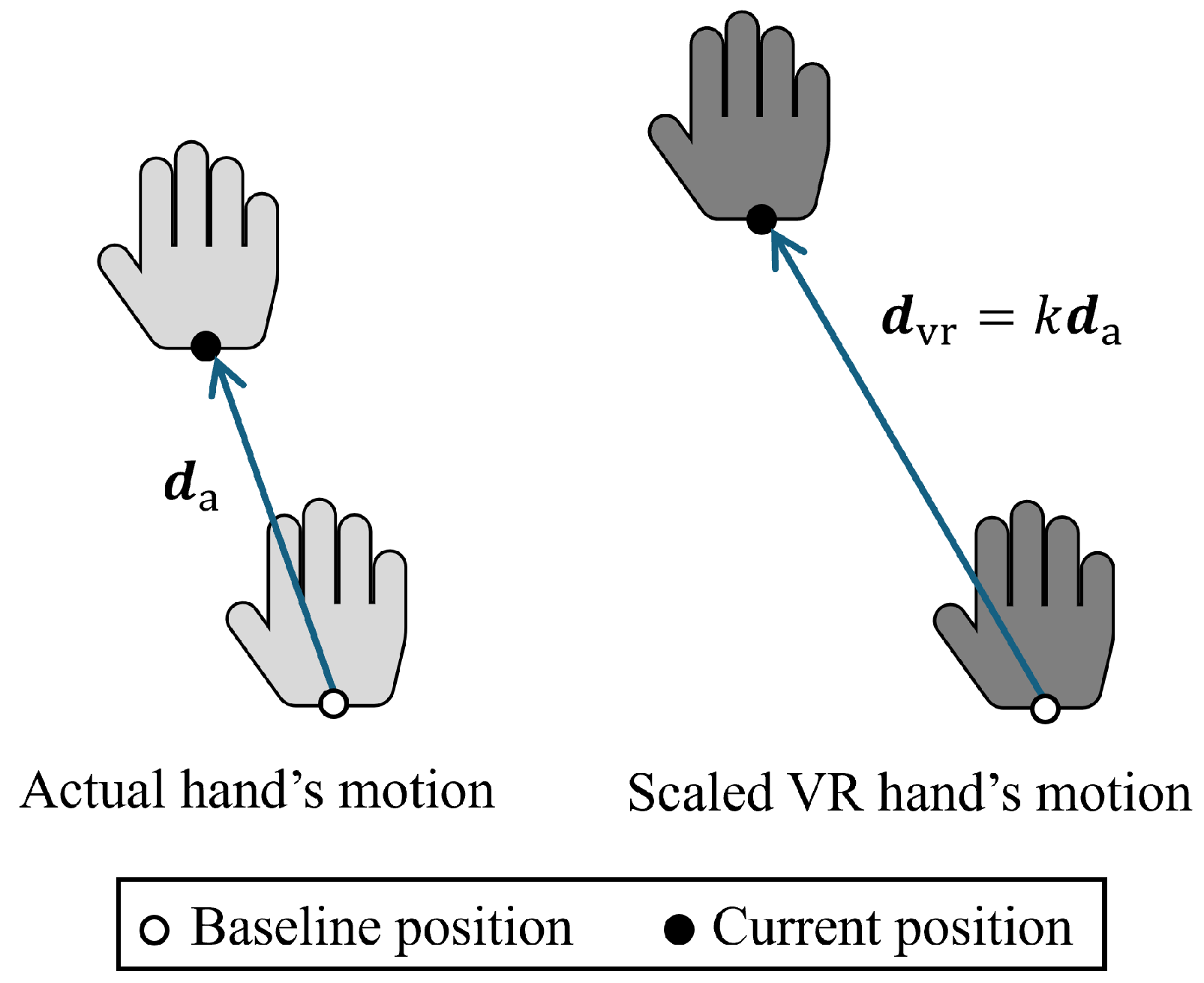
Figure 2 illustrates how the movement gain was applied. The gain caused either an expansion or a shrinkage of the hand’s motion. The displacement of the virtual hand was calculated with reference to the baseline position by multiplying the actual hand’s displacement by the gain factor. Participants were instructed to place their index finger at the center of the displayed geometric figure before each trial began. This position served as the baseline position from which the displacement of the actual and virtual hands was calculated. At the baseline position, the locations of the actual and virtual hands spatially coincided regardless of the gain condition.
Let the actual hand’s three-dimensional deviation be d a R 3 × 1 and the virtual hand’s deviation be d vr R 3 × 1 from the baseline position. Their relationship, using the gain k, was defined as follows:
d vr = k d a .
Here, when k > 1.0 , the motion of the virtual hand represented an expansion relative to that of the actual hand. When k < 1.0 , the virtual hand’s motion represented shrinkage. When k = 1.0 , the motions of the virtual and actual hands matched.

2.3. Experimental Participants

Fifteen university students (5 females and 10 males, mean age = 24.0 years, age range: 20 years and above) participated in the experiment after providing written informed consent. The sample size was determined a priori using a power analysis (G*Power, ver. 3.1.9.7 [47]) for paired t-tests with a significance level of α = 0.05 and statistical power of 1 β = 0.8 . All participants were right-handed, although handedness was not controlled as an inclusion criterion. They were recruited through an open call and were naive to the purpose of the study. No restrictions were imposed regarding prior experience with VR head-mounted displays.

2.4. Experimental Procedure

2.4.1. Procedures of Gain Detection Task

The experiment was conducted using the psychophysical method of constant stimuli. Participants judged the perceived motion gain of each stimulus using a three-alternative response format: expansion, match, or shrinkage.
This response format allowed both motion expansion ( k > 1.0 ) and shrinkage ( k < 1.0 ) conditions to be presented within a single experimental sequence, thereby reducing potential response biases and improving experimental efficiency. Although no explicit reference stimulus ( k = 1.0 ) was presented, the baseline condition was included among the test stimuli.
For subsequent analysis, the three response categories were recoded into binary responses depending on the direction of interest. Specifically, when analyzing expansion detection, “expansion” responses were treated as hits, whereas “match” and “shrinkage” responses were treated as non-expansion responses. Conversely, when analyzing shrinkage detection, “shrinkage” responses were treated as hits, and the other responses were treated as non-shrinkage responses. This approach is equivalent to a Yes–No task for each motion direction while maintaining a balanced stimulus presentation across gain conditions.
Because perceptual thresholds vary across individuals, a preliminary session was conducted prior to the main experiment to estimate each participant’s sensitivity. This was performed using a simplified staircase method.
Based on the results, the maximum gain was set within the range of k = 1.3 2.0 , and the minimum gain within k = 0.5 0.8 . A total of twelve gain levels were tested between these maximum and minimum values. Among them, five had k < 1.0 and six had k > 1.0 , in addition to the unity condition ( k = 1.0 ). The gain values were linearly spaced between each extreme (maximum or minimum) and 1.0. Because the maximum gain was farther from unity than the minimum gain, the number of expansion gains exceeded that of shrinkage gains.
In the main task, a randomized block design was employed, in which each of the twelve gain levels was presented once per block across fifteen blocks. In total, 180 ( 12 × 15 ) trials were conducted for each participant.
For each trial, participants traced either a triangle or a circle for one minute using the index finger of their dominant hand. The figure to be traced was selected randomly. They were asked to complete as many laps as possible within the time limit while focusing on the sensation of hand movement. After each trial, participants reported whether the motion of the virtual hand was perceived as expanded, shrunk, or matched relative to their actual hand motion.
At the beginning of both the preliminary and main phases, the virtual and real hands were calibrated to align at the center of the displayed figure.

2.4.2. Procedures of Embodiment Rating Task

Following the threshold detection experiment, another tracing task was conducted to evaluate the sense of ownership and agency. Participants were instructed to continuously trace the presented figure (the equilateral triangle or circle described in Section 2.1) for one minute.
After each trial, participants rated their subjective experience on a 10-point Likert scale ranging from 0 (strongly disagree) to 9 (strongly agree). Two statements were used to assess the sense of ownership and agency, respectively:
  • Ownership: I felt as if the virtual hand was my own hand.
  • Agency: I felt as if the movements of the virtual hand were caused by my own movements.
The motion gain k was manipulated over a range from k = 0.4 to k = 3.0 . The gain intervals were finer near k = 1.0 to closely examine deviations from the unity condition. The tested gains were 0.4, 0.6, 0.8, 0.9, 1.0, 1.2, 1.4, 1.6, 1.8, 2.2, 2.6, and 3.0. The gain range extended beyond the perceptual thresholds identified in our preliminary measurements, allowing embodiment to be evaluated across both near-threshold and strongly distorted motion conditions. Because the analysis was conducted on pooled data, the same gain values were used for all participants.
The presentation order of the gain conditions followed a randomized block design. Each condition was repeated twice. A one-minute interval was provided between trials.

2.5. Data Analysis

2.5.1. Psychometric Curve for Method of Constant Stimuli

Participants’ responses were separated into the expansion ( k 1.0 ) and shrinkage ( k 1.0 ) conditions, and psychometric curves were fitted for each. The extended four-parameter psychometric function was used for the analysis [48].
For motion expansion ( k 1.0 ), the psychometric function was defined as
P e ( k ) = γ e + ( 1 γ e λ e ) Φ k μ e σ e ,
where P e ( k ) represents the proportion of “expansion” responses at gain k. Here, γ e , λ e , μ e , and σ e represent the guess rate (false alarm rate), lapse rate, threshold (location parameter), and slope (scale parameter), respectively. Φ ( · ) denotes the cumulative distribution function of the standard normal distribution.
For motion shrinkage ( k 1.0 ), the psychometric function was defined using the deviation from the unity gain, 1.0 k , as
P s ( k ) = γ s + ( 1 γ s λ s ) Φ ( 1.0 k ) μ s σ s ,
where P s ( k ) represents the proportion of “shrinkage” responses at gain k. The parameters γ s , λ s , μ s , and σ s have the same interpretations as in the expansion case.
For the expansion condition, the psychometric function was fitted as a monotonically increasing function of k, because the proportion of “expansion” responses increases as k becomes larger than 1.0. For the shrinkage condition, the psychometric function was fitted as a monotonically increasing function of the deviation from unity, 1.0 k , because the proportion of “shrinkage” responses increases as k becomes smaller than 1.0.
The parameters γ e and γ s were fixed to the observed false alarm rates at the unity-gain condition. The remaining parameters ( μ e , σ e , λ e ) and ( μ s , σ s , λ s ) were estimated using maximum likelihood estimation.
Because the psychometric function included lapse and false-alarm parameters, the probability at k = μ did not necessarily equal 0.5. Nonetheless, μ was treated as the 50%-equivalent threshold because it represents the center of the underlying sensitivity function. For the expansion condition, the 50% and 84% detection thresholds in gain units were defined as μ e and μ e + σ e , respectively. For the shrinkage condition, because the function was fitted using 1.0 k , the 50% and 84% detection thresholds in gain units were defined as 1.0 μ s and 1.0 ( μ s + σ s ) , respectively. Thresholds were computed for each participant and then averaged across participants.
To statistically evaluate the symmetry of motion perception, we compared the magnitude of threshold deviation from the unity-gain condition between expansion and shrinkage. Specifically, the deviations were calculated as μ e 1.0 for expansion and μ s for shrinkage, and were compared using paired t-tests. Additionally, the sensitivity parameters σ e and σ s were compared between the two conditions using paired t-tests.

2.5.2. Analysis of Embodiment Scores

For the analysis of the sense of ownership and agency, mean ratings across the two repetitions were computed for each gain level. For each measure, ratings at non-unity gains ( k 1.0 ) were compared with those at the unity gain ( k = 1.0 ) using paired t-tests. To control for the increased risk of Type I errors due to multiple comparisons, Holm correction was applied because it controls the family-wise error rate while being less conservative than the Bonferroni correction.
In addition, to examine whether embodiment ratings decreased differently on the expansion and shrinkage sides, a linear mixed-effects model was applied to the questionnaire ratings. The model included the distance from the unity-gain condition, | k 1.0 | , the direction of deviation (expansion or shrinkage), and their interaction as fixed effects. The model was specified using Wilkinson notation as:
rating | k 1 | direction + ( 1 participant ) ,
where | k 1 | represents the magnitude of deviation from the unity gain. The interaction term was used to test whether the slopes differed between the expansion and shrinkage sides. Participants were included as a random effect to account for repeated measurements. The unity-gain condition ( k = 1.0 ) was excluded from this slope analysis because it did not belong to either direction. Separate models were fitted for ownership and agency ratings.

3. Results

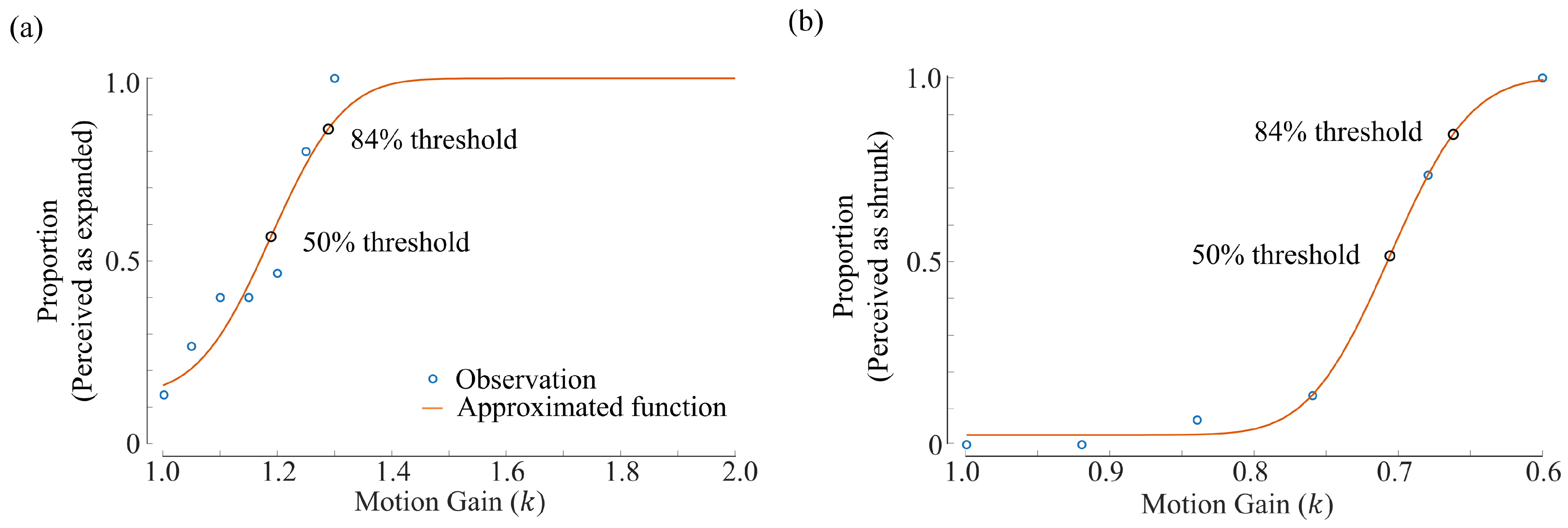
Figure 3 shows example psychometric curves for one participant under the motion expansion and shrinkage conditions. In Figure 3a, the vertical axis represents the proportion of trials in which the participant perceived the virtual hand movement as expanded. In Figure 3b, the vertical axis represents the proportion of trials in which the participant perceived the motion as shrunk.
Table 1 summarizes the mean and 95% confidence intervals of the estimated motion gain thresholds across participants. For the motion expansion condition, the mean and 95% confidence interval of the 50% threshold was 1.18 ± 0.05 , and the 84% threshold was 1.27 ± 0.07 . For the motion shrinkage condition, the 50% and 84% thresholds were 0.86 ± 0.03 and 0.78 ± 0.04 , respectively.
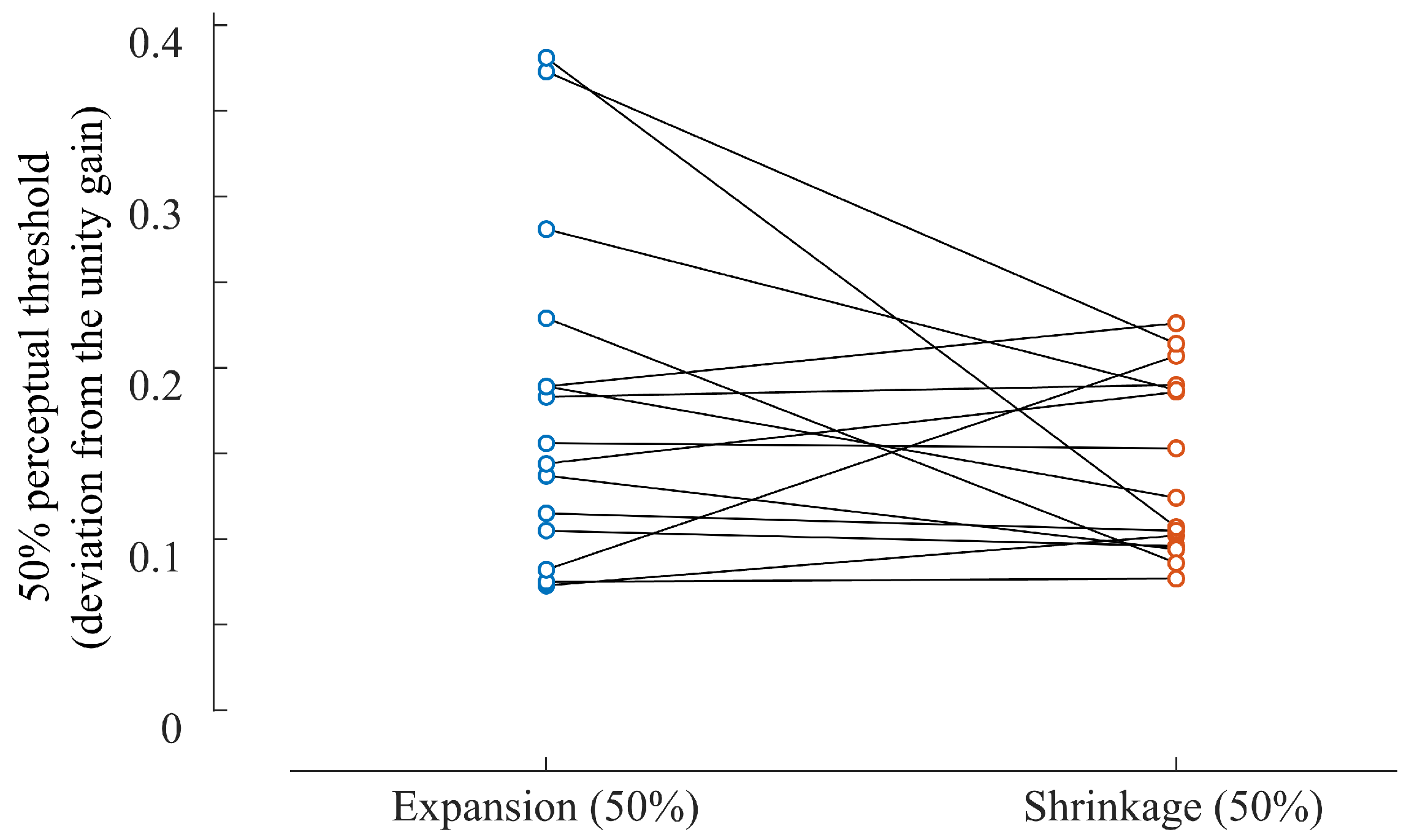
Figure 4 visually illustrates the paired comparison of the 50% threshold deviations from unity gain for motion expansion and shrinkage across participants. Paired t-tests revealed no significant difference in the magnitude of threshold deviation between the expansion and shrinkage conditions (mean difference = 0.037 [ 0.017 , 0.092 ] , t ( 14 ) = 1.47 , p = 0.16 , d z = 0.39 ). Similarly, there was no significant difference in the slopes ( σ ) between the two conditions (mean difference = 0.011 [ 0.016 , 0.038 ] , t ( 14 ) = 0.89 , p = 0.39 , d z = 0.24 ). These results did not show statistically significant differences in either threshold deviations or sensitivity between the shrinkage and expansion conditions.
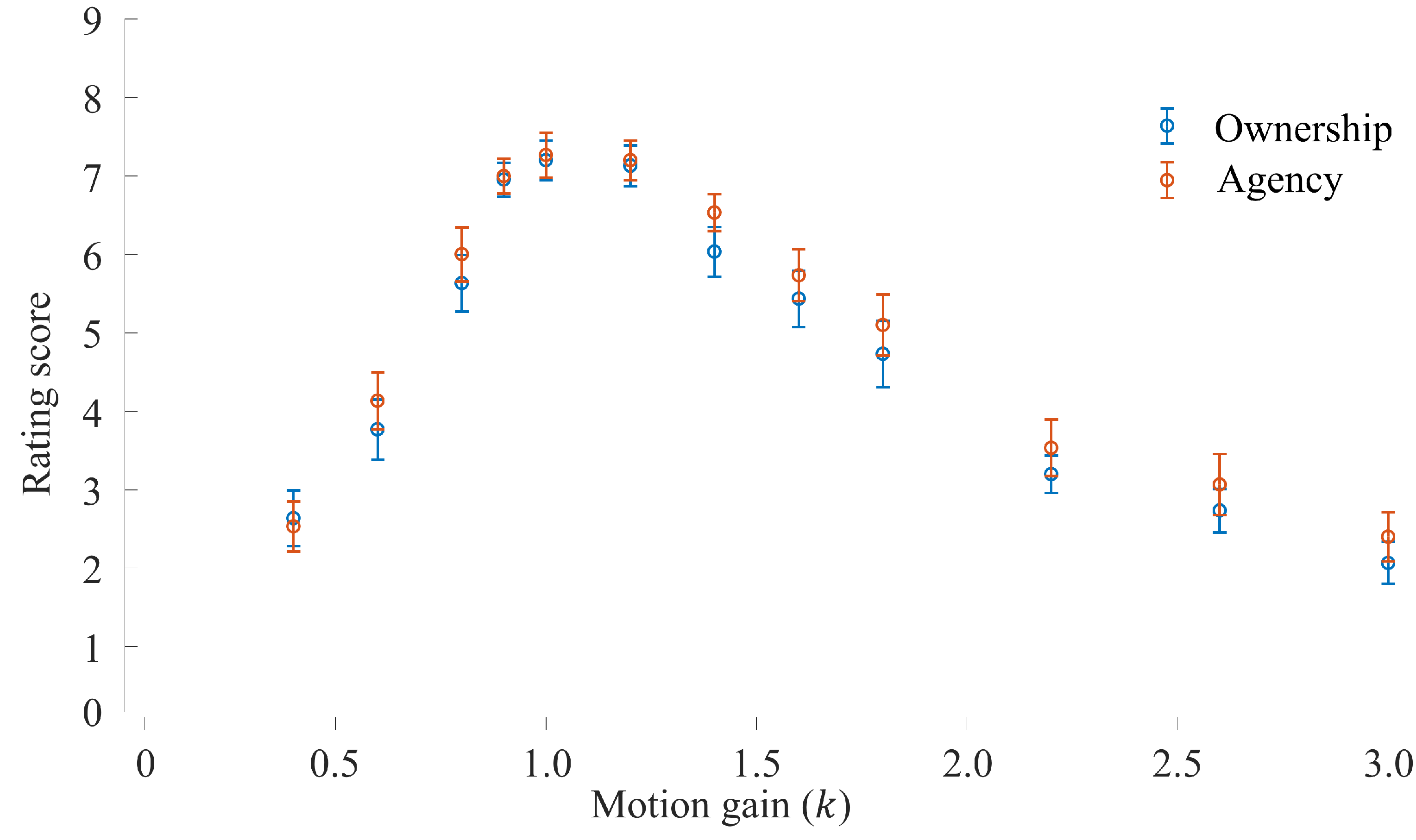
Figure 5 shows the mean ownership and agency ratings as a function of motion gain. Both ratings were highest near the unity-gain condition and decreased as the motion gain deviated from k = 1.0 .
Table 2 summarizes the results of the linear mixed-effects analyses including an interaction between deviation magnitude and direction. For both the ownership and agency scores, the effects of the gain and interaction were significant whereas the effect of the direction was not.
For the ownership ratings, the slopes were significantly different between the expansion and shrinkage conditions (mean difference = 5.71 [ 7.14 , 4.28 ] , t ( 157 ) = 7.88 , p < 0.001 ). The estimated slope was 2.78 on the expansion side (95% CI: [ 3.09 , 2.46 ] ) and 8.48 on the shrinkage side (95% CI: [ 9.88 , 7.09 ] ).
For the agency ratings, the slopes were also different between the two conditions (mean difference = 6.24 [ 7.65 , 4.84 ] , t ( 157 ) = 8.78 , p < 0.001 ). The estimated slope was 2.73 on the expansion side (95% CI: [ 3.04 , 2.42 ] ) and 8.97 on the shrinkage side (95% CI: [ 10.34 , 7.60 ] ).
Table 3 summarizes the mean ownership and agency ratings at each motion gain, the mean differences from the unity-gain condition ( k = 1.0 ) with the 95% confidence intervals and the Holm-adjusted p-values. Negative mean differences indicate lower ratings than those in the unity-gain condition.
For both ownership and agency, no significant differences from the unity-gain condition were observed at k = 0.9 and k = 1.2 . In contrast, ratings were significantly lower than those in the unity-gain condition at k 0.8 and k 1.4 .

4. Discussion

This study differs from previous work that primarily focused on identifying perceptual detection thresholds [4,5,6] by simultaneously examining both detection thresholds and subjective embodiment. From an application perspective, even when motion gain exceeds detection thresholds, such gains may still be usable if the degradation in embodiment remains within an acceptable range. Therefore, the present study focused on the behavior of embodiment in the suprathreshold region.
A central research question was whether the degradation of embodiment differs between motion expansion ( k > 1 ) and motion shrinkage ( k < 1 ). The results showed that embodiment ratings declined more steeply under motion shrinkage than under motion expansion. This indicates that the effect of motion gain on subjective embodiment is asymmetric with respect to the unity gain.
Ownership and agency ratings remained comparable to the unity-gain condition at k = 0.9 and k = 1.2 , whereas they were significantly reduced at k 0.8 and k 1.4 . This suggests that embodiment is maintained only within a limited range near the unity gain. Moreover, the acceptable range appears to be asymmetric: moderate expansion was tolerated, whereas shrinkage led to earlier degradation. These findings indicate that embodiment is more sensitive to motion shrinkage than to motion expansion.
One possible explanation for the preserved embodiment under moderate gain manipulation is the high adaptability of the human sensorimotor system. Previous studies have shown that humans can flexibly adapt to altered visuomotor mappings in VR environments through sensorimotor adaptation processes [16,17]. Therefore, embodiment degradation observed under motion gain manipulation may not solely reflect immediate sensory discrepancies, but also the limits of adaptation to altered visuomotor relationships.
Several previous studies have reported that motion expansion gains are less readily detected than motion shrinkage gains. For example, Esmaeili et al. [5] reported that, for lateral hand movements, the detection threshold for shrinkage gains was 0.81 (95% CI: [0.80, 0.82]), whereas that for expansion gains was 1.31 (95% CI: [1.30, 1.33]). A similar tendency was observed across other movement directions, consistently indicating that expansion gains were more tolerable than shrinkage gains. Beyond upper-limb movements, Hutton et al. [18] investigated rotational motion, in which participants were required to rotate their bodies by π / 2 rad to look to the right. In their study, the rotational gain applied to the avatar’s motion was manipulated relative to the participant’s actual body rotation. The gain threshold for amplification exceeded 1.5, whereas that for reduction was around 0.7. Taken together, these studies consistently indicate that detection thresholds for expansion and shrinkage gains are asymmetric with respect to the unity gain.
Nonetheless, Zenner and Krüger [4] and the present study suggest that perceptual thresholds can be approximately symmetric when centered around the point of subjective equality. In our study, detection thresholds for expansion (1.18 [1.13, 1.23]) and shrinkage (0.86 [0.83, 0.89]) were nearly symmetric around unity, indicating comparable sensitivity in both directions.
Taken together, previous studies suggest that motion shrinkage is often detected more readily than motion expansion; however, this asymmetry may diminish under certain experimental conditions. In contrast, the present results indicate that embodiment exhibits a robust asymmetry, with motion shrinkage leading to a more pronounced degradation than motion expansion.
The results of the present study suggest, for the first time, that while the asymmetry of perceptual detection thresholds for motion gain may be context-dependent or modifiable, subjective embodiment exhibits a robust asymmetry. The present findings are also consistent with studies suggesting that subjective and behavioral measures related to embodiment do not necessarily exhibit identical characteristics [46,49,50,51,52].
The asymmetric degradation of embodiment observed in this study may be explained by multiple factors.
First, motion shrinkage reduces the visual consequences of self-generated movements, resulting in a mismatch between predicted and observed sensory feedback [53,54]. From the perspective of predictive processing, such shrinkage may generate larger prediction errors than motion expansion because expected sensory consequences are partially absent [55,56]. Although both excess and reduced visual feedback could, in principle, be attributed to external causes, the absence of expected sensory consequences in motion shrinkage may be less plausibly explained. For example, it may require unnatural interpretations, such as the hand movement being externally constrained or otherwise impaired.
Second, from the perspective of agency, shrinkage weakens the perceived causal relationship between motor commands and visual outcomes, as intended movements produce insufficient visual responses.
Third, motion shrinkage may conflict with the internal body schema by effectively constraining the perceived movement range, whereas motion expansion can be interpreted as an extension of bodily capability.
Together, these factors may account for the stronger disruption of embodiment under motion shrinkage compared to motion expansion, although these interpretations remain speculative and warrant further investigation.
The findings of this study provide design implications for motion-scaled VR interaction systems. The psychophysical thresholds offer quantitative reference values for determining the range within which gain changes are likely to be difficult to detect. Meanwhile, the embodiment results indicate the range within which users can maintain a sense of ownership and agency, even when the gain exceeds perceptual thresholds. In particular, embodiment tends to remain higher under motion expansion than under motion shrinkage. Therefore, when designing motion-gain manipulations for VR applications, both perceptual detectability and subjective embodiment should be considered.
Several limitations of the present study should be acknowledged. First, the experiment employed a specific tracing task, which, although suitable for controlled measurement, may limit the generalizability of the findings to other types of interactions, such as reaching or object manipulation. In particular, previous studies have reported that detection thresholds depend on task characteristics [5].
In addition, hand movements were constrained by predefined geometric figures, potentially reducing variability in motor behavior. Embodiment and detection thresholds may differ under more naturalistic or unconstrained movement conditions. Furthermore, the tracing task in this study did not involve hand motion along the depth direction, even though detection thresholds are known to vary with movement direction [5,6]. Future studies should examine whether these effects generalize to other interaction tasks, such as reaching, object manipulation, and three-dimensional movements involving the depth direction.
The visual environment was simplified by displaying only the forearm and hand, thereby minimizing contextual visual information. While this design enabled the isolation of sensorimotor factors, the results may not directly generalize to more complex VR environments.
Another limitation is that participants completed the embodiment task after the threshold detection task. Repeated exposure to motion gain manipulations may have increased participants’ awareness of the experimental manipulation and sensitized them to motion-gain discrepancies, which may have influenced their subsequent subjective ratings. Future studies may counterbalance task order or employ independent participant groups to further examine this possibility.
Although the sample size was determined through a priori power analysis, the precision of some parameter estimates was limited by the number of participants, as reflected in the reported 95% confidence intervals. Future studies with larger and more diverse populations would help improve estimation precision and establish the generality of the findings.
Finally, this study focused on immediate perceptual responses and did not address potential adaptation effects. Given the known adaptability of human sensorimotor systems, prolonged exposure to motion gain manipulation may alter both detection thresholds and embodiment. Future studies should investigate how perceptual thresholds and embodiment change over time during extended exposure to motion scaling and whether the asymmetric effects observed between motion expansion and shrinkage persist after adaptation.

5. Conclusions

This study investigated the perceptual detection thresholds and subjective embodiment associated with motion gain manipulation of virtual hands in VR. Using the psychophysical method of constant stimuli and subjective ratings of ownership and agency, we examined both the detectability of motion gain and its impact on embodiment within a unified experimental framework.
The results showed that perceptual detection thresholds for motion expansion and shrinkage were approximately symmetric under the present experimental conditions. In contrast, embodiment exhibited a robust asymmetry: motion shrinkage led to a more rapid degradation of ownership and agency compared to motion expansion. These findings suggest that perceptual sensitivity and subjective embodiment are governed by partially distinct mechanisms, and that symmetry in detection does not necessarily imply symmetry in embodiment.
From a practical perspective, the results indicate that relying solely on perceptual detection thresholds may be insufficient for designing motion-scaled VR interactions. Even when gain manipulation exceeds detection thresholds, embodiment may be preserved within a limited range, particularly for motion expansion. Therefore, both perceptual detectability and subjective embodiment should be considered when designing motion-gain manipulations.
Overall, this study highlights the importance of considering suprathreshold perceptual effects and provides new insights into the asymmetric nature of embodiment in motion-scaled VR interactions.

Author Contributions

Conceptualization, S.O. and M.H.; methodology, X.F. and S.O.; software, X.F.; validation, X.F. and S.O.; formal analysis, X.F. and S.O.; investigation, X.F.; resources, X.F.; data curation, X.F.; writing—original draft preparation, X.F. and S.O.; writing—review and editing, X.F., S.O. and M.H.; visualization, X.F.; supervision, S.O.; project administration, S.O. All authors have read and agreed to the published version of the manuscript.

Funding

This research received no external funding.

Institutional Review Board Statement

The procedures of this study were approved by the Institutional Review Board of Tokyo Metropolitan University, Hino Campus (Approval No.: R7-85; Approval date: 1 March 2026).

Informed Consent Statement

Written informed consent was obtained from all participants involved in the study.

Data Availability Statement

The research data are available from the corresponding author upon direct request, accompanied by a clear explanation of the intended purpose.

Conflicts of Interest

The authors declare no conflicts of interest.

References

  1. Poupyrev, I.; Billinghurst, M.; Weghorst, S.; Ichikawa, T. The go-go interaction technique: Non-linear mapping for direct manipulation in VR. In Proceedings of the 9th Annual ACM Symposium on User Interface Software and Technology; ACM: New York, NY, USA, 1996; pp. 79–80. [Google Scholar] [CrossRef]
  2. Asai, Y.; Ueda, Y.; Enomoto, R.; Iwai, D.; Sato, K. ExtendedHand on Wheelchair. In Proceedings of the 29th Annual ACM Symposium on User Interface Software and Technology October; ACM: New York, NY, USA, 2016; pp. 147–148. [Google Scholar] [CrossRef]
  3. Wang, K.; Matsukura, H.; Iwai, D.; Sato, K. Stabilizing graphically extended hand for hand tremors. IEEE Access 2018, 6, 28838–28847. [Google Scholar] [CrossRef]
  4. Zenner, A.; Krüger, A. Estimating detection thresholds for desktop-scale hand redirection in virtual reality. In Proceedings of the 2019 IEEE Conference on Virtual Reality and 3D User Interfaces; IEEE: Piscataway, NJ, USA, 2019; pp. 47–55. [Google Scholar] [CrossRef]
  5. Esmaeili, S.; Benda, B.; Ragan, E.D. Detection of scaled hand interactions in virtual reality: The effects of motion direction and task complexity. In Proceedings of the IEEE Conference on Virtual Reality and 3D User Interfaces; IEEE: Piscataway, NJ, USA, 2020; pp. 453–462. [Google Scholar] [CrossRef]
  6. Hartfill, J.; Gabel, J.; Kruse, L.; Schmidt, S.; Riebandt, K.; Kühn, S.; Steinicke, F. Analysis of detection thresholds for hand redirection during mid-air interactions in virtual reality. In Proceedings of the 27th ACM Symposium on Virtual Reality Software and Technology; ACM: New York, NY, USA, 2021; pp. 1–10. [Google Scholar] [CrossRef]
  7. Slater, M. Inducing illusory ownership of a virtual body. Front. Neurosci. 2009, 3, 214–220. [Google Scholar] [CrossRef] [PubMed]
  8. Ernst, M.O.; Banks, M.S. Humans integrate visual and haptic information in a statistically optimal fashion. Nature 2002, 415, 429–433. [Google Scholar] [CrossRef] [PubMed]
  9. Petkova, V.I.; Ehrsson, H.H. If I were you: Perceptual illusion of body swapping. PLoS ONE 2008, 3, e3832. [Google Scholar] [CrossRef] [PubMed]
  10. Domna Banakou, R.G.; Slater, M. Illusory ownership of a virtual child body causes overestimation of object sizes and implicit attitude changes. Proc. Natl. Acad. Sci. USA 2013, 110, 12846–12851. [Google Scholar] [CrossRef] [PubMed]
  11. Watanabe, R.; Maekawa, A.; Kitazaki, M.; Monnai, Y.; Inami, M. Redirection Detection Thresholds for Avatar Manipulation with Different Body Parts. IEEE Trans. Vis. Comput. Graph. 2025, 31, 3098–3107. [Google Scholar] [CrossRef] [PubMed]
  12. Kawaguchi, A.; Okamoto, S.; Goto, Y.; Abe, Y.; Hara, M. Asura Hands: Having Two Independently Controlled Left Hands in Virtual Reality Environment. In Proceedings of the 2024 IEEE 13th Global Conference on Consumer Electronics; IEEE: Piscataway, NJ, USA, 2024; pp. 732–734. [Google Scholar] [CrossRef]
  13. Mashiyama, Y.; Kondo, R.; Fukuoka, M.; Teo, T.; Sugimoto, M. Investigating body perception of multiple virtual hands in synchronized and asynchronized conditions. Front. Virtual Real. 2024, 5, 1383957. [Google Scholar] [CrossRef]
  14. Aguel, M.F.; Kawaguchi, A.; Okamoto, S.; Hara, M. Asura Hands: Ownership of Three Left Hands Enhanced by Vibrotactile Feedback to Fingertip. In Proceedings of the 2025 IEEE 14th Global Conference on Consumer Electronics; IEEE: Piscataway, NJ, USA, 2025; pp. 1444–1446. [Google Scholar] [CrossRef]
  15. Guy, M.; Jeunet, C.; Moreau, G.; Normand, J.M. Manipulating the Sense of Embodiment in Virtual Reality: A study of the interactions between the senses of agency, self-location and ownership. In Proceedings of the International Conference on Artificial Reality and Telexistence Eurographics Symposium on Virtual Environments; The Eurographics Association: Eindhoven, The Netherlands, 2022. [Google Scholar] [CrossRef]
  16. Wähnert, S.; Schäfer, U. Sensorimotor adaptation in virtual reality: Do instructions and body representation influence aftereffects? Virtual Real. 2024, 28, 47. [Google Scholar] [CrossRef]
  17. Haar, S.; Sundar, G.; Faisal, A.A. Embodied virtual reality for the study of real-world motor learning. PLoS ONE 2021, 16, e0245717. [Google Scholar] [CrossRef] [PubMed]
  18. Hutton, C.; Ziccardi, S.; Medina, J.; Rosenberg, E.S. Individualized calibration of rotation gain thresholds for redirected walking. In Proceedings of the International Conference on Artificial Reality and Telexistence & Eurographics Symposium on Virtual Environments; The Eurographics Association: Eindhoven, The Netherlands, 2018; pp. 61–64. [Google Scholar] [CrossRef]
  19. Sun, Q.; Patney, A.; Wei, L.Y.; Shapira, O.; Lu, J.; Asente, P.; Zhu, S.; McGuire, M.; Luebke, D.; Kaufman, A. Towards virtual reality infinite walking: Dynamic saccadic redirection. ACM Trans. Graph. 2018, 37, 54. [Google Scholar] [CrossRef]
  20. Jaekl, P.M.; Jenkin, M.R.; Harris, L.R. Perceiving a stable world during active rotational and translational head movements. Exp. Brain Res. 2005, 163, 388–399. [Google Scholar] [CrossRef] [PubMed]
  21. Steinicke, F.; Bruder, G.; Jerald, J.; Frenz, H.; Lappe, M. Estimation of detection thresholds for redirected walking techniques. IEEE Trans. Vis. Comput. Graph. 2009, 16, 17–27. [Google Scholar] [CrossRef] [PubMed]
  22. Razzaque, S.; Swapp, D.; Slater, M.; Whitton, M.C.; SteedAuthors, A. Redirected walking in place. In Proceedings of the Workshop on Virtual Environments; The Eurographics Association: Eindhoven, The Netherlands, 2002; pp. 123–130. [Google Scholar] [CrossRef]
  23. Zhang, R.; Li, B.; Kuhl, S.A. Human sensitivity to dynamic translational gains in head-mounted displays. In Proceedings of the 2nd ACM Symposium on Spatial User Interaction; ACM: New York, NY, USA, 2014; pp. 62–65. [Google Scholar] [CrossRef]
  24. Hakim, M.A.; Thomas, J. Towards understanding how changing translation gain affects detection thresholds. In Proceedings of the Proceedings of the 2025 31st ACM Symposium on Virtual Reality Software and Technology (VRST’25); ACM: New York, NY, USA, 2025; pp. 1–9. [Google Scholar] [CrossRef]
  25. Neth, C.T.; Souman, J.L.; Engel, D.; Kloos, U.; Bülthoff, H.H.; Mohler, B.J. Velocity-dependent dynamic curvature gain for redirected walking. In Proceedings of the 2011 IEEE Virtual Reality Conference; IEEE: Piscataway, NJ, USA, 2011; pp. 151–158. [Google Scholar] [CrossRef]
  26. Li, H.; Bian, Y.; Yang, C.; Zhang, F.; Zhao, Y.; Liu, J.; Meng, X.; Fan, L. Estimation of human sensitivity for curvature gain of redirected walking technology. In Proceedings of the 23rd International Conference on Mobile Human-Computer Interaction; ACM: New York, NY, USA, 2021; pp. 1–12. [Google Scholar] [CrossRef]
  27. Benda, B.; Esmaeili, S.; Ragan, E.D. Determining detection thresholds for fixed positional offsets for virtual hand remapping in virtual reality. In Proceedings of the IEEE International Symposium on Mixed and Augmented Reality; IEEE: Piscataway, NJ, USA, 2020; pp. 269–278. [Google Scholar] [CrossRef]
  28. Ogawa, N.; Narumi, T.; Hirose, M. Effect of Avatar Appearance on Detection Thresholds for Remapped Hand Movements. IEEE Trans. Vis. Comput. Graph. 2021, 27, 3182–3197. [Google Scholar] [CrossRef] [PubMed]
  29. Sakurada, K.; Kondo, R.; Nakamura, F.; Kitazaki, M.; Sugimoto, M. Investigating the perceptual attribution of a virtual robotic limb synchronizing with hand and foot simultaneously. Front. Virtual Real. 2023, 4, 1210303. [Google Scholar] [CrossRef]
  30. Prasad, S.M.; Prasad, S.M.; Maniar, H.S.; Chu, C.; Schuessler, R.B.; Damiano, R.J. Surgical robotics: Impact of motion scaling on task performance. J. Am. Coll. Surg. 2004, 199, 863–868. [Google Scholar] [CrossRef] [PubMed]
  31. Richter, F.; Orosco, R.K.; Yip, M.C. Motion scaling solutions for improved performance in high delay surgical teleoperation. In Proceedings of the International Conference on Robotics and Automation; IEEE: Piscataway, NJ, USA, 2019; pp. 1590–1595. [Google Scholar] [CrossRef]
  32. Wang, T.; Li, H.; Pu, T.; Yang, L. Microsurgery robots: Applications, design, and development. Sensors 2023, 23, 8503. [Google Scholar] [CrossRef] [PubMed]
  33. Lim, J.; Richter, F.; Chiu, Z.Y.; Lee, J.; Quist, E.; Fisher, N.; Chambers, J.; Hong, S.; Yip, M.C. Optimal motion scaling for delayed telesurgery. In Proceedings of the IEEE/RSJ International Conference on Intelligent Robots and Systems; IEEE: Piscataway, NJ, USA, 2025; pp. 21431–21438. [Google Scholar] [CrossRef]
  34. Kilteni, K.; Groten, R.; Slater, M. The sense of embodiment in virtual reality. Presence Teleoperators Virtual Environ. 2012, 21, 373–387. [Google Scholar] [CrossRef]
  35. Kim, C.S.; Jung, M.; Kim, S.Y.; Kim, K. Controlling the Sense of Embodiment for Virtual Avatar Applications: Methods and Empirical Study. JMIR Serious Games 2020, 8, e21879. [Google Scholar] [CrossRef] [PubMed]
  36. Eubanks, J.C.; Moore, A.G.; Fishwick, P.A.; McMahan, R.P. A preliminary embodiment short questionnaire. Front. Virtual Real. 2021, 2, 647896. [Google Scholar] [CrossRef]
  37. Feng, X.; Okamoto, S.; Hara, M. Perceptual threshold of motion gain of virtual reality hands. In Proceedings of the The 12th International Symposium on Affective Science and Engineering; Japan Society of Kansei Engineering: Tokyo, Japan, 2026; p. 2IS05-01. [Google Scholar] [CrossRef]
  38. van Beers, R.J.; Wolpert, D.M.; Haggard, P. When feeling is more important than seeing in sensorimotor adaptation. Curr. Biol. 2002, 12, 834–837. [Google Scholar] [CrossRef] [PubMed]
  39. Ehrsson, H.; Holmes, N.; Passingham, R. Touching a rubber hand: Feeling of body ownership is associated with activity in multisensory brain areas. J. Neurosci. 2005, 25, 10564–10573. [Google Scholar] [CrossRef] [PubMed]
  40. Shimada, S.; Fukuda, K.; Hiraki, K. Rubber hand illusion under delayed visual feedback. PLoS ONE 2009, 4, e6185. [Google Scholar] [CrossRef] [PubMed]
  41. Marotta, A.; Bombieri, F.; Zampini, M.; Schena, F.; Dallocchio, C.; Fiorio, M.; Tinazzi, M. The moving rubber hand illusion reveals that explicit sense of agency for tapping movements is preserved in functional movement disorders. Front. Hum. Neurosci. 2017, 11, 291. [Google Scholar] [CrossRef] [PubMed]
  42. Farrer, C.; Franck, N.; Georgieff, N.; Frith, C.; Decety, J.; Jeannerod, M. Modulating the experience of agency: A positron emission tomography study. NeuroImage 2003, 18, 324–333. [Google Scholar] [CrossRef] [PubMed]
  43. Tsakiris, M.; Prabhu, G.; Haggard, P. Having a body versus moving your body: How agency structures body-ownership. Conscious. Cogn. 2006, 15, 423–432. [Google Scholar] [CrossRef] [PubMed]
  44. Godden, E.; Steedman, W.; Pan, M.K. Robotic characterization of markerless hand-tracking on Meta Quest Pro and Quest 3 virtual reality headsets. IEEE Trans. Vis. Comput. Graph. 2025, 31, 3025–3034. [Google Scholar] [CrossRef] [PubMed]
  45. Abdlkarim, D.; Di Luca, M.; Aves, P.; Maaroufi, M.; Yeo, S.H.; Miall, R.C.; Holland, P.; Galea, J.M. A methodological framework to assess the accuracy of virtual reality hand-tracking systems: A case study with the Meta Quest 2. Behav. Res. Methods 2023, 56, 1052–1063. [Google Scholar] [CrossRef] [PubMed]
  46. Kawaguchi, A.; Okamoto, S.; Hara, M. The relationship between proprioceptive drift and body ownership varies with the mediolateral position of a virtual hand. Appl. Sci. 2026, 16, 1492. [Google Scholar] [CrossRef]
  47. Faul, F.; Erdfelder, E.; Lang, A.G.; Buchner, A. G*Power 3: A flexible statistical power analysis program for the social, behavioral, and biomedical sciences. Behav. Res. Methods 2007, 39, 175–191. [Google Scholar] [CrossRef] [PubMed]
  48. Wichmann, F.A.; Hill, N.J. The psychometric function: I. Fitting, sampling, and goodness of fit. Percept. Psychophys. 2001, 63, 1293–1313. [Google Scholar] [CrossRef] [PubMed]
  49. Kammers, M.; de Vignemont, F.; Verhagen, L.; Dijkerman, H. The rubber hand illusion in action. Neuropsychologia 2009, 47, 204–211. [Google Scholar] [CrossRef] [PubMed]
  50. Pyasik, M.; Tieri, G.; Pia, L. Visual appearance of the virtual hand affects embodiment in the virtual hand illusion. Sci. Rep. 2020, 5412, 10. [Google Scholar] [CrossRef] [PubMed]
  51. Hasegawa, H.; Okamoto, S.; Itoh, K.; Hara, M.; Kanayama, N.; Yamada, Y. Self-body recognition through a mirror: Easing spatial-consistency requirements for rubber hand illusion. Psych 2020, 2, 114–127. [Google Scholar] [CrossRef]
  52. Tosi, G.; Mentesana, B.; Romano, D. The correlation between proprioceptive drift and subjective embodiment during the rubber hand illusion: A meta-analytic approach. Q. J. Exp. Psychol. 2023, 76, 2197–2207. [Google Scholar] [CrossRef] [PubMed]
  53. Blakemore, S.J.; Frith, C.D.; Wolpert, D.M. The cerebellum is involved in predicting the sensory consequences of action. Neuroreport 2001, 12, 1879–1884. [Google Scholar] [CrossRef] [PubMed]
  54. Wolpert, D.M.; Flanagan, J. Motor prediction. Curr. Biol. 2001, 11, R729–R732. [Google Scholar] [CrossRef] [PubMed]
  55. Friston, K.; Kiebel, S. Predictive coding under the free-energy principle. Philos. Trans. R. Soc. B 2009, 364, 1211–1221. [Google Scholar] [CrossRef] [PubMed]
  56. Friston, K. The free-energy principle: A unified brain theory? Nat. Rev. Neurosci. 2010, 11, 127–138. [Google Scholar] [CrossRef] [PubMed]
Figure 1. VR hand-tracing figures. (Left) Equilateral triangle with a side length of 30 cm. (Right) Circle with a radius of 15 cm. The figures were traced using the index finger of the dominant hand.
Virtualworlds 05 00029 g001
Figure 2. Expansion and shrinkage of virtual hand motion. The displacement of the virtual hand is scaled by a gain factor k with respect to the baseline position (white circles). For visual clarity, the actual and virtual hands are illustrated separately, although they spatially coincide at the baseline position.
Virtualworlds 05 00029 g002
Figure 3. Examples of approximated psychometric functions and detection thresholds for one participant. Panel (a) shows the expansion condition ( k 1.0 ), and panel (b) shows the shrinkage condition ( k 1.0 ). Blue circles indicate the observed response proportions, and orange curves indicate the approximated psychometric functions. The 50% and 84% thresholds estimated from the approximated functions are also shown.
Virtualworlds 05 00029 g003
Figure 4. Paired comparison of the psychometric 50% thresholds for motion expansion and shrinkage. Each circle represents one participant. The values are shown as deviations from the unity gain ( k = 1.0 ).
Virtualworlds 05 00029 g004
Figure 5. Mean ownership and agency ratings as a function of motion gain k. Blue circles indicate ownership ratings, and orange circles indicate agency ratings. Error bars represent the standard error of the mean.
Virtualworlds 05 00029 g005
Table 1. Psychophysical detection thresholds (DT, μ and μ + σ ) of motion gain and slope ( σ ). Mean and 95% confidence interval (CI).
Motion Enlargement ( k > 1 )Motion Shrinkage ( k < 1 )
Parameters50%-DT ( μ )84%-DT ( μ + σ ) σ 50% ( μ )84%-DT ( μ + σ ) σ
Mean ± 95% CI 1.18 ± 0.05 1.27 ± 0.07 0.08 ± 0.02 0.86 ± 0.03 0.78 ± 0.04 0.08 ± 0.01
Difference from 1.0 0.18 ± 0.05 -- 0.14 ± 0.03 --
Table 2. Summary of the linear mixed-effects analyses: (a) ownership and (b) agency.
(a) Ownership
EffectsCoefficient95% CI t ( 157 ) -value p -value
Intercept7.17 [ 6.65 , 7.70 ] 26.96<0.001
Gain deviation ( | 1 k | ) 2.78 [ 3.09 , 2.46 ] 17.43 <0.001
Direction (expansion/shrinkage)0.32 [ 0.34 , 0.97 ] 0.96 0.34
Gain deviation × Direction 5.71 [ 7.14 , 4.28 ] 7.88 <0.001
(b) Agency
EffectsCoefficient95% CI t ( 157 ) -value p -value
Intercept7.45 [ 6.92 , 7.98 ] 27.83<0.001
Gain deviation ( | 1 k | ) 2.73 [ 3.04 , 2.42 ] 17.46 <0.001
Direction (expansion/shrinkage)0.39 [ 0.25 , 1.03 ] 1.20 0.23
Gain deviation × Direction 6.24 [ 7.65 , 4.84 ] 8.78 <0.001
Table 3. Mean ownership and agency ratings at each motion gain. Diff. denotes the mean difference from the unity-gain condition ( k = 1.0 ), and the 95% confidence intervals correspond to these mean differences. The t-values were obtained from paired t-tests comparing each condition with the unity-gain condition, with d f = 14 for all comparisons. Adjusted p-values were obtained using Holm correction.
OwnershipAgency
Gain ( k )MeanDiff.95% CI t -ValueAdjustedMeanDiff.95% CI t -ValueAdjusted
p -Value p -Value
0.42.63 4.57 [ 5.72 , 3.42 ] 8.51 <0.0012.53 4.73 [ 5.73 , 3.73 ] 10.18 <0.001
0.63.77 3.43 [ 4.50 , 2.36 ] 6.87 <0.0014.13 3.13 [ 4.13 , 2.14 ] 6.75 <0.001
0.85.63 1.57 [ 2.42 , 0.71 ] 3.93 0.0036.00 1.27 [ 1.98 , 0.56 ] 3.83 0.004
0.96.95 0.18 [ 0.86 , 0.49 ] 0.60 0.567.00 0.05 [ 0.64 , 0.55 ] 0.17 0.87
1.07.207.27
1.27.13 0.07 [ 0.60 , 0.47 ] 0.27 0.797.20 0.07 [ 0.63 , 0.50 ] 0.25 0.80
1.46.03 1.17 [ 1.91 , 0.42 ] 3.36 0.0096.53 0.73 [ 1.32 , 0.14 ] 2.66 0.037
1.65.43 1.77 [ 2.43 , 1.11 ] 5.73 <0.0015.73 1.53 [ 2.11 , 0.96 ] 5.69 <0.001
1.84.73 2.47 [ 3.31 , 1.62 ] 6.25 <0.0015.10 2.17 [ 2.96 , 1.37 ] 5.85 <0.001
2.23.20 4.00 [ 4.78 , 3.22 ] 11.05 <0.0013.53 3.73 [ 4.56 , 2.91 ] 9.73 <0.001
2.62.73 4.47 [ 5.28 , 3.65 ] 11.77 <0.0013.07 4.20 [ 5.19 , 3.21 ] 9.08 <0.001
3.02.07 5.13 [ 5.95 , 4.31 ] 13.42 <0.0012.40 4.87 [ 5.75 , 3.99 ] 11.88 <0.001
Disclaimer/Publisher’s Note: The statements, opinions and data contained in all publications are solely those of the individual author(s) and contributor(s) and not of MDPI and/or the editor(s). MDPI and/or the editor(s) disclaim responsibility for any injury to people or property resulting from any ideas, methods, instructions or products referred to in the content.