
Article

Interindividual Variability in Exercise-Induced Hypoalgesia Following a Single Session of Immersive Virtual Reality-Based Exercise in Women with Fibromyalgia: An Exploratory Cluster Analysis

by
Claudio Carvajal-Parodi
1,2,*,
Gonzalo Arias-Álvarez
3,
Benjamín Parada-Norambuena
1,
Gaspar Real Zafra
1,
Francisco Guede-Rojas
4,
David Ulloa-Díaz
5 and
Jesús Ponce-González
6
1
Facultad de Ciencias de la Rehabilitación y Calidad de Vida, Escuela de Kinesiología, Universidad San Sebastián, Lientur #1457, Concepción 4030000, Chile
2
Escuela de Doctorado de la Universidad de Cádiz, Facultad de Ciencias de la Educación, Universidad de Cádiz, 11510 Puerto Real, Spain
3
Facultad de Ciencias de la Salud y Ciencias Sociales, Escuela de Kinesiología, Universidad de las Américas, Concepción 4030000, Chile
4
Exercise and Rehabilitation Sciences Institute, School of Physical Therapy, Faculty of Rehabilitation Sciences, Universidad Andres Bello, Santiago 7591538, Chile
5
Department of Sports Sciences and Physical Conditioning, Universidad Católica de la Santísima Concepción, Concepción 4030000, Chile
6
ExPhy Research Group, Department of Physical Education, Instituto de Investigación e Innovación Biomédica de Cádiz (INiBICA), Universidad de Cádiz, 11002 Cádiz, Spain
*
Author to whom correspondence should be addressed.
Virtual Worlds 2026, 5(2), 27; https://doi.org/10.3390/virtualworlds5020027
Submission received: 2 May 2026 / Revised: 3 June 2026 / Accepted: 5 June 2026 / Published: 9 June 2026

Abstract

Fibromyalgia (FM) is associated with altered pain modulation and heterogeneous responses to exercise. Exercise-induced hypoalgesia (EIH), typically observed in healthy individuals, appears inconsistent in FM. Immersive virtual reality-based exercise (VRBE) may influence pain through cognitive and attentional mechanisms, but its relationship with EIH remains unclear. This study aimed to identify exploratory response patterns based on changes in pressure pain thresholds (ΔPPT) following a single VRBE session and to explore associations with clinical and cognitive variables. A secondary pre–post analysis was conducted in 35 women with FM who completed a standardized VRBE protocol. PPTs were assessed at the trapezius, lumbar region, and knee before and after the intervention. K-means clustering was applied to ΔPPT values, and repeated measures ANOVA evaluated time × cluster interactions. No significant group-level changes in PPT were observed (p ≥ 0.432). Three response patterns were identified: positive responders (17%), negative responders (23%), and non-responders (60%), with significant time × cluster interactions across all sites (p < 0.001). Cognitive function and educational level were associated with ΔPPT but did not predict cluster membership. These findings indicate interindividual variability in EIH responses following VRBE in FM, highlighting the potential relevance of individualized monitoring during VR-based exercise interventions and the need for further investigation of underlying mechanisms.

1. Introduction

Fibromyalgia (FM) is a chronic condition affecting approximately 2–3% of the global population and is characterized by widespread musculoskeletal pain, fatigue, sleep disturbances, and psychological symptoms, which significantly impair quality of life [1,2,3]. Despite its higher prevalence in women, FM presents marked clinical heterogeneity, reflected in differences in symptom severity, psychological burden, and functional impairment [3,4,5]. This variability is also evident in sensory alterations such as hyperalgesia and allodynia, reflecting altered nociceptive processing and widespread mechanical pain sensitivity beyond local tissue involvement [3,6,7].
Cluster-based approaches have suggested the presence of potentially distinct clinical and sensory profiles in FM, characterized by combinations of clinical, psychological, and sensory variables, supporting the heterogeneous nature of the condition [8,9,10,11]. However, these models have primarily focused on baseline characteristics, without considering how individuals respond to therapeutic interventions [8,9,12,13]. In this context, exercise is a cornerstone in FM management, with consistent evidence supporting improvements in pain, fatigue, and psychological symptoms [14,15,16,17,18]. Nevertheless, responses to exercise are highly variable, and some patients may even experience symptom exacerbation following physical activity [19,20].
From a mechanistic perspective, exercise-induced hypoalgesia (EIH) refers to the acute reduction in pain or increase in nociceptive thresholds following a single bout of exercise [21]. Although well documented in healthy individuals, EIH shows heterogeneous expression in chronic pain conditions, particularly in FM, where it may be attenuated or even reversed [19,20,21]. Assessment of EIH using pressure pain thresholds (PPTs) may provide an indirect representation of dynamic changes in mechanical pain sensitivity and altered nociceptive processing, particularly when assessed across multiple anatomical sites [8,22,23]. In chronic musculoskeletal pain conditions, pressure pain sensitivity may reflect broader alterations in nociceptive processing rather than purely local tissue sensitivity, supporting the use of multisite PPT assessment when exploring generalized pain modulation responses such as EIH [7]. EIH is commonly investigated through the assessment of acute changes in pain sensitivity immediately following a single exercise exposure, allowing the exploration of short-term pain modulation responses rather than long-term therapeutic effects [24,25,26]. However, evidence exploring interindividual variability in these responses remains limited.
In recent years, virtual reality-based exercise (VRBE) has emerged as a promising therapeutic strategy [27,28]. By integrating physical activity with immersive virtual environments, virtual reality (VR) can modulate attentional, affective, and perceptual processes during exercise, potentially influencing pain experience [27,29]. In this context, VR has been proposed as a potential factor influencing pain modulation responses during exercise by altering perceived exertion, task engagement, attentional allocation, and cognitive load [18,29,30,31]. Previous studies have shown that VR interventions can reduce pain intensity and improve psychological outcomes in FM [28,32,33,34]; however, current evidence is predominantly short-term, based on small samples, or derived from exploratory designs. Moreover, these effects appear more consistent for pain intensity than for functional interference, limiting their clinical interpretation and highlighting the need for more robust studies [18,27,28,29].
Despite emerging evidence supporting VR-related analgesic effects in FM, the relationship between VRBE and EIH remains unclear. Recent exploratory studies have reported reductions in pain intensity following VRBE programs, but without changes in PPT or evidence of EIH after a single session or at the end of the intervention [33,34]. Similarly, repeated VR interventions have demonstrated sustained improvements in pain, suggesting a cumulative analgesic effect rather than a consistent acute modulation of nociceptive sensitivity [33,35]. Together, these findings indicate that while VR-based interventions may be associated with reductions in pain, their effect on pain modulation responses associated with EIH remains uncertain.
In this context, an important gap persists in literature. While previous studies have explored baseline clinical and sensory profiles in FM [8,9,10], and VRBE research has primarily focused on group-level average effects [33,34], little is known about interindividual variability in acute pain modulation responses following VRBE. Exploring preliminary response patterns—including generalized increases, decreases, or mixed changes in PPT across anatomical sites—may contribute to a better understanding of the heterogeneity of exercise-related pain modulation in FM and help generate hypotheses for more individualized rehabilitation approaches. This exploratory perspective may be both clinically and methodologically relevant, as group-level analyses alone may obscure divergent individual pain modulation responses, particularly in highly heterogeneous conditions such as FM [36,37].
Therefore, the aim of this exploratory secondary analysis was to examine interindividual variability in pressure pain threshold responses following a single session of VRBE in women with FM using cluster analysis, and to explore potential associations between these response patterns and sociodemographic, clinical, psychological, and cognitive variables.

2. Materials and Methods

2.1. Study Design

This study corresponds to a secondary exploratory analysis of pooled data from two independent studies with highly comparable methodological characteristics, including shared inclusion criteria, recruitment context, assessment setting, measurement instruments, and standardized evaluation and intervention procedures. Accordingly, the datasets were pooled for exploratory analyses. The single-session design was intended to explore acute pain modulation responses following VRBE exposure, consistent with experimental approaches commonly used in EIH research, rather than to evaluate long-term therapeutic effects.

2.2. Participants

A total of 35 women diagnosed with FM were included, recruited through convenience sampling from a patient association. The sample was derived from two independent studies: one previously published [34] and a second completed but not yet published. For the present analysis, only participants who completed the first intervention session were considered, as this time point was used to assess EIH response. Accordingly, the sample included 14 participants from the first study and 21 from the second. Both studies shared inclusion criteria, assessment procedures, and an equivalent intervention protocol, allowing exploratory pooling of the datasets for the present secondary analysis.
Inclusion criteria were adult women diagnosed with FM according to the 2016 American College of Rheumatology (ACR) criteria [38]. Exclusion criteria included pregnancy or breastfeeding; oncological pain; uncontrolled metabolic disorders; coexisting FM and another chronic pain condition of different etiology; or any physical or psychological condition limiting communication with the research team or proper execution of the protocol.

2.3. Baseline and Outcome Variables

Baseline variables included sociodemographic data (weight, height, body mass index [BMI], educational level), number of comorbidities, psychological variables (stress, anxiety, and depression) assessed using the Depression Anxiety Stress Scale (DASS-21), cognitive function assessed with the Montreal Cognitive Assessment (MoCA), and disease impact measured by the Fibromyalgia Impact Questionnaire Revised (FIQR).
The primary outcome was EIH, operationalized as the change in pressure pain thresholds (ΔPPT), calculated as the difference between post- and pre-intervention values for each anatomical site. An increase in PPT values was interpreted as a hypoalgesic response (EIH), whereas a decrease was interpreted as a hyperalgesic response. As EIH is considered a generalized pain modulation phenomenon, its interpretation was based on the concordance in the direction of change across the three PPT sites, rather than isolated changes at a single location.
PPTs were assessed at three sites on the dominant side: (i) upper trapezius (midpoint between C7 and the acromion), (ii) lumbar region (2 cm lateral to the L4–L5 interspinous space), and (iii) knee (2–3 cm medial to the inferior pole of the patella). Measurements were performed using a digital algometer (Wagner FPX-25, Wagner Instruments, Greenwich, CT, USA) with a 1 cm2 probe.
The measurement protocol was standardized: pressure was applied perpendicular to the skin at a constant rate of 0.5 kg/cm2/s. Three measurements per site were obtained with 3 min intervals, and the mean value was used for analysis. Assessments were conducted before the intervention and within 15 min after the session.
For interpretative purposes, response patterns were categorized according to the direction of change across the three sites: positive responders (generalized EIH; increase at all sites), negative responders (generalized hyperalgesic response; decrease at all sites), and non-responders (mixed patterns). This classification was used solely to facilitate clinical interpretation of the identified clusters.

2.4. Virtual Reality-Based Exercise Intervention

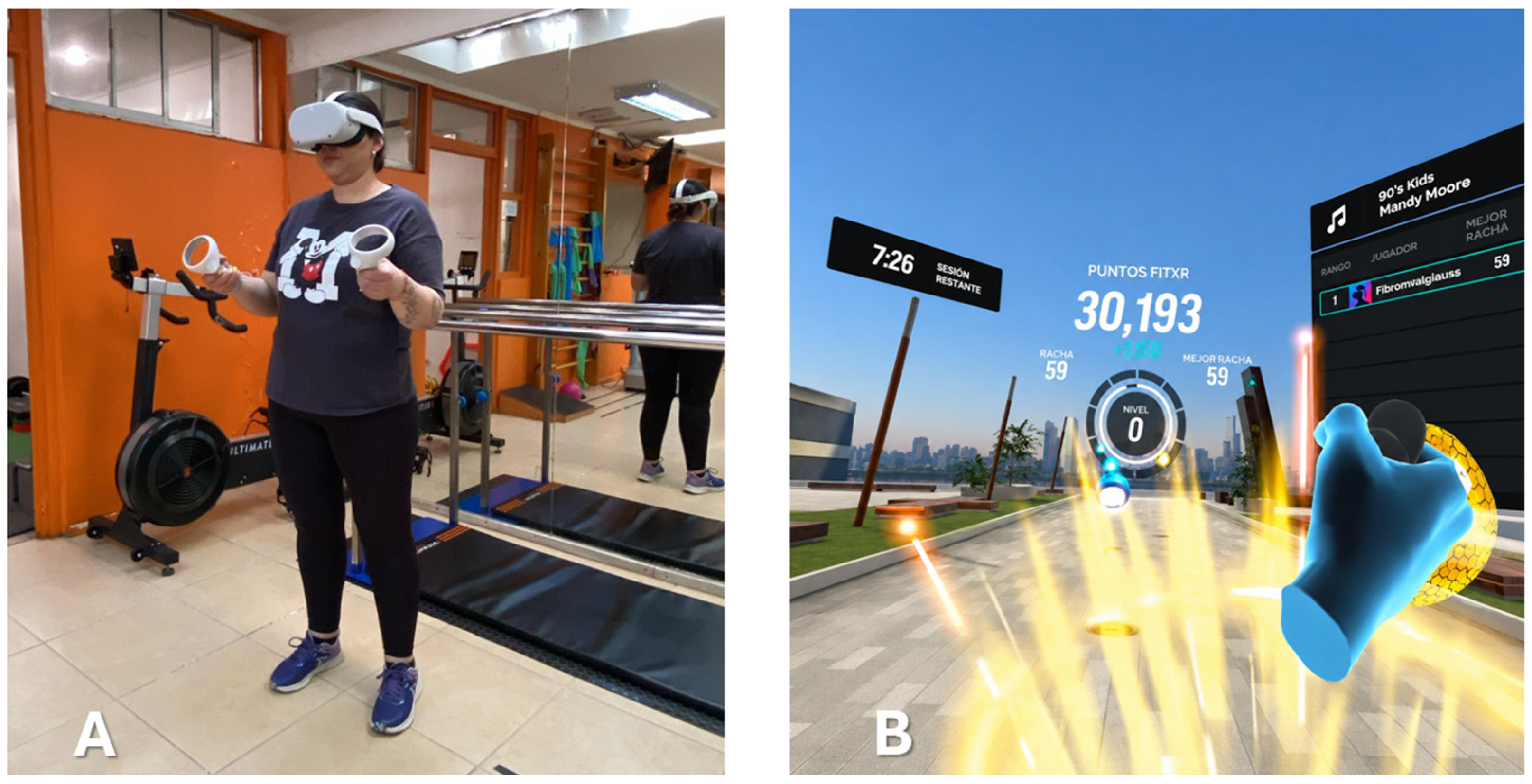
Participants completed a single session of immersive VRBE using a Meta Quest 2 headset (Meta Platforms Inc., Menlo Park, CA, USA) with handheld motion controllers (Figure 1A). The intervention was delivered through the FitXR application, a commercially available immersive fitness platform that integrates avatar-guided exercise tasks within an interactive virtual environment (Figure 1B). FitXR was selected due to its intuitive interface, minimal requirement for prior gaming experience, and ability to provide a standardized exercise experience while maintaining active participant engagement. The intervention used the boxing module of the application, which required participants to perform repetitive upper-limb movements in response to moving virtual targets and visual cues presented by the system avatar (Figure 1B). The tasks included punching movements (e.g., jab- and cross-type actions), trunk displacement and bending, squats, lunges, and defensive or obstacle-avoidance movements, promoting continuous whole-body visuomotor interaction throughout the session. In addition to physical execution, the immersive environment incorporated real-time audiovisual feedback, target-based interaction, attentional engagement, and performance scoring based on movement accuracy and task completion. Compared with conventional exercise settings, the VR environment required continuous sensorimotor adaptation and sustained interaction with dynamic virtual stimuli.
Each session lasted 15 min and was supervised by a trained physiotherapist who monitored participant safety without directly intervening in exercise execution, which was guided exclusively by the avatar and system interface. The VR content displayed to the participant was simultaneously projected onto a laptop screen, allowing continuous monitoring of movement execution and participant behavior throughout the session.
Prior to the intervention, participants performed a standardized 10 min warm-up on a cycle ergometer at moderate intensity (4–5 on the CR-10 perceived exertion scale). The VRBE session consisted of three phases: (1) 3 min of general joint mobility exercises for the spine and limbs guided by the avatar; (2) 10 min of interactive activity involving upper-limb movements and functional exercises (squats, lunges, and defensive actions performed in response to virtual targets and movement cues); and (3) 2 min of cool-down with breathing and general mobility exercises. During the interactive phase, participants were allowed to adapt or modify movements according to tolerance and could temporarily interrupt the activity if pain, discomfort, or fatigue occurred, following the preferred-intensity principle [39]. After completion of the session, an additional 5–10 min relaxation period was included, consisting of slow breathing and self-directed stretching exercises.

2.5. Statistical Analysis

Descriptive statistics were computed for all variables. To identify response patterns, an unsupervised cluster analysis using the K-means algorithm was performed based on ΔPPT values at the three anatomical sites (kg/cm2). The optimal number of clusters (k = 3) was determined using the elbow method. Exploratory cluster quality metrics, including the silhouette coefficient and Davies–Bouldin index, were additionally examined to support the interpretability of the clustering solution. Cluster solution quality was evaluated based on the proportion of variance explained by between-cluster separation. To assess intervention effects on absolute PPT values, repeated measures ANOVA was conducted with one within-subject factor (time: pre vs. post) and one between-subject factor (cluster), evaluating main effects and the time × cluster interaction. Analyses were performed separately for each anatomical site. When appropriate, post hoc comparisons were conducted using Bonferroni correction.
Additionally, univariate and multivariate linear regression models were performed to identify variables associated with ΔPPT, including educational level, DASS-21, MoCA, FIQR, number of comorbidities, weight, height, and BMI as predictors. Associations between baseline variables and cluster membership were explored using multinomial logistic regression models, with cluster as the dependent variable. Additional regression analyses were conducted to examine the association between psychological variables (DASS-21) and disease impact (FIQR). Educational level was classified into five ordinal categories (from lowest to highest) and included in the models using dummy coding, with the lowest level as the reference category.
Normality assumptions were assessed prior to inferential analyses. As some variables violated normality, pre–post comparisons were conducted using non-parametric tests (Wilcoxon signed-rank test); however, descriptive data are presented as mean ± standard deviation to facilitate comparability with previous literature. Given that the time factor included two levels (pre–post), the sphericity assumption was inherently satisfied. In this context, repeated measures ANOVA was used to assess interaction effects, given its acceptable robustness to moderate deviations from normality in balanced designs. Statistical significance was set at p < 0.05. Analyses were performed using JASP software (version 2.7.12.0). No relevant missing data were observed for the variables included in the analyses.

3. Results

3.1. General Characteristics

A total of 35 women with fibromyalgia (FM) were included (age: 46.0 ± 10.9 years; BMI: 29.0 ± 3.59 kg/m2). A summary of baseline sociodemographic variables is presented in Table 1 and Table 2.

3.2. Exploratory Comparison Between Original Study Samples

Exploratory comparisons between participants derived from the two original studies showed generally comparable baseline anthropometric, clinical, and pain sensitivity characteristics, including FIQR scores, baseline PPT values across anatomical sites, and ΔPPT responses (Supplementary Table S1). In addition, response patterns identified through cluster analysis were distributed across both study samples without evident concentration within a single dataset. Overall, these findings suggest reasonable consistency between the original cohorts and support the methodological consistency underlying the exploratory pooled analysis.

3.3. Pre–Post Changes in Pressure Pain Thresholds

Baseline PPT values across the three assessed sites were within low ranges compared with those typically reported in healthy populations. Normality testing using the Shapiro–Wilk test indicated that some PPT variables were not normally distributed (p < 0.05). Pre–post analyses showed no significant changes in PPT at any of the assessed sites (Table 3). These findings were consistent with the repeated measures ANOVA, which revealed no main effects of time for the trapezius (F(1,32) = 0.197; p = 0.660), lumbar region (F(1,32) = 0.298; p = 0.589), or knee (F(1,32) = 0.292; p = 0.593), indicating the absence of a group-level hypoalgesic effect following the VRBE intervention.

3.4. Exploratory Cluster Analysis of EIH Response Patterns and Repeated Measures ANOVA

Unsupervised cluster analysis using K-means, based on ΔPPT values across the three anatomical sites, identified three distinct response patterns. These clusters were clinically interpreted as positive responders (n = 6; 17%), defined by consistent increases in PPT across all sites (EIH response); negative responders (n = 8; 23%), characterized by consistent decreases in PPT across all sites, indicative of a hyperalgesic response; and non-responders (n = 21; 60%), who exhibited mixed or low-magnitude changes across sites. The clustering solution explained 59.7% of the total variance. Additional exploratory clustering metrics yielded a silhouette coefficient of 0.321 and a Davies–Bouldin index of 0.965.
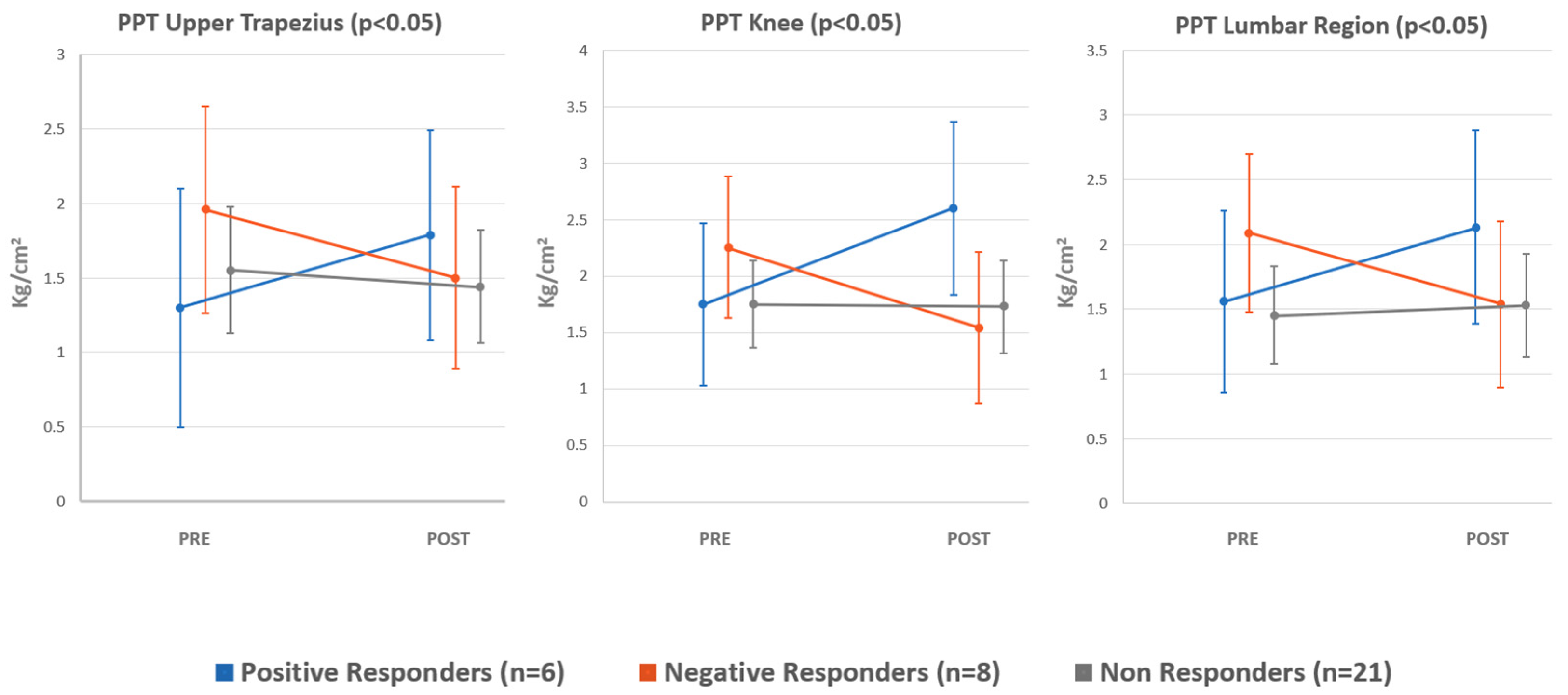
Repeated measures ANOVA showed no main effects of time across any site (trapezius: p = 0.660; lumbar: p = 0.589; knee: p = 0.593), confirming the absence of average pre–post changes in PPT. No main effects of cluster were observed (p ≥ 0.528), indicating comparable overall PPT levels across groups. However, a significant time × cluster interaction was identified for all anatomical sites: trapezius (F(2,32) = 15.56, p < 0.001, η2p = 0.493), lumbar (F(2,32) = 20.32, p < 0.001, η2p = 0.559), and knee (F(2,32) = 32.87, p < 0.001, η2p = 0.673). These findings indicate that both the direction and magnitude of PPT changes differed significantly between clusters, reflecting marked interindividual variability in response to the intervention (Figure 2).
Pre–post values of pressure pain thresholds (PPTs) across clusters were identified by K-means analysis (positive responders, negative responders, and non-responders). Data are presented for each anatomical site (upper trapezius, knee, and lumbar region). Positive responders show consistent increases in PPT across all three sites (generalized hypoalgesic response), negative responders show consistent decreases across all three sites (response consistent with increased mechanical pain sensitivity), and non-responders exhibit discordant or minimal changes across sites.
Post hoc comparisons with Bonferroni correction revealed significant differences between positive and negative responders at post-intervention for the trapezius (p = 0.004), lumbar region (p = 0.003), and knee (p < 0.001), confirming divergence in the direction of PPT responses between clusters.

3.5. Regression Analysis

Regression analyses showed that cognitive function (MoCA) was positively associated with ΔPPT at the lumbar site (R2 = 0.139; p < 0.05). Educational level was also significantly associated with ΔPPT at the lumbar (R2 = 0.26; p < 0.05) and knee sites (R2 = 0.335; p < 0.05); for the latter, higher educational levels were associated with greater increases in ΔPPT compared to the reference category.
Regarding disease impact, individual DASS-21 subscales were significantly associated with FIQR scores (all p < 0.001; R2 ≥ 0.54); however, these associations were not retained in multivariable models. Finally, none of the baseline variables evaluated in univariable or multivariable models significantly predicted cluster membership.

4. Discussion

The present exploratory analysis suggests that, although no significant group-level hypoalgesic effect was observed following a single session of VRBE, there is relevant interindividual variability in response. Pre–post analyses revealed no significant changes in PPT at any assessed site (trapezius p = 0.200; lumbar p = 0.945; knee p = 0.432), which was consistent with the absence of a main effect of time in repeated measures ANOVA models (p ≥ 0.589). Considering that EIH reflects a generalized pain modulation phenomenon, assessed here using a multisite approach, a significant time × cluster interaction was observed across all sites, with large effect sizes (trapezius: F(2,32) = 15.56, p < 0.001, η2p = 0.493; lumbar: F(2,32) = 20.32, p < 0.001, η2p = 0.559; knee: F(2,32) = 32.87, p < 0.001, η2p = 0.673). This exploratory clustering approach identified three preliminary response patterns: positive responders (n = 6, 17%), negative responders (n = 8, 23%), and non-responders (n = 21, 60%). These findings suggest that the absence of an average effect may not necessarily imply the absence of pain modulation, but rather the coexistence of divergent systemic responses that cancel each other out at the group level. From a mechanistic perspective, these findings may be compatible with previously described alterations in pain modulation processes in FM, where exercise may induce both inhibitory and facilitatory responses. Overall, these findings limit the interpretability of mean-based analyses and highlight the potential value of approaches that account for response heterogeneity in this context. Although exploratory, this approach may also contribute to the understanding of why average exercise effects in FM are often inconsistent across studies and individuals, particularly in interventions involving immersive and cognitively engaging exercise modalities such as VRBE. Importantly, these observations should be interpreted within the exploratory framework of the present study, which was designed to examine acute pain modulation responses following a single VRBE session rather than to evaluate clinical efficacy or long-term therapeutic effects.
The clinical interpretation of the observed ΔPPT values should nevertheless be approached cautiously. Although PPT assessment is widely used to characterize mechanical pain sensitivity and has consistently shown reduced thresholds in individuals with FM compared with pain-free controls [40,41,42], its utility as a biomarker of clinical status or treatment response remains limited [43]. Importantly, no well-established minimal detectable change or minimal clinically important difference values for PPT appear to be available specifically for FM. Therefore, the response patterns observed in the present study should be interpreted as preliminary indicators of interindividual variability in acute mechanical pain sensitivity responses rather than as definitive evidence of clinically meaningful hypoalgesia or hyperalgesia.
The pattern observed in this study can be interpreted in light of known mechanisms underlying EIH. In healthy individuals, EIH is mediated by activation of opioid and endocannabinoid systems, along with effective descending inhibitory modulation and spinal gating mechanisms, which reduce nociceptive processing at the central level and produce generalized hypoalgesic effects, including in regions remote from the exercised segment [21,26,44]. In contrast, these systems are altered in FM, with evidence of impaired descending inhibitory modulation (e.g., conditioned pain modulation, CPM) and dysfunction in serotonergic and noradrenergic pathways involved in endogenous analgesia [45,46]. In this context, not only may EIH fail to occur, but paradoxical responses may also emerge. Indeed, a substantial proportion of patients exhibit pain facilitation rather than inhibition [41], and exercise can induce generalized hyperalgesic responses in this population [47]. These mechanisms may help contextualize the response patterns observed in the present study: the absence of a group-level EIH effect, together with the identification of subgroups with opposing responses (hypoalgesia, hyperalgesia, and no change), suggests that pain modulation responses in FM may be heterogeneous across individuals. Overall, this reinforces the notion that the response to exercise in FM may be influenced by differences in central pain modulatory processes, which may vary across individuals.
The findings of this exploratory study can also be interpreted considering the potential modulatory role of VR, cognitive function, and educational level in pain processing. VR has demonstrated consistent analgesic effects in chronic pain, including FM, with clinically relevant reductions in pain, fatigue, and affective symptoms [18,48]. These effects are thought to be primarily mediated by attentional mechanisms (e.g., distraction) and modulation of cognitive–affective processes, particularly in active immersive environments that combine movement and engagement, which may promote more generalized hypoalgesic responses [49,50,51]. However, in chronic pain populations, EIH is highly variable and often impaired [24], suggesting that the effectiveness of interventions such as VRBE may depend on the integrity of central pain modulatory systems. In this context, cognitive function has been directly associated with descending modulation capacity, with poorer cognitive performance linked to greater dysfunction in these systems [52]. This is consistent with our findings, where MoCA scores were positively associated with ΔPPT at the lumbar site, suggesting a potential association between better cognitive function and greater hypoalgesic responses. Similarly, educational level—previously associated with lower pain severity, reduced functional interference, and lower catastrophizing [53,54,55]—was also associated with changes in PPT in our study. This may reflect differences in cognitive strategies, health literacy, or coping capacity. However, despite these associations, none of these variables predicted cluster membership, suggesting that while they may influence the magnitude of change, they are insufficient to explain the direction of the response (hypoalgesia vs. hyperalgesia). Overall, these findings are compatible with the hypothesis that responses to VRBE in FM may be influenced by the interaction between attentional, cognitive, and descending modulatory mechanisms. At the same time, they highlight a relevant gap in the literature, as no studies have directly examined the interaction between VR, cognitive function, and educational level in pain modulation or EIH in this population [29].
The marked interindividual variability observed in this study is consistent with findings in chronic pain populations. Unlike healthy individuals, in whom EIH tends to be consistent, chronic pain conditions—including FM—are characterized by heterogeneous responses, including hypoalgesia, no change, and hyperalgesia following exercise [24,26,56]. This variability has been reported across various chronic pain populations and is characterized by the presence of subgroups with divergent pain modulation patterns, which may result in opposing effects canceling each other out in mean-based analyses [57,58]. In this context, our findings are consistent with recent studies describing heterogeneous response patterns using cluster analysis in other clinical populations [58], although evidence specific to FM remains limited and has been scarcely explored using such approaches. Additionally, VRBE introduces cognitive and attentional components that may influence pain responses, potentially amplifying or attenuating EIH depending on the interaction between physical load, cognitive processing, and descending modulation mechanisms. However, evidence directly examining this interaction in FM is limited, which constrains the interpretation of our findings. Several factors have been proposed to contribute to this variability, including baseline descending modulation capacity, psychological factors, and autonomic function, although collectively they explain only a limited proportion of the observed variance [21,24,57,58,59,60]. This is consistent with our results, where baseline variables did not predict cluster membership. Overall, these findings reinforce the limitations of mean-based approaches and highlight the potential relevance of considering response heterogeneity as a central element in the interpretation of EIH in FM, particularly in interventions combining exercise and cognitive engagement such as VR.
Exercise-related pain represents a critical barrier to treatment adherence in FM; in particular, higher pain intensity and post-exercise symptom exacerbation have been consistently identified as factors limiting adherence to exercise programs [61,62]. From a clinical perspective, our findings may have potential implications for exercise prescription in FM, particularly regarding the risk of hyperalgesic responses and the need for individualized approaches from the initial session. Preliminary evidence suggests that VR-based interventions may improve adherence in chronic pain, potentially through mechanisms such as enjoyment, novelty, and distraction, and are associated with higher satisfaction and acceptability [63,64]. The identification of a subgroup of negative responders (23%), characterized by a generalized decrease in PPT following a single exercise session, suggests that exercise-related pain responses may not be uniformly hypoalgesic in this population, but may instead be associated with increased mechanical sensitivity in a clinically relevant proportion of patients. This is consistent with evidence showing that individuals with FM may experience clinically meaningful increases in pain and fatigue following submaximal exercise, with effects persisting up to 72 h [19], as well as generalized hyperalgesic responses in contrast to the inhibitory effects observed in healthy individuals [47]. In this context, the use of a preferred-intensity protocol, as implemented in this study, is clinically relevant, as it allows adjustment of exercise load according to individual tolerance, particularly in aerobic modalities [39]. The ability to self-regulate intensity and interrupt activity based on symptoms, together with the inclusion of pauses and recovery phases, may have mitigated negative responses, in line with evidence highlighting the role of exercise structuring and rest periods in pain modulation [65]. However, the persistence of a hyperalgesic subgroup despite these strategies underscores the need for ongoing individual monitoring and adaptive prescription based on the initial response to exercise. Additionally, the lack of baseline predictors of cluster membership suggests that pre-stratification based on clinical or psychological characteristics may be insufficient. This raises the exploratory possibility that acute responses could eventually be investigated as a potential “test–retest” strategy to guide treatment progression, although this hypothesis requires longitudinal validation. Overall, these findings support the implementation of flexible, self-regulated, and supervised exercise programs, particularly when using modalities such as VR, where the interaction between physical load and cognitive components may further influence response variability [66,67,68]. However, evidence to guide EIH-based personalization of exercise in FM remains limited and warrants further investigation, including the potential integration of digital monitoring systems and intelligent response-tracking approaches to better characterize VR-based rehabilitation interventions [69]. Future research should determine whether the response patterns identified in the present study can be replicated in larger samples and across repeated VRBE sessions. Additional questions include whether these acute responses remain stable over time, whether they are associated with specific pain modulation mechanisms, and whether they could be used to guide individualized exercise prescription and progression in people with FM.
This study has several limitations that should be considered when interpreting the findings. First, it is a secondary analysis combining data from two independent studies, which may introduce unaccounted variability. Second, the small sample size limits the stability and generalizability of the identified response patterns. Additionally, the exploratory nature of the cluster analysis and the small subgroup sizes further limit the stability and reproducibility of these patterns. Although exploratory clustering metrics suggested some degree of separation between response patterns, these findings should be interpreted cautiously given the small sample size and exploratory nature of the analysis. Third, the evaluation was restricted to the acute response following a single session, without follow-up, precluding conclusions regarding long-term clinical relevance. Accordingly, the observed PPT changes should be interpreted as exploratory acute responses rather than as evidence of sustained therapeutic effects. Fourth, no mechanistic measures of pain modulation (e.g., conditioned pain modulation, CPM) or physiological variables were included, limiting insight into underlying mechanisms. Fifth, the absence of a control group prevents causal attribution of the observed changes to the intervention, as the identified clusters may partly reflect spontaneous variability, habituation to algometry, or measurement error. Finally, the lack of baseline predictors may be influenced by sample size and variable selection.
Despite these limitations, the study has important strengths. It examines EIH in FM from an interindividual variability perspective, using cluster analysis to identify preliminary response patterns beyond mean-based approaches. It employs a standardized and objective outcome measure (PPT) across multiple sites, capturing generalized pain modulation. Additionally, it incorporates a structured, supervised VRBE protocol with self-regulated intensity, enhancing clinical applicability. Finally, it provides preliminary evidence on interindividual variability in EIH responses identified through cluster analysis in FM within a VR context, an area that remains underexplored.

5. Conclusions

A single session of VRBE did not produce a significant group-level hypoalgesic effect in this sample of women with FM; however, exploratory cluster analysis revealed substantial interindividual variability in PPT responses, including generalized increases, decreases, and minimal changes across anatomical sites. These findings suggest that group-level analyses alone may obscure divergent individual pain modulation responses in heterogeneous chronic pain conditions such as FM. From a clinical and methodological perspective, the present findings highlight the potential relevance of monitoring individual responses to exercise, particularly given the possibility of hyperalgesic responses in a subset of patients. Although VRBE may represent a promising exercise modality in FM, its acute effects on pain-related responses appear to vary considerably across individuals and should be interpreted cautiously in the context of this exploratory single-session design. Future studies with larger samples, control groups, mechanistic pain modulation measures, and longitudinal follow-up are needed to validate these preliminary response patterns and to further investigate factors potentially associated with variability in exercise-related pain responses in FM.

Supplementary Materials

The following supporting information can be downloaded at: https://www.mdpi.com/article/10.3390/virtualworlds5020027/s1, Table S1: Exploratory Comparison Between Participants Derived From the Two Original Studies Included in the Pooled Analysis.

Author Contributions

Conceptualization, C.C.-P. and G.A.-Á.; methodology, C.C.-P. and G.A.-Á.; validation, C.C.-P., G.A.-Á., F.G.-R., D.U.-D. and J.P.-G.; formal analysis, C.C.-P.; investigation, C.C.-P., G.A.-Á., B.P.-N. and G.R.Z.; resources, C.C.-P.; data curation, C.C.-P.; writing—original draft preparation, C.C.-P., G.A.-Á., B.P.-N., G.R.Z., F.G.-R., D.U.-D. and J.P.-G.; writing—review and editing, C.C.-P., G.A.-Á., B.P.-N., G.R.Z., F.G.-R., D.U.-D. and J.P.-G.; visualization, C.C.-P.; supervision, C.C.-P. and G.A.-Á.; project administration, C.C.-P.; funding acquisition, C.C.-P. All authors have read and agreed to the published version of the manuscript.

Funding

This research received no external funding.

Institutional Review Board Statement

The study was conducted in accordance with the Declaration of Helsinki, and approved by Ethics Committee of Universidad San Sebastián (IDs: 151-23 and 107-24) on 26 July 2024.

Informed Consent Statement

Informed consent was obtained from all subjects involved in the study.

Data Availability Statement

The data that support the findings of this study are available from the corresponding author upon reasonable request.

Conflicts of Interest

The authors declare no conflicts of interest.

Abbreviations

The following abbreviations are used in this manuscript:
FMFibromyalgia
EIHExercise-induced hypoalgesia
PPTPressure pain thresholds
VRBEVirtual reality-based exercise
VRVirtual reality
ACRAmerican College of Rheumatology
BMIBody mass index
DASS-21Depression Anxiety Stress Scale
MoCAMontreal Cognitive Assessment
FIQRFibromyalgia Impact Questionnaire Revised
ΔPPTChange in pressure pain thresholds
CPMConditioned pain modulation

References

  1. Wu, E.; Brener, A.; Hiser, J.K.D.; Hill, D.L.K.; Farmer, J.O. Fibromyalgia: Update on Pathogenesis and Management. Eur. J. Rheumatol. 2025, 12, e25032. [Google Scholar] [CrossRef] [Scilit]
  2. Durán, J.; Tejos-Bravo, M.; Cid, V.; Ferreccio, C.; Calvo, M. Chronic Pain in Chile: First Prevalence Report of Noncancer Chronic Pain, Fibromyalgia, and Neuropathic Pain and Its Associated Factors. Pain 2023, 164, 1852–1859. [Google Scholar] [CrossRef] [Scilit]
  3. Winslow, B.T.; Vandal, C.; Dang, L. Fibromyalgia: Diagnosis and Management. AFP Am. Fam. Physician 2023, 107, 137–144. [Google Scholar]
  4. Bair, M.J.; Krebs, E.E. Fibromyalgia. Ann. Intern. Med. 2020, 172, ITC33–ITC48. [Google Scholar] [CrossRef] [Scilit]
  5. Siracusa, R.; Paola, R.D.; Cuzzocrea, S.; Impellizzeri, D. Fibromyalgia: Pathogenesis, Mechanisms, Diagnosis and Treatment Options Update. Int. J. Mol. Sci. 2021, 22, 3891. [Google Scholar] [CrossRef] [Scilit] [PubMed]
  6. Hladkykh, F.V.; Liadova, T.I.; Matvieienko, M.S.; Komorovsky, R.; Smiyan, S.; Student, V. Central Sensitization and Nociplastic Pain: Shared Mechanisms in Fibromyalgia, Osteoarthritis, and Inflammatory Arthritis. J. Pain Res. 2026, 19, 571311. [Google Scholar] [CrossRef] [Scilit]
  7. Heikkala, E.; Karppinen, J. Pressure Pain Sensitivity Is More Strongly Associated with Musculoskeletal Pain among Women and Those with Chronic Diseases: Results from a Large Population-Based Birth Cohort Study. Musculoskelet. Sci. Pract. 2026, 82, 103503. [Google Scholar] [CrossRef] [Scilit]
  8. Fernández-de-las-Peñas, C.; Valera-Calero, J.A.; Arendt-Nielsen, L.; Martín-Guerrero, J.D.; Cigarán-Méndez, M.; Navarro-Pardo, E.; Pellicer-Valero, O.J. Clustering Analysis Identifies Two Subgroups of Women with Fibromyalgia with Different Psychological, Cognitive, Health-Related, and Physical Features but Similar Widespread Pressure Pain Sensitivity. Pain Med. 2023, 24, 881–889. [Google Scholar] [CrossRef] [Scilit]
  9. Docampo, E.; Collado, A.; Escaramís, G.; Carbonell, J.; Rivera, J.; Vidal, J.; Alegre, J.; Rabionet, R.; Estivill, X. Cluster Analysis of Clinical Data Identifies Fibromyalgia Subgroups. PLoS ONE 2013, 8, e74873. [Google Scholar] [CrossRef] [Scilit]
  10. Finnern, M.M.; Kleinböhl, D.; Flor, H.; Benrath, J.; Hölzl, R. Differential Sensory and Clinical Phenotypes of Patients with Chronic Widespread and Regional Musculoskeletal Pain. Pain 2021, 162, 56. [Google Scholar] [CrossRef] [Scilit] [PubMed]
  11. Maurel, S.; Giménez-Llort, L.; Alegre-Martin, J.; Castro-Marrero, J. Hierarchical Cluster Analysis Based on Clinical and Neuropsychological Symptoms Reveals Distinct Subgroups in Fibromyalgia: A Population-Based Cohort Study. Biomedicines 2023, 11, 2867. [Google Scholar] [CrossRef] [Scilit]
  12. Triñanes, Y.; González-Villar, A.; Gómez-Perretta, C.; Carrillo-de-la-Peña, M.T. Profiles in Fibromyalgia: Algometry, Auditory Evoked Potentials and Clinical Characterization of Different Subtypes. Rheumatol. Int. 2014, 34, 1571–1580. [Google Scholar] [CrossRef] [Scilit]
  13. Kumar, A.; Singh, A.; Kumar, U.; Bhatia, R. Pressure Pain Threshold Encode Hyperalgesia or Antinociception in Fibromyalgia Patients? J. Rheum. Dis. 2024, 31, 257–259. [Google Scholar] [CrossRef] [Scilit]
  14. Macfarlane, G.J.; Kronisch, C.; Dean, L.E.; Atzeni, F.; Häuser, W.; Fluß, E.; Choy, E.; Kosek, E.; Amris, K.; Branco, J.; et al. EULAR Revised Recommendations for the Management of Fibromyalgia. Ann. Rheum. Dis. 2017, 76, 318–328. [Google Scholar] [CrossRef] [Scilit] [PubMed]
  15. Zhang, Z.; Zhou, P.; He, N.; Wu, Z.; Bo, S.; Chen, C.; Chi, S.; Hou, N.; Hu, J.; Jing, F.; et al. Patient Version of Guideline for Fibromyalgia (2025 Edition). J. Evid. Based Med. 2025, 18, e70094. [Google Scholar] [CrossRef] [Scilit] [PubMed]
  16. Kundakci, B.; Kaur, J.; Goh, S.L.; Hall, M.; Doherty, M.; Zhang, W.; Abhishek, A. Efficacy of Nonpharmacological Interventions for Individual Features of Fibromyalgia: A Systematic Review and Meta-Analysis of Randomised Controlled Trials. Pain 2022, 163, 1432–1445. [Google Scholar] [CrossRef] [Scilit] [PubMed]
  17. Martinez, J.E.; Guimarães, I. Fibromyalgia—Are There Any New Approaches? Best Pract. Res. Clin. Rheumatol. 2024, 38, 101933. [Google Scholar] [CrossRef] [Scilit]
  18. Tang, P.; Cao, Y.; Vithran, D.T.A.V.; Xiao, W.; Wen, T.; Liu, S.; Li, Y. The Efficacy of Virtual Reality on the Rehabilitation of Musculoskeletal Diseases: Umbrella Review. J. Med. Internet Res. 2025, 27, e64576. [Google Scholar] [CrossRef] [Scilit]
  19. Berardi, G.; Eble, C.; Hunter, S.K.; Bement, M.H. Localized Pain and Fatigue During Recovery From Submaximal Resistance Exercise in People with Fibromyalgia. Phys. Ther. 2023, 103, pzad033. [Google Scholar] [CrossRef] [Scilit]
  20. da Cunha Ribeiro, R.P.; Franco, T.C.; Pinto, A.J.; Pontes Filho, M.A.G.; Domiciano, D.S.; de Sá Pinto, A.L.; Lima, F.R.; Roschel, H.; Gualano, B. Prescribed Versus Preferred Intensity Resistance Exercise in Fibromyalgia Pain. Front. Physiol. 2018, 9, 1097. [Google Scholar] [CrossRef] [Scilit]
  21. González-Iglesias, M.; Martínez-Benito, A.; López-Vidal, J.A.; Melis-Romeu, A.; Gómez-Rabadán, D.J.; Reina-Varona, Á.; Di-Bonaventura, S.; La Touche, R.; Fierro-Marrero, J. Understanding Exercise-Induced Hypoalgesia: An Umbrella Review of Scientific Evidence and Qualitative Content Analysis. Medicina 2025, 61, 401. [Google Scholar] [CrossRef] [Scilit]
  22. de la Coba, P.; Montoro, C.I.; Reyes Del Paso, G.A.; Galvez-Sánchez, C.M. Algometry for the Assessment of Central Sensitisation to Pain in Fibromyalgia Patients: A Systematic Review. Ann. Med. 2022, 54, 1403–1422. [Google Scholar] [CrossRef] [Scilit] [PubMed]
  23. Úbeda-D’Ocasar, E.; Valera-Calero, J.A.; Hervás-Pérez, J.P.; Caballero-Corella, M.; Ojedo-Martín, C.; Gallego-Sendarrubias, G.M. Pain Intensity and Sensory Perception of Tender Points in Female Patients with Fibromyalgia: A Pilot Study. Int. J. Environ. Res. Public Health 2021, 18, 1461. [Google Scholar] [CrossRef] [Scilit]
  24. Rice, D.; Nijs, J.; Kosek, E.; Wideman, T.; Hasenbring, M.I.; Koltyn, K.; Graven-Nielsen, T.; Polli, A. Exercise-Induced Hypoalgesia in Pain-Free and Chronic Pain Populations: State of the Art and Future Directions. J. Pain 2019, 20, 1249–1266. [Google Scholar] [CrossRef] [Scilit] [PubMed]
  25. Vaegter, H.B.; Jones, M.D. Exercise-Induced Hypoalgesia after Acute and Regular Exercise: Experimental and Clinical Manifestations and Possible Mechanisms in Individuals with and without Pain. Pain Rep. 2020, 5, e823. [Google Scholar] [CrossRef] [Scilit]
  26. Wewege, M.A.; Jones, M.D. Exercise-Induced Hypoalgesia in Healthy Individuals and People with Chronic Musculoskeletal Pain: A Systematic Review and Meta-Analysis. J. Pain 2021, 22, 21–31. [Google Scholar] [CrossRef] [Scilit] [PubMed]
  27. Bilika, P.; Karampatsou, N.; Stavrakakis, G.; Paliouras, A.; Theodorakis, Y.; Strimpakos, N.; Kapreli, E. Virtual Reality-Based Exercise Therapy for Patients with Chronic Musculoskeletal Pain: A Scoping Review. Healthcare 2023, 11, 2412. [Google Scholar] [CrossRef] [Scilit]
  28. Cortés-Pérez, I.; Zagalaz-Anula, N.; Ibancos-Losada, M.D.R.; Nieto-Escámez, F.A.; Obrero-Gaitán, E.; Osuna-Pérez, M.C. Virtual Reality-Based Therapy Reduces the Disabling Impact of Fibromyalgia Syndrome in Women: Systematic Review with Meta-Analysis of Randomized Controlled Trials. J. Pers. Med. 2021, 11, 1167. [Google Scholar] [CrossRef] [Scilit]
  29. Rooney, T.; Sharpe, L.; Winiarski, N.; Todd, J.; Colagiuri, B.; Van Ryckeghem, D.; Crombez, G.; Michalski, S.C. A Synthesis of Meta-Analyses of Immersive Virtual Reality Interventions in Pain. Clin. Psychol. Rev. 2025, 117, 102566. [Google Scholar] [CrossRef] [Scilit]
  30. Gupta, A.; Scott, K.; Dukewich, M. Innovative Technology Using Virtual Reality in the Treatment of Pain: Does It Reduce Pain via Distraction, or Is There More to It? Pain Med. 2018, 19, 151–159. [Google Scholar] [CrossRef] [Scilit]
  31. Capriotti, A.; Moret, S.; Del Bello, E.; Federici, A.; Lucertini, F. Virtual Reality: A New Frontier of Physical Rehabilitation. Sensors 2025, 25, 3080. [Google Scholar] [CrossRef] [Scilit] [PubMed]
  32. Arias-Álvarez, G.; Santamera-Lastras, M.; Guzmán-Oyarzo, D.; Osorio-Torres, W.; Parada-Norambuena, B.; Pecos-Martín, D.; González, J.G.P.; Gómez-Pulido, J.; Carvajal-Parodi, C. Immersive Virtual Reality Exercise: Effects on Cortisol, Quality of Life, Cognitive Function, and Psychological Symptoms in Fibromyalgia. Medicina 2026, 62, 446. [Google Scholar] [CrossRef] [Scilit]
  33. Gulsen, C.; Soke, F.; Eldemir, K.; Apaydin, Y.; Ozkul, C.; Guclu-Gunduz, A.; Akcali, D.T. Effect of Fully Immersive Virtual Reality Treatment Combined with Exercise in Fibromyalgia Patients: A Randomized Controlled Trial. Assist. Technol. 2022, 34, 256–263. [Google Scholar] [CrossRef] [Scilit]
  34. Carvajal-Parodi, C.; Arias-Álvarez, G.; Ulloa-Díaz, D.; Romero-Vera, L.; Andrades-Ramírez, O.; Guede-Rojas, F.; Ponce-González, J.G. Immersive Virtual Reality-Based Exercise for Pain Management in Fibromyalgia: An Exploratory Study with Risk of Poor Outcomes Stratification. Appl. Sci. 2025, 15, 5956. [Google Scholar] [CrossRef] [Scilit]
  35. Guede-Rojas, F.; Mendoza, C.; Rodríguez-Lagos, L.; Soto-Martínez, A.; Ulloa-Díaz, D.; Jorquera-Aguilera, C.; Carvajal-Parodi, C. Effects of Non-Immersive Virtual Reality Exercise on Self-Reported Pain and Mechanical Hyperalgesia in Older Adults with Knee and Hip Osteoarthritis: A Secondary Analysis of a Randomized Controlled Trial. Medicina 2025, 61, 1122. [Google Scholar] [CrossRef] [Scilit] [PubMed]
  36. Gao, J.; Liu, Y.; Wang, S.; Meng, X.; Bao, Z.; Jing, J.; Chen, Y. Exercise Interventions for Physical Function, Psychological Health, and Quality of Life in Patients with Myalgic Encephalomyelitis/Chronic Fatigue Syndrome and Fibromyalgia: A Systematic Review and Network Meta-Analysis. J. Psychosom. Res. 2026, 206, 112618. [Google Scholar] [CrossRef] [Scilit]
  37. Wang, T.; Su, H.; Zhou, Y.; Du, L.; Lv, Y.; Yu, L. Effects of Exercise on Pain, Fatigue, and Quality of Life in People with Fibromyalgia: A Systematic Review and Meta-Analysis of Randomized Controlled Trials. Front. Med. 2026, 13, 1782714. [Google Scholar] [CrossRef] [Scilit]
  38. Wolfe, F.; Clauw, D.J.; Fitzcharles, M.-A.; Goldenberg, D.L.; Häuser, W.; Katz, R.L.; Mease, P.J.; Russell, A.S.; Russell, I.J.; Walitt, B. 2016 Revisions to the 2010/2011 Fibromyalgia Diagnostic Criteria. Semin. Arthritis Rheum. 2016, 46, 319–329. [Google Scholar] [CrossRef] [Scilit]
  39. Newcomb, L.W.; Koltyn, K.F.; Morgan, W.P.; Cook, D.B. Influence of Preferred versus Prescribed Exercise on Pain in Fibromyalgia. Med. Sci. Sports Exerc. 2011, 43, 1106–1113. [Google Scholar] [CrossRef] [Scilit]
  40. Goubert, D.; Danneels, L.; Graven-Nielsen, T.; Descheemaeker, F.; Meeus, M. Differences in Pain Processing Between Patients with Chronic Low Back Pain, Recurrent Low Back Pain, and Fibromyalgia. Pain Physician 2017, 20, 307–318. [Google Scholar] [PubMed]
  41. Potvin, S.; Marchand, S. Pain Facilitation and Pain Inhibition during Conditioned Pain Modulation in Fibromyalgia and in Healthy Controls. Pain 2016, 157, 1704–1710. [Google Scholar] [CrossRef] [Scilit]
  42. Jespersen, A.; Dreyer, L.; Kendall, S.; Graven-Nielsen, T.; Arendt-Nielsen, L.; Bliddal, H.; Danneskiold-Samsoe, B. Computerized Cuff Pressure Algometry: A New Method to Assess Deep-Tissue Hypersensitivity in Fibromyalgia. Pain 2007, 131, 57–62. [Google Scholar] [CrossRef] [Scilit]
  43. González-Álvarez, M.E.; Riquelme-Aguado, V.; Arribas-Romano, A.; Fernández-Carnero, J.; Villafañe, J.H. The Association between Pressure Pain Thresholds, Conditioned Pain Modulation, Clinical Status, and Sleep Quality in Fibromyalgia Patients: A Clinical Trial Secondary Analysis. J. Clin. Med. 2024, 13, 4834. [Google Scholar] [CrossRef] [Scilit] [PubMed]
  44. Wu, B.; Zhou, L.; Chen, C.; Wang, J.; Hu, L.I.; Wang, X. Effects of Exercise-Induced Hypoalgesia and Its Neural Mechanisms. Med. Sci. Sports Exerc. 2022, 54, 220–231. [Google Scholar] [CrossRef] [Scilit]
  45. Welsch, P.; Üçeyler, N.; Klose, P.; Walitt, B.; Häuser, W. Serotonin and Noradrenaline Reuptake Inhibitors (SNRIs) for Fibromyalgia. Cochrane Database Syst. Rev. 2018, 2018, CD010292. [Google Scholar] [CrossRef] [Scilit]
  46. O’Brien, A.T.; Deitos, A.; Triñanes Pego, Y.; Fregni, F.; Carrillo-de-la-Peña, M.T. Defective Endogenous Pain Modulation in Fibromyalgia: A Meta-Analysis of Temporal Summation and Conditioned Pain Modulation Paradigms. J. Pain 2018, 19, 819–836. [Google Scholar] [CrossRef] [Scilit]
  47. Staud, R.; Robinson, M.E.; Price, D.D. Isometric Exercise Has Opposite Effects on Central Pain Mechanisms in Fibromyalgia Patients Compared to Normal Controls. Pain 2005, 118, 176–184. [Google Scholar] [CrossRef] [Scilit]
  48. Lier, E.J.; de Vries, M.; Steggink, E.M.; ten Broek, R.P.G.; van Goor, H. Effect Modifiers of Virtual Reality in Pain Management: A Systematic Review and Meta-Regression Analysis. Pain 2023, 164, 1658–1665. [Google Scholar] [CrossRef] [Scilit] [PubMed]
  49. Čeko, M.; Baeuerle, T.; Webster, L.; Wager, T.D.; Lumley, M.A. The Effects of Virtual Reality Neuroscience-Based Therapy on Clinical and Neuroimaging Outcomes in Patients with Chronic Back Pain: A Randomized Clinical Trial. Pain 2024, 165, 1860–1874. [Google Scholar] [CrossRef] [Scilit]
  50. Naugle, K.E.; Cervantes, X.A.; Boone, C.L.; Wind, B.; Naugle, K.M. The Acute Hypoalgesic Effects of Active Head-Mounted Display Virtual Reality Games. PLoS ONE 2024, 19, e0308064. [Google Scholar] [CrossRef] [Scilit] [PubMed]
  51. Baker, N.A.; Polhemus, A.H.; Haan Ospina, E.; Feller, H.; Zenni, M.; Deacon, M.; DeGrado, G.; Basnet, S.; Driscoll, M. The State of Science in the Use of Virtual Reality in the Treatment of Acute and Chronic Pain: A Systematic Scoping Review. Clin. J. Pain 2022, 38, 424–441. [Google Scholar] [CrossRef] [Scilit]
  52. Serrano, P.V.; Zortea, M.; Alves, R.L.; Beltran, G.; Deliberali, C.B.; Maule, A.; Torres, I.L.S.; Fregni, F.; Caumo, W. Association between Descending Pain Modulatory System and Cognitive Impairment in Fibromyalgia: A Cross-Sectional Exploratory Study. Front. Behav. Neurosci. 2022, 16, 917554. [Google Scholar] [CrossRef] [Scilit] [PubMed]
  53. Fitzcharles, M.-A.; Rampakakis, E.; Ste-Marie, P.A.; Sampalis, J.S.; Shir, Y. The Association of Socioeconomic Status and Symptom Severity in Persons with Fibromyalgia. J. Rheumatol. 2014, 41, 1398–1404. [Google Scholar] [CrossRef] [Scilit]
  54. Atzeni, F.; Alciati, A.; Bazzichi, L.; Govoni, M.; Biasi, G.; Di Franco, M.; Mozzani, F.; Gremese, E.; Dagna, L.; Batticciotto, A.; et al. Sociodemographic Factors in Fibromyalgia: Results from the Italian Fibromyalgia Registry. Clin. Exp. Rheumatol. 2022, 40, 1183–1188. [Google Scholar] [CrossRef] [Scilit] [PubMed]
  55. Fentazi, D.; Pester, B.D.; Yamin, J.B.; Jamison, R.N.; Edwards, R.R.; Meints, S.M. Why Is Low Educational Attainment Linked to Worse Pain and Function in Fibromyalgia? J. Pain 2025, 27, 104764. [Google Scholar] [CrossRef] [Scilit]
  56. Rojas-Galleguillos, F.; Clark-Hormazábal, C.; Méndez-Fuentes, E.; Guede-Rojas, F.; Mendoza, C.; Riveros Valdés, A.; Carvajal-Parodi, C. Exercise-Induced Hypoalgesia in Chronic Neck Pain: A Narrative Review. Sports Med. Health Sci. 2024, 6, 37–47. [Google Scholar] [CrossRef] [Scilit] [PubMed]
  57. Bossenger, N.R.; Lewis, G.N.; Rice, D.A.; Shepherd, D. The Autonomic and Nociceptive Response to Acute Exercise Is Impaired in People with Knee Osteoarthritis. Neurobiol. Pain 2023, 13, 100118. [Google Scholar] [CrossRef] [Scilit]
  58. Lyons, K.M.; Stout, J.R.; Stock, M.S.; Hanney, W.J.; Anderson, A.W. The Identification of Pain Phenotypes in Individuals With Low Back Pain in Response to Dynamic Resistance Exercise. Eur. J. Pain 2025, 29, e70136. [Google Scholar] [CrossRef] [Scilit]
  59. Liebermann, P.; Defrin, R. Opposite Effects of Isometric Exercise on Pain Sensitivity of Healthy Individuals: The Role of Pain Modulation. Pain Rep. 2024, 9, e1195. [Google Scholar] [CrossRef] [Scilit]
  60. Patricio, P.; Mailloux, C.; Wideman, T.H.; Langevin, P.; Descarreaux, M.; Beaulieu, L.; Massé-Alarie, H. Assessment of Exercise-induced Hypoalgesia in Chronic Low Back Pain and Potential Associations with Psychological Factors and Central Sensitization Symptoms: A Case–Control Study. Pain Pract. 2023, 23, 264–276. [Google Scholar] [CrossRef] [Scilit]
  61. Leese, C.; Gupte, D.; Christogianni, A.; Higgins, C.; Adair, P.; Dall, P.; Cameron, P.; Smith, B.H.; Colvin, L. Barriers and Facilitators for Physical Activity in People Living with Chronic Pain: A Systematic Review and Combined Analysis. Pain 2024, 165, 2721–2732. [Google Scholar] [CrossRef] [Scilit]
  62. Vancampfort, D.; McGrath, R.L.; Hemmings, L.; Gillis, V.; Bernar, K.; Van Damme, T. Physical Activity Correlates in People with Fibromyalgia: A Systematic Review. Disabil. Rehabil. 2023, 45, 4165–4174. [Google Scholar] [CrossRef] [Scilit]
  63. Tuck, N.; Pollard, C.; Good, C.; Williams, C.; Lewis, G.; Hames, M.; Aamir, T.; Bean, D. Active Virtual Reality for Chronic Primary Pain: Mixed Methods Randomized Pilot Study. JMIR Form. Res. 2022, 6, e38366. [Google Scholar] [CrossRef] [Scilit]
  64. Glavare, M.; Stålnacke, B.-M.; Häger, C.K.; Löfgren, M. Virtual Reality Exercises in an Interdisciplinary Rehabilitation Programme for Persons with Chronic Neck Pain: A Feasibility Study. J. Rehabil. Med. Clin. Commun. 2021, 4, 1000067. [Google Scholar] [CrossRef] [Scilit] [PubMed]
  65. Staud, R.; Robinson, M.E.; Weyl, E.E.; Price, D.D. Pain Variability in Fibromyalgia Is Related to Activity and Rest: Role of Peripheral Tissue Impulse Input. J. Pain 2010, 11, 1376–1383. [Google Scholar] [CrossRef] [Scilit] [PubMed]
  66. Matheve, T.; Bogaerts, K.; Timmermans, A. Virtual Reality Distraction Induces Hypoalgesia in Patients with Chronic Low Back Pain: A Randomized Controlled Trial. J. Neuroeng. Rehabil. 2020, 17, 55. [Google Scholar] [CrossRef] [Scilit]
  67. Flanagan, K.; Vickerstaff, V.; Wheatstone, P.; Minton, O.; Taubert, M.; Hudson, B.; White, N. Virtual Reality Technology for Pain Management in Advanced Cancer. Cochrane Database Syst. Rev. 2024, 11, CD016078. [Google Scholar] [CrossRef] [Scilit] [PubMed]
  68. Dumoulin, S.; Bouchard, S.; Loranger, C.; Quintana, P.; Gougeon, V.; Lavoie, K.L. Are Cognitive Load and Focus of Attention Differentially Involved in Pain Management: An Experimental Study Using a Cold Pressor Test and Virtual Reality. J. Pain Res. 2020, 13, 2213–2222. [Google Scholar] [CrossRef] [Scilit]
  69. Riaz, W.; Ji, J.; Ullah, A. TriViT-Lite: A Compact Vision Transformer–MobileNet Model with Texture-Aware Attention for Real-Time Facial Emotion Recognition in Healthcare. Electronics 2025, 14, 3256. [Google Scholar] [CrossRef] [Scilit]
Figure 1. (A) Patient with Meta Quest headset and handheld controllers. (B) FitXR environment and avatar.
Virtualworlds 05 00027 g001
Figure 2. Pre–Post Changes in Pressure Pain Thresholds (PPTs) by Cluster.
Virtualworlds 05 00027 g002
Table 1. Baseline Sociodemographic and Clinical Characteristics.
VariableAge
(Years)
Height
(m)
Weight
(kg)
No. of
Comorbidities
DASS-21FIQRMoCA
Mean46.01.6074.11.4333.668.725.0
SD10.90.0710.91.5215.521.23.17
Shapiro–Wilk W0.9760.9710.9740.8190.9620.9320.951
p-value0.6420.4800.576<0.0010.2650.0320.119
Abbreviations: DASS-21 = Depression Anxiety Stress Scale; FIQR = Fibromyalgia Impact Questionnaire Revised; MoCA = Montreal Cognitive Assessment; SD = standard deviation.
Table 2. Educational Level Distribution.
Educational Leveln%
Primary education12.9
Secondary education1234.3
Technical education1028.6
University degree1131.4
Postgraduate12.9
Table 3. Changes in Pressure Pain Thresholds (PPTs) Pre–Post Intervention.
Anatomical
Site
Pre
(kg/cm2)
Post
(kg/cm2)
ΔPPT
(Post–Pre)
p-ValueEffect Size (r)
Upper trapezius1.60 ± 0.961.51 ± 0.83−0.09 ± 0.430.2000.254
Lumbar region1.61 ± 0.861.64 ± 0.900.02 ± 0.490.945−0.015
Knee1.87 ± 0.871.83 ± 0.97−0.03 ± 0.610.4320.156
Data are presented as mean ± standard deviation. ΔPPT was calculated as the difference between post- and pre-intervention values. Inferential analyses were conducted using the Wilcoxon signed-rank test. Effect size was estimated using rank-biserial correlation (r). A positive ΔPPT indicates an increase in pain threshold (hypoalgesic response), whereas a negative ΔPPT indicates a decrease in pain threshold (response consistent with increased mechanical pain sensitivity).
Disclaimer/Publisher’s Note: The statements, opinions and data contained in all publications are solely those of the individual author(s) and contributor(s) and not of MDPI and/or the editor(s). MDPI and/or the editor(s) disclaim responsibility for any injury to people or property resulting from any ideas, methods, instructions or products referred to in the content.