


Simple Summary
We report two cases of human granulocytic anaplasmosis diagnosed in January 2025 in Suffolk County, New York. Both patients presented with acute febrile illness and characteristic laboratory abnormalities including leukopenia, thrombocytopenia, and elevated hepatic transaminases. Initial diagnostic evaluation did not prioritize tick-borne disease due to the winter season, resulting in delayed consideration. Diagnosis was confirmed by polymerase chain reaction in one case and serology in the other; both patients recovered rapidly with doxycycline therapy. These cases highlight the potential limitations of season-based diagnostic assumptions. While the timing of infection cannot be definitively established, these observations occurred during a winter period when episodic temperatures exceeded thresholds for tick activity. Recognition of anaplasmosis as a year-round consideration may facilitate earlier treatment and improved outcomes in endemic regions.
Abstract
Background: Human granulocytic anaplasmosis (HGA) is a tick-borne zoonotic infection caused by Anaplasma phagocytophilum and transmitted by Ixodes species. In temperate regions, HGA is considered seasonal, with most cases occurring during late spring and summer. We describe two cases of HGA diagnosed in January during a winter period with episodic temperatures exceeding thresholds for tick activity, highlighting atypical seasonal presentation and diagnostic challenges. Methods: This report details the clinical course, diagnostic reasoning, and management of two patients evaluated at a tertiary care hospital in Suffolk County, New York. Data were derived from direct clinical care and the electronic health record. The institutional review board determined this work did not constitute human subject research. Written informed consent was obtained from both patients. Results: Both patients presented with acute febrile illness and characteristic laboratory abnormalities. Due to winter season, tick-borne infection was not initially suspected, resulting in delayed consideration. PCR testing confirmed A. phagocytophilum infection in Case 1, meeting CDC criteria for confirmed HGA. Case 2 met CDC criteria for probable HGA based on serologic testing showing elevated IgG (1:320) in the appropriate clinical context. Treatment with doxycycline led to rapid clinical improvement and complete recovery. Conclusions: These cases demonstrate that HGA can be diagnosed during winter months in endemic regions. Although the precise timing of infection cannot be determined, these observations occurred during a period when episodic temperatures exceeded thresholds for tick activity. The cases highlight limitations of season-based diagnostic assumptions and suggest maintaining clinical suspicion for anaplasmosis year-round in endemic areas.
1. Introduction
Human granulocytic anaplasmosis (HGA) is an emerging tick-borne zoonotic infection caused by the obligate intracellular bacterium Anaplasma phagocytophilum [1]. In the northeastern United States, the primary vector is the black-legged tick, Ixodes scapularis, which also transmits other clinically significant pathogens including Borrelia burgdorferi and Babesia microti [2]. Since its recognition as a human pathogen in the 1990s, HGA incidence has increased substantially across endemic regions of North America [1,3,4].
Ticks are ectothermic arthropods whose survival, development, and host-seeking behavior are strongly influenced by environmental conditions. Temperature, humidity, and precipitation collectively regulate tick life cycles and seasonal activity patterns. Warmer temperatures and milder winters have been associated with increased tick survival, expanded geographic distribution, and longer periods of seasonal activity for I. scapularis in North America and Europe [2,5].
HGA exhibits a characteristic seasonal pattern, with most cases occurring during late spring and summer, corresponding to peak nymphal tick activity [1]. However, I. scapularis ticks enter diapause during winter only when temperatures remain persistently below critical thresholds. Experimental and field studies demonstrate that temperatures above approximately 4–7 °C (39–45 °F) can disrupt diapause and permit intermittent host-seeking activity, even during winter months [2]. Recent climatologic observations indicate that winter temperatures in parts of the northeastern United States can episodically exceed these thresholds during warm periods [6,7].
Despite increasing recognition of changing tick ecology and expanding disease risk, clinically confirmed winter season cases of HGA remain infrequently reported. While occasional winter cases have been documented, diagnostic suspicion for tick-borne illness during winter months is often low, which may contribute to delayed diagnosis or misclassification. Diagnostic delay attributable to seasonality bias represents an ongoing clinical challenge warranting continued documentation [8].
In this report, we describe two cases of HGA diagnosed in January 2025 in Suffolk County, New York. These cases highlight the importance of maintaining year-round clinical awareness of tick-borne infections in endemic regions.
2. Methods
This report details the clinical course, diagnostic reasoning, and management of two patients evaluated by the authoring clinical team at a tertiary care hospital in Suffolk County, New York. Data were derived from direct clinical care and the electronic health record. The institutional review board determined this work did not constitute human subject research. Written informed consent for publication was obtained from both patients. Meteorological data were obtained from Weather Spark and local weather services for Francis S. Gabreski Airport (Long Island, NY, USA).
3. Case Reports
3.1. Case 1
A 62-year-old patient with no significant medical history presented to the emergency department in mid-January 2025 with a three-day history of fever, severe myalgia affecting the lower extremities and back, and frontal headache. The patient reported hiking in wooded areas of Suffolk County approximately two weeks prior to symptom onset but denied tick bite, rash, or recent travel.
Physical examination revealed an acutely ill but alert patient. Vital signs: temperature 39.2 °C, heart rate 98 bpm, blood pressure 128/76 mmHg, respiratory rate 18 breaths/min, oxygen saturation 98% on room air. No rash, lymphadenopathy, or organomegaly was noted.
Laboratory evaluation revealed leukopenia (2.1 × 10³/µL; reference 4.5–11.0), thrombocytopenia (98 × 103/µL; reference 150–400), and elevated hepatic transaminases (AST 120 U/L, ALT 110 U/L; reference < 40). Additional findings included mild anemia (hemoglobin 12.8 g/dL), normal creatinine (0.9 mg/dL), and elevated C-reactive protein (45 mg/L; reference < 10). Peripheral blood smear examination identified morulae within neutrophils, prompting immediate initiation of doxycycline 100 mg twice daily.
PCR testing for A. phagocytophilum was ordered and returned positive two days later, confirming the diagnosis. Additional testing showed negative two-tier Lyme disease serology (ELISA and Western blot). Peripheral blood smear showed no intraerythrocytic parasites consistent with babesiosis. Negative influenza A/B and COVID-19 PCR, and blood cultures with no growth at five days.
The patient was managed as an outpatient with clinical improvement within 48 h of treatment initiation. Complete resolution of symptoms occurred by day five, with normalization of laboratory abnormalities at two-week follow-up.
3.2. Case 2
A 45-year-old patient with well-controlled hypertension presented to the emergency department in late January 2025 with a four-day history of fever, chills, generalized fatigue, and diffuse myalgias. The patient reported yard work and gardening activities in Suffolk County approximately two weeks prior to symptom onset but denied tick bite, rash, or travel.
Physical examination revealed an ill-appearing patient. Vital signs: temperature 38.9 °C, heart rate 102 bpm, blood pressure 142/84 mmHg, respiratory rate 20 breaths/min, oxygen saturation 97% on room air. No rash, lymphadenopathy, or splenomegaly was present.
Laboratory evaluation showed leukopenia (2.8 × 10³/µL), thrombocytopenia (110 × 103/µL), and elevated hepatic transaminases (AST 95 U/L, ALT 88 U/L). Additional findings included mild anemia (hemoglobin 13.2 g/dL), normal creatinine (1.0 mg/dL), and elevated ESR 42 mm/h reference < 20).
Given the constellation of fever, leukopenia, thrombocytopenia, and elevated transaminases following outdoor exposure, empiric doxycycline 100 mg twice daily was initiated. Serologic testing for A. phagocytophilum showed elevated IgG (1:320) with detectable IgM, though IgM was not used for diagnostic classification per CDC guidance. Two-tier Lyme disease serology was negative (ELISA), Babesia microti IgG/IgM was negative, influenza A/B and COVID-19 testing were negative, and blood cultures showed no growth.
The patient was managed as an outpatient with rapid clinical improvement. Fever resolved within 48 h, and complete symptom resolution occurred by day seven. Follow-up laboratory testing at two weeks showed normalization of all abnormalities. PCR testing was not performed, representing a limitation of diagnostic confirmation for this case.
4. Results
Both cases of HGA were diagnosed in January 2025, with reported outdoor exposures occurring approximately two weeks prior to symptom onset (early January 2025). Both patients presented with the characteristic clinical triad of fever, leukopenia, and thrombocytopenia, accompanied by elevated hepatic transaminases. Initial diagnostic evaluation in both cases did not prioritize tick-borne disease due to the winter season.
Diagnostic confirmation differed between the two cases. Case 1 met CDC criteria for confirmed HGA based on PCR detection of A. phagocytophilum DNA and microscopic identification of morulae in neutrophils. Case 2 was classified as probable HGA based on serologic testing showing elevated IgG (1:320) in the appropriate clinical context. While PCR offers higher specificity during acute infection, serologic testing remains valid when PCR is unavailable or when patients present later in the disease course. The rapid clinical response to doxycycline in Case 2, with defervescence within 48 h and complete resolution of laboratory abnormalities, provides strong supporting evidence for the diagnosis. Table 1 shows Patient characteristics and comparison.
Table 1.
Clinical presentation, laboratory findings, diagnostic confirmation, and outcomes of two cases of human granulocytic anaplasmosis diagnosed during the winter months in an endemic region.
Both patients demonstrated rapid clinical improvement following doxycycline initiation, with fever resolution within 48 h and complete symptom resolution within one week. Laboratory abnormalities normalized at two-week follow-up in both cases. Neither patient required hospitalization.
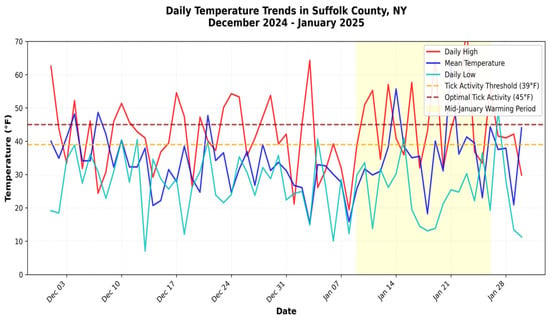
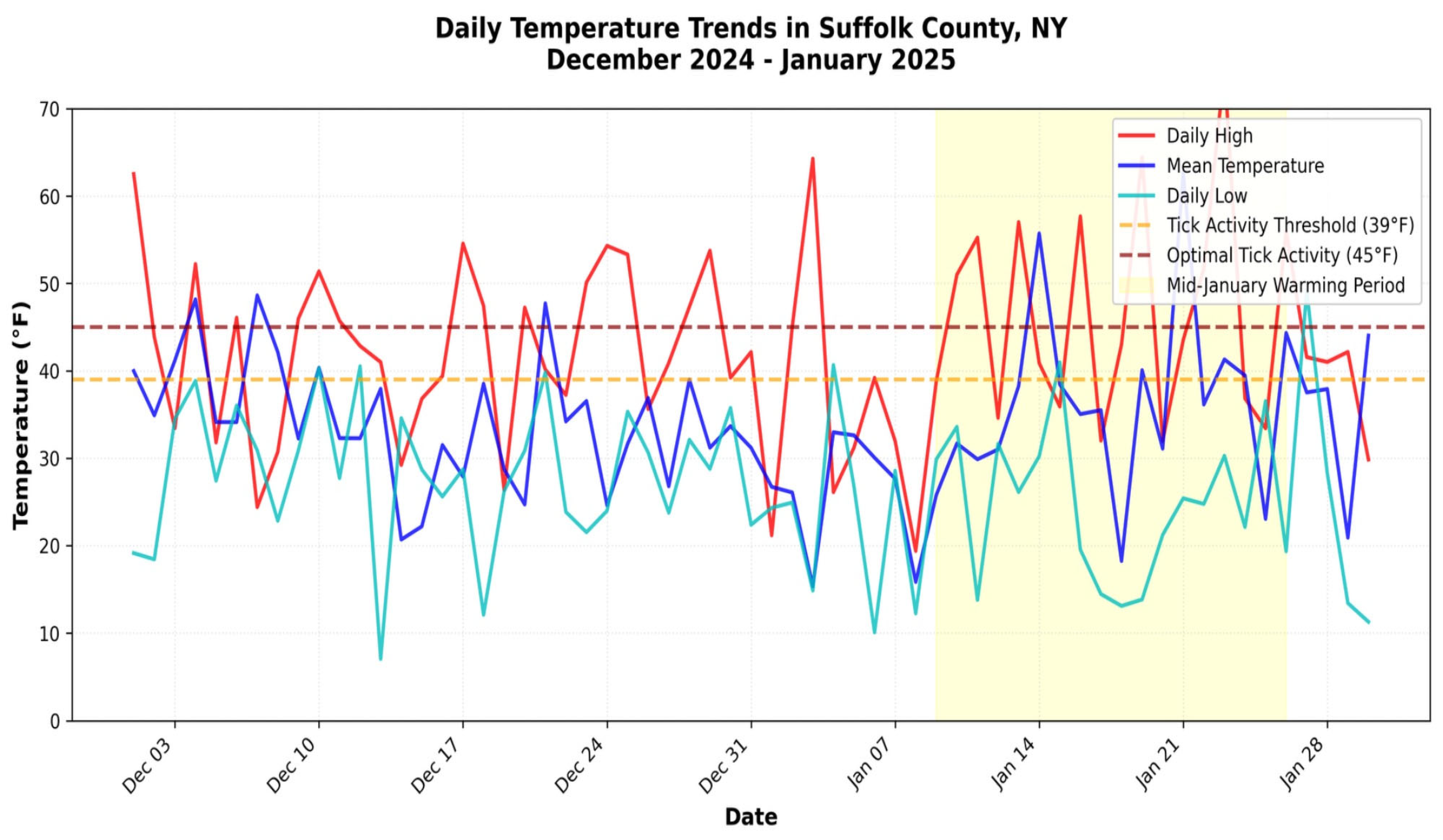
Meteorological data from Suffolk County during winter 2024–2025 revealed multiple days in early to mid-January when temperatures exceeded 43–59 °F (6–15 °C), surpassing the 39–45 °F threshold for potential Ixodes tick activity (Figure 1).
Figure 1.
Daily temperature trends in Suffolk County, NY, December 2024–January 2025. The graph displays daily high temperatures (red line), mean temperatures (blue line), and daily low temperatures (cyan line) throughout the winter period when both cases occurred. The orange dashed line indicates the tick activity threshold (39 °F/4 °C), while the maroon dashed line shows the optimal tick activity threshold (45 °F/7 °C). The yellow-shaded region highlights the mid-January warming period coinciding with the likely exposure windows for both patients. Multiple days during early and mid-January exceeded the tick activity thresholds, with temperatures reaching 43–59 °F (6–15 °C), providing meteorological context for potential tick questing behavior during winter months. Data source: Weather Spark/Francis S. Gabreski Airport and local weather services.
These warming periods coincided with the reported outdoor exposure windows for both patients, providing context for possible winter transmission, though the precise timing of infection cannot be definitively established.
5. Discussion
These two cases of HGA diagnosed in January 2025 provide important clinical observations regarding winter season presentation of tick-borne illness. Both patients presented with characteristic clinical and laboratory features of HGA but experienced delayed diagnostic consideration due to the winter season. This highlights a persistent clinical challenge, the tendency to deprioritize tick-borne diseases outside traditional peak transmission periods, despite evidence that Ixodes ticks can remain active during winter when temperatures intermittently exceed critical thresholds [2,6].
The diagnosis of HGA during winter months raises important questions about the timing and circumstances of infection. Three primary scenarios merit consideration: (1) late autumn exposure with delayed symptom onset, as HGA’s incubation period typically ranges from 5 to 14 days but can occasionally extend longer [5,9]; (2) actual winter transmission during episodic warming periods when tick activity resumes; or (3) reactivation of latent infection, though this is not well-documented for A. phagocytophilum [10]. While the precise timing of infection cannot be definitively established in these cases, both patients reported outdoor exposures approximately two weeks prior to symptom onset, occurring during early January 2025 when meteorological data demonstrated temperatures episodically exceeding 39–45 °F (4–7 °C), thresholds associated with tick questing activity [2,6].
The mechanisms underlying potential winter HGA transmission involve multiple biological and ecological factors. Transstadial transmission, the passage of A. phagocytophilum from one tick life stage to the next during molting is well established and represents the primary maintenance mechanism for this pathogen in Ixodes ticks [11,12]. Studies have documented efficient transstadial transmission from larvae to nymphs and from nymphs to adults in both I. scapularis and Ixodes Ricinus, with transmission rates ranging from 80 to 90% in experimental studies. This allows infected ticks that acquired the pathogen during late autumn feeding to retain infection through winter dormancy and into the subsequent active phase. Regarding transovarial transmission (vertical transmission from female tick to offspring), the evidence for A. phagocytophilum in Ixodes species remains limited and controversial [12]. While transovarial transmission has been demonstrated for A. phagocytophilum in Dermacentor albipictus ticks at efficiencies of 10–40%, conclusive evidence for this mode of transmission in I. scapularis or I. Ricinus, the primary vectors in North America and Europe have not been established. Most field studies detecting A. phagocytophilum DNA in unfed Ixodes larvae have found very low prevalence (typically <6%), which may reflect either rare transovarial events or environmental contamination rather than true vertical transmission.
From a clinical perspective, these cases underscore the importance of maintaining diagnostic vigilance for tick-borne illnesses throughout the year in endemic regions [1,5]. The characteristic presentation of HGA with fever, leukopenia, thrombocytopenia, and elevated hepatic transaminases following outdoor exposure should prompt consideration of the diagnosis regardless of season [9,13]. In Case 1, the identification of morulae on peripheral blood smear facilitated rapid diagnosis and treatment initiation. Case 2 relied on empiric treatment based on clinical presentation and characteristic laboratory findings, with subsequent serologic confirmation. Both approaches resulted in excellent outcomes, emphasizing the value of clinical pattern recognition and the effectiveness of early doxycycline therapy [10,13].
Several limitations must be acknowledged. First, the timing of infection cannot be definitively established, limiting conclusions about whether transmission occurred during winter or represented delayed presentation following late autumn exposure. Second, the absence of PCR testing in Case 2 prevents definitive confirmation, though the clinical presentation, serologic findings, and rapid response to doxycycline strongly support the diagnosis [13,14]. Third, representative photomicrographs of morulae were not captured during clinical evaluation of Case 1, limiting visual documentation. Fourth, this report describes only two cases from a single institution during one winter season, limiting generalizability.
6. Conclusions
Clinicians should maintain a high index of suspicion for tick-borne illnesses year-round when patients in endemic areas present with compatible clinical and laboratory features, particularly the characteristic triad of fever, leukopenia, thrombocytopenia, and elevated hepatic transaminases following outdoor exposure. Seasonal factors should inform but not override clinical judgment.
From a public health perspective, these cases serve as sentinel observations warranting enhanced surveillance to better characterize the temporal epidemiology of anaplasmosis. Individual case reports cannot establish epidemiologic trends, but they can identify gaps in current understanding and generate hypotheses for future investigation. Continued reporting of unusual seasonal presentations may ultimately contribute to a more comprehensive understanding of how vector ecology and disease risk are evolving in endemic regions.
Author Contributions
Conceptualization, A.K.Z. and M.S.; methodology, A.K.Z. and M.S.; data curation, A.K.Z.; writing, original draft preparation, M.S.; writing, review and editing, A.K.Z.; supervision, M.S. All authors have read and agreed to the published version of the manuscript.
Funding
This research received no external funding.
Institutional Review Board Statement
Ethical review and approval were waived for this study because it involved a review of a small number of clinical case reports using existing medical records, posed minimal risk to participants, and included no experimental interventions.
Informed Consent Statement
Written informed consent was obtained from all subjects involved in the study. Written informed consent has been obtained from the patients to publish this paper.
Data Availability Statement
No new data were created or analyzed in this study. Data sharing is not applicable to this article.
Acknowledgments
The authors acknowledge the clinical staff involved in the care of the patients described in this report and the availability of publicly accessible climatologic data used in this study. During the preparation of this manuscript, the authors used ChatGPT (OpenAI, Free version GPT-4) for assistance with language editing and formatting. The authors reviewed and edited the content and take full responsibility for the accuracy and integrity of the final manuscript.
Conflicts of Interest
The authors declare no conflicts of interest.
References
- Dumler, J.S.; Madigan, J.E.; Pusterla, N.; Bakken, J.S. Ehrlichioses in humans: Epidemiology, clinical presentation, diagnosis, and treatment. Clin. Infect. Dis. 2007, 45, S45–S51. [Google Scholar] [CrossRef] [Scilit] [PubMed]
- Eisen, R.J.; Eisen, L. The Blacklegged Tick, Ixodes scapularis: An Increasing Public Health Concern. Trends Parasitol. 2018, 34, 295–309. [Google Scholar] [CrossRef] [Scilit] [PubMed]
- Centers for Disease Control and Prevention (CDC). Anaplasmosis—Epidemiology and Statistics. Available online: https://www.cdc.gov/anaplasmosis/hcp/statistics/index.html (accessed on 2 February 2026).
- Dahlgren, F.S.; Heitman, K.N.; Drexler, N.A.; Massung, R.F.; Behravesh, C.B. Human granulocytic anaplasmosis in the United States from 2008 to 2012: A summary of national surveillance data. Am. J. Trop. Med. Hyg. 2015, 93, 66–72. [Google Scholar] [CrossRef] [Scilit] [PubMed]
- Bakken, J.S.; Dumler, J.S. Human granulocytic anaplasmosis. Infect. Dis. Clin. N. Am. 2015, 29, 341–355. [Google Scholar] [CrossRef] [Scilit] [PubMed] [PubMed Central]
- Ogden, N.H.; Bigras-Poulin, M.; O’Callaghan, C.J.; Barker, I.K.; Lindsay, L.R.; Maarouf, A.; Smoyer-Tomic, K.E.; Waltner-Toews, D.; Charron, D. A dynamic population model to investigate effects of climate on geographic range and seasonality of the tick Ixodes scapularis. Int. J. Parasitol. 2005, 35, 375–389. [Google Scholar] [CrossRef] [Scilit] [PubMed]
- Eisen, R.J.; Kugeler, K.J.; Eisen, L.; Beard, C.B.; Paddock, C.D. Tick-Borne Zoonoses in the United States: Persistent and Emerging Threats to Human Health. ILAR J. 2017, 58, 319–335. [Google Scholar] [CrossRef] [Scilit] [PubMed] [PubMed Central]
- Ismail, N.; McBride, J.W. Tick-Borne Emerging Infections: Ehrlichiosis and Anaplasmosis. Clin. Lab. Med. 2017, 37, 317–340. [Google Scholar] [CrossRef] [Scilit] [PubMed]
- Bakken, J.S.; Krueth, J.; Wilson-Nordskog, C.; Tilden, R.L.; Asanovich, K.; Dumler, J.S. Clinical and laboratory characteristics of human granulocytic ehrlichiosis. JAMA 1996, 275, 199–205. [Google Scholar] [CrossRef] [Scilit] [PubMed]
- Dumler, J.S. Anaplasma and Ehrlichia infection. Ann. N. Y. Acad. Sci. 2005, 1063, 361–373. [Google Scholar] [CrossRef] [Scilit] [PubMed]
- Massung, R.F.; Courtney, J.W.; Hiratzka, S.L.; Pitzer, V.E.; Smith, G.; Dryden, R.L. Anaplasma phagocytophilum in white-tailed deer. Emerg. Infect. Dis. 2005, 11, 1604–1606. [Google Scholar] [CrossRef] [Scilit] [PubMed] [PubMed Central]
- Stuen, S.; Granquist, E.G.; Silaghi, C. Anaplasma phagocytophilum—A widespread multi-host pathogen with highly adaptive strategies. Front. Cell. Infect. Microbiol. 2013, 3, 31. [Google Scholar] [CrossRef] [Scilit] [PubMed] [PubMed Central]
- Biggs, H.M.; Behravesh, C.B.; Bradley, K.K.; Dahlgren, F.S.; Drexler, N.A.; Dumler, J.S.; Folk, S.M.; Kato, C.Y.; Lash, R.R.; Levin, M.L.; et al. Diagnosis and Management of Tickborne Rickettsial Diseases—United States. MMWR Recomm. Rep. 2016, 65, 1–44. [Google Scholar] [CrossRef] [Scilit] [PubMed]
- CDC Anaplasmosis 2024 Case Definition. Available online: https://ndc.services.cdc.gov/case-definitions/anaplasmosis-2024 (accessed on 2 February 2026).

Disclaimer/Publisher’s Note: The statements, opinions and data contained in all publications are solely those of the individual author(s) and contributor(s) and not of MDPI and/or the editor(s). MDPI and/or the editor(s) disclaim responsibility for any injury to people or property resulting from any ideas, methods, instructions or products referred to in the content. |
© 2026 by the authors. Licensee MDPI, Basel, Switzerland. This article is an open access article distributed under the terms and conditions of the Creative Commons Attribution (CC BY) license.