Simple Summary
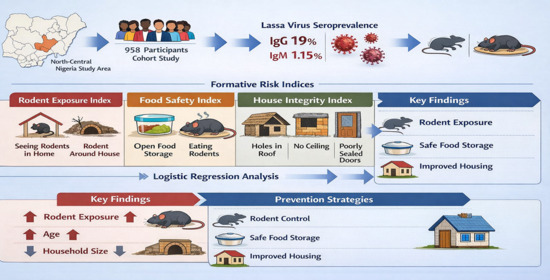
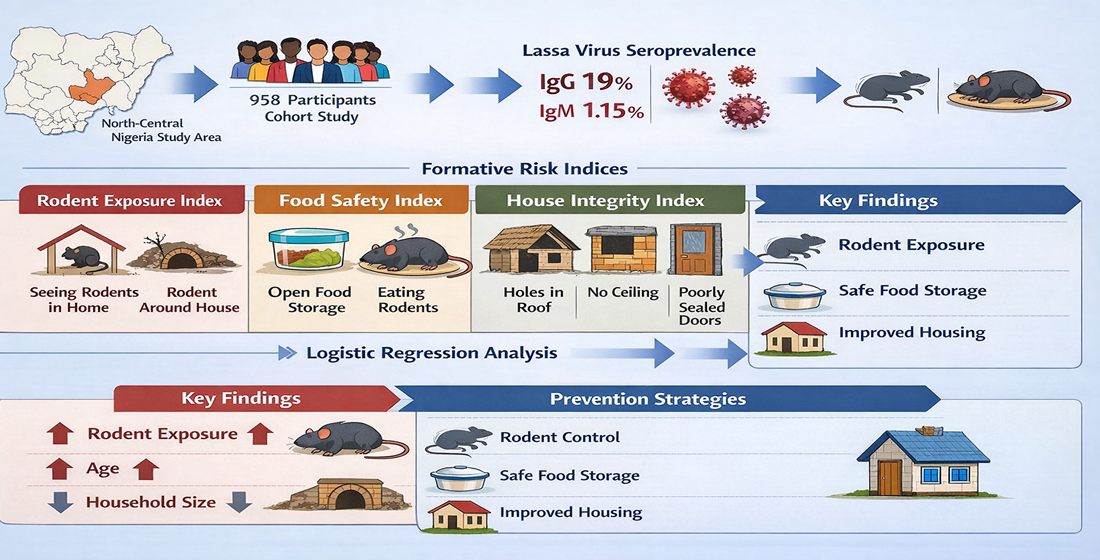
Lassa fever is a serious disease that continues to affect many communities in West Africa, yet the everyday household and behavioural factors that increase people’s chances of exposure are not fully understood. This study examined how living conditions, contact with rodents, household practices, and family size are related to past exposure to Lassa virus among residents of North-Central Nigeria. Information and blood samples were collected from nearly one thousand participants as part of an ongoing community study. The findings show that frequent contact with rodents and increasing age were linked to higher exposure, while living in larger households was associated with lower individual risk. These results help improve understanding of how Lassa virus spreads within communities and can guide researchers and public health workers in designing more effective household-level prevention and rodent control strategies.
Abstract
Lassa fever remains a major public health threat in West Africa, yet the household and behavioural determinants of prior Lassa virus exposure are not sufficiently understood. This study examined environmental, behavioural, and demographic factors associated with Lassa virus IgG seropositivity among residents of selected states in North-Central Nigeria. Analysis was carried out on baseline data from 958 participants enrolled in the first phase of an ongoing longitudinal cohort study, which collected information on rodent exposure, house integrity, food safety practices, and household composition. Formative indices were constructed and standardised, and logistic regression models with 1000-iteration bootstrap estimation were used to identify predictors of IgG positivity. Seroprevalence of Lassa virus IgG was 19%, while IgM positivity was 1.15%. Rodent activity around and within homes was widespread, with more than 86% of participants reporting rodent presence. Logistic regression analysis showed that rodent exposure (standardised coefficient 0.20, 95% CI 0.02–0.43) and participant age (0.20, 95% CI 0.05–0.35) were significant predictors of IgG seropositivity. Household size demonstrated a strong inverse association (−0.41, 95% CI −0.68 to −0.20). House integrity and food safety formative indices exhibited weak and non-significant effects. Model performance was acceptable (AUC 0.63; Brier score 0.148), and variance inflation factor values confirmed negligible multicollinearity. These findings emphasised the continuing role of rodent exposure and demographic factors in Lassa virus transmission risk. This implies that there is a need to strengthen community-level rodent control and household-based prevention strategies, which can help to reduce exposure.
1. Introduction
Lassa fever (LF) is the clinical disease caused by infection with Lassa virus (LASV), an arenavirus that remains a major public health challenge in West Africa. While LASV infection is widespread in endemic regions, the majority of infections are asymptomatic or paucisymptomatic and do not progress to Lassa fever. Only a subset of infected individuals develops symptomatic disease, and among these, a smaller proportion experience severe, acute, and potentially life-threatening illness, with case-fatality rates of approximately 15% reported among hospitalised patients [1]. The disease has been recorded as endemic in several countries within the United Nations West Africa sub-region, particularly Nigeria, Sierra Leone, Liberia, and Guinea, where recurrent outbreaks, sporadic infections, and high seropositivity have been documented for decades [2,3]. Although estimates vary, Lassa virus (LASV) infection is estimated to occur in several million individuals annually in West Africa [4], the majority of whom remain asymptomatic or experience mild illness. In contrast, clinical Lassa fever (LF) is estimated to account for several hundred thousand cases each year, with mortality often underestimated due to limited surveillance, poor diagnostic capacity, and the tendency of LF to mimic other febrile illnesses such as malaria, typhoid, and dengue [5]. Human infection occurs primarily through zoonotic transmission, typically through direct or indirect contact with excreta of either rats or rodents.
The multimammate rat (Mastomys natalensis) is recognised as the principal reservoir host capable of maintaining, shedding, and transmitting LASV across generations [6]. However, recent findings suggest that LASV circulation may be more complex than previously assumed. Molecular and ecological studies have identified LASV-positive individuals in other commensal rodent taxa, including Mus spp., Tatera spp., Rattus spp., and several peri-domestic species frequently found in rural and urban households [7,8]. While the extent to which these species support vertical or horizontal transmission remains unclear, their involvement regarding host diversity, viral spillover, and ecological determinants of persistent transmission in endemic communities raises important questions on the infection rate of the LF. Determining the reservoir competence of these non-traditional hosts is therefore crucial for understanding the full epidemiological view of LASV in West Africa.
Serological studies provide evidence of widespread LASV exposure across endemic regions. IgG seropositivity has been reported in both symptomatic and asymptomatic individuals, suggesting that LASV infection often occurs silently, particularly in rural populations [8,9]. In West Africa, community-based surveys have detected IgG prevalence ranging from <10% to >50%, with the highest values frequently observed in areas characterised by close human–rodent interactions, poor household infrastructure, and high rodent density [10,11]. A recent community-based study conducted in Guinea reported LASV IgG seroprevalence exceeding 80% despite a relatively low number of reported clinical Lassa fever cases, underscoring the substantial burden of asymptomatic or unrecognised LASV infection in some endemic settings [12]. In Nigeria, several seroprevalence investigations indicate especially high IgG positivity in the North-Central region, pointing to intense and recurrent exposure [7,13,14,15,16]. Benue and Plateau States, for instance, have repeatedly been identified as hyper-endemic LASV zones, whereas states such as Nasarawa, Kogi, and the Federal Capital Territory (FCT) experience sporadic but significant exposure, especially in rural settlements and farming communities [2].
A growing body of evidence demonstrates that behavioural, environmental, and demographic factors strongly influence LASV exposure patterns and IgG seropositivity [17]. Risk-enhancing behaviours commonly reported in endemic regions include consumption of rodents, open sun-drying of agricultural products, poor household sanitation, and inadequate domestic food storage [18,19,20]. These practices increase the probability of contact with rodent excreta, especially in households where rodents freely access food, water, and open spaces. Likewise, demographic conditions such as large family size, low socio-economic status, limited access to healthcare facilities, and low awareness of LF-prevention measures can significantly elevate exposure risks. For instance, [21] explored the drivers of Lassa fever infections in an endemic area of Nigeria, and they found that high mortality resulting from LASV infection was highly associated with open sun-drying of food, poor living conditions, and open pathways of rats in households. They also noted that lack of timely access to healthcare services, as well as the awareness rate about the disease, increased the risk factors and vulnerability to the disease. It is important to note that the evidence for a causal association between these purported risk behaviours and LASV infection or subsequent Lassa fever is limited, as current investigations have been observational in nature and primarily describe associations rather than causation.
On the other hand, environmental determinants of LASV transmission, which include building materials, roof or ceiling structure, type of flooring, presence of rodent burrows around the house, and overall housing integrity, have also been implicated in increasing the spread of LASV in West Africa. [22], examining rodent–human interactions in the Bo District of Sierra Leone, found that building design and household infrastructure influenced LASV transmission pathways. They recommended straightforward household modifications such as ceiling installation, rodent-proof food storage, waste disposal improvements, and fitting of windows and doors as cost-effective interventions to reduce LASV transmission. These environmental variables form the basis of increasingly recognised “formative risk indices,” which combine multiple household-level and behavioural factors into quantifiable measures of exposure risk.
In West Africa, including Sierra Leone and Nigeria, extensive research has been conducted that systematically examined multiple behavioural and environmental determinants of LASV IgG seropositivity using an integrated, risk-index–based methodological approach [9,23]. However, no studies of this kind have been carried out in North-Central Nigeria to the best of our knowledge, hence the need for the current study across five States in North-central Nigeria, which include Benue, Kogi, Nasarawa, Plateau, and the Federal Capital Territory (FCT). Understanding which specific and modifiable factors best predict IgG seropositivity is vital for designing targeted prevention programmes, guiding health education, and improving surveillance systems in endemic communities. This is particularly relevant in North-Central Nigeria, where the interaction between local ecology, rodent population structure, population movement, and agricultural activities creates favourable conditions for the persistence of LASV exposure.
Therefore, the current study investigates the behavioural, environmental, and demographic determinants associated with LASV IgG seropositivity among residents of selected states in North-Central Nigeria, using a formative risk indices model.
2. Materials and Methods
2.1. Study Area
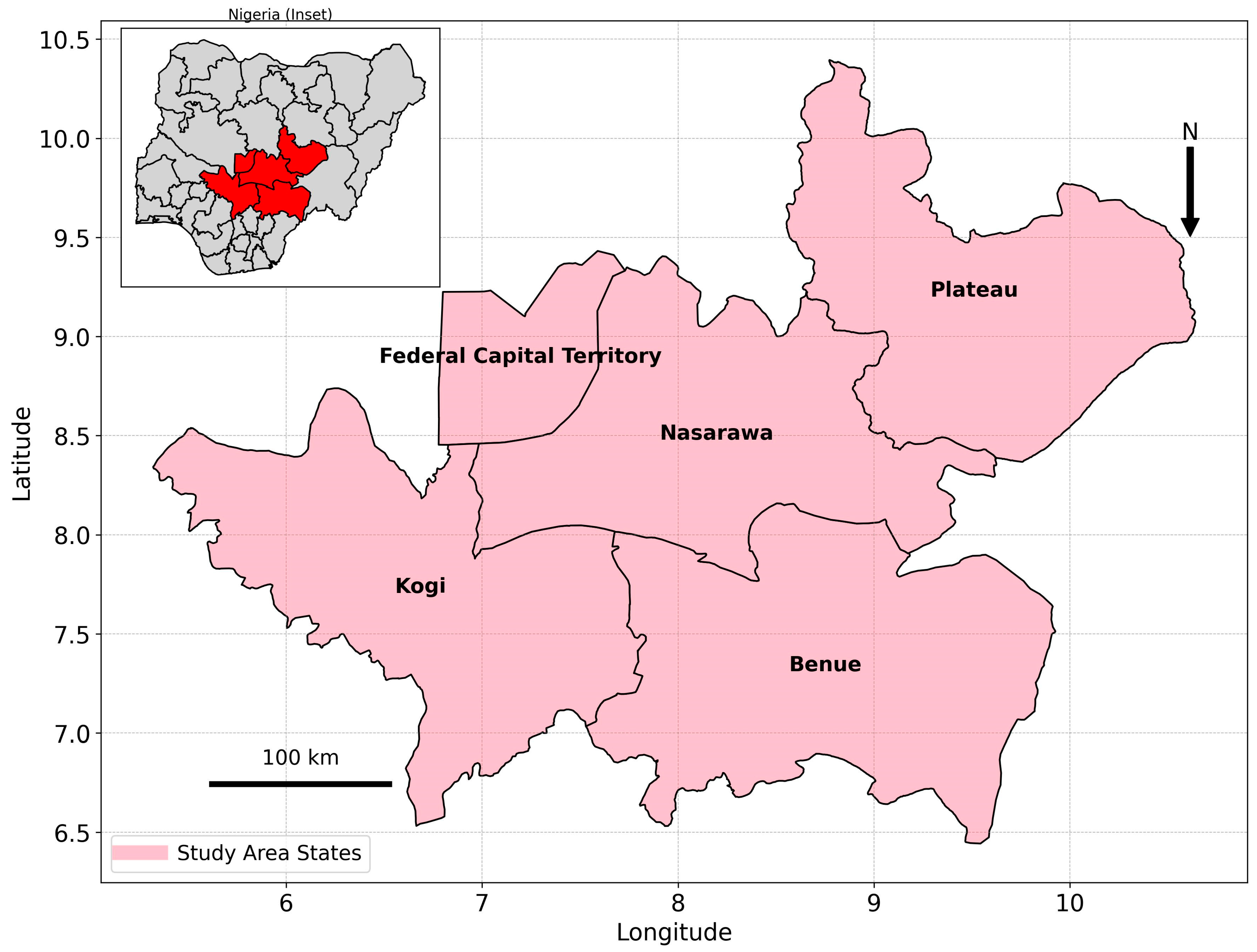
This study was conducted across five states in North Central Nigeria: Benue, Kogi, Nasarawa, Plateau, and the Federal Capital Territory (FCT) (Figure 1). The area is characterised by a mixture of Guinea and derived savannah vegetation [24], interspersed with farmlands, rocky terrains, and river basins such as the Benue and Niger river systems, which support year-round agricultural activity [25,26]. The climate is typically tropical, with a marked wet and dry season, creating environmental conditions favourable for the proliferation of Mastomys spp., the primary reservoir of Lassa virus [27]. Settlement patterns across the region range from densely populated urban centres to remote rural communities where traditional housing, bush encroachment, and rodent infestation are more common [28,29].
Figure 1.
Map of the study area comprising Benue, Kogi, Nasarawa, Plateau, and the Federal Capital Territory. Coordinate gridlines and an inset map of Nigeria are provided for geographic context. The area coloured red in the inset map is North Central, Nigeria, and it includes the study sites. The grey area is the other states in Nigeria.
Demographically, North Central Nigeria hosts a diverse population engaged predominantly in farming, trade, and civil service. These socio-economic dynamics, combined with varying standards of housing quality, sanitation, and waste management, shape human–rodent contact patterns across communities [30]. Epidemiologically, the region has recorded recurring Lassa fever outbreaks and remains a critical hotspot for surveillance due to its ecological suitability for rodent reservoirs, mobility of populations, and expanding human settlements [2,31].
2.2. Study Design and Setting
This study is part of a larger longitudinal cohort designed to monitor Lassa fever infection dynamics over time across North Central Nigeria. The analysis presented here is based on baseline data collected during the first phase of the study. Five states within the North Central geopolitical zone, Benue, Kogi, Nasarawa, Plateau, and the Federal Capital Territory (FCT), were included because this region represents a major Lassa fever belt in Nigeria, characterised by high annual case reports, rodent infestation, and diverse ecological and socio-demographic patterns that influence zoonotic disease transmission.
To ensure geographic representativeness while maintaining feasibility for repeated follow-up, two Local Government Areas (LGAs) were purposively selected in each state. The selection criteria included: (1) documented Lassa fever activity or historical case reports, (2) ecological suitability for Mastomys spp., (3) population density and settlement patterns that provide variability in environmental and household conditions, and (4) logistical accessibility to facilitate ongoing longitudinal tracking. Ecological suitability measures for Mastomys spp. were not available for all LGAs; therefore, LGA selection was purposive, and the generalizability of findings to other areas within the states should be interpreted with this limitation in mind.
2.3. Study Population and Eligibility Criteria
The study population included both adults (18 years) and minors (participants aged 1–17 years) residing permanently within selected households in the study LGAs. Hence, age-appropriate consent procedures were followed. Written informed consent was obtained from all participants aged 18 years and above. For participants younger than 18 years, parental or guardian consent was obtained, and age-appropriate assent was secured from children and adolescents judged capable of providing it, in accordance with national ethical guidelines and the approved protocol. Only individuals whose parents/guardians provided consent, and who themselves provided assent when applicable, were enrolled in the study. Individuals were eligible if they had lived in the study LGAs for at least six months to ensure meaningful exposure assessment. Temporary visitors or persons unwilling to provide blood samples were excluded.
2.4. Sample Size Determination
The required sample size for this study was guided by principles of predictive modelling and epidemiological survey design. For the prevalence estimation of Lassa virus IgG seropositivity, the minimum sample size per state was first computed using the standard formula for a single-population proportion as in (1).
where
minimum required sample size.
standard normal value corresponding to the desired confidence level (1.96 for 95% confidence).
expected prevalence of Lassa virus IgG seropositivity.
precision (margin of error).
Using an estimated IgG prevalence of 20% (0.20) for the sample size, rounding slightly downward from the 21% reported in a recent Nigerian serosurvey [32]. This rounding is consistent with standard epidemiologic practice, where prevalence estimates vary modestly. With a precision of 5% (0.05) and 95% confidence, the sample size was computed thus:
To ensure adequate representation across the five states (Benue, Kogi, Nasarawa, Plateau, and FCT), and to account for design effects related to multistage sampling, the value was inflated by a design effect (DEFF) of 1.5, yielding:
The original sample-size calculations targeted approximately 369 participants per state. Operational realities during baseline recruitment (field access, consent patterns and logistics) resulted in the following state-level enrolment: Benue n = 118, Kogi n = 135, Nasarawa n = 127, Plateau n = 276, and FCT n = 302 (total N = 958). Consequently, state-level prevalence estimates were not analysed as they would have wider uncertainty than originally planned. However, the overall sample (N = 958) and the number of IgG positive events (n = 182) provided sufficient statistical power for the planned multivariable modelling and robust bootstrap estimation of standardised effects. The frequency of IgG and IgM across study locations is presented in Supplementary Table S1.
2.5. Sampling Strategy
A multistage sampling approach was employed: Five North Central states were included due to their epidemiological relevance to Lassa fever. Two LGAs per state were purposively selected as described in the study design section. Within each LGA, communities were randomly selected. Systematic random sampling was used to select households, with sampling intervals determined by community size. Eligible participants, adults and minors aged 1 year and above, were identified within each selected household. Up to three participants per household were enrolled, depending on eligibility and availability. When more than three eligible individuals were present, participants were selected using a simple random draw method to ensure unbiased representation across age groups. For minors, parental or guardian consent and age-appropriate assent were obtained before enrolment.
2.6. Data Collection Procedures
2.6.1. Questionnaire and Environmental Assessment
Baseline data collection employed a structured interviewer-administered questionnaire capturing: Rodent exposure (see rodents at home, have rodent burrows around house); House integrity characteristics (hole in ceiling or roof, ceiling present in house, doors windows fit well); Food safety practices (food stored or dried in the open, eat or family eat rodents); Household composition; Individual sociodemographic characteristics.
2.6.2. Biological Sample Collection and Laboratory Testing
The venous blood samples were obtained from all study participants for serological analysis. Participants were categorised as minors (<18 years) and adults (≥18 years). Blood collection was performed under sterile conditions, with volumes adjusted according to age and physiological suitability. Adults (≥18 years) provided 5 mL of venous blood. Among minors, younger participants provided reduced volumes of approximately 2–3 mL, while older adolescents (15–17 years), who were physiologically comparable to adults, provided up to 5 mL of venous blood. All collected volumes were within ethically approved limits and sufficient for both IgG and IgM ELISA assays.
Blood samples were collected by trained laboratory technicians into EDTA-treated microtubes and packaged using a triple-layer system comprising primary receptacles, secondary containers, and an outer shipping package. Samples were prepared in triplicate and transported within 24 h under cold-chain conditions to Irrua Specialist Teaching Hospital, Edo State. Serum was separated for baseline and follow-up serological testing, while plasma was preserved for planned molecular analyses. All specimens were inactivated using 0.5% sodium hypochlorite for 30 min and initially stored at −20 °C. Transportation was carried out in portable coolers with ice packs to maintain a temperature of approximately −20 °C. Upon arrival at the laboratory, samples were immediately transferred to −80 °C storage to ensure long-term stability of antibodies and nucleic acids, minimise protein degradation, preserve antibody reactivity, and maintain viral RNA integrity for potential RT-PCR testing in IgM-positive participants during follow-up visits.
Serum IgG and IgM antibodies against Lassa virus were measured exclusively using the commercially available Panadea LASV (NP) IgG/IgM ELISA kits (Panadea Diagnostics GmbH, Hamburg, Germany). All assays were performed strictly according to the manufacturer’s instructions, which are based on established ELISA formats described previously [9,33].
The Panadea IgG assay employs plates coated with recombinant human Fc gamma receptor IIA (CD32a) or rheumatoid factor, while IgM detection is based on a μ-capture ELISA format using anti-human IgM–coated plates. These formats constitute integral components of the Panadea kit design and do not represent separate or independently developed ELISA assays.
2.7. Construction of Formative Risk Indices
Formative risk indices were developed to capture multidimensional household, behavioural, and environmental exposure domains relevant to Lassa virus transmission. Indicators were selected a priori based on established epidemiological and ecological understanding of Lassa fever transmission, including rodent–human contact patterns, household structure, and food storage practices, and were coded so that higher values consistently reflected higher exposure risk [1,3,34].
The indices were constructed using a theory-driven equal-weighting approach, consistent with established recommendations for formative index development when no strong empirical or theoretical basis exists for differential weighting [35,36]. Specifically, binary indicators within each domain were first coded so that higher values consistently represented higher exposure risk. Indicators within each formative domain were then summed with equal contribution, reflecting the assumption that each indicator represents a distinct but necessary component of the exposure construct. No outcome-based or data-driven optimisation was used in index construction to avoid circularity, overfitting, and loss of interpretability.
The observed indicators and their assigned weights used to construct each index are shown in Table 1.
Table 1.
Observed indicators, measurement type, and a priori weights used to construct formative and reflective indices.
The Food Safety formative index combined unsafe food-handling practices (open food storage or drying and rodent consumption), while the House Integrity formative index combined structural features facilitating rodent entry (roof or ceiling damage, ceiling presence, and poorly fitting doors or windows).
A Rodent Exposure Index was constructed separately to represent proximal exposure pathways. The Rodent Exposure Index was constructed as a reflective index, capturing direct household-level rodent contact. Rodent exposure was specified as a reflective construct because its indicators represent observable manifestations of a common underlying level of rodent infestation. Seeing rodents in the household and the presence of rodent burrows are expected to co-occur as consequences of the same latent exposure process, justifying a reflective measurement specification. Two binary indicators were included: seeing rodents inside the home (see_rodents_at_home) and observing rodent burrows around the house (have_rodent_borrows_around_house).
All indices were standardised to a zero mean and unit variance using the z-score transformation as in (2).
where is the raw score of index j for participant i, is the mean, and is the standard deviation.
To quantify the contribution of each indicator to its formative construct, weights were calculated as the Pearson correlation coefficient between each indicator and the respective latent index using (3).
where is the indicator k for construct j, and represents the weight.
These weights indicate the relative contribution of each observed variable to the corresponding latent construct. For reflective constructs, higher weights suggest stronger item-to-construct relationships, whereas for formative constructs, weights indicate the importance of each component in defining the index.
The standardised indices were included as predictors of LFV IgG seropositivity in a logistic regression model, alongside covariates such as age, sex, and household size, as in (4).
To facilitate interpretation, standardised regression coefficients were computed as in (5).
where is the standard deviation of predictor j, is the standard deviation of the predicted logit values and denotes the unstandardized logistic regression coefficient for the predictor , representing the change in the log-odds of IgG seropositivity associated with a one-unit increase in .
2.8. Statistical Analysis
Data were analysed using Python (version 3.10.9) statistical environments. Descriptive statistics included means, standard deviations, frequencies, and 95% confidence intervals. The primary analysis involved bootstrap-enhanced logistic regression (1000 iterations) to model determinants of Lassa virus IgG seropositivity using formative indices and covariates. Standardised coefficients and bootstrap confidence intervals were used to assess the magnitude and precision of effects.
Multicollinearity was evaluated using Variance Inflation Factors (VIFs), with all values below 1.2 indicating no problematic multicollinearity. Model performance was assessed using metrics such as the Area Under the ROC Curve (AUC) for discrimination [37], that is, how well the model can clearly distinguish between participants who were IgG seropositive and those who were not, Calibration curves and the Brier score for predictive accuracy [38], and Pairwise correlation matrices to explore variable relationships.
All analyses were two-tailed with significance thresholds set at p < 0.05, although emphasis was placed on effect sizes and confidence intervals rather than strict significance testing.
2.9. Ethical Considerations
Ethical approval was obtained from the Ethical Committee of the Federal University of Health Sciences, Otukpo (FUHSO) and the National Health Research Ethics Committee (NHREC) of Nigeria, approval number: NHREC 1 January 2007–1 September 2023. Data confidentiality and biosafety procedures adhered to national guidelines for infectious disease research.
3. Results
3.1. Study Population Characteristics
3.1.1. Sociodemographic Characteristics
A total of 958 participants were included in the analysis. The gender distribution showed a slightly higher proportion of females (53.86%, 95% CI 50.71 to 57.02) compared to males (46.14%, 95% CI 42.98 to 49.29), as shown in Table 2.
Table 2.
Distribution of Categorical Study Population Characteristics.
The household composition showed that respondents lived in moderately large households. The mean number of persons per household was 6.32 (95% CI 6.04 to 6.59), with some households having as many as 35 occupants. Similarly, the number of houses within compounds averaged 2.76 (95% CI 2.61 to 2.91). These metrics reflect the communal living patterns typical of many Nigerian rural and peri-urban settings, where extended families often cohabitate.
Age distribution revealed that participants were relatively young, with a mean age of 33.72 years (95% CI 32.65 to 34.78) and a median of 32 years (IQR 25). Age ranged from 1 to 86 years, suggesting a broad representation across the life course (Table 3). The wide age range strengthens the generalizability of findings to diverse age groups within the population.
Table 3.
Distribution of Continuous Study Population Characteristics According to Data Distribution.
3.1.2. Environmental and Behavioural Characteristics
Environmental exposure patterns strongly suggested a high degree of rodent–human interaction in the study communities. A substantial proportion of participants reported seeing rodents at home (86.85%, 95% CI 84.71 to 88.99) and observing rodent burrows around their houses (87.06%, 95% CI 84.93 to 89.18) (Table 2).
About one-quarter (24.53%, 95% CI 21.81 to 27.25) reported consuming rodents. Nearly 59% store or dry food in the open, a practice that increases the likelihood of contamination by rodent excreta. Also, housing quality indicators showed structural deficiencies. While most houses had ceilings (89.25%), almost half (49.27%) reported holes in their ceilings or roofs, and a large majority (72.23%) indicated that doors and windows did not fit well. Such structural gaps facilitate rodent entry and establish opportunities for viral contamination within living spaces.
3.1.3. Clinical and Serological Characteristics
Previous diagnosis of Lassa fever was extremely rare in the study population, with only 8 participants (0.84% of 958 respondents) reporting a prior diagnosis (Table 2), thereby limiting the ability to reliably estimate IgG seroprevalence within this subgroup. This low prevalence may reflect underdiagnosis, limited access to confirmatory testing, or misclassification of febrile illnesses in the region. Serological findings showed that 19% of participants had IgG antibodies, indicating prior exposure to Lassa virus, while only 1.15% were IgM-positive, reflecting very recent or ongoing infection. The moderate IgG positivity, coupled with very low IgM positivity, aligns with patterns of endemic Lassa virus circulation characterised by sporadic acute infections but ongoing background exposure. The distribution of IgG and IgM serostatus by age group among study participants is presented in Supplementary Table S2.
3.1.4. Construction of Formative Indices
Two formative indices were created to capture household and environmental determinants of Lassa virus exposure: FoodSafety_Formative and HouseIntegrity_Formative. Items contributing to FoodSafety_Formative included whether food was stored or dried in the open and the consumption of rodents by household members. The standardised weights for these items were 0.85 and 0.798, respectively, indicating that open food storage had a slightly higher contribution to the index (Table 4).
Table 4.
Formative index construction showing standardised path weights and indicator–construct correlations.
Similarly, HouseIntegrity_Formative was constructed from ceiling integrity, the presence of holes in the roof, and the fit of doors/windows. Weights ranged from 0.328 to 0.768, with holes in the ceiling and roof contributing most strongly to this index (Table 4). Rodent exposure was modelled reflectively, with high factor loadings on seeing rodents at home (0.919) and rodent burrows around the house (0.918). Because it is reflective, the index assumes that both indicators (see_rodents_at_home and have_rodent_borrows_around_house) are manifestations of the underlying construct “Rodent Exposure,” meaning the observed variables reflect the latent level of rodent contact rather than defining it additively (as is the case for the formative indices). The high correlations between each indicator and the index (≈0.92) indicate that both measures consistently capture the same underlying exposure pathway.
The resulting formative indices were standardised and used as predictors in logistic regression models for IgG seropositivity. Table 4 presents the indicators and their standardised weights used to construct the indices. The weights shown represent standardised correlations between each indicator and its corresponding formative index for descriptive purposes; they were not used in the construction of the formative indices.
The RodentExposure indicators exhibited the strongest correlations with their construct (r = 0.845 and 0.832), highlighting the reliability of these reflective measures. FoodSafety_Formative indicators had moderate correlations (r = 0.583–0.621), while HouseIntegrity_Formative indicators showed weaker correlations (r = 0.379–0.421), suggesting some variability in how individual household infrastructure components contribute to the overall index.
3.2. Logistic Regression Model
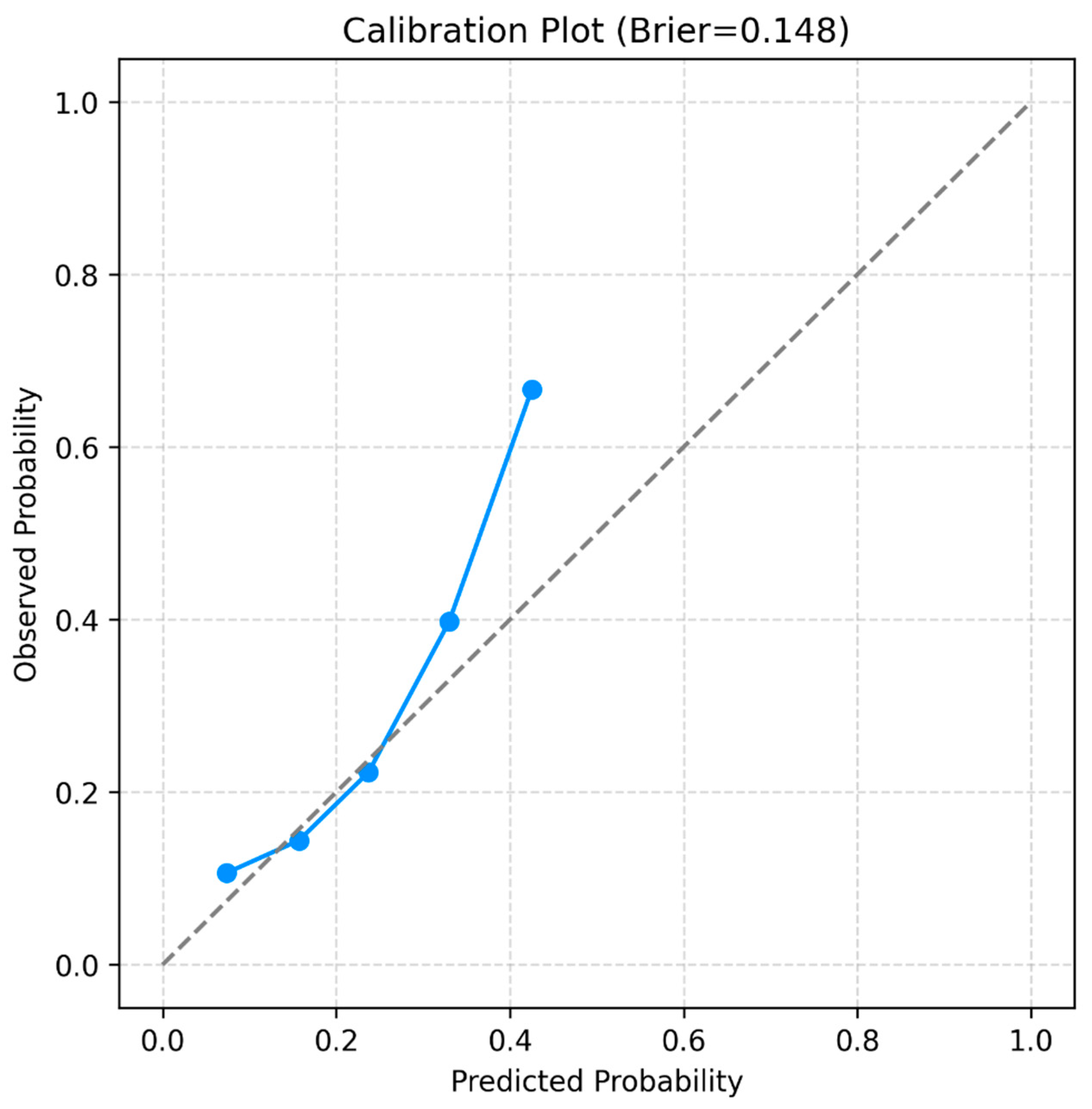
Logistic regression analysis was conducted to evaluate predictors of Lassa virus IgG seropositivity using standardised formative indices alongside demographic covariates. The model incorporating formative indices demonstrated modest discriminative performance rather than strong individual-level predictive ability. The calibration plot (Figure 2) indicated that predicted probabilities closely matched observed outcomes, with a Brier score of 0.148, which represents a modest improvement over a null model based solely on the observed IgG prevalence (~19%) and therefore reflects incremental predictive information contributed by the included variables. suggesting acceptable calibration and minimal overall prediction error. This score indicates that the model provides reasonably calibrated population-level risk estimates, but it is not optimised for the reliable identification of individual seropositive cases.
Figure 2.
Calibration plot of the logistic regression model predicting IgG seropositivity. The plot compares predicted probabilities of Lassa virus exposure (x-axis) with observed probabilities (y-axis). The diagonal dashed line represents perfect calibration, and the blue line represents the predicted probabilities. The blue line did not align perfectly with the diagonal line, which indicates that the model slightly underestimates risk. The Brier score of 0.148 quantifies overall prediction accuracy, with lower values indicating better calibration. Deviations from the diagonal indicate over- or under-estimation of risk by the model.
To ensure the robustness of the logistic regression model, we evaluated multicollinearity among predictors using the Variance Inflation Factor (VIF) and the correlation matrix. VIF values for all predictors ranged from 1.01 to 1.10 (Table 5), indicating that multicollinearity was negligible.
Table 5.
Variance Inflation Factor (VIF) values for predictor variables in the logistic regression model. All VIF values are below 1.2, indicating no evidence of problematic multicollinearity among the predictors.
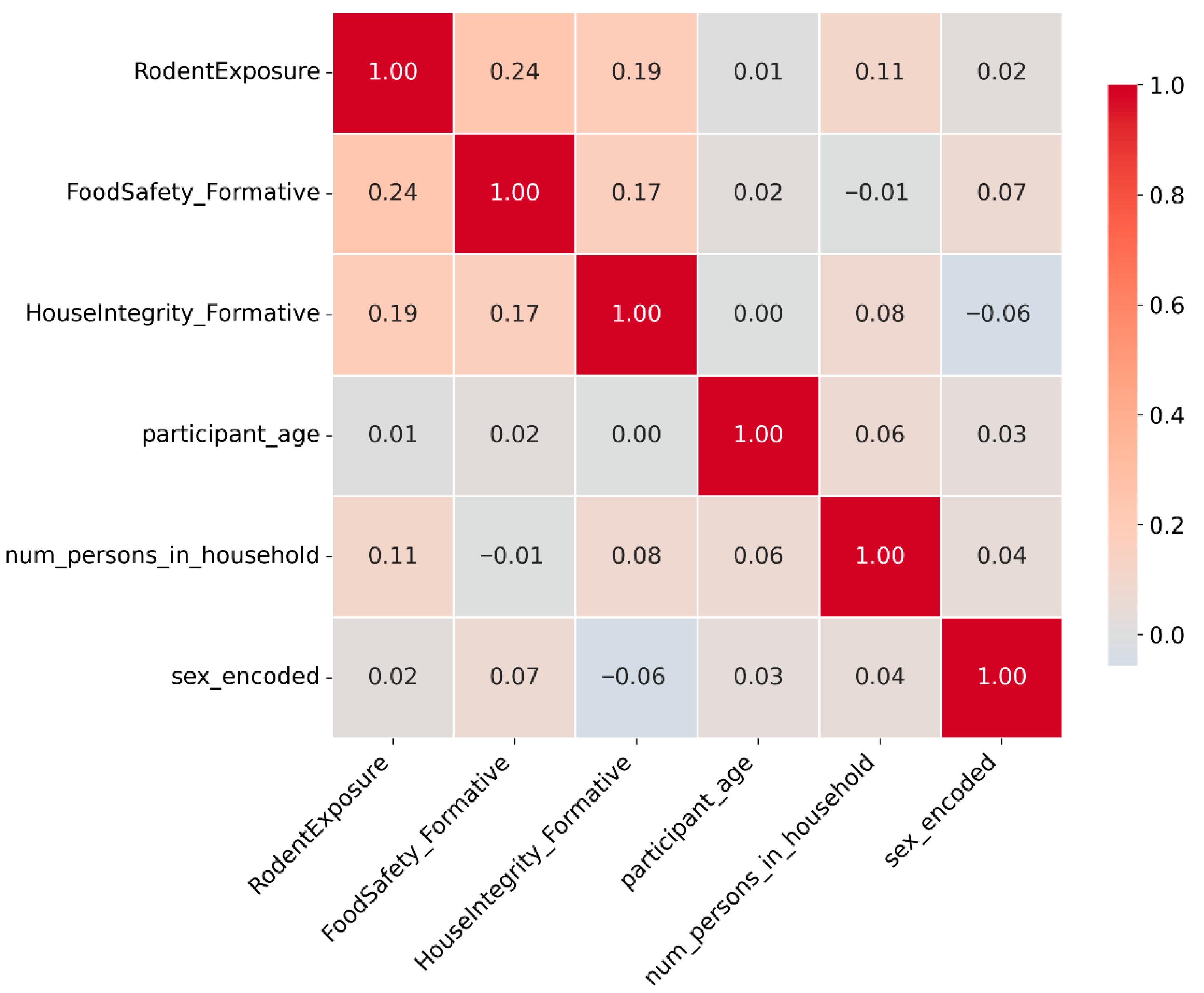
The pairwise correlation coefficients among predictors were low, with the highest observed correlation being 0.24 (RodentExposure × FoodSafety_Formative) (Figure 3), further supporting that predictors are not highly correlated. These findings suggest that each formative index and covariate contributes unique information to the model, justifying their simultaneous inclusion in the regression.
Figure 3.
Pairwise Correlation Heatmap of the predictors. The colour intensity indicates the strength and direction of associations. Strong positive and negative correlations are easily identifiable through the gradient scale in the colour bar.
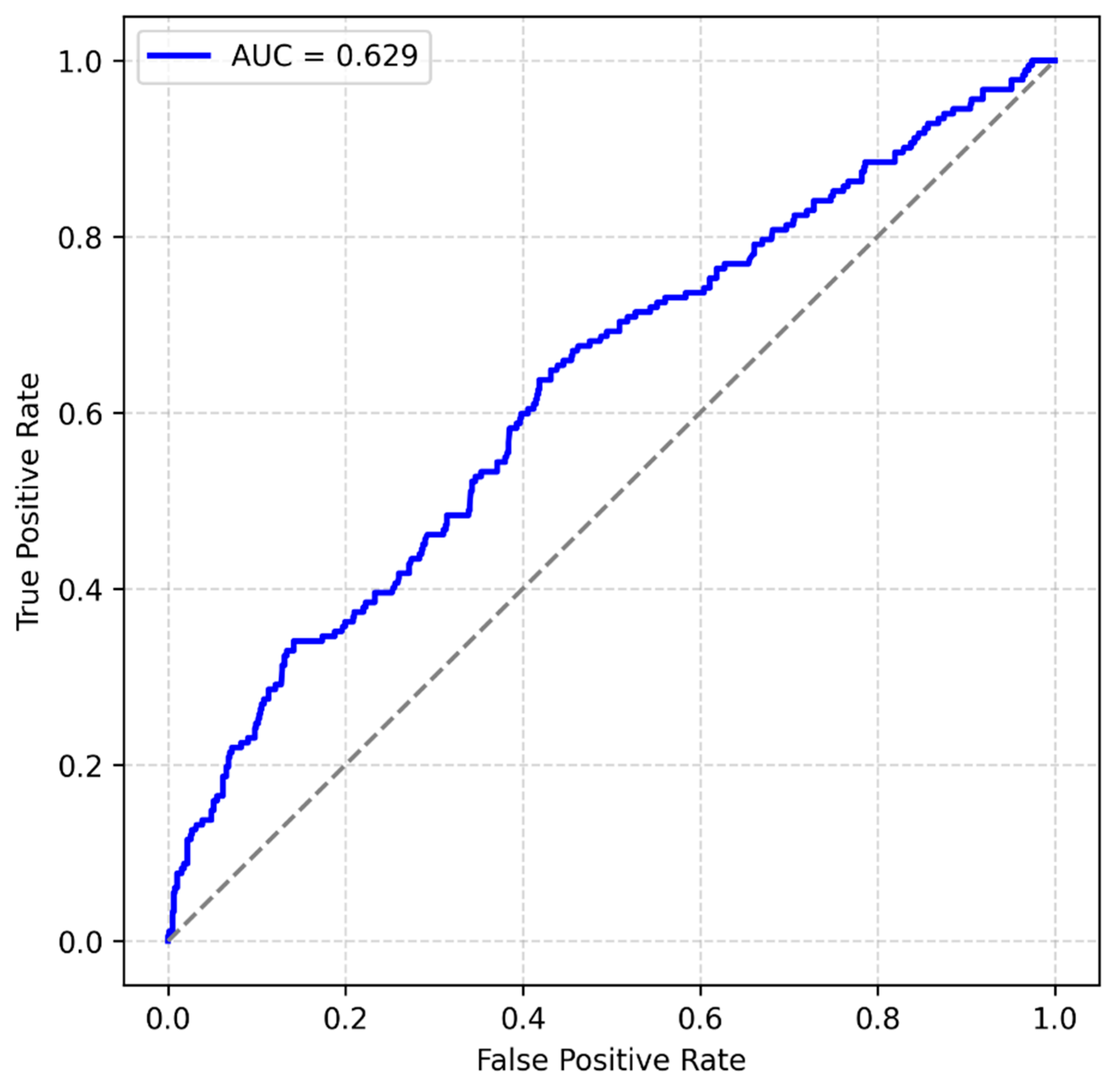
The model’s discriminative capacity is modest rather than strong, as shown in Figure 4, with an area under the ROC curve (AUC) of 0.63. While this indicates that the model performs better than chance at distinguishing seropositive from seronegative participants, the level of discrimination is limited and should be interpreted cautiously, particularly given the imbalance in IgG serostatus. It also highlights that other unmeasured factors likely contribute to Lassa virus exposure risk. This AUC value is consistent with community-based epidemiological models of endemic zoonotic infections [39], where transmission dynamics are complex and multiple latent factors, such as rodent behaviour, community-level sanitation, and seasonal effects, may influence infection risk and where the primary analytical goal is etiologic inference rather than individual-level classification.
Figure 4.
Receiver Operating Characteristic (ROC) Curve and AUC Value. The curve depicts the trade-off between sensitivity (true positive rate) and specificity (false positive rate), while the Area Under the Curve (AUC) quantifies the model’s overall discriminative ability. A higher AUC indicates a stronger capacity to distinguish between IgG-positive and IgG-negative individuals. The diagonal line indicates that there is no discrimination. A ROC curve aligning perfectly or below this line indicates that the model is just making random guesses.
Although the model demonstrated discrimination above chance (AUC = 0.63), this level of performance indicates modest discriminative ability and should be interpreted cautiously. Given the IgG seroprevalence of approximately 19%, a null model assigning the same predicted probability to all participants would be expected to yield a Brier score of approximately 0.16. The observed Brier score of 0.148, therefore, represents a modest improvement over the null baseline, indicating incremental predictive information contributed by the included household, behavioural, and demographic variables rather than strong individual-level predictive performance.
3.3. Standardised Effects and Comparative Influence of Predictors
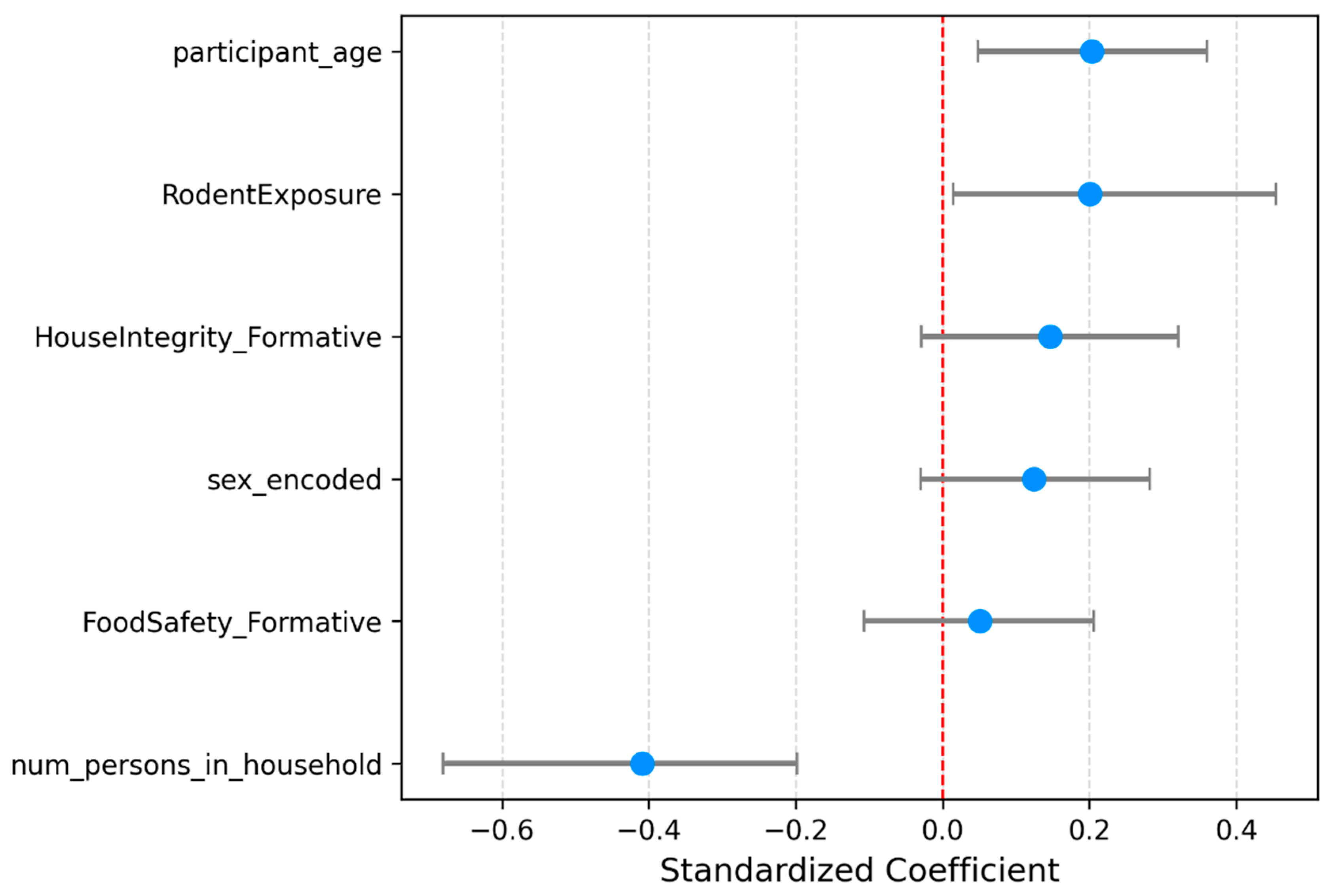
To better quantify the relative influence of each predictor, bootstrap-derived standardised coefficients with 95% confidence intervals (1000 iterations) were examined. The standardised coefficients shown in Figure 5 provide a clearer ranking of the relative importance of predictors of IgG seropositivity by placing all variables on a common scale. Among the predictors evaluated, household size exhibited the strongest effect, with a substantial negative standardised coefficient (Std_Coeff = −0.409, 95% CI: –0.677 to −0.196).
Figure 5.
Forest plot of bootstrap-derived standardised logistic regression coefficients for IgG seropositivity. The plot displays the effect sizes (points) and 95% confidence intervals (horizontal lines) for each household, environmental, and demographic predictor included in the model. Positive coefficients indicate increased odds of Lassa virus exposure, while negative coefficients indicate reduced odds. The vertical red line dividing the plot into negative and positive effect regions represents the line of no effect (effect size = 0).
Rodent exposure demonstrated a moderate positive standardised effect (Std_Coeff = 0.200, 95% CI: 0.023 to 0.430), reaffirming its critical role as a proximal exposure pathway for Lassa virus. This effect size reflects meaningful variation in IgG seropositivity attributable to differences in rodent presence and activity within the household environment. Participant age also showed a moderate positive effect (Std_Coeff = 0.204, 95% CI: 0.055 to 0.352), consistent with the notion of cumulative exposure risk; older individuals have had more prolonged opportunity for contact with rodent-contaminated environments.
In contrast, the formative constructs HouseIntegrity and FoodSafety demonstrated relatively weak and statistically non-significant standardised effects, with confidence intervals crossing zero (HouseIntegrity: Std_Coeff = 0.146, 95% CI: −0.033 to 0.326; FoodSafety: Std_Coeff = 0.051, 95% CI: −0.100 to 0.207). These results suggest that although these constructs are conceptually relevant contributors to household-level vulnerability, their measurable contribution to IgG seropositivity was modest in this model, once more proximal exposure factors, particularly rodent activity, were accounted for.
Sex showed a small positive association (Std_Coeff = 0.124, 95% CI: −0.044 to 0.278), indicating minimal gender-related differences in exposure risk within this cohort. The wide confidence interval and lack of statistical significance emphasise that any sex-related effect, if present, is likely weak.
3.4. Household, Behavioural and Environmental Determinants of Lassa Virus Exposure
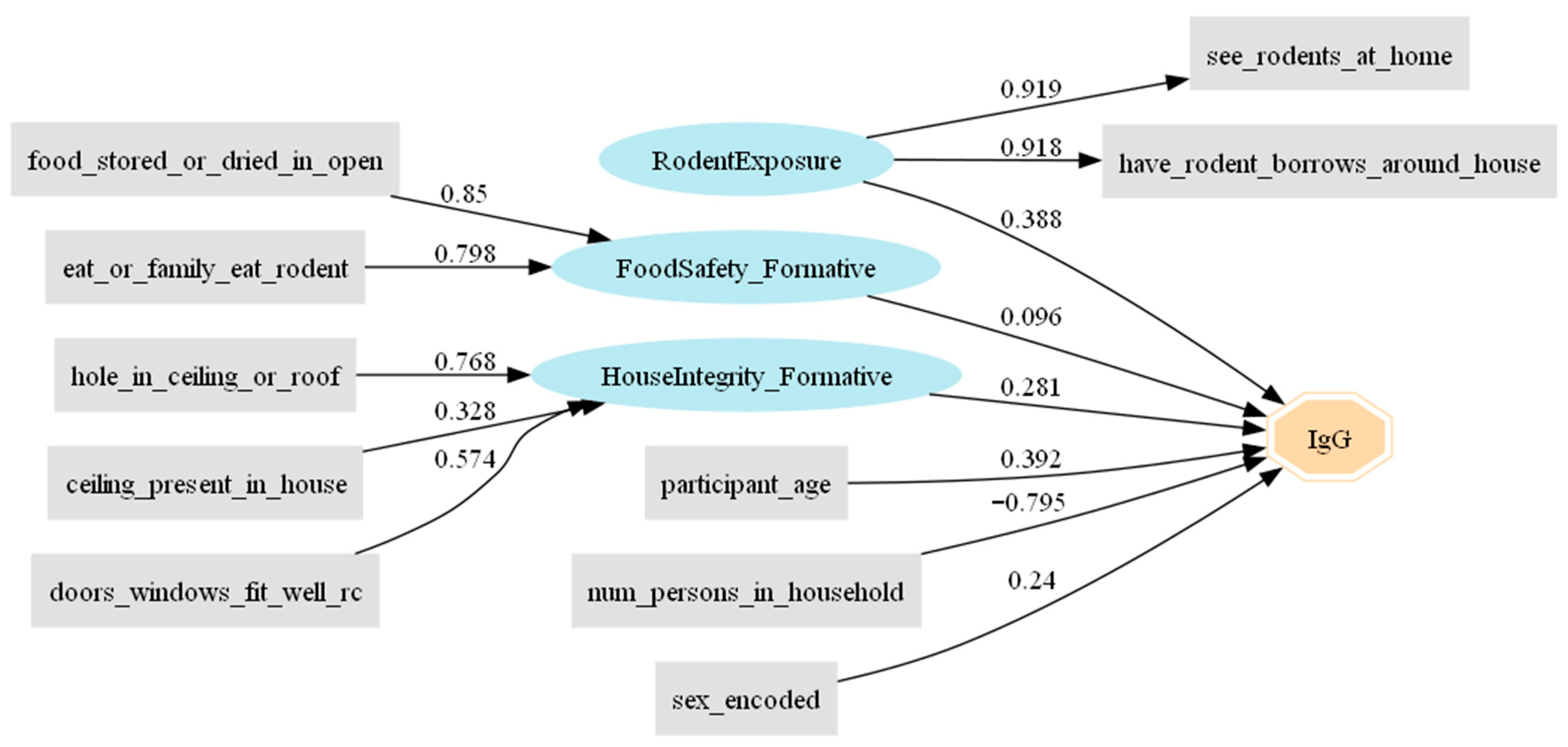
The formative path model in Figure 6 illustrates how household, behavioural, and environmental factors jointly contribute to the risk of Lassa virus exposure. In this framework, the FoodSafety_Formative and HouseIntegrity_Formative constructs were specified as formative indices, meaning that their indicators contribute to the definition of the construct rather than verifying a causal process. As such, the weight magnitude of each indicator reflects its relative contribution to the overall risk index.
Figure 6.
Formative path diagram showing standardised path weights. Arrows from indicators to formative indices denote the contribution of each indicator to its index. Arrows from indices and covariates to IgG show standardised effect directions and relative magnitudes derived from the logistic regression model. Coefficients in this diagram are illustrative; statistical significance should be interpreted from the regression results in Figure 5 and the associated confidence intervals.
The formative path diagram in Figure 6 illustrates how observed household, behavioural, and environmental indicators jointly construct higher-order formative risk indices, which, together with key sociodemographic variables, predict IgG seropositivity to Lassa virus. Unlike reflective models, the arrows in this formative specification indicate that the observed indicators define the latent constructs rather than being consequences of them; accordingly, the magnitude of the outer weights reflects the relative contribution of each indicator to its respective formative index. Figure 6 is presented as a conceptual and descriptive representation of the underlying regression model structure, with path coefficients indicating standardised effect directions and relative magnitudes for visual comparison only. Formal statistical inference and assessment of significance are derived exclusively from the bootstrap-derived standardised logistic regression.
3.4.1. Food Safety Index
The FoodSafety_Formative construct was composed of two indicators: food stored or dried in the open (standardised path coefficient = 0.85) and consumption of rodents by household members (standardised path coefficient = 0.798). These indicators contributed substantially to the index, reflecting their relative importance within the construct. While the index represents potential behavioural pathways for exposure, its association with IgG seropositivity in the logistic regression was small and not statistically significant, indicating that unsafe food practices may contribute only modestly to overall exposure in this population.
3.4.2. Household Integrity Index
The HouseIntegrity_Formative index combined structural features of the household, including holes in ceilings or roofs (standardised path coefficient = 0.768), poorly fitting doors and windows (standardised path coefficient = 0.574), and ceiling presence (standardised path coefficient = 0.328). These weights illustrate the relative contribution of each structural factor to the index. Although conceptually these features could facilitate rodent entry, the index showed a positive but non-significant association with IgG seropositivity in the regression analysis, suggesting that structural vulnerabilities alone were not strong independent predictors of exposure in this cohort.
3.4.3. Rodent Exposure Factor
The RodentExposure construct retained a reflective specification and exhibited high loadings on seeing rodents inside the home (0.919) and observing rodent burrows around the house (0.918), which indicate that these variables dominate the construction of the rodent exposure index. This confirms that visible rodent activity strongly co-occurs within households. The construct demonstrated a moderate and statistically meaningful positive association with IgG seropositivity (0.388), indicating that rodent presence remains a key proximal determinant of exposure in this population.
3.4.4. Paths to IgG Seropositivity
Several household and environmental factors showed direct associations with IgG positivity. HouseIntegrity_Formative showed a positive but statistically non-significant directional association with IgG seropositivity (standardised path coefficient = 0.281), indicating a weak and inconclusive trend toward higher exposure in households with poorer structural conditions. Similarly, FoodSafety_Formative demonstrated a small positive and non-significant association with IgG seropositivity (standardised path coefficient = 0.096). These findings suggest that while housing integrity and food-handling practices are conceptually relevant components of the exposure framework, their measurable contributions to IgG seropositivity were modest and not independently predictive once more proximal determinants, particularly rodent exposure, were accounted for in the regression model.
Among demographic variables, participant age exhibited a positive association with IgG (0.392), consistent with cumulative lifetime exposure. In contrast, the number of persons in the household was strongly and negatively associated with IgG (−0.795). This finding, though unintuitive, may indicate socio-behavioural patterns such as shared vigilance or housing arrangements that reduce individual risk, improved household routines, or structural differences in larger households that reduce per-person exposure. Sex showed a modest positive association with IgG seropositivity (0.24). Given the coding scheme used (male = 1, female = 0), this indicates that males were somewhat more likely to be IgG positive than females. This pattern may reflect gender-related differences in daily activities, occupational exposures, or behavioural practices that influence opportunities for contact with rodents or contaminated environments.
4. Discussion
The study population characteristics highlight environmental and behavioural conditions that create a high-risk setting for Lassa virus transmission. In this study, slightly more females than males participated, reflecting a modest gender imbalance in the study population (Table 2). This indicates a well-balanced study population with a modest female predominance, which is typical of community-based surveys where women are often more available or willing to participate [40,41,42]. The near-even distribution, however, still provides a balanced representation of both sexes for examining Lassa virus exposure and related risk factors. The widespread presence of rodents in homes and around living areas (Table 2), coupled with structural housing deficiencies, suggests that rodent–human contact is likely frequent and difficult to avoid. Practices such as open food storage further amplify the risk of contamination [16,43,44,45]. The substantial IgG seropositivity (19%) signals that past exposure to Lassa virus is relatively common in the cohort, even though few individuals report prior diagnoses. It is important to note that the reported overall IgG seroprevalence of 19% reflects the sample composition and was not weighted by the total population of each state. While population weighting could provide estimates more representative of state-level prevalence, our study’s primary focus was on identifying household, behavioural, and environmental determinants of Lassa virus exposure. Consequently, the unweighted seroprevalence serves as a descriptive measure of exposure in the study cohort and does not affect the validity of the associations observed in the multivariable models. The observed seroprevalence of 19% in this study is consistent with findings from other endemic regions in West Africa, which have similarly reported high rates of prior Lassa virus (LASV) exposure among community populations [12,23,46,47,48]. This discrepancy reinforces the likelihood of under-recognition of Lassa fever cases in routine healthcare. In contrast to certain studies focusing on hospital-based outbreaks, which may show different exposure profiles, our community-based data emphasises the silent, pervasive circulation of the virus in the general population.
Although the previous literature suggests that large household sizes and compound living arrangements may facilitate intra-household transmission once infection is introduced [18,19,22]. The baseline findings of this study showed a protective association, with individuals in larger households exhibiting lower odds of IgG seropositivity (Figure 5). This inverse relationship may reflect shared behavioural, structural, or socio-environmental factors that reduce individual-level exposure in larger family settings. For example, distributed household duties, lower per-person contact with rodent reservoirs, and differing patterns of room use and sleeping arrangements may collectively reduce individual risk. However, because this analysis is based on baseline data only, future longitudinal follow-up is needed to clarify whether this pattern persists over time and whether household size influences incident infections differently from past exposure. The demographic profile, with strong representation across age groups, indicates that the observed patterns are not restricted to specific subpopulations but reflect broader community risk.
A striking pattern in this study was the high level of rodent presence reported within households, with 86.85% of participants indicating they frequently saw rodents inside their homes and 87.06% observing rodent burrows around their houses. These findings are consistent with evidence from other West African settings, underscoring that rodent infestation is a widespread environmental reality rather than an isolated problem. For instance, [49] documented an 82.3% household rat prevalence rate in southeast Nigeria, while [22] reported that 92.4% of respondents in Sierra Leone frequently encountered rodents indoors. These patterns highlight the pervasive nature of rodent activity across the region and illustrate the sustained opportunities for rodent–human interaction that may facilitate the environmental transmission of Lassa virus. The household structural indicators, particularly the presence of holes in ceilings and poorly fitting doors and windows (Figure 6), suggest potential vulnerabilities that may facilitate rodent entry. In the logistic regression model, this index showed a modest positive standardised effect on IgG seropositivity (Std_Coeff = 0.146), though the confidence intervals indicated that this association was not statistically significant. These patterns suggest that structural vulnerabilities may contribute to rodent entry and potential Lassa virus exposure, but the evidence is not conclusive in this cohort. Nevertheless, these findings point to the potential value of exploring housing improvements, such as sealing gaps, repairing ceilings, and enhancing door and window fit, as part of broader community-based strategies for Lassa fever prevention in endemic areas.
Behavioural factors were considered in the analysis of exposure pathways, with a weak association observed in regression models. Practices such as storing or drying food in open environments and consuming peridomestic rodents, behaviours documented in several West African settings as part of household-level dietary practices [20,50,51], were positively associated with the latent Food Safety index. Although the FoodSafety_Formative construct showed a smaller and statistically non-significant association with IgG seropositivity compared with rodent exposure and household size, these behaviours remain relevant components of the broader household exposure context. Interventions targeting safe food handling and improved food storage practices may therefore be considered as supportive or complementary measures, rather than primary drivers of risk reduction, within integrated Lassa fever prevention strategies.
Our analysis indicated that environmental rodent exposure and household integrity, such as the presence of holes in ceilings or poorly fitting doors and windows, were associated with LASV IgG seropositivity, with rodent exposure showing the strongest effect (Figure 5). Food safety index, such as eat or family eats rodents, had a smaller association, suggesting they may represent a secondary pathway for exposure. Previous studies have similarly highlighted the primacy of household rodent control while acknowledging that food-related exposures can influence LASV transmission dynamics [45,52,53,54,55].
Demographic characteristics further refine risk stratification. The positive association between age and IgG seropositivity suggest cumulative lifetime exposure to Lassa virus rather than an increased current hazard of infection, indicating that age functions primarily as a marker of accumulated exposure over time. Accordingly, age alone should not be interpreted as a basis for prioritising exposure-prevention interventions, but rather as reflecting prolonged residence in endemic environments. Findings from clinical studies indicate that individuals aged 60 years and above experience higher mortality when acute Lassa fever occurs [21]; however, this relates to disease severity rather than exposure risk, which is the focus of the present analysis. Similarly, evidence from [47], which reported markedly higher odds of Lassa virus infection among individuals aged 45 years or older (adjusted odds ratio: 16.30; 95% CI: 5.31–50.30), aligns with the expectation that older individuals are more likely to have accumulated past exposures and should not be interpreted as evidence of increased current transmission risk in older age groups.
The findings in this study provide a data-driven framework for designing comprehensive Lassa fever control programs. Therefore, effective interventions should integrate three core components: (1) structural improvements that limit rodent entry into homes, (2) behavioural change interventions that address modifiable food safety and rodent-related practices, and (3) demographic targeting that ensures optimal resource allocation to high-risk subgroups. The formative path model and the bootstrap-derived standardised logistic regression coefficients present a coherent and complementary narrative. The formative constructs effectively summarise complex, multidimensional risk environments, while the regression results confirm that rodent exposure and housing integrity are the dominant environmental determinants of cumulative Lassa virus exposure, as reflected by IgG seropositivity. Behavioural food safety factors play a secondary role, and individual characteristics, particularly age, significantly shape long-term exposure risk. Together, these findings validate the robustness of the formative modelling approach for capturing real-world exposure pathways and provide strong empirical support for integrated household-level interventions targeting rodent control and housing improvement in endemic communities.
A key strength of this study lies in its integration of household, behavioural, and environmental determinants into standardised formative risk indices, allowing a multidimensional assessment of Lassa virus exposure that goes beyond traditional single-variable analyses. By combining a large, community-based sample (N = 958) across five ecologically and demographically diverse states in North-Central Nigeria with robust bootstrap-enhanced logistic regression, the study captures both proximal and distal drivers of IgG seropositivity while quantifying relative effect sizes. The inclusion of reflective and formative constructs, with careful theory-driven indicator selection, provides a refined understanding of how rodent activity, housing integrity, and food-handling practices jointly contribute to exposure risk. Also, the study leverages standardised measures to enable meaningful comparisons across risk domains and incorporates sociodemographic covariates to contextualise environmental and behavioural influences. Importantly, the use of both quantitative serology and detailed household-level surveys strengthens internal validity and allows the identification of priority areas for public health interventions, making the findings highly relevant for evidence-based Lassa fever prevention and community-level risk reduction strategies.
A major limitation of this study is that many of the household and behavioural variables relied on self-reported information, which may create room for the possibility of recall and social desirability bias. Another drawback is that the formative indices, while analytically valuable, may not fully capture the complexity of household practices. Future work using fully specified structural equation models with appropriate significance testing may further elucidate indirect and mediated pathways suggested by the formative framework. Also, future studies should incorporate longitudinal follow-up, direct environmental or rodent sampling, and geospatial risk profiling to enhance precision in identifying high-risk settings.
5. Conclusions
This study examined the household, environmental, and demographic determinants of Lassa virus IgG seropositivity in selected states in North-Central Nigeria. Using standardised formative indices with bootstrap-enhanced logistic regression, the analysis provided a clearer and more reliable understanding of how rodent exposure, household characteristics, and individual factors shape prior Lassa virus infection risk.
The findings revealed that exposure to rodents remains a central driver of Lassa virus transmission, with significant positive associations observed between rodent activity and IgG seropositivity. Participant age also demonstrated a meaningful positive effect, suggesting cumulative exposure across the life course. Household size showed a strong inverse relationship with seropositivity, which indicates a potential protective dynamic within larger households. In contrast, house integrity and food safety constructs had weak and statistically nonsignificant effects when proximal exposure factors were accounted for.
Following these findings, the implementation of rodent control efforts in high-density residential areas, such as sealing household entry points, proper waste management, removing food sources, using traps, and community-level fumigation, is recommended and should be supported by education on how rodents spread infection. Surveillance activities should also prioritise older adults, who may be at higher cumulative risk.
Supplementary Materials
The following supporting information can be downloaded at: https://www.mdpi.com/article/10.3390/zoonoticdis6010008/s1, Table S1: Frequency of IgG and IgM across study locations (percentages are in parentheses); Table S2: Distribution of IgG and IgM serostatus by age group among study participants.
Author Contributions
Conceptualization, Data Curation, Methodology, Investigation, Formal analysis, Resources, Software, Validation, Visualization, Writing—Original draft, Writing—review and editing, Manuscript finalization T.O.O.; Conceptualization, Writing—Original draft, Writing—review and editing, A.O.E.; Conceptualization, Funding acquisition, Writing—Original draft, Writing—review and editing, O.A.; Conceptualization, Funding acquisition, Investigation, Methodology, Writing—review and editing, Project administration,, S.O.A.; Conceptualization, Funding acquisition, Writing—review and editing, Project administration, O.S.S.; Conceptualization, Funding acquisition, Writing—review and editing, E.B.A.; Conceptualization, Funding acquisition, Writing—review and editing, I.A.O.U.; Conceptualization, Funding acquisition, Writing—review and editing., J.A.I.; Conceptualisation, Funding acquisition, Methodology, Writing—review and editing, Manuscript finalisation, Project administration, Supervision, J.A.-O. All authors have read and agreed to the published version of the manuscript.
Funding
This research was funded by the Tertiary Education Trust Fund (TETFUND), Nigeria, grant number TETF/ES/MEGA/RG/2021/FUHSO/VOL.1, tagged TETFUND mega grant for the establishment of a Centre of Excellence at the Federal University of Health Sciences, Otukpo, Nigeria. The APC was funded by TETFUND.
Institutional Review Board Statement
The study was conducted in accordance with the Declaration of Helsinki and approved by the Ethical Committee of the Federal University of Health Sciences, Otukpo (FUHSO) and the National Health Research Ethics Committee (NHREC) of Nigeria, approval number: NHREC 1 January 2007–1 September 2023, approval date: 1 September 2023.
Informed Consent Statement
Informed consent was obtained from all subjects involved in the study.
Data Availability Statement
The data supporting the findings of this study are available on request from the corresponding author. In accordance with the funder’s requirements, the dataset will be held for a two-year embargo period and will be released to the public only after the full study has been completed.
Acknowledgments
The authors gratefully acknowledge the Tertiary Education Trust Fund, Nigeria (TETFUND NG), for providing financial support for this project. We also thank the Institute of Viral Hemorrhagic Fever and Other Emergent Pathogens (IVEP), Irrua Specialist Teaching Hospital, Edo State, where the advanced analyses were conducted, for providing initial training to the project team at the commencement of the study and for their continued technical guidance during the serological and molecular analyses. Finally, we acknowledge the dedication and contributions of the field and laboratory assistants, as well as the Research Assistant, Clement Ameh, whose efforts were invaluable to the successful execution of this project.
Conflicts of Interest
The authors declare no conflicts of interest. The funders had no role in the design of the study; in the collection, analyses, or interpretation of data; in the writing of the manuscript; or in the decision to publish the results.
Abbreviations
The following abbreviations are used in this manuscript:
| LF | Lassa fever |
| LASV | Lassa Virus |
| IgG | Immunoglobulin G |
| IgM | Immunoglobulin M |
| FCT | Federal Capital Territory |
| LGA | Local Government Area |
| VIF | Variance Inflation Factor |
| RT-PCR | Reverse Transcription Polymerase Chain Reaction. |
References
- WHO. WHO Fact Sheets. Available online: https://www.who.int/news-room/fact-sheets/detail/lassa-fever (accessed on 18 January 2026).
- Akhiwu, H.O.; Yiltok, E.S.; Ebonyi, A.O.; Gomerep, S.; Shehu, N.Y.; Amaechi, E.P.; Onukak, A.E.; Iduh, P.; Oyagbemi, A.A.; Omame, G.; et al. Lassa Fever Outbreak in Adolescents in North Central Nigeria: Report of Cases. J. Virus Erad. 2018, 4, 225–227. [Google Scholar] [CrossRef] [PubMed]
- Fichet-Calvet, E.; Rogers, D.J. Risk Maps of Lassa Fever in West Africa. PLoS Negl. Trop. Dis. 2009, 3, e388. [Google Scholar] [CrossRef]
- Basinski, A.J.; Fichet-Calvet, E.; Sjodin, A.R.; Varrelman, T.J.; Remien, C.H.; Layman, N.C.; Bird, B.H.; Wolking, D.J.; Monagin, C.; Ghersi, B.M.; et al. Bridging the Gap: Using Reservoir Ecology and Human Serosurveys to Estimate Lassa Virus Spillover in West Africa. PLoS Comput. Biol. 2021, 17, e1008811. [Google Scholar] [CrossRef] [PubMed]
- Madueme, P.G.U.; Chirove, F. A Systematic Review of Mathematical Models of Lassa Fever. Math. Biosci. 2024, 374, 109227. [Google Scholar] [CrossRef] [PubMed]
- Olayemi, A.; Cadar, D.; Magassouba, N.; Obadare, A.; Kourouma, F.; Oyeyiola, A.; Fasogbon, S.; Igbokwe, J.; Rieger, T.; Bockholt, S.; et al. New Hosts of The Lassa Virus. Sci. Rep. 2016, 6, 25280. [Google Scholar] [CrossRef]
- Happi, A.N.; Olumade, T.J.; Ogunsanya, O.A.; Sijuwola, A.E.; Ogunleye, S.C.; Oguzie, J.U.; Nwofoke, C.; Ugwu, C.A.; Okoro, S.J.; Otuh, P.I.; et al. Increased Prevalence of Lassa Fever Virus-Positive Rodents and Diversity of Infected Species Found during Human Lassa Fever Epidemics in Nigeria. Microbiol. Spectr. 2022, 10, e0036622. [Google Scholar] [CrossRef]
- Edegbene, A.O.; Omotehinwa, T.O.; Anejo-Okopi, J.; Yaagoubi, S.E.; Shittu, O.S.; Audu, O.; Abah, E.O.; Ijoganu, S.; Kwaghgande, G.; Aju-Ameh, C.; et al. Serological Evidence of Lassa Virus Exposure in Non-Mastomys Small Mammals Within a Hyperendemic Region of North-Central Nigeria: A Pilot Study. Viruses 2025, 17, 1368. [Google Scholar] [CrossRef]
- Grant, D.S.; Engel, E.J.; Yerkes, N.R.; Kanneh, L.; Koninga, J.; Gbakie, M.A.; Alhasan, F.; Kanneh, F.B.; Kanneh, I.M.; Kamara, F.K.; et al. Seroprevalence of Anti-Lassa Virus IgG Antibodies in Three Districts of Sierra Leone: A Cross-Sectional, Population-Based Study. PLoS Negl. Trop. Dis. 2023, 17, e0010938. [Google Scholar] [CrossRef]
- Mariën, J.; Lo Iacono, G.; Rieger, T.; Magassouba, N.; Günther, S.; Fichet-Calvet, E. Households as Hotspots of Lassa Fever? Assessing the Spatial Distribution of Lassa Virus-Infected Rodents in Rural Villages of Guinea. Emerg. Microbes Infect. 2020, 9, 1055–1064. [Google Scholar] [CrossRef]
- Kahangwa, P.N.; Kitegile, A.S.; Machang’u, R.S.; Mhamphi, G.G.; Katakweba, A.S. The Prevalence of Leptospira Serovars in African Giant Pouched Rats (Cricetomys Spp.) from the Ngorongoro Conservation Area, Tanzania. Zoonotic Dis. 2024, 4, 37–48. [Google Scholar] [CrossRef]
- Mariën, J.; Nuismer, S.L.; Magassouba, N.; Soropogui, B.; Günther, S.; Becker-Ziaja, B.; Gabriel, M.; Müller-Kräuter, H.; Strecker, T.; Saez, A.M.; et al. Serosurveillance Identifies an Endemic Hotspot of Lassa Fever in Faranah, Upper Guinea. J. Infect. Dis. 2025, 232, e830–e838. [Google Scholar] [CrossRef]
- Ehichioya, D.U.; Asogun, D.A.; Ehimuan, J.; Okokhere, P.O.; Pahlmann, M.; Ölschläger, S.; Becker-Ziaja, B.; Günther, S.; Omilabu, S.A. Hospital-Based Surveillance for Lassa Fever in Edo State, Nigeria, 2005–2008. Trop. Med. Int. Health 2012, 17, 1001–1004. [Google Scholar] [CrossRef] [PubMed]
- Mateer, E.J.; Huang, C.; Shehu, N.Y.; Paessler, S. Lassa Fever–Induced Sensorineural Hearing Loss: A Neglected Public Health and Social Burden. PLoS Negl. Trop. Dis. 2018, 12, e0006187. [Google Scholar] [CrossRef]
- Asogun, D.A.; Günther, S.; Akpede, G.O.; Ihekweazu, C.; Zumla, A. Lassa Fever: Epidemiology, Clinical Features, Diagnosis, Management and Prevention. Infect. Dis. Clin. N. Am. 2019, 33, 933–951. [Google Scholar] [CrossRef]
- Al-Mustapha, A.I.; Adesiyan, I.M.; Orum, T.G.; Ogundijo, O.A.; Lawal, A.N.; Nzedibe, O.E.; Onyeka, L.O.; Muhammad, K.U.; Odetayo, L.; Oyewo, M.; et al. Lassa Fever in Nigeria: Epidemiology and Risk Perception. Sci. Rep. 2024, 14, 27669. [Google Scholar] [CrossRef]
- Longet, S.; Leggio, C.; Bore, J.A.; Key, S.; Tipton, T.; Hall, Y.; Koundouno, F.R.; Bower, H.; Bhattacharyya, T.; Magassouba, N.; et al. Influence of Landscape Patterns on Exposure to Lassa Fever Virus, Guinea. Emerg. Infect. Dis. 2023, 29, 304–313. [Google Scholar] [CrossRef]
- Bonner, P.C.; Schmidt, W.P.; Belmain, S.R.; Oshin, B.; Baglole, D.; Borchert, M. Poor Housing Quality Increases Risk of Rodent Infestation and Lassa Fever in Refugee Camps of Sierra Leone. Am. J. Trop. Med. Hyg. 2007, 77, 169–175. [Google Scholar] [CrossRef] [PubMed]
- Kamara, A.-B.S.; Moseray, A.; Fatoma, P.; Lamin, J.M.; Sankoh, O.A.; Rogers, M.K. Socioeconomic and Environmental Predictors of Lassa Fever Transmission in Lower Bambara Chiefdom, Kenema District, Eastern Sierra Leone. BMC Public Health 2024, 25, 3710. [Google Scholar] [CrossRef] [PubMed]
- Kobie, A.G.; Okeibunor, J.C.; Kanu, M.S. Socio-Cultural Determinants of Lassa Fever Transmission in Kailahun and Kenema Districts, Sierra Leone. Texila Int. J. Acad. Res. 2025, 12, 1–17. [Google Scholar] [CrossRef]
- Cadmus, S.; Akinseye, V.; Cadmus, E.; Famokun, G.; Fagbemi, S.; Ogunde, G.; Philip, A.; Ansumana, R.; Ayinmode, A.; Taiwo, O.; et al. Drivers of Lassa Fever in an Endemic Area of Southwestern Nigeria (2017–2021): An Epidemiological Study. PLoS ONE 2025, 20, e0327143. [Google Scholar] [CrossRef]
- Bonwitt, J.; Sáez, A.M.; Lamin, J.; Ansumana, R.; Dawson, M.; Buanie, J.; Lamin, J.; Sondufu, D.; Borchert, M.; Sahr, F.; et al. At Home with Mastomys and Rattus: Human-Rodent Interactions and Potential for Primary Transmission of Lassa Virus in Domestic Spaces. Am. J. Trop. Med. Hyg. 2017, 96, 935–943. [Google Scholar] [CrossRef]
- Ogundele, G.O.; Jolayemi, K.O.; Bello, S. Lassa Fever in West Africa: A Systematic Review and Meta-Analysis of Attack Rates, Case Fatality Rates and Risk Factors. BMC Public Health 2025, 25, 2948. [Google Scholar] [CrossRef] [PubMed]
- Chunwate, B.T.; Marchant, R.A.; Jew, E.K.K.; Stringer, L.C. Forest Cover and Land Use Change Trajectories within Gazetted Forest Reserves in Nasarawa State, North Central Nigeria (1966–2020). Trees For. People 2025, 21, 100963. [Google Scholar] [CrossRef]
- Hassan, B.A.; Knight, J. Adaptation to Climate Change and Variability by Farming Households in North-Central Nigeria. Sustainability 2023, 15, 16309. [Google Scholar] [CrossRef]
- Iordekighir, A.A.; Biam, C.K.; Abu, G.A.; Ezihe, J.A.C. Economic Impact of IFAD-Value Chain Development Programme on Rice Farmers in North Central Zone, Nigeria. J. Appl. Sci. Environ. Manag. 2025, 29, 71–77. [Google Scholar] [CrossRef]
- McCormick, J.B.; Fisher-Hoch, S.P. Lassa Fever. In Current Topics in Microbiology and Immunology; Oldstone, M.B.A., Ed.; Springer: Berlin, Heidelberg/Germany, 2002; Volume 262, pp. 75–109. [Google Scholar] [CrossRef]
- Audu, O.; Omotehinwa, T.O.; Adoche, N.I.; Ogwuche, E.O.; David, O.S. Assessment of Housing Characteristics and Crowding Index in Benue South Senatorial District, Nigeria. J. Biomed. Res. Clin. Pract. 2025, 8, 20–31. [Google Scholar] [CrossRef]
- Ajala, C.O.; Sulyman, A.O.; Umaru, E.T.; Idowu, O.O. Relationship between Informal Settlements and Residents’ Health in North-Central Nigeria. Natal J. Incl. cities Built Environ. 2025, 5, 11–32. [Google Scholar]
- Okoli, C.; Habeeb, I.; Pilau, N. An Assessment of the Impact of Rodent Infestations on Public Health in Abuja Municipal Area Council (A.M.A.C) Nigeria. J. Res. For. Wildl. Environ. 2024, 16, 103–112. [Google Scholar]
- Obionu, I.M.; Ochu, C.L.; Ukponu, W.; Okwor, T.; Dan-Nwafor, C.; Ilori, E.; Ihekweazu, C. Evaluation of Infection Prevention and Control Practices in Lassa Fever Treatment Centers in North-Central Nigeria during an Ongoing Lassa Fever Outbreak. J. Infect. Prev. 2021, 22, 275–282. [Google Scholar] [CrossRef]
- Ezenwa-Ahanene, A.; Salawu, A.T.; Adebowale, A.S. Descriptive Epidemiology of Lassa Fever, Its Trend, Seasonality, and Mortality Predictors in Ebonyi State, South- East, Nigeria, 2018–2022. BMC Public Health 2024, 24, 3470. [Google Scholar] [CrossRef] [PubMed]
- Gabriel, M.; Adomeh, D.I.; Ehimuan, J.; Oyakhilome, J.; Omomoh, E.O.; Ighodalo, Y.; Olokor, T.; Bonney, K.; Pahlmann, M.; Emmerich, P.; et al. Development and Evaluation of Antibody-Capture Immunoassays for Detection of Lassa Virus Nucleoprotein-Specific Immunoglobulin M and G. PLoS Negl. Trop. Dis. 2018, 12, e0006361. [Google Scholar] [CrossRef]
- McCormick, J.B.; Webb, P.A.; Krebs, J.W.; Johnson, K.M.; Smith, E.S. A Prospective Study of the Epidemiology and Ecology of Lassa Fever. J. Infect. Dis. 1987, 155, 437–444. [Google Scholar] [CrossRef]
- Diamantopoulos, A.; Winklhofer, H.M. Index Construction with Formative Indicators: An Alternative to Scale Development. J. Mark. Res. 2001, 38, 269–277. [Google Scholar] [CrossRef]
- OECD/European Union/EC-JRC. Handbook on Constructing Composite Indicators: Methodology and User Guide. 2008. Available online: https://www.oecd.org/content/dam/oecd/en/publications/reports/2008/08/handbook-on-constructing-composite-indicators-methodology-and-user-guide_g1gh9301/9789264043466-en.pdf (accessed on 24 January 2026).
- Omotehinwa, T.O.; Lawrence, M.O.; Oyewola, D.O.; Dada, E.G. Bayesian Optimization of One-Dimensional Convolutional Neural Networks (1D CNN) for Early Diagnosis of Autistic Spectrum Disorder. J. Comput. Math. Data Sci. 2024, 13, 100105. [Google Scholar] [CrossRef]
- Omotehinwa, T.O.; Edegbene, A.O.; Ode, O. Assessment of Knowledge and Utilization of Computers Among Healthcare Workers in Benue South, Nigeria. Int. J. Inf. Technol. Comput. Sci. 2025, 17, 26–46. [Google Scholar] [CrossRef]
- Magalhães, A.R.; Codeço, C.T.; Svenning, J.C.; Escobar, L.E.; Van de Vuurst, P.; Gonçalves-Souza, T. Neglected Tropical Diseases Risk Correlates with Poverty and Early Ecosystem Destruction. Infect. Dis. Poverty 2023, 12, 32. [Google Scholar] [CrossRef] [PubMed]
- Rata Mohan, D.S.; Jawahir, S.; Manual, A.; Abdul Mutalib, N.E.; Mohd Noh, S.N.; Ab Rahim, I.; Ab Hamid, J.; Amer Nordin, A. Gender Differences in Health-Seeking Behaviour: Insights from the National Health and Morbidity Survey 2019. BMC Health Serv. Res. 2025, 25, 900. [Google Scholar] [CrossRef] [PubMed]
- Thompson, A.E.; Anisimowicz, Y.; Miedema, B.; Hogg, W.; Wodchis, W.P.; Aubrey-Bassler, K. The Influence of Gender and Other Patient Characteristics on Health Care-Seeking Behaviour: A QUALICOPC Study. BMC Fam. Pract. 2016, 17, 38. [Google Scholar] [CrossRef]
- Amoo, O.S.; Shaibu, J.; Salu, O.; Idigbe, I.; Musa, Z.; Famokun, G.; Ezechi, O.; Salako, B.; Omilabu, S.; Audu, R. Comparative Assessment of Knowledge, Attitude/Practices and Prevention of Lassa Fever among Community Dwellers and Contacts of Confirmed Patients in Endemic Areas of Ondo State, Nigeria. Eur. J. Med. Health Sci. 2021, 3, 137–144. [Google Scholar] [CrossRef]
- Oladeinde, B.H.; Omoregie, R.; Odia, I. Public Awareness of Lassa Fever in Three Rural Communities of Nigeria. Int. J. Health Promot. Educ. 2015, 53, 128–135. [Google Scholar] [CrossRef]
- Aromolaran, O.; Samson, T.K.; Falodun, O.I. Knowledge and Practices Associated with Lassa Fever in Rural Nigeria: Implications for Prevention and Control. J. Public Health Afr. 2023, 14, 11. [Google Scholar] [CrossRef] [PubMed]
- Ter Meulen, J.; Lukashevich, I.; Sidibe, K.; Inapogui, A.; Marx, M.; Dorlemann, A.; Yansane, M.L.; Koulemou, K.; Chang-Claude, J.; Schmitz, H. Hunting of Peridomestic Rodents and Consumption of Their Meat as Possible Risk Factors for Rodent-to-Human Transmission of Lassa Virus in the Republic of Guinea. Am. J. Trop. Med. Hyg. 1996, 55, 661–666. [Google Scholar] [CrossRef] [PubMed]
- Nwafor, I.E.; Ogah, O.E.; Ojide, C.K.; Odeh, E.C.; Abu, A.M.; Chika-Igwenyi, N.M.; Nwidi, D.U.; Unigwe, U.S.; Ajayi, N.A.; Eke, M.A.S.; et al. Prevalence and Outcome of Lassa Fever among Hospitalized Patients in Ebonyi State, Nigeria, 2018–2019. Virus Res. 2020, 285, 198000. [Google Scholar] [CrossRef]
- Duvignaud, A.; Jaspard, M.; Etafo, I.C.; Gabillard, D.; Serra, B.; Abejegah, C.; le Gal, C.; Abidoye, A.T.; Doutchi, M.; Owhin, S.; et al. Lassa Fever Outcomes and Prognostic Factors in Nigeria (LASCOPE): A Prospective Cohort Study. Lancet Glob. Health 2021, 9, e469–e478. [Google Scholar] [CrossRef]
- Lukashevich, I.S.; Clegg, J.C.S.; Sidibe, K. Lassa Virus Activity in Guinea: Distribution of Human Antiviral Antibody Defined Using Enzyme-linked Immunosorbent Assay with Recombinant Antigen. J. Med. Virol. 1993, 40, 210–217. [Google Scholar] [CrossRef]
- Orji, M.-L.; Nwaneri, D.; Obu, D.; Anyanwu, O. Household Rat Infestation and Methods of Its Control in a Lassa Fever Endemic Community in Southeast Nigeria. Niger. J. Med. 2020, 29, 601. [Google Scholar] [CrossRef]
- Bonwitt, J.; Kelly, A.H.; Ansumana, R.; Agbla, S.; Sahr, F.; Saez, A.M.; Borchert, M.; Kock, R.; Fichet-Calvet, E. Rat-Atouille: A Mixed Method Study to Characterize Rodent Hunting and Consumption in the Context of Lassa Fever. Ecohealth 2016, 13, 234–247. [Google Scholar] [CrossRef]
- Tiamiyu, A.B.; Adegbite, O.A.; Freides, O.; Frndak, S.; Mohammed, S.S.; Broach, E.; Lombardi, K.; Anyebe, V.; Akiga, R.; Okeke, N.C.; et al. Seroprevalence and Risk Factors for Lassa Virus Infection in South-West and North-Central Nigeria: A Community-Based Cross-Sectional Study. BMC Infect. Dis. 2024, 24, 1118. [Google Scholar] [CrossRef] [PubMed]
- Asogun, D.; Arogundade, B.; Unuabonah, F.; Olugbenro, O.; Asogun, J.; Aluede, F.; Ehichioya, D. A Review of the Epidemiology of Lassa Fever in Nigeria. Microorganisms 2025, 13, 1419. [Google Scholar] [CrossRef]
- Clark, J.; Yakob, L.; Douno, M.; Lamine, J.; Magassouba, N.F.; Fichet-Calvet, E.; Mari-Saez, A. Domestic Risk Factors for Increased Rodent Abundance in a Lassa Fever Endemic Region of Rural Upper Guinea. Sci. Rep. 2021, 11, 20698. [Google Scholar] [CrossRef]
- Sama, D.J.; Haider, N.; Guitian, J.; Osman, A.Y.; Ntoumi, F.; Zumla, A.; Kock, R.; Ansumana, R. Identifying Risk Factors for Clinical Lassa Fever in Sierra Leone, 2019-2021. Epidemiol. Infect. 2024, 152, e177. [Google Scholar] [CrossRef] [PubMed]
- Tobin, E.; Asogun, D.; Akpede, N.; Adomeh, D.; Odia, I.; Gunther, S. Lassa Fever in Nigeria: Insights into Seroprevalence and Risk Factors in Rural Edo State: A Pilot Study. J. Med. Trop. 2015, 17, 51. [Google Scholar] [CrossRef]
Disclaimer/Publisher’s Note: The statements, opinions and data contained in all publications are solely those of the individual author(s) and contributor(s) and not of MDPI and/or the editor(s). MDPI and/or the editor(s) disclaim responsibility for any injury to people or property resulting from any ideas, methods, instructions or products referred to in the content. |
© 2026 by the authors. Licensee MDPI, Basel, Switzerland. This article is an open access article distributed under the terms and conditions of the Creative Commons Attribution (CC BY) license.