Article

Cognitive Bias and Trust in Digital Accounting Decisions

by
Ioannis Ch. Lampropoulos
1,*,
Eleftherios Aggelopoulos
1,
Elen Paraskevi Paraschi
2,
Nikolaos Georgopoulos
3 and
Maria Kalogera
1
1
Department of Business Administration, University of Patras, University Campus, 26504 Patras, Greece
2
Department of Tourism Management, University of Patras, University Campus, 26504 Patras, Greece
3
Department of Social and Behavioral Sciences, European University Cyprus, Nicosia 2404, Cyprus
*
Author to whom correspondence should be addressed.
FinTech 2026, 5(2), 49; https://doi.org/10.3390/fintech5020049
Submission received: 27 February 2026 / Revised: 2 May 2026 / Accepted: 18 May 2026 / Published: 1 June 2026

Abstract

This study maps how cognitive and behavioral concepts such as trust, emotion, and bias are represented in the literature on digital financial accounting-based decision-making and FinTech adoption (artificial intelligence, blockchain, big data analytics, and automated reporting). The study employs a bibliometric mapping analysis of 19,655 publications from SCOPUS, creating three visualizations through the VOSviewer software: Network, Overlay, and Density Visualization. This technique maps thematic clusters and identifies conceptual connections in the literature on cognitive and behavioral dimensions of FinTech adoption. Results highlight trust as a central node linking FinTech adoption with cognitive and behavioral factors. Key cognitive biases, including overconfidence, anchoring, and loss aversion, appear in the literature as recurrent concepts associated with FinTech adoption, while financial literacy is frequently discussed as a mitigating factor. The study extends behavioral financial accounting-based theory and technology acceptance models by integrating psychological and technological approaches into a unified conceptual framework, providing theoretical and practical implications for FinTech designers, regulatory authorities, and educational institutions.

1. Introduction

There is a significant gap between the technological advancement of FinTech and its adoption by the real world of businesses. The overarching question that arises here is: “Why, while FinTech technologies have advanced rapidly, their adoption by individuals and businesses often remains slow or ineffective?” Despite rapid advances in FinTech, adoption by individuals and firms often remains slow, and the financial and accounting literature has yet to provide a convincing explanation. While bibliometric studies [1,2] show a surge in research on cognitive distortions—highlighting themes such as overconfidence, anchoring, confirmation bias, and herding—most work focuses narrowly on stock markets, leaving other assets and biases underexplored. Few studies integrate trust, emotions, and cognitive biases with technology acceptance models and human–computer interaction, underscoring the absence of a unified conceptual framework for digital financial decision-making.
The present study addresses this research gap by bibliometrically mapping how human factors, such as cognitive biases, emotions, and trust, are represented and interconnected in the literature on FinTech adoption and digital financial decision-making. So, the main motivation of the study is the bibliometric analysis for the systematic mapping of cognitive and behavioral mechanisms and their relative interconnections in the decision-making context of business digital upgrading.
Concept mapping refers to an approach that enables the visual representation between concepts, topics, or research areas. Rather than presenting data in the form of simple lists or tables, this technique transforms it into a network of nodes and connections, where each node is a concept and the connections show the relationship between them. In essence, concept mapping offers a holistic, “top-down” view of a research area, making complex information more accessible and easily understood. It is a powerful tool for bibliometric analysis, as it transforms a huge amount of data into a visual knowledge map.
The study, using the VOSviewer software (version 1.6.20), produces three different types of visualization (i.e., network, overlay, density visualization) to highlight different aspects of the data, illustrating its conceptual framework. In this way, it explains how each type of visualization contributed to revealing specific relationships. These types constitute different analytical tools, each of which revealed a distinct piece of the puzzle, ultimately leading to the synthesis of the final conceptual framework. Network Visualization shows groups of keywords based on their frequency of occurrence, allowing the identification of thematic clusters and the relationships between them.
Overlay Visualization introduces a temporal dimension, showing the evolution of research topics over time. Different color codings correspond to the average year of publication for each term. Using the element of time (chronological evolution of publications), this visualization revealed the evolution of research topics. Density Visualization highlights areas of high and low concentration of terms in the network, highlighting the “densest” points with the highest frequency of occurrence and the strongest connections.
Methodologically, the research covers an extensive sample of 19,655 SCOPUS publications, using advanced bibliometric mapping techniques (network, overlay, density visualization) to reveal thematic clusters, temporal trends, and conceptual connections in the international research field. The SCOPUS database was selected as the primary source due to its extensive coverage—broader than that of Web of Science—and its rich metadata, fully compatible with bibliometric tools such as VOSviewer [3,4,5,6,7]. Its broad thematic coverage and the high quality of its records make SCOPUS particularly suitable for mapping research trends and studying keyword networks.
The results of the bibliometric mapping show that the literature on FinTech, blockchain, AI, big data, and automation is frequently connected with psychological and behavioral factors. Thus, the literature presents FinTech not only as a technical domain, but also as a field in which bias, emotion, and trust are recurrently discussed in relation to acceptance. Bibliometric mapping revealed trust as a central node that connects technological innovations (e.g., blockchain, AI, explainability), psychological factors (risk, emotion, biases), and institutional mechanisms (regulatory frameworks, policies). The position of trust in the network shows that it functions as a “bridge” between technological and human/institutional elements. As regards the visualization results, network visualization helped to identify thematic clusters and relationships between concepts. It emphasized trust functions as a central node connecting technological and behavioral/cognitive factors. Overlay visualization showed that the focus of the literature is shifting from older topics related to cost analysis and optimization methodology to more modern technologies, trust και AI/Explainability. The density analysis showed a very strong central core around the term “decision-making”, which is the central reference point of the map. Here, four hotspots are created: (a) decision-making and risk, (b) cost/optimization, (c) digital technologies (AI, blockchain), (d) accounting–management–methodology.
In contrast to prior bibliometric studies, which typically examine behavioral biases, FinTech adoption, or technology acceptance models in isolation, the present study adopts an integrative approach. The article offers some valuable insights: First, it combines three dimensions (bias–emotion–trust) into a single decision-making framework, something that had not been systematically mapped in the literature. So, it reveals that decisions to adopt FinTech are influenced by biases and emotions, not just rational criteria (psychological dimension). Second, it highlights trust as a “bridge” between technology and human psychology, not just as another variable (Technology–human bridge). Trust appears in the bibliometric network as a connecting concept linking technological factors (AI, blockchain, UX), institutional elements (regulatory framework), and psychological dimensions (bias–emotion). Thus, the study extends technology acceptance models (Technology Acceptance Model—TAM, Unified Theory of Acceptance and Use of Technology 2—UTAUT2) by incorporating psychological mechanisms (biases, emotions) that have been under-represented until now. Third, it offers practical directions (practical value) for enhancing trust through technological design (explainability, UX/UI), institutional interventions (regulatory transparency, security) and education (financial literacy) to improve decision-making as regards digital technology adoption. Overall, the study extends technology acceptance models and trust theories by incorporating the role of cognitive biases and emotional engagement in digital decision-making. At the practical level, the findings provide guidance to FinTech solution designers, regulatory authorities, and educational institutions to enhance trust, reduce distortions, and improve the user experience.
To sum up, this study extends prior bibliometric research by integrating FinTech adoption—defined as the use of digital financial technologies to enhance efficiency, accuracy, and transparency—with insights from cognitive and behavioral psychology and from technological innovations in AI, blockchain, and human-centered design. This integration highlights how FinTech adoption influences corporate performance through improved decision-making, cost reduction, stronger governance, and financial innovation.
The paper proceeds as follows: Section 2 examines the theoretical background and related literature, Section 3 details the methodology, Section 4 outlines the results, Section 5 interprets the findings, and the final section concludes the study.

2. Conceptual Background and Related Literature

In this study, the term “cognitive biases” is used to describe systematic deviations from rational judgment, and it is used consistently throughout the manuscript. As mentioned above, the aim of the article is to map, through bibliometric analysis, how cognitive biases, emotions, and trust are represented and conceptually connected in the literature on financial decision-making and FinTech adoption. That is, it aspires to show what are the dominant themes, conceptual connections and trends in relevant accounting and corporate performance literature focusing on FinTech adoption. In the specific field, decisions to adopt new FinTech technologies are not solely rational; they are shaped by psychological factors, such as cognitive biases and emotional reactions. All of these are linked to decision-making in that they determine if, when and how a user/organization will trust and integrate new technologies into its financial accounting decisions.
But how do the concepts of bias, emotion, and trust relate to each other, as well as to decision-making in terms of FinTech adoption?
Cognitive biases distort decisions (e.g., overconfidence, anchoring, loss aversion) and act as barriers to FinTech adoption since they lead to a distorted perception of risk or a preference for the status quo. Cognitive biases are decisive factors in financial decision-making, affecting both individual and collective behavior in markets. Biases such as heuristics, overconfidence, herding, confirmation, and anchoring exert a negative influence on investment decisions [8]. Research highlights overconfidence, loss aversion, anchoring, and herding behavior as key determinants, whose recognition and management are essential for market stability [8]. In the context of digital finance, these distortions are intensified by technological innovations and social platforms [9]. Financial literacy operates as a mediating factor in decision-making [10], while digital finance modifies this relationship [8]. Social influence and facilitating conditions strengthen adoption intentions, whereas education can moderate the relationship between expected performance and usage intention [11]. Finally, artificial intelligence, when combined with human judgment, can help identify and mitigate these biases [12].
In addition, emotions such as fear of uncertainty influence risk perception, predisposition to use digital tools and user experience; they can enhance or limit adoption intention and reinforce caution [1]. The scientific literature on the role of emotions in decision-making has intensified in multiple disciplines in recent years [13]. To understand how emotions influence managerial decisions and judgment, researchers distinguish between 2 categories of emotions: integral emotions, which are directly related to the object of human judgment, and incidental emotions, which arise from factors unrelated to the evaluative judgment itself. Both categories can significantly influence decision-making processes, acting either as useful guides or as systematic biases [14]. For example, anger as an incidental emotion increases individuals’ preference for uncertain and risky choices [15]. Furthermore, emotions can exert pervasive and often unconscious effects on decision-making, potentially leading to unintended outcomes in managerial contexts [14].
These emotional influences become particularly pronounced in organizational contexts, particularly during times of economic turmoil, where complex technology adoption decisions, such as the implementation of financial technology (fintech) solutions, must be made. The intersection of emotional decision-making processes with organizational technology adoption presents a rich field for examination, especially given the significant benefits and risks associated with fintech integration.
Moreover, trust indicates that the user trusts the FinTech tool itself (trust in technology) and the institutions (e.g., regulations, government support, security framework) that frame it (institutional trust). In the reviewed literature, trust is frequently discussed as a bridging concept between technological adoption, cognitive biases, and emotional factors in FinTech-related decision-making. The manager who is considering adopting FinTech (e.g., blockchain for reporting, AI for forecasting) is faced with fear (risk perception) and cognitive biases (e.g., overconfidence in old methods, anchoring in traditional tools, aversion to the unknown). Trust may act as a counterbalance to fear and cognitive distortions, limiting their influence on the decision-making process. The literature suggests that trust is often associated with more positive attitudes toward digital financial technologies and with reduced perceived uncertainty. Trust shapes both attitudes and actual usage, with security concerns, lack of digital literacy, and perceived risk remaining significant obstacles [16,17,18]. The TAM and UTAUT2 models highlight the importance of usability, security, and user experience [19,20]. Trust is a decisive factor in the adoption of FinTech services, influencing both intention and actual usage [20,21]. It mediates the effect of perceived risk [22] and significantly shapes perceived usefulness and user attitudes [23]. Perceived usefulness, ease of use, and data security strengthen trust and, consequently, adoption intention [23,24]. At the national level, trust operates as a mechanism mediating between government support and adoption, underscoring the importance of institutional measures [25]. Financial literacy, transparency, and familiarity with technology further reinforce user trust [26]. Thus, trust makes it more likely that a positive decision will be made to adopt new technologies in financial accounting.
The relationship between cognitive biases and trust plays a critical role in the acceptance of new technologies. Response biases such as yea-saying can artificially inflate acceptance scores, thereby misrepresenting respondents’ true intentions or actual usage [27]. In turn, negativity bias linked to perceptions of risk and distrust has a stronger influence on adoption decisions than positive evaluations [28]. Adoption is also shaped by System 1 and System 2 cognitive processes [29], as well as stimuli that create an illusion of understanding [30]. Overestimation of existing technologies and overconfidence further affect user preferences [31]. Trust, enhanced through personalization and familiarity, serves as a mediator of adoption intention [32], while institutional trust is a core component of technology acceptance models [33].
Further, we define FinTech adoption as the integration of digital financial technologies including blockchain, artificial intelligence, big data analytics, and automated reporting into accounting processes, with the aim of enhancing efficiency, accuracy, and transparency. This adoption influences corporate performance by improving decision-making, reducing transactions and compliance costs, strengthening financial governance, and fostering innovation in financial management. FinTech service adoption is strongly shaped by behavioral and psychological factors, including trust, perceived usefulness, ease of use, social influence, and financial literacy [18,20,34]. More specifically, the use of AI in financial services is transforming decision-making and trust, with Generation Z valuing personalization and decision support, yet expressing concerns over security and accountability [35]. Explainable AI enhances trust through transparency [36], while performance and transparency are key determinants [37,38]. Excessive transparency, however, can undermine trust [39]. AI systems improve analytical capabilities, reduce biases, and offer personalized experiences [40], while their integration with traditional services fosters acceptance and trust [41]. Successful adoption requires human-centered design, ethical application, and an appropriate degree of transparency [36,42].
To highlight the above relationships and interactions, our study utilizes the bibliometric mapping of research. Its usefulness is manifold, as it allows researchers to:
  • Identify structures: They can identify key groups of topics (clusters) that are closely related.
  • Reveal trends: They can produce time analysis (such as Overlay Visualization) which shows the evolution of research interests.
  • Identify gaps: They can locate areas that are under-researched.
  • Understand influence: They can determine density (such as Density Visualization), indicating the most important and frequently mentioned terms.
The specific mapping methodology consists of 3 visualizations. Based on these three visualizations, the central research goal of the article can be specialized in 3 corresponding questions: (a) What are the central nodes and conceptual relationships (Network Visualization); (b) How have the themes evolved over time (Overlay Visualization); (c) Where are the “hottest” research topics located and what are the secondary areas (Density Visualization). Thus, the research becomes more multidimensional: it does not only look for “topics” but for triple relationship of structure–temporal evolution–intensity.
Bibliometric mapping of research on cognitive distortions and financial decision-making reveals a steady and significant increase in publications since the late 2000s, with intensity between 2017 and 2021 [43,44]. Studies identify dominant themes such as overconfidence, anchoring, confirmation bias, loss aversion, and herding behavior, which are directly linked to investment behavior and risk management [40,45]. Analysis of research trends highlights that most studies focus on stock markets, leaving gaps in other categories of investment assets [46], while there is growing interest in cross-cutting themes such as financial literacy, risk perception, and the impact of technology on investor behavior [47]. Recent bibliometric studies identify research gaps in topics such as optimism bias, investor sentiment, and self-attribution bias, which have received limited exploration in the literature [45,48].

3. Methodology

The analysis was based on data retrieved from the SCOPUS database, with searches limited to the fields Article Title, Abstract, and Keywords, without applying additional filters or exclusion criteria. The search strategy was designed to address the research question concerning the dominant themes, concept networks, and research trends related to cognitive distortions, trust, and digital financial decision-making in the context of accounting and corporate performance management. To ensure full transparency and reproducibility, the complete set of search queries used in this study is provided in Appendix A.
For this purpose, six main thematic areas were defined: Cognitive Bias and Decision-Making in Accounting/Performance, FinTech Adoption and Behavioral Factors, AI and Bias in Financial Decision-Making, Sustainability, ESG and Digital Tools, Trust and Cognitive Bias, and Trust, and FinTech and Decision-Making. These themes covered a total of ten distinct searches, each including specific combinations of keywords constructed using Boolean operators (AND, OR). The searches yielded between 2 and 18,773 publications each, with the total number amounting to 21,110 articles. The results of each search were exported in RIS file format and imported into Zotero, where they were merged into a single file for further processing. Data cleaning followed, with the removal of duplicate records to ensure the avoidance of double counting and the accurate representation of co-authorship and keyword co-occurrence networks. After cleaning was completed, the final sample consisted of 19,655 unique publications.
The cleaned RIS file was imported into VOSviewer software (version 1.6.20, Centre for Science and Technology Studies, Leiden University, Leiden, The Netherlands) to perform keyword co-occurrence analysis, map conceptual relationships, and visually represent the thematic clusters of the literature. Before the analysis, a thesaurus.txt file was created and applied in order to exclude terms unrelated to the research topic, such as general (e.g., work, lifestyle), demographic (e.g., adult, child), geographic (e.g., Europe, United States), medical/clinical terms outside the study’s scope (e.g., lung cancer, chemotherapy), environmental (e.g., forest management, air pollution), and technical terms from unrelated scientific areas (e.g., animal behavior, building). This process ensured that the keyword mapping exclusively reflected the study’s subject area, avoiding distortions and artificial connections that could arise from unrelated concepts. The overall methodological process, from database selection to final analysis, is presented in Figure 1.
It should be noted that several steps in the bibliometric analysis involve methodological choices that may introduce a degree of subjectivity. These include the selection of keywords, the construction of search queries, the application of thesaurus-based filtering, and the definition of thresholds for keyword inclusion. Although such decisions follow established practices in bibliometric research and are necessary to ensure relevance and reduce noise, they may influence the structure and interpretation of the resulting networks. Consequently, alternative parameter settings could lead to variations in the identified clusters and relationships. This limitation should be considered when interpreting the findings. No formal sensitivity analysis was conducted in this study. The selected parameter values (e.g., minimum keyword occurrence threshold and number of keywords included) were chosen to balance readability and analytical depth, following common practices in bibliometric mapping. However, it is acknowledged that different parameter configurations could lead to variations in the network structure and cluster composition. Future research could incorporate systematic sensitivity analysis to assess the robustness of the results under alternative parameter settings.
The thesaurus-based filtering procedure was applied to improve the relevance of the keyword network and reduce noise from terms outside the scope of the study. Terms were excluded when they referred to general background concepts, demographic characteristics, geographic locations, medical or clinical terminology unrelated to the research question, environmental terms, or technical concepts from unrelated scientific fields. Terms were retained when they were directly related to cognitive biases, trust, decision-making, accounting, financial management, FinTech, digital finance, artificial intelligence, blockchain, or other concepts relevant to the study’s thematic scope. The thesaurus file used for filtering terms was developed based on predefined exclusion criteria and can be made available upon reasonable request to ensure transparency and reproducibility of the analysis.
It should also be noted that the search strategy was intentionally broad to capture the interdisciplinary nature of the research field. The objective of this study is not to analyze FinTech adoption in isolation, but to map the broader conceptual and behavioral foundations that underpin digital financial decision-making. This broader scope reflects the interdisciplinary nature of digital financial decision-making, where accounting interacts with behavioral, technological, and managerial dimensions.
As a result, not all publications in the dataset focus exclusively on FinTech adoption. Approximately 890 publications (4.5% of the total corpus) directly reference FinTech-related terms (e.g., FinTech, financial technology, blockchain, digital banking, mobile payments) in their title, abstract, or keywords. The remaining publications contribute to the broader conceptual landscape of behavioral decision-making, trust, and cognitive biases, which form the foundational constructs underlying FinTech adoption research.
Therefore, the inclusion of a broader dataset is a deliberate methodological choice aimed at capturing a wider conceptual ecosystem rather than a narrow FinTech-specific corpus.

4. Results

4.1. Visualization Process and Analysis Parameters

This section describes the parameters applied in VOSviewer for the keyword co-occurrence analysis, as well as the rationale behind their selection. VOSviewer software was used for the visualization and analysis of relationships between keywords. After data extraction and cleaning, a minimum number of keyword occurrences filter was applied, set to five. The aim of selecting this threshold was to reduce the “noise” caused by terms that appear only a few times, while still retaining enough variety to capture secondary but potentially important concepts. With this parameter, from a total of 80,675 distinct keywords, 7494 were retained—a number deemed manageable for the next stage.
Subsequently, the parameter number of keywords to be selected was set to 1000, so that the terms with the highest total link strength would be included in the map. Choosing this number of keywords allowed for a balance between detail and clarity in the visualization, ensuring that the dominant concepts would be clearly visible without obscuring important thematic associations. This parameterization produced a map that maintains high readability, enabling focus on both central and secondary nodes, which are subsequently analyzed in terms of their themes, network structure, and temporal evolution.
As mentioned above, to present the results, three main visualizations were created using VOSviewer, including Network, Overlay, and Density visualizations. Network Visualization illustrates keyword clusters based on co-occurrence patterns, enabling the identification of thematic groups and theirrelationships between them. Overlay Visualization incorporates temporal dimension information, showing the evolution of research topics over time, with different color coding corresponding to the average publication year of each term. Density Visualization highlights areas of high and low term concentration, pointing out the “densest” parts of the network, i.e., those with the greatest frequency and strongest connections.
The combination of these three types of visualization offers a multidimensional approach: from identifying central thematic axes and concept networking, to analyzing temporal trends and recognizing the most influential areas of the literature.

4.2. Network Visualization Analysis

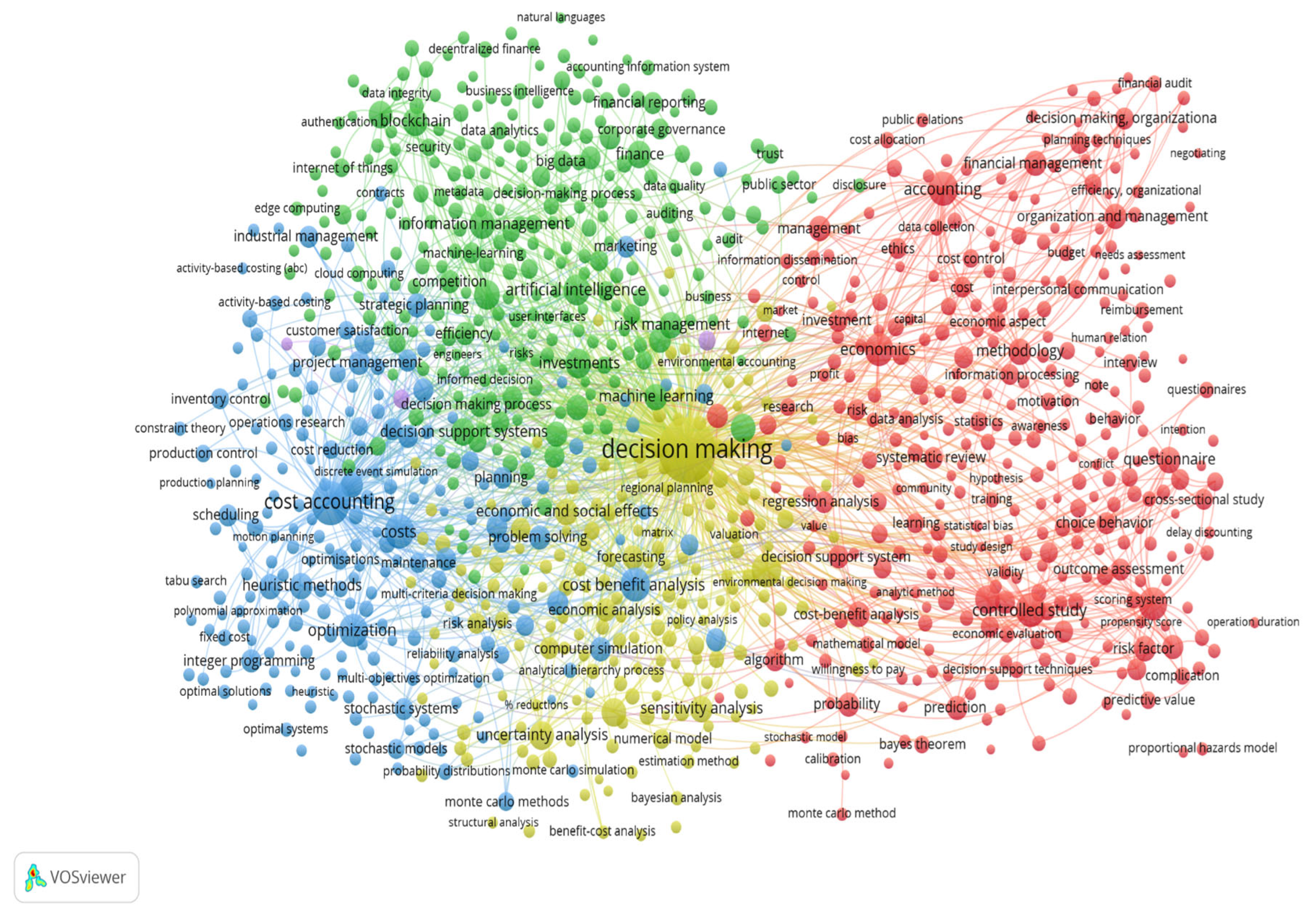
The Network Visualization generated by VOSviewer presents the networking of keywords based on their co-occurrence in published articles. In the figure (Figure 2), each node corresponds to a keyword, its size reflects its frequency of occurrence, and the connections (edges) represent the total link strength between terms. The different color shades group the nodes into thematic clusters, allowing for the identification of dominant research axes and the relationships between them. This visualization facilitates the detection of central and peripheral concepts, as well as the mapping of thematic connections that shape the structure of the literature.
The Network Visualization analysis revealed six clusters, of which four are dominant and two are peripheral.
The yellow cluster is positioned at the center of the map, with the term decision-making forming the largest node and the convergence point of the other themes. Surrounding it are concepts related to risk assessment and cost analysis (risk assessment, cost–benefit analysis), quantitative evaluation and simulation (uncertainty analysis, sensitivity analysis, simulation, forecasting), as well as advanced computational techniques (Bayesian analysis, Monte Carlo methods, algorithms). Connections with terms such as policy making, economic and social effects, stakeholder, and risk perception highlight the dual nature of this cluster: it combines technical/computational approaches with socioeconomic and institutional parameters.
On the left, the blue cluster brings together concepts related to cost accounting, optimization, and operations research. Central terms include cost accounting, optimization, heuristic methods, stochastic systems, integer programming, scheduling, project management, and supply chain management. It contains specialized techniques such as tabu search, polynomial approximation, multi-objective optimization, and linear programming, which support decision-making under resource constraints. The connection to the yellow cluster is made through the term decision support systems, highlighting the contribution of optimization techniques to improving the decision-making process.
In the upper left, the green cluster focuses on information technologies and their applications in the financial and accounting sphere. Central nodes such as artificial intelligence, machine learning, blockchain, information management, financial reporting, and auditing are accompanied by terms relating to data analysis (data analytics), network security (network security), computational infrastructure (cloud computing, Internet of Things), and innovative technological solutions (smart contract, decentralized finance). Links with terms such as trust, efficiency, and risk perception indicate the role of this cluster in shaping systems of trust and security within the digital financial domain.
On the right, the red cluster reflects the socioeconomic and organizational dimension of the theme. It includes terms such as accounting, financial management, economics, organization and management, as well as methodological research indicators (systematic review, regression analysis, questionnaire, choice behavior, outcome assessment). In parallel, it contains concepts relating to human behavior and organizational culture (motivation, judgment, cognition, interpersonal communication, ethics), highlighting the influence of cognitive and behavioral factors on digital financial decision-making.
The arrangement and interconnections of the clusters show that the thematic area of decision-making functions as a central axis linking technological, methodological, economic, and behavioral components, fully aligning with the study’s research question and title. This overall mapping provides an aggregated view of the dominant themes and their interconnections. However, the keyword co-occurrence network analysis produced by VOSviewer allows for a further distinction of the topics into six clusters, of which four are clearly dominant with dense internal connections, while two are considerably smaller and peripheral. In addition to the visual interpretation of the map, the relative prominence of the clusters was assessed through the number of terms included in each cluster. Quantitatively, the distribution of keywords per cluster shows significant differences in size and thematic density. This distribution indicates that the first four clusters account for the main thematic structure of the network, whereas the two smallest clusters represent marginal or peripheral associations. The size difference between the first four clusters and the last two reflects the variety and research coverage of the themes: the larger clusters gather the bulk of keywords, while the smaller ones appear as marginal themes with limited connections.
These clusters are interconnected through common bridging terms, forming a unified research field that combines decision-making, technological applications, administrative practices, and research methodology.
The first cluster, shown in yellow and centrally located in the network, has “decision-making” as its dominant term. From this node extend dozens of direct connections to terms describing critical aspects of the decision-making process, such as “risk assessment” and “risk perception,” as well as methodological approaches such as “cost–benefit analysis,” “cost effectiveness,” “sensitivity analysis,” and “uncertainty analysis.” The yellow cluster encompasses terms related to strategic planning and modeling tools (“planning,” “forecasting,” “simulation,” “computer simulation”), as well as policy-making processes (“policy,” “policy making”). The centrality of “decision-making” positions it as a convergence point for the other thematic areas.
The blue cluster, located on the left, exhibits a strong technical and methodological orientation. It incorporates cost-related terminology (“cost accounting,” “costs,” “cost control”) and optimization methods (“optimization,” “integer programming,” “heuristic methods,” “multi-objectives optimization”). It also integrates terms associated with decision support systems and industrial management (“stochastic systems,” “intelligent systems,” “decision support systems,” “production control,” “scheduling,” “inventory control,” “industrial management”), alongside mathematical and computational methods (“polynomial approximation,” “linear programming,” “probabilistic models”).
The green cluster, situated in the upper left, is linked to digital technologies and artificial intelligence. It includes technologies such as “blockchain,” “internet of things,” “data analytics,” “cloud computing,” and “digital twin,” as well as “machine learning” and “artificial intelligence.” This cluster bridges technological concepts with managerial and financial management (“management accounting,” “financial reporting,” “finance,” “auditing,” “marketing”), while also encompassing information management and security (“information management,” “information use,” “information security”), efficiency, and investment (“efficiency,” “productivity,” “investments”).
The red cluster, located on the right, integrates economics, management, and research methodology. It contains economic and managerial terms (“accounting,” “economics,” “financial management,” “organization and management”), statistical and methodological concepts (“methodology,” “regression analysis,” “probability,” “prediction,” “statistical model”), and topics related to risk management (“risk factors,” “outcome assessment”). It further includes socio-behavioral concepts (“choice behavior,” “motivation,” “interpersonal communication,” “ethics”) and study types (“controlled study,” “major clinical study,” “cross-sectional study,” “systematic review,” “surveys and questionnaires”).
The remaining two clusters are significantly smaller and contain a very limited number of terms, indicating weak connectivity and marginal thematic importance. For this reason, they are not analyzed in detail and are considered peripheral to the main structure of the network.
The interconnections between the clusters are multi-layered: the yellow cluster is closely linked to the blue through terms combining analysis and optimization (“decision support systems,” “planning,” “optimization,” “uncertainty analysis”), to the green through terms bridging technology and management (“decision-making process,” “efficiency,” “machine learning”), and to the red through statistical and evaluative terminology (“regression analysis,” “policy,” “data analysis”). The blue cluster connects to the green via management and efficiency terms (“management accounting,” “project management”), while the green and red clusters intersect in governance and accountability topics (“trust,” “corporate social responsibility”). The blue and red clusters display a weaker yet present connection through economic and cost-related terms (“cost control,” “investment”).
The findings of the Network Visualization indicate that decision-making forms the central core around which technological, methodological, and socio-economic dimensions are structured. This reinforces the hypothesis that trust and cognitive distortions are examined in the literature as interrelated elements with risk assessment and technological innovation.

4.3. Overlay Visualization Analysis

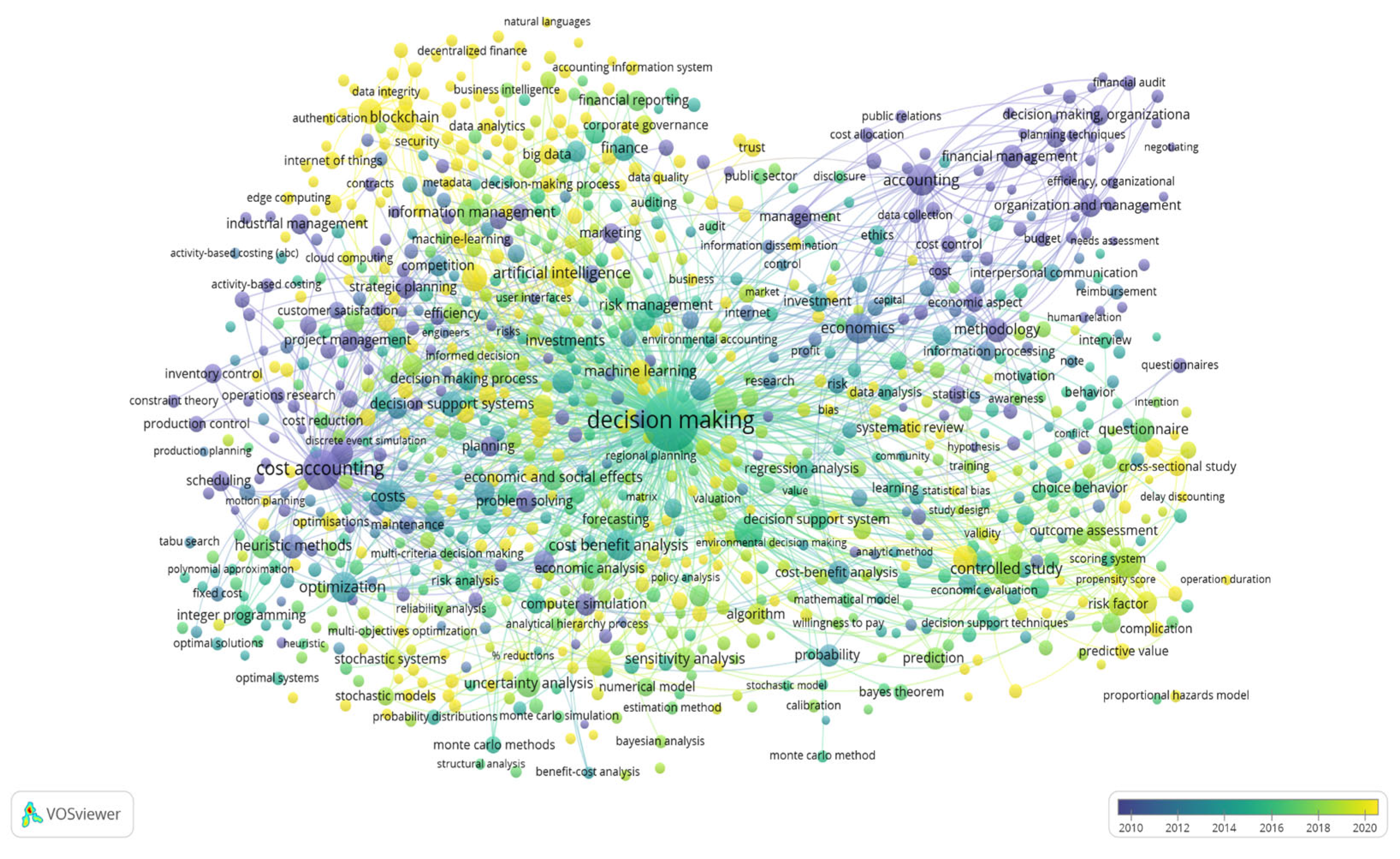
The Overlay Visualization created in VOSviewer adds the time dimension to the mapping of keywords. In Figure 3, the nodes, connections, and sizes are maintained as in the Network Visualization, but the color coding corresponds to the average publication year of each keyword. Shades of purple and blue represent terms that appear mainly in older publications, while shades of yellow and green indicate more recent research themes. This approach makes it possible to examine trends and to distinguish between topics that prevailed in the past and those that are emerging in the recent literature. The interpretation of temporal trends is based on visual patterns of average publication years and does not include additional quantitative time-series analysis.
The Overlay Visualization created in VOSviewer adds the time dimension to the mapping of keywords, retaining the nodes, connections, and sizes as in the Network Visualization, but applying color coding according to the mean publication year of each term. At the core of the map, the term decision-making appears as the largest node, with extensive connections in all directions, while its color shade indicates an average temporal appearance in more recent years. In the lower-left area of the network, the blue cluster gathers themes such as cost accounting, optimization, integer programming, stochastic systems, and heuristic methods, which appear mainly in earlier periods (blue and purple shades). In the upper-left area, the green cluster encompasses terms including information management, blockchain, the Internet of Things, artificial intelligence, machine learning, and finance, characterized by green and yellow shades, indicating a strong presence in more recent years. On the right side, the purple cluster includes terms such as accounting, economics, financial management, organization and management, methodology, and systematic review, which are associated with older publications, as indicated by the blue and purple shades. In the lower-central area, the yellow cluster includes terms such as risk assessment, cost–benefit analysis, simulation, sensitivity analysis, Bayesian analysis, and prediction, which mostly show green and yellow shades, pointing to more recent research. The overall color distribution indicates a temporal shift from older themes focused on cost analysis and methodology toward newer trends emphasizing cutting-edge technologies, data analysis, and quantitative risk assessment methods.
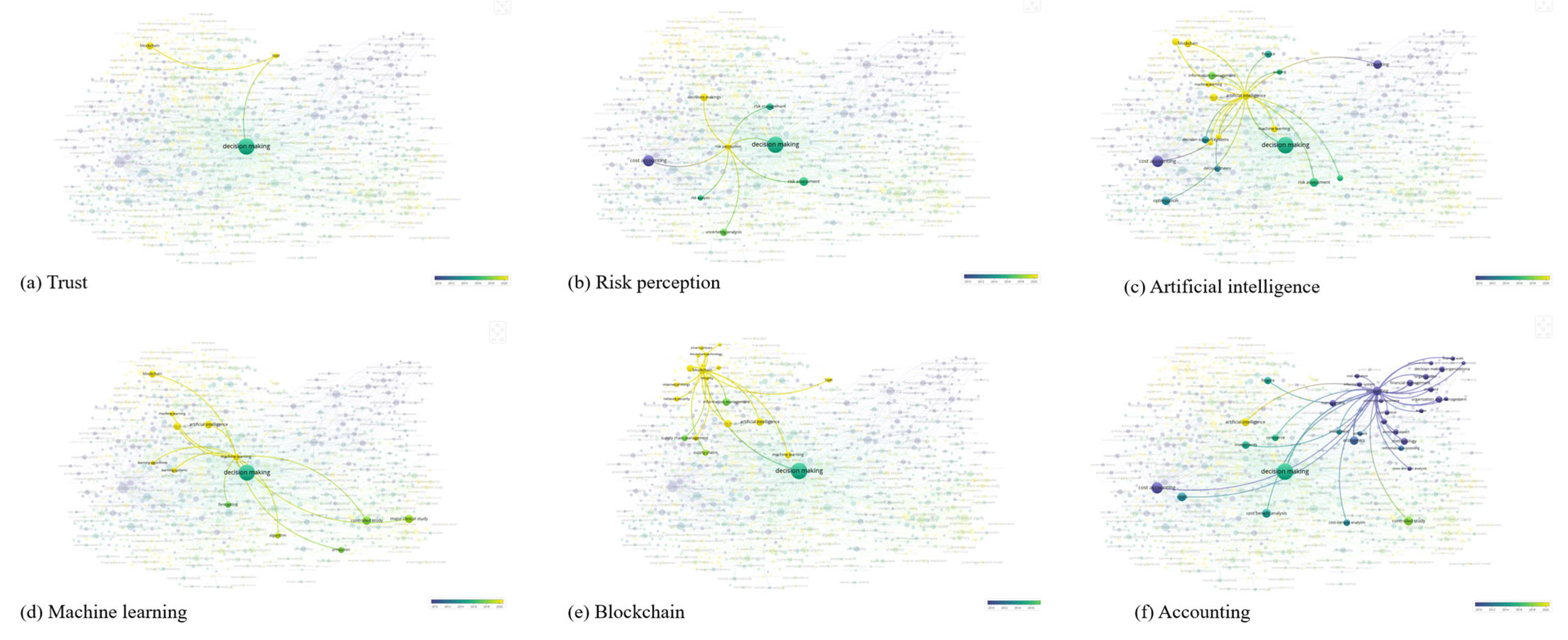
To examine more closely the temporal and thematic dynamics of individual concepts with high visibility and connectivity in the map, six representative nodes were selected: trust, risk perception, artificial intelligence, machine learning, blockchain, and accounting. Their selection was based on their position in the network, frequency of occurrence, and thematic connections with the concept of decision-making. Figure 4 presents the visualization of these concepts within the Overlay Visualization, where color coding captures their temporal trends and their connections with other nodes.
In the visualizations, the six selected concepts–trust, risk perception, artificial intelligence, machine learning, blockchain, and accounting–display different temporal dynamics and interconnections with the central node decision-making. The concept trust is directly connected with decision-making and the blockchain node, with strong presence in the most recent years, indicating growing research interest. Risk perception appears linked to risk management and risk assessment, as well as to decision-making, showing a steady but not sharply increasing trajectory. Artificial intelligence and machine learning are closely connected with each other and with decision-making, while showing increased activity in recent years, indicating their establishment as modern decision-support tools. Blockchain presents strong connections with trust, security, and information management, and appears mainly in recent years, reflecting its entry into the discussion on decision-making. Finally, accounting appears as an important node connected to decision-making, finance, economics, and cost accounting, with presence throughout the entire time span, illustrating its consistent role in the literature.

4.4. Density Visualization Analysis

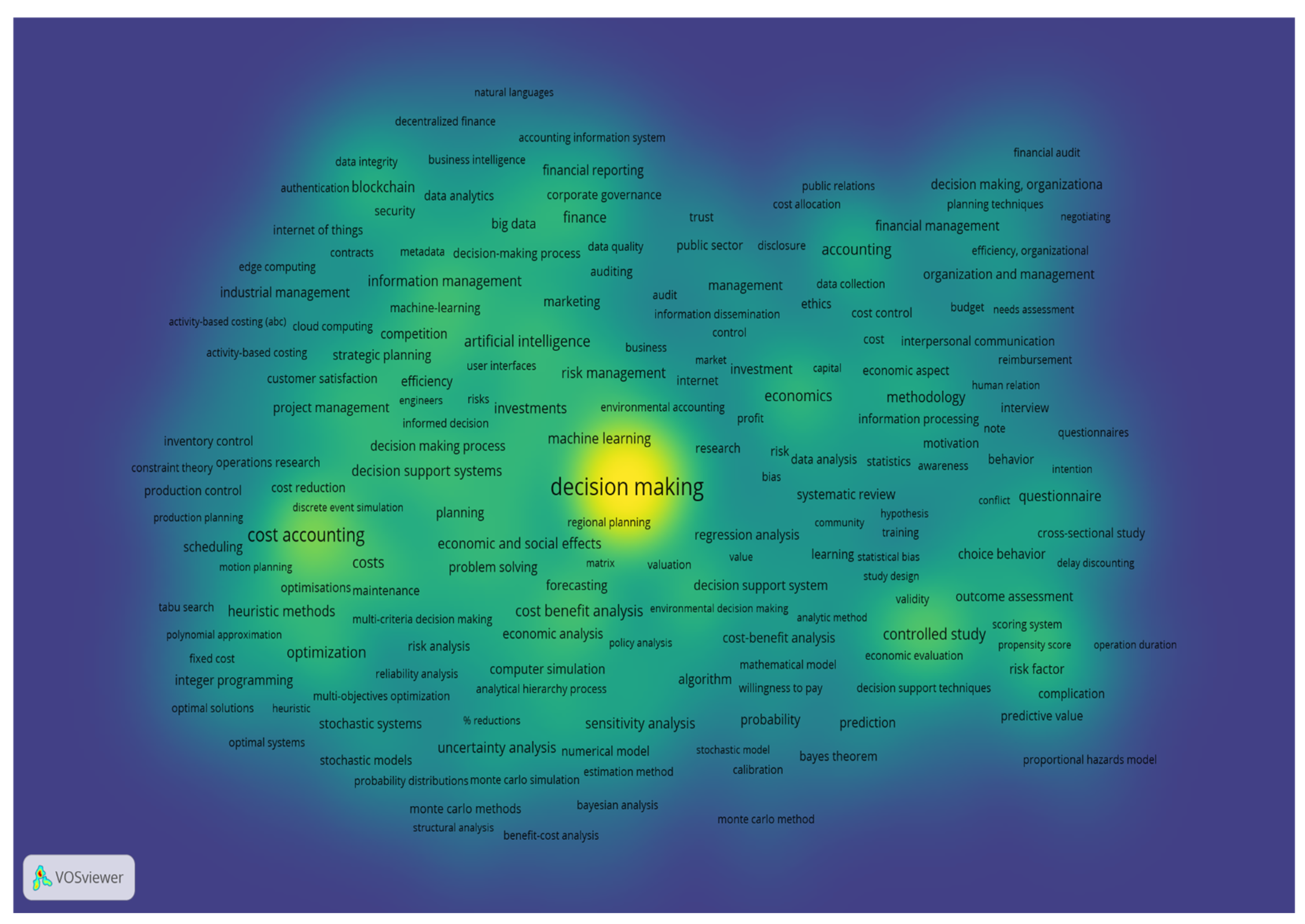
The Density Visualization in VOSviewer focuses on the intensity and density of keyword occurrence in the network. In the figure (Figure 5), the color gradient indicates areas with different concentrations and frequencies of term co-occurrence: areas shaded in yellow and light green represent the “densest” zones, where terms occur more frequently and have strong connections with other keywords, while dark green or blue shades indicate less dense areas with lower frequency and connectivity. This visualization makes areas of high research concentration immediately visible and can be used to identify thematic cores within the literature.
The Density Visualization shows a very intense yellow core around the decision-making node, which constitutes the central “hot spot” of the map. Around it, a ring of high–medium density (yellow-green shades) is formed, including directly adjacent terms such as risk assessment, cost–benefit analysis, forecasting, regression analysis, decision support system(s), planning, economic and social effects, and algorithms. The transition from yellow to green indicates that these terms frequently co-occur with decision-making and form its functional core, while the further shift to bluish-green–blue colors denotes a sparser presence.
To the left of the center, a compact green “island” is visible around cost accounting, accompanied by terms such as costs, cost effectiveness, optimization, heuristic methods, integer programming, stochastic systems, scheduling, mathematical models, and computer simulation. The continuous green shading toward the center indicates a strong connection between this left section and decision-making. In the upper-left, a second, more recent cluster emerges, including terms such as blockchain, data analytics, security, the Internet of Things, information management, and artificial intelligence, and machine learning; the shades here tend toward yellow-green, indicating the concentration and proximity of digital/analytical topics to the core.
To the right of the center, an extended green area is organized around terms such as accounting, financial management, organization and management, economics, and methodology. Further down to the right, the map becomes “hot” again around clinical–methodological terms such as systematic review, questionnaire, cross-sectional study, controlled study, statistical model, outcome assessment, risk factor(s), and predictive value, which are visibly linked to decision-making through green–yellow-green bridges.
In the lower zone, cooler (blue) shades dominate, with distinct clusters of statistical uncertainty and model evaluation terms: uncertainty analysis, sensitivity analysis, probability, prediction, Bayes theorem, receiver operating characteristics, proportional hazards model, as well as isolated Monte Carlo method(s), Bayesian analysis, and Bayesian inference. The cool palette indicates lower overall density, but the visible green connections to the central core signal functional proximity to decision-making.
Overall, the density map depicts a clear central cluster around decision-making and four secondary yet dense zones: (a) on the left, focused on cost accounting/optimization with a strong presence of mathematical and computational techniques, (b) in the upper-left, a “digital” hotspot with blockchain, AI, and machine learning, (c) on the right, a thematic area of accounting–economics–management with methodological and organizational terms, and (d) in the lower-right, a cluster of controlled/statistical study with evaluation indicators and risk factors.
The cooler peripheries (deep blue) include isolated techniques/terms of lower overall density, while the hot pathways linking them to the core indicate the main channels of associations within the network.

5. Discussion

It is important to distinguish between patterns identified through bibliometric mapping and findings derived from empirical studies, as co-occurrence reflects conceptual proximity rather than validated theoretical relationships. Starting with the role of trust, the Network Visualization analysis highlighted the concept of trust as a central node, connected with FinTech technologies such as blockchain, artificial intelligence, and information management, as well as with factors such as risk perception. This position suggests that trust appears as a linking concept between technological infrastructures and the behavioral dimension of decision-making in the literature—an observation consistent with the findings of [20], which indicates that trust affects both the intention to use and the actual adoption of FinTech services, together with factors such as performance expectancy and effort expectancy. Similarly, the study by [25] showed that government support indirectly enhances FinTech adoption through increased trust, a pattern reflected in the network, where trust is also linked to institutional terms such as policy and governance.
The differentiation between trust in traditional finance and in FinTech is also highlighted by [49], who concluded that trust in traditional financial institutions does not directly affect FinTech adoption—something consistent with the network, where trust is positioned closer to terms expressing innovation and security, such as blockchain and security, rather than to traditional banking terms such as accounting and economics. Conversely, refs. [50,51] showed that erosion of trust in banks, as in the case of the Wells Fargo scandal, can act as a catalyst for FinTech adoption, especially when new technologies offer high transparency and strong brand reputation. The Overlay Visualization shows that the concept of trust appears mainly in recent publications [20,25], indicating a shift in emphasis from traditional banking toward decentralized and automated systems.
Moving to the emotional dimension of decision-making, the concept of emotion appears in association with terms related to decision-making, trust, and user experience. Its placement near themes such as psychology, security, and usability aligns with the study of [52], which reports that emotional factors such as trust, security, social influence, and hedonic motivations play a critical role in decision-making in digital environments, while the COVID-19 pandemic brought significant changes to purchasing behavior. Ref. [53] review shows that FinTech has transformed decision-making by enhancing accessibility and innovation, while also introducing bias risks linked to the interplay of emotion, trust, and bias. The study by [54] finds that trust has the most significant effect on FinTech adoption, followed by financial literacy and the regulatory framework—an observation reinforced by the proximity of trust and emotion in the network. Ref. [55] proposes a framework highlighting the growing importance of emotion, while ref. [56] shows that emotional intelligence mediates between trust, risk, and benefits, influencing interest in using FinTech. Ref. [57] links FinTech adoption to improved decision-making through cost reduction, while refs. [58,59] emphasize the role of emotions and brain mechanisms in taking or avoiding risks—findings that align with the links between emotion, risk perception, and bias.
With regard to artificial intelligence and explainability, the findings indicate that artificial intelligence emerges as a key thematic node linked to trust, explainability, and blockchain. Ref. [60] reports that Explainable AI (XAI) enhances transparency and trust, while ref. [36] shows that XAI in financial systems creates transparent environments, improving decision-making. Ref. [61] presents an XAI approach for the banking sector, and ref. [62] demonstrates that explanation features increase adoption and trust in algorithmic advisors. Ref. [63] emphasizes tailoring the level of explanation, while ref. [64] proposes combining AI and blockchain to enhance reliability. Ref. [65] highlights the need for human-centric design, a finding reflected in the proximity of human-centric design, trust, and AI in the network.
Next, cognitive biases and financial literacy emerge as critical factors in relation to FinTech adoption. Overconfidence, anchoring, and loss aversion are associated with FinTech adoption, financial literacy, and digital platforms. Ref. [10] shows that these are reinforced by technologies and social networks, while ref. [8] documents the mediating role of financial literacy. Ref. [1] finds that biases limit FinTech adoption but literacy improves this relationship. Ref. [66] notes that financial literacy reduces overconfidence, while digital literacy may increase it, and ref. [47] reports a reduction in biases in younger users. Ref. [67] records that overconfidence and loss aversion influence decisions regardless of robo-advisor (powered by artificial intelligence) use, while ref. [68] shows reduced overconfidence in executives through FinTech. Ref. [69] documents cultural differences in susceptibility to anchoring and overconfidence, linking them to cognitive skills.
Finally, the thematic dimension of User Experience (UX) and User Interface (UI), design, and regulation strengthens the connection between user experience, trust, and the regulatory framework. Ref. [70] reports that AI-driven UX/UI design improves user experience, but maintaining trust requires a balance with ethical considerations. Ref. [71] shows that careful design in robo-advisors enhances trust and satisfaction, and the review by [72] links technologies such as AI, blockchain, AR/VR, and voice user interface (VUI) with accessibility and security. Ref. [20] reinforces the position that trust is critical for FinTech adoption, while ref. [42] proposes more understandable explanations for AI decisions. Ref. [72] emphasizes the need for regulatory and ethical standards, and ref. [73] records the role of trust in financial inclusion through mobile money. Ref. [74] confirms that data security, trust, and user interface design are key factors in adoption.
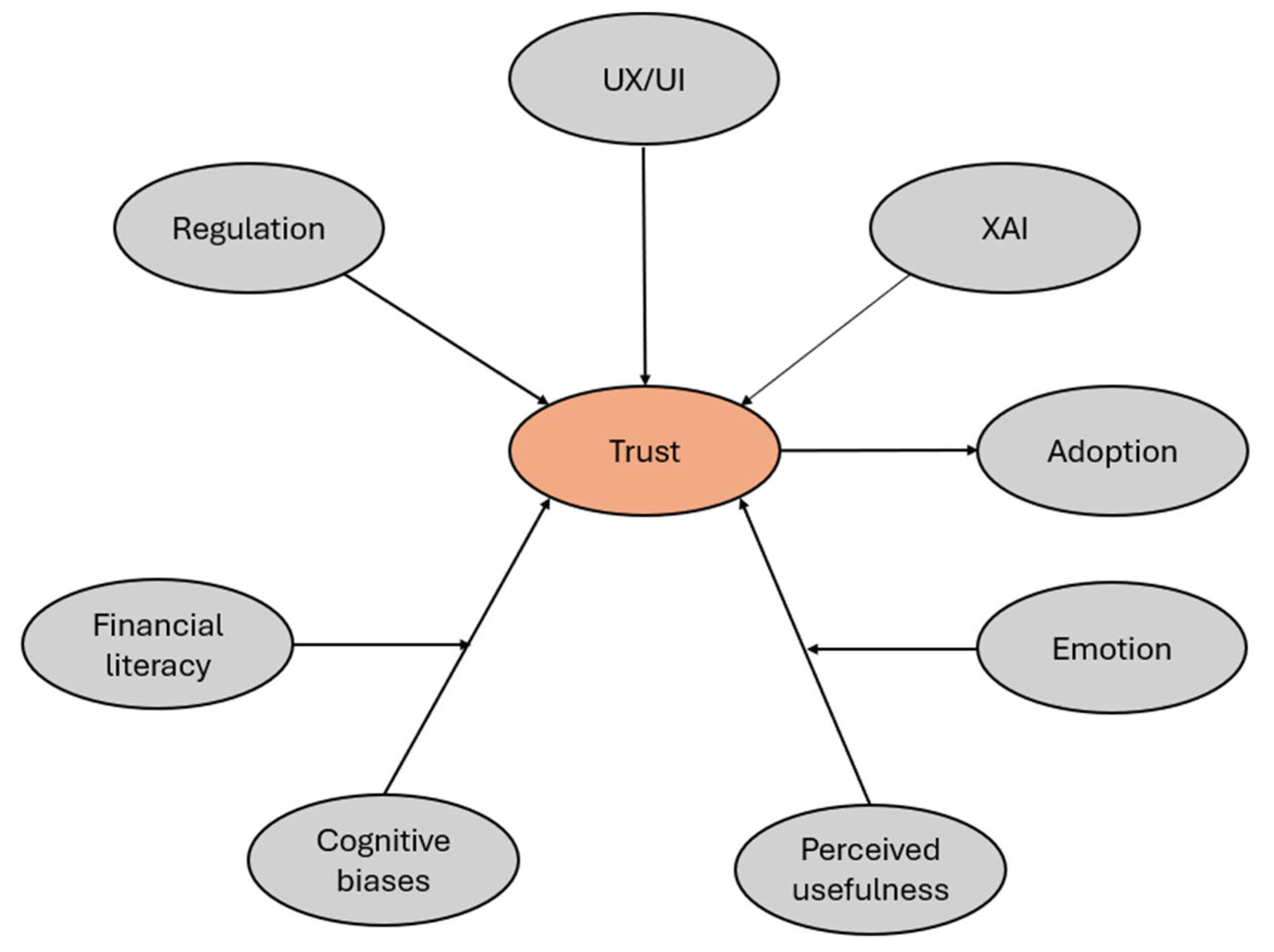
The visualization of thematic clusters and concept networks revealed three distinct but interconnected groups of factors—technological, behavioral, and institutional—that converge around the axis of trust. The synthesis of these groups enabled the formulation of the conceptual framework presented in Figure 6. It should be noted that the framework does not specify causal directionality or formally tested relationships, but rather represents a conceptual synthesis derived from the bibliometric mapping.
The comparison of the findings with the literature reviewed in this study revealed a set of interconnected thematic axes in which trust functions as the central linking mechanism between technological parameters (e.g., AI, blockchain, UX design), emotional and behavioral factors (emotion, cognitive biases), and regulatory frameworks (regulation). These interconnections confirm theoretical models such as UTAUT2 and the Trust Theoretic Model, while the present framework goes beyond their existing applications by incorporating the role of cognitive biases and financial literacy—elements that remain underrepresented in most empirical studies.
The framework represents a simplified synthesis of the bibliometric network, intended to enhance interpretability rather than to capture the full complexity of the underlying relationships. The synthesis of the thematic axes identified (Figure 6) highlights trust as a central and highly connected concept linking technological, behavioral, and institutional factors in the literature on FinTech adoption. Technological factors—such as artificial intelligence and explainability (AI/explainability) and human-centric design (UX/design)—enhance trust through transparency, understanding, and positive user experience. Behavioral factors—cognitive biases, emotion, and financial literacy—influence trust and adoption intention, with financial literacy functioning as a critical mitigating mechanism. Institutional factors (regulation) provide the security and transparency framework necessary to strengthen trust and remove adoption barriers.
This model suggests that strengthening trust requires integrated interventions at all levels—technological, behavioral, and institutional—in order to improve digital financial decision-making and increase financial inclusion. The application of this framework can guide FinTech solution designers toward enhancing transparency and positive user experience, support educational institutions in developing targeted financial literacy programs, and provide regulatory authorities with evidence-based grounds for adopting policies that strengthen trust and reduce perceived risk.
Based on the conceptual framework illustrated in Figure 6, the following research propositions are suggested for future investigation:
P1: Increased transparency and explainability of artificial intelligence algorithms enhance user trust and, in turn, the intention to adopt FinTech.
P2: Financial literacy mitigates the negative impact of cognitive biases on digital financial decision-making.
P3: Positive emotional engagement strengthens the effect of perceived usefulness on the intention to adopt FinTech.
P4: Regulatory frameworks that enhance security and transparency increase institutional trust, which leads to higher adoption rates.
The above propositions are not empirically tested within the scope of this study and should be interpreted as indicative directions for future empirical research rather than as validated hypotheses.
It is important to emphasize that the present study adopts a descriptive and exploratory bibliometric approach and does not aim to establish causal relationships or test hypotheses through statistical or econometric models. The identification of central concepts, such as trust, is based on co-occurrence patterns and network centrality rather than formal statistical inference. Therefore, the findings should be interpreted as indicative of conceptual associations within the literature rather than as evidence of causal mechanisms. In this sense, the study provides a structured foundation for future empirical research, which may employ quantitative, experimental, or survey-based methods to test the behavioral relationships identified in this mapping exercise.

5.1. Practical Implications

The findings of this study suggest that trust is a prominent and highly connected concept in the literature on FinTech adoption, linking technological innovations, emotional factors, and cognitive biases. Given the exploratory and descriptive nature of the present bibliometric study, the following implications should be interpreted with caution, as indicative rather than prescriptive insights. This observation suggests that digital financial service providers should prioritize investments in technologies that improve transparency and interpretability, such as Explainable AI [36,60], as well as in architectures that combine blockchain and AI to increase reliability [64]. In product design, the integration of human-centric principles [65] and an emphasis on personalization and usability [70,75] may enhance user experience while also reinforcing trust.
At the regulatory level, the results show that trust is reinforced when accompanied by a clear and effective institutional framework [25,72], while regulatory interventions can aim to reduce cognitive biases—such as overconfidence, loss aversion, and anchoring bias—through appropriate information mechanisms and disclosure rules [1,66,76]. Additionally, the differentiation of trust towards FinTech versus traditional banking [49,50,51] suggests that policies should be tailored to the specific financial environment and user profile.
Finally, the results indicate that improving financial literacy can mitigate the effects of cognitive biases and enhance rationality in decision-making [8,67,76]. The development of educational tools and digital nudges that leverage emotional and social factors [8,56] can facilitate more effective decision processes and promote the adoption of emerging technologies in the financial sector.

5.2. Limitations and Future Research

This study has several limitations that should be considered when interpreting the findings. First, the selection of sources relied on specific databases and predefined search criteria, which may have excluded relevant studies that did not satisfy these conditions. Second, the focus on specific keywords means that related topics described using alternative terminology may not have been included in the analysis. Third, the visualization methods used (network and overlay visualization) depict co-occurrence relationships and thematic connections but do not establish causal associations. Future research could strengthen the findings by employing multimodal analysis methods and expanding the sources and search terms to capture the field more comprehensively.
In addition, the exclusive use of the SCOPUS database may have excluded relevant studies available in other databases, such as Web of Science. Future research could incorporate multiple databases to improve the comprehensiveness and robustness of the analysis.
In addition, it should be noted that keyword co-occurrence reflects patterns in the use of terminology within the literature rather than necessarily indicating strong theoretical or causal relationships between concepts. Therefore, the proximity of terms in the network should be interpreted as conceptual association rather than validated theoretical integration. As a result, the conceptual framework proposed in this study represents an analytical synthesis of the literature rather than a formally tested model.
The broad scope of the dataset may reduce the specificity of FinTech-focused conclusions; however, it enhances the conceptual comprehensiveness of the analysis by incorporating related behavioral, cognitive, and decision-making literature. Overall, the study should be interpreted primarily as a mapping exercise that identifies research themes and conceptual associations, rather than as an empirical test of behavioral mechanisms in FinTech adoption. Within this context, accounting should be interpreted as one of several interconnected domains rather than as the exclusive focus of the analysis.

6. Conclusions

This study employed bibliometric analysis and visualization techniques (Network and Overlay Visualization) to map thematic trends, interconnections, and temporal shifts in the international literature on cognitive bias and trust in financial decision-making within the context of FinTech, accounting, and corporate performance. The analysis was based on data from the Scopus database, using specific keywords that led to the formation of thematic clusters, enabling the identification of central concepts and linkages.
The study highlights that the literature on FinTech technologies in financial accounting is not limited to technical and economic criteria, but also includes psychological concepts such as cognitive biases, emotions, and trust. The main finding is that trust appears as a central and well-connected concept in the bibliometric network, linking technological, behavioral, and institutional dimensions. In this sense, trust should be interpreted as a prominent concept in the literature rather than as a causally validated determinant of managerial behavior. This study contributes by developing a conceptual framework that integrates cognitive biases, emotions, and trust as interconnected concepts within the bibliometric literature on FinTech adoption and digital financial decision-making.

Author Contributions

Conceptualization, I.C.L. and E.A.; methodology, I.C.L., E.A., E.P.P., N.G. and M.K.; software, I.C.L.; validation, I.C.L., E.A., E.P.P., N.G. and M.K.; formal analysis, I.C.L.; investigation, I.C.L., E.A., E.P.P., N.G. and M.K.; resources, E.A., E.P.P. and M.K.; data curation, I.C.L. and N.G.; writing—original draft preparation, I.C.L.; writing—review and editing, E.A., E.P.P., N.G. and M.K.; visualization, I.C.L.; supervision, E.A., E.P.P. and M.K.; project administration, I.C.L. All authors have read and agreed to the published version of the manuscript.

Funding

This paper has been financed by the funding program “MEDICUS”, of the University of Patras.

Institutional Review Board Statement

Not applicable.

Informed Consent Statement

Not applicable.

Data Availability Statement

The data that support the findings of this study are available from the Scopus database (Elsevier). Access to these data is subject to subscription or licensing restrictions.

Acknowledgments

During the preparation of this manuscript, the authors used ChatGPT (OpenAI, GPT-5.2 version) for language editing and formatting purposes. The authors have reviewed and edited the output and take full responsibility for the content of this publication.

Conflicts of Interest

The authors declare no conflicts of interest. The funders had no role in the design of the study; in the collection, analyses, or interpretation of data; in the writing of the manuscript; or in the decision to publish the results.

Appendix A. Search Queries

The bibliometric dataset was constructed using SCOPUS searches conducted in the fields Article Title, Abstract, and Keywords, without applying additional filters or exclusions. The following search queries were used:
Search 1:
(“cognitive bias” OR “bounded rationality” OR “heuristic” OR “decision-making”) AND (“accounting” OR “auditing” OR “financial reporting” OR “management accounting” OR “performance management”)
Search 2:
(“confirmation bias” OR “anchoring bias” OR “overconfidence bias” OR “loss aversion” OR “framing effect”) AND (“accounting” OR “auditing” OR “corporate performance” OR “financial decision-making”)
Search 3:
(“FinTech” OR “digital finance” OR “robo-advisor” OR “blockchain” OR “digital banking”) AND (“trust” OR “digital trust” OR “emotional engagement”) AND (“accounting” OR “financial reporting” OR “performance management” OR “auditing”)
Search 4:
(“technology acceptance model” OR “TAM” OR “UTAUT” OR “behavioral intention”) AND (“FinTech” OR “digital finance” OR “financial technology”) AND (“accounting” OR “management” OR “corporate performance”)
Search 5:
(“cognitive bias” OR “heuristic” OR “bounded rationality”) AND (“artificial intelligence” OR “machine learning” OR “predictive analytics”) AND (“financial decision-making” OR “investment decision” OR “auditing” OR “management accounting”)
Search 6:
(“artificial intelligence” OR “AI” OR “machine learning” OR “deep learning”) AND (“trust” OR “decision-making” OR “judgment bias”) AND (“accounting” OR “auditing” OR “performance management” OR “financial reporting”)
Search 7:
(“cognitive bias” OR “judgment bias” OR “decision-making”) AND (“sustainability reporting” OR “ESG” OR “climate risk disclosure”) AND (“FinTech” OR “digital platform” OR “blockchain” OR “accounting technology”)
Search 8:
(“trust” OR “decision-making” OR “behavioral bias”) AND (“ESG” OR “sustainability” OR “corporate social responsibility”) AND (“accounting” OR “auditing” OR “corporate performance”)
Search 9:
(“trust” OR “digital trust”) AND (“cognitive bias” OR “judgment bias” OR “bounded rationality”) AND (“accounting” OR “auditing” OR “financial decision-making” OR “performance management”)
Search 10:
(“trust” OR “digital trust”) AND (“FinTech” OR “digital finance” OR “robo-advisor” OR “blockchain”) AND (“decision-making” OR “financial decision-making” OR “investment decision”)

References

  1. Aftab, R.; Fazal, A.; Andleeb, R. Behavioral biases and Fintech adoption: Investigating the role of financial literacy. Acta Psychol. 2025, 257, 105065. [Google Scholar] [CrossRef] [PubMed]
  2. Jafri, J.A.; Amin, S.I.M.; Rahman, A.A.; Nor, S.M. A systematic literature review of the role of trust and security on Fintech adoption in banking. Heliyon 2024, 10, e22980. [Google Scholar] [CrossRef]
  3. Burnham, J.F. Scopus database: A review. Biomed. Digit. Libr. 2006, 3, 1. [Google Scholar] [CrossRef]
  4. Elsevier. Scopus Content Coverage Guide; Elsevier B.V.: Amsterdam, The Netherlands, 2023; Available online: https://www.scribd.com/document/51712547/Scopus-Content-Coverage-Guide (accessed on 11 November 2025).
  5. Mongeon, P.; Paul-Hus, A. The journal coverage of Web of Science and Scopus: A comparative analysis. Scientometrics 2016, 106, 213–228. [Google Scholar] [CrossRef]
  6. Van Eck, N.; Waltman, L. Software survey: VOSviewer, a computer program for bibliometric mapping. Scientometrics 2010, 84, 523–538. [Google Scholar] [CrossRef] [PubMed]
  7. Van Eck, N.J.; Waltman, L. Visualizing bibliometric networks. In Measuring Scholarly Impact: Methods and Practice; Springer International Publishing: Cham, Switzerland, 2014; pp. 285–320. [Google Scholar]
  8. Arif, K.; Hafeez, M.; Tahir, M.T.; Parveen, S. Cognitive Biases and Financial Decision Making: The Role of Digital Finance and Financial Literacy. J. Soc. Sci. Adv. 2025, 6, 27–42. [Google Scholar] [CrossRef]
  9. Kara, A.U. The role of cognitive biases in financial decision-making. Next Gener. J. Young Res. 2024, 8, 203. [Google Scholar] [CrossRef]
  10. Dou, H. Behavioral Finance in the Context of Digital Finance. Financ. Econ. 2025, 1, 53. [Google Scholar] [CrossRef]
  11. Idrees, M.A.; Ullah, S. Comparative analysis of FinTech adoption among Islamic and conventional banking users with moderating effect of education level: A UTAUT2 perspective. J. Open Innov. Technol. Mark. Complex. 2024, 10, 100343. [Google Scholar] [CrossRef]
  12. Athota, V.S.; Pereira, V.; Hasan, Z.; Vaz, D.; Laker, B.; Reppas, D. Overcoming financial planners’ cognitive biases through digitalization: A qualitative study. J. Bus. Res. 2023, 154, 113291. [Google Scholar] [CrossRef]
  13. Morelli, M.; Casagrande, M.; Forte, G. Decision Making: A Theoretical Review. Integr. Psychol. Behav. Sci. 2021, 56, 609–629. [Google Scholar] [CrossRef]
  14. Lerner, J.S.; Li, Y.; Valdesolo, P.; Kassam, K.S. Emotion and Decision Making. Annu. Rev. Psychol. 2015, 66, 799–823. [Google Scholar] [CrossRef]
  15. Bartholomeyczik, K.; Gusenbauer, M.; Treffers, T. The influence of incidental emotions on decision-making under risk and uncertainty: A systematic review and meta-analysis of experimental evidence. Cogn. Emot. 2022, 36, 1054–1073. [Google Scholar] [CrossRef] [PubMed]
  16. Shahzad, A.; Zahrullail, N.; Akbar, A.; Mohelska, H.; Hussain, A. COVID-19’s Impact on fintech adoption: Behavioral intention to use the financial portal. J. Risk Financ. Manag. 2022, 15, 428. [Google Scholar] [CrossRef]
  17. Khan, H.A.; Zaman, S.U. Behavioural factors affect Fintech adoption in Pakistan. Asian Bull. Big Data Manag. 2025, 5, 20–28. [Google Scholar] [CrossRef]
  18. Firmansyah, E.A.; Masri, M.; Anshari, M.; Besar, M.H.A. Factors affecting fintech adoption: A systematic literature review. FinTech 2022, 2, 21–33. [Google Scholar] [CrossRef]
  19. Singh, S.; Sahni, M.M.; Kovid, R.K. What drives FinTech adoption? A multi-method evaluation using an adapted technology acceptance model. Manag. Decis. 2020, 58, 1675–1697. [Google Scholar] [CrossRef]
  20. Amnas, M.B.; Selvam, M.; Raja, M.; Santhoshkumar, S.; Parayitam, S. Understanding the determinants of FinTech adoption: Integrating UTAUT2 with trust theoretic model. J. Risk Financ. Manag. 2023, 16, 505. [Google Scholar] [CrossRef]
  21. Hu, Z.; Ding, S.; Li, S.; Chen, L.; Yang, S. Adoption intention of fintech services for bank users: An empirical examination with an extended technology acceptance model. Symmetry 2019, 11, 340. [Google Scholar] [CrossRef]
  22. Samarasekara, L.; Tanaraj, K.; Rajespari, K.; Sundarasen, S.; Rajagopalan, U. Unlocking the key drivers of FinTech adoption: The mediating role of trust among Malaysians. Migr. Lett. 2023, 20, 505–521. [Google Scholar] [CrossRef]
  23. Meyliana, M.; Fernando, E. The influence of perceived risk and trust in adoption of fintech services in Indonesia. CommIT (Commun. Inf. Technol.) J. 2019, 13, 31–37. [Google Scholar] [CrossRef]
  24. Zhang, W.; Siyal, S.; Riaz, S.; Ahmad, R.; Hilmi, M.F.; Li, Z. Data security, customer trust and intention for adoption of Fintech services: An empirical analysis from commercial bank users in Pakistan. Sage Open 2023, 13, 1388. [Google Scholar] [CrossRef]
  25. Balaskas, S.; Koutroumani, M.; Komis, K.; Rigou, M. FinTech services adoption in Greece: The roles of trust, government support, and technology acceptance factors. FinTech 2024, 3, 83–101. [Google Scholar] [CrossRef]
  26. Jünger, M.; Mietzner, M. Banking goes digital: The adoption of FinTech services by German households. Financ. Res. Lett. 2020, 34, 101260. [Google Scholar] [CrossRef]
  27. Ciriello, R.F.; Loss, S. The yea-paradox: Cognitive bias in technology acceptance surveys. Inf. Softw. Technol. 2023, 161, 107253. [Google Scholar] [CrossRef]
  28. Frank, D.A.; Chrysochou, P.; Mitkidis, P. The paradox of technology: Negativity bias in consumer adoption of innovative technologies. Psychol. Mark. 2023, 40, 554–566. [Google Scholar] [CrossRef]
  29. Khatri, V.; Samuel, B.M.; Dennis, A.R. System 1 and System 2 cognition in the decision to adopt and use a new technology. Inf. Manag. 2018, 55, 709–724. [Google Scholar] [CrossRef]
  30. Comi, A.; Eppler, M.; Herrmann, A.; Schlager, T. Cognitive Biases in New Technology Appropriation: An Experiment on the Impact of Judgmental and Presentational Priming; ICIS: Houston, TX, USA, 2013. [Google Scholar]
  31. Moynihan, D.P.; Lavertu, S. Cognitive biases in governing: Technology preferences in election administration. Public Adm. Rev. 2012, 72, 68–77. [Google Scholar] [CrossRef]
  32. Komiak, S.Y.; Benbasat, I. The effects of personalization and familiarity on trust and adoption of recommendation agents. MIS Q. 2006, 30, 941–960. [Google Scholar] [CrossRef]
  33. Bahmanziari, T.; Pearson, J.M.; Crosby, L. Is trust important in technology adoption? A policy capturing approach. J. Comput. Inf. Syst. 2003, 43, 46–54. [Google Scholar] [CrossRef]
  34. Al Rubaiai, I.R.; Pria, S. Customer usage behaviour of FinTech products in Sultanate of Oman. Int. J. Res. Entrep. Bus. Stud. 2022, 3, 11–24. [Google Scholar] [CrossRef]
  35. Agrawal, A.; Dave, S. A study on the impact of AI on investment decision-making among Gen Z. Int. Sci. J. Eng. Manag. 2025, 4. [Google Scholar] [CrossRef]
  36. Mandava, R.; Vellela, S.S.; Gorintla, S.; Dalavai, L.; Malathi, N.; Haritha, K. Evaluating the Impact of Explainable AI on User Trust in Financial Decision-Support Systems. In Proceedings of the 2025 International Conference on Computational Robotics, Testing and Engineering Evaluation (ICCRTEE), Virudhunagar, India, 28–30 May 2025; pp. 1–6. [Google Scholar]
  37. Trinh, T.K.; Jia, G.; Cheng, C.; Ni, C. Behavioral responses to AI financial advisors: Trust dynamics and decision quality among retail investors. Appl. Comput. Eng. 2025, 144, 69–79. [Google Scholar] [CrossRef]
  38. Maier, T.; Menold, J.; McComb, C. The relationship between performance and trust in AI in E-Finance. Front. Artif. Intell. 2022, 5, 891529. [Google Scholar] [CrossRef]
  39. Schmidt, P.; Biessmann, F.; Teubner, T. Transparency and trust in artificial intelligence systems. J. Decis. Syst. 2020, 29, 260–278. [Google Scholar] [CrossRef]
  40. Gupta, A.; Singh, L. Bibliometric Analysis on Influence of Behaviour Biases and Investment Decision Making. Anusandhan–NDIM’s J. Bus. Manag. Res. 2023, 5, 50–59. [Google Scholar] [CrossRef]
  41. Lokesh, T.; Shree, T.; Harini, P.; Kalaivani, N. Evaluating the influence of AI-powered financial advisory service on customer decision-making compared to traditional in-person banking advisors. ASET. J. Manag. Sci. 2025, 4, 388–398. [Google Scholar] [CrossRef]
  42. Cornacchia, G.; Narducci, F.; Ragone, A. Improving the user experience and the trustworthiness of financial services. In Proceedings of the IFIP Conference on Human-Computer Interaction, Bari, Italy, 30 August–3 September 2021; Springer International Publishing: Cham, Switzerland, 2021; pp. 264–269. [Google Scholar]
  43. Rahmah, R.; Siregar, I.W. Bias Perilaku Dan Keputusan Keuangan: Analisis Bibliometrik. Arbitr. J. Econ. Account. 2022, 3, 346–353. [Google Scholar] [CrossRef]
  44. Das, P.; Das, A.K.; Acharjee, S. A Bibliometric Analysis of Research in Behavioural Finance: Special Emphasis on Selected Behavioural Biases in Investment Decision Making. Colombo Bus. Bus. J. 2024, 15, 1–27. [Google Scholar] [CrossRef]
  45. Rosyidah, U.; Pratikto, H. The role of behavioral bias on financial decision making: A systematic literature review and future research agenda. J. Enterp. Dev. (JED) 2022, 4, 156–179. [Google Scholar]
  46. Dhingra, B.; Yadav, M.; Saini, M.; Mittal, R. A bibliometric visualization of behavioral biases in investment decision-making. Qual. Res. Financ. Mark. 2024, 16, 503–526. [Google Scholar] [CrossRef]
  47. Novitasari, S. Examining financial behavior and decision-making: A bibliometric study of trends and insights. West Sci. Account. Financ. 2023, 1, 69–78. [Google Scholar] [CrossRef]
  48. Cherkaoui, A.; Oudrhough, Y. Cognitive Bias and Sustainable Decision-Making: A Bibliometric Analysis of Emerging Trends and Research Gaps. In Proceedings of the 2024 International Conference on Sustainable Islamic Business and Finance (SIBF), Sakhir, Kingdom of Bahrain, 27–28 November 2024; pp. 324–328. [Google Scholar]
  49. Paaso, M.; Okat, D.; Pursiainen, V. Trust in Traditional Finance and Consumer Fintech Adoption. In Proceedings of the Paris December 2021 Finance Meeting EUROFIDAI-ESSEC, Online, 16 December 2021. [Google Scholar]
  50. Yang, K. Trust as an entry barrier: Evidence from fintech adoption. J. Financ. Econ. 2025, 169, 104062. [Google Scholar] [CrossRef]
  51. Elomari, R. Consumer perception of robo-advisors: Trust, adoption barriers, and behavioral insights. Multidimens. Res. Insights 2025, 1, 1–12. [Google Scholar] [CrossRef]
  52. Anju, L.; Veni, S. The role of emotional factors in shaping online shopping behavior: A comprehensive analysis of consumer engagement and decision-making. J. Inf. Syst. Eng. Manag. 2025, 10, 920–926. [Google Scholar] [CrossRef]
  53. Mahmudi, B. The Evolution of FinTech and its Effects on Financial Decision Making: A Systematic Literature Review. Manag. Stud. Bus. J. (Product.) 2024, 1, 174–181. [Google Scholar] [CrossRef]
  54. Abu-AlSondos, I.A.; Alsmadi, A.A.; Al-Daoud, K.I.; Aldulaimi, S.H. Exploring the Impact of Decision Models on FinTech Adoption: An Empirical Study. In 2024 International Conference on Decision Aid Sciences and Applications (DASA); IEEE: Piscataway, NJ, USA, 2024; pp. 1–7. [Google Scholar]
  55. Barone, M.; Bussoli, C.; Fattobene, L. Digital financial consumers’ decision-making: A systematic literature review and integrative framework. Int. J. Bank. Mark. 2024, 42, 1978–2022. [Google Scholar] [CrossRef]
  56. Khudori, M.; Ayudiati, C. Pengaruh Trust, Resiko, Manfaat dan Kemudahan terhadap Minat Menggunakan Fintech dengan Kecerdasan Emosi sebagai Variabel Intervening. Indo-Fintech Intellect. J. Econ. Bus. 2023, 3, 438–448. [Google Scholar] [CrossRef]
  57. Carlin, B.; Olafsson, A.; Pagel, M. FinTech and Consumer Well-Being in the Information Age; Working Papers; University of California at Los Angeles: Los Angeles, CA, USA, 2018. [Google Scholar]
  58. Peterson, R.L. Affect and financial decision-making: How neuroscience can inform market participants. J. Behav. Financ. 2007, 8, 70–78. [Google Scholar] [CrossRef]
  59. Merkle, C.; Kempf, A.; Niessen-Ruenzi, A. Emotion and Finance-An Interdisciplinary Approach to the Impact of Emotions on Financial Decision Making. In Proceedings of the International Meeting on Experimental and Behavioral Economics (IMEBE), Granada, Spain, 2–4 April 2009; Available online: https://madoc.bib.uni-mannheim.de/28968/ (accessed on 2 May 2026).
  60. Bura, C.; Jonnalagadda, A.K.; Naayini, P. The role of explainable ai (xai) in trust and adoption. J. Artif. Intell. Gen. Sci. (JAIGS) 2024, 7, 262–277. [Google Scholar] [CrossRef]
  61. Hanif, A. Towards explainable artificial intelligence in banking and financial services. arXiv 2021, arXiv:2112.08441. [Google Scholar] [CrossRef]
  62. Ben David, D.; Resheff, Y.S.; Tron, T. Explainable AI and adoption of financial algorithmic advisors: An experimental study. In Proceedings of the 2021 AAAI/ACM Conference on AI Ethics, and Society, Virtual, 19–21 May 2021; pp. 390–400. [Google Scholar]
  63. Burgt, J.V.D. Explainable AI in banking. J. Digit. Bank. 2020, 4, 344–350. [Google Scholar] [CrossRef]
  64. Nassar, M.; Salah, K.; Ur Rehman, M.H.; Svetinovic, D. Blockchain for explainable and trustworthy artificial intelligence. Wiley Interdiscip. Rev. Data Min. Knowl. Discov. 2020, 10, e1340. [Google Scholar] [CrossRef]
  65. Bhomia, Y.; Singh, M.; Kumar, A. Explainability and trust in AI: Bridging the gap between users and complex models. Pharma Innov. J. 2019, 8, 10–13. [Google Scholar] [CrossRef]
  66. Hakim, M.S.; Setyaningrum, R.V.; Yunita, R.D.S.; Nareswari, N. Mitigating overconfidence bias in investment behavior: The roles of financial literacy and digital financial literacy. EKUITAS (J. Ekon. Dan Keuang.) 2025, 9, 82–96. [Google Scholar] [CrossRef]
  67. Rahmat, T.K.; Sukmaningrum, P.S.; Rusmita, S.A. The Impact of Overconfidence and Loss Aversion Bias on Investment Decision Making Among Users of Robo Advisors in Islamic Financial Technology. J. Ekon. Dan Bisnis Islam 2024, 9, 225–246. [Google Scholar] [CrossRef]
  68. Wang, L.; Xiao, W.; Huang, D. Does Fintech affect the psychological traits of managers? Based on the perspective of manager overconfidence. Front. Psychol. 2022, 13, 1008944. [Google Scholar] [CrossRef]
  69. Czerwonka, M. Anchoring and overconfidence: The influence of culture and cognitive abilities. Int. J. Manag. Econ. 2017, 53, 48–66. [Google Scholar] [CrossRef]
  70. Xu, Y.; Liu, Y.; Xu, H.; Tan, H. AI-driven UX/UI design: Empirical research and applications in FinTech. Acad. Nexus J. 2024, 3, 16. [Google Scholar] [CrossRef]
  71. Runsewe, O.; Akwawa, L.A.; Folorunsho, S.O.; Osundare, O.S. Optimizing user interface and user experience in financial applications: A review of techniques and technologies. World J. Adv. Res. Rev. 2024, 23, 934–942. [Google Scholar] [CrossRef]
  72. Kerényi, J.M.Á.; Müller, J. The need for trust and ethics in the digital age–Sunshine and shadows in the FinTech world. Financ. Econ. Rev. 2019, 18, 5–34. [Google Scholar] [CrossRef]
  73. Okello Candiya Bongomin, G.; Ntayi, J. Trust: Mediator between mobile money adoption and usage and financial inclusion. Soc. Responsib. J. 2020, 16, 1215–1237. [Google Scholar] [CrossRef]
  74. Stewart, H.; Jürjens, J. Data security and consumer trust in FinTech innovation in Germany. Inf. Comput. Secur. 2018, 26, 109–128. [Google Scholar] [CrossRef]
  75. Komatireddy, K.; Mangeshikar, S.; Gada, T. Augmenting trust in robo advisor experiences through thoughtful UX design. FMDB Trans. Sustain. Comput. Syst. 2024, 2, 54–63. [Google Scholar] [CrossRef]
  76. Jaiswal, A.; Patel, S. A study on the role of financial literacy in mitigating behavioral biases. Int. J. Sci. Res. Eng. Manag. 2025, 9, 49818. [Google Scholar] [CrossRef]
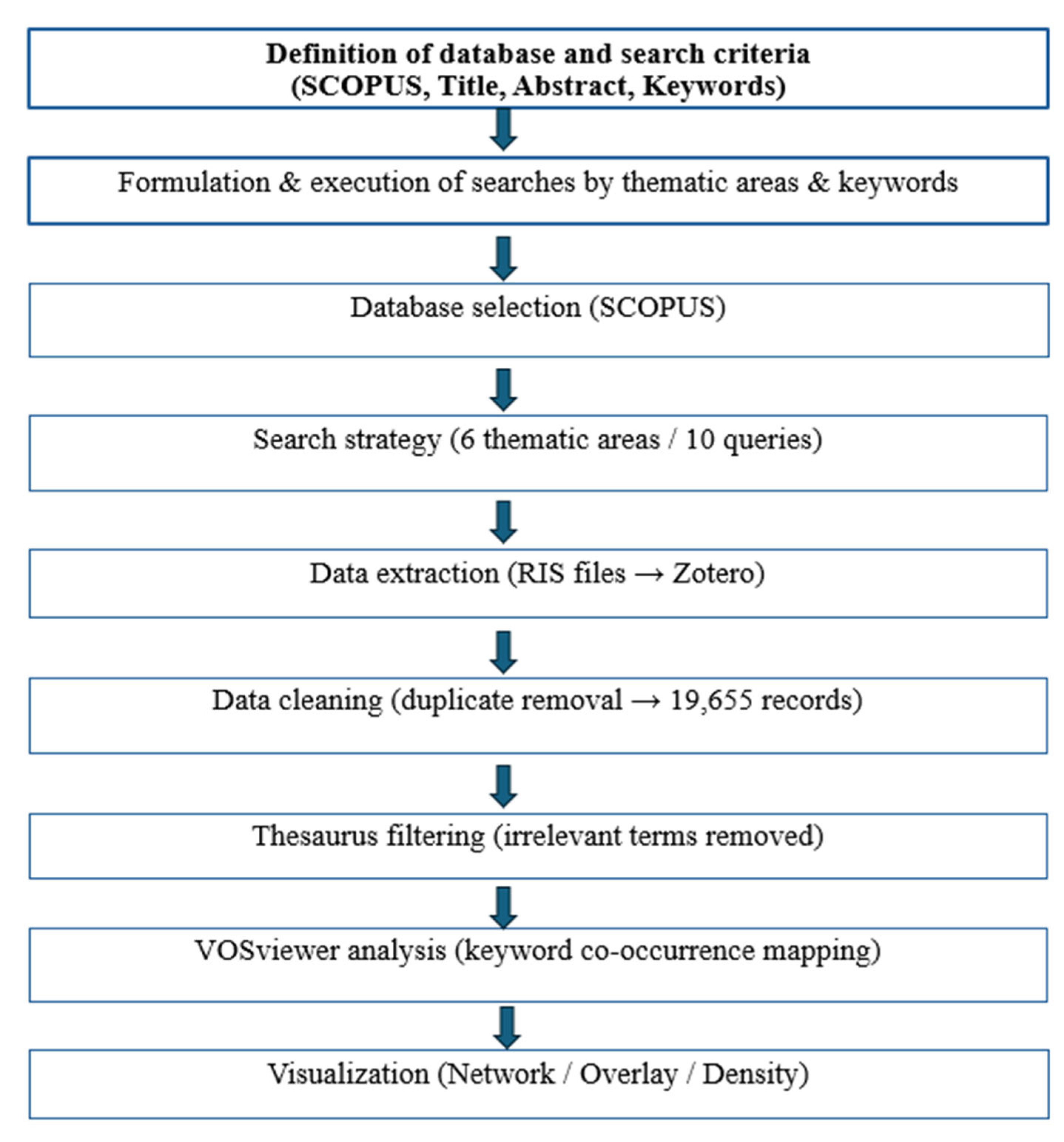
Figure 1. Methodological flow diagram of the bibliometric analysis, illustrating database selection, search strategy, data extraction, cleaning, thesaurus filtering, and keyword co-occurrence mapping using VOSviewer.
Fintech 05 00049 g001
Figure 2. Network Visualization analysis representation.
Fintech 05 00049 g002
Figure 3. Overlay Visualization analysis representation.
Fintech 05 00049 g003
Figure 4. Visualization of the six selected concepts in the Overlay Visualization.
Fintech 05 00049 g004
Figure 5. Density Visualization analysis representation.
Fintech 05 00049 g005
Figure 6. Conceptual framework for trust in FinTech adoption.
Fintech 05 00049 g006
Disclaimer/Publisher’s Note: The statements, opinions and data contained in all publications are solely those of the individual author(s) and contributor(s) and not of MDPI and/or the editor(s). MDPI and/or the editor(s) disclaim responsibility for any injury to people or property resulting from any ideas, methods, instructions or products referred to in the content.