
Transparency by Design: A Narrative Synthesis of AI Disclosure, Explainability, and Trust in Consumer-Facing FinTech


Abstract
1. Introduction
2. Background Literature
2.1. Consumer-Facing FinTech and AI Systems
2.2. Transparency Cues: Disclosure, Explainability, Interpretability, and Control
2.3. Trust-Related Outcomes
2.4. Trust Calibration Versus Mere Acceptance
3. Research Method
3.1. Search Strategy
3.2. Eligibility Criteria
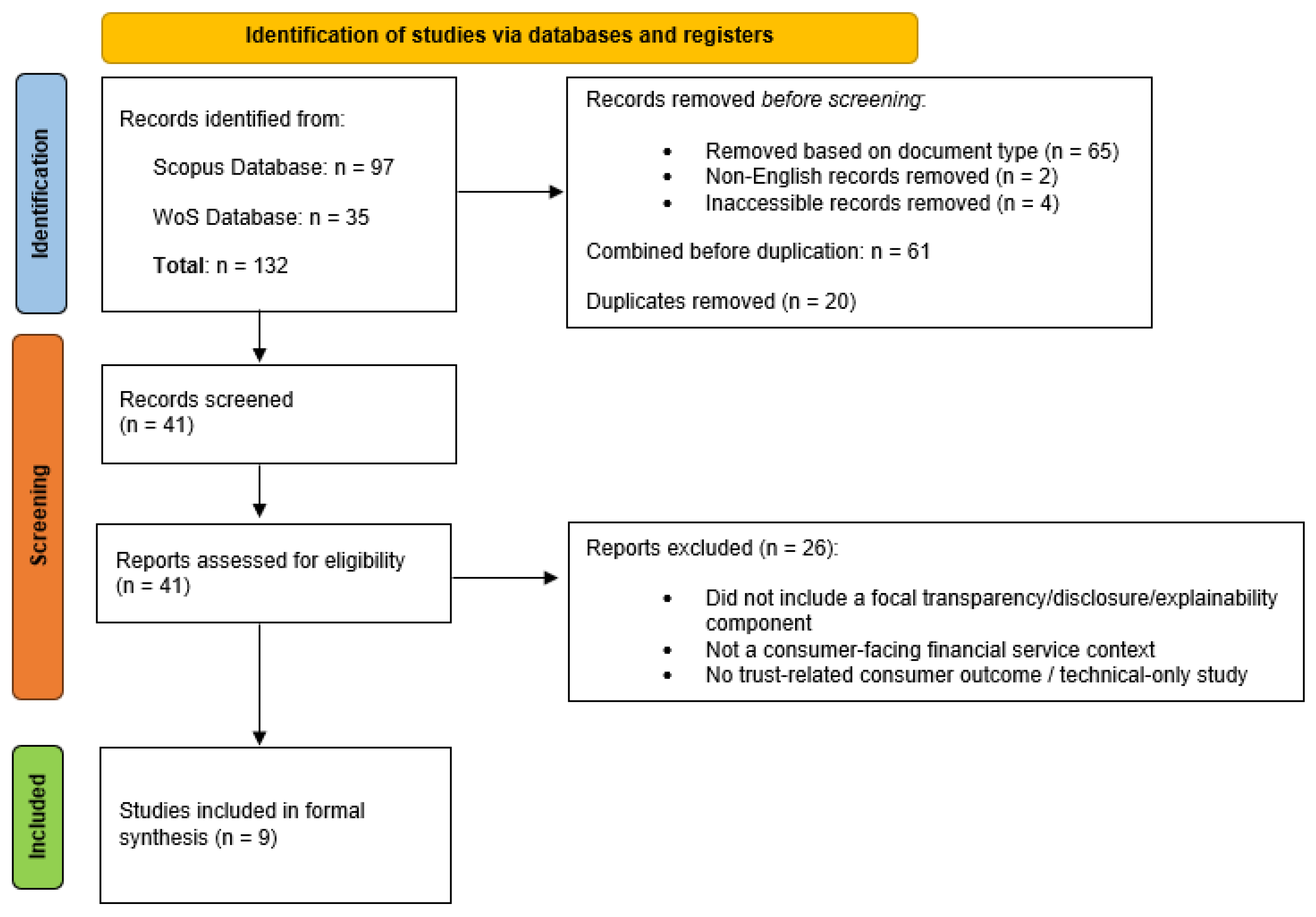
3.3. Screening and Study Selection
3.4. Quality/Risk-of-Bias Appraisal Approach
3.5. Narrative Synthesis Approach
4. Results
4.1. Overview of Included Studies
4.2. RQ1: Types of AI Disclosure and Explainability Cues Examined
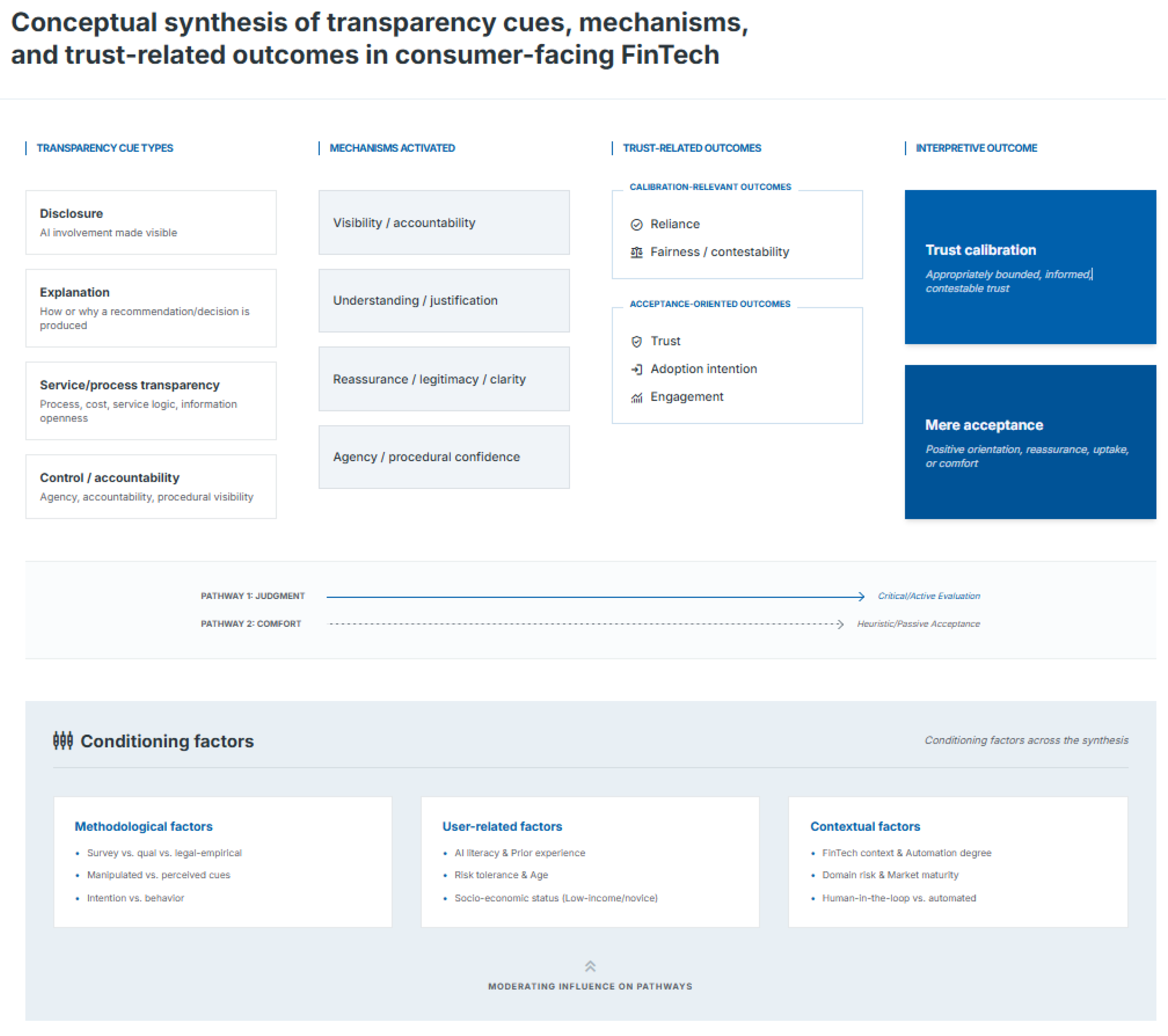
4.3. RQ2: How Transparency Cues Influence Trust-Related Outcomes
4.4. RQ3: FinTech Application Contexts in Which These Relationships Have Been Studied
4.5. RQ4: Methodological, User-Related, and Contextual Conditioning Factors
4.5.1. Methodological Factors
4.5.2. User-Related Factors
4.5.3. Contextual Factors
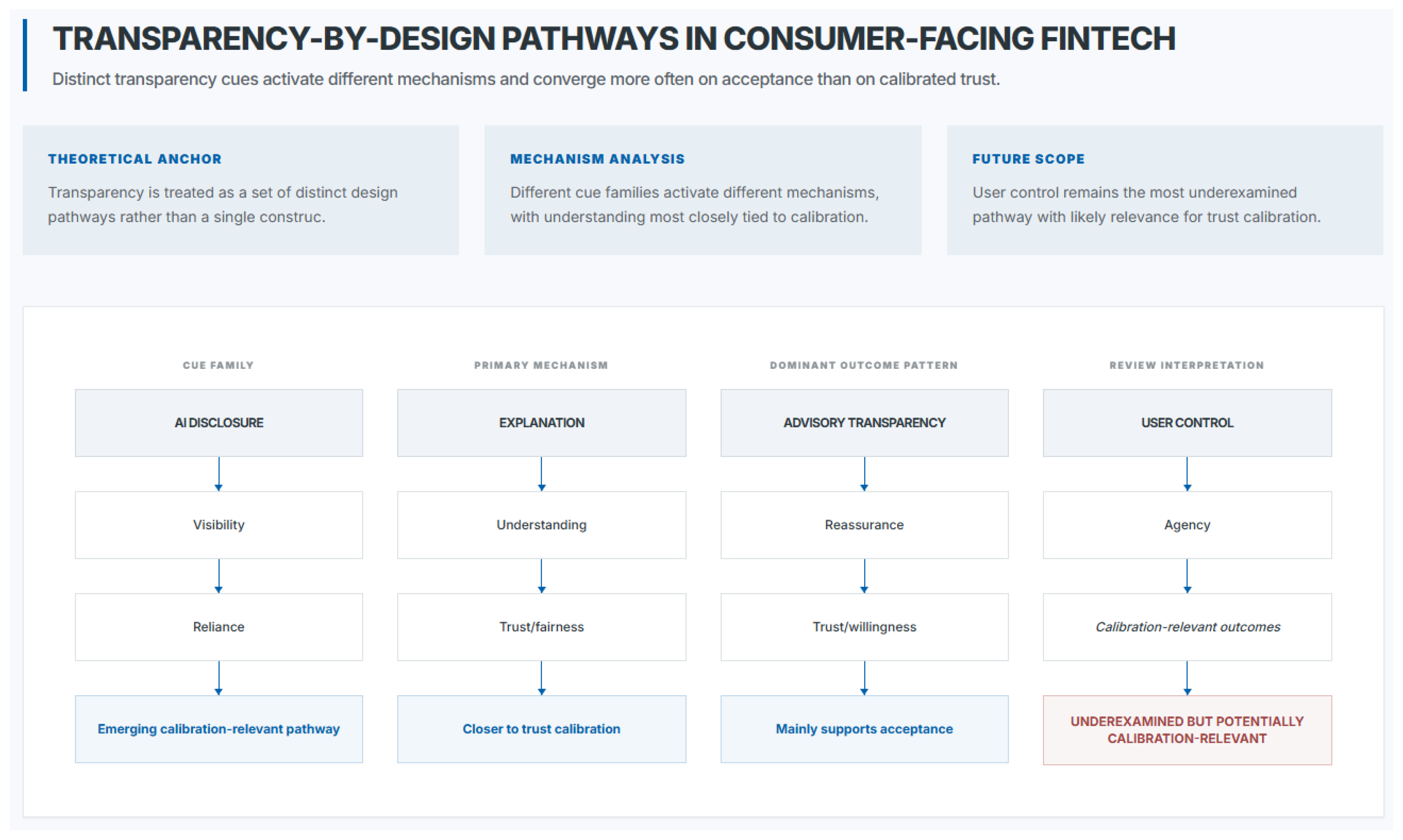
4.6. RQ5: Do Transparency Cues Support Trust Calibration or Mainly Acceptance?
4.7. Role of Adjacent Contextual Literature
5. Discussion
5.1. Main Synthesis: Transparency Is Studied More as a Trust-Building Device than as a Calibration Mechanism
5.2. Theoretical Interpretation: Transparency by Design in Consumer-Facing FinTech
5.3. Trust Calibration Versus Mere Acceptance as the Key Contribution of the Review
5.4. Context Matters: Why Transparency Works Differently Across FinTech Settings
5.5. Conditioning Factors and Boundary Conditions
5.6. Implications for Design and Practice in Consumer-Facing FinTech
5.7. Methodological Implications for Future Research
5.8. Limitations of the Review
6. Conclusions
Funding
Institutional Review Board Statement
Informed Consent Statement
Data Availability Statement
Conflicts of Interest
Abbreviations
| ACI | Automated Credit Interface/Automated Credit Decision-Making |
| AFA | AI Financial Advice/Advisory System |
| AI | Artificial Intelligence |
| AT | Acceptance |
| CHAT | FinTech Chatbot |
| CI | Continuance Intention |
| CR | Credibility |
| CRP | Crowdfunding/Recommendation Platform |
| CTRL | User Control/Override/Customization |
| DISC | AI Disclosure |
| ENG | Engagement |
| EXPL | Explanation/Explainable AI |
| EXPV | Prior Experience and Literacy |
| FA | Fairness Perception |
| FinTech | Financial Technology |
| GOV | Platform and Governance Features |
| HUM | Preference for Human Involvement |
| INFOQ | Information Quality/Clarity of Criteria |
| INTP | Interpretability/Comprehensibility |
| LEGAL-EMP | Legal-Empirical |
| LLM | Large Language Model |
| MARK | Market Maturity and Regulatory Environment |
| MB | Mobile Banking/Digital Wallet |
| MECH | Mechanism/Mediation |
| METH | Methodological Conditioning |
| MM | Mixed Methods |
| MX | Mixed/Ambiguous |
| NR | Not Really Assessed |
| OLS | Ordinary Least Squares |
| PC | Psychological Comfort |
| PERS | Personalization and User Fit |
| PLS-SEM | Partial Least Squares Structural Equation Modeling |
| PR | Perceived Risk |
| RA | Robo-Advisory/Automated Investment Advising |
| RESP | Responsibility Attribution/AI Involvement |
| RL | Reliance |
| RQ | Research Question |
| S1–S9 | Formally included studies |
| SEM | Structural Equation Modeling |
| STAK | Decision Stakes and Adverse Outcome Context |
| SURV | Survey |
| TAM | Technology Acceptance Model |
| TC | Trust Calibration |
| TR | Trust |
| TRSP | Advisory or Platform Transparency |
| UTAUT | Unified Theory of Acceptance and Use of Technology |
| VULN | User Vulnerability and Resource Constraints |
| WoS | Web of Science |
| XAI | Explainable Artificial Intelligence |
| 2SLS | Two-Stage Least Squares |
References
- Nwafor, C.N.; Nwafor, O.; Brahma, S. Enhancing Transparency and Fairness in Automated Credit Decisions: An Explainable Novel Hybrid Machine Learning Approach. Sci. Rep. 2024, 14, 25174. [Google Scholar] [CrossRef] [PubMed]
- Jamshed, H.; Waheed, U.; Iqbal, S.; Faheem, M.; Ashraf, M.W.; Mansoor, Y. Dynamic Smart Contracts Framework on Ethereum Private Blockchain for Real Estate Management. J. Eng. 2025, 2025, e70063. [Google Scholar] [CrossRef]
- Damaševičius, R.; Bacanin, N.; Nayyar, A. Blockchain Technology for a Trustworthy Social Credit System: Implementation and Enforcement Perspectives. Clust. Comput. 2025, 28, 162. [Google Scholar] [CrossRef]
- Alkhouri, R.; Halteh, K. The Integrated Ethical Governance Framework: Bridging Ethical Theory and Regulatory Practice in FinTech. Soc. Sci. Humanit. Open 2026, 13, 102661. [Google Scholar] [CrossRef]
- Dadabada, P.K. Analyzing the Impact of ESG Integration and FinTech Innovations on Green Finance: A Comparative Case Studies Approach. J. Knowl. Econ. 2025, 16, 7959–7978. [Google Scholar] [CrossRef]
- Shin, D. The Effects of Explainability and Causability on Perception, Trust, and Acceptance: Implications for Explainable AI. Int. J. Hum. Comput. Stud. 2021, 146, 102551. [Google Scholar] [CrossRef]
- Huang, C.-H.; Nguyen, V.-T. Revisiting the Shifting Landscape of P2P Lending: A Systematic Review Based on the Affordance Actualization Perspective. Electron. Commer. Res. 2026, 1–27. [Google Scholar] [CrossRef]
- Kpatcha, E. Balancing Fairness and Accuracy in Machine Learning-Based Probability of Default Modeling via Threshold Optimization. J. Risk Financ. Manag. 2025, 18, 724. [Google Scholar] [CrossRef]
- Aini, S. Trusting AI in Finance: The Role of Psychological Traits and AI Literacy in Shaping User Behaviour Toward Robo-Advisors. S. East Asian J. Manag. 2025, 19, 4. [Google Scholar] [CrossRef]
- Balaskas, S.; Koutroumani, M.; Komis, K.; Rigou, M. FinTech Services Adoption in Greece: The Roles of Trust, Gov-ernment Support, and Technology Acceptance Factors. FinTech 2024, 3, 83–101. [Google Scholar] [CrossRef]
- Chong, F.H.L. Enhancing Trust through Digital Islamic Finance and Blockchain Technology. Qual. Res. Financ. Mark. 2021, 13, 328–341. [Google Scholar] [CrossRef]
- Ally, A.M. Artificial Intelligence (AI) and Financial Technology (FinTech) in Tanzania; Legal and Regulatory Issues. Int. J. Law Manag. 2025; ahead of print. [CrossRef]
- Stacy, J.; Kim, R.; Barrett, C.; Sekar, B.; Simon, S.; Banaei-Kashani, F.; Rosenberg, M.A. Qualitative Evaluation of an Artificial Intelligence-Based Clinical Decision Support System to Guide Rhythm Management of Atrial Fibrillation: Survey Study. JMIR Form. Res. 2022, 6, e36443. [Google Scholar] [CrossRef]
- Plakolli-Kasumi, L. AI in the Banking Sector: Lessons from the Schufa Case. Bialostockie Stud. Prawnicze 2025, 30, 155–165. [Google Scholar] [CrossRef]
- Rajendra, J.B.; Thuraisingam, A.S. The Role of Explainability and Human Intervention in AI Decisions: Jurisdictional and Regulatory Aspects. Inf. Commun. Technol. Law 2025, 35, 152–183. [Google Scholar] [CrossRef]
- Yang, C.C. Explainable Artificial Intelligence for Predictive Modeling in Healthcare. J. Healthc. Inform. Res. 2022, 6, 228–239. [Google Scholar] [CrossRef]
- Nazmi, A.N.A.; Lye, C.T.; Tay, L.Y. Promoting Robo-Advisor Adoption among B40 in Malaysia through Advisory Transparency and UTAUT Models. Eng. Technol. Appl. Sci. Res. 2024, 14, 18727–18733. [Google Scholar] [CrossRef]
- Vallarino, D. Causal-GNN for Ethical AI in Financial Services: Ensuring Fairness, Compliance, and Transparency in Automated Decision-Making. Artif. Intell. Law 2025, 1–16. [Google Scholar] [CrossRef]
- Jung, D.; Dorner, V.; Weinhardt, C.; Pusmaz, H. Designing a Robo-Advisor for Risk-Averse, Low-Budget Consumers. Electron. Mark. 2018, 28, 367–380. [Google Scholar] [CrossRef]
- Donou-Adonsou, F.; Leslie-Piper, N. Digital Traps: The Compounding Impact of BNPL and Social Media on Consumer Financial Stress. Financ. Res. Lett. 2026, 93, 109636. [Google Scholar] [CrossRef]
- Wang, Y.; Wang, J.; Othman, I. User-Centric Intelligent Recommendations for E-Commerce Crowdfunding Success. J. Organ. End User Comput. 2025, 37, 1–27. [Google Scholar] [CrossRef]
- Qureshi, J.N.; Farooq, M.S. ChainAgile: A Framework for the Improvement of Scrum Agile Distributed Software Development Based on Blockchain. PLoS ONE 2024, 19, e0331232. [Google Scholar] [CrossRef]
- Kaushal, V.; Yadav, R. Learning Successful Implementation of Chatbots in Businesses from B2B Customer Experience Perspective. Concurr. Comput. 2023, 35, e7450. [Google Scholar] [CrossRef]
- Kozodoi, N.; Jacob, J.; Lessmann, S. Fairness in Credit Scoring: Assessment, Implementation and Profit Implications. Eur. J. Oper. Res. 2022, 297, 1083–1094. [Google Scholar] [CrossRef]
- Hefny, M.H.M.; Helmy, Y.; Abdelsalam, M. Open Banking API Framework to Improve the Online Transaction between Local Banks in Egypt Using Blockchain Technology. J. Adv. Inf. Technol. 2023, 14, 729–740. [Google Scholar] [CrossRef]
- Bashir, Z.; Farooq, S.; Iqbal, M.S.; Aamir, M. The Role of Trust in Financial Robo-Advisory Adoption: A Case of Young Retail Investors in Pakistan. Sustain. Futures 2025, 9, 100538. [Google Scholar] [CrossRef]
- Abbas, S.K. Lending by Algorithm: Fair or Flawed? An Information-Theoretic View of Credit Decision Pipelines. SN Comput. Sci. 2025, 6, 679. [Google Scholar] [CrossRef]
- Arora, S.; Rajesh, A.; Misra, R.; Singh, G. Bridging Technology and Trust: The Role of AI-Driven Robo-Advisors in Middle-Class Financial Management. Manag. Decis. 2025, 1–24. [Google Scholar] [CrossRef]
- Alonso-Robisco, A.; Carbó, J.M. Should We Trust the Credit Decisions Provided by Machine Learning Models? Comput. Econ. 2025, 66, 4245–4274. [Google Scholar] [CrossRef]
- Azam, M.; Abdul-Majeed Hamdoun, A.; Abed Alhaleem Maslat Harahsheh, E.; Mashdurohatun, A.; Parsaulian Sidauruk, H. Contemporary Issues on Interfaith Law and Society Religious Diversity in the Digital Economy: Interfaith Legal Pathways to Harmonize Sharia, Christian Ethics, and International Law. Contemp. Issues Interfaith Law Soc. 2025, 4, 207–264. [Google Scholar] [CrossRef]
- Bulavynets, O.; Shashkevych, O.; Gerchakivskiy, S.; Gavkalova, N.; Atamas, O.; Yuriy, S.I. Digital transformation of the public finance system: Challenges, inclusivity, and prospects for sustainable development. J. Eng. Technol. Ind. Appl. ITEGAM-JETIA Manaus 2026, 12, 1170–1180. [Google Scholar] [CrossRef]
- Shin, D.; Rasul, A.; Fotiadis, A. Why Am I Seeing This? Deconstructing Algorithm Literacy through the Lens of Users. Internet Res. 2022, 32, 1214–1234. [Google Scholar] [CrossRef]
- Lui, A.T.; Lamb, G.; Durodola, L. A Right to Explanation for Algorithmic Credit Decisions in the UK. Law Innov. Technol. 2025, 17, 289–317. [Google Scholar] [CrossRef]
- To, M.H.; Tran, B.M. A Personalized Investment Advisory System Using Large Language Models: Evidence from Vietnam’s Stock Market. Glob. Bus. Financ. Rev. 2026, 31, 1–20. [Google Scholar] [CrossRef]
- Mendel, T.; Mandal, S.; Nov, O.; Wiesenfeld, B.M. Who Is Responsible, the Advisor or the AI? Understanding the Effects of Advisors Disclosing Their AI Use on Their Perceived Responsibility and AI Reliance. Proc. ACM Hum. Comput. Interact. 2025, 9, 1–30. [Google Scholar] [CrossRef]
- Bambauer, J.; Zarsky, T. The algorithm game. Notre Dame L. Rev. 2018, 94, 1–48. [Google Scholar]
- Kwon, D.; Jeong, P.; Chung, D. An Empirical Study of Factors Influencing the Intention to Use Robo-Advisors. J. Inf. Knowl. Manag. 2022, 21, 2250039. [Google Scholar] [CrossRef]
- Kulkarni, M.S.; Patil, K.P.; Pramod, D. The Role of Robo-Advisors in Behavioural Finance, Shaping Investment Decisions. Cogent Econ. Financ. 2025, 13, 2571403. [Google Scholar] [CrossRef]
- Page, M.J.; McKenzie, J.E.; Bossuyt, P.M.; Boutron, I.; Hoffmann, T.C.; Mulrow, C.D.; Shamseer, L.; Tetzlaff, J.M.; Akl, E.A.; Brennan, S.E.; et al. The PRISMA 2020 Statement: An Updated Guideline for Reporting Systematic Reviews. BMJ 2021, 372, n71. [Google Scholar] [CrossRef] [PubMed]
- Nain, I.; Rajan, S. Algorithms for Better Decision-Making: A Qualitative Study Exploring the Landscape of Robo-Advisors in India. Manag. Financ. 2023, 49, 1750–1761. [Google Scholar] [CrossRef]
- Abbas, S.K.; Szabó, Z.; Kő, A. Robo-Advisors in Fintech-Challenges and Solutions. Acta Polytech. Hung. 2025, 22, 131–151. [Google Scholar] [CrossRef]



| Decision Rule | Include When | Exclude When |
|---|---|---|
| Service context | The study examines a consumer-facing financial service, such as robo-advisors, AI-enabled financial advice, FinTech chatbots, digital wallets, mobile banking, crowdfunding platforms, or lending/credit interfaces. | The study focuses on back-end financial systems, internal banking operations, institutional trading, compliance, fraud detection, or non-financial AI applications. |
| AI/algorithmic component | AI or algorithmic mediation is central to the user-facing decision or interface. | AI is only background infrastructure or is not central to the user-facing service. |
| Transparency-related component | The study includes a focal disclosure-, transparency-, or explainability-related construct, feature, manipulation, or evaluative dimension, such as explanation, AI disclosure, advisory transparency, interpretability, comprehensibility, information quality, or user control. | The study examines general FinTech trust, TAM, UTAUT, or adoption without a transparency/disclosure/explainability component. |
| Outcome requirement | The study reports at least one trust-related consumer outcome, such as trust, perceived risk, fairness, credibility, reliance, or adoption intention. | The study is technical XAI, modeling, or fairness work without end-user perceptions, responses, or trust-related outcomes. |
| Robo-advisor rule | Robo-advisor studies are included even if explainability is not the exact term used, provided that a genuine transparency-related feature is present. | Robo-advisor studies are excluded if they focus only on trust/adoption and do not operationalize a transparency/disclosure/explainability element. |
| Chatbot rule | FinTech chatbot studies are included when they examine trust together with transparency, explanation, or user control. | Non-financial chatbot studies, or chatbot studies without a trust–transparency link, are excluded. |
| Lending/credit rule | AI lending or credit studies are included when they examine the consumer-facing side and include fairness, transparency, explainability, or trust perceptions. | Technical credit scoring, risk modeling, or internal lending systems without consumer-facing perceptions are excluded. |
| Context boundary | Financial e-commerce or crowdfunding studies are included when they clearly function as consumer-facing FinTech contexts and include transparency/trust mechanisms. | General e-commerce recommender studies without a clear financial-service context are excluded. |
| Authors | Country | FinTech Context | Method | Sample | Core Transparency Cue | Core Trust-Related Outcome |
|---|---|---|---|---|---|---|
| To et al. [34] | Vietnam | LLM-based personalized investment advisory system | Design science research combining multi-agent system development, historical back-testing, expert evaluation, and investor surveys | 50 listed firms; 50 retail investors | EXPL | TR |
| Mendel et al. [35] | United States | AI-assisted personal finance/retirement investment advising | Between-subjects online advising simulation with AI disclosed vs. undisclosed to clients | 113 | DISC | RL |
| Kwon et al. [37] | South Korea | Robo-advisory/AI-based investment advisory service | Online survey with structural equation modeling using a combined TAM and innovation resistance model | 158 | TRSP | AI |
| Nazmi et al. [17] | Malaysia | Financial robo-advisors for low-income households | Self-administered bilingual questionnaire analyzed with SEM/PLS-SEM using UTAUT with advisory transparency as a mediator | 217 | TRSP | AI |
| Kulkarni et al. [38] | India | Robo-advisory/AI-powered financial robo-advisor for retail investment decision-making | Cross-sectional survey analyzed with PLS-SEM (SmartPLS 4.0) | 461 | EXPL | AI |
| Jung et al. [19] | Germany | Robo-advisory/automated web-based investment advisory | Design science study with iterative prototype development and two controlled mixed-method laboratory evaluations | 30 | TRSP | TR |
| Lui et al. [33] | United Kingdom | Automated credit decision-making/credit scoring | Doctrinal and comparative legal analysis with UK public and bank-employee surveys | 99 | EXPL | TR |
| Nain et al. [40] | India | Robo-advisory/automated wealth management | Semi-structured interviews with industry experts analyzed by content analysis | 12 | TRSP | TR |
| Wang et al. [21] | China | E-commerce crowdfunding/crowdfunding recommendation platform | Mixed-method empirical framework combining a structured survey, OLS/SEM/2SLS mediation analysis, XGBoost, and investment-strategy simulation | 300 survey respondents + 5000 crowdfunding projects | EXPL | TR |
| Cue Code | Cue Family | Definition Used in This Review | Example Operationalization | Studies | FinTech Contexts |
|---|---|---|---|---|---|
| DISC | AI disclosure | Explicit disclosure that AI is involved in the advisory or decision process | Whether clients know that advisors used AI and whether the AI recommendation is visible | Mendel et al. [35] | RA |
| EXPL | Explanation/explainable AI | Cues clarifying how an AI-enabled system reaches or supports a recommendation or decision | Natural-language explanations; right to explanation for automated credit decisions; perceived algorithm interpretability and structural assurance | To et al. [34]; Lui et al. [33]; Kulkarni et al. [38]; Wang et al. [21] * | AFA; ACI; RA; CRP |
| TRSP | Advisory or platform transparency | Openness about service logic, process, costs, information basis, or platform functioning | Transparency of algorithms used in robo-advisor decisions; costs, information, and process transparency; interface features clarifying business models, processes, and assets | To et al. [34]; Lui et al. [33]; Kwon et al. [37]; Nazmi et al. [17]; Nain et al. [40]; Jung et al. [19] | AFA; ACI; RA |
| INTP | Interpretability/comprehensibility | User-perceived understandability of algorithmic reasoning or recommendation logic | Algorithm interpretability as part of explainable robo-advisor design | Kulkarni et al. [38] | RA |
| CTRL | User control/override/customization | Degree to which users can influence, inspect, or retain agency over automated decisions | User control over automated investment decisions alongside transparency of algorithmic information | Kwon et al. [37] | RA |
| INFOQ | Information quality/clarity of criteria | Clarity and usability of decision-relevant information | Clearer cost, information, and process features for low-income users | Nazmi et al. [17] | RA |
| RESP | Responsibility attribution/AI involvement | Cues about who is responsible when AI is involved in a recommendation | AI-use disclosure shifting responsibility perceptions between the advisor and the AI-supported process | Mendel et al. [35] | RA |
| Study | Transparency Cue | Trust-Related Outcome(s) | Direction of Effect | Summary of Finding | Interpretive Note |
|---|---|---|---|---|---|
| To et al. [34] | EXPL | TR; AI | Positive | Explainable and transparent personalized recommendations were associated with higher investor trust and willingness to use, alongside strong system performance. | Supportive evidence, but not based on a direct causal transparency manipulation; more trust- and use-oriented than calibration-focused. |
| Mendel et al. [35] | DISC | RL; TR | Mixed/conditional | Disclosing advisor AI use did not directly increase AI reliance, but indirectly increased reliance by reducing perceived personal responsibility. | A clear case in which disclosure reshapes responsibility and reliance rather than simply elevating trust. |
| Kwon et al. [37] | TRSP | AI | Indirect only | Transparency increased perceived usefulness and indirectly supported adoption intention while reducing innovation resistance. | Adoption-oriented and mediated, not a direct transparency-to-trust effect. |
| Nazmi et al. [17] | TRSP | AI | Positive | Advisory transparency had a significant positive direct effect on robo-advisor adoption intention and mediated key UTAUT-linked predictors. | Transparency functions mainly as an adoption-enabling mechanism, especially in a low-income user setting. |
| Kulkarni et al. [38] | EXPL | AI | Positive | Perceived algorithm interpretability, together with interactivity, personalization, and autonomy, was associated with reduced behavioral biases relevant to investment decision-making; structural assurance was not significant. | Transparency-related features appear beneficial, but this is not a clean test of disclosure/explanation effects on trust itself. |
| Jung et al. [19] | TRSP | TR; AI | Positive | Improved cost, process, and information transparency increased trust, satisfaction, and willingness to invest, although many users still preferred some human contact. | Strong evidence for trust-building, but not necessarily for calibrated challenge or appropriate skepticism. |
| Lui et al. [33] | EXPL | TR; FA | Unclear/indirect | Opacity was framed as undermining trust and fairness in automated credit decisions, with strong support for a right to explanation, especially regarding criteria and weightings. | Explanation is treated as a safeguard for understanding and contestability, but no experimental effect size was estimated. |
| Nain et al. [40] | TRSP | TR; AI | Positive | Interview evidence identified transparency in operations as a central pillar for building trust and encouraging adoption in robo-advisory. | Qualitative and provider-oriented evidence; useful for interpretation but not strong causal inference. |
| Wang et al. [21] | EXPL | TR; AI | Positive | Recommendation transparency and perceived platform control increased trust, while trust mediated the path from transparency to crowdfunding success; engagement and update frequency were also important. | Extends the review beyond advisory settings and links transparency to trust-mediated platform outcomes. |
| Context Code | FinTech Application Context | Studies | Typical Transparency Cues | Typical Trust-Related Outcomes | Evidence Density |
|---|---|---|---|---|---|
| RA | Robo-advisory/automated investment advising | [17,19,35,37,38,40] | DISC, EXPL, TRSP | TR, RL, AI | High |
| AFA | AI financial advice/advisory system | [34] | EXPL | TR, AI | Low |
| ACI | Automated credit decision-making/credit scoring | [33] | EXPL | TR, FA | Low |
| CRP | Crowdfunding/recommendation platform | [21] | EXPL | TR, AI | Low |
| Factor Code | Factor Category | Specific Factor | How It Conditions the Relationship | Studies | Interpretive Summary |
|---|---|---|---|---|---|
| MECH | Mechanism/mediation | Indirect effects through intermediate perceptions or evaluations | Transparency often works through mediators such as perceived responsibility, perceived usefulness, or advisory transparency rather than acting directly on trust-related outcomes. | [17,21,35,37] | Transparency frequently operates through intermediate psychological or evaluative pathways rather than as a standalone trust trigger. |
| PERS | Personalization and user fit | Risk profile, investment horizon, tailored recommendation design | When transparency is embedded in personalized recommendations, it may be more likely to support trust and willingness to use. | [34] | Personalization may strengthen the value of explanation, but the evidence remains limited. |
| STAK | Decision stakes and adverse outcome context | High-stakes or unfavorable financial decisions | Explanation becomes more salient when users face consequential or negative outcomes, such as unsuccessful credit applications. | [33] | In credit contexts, transparency functions less as persuasion and more as a procedural safeguard linked to fairness and justified trust. |
| EXPV | Prior experience and literacy | Investment experience, financial literacy, digital literacy | User capability shapes whether transparency is meaningful, actionable, or adoption-enabling. | [17,19,38] | Transparency is not equally effective across user groups; its value depends partly on users’ ability to interpret and use it. |
| VULN | User vulnerability and resource constraints | Risk aversion, low budgets, low savings, low-income status | Transparency appears especially important for financially vulnerable or low-confidence users, but often supports reassurance and adoption more than calibrated challenge. | [17,19] | Transparency may play a compensatory role for vulnerable users, mainly by supporting confidence and uptake. |
| HUM | Preference for human involvement | Desire for human touch or hybrid advisory | Even where transparency is valued, users or experts may still prefer some human involvement. | [19,40] | Transparency alone may be insufficient where trust depends partly on interpersonal reassurance. |
| MARK | Market maturity and regulatory environment | Nascent markets, regulatory ambiguity, emerging-market conditions | Low awareness, institutional uncertainty, and evolving regulation shape how transparency is interpreted. | [17,40] | Transparency appears to function differently in emerging or still-maturing FinTech environments than in more institutionalized settings. |
| METH | Methodological conditioning | Survey, qualitative, design, and legal-empirical study designs | Observed transparency effects vary by design type; survey and design studies more often report positive associations, whereas qualitative and legal-empirical studies emphasize contestability, fairness, and interpretive complexity. | [17,19,21,33,34,37,40] | Apparent positivity should be interpreted in light of design differences, since not all studies test causal effects in the same way. |
| GOV | Platform and governance features | Platform control, update frequency, learning capability | In platform contexts, transparency interacts with governance and usability features that shape trust, engagement, and downstream outcomes. | [21] | In crowdfunding and recommendation environments, transparency is embedded in a broader platform ecology rather than functioning as an isolated cue. |
| BIAS | Behavioral and cognitive filtering | Bias reduction and interpretability-linked decision support | Transparency-related features may matter by reducing behavioral biases or improving users’ ability to process recommendations, rather than by directly increasing trust. | [38] | Transparency may influence decision quality indirectly, but the evidence is less cleanly trust-centered than in other studies. |
| Study | Transparency Cue | Observed Outcome Pattern | Calibration Signal | Basis for Classification | Classification |
|---|---|---|---|---|---|
| [34] | EXPL | Explanation was associated with higher trust and willingness to use the advisory system. | Weak | Supports trust and intended use, but does not test whether users became more discerning or better calibrated in their reliance. | AT |
| [35] | DISC | Disclosure did not directly increase reliance, but indirectly increased AI reliance by reducing perceived personal responsibility. | Clear | Directly links disclosure to responsibility and reliance, showing changed accountability dynamics rather than simple uptake. | TC |
| [37] | TRSP | Transparency increased perceived usefulness and indirectly supported adoption intention while reducing innovation resistance. | Weak | Mediated and adoption-focused; does not test whether transparency improves differentiated trust or reliance. | AT |
| [17] | TRSP | Advisory transparency directly increased adoption intention and mediated key adoption pathways. | Weak | Transparency mainly supports acceptance among low-income users, not calibrated trust or contestability. | AT |
| [38] | EXPL | Interpretability-related features were associated with lower behavioral biases and more favorable usage-oriented outcomes. | Limited | May indirectly improve decision quality, but the study is not centered on trust, reliance, or calibrated judgment. | AT |
| [19] | TRSP | Transparency increased trust, satisfaction, and willingness to invest, although many users still preferred some human contact. | Weak | Shows trust-building and adoption support, but not whether transparency improves calibrated trust or challenge. | AT |
| [33] | EXPL | Explanation is framed as necessary for trust, fairness, and the ability to understand and contest automated credit decisions. | Strong | Treats explanation as a safeguard for informed judgment, contestability, and fairness in a high-stakes credit context. | TC |
| [40] | TRSP | Transparency was identified qualitatively as a pillar of trust and adoption in robo-advisory. | Weak | Transparency is discussed as trust-building and adoption-enabling, not as a mechanism for calibrated reliance or challenge. | AT |
| [21] | EXPL | Recommendation transparency increased trust, which then mediated broader platform outcomes, including crowdfunding success. | Mixed | Transparency is central and trust is explicit, but the outcome pattern extends into engagement and performance rather than clean calibration. | MX |
| Study | Why Relevant | Why Not Formally Included | How Used in Discussion |
|---|---|---|---|
| Bashir et al. [26] | Shows trust formation as a central mechanism in robo-advisory adoption, especially via trust propensity and age. | No direct transparency, disclosure, or explainability cue. | Supports interpretation of trust as a mediator in robo-advisory adoption, especially in emerging markets. |
| Abbas et al. [27] | Identifies transparent communication, visible assurances, privacy, audits, and user education as trust-relevant conditions. | Qualitative ecosystem evidence rather than a direct transparency-to-trust test. | Used as background on the broader trust ecology surrounding transparency, privacy, and security. |
| Arora et al. [28] | Shows that perceived trust and trialability support psychological comfort and continuance in AI robo-advisory. | Examines trust and continuance without a direct transparency or explainability intervention. | Used to interpret psychological comfort as a trust-adjacent continuance mechanism. |
| Alonso-Robisco and Carbó [29] | Shows that post hoc explainability varies in reliability, with implications for how explanations should be trusted. | Methodological explainability study without consumer trust or adoption outcomes. | Used as a bridge paper on transparency-by-design, explanation quality, and explainability reliability in credit AI. |
| Aini [41] | Identifies AI literacy and psychological traits as antecedents of trust in robo-advisors. | Trust-formation study without a direct transparency, disclosure, or explainability treatment. | Used as an adjacent mechanism paper on AI literacy → trust → behavior in consumer-facing finance. |
| Gap Domain | Observed Gap | Evidence Basis from the Review | Why the Gap Matters | Priority Level |
|---|---|---|---|---|
| FinTech context coverage | The formal evidence base is heavily concentrated in robo-advisory, with very limited coverage of other consumer-facing FinTech settings. | Most formally included studies fall in RA, with only one study each in AFA, ACI, and CRP; no formal studies were identified in CHAT or MB. | This concentration limits the external validity of the review and makes it difficult to infer whether transparency works similarly across advisory, lending, chatbot, wallet, and platform-based financial services. | High |
| Transparency cue coverage | Explanation and broad advisory/platform transparency dominate, while disclosure, responsibility attribution, user control, and information-quality cues are underexamined. | The formal corpus is dominated by EXPL and TRSP. DISC, RESP, CTRL, and INFOQ appear only sparsely and often as secondary rather than focal cues. | The field currently cannot determine which transparency mechanisms are most effective, for whom, and under what conditions. | High |
| Trust outcome coverage | The literature emphasizes trust and adoption-related outcomes more than fairness, reliance, risk, contestation, or overreliance. | Across the formal studies, TR and especially AI recur most often, whereas RL appears centrally only in S2 and FA only in S7; PR, CR, CI, PC, and ENG are largely absent or peripheral in the formal set. | This outcome pattern makes it difficult to distinguish trust quality from trust quantity and weakens claims about appropriate reliance. | Very high |
| Trust calibration assessment | Very few studies directly test whether transparency improves appropriately bounded, reflective, or contestable trust. | In the formal synthesis, only a small subset was classified as clearly supporting TC; most studies were classified as AT, with one mixed case. | This is the central conceptual gap in the literature: transparency is often assumed to be beneficial without testing whether it improves judgment rather than merely acceptance. | Very high |
| Comparative cue testing | Few studies compare different transparency formats head-to-head within the same task or system. | Most studies examine one transparency construct at a time, often bundled with other design features such as personalization, usability, governance, or control. | Without direct comparison, the field cannot identify whether disclosure, explanation, transparency, or control are interchangeable, complementary, or differently effective. | High |
| Causal identification and design rigor | Much of the literature relies on surveys, qualitative studies, design evaluations, or normative/legal analysis rather than tightly controlled behavioral tests. | The corpus includes several SURV, QUAL, MM, and LEGAL-EMP studies, but relatively few clean experimental designs directly isolating transparency effects on trust-related behavior. | Positive transparency findings may reflect perception-level associations rather than causal effects on trust, reliance, or contestation. | High |
| Behavioral realism | Real or consequential financial behavior is rarely tested; many studies rely on intention, ratings, simulations, or hypothetical interactions. | Adoption intention, trust ratings, and qualitative judgments dominate; only limited evidence addresses downstream behavior, and even then mostly outside repeated real-use settings. | Trust calibration is most meaningful when decisions carry consequences, uncertainty, or error costs. | High |
| Longitudinal and repeated-interaction evidence | The literature is largely static and cross-sectional, with little evidence on how transparency affects trust over time. | Most formal studies are one-shot surveys, laboratory tasks, or single-evaluation designs; repeated exposure, trust updating, and post-error trust repair are largely absent. | Trust calibration is dynamic. A cue that boosts initial trust may not sustain appropriate reliance after repeated use, changing accuracy, or system failure. | Very high |
| Adverse and high-stakes decision contexts | High-stakes, contested, or unfavorable outcomes are underrepresented outside automated credit decisions. | S7 stands out because explanation is tied to unsuccessful credit applications, fairness, and contestability; most other studies focus on advisory uptake or trust-building in non-adverse contexts. | Calibration matters most when consumers are vulnerable to denial, loss, unfair treatment, or poor recommendations. | High |
| User heterogeneity and vulnerable segments | Consumer differences are acknowledged but not systematically tested across literacy, experience, income, or vulnerability profiles. | A few studies include low-income users, inexperienced users, risk-averse users, or emerging-market populations, but cross-study comparability is limited and formal moderator testing is sparse. | Transparency may help some users and confuse others; without segment-sensitive evidence, design recommendations remain blunt. | High |
| Human–AI relational design | The role of hybrid advisory, human fallback, and human-touch preferences remains underdeveloped. | Several studies note a continuing preference for human involvement or hybrid support, but do not systematically test how transparency interacts with human presence. | Trust in consumer finance is often relational. Transparency may work differently in fully automated versus human-in-the-loop systems. | Medium–High |
| Explanation quality and fidelity | The literature pays limited attention to whether explanations are accurate, faithful, comprehensible, or merely present. | Formal studies often treat explanation as present/valued, while adjacent credit studies show that explanation reliability and fairness perception can diverge from model-level properties. | Assuming that any explanation is beneficial risks overclaiming the value of transparency and obscures when explanations may mislead. | Very high |
| Platform and governance integration | Transparency is rarely studied as part of a broader governance ecology including control, updates, learning support, and platform signaling. | S9 is the main example linking recommendation transparency with platform control, engagement, update frequency, and success. | Consumer-facing FinTech operates in socio-technical environments, so isolated cue testing may miss the broader architecture that shapes trust. | Medium–High |
| Measurement standardization | The field lacks a consistent bundle of trust-calibration measures across studies. | Different studies use trust, fairness, reliance, adoption, usefulness, or adjacent constructs in non-comparable ways; several outcomes fall outside a standardized calibration framework. | This limits cumulative synthesis and makes it difficult to compare which transparency designs support informed trust rather than simple positivity. | High |
| Research Priority | What Future Studies Should Build/Test | Recommended Design | Priority Measures | Expected Contribution |
|---|---|---|---|---|
| Compare transparency cue types directly | Test AI disclosure, explanation, advisory transparency, user control, responsibility cues, and information-quality cues within the same consumer-facing FinTech task rather than in separate studies. | Multi-arm randomized experiment within the same interface and decision task, ideally in robo-advisory, credit, chatbot, or wallet settings. | Trust, reliance, fairness perception, perceived risk, adoption intention, comprehension, confidence, challenge/appeal behavior. | Identifies which transparency mechanisms genuinely improve informed judgment rather than merely increasing positivity toward AI. |
| Move from acceptance to calibration | Build studies that test whether transparency improves appropriate reliance, not just trust or adoption intention. | Behavioral experiment with variable-quality AI outputs, including correct, incorrect, uncertain, and borderline recommendations. | Appropriate reliance, overreliance, underreliance, verification behavior, override behavior, contestation, calibration error. | Directly addresses the core gap in the literature by distinguishing calibrated trust from simple acceptance. |
| Expand beyond robo-advisory | Study transparency in underrepresented FinTech contexts, especially automated credit, mobile banking, digital wallets, chatbots, fraud alerts, and embedded finance interfaces. | Context-specific survey experiments, field simulations, or platform-based studies across multiple FinTech domains. | Trust, fairness, reliance, user engagement, perceived legitimacy, decision quality, complaint/appeal behavior. | Improves external validity and shows whether transparency effects generalize beyond robo-advisory. |
| Study high-stakes and adverse decisions | Build designs around loan denials, fraud flags, suspicious-transaction notices, disputed recommendations, and rejected applications. | Scenario experiment, simulated platform study, or quasi-field design with adverse outcome conditions and response options. | Fairness perception, trust, perceived legitimacy, emotional response, willingness to appeal, comprehension of reasons, reliance adjustment. | Tests transparency where it matters most: under harm, uncertainty, contestation, and consumer vulnerability. |
| Separate explanation presence from explanation quality | Compare faithful, specific, comprehensible explanations against vague, generic, post hoc, or potentially misleading ones. | Controlled experiment varying explanation fidelity, specificity, completeness, and readability while holding the interface constant. | Explanation comprehension, trustworthiness judgments, fairness, reliance, error detection, explanation satisfaction. | Prevents the field from assuming that any explanation is beneficial and clarifies when explanation quality supports or undermines trust. |
| Integrate transparency with governance architecture | Study transparency together with platform control, update frequency, audit signals, learning support, and escalation/human-support options. | Platform-style experiment, mixed-method simulation, or interface prototype comparison with governance features manipulated systematically. | Trust, engagement, perceived control, legitimacy, reliance, willingness to continue, actual decision outcomes. | Better reflects real FinTech environments where trust is shaped by socio-technical design rather than a single cue. |
| Test user-sensitive transparency design | Examine how transparency works for low-literacy, novice, low-income, risk-averse, expert, and digitally experienced users. | Stratified experiment, moderated survey experiment, or mixed-method design with predefined user segments. | Comprehension, cognitive load, trust, reliance, fairness, confidence, usability, decision quality. | Supports segment-sensitive design guidance and helps avoid one-size-fits-all transparency recommendations. |
| Study repeated interaction and trust dynamics | Move beyond one-shot designs to test how trust changes after repeated use, changing performance, and system failure or recovery. | Longitudinal panel study, repeated-session lab design, diary study, or platform log study with staged recommendation quality changes. | Trust trajectory, reliance trajectory, trust repair, switching behavior, continued use, tolerance of error, confidence updating. | Captures the dynamic nature of trust calibration and reveals whether early transparency benefits persist or decay over time. |
| Build more behaviorally realistic tasks | Use tasks that involve portfolio choice, acceptance/rejection of advice, loan appeal decisions, switching behavior, or allocation choices rather than only ratings or intentions. | Incentivized behavioral experiment, simulated financial decision environment, or field-like digital platform task. | Actual choice, reliance, switching, override, deliberation time, allocation quality, economic outcomes. | Strengthens behavioral validity and shows whether transparency changes what users actually do under meaningful trade-offs. |
| Examine hybrid human–AI trust arrangements | Test how transparency interacts with human advisors, escalation options, and human oversight visibility. | Factorial experiment comparing AI-only, human-only, and human-in-the-loop advisory or credit-decision settings. | Trust, responsibility attribution, reliance, perceived accountability, satisfaction, human fallback preference. | Clarifies whether transparency works differently in automated versus hybrid systems and how accountability is socially distributed. |
| Standardize trust-calibration measurement | Develop a common measurement bundle that can be reused across consumer-facing FinTech transparency studies. | Multi-study framework paper, coordinated replication, or common-protocol empirical program. | Trust, reliance, fairness, contestability, comprehension, confidence calibration, verification, overreliance/underreliance. | Improves comparability across studies and enables stronger cumulative claims about transparency-by-design. |
| Link transparency to decision quality and welfare | Test whether transparency improves not only perceptions but also financial judgment quality and consumer welfare, especially among vulnerable users. | Experimental or quasi-experimental design with objective performance benchmarks and subgroup analysis. | Decision accuracy, portfolio quality, harmful-choice avoidance, bias reduction, perceived risk, welfare-relevant outcomes. | Moves the literature from attitude change toward practical consumer protection and meaningful FinTech design implications. |
Disclaimer/Publisher’s Note: The statements, opinions and data contained in all publications are solely those of the individual author(s) and contributor(s) and not of MDPI and/or the editor(s). MDPI and/or the editor(s) disclaim responsibility for any injury to people or property resulting from any ideas, methods, instructions or products referred to in the content. |
© 2026 by the author. Licensee MDPI, Basel, Switzerland. This article is an open access article distributed under the terms and conditions of the Creative Commons Attribution (CC BY) license.
Share and Cite
Balaskas, S. Transparency by Design: A Narrative Synthesis of AI Disclosure, Explainability, and Trust in Consumer-Facing FinTech. FinTech 2026, 5, 41. https://doi.org/10.3390/fintech5020041
Balaskas S. Transparency by Design: A Narrative Synthesis of AI Disclosure, Explainability, and Trust in Consumer-Facing FinTech. FinTech. 2026; 5(2):41. https://doi.org/10.3390/fintech5020041
Chicago/Turabian StyleBalaskas, Stefanos. 2026. "Transparency by Design: A Narrative Synthesis of AI Disclosure, Explainability, and Trust in Consumer-Facing FinTech" FinTech 5, no. 2: 41. https://doi.org/10.3390/fintech5020041
APA StyleBalaskas, S. (2026). Transparency by Design: A Narrative Synthesis of AI Disclosure, Explainability, and Trust in Consumer-Facing FinTech. FinTech, 5(2), 41. https://doi.org/10.3390/fintech5020041