1. Introduction
A review of the newest literature suggests that digitalization is seen as both a proxy and a primary driver of FinTech development, fundamentally altering financial intermediation, payment systems, credit allocation, and asset management. Digital technologies reduce transaction costs, facilitate the emergence of new business models, and accelerate data processing and risk assessment, thereby transforming the production, distribution, and consumption of financial services [
1,
2,
3]. At the same time, research highlights the close integration of digitalization with sustainability agendas. Fintech supports greener and more inclusive growth by mobilizing capital inflows for low-carbon projects, raising the traceability of environmental impacts, and broadening access to financial services for broader groups of populations [
4,
5,
6,
7].
At the country level, digitalization facilitates the collection of granular environmental, social, and governance (ESG) data, enable automated disclosure, support real-time monitoring of environmental performance, and strengthens institutional and regulatory oversight frameworks [
8,
9]. These capabilities advance corporate governance reforms and promote more responsible capital allocation across the economy. In addition, digitalization encourages green and technological innovation, enhances resource efficiency, sustainable economic structures, particularly in countries with advanced digital infrastructure and strong innovation capacity [
10,
11]. All the same, the literature also identifies new ESG-related risks at the macroeconomic level associated with widespread digitalization and FinTech expansion. Several studies suggest that digital transformation may yield non-linear effects, with performance improvements plateauing or reversing as digitalization becomes excessive, potentially leading to diminishing returns or increased risk and reduced return on assets at the aggregate level [
12,
13,
14].
The majority of empirical evidence focuses on the firm or company level. Existing studies investigate the impact of digitalization and FinTech adoption on individual firms’ environmental performance, innovation output, ESG scores, internal control quality, and market valuation. These studies frequently conclude that digital capabilities enhance transparency, mitigate agency problems, and facilitate greener investment decisions, particularly in firms with robust governance structures or government ownership. Conversely, weak governance tends to diminish these benefits. Sectoral analyses further indicate that the positive ESG effects of digitalization are more pronounced in knowledge-intensive and service sectors compared to heavy industry, and are contingent upon firms’ absorptive capacity and organizational resilience. In contrast, the governmental or country-level dimension is considerably less developed in the existing literature and requires deeper investigation. So far, research has focused on single-level analysis, usually at the firm level, while multi-level analysis at the national and cross-country levels has received little attention. Firms in regions with close public attention to the environment have a more effective impact of regional digitalization on corporate ESG performance [
15]. No cross-country analysis of whether the same level of firms’ digital capabilities results in the same sustainability returns have been carried out. Ibrahimi et al. (2025) [
16] reveal a connection between sustainable innovation and firm-specific factors and institutional quality, but do not analyze the impact at the country level or the impact of digital transformation at the firm level. These two levels are studied in isolation. Li et al. (2024) [
17] studied the impact of digitalization and network capabilities on firms’ sustainability performance, as well as the role of Business Model Innovation and environmental dynamism in this relationship. No country-level digital capability variables are being analyzed [
18,
19].
The objective of the current research is to enhance understanding of how a country’s digitalization maturity, serving as a proxy for FinTech development, influences its sustainability performance in terms of ESG risk profile. By shifting the focus from the company level to the governmental level, this study aims to deeper the understanding of the topic on the level of individual country, providing a possibility of different regions comparison and evidence-based policy recommendations.
By expanding the analysis of the connections between digitalization and sustainability from the business level to the national level, this study contributes to the body of knowledge on digital innovation and green development. It considers digitalization as a system-level capability integrated into national innovation and governance institutions rather than as a stand-alone technological force. The study provides evidence that complementarities between digital infrastructure, institutional quality, and governance capability lead to sustainability improvements by experimentally showing a strong and non-linear relationship between digital maturity and unmanaged ESG risk across countries from different regions. Thus, this study addresses a gap in previous research by expanding the investigation of digitization and sustainability from the corporate level to the national level, viewing digitization as a system-level capability rather than just a technology to transform processes.
This article is structured as follows:
Section 2 provides a systematic literature review on digitalization, financial technology, sustainable development and ESG, identifying research gaps at the country level. This is followed by a description of the data sources, variables and empirical methodology, including the regression framework and cluster analysis. The empirical results, detailing both regression and clustering findings on overall ESG risk and its dimensions, are followed by a discussion within a theory-driven framework, highlighting the implications for innovation, institutional governance and green development. Finally, the main conclusions are summarized, policy implications are outlined and directions for future research are identified.
2. Systematic Literature Review on Digitalization Role in Economic Development
As a new financial model incorporating digital technologies, FinTech can catalyze the green, low-carbon, and circular development more effectively than traditional finance. Digitalization of the financial sector promotes the efficiency of carbon emissions at the country and region levels through green finance and green technological innovation [
20]. Strong and effective development of digital financial solutions stimulates the decarbonization of the economy and the transformation of conventional economic activities into more sustainable practices [
21,
22]. Thus, FinTech stimulates the development of the financial system, promotes technological innovation, and enhances environmental management [
23].
Authors employed updated PRISMA 2020 systematic literature review method by Page et al. (2021) [
24] to identify relevant publications on the selected topic. Selected publications were further used for content analysis to investigate main relations identified between digitalization of financial sector and its impact on country’s sustainable economic development.
Authors employed SCOPUS and Web of Science databases as the most prominent sources in the field. Initial search of literature sources was done on 20 December, 2025. Search details for the selected databases are shown in
Table 1.
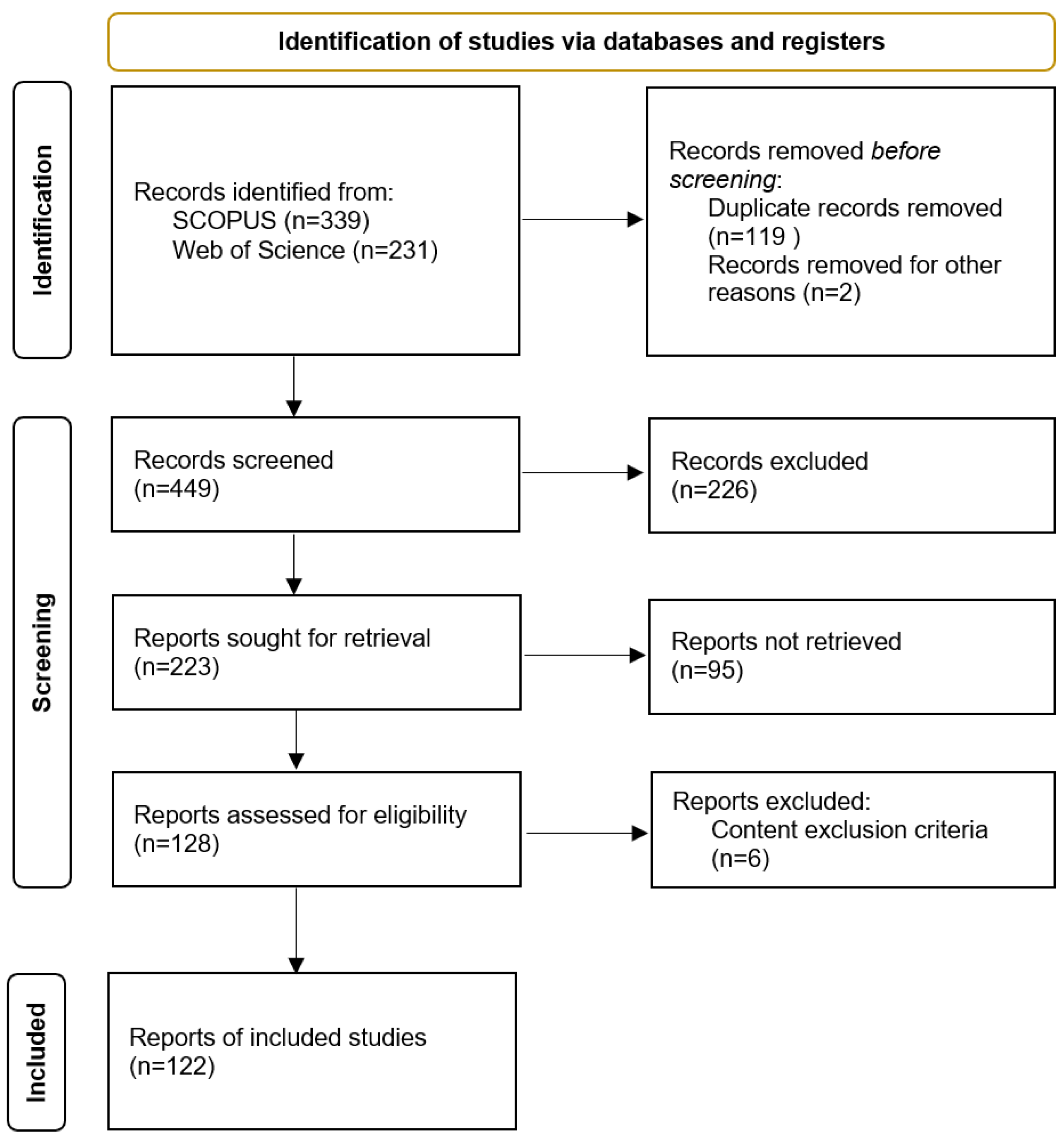
Further, following the PRISMA methodology, the authors excluded publications without clear research objectives or purpose, as well as publications that were not clearly related to sustainable development. To assess the impact of FinTech on sustainable development, as shown in
Figure 1, the authors used 122 publications for a detailed literature review.
During the selection process, the full texts of 95 publications could not be obtained, and 6 publications were dedicated to Islamic finance, resulting in 122 publications selected as the basis for further content analysis.
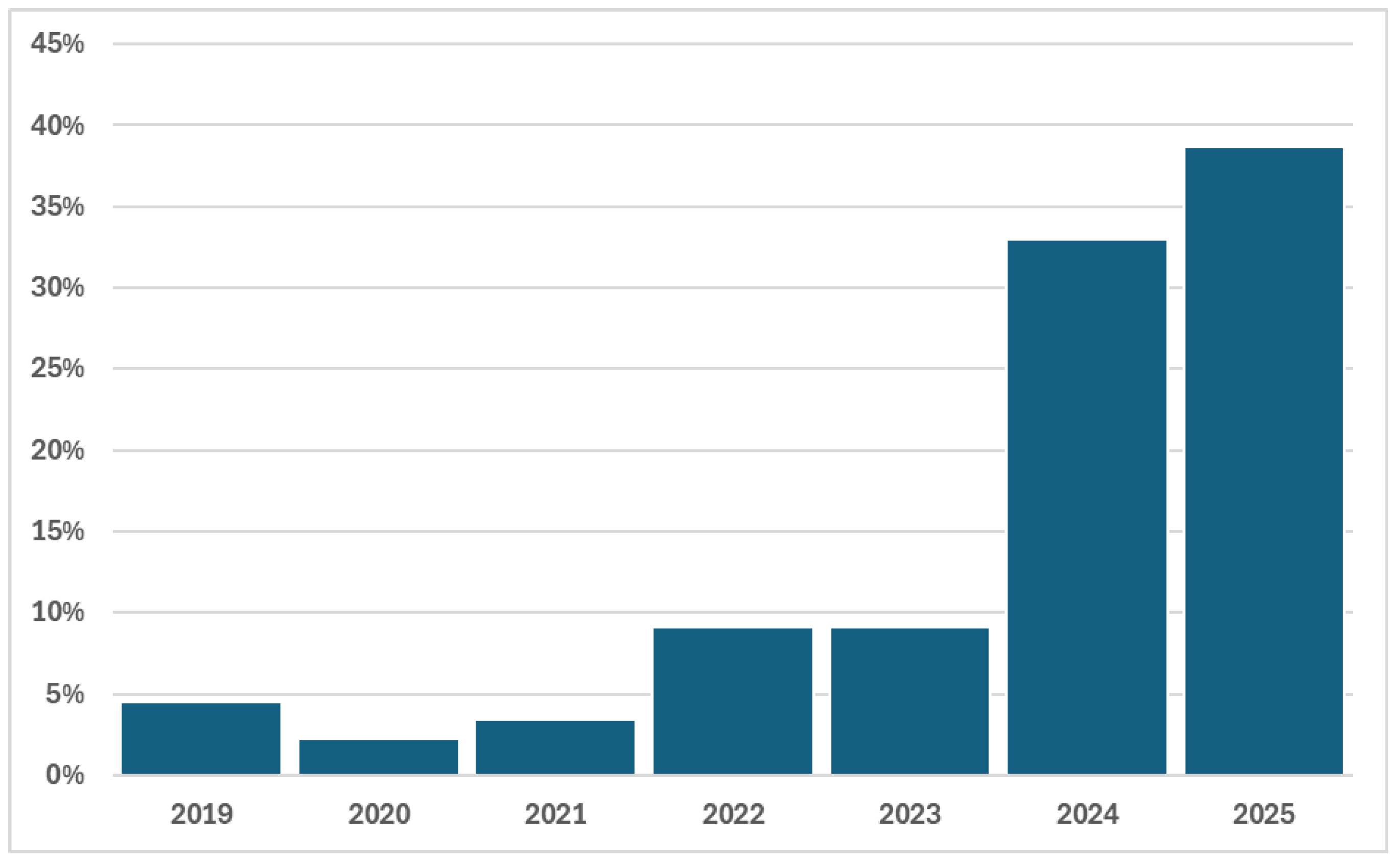
Figure 2 shows the relative distribution of the selected 122 publications by year, showing that more than 70% of the reports that include content analysis and keyword network mapping were published in 2024 and 2025, which indicates that the selected research topic has been little studied in the academic environment.
The author’s analysis of the publication on the connection between digitalization in the financial sector and sustainable development identified the most important areas of research, which were summarized in
Table 2.
As
Table 2 shows, the sustainable development of a country is closely linked to several aspects of the impact of digitalization. Environmental factors as a key aspect of sustainable development are explored in publications related to the application of blockchain technology, with Shu et al., 2022 [
25] investigating systems that can impact carbon emissions, while Basdekidou and Papapanagos, 2024 [
26] explore the general implementation of blockchain and its inclusion in ESG and DEI performance. Research also focuses on the impact of technology on more efficient use of renewable energy with artificial intelligence solutions [
27,
28,
29,
30,
31], as well as the choice of sustainable businesses identified by Hasan et al., 2024 [
32]. The role of financial technology in promoting carbon neutrality [
33,
34] and the interaction of digitalization with environmental sustainability [
35] are analyzed.
Achieving the Sustainable Development Goals through social inclusion is seen as a potential driver of financial technology development [
33], and the role of financial technology in promoting gender equality, in the South Asian region, Dhar et al., 2025 [
34], additional rural empowerment, Hoeyi et al., 2025 [
35], and the potential for transforming economic activity towards more sustainable approaches, Hasan et al., 2024 [
36]. The roles of financial technology development [
37] and financial inclusion [
38] in reducing inequality and poverty are examined. Overall, digital financial inclusion has been found to be associated with more innovative, sustainable economic growth [
39].
Stable economic development as a key to economic growth, and digitalization as one of the influencing factors, has been studied by Xie and Huang, 2024 [
40], Kumar et al., 2025 [
41]. Munarso et al., 2025 [
42] have developed a framework that provides insight into the potential transformation of rural economies. FinTech business models have proven themselves to be adaptable, capable of rapidly increasing their impact on the economy [
43]. In turn, ESG risks are studied by assessing and comparing their impact on S&P500 and Nasdaq100 companies, indicating a relationship between company size and ESG risk indicators [
44].
Regulatory aspect is considered in different ways: need for more detailed regulations and consumer protection is inferred by Rambaud and Gazquez, 2022 [
45], while governance mechanisms in the era of Artificial Intelligence is studied by Pashang and Weber, 2023 [
46]. Role of regulatory institutions and its openness to new technologies is analysed by Campanella et al., 2025 [
47], indicating positive impact of ‘sand-boxes’ for new product adoptions. General need for digitalization policies [
48] and performance tracking [
49] methodologies is considered an integral part of increasing the country’s sustainable development potential.
The development of new technologies and innovative [
50] approaches in the traditional financial sector are also widely studied [
51]. Digital literacy of employees as important impact factor to adopt new solutions Cetindamar et al., 2024 [
52], while Dery et al., 2017 [
53] believes general employee experience in digital environment leads to digital innovations and creates new entrepreneurial ecosystems [
54]. Open banking has also been studied as one of the drivers of the development of new banking platforms [
55], as well as consumer perception towards adoption of open banking solutions Chan et al., 2022 [
56].
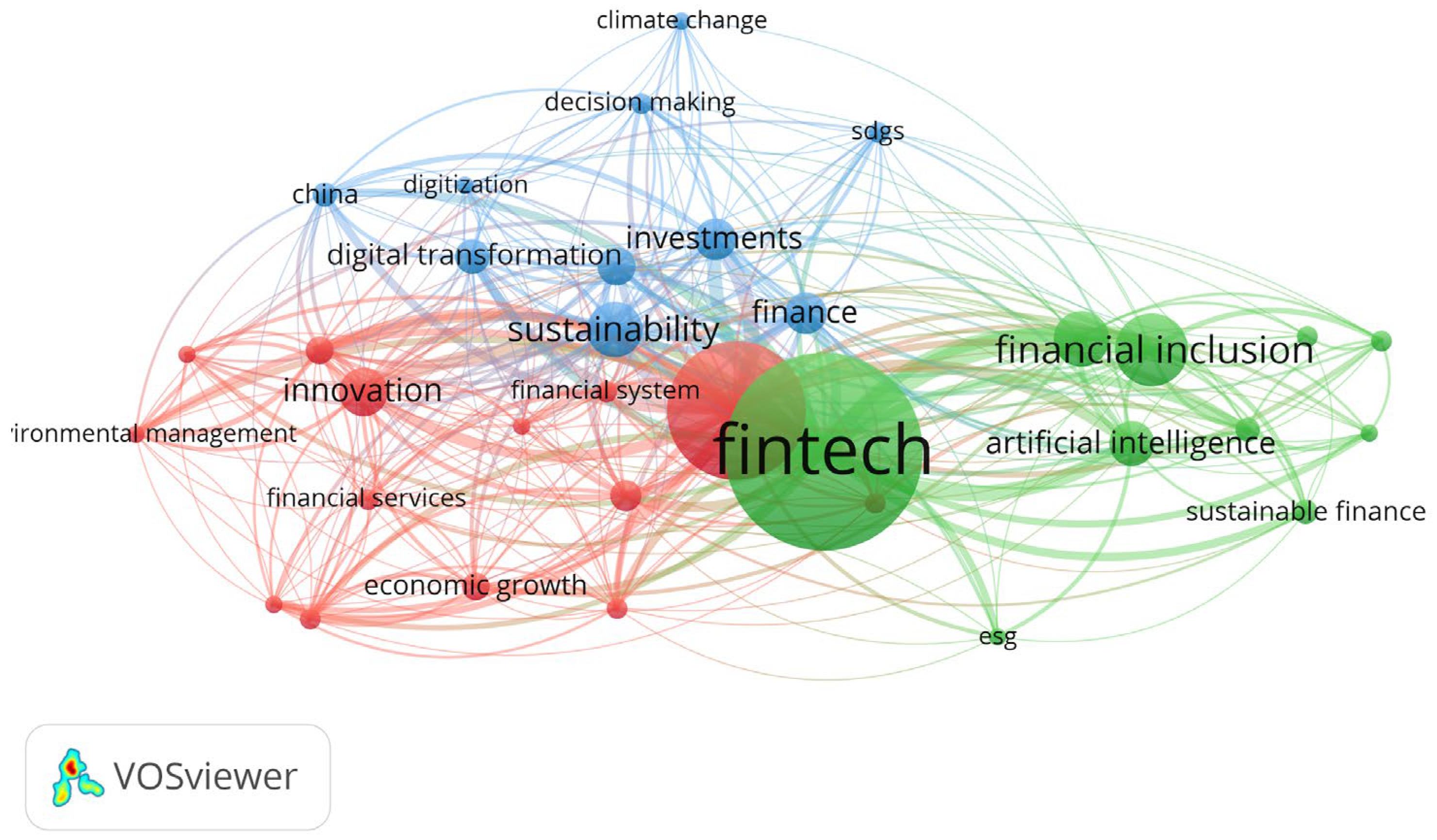
In addition to the literature systematic review authors also created publication keywords and country of origin network maps using automated tool VOSviewer (v.1.6.20). The keyword map, as shown in
Figure 3, defines three clusters of publications: financial sector innovations and economy’s growth (red cluster), digitalization and technological aspect of financial sector (green cluster) and sustainability relations with financial technology developments (blue cluster).
Digitalization enhances the capacity of public institutions—regulatory agencies, tax authorities, environmental protection bodies—in three dimensions: compliance monitoring, environmental standard enforcement and sustainability policy implementation. Countries with more developed digital ecosystems can regulate ESG-related activities more effectively Latorcai et al., 2025 [
57]. It is therefore important for government institutions to anticipate user needs and provide services before they are explicitly requested, using data and digital technologies, including artificial intelligence. Strategic-level progress is often achieved by engaging more external actors and implementing collaboration (OECD, 2026) [
58].
Organizations adopt sustainability practices in response to three main pressures: regulation, professional standards, and industry best practices. Digital infrastructure reinforces all three of these pressures [
59]. In turn, institutional quality influences the relationship between financial technology adoption and sustainability outcomes, and the strength of the digitalization-green growth nexus depends on the degree of digital and financial maturity in different economies [
60]. The literature mainly studies enterprise-level digital transformation and ESG performance. The public sector dimension—how digitalization strengthens government capacity for ESG regulation, monitoring, and enforcement—remains significantly understudied.
Digitalization significantly improves ESG disclosure, as the use of digital technologies helps to optimize all business processes, process large amounts of information more timely and efficiently [
61]. Digital tools significantly improve the quality of ESG information, provide more detailed ESG data, automated information disclosure, real-time environmental monitoring and better internal control systems, thus supporting corporate governance reforms and more responsible investments. Digitalization improves ESG transparency in green innovations, its positive impact is more pronounced in manufacturing, high-tech companies, companies with greater analytical capabilities and companies in policy-supported sectors. Companies in less regulated sectors often use artificial intelligence to generate standardized sustainability reports [
62].
ESG disclosure is critical for investment decisions in sustainable investing, but human interference reduces its quality Therefore, IoT and blockchain technologies can help with ESG data collection. It can also guarantee security, transparency, and traceability in data collection and ESG report disclosure [
63]. However, environmental performance metrics created with a machine learning approach have predictive validity, which aligns with solving proxy controversies [
64]. Regulators should consider establishing international alliances to develop uniform ESG standards and regulatory tools [
65].
Due to the growing generation of data and digitalization, FinTechs are facing several challenges, including big data management, personal data protection, cybersecurity, and the privacy of customers’ financial data [
66]. Digital transformation has driven the development of secure data storage solutions and trusted frameworks for sharing customers’ data within the FinTech ecosystem. A significant increase in the quantity of data processed by FinTechs has been observed recently; however, no corresponding changes have been noted in transparency. The FinTechs are safeguarding themselves by using technical and legal terminology in their privacy statements, rather than the user comprehension required by the GDPR [
67]. Current regional and national legal efforts are insufficient to address the challenges posed by the cross-border nature of the development and application of AI [
68]. The rapid spread of FinTech and pervasive digitalization are creating new ESG-related risks: cyber risk, data privacy breaches, algorithmic bias and exclusion, greenwashing through unclear ESG valuation, and the risk that excessive digital investments undermine profitability and long-term sustainability.
It is important to determine how a country’s digital maturity, used as an indicator of the development of FinTech and AI, affects its sustainability and ESG risk profile. Moving from the company to the government level, an attempt is made to identify the mechanisms by which digitalization promotes or hinders sustainable development at the national level. Blockchain technology and financial literacy help shape a more inclusive and sustainable digital financial services [
69]. Using blockchain technology in data management can improve its transparency and security. These aspects are critical for ensuring ESG compliance. Overall, ICT solutions can improve compliance and reporting efficiency, while the aforementioned technologies support financial institutions in achieving their sustainability and innovation goals, ensuring more efficient operations and corporate governance.
FinTech also stimulates investments in green technologies and projects, thus making access to financial resources easier. The data-driven capabilities of FinTech enhance transparency in financial decision-making [
70]. FinTech can reduce information asymmetry and reduce transaction costs in the energy conservation and carbon reduction sectors [
71]. Fintech has already shown potential for positive impact on the environment, although its further development requires constant alignment with green practices for maximum effectiveness [
72]. Currently, the main FinTech challenges include technological scalability, regulatory compliance, and data privacy. FinTech innovations must be balanced with potential risks [
73]. FinTech has democratized and eased companies and individuals access to financial services, particularly those who were traditionally excluded from the financial sector [
74]. This development has facilitated a higher rate of participation in the financial sector, strengthening national wealth accumulation and financial inclusivity [
69].
Digital platforms enable broader stakeholder engagement, more comprehensive ESG disclosure, and stronger accountability mechanisms [
70]. At the country level, this translates into greater public scrutiny of corporate and institutional sustainability behaviour, which disciplines ESG risk [
71]. Digital transformation raises ESG scores, with stakeholder theory and dynamic capabilities theory providing the strongest explanatory power. Business-process digitisation delivers the largest ESG gains, followed by data-infrastructure upgrades [
72]. Digital transformation delivers largest ESG gains through three transmission mechanisms: technological innovation, internationalisation, and information transparency. Stakeholder theory further elucidates the macro-level linkage: in digitally mature economies, platforms for ESG disclosure and stakeholder engagement create feedback loops that increase corporate accountability. Governence outcomes are the most understudied ESG dimention in the digital transformation literature. A recent meta-analysis of 835,000 firm-year observations confirms that digital transformation systematically improves ESG performance, with the strongest gains associated with business-process digitization and data infrastructure development [
73].
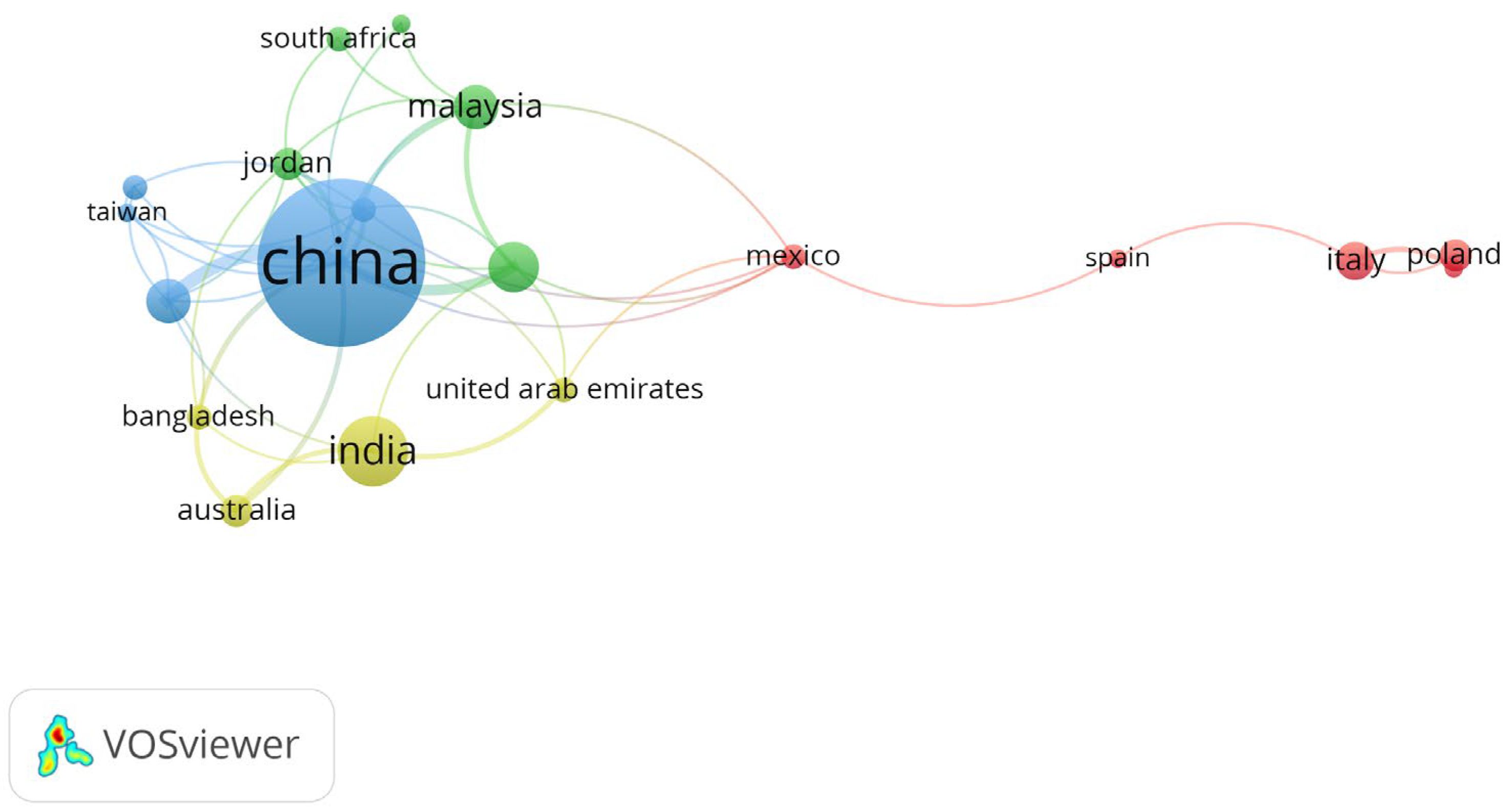
The study also created a network map based on the countries of origin of the authors
Figure 4 shows two influential countries that occupy the leading positions in terms of the number of publications related to this topic, namely China and India. At the same time map clear indicates a lack of publications coming from European countries and their distant relations to other countries and their authors—a separate string of authors can be identified from Poland, Italy and Spain with minority of publication count from the selected dataset.
Table 3 shows list of countries with number of publications and total citations of those publications including countries with five or more publications.
Figure 4 and
Table 3 highlight a strong geographical imbalance in the academic literature. The map of the publication network by country (
Figure 4) demonstrates that research activity is strongly concentrated in Asia-Pacific countries, especially China and India., as well as in
Table 3 China and India are the leaders in terms of the number of publications. In contrast, European countries in the network appear more fragmented with fewer publications overall, although Italy shows the highest average citation rate. The findings indicate a clear research gap and highlight the need for more Europe-focused and comparative cross-country research on digitalization, financial technologies (FinTech) and sustainable development of countries.
3. Methodology of the Research and Research Sample
To identify distinct groups of countries with similar configurations of fintech-related digitalization and ESG risks, this study applies cluster analysis at the country level. The analysis is used to uncover typologies of country performance that reflect diverse combinations of digital development and sustainability profiles as determined by the ESG Country Risk Rating.
To capture the nature of digitalization at the country level, the following indices are employed:
DiGiX—Digitalization Index (2024) [
74]: The DiGiX index measures the overall level of digitalization by combining indicators related to digital infrastructure, connectivity, use of digital services, and digital skills. It provides a composite score for each country, with higher values indicating more advanced digital development.
ICT Development Index (IDI, 2025) [
75]: the IDI is an internationally used composite measure of information and communication technology development, typically combining indicators of access (e.g., fixed and mobile networks), use (e.g., internet usage) and skills (e.g., basic education indicators). Higher scores reflect more advanced development.
ESG-related risks at the country level are measured using Sustainalytics’ ESG Country Risk Ratings [
76] and the associated E (Enviromental), S (Social) and G (Governance) pillar indicators. Sustainalytics’ country ratings are designed to capture the extent to which a sovereign is exposed to, and manages, material environmental, social and governance risks. The overall rating summarizes a country’s unmanaged ESG risk on a continuous scale, with higher values indicating higher residual ESG risk. The score reflects both exposure to ESG issues (e.g., climate vulnerability, social conditions, institutional set-up) and the quality of policies and institutions that mitigate these risks. Where available, the authors additionally make use of selected sub-indicators from the Sustainalytics framework for descriptive profiling of clusters.
The analysis combines the latest available data of each source: Sustainalytics ESG Country Risk Ratings (2025), IDI (2025), and DiGiX (2024). The authors treat this as a near-contemporaneous cross-sectional design with a short, economically plausible timing structure in which digitalization capacity (DiGiX 2024) slightly precedes the 2025 ESG risk outcomes, while IDI is measured in the same year as ESG risk. The authors do not impose a formal multi-year lag model; instead, results are interpreted as associations based on closely adjacent data sets. The authors are avere of the fact that any remaining year mismatch may add measurement noise and is expected to attenuate estimated relationships rather than mechanically create them; nevertheless, this is a limitation and motivates future work using fully year-aligned panel data. Missing data are handled transparently: each regression uses the maximum available sample for the variables included, while clustering and cross-pillar robustness comparisons are restricted to countries with non-missing DiGiX.
The analysis is cross-sectional and is therefore interpreted as documenting associations rather than causal effects. Digitalization is correlated with broader structural factors, so the authors complement the baseline results with a parsimonious sensitivity specification using World Bank governance indicators, but causal identification remains outside the scope of this study. In addition, the country-level nature of the indicators may mask important within-country differences; results should be read as country typologies rather than within-economy distributional statements. Finally, because DiGiX and IDI are highly correlated, the authors report formal multicollinearity diagnostics and interpret the joint regression cautiously as reflecting only each proxy’s unique component. Before continuing with cluster analysis the authors are determining the linkage between digitalization and country ESG risk. In order to build the theoretical framework for the upcoming analysis let consider
ESGi as Sustainalytics ESG Country Risk Rating for country
i—interpreted as unmanaged ESG risk such that higher values indicate higher residual exposure after accounting for national risk management capacity. Let
DiGiXi and
IDIi denote two complementary proxies for country-level digital maturity: DiGiX capturing a broad multidimensional digitalization construct and IDI capturing access, use, and skills of technological solutions. The authors expect that digital capacity of the country reduces country`s unmanaged ESG risk through improved immeasurability and timeliness of ESG-relevant information, enhanced policy execution, supervision, and integrity of public administration, and better inclusiveness in digital finance and service delivery. So that higher level of digitalization is related to lower unmanaged ESG risk.
where “\”
ε_
i “\-“ unobserved “\” determinants “\” of “\” ESGrisk;
β_1 “\&”
β_2 “\<” 0, as “\” both “\” dimensions “\” of “\” digitalization are “\” negatively “\” associated “\” with “ ” countryESGrisk.
Equations (1) and (2) are interpreted as reduced-form associations (not causal effects) and are used mainly to characterize the strength and shape of the digitalization–ESG relationship and motivate the clustering analysis.
Digital transformation can reveal non-linear effects, the authors apply the standard way to test curvature via a quadratic extension:
If ∂ “\>” 0 “\-” the “\” marginal “\” effect “\” becomes “\” less “\” negative “\” as “\” digitalization “\” level “\” increases.
If ∂ “\<” 0 “\-” the “\” marginal “\” effect “\” becomes “\” more “\” negative “\” as “\” digitalization “\” level “\” increases.
To reduce sensitivity to heteroskedasticity that is typical in cross-country data, inference is based on heteroskedasticity-robust standard errors. As an additional check for omitted institutional determinants, meaning without expanding the model with a broad control set, the authors estimate an additional sensitivity specification that adds country-level governance covariates from the World Bank Worldwide Governance Indicators (WGI): Political Stability and Absence of Violence/Terrorism and Government Effectiveness. Conclusions continue to rely on heteroskedasticity-robust standard errors.
The following hypotheses are formulated:
H1. Countries exhibiting higher digitalization maturity are associated with lower levels of unmanaged ESG risk.
H2. Each digitalization proxy retains explanatory power for ESG risk when controlling for the other, indicating that each proxy captures partially distinct aspects of digital maturity.
The ESG risk dataset covers 163 countries. Availability differs across digitalization proxies: DiGiX is available for 94 countries, IDI for 131 countries, and the complete-case sample with both DiGiX and IDI is 86 countries. Each regression uses the maximum available sample for the variables included in that specification. Descriptive statistics is summarized in
Table 4.
The correlation (presented in
Table 5) indicates a strong digital–ESG gradient: higher digitalization is associated with lower ESG risk. At the same time, DiGiX and IDI are highly correlated, which anticipates collinearity effects in joint regressions.
To check multicollinearity, the authors compute variance inflation factors (VIFs) for the joint regression that includes both DiGiX and IDI (Model C). With two predictors, the VIF can be calculated directly from their sample correlation. Using the complete-case correlation reported in
Table 5 (r = 0.887, N = 86), the implied VIF is 4.69 for both variables (tolerance 0.213). This indicates meaningful overlap between the two digitalization proxies, so in the joint model each coefficient reflects only the part of the index that is not shared with the other, and coefficient magnitudes can become sensitive to this overlap. The second part of the research aims to assess whether a country’s level of digitalization, as measured by the DiGiX index, is systematically associated with lower unmanaged ESG risk level. Moreover, it is necessary to determine whether the relationship between digitalization and ESG risk is consistent across ESG pillars, or if certain countries demonstrate pillar-specific deviations relative to their overall risk–digitalization alignment.
H3. Countries with more advanced levels of digitalization are expected to exhibit significantly lower unmanaged risk, as indicated by the overall Country-Risk Score.
H4. Countries with higher DiGiX level are expected to exhibit significantly lower unmanaged environmental risk, as measured by the NCPC-Risk Score (Environmental factors).
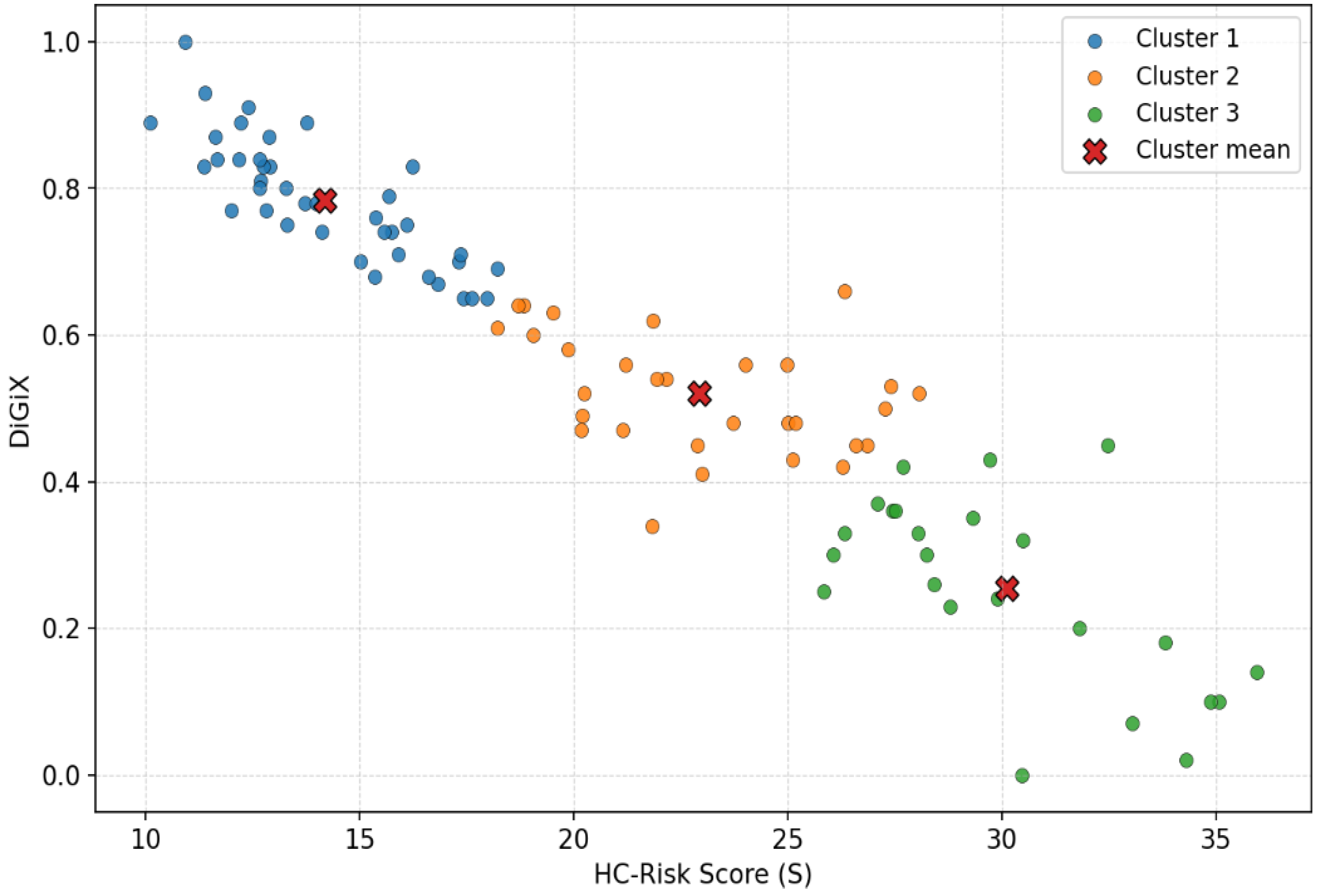
H5. Countries with higher DiGiX score are expected to exhibit significantly lower unmanaged social risk, as indicated by the HC-Risk Score (Social factors).
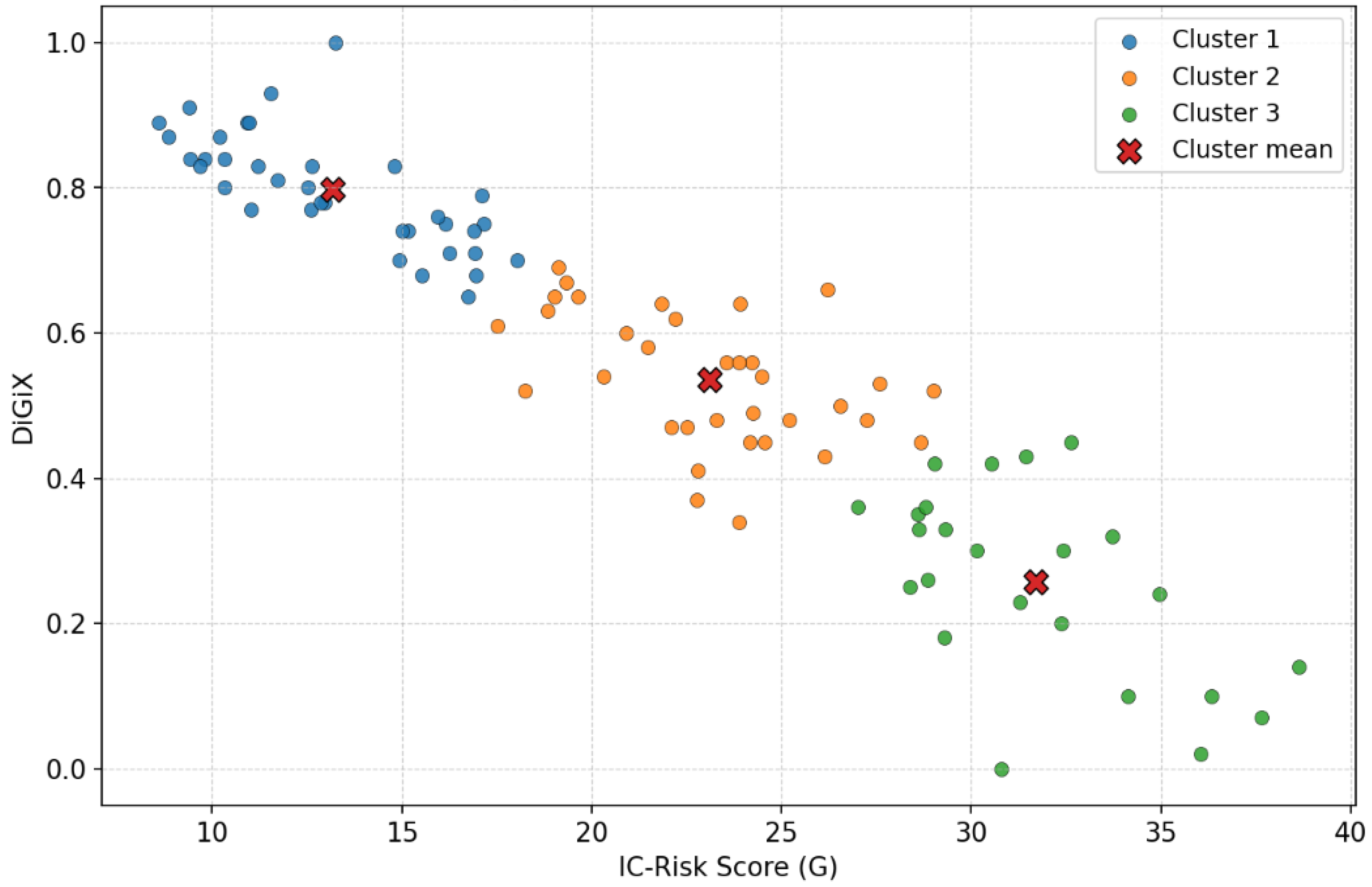
H6. Countries with more advanced levels of digitalization are expected to exhibit significantly lower unmanaged governance risk, as measured by the IC-Risk Score (Governance factors).
The authors use an unsupervised, comparative clustering approach to examine how country-level digitalization relates to unmanaged ESG risk. Four separate two-variable clustering exercises are run, each combining the DiGiX index with one risk measure: the overall Country-Risk Score, the Social pillar proxy (HC-Risk), the Environmental proxy (NCPC-Risk), and the Governance proxy (IC-Risk). Before clustering, both variables in each pairing are standardized using z-scores to ensure they are on the same scale and to avoid distortions from differences in variance.
Cluster analysis is implemented with k-means on z-standardized variables using Euclidean distance. In order to reduce sensitivity to initial centroid placement, the algorithm is run with multiple random initializations and a fixed random seed; the solution with the lowest within-cluster sum of squares is retained (parameters: n_init = 5, max_iter = 300, random_state = 42). For comparability across analyses, clusters are relabeled by ascending mean risk, so that Cluster 1 always represents the lowest-risk group. Because clusters are constructed from the same two variables, ANOVA is reported as a descriptive summary of separation, while external validation is reported separately. The authors apply k-means (with k = 3), chosen to produce intuitive low-, medium-, and high-risk groups while keeping clusters large enough for meaningful interpretation.
The choice of k = 3 is supported by internal clustering diagnostics computed on the standardized (z-scored) data and reported here for transparency. For the four specifications, the within-cluster sum of squares drops substantially when moving from k = 2 to k = 3 (from 54.80 to 28.46; 52.89 to 29.28; 62.76 to 36.75; 56.06 to 29.49), indicating that a three-group solution materially improves fit relative to a two-group split. Moving further to k = 4 yields smaller additional fit gains (19.05, 18.26, 26.11, 18.97, respectively), while silhouette values decline from 0.55–0.60 at k = 2 to 0.49–0.52 at k = 3 (and 0.43–0.49 at k = 4). Davies–Bouldin values are also lowest at k = 2 in most cases (e.g., 0.56, 0.53, 0.61, 0.57), but k = 3 remains competitive (0.63, 0.67, 0.70, 0.64) while offering the intended interpretability as low/medium/high unmanaged-risk typologies that can be compared consistently across E, S, and G pillars. Given the study’s objective of a stable and interpretable segmentation, k = 3 is retained.
The clustering analysis and the cross-pillar stability comparison are conducted on the DiGiX-available sample (N = 94), because DiGiX is required in all four clustering specifications. The complete-case regression model including both DiGiX and IDI is estimated on a smaller overlapping sample (N = 86). Accordingly, regression and clustering results are complementary but not computed on identical country sets.
All calculations were performed using standard statistical software (MATLAB R2022b version 9.13), and key parameters are reported to support replication.
4. Results
The results of the regression analysis are presented in
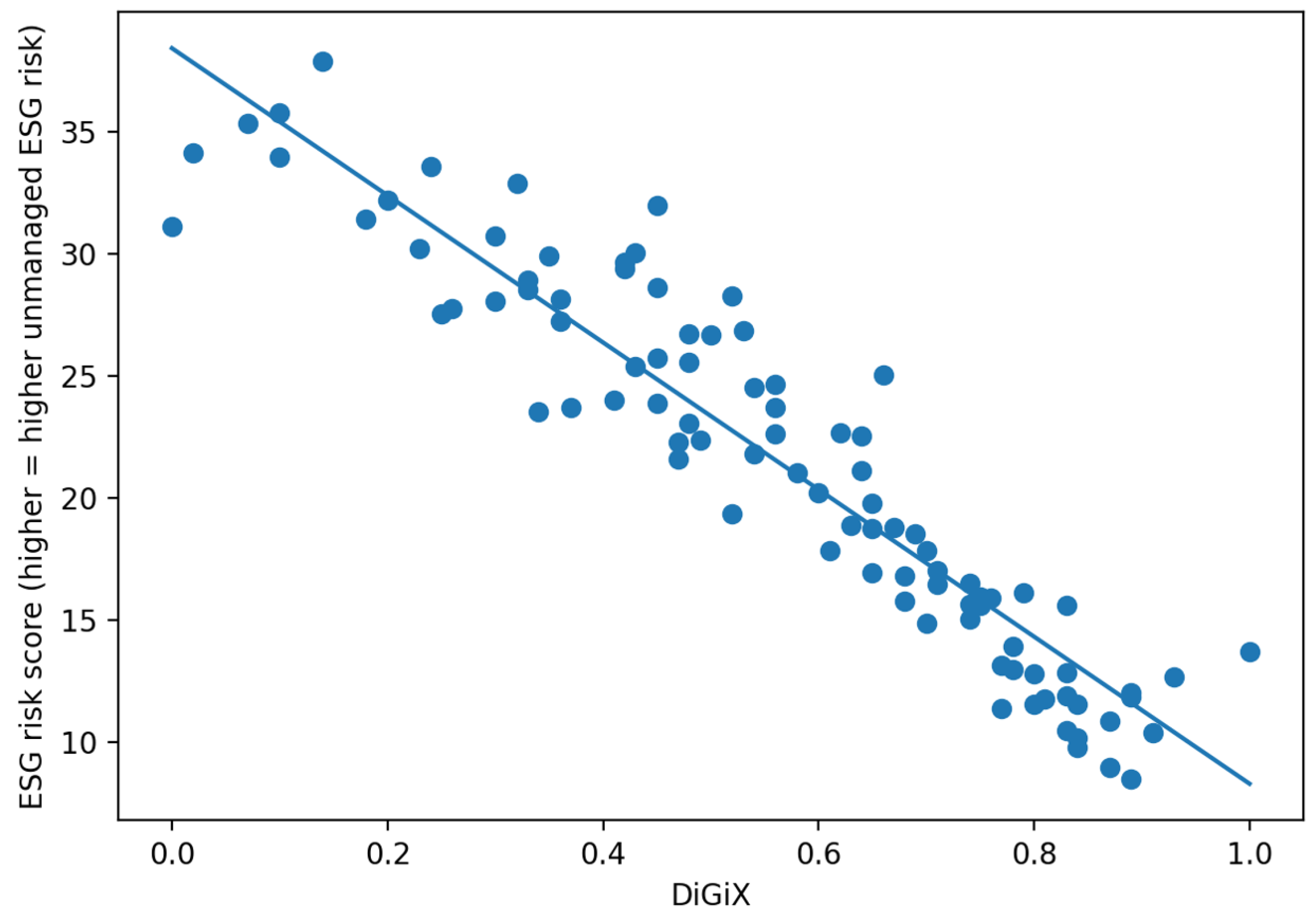
Table 6. As shown, model (A) estimates the unconditional link between ESG risk and DiGiX. The results suggest that countries with higher levels of multidimensional digitalization tend to have significantly lower unmanaged ESG risk. The model fits the cross-country data well (R
2 = 0.88), which aligns with the pattern in
Figure 5, where observations closely follow a downward-sloping trend.
To clarify the economic significance, Model (A) implies that a 0.10 increase in DiGiX is associated with an average 3.02-point decrease in the ESG risk score. Using the sample dispersion in
Table 4, a one-standard-deviation increase in DiGiX (SD = 0.235) corresponds to an average 7.09-point decrease in ESG risk, which is sizeable relative to the ESG risk standard deviation (SD = 7.603).
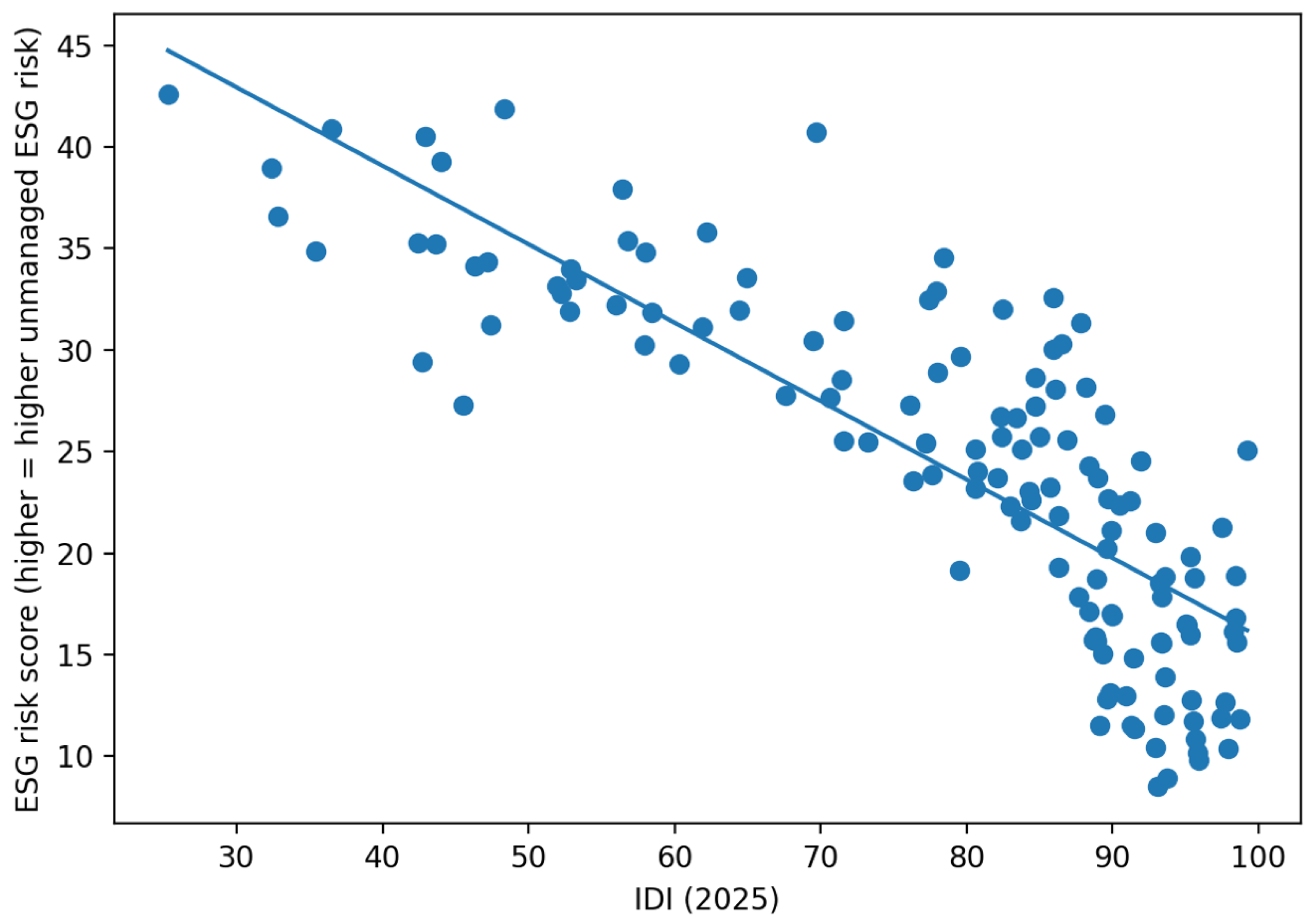
For IDI, Model (B) implies that a 10-point increase in IDI is associated with roughly a 3.86-point decrease in ESG risk. These magnitudes indicate that differences in digital maturity are associated with economically meaningful differences in unmanaged ESG risk across countries.
Many plausible omitted factors (e.g., GDP per capita, education, institutional capacity, political stability) are expected to be positively correlated with digitalization and negatively correlated with unmanaged ESG risk. If so, the bivariate coefficient on DiGiX (and IDI) may partially capture these correlated fundamentals, biasing the magnitude away from zero. This does not overturn the empirical pattern: digitalization is strongly aligned with lower unmanaged ESG risk, but it implies that coefficient sizes should be interpreted cautiously and as composite associations reflecting both digital maturity and correlated institutional and development characteristics.
Model (B) repeats the baseline analysis using the IDI. The relationship remains negative and highly significant: a 0.1 increase in IDI is associated with roughly a 3.86 point decrease in ESG risk. Although the model fit (R
2 = 0.672) is lower than in Model (A), it is still strong and meaningful.
Figure 6 also shows a clear downward trend, albeit with more dispersion than the DiGiX plot. This pattern supports the idea that DiGiX being a broader, multidimensional index captures institutional and ecosystem features more closely linked to unmanaged ESG risk, whereas the IDI reflects a narrower view of digital development.
Models (A2) and (B2) test whether the link between digitalization and ESG risk is strictly linear. For DiGiX, the negative and marginally significant quadratic term suggests that the decline in ESG risk becomes steeper as digitalization increases. This pattern is consistent with threshold type dynamics: once digitalization reaches a certain level, complementary capabilities (such as regulatory capacity, data integration, monitoring tools, and digital public services) scale more effectively, generating larger improvements in unmanaged ESG risk. For the IDI, the quadratic specification is also statistically supported, with a negative squared term. The coefficient pattern points to an inverted relationship, meaning that for most countries in the sample, the marginal effect of IDI on ESG risk is negative and becomes more pronounced at higher IDI levels.
Model (C) estimates the joint relationship on the complete-case sample (N = 86), which is smaller than the clustering sample because it requires both DiGiX and IDI. The DiGiX coefficient remains strongly negative and sizable. The IDI coefficient turns small and positive but remains statistically significant. This behavior is consistent with the VIF results (VIF = 4.69 for both DiGiX and IDI), which indicate non-trivial multicollinearity and help explain why the IDI coefficient becomes unstable once DiGiX is included. This sign shift is best understood as a partial regression artifact arising from the high correlation between the two digitalization measures. When two highly overlapping indicators enter the model together, each coefficient reflects only the variable’s unique component after controlling for the other, which may not correspond to a meaningful theoretical construct on its own. Overall, the findings indicate that the digital-ESG relationship is robust and is primarily captured by DiGiX in this dataset, while IDI adds little explanatory value once DiGiX is included.
It is worth considering that the subsequent unsupervised clustering analysis estimated independently of the regression specification reproduces the same monotonic ordering: low-risk clusters have systematically higher DiGiX across overall ESG risk and across E, S, and G pillars. This convergence between parametric regressions and nonparametric clustering reduces concern that the findings are an artifact of a particular functional form.
To address the potential concerns about omitted variable bias,
Table 6b reports sensitivity specification that adds institutional covariates from the World Bank Worldwide Governance Indicators (WGI): Political Stability and Absence of Violence/Terrorism and Government Effectiveness (both from 2023) to the baseline DiGiX regression. The DiGiX coefficient remains negative and highly statistically significant, while its magnitude attenuates relative to the bivariate model, indicating that some of the baseline association reflects institutional conditions correlated with digitalization. Political stability is independently associated with lower unmanaged ESG risk, whereas government effectiveness is not statistically significant once DiGiX and political stability are included. Overall, this sensitivity check supports the robustness of the digitalization and ESG rise while reinforcing the interpretation of the regression estimates as reduced-form associations rather than causal effects.
The
Table 6b reports a parsimonious sensitivity specification addressing potential omitted variable bias by including institutional covariates from the World Bank Worldwide Governance Indicators. The DiGiX coefficient remains negative and highly significant, although its magnitude attenuates relative to the baseline bivariate model, indicating that part of the digitalization and ESG association overlaps with institutional conditions captured by WGI. Political stability is independently associated with lower unmanaged ESG risk, while government effectiveness is not statistically distinguishable from zero once DiGiX and political stability are included. Overall, the sensitivity results support the robustness of the digitalization and ESG increase while reinforcing the interpretation of regression coefficients as reduced-form associations rather than causal effects.
Table 7 presents the one way ANOVA results assessing whether mean values differ across the three clusters (k = 3), formed using k means on standardized variables (z scores). For each analysis, the ANOVA reports the F statistic,
p value, and η
2 as an effect size indicator showing how much variance is explained by cluster membership. Levene’s test is also reported as a diagnostic for variance equality across clusters. Because Levene’s test indicates unequal variances for DiGiX in all cases, Welch’s ANOVA—robust to heteroskedasticity—was additionally performed. Welch’s ANOVA confirms that differences in DiGiX across clusters remain highly significant (Welch
p values ≈ 10
−24).
Since the clusters are built using DiGiX and the risk score, it’s natural that these same variables differ across clusters. For that reason, the authors report the ANOVA mainly as a clear descriptive summary of how strongly the clusters are separated (including η2), rather than as an independent validation test.
To provide non-circular evidence, the authors also test whether clusters differ on the ICT Development Index (IDI), which is not used in the clustering in the first round.
Table 7b offers an external check. For each of the four analyses, the table reports average IDI values for Clusters 1–3 (where Cluster 1 is the lowest-risk group and Cluster 3 the highest-risk group) and summarizes between-cluster differences using two complementary tests: Welch’s ANOVA, which is appropriate here because IDI does not satisfy the equal-variance assumption, and the Kruskal–Wallis test, which provides a nonparametric cross-check. Across all four clusterings, IDI follows a clear monotonic pattern, with the highest mean IDI in Cluster 1 and the lowest in Cluster 3, showing that the typology aligns with a broader measure of digital development beyond DiGiX alone.
The statistical evidence also shows these IDI gaps are not random. The
Table 7b demonstrates that the clustering results go beyond simply re-stating the separation visible in the DiGiX and risk scatterplots: countries that fall into the low-risk/high-DiGiX cluster also score systematically higher on an independent ICT development metric, which strengthens confidence that the clusters capture meaningful differences in underlying digital maturity.
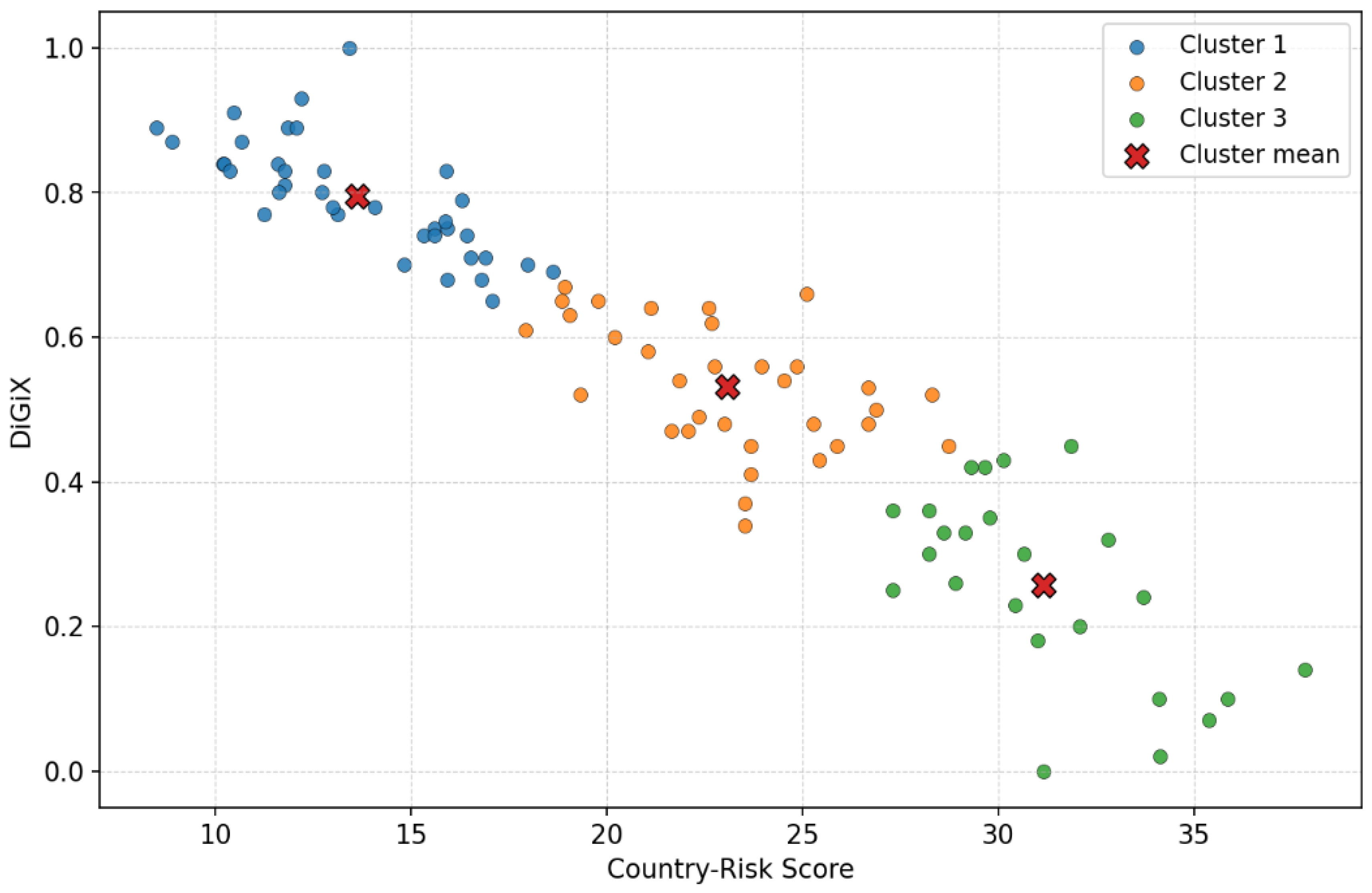
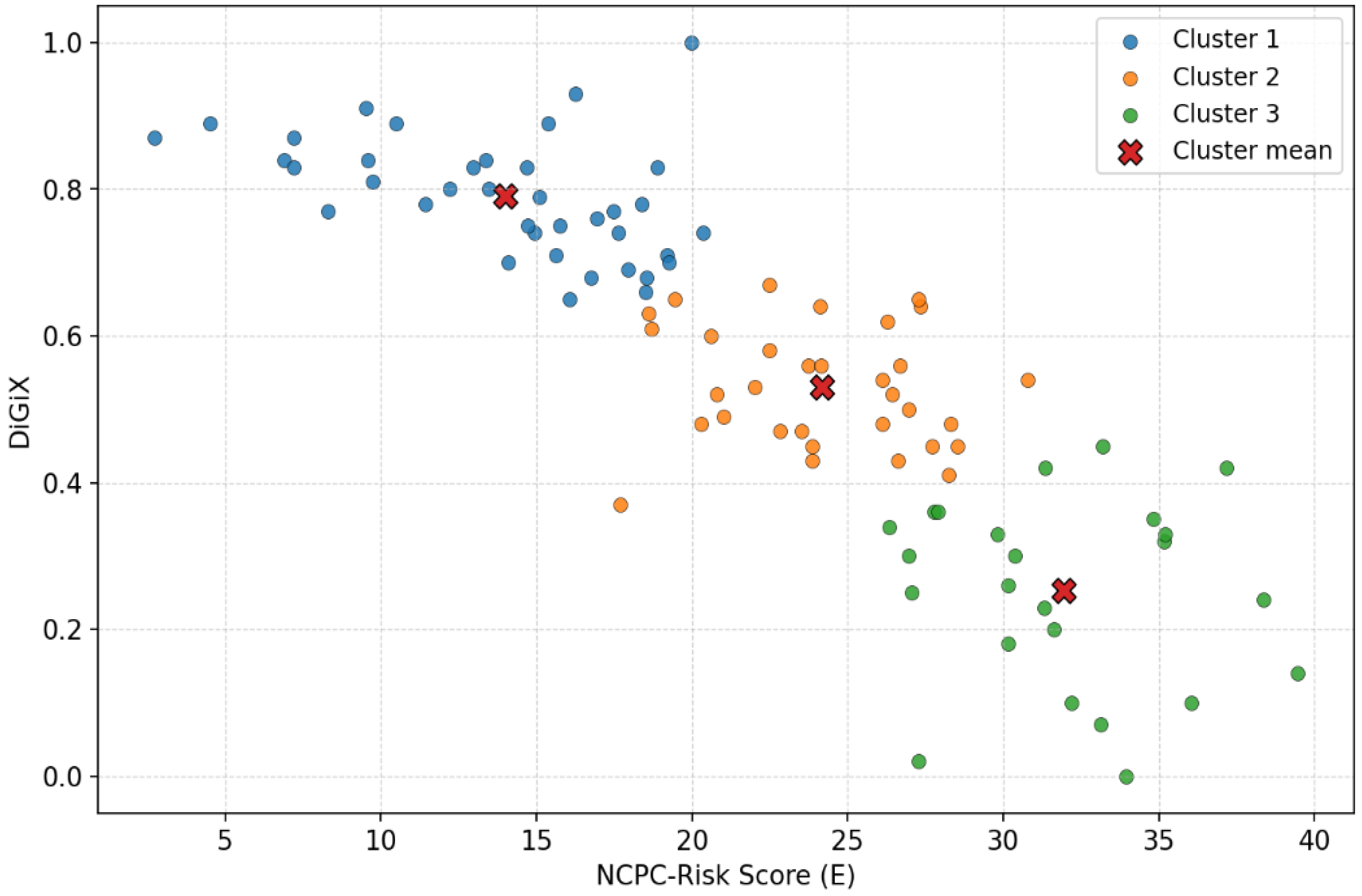
Across all four ESG risk dimensions, the results reveal a clear and statistically significant pattern: countries in the lowest risk cluster consistently show the highest DiGiX values, while those in the highest risk cluster show the lowest. Cluster centroids remain stable across all analyses: approximately 0.79, 0.53, and 0.25, demonstrating a monotonic decline in digitalization capacity as unmanaged ESG risk increases. This pattern holds for each ESG pillar (environmental, social, and governance). The corresponding visual evidence is shown in the plots following
Figure 7. Regionally, Europe displays a highly concentrated structure. The majority of European countries (26 out of 36) fall into Cluster 1, representing low unmanaged risk and high digitalization. This aligns with Europe’s generally strong performance on DiGiX, especially in advanced Western and Nordic economies. A smaller set of European countries (9 out of 36) are in Cluster 2, reflecting mid-range DiGiX and higher unmanaged risk. Only one European country, Ukraine, falls into Cluster 3, reflecting substantially higher unmanaged risk and comparatively low digitalization. The Asia Pacific region shows far greater diversity. The largest group (11 out of 28 countries) belongs to Cluster 2, a mid-risk, mid digitalization segment. This includes several large or rapidly developing economies. A notable advanced economy subgroup appears in Cluster 1. Cluster 3 is characterized by higher unmanaged risk and lower levels of digitalization and contains 9 out of 28 countries. Overall, the Asia Pacific distribution shows that digitalization differentiates countries more strongly along institutional and development lines than in Europe, where the digitalization landscape is more homogeneous.
Figure 8,
Figure 9 and
Figure 10 show the clustering results based on DiGiX and unmanaged ESG risk for each pillar (environmental, social, and governance).
Environmental risk: Most European countries fall into Cluster 1 (26 out of 36), placing them in the low-risk, high-digitalization category for unmanaged environmental risk. The remaining European countries fall into Cluster 2 (10 out of 36). Importantly, no European country appears in Cluster 3 for the environmental dimension. This indicates that environmental unmanaged risk in Europe ranges only from low to moderate, without reaching the highest-risk category. In the Asia-Pacific region, the distribution is more balanced. Cluster 2 is the largest group (10 out of 28), followed closely by Cluster 1 (9 out of 28) and Cluster 3 (9 out of 28). This balanced spread shows that several Asia-Pacific countries experience higher unmanaged environmental risks relative to their digitalization levels. The almost even distribution across clusters highlights how environmental risk varies substantially across the region—reflecting differences in regulatory capacity, exposure to environmental hazards, and the extent to which digital tools are integrated into monitoring and management systems.
Social risk: European countries show an even stronger concentration in the low-risk, high-digitalization segment when considering the social dimension. Cluster 1 includes 28 of the 36 European countries, covering most Western, Northern, and several Central European states. Cluster 2 comprises 7 out of 36 countries representing mid-range digitalization levels and higher unmanaged social risk. Cluster 3 again contains only Ukraine, which consistently appears as a higher-risk outlier once social unmanaged risk is considered alongside digitalization. In the Asia-Pacific region, Cluster 2 is also the largest group, including 11 out of 28 countries. This segment comprises middle-income and Gulf economies. Cluster 1, with 9 out of 28 countries, includes digitally advanced cases and specifically for the social context Malaysia. Cluster 3 contains 8 out of 28 countries with higher unmanaged social risk. The distribution highlights substantial variation in social unmanaged risk across the Asia-Pacific region, even among countries with comparable levels of digitalization.
Governance risk: The most European countries fall into Cluster 1, with 25 out of 36 represented. This pattern reflects Europe’s comparatively strong institutional capacity and higher levels of digitalization, both of which support more effective governance and risk management. A smaller group (10 out of 36 European countries) appears in Cluster 2. Cluster 3 again includes only Ukraine, consistent with its higher unmanaged governance risk when considered alongside digitalization. In the Asia-Pacific region, Cluster 2 is the dominant grouping for governance, containing 11 out of 28 countries. This includes countries with mid-range digitalization and higher unmanaged governance risks. Cluster 1 includes 8 out of 28 countries and consists mainly of digitally advanced and institutionally stronger economies. Cluster 3 comprises 9 out of 28 countries with higher-risk governance environments. Overall, the governance-pillar results mirror the broader regional dynamics observed in the environmental and social dimensions. In the Asia-Pacific region, differences in digitalization levels and institutional maturity lead to marked variation in cluster assignments, rather than a single dominant regional pattern.
The ANOVA results confirm that the cluster solutions are statistically meaningful: p-values are effectively zero, and effect sizes are substantial across all models. These findings support the interpretation that digitalization acts as a structural enabler of ESG risk management. Higher digital capacity improves data availability and quality, accelerates reporting and traceability, strengthens compliance mechanisms, and enables more scalable monitoring and control systems. As a result, ESG risks are less likely to remain unmanaged in digitally advanced environments, as institutions can detect issues earlier, document performance more reliably, and enforce governance processes more consistently. While the analysis does not establish causality, the relationship is strong, stable, and consistent across all four risk constructs examined. Comparing the results from the four analyses yields several overarching conclusions. First, the consolidated clustering results show a high degree of structural consistency across ESG pillars. 83 out of 94 countries remain in the same cluster across all four specifications. This stability suggests that countries’ relative positions are robust whether ESG risk is assessed as a composite or decomposed into its individual components. In other words, for most jurisdictions, the relationship between digitalization and unmanaged ESG risk does not depend on the specific pillar: countries with higher DiGiX consistently fall into low-risk clusters, and those with lower DiGiX consistently fall into high-risk clusters. A smaller subset (11 out of 94 countries) shows a one-pillar shift, meaning that their cluster assignment changes in exactly one pillar-based analysis while remaining consistent in the other three. These shifts highlight cases where a country’s ESG risk profile is uneven across dimensions relative to its overall position. For example, Croatia is generally aligned with the low-risk, high-digitalization group but shifts in the governance-specific clustering, suggesting that governance risk diverges from its environmental, social, and overall patterns. Several countries (e.g., Indonesia, Paraguay, Saudi Arabia, Azerbaijan, Ukraine, and Vietnam) shift in the environmental clustering, indicating that environmental risks deviate from their broader ESG profiles. Others (e.g., Botswana, Hungary, Malaysia, Poland, and Vietnam) shift in the social dimension, suggesting that human-capital or social-risk characteristics occasionally diverge from the general ESG-digitalization relationship.
In summary, the findings indicate that digital maturity is closely linked to overall ESG risk management capacity rather than to a single ESG pillar. The high stability of cluster membership across the environmental, social, and governance dimensions demonstrates that higher levels of digitalization correspond to a broad-based reduction in unmanaged ESG risk. The limited number of one-pillar shifts implies that, while digitalization generally supports improvements across the board, some countries exhibit pillar-specific vulnerabilities (most often in the environmental or social dimensions)—that require targeted institutional and policy interventions beyond digital advancement alone.
5. Discussion
By analyzing the connection between unmanaged ESG risk and digital maturity at the national level, this study contributes to the theoretical understanding of how digital financial innovation affects sustainability. The results underscore the significance of national digital systems as structural enablers of sustainability and contribute to macro-level perspectives on digital financial innovation and sustainable development by moving beyond company-level assessments.
The strong negative association between digital maturity and ESG risk confirms that digital technologies act not only as productivity-enhancing tools, but also as important components of national innovation and governance systems. According to the reviewed literature, digitalization improves sustainability outcomes when included in complementary institutional, regulatory, and governance frameworks [
1,
8,
48].
The stronger explanatory power of the DiGiX Index indicates that while ICT access and connectivity are necessary, they are not sufficient to mitigate ESG risk. Broader digital powers, including infrastructure, skills, institutional readiness, and the digital integration of the public sector, lead to higher sustainability. The finding aligns with other research that stresses the importance of governance and regulatory capacity in reducing the negative effects on the long-term of use FinTech and AI [
46,
47].
These results are consistent with the article’s larger theoretical framework, which examines the relationship between institutional quality and digital innovation. Fintech solutions are more successfully incorporated into ESG practices in settings with more robust governance frameworks, encouraging green investment and ethical financial conduct. On the other hand, weaker institutional frameworks can restrict the benefits of digitization [
71,
72]. The role of data is another significant conclusion covered in the article. The availability and traceability of ESG data are greatly improved by digital finance, which strengthens accountability and monitoring. However, if governmental monitoring doesn’t keep up with developments in technology, this also raises concerns about data standardization, privacy, and the possibility of “greenwashing.” [
59,
60,
70].
The nonlinear relationship between digitalization and ESG risk provides empirical support for technological change. The reduction in ESG risk is amplified at higher levels of digital maturity, suggesting the existence of digital maturity thresholds above which sustainability is achievable. This finding is consistent with research that emphasizes capability building, organizational readiness and digital literacy to reap the benefits of digital financial innovation [
52,
53].
Cross-country analysis reveals how digital financial innovation impacts ESG risk mitigation, with European countries mostly concentrated in a relatively homogeneous cluster of low-risk, high-digital levels. This suggests that in Europe, digital financial innovation has long been used in mature governance systems, regulatory enforcement and the public sector, and the use of digital technologies reduces environmental, social and governance risks. In contrast, there is significantly more heterogeneity in the Asia-Pacific region, where digitally advanced economies such as (Japan, Australia and Singapore) have tended to follow the European model, with a large group of emerging economies concentrated in medium- or high-risk clusters. It helps to clarify that digital financial innovation, especially FinTech, can have limited or even negative impacts in places where there isn’t enough government or regulatory control [
12,
13]. In Asia-Pacific region, digital financial innovation is more uneven and often decoupled from governance maturity.
Finally, the discussion emphasizes that sustainability driven by fintech is not a given. It depends on supporting components like financial inclusion, digital literacy, and regulatory quality.
6. Conclusions
From a theoretical perspective, this study reveals how digital financial innovation influences ESG risk management at the national level as a system-level capability. Digital maturity represents the co-evolution of infrastructure, institutions, governance, and innovation capacity rather than functioning as a stand-alone technology force.
The research highlights digitalization ought to be seen as a fundamental component of sustainable development plans from a policy perspective. A nation’s capacity to manage ESG risks and enhance policy execution can be enhanced by investments in digital infrastructure, data governance, and digital public services.
Cross-country evidence suggests that digital financial innovation is not a stand-alone solution, but rather a systemic capability, as ESG risk management is influenced by strong national institutional and governance structures. In Europe, high levels of digital maturity are embedded in strong institutional structures, while the results from Asia-Pacific highlight that without improvements in governance, regulation and policy implementation, the sustainability benefits of digital financial innovation remain uneven. Thus, digitalization can significantly reduce ESG risks, but only if it is based on strong institutions and well-designed policy frameworks.
However, rapid adoption of FinTech and AI might lead to new ESG-related risks, such as cybersecurity vulnerabilities, data privacy concerns, algorithmic bias, and greenwashing, in the absence of robust protections. Therefore, in order to ensure that innovations are in line with ethical standards, regulatory capability, and sustainability, policymakers should develop coordinated digital and sustainability regulations.
The results of the current research suggest also a practical takeaway: countries that are more digitally developed tend to manage ESG risks better. This does not mean digitalization automatically solves different kinds of ESG problems, but it does make it easier to measure risks, spot issues early, and enforce rules. For policymakers, this points to the value of investing in the basics of digital government, such as reliable data systems, interoperable registries, and secure data sharing, ensuring that environmental, social, and governance information is timely, comparable, and verifiable. Stronger digital capacity can help regulators supervise more effectively and can reduce the chance that ESG risks remain invisible or unmanaged.
For sustainable finance governance, the message is similar: better digital foundations make ESG reporting and verification less costly and more credible. Clear standards for data, common identifiers, and simple digital reporting pipelines can improve transparency for investors and reduce compliance burden for companies and countries. The clustering results also help target policy action. Countries in the high-risk/low-digitalization cluster may benefit most from a sequenced approach: first, building basic digital infrastructure and administrative capacity, then scaling more advanced ESG frameworks. And where countries show a pillar-specific shift, policymakers should be targeted to that area rather than assuming broad digital progress will fix every ESG weakness.
The results of this study highlight the role of digital financial innovation as a driver of sustainable development and effective ESG risk management. The nonlinear relationship between digitalization and ESG performance suggests that policymakers should not only promote digital adoption, but also ensure that countries reach a sufficient level of digital maturity, especially in less digitally developed economies. At the same time, policymakers need to strengthen regulations, data governance, transparency and cross-border data sharing, where international cooperation is particularly important. Limitations of the study include the use of aggregated country-level indices, which may mask important heterogeneity across countries; the analysis also has cross-sectional design, which limits the interpretation of causal relationships despite the strong associations found; further research using panel data could better capture dynamic effects and causal pathways; and ESG risk assessments, while comprehensive, are still subject to measurement and methodological assumptions.
Future research could expand this framework by using longitudinal data to explore causal dynamics, examining the relationship between digital financial innovation and governance quality, or by disaggregating digital solutions into specific policy instruments such as e-government systems, regulatory technologies, or digital financial infrastructures, and assessing ESG risks. Such methods would significantly improve understanding of how national digital innovation systems, including the financial sector, could be designed to promote long-term sustainable development.