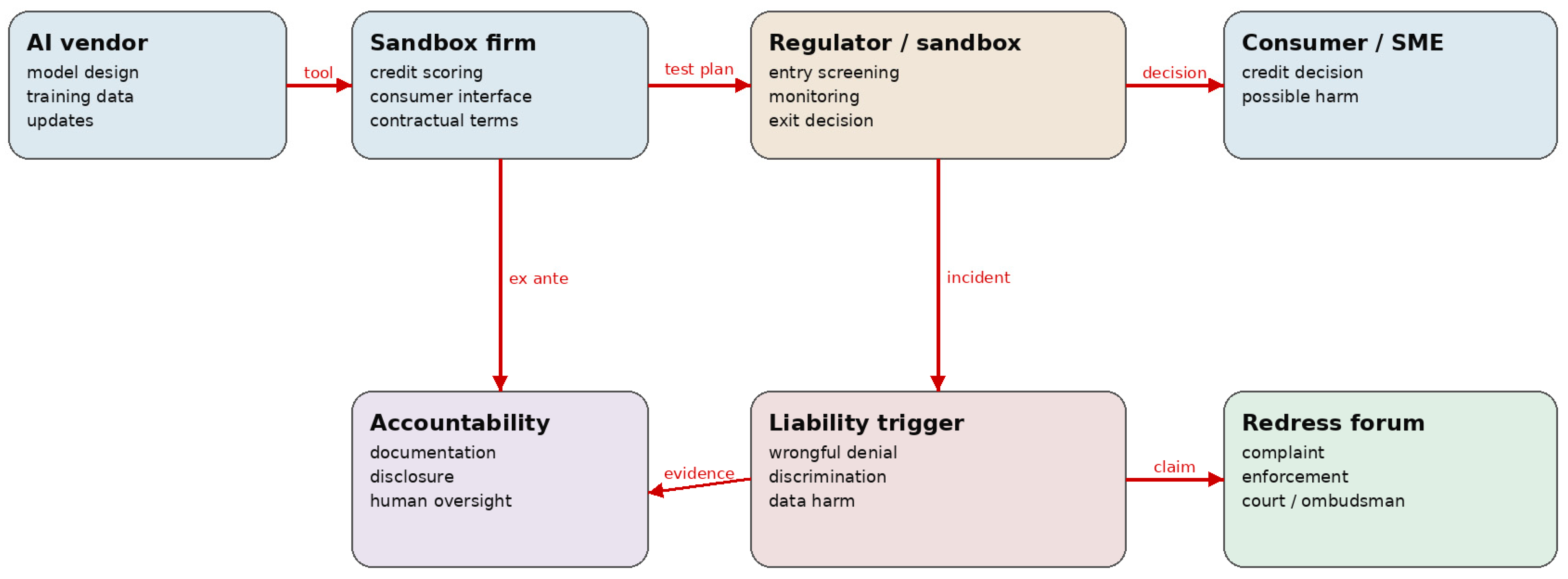

Accountability and Liability in AI-Related Financial Regulatory Sandboxes: A Comparative Legal Analysis


Abstract
1. Introduction
2. Materials and Methods
2.1. Scope and Definitions
2.2. Methodological Approach
2.3. Case Selection and Comparative Strategy
2.4. Source Corpus and Evidentiary Base
2.5. Analytical Mapping Protocol: Accountability and Liability Along the Sandbox Lifecycle
2.6. Reliability, Limitations, and Interpretive Stance
3. Conceptual Framework: Accountability vs. Liability in Experimental Governance
3.1. Accountability as Answerability and Enforceability
3.2. Liability as Ex Post Responsibility and Compensation
3.3. Why Sandboxes Strain Both Accountability and Liability
4. Typology of AI-Supported Sandboxes and Risk Allocation
5. Comparative Legal Analysis
5.1. European Union
5.2. United Kingdom
5.3. Singapore
5.4. Norway
5.5. Hungary
6. Cross-Cutting Comparative Observations
6.1. Sandboxes Are Not Liability Shields, but They Can Create Accountability Gaps
6.2. AI Increases the Need for Documentation, Explainability and Impact Assessment
6.3. RegTech/SupTech Changes Regulator Accountability as Well as Firm Accountability
6.4. Norway and Hungary Illustrate Two Distinct European “Institutional Logics”
7. Design Recommendations: An Accountability and Liability Protocol for AI-Supported Sandboxes
7.1. Role Clarity and Responsibility Mapping
7.2. Baseline Rights and Consumer Protection
7.3. Evidence and Documentation Deliverables
7.4. Supervisory Accountability
7.5. Exit and Post-Sandbox Obligations
8. Conclusions
Funding
Institutional Review Board Statement
Informed Consent Statement
Data Availability Statement
Acknowledgments
Conflicts of Interest
References
- Zetzsche, D.A.; Arner, D.W.; Buckley, R.P. The Future of Fintech: The Regulatory Sandbox. Eur. Bus. Organ. Law Rev. 2020, 21, 1–24. [Google Scholar]
- Ahern, D. Regulatory Lag, Regulatory Friction and Regulatory Transition as FinTech Disenablers: Calibrating an EU Response to the Regulatory Sandbox Phenomenon. Eur. Bus. Organ. Law Rev. 2021, 22, 395–432. [Google Scholar] [CrossRef]
- Ringe, W.-G.; Ruof, C. Regulating Fintech in the EU: The Case for a Guided Sandbox. Eur. J. Risk Regul. 2020, 11, 604–629. [Google Scholar] [CrossRef]
- de Carvalho, P.S. Retaining Influence in Post-Brexit International Financial Regulation: Lessons from the UK’s FinTech Framework. J. Financ. Regul. 2022, 8, 104–131. [Google Scholar] [CrossRef]
- Kálmán, J. The Role of Regulatory Sandboxes in FinTech Innovation: A Comparative Case Study of the UK, Singapore, and Hungary. FinTech 2025, 4, 26. [Google Scholar] [CrossRef]
- Johnson, W.G. Caught in QuickSand? Compliance and Legitimacy Challenges in ‘Regulatory Sandboxes’ and ‘Regulatory Pioneers’. Regul. Gov. 2023, 17, 709–725. [Google Scholar] [CrossRef]
- Wang, Y.; Zhou, Z. Effectiveness of Regulatory Sandboxes in Financial Services: A Systematic Review. Regul. Gov. 2026. [Google Scholar] [CrossRef]
- Raudla, R.; Douglas, S.; Tenorio, L. To Sandbox or Not to Sandbox? A Global Analysis of Regulatory Sandboxes. Regul. Gov. 2025, 19, 917–932. [Google Scholar] [CrossRef]
- Goo, J.J.; Heo, J.-Y. The Impact of the Regulatory Sandbox on the FinTech Industry, with a Discussion on the Relation between Regulatory Sandboxes and Open Innovation. J. Open Innov. Technol. Mark. Complex. 2020, 6, 43. [Google Scholar] [CrossRef]
- Parenti, R. Regulatory Andboxes and Innovation Hubs for FinTech, European Parliament, Brussel, 2020. Available online: https://www.europarl.europa.eu/RegData/etudes/STUD/2020/652752/IPOL_STU(2020)652752_EN.pdf (accessed on 7 April 2026).
- Brown, E.; Piroska, D. Governing Fintech and Fintech as Governance: The Regulatory Sandbox, Riskwashing, and Disruptive Social Classification. New Political Econ. 2022, 27, 19–32. [Google Scholar] [CrossRef]
- Cornelli, G.; Doerr, S.; Gambacorta, L.; Merrouche, O. Regulatory Sandboxes and Fintech Funding: Evidence from the UK. BIS Working Papers No 901, 2023. Available online: https://www.bis.org/publ/work901.pdf (accessed on 10 March 2026).
- Sabel, C.F.; Zeitlin, J. Learning from Difference: The New Architecture of Experimentalist Governance in the EU. Eur. Law J. 2008, 14, 271–327. [Google Scholar] [CrossRef]
- Buckley, R.P.; Arner, D.W.; Zetzsche, D.A.; Weber, R.H. The Road to RegTech: The (Astonishing) Example of the European Union. J. Bank. Regul. 2020, 21, 26–36. [Google Scholar] [CrossRef]
- McNulty, D. Data Access Technologies and the ‘New Governance’ of Financial Regulation. J. Financ. Regul. 2023, 9, 225–254. [Google Scholar] [CrossRef]
- McCarthy, J. The Regulation of RegTech and SupTech in Finance. J. Financ. Regul. Compliance 2023, 31, 186–205. [Google Scholar] [CrossRef]
- Bagherifam, N.; Naghdi, S.; Ahmadian, V.; Fazlzadeh, A.; Shishehgarkhaneh, M.B. Digital Regulatory Governance: The Role of RegTech and SupTech in Transforming Financial Oversight and Administrative Capacity. Int. J. Financ. Stud. 2025, 13, 217. [Google Scholar] [CrossRef]
- von Solms, J. Integrating Regulatory Technology (RegTech) into the Digital Transformation of a Bank Treasury. J. Bank. Regul. 2020, 22, 152–168. [Google Scholar] [CrossRef]
- Vives, X. Digital Disruption in Banking. Annu. Rev. Financ. Econ. 2019, 11, 243–272. [Google Scholar] [CrossRef]
- Haddad, C.; Hornuf, L. The Emergence of the Global Fintech Market: Economic and Technological Determinants. Small Bus. Econ. 2019, 53, 81–105. [Google Scholar] [CrossRef]
- Alaassar, A.; Mention, A.-L.; Aas, T.H. Exploring How Social Interactions Influence Regulators and Innovators: The Case of Regulatory Sandboxes. Technol. Forecast. Soc. Change 2020, 160, 120257. [Google Scholar] [CrossRef]
- Butler, T.; Gozman, D.; Lyytinen, K. The Regulation of and Through Information Technology: Towards a Conceptual Ontology for IS Research. J. Inf. Technol. 2023, 38, 151–188. [Google Scholar] [CrossRef]
- Truby, J.; Brown, R.D.; Ibrahim, I.; Caudevilla Parellada, I. A Sandbox Approach to Regulating High-Risk Artificial Intelligence Applications. Eur. J. Risk Regul. 2022, 13, 270–294. [Google Scholar] [CrossRef]
- Buocz, T.; Pfotenhauer, S.M.; Eisenberger, A. Regulatory Sandboxes in the AI Act: Reconciling Innovation and Safety. Law Innov. Technol. 2023, 15, 357–389. [Google Scholar] [CrossRef]
- Lanamäki, A.; Väyrynen, K.; Vainionpää, F.; Hietala, H.; Tervo, E.; Moltzau, A.; Weerts, S. What to Expect from the Upcoming EU AI Act Sandboxes? Panel Report. Digit. Soc. 2025, 4, 42. [Google Scholar] [CrossRef]
- Undheim, T. Regulatory Sandboxes as a Policy Tool for Moral Imagination: An Example from Norway. AI Ethics 2023, 3, 997–1002. [Google Scholar] [CrossRef]
- Paul, L.A. From Watchdogs to Partners in Tech Innovation: How Data Protection Authorities Use Regulatory Sandboxes. In Cambridge Forum on AI: Law and Governance; Cambridge University Press: Cambridge, UK, 2025. [Google Scholar]
- Genicot, G.; Moraes, C. Exploring the Boundaries of AI Regulatory Sandboxes under the AI Act. In Cambridge Forum on AI: Law and Governance; Cambridge University Press: Cambridge, UK, 2025. [Google Scholar]
- Bovens, M. Analysing and Assessing Accountability: A Conceptual Framework. Eur. Law J. 2007, 13, 447–468. [Google Scholar] [CrossRef]
- Bovens, M.; Schillemans, T.; Hart, P. Does Public Accountability Work? An Assessment Tool. Public Adm. 2008, 86, 225–242. [Google Scholar] [CrossRef]
- Diakopoulos, N. Accountability in Algorithmic Decision Making. Commun. ACM 2016, 59, 56–62. [Google Scholar] [CrossRef]
- Mittelstadt, B.D.; Allo, P.; Taddeo, M.; Wachter, S.; Floridi, L. The Ethics of Algorithms: Mapping the Debate. Big Data Soc. 2016, 3, 2053951716679679. [Google Scholar] [CrossRef]
- Tsamados, A.; Aggarwal, N.; Cowls, J.; Morley, J.; Roberts, H.; Taddeo, M.; Floridi, L. The Ethics of Algorithms: Key Problems and Solutions. AI Soc. 2022, 37, 215–230. [Google Scholar] [CrossRef]
- Wachter, S.; Mittelstadt, B.; Floridi, L. Why a Right to Explanation of Automated Decision-Making Does Not Exist in the GDPR. Int. Data Priv. Law 2017, 7, 76–99. [Google Scholar] [CrossRef]
- Buiten, M.; de Streel, A.; Peitz, M. The Law and Economics of AI Liability. Comput. Law Secur. Rev. 2023, 48, 105794. [Google Scholar] [CrossRef]
- Hacker, P. The European AI Liability Directives—Critique of a Half-Hearted Approach and Lessons for the Future. Comput. Law Secur. Rev. 2023, 51, 105871. [Google Scholar] [CrossRef]
- De Bruyne, J.; Dheu, O.; Ducuing, C. The European Commission’s Approach to Extra-Contractual Liability and AI: An Evaluation of the AI Liability Directive and the Revised Product Liability Directive. Comput. Law Secur. Rev. 2023, 51, 105894. [Google Scholar] [CrossRef]
- Montagnani, M.L.; Najjar, M.-C.; Davola, A. The EU Regulatory approach(es) to AI liability, and its Application to the financial services market. Comput. Law Secur. Rev. 2024, 534, 105984. [Google Scholar] [CrossRef]
- Rosati, E. Infringing AI: Liability for AI-Generated Outputs under International, EU, and UK Copyright Law. Eur. J. Risk Regul. 2024, 16, 603–627. [Google Scholar] [CrossRef]
- Regulation (EU) 2024/1689 of the European Parliament and of the Council laying down harmonised rules on artificial intelligence (Artificial Intelligence Act). Official Journal of the European Union, 13 June 2024.
- Directive (EU) 2024/2853 of the European Parliament and of the Council of 23 October 2024 on liability for defective products and repealing Council Directive 85/374/EEC. Official Journal of the European Union, 23 October 2024.
- European Parliament. AI Liability Directive. Legislative Train Schedule. Available online: https://www.europarl.europa.eu/legislative-train/theme-a-europe-fit-for-the-digital-age/file-ai-liability-directive (accessed on 29 March 2026).
- Agenda Kaupang. Evaluation of the Norwegian Data Protection Authority’s Regulatory Sandbox for Artificial Intelligence (English Version); Report for the Norwegian Data Protection Authority; Agenda Kaupang: Oslo, Norway, 2023. [Google Scholar]
- Magyar Nemzeti Bank. Press Release: The MNB Promotes the Innovations of the Financial Sector by a Regulatory Sandbox Among the First Countries in the Region. 19 December 2018. Available online: https://www.mnb.hu/en/pressroom/press-releases/press-releases-2018/the-mnb-promotes-the-innovations-of-the-financial-sector-by-a-regulatory-sandbox-among-the-first-countries-in-the-region (accessed on 5 March 2026).
- Magyar Nemzeti Bank. Innovation Hub: Regulatory Sandbox. Available online: https://www.mnb.hu/innovation-hub/ (accessed on 5 March 2026).
- Magyar Nemzeti Bank. MNB FinTech Strategy (English); Magyar Nemzeti Bank: Budapest, Hungary, 2019. [Google Scholar]
- Monetary Authority of Singapore. FinTech Regulatory Sandbox Guidelines/Framework (Initially Launched 2016; Updated Versions). Available online: https://www.mas.gov.sg/development/fintech/sandbox (accessed on 5 April 2026).
- UK Financial Conduct Authority. Regulatory Sandbox—Cohort Reports and Guidance (Since 2016). Available online: https://www.fca.org.uk/firms/innovation/regulatory-sandbox (accessed on 5 April 2026).
- Lee, D.K.C.; Guan, C.; Yu, Y.; Ding, Q. A Comprehensive Review of Generative AI in Finance. FinTech 2024, 3, 460–478. [Google Scholar] [CrossRef]
- Manta, O.; Vasile, V.; Rusu, E. Banking Transformation Through FinTech and the Integration of Artificial Intelligence in Payments. FinTech 2025, 4, 13. [Google Scholar] [CrossRef]
- Vasile, V.; Manta, O. FinTech and AI as Opportunities for a Sustainable Economy. FinTech 2025, 4, 10. [Google Scholar] [CrossRef]
- Mkrtchyan, G.; Treiblmaier, H. Business Implications and Theoretical Integration of the Markets in Crypto-Assets (MiCA) Regulation. FinTech 2025, 4, 11. [Google Scholar] [CrossRef]
- Ante, L.; Fiedler, I.; Willruth, J.M.; Steinmetz, F. A Systematic Literature Review of Empirical Research on Stablecoins. FinTech 2023, 2, 34–47. [Google Scholar] [CrossRef]
- European Commission. AI Act—Application Timeline and Entry into Force Information. Shaping Europe’s Digital Future. Available online: https://digital-strategy.ec.europa.eu/en/policies/regulatory-framework-ai (accessed on 29 March 2026).
- Vijayagopal, P.; Jain, B.; Ayinippully Viswanathan, S. Regulations and FinTech: A Comparative Study of the UK, the US and Singapore. J. Risk Financ. Manag. 2024, 17, 324. [Google Scholar] [CrossRef]
- Moltzau, E. Norway’s AI Sandbox: A Model for Responsible AI Development. Harv. Data Sci. Rev. 2024. [Google Scholar] [CrossRef]
- Rudin, C. Stop Explaining Black Box Machine Learning Models for High Stakes Decisions and Use Interpretable Models Instead. Nat. Mach. Intell. 2019, 1, 206–215. [Google Scholar] [CrossRef]
- Arrieta, A.B.; Díaz-Rodríguez, N.; Del Ser, J.; Bennetot, A.; Tabik, S.; Barbado, A.; Garcia, S.; Gil-Lopez, S.; Molina, D.; Benjamins, R.; et al. Explainable Artificial Intelligence (XAI): Concepts, Taxonomies, Opportunities and Challenges toward Responsible AI. Inf. Fusion 2020, 58, 82–115. [Google Scholar] [CrossRef]
- Guidotti, R.; Monreale, A.; Ruggieri, S.; Turini, F.; Giannotti, F.; Pedreschi, D. A Survey of Methods for Explaining Black Box Models. ACM Comput. Surv. 2018, 51, 1–42. [Google Scholar] [CrossRef]
- Norwegian Data Protection Authority. Finterai: Machine Learning Without Data Sharing. Regulatory Sandbox Report. 2025. Available online: https://www.datatilsynet.no/en/regulations-and-tools/reports-on-specific-subjects/reports/finterai-machine-learning-without-data-sharing/ (accessed on 17 May 2026).


| Dimension | Operational Question | Typical Evidence in Sandbox Materials | Primary Accountability/Liability Relevance |
|---|---|---|---|
| A1—Entry transparency & gatekeeping | Who can enter the sandbox and on what criteria; are selection and rejection reasons traceable? | Eligibility criteria; application templates; published cohort summaries; decision rationales (where available) | Legitimacy and equal treatment; reduces arbitrariness and improves contestability |
| A2—Role clarity across the AI supply chain | Are responsibilities allocated across participant, vendor, cloud/outsourcing, data providers? | RACI matrices; outsourcing/third-party disclosure; contractual assurance requirements; governance maps | Prevents ‘accountability dilution’; supports later attribution of control/fault |
| A3—Documentation, audit trail & monitoring | What artefacts must be produced and retained; how is model drift monitored? | Model documentation packs; logging requirements; KPI dashboards; incident reporting templates | Enables answerability and strengthens evidentiary position in ex post claims |
| A4—User-facing safeguards & redress | How are users informed; how are complaints and compensation handled? | Disclosure scripts; opt-in forms; complaints workflow; insurance/compensation schemes; ombuds routes | Protects consumers; shapes contractual expectations; supports enforceability |
| A5—Supervisory governance & due process | How are supervisory decisions made, recorded, and reviewable? | Decision logs; escalation procedures; separation-of-functions policies; review mechanisms | Constrains regulator discretion; reduces procedural risk; supports administrative-law accountability |
| A6—Public learning and non-endorsement discipline | Does the sandbox generate generalisable learning without implying certification? | Anonymised lessons learned; published reports; communication policies; transparency statements | Addresses riskwashing and reputational endorsement effects |
| L1—Baseline civil liability posture | Is it clear that sandbox participation does not waive civil liability? | Explicit disclaimers; consumer information; contractual terms; regulator statements | Avoids ‘liability shield’ misconceptions; manages reliance |
| L2—Product/software liability interface | How might the innovation be characterised as a product/service; how are defects framed? | Technical descriptions; vendor role statements; update policies; quality controls | Connects to strict liability regimes and defect analysis |
| L3—Evidence, causation, and information asymmetry | Are logs and explanations available to support causation/fault claims? | Retention policies; explainability artefacts; audit rights; incident reports | Mitigates ‘black-box’ evidentiary gaps; affects burden of proof |
| L4—Public enforcement and private redress interface | How do supervisory remedies interact with consumer compensation or litigation? | Enforcement discretion notes; complaints and remediation rules; reporting obligations | Shapes incentives and deterrence; prevents governance gaps |
| L5—Potential state/public liability touchpoints | Could supervisory conduct become a relevant cause of harm, triggering public law accountability? | Facilitation vs. enforcement separation; advisory disclaimers; procedural safeguards | Clarifies boundaries of regulator involvement; supports legitimacy and risk management |
| Type | Sandbox Focus | Typical Accountability Mechanisms | Typical Liability Implications | Illustrative Examples |
|---|---|---|---|---|
| AI-system testing | Testing AI systems against horizontal AI governance, data-protection or fundamental-rights constraints | Documentation deliverables; impact assessment; supervisory guidance; public learning reports | No displacement of baseline GDPR/tort/product liability; documentation affects evidentiary position | EU AI Act sandboxes; DPA AI sandboxes such as Norway |
| AI-embedded FinTech product | Testing financial products/services where AI is integral (credit, fraud, KYC/AML, robo-advice) | User disclosure; exposure limits; complaint handling; monitoring and incident reporting | Contractual, tort/product and regulatory liability remain; sandbox conditions shape standard of care | FCA, MAS and MNB financial sandboxes |
| AI-enabled supervision | Use of AI-enabled SupTech or analytics by regulators during sandbox testing | Governance of supervisory tools; decision logs; contestability of supervisory inferences | Potential administrative-law challenge if AI-supported supervisory analytics affect regulatory decisions | RegTech/SupTech governance models |
| Multi-authority AI-FinTech | Projects involving multiple authorities or cross-border testing | Joint protocols; inter-authority coordination; harmonised deliverables | Complex allocation across firm, vendor, regulator and redress forum; accountability gaps if coordination fails | Cross-border pilots and AI-FinTech test environments |
| Dimension | EU | UK | Singapore | Norway | Hungary |
|---|---|---|---|---|---|
| A1 Entry transparency | E | E | E | E | I |
| A2 Role clarity across AI supply chain | E/I | I | I | I | I |
| A3 Documentation and monitoring | E | I | E/I | E | I |
| A4 User safeguards and redress | E | E | E | I | E |
| A5 Supervisory governance | I | I | E | E | I |
| A6 Public learning/non-endorsement | I | I | U/I | E | U/I |
| L1 Baseline civil liability preserved | E/I | I | I | E/I | I |
| L2 Product/software liability interface | E | I | I | I | E |
| L3 Evidence and causation support | E/I | I | I | I | I |
| L4 Public/private enforcement interface | I | I | I | I | I |
| L5 Public law/state-liability touchpoints | I | U/I | U/I | I | I |
| Scenario | Accountability Deliverables in Sandbox | Tripartite Liability Analysis and Sandbox-Specific Effect |
|---|---|---|
| AI credit scoring/underwriting | Data lineage; feature governance; bias testing; human review; adverse-action explanation; drift monitoring | Contractual: wrongful denial or breach of service terms if promised safeguards are not delivered. Tort/product: negligent model design, discriminatory output or defective AI-enabled software; documentation may prove or rebut causation. Regulatory/public law: consumer, anti-discrimination and data-protection enforcement; sandbox records affect standard-of-care analysis. |
| Fraud detection/transaction monitoring | Threshold governance; false-positive review; incident reporting; escalation workflow | Contractual: blocked or delayed transactions may trigger service claims. Tort/product: negligent controls where foreseeable harm follows from false positives or false negatives. Regulatory/public law: market-conduct, AML and consumer enforcement; monitoring logs show whether safeguards were proportionate. |
| AI-enabled KYC/identity verification | Representative testing data; manual fallback; DPIA-style assessment; vendor assurance | Contractual: wrongful refusal or onboarding failure may breach customer-facing terms. Tort/product: exclusion, discriminatory impact or privacy harm may support tort/product or data-protection claims. Regulatory/public law: data-protection and financial-crime supervision; sandbox conditions shape reasonable fallback expectations. |
| LLM/generative AI in advice or communication | Human-in-the-loop controls; prompt/output logs; guardrails; clear user disclosure | Contractual: misleading advice/support may breach service obligations. Tort/product: hallucinated or unsuitable recommendations may support negligence or defect arguments. Regulatory/public law: consumer-protection and conduct enforcement; logs are critical for attribution and causation. |
| AI-enabled SupTech monitoring | Decision logs; contestability; separation between facilitation and enforcement | Contractual: usually indirect unless supervisory outputs affect firm-user obligations. Tort/product: only exceptional and fact-dependent. Regulatory/public law: administrative-law review, due-process claims and possible state-liability arguments where AI-supported supervisory inferences materially affect regulatory decisions. |
Disclaimer/Publisher’s Note: The statements, opinions and data contained in all publications are solely those of the individual author(s) and contributor(s) and not of MDPI and/or the editor(s). MDPI and/or the editor(s) disclaim responsibility for any injury to people or property resulting from any ideas, methods, instructions or products referred to in the content. |
© 2026 by the author. Licensee MDPI, Basel, Switzerland. This article is an open access article distributed under the terms and conditions of the Creative Commons Attribution (CC BY) license.
Share and Cite
Kálmán, J. Accountability and Liability in AI-Related Financial Regulatory Sandboxes: A Comparative Legal Analysis. FinTech 2026, 5, 46. https://doi.org/10.3390/fintech5020046
Kálmán J. Accountability and Liability in AI-Related Financial Regulatory Sandboxes: A Comparative Legal Analysis. FinTech. 2026; 5(2):46. https://doi.org/10.3390/fintech5020046
Chicago/Turabian StyleKálmán, János. 2026. "Accountability and Liability in AI-Related Financial Regulatory Sandboxes: A Comparative Legal Analysis" FinTech 5, no. 2: 46. https://doi.org/10.3390/fintech5020046
APA StyleKálmán, J. (2026). Accountability and Liability in AI-Related Financial Regulatory Sandboxes: A Comparative Legal Analysis. FinTech, 5(2), 46. https://doi.org/10.3390/fintech5020046