1. Introduction
Electroencephalography (EEG) has become a widely used non-invasive technique for monitoring brain activity due to its high temporal resolution and applicability in both clinical and assistive systems [
1]. It plays a crucial role in understanding neurological and neurodevelopmental disorders such as epilepsy, Alzheimer’s disease, dementia, autism spectrum disorders, and stroke-related impairments. However, EEG signals are highly complex, non-stationary, and sensitive to noise, which makes interpretation difficult without advanced computational and visualization tools. This has motivated the development of intelligent systems that combine signal processing, machine learning, and multimodal integration to improve the understanding and usability of EEG data.
Recent research in EEG-based human–computer interaction (HCI) [
2] has increasingly moved toward multimodal frameworks. A comprehensive review of 124 studies conducted between 2016 and 2024 highlights the integration of EEG with complementary biosignals such as EOG, EMG, fNIRS, ECG, and others, combined with deep learning approaches for feature extraction and classification [
3]. Convolutional neural networks remain the most widely used architecture for spatio-temporal feature learning, while early and intermediate fusion strategies are commonly adopted to improve performance. These multimodal systems have shown strong results in applications such as emotion recognition, sleep staging, and cognitive state decoding. However, this study also reports persistent limitations, including the lack of real-time deployment, synchronization issues between modalities, limited datasets, and insufficient explainability of learned representations.
In assistive and rehabilitation technologies, multimodal EEG systems have also demonstrated promising results. For instance, an EEG–EMG-based human–machine interface for upper-limb rehabilitation integrates brain and muscular activity to control a wearable robotic system for hand and wrist movement assistance [
4]. EEG signals were used to classify rest and grasp states using a Riemannian geometry approach, while EMG signals detected movement onset for wrist coordination. The system achieved approximately 85% classification accuracy in preliminary testing, but the authors highlight the need for larger clinical studies and improved robustness for stroke patient applications.
Similarly, multimodal EEG-based brain–computer interface (BCI) systems have been developed for mobility assistance. A neurointerface wheelchair system integrates motor imagery, intentional blink detection, and attention-level analysis using machine learning models, including random forest and support vector machines [
5]. Implemented on an embedded Jetson Nano platform with a dry-electrode EEG headset, the system achieves around 80% accuracy for motor imagery classification and up to 94.1% for attention detection, while maintaining low-latency real-time performance. Despite these results, challenges remain with regard to improving accuracy in real-world environments, enhancing lateral motor imagery detection, and expanding dataset diversity.
Beyond motor and assistive applications, EEG-based emotion recognition has also benefited from multimodal learning strategies. A recent review of multimodal EEG emotion recognition highlights the importance of fusion algorithms and feature representation techniques [
6]. The study compares classical and deep learning-based fusion strategies and shows that performance degradation often occurs when inter-modal relationships are not properly modeled. It further emphasizes that increasing the number of modalities without careful system design can reduce classification reliability, and that current approaches often lack rigorous integration and generalization capability.
Despite these significant advances, most existing approaches focus primarily on classification accuracy and system performance, paying limited attention to integrated visualization, interpretability, and clinical usability. In particular, there is still a lack of unified platforms that combine EEG signal analysis, interactive visualization, and structured clinical data management for real-world medical workflows.
To address these limitations, this work proposes an interactive EEG-based brain interface designed for visualization and exploration of disorder-specific neural dynamics through spectrograms, topographic maps, and connectivity graphs, combined with a web-based clinical database for patient management. The system allows technicians and clinicians to store and access structured patient information, including diagnosis, severity level, number of recordings, sampling frequency, recording duration, and acquisition dates.
In the following section, the Methodology describes the datasets used, the signal processing pipeline, and the design of the proposed interface. The Results section presents the implementation of the interactive visualization system along with the integrated clinical web platform. Finally, the Discussion and Conclusions sections analyze the findings, system limitations, and future improvements.
2. Materials and Methods
This section presents the core components of the proposed framework, including the datasets used for evaluation, the mathematical formalism underlying EEG signal analysis and connectivity modeling, and the implementation of the interactive visualization platform. It provides a unified description of the data sources, the theoretical foundations guiding feature extraction and network representation, and the design of the web-based system developed for real-time EEG exploration and interpretation.
2.1. Dataset Collection and Preprocessing
To ensure a comprehensive evaluation across multiple neurological conditions, this study uses several publicly available EEG datasets.
Table 1 summarizes the main characteristics of each dataset, including the associated disorder, number of subjects, sampling frequency, number of channels, and total recording duration.
Because the datasets were acquired using different EEG systems and acquisition protocols, a harmonization procedure was applied before visualization. Signals were resampled to a common sampling frequency of 256 Hz whenever necessary. Channel names were mapped to the international 10–20 system, and only common electrodes shared across datasets were retained for connectivity analysis. Recordings of varying durations were segmented into fixed-length epochs to ensure consistency during spectral and network analysis. Finally, all signals were normalized using z-score normalization to reduce inter-subject and inter-dataset variability.
Prior to the application of the proposed mathematical framework, the EEG signals undergo a series of preprocessing steps to enhance signal quality and ensure the reliability of subsequent analyses. First, a band-pass filter is applied to retain the relevant frequency components while removing low-frequency drifts and high-frequency noise. In addition, power-line interference is attenuated using a notch filter. To mitigate the impact of physiological and non-physiological artifacts such as eye blinks, muscle activity, and motion disturbances, artifact removal techniques are employed [
13,
14], including independent component analysis (ICA) or automated rejection methods. The signals are then normalized to reduce inter-subject variability and segmented into fixed-length epochs to ensure temporal consistency. These preprocessing steps contribute to improving signal stationarity and provide a foundation for accurate spectral, temporal, and connectivity-based analysis.
2.2. Mathematical Formulation of EEG Connectivity and Network Modeling
The proposed framework models EEG signals through a unified representation that combines spectral analysis, inter-channel dependencies, and graph-based connectivity. Let denote the EEG signal recorded at electrode i, with . After preprocessing (filtering and artifact removal), the signals are analyzed in both time and frequency domains to extract meaningful neural features.
To characterize the spectral content, the Power Spectral Density (PSD) is estimated using Welch’s method [
15], as shown in Equation (
1):
where
is the Fourier transform of the
k-th segment. This representation captures the distribution of signal power across frequency bands and serves as the basis for band-specific analysis.
Temporal relationships between channels are quantified using the normalized cross-correlation [
16], as computed in Equation (
2):
which measures linear dependencies and time-lagged interactions between brain regions.
To capture frequency-specific coupling, coherence is computed as Equation (
3):
providing a normalized measure of synchronization across frequencies. In addition, phase-based synchronization is evaluated using the Phase Locking Value (PLV) [
17] in Equation (
4):
where
and
are the instantaneous phases. This metric captures nonlinear phase alignment between EEG signals.
Based on these measures, the EEG system is modeled as a weighted graph
(
5), where nodes correspond to electrodes and edge weights reflect functional connectivity [
18]:
A thresholding step is applied to retain only significant connections, resulting in a sparse adjacency matrix that defines the functional brain network.
To analyze the resulting topology, graph-theoretical measures are employed. In particular, the degree centrality, as shown in Equation (
6):
quantifies the overall connectivity strength of each node, while betweenness centrality (
7),
identifies nodes that play a key role in information flow within the network.
Overall, this formulation provides a compact yet expressive representation of EEG data, capturing spectral characteristics, inter-channel synchronization, and network topology within a unified framework.
2.3. System Implementation and Interactive EEG Visualization Platform
The proposed system extends traditional EEG analysis pipelines by integrating preprocessing, signal analysis, and visualization into a unified web-based platform that enables real-time, interactive interpretation of EEG data. Unlike offline approaches, the system ensures a continuous flow from raw multichannel EEG recordings to synchronized visual outputs within a single environment.
The processing layer extracts time–frequency, spectral, and spatial features from EEG signals. Time–frequency analysis is performed using localized Fourier transforms to generate spectrograms capturing transient neural dynamics, while band decomposition is used to estimate power distributions across standard frequency ranges. These features are then projected onto scalp topographies to provide intuitive spatial representations of brain activity.
In addition, functional connectivity is modeled using a weighted adjacency matrix , where each coefficient quantifies inter-channel relationships. After thresholding to retain significant connections, a sparse brain network is constructed and embedded in a 3D space using electrode coordinates, enabling interactive visualization of connectivity patterns through nodes and edges.
These computational modules are tightly integrated with the web interface [
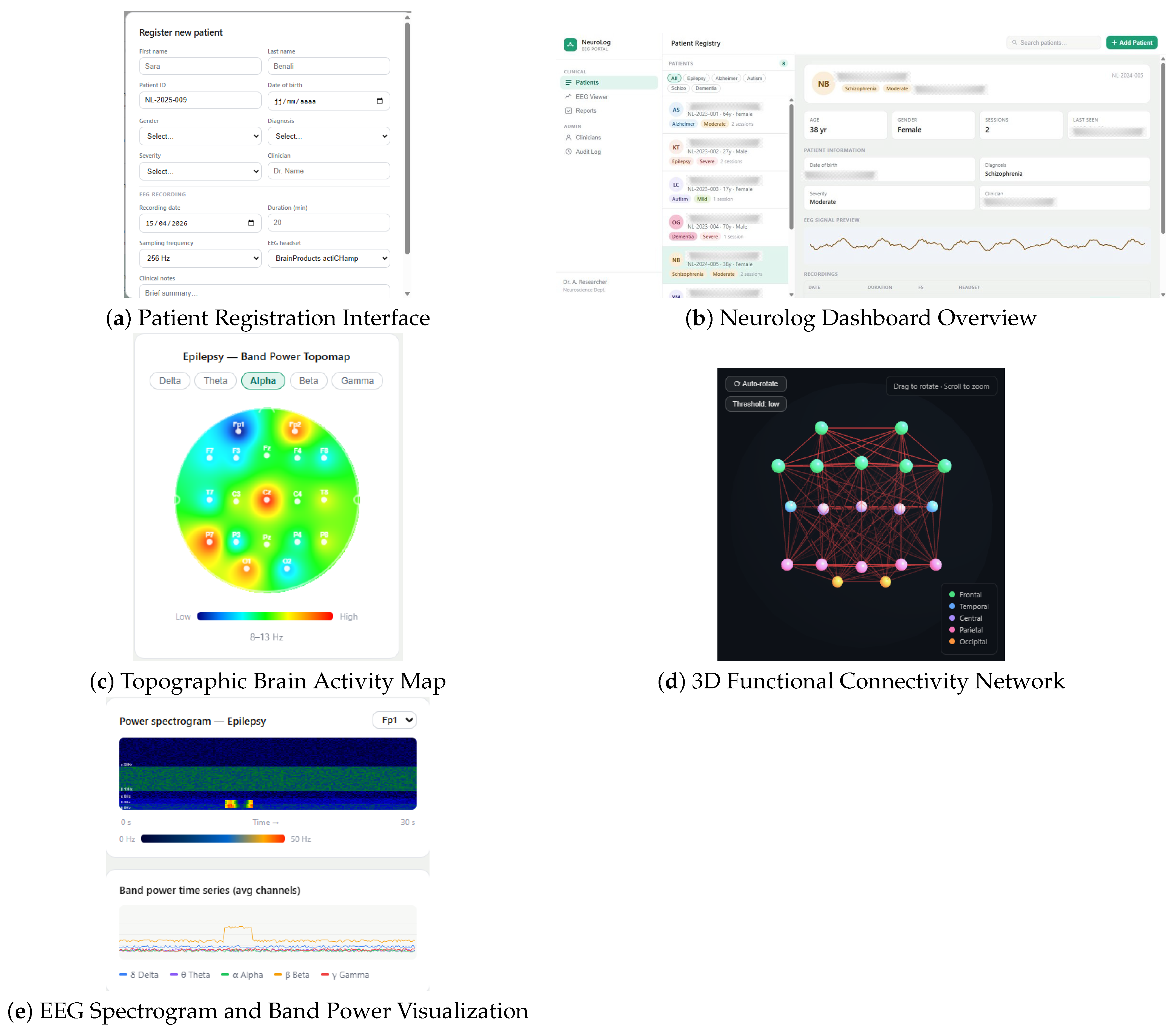
19], as implemented in the NeuroLog platform. Users can manage patients and EEG sessions while dynamically exploring synchronized visualizations such as spectrograms, band power maps, topographic distributions, and 3D connectivity graphs, all updated in real time based on user interaction.
From an implementation perspective, the system relies on a modular architecture linking optimized backend signal processing routines with responsive frontend visualization components. Vectorized computations ensure efficiency, while the interactive design maintains smooth real-time updates, making the platform suitable for both clinical and research applications.
3. Results
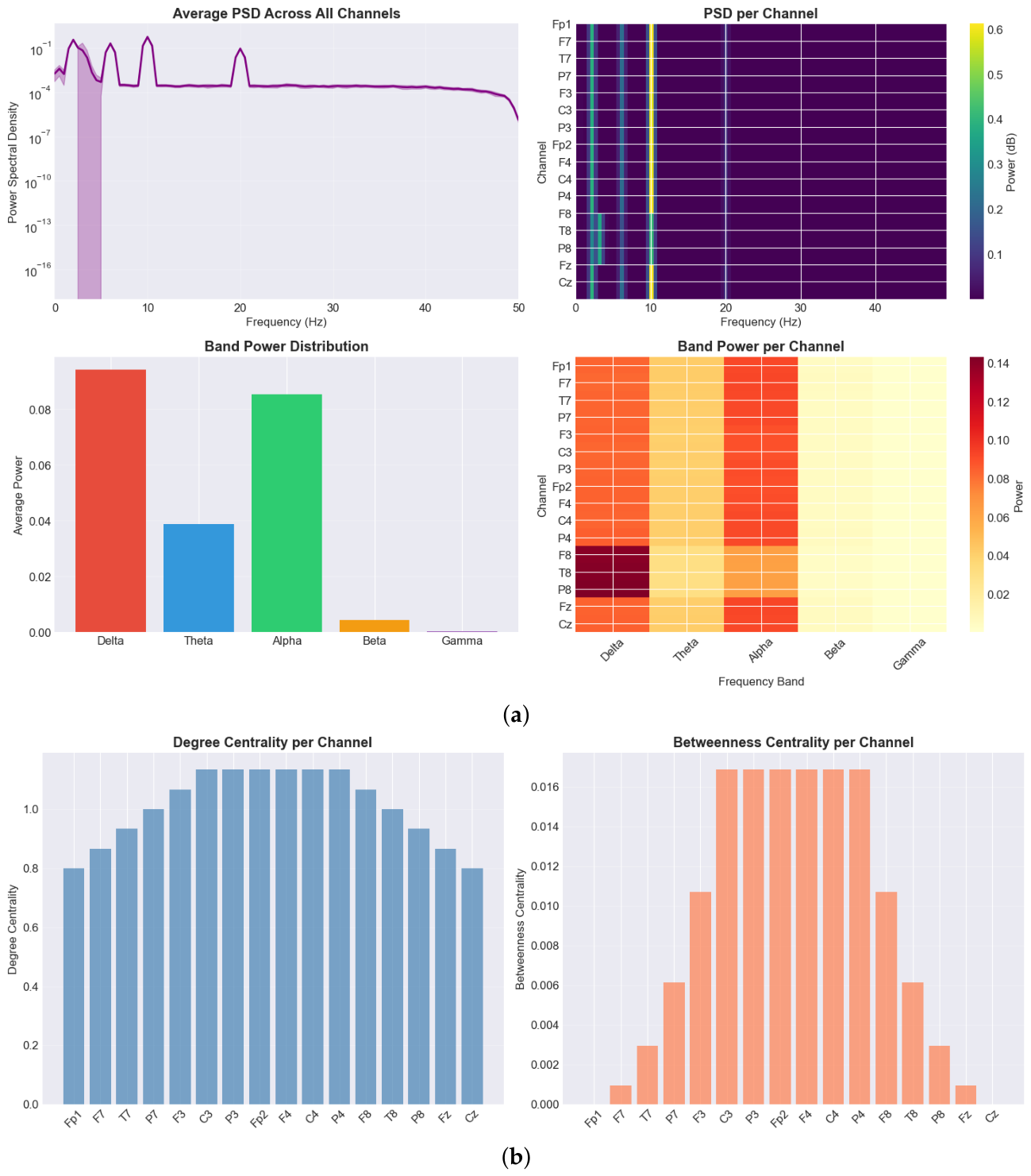
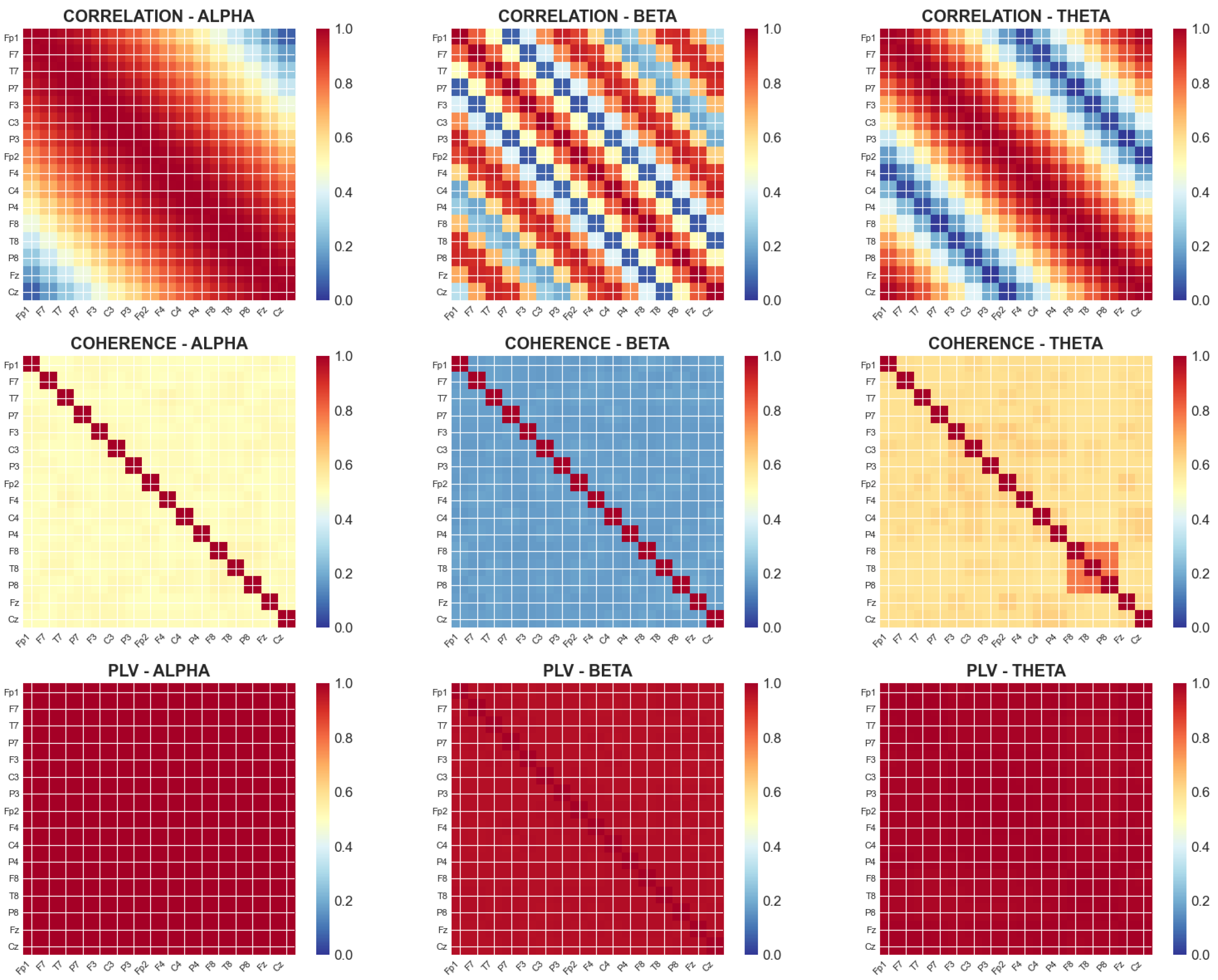
To demonstrate the capabilities of the proposed NeuroLog platform, representative EEG recordings from the CHB-MIT epilepsy dataset were selected for visualization and analysis. The results presented in
Figure 1 and
Figure 2 correspond to a representative EEG segment processed through the proposed pipeline and are intended to illustrate the functionality of the spectral, connectivity, and graph-based analysis modules. Similar preprocessing and visualization procedures were applied to the remaining datasets listed in
Table 1, despite differences in sampling frequencies, recording durations, and channel configurations.
The results presented in
Figure 1 demonstrate the spectral decomposition of the EEG signals, where a clear dominance of the alpha band is observed with a normalized power of 0.085, followed by lower contributions from delta and theta bands, while beta and gamma activities remain minimal (≈0.001). This distribution is characteristic of a resting-state brain condition, reflecting reduced cognitive load and stable synchronized oscillatory activity. The prominence of alpha activity suggests a relaxed wakeful state, while the reduced high-frequency components indicate limited cortical excitation.
As illustrated in
Figure 2a, the functional connectivity analysis based on correlation, coherence, and phase locking value (PLV) reveals strong inter-channel synchronization, particularly within the alpha and theta frequency ranges. The coherence and PLV matrices exhibit consistent coupling patterns across multiple electrode pairs, indicating efficient phase–amplitude relationships between distant cortical regions. This convergence across different connectivity metrics highlights the presence of stable large-scale neural coordination, suggesting efficient communication between frontal, central, and parietal areas.
Figure 2b presents the corresponding brain network representation derived from these connectivity measures. The resulting graph exhibits a clear small-world organization, characterized by a high clustering coefficient (0.915) and a short average path length (1.125). This structure reflects an optimal balance between local specialization and global integration, enabling efficient information transfer across the network. Furthermore, centrality analysis identifies key hub nodes located in central and parietal regions, particularly electrodes C3, C4, P3, and F4. These nodes play a critical role in maintaining network efficiency by acting as major information relay points, facilitating integration between functional brain regions.
The developed NeuroLog platform demonstrates the effectiveness of integrating EEG analysis within a unified web-based environment, as shown in
Figure 3. The interface enables structured patient management alongside direct access to signal-level information, allowing users to seamlessly navigate between clinical metadata and EEG recordings. This tight coupling between data organization and signal visualization significantly reduces the complexity of traditional workflows, where multiple tools are typically required, and highlights the practical relevance of the proposed system.
The generated visualizations provide complementary and mutually reinforcing insights into brain activity. Spectrograms reveal the temporal evolution of frequency components, while band power and topographic maps emphasize the spatial distribution of neural rhythms across the scalp. In addition, the 3D connectivity representation offers a global perspective on inter-channel interactions, making it possible to identify dominant connections and network structures. The simultaneous availability of these views within an interactive interface enhances interpretability and allows for a more comprehensive understanding of EEG patterns.
4. Discussion and Conclusions
Overall, the results demonstrate that the proposed framework can effectively capture both the spectral characteristics of EEG signals and their underlying functional connectivity patterns. The observed dominance of alpha activity, together with the consistency between correlation, coherence, and PLV measures, suggests that the extracted features are physiologically meaningful and suitable for characterizing neural dynamics. Furthermore, the graph-based analysis reveals a small-world network organization, consistent with findings reported in the neuroscience literature, while highlighting key hub regions involved in information transfer across the brain.
A major contribution of this work lies in the integration of multiple EEG analysis modalities within the NeuroLog platform. By combining spectrograms, topographic maps, connectivity matrices, and graph-based visualizations in a single interactive environment, the system facilitates EEG exploration and interpretation while simplifying traditional workflows. Although the current implementation does not provide direct device control, it incorporates several core stages commonly associated with BCI systems, including signal acquisition, preprocessing, feature extraction, visualization, and user feedback through real-time interactive displays.
The current platform represents an initial step toward a more comprehensive EEG analysis and decision-support framework. Future work will focus on integrating machine learning and deep learning models for automated disorder classification, real-time EEG streaming, and longitudinal patient monitoring. Additional developments will investigate advanced connectivity measures, graph neural network approaches, and multimodal fusion with complementary physiological signals. Finally, large-scale validation studies involving multiple neurological disorders and clinical experts will be conducted to further assess the practical utility and clinical relevance of the proposed platform.