


Abstract
The objective of this work was to characterize the morphology and physicochemical properties of 15 genotypes of native beans from the province of Jujuy, Argentina, 10 of which are ñuñas. The morphological descriptors used were length, width, thickness, and color. Hydration capacity (HC), popping yield (PY), proximal composition, and 100-seed weight (100 W) were also determined. The ñuñas presented rounded shapes and, in general, were smaller than beans since lower values of length and 100 W were observed (9–12 mm and 31.4–48.8 g, respectively, versus 13–15 mm and 40–55 g for beans). No differences were observed between both groups in width (8–7.5 mm), while thickness was more variable in ñuñas (5.8–7.3 mm versus 5.8–6.7 mm for beans). The ñuñas ranged in colors, including whitish, brown, purple, and reddish examples, with a mottled, rhomboid bicolor, and tricolor patterns. The beans ranged from light brown to dark purple, either single-colored or with wide bicolored stripes. Darker colors might indicate the presence of polyphenols and anthocyanin. The physicochemical properties depended on the genotype; the ñuñas presented higher HC (50–67%) and PY (20–36%). The protein content—a key characteristic of legumes—varied between 18 and 25% for all the varieties studied, while lipids ranged from 0.23 to 1.29%. In conclusion, these different characteristics of each genotype could exhibit varying behaviors in response to treatments applied for industrialization. In the canning industry, high values of HC are preferred, while PY describes the ability of ñuñas to expand when exposed to heat.
1. Introduction
The common bean, native to Central and South America, is found in northern Argentina, Bolivia, Peru, and Central America. Less well-known are ñuñas, which existed before the Incas [1]. Andean legumes, such as beans, ñuñas, and faba, are being reintroduced in Jujuy, Argentina, by the Institute of Research and Technological Development for Family Agriculture in the NOA Region (INTA-IPAF NOA) to reinforce their presence in local cuisine. There is limited knowledge about the physical characteristics of these seeds, which are important as they determine their suitability for industrial processing [1].
Andean beans have various colors [2], and determining their nutritional contribution and technological aptitudes would promote their consumption. Their proteins have high lysine and minerals [3]. Flours from commercial beans grown in northern Argentina are an important source of dietary fiber, proteins, phytosterols, and γ-tocopherol. Additionally, flours obtained from pigmented beans contain phenolic compounds and higher antioxidant activities [3] than those from non-pigmented ones. The aim was to characterize the morphology and physicochemical properties of 15 genotypes of native beans from Jujuy, 10 of which are ñuñas. Revaluing their properties would represent an alternative for commercialization, primarily due to their potential use in the production of healthy and gluten-free foods and would also contribute to the conservation of the biodiversity of these crops, giving rise to different uses and adding value to local cuisine.
2. Materials and Methods
The seeds were provided by INTA-IPAF NOA. Its production was carried out in its experimental field (2190 masl), Maimará, Jujuy, for two consecutive years (2023 and 2024). They were numbered from 1 to 15. Samples 2, 3, 4,5,7, 8, 9, 12, 13, and 15 are ñuñas, and the rest are beans (see Figure 1).
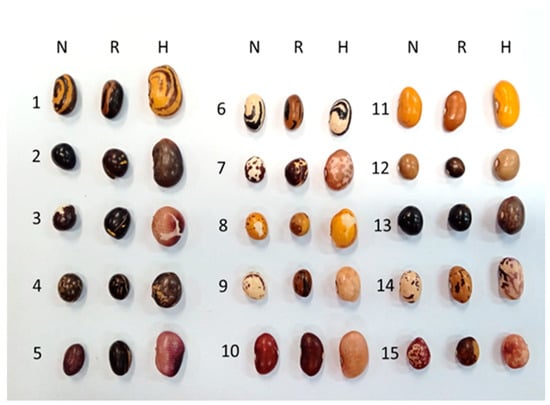
Figure 1.
Andean beans from Jujuy, Argentina, 10 of which are ñuñas (num. 2, 3, 4, 5, 7, 8, 9, 12, 13). Images of native beans and beans after thermal treatment and hydration. N: native; R: roasted; H: hydrated.
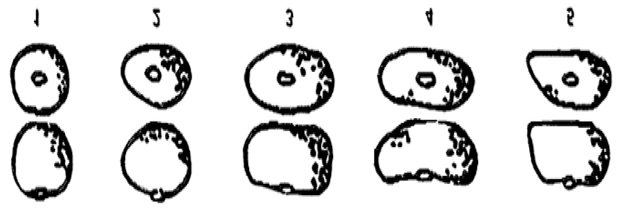
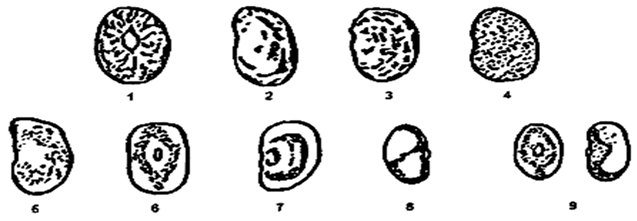
Morphological characterization was conducted according to descriptors for the common bean (Phaseolus vulgaris L.) proposed by the International Board of Plant Genetic Resources (IBPGR, 1982; now, IPGRI) [4], detailed in Table 1.

Table 1.
Bean descriptors used in the present work *.
Fresh beans (20 g) were roasted using an electric oven (Ken Brown, Ciudad, País) at 250 °C for 10 min. Time of first popping (T) was recorded. Popped beans were counted, and the volume of five expanded beans (VE) was recorded via displacement of ethanol. Popping yield (PY) was determined according to Equation (1):
where denotes fully popped grains weight, denotes semi-popped grains weight, and W denotes grains before popping total weight.
Hydration capacity (HC) and swelling capacity (SC) were expressed as the amount of water that seeds absorbed after overnight soaking in excess of water. HC and SC are expressed as percentages in weight and volume, respectively (Equations (2) and (3)):
where W1 is the weight of seeds before soaking, and W2 is weight of seeds after soaking;
where V1 is volume of seeds before soaking and V2 is volume of seeds after soaking.
Whole beans were finely ground, and proximate chemical composition was determined according to AOAC official methods [5]. All measurements and treatments were conducted in triplicate. Data were analyzed using XLSTAT software (V2008.1.50162).
3. Results and Discussion
3.1. Evaluation of Morphological and Technological Quality
The results show that ñuñas (9.73–12.51 mm) are shorter compared to beans (11.06–15.27 mm), and there were no significant differences in width between beans (7.84–8.95 mm) and ñuñas (7.53–8.93 mm). The variability of thickness was greater among ñuñas than beans (Table 2).
Table 2.
Proximate composition, morphological characteristics, and descriptors of Andean beans.
Andean beans are categorized as medium and large according to the 100-seed weight [6], while ñuñas, on average, are smaller. Nevertheless, according to the IBPGR [4], based on seed length, Andean beans are classified as medium (1–2 cm length, approx.) and ñuñas as small (<1 cm length, approx.). Cruz Balarezo et al. [1] reported similar findings for native ñuñas from Peru and Bolivia. From a technological standpoint, these characteristics impact grinding performance, cooking time, nutritional value, and appearance.
Ñuñas are typically round, though one sample (N° 2) was classified as oval. Beans were described as round, oval, and kidney-shaped (Table 2). The brilliance was generally medium for both. The most distinctive feature of Andean beans is their pattern diversity color, overshadowing their nutritional potential. Ñuñas exhibited a broad range of primary colors (black, brown, grey, dark pink, dark purple, cream, and dark reddish brown). Some ñuñas are single-colored (samples N°. 2, 5, 12), while bicolor ones combine lighter colors (whitish, cream) or darker hues such as brown (Table 1). Only ñuña Nº 8 showed three colors. Among the beans, three were bicolor, featuring dark broad stripes (black and brown). Other observed color patterns in ñuñas included constant mottled, rhomboid spotted, speckled, and bicolor. These color variations in the seed coat may be associated to the presence of phenolic compounds [6].
3.2. Chemical Composition
Significant differences were observed between beans and ñuñas (p < 0.05) for all macro components analyzed (Table 2). The moisture content was higher in ñuñas than beans. In all cases, the lipid content was less than 1.63%. Both beans and ñuñas exhibited high protein and carbohydrate content. Similar studies on beans [2,3] suggest high fiber content. This makes them a significant source of nutrients with functional potential. The results align with those reported by Nagai et al. [3], and also with native varieties from Peru and Bolivia [2].
3.3. Hydration Capacity
Figure 1 shows that all grains increased in size after soaking. HC and SC of ñuñas were significantly higher than those of beans (Figure 2). Water retention is associated with chemical composition as it depends on the retention of water molecules by the hydrophilic components of bean macromolecules [7]. Kajiwara et al. [7] suggest the formation of complexes between carbohydrates, polyphenols, and proteins during maceration, which enhances the physical retention of water but increases cooking time. This phenomenon could explain the high SC observed in ñuña Nº4 (dark brown color).
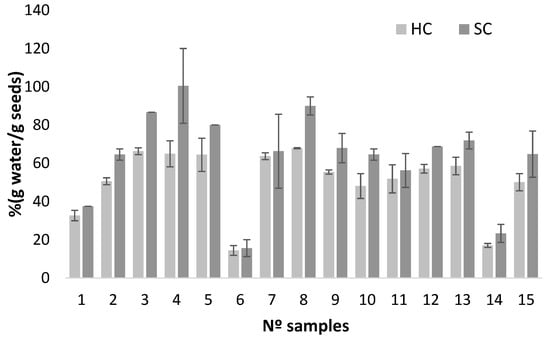
Figure 2.
Hydration properties (HC: hydration capacity; SC: swelling capacity) of Andean beans.
3.4. Roasted Grain Quality
Figure 1 indicates that only ñuñas demonstrated expansion capacity during roasting, as evidenced by the separation of the seed coat at the center of the bean. PY, VE, and T (Table 3) showed significant differences among the analyzed ñuñas. Genotype Nº12 exhibited the highest PY, sample N° 3 had the greatest VE, and sample N°9 required the shortest time to initiate popping (3.34 s). The popping capacity is a significant quality in ñuña-type beans, which is influenced by genetic variability as well as non-genetic factors such as seed shape, its inelastic coat, and the quantity and quality of stored starch [1].
Table 3.
Roasting and popping properties of ñuñas.
4. Conclusions
The native legumes studied demonstrate significant potential as sources of proteins, minerals, and possibly functional compounds. The native genotypes were classified as medium or large based on the weight of 100 grains, or as small or medium based on their length. The presence of dark colors in the seed coat of some genotypes is likely associated with antioxidant compounds. The hydration properties are particularly significant, especially in certain ñuña genotypes. The ñuñas are proposed as popping beans due to their ability to expand when exposed to heat and could produce a snack-type food with high protein content following a short thermal treatment (3–7 min). Revaluing Andean bean properties would represent an alternative for commercialization and would contribute to the conservation of the biodiversity of these crops, fostering different uses and adding value to local cuisine.
Author Contributions
Conceptualization, C.N.S. and S.P.M.; methodology, C.N.S.; software, S.P.M.; validation, C.N.S., S.P.M. and M.A.G.; formal analysis, S.P.M.; investigation, C.N.S.; resources, C.N.S. and S.P.M.; data curation, S.P.M.; writing—original draft preparation, C.N.S. and S.P.M.; writing—review and editing, C.N.S., S.P.M., M.A.G., M.O.L. and N.C.S.; visualization, S.P.M.; supervision, N.C.S.; project administration, M.O.L.; funding acquisition, M.O.L. All authors have read and agreed to the published version of the manuscript.
Funding
This research received no external funding.
Institutional Review Board Statement
Not applicable.
Informed Consent Statement
Not applicable.
Data Availability Statement
Data are contained within the article.
Acknowledgments
The authors express their thanks to INTA- IPAF NOA for providing the seeds as part of their recovery program concerning the recovery and reintroduction processes of Andean beans in the region. They also thank the Ia ValSe-Food-CYTED Network for its support and to Universidad de Lima.
Conflicts of Interest
The authors declare no conflict of interest.
References
- Cruz Balarezo, J.; Camarena Mayta, F.; Baudoin, J.P.; Huaringa Joaquín, A.; Blas Sevillano, R. Evaluación agromorfológica y caracterización molecular de la ñuña (Phaseolus vulgaris L.). Idesia (Arica) 2009, 27, 29–40. [Google Scholar] [CrossRef]
- Kajiwara, V.; ModaCirino, V.; dos Santos Scholz, M.B. Studies on nutritional and functional properties of various genotypes of Andean beans. J. Food Sci. Technol. 2021, 59, 1468–1477. [Google Scholar] [CrossRef] [PubMed]
- Nagai, N.F.; Argel, N.S.; Andrés, S.C. Physicochemical characterization and functional properties of flours from North-western Argentina bean (Phaseolus vulgaris L.) cultivars. Cereal. Chem. 2022, 99, 850–859. [Google Scholar] [CrossRef]
- International Board Plant Genetic Resources (IBPGR). Descriptors for Phaseolus vulgaris L.; Food and Agiculture Organization of de United Nations: Roma, Italy, 1982; 32p. [Google Scholar]
- AOAC. Official Methods of Analysis of AOAC International, 17th ed.; Association of Official Analytical Chemists (AOAC) International: Gaithersburg, MD, USA, 2000. [Google Scholar]
- Jamanca Gonzales, N.C.; Ocrospoma Dueñas, R.W.; Eguilas Caushi, Y.M.; Padilla Fabian, R.A.; Silva-Paz, R.J. Food grain quality: Analysis of physical, biometric, and colorimetric properties to promote consumption. Heliyon 2024, 10, e29234. [Google Scholar] [CrossRef] [PubMed]
- Kajiwara, V.; Moda-Cirino, V.; dos Santos Scholz, M.B. The influence of chemical composition diversity in the cooking quality of Andean bean genotypes. Food Chem. 2021, 339, 127917. [Google Scholar] [CrossRef] [PubMed]
Disclaimer/Publisher’s Note: The statements, opinions and data contained in all publications are solely those of the individual author(s) and contributor(s) and not of MDPI and/or the editor(s). MDPI and/or the editor(s) disclaim responsibility for any injury to people or property resulting from any ideas, methods, instructions or products referred to in the content. |
© 2024 by the authors. Licensee MDPI, Basel, Switzerland. This article is an open access article distributed under the terms and conditions of the Creative Commons Attribution (CC BY) license (https://creativecommons.org/licenses/by/4.0/).