Article

Down by the Riverside—Impacts of a Large Open-Air Festival on the Microalgal Community


1
Department of Functional and Evolutionary Ecology, University of Vienna, 1030 Vienna, Austria
2
Institute for Water Quality and Resource Management, TU Wien, 1040 Vienna, Austria
3
NWU Planung GmbH, 1070 Vienna, Austria
*
Author to whom correspondence should be addressed.
Phycology 2026, 6(2), 66; https://doi.org/10.3390/phycology6020066
Submission received: 28 April 2026 / Revised: 4 June 2026 / Accepted: 6 June 2026 / Published: 11 June 2026

Abstract

Rivers have always been essential to humankind. They are used for many purposes and, as a result, have been heavily modified. Human impacts, many of them still poorly understood, interfere with river ecosystems, making them vulnerable to disturbances. Amongst these, mega events along riverbanks are listed. We studied the effects of the “FM4 Frequency Festival,” which attracted more than 200,000 visitors, on microalgae in the channelized section of the River Traisen in St. Pölten, the capital of Lower Austria. During the festival, phosphorus, dissolved organic carbon, and chloride increased significantly during the whole study period compared with before and after. Although the overall epilithic biomass remained unchanged during the festival period, the phytobenthos community experienced an increase in taxonomic richness downstream of the festival area. Both the Shannon diversity (mean ± SD = 2.89 ± 0.34) and Pielou’s evenness (mean ± SD = 0.73 ± 0.08) did not differ significantly between the sampling dates before, during, and after the festival. We found a shift towards Achnanthidium minutissimum as the dominant species during the festival. Diatoma ehrenbergii, which is sensitive to nutrient enrichment and organic pollution, disappeared during the event. Overall, the biofilm shifted towards a community dominated by heterotrophs during the festival, likely due to high organic loading. Pelagic microalgae experienced a rise in the total taxa number during the festival, which was partly caused by resuspension of phytobenthos. Our results reflect significant impacts from visitors to the Traisen ecosystem. Not only short-term changes in the hydrochemical environment but also mechanical disturbances of the phytobenthos caused by visitors were demonstrated. We suggest continuous monitoring to verify that such events will not have long-term impacts on the system.

1. Introduction

Rivers provide biological and physical resources that sustain life, culture, and economies [1]. Nevertheless, or perhaps for this very reason, one of the most human-affected environments are streams and rivers [2,3]. Since the Neolithic Revolution, humans have settled near rivers, lakes, and seashores. Aquatic ecosystems have been essential to the development of transportation, agriculture, and food. Therefore, humans have tamed rivers with dams, flood regulations, and other management actions to their benefit [4,5,6]. With an increasing human population over the last few decades, this interference has increased, resulting in a dramatic change in river shape [7,8,9]. Anthropogenic river- and land-management actions have modified the world’s rivers over the last century by interrupting the fluxes of water, sediment, and nutrients [10,11,12,13,14,15]. With these changes in natural variation, habitat conditions, and dynamics, rivers are less sustainable and resilient than in their natural state [16]. If natural conditions, such as variable flow regimes, natural fluctuations in heat and light, clean water, and a naturally diverse biotic community, are not maintained in rivers, species loss and the loss of ecosystem services will occur [17].
Humans also use rivers to dilute pollutants of domestic, industrial, and agricultural origin, leading to serious degradation of water quality [18]. As such, concerns about river conditions and quality increased, and consequently, the EU Water Framework Directive [19] was developed to achieve a “good status” for all rivers in Europe. A key requirement of the EU Water Framework Directive, which entered into force in 2000, was to improve the ecological status of rivers by reducing phosphorus and nitrogen levels. The major sources of these nutrients are urban activities and agriculture [20]. Phosphorus in freshwaters can foster toxic algal blooms [21] and/or anoxic conditions due to the decomposition of organic material [22]. Increased nitrate concentrations pose a direct health threat to humans and other mammals [23]. Both nutrients contribute to water eutrophication, a widespread problem [20].
Eutrophication in rivers is mainly associated with a proliferation of the algal community [21,24,25,26]. This often creates ecological problems, including fluctuations in dissolved oxygen and pH driven by the diurnal cycles of photosynthesis and respiration [27,28], reductions in the invertebrate taxonomic richness [29], and an imbalance in flora and fauna [30]. Benthic algae are an important component of the aquatic food web [31]. Through their density, abundance, and diversity, they reflect the health of their environment [32]. In many mid-sized streams, they are the primary energy source for the river community as a whole [33]. Also, in headwater streams, they are an important food source for invertebrates [34]. In addition, benthic algae transform inorganic compounds into organic forms, and therefore, act as chemical modulators in aquatic ecosystems [35]. Moreover, they are the primary harvesters of inorganic phosphorus and nitrogen compounds [36,37], thereby contributing to the self-purification of streams. The phenomenon of self-purification enables rivers to recover to pre-pollution levels. Still, this depends on a complex mix of hydraulic stability, flow level, and periphytic communities [38].
The theoretical framework for predicting the effects of human activities on rivers and managing these activities is called disturbance ecology. The diversity of contaminants and habitat alterations from human activities is challenging the prediction of river responses to such disturbances. This can be improved by distinguishing the effects and recognizing similarities in sets of stressors affecting rivers [39]. During succession, communities change structurally and physiologically, and disturbance effects may vary with the developmental stage [40]. These effects of disturbances on phytobenthos communities have been demonstrated in numerous studies [40,41,42,43]. However, the term “disturbance” is relative, as the same event can hurt one population, whereas it may have neutral or even positive effects on other populations [44]. A positive disturbance effect can be an increase in biodiversity. The intermediate disturbance hypothesis [45,46,47] states that the highest diversity should be at intermediate levels of disturbance. Responses from communities to disturbance also vary spatially. The structure and function of a community may be affected by environmental patchiness, altering the rate and pattern of post-disturbance recovery by reducing or strengthening resistance [40].
Recreational activities on, in, and along waters (e.g., bathing, swimming, boating) contribute to human well-being, but may stress aquatic ecosystems. This can cause habitat degradation or even loss, potentially impacting the composition, diversity, and abundance of water organisms [48]. One example of such activities is music and cultural festivals, which are often held near water bodies. These events attract thousands to millions of visitors and bring them into close vicinity or directly into rivers. The biggest music festival in the world, the “Donauinselfest”, on the Danube Island in Vienna (Austria), attracts up to 3.2 million people [49]. The biggest religious festival associated with a river is the Kumbh Mela in India. Millions of people take a ritual dip in the water on multiple dates and in multiple rivers. To our knowledge, only a handful of studies have investigated the environmental impacts of this type of anthropogenic use on water bodies and their associated communities, focusing on religious festivals in India and the rivers they affect [50,51,52,53].
The FM4 Frequency Festival (FQ) is one of Austria’s biggest music festivals. It has been in the capital of Lower Austria, St. Pölten, since 2009. Since then, the number of annual visitors increased from around 40,000 per day (for 3 days) to 55,000 per day (for 4 days) in 2018. The festival area is located in the southern district of the city, with a campsite along the river Traisen. Along this section of the river, artificial ground sillings have been constructed every 200 m. Visitors use the river to cool off, swim, or wash themselves and their dishes. In particular, the groundsills are used for sitting in the shallow overflow and as a bridge between the camping grounds. One serious environmental problem associated with large festivals is waste management and disposal [54,55,56]. Given the campsite’s unique location in the festival area, this problem extends to the river ecosystem (Figure 1). Not only garbage but also food, beverages, cosmetics, and human excretions enter the river. Studies suggest that sweat, personal care products, hair and skin, as well as urine and feces, can contribute substantially to anthropogenic dissolved organic matter in swimming pools [57,58]. High organic loading has already been proven for the Traisen during the festival [59], which also had significant effects on the heterotrophic microbial community [60].
In the current survey, we evaluated potential impacts of the FQ on the phytobenthos community of the river Traisen. The event, which takes place along a river section, is a great opportunity to study significant chemical and physical changes in the water column over a predefined short period. The predictability of the disturbance enabled a Before–After Control–Impact (BACI) experimental design, which is ideal for measuring specific effects on the phytobenthos community. The river is part of the festival area, which comprises a unique camping ground along both shorelines. The FQ is therefore a prime example for studying the impacts of mass events on aquatic ecosystems. By gaining more information about this influence, disturbances can be recognized at an early stage, enabling timely countermeasures.
We focused on two research questions: (1) is there a measurable impact in terms of selected parameters and the algal community, and (2) if so, how long does the recovery phase take until the pre-festival state is reached again? We expected that visitors along the shore and in the riverbed would not only increase the nutrient levels, such as phosphorus and nitrate, but also directly influence the algal community, e.g., by entering, thereby causing mechanical disruption. We assumed that nutrient levels would increase significantly during the festival due to allochthonous inputs from visitors, reflected in an increase in phytobenthos biomass. Due to the disturbance, we expected a higher number of algal taxa shortly after the event. Since rivers constantly transport new water packages, we assumed that the original state would be restored within a short time.

2. Materials and Methods

2.1. Study Area and Study Period

The study area is a highly modified, channeled section of the river Traisen located in the capital of Lower Austria, St. Pölten. The FQ camping ground is located between river km 28.6 and 32.1 on both shorelines, covering approximately 0.5 km2 (Figure 1). The camping ground sheltered approximately 50,000 visitors each day of the festival. In this reach, the river Traisen had an annual mean discharge of 14 m3 s−1 in 2018 [61]. The river’s catchment area is 767 km2 and crosses four bioregions before discharging into the Danube River, with the largest being the Limestone Alpine Foothills (Kalkvoralpen). The reach of the Traisen in the study area falls within the Bavarian–Austrian Alpine Foothills and the ecoregion Central Uplands [62]. Approximately 50% of the Traisen reach is in an extensively to intensely affected anthropogenic condition [63]. For example, the study area comprises 17 artificial groundsills.
Samples were taken on two sites, one located upstream (US; 48°09′40″ N, 15°37′46″ E) and the second one located downstream (DS; 48°11′33″ N, 15°38′01″ E), in the festival area (Supplementary Figure S1). We started the sampling campaign three months before the festival to establish a baseline for the river. During the FQ, the sampling interval was shortened to consider the daily impact. We continued sampling after the FQ to also assess the system’s recovery. In addition to the photoautotrophic biofilm, we included monitoring of microalgae in the pelagial and certain hydrochemical parameters. The FQ took place from August 16th to 19th, although the camping ground was already open on August 14th and closed on August 20th. The sampling campaign for environmental variables was from 24 May to 26 September 2018. Algae sampling took place on 16 occasions (June 12th & 25th; July 13th & 24th; August 2nd, 8th, 13th, 15th, 16th, 17th, 18th, 20th, 23rd & 30th; September 6th & 26th), with daily sampling during the festival weekend (bold).

2.2. In Situ Measurements

Measurements were performed with portable meters from WTW (Xylem Analytics Germany Sales GmbH & Co. KG, Weilheim, Germany): pH (WTW pH 33110), conductivity (WTW Cond 3310), and dissolved oxygen (O2) and temperature (temp) (WTW Multi 3510 IDS). The flow velocity at the groundsills, US and DS, was measured with an OTT universal current meter (OTT HydroMet GmbH, Kempten, Germany) in 1 m sections across the river. In addition, discharge, air temp, and rainfall were taken from nearby meteorological stations (NOEL, 48°10′26.4″ N 15°36′50.4″ E).

2.3. Hydrochemistry

Samples for ion analyses were collected 5 cm below the water surface using 50 mL sterile Eppendorf tubes; 4 replicates were collected at each site. For dissolved organic carbon (DOC) analysis, samples were collected with a syringe and immediately filtered in the field (Whatman GF/F filters, pore size 0.7 μm) into pre-combusted borosilicate glass vials. All samples were transported in a cool box with ice to the laboratory and stored at 4 °C in the dark until further analysis, which was done on the following day. Cations (NO3, Cl, SO42−) [64] and anions (Ca2+, Mg2+, K+, Na+) [65] were analyzed by means of ion chromatography (Metrohm Compact IC 761, cation column: Metrohm Metrosep C2, anion column: Metrohm Metrosep A Supp 5; Metrohm AG, Herisau, Switzerland). Total phosphorus (Ptot) was measured after wet combustion of the unfiltered sample [66] with a spectrophotometer at 890 nm (Hach-Lange DR 2800, Loveland, CO, USA). Analysis of DOC was performed on a GE-Sievers 900 TOC analyzer (SUEZ Water Technologies & Solutions, Trevose, PA, USA) using the persulfate oxidation method with an inorganic carbon removal unit.

2.4. Algae Community

Samples of the phytobenthos community were taken from the surface of ground sills at the US and DS (random sampling of an area of about 15 m2). Semiquantitative samples of the phytoplankton were taken in the pools upstream of the groundsills with a plankton net (30 µm mesh size) and transferred to Eppendorf tubes (cooled) to the laboratory for preparation and identification. For phytobenthos, mixed subsamples of the phytobenthic biomass samples were analyzed (see Section 2.5 Phytobenthic Biomass). The life material was identified within 24 h to the lowest possible taxonomic level with a compound microscope (Axio Imager M1, Carl Zeiss AG, Oberkochen, Germany) at magnifications of 400×, 600×, and 1000×. When the highest resolution was required, a scanning electron microscope was used to examine specific features (SEM; JSM-6390, JEOL Ltd., Tokyo, Japan). Identification followed keys for diatoms (=Bacillariophyceae) [67,68,69,70,71], Cyanobacteria (=cyanoprokaryotes) [72,73,74], green flagellates and Tetrasporales [75,76], Chlorococcales [77], Xanthophyceae [78,79], and Rhodophyta [80], as well as a key for field identification of common phytobenthos [81]. We combined the phyla Chlorophyta and Streptophyta in the current study under the umbrella term “green algae”. Species name and author cross-checking followed the AlgaeBase online database [82]. Diatoms were identified after wet combustion: samples were placed on cover slips, dried by gentle heating, then heated to the maximum to combust organic material (only the inorganic part remained). Calcium carbonate was then removed by washing the cover slips in 5% HCl, followed by rinsing in reverse osmosis water. After drying, the diatoms were embedded in the synthetic resin NaphraxTM (Brunel Microscopes Ltd., Chippenham Wiltshire, UK). Algal abundance was assessed using a semiquantitative scale that ranged from 0 to 5, initially developed by Korde [83], and has since been widely applied in various water monitoring programs (0 = not present, 1 = very rare/sporadic, 2 = rare, 3 = moderate, 4 = high, 5 = very high abundance) [84]. We assessed the community diversity using n^3-transformed relative abundance data to reflect true proportions. The Shannon diversity index (H′) and evenness (J′) were used to compare phytoplankton diversity and evenness between sites × season using formula as follows: H′ = ∑(pi ⋆ln(pi)), with pi denoting the proportion of the entire community made up of species i and J′ = H′/(ln(S)) with S denoting the species richness [85,86].

2.5. Phytobenthic Biomass

The benthic community was collected on each sampling day with a modified DOUGLAS sampler [76] and transferred into separate specimen jars. The DOUGLAS sampler covered an area of 25 cm2; four areas were randomly selected within the 15 m2 area sampled for taxonomic work. The samples were stored at 4 °C for up to 12 h before the next step of preparation. Each sample was poured into a measuring cylinder and made up to 1000 mL. The diluted and homogenized sample was then split into two parts and filtered on glass fiber filters (Whatman GF/C; Cytiva, Marlborough, MA, USA). One was stored at −80 °C until algal pigment extraction, whereas the other filter (pre-dried and pre-weighted) was dried at 60 °C until constant weight for dry mass (DM) measurement. After weighing, this filter was combusted for 2 h at 480 °C in a muffle furnace to obtain the ash mass (AM). Organic matter (OM) was calculated as OM = DM − AM. For the pigment analysis, frozen filters were cut into small pieces and transferred to Eppendorf tubes containing 10 mL of 90% acetone. Homogenization was performed by an ultrasonic probe (Branson Sonifier 250; Brookfield, CT, USA). After 12 h of extraction at 4 °C in the dark, the extract was centrifuged and a portion of the supernatant was used for spectrophotometric analysis of chlorophyll-a (Chl-a; [87]). Another part of the pigment extract was injected into an HPLC System (Merck-Hitachi LaChrom Elite, Darmstadt, Germany, column: Merck-Superspher RP-18, software: EZ Chrom Elite 3.3.2). A gradient program was run according to [88], with peak detection at 440 nm [89,90]. To calculate group affiliations, the factor analysis routine CHEMTAX V1.95 was used [91]. The software uses a data matrix of pigment concentrations, along with an initial estimate of the most appropriate pigment/Chl-a ratios for the algae classes expected in the samples [91,92]. Based on microscopic observations, we limited the groups to the relative contributions of Cyanobacteria, Bacillariophyceae, and Chlorophyta to total algal biomass, as determined by Chl-a. The autotrophic index (AI) represents the quotient between Chl-a and AFDM and was calculated for each sampling date for the US and DS [93]. The AI is used to determine the relative importance of photoautotrophs compared with heterotrophic microorganisms and to identify potential organic pollution. Values <100 indicate a community dominated by photoautotrophs, and values >400 a community mainly consisting of heterotrophs and/or organic detritus. Between 100 and 400, an indifferent community inhabits the system [94].

2.6. Statistics

Significant differences in environmental variables between “site” (US versus DS) and “period” were tested with a Two-Way Analysis of Variance (ANOVA) after passing tests for normal distribution and variance homogeneity. “Period” comprises three categories: before the FQ (B), during the Frequency festival (D), and after the FQ (A). If data did not meet these criteria, the Kruskal–Wallis test (H-test) was applied, followed by Tukey’s post hoc test. We used PAST © (version 3.10) for the Two-Way ANOVA, H-test, and Tukey’s test. For seasonal post hoc comparisons, the significance p-level was adjusted to 0.0167 (Bonferroni correction for three groups).
For an overview of environmental conditions, we performed a principal component analysis (PCA) based on normalized data of environmental parameters (PRIMER V7; PRIMER-E Quest Research Ltd., Albany, New Zealand). Parameters were manually selected according to their potential influence on the algal community and to minimize autocorrelation. Principal components (PCs) with eigenvalues > 1 were considered for further interpretation.
We studied algal community patterns using two-dimensional non-metric multidimensional scaling (NMDS) in PRIMER V7, based on a Bray–Curtis similarity matrix of the taxonomic data. To obtain insight into environmental variables that significantly contributed to the community development, (1) environmental variables showing Pearson correlations r > 0.35 with the NMDS axes were plotted, and (2) the BEST routine was applied (Spearman rank, BIOENV-method, maximum number of variables = 5, resemblance measure: Euclidean distance, 999 permutations). The BEST routine identifies the combination of environmental variables whose multivariate pattern most closely matches that of the algal community data, thereby supporting interpretation of the influence of the considered environmental variables.
To test the goodness of “period” groups (B, D, A), a canonical analysis of principal coordinates (CAP) was calculated based on the Bray–Curtis similarity resemblance matrix between taxa occurrences (9999 permutations). CAP is used to discriminate predefined groups and visualize the separation. To test for significant differences in the algae community between “period” (B, D, A) and “site” (US, DS), we performed a Permutational Multivariate Analysis of Variance (PERMANOVA; 999 permutations) based on Bray–Curtis dissimilarities with the PRIMER V7 software package. We applied a distance-based test for homogeneity of multivariate dispersions with the PERMDISP routine in PRIMER (p(perm) = 0. 07 for “period”, 0.30 for “site”). PERMANOVA is a nonparametric method that tests whether community structures differ significantly between predefined groups. In addition, the SIMPER (Similarity Percentages) routine in PRIMER V7 was used to provide an overview of group dissimilarities between “site” and “period” and of the taxa that contributed the most to the group similarities within each group. Groups were defined using “site” × “period” (UB, UD, UA, DB, DD, DA). For these groups, we also tested for significant differences in the taxa number, Shannon diversity index, and Pielou’s evenness using One-Way ANOVAs (Sigmaplot 14.5, Systat Software Inc., San Jose, CA, USA). Raw data passed the tests for variance homogeneity (Brown–Forsythe) and normality (Shapiro–Wilk).

3. Results

3.1. Abiotic Factors

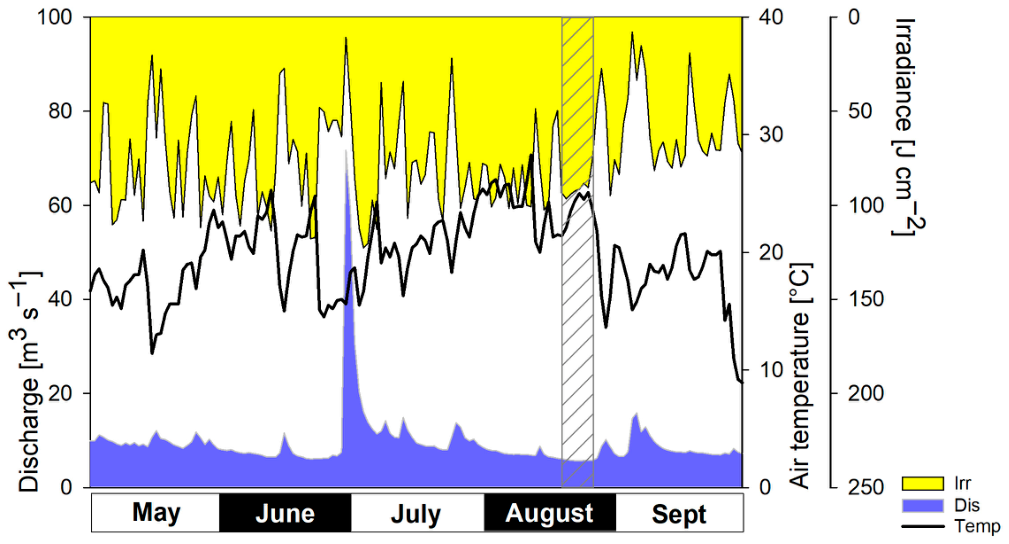
The mean discharge during the study period was 9.7 m3 s−1, with a flood event in the end of June (maximum 71.7 m3 s−1) and low water during the FQ with 5.9 m3 s−1 (Figure 2). Water level fluctuations were mainly explained by weather conditions: increased water levels were related to rainy, cloudy weather conditions that provided low incoming irradiance and air temp (Figure 2). The maximum air temp was observed on August 9th, with a 24 h mean of 28.8 °C, only five days before campers arrived. During the FQ, the mean air temp of 23 °C indicated sunny, pleasant weather, ideal for outdoor activities (Figure 2).
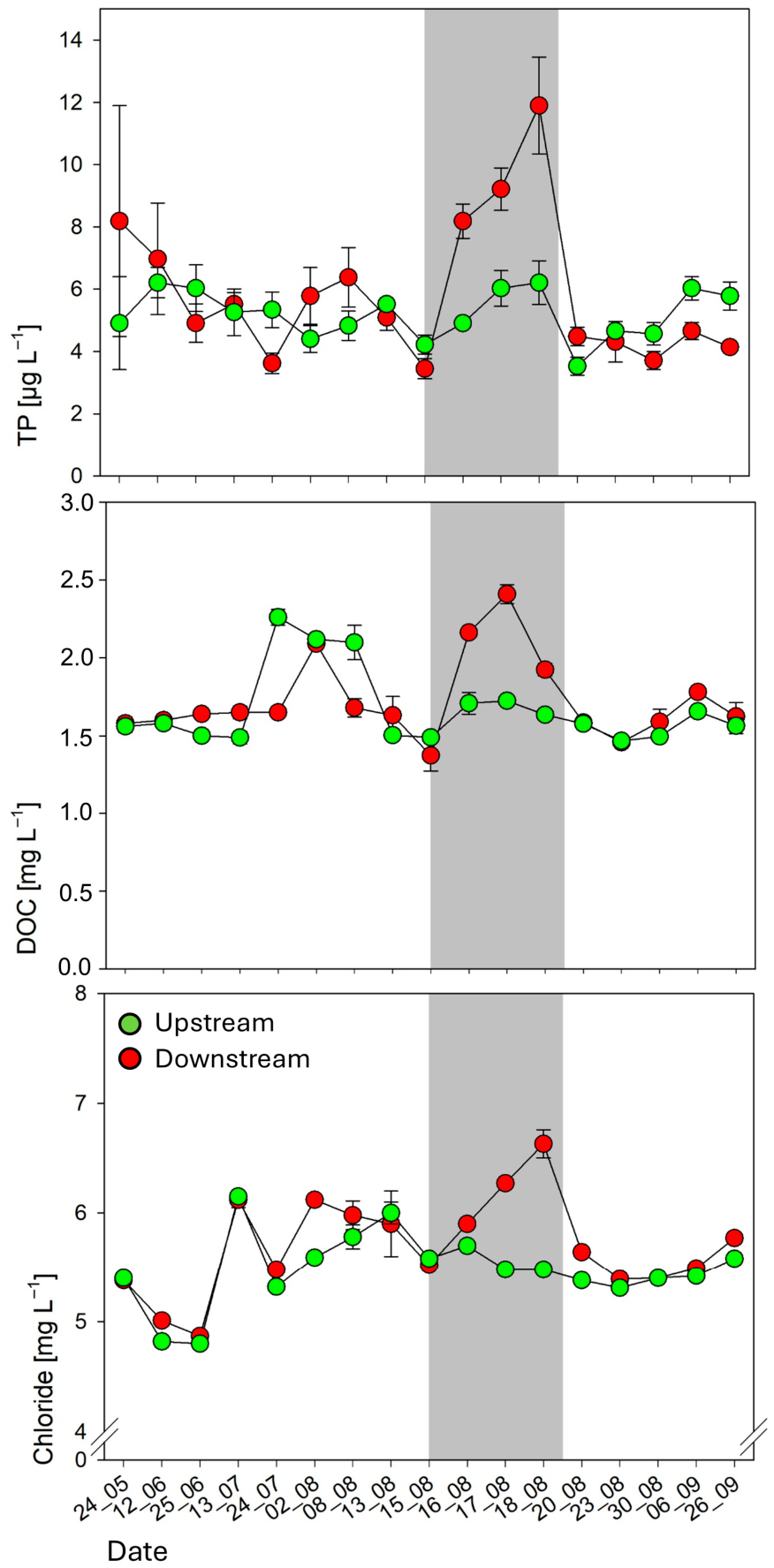
The highest conductivity values were measured at the US with 464 μS cm−1 on September 26th and the DS with 446 μS cm−1 on August 18th. The pH ranged from 8.2 to 8.6 at the US and from 8.0 to 8.7 at the DS. The water temp reached a maximum of 23.8 °C on June 12th at the DS and a minimum of 11.4 °C on September 26th at the US (Supplementary Table S1). Predominant ions were Ca2+/Mg2+ and HCO3/SO42−, respectively (Supplementary Table S1; Supplementary Figure S2). We did not observe a pronounced change in the ion composition during the study period; however, an overall increase in the ion content towards the end of summer was noted, mainly due to Ca2+ and HCO3. The increase was also recognized by conductivity measurements. We did not find significant differences between the US and DS for Ca2+, K+, Na+, NH4+, nitrate, O2, and SO42− (Supplementary Table S1). Contrarily, alkalinity, Cl, Cond, DOC, Mg2+, nitrite, pH, Ptot, and temp displayed significant differences between the two sampling sites during the FQ and/or after the festival (Supplementary Table S1). Mg2+ and pH were significantly different before the FQ but did not show significant differences during or after the FQ (Supplementary Table S1). During the FQ, a gradual increase in the following variables was observed (Figure 3): Cl at the DS was significantly higher than at the US. Also, for Ptot and DOC, the DS values were significantly higher than at the US.
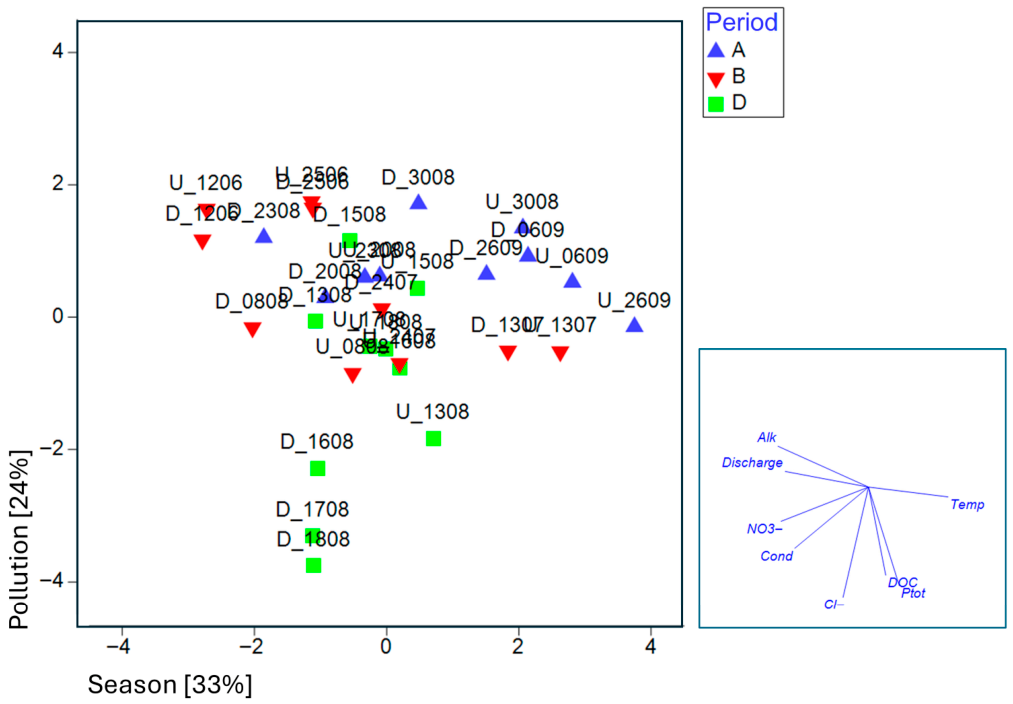
A PCA of environmental variables yielded three principal components (PCs; Table 1). According to the loadings of the PCs, we interpreted their main background variable as “season” for PC1 (explaining 33% variation of the data), “pollution” for PC2 (24%), and “discharge” (13%) for PC3 (Table 1, Figure 4). Data points are mainly arranged along the “season” PC, as can be seen from the score plot (Figure 4). In addition, the DS during the FQ is clearly separated from other data, oriented vertically along “pollution”. The variables DOC, Cl, and Ptot are strongly associated with this PC (Table 1, Figure 4), indicating the high impact of visitors.

3.2. Phytobenthic Community

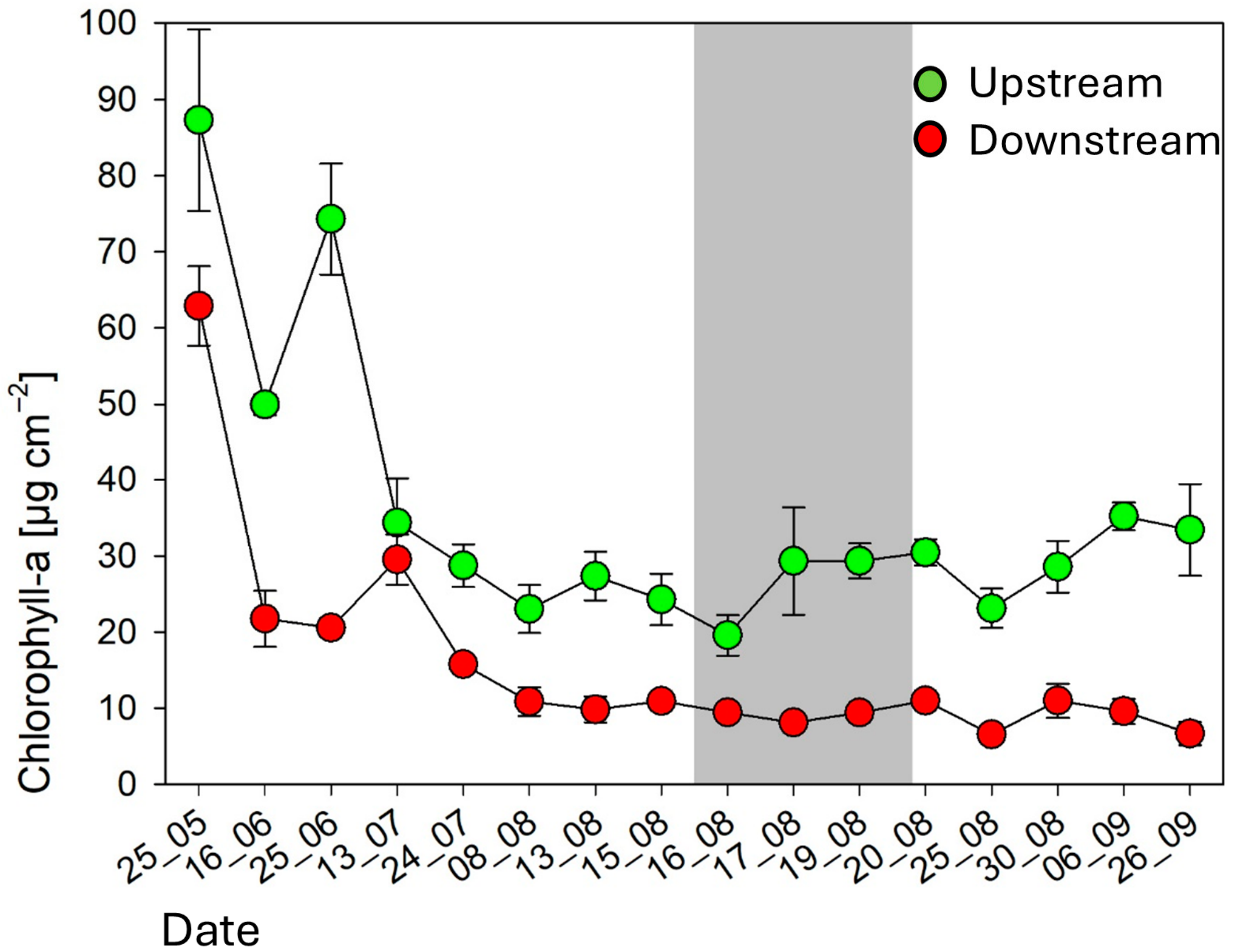
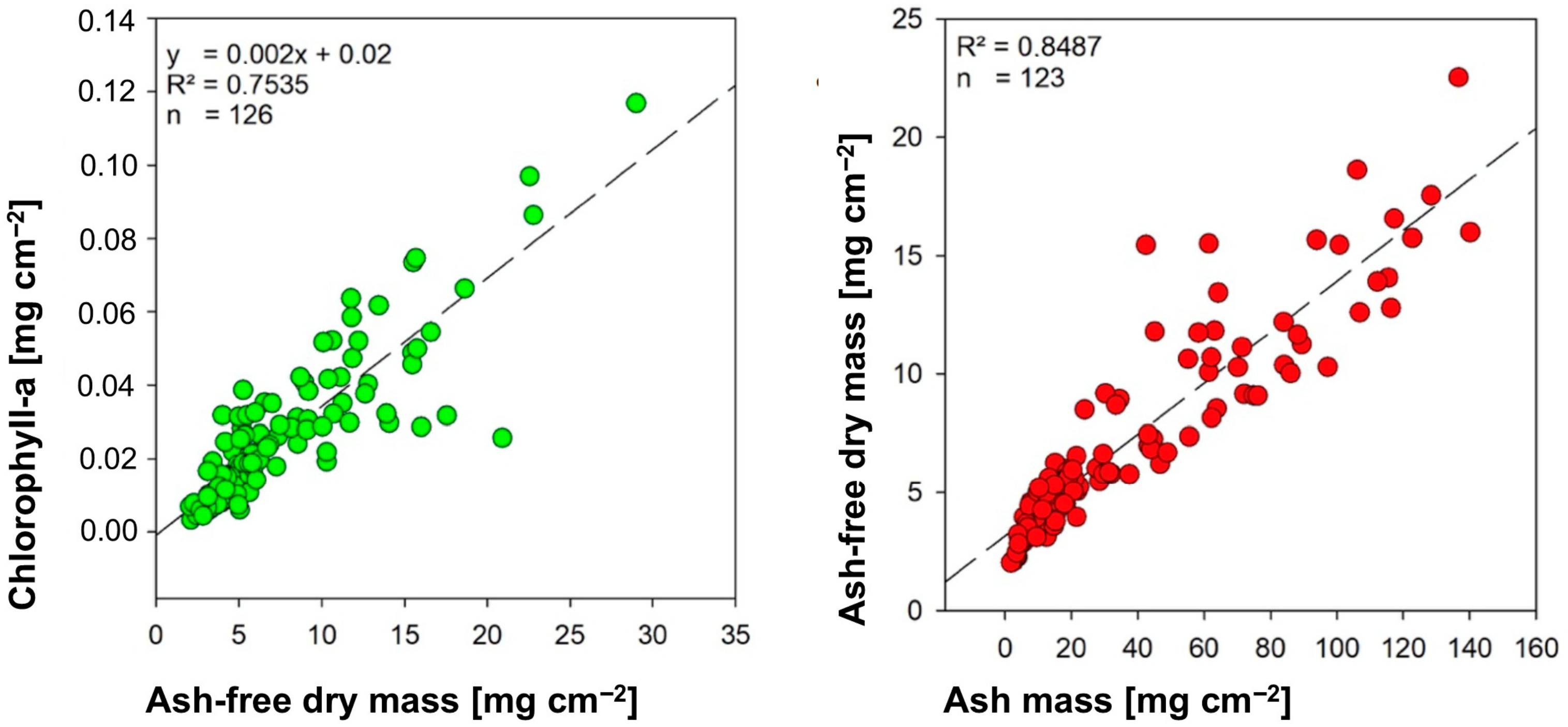
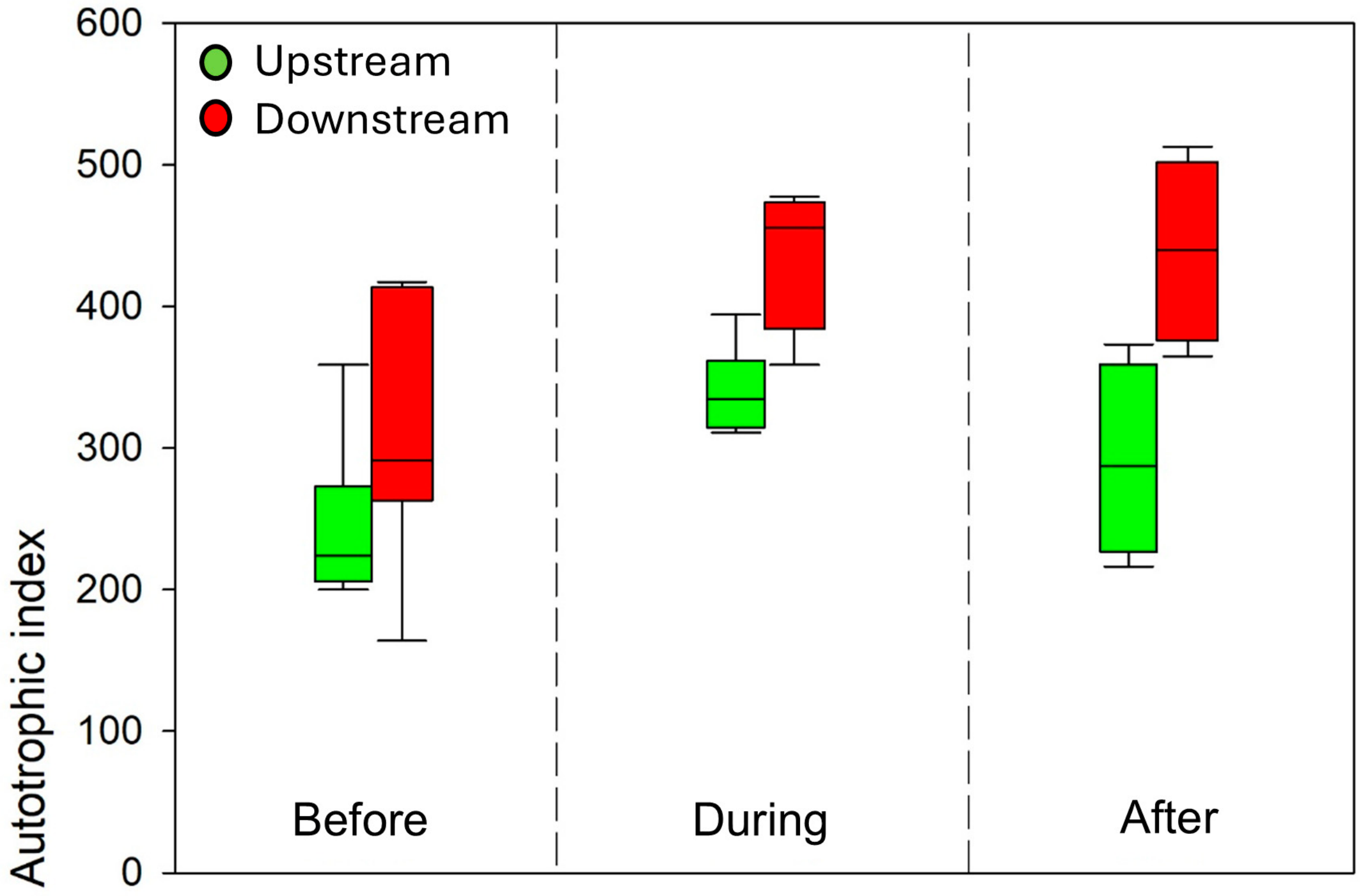
Phytobenthos had the highest biomass at both sites during June, with maxima of 88 μg Chl-a cm−2 (US) and 63 μg cm−2 (DS), respectively (Figure 5). From July to the end of September, the biomass was below 30 μg Chl-a cm−2 (US) and 10 (DS), with no significant change during and after the FQ (Figure 5). The OM was highly correlated with Chl-a (Figure 6 left), with a ratio of around 2 ‰ Chl-a per unit OM. The AM and OM were highly correlated (Figure 6 right). The mean AIs were 285 (US) and 388 (DS) across the whole study period. The highest AI was observed during the FQ, with 344 for the US and 454 for the DS. The DS location showed a significantly higher AI during and after the FQ compared with the US (Figure 7).
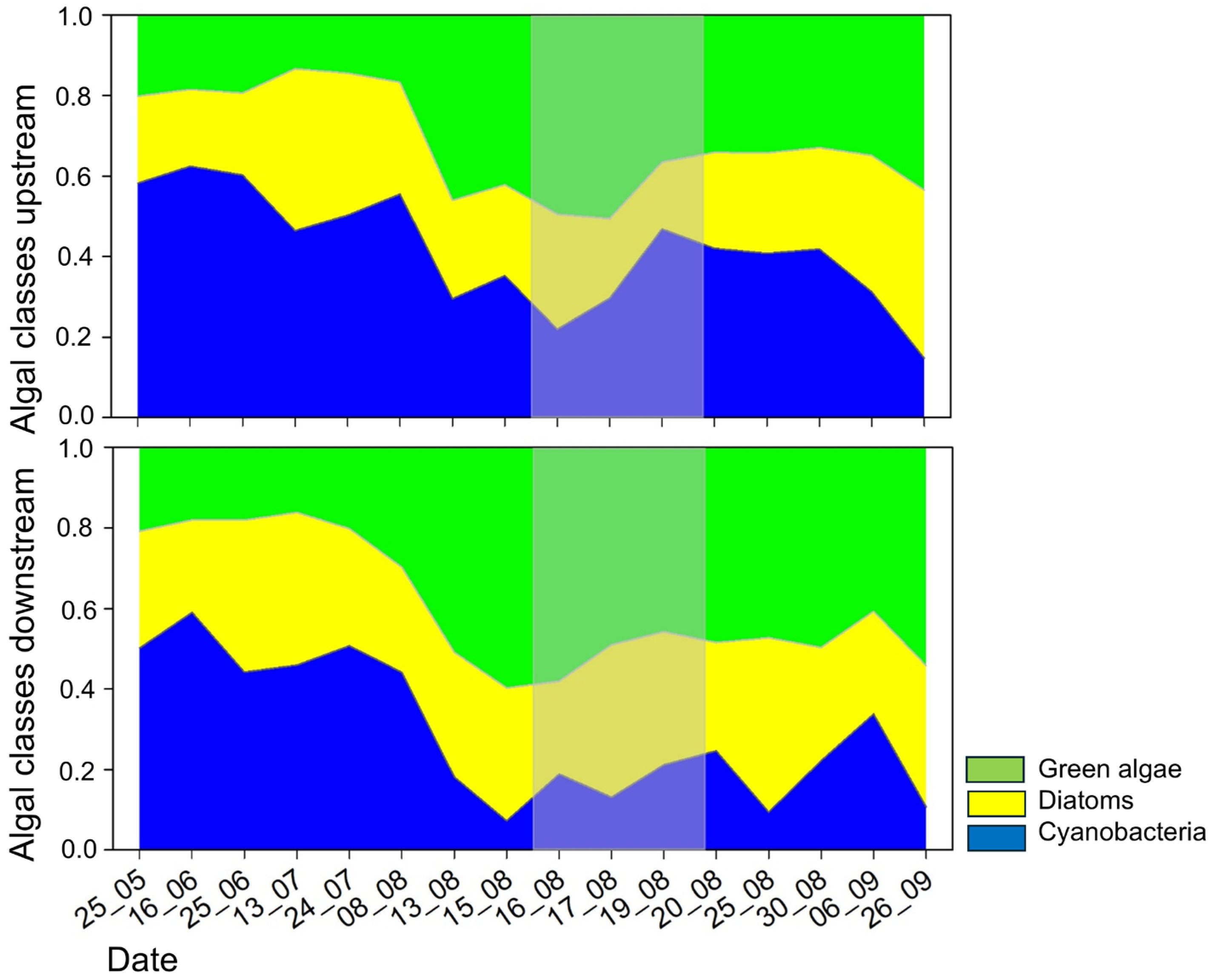
The main contributors to the phytobenthos biomass were the major algal groups green algae (Chloro-/Streptophyta), diatoms (Bacillariophyceae) (Supplementary Figure S3), and Cyanobacteria. Cyanobacteria were most abundant during late spring to mid-summer. During and after the FQ, green algae increased in biomass (Figure 8). The taxa number displayed a different pattern: although Cyanobacteria contributed heavily to the overall biomass, the number of taxa was low. Diatoms showed the highest taxonomic richness (Supplementary Figure S4, Supplementary Table S2).
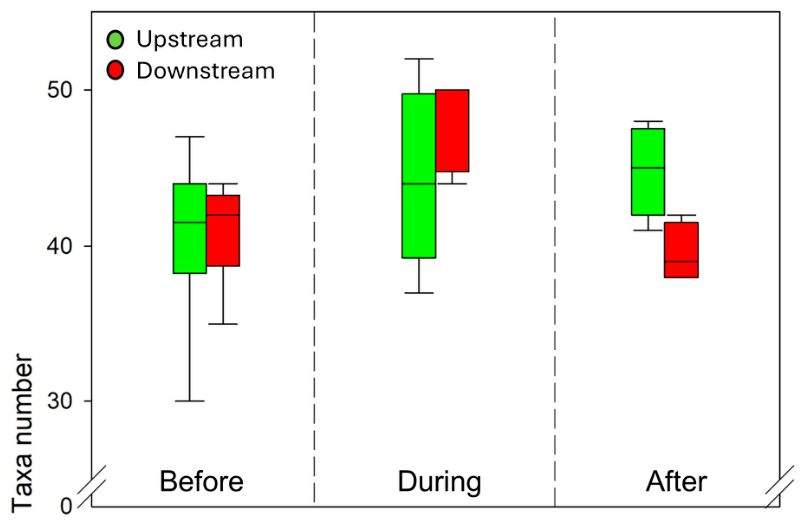
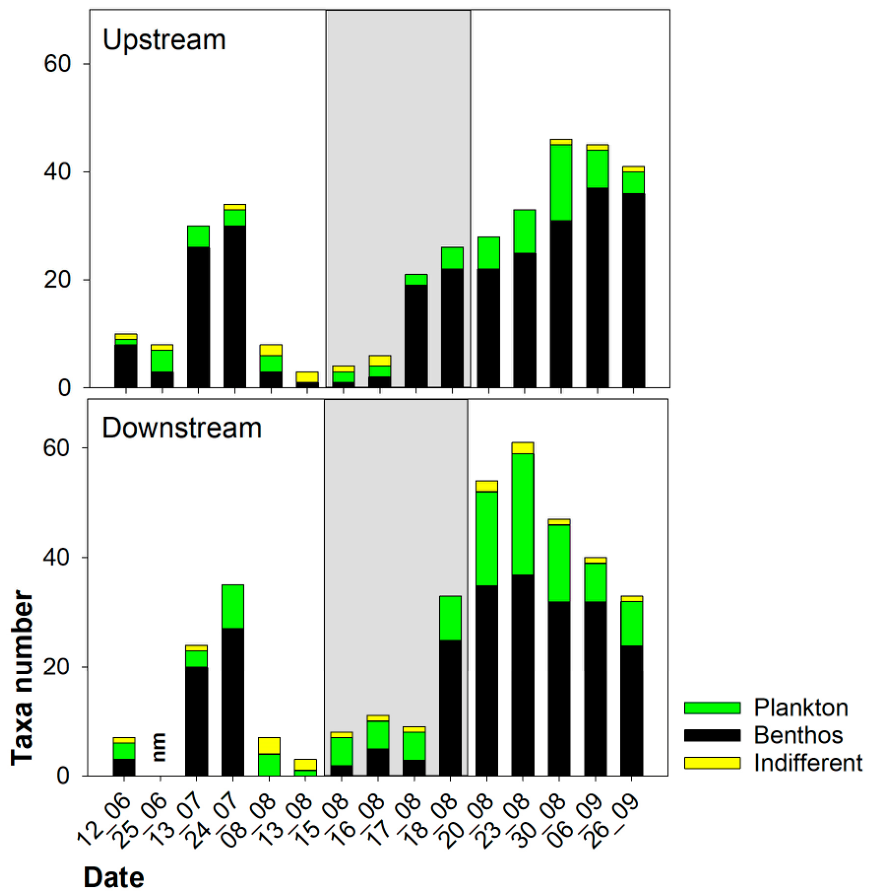
The total number of taxa recorded in the current survey was 198, including 150 benthal taxa, 43 pelagic taxa, and 5 commonly found in both zones. The lowest overall taxa number was found just after a flood event at the DS on July 13th (Supplementary Figure S3). During the FQ, diatoms had the lowest species richness, while the green algae had the highest. To present the different patterns more clearly, we pooled the taxonomic richness data into three categories: before, during, and after the FQ. Overall, the total number of phytobenthos taxa increased significantly at the DS during the FQ compared with the periods before (p = 0.044, n = 5) and after the event (p = 0.016, n = 5). Contrarily, the taxa number did not change significantly at the US (Figure 9). Both H′ (mean ± SD = 2.89 ± 0.34, p = 0.063, n = 15) and J′ (mean ± SD = 0.73 ± 0.08, p = 0.130, n = 15) did not differ significantly between the groups. However, a tendency towards higher values was observed from spring to autumn and from the US to the DS (Supplementary Figures S5 and S6).

3.3. Pelagic Algae Community

Green algae, diatoms and Cyanobacteria dominated the phytoplankton, with diatoms showing the highest taxa numbers at both sites (Supplementary Table S3). Before the FQ, the DS had, on average, 2% fewer identified taxa in phytoplankton than the US. During the event, the DS had, on average, 49% more total taxa than the US. After the FQ, the DS had 9% fewer taxa than the US again. The most abundant diatom taxa at the DS during the FQ were Achnanthidium minutissimum, Cyclotella sp., Fragilaria acus, Fragilaria capucina, and Fragilaria ulna. The most abundant green algae in this period were Ankistrodesmus sp., Ankistodesmus spiralis, Spirogyra sp., Scenedesmus sp., Scenedesmus dimorphus, and Pandorina morum.
The pelagic algal community consisted of true planktonic, resuspended phytobenthos, and indifferent forms usually found in both habitats (Figure 10). Before the event, the DS had 15% less resuspended phytobenthos taxa and 52% more true planktonic taxa compared with the US. During the FQ, the DS had 18% more resuspended phytobenthic taxa and 158% more true planktonic taxa than the US. After the event, the DS again had 15% less resuspended phytobenthos taxa and 16% more true planktonic taxa than the US. An additional increase in resuspended phytobenthos at both sites was evident shortly after the high-water event at the end of June (see also Figure 2).

3.4. Linking Algae Community Patterns to Environmental Conditions

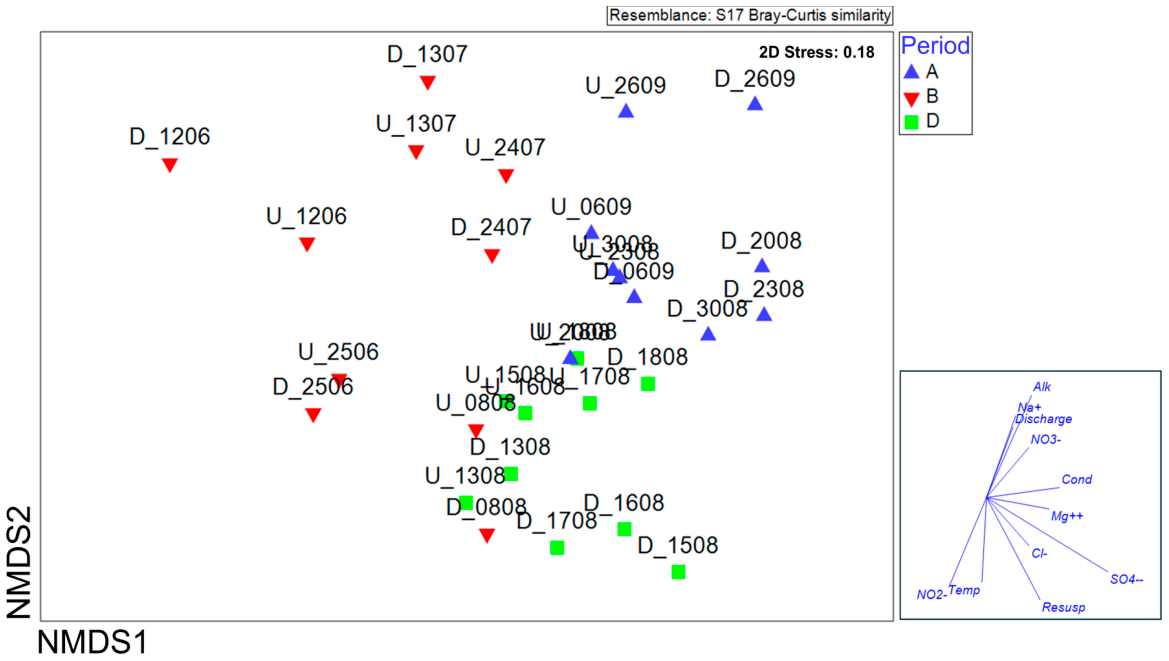
The development of the algae community showed a clear seasonal pattern along NMDS axis 1 (Figure 11). In addition, NMDS axis 2 separated the FQ from the period before and after the FQ, but also periods of cold water, which were partly associated with high discharge (Figure 11). The BEST routine had the best match with temp, NO3, Cl, SO42−, and sediment resuspension by visitors (999 permutations, Spearman rank r = 0.549), where the first two variables were largely associated with high discharge and the latter three with the FQ (Figure 11).
The CAP of three predefined groups B, D, and A, based on the taxa Bray–Curtis similarity matrix, was highly significant (p = 0.0001; Supplementary Figure S7; Supplementary Table S4), correctly classifying 87% of the cases. Misclassified cases were U_2008, D_1808, just after the festival, and 0808. This sampling date was also placed within the FQ in the NMDS analysis (Figure 11). The main taxa for the group separation along CAP axis 1, reflecting a mainly seasonal pattern, were diatoms such as Achnanthidium minutissimum, Cymbella cymbiformis, Diatoma tenuis, Fragilaria pararumpens, and Platessa conspicua, but also phytoplankton, e.g., Coelastrum spp., Dinobryon, Pandorina, Peridinium, and Staurastrum gracile. All these taxa had the highest abundances in spring to summer (Supplementary Table S5). Characteristic taxa of the FQ, which were negatively related to CAP axis 2, were Encyonema silesiacum, Fragilaria ulna, Navicula antonii, Navicula radiosa, and Nitzschia sigmoidea.
The PERMANOVA resulted in highly significant differences between factors “location” (US and DS; pperm = 0.025, 9999 permutations) and “period” (pperm = 0.0001). Pairwise post hoc comparisons revealed significant differences across all periods (Supplementary Table S6). Each of the six groups B_US, D_US, A_US, B_DS, D_DS, and A_DS had high within-group similarity between around 45 and 65%, as calculated by SIMPER (Supplementary Table S7). Achnanthidium minutissimum and Cocconeis pediculus contributed to the similarity within each group. Still, there exist taxa that contributed strongly to only one group, e.g., Pediastrum boryanum for D_US and Nitzschia dissipata and Navicula radiosa for D_DS. We further compared the average dissimilarity between the US and the DS in the periods before, during, and after the event (Supplementary Table S7). Dissimilarity ranged from 43% during the FQ to 50% before the event. Besides diatom taxa, taxa from other groups clearly separated the sites. Examples are filamentous Zygnematophyceae Spirogyra and Zygnema, which occurred in higher abundances at the US before and during the FQ, but increased at the DS after the FQ. Phytoplankton taxa increased during the study period, with a tendency towards a higher average abundance at the DS in late summer to autumn compared with the FQ, where the US indicated a higher abundance, e.g., for Pediastrum and Scenedesmus.

4. Discussion

We observed distinct shifts in both the abiotic variables and the algal community during and after the music festival. These short-term effects could not only be traced back to the input of various substances but also to mechanical disturbances caused by visitors entering the riverbed. Although the impacts of mass events located near or even within aquatic systems are very likely, limnological research on this topic is limited and mostly focuses on basic physico-chemical variables. Most studies were conducted in India, where religious events such as idol immersions led to eutrophication and pollution, not only from human activities but also from toxic substances released from the idols into the water [95,96]. Also, mass ritualistic bathing caused severe eutrophication, including elevated biochemical oxygen demand and dissolved oxygen depletion, high levels of fecal coliforms and other pathogens, and increased nutrient load [53,97,98]. A few studies in the temperate zone investigated short-term mass events, e.g., the input of illegal drugs into Lake Balaton [99]. However, not only are released chemicals a threat to aquatic organisms, but noise can also have negative effects. A survey on fish stress hormones during a music festival revealed elevated stress levels [100].
Environmental parameters clearly showed a seasonal pattern that interfered with a high-water event and the music festival (Figure 4, Table 1). During and shortly after the FQ, the US and DS environmental conditions showed pronounced changes, especially of those parameters indicating anthropogenic impact. Before the event, Cl-, DOC, and Ptot had comparable concentrations at both sites. Still, after the first day of the FQ, this pattern shifted towards significantly higher values at DS, which became increasingly pronounced over the course of the FQ. The mean Ptot at the DS on August 18th, when the main acts took place, was twice as high as the US concentrations, and DOC was 1.4 times higher at the DS than at the US. Only 1 day after the FQ finished, the differences in Cl, Ptot, and DOC decreased (Figure 3) and returned to initial conditions 3 days later. Harjung et al. [59] identified the origin of additional DOC at the DS as a refractory carbon load. The components turned out to be mainly synthetic from sunscreen ingredients, specifically phenylbenzimidazole sulfonic acid. Scientific evidence on the aging and residence times of UV filters in freshwater systems originating from sunscreens and cosmetics is largely missing, and studies explicitly addressing the impacts of sunscreen on freshwater organisms are extremely rare [48]. Also, Cl reached the highest value during the FQ on August 18th at the DS, while the US values remained unchanged. Cl often indicates pollution, originating, e.g., from wastewater, industry effluents, road salt [101,102], or even swimmers [103]. In accordance, the electrical conductivity increased at the DS during the FQ, indicating major ion input into the river. From the data obtained in the current study, we cannot directly relate the origin of pollutants. We assume that the sources of these additional nutrients and ions were of anthropogenic origin, mainly from visitor excretions (e.g., urine and sweat) and human activities in and near the river (e.g., dust/soil input from the shore). In general, the ion composition of the Traisen is dominated by Ca2+ and Mg2+, and HCO3 and SO42−, which is characteristic of carbonate waters, indicating a high buffer capacity. At both sampling sites, the highest SO42− concentrations were measured at the end of the study period, with the US values consistently higher than the DS values. We assume that intensive agricultural land use, such as tilling and harvesting, and runoff from fields adjacent to the river, were responsible for this increase. Increased SO42− at both sampling sites during the FQ indicates a drought with low discharge, as observed in other rivers [104].
AFDM was highly coincident with Chl-a amounts (Figure 6); the Chl-a per unit AFDM indicated that photoautotrophs were the main component of the biofilm community. The phytobenthos biomass was significantly increased at the US compared with the DS (Figure 5). The maximum values of around 90 µg cm−2 Chl-a at the beginning of the study period were close to the maximum values observed in highly eutrophicated streams [31,105]. We found massive growth of Spirogyra and Zygnema filaments, with both genera belonging to the Zygnematophyceae, and both highly competitive under the given environmental conditions of intermediate flow velocity and high nutrient and light supply [106,107]. The flood event in late June significantly reduced the biomass. Specifically, filamentous green algae such as Spirogyra sp. and Zygnema sp. decreased strongly, which can be explained by the lack of holdfasts. The reduction in Spirogyra filaments after a flood event was already observed in another survey [108]. Contrary to our expectations, no significant changes in biomass were detected after the spate, with mean Chl-a values ranging from 10 µg cm−2 (DS) to 30 µg cm−2 (US; Figure 5). According to Dodds et al. [95], these values indicate eutrophicated to highly eutrophicated conditions. The authors defined a threshold of 7 µg cm−2 (mean) or 20 µg cm−2 Chl-a (maximum) as the mesotrophic–eutrophic boundary. Bothwell [94] showed that periphyton biomass rapidly increases with additional phosphate supply. Especially at phosphate levels > 10 μg L−1, periphyton growth is boosted [109,110,111,112]. In the current study, such Ptot levels were observed for only 3 days during the FQ, which was clearly too short for the development of a massive bloom. In addition, we assume that mechanical stress from visitors crossing the riverbed prevented further biomass accumulation.
Concerning the AI, we found an indifferent community, with mean AIs of 285 for the US and 388 for the DS, with the latter already indicating high levels of heterotrophs. Taking a closer look at the temporal change of the DS community, a shift from a balanced autotrophic/heterotrophic community before the FQ (AI = 314) to a biofilm dominated by heterotrophs and/or organic detritus during the FQ (AI = 454) and after the event (AI = 429) was evident (Figure 7). The lowest AI was determined immediately after the flood event, with values of 200 at the US and 164 at the DS. During and after the FQ, the AI was significantly higher at the DS than at the US, whereas before the FQ, both sites showed no significant difference. AI also increased at the US during IFQ but did not reach values >400. The increase during the FQ at both sites is explained by extremely low discharge, which results in organic detritus accumulating on the ground sill, as observed in other studies [113,114,115]. We assume that after the event, a brief increase in discharge washed away organic detritus, thereby reducing the AI at the US. The AI of the DS, however, did not decrease after the festival period, suggesting prolonged organic pollution [116]. This assumption is supported by the microbial community, which showed a marked increase in heterotrophic bacteria in the water column during the FQ, especially at the DS [60].
By the end of July, Cyanobacteria were dominant at both sites (Figure 8). A flood event at the end of June led to a shift towards diatoms. Obviously, benthic diatoms are more resistant to a high flow velocity than most Cyanobacteria and green algae [117,118]. The development of stalk systems prevents them from being flushed away, even at a high flow velocity. In addition, this group uses near-bottom zones with reduced shear stress. In a study examining hydrodynamic gradients along river sections, optimal flow velocities for diatom growth were around 1m s−1 [119]; such values were reached just after the flood event. During August, with very low discharge (Figure 2), green algae became predominant. After the FQ, the site comparison revealed some differences in the algal group composition. Diatoms and the green group became abundant US, reaching about 80% of the overall biomass by late September, while Cyanobacteria declined steadily. Conversely, Cyanobacteria increased at the DS until early September, after which abundance dropped below 20%, reaching a percentage comparable to that at the US (Figure 8).
The taxa number displayed a different pattern compared with group contributions in terms of biomass. Diatoms consistently showed the highest taxonomic richness, whereas Cyanobacteria showed the lowest. The lowest number of diatom taxa was observed on the last day of the FQ at the DS. Conversely, the highest Cyanobacteria taxon number was recorded just 3 days after the FQ at the DS. The total taxa number did not change significantly at the US between B, D and A, but we found significantly more taxa at the DS during the event compared with the periods B and A. This result indicates different responses to disturbance from the flood event in late June and from the FQ. While the minimum total taxa number was observed at both the US and DS just after the flood, the overall algal community at the DS responded to the FQ by increasing the species richness. The community pattern was an increase in green algae and Cyanobacteria at the expense of diatoms, which declined in taxa number. In addition, disturbance effects by mechanical resuspension of phytobenthos into the water column contributed to an increase in the overall taxa number (Figure 10). The pattern of lowest taxa numbers just after the high-water event until the FQ, followed by the highest richness just after the FQ, fits into the concept of the intermediate disturbance hypothesis [45,47]. The flood caused severe physical disturbance, with only a few tolerant taxa surviving. This period was followed by very low disturbance with only highly competitive taxa dominating the phytobenthic community, such as diatom taxa Achnanthidium minutissimum, Cocconeis pediculus, and Diatoma spp. This period was followed by the FQ, which resulted in combined intermediate chemical and physical disturbance, thus enabling many taxa to co-exist.
The reduced diatom diversity during the FQ can be seen as a response to pollution [120]. A closer look at the DS diatom community revealed that the pioneer species Achnanthidium minutissimum [121] became very dominant, with a relative abundance of around 50% on August 20th. A. minutissimum sometimes shows massive growth as a first colonizer and has a broad ecological niche. In contrast, Diatoma ehrenbergii and Amphora copulata were detected before and after the FQ but were absent during the event. These taxa are known to be sensitive to nutrient enrichment and organic pollution [121]. We assume that visitors mechanically removed a lot of periphyton while sitting and walking on the groundsills. The pioneer species A. minutissimum rapidly occupied the bare substrate, while organic and nutrient enrichment during the FQ suppressed growth of Diatoma ehrenbergii. After the FQ, the relative abundances of Amphora copulata, Navicula lanceolata, Platessa conspicua, Fragilaria sp. and Fragilaria ulna increased, while the A. minutissimum occurrence decreased to levels comparable with those before the event.
The Cyanobacteria community was enriched with Komvophoron sp. (only the DS on August 20th and 23rd) and Merismopedia sp., among others. The ecology and distribution of the genus Komvophoron are still not well characterized [122], but most species prefer muddy sediment rich in organic detritus [123]. This finding is also supported by the increased AIs during and after the festival (Figure 7). The increase in taxa richness among green algae was mainly driven by planktonic taxa, including Coelastrum sp., Scenedesmus dimorphus, and Kirchneriella incurvata. Still, the abundances of certain phytobenthic taxa also increased. Spirogyra sp. showed high abundance, especially during the FQ, forming large floating mats on both sampling sites. The development of Spirogyra mats occurs regularly during the hot season and can be traced to a high water temp paired with high incoming irradiance and low discharge.
Diatoms dominated the pelagic community, but after the FQ, green algae also increased, especially at the DS (Supplementary Table S3). Taking a closer look at period B, we found more resuspended phytobenthic taxa at the US, while the DS had more euplanktonic forms. The high-water event caused a boost of resuspended forms for around two weeks, before the taxa number dropped due to sedimentation (Figure 9). Our findings are in accordance with other studies of resuspended phytobenthos abundance in rivers [124,125,126]. During the FQ, especially in the last days, both sites showed increased richness, mainly due to resuspended phytobenthic forms (Figure 10). After the event, the pattern resembled that of the FQ. The pattern is explained by mechanical stress from visitor trampling. Increased nutrient input via visitors most probably boosted a phytoplankton bloom with high abundances of Ankistrodesmus sp., A. spiralis, Coelastrum sp., C. reticulatum, Fragilaria acus, F. capucina, F. ulna, Spirogyra sp., Scenedesmus sp., S. dimorphus, and Pandorina morum at the DS. Ankistrodesmus is mostly found in eutrophic standing waters and also in river plankton [127]. Also, Scenedesmus dimorphus is very common in eutrophicated standing waters [77]. Pandorina morum is widespread in plankton of oligo- to eutrophic waters [76]. Additionally, high turbulence from swimming and other recreational activities reduces sinking losses, increases light exposure of suspended algae, and enhances nutrient acquisition [128].
Algal community composition patterns were studied using a semiquantitative scale comparable with the Braun–Blanquet scale (and subsequently transformed), a long-established and still widely used approach in phytosociology [129]. We see this approach as very promising for this type of environmental study, especially if combined with multivariate statistics based on ordinal scaling. Limitations of the semiquantitative approach include its inapplicability for calculating growth and loss rates of taxa, as well as specific metabolic rates, such as productivity and respiration per unit biovolume/cell. Here, quantitative methods are a good alternative for certain research questions. On the other hand, Utermöhl counting [130], commonly used for quantifying phytoplankton, provides much lower taxonomic resolution due to methodological limitations, e.g., the long working distance of objectives. For monitoring purposes, quantitative methods, such as counting benthic diatoms, are commonly used in applied limnology [131]. Still, they exclude other algal groups that also provide essential information. Moreover, rare species will probably not be considered if only a limited number of frustules are counted, and abundant taxa are given much greater importance [132].
Observed algal community patterns clearly reflected seasonal development and disturbances from a flood and anthropogenic impacts. We sampled from one upstream and one downstream site due to limited resources and personal power. This limitation prevented us from studying pollution gradients and potential differences in recovery across river sections. We, however, randomly sampled several areas from each site to account for the natural variation and patchy distribution of phytobenthos taxa. According to the BEST analysis, sediment resuspension, Cl, and SO4−2 were highly correlated with the altered community pattern during the FQ; all three parameters indicate human activities. Both the US and DS, as well as the sampling periods before, during, and after the event, showed a distinct community pattern with high predictability for the respective groups (CAP). From a conservation perspective, significant alterations in community structure have been documented. For the algal community, these effects can be recognized for several weeks (for other organismic groups, potential impacts are yet to be studied). Identified taxa characterized the river as an eutrophicated system already before the FQ took place, and most of the taxa are common. Also, the AI values indicate a well-developed heterotrophic community in the biofilms, which persisted throughout the study period. We assume that the elevated AI was not only caused by the FQ but also by people entering the riverbed for recreational activities during the hot season. Low discharge during the summertime exacerbated eutrophication.
While the majority of river disturbance research focuses on either a strong, short-term increase in flow velocity and discharge (i.e., flood events) or long-term changes in water chemistry (i.e., sewage discharge), this kind of disturbance is unique because it combines nutrient input and mechanical stress without changes in discharge. The strong increase in mechanical stress on the benthic community (with unchanged discharge) and the simultaneous changes in hydrochemistry are very complex and call for further studies to better understand the many impacts of this kind of river use.

5. Conclusions

We found significant impacts of the FQ on selected hydrochemical variables and the algal community, mainly at the DS. In particular, Ptot, DOC, and Cl increased significantly during the FQ, and the benthic and pelagic photoautotrophic communities shifted towards higher overall taxa richness. The decrease in benthic diatoms was overcompensated by increases in green algae and Cyanobacteria, resulting in the maximum number of taxa. The pelagic algae community increased not only by a gain in resuspended phytobenthic species due to the mechanical stress but also by a rise of true pelagic forms and indifferent species.
After the music event, hydrochemical parameters were comparable with initial values within one to three days. Although the phytobenthos biomass did not increase after the FQ, the DS algae community showed a different composition throughout the study period. As the US and DS were comparable before the FQ but showed differences after the event, we assume a long recovery phase of several weeks. The AI at the DS did not reach the BF value, indicating a shift from a balanced autotrophic/heterotrophic biofilm community to a more heterotrophic one. We assume that organic matter released directly by visitors or indirectly by human activities on land was responsible for this shift. The main differences between the benthic photoautotrophs were increases in green algal and Cyanobacteria taxon richness and abundance. The change in the overall phytobenthic community composition is explained by a combination of mechanical disturbance during the FQ, nutrient input, and low discharge. Although we found some indications that the river system recovered within a few weeks, we did not focus on possible long-term effects. The monitored period may still be too short to demonstrate complete recovery of the system.

Supplementary Materials

The following supporting information can be downloaded at: https://www.mdpi.com/article/10.3390/phycology6020066/s1.

Author Contributions

Conceptualization, M.S.; methodology, M.S. and A.H.; validation, V.A., A.H., N.K. and M.S.; formal analysis, V.A.; investigation, V.A., A.H., M.S. and N.K.; writing—original draft preparation, V.A. and M.S.; writing—review and editing, V.A., A.H., N.K. and M.S.; visualization, M.S. and V.A.; supervision, M.S. and A.H.; project administration, M.S.; funding acquisition, M.S. All authors have read and agreed to the published version of the manuscript.

Funding

This study was funded by the State Government of Lower Austria (K3-F-799/001-2018).

Data Availability Statement

The raw data supporting the conclusions of this article will be made available by the authors on request.

Acknowledgments

Special thanks to Jakob Schelker for open discussions and helping hands in the field. Hubert Kraill (University of Vienna) and Gertraud Stenizka (WCL Lunz) supported the chemical analysis. Meteorological data were provided from Geosphere Austria; discharge data are from the Hydrographic Service Lower Austria.

Conflicts of Interest

Author Victor Aigner was employed by the company NWU Planung GmbH. The remaining authors declare that the research was conducted in the absence of any commercial or financial relationships that could be construed as a potential conflict of interest.

Abbreviations

The following abbreviations are used in this manuscript:
FQFrequency festival
BPeriod before the festival took place
DFestival period
APeriod before the festival took place
USUpstream site
DS Downstream site
Chl-aChlorophyll-a
AFDMAsh free dry mass
AIAutotrophic index
tempTemperature

References

  1. Lowe, W.H. The Trouble with Rivers. BioScience 2006, 56, 260. [Google Scholar] [CrossRef][Green Version]
  2. Vitousek, P.M.; Mooney, H.A.; Lubchenco, J.; Melillo, J.M. Human Domination of Earth’s Ecosystems. Science 1997, 277, 494–499. [Google Scholar] [CrossRef]
  3. Best, J. Anthropogenic stresses on the world’s big rivers. Nat. Geosci. 2019, 12, 7–21. [Google Scholar] [CrossRef]
  4. Braemer, F.; Genequand, D.; Maridat, C.D.; Blanc, P.M.; Dentzer, J.M.; Gazagne, D.; Wech, P. Long-term management of water in the Central Levant: The Hawran case (Syria). World Archaeol. 2009, 41, 36–57. [Google Scholar] [CrossRef]
  5. Meybeck, M.; Lestel, L. A Western European River in the Anthropocene: The Seine, 1870–2010. In Rivers of the Anthropocene, 1st ed.; Meybeck, M., Kelly, J.M., Scarpino, P., Berry, H., Syvitski, J., Eds.; University of California Press: Oakland, CA, USA, 2017; pp. 84–100. [Google Scholar]
  6. Miller, R. Water use in Syria and Palestine from the Neolithic to the Bronze Age. World Archaeol. 1980, 11, 331–341. [Google Scholar] [CrossRef]
  7. Mauch, C.; Zeller, T. 1. Rivers in History and Historiography—An Introduction. In Rivers in History: Perspectives on Waterways in Europe and North America; Mauch, C., Zeller, T., Eds.; University of Pittsburgh Press: Pittsburgh, PA, USA, 2008; pp. 1–11. [Google Scholar]
  8. Schwarz, H.E.; Emel, J.; Dickens, W.J.; Rogers, P.; Thompson, J. Water quality and flows. In The Earth as Transformed by Human Action: Global Change and Regional Changes in the Biosphere over the Past 300 Years; Turner, B.L., II, Clark, W.C., Kates, R.W., Richards, J.F., Mathews, J.T., Meyer, W.B., Eds.; Cambridge University Press: Cambridge, UK, 1990; pp. 253–270. [Google Scholar]
  9. Ekka, A.; Pande, S.; Jiang, Y.; der Zaag, P.v. Anthropogenic Modifications and River Ecosystem Services: A Landscape Perspective. Water 2020, 12, 2706. [Google Scholar] [CrossRef]
  10. Dynesius, M.; Nilsson, C. Fragmentation and Flow Regulation of River Systems in the Northern Third of the World. Science 1994, 266, 753–762. [Google Scholar] [CrossRef]
  11. Syvitski, J.P.M.; Kettner, A. Sediment flux and the Anthropocene. Philos. Trans. R. Soc. A Math. Phys. Eng. Sci. 2011, 369, 957–975. [Google Scholar] [CrossRef]
  12. Syvitski, J.P.M.; Vörösmarty, C.J.; Kettner, A.J.; Green, P. Impact of Humans on the Flux of Terrestrial Sediment to the Global Coastal Ocean. Science 2005, 308, 376–380. [Google Scholar] [CrossRef]
  13. Ward, J.; Tockner, K.; Schiemer, F. Biodiversity of floodplain river ecosystems: Ecotones and connectivity 1. Regul. Rivers Res. Manag. 1999, 15, 125–139. [Google Scholar] [CrossRef]
  14. Grizzetti, B.; Pistocchi, A.; Liquete, C.; Udias, A.; Bouraoui, F.; van de Bund, W. Human pressures and ecological status of European rivers. Sci. Rep. 2017, 7, 205. [Google Scholar] [CrossRef] [PubMed]
  15. Schmutz, S.; Moog, O. Dams: Ecological Impacts and Management. In Riverine Ecosystem Management: Science for Governing Towards a Sustainable Future; Schmutz, S., Sendzimir, J., Eds.; Springer International Publishing: Cham, Switzerland, 2018; pp. 111–127. [Google Scholar]
  16. Beechie, T.J.; Sear, D.A.; Olden, J.D.; Pess, G.R.; Buffington, J.M.; Moir, H.; Roni, P.; Pollock, M.M. Process-based Principles for Restoring River Ecosystems. BioScience 2010, 60, 209–222. [Google Scholar] [CrossRef]
  17. Baron, J.S.; Poff, N.L.; Angermeier, P.L.; Dahm, C.N.; Gleick, P.H.; Hairston, N.G.; Jackson, R.B.; Johnston, C.A.; Richter, B.D.; Steinman, A.D. Meeting—Ecological and societal need for freshwater. Ecol. Appl. 2002, 12, 1247–1260. [Google Scholar] [CrossRef]
  18. Meybeck, M.; Chapman, D.; Helmer, R. Global Freshwater Quality: A First Assessment; Published on belhalf of WHO and UNEP by Blackwell Reference; Blackwell Reference: Oxford, UK, 1989; p. 306. [Google Scholar]
  19. The European Parlament and the Council of the European Union. Directive 2000/60/EC of the European Parliament and of the Council of 23 October 2000 establishing a framework for Community action in the field of water policy. Off. J. Eur. Communities 2000, 327, 1–73. [Google Scholar]
  20. Carpenter, S.R.; Caraco, N.F.; Correll, D.L.; Howarth, R.W.; Sharpley, A.N.; Smith, V.H. Nonpoint pollution of surface waters with phosphorus and nitrogen. Ecol. Appl. 1998, 8, 559–568. [Google Scholar] [CrossRef]
  21. McDowell, R.W.; Luo, D.; Pletnyakov, P.; Upsdell, M.; Dodds, W.K. Anthropogenic nutrient inputs cause excessive algal growth for nearly half the world’s population. Nat. Commun. 2025, 16, 1830. [Google Scholar] [CrossRef]
  22. Mallin, M.A.; Cahoon, L.B. The Hidden Impacts of Phosphorus Pollution to Streams and Rivers. BioScience 2020, 70, 315–329. [Google Scholar] [CrossRef]
  23. Wang, J.; Liu, X.; Beusen, A.H.W.; Middelburg, J.J. Surface-Water Nitrate Exposure to World Populations Has Expanded and Intensified during 1970–2010. Environ. Sci. Technol. 2023, 57, 19395–19406. [Google Scholar] [CrossRef]
  24. Mainstone, C.P.; Parr, W. Phosphorus in rivers—Ecology and management. Sci. Total Environ. 2002, 282–283, 25–47. [Google Scholar] [CrossRef]
  25. Hilton, J.; O’Hare, M.; Bowes, M.J.; Jones, J.I. How green is my river? A new paradigm of eutrophication in rivers. Sci. Total Environ. 2006, 365, 66–83. [Google Scholar] [CrossRef]
  26. Dodds, W.K.; Smith, V.H. Nitrogen, phosphorus, and eutrophication in streams. Inland Waters 2016, 6, 155–164. [Google Scholar] [CrossRef]
  27. Quinn, J.; Gilliland, B.W. The Manawatu River cleanup—Has it worked? Trans. Inst. Prof. Eng. N. Z. Civ. Eng. Sect. 1989, 16, 22–26. Available online: https://search.informit.org/doi/10.3316/informit.376511745638334 (accessed on 27 April 2026).
  28. Kaijser, W.; Lorenz, A.W.; Birk, S.; Hering, D. The interplay of nutrients, dissolved inorganic carbon and algae in determining macrophyte occurrences in rivers. Sci. Total Environ. 2021, 781, 146728. [Google Scholar] [CrossRef]
  29. Qu, Y.; Keller, V.; Bachiller-Jareno, N.; Eastman, M.; Edwards, F.; Jürgens, M.D.; Sumpter, J.P.; Johnson, A.C. Significant improvement in freshwater invertebrate biodiversity in all types of English rivers over the past 30 years. Sci. Total Environ. 2023, 905, 167144. [Google Scholar] [CrossRef]
  30. Wharfe, J.; Taylor, K.S.; Montgomery, H.A.C. The growth of Cladophora glomerata in a river receiving sewage effluent. Water Res. 1984, 18, 971–979. [Google Scholar] [CrossRef]
  31. Stevenson, R.J. An Introduction to Algal Ecology in Freshwater Benthic Habitats. In Algal Ecology; Stevenson, R.J., Bothwell, M.L., Lowe, R.L., Thorp, J.H., Eds.; Academic Press: San Diego, CA, USA, 1996; pp. 3–30. [Google Scholar]
  32. Law, R.J. A Review of the Function and uses of, and Factors Affecting, Stream Phytobenthos. Freshw. Rev. 2011, 4, 135–166. [Google Scholar] [CrossRef]
  33. Vannote, R.L.; Minshall, G.W.; Cummins, K.W.; Sedell, J.R.; Cushing, C.E. The River Continuum Concept. Can. J. Fish. Aquat. Sci. 1980, 37, 130–137. [Google Scholar] [CrossRef]
  34. Mayer, M.S.; Likens, G.E. The Importance of Algae in a Shaded Headwater Stream as Food for an Abundant Caddisfly (Trichoptera). J. N. Am. Benthol. Soc. 1987, 6, 262–269. [Google Scholar] [CrossRef]
  35. Lock, M.A.; Wallace, R.R.; Costerton, J.W.; Ventullo, R.M.; Charlton, S.E. River Epilithon: Toward a Structural-Functional Model. Oikos 1984, 42, 10–22. [Google Scholar] [CrossRef]
  36. Mulholland, P.J.; Rosemond, A.D. Periphyton Response to Longitudinal Nutrient Depletion in a Woodland Stream: Evidence of Upstream-Downstream Linkage. J. N. Am. Benthol. Soc. 1992, 11, 405–419. [Google Scholar] [CrossRef]
  37. Vymazal, J. The use of periphyton communities for nutrient removal from polluted streams. Hydrobiologia 1988, 166, 225–237. [Google Scholar] [CrossRef]
  38. Elósegui, A.; Arana, X.; Basaguren, A.; Pozo, J. Self-purification processes along a medium-sized stream. Environ. Manag. 1995, 19, 931–939. [Google Scholar] [CrossRef]
  39. Stevenson, R.J.; Sabater, S. Understanding effects of global change on river ecosystems: Science to support policy in a changing world. Hydrobiologia 2010, 657, 3–18. [Google Scholar] [CrossRef]
  40. Peterson, C.G.; Stevenson, R.J. Resistance and Resilience of Lotic Algal Communities: Importance of Disturbance Timing and Current. Ecology 1992, 73, 1445–1461. [Google Scholar] [CrossRef]
  41. Luttenton, M.R.; Rada, R.G. Effects of disturbance on epiphytic community architecture. J. Phycol. 1986, 22, 320–326. [Google Scholar] [CrossRef]
  42. McIntire, C.D. Some effects of current velocity on periphyton communities in laboratory streams. Hydrobiologia 1966, 27, 559–570. [Google Scholar] [CrossRef]
  43. Tett, P.; Gallegos, C.; Kelly, M.G.; Hornberger, G.M.; Cosby, B.J. Relationships among substrate, flow, and benthic microalgal pigment density in the Mechums River, Virginia 1. Limnol. Oceanogr. 1978, 23, 785–797. [Google Scholar] [CrossRef]
  44. Lowe, R.L. Periphyton Patterns in Lakes. In Algal Ecology; Stevenson, R.J., Bothwell, M.L., Lowe, R.L., Thorp, J.H., Eds.; Academic Press: San Diego, CA, USA, 1996; pp. 57–76. [Google Scholar]
  45. Connell, J.H. Diversity in tropical rain forests and coral reefs. Science 1978, 199, 1302–1310. [Google Scholar] [CrossRef] [PubMed]
  46. Horn, H.S. Markovian properties of forest succession. In Ecology and Evolution of Communities; Belknap Press: Cambridge, MA, USA, 1975; pp. 196–211. [Google Scholar]
  47. Townsend, C.R.; Scarsbrook, M.R.; Dolédec, S. The intermediate disturbance hypothesis, refugia, and biodiversity in streams. Limnol. Oceanogr. 1997, 42, 938–949. [Google Scholar] [CrossRef]
  48. Venohr, M.; Langhans, S.D.; Peters, O.; Hölker, F.; Arlinghaus, R.; Mitchell, L.; Wolter, C. The underestimated dynamics and impacts of water-based recreational activities on freshwater ecosystems. Environ. Rev. 2018, 26, 199–213. [Google Scholar] [CrossRef]
  49. Donauinselfest: Neuer Rekord Mit 3,2 Millionen Besuchern. Kurier, 2013. Available online: https://kurier.at/kultur/donauinselfest-neuer-rekord-mit-3-2-millionen-besuchern/16.716.000 (accessed on 27 April 2026).
  50. Dwivedi, S.; Chauhan, P.S.; Mishra, S.; Kumar, A.; Singh, P.K.; Kamthan, M.; Chauhan, R.; Awasthi, S.; Yadav, S.; Mishra, A.; et al. Self-cleansing properties of Ganga during mass ritualistic bathing on Maha-Kumbh. Environ. Monit. Assess. 2020, 192, 221. [Google Scholar] [CrossRef]
  51. Shukla, N.; Gupta, M.; Chaurasia, G.; Singh, S.; Singh, S.; Shukla, D.N.; Srivastava, V.; Tandon, P. A study on phytoplankton diversity in River Ganga at Allahbad, Uttar Pradesh (India). Green Chem. Technol. Lett. 2015, 1, 92–95. [Google Scholar] [CrossRef]
  52. Sinha, A.K.; Pande, D.P.; Srivastava, R.K.; Srivastava, P.; Srivastava, K.N.; Kumar, A.; Tripathi, A. Impact of mass bathing on the water quality of the Ganga River at Haudeshwarnath (Pratapgarh), India—A case study. Sci. Total Environ. 1991, 101, 275–280. [Google Scholar] [CrossRef]
  53. Tyagi, V.K.; Bhatia, A.; Gaur, R.Z.; Khan, A.A.; Ali, M.; Khursheed, A.; Kazmi, A.A.; Lo, S.-L. Impairment in water quality of Ganges River and consequential health risks on account of mass ritualistic bathing. Desalin. Water Treat. 2013, 51, 2121–2129. [Google Scholar] [CrossRef]
  54. Gray, R. The people fighting the war on waste at music festivals. BBC, 27 June 2019. Available online: https://www.bbc.com/culture/article/20190627-the-people-fighting-the-war-on-waste-at-music-festivals (accessed on 27 April 2026).
  55. Kennedy, S.C. Coachella Generates 107 Tons of Solid Waste Each Day. About 20% of It Gets Recycled. Desert Sun, 2019. Available online: https://eu.desertsun.com/story/life/entertainment/music/coachella/2017/04/21/coachella-generates-107-tons-solid-waste-each-day-20-gets-recycled/305682001 (accessed on 27 April 2026).
  56. Varagur, K. When The Music Stops, Festivals Are Left with Mountains of Uneaten Food. Huffpost, 2016. Available online: https://www.huffpost.com/entry/music-festivals-food-waste-problem_n_578d3fc0e4b0a0ae97c30b02 (accessed on 27 April 2026).
  57. Daiber, E.J.; DeMarini, D.M.; Ravuri, S.A.; Liberatore, H.K.; Cuthbertson, A.A.; Thompson-Klemish, A.; Byer, J.D.; Schmid, J.E.; Afifi, M.Z.; Blatchley, E.R.; et al. Progressive Increase in Disinfection Byproducts and Mutagenicity from Source to Tap to Swimming Pool and Spa Water: Impact of Human Inputs. Environ. Sci. Technol. 2016, 50, 6652–6662. [Google Scholar] [CrossRef]
  58. Seredyńska-Sobecka, B.; Stedmon, C.A.; Boe-Hansen, R.; Waul, C.K.; Arvin, E. Monitoring organic loading to swimming pools by fluorescence excitation–emission matrix with parallel factor analysis (PARAFAC). Water Res. 2011, 45, 2306–2314. [Google Scholar] [CrossRef]
  59. Harjung, A.; Attermeyer, K.; Aigner, V.; Krlovic, N.; Steniczka, G.; Švecová, H.; Schagerl, M.; Schelker, J. High Anthropogenic Organic Matter Inputs during a Festival Increase River Heterotrophy and Refractory Carbon Load. Environ. Sci. Technol. 2020, 54, 10039–10048. [Google Scholar] [CrossRef]
  60. Leopold, M.; Krlovic, N.; Schagerl, M.; Schelker, J.; Kirschner, A.K.T. Short-term impacts of a large cultural event on the microbial pollution status of a pre-alpine river. J. Water Health 2023, 21, 1898–1907. [Google Scholar] [CrossRef]
  61. Hydrographisches Jahrbuch. Available online: https://wasser.gv.at/hydjb/ (accessed on 27 May 2026).
  62. WISA—Wasserinformationssystem Austria. Available online: https://maps.wisa.bmluk.gv.at/gewaesserbewirtschaftungsplan-2021# (accessed on 26 May 2026).
  63. Preis, S.; Schager, E. Ausweisung flusstypspezifisch erhaltener Fließgewässer(-abschnitte) im Traiseneinzugsgebiet. In Studie i.A. des Amtes der NÖ Landesregierung Gruppe Wasser; ABT Wasser-und Umwelttechnik GmbH: Mindelheim, Germany, 2000. [Google Scholar]
  64. OENORM EN ISO 14911; Wasserbeschaffenheit—Bestimmung der Gelösten Kationen Li+, Na+, NH4+, K+, Mn2+, Ca2+, Mg2+, Sr2+, und Ba2+ Mittels Ionenchromatographie—Verfahren für Wasser und Abwasser. Austrian Standards International: Vienna, Austria, 1999.
  65. OENORM EN ISO 10304; Wasserbeschaffenheit—Bestimmung von Gelösten Anionen Mittels Flüssigkeits-Ionenchromatographie—Teil 4: Bestimmung von Chlorat, Chlorid und Chlorit in Gering Belastetem Wasser. Austrian Standards International: Vienna, Austria, 2022.
  66. OENORM EN ISO 6878; Wasserbeschaffenheit—Bestimmung von Phosphor—Photometrisches Verfahren Mittels Ammoniummolybdat. Austrian Standards International: Vienna, Austria, 2004.
  67. Krammer, K.; Lange-Bertalot, H. Bacillariophyceae. 1, Naviculaceae; Durchgesehener Nachdruck der 1. Auflage; G. Fischer: Stuttgart, Germany, 2007. [Google Scholar]
  68. Krammer, K.; Lange-Bertalot, H. Bacillariophyceae. 2, Bacillariaceae, Epithemiaceae, Surirellaceae; Ergänzter Nachdruck der 1. Auflage; G. Fischer: Stuttgart, Germany, 2007. [Google Scholar]
  69. Krammer, K.; Lange-Bertalot, H. Bacillariophyceae. 3, Centrales, Fragilariaceae, Eunotiaceae; 1. Auflage, unveränderter Nachdruck; G. Fischer: Stuttgart, Germany, 2008. [Google Scholar]
  70. Krammer, K.; Lange-Bertalot, H. Bacillariophyceae. 4, Achnanthaceae. Kritische Ergänzungen zu Achnanthes s.l., Navicula s.str., Gomphonema; Ergänzter Nachdruck der 1. Auflage; Fischer: Stuttgart, Germany, 2004. [Google Scholar]
  71. Hofmann, G.; Werum, M.; Lange-Bertalot, H. Diatomeen im Süßwasser-Benthos von Mitteleuropa: Bestimmungsflora Kieselalgen für die ökologische Praxis: über 700 der häufigsten Arten und ihrer Ökologie; Gantner: Rugell, Germany, 2011. [Google Scholar]
  72. Komárek, J.; Anagnostidis, K. Cyanoprokaryota. 1, Chroococcales; Fischer: Stuttgart, Germany, 1999. [Google Scholar]
  73. Komárek, J.; Anagnostidis, K. Cyanoprokaryota. 2, Oscillatoriales; Fischer: Stuttgart, Germany, 2005. [Google Scholar]
  74. Komárek, J.; Anagnostidis, K. Cyanoprokaryota. 3, Heterocytous genera; Fischer: Stuttgart, Germany, 2013. [Google Scholar]
  75. Ettl, H.; Gärtner, G. Chlorophyta. 2, Tetrasporales, Chlorococcales, Gloeodendrales; G. Fischer: Stuttgart, Germany, 1988. [Google Scholar]
  76. Ettl, H. Chlorophyta I: Phytomonadina; Gustav Fischer Verlag: Jena, Germany, 1983. [Google Scholar]
  77. Komarek, J.; Fott, B. Das Phytoplankton des Süßwassers. Systematik und Biologie Teil 7, 1. Hälfte. Chlorophyceae (Grünalgen), Ordnung Chlorococcales; Band 16, 7. Teil, 1. Hälfte; E. Schweizerbart’sche Verlagsbuchhandlung: Stuttgart, Germany, 1983. [Google Scholar]
  78. Rieth, A. Xanthophyceae. 2; Fischer: Stuttgart, Germany, 1980. [Google Scholar]
  79. Ettl, H. Xanthophyceae. 1; Fischer: Stuttgart, Germany, 1978. [Google Scholar]
  80. Eloranta, P.; Kwandrans, J.; Kusel-Fetzmann, E. Rhodophyta and Phaeophyceae; Springer Spektrum: Berlin/Heidelberg, Germany, 2011. [Google Scholar]
  81. Gutowski, A.; Foerster, J. Benthische Algen ohne Diatomeen und Characeen Bestimmungshilfe; LANUV-Arbeitsblatt 9; LANUV NRW: Recklinghausen, Germany, 2009.
  82. Guiry, M.D.; Guiry, G.M. AlgaeBase. Available online: https://www.algaebase.org (accessed on 3 April 2025).
  83. Korde, N.V. Methods of biological study of bottom sediments of lakes (field work and biological analyses). Life Fresh Waters USSR 1956, 4, 383–413. [Google Scholar]
  84. Alster, A.; Kaplan-Levy, R.N.; Barinova, S.S.; Zohary, T. Analyzing semiquantitative phytoplankton counts. Hydrobiologia 2024, 851, 1079–1090. [Google Scholar] [CrossRef]
  85. Shannon, C.E.; Weaver, W. The Mathematical Theory of Communication; University of Illinois: Urbana, IL, USA, 1949; Volume 117, p. 10. [Google Scholar]
  86. Pielou, E.C. An Introduction to Mathematical Ecology; Wiley-Inter-Science: New York, NY, USA, 1969. [Google Scholar]
  87. Jeffrey, S.W.; Humphrey, G.F. New spectrophotometric equations for determining chlorophylls a, b, c1 and c2 in higher plants, algae and natural phytoplankton. Biochem. Physiol. Pflanz. 1975, 167, 191–194. [Google Scholar] [CrossRef]
  88. Wright, S.W.; Jeffrey, S.W.; Mantoura, R.F.C.; Llewellyn, C.A.; Bjørnland, T.; Repeta, D.; Welschmeyer, N. Improved HPLC method for the analysis of chlorophylls and carotenoids from marine phytoplankton. Mar. Ecol. Prog. Ser. 1991, 77, 183–196. [Google Scholar] [CrossRef]
  89. Schagerl, M.; Donabaum, K. Patterns of major photosynthetic pigments in freshwater algae. 1. Cyanoprokaryota, Rhodophyta and Cryptophyta. Ann. Limnol.-Int. J. Limnol. 2003, 39, 35–47. [Google Scholar] [CrossRef]
  90. Schagerl, M.; Pichler, C.; Donabaum, K. Patterns of major photosynthetic pigments in freshwater algae. 2. Dinophyta, Euglenophyta, Chlorophyceae and Charales. Ann. Limnol.-Int. J. Limnol. 2003, 39, 49–62. [Google Scholar] [CrossRef]
  91. Mackey, M.; Mackey, D.; Higgins, H.; Wright, S. CHEMTAX—A program for estimating class abundances from chemical mark ers: Application to HPLC measurements of phytoplankton. Mar. Ecol.-Prog. Ser. 1996, 144, 265–283. [Google Scholar] [CrossRef]
  92. Higgins, H.W.; Wright, S.W.; Schluter, L. Quantitative interpretation of chemotaxonomic pigment data. In Phytoplankton Pigments: Characterization, Chemotaxonomy and Applications in Oceanography; Roy, S., Llewellyn, C.A., Egeland, E.S., Johnsen, G., Eds.; Cambridge Environmental Chemistry Series; Cambridge University Press: Cambridge, UK, 2011; pp. 257–313. [Google Scholar]
  93. APHA. Standard Methods for the Examination of Water and Wastewater, 24th ed.; American Public Health Association: Washington, DC, USA; American Water Works Association: Denver, CO, USA; Water Environment Federation: Alexandria, VA, USA, 2022. [Google Scholar]
  94. Biggs, B.J.F.; Close, M.E. Periphyton biomass dynamics in gravel bed rivers: The relative effects of flows and nutrients. Freshw. Biol. 1989, 22, 209–231. [Google Scholar] [CrossRef]
  95. Rakshit, D.; Sarkar, S.K. Idol immersion and its adverse impact on water quality and plankton community in Hooghly (Ganges) River Estuary, India: Implications for conservation management. Indian J. Geo-Mar. Sci. 2018, 47, 1870–1879. [Google Scholar]
  96. Dubey, R.S.; Dubey, A.R. Comparative Effects of Idols Immersion on the Quality of Flowing Holy Ganga Water and Stagnant Water of Ganga Sarovar: A Case Study at Varanasi. Int. J. Sci. Eng. Technol. 2016, 5, 1–9. [Google Scholar]
  97. Mullick, R.; Samanta, D.; Sinha, S.; Roy, D. Role of Phytoplankton in Comprehending the Vulnerabilities Imposed due to Gangasagar Festival. Int. J. Ecol. Environ. Sci. 2023, 50, 123–129. [Google Scholar] [CrossRef]
  98. Varma, K.; Tripathi, P.; Upadhyaya, S.; Srivastava, A.; Ravi, N.K.; Singhal, A.; Jha, P.K. Assessment of mass bathing event (Kumbh- 2019) impact on the river water quality by using multivariate analysis and water quality index (WQI) techniques at Sangam (Prayagraj), India. Groundw. Sustain. Dev. 2022, 17, 100750. [Google Scholar] [CrossRef]
  99. Maasz, G.; Molnar, E.; Mayer, M.; Kuzma, M.; Takács, P.; Zrinyi, Z.; Pirger, Z.; Kiss, T. Illicit Drugs as a Potential Risk to the Aquatic Environment of a Large Freshwater Lake after a Major Music Festival. Environ. Toxicol. Chem. 2021, 40, 1491–1498. [Google Scholar] [CrossRef]
  100. Cartolano, M.C.; Berenshtein, I.; Heuer, R.M.; Pasparakis, C.; Rider, M.; Hammerschlag, N.; Paris, C.B.; Grosell, M.; McDonald, M.D. Impacts of a local music festival on fish stress hormone levels and the adjacent underwater soundscape. Environ. Pollut. 2020, 265, 114925. [Google Scholar] [CrossRef]
  101. Hong, Y.; Zhu, Z.; Liao, W.; Yan, Z.; Feng, C.; Xu, D. Freshwater Water-Quality Criteria for Chloride and Guidance for the Revision of the Water-Quality Standard in China. Int. J. Environ. Res. Public Health 2023, 20, 2875. [Google Scholar] [CrossRef]
  102. Wu, D.; Hu, Y.; Liu, Y.; Zhang, R. Review of Chloride Ion Detection Technology in Water. Appl. Sci. 2021, 11, 11137. [Google Scholar] [CrossRef]
  103. Schulz, L. Nährstoffeintrag in Seen durch Badegäste. Zentralblatt Bakteriol. Mikrobiol. Hyg. Ser. B 1981, 173, 528–548. [Google Scholar]
  104. Mayer, B.; Shanley, J.B.; Bailey, S.W.; Mitchell, M.J. Identifying sources of stream water sulfate after a summer drought in the Sleepers River watershed (Vermont, USA) using hydrological, chemic al, and isotopic techniques. Appl. Geochem. 2010, 25, 747–754. [Google Scholar] [CrossRef]
  105. Biggs, B.J.F. Eutrophication of streams and rivers: Dissolved nutrient-chlorophyll relationships for benthic algae. J. N. Am. Benthol. Soc. 2000, 19, 17–31. [Google Scholar] [CrossRef]
  106. Long, M.; Wang, Z.; Chen, L.; Hu, Y.; Wang, Y.; Zuo, Q. Effects of Sluice Interception on Water Quality and Spirogyra in the Typical Irrigation Ditches of Jianghan Plain, China. Water 2026, 18, 609. [Google Scholar] [CrossRef]
  107. Krupek, R.A.; Empinotti, A.; Santos, R.K.; Araujo, E.A.T. Influence of physical characteristics of environment (light and current velocity) on the substrate occupation by Spirogyra sp. in stream ecosystems. Braz. J. Bot. 2014, 37, 453–459. [Google Scholar] [CrossRef]
  108. Power, M.E.; Stewart, A.J. Disturbance and Recovery of an Algal Assemblage Following Flooding in an Oklahoma Stream. Am. Midl. Nat. 1987, 117, 333–345. [Google Scholar] [CrossRef]
  109. Horner, R.R.; Welch, E.B.; Veenstra, R.B. Development of nuisance periphytic algae in laboratory streams in relation to enrichment and velocity. In Periphyton of Freshwater Ecosystems; Wetzel, R.G., Ed.; Springer: Dordrecht, The Netherlands, 1983; pp. 121–134. [Google Scholar]
  110. Horner, R.R.; Welch, E.B. Stream Periphyton Development in Relation to Current Velocity and Nutrients. Can. J. Fish. Aquat. Sci. 1981, 38, 449–457. [Google Scholar] [CrossRef]
  111. Mackenthun, K.M. The Phosphorus Problem. J.—Am. Water Work. Assoc. 1968, 60, 1047–1054. [Google Scholar] [CrossRef]
  112. Wong, S.L.; Clark, B. Field Determination of the Critical Nutrient Concentrations for Cladophora in Streams. J. Fish. Res. Board Can. 1976, 33, 85–92. [Google Scholar] [CrossRef]
  113. Covich, A.P. Geographical and Historical Comparisons of Neotropical Streams: Biotic Diversity and Detrital Processing in Highly Variable Habitats. J. N. Am. Benthol. Soc. 1988, 7, 361–386. [Google Scholar] [CrossRef] [PubMed]
  114. Larned, S.T. Dynamics of coarse riparian detritus in a Hawaiian stream ecosystem: A comparison of drought and post-drought conditions. J. N. Am. Benthol. Soc. 2000, 19, 215–234. [Google Scholar] [CrossRef]
  115. Mathuriau, C.; Thomas, A.; Chauvet, E. Seasonal dynamics of benthic detritus and associated macroinvertebrate communities in a neotropical stream. Fundam. Appl. Limnol./Arch. Hydrobiol. 2008, 171, 323–333. [Google Scholar] [CrossRef]
  116. Steinman, A.D.; McIntire, C.D. Recovery of lotic periphyton communities after disturbance. Environ. Manag. 1990, 14, 589–604. [Google Scholar] [CrossRef]
  117. Barry, B.J.F.; Hickey, C.W. Periphyton responses to a hydraulic gradient in a regulated river in New Zealand. Freshw. Biol. 1994, 32, 49–59. [Google Scholar] [CrossRef]
  118. Müllner, A.N.; Schagerl, M. Abundance and Vertical Distribution of the Phytobenthic Community with in a Pool and Riffle Sequence of an Alpine Gravel Stream. Int. Rev. Hydrobiol. 2003, 88, 243–254. [Google Scholar] [CrossRef]
  119. Wang, H.; Li, Y.; Li, J.; An, R.; Zhang, L.; Chen, M. Influences of hydrodynamic conditions on the biomass of benthic diatoms in a natural stream. Ecol. Indic. 2018, 92, 51–60. [Google Scholar] [CrossRef]
  120. Patrick, R. Diatom communities. In The structure and Function of Fresh-Water Microbial Communities; Cairns, J., Ed.; Virginia Polytechnic Institute and State University Press: Blacksburg, VA, USA, 1969; pp. 151–164. [Google Scholar]
  121. Lange-Bertalot, H.; Hofmann, G.; Werum, M.; Cantonati, M. Freshwater Benthic Diatoms of Central Europe. In Over 800 Common Species Used in Ecological Assessment; English Edition with Updated Taxonomy and Added Species; Koeltz Botanical Books: Oberreifenberg, Germany, 2017; p. 942. [Google Scholar]
  122. Nienaber, M.A.; Steinitz-Kannan, M. A Guide to Cyanobacteria; The University Press of Kentucky: Lexington, KY, USA, 2018. [Google Scholar]
  123. Hašler, P.; Poulíčková, A. Diversity, taxonomy and autecology of autochtonous epipelic cyanobacteria of the genus Komvophoron (Borziaceae, Oscillatoriales): A study on populations from the Czech Republic and British Isles. Biologia 2010, 65, 7–16. [Google Scholar] [CrossRef]
  124. Kim, Y.-J. Dynamics of Phytoplankton Community in Youngsan River. Algae 2003, 18, 207–215. [Google Scholar] [CrossRef]
  125. Leland, H. The influence of water depth and flow regime on phytoplankton biomass and community structure in a shallow, lowland river. Hydrobiologia 2003, 506–509, 247–255. [Google Scholar] [CrossRef]
  126. Zelnik, I.; Balanč, T.; Toman, M. Diversity and Structure of the Tychoplankton Diatom Community in the Limnocrene Spring Zelenci (Slovenia) in Relation to Environmental Factors. Water 2018, 10, 361. [Google Scholar] [CrossRef]
  127. Linne von Berg, K.-H.; Hoef-Emden, K.; Marin, B.; Melkonian, M. Der Kosmos-Algenführer: Die Wichtigsten Süßwasseralgen im Mikroskop, 1st ed.; Kosmos: Stuttgart, Germany, 2004. [Google Scholar]
  128. Smayda, T.J. The suspension and sinking of phytoplankton in the sea. In Oceanography and Marine Biology—An Annual Review; Hafner Publishing Company: New York, NY, USA, 1970; pp. 353–414. [Google Scholar]
  129. Chytrý, M.; Schaminée, J.H.; Schwabe, A. Vegetation survey: A new focus for Applied Vegetation Science. Appl. Veg. Sci. 2011, 14, 435–439. [Google Scholar] [CrossRef]
  130. Utermöhl, H. Zur Vervollkommnung der quantitativen Phytoplankton-Methodik. Int. Ver. Theor. Angew. Limnol. Mitteilungen 1958, 9, 1–38. [Google Scholar] [CrossRef]
  131. Costa, A.P.T.; Schneck, F. Diatoms as indicators in running waters: Trends of studies on biological assessment and monitoring. Environ. Monit. Assess. 2022, 194, 695. [Google Scholar] [CrossRef]
  132. Brabcová, B.; Marvan, P.; Opatřilová, L.; Brabec, K.; Fránková, M.; Heteša, J. Diatoms in water quality assessment: To count or not to count them? Hydrobiologia 2017, 795, 113–127. [Google Scholar] [CrossRef]
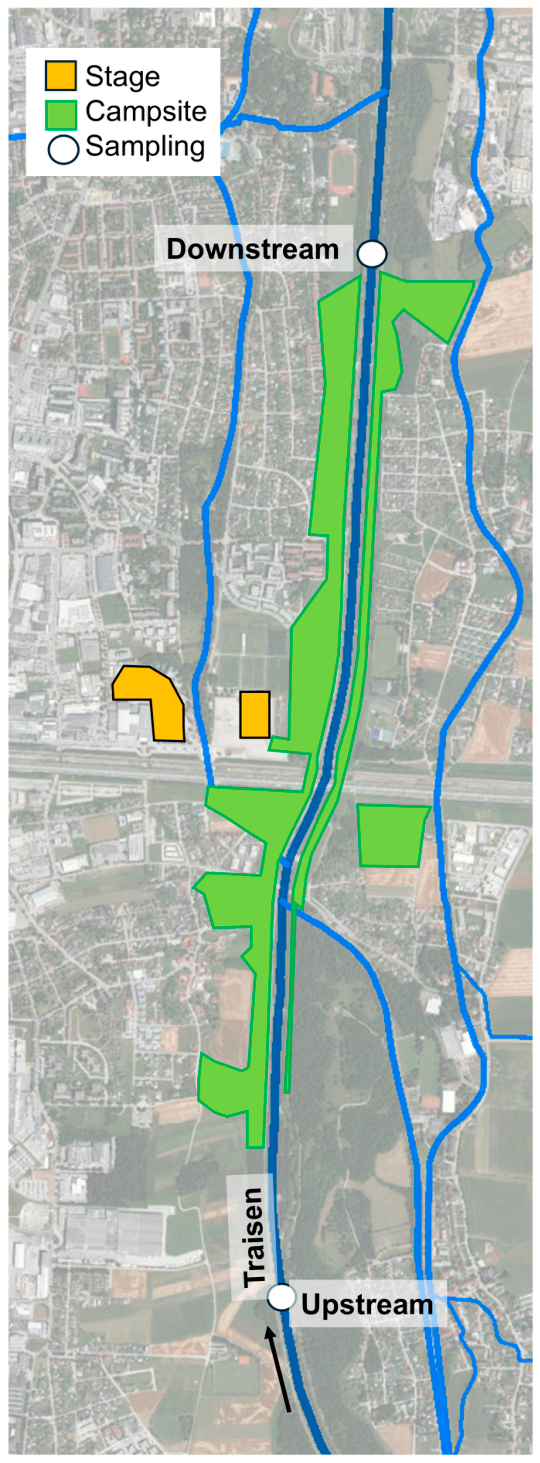
Figure 1. Map of the study area with the sampling spot at the upstream and downstream location. The black arrow indicates the flow direction from South to North. Source: basemap.at.
Phycology 06 00066 g001
Figure 2. Weather conditions and discharge of the Traisen river during the study period from May 24th to September 26th, 2018. The dashed area indicates the duration of the Frequency event. Irradiance and air temperature data from weather station St. Pölten Landhaus, Geosphere Austria; discharge from gauge station Windpassing, Hydrographic Service Lower Austria.
Phycology 06 00066 g002
Figure 3. TP, DOC, and chloride amounts during the study period, with sampling stations upstream (US; green dots) and downstream (DS; red dots). The grey areas indicate the festival period (average ± standard error; n = 4).
Phycology 06 00066 g003
Figure 4. Score plot of PCA based on selected, normalized environmental variables showing sampling occasions. The first two principal components are shown. Labeling in the plot: U—upstream, D—downstream, and numbers—sampling date. Symbols according to the period: B—before the festival, D—during the event, and A—after the festival. The insert on the right shows the Pearson correlation coefficients for the principal components >0.35.
Phycology 06 00066 g004
Figure 5. Changes in the chlorophyll-a concentration during the study period. The grey area indicates the Frequency festival (mean and SE, n = 4).
Phycology 06 00066 g005
Figure 6. Relationships between the benthic chlorophyll-a, ash and ash-free dry masses.
Phycology 06 00066 g006
Figure 7. Autotrophic index (AI) from upstream and downstream of the festival area before, during, and after the Frequency festival.
Phycology 06 00066 g007
Figure 8. Phytobenthos class distribution during the study period based on Chl-a as a proxy for biomass. The grey areas indicate the Frequency festival period.
Phycology 06 00066 g008
Figure 9. Algae taxa observed at the upstream and downstream sites of the festival area before, during, and after the Frequency festival. Boxes show the median, 25th and 75th percentiles, and minimum/maximum values.
Phycology 06 00066 g009
Figure 10. Phytoplankton community with euplanktonic, resuspended phytobenthos, and indifferent species. Upstream (top) and downstream site (bottom). The grey areas indicate the Frequency festival period.
Phycology 06 00066 g010
Figure 11. NMDS plot of the algae community. Labeling indicates the site, with U—upstream of the festival area and D—downstream. Numbers show the exact dates (day, month). Symbols according to the period: B—before the festival, D—during the event, and A—after the festival. The right insert shows environmental variables related to the NMDS axis with a Pearson correlation coefficient r > 0.35.
Phycology 06 00066 g011
Table 1. Factor loadings of principal components (eigenvalues > 1). Percentage contribution to the variation; the cumulative variation of these principal components was 70%.
VariableSeason (33%)Pollution (24%)Discharge (13%)
Alk−0.4740.2130.157
Cl−0.133−0.577−0.15
NO3−0.458−0.1790.256
Ptot0.161−0.5150.06
Cond−0.386−0.32−0.522
Temp0.417−0.0510.321
Discharge−0.4360.0820.501
DOC0.09−0.4610.508
Values in bold indicate loadings >0.4 for better visibility.
Disclaimer/Publisher’s Note: The statements, opinions and data contained in all publications are solely those of the individual author(s) and contributor(s) and not of MDPI and/or the editor(s). MDPI and/or the editor(s) disclaim responsibility for any injury to people or property resulting from any ideas, methods, instructions or products referred to in the content.