


Abstract
Dulce (Palmaria palmata) is a high-value macroalga that is increasingly being cultivated, with strong potential for waste valorisation in nutrient-rich aquaculture systems (RASs). This study evaluated P. palmata growth in, and nutrient uptake from, commercial Atlantic salmon RAS effluent. A 12-week bench-scale experiment cultivated wild-collected P. palmata (average 10 g fresh weight, FW). These were grown in 1 L glass beakers at three effluent dilutions (25%, RAS25; 50%, RAS50; 100%, RAS100) and in seawater (SW) using 10 replicates. The water samples were analysed for ammonium nitrogen (NH4-N), nitrate nitrogen (NO3-N), and orthophosphate (PO4-P) using a spectrophotometer. RAS25 and RAS50 exhibited 100% survival and maintained a dark red colour, with RAS50 achieving the highest specific growth rate (0.49 ± 0.13% day−1), significantly higher than that of SW and RAS25. In contrast, RAS100 led to complete disintegration by 4–8 weeks with significant colour degradation. SW also exhibited reduced colour and 50% mortality by week 12. Sori’s presence was highest in RAS25/RAS50 (up to 80% at week 8 in RAS50), low in SW (10%), and absent in RAS100. The NH4-N uptake was notably 3× higher than that of NO3-N (0.16 vs. 0.05 mg g FW−1 day−1), without differences among the groups. The PO4-P uptake was significantly higher for RAS50 (0.07 mg g FW−1 day−1) than for RAS100. P. palmata performed best in the diluted RAS effluents, as undiluted conditions led to acute tissue disintegration; the nitrogen and phosphorus uptake from the RAS effluents demonstrates significant potential for nutrient valorisation.
1. Introduction
The Dulse (Palmaria palmata) is a red macroalgae widely distributed across the North Atlantic [1]. It is a popular and highly valued macroalgae species in Western markets, consumed as a snack, food supplement, and culinary ingredient [2], with an estimated market value of €5 to €47 per 100 g of dried product [3].
Wild harvesting remains the primary source of P. palmata, with annual landings reaching 38 to 100 dry tonnes in New Brunswick, Canada, and 138 to 458 dry tonnes in France [3]. However, systematic reporting of wild P. palmata harvests to the Food and Agriculture Organization (FAO) is lacking. Despite its broad geographic distribution and abundance, the harvestable biomass of P. palmata is limited by interannual stock variations, seasonal availability, and regulatory frameworks [3,4]. These limitations have spurred research and development into its cultivation.
Cultivation efforts for P. palmata aim to increase production availability and quality predictability, though large-scale commercial enterprises have not yet been established. However, there are a few examples of small–medium companies, such as a Portuguese company that has operated a semi-commercial land-based P. palmata cultivation using vegetative propagation since 2013, producing up to 2 wet tonnes per year [3]. The same review article stated that pre-commercial trials were also underway in Eastern Canada, while companies in the USA, Denmark and Norway were developing spore and seedling production for sea-based deployment. While cultivation in open-sea environments and through sexual reproduction offers potential, it faces significant challenges due to the uncontrolled nature of the external environment, hindering its large-scale implementation [3,4]. Dulse cultivation typically uses vegetative propagation from blade fragments in indoor or outdoor tank systems. Successful cultivation requires maintaining low water temperatures (ideally 8–15 °C) [5] and moderate light levels (60–100 µmol photons m−2 s−1); however, recent work found peak growth at 200 µmol photons m−2 s−1 [6,7]. Another study demonstrated that P. palmata exhibited an increased growth rate and no signs of chronic photoinhibition at irradiances of up to 1600 μmol m−2 s−1 under a 16 h light per day photoperiod. While P. palmata exhibits broad salinity tolerance (15–50 practical salinity units; PSU), its optimal growth occurs in full-strength seawater (32 PSU). However, genetic and environmental factors can influence its physiological responses; for instance, Schmedes and Nielsen [6] demonstrated that 15 PSU supported maximal growth of fronds from Danish inner waters, outperforming rates at 25 or 35 PSU, especially under nutrient-restricted conditions.
Nutrient enrichment, particularly inorganic carbon, nitrogen, and phosphorus, is essential for sustained growth under controlled conditions and generally results in higher growth rates. It has also been documented that P. palmata strongly prefers ammonium (NH4+) over nitrate (NO3−) as a nitrogen source due to the lower energy cost of assimilation [8]. Phosphorus is also crucial for P. palmata, as shown by the correlation between orthophosphate (PO4-P) availability and nitrogen uptake, where phosphorus limitation constrained nitrogen assimilation, protein synthesis, and growth [8].
The integration of aquaculture with P. palmata aquaponics has been explored by several studies for nutrient recycling, using fish effluents to fertilize the macroalgae [4,7,8]. Recirculating aquaculture systems (RASs) are production systems designed to treat and reuse water, achieving water reuse rates of up to 99% through various treatment units, including solids filtration and biological reactors [9]. Nevertheless, non-toxic compounds, particularly nitrate (the end product of ammonium oxidation) and orthophosphate (not fully assimilated by fish), tend to accumulate. A survey of six commercial RASs found nitrate to range between 27 and 92 mg L−1, whereas orthophosphate ranged between 2.1 and 22 mg L−1 [10]. Increasing regulatory pressure to limit nutrient discharge into the environment—where it can contribute to eutrophication—is driving the implementation of additional chemical and biological treatment processes for RAS farm effluents. The current driver for the development, construction, and operation of RASs worldwide is the Atlantic salmon (Salmo salar) aquaculture industry, which produces approximately 2.8 million tonnes of fish annually [11]. All juveniles (smolt) are produced in land-based systems before the growth phase at sea, and a majority of these systems, 50–70%, are specifically RASs [12]. Historically, freshwater use limited RAS application for seawater macroalgae; however, the salmon industry is now extending the growth period on land by rearing fish in brackish water (12–20 PSU) [13]. This development has created an opportunity to explore the feasibility of cultivating valuable macroalgae in nutrient-rich salmon effluent water, thereby simultaneously reducing nitrogen and phosphorus discharge into the environment. For instance, P. palmata integrated into a commercial Atlantic halibut (Hippoglossus hippoglossus) RAS for one year showed the highest growth rates (1.1% day−1) in effluent water at 8–9 °C and elevated tissue nitrogen content (4.2–4.4% DW) compared to a seawater control [8]. Given the greater commercial production of Atlantic salmon compared to Atlantic halibut, there is significantly more opportunity to produce macroalgae in discharge water from salmon facilities. However, the potential for P. palmata to grow in and uptake nutrients from commercial Atlantic salmon RAS effluent remains to be fully elucidated. In the current trial, all treatments were adjusted to 32 PSU for standardization, and this must be considered when discussing the results.
The objective of the present study was to conduct a bench-scale exploratory experiment to evaluate both the growth performance and nutrient uptake of P. palmata cultured in different dilutions of commercial Atlantic salmon RAS effluent and seawater over a 12-week period. The experimental hypothesis was that the addition of dissolved nutrients in the discharge water from fish farming facilities is beneficial to the growth of P. palmata.
2. Materials and Methods
2.1. Experimental Design, Dulse and Water Matrices
The current study consisted of evaluating the growth and nutrient uptake of P. palmata cultivated in effluent from a commercial Atlantic salmon RAS. For this purpose, 40 macroalgae specimens were collected from the shore of Tromsø island in Norway, at approximately 69°64′39.06″ N, 18°95′62.94″ E, in mid-November 2024. The plants were collected randomly and without bias for size or possible reproductive condition (presence/absence of sori). After collection they were sorted and cleaned by hand to ensure a minimum of epiphytes were present. The specimens were moved to the research facilities of Nofima AS, Tromsø, Norway, and kept in seawater at 32 PSU, 6 °C water temperature, under an 18:6 light:dark photoperiod, at a light intensity of 40 PAR, in 20 L tanks for 2 weeks for acclimatization.
The experiment involved five treatment groups, each with ten replicates. These groups consisted of four varying water compositions: (i) 25% RAS water with 75% seawater (named RAS25), (ii) 50% RAS water with 50% seawater (named RAS50), (iii) 100% RAS water (named RAS100), and (iv) 100% seawater used as a control (named SW). The fifth group, a control, consisted of ten replicates with 100% RAS water but without P. palmata, and was included for the initial four weeks. This RAS-only control (P. palmata) was included to quantify background nutrient loss. A similar control was not used for the RAS 25/50/SW because the nutrient concentrations in these mixes were stable and below detection limits for SW, nor for the RAS100, which represented the highest expected background microbial activity, and thus could be monitored for changes in nutrient concentrations.
Each replicate consisted of a 1 L glass beaker with a P. palmata specimen with an average fresh weight (FW) of 10 g and an average cluster length of 90 mm. The initial stocking density of P. palmata was 10 kg FW m−3. All specimens looked healthy, with a colour score of 5.5 (bright dark red). Each glass beaker had its own air supply, with continuous air at a rate of 3.0 L air/minute.
The seawater was collected from the Nofima land-based research facility in Kvaløya, Tromsø, Norway, and the RAS water was collected from a freshwater commercial Atlantic salmon smolt RAS effluent from the Troms region. Both water samples were moved to Nofima facilities and stored in 10 L canisters at −20 °C. Sub-samples were defrosted as needed for the experiment. One day prior to use, both the seawater and RAS water were sterilized using a high-pressure steam sterilizer (SX-700E, TOMY Digital Biology, Nerima, Japan). They were then mixed according to the treatment (100%, 50%, or 25% RAS freshwater), and artificial sea salt (Instant Ocean, Blacksburg, VA, USA) was added to all water mixtures to achieve a consistent initial salinity of 32 PSU.
2.2. Experimental Set-Up, Sampling and Analysis
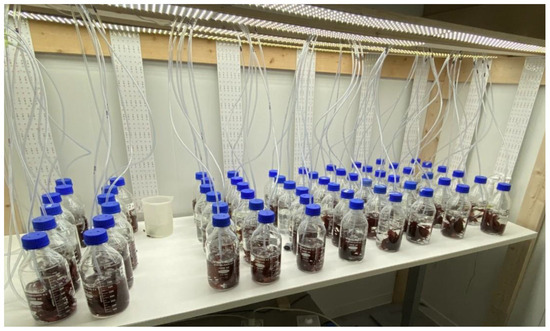
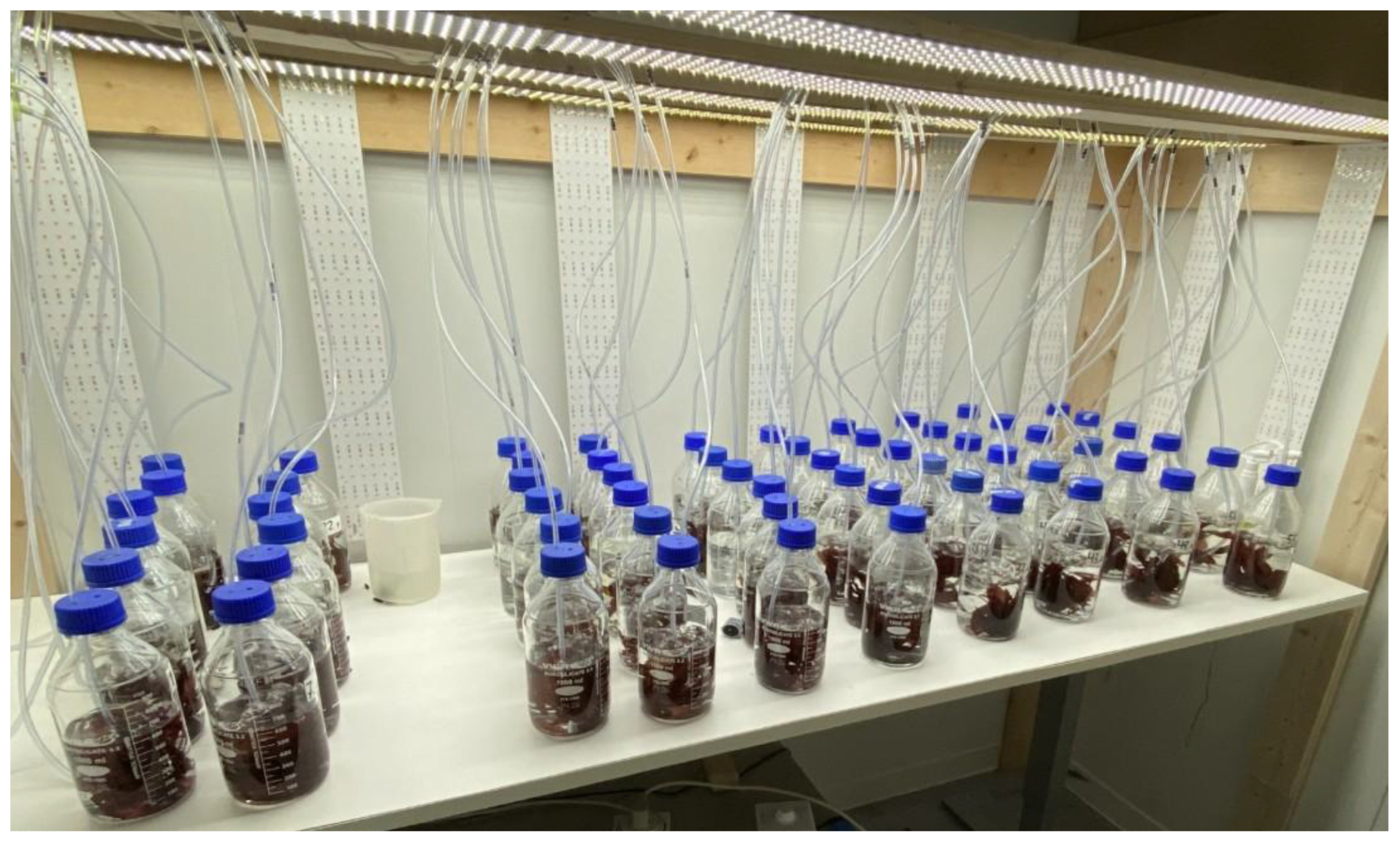
The experimental set-up consisted of fifty identical 1 L glass beakers, with an air stone to supply constant aeration, placed in a temperature-controlled room (constant 10 °C) (Figure 1). The specimens were cultured under LED lights at a photosynthetic photon flux density (PPFD) of 40 µmol photons m−2 s−1 (LUX 2600), with a photoperiod set to 18 h light:6 h dark.
Figure 1.
The experimental set-up used during the trial.
At the beginning of the experiment (week 0), each beaker was filled with 0.7 L of its respective treatment water, and one P. palmata specimen was added. Every 2 weeks (i.e., weeks 2, 4, 6, 8, and 10), the beaker water was fully replaced by the same stored water mix to ensure consistent nutrient supply for algal growth. A 2-week culture interval was selected based on preliminary test results that showed that in these experimental conditions nutrients are typically depleted within this timeframe for a control group, and this schedule balanced sample handling capacity while ensuring stable and repeatable conditions between full water exchanges.
Water samples (50 mL) were taken immediately before water removal and again after new water was added. These samples were stored in falcon tubes at −20 °C until analysis. This allowed for the determination of initial and final nutrient concentrations for each 2-week period, enabling the estimation of nutrient uptake.
Water samples were analysed for ammonium nitrogen (NH4-N; Spectroquant test kit No. 114752), nitrate nitrogen (NO3-N; Spectroquant test kit No. 109713), and orthophosphate (PO4-P; Spectroquant test kit No. 114848) using a Spectroquant Prove 100 spectrophotometer (all Merck KGaA, Darmstadt, Germany).
The P. palmata specimens were removed from their beakers every 4 weeks (i.e., weeks 0, 4, 8, and 12) for determination of fresh weight, cluster length, sori (spore-bearing structures) presence, and colour assessment. For each specimen, the maximum cluster length was determined by extending the longest frond from the holdfast to its distal tip. The sori on individual P. palmata specimens were visually assessed by direct observation and microscopy to confirm spore presence at weeks 0, 4, and 8. For each specimen, the presence or absence of visible sori was recorded, and the proportion of individuals with sori per treatment was calculated. Sori assessment could not be performed at week 12 due to logistical constrains associated with the final sampling procedures.
Using the fresh weight collected, the specific growth rate (% day−1) was calculated using the following Equation (1):
where FWi and FWf are the fresh weights (in g) on days T1 and T2, respectively.
The nutrient uptake rates for ammonium nitrogen, nitrate nitrogen, and orthophosphate were calculated in mg g FW−1 day−1 using Equation (2):
where Ci1/ Ci2 and Cf1/ Cf2 represent the nutrient concentrations (mg L−1) at the start and end of a two-week water exchange period, FWi and FWf represent the fresh weight (g) of P. palmata at the start and end of a four-week growth period, v is the water volume in the glass beaker (0.7 L), and d is the number of days. The fifth group, a control, comprising ten replicates of 100% RAS water without P. palmata, was used to quantify changes in water quality not attributable to P. palmata. The uptake rates were corrected by subtracting the concentration changes observed in this control group, ensuring that differences in nutrient concentrations were attributed specifically to uptake by P. palmata.
The removal efficiency for ammonium nitrogen (NH4-N), nitrate nitrogen (NO3-N), and orthophosphate (PO4-P) was calculated as percentage removal. This was determined as the percentage of nutrient removed per P. palmata within each two-week interval between water exchanges. The results were then averaged over the 12-week experimental period for the RAS25 and RAS50 treatments. For the RAS100 treatment, the data were averaged only for the first 4 weeks, as the P. palmata specimens began to disintegrate thereafter. The nutrient concentrations in the SW treatment water were consistently below the limit of detection and therefore the uptake rate and removal efficiency could not be calculated for this treatment. The calculation followed Equation (3):
The colour of the P. palmata specimens was assessed and scored using a scoring system (1 to 8) developed for this study and described in Table 1.
Table 1.
Visual colour score, hexadecimal code, and corresponding description for P. palmata.
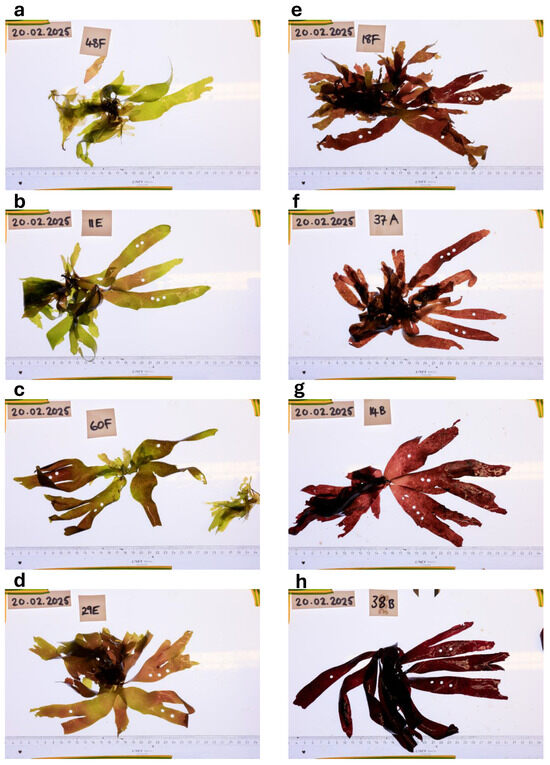
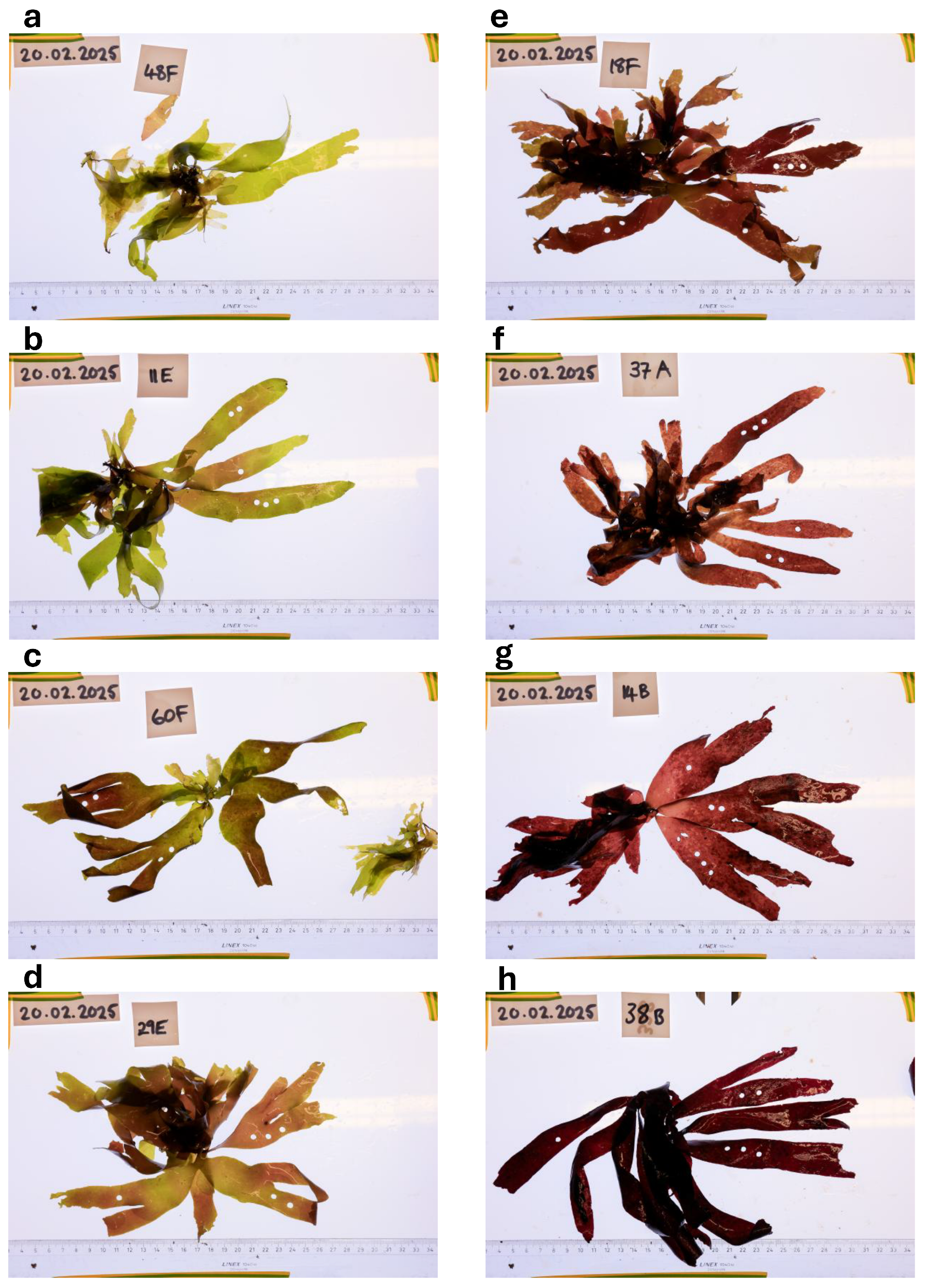
For this, the specimens were removed from the glass beaker and placed on a white board under standardized lighting, and a fixed-distance camera was used to take a photograph, as exemplified in Figure 2. This was done for all 40 replicates in weeks 0, 4, 8 and 12 for all treatments. There was one exception; in week 12, there was no scoring for the RAS100 replicates, which was due to the P. palmata specimens’ disintegration and exclusion from the study. Thereafter, the P. palmata specimens were scored by visually comparing the photographs and the colour palette developed. In Figure 2, punched holes are visible in the P. palmata fronds. These holes were made to tag specific fronds for individual growth measurements during the trial. However, the resulting data were unclear and therefore are not presented.
Figure 2.
Representative images for P. palmata specimens showing the full range of observed colour at the end of the experimental period (week 12). The colour score ranged 1–8 (a–h), as described in Table 1.
2.3. Data and Statistical Analysis
Statistical analyses were performed with JMP Student Edition 18.2.0 (JMP Statistical Discovery LLC, Cary, NC, USA).
Individual glass beakers with a single P. palmata specimen were considered replicates.
Water quality results that were below the spectrophotometer test kit detection limit were assigned the limit of detection (LOD) value (i.e., 0.05 mg L−1 for ammonium nitrogen, 1.0 mg L−1 for nitrate nitrogen, and 0.05 mg L−1 for orthophosphate). The fifth group, comprising ten replicates with 100% RAS water but no P. palmata, was used to quantify and correct for changes in water quality not attributable to P. palmata. This control revealed a +46% change for nitrate nitrogen, −19% for ammonium nitrogen, and −4.6% for orthophosphate, which was then applied to correct the water sample results from the other four treatments. Due to concentration resets at each water replacement, nutrient uptake was calculated per 2-week interval and not averaged across time points. Homogeneity of variances was assessed using Levene’s test, and normality was assessed using a Shapiro–Wilk test. Data underwent transformation as necessary to meet parametric test assumptions. Count data, or other data that did not meet assumptions of normality or homogeneity of variance, were transformed using log10 (x + 1). Percentage data were transformed using arcsin√ (x/100) before analysis. One-way ANOVA was used to compare differences among treatment groups for continuous data, i.e., growth performance, nutrient removal efficiency and uptake rate. When significant differences were observed, Student’s t-tests were used for pairwise comparisons. For categorical data (i.e., colour scoring and sori presence), Likelihood Ratio Chi-Square was used to assess differences among treatment groups. This was followed by analysis of means for proportions (ANOM-P) to identify specific group proportions significantly different from the overall average. A significance level (α) of 0.05 was used for all analyses. All data are presented as average ± standard deviation (S.D.).
3. Results
3.1. Growth Performance
Survival of P. palmata at the end of the 12-week experiment varied among treatments. The specimens in the RAS25 and RAS50 treatments maintained 100% survival. In contrast, 50% of the specimens in the SW treatment disintegrated between weeks 10 and 12, and all specimens in RAS100 disintegrated between weeks 4 and 8. For this reason, most parameters for RAS100 are only available until week 4.
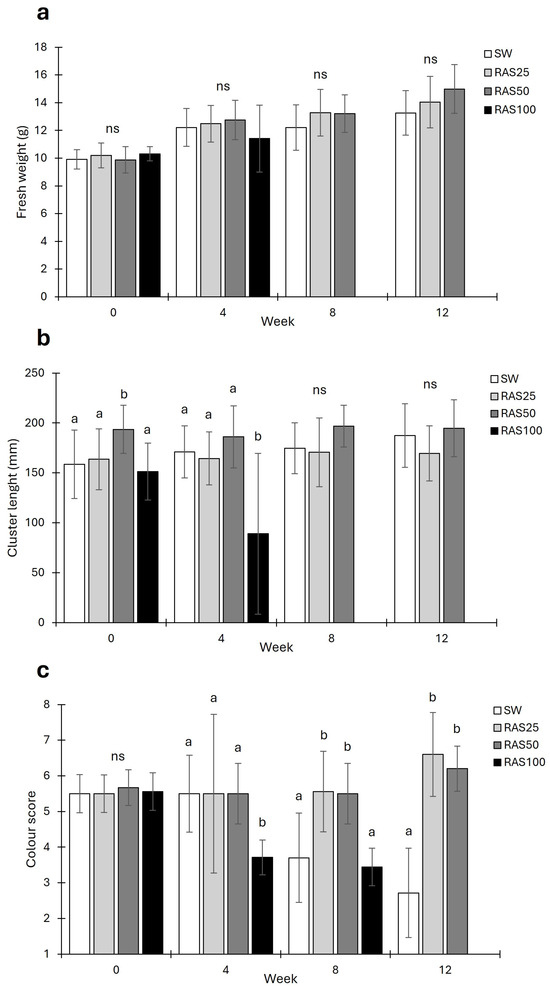
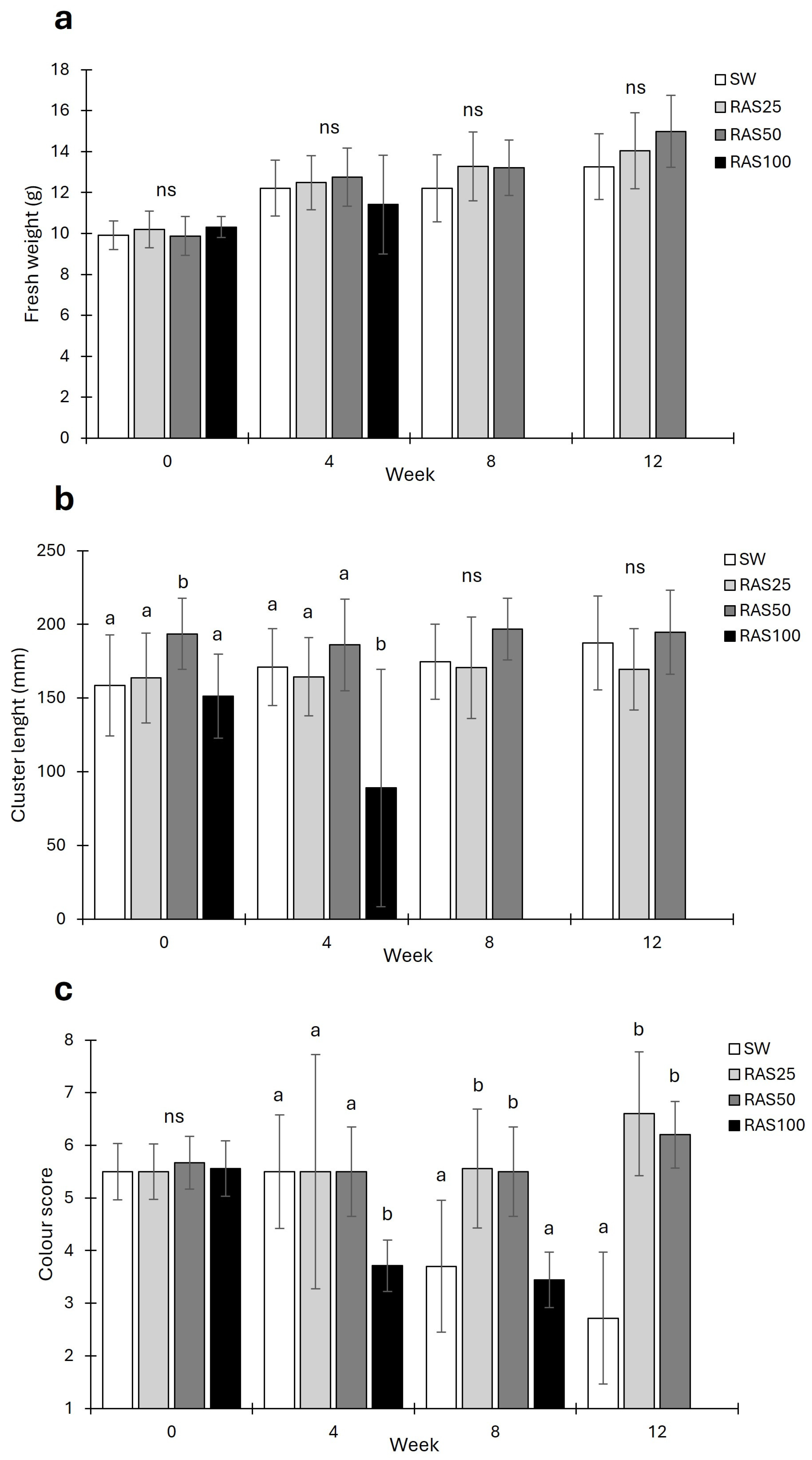
The fresh weight of P. palmata did not significantly differ among the treatments when compared at any measured time point (weeks 0, 4, 8, or 12). The average fresh weight (±S.D.) was 10.1 ± 0.8 g at week 0 and increased to 14.3 ± 1.8 g at week 12 (Figure 3a).
Figure 3.
P. palmata (a) fresh weight (g), (b) cluster length (mm), and (c) colour score throughout the 12-week experimental period. Data are shown as mean ± S.D (n = 10 per treatment, except SW at Week 12, where n = 5). Lowercase letter superscripts represent significant differences among treatments within each week; ns (non-significant) indicates no significant difference. Note, RAS100 has 100% mortality by week 8.
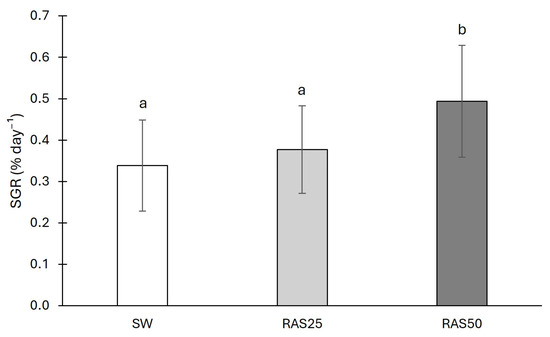
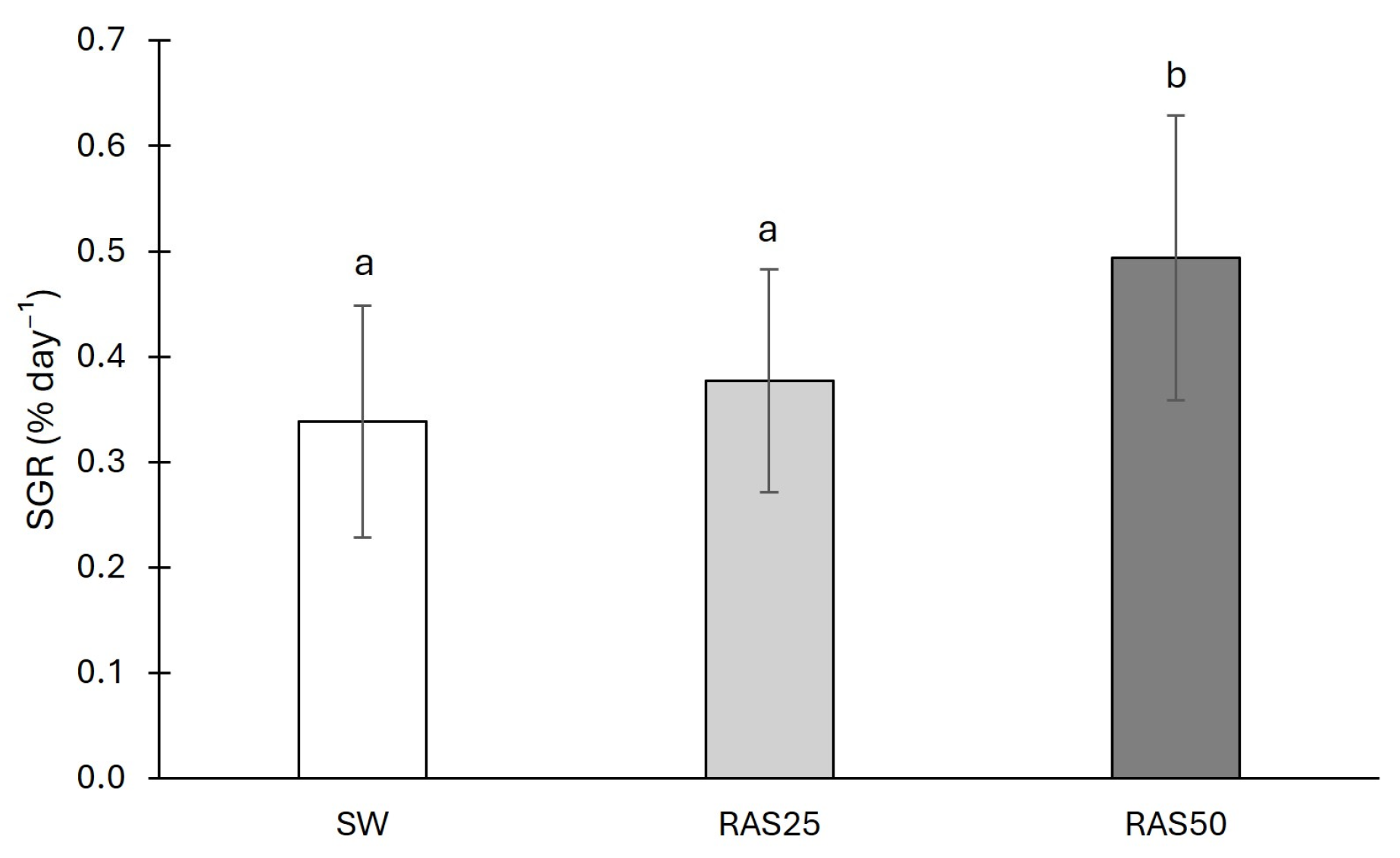
The 12-week SGR of P. palmata in RAS50 (0.49 ± 0.13% d−1) was significantly higher (p = 0.042) than in the specimens grown in SW (0.34 ± 0.11% d−1) and RAS25 (0.38 ± 0.11% d−1) (Figure 4). Specifically, RAS50 showed a 46% higher SGR compared to SW and a 31% higher SGR compared to RAS25.
Figure 4.
P. palmata specific growth rate (% d−1) for the 12-week experimental period for SW (white), RAS25 (grey) and RAS50 (dark grey). Data are shown as mean ± S.D. (n = 10 per treatment, except SW, where n = 5). Lowercase letter superscripts represent significant differences among treatments.
The P. palmata cluster length showed specific significant differences. It was significantly higher for RAS50 (23% higher) at week 0 (p = 0.016) and significantly lower for RAS100 (49% lower) at week 4 (p < 0.001) relative to the other treatments (Figure 3b). For the remaining weeks, the cluster length did not significantly differ among the RAS25, RAS50, and SW treatments. The average cluster length (±S.D.) was 166.8 ± 32.3 mm at week 0 and 183.2 ± 29.4 mm at week 12.
3.2. Colour and Sori
Initially, P. palmata had a colour score of 5.6, generally reflecting a dark red hue. At week 4, the colour score for RAS100 was 3.7, appearing red orange. This was significantly lower (p = 0.006) compared to the other treatments, which remained 5.5, dark red. By week 8, both the RAS100 (3.4) and SW (3.7) treatments exhibited significantly lower colour scores (p < 0.001), changing to or remaining a red orange. In contrast, the RAS25 and RAS50 treatments maintained a score of 5.5–5.6, reflecting a dark red colour during this period. At week 12, the colour score for SW was 2.7, which was significantly lower, appearing as a dark orange brown (p < 0.001). Meanwhile, the RAS25 and RAS50 treatments’ colours deepened to 6.2–6.6, a very dark red (Figure 3c).
At the start of the experiment (week 0), the percentage of sori presence did not significantly differ among the treatments, ranging between 0 and 20% within the P. palmata specimens per treatment (Table 2). No sori were observed in the RAS100 treatment throughout the trial. In contrast, the RAS25 and RAS50 treatments exhibited the highest incidence of sori, significantly different (p < 0.001) from the other groups, reaching up to 60–80% of individuals by weeks 4 and 8. The SW treatment showed low sori presence (10%) by weeks 4 and 8.
Table 2.
Percentage (%) of P. palmata specimens exhibiting visible sori per treatment at weeks 0, 4 and 8 (n = 10). Lowercase letter superscripts represent significant differences among treatments.
3.3. Nutrient Removal Efficiency and Uptake Rate
The initial nutrient concentrations differed across treatments, reflecting the dilution gradient of RAS effluent. In the RAS100 treatment, the average initial concentrations of NH4-N, NO3-N, and PO4-P were 2.4, 7.0, and 3.2 mg/L, respectively; while RAS50 had corresponding concentrations of 1.4, 4.4, and 1.7 mg/L; and RAS25 had the lowest concentrations of 0.5, 2.4, and 0.9 mg/L. The SW measurements were below the detection level. The values from the fifth group, a control (100% RAS water without P. palmata), for the NH4-N, NO3-N, and PO4-P concentrations were 2.1, 6.2, and 3.3 mg/L, respectively.
In the RAS100 control without P. palmata, the nitrate concentrations increased by 46%, while ammonium decreased by 19% and PO4-P declined by 4.6%. These changes likely reflect microbial nitrification converting ammonium to nitrate, along with minor phosphorus losses through adsorption or precipitation processes occurring in the stored water.
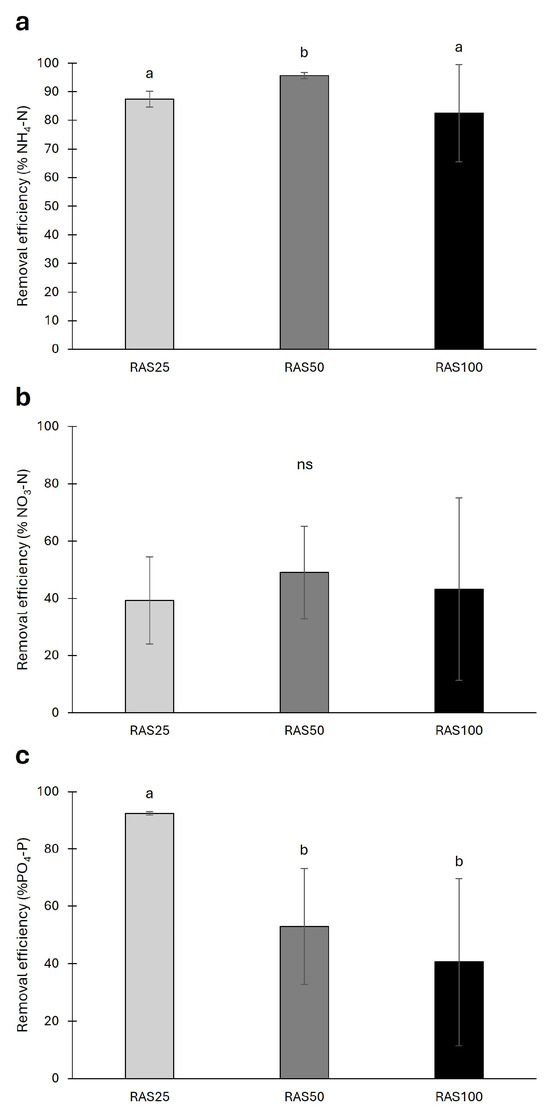
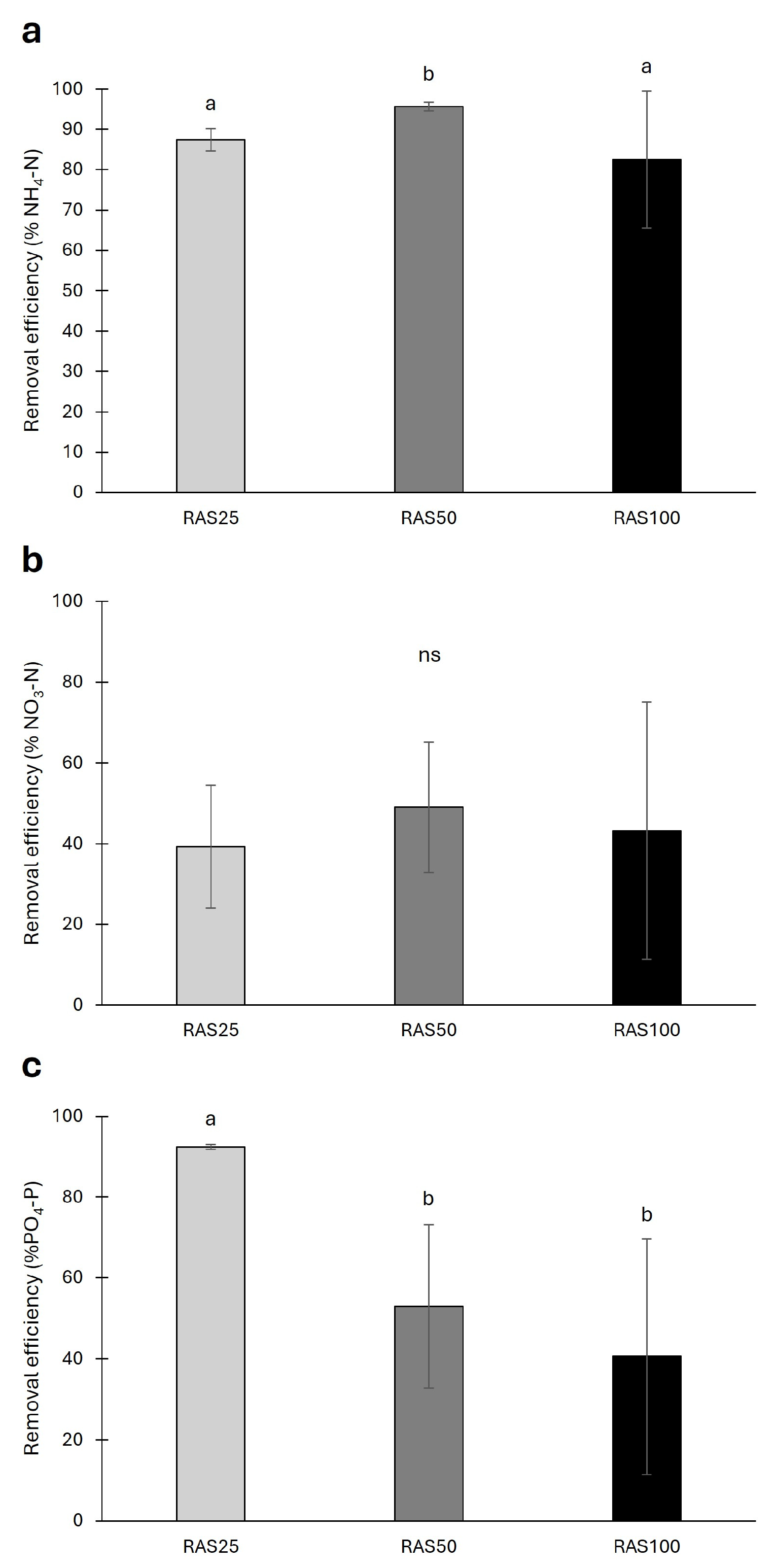
P. palmata demonstrated varying nutrient removal efficiencies across the treatment groups. Percentages nearing 100% signify that those individuals consumed nearly all available nutrients from the water within the two-week water renewal cycles. Ammonium nitrogen (NH4-N) removal was significantly higher for RAS50 (96.0 ± 1.0%) compared to RAS25 (87.0 ± 3.0%) and RAS100 (83.0 ± 17.0%) (p = 0.029) (Figure 5a). Nitrate nitrogen (NO3-N) removal did not differ significantly among the treatments, with average removal rates ranging from 39% to 49% (Figure 5b). In contrast, orthophosphate (PO4-P) removal was significantly higher for RAS25 (92.0 ± 1.0%) compared to RAS50 (53.0 ± 20.0%) and RAS100 (41.0 ± 29.0%) (p < 0.001) (Figure 5c). The nutrient concentrations in the SW treatment were below the limit of detection for all three parameters.
Figure 5.
Ammonium nitrogen (NH4-N) (a), nitrate nitrogen (NO3-N) (b) and orthophosphate (PO4-P) (c) removal (%) by P. palmata cultured at different RAS water mixes, averaged for 12-week experimental period. RAS25 SW (grey), RAS50 (dark grey) and RAS100 (black). RAS100 data were averaged only for first 4 weeks, as P. palmata specimens began to disintegrate thereafter. Data are shown as mean ± S.D. (n = 8–10 per treatment). Lowercase letter superscripts represent significant differences among treatments; ns (non-significant) indicates no significant difference.
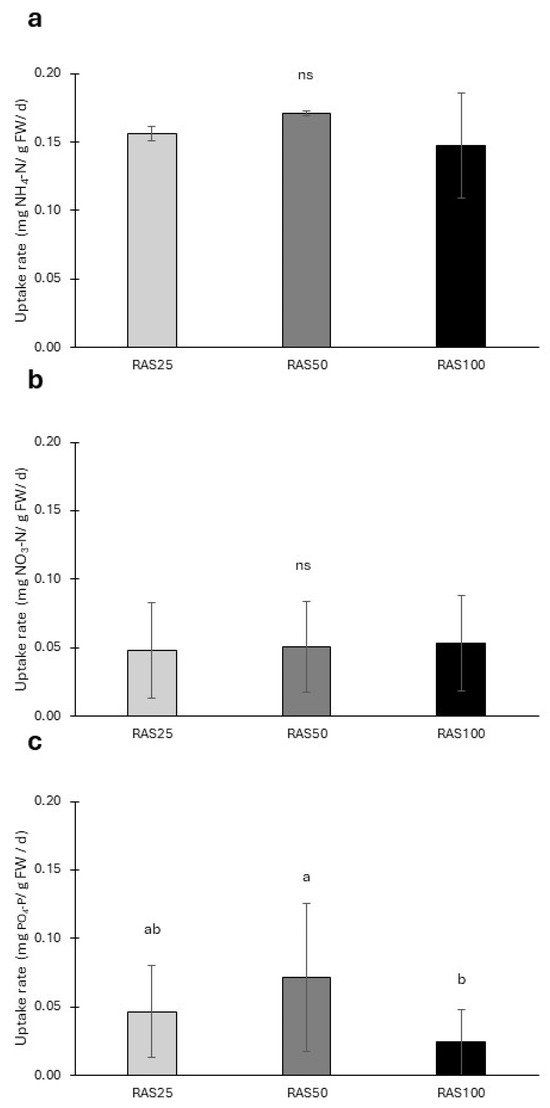
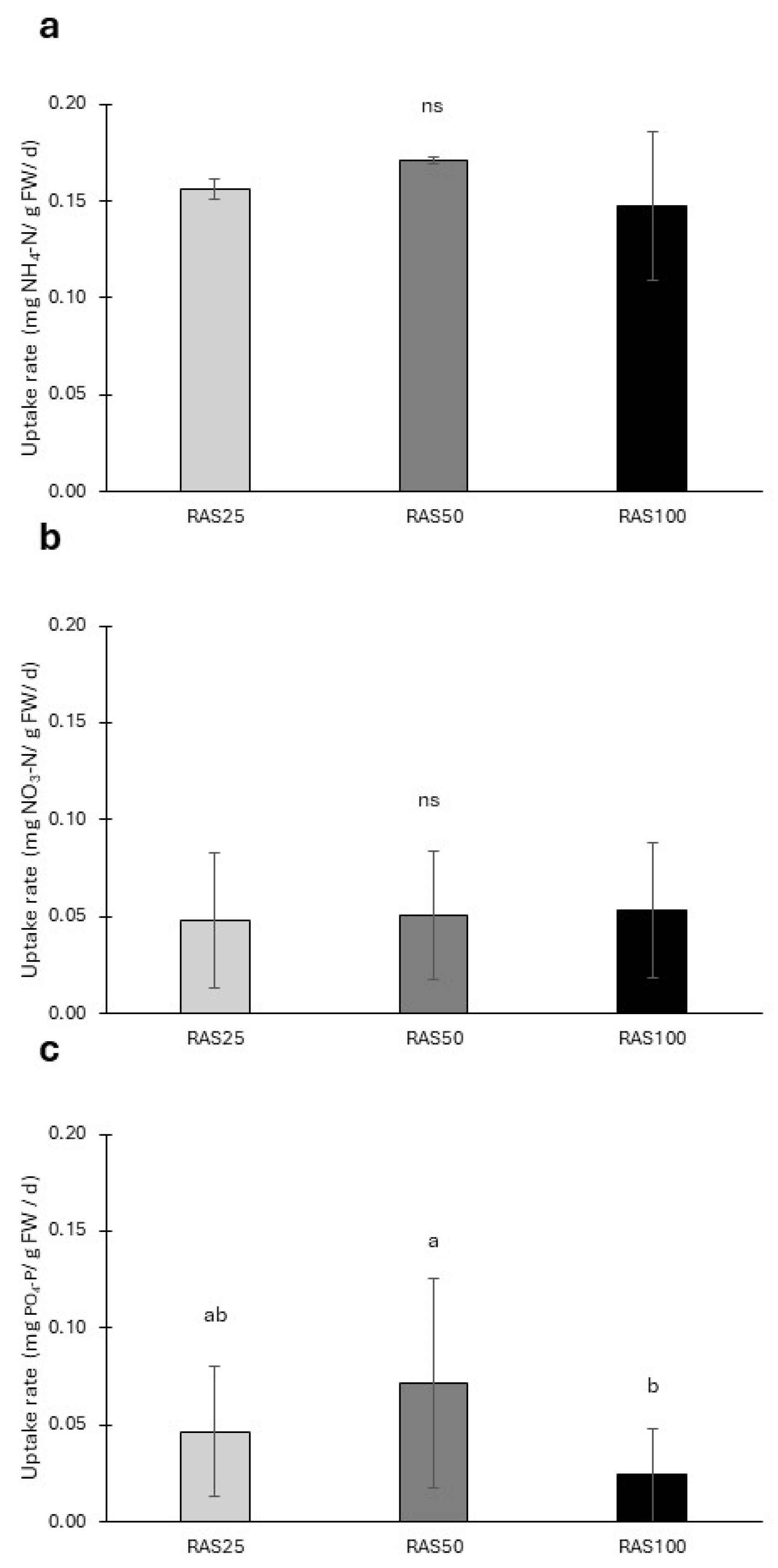
The nutrient uptake rates for P. palmata, defined as the amount of nutrient assimilated per gram of fresh weight increase, varied among the treatments and nutrient types. Uptake rates of ammonium nitrogen (NH4-N) and nitrate nitrogen (NO3-N) did not significantly differ among treatments. The average uptake rates were, on average, 0.16 mg g FW−1 d−1 for NH4-N (Figure 6a) and 0.05 mg g FW−1 d−1 for NO3-N (Figure 6b), respectively. Notably, the NH4-N uptake rate was approximately three times higher than that of NO3-N. In contrast, orthophosphate (PO4-P) uptake was significantly higher (p < 0.031) for RAS50 (0.07 ± 0.05 mg g FW−1 d−1) compared to RAS100 (0.02 ± 0.02 mg g FW−1 d −1). RAS25 (0.05 ± 0.03 mg g FW−1 d −1) showed no significant differences from these groups (Figure 6c).
Figure 6.
Ammonium nitrogen (NH4-N) (a), nitrate nitrogen (NO3-N) (b) and orthophosphate (PO4-P) (c) uptake rate (mg g FW−1 day−1) by P. palmata fresh weight (FW) increase in different RAS water mixes during 12-week experimental period. RAS25 SW (grey), RAS50 (dark grey) and RAS100 (black). RAS100 data were averaged only for first 4 weeks, as P. palmata specimens began to disintegrate thereafter. Data are shown as mean ± S.D. (n = 8–10 per treatment). Lowercase letter superscripts represent significant differences among treatments; ns (non-significant) indicates no significant difference.
4. Discussion
Overall, P. palmata exhibited the strongest performance in the diluted RAS effluents, with both RAS25 and RAS50 maintaining 100% survival and consistently dark red pigmentation throughout the 12-week period. RAS50 supported the highest specific growth rate, significantly exceeding that of SW and RAS25, while also showing the highest PO4 P uptake. In contrast, the undiluted RAS100 resulted in rapid colour loss and complete disintegration of all specimens by weeks 4–8, and the SW treatment showed progressive colour degradation and 50% mortality by week 12, indicating nutrient insufficiency. Sori formation was most pronounced in RAS25 and RAS50, low in SW and absent in RAS100. These results collectively show that diluted RAS effluents provide favourable growth conditions while undiluted effluent can induce acute tissue damage. It is important to note that this experiment was conducted in small, static batch cultures with autoclaved water, which differ fundamentally from the continuous flow conditions of commercial RAS, where nutrient delivery and removal occur constantly. As a result, the nutrient uptake values reported here should not be extrapolated to predict full-scale bioremediation performance. Instead, the batch approach enabled a controlled comparison among the RAS dilution levels, allowing us to assess how effluent strength influences P. palmata survival, growth, pigmentation, reproductive development, and nutrient assimilation under standardized laboratory conditions.
P. palmata exhibits a distinctive seasonal growth cycle in the wild, primarily driven by water temperature, light irradiance and photoperiod. Studies on P. palmata population dynamics in northern Spain and West Norway found that maximum growth rates typically occur during periods of peak irradiance and photoperiod, leading to maximum frond lengths by August [14,15]. As the growing season concludes, the same studies found that fronds, particularly apical sections, show signs of senescence, leading to death or breakage. This damage is often exacerbated by high summer temperatures and low external nutrient concentrations. In the current study, the P. palmata individuals grown in the RAS25 and RAS50 treatments maintained 100% survival for the entire 12-week experimental period. In contrast, all the specimens in RAS100 had disintegrated between weeks 4 and 8, and 50% of the specimens in the SW treatment disintegrated between weeks 10 and 12. The low survival in SW, coupled with a reduction in the colour score (a change from dark red to dark orange brown), indicates tissue decay. Several factors have been suggested to lead to such decay, including high light irradiance, reduced water movement, low nutrient supply, or a high supply of toxic components like ammonia (NH3+) [16]. In the current study, it is likely that tissue decay and, thus, the lower survival in the SW treatment were linked to insufficient nutrient availability. The water was renewed every two weeks, and the available nutrients may not have been sufficient to sustain P. palmata survival. Macroalgae are able to store surplus nutrients in their tissue [16], and P. palmata in the SW in the current study likely utilized those stores accumulated while growing in the wild during the initial weeks of the experimental trial. Consequently, the visible effects, such as colour bleaching by week 8 and the disintegration of 50% of P. palmata specimens by week 12, only became apparent once those stored nutrients were likely depleted. In contrast, the RAS100 observations were more acute: by week 4, the P. palmata specimens were bleaching, the colour score had changed from 5.6 to 3.7, and the specimens in all 10 replicates disintegrated between weeks 4 and 8. A possible cause of this in nutrient-enriched culture media is ammonium toxicity. A study found that a supply of NH4+ at 500 µM (approximately 7 mg L−1 NH4-N) led to bleached tissue and reduced growth within 3 weeks [16]. However, the RAS100 NH4-N was 2.3 mg L−1 on average, which is 3x lower compared to the previous study, and is within the range of ammonium enrichment reviewed by Lafeuille and Tamigneaux [7], i.e., 100–500 µmol (1.4–7.0 mg L−1 NH4-N). Another possible cause is the accumulation of substances originating from feed, fish, or bacteria in the RAS associated with the high water reuse degree, including heavy metals originating from the fish feed premix [17]. To the authors’ knowledge, this effect has not been previously reported in P. palmata cultures utilizing fish RAS effluent. However, similar issues have been observed in other aquatic species; for instance, common carp (Cyprinus carpio) eggs incubated with water from an RAS operated at low water renewal rates exhibited reduced egg hatching, increased larval mortality, and impaired larval development, which was suggested to be linked to heavy metal accumulation, specifically arsenic and copper [18]. Another toxic substance that can accumulate in commercial RAS is hydrogen sulphite (H2S), produced by anaerobic–anoxic microbial consumption of organic matter [19]. This is particularly the case in water rich in organic matter and low oxygen, as was the effluent water used in the current study. Kelp (Nereocystis leutkeana) exposed to H2S showed reduced growth rates [20]. Whether undiluted RAS water from commercial intensive farms contain accumulated substances, such as metals or H2S, that can impair P. palmata cultivation should be further investigated. Therefore, depending on the water renewal rates and substance accumulation, employing a water dilution (e.g., 25–50%) could significantly improve P. palmata cultivation outcomes.
The growth rate of P. palmata is influenced by several environmental factors, with Lafeuille and Tamigneaux [7] summarizing various impacts on the SGR in land-based P. palmata cultivation, including algal density, culture vessels, water source, salinity, temperature, light intensity, light photoperiod, nutrient enrichment, and N:P ratio. The specific growth rates reported in the literature typically vary from 0.33 to 12% day−1. For instance, the lowest SGR of 0.33% day−1 was associated with 20 cm fronds, 5 kg FW m−2 density in a 140 L indoor tank, raw seawater (29 PSU, 9 °C), a light intensity of 50 µmol photons m−2 s−1, 18:6 light:dark photoperiod, and no nutrient enrichment [7]. On the other hand, the highest rates, up to 12% day−1, were observed by Pang and Lüning [21] with 7–10 cm long fronds at 4.2 kg FW m−2 in a 60 L indoor tank, using filtered seawater at 10 °C, a light intensity of 1600 µmol photons m−2 s−1, 18:6 light:dark photoperiod, and enrichment (100 µmol NH4+ and 10 µmol PO43−; approximately 1.4 mg L−1 NH4-N and 0.3 mg L−1 PO4-P). The results from these two studies notably differ, with the substantially higher SGR in Pang and Lüning [21] likely attributed to the significantly higher light intensities and specific ammonium nitrogen enrichment, contrasting with the lower light and un-enriched ambient seawater used by Lafeuille and Tamigneaux [7]. In the current study, the seawater group had a growth rate of 0.34% day−1, which is comparable to the P. palmata growth rates in similar conditions reported by Lafeuille and Tamigneaux [7]. However, even with nutrient levels similar to or higher than those reported by Pang and Lüning [21], the highest growth rate achieved in RAS50 (1.3 mg L−1 NH4-N, 4.3 mg L−1 NO3-N, and 4.3 mg L−1 PO4-P) was considerably lower, at 0.49% day−1. This difference could be due to the difference in light intensity; Pang and Lüning [21] used 1600 µmol photons m−2 s−1, whereas the current study only used 40 µmol photons m−2 s−1. This effect of irradiance on SGR is well documented; for instance, Lafeuille and Tamigneaux [7] showed increasing SGRs (from 0.33 to 0.59% day−1) with increased irradiance (from 50 to 200 µmol photons m−2 s−1). A more comparable study on P. palmata integrated with Atlantic halibut production reported growth rates of 1.1% day−1 [8], but used a considerably higher irradiance range (100–1460 µmol photons m−2 s−1). Therefore, the relatively low light intensity employed in the current study could be partially responsible for the lower-than-expected growth rates of P. palmata grown in nutrient-rich RAS effluent. This study focused on mature P. palmata and it would be worthwhile repeating such studies on newly settled juvenile P. palmata to see whether similar growth rates would be found in different life stages of the species grown in RAS effluent. The reproductive stage could have also influenced the growth rates.
Sori structures, found on the fronds of diploid tetrasporophytes, are where haploid tetraspores develop through meiosis. The formation and maturation of tetrasporangial tissue within sori are primarily triggered by specific environmental cues, such as short-day conditions (e.g., 8 h of light per day) combined with temperatures of 10 °C or below [3]. For example, P. palmata showed massive tetrasporangia development under short-day conditions at 10 °C, but not at 15 °C [22]. In the current study, P. palmata individuals were wild-collected in mid-November in Tromsø, Norway, where the average seawater surface temperature was 7–8 °C (https://seatemperature.info) and the photoperiod was approximately 4 h light:20 h dark (https://www.gaisma.com). Studies of the year-round reproductive status of P. palmata at Trondheimsfjord, Norway indicated that the occurrence percentage of fertile male gametophytes and tetrasporophytes varies, from <10% from May to September to a peak of 30–50% during January–February [3,15]. At the start of the current study, 0–20% of the individuals exhibited sori structures. This may indicate that the wild-captured individuals had finished their growth period (spring–summer) and were in a reproductive maturation phase. Interestingly, these structures were absent in the seawater treatment (SW) throughout the 12-week period but increased to 60–80% by week 12 in the 25% and 50% RAS dilution treatments. Reproductive costs in algae are linked to an increased resource uptake, supported by nutrient reserves or compensated by the photosynthetic capacity of reproductive structures [23]. The high sori presence in RAS25 and RAS50 may have been a result of using wild individuals that were already entering their maturation phase, combined with cultivation in a medium rich in nitrogen and phosphorus that supported the high reproductive cost of sori development. However, while this result suggests an optimal culture medium for P. palmata that supports a very high percentage of sori-producing individuals, it may also have its drawbacks, as vegetative growth is replaced by maturing structures. In aquaculture, preventing sexual maturation is often desired to maximize vegetative biomass, as observed in other aquatic species. These results show that the time of year when wild P. palmata is collected can significantly impact growth performance and sexual maturation. Conversely, if sori induction is the goal, then using RAS-enhanced seawater shows strong potential to encourage sori development.
Nutrient enrichment, particularly with inorganic carbon, nitrogen, and phosphorus, is essential for sustained growth under controlled conditions and generally results in higher growth rates. Moreover, nitrogen and phosphorus uptake by macroalgae are known to increase with elevated nutrient concentrations in an aquatic medium. For example, P. palmata grown for 4 weeks in 1 L flasks at 10 °C enriched with 300 µM of ammonium (4.2 mg NH4-N L−1) and 30 µM phosphorus (0.9 mg PO4-P L−1) registered a nitrogen uptake rate of 1.64 mg N gDW−1 day−1 and a phosphate uptake rate of approximately 0.5 mg P gDW−1 day−1 [24]. In another study, P. palmata cultivated in fully recirculated cold seawater showed rates of 0.65 mg N gDW−1 day−1 and 0.14 mg P gDW−1 day−1 [5], which show how different production conditions can impact the nutrient uptake rates. The latter study also observed that neither the tested nutrient concentrations (NO3−/PO43−: 2865:195, 3570:242, and 4284:291 μM) nor temperature levels (5 and 10 °C) significantly changed the nitrate or phosphate uptake rates, suggesting the lack of difference could be linked to a deficiency in trace elements in the media. In the current study, the nutrient uptake rates for P. palmata were expressed as the amount of nutrients assimilated from the water per gram of fresh weight (FW) increase per day (mg g FW−1 day−1). Due to the unfeasibility of destroying individuals for dry weight (DW) analysis, and since the nutrients were not measured in the plant tissue, a direct comparison with studies reporting DW-based rates is not possible. However, when the absolute uptake rates are converted into a ratio, a comparison is more feasible. For example, the current study observed P. palmata’s maximum nutrient uptake rates as 0.22 mg N (NH4-N + NO3-N) g FW−1 day−1 and 0.07 mg PO4-P g FW−1 day−1, resulting in an approximate N:P uptake ratio of 1:0.3. This N:P ratio is comparable to ratios of 1:0.3 in [24] and of 1:0.2 in [5]. Thus, despite the different methodologies and the challenges of direct comparison, the observed N:P uptake ratio in this study aligns well with findings from similar research. Furthermore, previous studies have shown that both ammonium and nitrate are nitrogen sources for macroalgal growth, although P. palmata has a greater affinity for NH4+. This is further illustrated in the current study, where the uptake rates of ammonium nitrogen (NH4-N) and nitrate nitrogen (NO3-N) ranged from 0.15 to 0.17 mg NH4-N g FW−1 day−1 and 0.05 to 1 mg NO3-N g FW−1 day−1. Not only was the NH4-N uptake approximately three times higher, but the nutrient removal efficiencies also exceeded 83% for NH4-N (indicating complete consumption), whereas only 39–49% of nitrate nitrogen was removed, leaving substantial amounts in the medium after the two-week culture period. In aquaculture effluents, the total ammonia nitrogen (TAN; NH4+ + NH3) is typically kept below 2.0 mg/L due to its toxicity (particularly NH3) to aquatic organisms, including fish. This is achieved by bioreactors in RASs that oxidize TAN into nitrate. Therefore, the more abundant form of nitrogen in RAS effluents is nitrate, typically ranging from 27 to 92 mg L−1 [10]. Those authors also reported a typical inorganic N:P ratio of approximately 10:0.7–2 in commercial RASs. Given P. palmata’s higher affinity for ammonium over nitrate and its specific N:P uptake ratio, optimizing the nutrient profile, specifically the ammonium:nitrate balance and overall N:P ratio, is crucial for efficient cultivation in RAS effluents, where nitrate is the predominant nitrogen form.
This study found P. palmata’s maximum nutrient uptake to be 0.22 mg N (NH4-N + NO3-N) and 0.07 mg PO4-P per gram FW per day. Considering a standard Atlantic salmon smolt diet containing approximately 7% nitrogen and 2% phosphorus [25], and assuming that 45% of feed nitrogen and 18% of feed phosphorus are excreted as inorganic forms [26], these uptake rates indicate a substantial potential for P. palmata to utilize the nutrients that accumulate in RASs. Using the highest SGR observed in this study (0.49% day−1), this corresponds to a potential production of approximately 0.71 kg fresh weight per kg feed based on nitrogen availability, or 0.25 kg fresh weight per kg feed when limited by phosphorus. These results add to the current literature highlighting the immense potential for macroalgae cultivation to valorise nutrient waste in RAS, particularly for an Atlantic salmon industry that uses approximately 100 thousand tonnes of feed annually exclusively in the land-based production phase.
5. Conclusions
In conclusion, this study demonstrates the potential of and critical factors for cultivating mature P. palmata from RAS effluents. Optimal algal survival and growth were achieved in diluted RAS effluents (25–50% dilution), indicating that raw seawater lacks sufficient nutrients, while undiluted RAS effluent can lead to acute tissue disintegration, potentially due to accumulated harmful substances from fish feed production. The growth rates were primarily limited by the relatively low light intensity, underscoring the necessity for increased irradiance to maximize biomass production even in nutrient-rich conditions. Furthermore, while the RAS effluents promoted significant sori development, possibly impacting the growth rates in this study and in any future cultivation, this may conflict with goals of maximizing vegetative biomass. P. palmata exhibited a strong preference for ammonium over nitrate, confirming its higher affinity for NH4+ and achieving high removal efficiencies. Critically, the substantial nutrient uptake capacity of P. palmata, particularly its ability to assimilate both nitrogen and phosphorus from RAS effluents, reinforces its immense potential for nutrient valorisation, thereby enhancing the sustainability of the land-based Atlantic salmon aquaculture industry. Future work should include photosynthesis, chlorophyll content, and soluble N/P pools to mechanistically link nutrient uptake to tissue physiology.
Author Contributions
Conceptualization, V.C.M., I.H., T.H.E. and P.J.; methodology, I.H., T.H.E. and P.J.; data curation, V.C.M., A.L.B., I.H., T.H.E. and P.J.; formal analysis, V.C.M., A.L.B. and P.J.; investigation, V.C.M., A.L.B., I.H., T.H.E. and P.J.; writing—original draft preparation, V.C.M.; writing—review and editing, V.C.M., A.L.B., I.H., T.H.E. and P.J.; project administration, P.J.; funding acquisition V.C.M. and P.J. All authors have read and agreed to the published version of the manuscript.
Funding
This work was supported by Regionale forskningsfond ARKTIS, Norway, project nr 337226, “Producing high value macroalgae in Troms and Finnmark county through advanced hatchery and production techniques”.
Data Availability Statement
The data presented in this study are available on request from the corresponding author. The data are not publicly available due to commercial privacy restrictions.
Acknowledgments
The authors would like to thank Alexandra Kinnby at Nofima and the University of Gothenburg for support with the P. palmata experimental trial and the Atlantic salmon production company for their time and for supplying the RAS water for this study.
Conflicts of Interest
Authors Imen Hamed, Tor H. Evensen and Philip James were employed by the company Nofima AS. The remaining authors declare that the research was conducted in the absence of any commercial or financial relationships that could be construed as a potential conflict of interest.
Abbreviations
The following abbreviations are used in this manuscript:
| RASs | recirculating aquaculture systems |
| FW | fresh weight |
| SW | seawater |
| FAO | food and agriculture organization |
| PSU | practical salinity units |
| DW | dry weight |
| PPFD | photosynthetic photon flux density |
| SGR | specific growth rate |
| LOD | limit of detection |
| ANOM-P | analysis of means for proportions |
| TAN | total ammonia nitrogen |
References
- Dumay, J.; Cognie, B.; Fleurence, J.; Morançais, M.; Turpin, V.; Gavilan, M.C.; Le Strat, Y. Palmaria Species: From Ecology and Cultivation to its use in Food and Health benefits. In Sustainable Global Resources of Seaweeds Volume 1: Bioresources, Cultivation, Trade and Multifarious Applications; Rao, A.R., Ravishankar, G., Eds.; Springer: Cham, Switzerland, 2022; p. 656. [Google Scholar]
- Mouritsen, O.G.; Dawczynski, C.; Duelund, L.; Jahreis, G.; Vetter, W.; Schröder, M. On the human consumption of the red seaweed dulse (Palmaria palmata (L.) Weber & Mohr). J. Appl. Phycol. 2013, 25, 1777–1791. [Google Scholar] [CrossRef] [Scilit]
- Stévant, P.; Schmedes, P.S.; Le Gall, L.; Wegeberg, S.; Dumay, J.; Rebours, C. Concise review of the red macroalga dulse, Palmaria palmata (L.) Weber & Mohr. J. Appl. Phycol. 2023, 35, 523–550. [Google Scholar] [CrossRef] [Scilit]
- Grote, B. Recent developments in aquaculture of Palmaria palmata (Linnaeus) (Weber & Mohr 1805): Cultivation and uses. Rev. Aquac. 2019, 11, 25–41. [Google Scholar] [CrossRef] [Scilit]
- Tremblay-Gratton, A.; Boussin, J.-C.; Tamigneaux, É.; Vandenberg, G.; Le François, N.R. Bioremediation efficiency of Palmaria palmata and Ulva lactuca for use in a fully recirculated cold-seawater naturalistic exhibit: Effect of high NO3 and PO4 concentrations and temperature on growth and nutrient uptake. J. Appl. Phycol. 2018, 30, 1295–1304. [Google Scholar] [CrossRef] [Scilit]
- Schmedes, P.S.; Nielsen, M.M. Productivity and growth rate in Palmaria palmata affected by salinity, irradiance, and nutrient availability—The use of nutrient pulses and interventional cultivation. J. Appl. Phycol. 2020, 32, 4099–4111. [Google Scholar] [CrossRef] [Scilit]
- Lafeuille, B.; Tamigneaux, É.; Rodriguez, M.P.R.; Berger, K.; Provencher, V.; Beaulieu, L. Indoor tank cultivation of Palmaria palmata from Atlantic Canada: Effects of light and nitrogen enrichment on specific growth rate, chemical composition and in vitro bioactivities. J. Appl. Phycol. 2025, 37, 1123–1137. [Google Scholar] [CrossRef] [Scilit]
- Corey, P.; Kim, J.K.; Duston, J.; Garbary, D.J. Growth and nutrient uptake by Palmaria palmata integrated with Atlantic halibut in a land-based aquaculture system. Algae 2014, 29, 35. [Google Scholar] [CrossRef] [Scilit]
- Badiola, M.; Mendiola, D.; Bostock, J. Recirculating Aquaculture Systems (RAS) analysis: Main issues on management and future challenges. Aquac. Eng. 2012, 51, 26–35. [Google Scholar] [CrossRef] [Scilit]
- Mota, V.C.; Martins, C.I.; Eding, E.H.; Canário, A.V.; Verreth, J.A. Steroids accumulate in the rearing water of commercial recirculating aquaculture systems. Aquac. Eng. 2014, 62, 9–16. [Google Scholar] [CrossRef] [Scilit]
- FAO. The State of World Fisheries and Aquaculture 2024—Blue Transformation in Action; FAO: Rome, Italy, 2024; p. 264. [Google Scholar]
- Meriac, A. Smolt Production and the Potential for Solid Waste Collection in Norway; Nofima AS: Tromsø, Norway, 2019. [Google Scholar]
- Ytrestøyl, T.; Takle, H.; Kolarevic, J.; Calabrese, S.; Timmerhaus, G.; Rosseland, B.O.; Teien, H.C.; Nilsen, T.O.; Handeland, S.O.; Stefansson, S.O. Performance and welfare of Atlantic salmon, Salmo salar L. post-smolts in recirculating aquaculture systems: Importance of salinity and water velocity. J. World Aquac. Soc. 2020, 51, 373–392. [Google Scholar] [CrossRef] [Scilit]
- Faes, V.A.; Viejo, R.M. Structure and dynamics of a population of Palmaria palmata (Rhodophyta) in Northern Spain 1. J. Phycol. 2003, 39, 1038–1049. [Google Scholar] [CrossRef] [Scilit]
- Bøe, R.R. Investigation of Important Steps in Palmaria palmata Cultivation; NTNU: Trondheim, Norway, 2019. [Google Scholar]
- Grote, B. Bioremediation of aquaculture wastewater: Evaluating the prospects of the red alga Palmaria palmata (Rhodophyta) for nitrogen uptake. J. Appl. Phycol. 2016, 28, 3075–3082. [Google Scholar] [CrossRef] [Scilit]
- Mota, V.C.; Limbu, P.; Martins, C.I.; Eding, E.H.; Verreth, J.A. The effect of nearly-closed RAS on the feed intake and growth of Nile tilapia (Oreochromis niloticus), African catfish (Clarias gariepinus) and European eel (Anguilla anguilla). Aquac. Eng. 2015, 68, 1–5. [Google Scholar] [CrossRef] [Scilit]
- Martins, C.I.M.; Pistrin, M.G.; Ende, S.S.W.; Eding, E.H.; Verreth, J.A.J. The accumulation of substances in Recirculating Aquaculture Systems (RAS) affects embryonic and larval development in common carp Cyprinus carpio. Aquaculture 2009, 291, 65–73. [Google Scholar] [CrossRef] [Scilit]
- Fernandes, P.M.; Steigum, E.; Höglund, E.; Rojas-Tirado, P.; Åtland, A. Hydrogen sulphide dynamics in recirculating aquaculture systems with moving or fixed bed biofilters: A case study in two commercial salmon smolt producing farms in Norway. Aquac. Eng. 2024, 104, 102392. [Google Scholar] [CrossRef] [Scilit]
- Wagner, S. The Effects of Hydrogen Sulfide on Kelp Growth Using Nereocystis Leutkeana; Friday Harbor Laboratories Student Research Papers; University of Washington: Seattle, WA, USA, 2024; p. 19. [Google Scholar]
- Pang, S.; Lüning, K. Tank cultivation of the red alga Palmaria palmata: Effects of intermittent light on growth rate, yield and growth kinetics. J. Appl. Phycol. 2004, 16, 93–99. [Google Scholar] [CrossRef] [Scilit]
- Pang, S.J.; Lüning, K. Tank cultivation of the red alga Palmaria palmata: Year-round induction of tetrasporangia, tetraspore release in darkness and mass cultivation of vegetative thalli. Aquaculture 2006, 252, 20–30. [Google Scholar] [CrossRef] [Scilit]
- De Wreede, R.; Klinger, T. Reproductive strategies in algae. In Plant Reproductive Ecology: Patterns and Strategies; Doust, J.L., Lovett, L., Eds.; Oxford University Press: New York, NY, USA, 1988; pp. 267–284. [Google Scholar]
- Corey, P.; Kim, J.K.; Duston, J.; Garbary, D.J.; Prithiviraj, B. Bioremediation potential of Palmaria palmata and Chondrus crispus (Basin Head): Effect of nitrate and ammonium ratio as nitrogen source on nutrient removal. J. Appl. Phycol. 2013, 25, 1349–1358. [Google Scholar] [CrossRef] [Scilit]
- Mota, V.C.; Verstege, G.; Striberny, A.; Lutfi, E.; Dessen, J.-E.; Sveen, L.; Burgerhout, E.; Bou, M. Smoltification, seawater performance, and maturation in Atlantic salmon (Salmo salar) fed different fat levels. Front. Aquac. 2024, 3, 1323818. [Google Scholar] [CrossRef] [Scilit]
- Wang, X.; Olsen, L.M.; Reitan, K.I.; Olsen, Y. Discharge of nutrient wastes from salmon farms: Environmental effects, and potential for integrated multi-trophic aquaculture. Aquac. Environ. Interact. 2012, 2, 267–283. [Google Scholar] [CrossRef] [Scilit]









Disclaimer/Publisher’s Note: The statements, opinions and data contained in all publications are solely those of the individual author(s) and contributor(s) and not of MDPI and/or the editor(s). MDPI and/or the editor(s) disclaim responsibility for any injury to people or property resulting from any ideas, methods, instructions or products referred to in the content. |
© 2026 by the authors. Licensee MDPI, Basel, Switzerland. This article is an open access article distributed under the terms and conditions of the Creative Commons Attribution (CC BY) license.