
Algal–Bacterial Interactions: Mechanisms, Ecological Significance, and Biotechnological Implications

 ,
,  ,
,  ,
,  and
and 
Abstract
1. Introduction
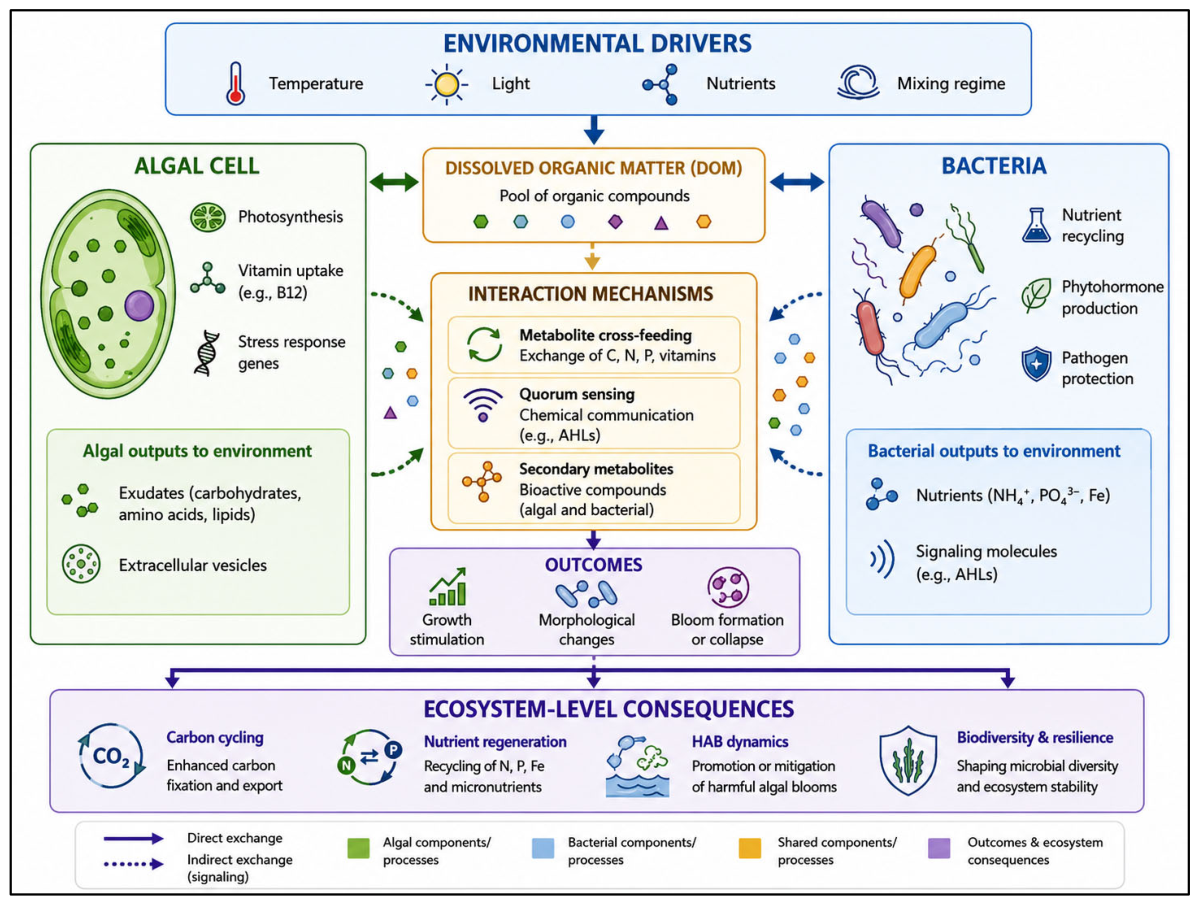
2. The Phycosphere as a Dynamic Interface for Algal–Bacterial Exchange
3. Molecular Regulation and Ecological Consequences of Algal–Bacterial Interactions
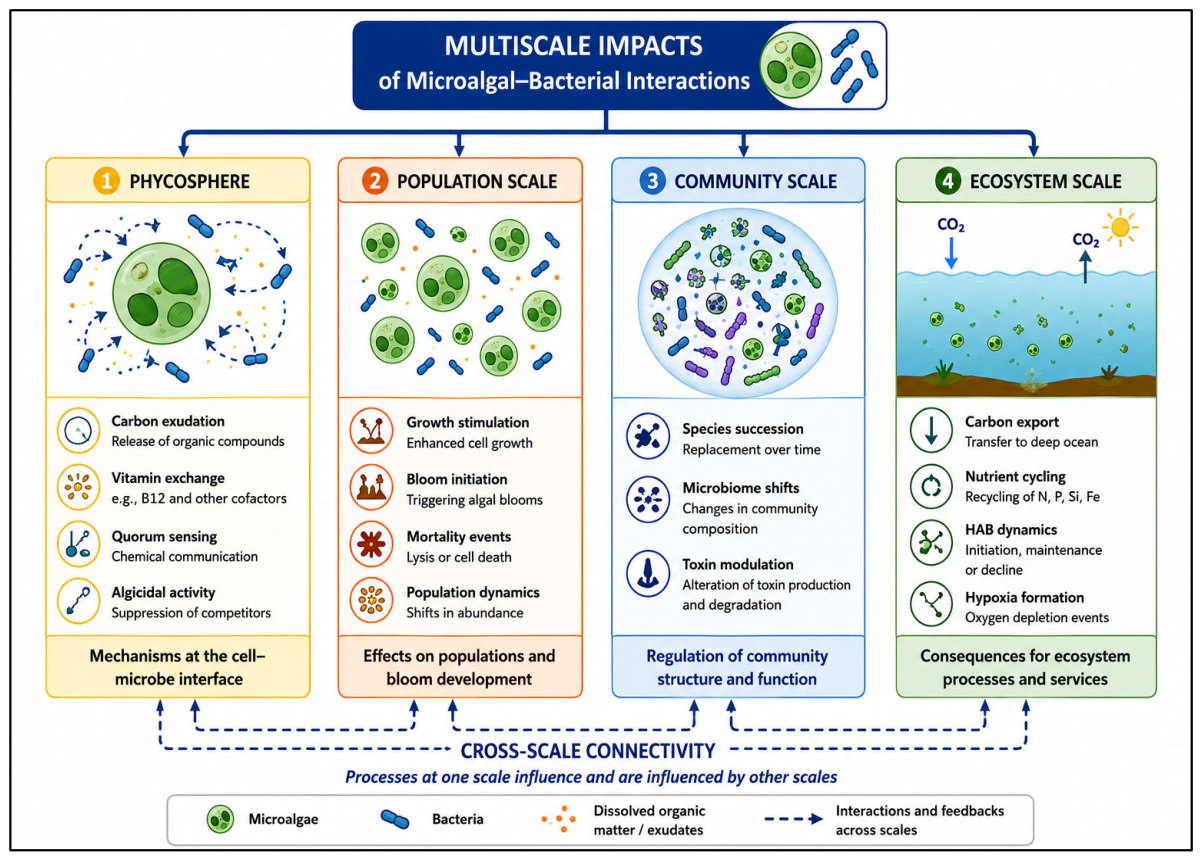
4. Ecological Scaling: From Microscale Interactions to Ecosystem Processes
5. Biotechnological Applications and Engineering of Algal–Bacterial Consortia
6. Methodological Advances
7. Biotechnological Applications
7.1. Algal Cultivation and Biomass Production
7.2. Biofuels and Bioproducts

| Application Area | Key Mechanisms | Role of Algae | Role of Bacteria | Practical Outcomes | References |
|---|---|---|---|---|---|
| Biomass production | Nutrient recycling; vitamin supply; ROS mitigation | Photosynthetic carbon fixation; oxygen release | Nutrient mineralization; vitamin (e.g., B12) production | Increased growth and biomass yield | [114,115,116,117,118] |
| Biofuels and bioproducts | Metabolic modulation; stress-induced lipid accumulation | Lipid, carbohydrate, pigment synthesis | Regulation of nutrient availability; signaling interactions | Enhanced lipid productivity; improved biochemical composition | [119,120,121,122,123] |
| Wastewater treatment | Coupled photosynthesis–respiration; nutrient removal | Oxygen production; uptake of N and P | Organic matter degradation; nutrient remineralization | Reduced energy demand; efficient pollutant removal | [124,125,126,127,128] |
| Bioremediation | Contaminant transformation; biosorption | Metal sequestration; oxygen supply | Degradation of hydrocarbons, pesticides, pollutants | Improved removal of complex contaminants | [133,134,135,136,137] |
| Aquaculture | Microbial balance; pathogen suppression | Oxygenation; nutritional support | Antimicrobial production; competition with pathogens | Improved water quality; enhanced organism health | [129,130,131,132] |
| Bioflocculation and harvesting | Biofilm formation; EPS production | Biomass formation | Extracellular polymer production; floc formation | Easier biomass recovery; reduced harvesting costs | [121,221,222] |
7.3. Wastewater Treatment and Bioremediation
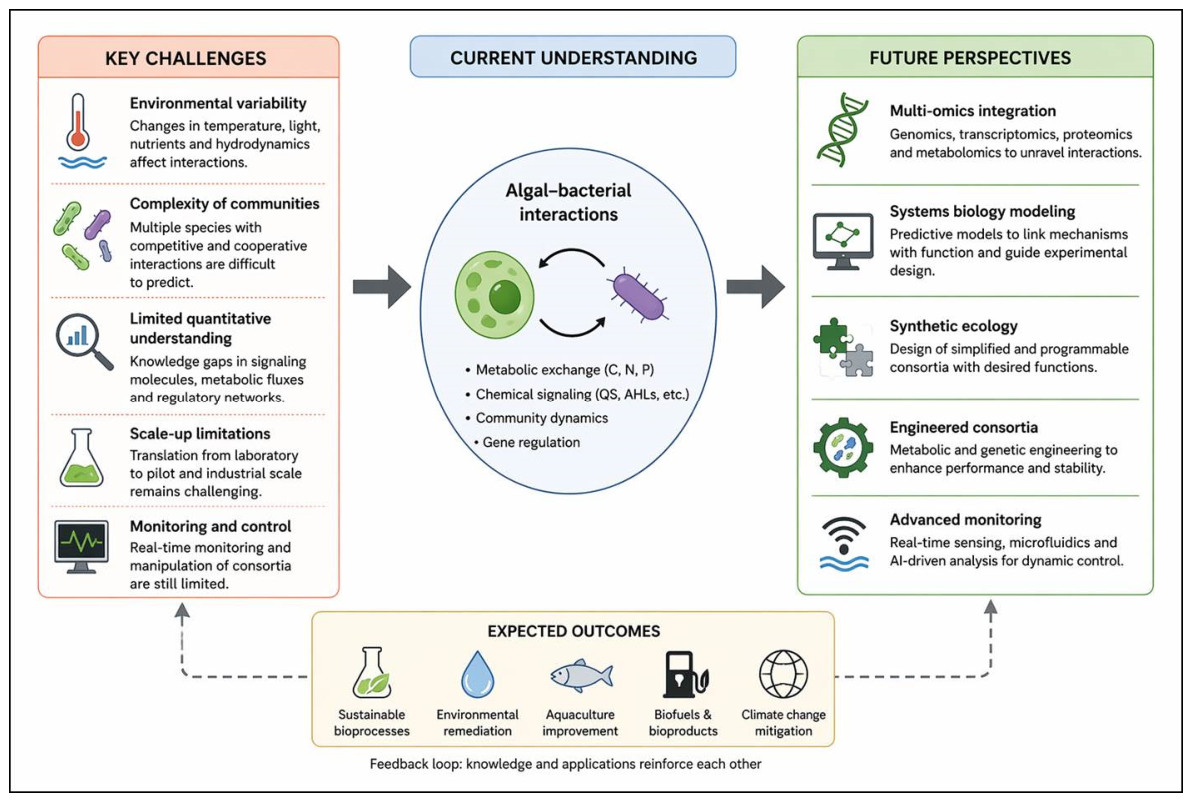
8. Challenges and Future Perspectives
9. Conclusions
Author Contributions
Funding
Data Availability Statement
Acknowledgments
Conflicts of Interest
References
- Das, B.D.; Bhattarai, A. The Versatility of Algae in Addressing Global Sustainability Challenges. Front. Bioeng. Biotechnol. 2025, 13, 1621817. [Google Scholar] [CrossRef] [PubMed]
- Mugnai, S.; Derossi, N.; Hendlin, Y. Algae Communication, Conspecific and Interspecific: The Concepts of Phycosphere and Algal-Bacteria Consortia in a Photobioreactor (PBR). Plant Signal. Behav. 2023, 18, 2148371. [Google Scholar] [CrossRef]
- Arenas Colarte, C.; Balic, I.; Díaz, Ó.; Moreno, A.A.; Amenabar, M.J.; Bruna Larenas, T.; Caro Fuentes, N. High-Value Bioactive Molecules Extracted from Microalgae. Microorganisms 2025, 13, 2018. [Google Scholar] [CrossRef]
- Clerc, E.E.; Raina, J.B.; Keegstra, J.M.; Landry, Z.; Pontrelli, S.; Alcolombri, U.; Lambert, B.S.; Anelli, V.; Vincent, F.; Masdeu-Navarro, M.; et al. Strong Chemotaxis by Marine Bacteria towards Polysaccharides Is Enhanced by the Abundant Organosulfur Compound DMSP. Nat. Commun. 2023, 14, 8080. [Google Scholar] [CrossRef] [PubMed]
- Abate, R.; Oon, Y.L.; Oon, Y.S.; Bi, Y.; Mi, W.; Song, G.; Gao, Y. Diverse Interactions between Bacteria and Microalgae: A Review for Enhancing Harmful Algal Bloom Mitigation and Biomass Processing Efficiency. Heliyon 2024, 10, e36503. [Google Scholar] [CrossRef]
- Burgunter-Delamare, B.; Shetty, P.; Vuong, T.; Mittag, M. Exchange or Eliminate: The Secrets of Algal-Bacterial Relationships. Plants 2024, 13, 829. [Google Scholar] [CrossRef] [PubMed]
- Kazamia, E.; Czesnick, H.; Nguyen, T.T.; Croft, M.T.; Sherwood, E.; Sasso, S.; Hodson, S.J.; Warren, M.J.; Smith, A.G. Mutualistic Interactions between Vitamin B12-Dependent Algae and Heterotrophic Bacteria Exhibit Regulation. Environ. Microbiol. 2012, 14, 1466–1476. [Google Scholar] [CrossRef]
- George, D.M.; Vincent, A.S.; Mackey, H.R. An Overview of Anoxygenic Phototrophic Bacteria and Their Applications in Environmental Biotechnology for Sustainable Resource Recovery. Biotechnol. Rep. 2020, 28, e00563. [Google Scholar] [CrossRef]
- Zengler, K.; Zaramela, L.S. The Social Network of Microorganisms—How Auxotrophies Shape Complex Communities. Nat. Rev. Microbiol. 2018, 16, 383–390. [Google Scholar] [CrossRef]
- Villiot, N.; Maas, A.E.; Poulton, A.J.; Blanco-Bercial, L. Organic and Inorganic Nutrients Modulate Taxonomic Diversity and Trophic Strategies of Small Eukaryotes in Oligotrophic Oceans. FEMS Microbes 2022, 4, xtac029. [Google Scholar] [CrossRef]
- Coolahan, M.; Whalen, K.E. A Review of Quorum-Sensing and Its Role in Mediating Interkingdom Interactions in the Ocean. Commun. Biol. 2025, 8, 179. [Google Scholar] [CrossRef] [PubMed]
- Menaa, F.; Wijesinghe, P.A.U.I.; Thiripuranathar, G.; Uzair, B.; Iqbal, H.; Khan, B.A.; Menaa, B. Ecological and Industrial Implications of Dynamic Seaweed-Associated Microbiota Interactions. Mar. Drugs 2020, 18, 641. [Google Scholar] [CrossRef] [PubMed]
- Barak-Gavish, N.; Dassa, B.; Kuhlisch, C.; Nussbaum, I.; Brandis, A.; Rosenberg, G.; Avraham, R.; Vardi, A. Bacterial Lifestyle Switch in Response to Algal Metabolites. eLife 2023, 12, e84400. [Google Scholar] [CrossRef]
- Coyne, K.J.; Wang, Y.; Johnson, G. Algicidal Bacteria: A Review of Current Knowledge and Applications to Control Harmful Algal Blooms. Front. Microbiol. 2022, 13, 871177. [Google Scholar] [CrossRef]
- Yao, L.; Zhao, X.; Zhou, G.-J.; Liang, R.; Gou, T.; Xia, B.; Li, S.; Liu, C. Seasonal Succession of Phytoplankton Functional Groups and Driving Factors of Cyanobacterial Blooms in a Subtropical Reservoir in South China. Water 2020, 12, 1167. [Google Scholar] [CrossRef]
- Zhang, W.; Meng, S.; Wu, X.; Shen, H.; Wang, D.; Qiu, T.; Li, W.; Chen, J.; Li, L.; Liang, B. Microorganism-Based Strategies for the Control of Cyanobacterial Blooms: A Review of Recent Progress. Toxins 2025, 17, 604. [Google Scholar] [CrossRef]
- Gopalakrishnappa, C.; Li, Z.; Kuehn, S. Environmental Modulators of Algae-Bacteria Interactions at Scale. Cell Syst. 2024, 15, 838–853.e13. [Google Scholar] [CrossRef]
- Gu, X.; Cao, Z.; Zhao, L.; Seswita-Zilda, D.; Zhang, Q.; Fu, L.; Li, J. Metagenomic Insights Reveal the Microbial Diversity and Associated Algal-Polysaccharide-Degrading Enzymes on the Surface of Red Algae among Remote Regions. Int. J. Mol. Sci. 2023, 24, 11019. [Google Scholar] [CrossRef] [PubMed]
- Merchant, S.S.; Helmann, J.D. Elemental Economy: Microbial Strategies for Optimizing Growth in the Face of Nutrient Limitation. Adv. Microb. Physiol. 2012, 60, 91–210. [Google Scholar] [CrossRef]
- Song, J.; Ryu, H.; Chung, M.; Kim, Y.; Blum, Y.; Lee, S.S.; Pertz, O.; Jeon, N.L. Microfluidic Platform for Single Cell Analysis under Dynamic Spatial and Temporal Stimulation. Biosens. Bioelectron. 2018, 104, 58–64. [Google Scholar] [CrossRef]
- Dang, H.; Lovell, C.R. Microbial Surface Colonization and Biofilm Development in Marine Environments. Microbiol. Mol. Biol. Rev. 2015, 80, 91–138. [Google Scholar] [CrossRef]
- Silva, M.I.B.d.; Brandão, L.P.M.; Brighenti, L.S.; Staehr, P.A.U.; Barros, C.F.d.A.; Barbosa, F.A.R.; Bezerra-Neto, J.F. Nutrient, Organic Matter and Shading Alter Planktonic Structure and Density of a Tropical Lake. Limnol. Rev. 2025, 25, 16. [Google Scholar] [CrossRef]
- Li, K.; Wang, L.; Li, Z.; Xie, Y.; Wang, X.; Fang, Q. Exploring the Spatial-Seasonal Dynamics of Water Quality, Submerged Aquatic Plants and Their Influencing Factors in Different Areas of a Lake. Water 2017, 9, 707. [Google Scholar] [CrossRef]
- Brenckman, C.M.; Parameswarappa Jayalakshmamma, M.; Pennock, W.H.; Ashraf, F.; Borgaonkar, A.D. A Review of Harmful Algal Blooms: Causes, Effects, Monitoring, and Prevention Methods. Water 2025, 17, 1980. [Google Scholar] [CrossRef]
- Ralston, D.K.; Moore, S.K. Modeling Harmful Algal Blooms in a Changing Climate. Harmful Algae 2020, 91, 101729. [Google Scholar] [CrossRef]
- Dal Bello, M.; Abreu, C.I. Temperature Structuring of Microbial Communities on a Global Scale. Curr. Opin. Microbiol. 2024, 82, 102558. [Google Scholar] [CrossRef]
- Schneider, A.T.; Machado, R.L.S.; Dutra, D.A.; Machado, E.F.; Dias, R.R.; Deprá, M.C.; Zepka, L.Q.; Jacob-Lopes, E. Microalgae Biotechnology and Its Role in Sustainable and Healthy Food Design. Front. Bioeng. Biotechnol. 2025, 13, 1716473. [Google Scholar] [CrossRef] [PubMed]
- Satiro, J.; dos Santos Neto, A.G.; Marinho, T.; Sales, M.; Marinho, I.; Kato, M.T.; Simões, R.; Albuquerque, A.; Florencio, L. The Role of the Microalgae–Bacteria Consortium in Biomass Formation and Its Application in Wastewater Treatment Systems: A Comprehensive Review. Appl. Sci. 2024, 14, 6083. [Google Scholar] [CrossRef]
- Olofsson, M.; Uchimiya, M.; Ferrer-González, F.X.; Schreier, J.E.; Powers, M.A.; Smith, C.B.; Edison, A.S.; Moran, M.A. Dynamic Reworking of Marine Diatom Endometabolomes in Response to Temperature and a Model Bacterium. mSystems 2026, 11, e01036-25. [Google Scholar] [CrossRef]
- Huang, Y.; Yu, J.; Huang, X.; Sun, J.; Tang, W.; Wei, M.; Yang, G.; Fu, Y. Algal-Bacterial Symbiotic System for Treatment of Heavy Metal Containing Wastewater: Performance, Mechanisms and Applications. npj Clean Water 2025, 8, 86. [Google Scholar] [CrossRef]
- Costa, G.d.S.; Martinez-Burgos, W.J.; dos Reis, G.A.; Puche, Y.P.; Vega, F.R.; Rodrigues, C.; Serra, J.L.; Campos, S.d.M.; Soccol, C.R. Advances in Biomass and Microbial Lipids Production: Trends and Prospects. Processes 2024, 12, 2903. [Google Scholar] [CrossRef]
- Pacheco-Valenciana, A.; Tausch, A.; Veseli, I. Microbial Model Communities Exhibit Widespread Metabolic Interdependencies. Commun. Biol. 2025, 8, 1752. [Google Scholar] [CrossRef] [PubMed]
- Doulcier, G.; Takacs, P.; Hammerschmidt, K. Stability of Ecologically Scaffolded Traits during Evolutionary Transitions in Individuality. Nat. Commun. 2024, 15, 6566. [Google Scholar] [CrossRef]
- Shahreen, N.; Osinuga, A.; Malla, S.; Razmpour, T.; Tabibian, M.; Saha, R. Multi-Omics Integration in Genome-Scale Metabolic Models: A Review of Constraint-Based Approaches. Mol. Omics 2026, 22, aaiag005. [Google Scholar] [CrossRef]
- Ren, Z.J. The Rewards and Challenges of Interdisciplinary Collaborations. iScience 2019, 20, 575–578. [Google Scholar] [CrossRef] [PubMed]
- Cao, Y.; Zhi, S.; Phyu, K.; Wang, H.; Liu, J.; Xu, X.; Zhang, K. Interaction between Microalgae and Phycosphere Bacteria in a Binary Cultivation System-Based Dairy Farm Wastewater Treatment. Bioresour. Technol. 2024, 409, 131248. [Google Scholar] [CrossRef]
- Yarbro, J.; Khorunzhy, E.; Boyle, N. The Phycosphere and Its Role in Algal Biofuel Production. Front. Clim. 2024, 6, 1277475. [Google Scholar] [CrossRef]
- Wood, E.; Edvardsen, B.; Skjånes, K. Phycosphere of an Algal Co-Culture Phycoremediation System: Stability of Bacterial Communities in an Oedogonium–Stigeoclonium Co-Culture during Cultivation in Microbially Rich Wastewater. J. Appl. Phycol. 2025, 37, 837–853. [Google Scholar] [CrossRef]
- Baker, D.; Lauer, J.; Ortega, A.; Jackrel, S.L.; Denef, V.J. Effects of Phycosphere Bacteria on Their Algal Host Are Host Species-Specific and Not Phylogenetically Conserved. Microorganisms 2023, 11, 62. [Google Scholar] [CrossRef]
- Steichen, S.A.; Gao, S.; Waller, P.; Brown, J.K. Association between Algal Productivity and Phycosphere Composition in an Outdoor Chlorella sorokiniana Reactor Based on Multiple Longitudinal Analyses. Microb. Biotechnol. 2020, 13, 1546–1561. [Google Scholar] [CrossRef] [PubMed]
- Li, W.; Mayali, X. Uncovering Hidden Nutrient Dynamics in Algal-Bacterial Consortia: Nanoscale Stable Isotope Probing in the Phycosphere. Microsc. Microanal. 2025, 31, ozaf048.953. [Google Scholar] [CrossRef]
- Chen, C.; Zhang, H.; Liang, X.; Li, M.; Gu, Y. Response of Rhizosphere Microenvironment of Mulberry (Morus alba L.) to Different Cultivars. Microorganisms 2025, 13, 2157. [Google Scholar] [CrossRef]
- Zhu, J.; Tang, S.; Cheng, K.; Cai, Z.; Chen, G.; Zhou, J. Microbial Community Composition and Metabolic Potential during a Succession of Algal Blooms from Skeletonema sp. to Phaeocystis sp. Front. Microbiol. 2023, 14, 1147187. [Google Scholar] [CrossRef]
- Krohn-Molt, I.; Wemheuer, B.; Alawi, M.; Poehlein, A.; Güllert, S.; Schmeisser, C.; Pommerening-Röser, A.; Grundhoff, A.; Daniel, R.; Hanelt, D.; et al. Metagenome Survey of a Multispecies and Alga-Associated Biofilm Revealed Key Elements of Bacterial-Algal Interactions in Photobioreactors. Appl. Environ. Microbiol. 2013, 79, 6196–6206. [Google Scholar] [CrossRef] [PubMed]
- Mattsson, L.; Sörenson, E.; Capo, E.; Farnelid, H.M.; Hirwa, M.; Olofsson, M.; Svensson, F.; Lindehoff, E.; Legrand, C. Functional Diversity Facilitates Stability under Environmental Changes in an Outdoor Microalgal Cultivation System. Front. Bioeng. Biotechnol. 2021, 9, 651895. [Google Scholar] [CrossRef]
- Vila Duplá, M. Advancements in Algal Microbiome Research: A Game-Changer for Climate Resilience and Invasion Success? Microb. Ecol. 2025, 88, 63. [Google Scholar] [CrossRef] [PubMed]
- Isaac, A.; Mohamed, A.R.; Amin, S.A. Rhodobacteraceae Are Key Players in Microbiome Assembly of the Diatom Asterionellopsis glacialis. Appl. Environ. Microbiol. 2024, 90, e00570-24. [Google Scholar] [CrossRef]
- Fuentes, J.L.; Garbayo, I.; Cuaresma, M.; Montero, Z.; González-del-Valle, M.; Vílchez, C. Impact of Microalgae-Bacteria Interactions on the Production of Algal Biomass and Associated Compounds. Mar. Drugs 2016, 14, 100. [Google Scholar] [CrossRef]
- García-Márquez, J.; Domínguez-Maqueda, M.; Llamas, I.; Tapia-Paniagua, S.T.; Arijo, S.; Moriñigo, M.Á.; Balebona, M.C. Extracellular Products Derived from Bacillus pumilus Cultured on Microalgal and Cyanobacterial Supplemented Media: Potential for Controlling Four Specific Aquaculture Pathogens. Front. Mar. Sci. 2025, 12, 1705909. [Google Scholar] [CrossRef]
- Mirghani, R.; Saba, T.; Khaliq, H.; Mitchell, J.; Do, L.; Chambi, L.; Diaz, K.; Kennedy, T.; Alkassab, K.; Huynh, T.; et al. Biofilms: Formation, Drug Resistance and Alternatives to Conventional Approaches. AIMS Microbiol. 2022, 8, 239–277. [Google Scholar] [CrossRef]
- Penesyan, A.; Paulsen, I.T.; Kjelleberg, S.; Gillings, M.R. Three Faces of Biofilms: A Microbial Lifestyle, a Nascent Multicellular Organism, and an Incubator for Diversity. npj Biofilms Microbiomes 2021, 7, 80. [Google Scholar] [CrossRef] [PubMed]
- Yasir, M.; Hossain, A.; Pratap-Singh, A. Pesticide Degradation: Impacts on Soil Fertility and Nutrient Cycling. Environments 2025, 12, 272. [Google Scholar] [CrossRef]
- Chakraborty, S.; Talukdar, A.; Dey, S.; Bhattacharya, S. Role of Fungi, Bacteria and Microalgae in Bioremediation of Emerging Pollutants with Special Reference to Pesticides, Heavy Metals and Pharmaceuticals. Discov. Environ. 2025, 3, 91. [Google Scholar] [CrossRef]
- Khan, F.; Siddique, A.B.; Shabala, S.; Zhou, M.; Zhao, C. Phosphorus Plays Key Roles in Regulating Plants’ Physiological Responses to Abiotic Stresses. Plants 2023, 12, 2861. [Google Scholar] [CrossRef] [PubMed]
- Stenger, P.L.; Tribollet, A.; Guilhaumon, F.; Cuet, P.; Pennober, G.; Jourand, P. A Multimarker Approach to Identify Microbial Bioindicators for Coral Reef Health Monitoring—Case Study in La Réunion Island. Microb. Ecol. 2024, 87, 179. [Google Scholar] [CrossRef]
- Davy, S.K.; Allemand, D.; Weis, V.M. Cell Biology of Cnidarian-Dinoflagellate Symbiosis. Microbiol. Mol. Biol. Rev. 2012, 76, 229–261. [Google Scholar] [CrossRef]
- Oruganti, R.K.; Katam, K.; Show, P.L.; Gadhamshetty, V.; Upadhyayula, V.K.K.; Bhattacharyya, D. A Comprehensive Review on the Use of Algal-Bacterial Systems for Wastewater Treatment with Emphasis on Nutrient and Micropollutant Removal. Bioengineered 2022, 13, 10412–10453. [Google Scholar] [CrossRef]
- Morocho-Jacome, A.L.; Mejia-da-Silva, L.d.C.; Bresaola, M.D.; Matsudo, M.C.; Bezerra, R.P.; Carvalho, J.C.M.d. Nutrient Recycling in Microalgae Cultivation as a Sustainable Process for Biomass Production. Fermentation 2026, 12, 1. [Google Scholar] [CrossRef]
- Joglar, V.; Pontiller, B.; Martínez-García, S.; Fuentes-Lema, A.; Pérez-Lorenzo, M.; Lundin, D.; Pinhassi, J.; Fernández, E.; Teira, E. Microbial Plankton Community Structure and Function Responses to Vitamin B12 and B1 Amendments in an Upwelling System. Appl. Environ. Microbiol. 2021, 87, e0152521. [Google Scholar] [CrossRef] [PubMed]
- Hamada, M.; Schröder, K.; Bathia, J.; Kürn, U.; Fraune, S.; Khalturina, M.; Khalturin, K.; Shinzato, C.; Satoh, N.; Bosch, T.C.G. Metabolic Co-Dependence Drives the Evolutionarily Ancient Hydra-Chlorella Symbiosis. eLife 2018, 7, e35122. [Google Scholar] [CrossRef]
- Bäcker, M.; Doekes, H.M.; Garza, D.R.; Meijer, J.; van Vliet, S.; Allen, R.J.; Hogeweg, P.; Dutilh, B.E.; van Dijk, B. Spatial Structure: Shaping the Ecology and Evolution of Microbial Communities. FEMS Microbiol. Rev. 2026, 50, fuaf067. [Google Scholar] [CrossRef]
- Safi, K.; Zeldis, J.; Tait, L. Microplankton Interactions with Decadal-Scale Nutrient Enrichment in a Deep Estuary, with Implications for Eutrophication-Related Ecosystem Stressors. Estuaries Coasts 2022, 45, 2472–2491. [Google Scholar] [CrossRef]
- Worthington, R.J.; Richards, J.J.; Melander, C. Small Molecule Control of Bacterial Biofilms. Org. Biomol. Chem. 2012, 10, 7457–7474. [Google Scholar] [CrossRef]
- Qu, T.; Zhao, X.; Guan, C.; Hou, C.; Chen, J.; Zhong, Y.; Lin, Z.; Xu, Y.; Tang, X.; Wang, Y. Structure-Function Covariation of Phycospheric Microorganisms Associated with the Typical Cross-Regional Harmful Macroalgal Bloom. Appl. Environ. Microbiol. 2023, 89, e0181522. [Google Scholar] [CrossRef]
- Di Costanzo, F.; Di Dato, V.; Romano, G. Diatom-Bacteria Interactions in the Marine Environment: Complexity, Heterogeneity, and Potential for Biotechnological Applications. Microorganisms 2023, 11, 2967. [Google Scholar] [CrossRef] [PubMed]
- Martínez-Pérez, C.; Zweifel, S.T.; Pioli, R.; Stocker, R. Space, the Final Frontier: The Spatial Component of Phytoplankton–Bacterial Interactions. Mol. Microbiol. 2024, 122, 331–346. [Google Scholar] [CrossRef] [PubMed]
- Iyer, D.; Laws, E.; LaJeunesse, D. Escherichia coli Adhesion and Biofilm Formation on Polymeric Nanostructured Surfaces. ACS Omega 2023, 8, 47520–47529. [Google Scholar] [CrossRef] [PubMed]
- Simões, L.C.; Simões, M.; Vieira, M.J. Adhesion and Biofilm Formation on Polystyrene by Drinking Water-Isolated Bacteria. Antonie Van Leeuwenhoek 2010, 98, 317–329. [Google Scholar] [CrossRef]
- Fuqua, C.; Parsek, M.R.; Greenberg, E.P. Regulation of Gene Expression by Cell-to-Cell Communication: Acyl-Homoserine Lactone Quorum Sensing. Annu. Rev. Genet. 2001, 35, 439–468. [Google Scholar] [CrossRef]
- Ilyaskina, D.; Altveş, S.; Dong, L.; Bouwmeester, H.; El Aidy, S. Adaptive and Metabolic Convergence in Rhizosphere and Gut Microbiomes. Microbiome 2025, 13, 173. [Google Scholar] [CrossRef]
- Cheng, Q.; Ma, J.; Yang, Y. Enrichment of Vitamin B12-Producing Porphyrobacter in the Phycosphere Microbiome Promotes Microalgal Stress Adaptation to Antibiotic Exposure. Microbiome 2025, 13, 240. [Google Scholar] [CrossRef]
- Allam, H.; Dalal, S.; Eltanahy, E.; Hussien, M. Seaweed-Associated Heterotrophic Bacteria—Novel Sources of Antimicrobial and Antiviral Agents. In Marine Biotechnology for Healthcare; Academic Press: Cambridge, MA, USA, 2026; pp. 219–240. [Google Scholar] [CrossRef]
- Lamont, R.J.; Koo, H.; Hajishengallis, G. The Oral Microbiota: Dynamic Communities and Host Interactions. Nat. Rev. Microbiol. 2018, 16, 745–759. [Google Scholar] [CrossRef] [PubMed]
- Fefilova, A.S.; Antifeeva, I.A.; Gavrilova, A.A.; Turoverov, K.K.; Kuznetsova, I.M.; Fonin, A.V. Reorganization of Cell Compartmentalization Induced by Stress. Biomolecules 2022, 12, 1441. [Google Scholar] [CrossRef]
- Cai, G.; Wu, Y.; Chen, Z.; Yang, X.; Jiang, X.; Wang, Q.; Cai, R.; Wang, H. Host-Driven Evolution Shapes the Polysaccharide Utilization Profiles of Alga-Associated Flavobacteriaceae. Microbiome 2026, 14, 79. [Google Scholar] [CrossRef]
- Urvoy, M.; Labry, C.; L’Helguen, S.; Lami, R. Quorum Sensing Regulates Bacterial Processes That Play a Major Role in Marine Biogeochemical Cycles. Front. Mar. Sci. 2022, 9, 834337. [Google Scholar] [CrossRef]
- Rojas-Villalta, D.; Gómez-Espinoza, O.; Murillo-Vega, F.; Villalta-Romero, F.; Guerrero, M.; Guillén-Watson, R.; Núñez-Montero, K. Insights into Co-Cultivation of Photosynthetic Microorganisms for Novel Molecule Discovery and Enhanced Production of Specialized Metabolites. Fermentation 2023, 9, 941. [Google Scholar] [CrossRef]
- Selegato, D.M.; Castro-Gamboa, I. Enhancing Chemical and Biological Diversity by Co-Cultivation. Front. Microbiol. 2023, 14, 1117559. [Google Scholar] [CrossRef] [PubMed]
- Rajakovich, L.J.; Balskus, E.P. Metabolic Functions of the Human Gut Microbiota: The Role of Metalloenzymes. Nat. Prod. Rep. 2019, 36, 593–625. [Google Scholar] [CrossRef]
- Li, C.; Yin, W.; Pan, Y. Interactions with Bacteria Shape Diatom Adaptation to Carbon Concentration Changes. Nat. Commun. 2026, 17, 1289. [Google Scholar] [CrossRef]
- Parmar, P.; Kumar, R.; Neha, Y.; Srivatsan, V. Microalgae as Next Generation Plant Growth Additives: Functions, Applications, Challenges and Circular Bioeconomy Based Solutions. Front. Plant Sci. 2023, 14, 1073546. [Google Scholar] [CrossRef]
- Nef, C.; Jung, S.; Mairet, F.; Kaas, R.; Grizeau, D.; Garnier, M. How Haptophytes Microalgae Mitigate Vitamin B12 Limitation. Sci. Rep. 2019, 9, 8417. [Google Scholar] [CrossRef]
- Tong, C.Y.; Honda, K.; Derek, C.J.C. A Review on Microalgal-Bacterial Co-Culture: The Multifaceted Role of Beneficial Bacteria towards Enhancement of Microalgal Metabolite Production. Environ. Res. 2023, 228, 115872. [Google Scholar] [CrossRef]
- Zhou, J.; Lyu, Y.; Richlen, M.; Anderson, D.M.; Cai, Z. Quorum Sensing Is a Language of Chemical Signals and Plays an Ecological Role in Algal-Bacterial Interactions. CRC Crit. Rev. Plant Sci. 2016, 35, 81–105. [Google Scholar] [CrossRef]
- Aslam, M.; Pei, P.; Ye, P.; Li, T.; Liang, H.; Zhang, Z.; Ke, X.; Chen, W.; Du, H. Unraveling the Diverse Profile of N-Acyl Homoserine Lactone Signals and Their Role in the Regulation of Biofilm Formation in Porphyra haitanensis-Associated Pseudoalteromonas galatheae. Microorganisms 2023, 11, 2228. [Google Scholar] [CrossRef]
- Lipsman, V.; Shlakhter, O.; Rocha, J.; Segev, E. Bacteria Contribute Exopolysaccharides to an Algal-Bacterial Joint Extracellular Matrix. npj Biofilms Microbiomes 2024, 10, 36. [Google Scholar] [CrossRef] [PubMed]
- Matin, M.; Koszarska, M.; Atanasov, A.G.; Król-Szmajda, K.; Jóźwik, A.; Stelmasiak, A.; Hejna, M. Bioactive Potential of Algae and Algae-Derived Compounds: Focus on Anti-Inflammatory, Antimicrobial, and Antioxidant Effects. Molecules 2024, 29, 4695. [Google Scholar] [CrossRef] [PubMed]
- Kim, H.; Kimbrel, J.A.; Vaiana, C.A. Bacterial Response to Spatial Gradients of Algal-Derived Nutrients in a Porous Microplate. ISME J. 2022, 16, 1036–1045. [Google Scholar] [CrossRef]
- Nef, C.; Pierella Karlusich, J.J.; Bowler, C. From Nets to Networks: Tools for Deciphering Phytoplankton Metabolic Interactions within Communities and Their Global Significance. Philos. Trans. R. Soc. B 2024, 379, 20230172. [Google Scholar] [CrossRef]
- Tourneroche, A.; Lami, R.; Hubas, C.; Blanchet, E.; Vallet, M.; Escoubeyrou, K.; Paris, A.; Prado, S. Bacterial–Fungal Interactions in the Kelp Endomicrobiota Drive Autoinducer-2 Quorum Sensing. Front. Microbiol. 2019, 10, 1693. [Google Scholar] [CrossRef]
- Rutherford, S.T.; Bassler, B.L. Bacterial Quorum Sensing: Its Role in Virulence and Possibilities for Its Control. Cold Spring Harb. Perspect. Med. 2012, 2, a012427. [Google Scholar] [CrossRef] [PubMed]
- Rahman, M.M.; Hosano, N.; Hosano, H. Recovering Microalgal Bioresources: A Review of Cell Disruption Methods and Extraction Technologies. Molecules 2022, 27, 2786. [Google Scholar] [CrossRef]
- Zhou, Q.; Wang, Y.; Wen, X.; Liu, H.; Zhang, Y.; Zhang, Z. The Effect of Algicidal and Denitrifying Bacteria on the Vertical Distribution of Cyanobacteria and Nutrients. Water 2022, 14, 2129. [Google Scholar] [CrossRef]
- Guidi, F.; Pezzolesi, L.; Vanucci, S. Microbial Dynamics during Harmful Dinoflagellate Ostreopsis cf. ovata Growth: Bacterial Succession and Viral Abundance Pattern. MicrobiologyOpen 2018, 7, e00584. [Google Scholar] [CrossRef]
- Caruso, G.; Giacobbe, S.; Azzaro, F.; Decembrini, F.; Leonardi, M.; Maimone, G.; Profeta, A.; Rinelli, P. Trophic and Microbial Dynamics in a Mediterranean Transitional Ecosystem (Lake Faro, Southern Italy): Implications for Pinna nobilis Conservation. Microorganisms 2026, 14, 423. [Google Scholar] [CrossRef]
- Yang, Y.; Zhang, X.; Du, X.; Fan, Y.; Gao, J. From Microbial Functions to Measurable Indicators: A Framework for Predicting Grassland Productivity and Stability. Agronomy 2025, 15, 2765. [Google Scholar] [CrossRef]
- Nneoma, U.C.; Chukwudi, O.F.; Nnenna, U.J.; Paul-Chima, U.O. Hybrid Biofactories: Integrating Microalgae and Engineered Microbiomes for Enhanced Biofuel Production in Circular Carbon Systems. Front. Energy Res. 2025, 13, 1654079. [Google Scholar] [CrossRef]
- Zhu, S.; Higa, L.; Barela, A.; Lee, C.; Chen, Y.; Du, Z.-Y. Microalgal Consortia for Waste Treatment and Valuable Bioproducts. Energies 2023, 16, 884. [Google Scholar] [CrossRef]
- Li, M.; Liu, J.; Zhang, C.; Wang, J.; Li, P.; Sun, J.; Sun, Y. Response of Algal–Bacterial Regrowth Characteristics to Hypochlorite in Landscape Ponds Replenished with Reclaimed Water. Water 2022, 14, 3893. [Google Scholar] [CrossRef]
- Brandenburg, K.; Siebers, L.; Keuskamp, J.; Jephcott, T.G.; Van de Waal, D.B. Effects of Nutrient Limitation on the Synthesis of N-Rich Phytoplankton Toxins: A Meta-Analysis. Toxins 2020, 12, 221. [Google Scholar] [CrossRef] [PubMed]
- Thompson, J.R.; Rivera, H.E.; Closek, C.J.; Medina, M. Microbes in the Coral Holobiont: Partners through Evolution, Development, and Ecological Interactions. Front. Cell. Infect. Microbiol. 2015, 4, 176. [Google Scholar] [CrossRef]
- Landa, M.; Blain, S.; Christaki, U.; Monchy, S.; Obernosterer, I. Shifts in Bacterial Community Composition Associated with Increased Carbon Cycling in a Mosaic of Phytoplankton Blooms. ISME J. 2016, 10, 39–50. [Google Scholar] [CrossRef]
- Zhou, J.; Chen, G.F.; Ying, K.Z.; Jin, H.; Song, J.T.; Cai, Z.H. Phycosphere Microbial Succession Patterns and Assembly Mechanisms in a Marine Dinoflagellate Bloom. Appl. Environ. Microbiol. 2019, 85, e00349-19. [Google Scholar] [CrossRef] [PubMed]
- Eladl, S.N.; Elnabawy, A.M.; Eltanahy, E.G. Recent Biotechnological Applications of Value-Added Bioactive Compounds from Microalgae and Seaweeds. Bot. Stud. 2024, 65, 28. [Google Scholar] [CrossRef] [PubMed]
- Novoveská, L.; Nielsen, S.L.; Eroldoğan, O.T.; Haznedaroglu, B.Z.; Rinkevich, B.; Fazi, S.; Robbens, J.; Vasquez, M.; Einarsson, H. Overview and Challenges of Large-Scale Cultivation of Photosynthetic Microalgae and Cyanobacteria. Mar. Drugs 2023, 21, 445. [Google Scholar] [CrossRef]
- Morón-López, J. Influence of Bloom Stage on the Effectiveness of Algicidal Bacteria in Controlling Harmful Cyanobacteria: A Microcosm Study. Environ. Pollut. 2025, 374, 126261. [Google Scholar] [CrossRef] [PubMed]
- Zhou, Y.; Zeeshan Ul Haq, M. Engineering of Synthetic Microbial Consortia for Sustainable Management of Wastewater and Polyethylene Terephthalate: A Comprehensive Review. Int. J. Mol. Sci. 2025, 26, 11623. [Google Scholar] [CrossRef]
- Mignogna, D.; Szabó, M.; Ceci, P.; Avino, P. Biomass Energy and Biofuels: Perspective, Potentials, and Challenges in the Energy Transition. Sustainability 2024, 16, 7036. [Google Scholar] [CrossRef]
- Rathour, R.K.; Sharma, D.; Ullah, S. Bacterial–Microalgal Consortia for Bioremediation of Textile Industry Wastewater and Resource Recovery for Circular Economy. Biotechnol. Environ. 2024, 1, 6. [Google Scholar] [CrossRef]
- Balabanova, L.; Averianova, L.; Marchenok, M.; Son, O.; Tekutyeva, L. Microbial and Genetic Resources for Cobalamin (Vitamin B12) Biosynthesis: From Ecosystems to Industrial Biotechnology. Int. J. Mol. Sci. 2021, 22, 4522. [Google Scholar] [CrossRef]
- González-González, L.M.; de-Bashan, L.E. Toward the Enhancement of Microalgal Metabolite Production through Microalgae–Bacteria Consortia. Biology 2021, 10, 282. [Google Scholar] [CrossRef]
- Rasheed, N.; Pourbakhtiar, A.; Mehdizadeh Allaf, M.; Baharlooeian, M.; Rafiei, N.; Alishah Aratboni, H.; Morones-Ramirez, J.R.; Winck, F.V. Microalgal Co-Cultivation—Recent Methods, Trends in Omic-Studies, Applications, and Future Challenges. Front. Bioeng. Biotechnol. 2023, 11, 1193424. [Google Scholar] [CrossRef]
- Jha, S.; Singh, R.; Pandey, B.K. Recent Aspects of Algal Biomass for Sustainable Fuel Production: A Review. Discov. Sustain. 2024, 5, 300. [Google Scholar] [CrossRef]
- Alwaleed, E.A.; Galal, H.R.M.; Aboueldahab, M.; Saber, H. Maximizing Lipid Accumulation in Tetradesmus obliquus under Heavy Metal Stress for Sustainable Biodiesel Innovation. BMC Biotechnol. 2025, 25, 20. [Google Scholar] [CrossRef]
- Eldiehy, K.S.H.; Haraz, Y.G.; Alkhazi, I.S.; Alrashidi, M.; Alghamdi, M.; Elbanhawy, N.M.; Atta, O.M. Microalgal Biofactories: Sustainable Solutions for Nutrition and Cosmetics. Phycology 2026, 6, 17. [Google Scholar] [CrossRef]
- Dong, S.; Huang, F.; Zou, X.; Luo, Q.; Li, J. Microalgae as a Synergistic Enhancer for In Situ and Ex Situ Treatment Technologies in Sustainable Shrimp Aquaculture: A Critical Review. Fishes 2026, 11, 60. [Google Scholar] [CrossRef]
- Jurado-Flores, A.; Heredia-Martínez, L.G.; Torres-Cortes, G.; Díaz-Santos, E. Harnessing Microalgae and Cyanobacteria for Sustainable Agriculture: Mechanistic Insights and Applications as Biostimulants, Biofertilizers and Biocontrol Agents. Agriculture 2025, 15, 1842. [Google Scholar] [CrossRef]
- Dębowski, M.; Kisielewska, M.; Zieliński, M.; Kazimierowicz, J. Anaerobic Digestion of Microalgal–Bacterial Consortia Biomass: Challenges and Prospects for Circular Wastewater Treatment. Appl. Sci. 2026, 16, 2524. [Google Scholar] [CrossRef]
- Minhas, A.K.; Gaur, S.; Sunny, S.; Paladugu, C.; Ravishankar, G.A.; Pereira, L.; Ambati, R.R. Microalgae-Based Wastewater Treatment Processes for the Bioremediation and Valorization of Biomass: A Review. Phycology 2026, 6, 18. [Google Scholar] [CrossRef]
- Namba, K.; Dolatimehr, A. Microalgae as Bio-Based Circular Solutions for Harmful Algal Bloom (HAB) in Lake Tegel, Berlin, Germany. In Emerging Pollutants; Zandaryaa, S., Fares, A., Eckstein, G., Eds.; Springer: Cham, Switzerland, 2025. [Google Scholar] [CrossRef]
- Laabassi, A.; Fercha, A.; Bellucci, S.; Postiglione, A.; Maresca, V.; Dentato, M.; Boudehane, A.; Amira, L.; Saada, F.Z.; Boukehil, R.; et al. Phosphorus Loading Drives Microalgal Community Changes and Enhances Nutrient Removal in Photobioreactors Treating Synthetic Wastewater. Plants 2026, 15, 351. [Google Scholar] [CrossRef]
- Amillano-Cisneros, J.M.; Fuentes-Valencia, M.A.; Leyva-Morales, J.B.; Savín-Amador, M.; Márquez-Pacheco, H.; Bastidas-Bastidas, P.d.J.; Leyva-Camacho, L.; De la Torre-Espinosa, Z.Y.; Badilla-Medina, C.N. Effects of Microorganisms in Fish Aquaculture from a Sustainable Approach: A Review. Microorganisms 2025, 13, 485. [Google Scholar] [CrossRef]
- Chen, Y.; Pei, P.; Aslam, M.; Syaifudin, M.; Bi, R.; Li, P.; Du, H. Microorganisms in Macroalgae Cultivation Ecosystems: A Systematic Review and Future Prospects Based on Bibliometric Analysis. Microorganisms 2025, 13, 1110. [Google Scholar] [CrossRef]
- Patel, A.K.; Singhania, R.R.; Awasthi, M.K.; Varjani, S.; Bhatia, S.K.; Tsai, M.L.; Hsieh, S.L.; Chen, C.W.; Dong, C.D. Emerging Prospects of Macro- and Microalgae as Prebiotic. Microb. Cell Fact. 2021, 20, 112. [Google Scholar] [CrossRef]
- Ahmad, A.; Hassan, S.W.; Banat, F. An Overview of Microalgae Biomass as a Sustainable Aquaculture Feed Ingredient: Food Security and Circular Economy. Bioengineered 2022, 13, 9521–9547. [Google Scholar] [CrossRef] [PubMed]
- Ogello, E.; Muthoka, M.; Outa, N. Exploring Regenerative Aquaculture Initiatives for Climate-Resilient Food Production: Harnessing Synergies Between Technology and Agroecology. Aquac. J. 2024, 4, 324–344. [Google Scholar] [CrossRef]
- Dell’Anno, F.; Rastelli, E.; Sansone, C.; Brunet, C.; Ianora, A.; Dell’Anno, A. Bacteria, Fungi and Microalgae for the Bioremediation of Marine Sediments Contaminated by Petroleum Hydrocarbons in the Omics Era. Microorganisms 2021, 9, 1695. [Google Scholar] [CrossRef]
- Maglione, G.; Zinno, P.; Tropea, A.; Mussagy, C.U.; Dufossé, L.; Giuffrida, D.; Mondello, A. Microbes’ Role in Environmental Pollution and Remediation: A Bioeconomy Focus Approach. AIMS Microbiol. 2024, 10, 723–755. [Google Scholar] [CrossRef]
- Aslam, A.; Kanwal, F.; Javied, S.; Nisar, N.; Torriero, A.A. Microbial Biosorption: A Sustainable Approach for Metal Removal and Environmental Remediation. Int. J. Environ. Sci. Technol. 2025, 22, 13245–13276. [Google Scholar] [CrossRef]
- Tziourrou, P.; Golia, E.E. Phytoremediation of Co-Contaminated Environments: A Review of Microplastic and Heavy Metal/Organic Pollutant Interactions and Plant-Based Removal Approaches. Soil Syst. 2025, 9, 137. [Google Scholar] [CrossRef]
- García-Jiménez, B.; Torres-Bacete, J.; Nogales, J. Metabolic Modelling Approaches for Describing and Engineering Microbial Communities. Comput. Struct. Biotechnol. J. 2020, 19, 226–246. [Google Scholar] [CrossRef]
- Alcocer-García, H.; Sánchez-Ramírez, E.; García-García, E.; Ramírez-Márquez, C.; Ponce-Ortega, J.M. Unlocking the Potential of Biomass Resources: A Review on Sustainable Process Design and Intensification. Resources 2025, 14, 143. [Google Scholar] [CrossRef]
- Aggarwal, N.; Kitano, S.; Puah, G.R.Y.; Kittelmann, S.; Hwang, I.Y.; Chang, M.W. Microbiome and Human Health: Current Understanding, Engineering, and Enabling Technologies. Chem. Rev. 2023, 123, 31–72. [Google Scholar] [CrossRef]
- Sarker, N.K.; Kaparaju, P. Integrated Multi-Technology Framework for Algal Wastewater Treatment: A Comprehensive Review of Biofilm Reactors, Nano-Enhancement, AI Optimization, and 3D-Printed Architectures. ChemEngineering 2025, 9, 111. [Google Scholar] [CrossRef]
- Stubbendieck, R.M.; Vargas-Bautista, C.; Straight, P.D. Bacterial Communities: Interactions to Scale. Front. Microbiol. 2016, 7, 1234. [Google Scholar] [CrossRef]
- San Román, M.; Arrabal, A.; Benitez-Dominguez, B.; Quirós-Rodríguez, I.; Diaz-Colunga, J. Towards Synthetic Ecology: Strategies for the Optimization of Microbial Community Functions. Front. Synth. Biol. 2025, 3, 1532846. [Google Scholar] [CrossRef]
- Baimakhanova, B.B.; Sadanov, A.K.; Ratnikova, I.A.; Baimakhanova, G.B.; Orasymbet, S.E.; Amitova, A.A.; Aitkaliyeva, G.S.; Kakimova, A.B. In Silico Modeling of Metabolic Pathways in Probiotic Microorganisms for Functional Food Biotechnology. Fermentation 2025, 11, 458. [Google Scholar] [CrossRef]
- Sunita; Sajid, A.; Singh, Y.; Shukla, P. Computational Tools for Modern Vaccine Development. Hum. Vaccin. Immunother. 2020, 16, 723–735. [Google Scholar] [CrossRef] [PubMed]
- Passi, A.; Tibocha-Bonilla, J.D.; Kumar, M.; Tec-Campos, D.; Zengler, K.; Zuniga, C. Genome-Scale Metabolic Modeling Enables In-Depth Understanding of Big Data. Metabolites 2021, 12, 14. [Google Scholar] [CrossRef]
- Chasman, D.; Walters, K.B.; Lopes, T.J.; Eisfeld, A.J.; Kawaoka, Y.; Roy, S. Integrating Transcriptomic and Proteomic Data Using Predictive Regulatory Network Models of Host Response to Pathogens. PLoS Comput. Biol. 2016, 12, e1005013. [Google Scholar] [CrossRef]
- He, Y.; Wang, S.; Mi, Y.; Liu, M.; Ren, H.; Guo, Z.; Chen, Z.; Cai, Y.; Xu, J.; Liu, D.; et al. Adaptive Laboratory Evolution of a Microbial Consortium Enhancing Non-Protein Nitrogen Assimilation for Feed Protein Production. Microorganisms 2025, 13, 1416. [Google Scholar] [CrossRef] [PubMed]
- Son, A.; Park, J.; Kim, W.; Lee, W.; Yoon, Y.; Ji, J.; Kim, H. Integrating Computational Design and Experimental Approaches for Next-Generation Biologics. Biomolecules 2024, 14, 1073. [Google Scholar] [CrossRef]
- Liu, A. Toward the Effective Implementation of the Biosafety Protocol: A Chinese Regulatory Capacity-Building Perspective. J. Law Biosci. 2025, 12, lsaf011. [Google Scholar] [CrossRef]
- Renganathan, P.; Gaysina, L.A.; García Gutiérrez, C.; Rueda Puente, E.O.; Sainz-Hernández, J.C. Harnessing Engineered Microbial Consortia for Xenobiotic Bioremediation: Integrating Multi-Omics and AI for Next-Generation Wastewater Treatment. J. Xenobiot. 2025, 15, 133. [Google Scholar] [CrossRef]
- Etesami, H. The Dual Nature of Plant Growth-Promoting Bacteria: Benefits, Risks, and Pathways to Sustainable Deployment. Curr. Res. Microb. Sci. 2025, 9, 100421. [Google Scholar] [CrossRef]
- Hajiyev, E.; Watson, M.; Emadi, H.; Eissa, B.; Hussain, A.; Baig, A.R.; Shahin, A. A Comparative Study of Major Risk Assessment (RA) Frameworks in Geologic Carbon Storage (GCS). Fuels 2025, 6, 42. [Google Scholar] [CrossRef]
- Yang, X.; Liu, Z.; Zhang, Y.; Shi, X.; Wu, Z. Dinoflagellate–Bacteria Interactions: Physiology, Ecology, and Evolution. Biology 2024, 13, 579. [Google Scholar] [CrossRef] [PubMed]
- Franco-Duarte, R.; Černáková, L.; Kadam, S.; Kaushik, K.S.; Salehi, B.; Bevilacqua, A.; Corbo, M.R.; Antolak, H.; Dybka-Stępień, K.; Leszczewicz, M.; et al. Advances in Chemical and Biological Methods to Identify Microorganisms—From Past to Present. Microorganisms 2019, 7, 130. [Google Scholar] [CrossRef]
- Xu, X.; Valavanis, D.; Ciocci, P.; Confederat, S.; Marcuccio, F.; Lemineur, J.F.; Actis, P.; Kanoufi, F.; Unwin, P.R. The New Era of High-Throughput Nanoelectrochemistry. Anal. Chem. 2023, 95, 319–356. [Google Scholar] [CrossRef]
- Kastuganova, K.; Askerov, A.; Szabó, A.; Barteneva, N.S. Systematic Review: Long-Read Sequencing in Algal Studies. Int. J. Mol. Sci. 2026, 27, 2415. [Google Scholar] [CrossRef] [PubMed]
- Notario, E.; Visci, G.; Fosso, B.; Gissi, C.; Tanaskovic, N.; Rescigno, M.; Marzano, M.; Pesole, G. Amplicon-Based Microbiome Profiling: From Second- to Third-Generation Sequencing for Higher Taxonomic Resolution. Genes 2023, 14, 1567. [Google Scholar] [CrossRef]
- Xie, Z.; Canalda-Baltrons, A.; d’Enfert, C.; Manichanh, C. Shotgun Metagenomics Reveals Interkingdom Association between Intestinal Bacteria and Fungi Involving Competition for Nutrients. Microbiome 2023, 11, 275. [Google Scholar] [CrossRef] [PubMed]
- De Bernardini, N.; Basile, A.; Zampieri, G.; Kovalovszki, A.; De Diego Diaz, B.; Offer, E.; Wongfaed, N.; Angelidaki, I.; Kougias, P.G.; Campanaro, S.; et al. Integrating Metagenomic Binning with Flux Balance Analysis to Unravel Syntrophies in Anaerobic CO2 Methanation. Microbiome 2022, 10, 117. [Google Scholar] [CrossRef]
- Colonna, G. Interactomic Analyses and a Reverse Engineering Study Identify Specific Functional Activities of One-to-One Interactions of the S1 Subunit of the SARS-CoV-2 Spike Protein with the Human Proteome. Biomolecules 2024, 14, 1549. [Google Scholar] [CrossRef] [PubMed]
- Krinos, A.I.; Cohen, N.R.; Follows, M.J.; Alexander, H. Reverse Engineering Environmental Metatranscriptomes Clarifies Best Practices for Eukaryotic Assembly. BMC Bioinform. 2023, 24, 74. [Google Scholar] [CrossRef] [PubMed]
- Romero-Puertas, M.C.; Terrón-Camero, L.C.; Peláez-Vico, M.Á.; Molina-Moya, E.; Sandalio, L.M. An Update on Redox Signals in Plant Responses to Biotic and Abiotic Stress Crosstalk: Insights from Cadmium and Fungal Pathogen Interactions. J. Exp. Bot. 2021, 72, 5857–5875. [Google Scholar] [CrossRef]
- Muller, M.P.; Jiang, T.; Sun, C.; Lihan, M.; Pant, S.; Mahinthichaichan, P.; Trifan, A.; Tajkhorshid, E. Characterization of Lipid-Protein Interactions and Lipid-Mediated Modulation of Membrane Protein Function through Molecular Simulation. Chem. Rev. 2019, 119, 6086–6161. [Google Scholar] [CrossRef]
- Biffo, S.; Ruggero, D.; Santoro, M.M. The Crosstalk between Metabolism and Translation. Cell Metab. 2024, 36, 1945–1962. [Google Scholar] [CrossRef] [PubMed]
- Razzaq, A.; Sadia, B.; Raza, A.; Khalid Hameed, M.; Saleem, F. Metabolomics: A Way Forward for Crop Improvement. Metabolites 2019, 9, 303. [Google Scholar] [CrossRef]
- Schulte-Hillen, R.; Giesler, J.K.; Mock, T.; Belshaw, N.; John, U.; Harder, T.; Kühne, N.; Neuhaus, S.; Wohlrab, S. Genotype and Culture Condition Effects on Single-Cell Diatom Microbiomes: Enhanced Detection of Low-Abundance Taxa with CRISPR-Cas9. ISME Commun. 2025, 5, ycaf194. [Google Scholar] [CrossRef]
- Goulitquer, S.; Potin, P.; Tonon, T. Mass Spectrometry-Based Metabolomics to Elucidate Functions in Marine Organisms and Ecosystems. Mar. Drugs 2012, 10, 849–880. [Google Scholar] [CrossRef]
- Ranava, D.; Backes, C.; Karthikeyan, G.; Ouari, O.; Soric, A.; Guiral, M.; Cárdenas, M.L.; Giudici-Orticoni, M.T. Metabolic Exchange and Energetic Coupling between Nutritionally Stressed Bacterial Species: Role of Quorum-Sensing Molecules. mBio 2021, 12, e02758-20. [Google Scholar] [CrossRef]
- Moiz, B.; Li, A.; Padmanabhan, S.; Sriram, G.; Clyne, A.M. Isotope-Assisted Metabolic Flux Analysis: A Powerful Technique to Gain New Insights into the Human Metabolome in Health and Disease. Metabolites 2022, 12, 1066. [Google Scholar] [CrossRef]
- Zhang, S.; Chen, J.; Gao, F.; Su, W.; Li, T.; Wang, Y. Foodomics as a Tool for Evaluating Food Authenticity and Safety from Field to Table: A Review. Foods 2025, 14, 15. [Google Scholar] [CrossRef] [PubMed]
- Barbosa, A.; Miranda, S.; Azevedo, N.F.; Cerqueira, L.; Azevedo, A.S. Imaging Biofilms Using Fluorescence in Situ Hybridization: Seeing Is Believing. Front. Cell. Infect. Microbiol. 2023, 13, 1195803. [Google Scholar] [CrossRef]
- Gyngard, F.; Steinhauser, M.L. Biological Explorations with Nanoscale Secondary Ion Mass Spectrometry. J. Anal. At. Spectrom. 2019, 34, 1534–1545. [Google Scholar] [CrossRef]
- Evans, T.D.; Zhang, F. Bacterial Metabolic Heterogeneity: Origins and Applications in Engineering and Infectious Disease. Curr. Opin. Biotechnol. 2020, 64, 183–189. [Google Scholar] [CrossRef] [PubMed]
- Ahmed, T.; Shimizu, T.S.; Stocker, R. Bacterial Chemotaxis in Linear and Nonlinear Steady Microfluidic Gradients. Nano Lett. 2010, 10, 3379–3385. [Google Scholar] [CrossRef]
- Park, C.H.; Park, J.H.; Suh, Y.J. Perspective of 3D Culture in Medicine: Transforming Disease Research and Therapeutic Applications. Front. Bioeng. Biotechnol. 2024, 12, 1491669. [Google Scholar] [CrossRef] [PubMed]
- Robinson, M.M.; Dasari, S.; Konopka, A.R.; Johnson, M.L.; Manjunatha, S.; Esponda, R.R.; Carter, R.E.; Lanza, I.R.; Nair, K.S. Enhanced Protein Translation Underlies Improved Metabolic and Physical Adaptations to Different Exercise Training Modes in Young and Old Humans. Cell Metab. 2017, 25, 581–592. [Google Scholar] [CrossRef]
- Baglamis, S.; Sheraton, V.M.; van Neerven, S.M.; Logiantara, A.; Nijman, L.E.; Hageman, L.A.; Léveillé, N.; Elbers, C.C.; Bijlsma, M.F.; Vermeulen, L.; et al. Clonal Dispersal Is Associated with Tumor Heterogeneity and Poor Prognosis in Colorectal Cancer. iScience 2025, 28, 112403. [Google Scholar] [CrossRef]
- van den Berg, N.I.; Machado, D.; Santos, S.; Rocha, I.; Chacón, J.; Harcombe, W.; Mitri, S.; Patil, K.R. Ecological Modelling Approaches for Predicting Emergent Properties in Microbial Communities. Nat. Ecol. Evol. 2022, 6, 855–865. [Google Scholar] [CrossRef]
- Chow, A.; Lareau, C.A. Concepts and New Developments in Droplet-Based Single Cell Multi-Omics. Trends Biotechnol. 2024, 42, 1379–1395. [Google Scholar] [CrossRef]
- Germain, R.N.; Meier-Schellersheim, M.; Nita-Lazar, A.; Fraser, I.D.C. Systems Biology in Immunology: A Computational Modeling Perspective. Annu. Rev. Immunol. 2011, 29, 527–585. [Google Scholar] [CrossRef] [PubMed]
- Rampler, E.; Abiead, Y.E.; Schoeny, H.; Rusz, M.; Hildebrand, F.; Fitz, V.; Koellensperger, G. Recurrent Topics in Mass Spectrometry-Based Metabolomics and Lipidomics—Standardization, Coverage, and Throughput. Anal. Chem. 2021, 93, 519–545. [Google Scholar] [CrossRef]
- Saddler, M.R.; McDermott, J.H. Models Optimized for Real-World Tasks Reveal the Task-Dependent Necessity of Precise Temporal Coding in Hearing. Nat. Commun. 2024, 15, 10590. [Google Scholar] [CrossRef]
- Titocci, J.; Bon, M.; Fink, P. Morpho-Functional Traits Reveal Differences in Size Fractionated Phytoplankton Communities but Do Not Significantly Affect Zooplankton Grazing. Microorganisms 2022, 10, 182. [Google Scholar] [CrossRef]
- Bolger, M.S.; Osness, J.B.; Gouvea, J.S.; Cooper, A.C. Supporting Scientific Practice through Model-Based Inquiry: A Students’ Eye View of Grappling with Data, Uncertainty, and Community in a Laboratory Experience. CBE Life Sci. Educ. 2021, 20, ar59. [Google Scholar] [CrossRef]
- Paccoia, V.D.; Bonacci, F.; Clementi, G.; Cottone, F.; Neri, I.; Mattarelli, M. Toward Field Deployment: Tackling the Energy Challenge in Environmental Sensors. Sensors 2025, 25, 5618. [Google Scholar] [CrossRef]
- Buonasera, K.; Galletta, M.; Calvo, M.R.; Pezzotti Escobar, G.; Leonardi, A.A.; Irrera, A. Organic Fluorescent Sensors for Environmental Analysis: A Critical Review and Insights into Inorganic Alternatives. Nanomaterials 2025, 15, 1512. [Google Scholar] [CrossRef] [PubMed]
- Zaka, M.M.; Samat, A. Advances in Remote Sensing and Machine Learning Methods for Invasive Plants Study: A Comprehensive Review. Remote Sens. 2024, 16, 3781. [Google Scholar] [CrossRef]
- Jiang, M.; Dai, M.; Yang, X.; Yu, X.; Shen, X.; Zhong, G. How Can Technological Progress Save Water Resources: By Pioneering Innovations or Efficient Management? Humanit. Soc. Sci. Commun. 2025, 12, 1761. [Google Scholar] [CrossRef]
- Nourazarain, A.; Vaziri, Y. Nutrigenomics Meets Multi-Omics: Integrating Genetic, Metabolic, and Microbiome Data for Personalized Nutrition Strategies. Genes Nutr. 2025, 20, 30. [Google Scholar] [CrossRef]
- Rico, A.; Hommen, U.; Escher, B.I.; Koch, A.; Bado-Nilles, A.; González-Gaya, B.; Cody, E.; Sylvester, F.; Treu, G.; Alurralde, G.; et al. The Use of Diagnostic Tools to Assess the Risks of Chemicals to Freshwater Ecosystems: Towards a Unified Evaluation Framework. Environ. Manag. 2025, 75, 3433–3448. [Google Scholar] [CrossRef]
- Mukherjee, C.; Beall, C.J.; Griffen, A.L.; Leys, E.J. High-Resolution ISR Amplicon Sequencing Reveals Personalized Oral Microbiome. Microbiome 2018, 6, 153. [Google Scholar] [CrossRef] [PubMed]
- Bekele, G.K.; Abda, E.M.; Tuji, F.A.; Meka, A.F.; Gemeda, M.T. Shotgun Metagenomics Reveals Metabolic Potential and Functional Diversity of Microbial Communities of Chitu and Shala Soda Lakes in Ethiopia. Microbiol. Res. 2025, 16, 71. [Google Scholar] [CrossRef]
- Sabih Ur Rehman, S.; Nasar, M.I.; Mesquita, C.S.; Al Khodor, S.; Notebaart, R.A.; Ott, S.; Mundra, S.; Arasardanam, R.P.; Muhammad, K.; Alam, M.T. Integrative Systems Biology Approaches for Analyzing Microbiome Dysbiosis and Species Interactions. Brief. Bioinform. 2025, 26, bbaf323. [Google Scholar] [CrossRef]
- Van Den Bossche, T.; Armengaud, J.; Benndorf, D.; Blakeley-Ruiz, J.A.; Brauer, M.; Cheng, K.; Creskey, M.; Figeys, D.; Grenga, L.; Griffin, T.J.; et al. The Microbiologist’s Guide to Metaproteomics. iMeta 2025, 4, e70031. [Google Scholar] [CrossRef]
- Sibanyoni, N.R.; Mmotla, K.; Mashabela, M.D. Chemical Dialogues in the Rhizosphere: Metabolomics Perspectives on Plant Defence and Microbial Interactions. Plant Soil 2026, 518, 577–603. [Google Scholar] [CrossRef]
- Pan, C.; Fischer, C.R.; Hyatt, D.; Bowen, B.P.; Hettich, R.L.; Banfield, J.F. Quantitative Tracking of Isotope Flows in Proteomes of Microbial Communities. Mol. Cell. Proteom. 2011, 10, M110.006049. [Google Scholar] [CrossRef]
- Hickey, S.M.; Ung, B.; Bader, C.; Brooks, R.; Lazniewska, J.; Johnson, I.R.D.; Sorvina, A.; Logan, J.; Martini, C.; Moore, C.R.; et al. Fluorescence Microscopy—An Outline of Hardware, Biological Handling, and Fluorophore Considerations. Cells 2021, 11, 35. [Google Scholar] [CrossRef]
- Jiang, H.; Favaro, E.; Goulbourne, C.N.; Rakowska, P.D.; Hughes, G.M.; Ryadnov, M.G.; Fong, L.G.; Young, S.G.; Ferguson, D.J.; Harris, A.L.; et al. Stable Isotope Imaging of Biological Samples with High Resolution Secondary Ion Mass Spectrometry and Complementary Techniques. Methods 2014, 68, 317–324. [Google Scholar] [CrossRef] [PubMed]
- Sweet, E.; Yang, B.; Chen, J.; Vickerman, R.; Lin, Y.; Long, A.; Jacobs, E.; Wu, T.; Mercier, C.; Jew, R.; et al. 3D Microfluidic Gradient Generator for Combination Antimicrobial Susceptibility Testing. Microsyst. Nanoeng. 2020, 6, 92. [Google Scholar] [CrossRef]
- Simeonidis, E.; Price, N.D. Genome-Scale Modeling for Metabolic Engineering. J. Ind. Microbiol. Biotechnol. 2015, 42, 327–338. [Google Scholar] [CrossRef]
- Lian, J.; Wijffels, R.H.; Smidt, H.; Sipkema, D. The Effect of the Algal Microbiome on Industrial Production of Microalgae. Microb. Biotechnol. 2018, 11, 806–818. [Google Scholar] [CrossRef]
- Rutala, W.A.; Weber, D.J. Disinfection, Sterilization, and Control of Hospital Waste. In Mandell, Douglas, and Bennett’s Principles and Practice of Infectious Diseases; Elsevier: Amsterdam, The Netherlands, 2015; pp. 3294–3309.e4. [Google Scholar] [CrossRef]
- Xu, Q.; Zhang, H.; Vandenkoornhuyse, P.; Guo, S.; Kuzyakov, Y.; Shen, Q.; Ling, N. Carbon Starvation Raises Capacities in Bacterial Antibiotic Resistance and Viral Auxiliary Carbon Metabolism in Soils. Proc. Natl. Acad. Sci. USA 2024, 121, e2318160121. [Google Scholar] [CrossRef] [PubMed]
- Schwander, L.; Brabender, M.; Mrnjavac, N.; Wimmer, J.L.E.; Preiner, M.; Martin, W.F. Serpentinization as the Source of Energy, Electrons, Organics, Catalysts, Nutrients and pH Gradients for the Origin of LUCA and Life. Front. Microbiol. 2023, 14, 1257597. [Google Scholar] [CrossRef] [PubMed]
- Helliwell, K.E.; Collins, S.; Kazamia, E.; Purton, S.; Wheeler, G.L.; Smith, A.G. Fundamental Shift in Vitamin B12 Eco-Physiology of a Model Alga Demonstrated by Experimental Evolution. ISME J. 2015, 9, 1446–1455. [Google Scholar] [CrossRef]
- Basar, N.U.; Shahid, M.A.; Primo, A.S.B.; Kadyampakeni, D.M. Synergies between Biostimulants and Plant Nutrients: A Review of Ecofriendly Nutrient Management in Crop Production. Discov. Agric. 2025, 3, 150. [Google Scholar] [CrossRef]
- Rodríguez-Rojas, A.; Kim, J.J.; Johnston, P.R.; Makarova, O.; Eravci, M.; Weise, C.; Hengge, R.; Rolff, J. Non-Lethal Exposure to H2O2 Boosts Bacterial Survival and Evolvability against Oxidative Stress. PLoS Genet. 2020, 16, e1008649. [Google Scholar] [CrossRef]
- Menaa, F.; Wijesinghe, U.; Thiripuranathar, G.; Althobaiti, N.A.; Albalawi, A.E.; Khan, B.A.; Menaa, B. Marine Algae-Derived Bioactive Compounds: A New Wave of Nanodrugs? Mar. Drugs 2021, 19, 484. [Google Scholar] [CrossRef]
- Bosch, T.C.G.; Wigley, M.; Colomina, B.; Bohannan, B.; Meggers, F.; Amato, K.R.; Azad, M.B.; Blaser, M.J.; Brown, K.; Dominguez-Bello, M.G.; et al. The Potential Importance of the Built-Environment Microbiome and Its Impact on Human Health. Proc. Natl. Acad. Sci. USA 2024, 121, e2313971121. [Google Scholar] [CrossRef] [PubMed]
- Troiano, D.T.; Studer, M.H.P. Microbial Consortia for the Conversion of Biomass into Fuels and Chemicals. Nat. Commun. 2025, 16, 6712. [Google Scholar] [CrossRef]
- Gupta, A.; Singh, U.B.; Sahu, P.K.; Paul, S.; Kumar, A.; Malviya, D.; Singh, S.; Kuppusamy, P.; Singh, P.; Paul, D. Linking Soil Microbial Diversity to Modern Agriculture Practices: A Review. Int. J. Environ. Res. Public Health 2022, 19, 3141. [Google Scholar] [CrossRef]
- Zabochnicka, M.; Krzywonos, M.; Romanowska-Duda, Z.; Szufa, S.; Darkalt, A.; Mubashar, M. Algal Biomass Utilization toward Circular Economy. Life 2022, 12, 1480. [Google Scholar] [CrossRef]
- Kim, H.; Brisson, V.L.; Casey, J.R.; Swink, C.; Rolison, K.A.; McCall, N.; Golini, A.N.; Northen, T.R.; Veličković, D.; Weber, P.K.; et al. Spatially Structured Bacterial Interactions Alter Algal Carbon Flow to Bacteria. ISME J. 2025, 19, wraf096. [Google Scholar] [CrossRef] [PubMed]
- Wang, M.; Ye, X.; Bi, H.; Shen, Z. Microalgae Biofuels: Illuminating the Path to a Sustainable Future amidst Challenges and Opportunities. Biotechnol. Biofuels Bioprod. 2024, 17, 10. [Google Scholar] [CrossRef]
- Sharma, A.K.; Jaryal, S.; Sharma, S.; Dhyani, A.; Tewari, B.S.; Mahato, N. Biofuels from Microalgae: A Review on Microalgae Cultivation, Biodiesel Production Techniques and Storage Stability. Processes 2025, 13, 488. [Google Scholar] [CrossRef]
- Sajjad, W.; Din, G.; Rafiq, M.; Iqbal, A.; Khan, S.; Zada, S.; Ali, B.; Kang, S. Pigment Production by Cold-Adapted Bacteria and Fungi: Colorful Tale of Cryosphere with Wide Range Applications. Extremophiles 2020, 24, 447–473. [Google Scholar] [CrossRef] [PubMed]
- Yin, W.; Wang, Y.; Liu, L.; He, J. Biofilms: The Microbial “Protective Clothing” in Extreme Environments. Int. J. Mol. Sci. 2019, 20, 3423. [Google Scholar] [CrossRef]
- Spagnuolo, D.; Jamal, A.; Prisa, D. Comparative Evaluation of Marine Algae-Based Biostimulants for Enhancing Growth, Physiological Performance, and Essential Oil Yield in Lavender (Lavandula angustifolia) under Greenhouse Conditions. Phycology 2025, 5, 41. [Google Scholar] [CrossRef]
- Stylianou, I.; Christofi, M.; Karasamani, I.; Magidou, M. Assessing the Transition Risks of Environmental Regulation in the United States: Revisiting the Porter Hypothesis. Risk Anal. 2025, 45, 4332–4349. [Google Scholar] [CrossRef]
- Cai, Y.-M. Non-Surface Attached Bacterial Aggregates: A Ubiquitous Third Lifestyle. Front. Microbiol. 2020, 11, 557035. [Google Scholar] [CrossRef]
- Bian, Z.; Zhang, Y.; Lin, H.; Zhu, Y.; Zhang, J. Integrating Sustainability into Biologically Inspired Design: A Systematic Evaluation Model. Biomimetics 2025, 10, 111. [Google Scholar] [CrossRef] [PubMed]
- Ampofo, J.; Abbey, L. Microalgae: Bioactive Composition, Health Benefits, Safety and Prospects as Potential High-Value Ingredients for the Functional Food Industry. Foods 2022, 11, 1744. [Google Scholar] [CrossRef]
- Puja, H.; Mislin, G.L.A.; Rigouin, C. Engineering Siderophore Biosynthesis and Regulation Pathways to Increase Diversity and Availability. Biomolecules 2023, 13, 959. [Google Scholar] [CrossRef]
- Ranjbar, S.; Malcata, F.X. Is Genetic Engineering a Route to Enhance Microalgae-Mediated Bioremediation of Heavy Metal-Containing Effluents? Molecules 2022, 27, 1473. [Google Scholar] [CrossRef]
- Lyu, X.; Nuhu, M.; Candry, P.; Wolfanger, J.; Betenbaugh, M.; Saldivar, A.; Zuniga, C.; Wang, Y.; Shrestha, S. Top-Down and Bottom-Up Microbiome Engineering Approaches to Enable Biomanufacturing from Waste Biomass. J. Ind. Microbiol. Biotechnol. 2024, 51, kuae025. [Google Scholar] [CrossRef] [PubMed]
- Keffala, C.; Jmii, G.; Mokhtar, A.; Zouhir, F.; Liady, N.D.; Tychon, B.; Jupsin, H. Diagnosis and Assessment of a Combined Oxylag and High Rate Algal Pond (COHRAP) for Sustainable Water Reuse: Case Study of the University Campus in Tunisia. Water 2025, 17, 1326. [Google Scholar] [CrossRef]
- Pang, F.; Li, Q.; Solanki, M.K.; Wang, Z.; Xing, Y.X.; Dong, D.F. Soil Phosphorus Transformation and Plant Uptake Driven by Phosphate-Solubilizing Microorganisms. Front. Microbiol. 2024, 15, 1383813. [Google Scholar] [CrossRef] [PubMed]
- Song, X.; Li, P.; Zhang, B.; Yu, K.; Zhang, D.; He, Y. Realization Approaches for Constructing Energy Self-Sufficient Wastewater Treatment Plants: A Review. Carbon Neutrality 2025, 4, 21. [Google Scholar] [CrossRef]
- Ezhumalai, G.; Arun, M.; Manavalan, A.; Rajkumar, R.; Heese, K. A Holistic Approach to Circular Bioeconomy through the Sustainable Utilization of Microalgal Biomass for Biofuel and Other Value-Added Products. Microb. Ecol. 2024, 87, 61. [Google Scholar] [CrossRef]
- Narayanan, I.; Rajamanickam, R.; Singh, R.K. Microalgae-Based Remediation of Pharmaceutical Contaminants: Emerging Strategies and Technological Synergies. Discov. Appl. Sci. 2025, 7, 1288. [Google Scholar] [CrossRef]
- Liu, P.; Wen, S.; Zhu, S.; Hu, X.; Wang, Y. Microbial Degradation of Soil Organic Pollutants: Mechanisms, Challenges, and Advances in Forest Ecosystem Management. Processes 2025, 13, 916. [Google Scholar] [CrossRef]
- Ordóñez, J.I.; Cortés, S.; Maluenda, P.; Soto, I. Biosorption of Heavy Metals with Algae: Critical Review of Its Application in Real Effluents. Sustainability 2023, 15, 5521. [Google Scholar] [CrossRef]
- Almatroudi, A. Biofilm Resilience: Molecular Mechanisms Driving Antibiotic Resistance in Clinical Contexts. Biology 2025, 14, 165. [Google Scholar] [CrossRef]
- Hidalgo, D.; Garrote, L.; Infante, F.; Martín-Marroquín, J.M.; Pérez-Zapatero, E.; Corona, F. Targeted Acidogenic Fermentation of Waste Streams for the Selective Production of Volatile Fatty Acids as Bioplastic Precursors. Appl. Sci. 2025, 15, 5923. [Google Scholar] [CrossRef]
- Singhal, N.; Vardhan, H.; Jain, R. Algorithms for Nature: Integrating Technology, Ecology, and Society for Sustainable Conservation. Environ. Syst. Res. 2025, 14, 30. [Google Scholar] [CrossRef]
- Kumar Sarker, A.; Kuar, K.D.; Kuriakose, E.; Morton, C.O.; Stack, C.M.; Moffitt, M.C. Beyond the Single Isolate: Leveraging Plant-Associated Microbial Communities for Crop Resilience. Microorganisms 2026, 14, 456. [Google Scholar] [CrossRef]
- Meng, S.L.; Chen, X.; Wang, J.; Fan, L.M.; Qiu, L.P.; Zheng, Y.; Chen, J.Z.; Xu, P. Interaction Effects of Temperature, Light, Nutrients, and pH on Growth and Competition of Chlorella vulgaris and Anabaena sp. Strain PCC. Front. Environ. Sci. 2021, 9, 690191. [Google Scholar] [CrossRef]
- Elbehiry, A.; Marzouk, E.; Abalkhail, A.; Abdelsalam, M.H.; Mostafa, M.E.A.; Alasiri, M.; Ibrahem, M.; Ellethy, A.T.; Almuzaini, A.; Aljarallah, S.N.; et al. Detection of Antimicrobial Resistance via State-of-the-Art Technologies versus Conventional Methods. Front. Microbiol. 2025, 16, 1549044. [Google Scholar] [CrossRef]
- Garcia, J.; Rios-Colque, L.; Peña, A.; Rojas, L. Condition Monitoring and Predictive Maintenance in Industrial Equipment: An NLP-Assisted Review of Signal Processing, Hybrid Models, and Implementation Challenges. Appl. Sci. 2025, 15, 5465. [Google Scholar] [CrossRef]
- Bhagwat, V.R. Safety of Water Used in Food Production. In Food Safety and Human Health; Academic Press: London, UK, 2019; pp. 219–247. [Google Scholar] [CrossRef]
- Abd-El-Aziz, A.; Elnagdy, S.M.; Han, J.; Mihelič, R.; Wang, X.; Agathos, S.N.; Li, J. Bacteria-Microalgae Interactions from an Evolutionary Perspective and Their Biotechnological Significance. Biotechnol. Adv. 2025, 82, 108591. [Google Scholar] [CrossRef]
- Qattan, S.Y.A. Harnessing Bacterial Consortia for Effective Bioremediation: Targeted Removal of Heavy Metals, Hydrocarbons, and Persistent Pollutants. Environ. Sci. Eur. 2025, 37, 85. [Google Scholar] [CrossRef]
- Arora, N.; Poluri, K.M. Editorial: Symbiotic Interactions of Algae and Microorganisms: Physiology and Industrial Applications. Front. Mar. Sci. 2024, 10, 1345329. [Google Scholar] [CrossRef]
- Li, J.; Liao, Q.; Zhou, H.; Hu, R.; Li, Y.; Hu, Z.; Yu, B.; Liu, P.; Zheng, Q.; Pu, W.; et al. Multi-Omics Analyses Reveal Regulatory Networks Underpinning Metabolite Biosynthesis in Nicotiana tabacum. Nat. Commun. 2025, 16, 10339. [Google Scholar] [CrossRef]
- Eissler, Y.; Castillo-Reyes, A.; Dorador, C.; Cornejo-D’Ottone, M.; Celis-Plá, P.S.M.; Aguilar, P.; Molina, V. Virus-to-Prokaryote Ratio in the Salar de Huasco and Different Ecosystems of the Southern Hemisphere and Its Relationship with Physicochemical and Biological Parameters. Front. Microbiol. 2022, 13, 938066. [Google Scholar] [CrossRef]
- Wiggins, G.A.; Bhattacharya, J. Mind the Gap: An Attempt to Bridge Computational and Neuroscientific Approaches to Study Creativity. Front. Hum. Neurosci. 2014, 8, 540. [Google Scholar] [CrossRef]
- Leggieri, P.A.; Liu, Y.; Hayes, M.; Connors, B.; Seppälä, S.; O’Malley, M.A.; Venturelli, O.S. Integrating Systems and Synthetic Biology to Understand and Engineer Microbiomes. Annu. Rev. Biomed. Eng. 2021, 23, 169–201. [Google Scholar] [CrossRef]
- Freilich, S.; Zarecki, R.; Eilam, O.; Segal, E.S.; Henry, C.S.; Kupiec, M.; Gophna, U.; Sharan, R.; Ruppin, E. Competitive and Cooperative Metabolic Interactions in Bacterial Communities. Nat. Commun. 2011, 2, 589. [Google Scholar] [CrossRef]
- Louca, S.; Polz, M.F.; Mazel, F.; Albright, M.B.N.; Huber, J.A.; O’Connor, M.I.; Ackermann, M.; Hahn, A.S.; Srivastava, D.S.; Crowe, S.A.; et al. Function and Functional Redundancy in Microbial Systems. Nat. Ecol. Evol. 2018, 2, 936–943. [Google Scholar] [CrossRef]
- Deans, C. Biological Prescience: The Role of Anticipation in Organismal Processes. Front. Physiol. 2021, 12, 672457. [Google Scholar] [CrossRef]
- Gibbs, T.; Levin, S.A.; Levine, J.M. Coexistence in Diverse Communities with Higher-Order Interactions. Proc. Natl. Acad. Sci. USA 2022, 119, e2205063119. [Google Scholar] [CrossRef] [PubMed]
- Selvarajan, R.; Sibanda, T.; Venkatachalam, S. Distribution, Interaction and Functional Profiles of Epiphytic Bacterial Communities from the Rocky Intertidal Seaweeds, South Africa. Sci. Rep. 2019, 9, 19835. [Google Scholar] [CrossRef]
- González-Olalla, J.M.; Medina-Sánchez, J.M.; Carrillo, P. Fluctuation at High Temperature Combined with Nutrients Alters the Thermal Dependence of Phytoplankton. Microb. Ecol. 2022, 83, 555–567. [Google Scholar] [CrossRef]
- Mitchell, A.; Hayes, C.; Hudson, C.J.; Connell, S.D.; Harvey, B.P.; Agostini, S.; Jolly, J.; Ravasi, T.; Booth, D.J.; Nagelkerken, I. Marine Heatwaves, Ocean Warming and Acidification Reshape Reef Fish Gut Microbiomes. Mol. Ecol. 2026, 35, e70275. [Google Scholar] [CrossRef]
- Bagra, K.; Kneis, D.; Padfield, D.; Szekeres, E.; Teban-Man, A.; Coman, C.; Singh, G.; Berendonk, T.U.; Klümper, U. Contrary Effects of Increasing Temperatures on the Spread of Antimicrobial Resistance in River Biofilms. mSphere 2024, 9, e00573-23. [Google Scholar] [CrossRef]
- Jeckel, H.; Nosho, K.; Neuhaus, K. Simultaneous Spatiotemporal Transcriptomics and Microscopy of Bacillus subtilis Swarm Development Reveal Cooperation across Generations. Nat. Microbiol. 2023, 8, 2378–2391. [Google Scholar] [CrossRef]
- Chatterji, S.; Butenweg, C.; Klinkel, S. Unified Force-Based Design Approach for the Seismic Analysis and Design of Liquid Storage Tanks. Bull. Earthq. Eng. 2025, 23, 2377–2420. [Google Scholar] [CrossRef]
- He, L.; Wang, W.; Zhang, C.; Zhang, F. Integrated Physiological and Multi-Omics Analyses Reveal the Coordinated Regulation of Carbon and Nitrogen Metabolism in Rapeseed (Brassica napus L.) Tolerance to Saline-Alkaline Stress. Genes 2026, 17, 147. [Google Scholar] [CrossRef] [PubMed]
- Sorensen, P.O.; Karaoz, U.; Beller, H.R. Multi-Omics Reveals Nitrogen Dynamics Associated with Soil Microbial Blooms during Snowmelt. Nat. Microbiol. 2026, 11, 359–374. [Google Scholar] [CrossRef]
- Diniz Behn, C.; Jin, E.S.; Bubar, K.; Malloy, C.; Parks, E.J.; Cree-Green, M. Advances in Stable Isotope Tracer Methodology Part 1: Hepatic Metabolism via Isotopomer Analysis and Postprandial Lipolysis Modeling. J. Investig. Med. 2020, 68, 3–10. [Google Scholar] [CrossRef] [PubMed]
- Owens, K. Microbial Communities Associated with Sympagic and Planktonic Habitats during a Polar Vortex Influencing the North American Great Lakes Basin. Environ. Microbiol. 2025, 14, e00932-25. [Google Scholar] [CrossRef] [PubMed]
- Mahjour, S.K.; Saleh, A.; Mahjour, S.S. Dimension-Adaptive Machine Learning for Efficient Uncertainty Quantification in Geological Carbon Storage Models. Processes 2025, 13, 1834. [Google Scholar] [CrossRef]
- Brooks, S.M.; Alper, H.S. Applications, Challenges, and Needs for Employing Synthetic Biology beyond the Lab. Nat. Commun. 2021, 12, 1390. [Google Scholar] [CrossRef]
- Fulbright, S.P.; Robbins-Pianka, A.; Berg-Lyons, D.; Knight, R.; Reardon, K.F.; Chisholm, S.T. Bacterial Community Changes in an Industrial Algae Production System. Algal Res. 2018, 31, 147–156. [Google Scholar] [CrossRef]
- Huanel, O.R.; Montecinos, A.E.; Sepúlveda-Espinoza, F.; Guillemin, M.-L. Impact of Persistent Barrier to Gene Flow and Catastrophic Events on Red Algae Evolutionary History along the Chilean Coast. Front. Genet. 2024, 15, 1336427. [Google Scholar] [CrossRef]
- Ibrahim, M.; Raajaraam, L.; Raman, K. Modelling Microbial Communities: Harnessing Consortia for Biotechnological Applications. Comput. Struct. Biotechnol. J. 2021, 19, 3892–3907. [Google Scholar] [CrossRef] [PubMed]
- Feierabend, M.; Töpfer, N. In Silico Encounters: Harnessing Metabolic Modelling to Understand Plant-Microbe Interactions. FEMS Microbiol. Rev. 2025, 49, fuaf030. [Google Scholar] [CrossRef] [PubMed]
- Jacobs, M.N.; Hoffmann, S.; Hollnagel, H.M.; Kern, P.; Kolle, S.N.; Natsch, A.; Landsiedel, R. Avoiding a Reproducibility Crisis in Regulatory Toxicology—On the Fundamental Role of Ring Trials. Arch. Toxicol. 2024, 98, 2047–2063. [Google Scholar] [CrossRef]
- Witzany, G. The Biocommunication Method: On the Road to an Integrative Biology. Commun. Integr. Biol. 2016, 9, e1164374. [Google Scholar] [CrossRef]
- Larsen, P.E.; Gibbons, S.M.; Gilbert, J.A. Modeling Microbial Community Structure and Functional Diversity across Time and Space. FEMS Microbiol. Lett. 2012, 332, 91–98. [Google Scholar] [CrossRef]
- Koskella, B.; Bergelson, J. The Study of Host-Microbiome (Co)Evolution across Levels of Selection. Philos. Trans. R. Soc. B Biol. Sci. 2020, 375, 20190604. [Google Scholar] [CrossRef]
- Naga, N.G.; Taha, R.M.; Hamed, E.A.; Nawar, E.A.; Jaheen, H.O.; Mobarak, A.A.; Radwan, Y.M.; Faramawy, A.G.; Arayes, M.A. The Silent Microbial Shift: Climate Change Amplifies Pathogen Evolution, Microbiome Dysbiosis, and Antimicrobial Resistance. Trop. Dis. Travel Med. Vaccines 2025, 11, 43. [Google Scholar] [CrossRef]
- Agbna, G.H.D.; Zaidi, S.J. Hydrogel Performance in Boosting Plant Resilience to Water Stress—A Review. Gels 2025, 11, 276. [Google Scholar] [CrossRef]
- Lawson, C.E.; Harcombe, W.R.; Hatzenpichler, R.; Lindemann, S.R.; Löffler, F.E.; O’Malley, M.A.; García Martín, H.; Pfleger, B.F.; Raskin, L.; Venturelli, O.S.; et al. Common Principles and Best Practices for Engineering Microbiomes. Nat. Rev. Microbiol. 2019, 17, 725–741. [Google Scholar] [CrossRef] [PubMed]
- Yoon, H.J.; Seo, J.H.; Shin, S.H.; Abdelhamid, M.A.A.; Pack, S.P. Bioinformation and Monitoring Technology for Environmental DNA Analysis: A Review. Biosensors 2025, 15, 494. [Google Scholar] [CrossRef] [PubMed]
- Sangregorio-Soto, V.; Mayorga Lancheros, E.Y.; De La Hoz, R. Recent Advances in Microalgae Cultivation Systems: Toward Autonomous Architecture. Fermentation 2026, 12, 147. [Google Scholar] [CrossRef]


| Interaction | Mechanism | Key Compounds | Algal Outcome | Bacterial Outcome | References |
|---|---|---|---|---|---|
| Carbon release | DOM exudation | Sugars, amino acids | Microbiome shaping | Energy, chemotaxis | [68] |
| Microbiome assembly | Metabolic selection | CAZymes, transporters | Beneficial taxa recruitment | Niche specialization | [69] |
| Colonization | Biofilm formation | Pili, EPS | Stable exchange | Access to exudates | [70] |
| Cross-feeding | Nutrient exchange | B12, NH4+, PO43− | Growth enhancement | Carbon supply | [71] |
| Signaling | Quorum sensing | AHLs, metabolites | Gene regulation | Coordinated behavior | [72] |
| Environmental control | Metabolic shifts | Stress exudates | Microbiome restructuring | Adaptive response | [73] |
| Methodological Approach | Primary Output | Strengths | Limitations | References |
|---|---|---|---|---|
| Amplicon Sequencing | Community composition | Rapid profiling of microbiomes | Limited functional insight | [197] |
| Shotgun Metagenomics | Functional gene repertoire | Metabolic pathway prediction | Activity not confirmed | [198] |
| Metatranscriptomics | Active gene expression | Dynamic regulatory insight | RNA instability; snapshot view | [199] |
| Proteomics | Enzyme and protein profiles | Functional validation | Lower sensitivity for rare taxa | [200] |
| Metabolomics | Exudate and signaling molecules | Direct chemical evidence | Complex data interpretation | [201] |
| Stable Isotope Probing | Nutrient flux quantification | Quantitative exchange tracking | Technical complexity | [202] |
| Fish and Confocal Microscopy | Spatial localization | Visualization of attachment | Limited metabolic info | [203] |
| NanoSIMS | Subcellular isotopic mapping | High spatial resolution | Expensive instrumentation | [204] |
| Microfluidics | Controlled gradient experiments | Real-time interaction studies | Simplified conditions | [205] |
| Genome-Scale Modeling | Metabolic simulations | Predictive capability | Requires accurate parameters | [206] |
Disclaimer/Publisher’s Note: The statements, opinions and data contained in all publications are solely those of the individual author(s) and contributor(s) and not of MDPI and/or the editor(s). MDPI and/or the editor(s) disclaim responsibility for any injury to people or property resulting from any ideas, methods, instructions or products referred to in the content. |
© 2026 by the authors. Licensee MDPI, Basel, Switzerland. This article is an open access article distributed under the terms and conditions of the Creative Commons Attribution (CC BY) license.
Share and Cite
Prisa, D.; Matsoukis, A.; Jamal, A.; Spagnuolo, D.; Ruggeri, L.M. Algal–Bacterial Interactions: Mechanisms, Ecological Significance, and Biotechnological Implications. Phycology 2026, 6, 50. https://doi.org/10.3390/phycology6020050
Prisa D, Matsoukis A, Jamal A, Spagnuolo D, Ruggeri LM. Algal–Bacterial Interactions: Mechanisms, Ecological Significance, and Biotechnological Implications. Phycology. 2026; 6(2):50. https://doi.org/10.3390/phycology6020050
Chicago/Turabian StylePrisa, Domenico, Aristidis Matsoukis, Aftab Jamal, Damiano Spagnuolo, and Lorenzo Maria Ruggeri. 2026. "Algal–Bacterial Interactions: Mechanisms, Ecological Significance, and Biotechnological Implications" Phycology 6, no. 2: 50. https://doi.org/10.3390/phycology6020050
APA StylePrisa, D., Matsoukis, A., Jamal, A., Spagnuolo, D., & Ruggeri, L. M. (2026). Algal–Bacterial Interactions: Mechanisms, Ecological Significance, and Biotechnological Implications. Phycology, 6(2), 50. https://doi.org/10.3390/phycology6020050