

Ulvan in Agriculture: An Eco-Friendly Approach to Plant Disease Management

 , , ,
, , ,  ,
,  , , and
Abstract
1. Introduction
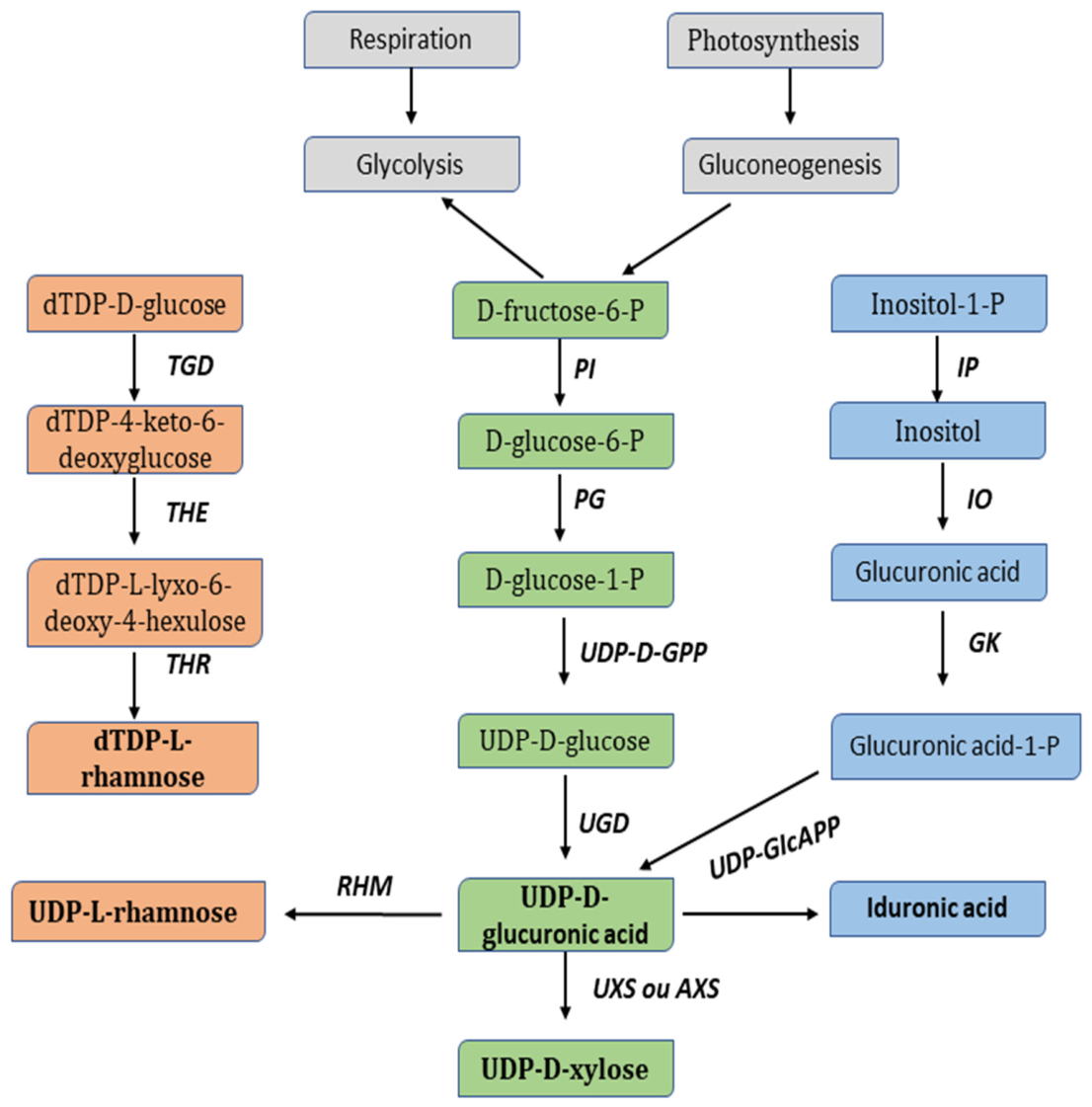
2. Biosynthesis of Ulvan in Ulva
3. Physicochemical Characteristics of Ulvan

| Ulva Species | Yield (%) | Carbohydrate (%) | Protein (%) | Sulfate (%) | Ash (%) | Reference |
|---|---|---|---|---|---|---|
| Ulva arasakii | - | 54.9 | - | 0.4 | - | [51] |
| Ulva conglobata | 1.1 | - | 3.9 | 23.2 | 16.3 | [52] |
| Ulva compressa | 9.0 | 42.0 | 12 | 6.7 | 19.2 | [53] |
| Ulva lacinulata (Formerly Ulva armoricana) | 40.0 | 48.7 | 7.3 | 14.4 | 17.0 | [54] |
| Ulva lactuca (Formerly Ulva rotundata) | 8.0 | 35.9 | 12.6 | 11.4 | - | [54] |
| Ulva rigida | 10.9 | 59.5 | 10.0 | 19.8 | 18.1 | [55] |
| Ulva clathrata | 6.8 | 31.3 | 8.2 | 10.6 | 19.0 | [56] |
| Ulva linza | 9.8 | 51.0 | 1.9 | 17.7 | - | [57] |
| Ulva lactuca | 16.6 | 37.7 | 2.9 | 14.3 | 15.7 | [58] |
| Ulva compressa (formerly Ulva gigantea) | 79.6 | 5.8 | 11.9 | - | [59] | |
| Ulva ohnoi | 6.3 | 54.7 | 2.8 | 14.1 | 25.9 | [60] |
| Ulva meridionalis | 18.7 | - | 6.8 | 10.0 | 12.9 | [61] |
| Ulva prolifera | 20.3 | 56.1 | 1.9 | 16.8 | - | [62,63] |
| Ulva intestinalis | 12.0 | 58.7 ± 0.41 | 10.4 ± 0.55 | 18.4 ± 0.14 | - | [64] |
| Ulva lactuca (formerly Ulva fasciata) | 13.0 | 48.8 | 4.2 | 18.6 | 14.9 | [65] |
| Ulva reticulata | 4.5 | 35.7 | 10.1 | 14.6 | 19.5 | [66,67] |
| Ulva australis (formerly Ulva pertusa) | 26.7 | 41.9–51.3 | 2.4–3.3 | - | 21.2–24.9 | [49] |
| Ulva lactuca (formerly Ulva fasciata) | 43.66 | 31.5 | 12.66 | 20.45 ± 1.98 | 33.57 | [68] |
| Ulva lactuca | 36.5 | 24.27 | 9.67 | - | 39.29 | [69] |
| Ulva Species | Source | Rhamnose (mol%) | Glucuronic Acid (mol%) | Iduronic Acid (mol%) | Xylose (mol%) | Galactose (mol%) | Ref. |
|---|---|---|---|---|---|---|---|
| Ulva arasakii | Blade | 33.2 | - | - | 11.0 | - | [51] |
| Ulva conglobata | Blade | 67.8 | 6.0 | - | 1.5 | 2.4 | [52] |
| Ulva lacinulata (Formely Ulva armoricana) | Blade | 51.6 | 21.3 | 7.0 | 7.5 | 3.1 | [54] |
| Ulva clathrata | Filamentous | 10.7 | 4.0 | - | - | 4.8 | [56] |
| Ulva linza | Blade | 61.6 | 22.6 | - | 10.5 | - | [57] |
| Ulva compressa (formerly Ulva gigantea) | Blade | 42.1 | 15.4 | 3.6 | 28.8 | 2.3 | [59] |
| Ulva lactuca (formerly Ulva fasciata) | Blade | 57.4 | 14.7 | - | 26.1 | 1.9 | [71] |
| Ulva lactuca | Blade | 33.5 | 22.5 | 6.0 | 7.3 | 1.6 | [58] |
| Ulva meridionalis | Filamentous | 39.0 | - | 17 | - | 6.0 | [61] |
| Ulva ohnoi | Blade | 47.1 | 28.6 | 8.8 | 5.5 | 2.6 | [18] |
| Ulva intestinalis | Filamentous | 30.18 | - | - | 8.53 | 15.79 | [64] |
| Ulva australis (formerly Ulva pertusa) | Blade | 22.4–29.5 | - | - | 10.0–13.3 | 0.3–0.5 | [49] |
| Ulva rigida | Blade | 49 | 26 | 18 | 6 | - | [71] |
| Ulva australis | Blade | 51 | 18 | 7 | 22 | - | [71] |
| Ulva flexuosa | Filamentous | 56 | 21 | 6 | 15 | - | [71] |
| Ulva sp. | Blade | 47 | 20 | 10 | 19 | - | [71] |
| Ulva compressa | Filamentous | 47 | 24 | 7 | 17 | - | [71] |
| Ulva prolifera | Filamentous | 60 | 17 | 7 | 15 | - | [71] |
| Ulva ralfsii | Cultivated | 38 | 24 | 4 | 16 | 16 | [71] |
| Ulva ralfsii | Wild | 43 | 26 | 6 | 14 | 10 | [71] |
| Ulva papenfussii | South China Sea | 44.9 | 15.7 | 23.4 | 8.5 | 2.2 | [72] |
4. Ulvan Extraction Methods
4.1. Conventional Extraction Methods
4.2. Advanced Extraction Techniques
4.2.1. Enzyme-Assisted Extraction (EAE)
4.2.2. Physical-Assisted Extraction
| Ulva Species | Extraction Method | Duration | Temp. (°C) | Yield (%) | Ref. |
|---|---|---|---|---|---|
| Ulva rigida | HWE | 1 h | 100 | 7.0 | [93] |
| Ulva rigida | Pressurized hot water | 30 min | 130 | 24.2 | [55] |
| Ulva lactuca | Enzymatic and chemical extraction | 5 h | 50 | 17.1 | [94] |
| Ulva lacinulata (formerly Ulva armoricana) | EAE | 3.25 h | 50 | 35.3 | [95] |
| Ulva ohnoi | MAE | 1 h | 85 | 36.5 ± 3.1 | [86] |
| Ulva meridionalis | MAE | 1 h | 85 | 40.4 | [86] |
| Ulva ohnoi | Acid extraction | 1 h | 85 | 8.1 | [60] |
| Ulva ohnoi | Weak alkali extraction | 1 h | 85 | 4.3 ± 0.5 | [60] |
| Ulva prolifera | MAE | 15 min | 120 | 36.4 | [87] |
| Ulva lactuca | Maceration | 24 h | 4 | 42.5 ± 4.4 | [96] |
| Ulva lactuca | EAE | 3 h | 50 | 58.4 ± 7.3 | [96] |
| Ulva lactuca | Acid extraction | 4 h | 90 | 18 | [50] |
| Ulva clathrata | HWE | 2 h | 100 | 11.2 | [97] |
| Ulva lactuca | HWE | 1–3 h | 80–90 | High (not specified) | [14] |
| Ulva lactuca | HWE | 3 h | 90 | 11 ± 3 | [50] |
| Ulva Lactuca (Formerly Ulva fasciata) | Pressurized hot water | 1 h | 110 | 19.6 | [13] |
| Ulva australis (formerly Ulva pertusa) | EAE | 3 h | 50 | 25.3 | [49] |
| Ulva intestinalis | HWE | 1.5 h | 100 | 15.2 | [98] |
| Ulva australis (formerly Ulva pertusa) | Ultrasound and EAE | 3 h | 50 | 26.7 ± 0.9 | [49] |
| Ulva australis (formerly Ulva pertusa) | UAE | 3 h | 90 | 20.6 | [49] |
| Ulva australis (formerly Ulva pertusa) | HWE | 3 h | 90 | 17.8 | [49] |
| Ulva ohnoi | Acid extraction | 3 h | 37 | 3.5 | [99] |
| Ulva tepida | Acid extraction | 3 h | 37 | 3.9 | [99] |
| Ulva prolifera | Acid extraction | 3 h | 37 | 6.7 | [99] |
| Ulva rigida | Aqueous extraction | 30 min | 40 | Not specified | [100] |
| Ulva fenestrata | EAE (Cellulysin) | 20 h | 50 (estimated) | 14.1 | [88] |
| Ulva fenestrata | Combined enzymatic and ultrasound | 17 h + 40 min | 50 (estimated) | 17.9 | [88] |
| Ulva lactuca | EAE | 2 h | 90 | Not specified | [88] |
| Ulva sp. | Enzymatic extraction (Viscozyme L) | 20 h | 50 | ~9 | [88] |
| Ulva sp. | UAE | 40 min | Not specified | ~12 | [88] |
| Ulva lactuca | HCl 0.01 M extraction | 4 h | 90 | 18 | [23] |
5. Purification and Characterization
6. Mechanistic Insights: Ulvan-Induced Phytopathogen Inhibition
6.1. Induction of Plant Defense Signaling Pathways
6.2. Direct Antimicrobial Effects
6.3. Competitive Inhibition of Pathogen Adhesion
6.4. Nutrient Deprivation
6.5. Effect of Ulvan on Phytopathogens
| Ulvan Species | Crop Plants | Disease | (Fungi, Bact., Virus) | Application | Conc. | Assay | Response to Disease | Ref. |
|---|---|---|---|---|---|---|---|---|
| Ulva sp. | Cabbage (Brassica oleracea) | Black Rot | Xanthomonas campestris pv. campestris (Bacteria) | Foliar spray | 2% (w/v) | qPCR detection of bacterial load | 65% reduction in bacterial spread | [134] |
| Ulva rigida | Rice (Oryza sativa) | Rice Blast | Magnaporthe oryzae (Fungi) | Seed treatment and Foliar spray | 1.5% (w/v) | Spore germination inhibition assay | 60% reduction in fungal colonization | [27] |
| Ulva linza | Rice (Oryza sativa) | Bacterial Leaf Blight | Xanthomonas oryzae (Bacteria) | Foliar spray | 2.5% (w/v) | qPCR detection | 70% suppression of bacterial spread | [135] |
| Ulva lactuca (formerly Ulva fasciata) | Soybean (Glycine max) | Soybean Rust | Phakopsora pachyrhizi (Fungi) | Foliar spray | 2% (w/v) | Spore germination assay | 70% inhibition urediniospore germination | [136] |
| Ulva intestinalis | Barley (Hordeum vulgare) | Barley Stripe Rust | Puccinia striiformis (Fungi) | Foliar spray | 1% (w/v) | Rust pustule count | 60% decrease in pustule formation | [137] |
| Ulva lactuca | Cotton (Gossypium hirsutum) | Cotton Wilt | Fusarium oxysporum (Fungi) | Root dip | 2% (w/v) | Wilting index | 65% reduction in root colonization | [138] |
| Ulva fasciata | Tobacco (Nicotiana tabacum) | TMV | Virus | Foliar spray | 2% (w/v) | ELISA viral titer assay | 60% reduction in viral load | [11] |
| Ulva fasciata | Tomato (Solanum lycopersicum) | Bacterial Speck | Pseudomonas syringae (Bacteria) | Foliar spray | 1% (w/v) | CFU count reduction assay | 70% reduction in bacterial growth | [48] |
| Ulva lacinulata (formerly Ulva armoricana) | Cucumber (Cucumis sativus) | Angular Leaf Spot | Xanthomonas campestris (Bacteria) | Foliar spray | 1.5% (w/v) | Biofilm inhibition assay | Disruption of bacterial biofilm formation | [11] |
| Ulva compressa (formerly Ulva compress) | Pepper (Capsicum annuum) | Bacterial Spot | Xanthomonas vesicatoria (Bacteria) | Seed priming and Foliar spray | 2% (w/v) | Disease severity index | Reduction in necrotic lesions | [139] |
| Ulva prolifera | Potato (Solanum tuberosum) | Late Blight | Xanthomonas vesicatoria (Bacteria) | Foliar spray | 2% (w/v) | Leaf disc assay | 55% inhibition of sporangial germination | [140] |
| Ulva australis (formerly Ulva pertusa) | Tomato (Solanum lycopersicum) | TYLCV | Virus | Soil drench and Foliar spray | 1.5% (w/v) | RT-PCR viral load assay | 40% suppression of viral replication | [141] |
| Ulva rigida | Grape (Vitis vinifera) | Powdery Mildew | Botrytis cinerea (Fungi) | Foliar spray | 1% (w/v) | Conidial germination assay | 65% reduction in fungal growth | [142] |
| Ulva lactuca | Tomato (Solanum lycopersicum) | Early Blight | Alternaria solani (Fungi) | Foliar spray | 2% (w/v) | Disease severity index | Reduced lesion size and fungal sporulation | [23] |
| Ulva reticulata | Citrus (Citrus spp.) | Citrus Canker | Xanthomonas citri (Bacteria) | Foliar spray | 2% (w/v) | Symptom severity scale | 50% reduction in lesion formation | [143] |
| Ulva intestinalis | Wheat (Triticum aestivum) | Fusarium Head Blight | Fusarium graminearum (Fungi) | Soil drench | 2.5% (w/v) | PCR-based pathogen quantification | 50% disease reduction | [144] |
| Ulva fasciata | Maize (Zea mays) | Maize Lethal Necrosis | MCMV and SCMV | Soil drench | 1.5% (w/v) | Virus suppression index | 55% reduction in disease severity | [145] |
| Ulva fasciata | Lettuce (Lactuca sativa) | Downy Mildew | Bremia lactucae (Oomycete) | Foliar spray | 2.5% (w/v) | Disease severity scale | 50% reduction in lesion expansion | [146] |
7. Formulation Strategies and Application Methods of Ulvan
8. Current Challenges and Limitations of the Ulvan Application
8.1. Variability Related to Species, Season, and Extraction Method
8.2. Challenges in Standardization and Quality Control
8.3. Economic Feasibility and Industrial Scalability
8.4. Regulatory Hurdles (Particularly in EU and US Contexts)
9. Future Prospects and Application
10. Conclusions
Author Contributions
Funding
Data Availability Statement
Conflicts of Interest
Abbreviations
| SA | Salicylic acid |
| JA | Jasmonic acid |
| ET | Ethylene |
| SAR | Systemic acquired resistance |
| ISR | Induced systemic resistance |
| SP | Sulfated polysaccharide |
| OXO | Oxalate oxidase |
| UDP | Uridine 5′-diphosphate |
| GPP | Glucose pyrophosphorylase |
| GlcAPP | Glucuronic acid pyrophosphorylase |
| UGD | UDP-D-glucose dehydrogenase |
| PI | Phosphoglucose isomerase |
| GK | Glucuronokinase |
| IO | Inositol oxygenase |
| IP | Inositol-1-phosphatase |
| RHM | Rhamnose synthase |
| THE | dTDP-6-deoxy-D-xylo-4-hexulose 3,5-epimerase |
| THR | dTDP-6-deoxy-L-lyxo-4-hexulose reductase |
| EAE | Enzyme-assisted extraction |
| UAE | Ultrasound-assisted extraction |
| DES | Deep eutectic solvents |
| MWCO | Molecular weight cut-offs |
| AEC | Anion-exchange chromatography |
| TGA | Thermogravimetric analysis |
| FTIR | Fourier transform infrared spectroscopy |
| MW | Molecular weight |
| MWD | Molecular weight distribution |
| XRD | X-ray diffraction |
| PTI | Pattern-triggered immunity |
| ETI | Effector-triggered immunity |
| MAPK | Mitogen-activated protein kinase |
| ROS | Reactive oxygen species |
| PRS | Pattern recognition receptor |
| MAMP | Microbe-associated molecular patterns |
| RLCK | Receptor-like cytoplasmic kinase |
| PAL | Phenylalanine ammonia-lyase |
| NLR | Nucleotide-binding leucine-rich repeat |
| HR | Hypersensitive response |
| AzA | Azelaic acid |
| MeSA | Methyl salicylate |
| ICS1 | Isochorismate synthase 1 |
| PGPR | Plant growth-promoting rhizobacteria |
| LOX | α-linolenic acid-lipoxygenase |
| T3SS | Type III secretion system |
| RG-I | Rhamnogalacturonan I |
| HG | Homogalacturonan |
| EPS | Extracellular polymeric substance |
| SOD | Superoxide dismutase |
| QS | Quorum sensing |
| TMV | Tobacco mosaic virus |
| MeJA | Methyl jasmonate |
| TYLCV | Tomato yellow leaf curl virus |
| CMV | Cucumber mosaic virus |
| PVY | Potato virus Y |
| MCMV | Maize Chlorotic Mottle Virus |
| SCMV | Sugarcane Mosaic Virus |
References
- Islam, M.Z.; Zheng, L. Why is it necessary to integrate circular economy practices for agri-food sustainability from a global perspective? Sustain. Dev. 2025, 33, 600–620. [Google Scholar] [CrossRef] [Scilit]
- Ali, Q.; Yu, C.; Hussain, A.; Ali, M.; Ahmar, S.; Sohail, M.A.; Riaz, M.; Ashraf, M.F.; Abdalmegeed, D.; Wang, X.; et al. Genome engineering technology for durable disease resistance: Recent progress and future outlooks for sustainable agriculture. Front. Plant Sci. 2022, 13, 860281. [Google Scholar] [CrossRef] [Scilit] [PubMed]
- Pérez-Pizá, M.C.; Sautua, F.J.; Szparaga, A.; Bohata, A.; Kocira, S.; Carmona, M.A. New tools for the management of fungal pathogens in extensive cropping systems for friendly environments. Crit. Rev. Plant Sci. 2024, 43, 63–93. [Google Scholar] [CrossRef] [Scilit]
- Feng, T.; Xiong, R.; Huan, P. Productive use of natural resources in agriculture: The main policy lessons. Resour. Policy 2023, 85, 103793. [Google Scholar] [CrossRef] [Scilit]
- Jaiswal, D.K.; Kumar, V.; Kumar, S.; Verma, J.P.; Chaurasia, R. Unveiling the hidden heroes of sustainable agriculture: A significance of soil and crops microbiomes. Ecol. Front. 2026, in press.. [Google Scholar]
- Yousefi, M.; Matzdorf, B.; Ewert, F. Research frameworks in agricultural living labs: A systematic review and comparative analysis. Agric. Syst. 2026, 233, 104629. [Google Scholar] [CrossRef] [Scilit]
- Kumar, R.R.; Dastan, L.C. Young and Green Technologies 5.0: Faces of Innovation of Entrepreneurship for Sustainable Development. In Industry 5.0; Auerbach Publications: Boca Raton, FL, USA, 2026; pp. 10–20. [Google Scholar]
- Chanthini, K.M.P. Seaweed-based green nanotechnology for One Health-aligned agriculture. J. Appl. Phycol. 2026, 38, 1647–1665. [Google Scholar] [CrossRef] [Scilit]
- Khan, N.; Ray, R.L.; Sargani, G.R.; Ihtisham, M.; Khayyam, M.; Ismail, S. Current progress and future prospects of agriculture technology: Gateway to sustainable agriculture. Sustainability 2021, 13, 4883. [Google Scholar] [CrossRef] [Scilit]
- Tsion, K.; Steven, W. An overview use and impact of organic and synthetic farm inputs in developed and developing countries. Afr. J. Food Agric. Nutr. Dev. 2019, 19, 14517–14540. [Google Scholar]
- Sekar, S.; Jeyachandran, S.; Giri, J.; Aman, M. Advancing sustainable agriculture: The potential of seaweed-derived bio pesticides from marine biomass. Bioresour. Bioprocess. 2025, 12, 22. [Google Scholar] [CrossRef] [Scilit]
- Bahmani, R.; More, P.; Babarinde, S.; Zhou, M.; Prithiviraj, B. Seaweeds for plant disease management: Current research advances and future perspectives. Phytoparasitica 2023, 51, 783–802. [Google Scholar] [CrossRef] [Scilit]
- Paulert, R.; Brunel, F.; Melcher, R.L.; Cord-Landwehr, S.; Niehues, A.; Mormann, M.; Moerschbacher, B.M. The non-sulfated ulvanobiuronic acid of ulvans is the smallest active unit able to induce an oxidative burst in dicot cells. Carbohydr. Polym. 2021, 270, 118338. [Google Scholar] [CrossRef] [Scilit]
- Cindana Mo’o, F.R.; Wilar, G.; Devkota, H.P.; Wathoni, N. Ulvan, a polysaccharide from macroalga Ulva sp.: A review of chemistry, biological activities and potential for food and biomedical applications. Appl. Sci. 2020, 10, 5488. [Google Scholar] [CrossRef] [Scilit]
- Contreras, R.A.; González, A.; Laporte, D.; Moenne, A. Oligo-carrageenan kappa, oligo-ulvans and carrageenan kappa differentially increase the level of hormones involved in growth and defense against biotic and abiotic stresses in Arabidopsis thaliana. Algal Res. 2026, 94, 104507. [Google Scholar] [CrossRef] [Scilit]
- López-Serrano, L.; Scalschi, L.; Simeón, R.; San Bautista, A.; González-Hernández, A.I. Harnessing the Power of Biostimulants: A Comprehensive Review of Their Role in Enhancing Agricultural Productivity and Sustainability. Appl. Sci. 2026, 16, 1924. [Google Scholar] [CrossRef] [Scilit]
- Přerovská, T.; Jindřichová, B.; Henke, S.; Yvin, J.C.; Ferrieres, V.; Burketová, L.; Lipovová, P.; Nguema-Ona, E. Arabinogalactan protein-like proteins from Ulva lactuca activate immune responses and plant resistance in an oilseed crop. Front. Plant Sci. 2022, 13, 893858. [Google Scholar] [CrossRef] [Scilit]
- Kidgell, J.T.; Magnusson, M.; De Nys, R.; Glasson, C.R.K. Ulvan: A systematic review of extraction, composition and function. Algal Res. 2019, 39, 101422. [Google Scholar] [CrossRef] [Scilit]
- Simon, C.; McHale, M.; Sulpice, R. Applications of Ulva biomass and strategies to improve its yield and composition: A perspective for Ulva aquaculture. Biology 2022, 11, 1593. [Google Scholar] [CrossRef] [Scilit] [PubMed]
- Tziveleka, L.-A.; Ioannou, E.; Roussis, V. Ulvan, a bioactive marine sulphated polysaccharide as a key constituent of hybrid biomaterials: A review. Carbohydr. Polym. 2019, 218, 355–370. [Google Scholar] [CrossRef] [Scilit] [PubMed]
- Pari, R.F.; Uju, U.; Hardiningtyas, S.D.; Ramadhan, W.; Wakabayashi, R.; Goto, M.; Kamiya, N. Ulva seaweed-derived ulvan: A promising marine polysaccharide as a sustainable resource for biomaterial design. Mar. Drugs 2025, 23, 56. [Google Scholar] [CrossRef] [Scilit]
- Shomron, A.; Duanis-Assaf, D.; Galsurker, O.; Golberg, A.; Alkan, N. Extract from the macroalgae Ulva rigida induces table grapes resistance to Botrytis cinerea. Foods 2022, 11, 723. [Google Scholar] [CrossRef] [Scilit]
- De Borba, M.C.; de Freitas, M.B.; Stadnik, M.J. Ulvan enhances seedling emergence and reduces Fusarium wilt severity in common bean (Phaseolus vulgaris L.). Crop Prot. 2019, 118, 66–71. [Google Scholar] [CrossRef] [Scilit]
- Dos Santos Costa, D.; Moreno, D.S.A.; da Silva, S.L.; Figueira, T.A.; de Oliveira, V.P.; Alviano, C.S.; da Silva, A.J.R. Postharvest treatment with ulvan polysaccharide modulates lipid metabolism in tomato fruits (Solanum lycopersicum cv. Sweet Grape). J. Appl. Phycol. 2024, 36, 2917–2933. [Google Scholar] [CrossRef] [Scilit]
- Paulert, R.; Talamini, V.; Cassolato, J.E.F.; Duarte, M.E.R.; Noseda, M.D.; Smania, A.; Stadnik, M.J. Effects of sulfated polysaccharide and alcoholic extracts from green seaweed Ulva fasciata on anthracnose severity and growth of common bean (Phaseolus vulgaris L.). J. Plant Dis. Prot. 2009, 116, 263–270. [Google Scholar] [CrossRef] [Scilit]
- Delgado, D.Z.; de Freitas, M.B.; Stadnik, M.J. Effectiveness of saccharin and ulvan as resistance inducers against rust and angular leaf spot in bean plants (Phaseolus vulgaris). Crop Prot. 2013, 47, 67–73. [Google Scholar] [CrossRef] [Scilit]
- Paulert, R.; Ebbinghaus, D.; Urlass, C.; Moerschbacher, B.M. Priming of the oxidative burst in rice and wheat cell cultures by ulvan and enhanced resistance against powdery mildew in wheat and barley plants. Plant Pathol. 2010, 59, 634–642. [Google Scholar] [CrossRef] [Scilit]
- De Freitas, M.B.; Stadnik, M.J. Race-specific and ulvan-induced defense responses in bean (Phaseolus vulgaris) against Colletotrichum lindemuthianum. Physiol. Mol. Plant Pathol. 2012, 78, 8–13. [Google Scholar] [CrossRef] [Scilit]
- Shukla, P.S.; Michalak, I.; Burlot, A.S.; Bourgougnon, N.; Daridon, B.; Ronga, D.; Hurtado, A.; Critchley, A.T. Phycobiostimulants: Next-generation sustainable agricultural inputs. ACS Agric. Sci. Technol. 2025, 5, 424–453. [Google Scholar] [CrossRef] [Scilit]
- Hamouda, R.A.; Hussein, M.H.; El-Naggar, N.E.A.; Karim-Eldeen, M.A.; Alamer, K.H.; Saleh, M.A.; Al Masoudi, L.M.; Sharaf, E.M.; El-Azeem, R.M.A. Promoting effect of soluble polysaccharides extracted from Ulva spp. on Zea mays L. growth. Molecules 2022, 27, 1394. [Google Scholar] [CrossRef] [Scilit]
- De Borba, M.C.; Velho, A.C.; Maia-Grondard, A.; Baltenweck, R.; Magnin-Robert, M.; Randoux, B.; Holvoet, M.; Hilbert, J.-L.; Flahaut, C.; Reignault, P. The algal polysaccharide ulvan induces resistance in wheat against Zymoseptoria tritici without major alteration of leaf metabolome. Front. Plant Sci. 2021, 12, 703712. [Google Scholar] [CrossRef] [Scilit]
- Murphy, E.J.; Fehrenbach, G.W.; Abidin, I.Z.; Buckley, C.; Montgomery, T.; Pogue, R.; Murray, P.; Major, I.; Rezoagli, E. Polysaccharides—Naturally occurring immune modulators. Polymers 2023, 15, 2373. [Google Scholar] [CrossRef] [Scilit]
- Meenu, M.; Khandare, K.; Kumar, S.; Kenyanya, S.; Mansi; Garg, M.; Chamoli, P. Biopolymers for the Preparation of Biodegradable Nanoparticles. In Green Chemistry Methods for Producing Biopolymeric Nanomaterials; Springer: Singapore, 2025; pp. 477–505. [Google Scholar]
- Singh, A.; Sharma, K.; Chahal, H.S.; Kaur, H.; Hasanain, M. Seaweed-derived plant boosters: Revolutionizing sustainable farming and soil health. Front. Soil Sci. 2025, 5, 1504045. [Google Scholar] [CrossRef] [Scilit]
- Shukla, P.S.; Borza, T.; Critchley, A.T.; Prithiviraj, B. Seaweed-based compounds and products for sustainable protection against plant pathogens. Mar. Drugs 2021, 19, 59. [Google Scholar] [CrossRef] [Scilit] [PubMed]
- Urban, L.; Lauri, F.; Ben Hdech, D.; Aarrouf, J. Prospects for increasing the efficacy of plant resistance inducers stimulating salicylic acid. Agronomy 2022, 12, 3151. [Google Scholar] [CrossRef] [Scilit]
- Pradhan, B.; Bhuyan, P.P.; Ki, J.S. Immunomodulatory, antioxidant, anticancer, and pharmacokinetic activity of Ulvan, a seaweed-derived sulfated polysaccharide: An updated comprehensive review. Mar. Drugs 2023, 21, 300. [Google Scholar] [CrossRef] [Scilit]
- Li, C.; Tang, T.; Du, Y.; Jiang, L.; Yao, Z.; Ning, L.; Zhu, B. Ulvan and Ulva oligosaccharides: A systematic review of structure, preparation, biological activities and applications. Bioresour. Bioprocess. 2023, 10, 66. [Google Scholar] [CrossRef] [Scilit]
- Zhao, Y.; Yuan, X.; Li, J.; Wang, H.; Pan, B.; Zhu, B. Biochemical characterization of a novel bifunctional cellulase-glucanase and its application for efficient degradation of kelp powder. Int. J. Biol. Macromol. 2025, 321, 146570. [Google Scholar] [CrossRef] [Scilit]
- Patel, A.K.; Vadrale, A.P.; Singhania, R.R.; Michaud, P.; Pandey, A.; Chen, S.J.; Chen, C.W.; Dong, C.D. Algal polysaccharides: Current status and future prospects. Phytochem. Rev. 2023, 22, 1167–1196. [Google Scholar] [CrossRef] [Scilit]
- Duong, T.T.; Nguyen, H.T.T.; Nguyen, H.T.; Nguyen, Q.T.; Nguyen, B.D.; Chuong, N.N.; Chu, H.D.; Tran, L.S.P. Advances in the Genus Ulva Research: From Structural Diversity to Applied Utility. Plants 2025, 14, 3052. [Google Scholar] [CrossRef] [Scilit]
- Alfinaikh, R.S.; Alamry, K.A.; Hussein, M.A. Sustainable and biocompatible hybrid materials-based sulfated polysaccharides for biomedical applications: A review. RSC Adv. 2025, 15, 4708–4767. [Google Scholar] [CrossRef] [Scilit]
- Yang, M.; Deng, Q.; Chen, R.; Sun, Y.; Zhou, X.; Chen, H. Extraction, purification, structural characteristics, and biological activities of seaweed polysaccharides: A review. Starch-Stärke 2025, 77, 2400029. [Google Scholar] [CrossRef] [Scilit]
- Abu-Resha, A.M.; El-Sheekh, M.M.; Abou-El-Souod, G.W.; Morsi, H.; Makhlof, M. Optimized production and characterization of ulvan from Ulva lactuca with in vitro biological activities. Sci. Rep. 2026, 16, 11374. [Google Scholar] [CrossRef] [Scilit]
- Déniel Luque, A.; Pliego-Cortés, H.; Burlot, A.S.; Terme, N.; Furic, M.; Bourgougnon, N. Production of enriched protein extracts from cultivated Ulva sp. (Chlorophyta, Ulvales) by high-pressure homogenization. Front. Mar. Sci. 2025, 12, 1675710. [Google Scholar] [CrossRef] [Scilit]
- Nagahawatta, D.P.; Liyanage, N.M.; Jayawardena, T.U.; Yang, F.; Jayawardena, H.H.A.C.K.; Kurera, M.J.M.S.; Wang, F.; Fu, X.; Jeon, Y.-J. Functions and values of sulfated polysaccharides from seaweed. Algae 2023, 38, 217–240. [Google Scholar] [CrossRef] [Scilit]
- Lahaye, M.; Robic, A. Structure and functional properties of ulvan, a polysaccharide from green seaweeds. Biomacromolecules 2007, 8, 1765–1774. [Google Scholar] [CrossRef] [Scilit]
- Agarwal, P.K.; Dangariya, M.; Agarwal, P. Seaweed extracts: Potential biodegradable, environmentally friendly resources for regulating plant defence. Algal Res. 2021, 58, 102363. [Google Scholar] [CrossRef] [Scilit]
- Chen, J.; Zeng, W.; Gan, J.; Li, Y.; Pan, Y.; Li, J.; Chen, H. Physicochemical properties and anti-oxidation activities of ulvan from Ulva pertusa Kjellm. Algal Res. 2021, 55, 102269. [Google Scholar] [CrossRef] [Scilit]
- Wahlström, N.; Nylander, F.; Malmhäll-Bah, E.; Sjövold, K.; Edlund, U.; Westman, G.; Albers, E. Composition and structure of cell wall ulvans recovered from Ulva spp. along the Swedish west coast. Carbohydr. Polym. 2020, 233, 115852. [Google Scholar] [CrossRef] [Scilit]
- Lai, M.; Li, C.-F.; Li, C. Characterization and thermal behavior of six sulphated polysaccharides from seaweeds. Food Hydrocoll. 1994, 8, 215–232. [Google Scholar] [CrossRef] [Scilit]
- Mao, W.; Zang, X.; Li, Y.; Zhang, H. Sulfated polysaccharides from marine green algae Ulva conglobata and their anticoagulant activity. J. Appl. Phycol. 2006, 18, 9–14. [Google Scholar] [CrossRef] [Scilit]
- Chattopadhyay, K.; Mandal, P.; Lerouge, P.; Driouich, A.; Ghosal, P.; Ray, B. Sulphated polysaccharides from Indian samples of Enteromorpha compressa (Ulvales, Chlorophyta): Isolation and structural features. Food Chem. 2007, 104, 928–935. [Google Scholar] [CrossRef] [Scilit]
- Robic, A.; Sassi, J.; Dion, P.; Lerat, Y.; Lahaye, M. Seasonal variability of physicochemical and rheological properties of ulvan in two Ulva species (Chlorophyta) from the Brittany coast. J. Phycol. 2009, 45, 962–973. [Google Scholar] [CrossRef] [Scilit] [PubMed]
- Toskas, G.; Hund, R.-D.; Laourine, E.; Cherif, C.; Smyrniotopoulos, V.; Roussis, V. Nanofibers based on polysaccharides from the green seaweed Ulva rigida. Carbohydr. Polym. 2011, 84, 1093–1102. [Google Scholar] [CrossRef] [Scilit]
- Qi, X.; Mao, W.; Gao, Y.; Chen, Y.; Chen, Y.; Zhao, C.; Li, N.; Wang, C.; Yan, M.; Lin, C. Chemical characteristic of an anticoagulant-active sulfated polysaccharide from Enteromorpha clathrata. Carbohydr. Polym. 2012, 90, 1804–1810. [Google Scholar] [CrossRef] [Scilit]
- Qi, X.; Mao, W.; Chen, Y.; Chen, Y.; Zhao, C.; Li, N.; Wang, C. Chemical characteristics and anticoagulant activities of two sulfated polysaccharides from Enteromorpha linza (Chlorophyta). J. Ocean Univ. China 2013, 12, 175–182. [Google Scholar] [CrossRef] [Scilit]
- Tian, H.; Yin, X.; Zeng, Q.; Zhu, L.; Chen, J. Isolation, structure, and surfactant properties of polysaccharides from Ulva lactuca L. from South China Sea. Int. J. Biol. Macromol. 2015, 79, 577–582. [Google Scholar] [CrossRef] [Scilit] [PubMed]
- Chandika, P.; Ko, S.-C.; Jung, W.-K. Marine-derived biological macromolecule-based biomaterials for wound healing and skin tissue regeneration. Int. J. Biol. Macromol. 2015, 77, 24–35. [Google Scholar] [CrossRef] [Scilit]
- Glasson, C.R.; Sims, I.M.; Carnachan, S.M.; de Nys, R.; Magnusson, M. A cascading biorefinery process targeting sulfated polysaccharides (ulvan) from Ulva ohnoi. Algal Res. 2017, 27, 383–391. [Google Scholar] [CrossRef] [Scilit]
- Onda, A.; Onda, S.; Koike, M.; Yanagisawa, K.; Tsubaki, S.; Hiraoka, M. Catalytic hydrolysis of polysaccharides derived from fast-growing green macroalgae. ChemCatChem 2017, 9, 2638–2641. [Google Scholar] [CrossRef] [Scilit]
- Cho, M.; Yang, C.; Kim, S.M.; You, S. Molecular characterization and biological activities of water-soluble sulfated polysaccharides from Enteromorpha prolifera. Food Sci. Biotechnol. 2010, 19, 525–533. [Google Scholar] [CrossRef] [Scilit]
- Shi, M.-J.; Wei, X.; Xu, J.; Chen, B.-J.; Zhao, D.-Y.; Cui, S.; Zhou, T. Carboxymethylated degraded polysaccharides from Enteromorpha prolifera: Preparation and in vitro antioxidant activity. Food Chem. 2017, 215, 76–83. [Google Scholar] [CrossRef] [Scilit]
- Tabarsa, M.; You, S.; Dabaghian, E.H.; Surayot, U. Water-soluble polysaccharides from Ulva intestinalis: Molecular properties, structural elucidation and immunomodulatory activities. J. Food Drug Anal. 2018, 26, 599–608. [Google Scholar] [CrossRef] [Scilit] [PubMed]
- De Carvalho, M.M.; de Freitas, R.A.; Ducatti, D.R.; Ferreira, L.G.; Gonçalves, A.G.; Colodi, F.G.; Mazepa, E.; Aranha, E.M.; Noseda, M.D.; Duarte, M.E.R. Modification of ulvans via periodate–chlorite oxidation: Chemical characterization and anticoagulant activity. Carbohydr. Polym. 2018, 197, 631–640. [Google Scholar] [CrossRef] [Scilit] [PubMed]
- Thu, Q.T.M.; Bang, T.H.; Nu, N.T.; Vu Luong, D.; Ly, B.M.; Van, T.T.T.; Thuy, T.T.T. Structural determination of ulvan from green seaweed Ulva reticulata collected at central coast of Vietnam. Chem. Lett. 2015, 44, 788–790. [Google Scholar] [CrossRef] [Scilit]
- Tran, T.T.V.; Truong, H.B.; Tran, N.H.V.; Quach, T.M.T.; Nguyen, T.N.; Bui, M.L.; Yuguchi, Y.; Thanh, T.T.T. Structure, conformation in aqueous solution and antimicrobial activity of ulvan extracted from green seaweed Ulva reticulata. Nat. Prod. Res. 2018, 32, 2291–2296. [Google Scholar] [CrossRef] [Scilit] [PubMed]
- Barakat, K.M.; Ismail, M.M.; Abou El Hassayeb, H.E.; El Sersy, N.A.; Elshobary, M.E. Chemical characterization and biological activities of ulvan extracted from Ulva fasciata (Chlorophyta). Rend. Fis. Acc. Lincei 2022, 33, 829–841. [Google Scholar] [CrossRef] [Scilit]
- Ibrahim, M.I.A.; Amer, M.S.; Ibrahim, H.A.H.; Zaghloul, E.H. Considerable production of ulvan from Ulva lactuca with special emphasis on its antimicrobial and anti-fouling properties. Appl. Biochem. Biotechnol. 2022, 194, 3097–3118. [Google Scholar] [CrossRef] [Scilit]
- De Freitas, M.B.; Ferreira, L.G.; Hawerroth, C.; Duarte, M.E.R.; Noseda, M.D.; Stadnik, M.J. Ulvans induce resistance against plant pathogenic fungi independently of their sulfation degree. Carbohydr. Polym. 2015, 133, 384–390. [Google Scholar] [CrossRef] [Scilit]
- Kidgell, J.T.; Carnachan, S.M.; Magnusson, M.; Lawton, R.J.; Sims, I.M.; Hinkley, S.F.R.; de Nys, R.; Glasson, C.R.K. Are all ulvans equal? A comparative assessment of the chemical and gelling properties of ulvan from blade and filamentous Ulva. Carbohydr. Polym. 2021, 264, 118010. [Google Scholar] [CrossRef] [Scilit]
- Tran, V.H.N.; Mikkelsen, M.D.; Truong, H.B.; Vo, H.N.M.; Pham, T.D.; Cao, H.T.T.; Nguyen, T.T.; Meyer, A.S.; Thanh, T.T.T.; Van, T.T.T. Structural characterization and cytotoxic activity evaluation of ulvan polysaccharides extracted from the green algae Ulva papenfussii. Mar. Drugs 2023, 21, 556. [Google Scholar] [CrossRef] [Scilit]
- Yi, X.; Xie, J.; Mei, J. Recent advances in marine-derived polysaccharide hydrogels: Innovative applications and challenges in emerging food fields. Polymers 2025, 17, 2553. [Google Scholar] [CrossRef] [Scilit]
- Jangra, N.; Singla, A.; Puri, V.; Dheer, D.; Chopra, H.; Malik, T.; Sharma, A. Herbal bioactive-loaded biopolymeric formulations for wound healing applications. RSC Adv. 2025, 15, 12402–12442. [Google Scholar] [CrossRef] [Scilit]
- Ghaderiardakani, F. Ulva Growth, Development and Applications. Ph.D. Thesis, University of Birmingham, Birmingham, England, 2019. [Google Scholar]
- Fávero Massocato, T.; Robles-Carnero, V.; Rodrigues Moreira, B.; Castro-Varela, P.; Bonomi-Barufi, J.; Abdala-Díaz, R.; Rubi Rörig, L.; López Figueroa, F.D. Characterization and biological activities of the ulvan polysaccharide-rich fraction obtained from Ulva rigida and Ulva pseudorotundata and their potential for pharmaceutical application. Mar. Biotechnol. 2024, 26, 324–337. [Google Scholar] [CrossRef] [Scilit]
- Gonzales, K.N.; Troncoso, O.P.; Torres, F.G. Controlled extraction and characterization of ulvan from Ulva papenfussii with potential applications in sustainable energy. J. Appl. Phycol. 2025, 37, 2051–2059. [Google Scholar] [CrossRef] [Scilit]
- Yaich, H.; Amira, A.B.; Abbes, F.; Bouaziz, M.; Besbes, S.; Richel, A.; Blecker, C.; Attia, H.; Garna, H. Effect of extraction procedures on structural, thermal and antioxidant properties of ulvan from Ulva lactuca collected in Monastir coast. Int. J. Biol. Macromol. 2017, 105, 1430–1439. [Google Scholar] [CrossRef] [Scilit] [PubMed]
- Kidgell, J.T. The Structure and Bioactivity of Ulvan, a Sulfated Polysaccharide from Ulva (Chlorophyta). Ph.D. Thesis, James Cook University, Townsville, Australia, 2021. [Google Scholar]
- Alves, A.; Sousa, R.A.; Reis, R.L. A practical perspective on ulvan extracted from green algae. J. Appl. Phycol. 2013, 25, 407–424. [Google Scholar] [CrossRef] [Scilit]
- Aparicio, M.d.P.G.; Marina, M.L. Application of enzyme-assisted extraction for food analysis and release of natural products. In Green Extraction Techniques in Food Analysis; Bentham Science Publishers: Singapore, 2023; pp. 431–496. [Google Scholar]
- Robic, A.; Gaillard, C.; Sassi, J.; Lerat, Y.; Lahaye, M. Ultrastructure of ulvan: A polysaccharide from green seaweeds. Biopolymers 2009, 91, 652–664. [Google Scholar] [CrossRef] [Scilit]
- Deng, Y.; Wang, W.; Zhao, S.; Yang, X.; Xu, W.; Guo, M.; Xu, E.; Ding, T.; Ye, X.; Liu, D. Ultrasound-assisted extraction of lipids as food components: Mechanism, solvent, feedstock, quality evaluation and coupled technologies—A review. Trends Food Sci. Technol. 2022, 122, 83–96. [Google Scholar] [CrossRef] [Scilit]
- Nakib, M.E.; Aytaç, S. Ultrasonic-assisted extraction (UAE) of bioactive compounds: Mechanisms, benefits, applications, and synergistic approaches. Curr. Stud. Mol. Biol. Genet. 2024, 11, 11. [Google Scholar]
- Lakshmi, D.S.; Sankaranarayanan, S.; Gajaria, T.K.; Li, G.; Kujawski, W.; Kujawa, J.; Navia, R. A short review on the valorization of green seaweeds and ulvan: Feedstock for chemicals and biomaterials. Biomolecules 2020, 10, 991. [Google Scholar] [CrossRef] [Scilit]
- Tsubaki, S.; Oono, K.; Hiraoka, M.; Onda, A.; Mitani, T. Microwave-assisted hydrothermal extraction of sulfated polysaccharides from Ulva spp. and Monostroma latissimum. Food Chem. 2016, 210, 311–316. [Google Scholar] [CrossRef] [Scilit]
- Yuan, Y.; Xu, X.; Jing, C.; Zou, P.; Zhang, C.; Li, Y. Microwave assisted hydrothermal extraction of polysaccharides from Ulva prolifera: Functional properties and bioactivities. Carbohydr. Polym. 2018, 181, 902–910. [Google Scholar] [CrossRef] [Scilit] [PubMed]
- Malvis Romero, A.; Picado Morales, J.J.; Klose, L.; Liese, A. Enzyme-assisted extraction of ulvan from the green macroalgae Ulva fenestrata. Molecules 2023, 28, 6781. [Google Scholar] [CrossRef] [Scilit] [PubMed]
- Negi, T.; Kumar, A.; Sharma, S.K.; Rawat, N.; Saini, D.; Sirohi, R.; Prakash, O.; Dubey, A.; Dutta, A.; Shahi, N.C. Deep eutectic solvents: Preparation, properties, and food applications. Heliyon 2024, 10, e28784. [Google Scholar] [CrossRef] [Scilit] [PubMed]
- Obluchinskaya, E.D.; Pozharitskaya, O.N.; Zakharova, L.V.; Daurtseva, A.V.; Flisyuk, E.V.; Shikov, A.N. Efficacy of natural deep eutectic solvents for extraction of hydrophilic and lipophilic compounds from Fucus vesiculosus. Molecules 2021, 26, 4198. [Google Scholar] [CrossRef] [Scilit]
- Ramon, M.R.; Durand, E.; Garcia-Sosa, K.; Peña-Rodríguez, L.M. Exploring the potential of deep eutectic solvents (DES) in bioactive natural product research: From DES to NaDES, THEDES, and beyond. PeerJ Anal. Chem. 2023, 5, e28. [Google Scholar] [CrossRef] [Scilit]
- Ramadhan, W.; Alamsyah, A.; Hardiningtyas, S.D.; Pari, R.F.; Wakabayashi, R.; Kamiya, N.; Goto, M. Facilitating ulvan extraction from Ulva lactuca via deep eutectic solvent and peracetic acid treatment. ASEAN J. Chem. Eng. 2024, 24, 90–101. [Google Scholar] [CrossRef] [Scilit]
- Paradossi, G.; Cavalieri, F.; Pizzoferrato, L.; Liquori, A.M. A physico-chemical study on the polysaccharide ulvan from hot water extraction of the macroalga Ulva. Int. J. Biol. Macromol. 1999, 25, 309–315. [Google Scholar] [CrossRef] [Scilit]
- Yaich, H.; Garna, H.; Besbes, S.; Barthélemy, J.-P.; Paquot, M.; Blecker, C.; Attia, H. Impact of extraction procedures on the chemical, rheological and textural properties of ulvan from Ulva lactuca of Tunisia coast. Food Hydrocoll. 2014, 40, 53–63. [Google Scholar] [CrossRef] [Scilit]
- Hardouin, K.; Bedoux, G.; Burlot, A.-S.; Donnay-Moreno, C.; Bergé, J.-P.; Nyvall-Collén, P.; Bourgougnon, N. Enzyme-assisted extraction (EAE) for the production of antiviral and antioxidant extracts from the green seaweed Ulva armoricana. Algal Res. 2016, 16, 233–239. [Google Scholar] [CrossRef] [Scilit]
- Fournière, M.; Latire, T.; Lang, M.; Terme, N.; Bourgougnon, N.; Bedoux, G. Production of active poly- and oligosaccharidic fractions from Ulva sp. by combining enzyme-assisted extraction and depolymerization. Metabolites 2019, 9, 182. [Google Scholar] [CrossRef] [Scilit]
- Chi, Y.; Li, H.; Wang, P.; Du, C.; Ye, H.; Zuo, S.; Guan, H. Structural characterization of ulvan extracted from Ulva clathrata assisted by an ulvan lyase. Carbohydr. Polym. 2020, 229, 115497. [Google Scholar] [CrossRef] [Scilit] [PubMed]
- Klongklaew, N.; Praiboon, J.; Tamtin, M.; Srisapoome, P. Chemical composition of hot water crude extract from Ulva intestinalis and its effects on shrimp immunity. Fish Shellfish Immunol. 2021, 112, 8–22. [Google Scholar] [CrossRef] [Scilit] [PubMed]
- Glasson, C.R.; Luiten, C.A.; Carnachan, S.M.; Daines, A.M.; Kidgell, J.T.; Hinkley, S.F. Structural characterization of ulvans extracted from cultivated Ulva. Int. J. Biol. Macromol. 2022, 194, 571–579. [Google Scholar] [CrossRef] [Scilit] [PubMed]
- Hardiningtyas, S.D.; Al Haqqy, R.I.; Albarokah, N.; Ramadhan, W.; Pari, R.F.; Wakabayashi, R.; Moriyama, K. Extraction of polysaccharide ulvan from Ulva lactuca via hydrated deep eutectic solvents. ChemRxiv 2024, preprint. [Google Scholar]
- Siddhanta, A.K.; Goswami, A.M.; Ramavat, B.K.; Mody, K.H.; Mairh, O.P. Water soluble polysaccharides of marine algal species of Ulva of Indian waters. Indian J. Geo-Mar. Sci. 2001, 30, 166–172. [Google Scholar]
- Adrien, A.; Bonnet, A.; Dufour, D.; Baudouin, S.; Maugard, T.; Bridiau, N. Pilot production of ulvans from Ulva sp. and their effects on dermal fibroblasts. Carbohydr. Polym. 2017, 157, 1306–1314. [Google Scholar] [CrossRef] [Scilit]
- Dufour, A.A.A.B.D. Pilot production of ulvans from Ulva sp. Carbohydr. Polym. 2016, 88, 537–546. [Google Scholar]
- Otero, P.; Carpena, M.; Garcia-Oliveira, P.; Garcia-Perez, P.; Fraga-Corral, M.; Cao, H.; Nie, S.; Xiao, J.; Simal-Gandara, J.; Prieto, M.A. Seaweed polysaccharides: Emerging extraction technologies, chemical modifications and bioactive properties. Crit. Rev. Food Sci. Nutr. 2023, 63, 1901–1929. [Google Scholar] [CrossRef] [Scilit]
- Shefer, S.; Robin, A.; Chemodanov, A.; Lebendiker, M.; Bostwick, R.; Rasmussen, L.; Lishner, M.; Gozin, M.; Golberg, A. Fighting SARS-CoV-2 with green seaweed Ulva sp. extract. PeerJ 2021, 9, e12398. [Google Scholar] [CrossRef] [Scilit]
- Ben Amor, C.; Jmel, M.A.; Chevallier, P.; Mantovani, D.; Smaali, I. Efficient extraction of a high molecular weight ulvan from stranded Ulva sp. biomass. Biomass Convers. Biorefin. 2023, 13, 3975–3985. [Google Scholar] [CrossRef] [Scilit]
- Kazemi, M.; Fathi, M.; Jahanbin, K.; Taghdir, M.; Abbaszadeh, S. Optimization of ultrasonic-assisted hot acidic solvent extraction of ulvan from Ulva intestinalis. Food Hydrocoll. 2023, 142, 108837. [Google Scholar] [CrossRef] [Scilit]
- González-Ballesteros, N.; Rodríguez-Argüelles, M.C.; Prado-López, S.; Lastra, M.; Grimaldi, M.; Cavazza, A.; Nasi, L.; Salviati, G.; Bigi, F. Macroalgae-mediated synthesis of gold and silver nanoparticles. Mater. Sci. Eng. C 2019, 97, 498–509. [Google Scholar] [CrossRef] [Scilit] [PubMed]
- Harshvardhan, K.; Mishra, A.; Jha, B. Purification and characterization of cellulase from marine Bacillus sp. H1666. J. Mol. Catal. B Enzym. 2013, 93, 51–56. [Google Scholar] [CrossRef] [Scilit]
- He, J.; Xu, Y.; Chen, H.; Sun, P. Extraction, structural characterization, and antioxidant activity of seaweed polysaccharides. Int. J. Mol. Sci. 2016, 17, 1988. [Google Scholar] [CrossRef] [Scilit]
- Jmel, M.A.; Anders, N.; Messaoud, G.B.; Marzouki, M.N.; Spiess, A.; Smaali, I. Extraction and characterization of cellulose from stranded Ulva lactuca. J. Clean. Prod. 2019, 234, 1421–1427. [Google Scholar] [CrossRef] [Scilit]
- Striegel, A.M. Multiple detection in size-exclusion chromatography of macromolecules. Anal. Chem. 2005, 77, 104–113. [Google Scholar] [CrossRef] [Scilit]
- Gajaria, T.K.; Bhatt, H.; Khandelwal, A.; Vasu, V.T.; Reddy, C.R.K.; Lakshmi, D.S. Fabrication of porous ulvan scaffold by chemical cross-linking. J. Bioact. Compat. Polym. 2020, 35, 301–313. [Google Scholar] [CrossRef] [Scilit]
- Madany, M.A.; Abdel-Kareem, M.S.; Al-Oufy, A.K.; Haroun, M.; Sheweita, S.A. The biopolymer ulvan from Ulva fasciata: Extraction towards nanofibers fabrication. Int. J. Biol. Macromol. 2021, 177, 401–412. [Google Scholar] [CrossRef] [Scilit]
- Bradford, M.M. A rapid and sensitive method for the quantitation of microgram quantities of protein utilizing the principle of protein-dye binding. Anal. Biochem. 1976, 72, 248–254. [Google Scholar] [CrossRef]
- Craigie, J.S.; Wen, Z.C.; Van der Meer, J.P. Interspecific, intraspecific and nutritionally determined variations in the composition of agars from Gracilaria spp. Bot. Mar. 1984, 27, 55–62. [Google Scholar] [CrossRef] [Scilit]
- Martin, R.L.; Le Boulch, P.; Clin, P.; Schwarzenberg, A.; Yvin, J.-C.; Andrivon, D.; Nguema-Ona, E.; Val, F. A comparison of PTI defense profiles induced in Solanum tuberosum by PAMP and non-PAMP elicitors. PLoS ONE 2020, 15, e0236633. [Google Scholar] [CrossRef] [Scilit]
- El Modafar, C.; Elgadda, M.; El Boutachfaiti, R.; Abouraicha, E.; Zehhar, N.; Petit, E.; El Alaoui-Talibi, Z.; Courtois, B.; Courtois, J. Induction of natural defence in tomato seedlings in response to bioelicitors from green algae. Sci. Hortic. 2012, 138, 55–63. [Google Scholar] [CrossRef] [Scilit]
- Ali, O.; Ramsubhag, A.; Jayaraman, J. Biostimulant properties of seaweed extracts in plants: Implications towards sustainable crop production. Plants 2021, 10, 531. [Google Scholar] [CrossRef] [Scilit]
- Jaulneau, V.; Lafitte, C.; Jacquet, C.; Fournier, S.; Salamagne, S.; Briand, X.; Esquerré-Tugayé, M.-T.; Dumas, B. Ulvan, a sulfated polysaccharide from green algae, activates plant immunity through the jasmonic acid signaling pathway. J. Biomed. Biotechnol. 2010, 2010, 525291. [Google Scholar] [CrossRef] [Scilit]
- Hmani, I.; Ktari, L.; Ismail, A.; El Bour, M. Biotechnological potential of Ulva ohnoi epiphytic bacteria. Front. Mar. Sci. 2023, 10, 1042527. [Google Scholar] [CrossRef] [Scilit]
- Hung, Y.-H.R.; Chen, G.-W.; Pan, C.-L.; Lin, H.-T.V. Production of ulvan oligosaccharides with antioxidant activity. Fermentation 2021, 7, 160. [Google Scholar] [CrossRef] [Scilit]
- Fuertes-Rabanal, M.; Rebaque, D.; Largo-Gosens, A.; Encina, A.; Mélida, H. Cell walls: A comparative view of plants, algae, and microorganisms. J. Exp. Bot. 2024, 75, erae512. [Google Scholar]
- Gadenne, V.; Lebrun, L.; Jouenne, T.; Thebault, P. Antiadhesive activity of ulvan polysaccharides immobilized on titanium. Colloids Surf. B Biointerfaces 2013, 112, 229–236. [Google Scholar] [CrossRef] [Scilit] [PubMed]
- Gadenne, V.; Lebrun, L.; Jouenne, T.; Thebault, P. Role of molecular properties of ulvans on antiadhesive surfaces. J. Biomed. Mater. Res. A 2015, 103, 1021–1028. [Google Scholar] [CrossRef] [Scilit]
- Mishra, R.; Panda, A.K.; De Mandal, S.; Shakeel, M.; Bisht, S.S.; Khan, J. Natural anti-biofilm agents. Front. Microbiol. 2020, 11, 566325. [Google Scholar] [CrossRef] [Scilit]
- Behzadnia, A.; Moosavi-Nasab, M.; Oliyaei, N. Anti-biofilm activity of marine algae-derived compounds. Front. Microbiol. 2024, 15, 1270174. [Google Scholar] [CrossRef] [Scilit]
- Burgunter-Delamare, B.; Shetty, P.; Vuong, T.; Mittag, M. Exchange or eliminate: Secrets of algal-bacterial relationships. Plants 2024, 13, 829. [Google Scholar] [CrossRef] [Scilit]
- Ren, H.; Zhao, X.; Li, W.; Hussain, J.; Qi, G.; Liu, S. Calcium signaling in plant programmed cell death. Cells 2021, 10, 1089. [Google Scholar] [CrossRef] [Scilit]
- Salazar, M.E.; Podgornaia, A.I.; Laub, M.T. MgrB regulates PhoQ bifunctionality. Mol. Microbiol. 2016, 102, 430–445. [Google Scholar] [CrossRef] [Scilit] [PubMed]
- Kandari, D.; Joshi, H.; Bhatnagar, R. Zur: Zinc-sensing transcriptional regulator. Pathogens 2021, 10, 344. [Google Scholar] [CrossRef] [Scilit] [PubMed]
- Henriques, B.; Teixeira, A.; Figueira, P.; Reis, A.T.; Almeida, J.; Vale, C.; Pereira, E. Simultaneous removal of trace elements by Ulva lactuca. Sci. Total Environ. 2019, 652, 880–888. [Google Scholar] [CrossRef] [Scilit]
- Chiquito-Contreras, R.G.; Murillo-Amador, B.; Carmona-Hernandez, S.; Chiquito-Contreras, C.J.; Hernandez-Montiel, L.G. Effect of marine bacteria and ulvan on antioxidant defense enzymes. Antioxidants 2019, 8, 580. [Google Scholar] [CrossRef] [Scilit]
- Ferreira, M.E.; Dias, J.S.; Mengistu, A.; Williams, P.H. Screening of Portuguese cole landraces. Euphytica 1992, 65, 219–227. [Google Scholar] [CrossRef] [Scilit]
- Contreras-Porcia, L.; Dennett, G.; González, A.; Vergara, E.; Medina, C.; Correa, J.A.; Moenne, A. Copper-induced genes in Ulva compressa. Mar. Biotechnol. 2011, 13, 544–556. [Google Scholar] [CrossRef] [Scilit]
- Blum, M.M.C.; Reis, E.M.; Vieira, F.T.; Carlini, R. Effect of substrate, temperature and photoperiod on Phakopsora pachyrhizi. Summa Phytopathol. 2015, 41, 101–106. [Google Scholar] [CrossRef] [Scilit]
- Paulert, R.; Ascrizzi, R.; Malatesta, S.; Berni, P.; Noseda, M.D.; De Carvalho, M.M.; Marchioni, I.; Pistelli, L.; Duarte, M.E.R.; Mariotti, L. Ulva intestinalis extract as plant biostimulant. Plants 2021, 10, 1391. [Google Scholar]
- Vicente, T.F.L.; Lemos, M.F.L.; Félix, R.; Valentão, P.; Félix, C. Marine macroalgae as inhibitors of fungal phytopathogens. J. Fungi 2021, 7, 1006. [Google Scholar] [CrossRef] [Scilit] [PubMed]
- Vicente, T.F.L.; Félix, C.; Félix, R.; Valentão, P.; Lemos, M.F.L. Seaweed as a natural source against phytopathogenic bacteria. Mar. Drugs 2022, 21, 23. [Google Scholar] [CrossRef] [Scilit] [PubMed]
- Acrres, T.; Schimmels, T.; Van Der Weide, R.Y.; Elissen, H.J.H.; Hol, S.J.E.; Evenhuis, A.; De Vos, R.C.H.; Van Der Meer, I.M.; Van Geel, W.C.A. Agricultural Applications of Seaweed Extracts; Wageningen Plant Research: Wageningen, The Netherlands, 2022. [Google Scholar]
- Manjunatha, L.; Rajashekara, H.; Uppala, L.S.; Ambika, D.S.; Patil, B.; Shankarappa, K.S.; Nath, V.S.; Kavitha, T.R.; Mishra, A.K. Mechanisms of microbial plant protection. Plants 2022, 11, 3449. [Google Scholar] [CrossRef] [Scilit]
- Chanthini, K.M.-P.; Senthil-Nathan, S.; Sivanesh, H.; Ramasubramanian, R.; Stanley-Raja, V.; Karthi, S.; Shyam-Sundar, N.; Ali, M.A.; Alwahibi, M.S. Seaweed compounds induce resistance in tomato. Chem. Biol. Technol. Agric. 2023, 10, 120. [Google Scholar] [CrossRef] [Scilit]
- Nawaz, A.; Rehman, H.U.; Usman, M.; Wakeel, A.; Shahid, M.S.; Alam, S.; Sanaullah, M.; Atiq, M.; Farooq, M. Nanobiotechnology in crop stress management. Discov. Nano 2023, 18, 74. [Google Scholar] [CrossRef] [Scilit]
- El-Naggar, N.E.-A.; Shiha, A.M.; Mahrous, H.; Mohammed, A.B.A. Green synthesis of chitosan nanoparticles. Sci. Rep. 2024, 14, 11336. [Google Scholar] [CrossRef] [Scilit]
- Zulfiqar, F.; Moosa, A.; Ali, H.M.; Bermejo, N.F.; Munné-Bosch, S. Biostimulants in sustainable agriculture. Plant Physiol. Biochem. 2024, 211, 108699. [Google Scholar] [CrossRef] [Scilit]
- Narendra, K.; Lakshmi, K.S.; Khan, Z.; Latha, G.S.; Latha, M.M.; Ragalatha, R.; Xavier, J.; Vijay, N.; Mallikarjuna, K. Algal extracts and their importance in promoting plant growth. Afr. J. Bio. Sc. 2024, 6, 1146–1163. [Google Scholar]
- Shefer, S.; Lebendiker, M.; Finkelshtein, A.; Chamovitz, D.A.; Golberg, A. Ulvan crude extract’s chemical and biophysical profile and its effect as a biostimulant on Arabidopsis thaliana. Algal Res. 2022, 62, 102609. [Google Scholar] [CrossRef] [Scilit]
- Shefer, S.; Vitkin, E.; Palatnik, R.R.; Zilberman, D.; Golberg, A. Ulvan long-term biostimulant effects on Arabidopsis thaliana seed treatment via medium supplementation. J. Appl. Phycol. 2025, 38, 715–734. [Google Scholar] [CrossRef] [Scilit]
- Jiang, Y.; Wang, K.; Pan, X.; Zhang, Y.; Duan, H.; Zhao, T.; Ma, Z.; Feng, J.; Zhou, X.; Lei, B.; et al. Citral-amino-oligosaccharide Schiff base induces plant systemic acquired resistance against tobacco mosaic virus. Pest Manag. Sci. 2026, 82, 4429–4439. [Google Scholar] [CrossRef] [Scilit]
- Zhao, X.; Wang, X.; Zhang, J.; Feng, L.; Gao, G. Sustainable production of ulvan from green macroalgae and its potential in carbon sequestration: A critical review. Int. J. Biol. Macromol. 2025, 330, 147978. [Google Scholar] [CrossRef] [Scilit] [PubMed]
- Pereira, L.; Valado, A. Marine Algae Hydrogels as Emerging Biomaterials for Medicine. Gels 2026, 12, 228. [Google Scholar] [CrossRef] [Scilit] [PubMed]
- Pereira, S.G.; Pereira, R.N.; Ferreira, S.; Nunes, C.; Teixeira, J.A.; Rocha, C.M. Advancements in ulvan valorization from Ulva rigida: Unveiling a combined approach of electric fields and subcritical water extraction. Innov. Food Sci. Emerg. Technol. 2025, 106, 104318. [Google Scholar] [CrossRef] [Scilit]
- Fransiska, D.; Sedayu, B.B.; Sinurat, E.; Marraskuranto, E.; Irianto, H.E. Ulvan from Green Seaweed as a Sustainable Source of Sulfated Polysaccharide for Biomedical Applications. In Marine Biotechnology; CRC Press: Boca Raton, FL, USA, 2025; pp. 136–155. [Google Scholar]
- Hofmann, L.C.; Strauss, S.; Shpigel, M.; Guttman, L.; Stengel, D.B.; Rebours, C.; Gjorgovska, N.; Turan, G.; Balina, K.; Zammit, G.; et al. The green seaweed Ulva: Tomorrow’s “wheat of the sea” in foods, feeds, nutrition, and biomaterials. Crit. Rev. Food Sci. Nutr. 2025, 65, 3728–3763. [Google Scholar] [CrossRef] [Scilit]
- Ottolina, G.; Zaccheria, F.; Paini, J. Resource Recovery from Green Tide Biomass: Sustainable Cascading Biorefinery Strategies for Ulva spp. Biomass 2025, 5, 41. [Google Scholar] [CrossRef] [Scilit]
- Sunwoo, I.Y.; Kim, T.; Ryu, Y.K.; Lee, W.K.; Kim, J.; Koh, E.J.; Lee, Y.-J.; Choi, W.Y. Integrated sustainable valorization of seaweed (Ulva ohnoi) biomass into food-grade ingredients with year-round cultivated feedstock. Bioresour. Bioprocess. 2026, 13, 35. [Google Scholar] [CrossRef] [Scilit]
- El-Gendy, N.S.; Shaaban Sadek, M.; Nassar, H.N.; Mustafa, A. Eco-Friendly Extraction of Sustainable and Valorized Value-Added Products from Ulva fasciata Macroalgae: A Holistic Technoeconomic Analysis. Int. J. Biomater. 2025, 2025, 5811057. [Google Scholar] [CrossRef] [Scilit]
- Suparmaniam, U.; Lam, M.K.; Ho, Y.C.; Tan, I.S.; Lau, S.Y.; Kansedo, J.; Cheng, Y.W.; Naqvi, S.R.; Pugazhendi, A. Scale-up and industrial production of algal biomedical products. In Algae Biotechnology for Biomedical and Nutritional Applications; Academic Press: Cambridge, MA, USA, 2025; pp. 269–293. [Google Scholar]
- Prates, J.A.; Ezzaitouni, M.; Guil-Guerrero, J.L. Marine Macroalgal Polysaccharides as Precision Tools for Health and Nutrition. Phycology 2025, 5, 58. [Google Scholar] [CrossRef] [Scilit]
- Sundar, P.S.; Alagarsamy, V.; Bose, S.C.; Manjappa, A.S.; Galatage, S.T.; Lakshmanarao, P.; Karjun, K.M.; Solomon, V.R. Marine-Based Polysaccharides in Food: Safety and Regulation. In Multifunctional Marine Polysaccharides: Drug Delivery, Biomedicine and Food Technology Applications; Springer: Singapore, 2026; pp. 549–583. [Google Scholar]
- Dinesh Kumar, S.; Majumder, A.; Suhail Haq, R.; Logesh, K.; Hariprakash, M.; Rithika, S.; Sineka, A.; Nithisha, S.; Ibrahim, S.S.M.; Eswar, I.; et al. Advancement in Phycoremediation Efficiency of Ulva: An Overview. In Phycoremediation: A Contemporary Technology for Nutrient Resources Recovery from Wastewater; Springer: Singapore, 2026; pp. 131–171. [Google Scholar]
- Deniz, N.; Sarıtaş, S.; Bechelany, M.; Karav, S. Prebiotic and functional fibers from micro-and macroalgae: Gut microbiota modulation, health benefits, and food applications. Int. J. Mol. Sci. 2025, 26, 11082. [Google Scholar] [CrossRef] [Scilit]
- Moovendhan, M. The Potential Therapeutic Applications of Marine Polysaccharides in the Treatment of Inflammatory Diseases. Bioact. Carbohydr. Diet. Fibre 2025, 34, 100502. [Google Scholar] [CrossRef] [Scilit]




| Component | Function | Significance in Agriculture | References |
|---|---|---|---|
| Glucuronic Acid and Iduronic Acid | Anionic nature, metal chelation | Enhances nutrient bioavailability and soil remediation by binding heavy metals. | [18,47,50] |
| Rhamnose | Structural rigidity, bioactivity | Triggers plant defense pathways and SAR. | [18,38] |
| Xylose | Structural stability | Influences viscosity and film-forming ability in coatings for seed protection. | [73,74] |
| Sulfate Groups | Electrostatic interactions, antimicrobial properties | Disrupts pathogen membranes, binds to plant receptors, and activates immune responses. | [18,69] |
| Minor Sugars (Galactose, Arabinose, Glucose) | Polysaccharide integrity | Alters bioadhesive properties for foliar applications. | [38,47] |
Disclaimer/Publisher’s Note: The statements, opinions and data contained in all publications are solely those of the individual author(s) and contributor(s) and not of MDPI and/or the editor(s). MDPI and/or the editor(s) disclaim responsibility for any injury to people or property resulting from any ideas, methods, instructions or products referred to in the content. |
© 2026 by the authors. Licensee MDPI, Basel, Switzerland. This article is an open access article distributed under the terms and conditions of the Creative Commons Attribution (CC BY) license.
Share and Cite
Sahoo, S.; Saha, D.; Saxena, P.; Kundu, A.; Das, S.; Behera, M.; Pathania, R.; Singh, L. Ulvan in Agriculture: An Eco-Friendly Approach to Plant Disease Management. Phycology 2026, 6, 51. https://doi.org/10.3390/phycology6020051
Sahoo S, Saha D, Saxena P, Kundu A, Das S, Behera M, Pathania R, Singh L. Ulvan in Agriculture: An Eco-Friendly Approach to Plant Disease Management. Phycology. 2026; 6(2):51. https://doi.org/10.3390/phycology6020051
Chicago/Turabian StyleSahoo, Subhasini, Debajyoti Saha, Pallavi Saxena, Anupam Kundu, Sasmita Das, Maheswari Behera, Ruchi Pathania, and Lakshmi Singh. 2026. "Ulvan in Agriculture: An Eco-Friendly Approach to Plant Disease Management" Phycology 6, no. 2: 51. https://doi.org/10.3390/phycology6020051
APA StyleSahoo, S., Saha, D., Saxena, P., Kundu, A., Das, S., Behera, M., Pathania, R., & Singh, L. (2026). Ulvan in Agriculture: An Eco-Friendly Approach to Plant Disease Management. Phycology, 6(2), 51. https://doi.org/10.3390/phycology6020051