
Article

Lipid Indices and Antioxidant Capacity in Dunaliella and Tetraselmis: Functional Insights for n-3 Supply in Aquafeed Ingredient

by
Paulina Montserrat Serrano-Espinosa
1,
Angel Valdez-Ortiz
2,
Manuel García-Ulloa
1,
Aracely Evangelina Chávez-Piña
3,
José P. Tejeda-Miramontes
4 and
Hervey Rodríguez-González
1,*
1
Centro Interdisciplinario de Investigación para el Desarrollo Integral Regional Unidad Sinaloa, Instituto Politécnico Nacional, Guasave 81101, Mexico
2
Facultad de Ciencias Químico-Biológicas, Universidad Autónoma de Sinaloa, Culiacán 80030, Mexico
3
Escuela Nacional de Medicina y Homeopatía, Instituto Politécnico Nacional, Ciudad de México 07320, Mexico
4
Departamento de Salud, Universidad Iberoamericana, Ciudad de México 01219, Mexico
*
Author to whom correspondence should be addressed.
Phycology 2026, 6(2), 49; https://doi.org/10.3390/phycology6020049
Submission received: 9 April 2026 / Revised: 24 April 2026 / Accepted: 29 April 2026 / Published: 11 May 2026

Abstract

Aquafeed formulations often rely on lipid sources that supply n-3 fatty acids but are vulnerable to oxidation, highlighting the need for ingredients that clarify how n-3 delivery and oxidative stability interact. Biomass from Dunaliella tertiolecta and Tetraselmis chuii were chemically characterized to examine this relationship using fatty acid profiles, lipid quality indices, and antioxidant activity. Dunaliella contained α-linolenic acid as its main n-3 fatty acid (27.19% of total FA), whereas Tetraselmis contained eicosapentaenoic acid (5.94%) and minor docosahexaenoic acid (0.77%). These differences produced distinct peroxidizability index values: 82.5 in Dunaliella and 101.4 in Tetraselmis, reflecting the contrasting susceptibilities of their lipid fractions to oxidation. Antioxidant measurements also diverged; Dunaliella showed higher reducing activity (FRAP: 200.33 mg TE g−1 db), while Tetraselmis exhibited greater DPPH activity (69.62 mg TE g−1 db) and flavonoid content (25.73 mg EEPC g−1 db). The combination of high EPA with higher PI in Tetraselmis and lower PI with stronger reducing capacity in Dunaliella highlights the conditions under which each biomass may influence n-3 availability and oxidative stability in formulated feeds. These results establish a functional decision framework for selecting and combining microalgal ingredients based on trade-offs between HUFA delivery and oxidative stability in aquafeed formulation.

1. Introduction

Aquaculture production continues to grow rapidly and now plays a significant role in the global supply of aquatic animal proteins [1,2,3]. However, many farming systems still depend heavily on fishmeal and fish oil, raising environmental and economic concerns regarding overfishing, supply disruptions, and price fluctuations [4,5]. These issues highlight the need for sustainable alternatives to reduce the pressure on marine resources. Microalgae have emerged as a promising option because they provide proteins, essential fatty acids, and bioactive compounds, particularly long-chain n-3 fatty acids such as eicosapentaenoic acid (EPA) and docosahexaenoic acid (DHA), which are essential for growth, immune function, and larval development in marine fish and shrimp; natural antioxidants (carotenoids, polyphenols, flavonoids, and tocopherols) that help protect dietary lipids from oxidation and may reduce oxidative stress in cultured organisms; and dietary fiber (structural polysaccharides and β-glucans), which can modulate gut function, microbiota balance, and feed pellet stability during processing, and their cultivation can be decoupled from capture fisheries [6,7,8,9,10]. Recent reviews have emphasized the potential of microalgal biomass to enhance feed sustainability [2,3,6,8,11]. Feeding trials have evaluated microalgal biomass and oils as partial replacements for fishmeal or fish oil, with outcomes including maintained growth performance in several cases and shifts in tissue fatty acid profiles across multiple aquaculture species [2,12]. Nonetheless, most applications are still in the pilot stage, and production methods vary widely, making comparisons difficult and complicating the assessment of nutritional suitability for formulated aquafeeds. This limitation is mainly associated with inconsistencies in reporting metrics such as absolute fatty acid concentrations (e.g., mg g−1 biomass), lipid quality indices (e.g., peroxidizability index, fish lipid quality index), and antioxidant capacity under standardized conditions.
Microalgae support aquaculture as live feed, bulk biomass, and extracted fractions [2,3,7,10,13]. Chlorella spp. and Nannochloropsis spp. were among the most frequently evaluated genera in these supplementation studies; Chlorella is commonly positioned as protein-rich biomass, whereas Nannochloropsis is typically referenced as an EPA-rich source for n-3 delivery [8,14,15]. Many species have been tested as partial replacements for fishmeal or fish oil in fish and shrimp diets [2,10]. However, published studies often report very different compositional profiles because the strains, culture conditions, and analytical methods vary substantially [8,15,16]. This variability makes it more challenging to compare datasets and limits the ability to rationally select and position raw materials for defined nutritional roles. Dunaliella and Tetraselmis consistently stand out as strong candidates in this diverse landscape [2,3,8,13].
Lipid quality is crucial when evaluating microalgal biomass as a substitute for fish oil because oxidative stability and long-chain n-3 PUFA content influence feed storage and fatty acid profiles of farmed species [11,17,18,19,20]. Nutritional indices, such as the peroxidizability index and fish lipid quality index, provide quantitative measures of oxidative susceptibility and EPA + DHA contributions [18,21] and serve as valuable tools for ingredient assessment. Although fatty acid profiles are often reported, these indices are frequently omitted [22], limiting the interpretation of lipid data in terms of oxidative stability and functional n-3 delivery. Consequently, our understanding of lipid functionality in feed formulations remains limited. Combined assessments of fatty acids, lipid indices, and antioxidant traits under conditions relevant to solid feed production are still rare, leaving uncertainty about how promising species perform comparatively when used as bulk ingredients rather than purified oils.
Research on Dunaliella tertiolecta and Tetraselmis chuii has often focused on growth responses, pigment production, or isolated lipid classes [8,15], with experimental designs varying considerably among strains, culture media, and harvesting methods. Evidence suggests that both species can provide proteins, polyunsaturated fatty acids, and carotenoids, but the reported compositions differ widely and are rarely assessed within a coherent, feed-oriented analytical framework [4]. This lack of integration also applies to traits such as antioxidant capacity, fiber content, and lipid quality indices, mainly when these microalgae are used as solid ingredients in formulated feeds. Comparative studies analyzing proximate composition, fatty acids, and functional lipid indices under standardized production and processing conditions are scarce and methodologically heterogeneous [12,14]. This gap hampers evidence-based decision-making regarding inclusion levels and potential combinations of these microalgae in commercial aquaculture feed formulations.
This study goes beyond compositional comparison by proposing an integrated framework linking lipid quality indices and antioxidant traits with functional ingredient positioning in aquafeed formulation. To address this, the nutritional and functional profiles of D. tertiolecta and T. chuii were characterized under unified production and processing conditions relevant to aquafeed manufacturing. The analysis included proximate composition (protein, lipid, fiber, carbohydrate, and ash) to identify differences in nutrient supply as well as fatty acid profiles and lipid quality indices (peroxidizability index and fish lipid quality index) that indicate oxidative susceptibility and potential contributions of EPA + DHA. Antioxidant-related traits were also evaluated and integrated with compositional and lipid data to determine whether the two microalgae displayed distinct yet potentially complementary roles as solid feed ingredients. This integrated approach enhances the interpretation of their functional value within formulated diets and provides a framework for future in vivo validation of farmed species.

2. Materials and Methods

2.1. Microalgal Biomass and Preprocessing

Dried biomass of Dunaliella tertiolecta and Tetraselmis chuii was obtained from a phototrophic production system operated under standardized culture conditions. Briefly, cultures were grown in F/2 medium at 24 °C under a 12:12 h light: dark cycle with 150–250 μmol photons m−2 s−1 (cool-white fluorescent lamps) and continuous aeration, supplemented with 1% CO2. Microalgae were initially cultivated in laboratory-scale closed photobioreactor units with a working volume of 2 L, using artificial seawater adjusted to a salinity of 35 ± 0.5 PSU (measured with a calibrated handheld refractometer, ATAGO Master-S/Millá handheld refractometer, ATAGO Co., Ltd., Tokyo, Japan). The 2 L photobioreactor units were cylindrical glass vessels (internal diameter 10 cm) filled to a culture depth of approximately 25 cm, giving a surface-to-volume ratio close to 0.08 cm−1. After the initial growth phase, the cultures were scaled up and transferred to 20 L carboys (internal diameter 28 cm; culture depth approximately 40 cm) under the same controlled conditions. The cultivation temperature was selected within the range commonly reported for laboratory-scale cultivation of marine microalgae, and both species were grown under identical conditions to ensure comparability of lipid profiles [23,24,25]. The medium was renewed every week.
Biomass harvesting was performed by flocculation using a method modified from Hadiyanto et al. [26]. Chitosan (Sigma-Aldrich, St. Louis, MO, USA) was dissolved in 1% (v/v) acetic acid and added to the cultures (pH 8.0) to achieve a final concentration of 120 mg L−1. Mixing conditions consisted of a rapid phase at 150 rpm for 2 min, followed by a slow phase at 30 rpm for 20 min. After 30 min of settling, the biomass was recovered by centrifugation (Eppendorf, Hamburg, Germany). The recovered biomass was washed twice with distilled water to remove residual chitosan and salts prior to drying. Drying was conducted in a forced-air convection oven (UF55, Memmert GmbH + Co. KG, Schwabach, Germany) at 40 °C for 24 h until constant weight was achieved. The dried biomass was milled, sieved (<500 µm), and stored at −20 °C under dark conditions for up to 4 weeks to minimize lipid oxidation. Three independent sub-samples from each species were analyzed.

2.2. Experimental Design

For each species, three independent analytical sub-samples (technical replicates) from a single homogenized biomass batch were analyzed (n = 3). This batch was prepared as a composite sample by pooling biomass from three independent biological replicates. In total, three independent biological replicates (i.e., three separate 20 L carboy cultures started from different inocula on different days) were produced per species. Biomass harvested from these three cultures was combined after washing and drying into a single homogenized composite batch per species, which was then subdivided into three analytical sub-samples (technical replicates, n = 3). Therefore, statistical analyses are based on analytical replicates from a pooled biological composite, not on three independent biological replicates. Each sub-sample was used to determine proximate composition, fatty acid profiling, lipid indices, and antioxidant assays. All analyses were performed under identical laboratory conditions to reduce procedural variability. Although analytical replication was used to ensure precision, biomass originated from pooled biological replicates under controlled conditions, allowing comparative interpretation at the ingredient level rather than inferential statistical extrapolation to the independent biological population.

2.3. Proximate Composition

The proximate composition followed the AOAC (2019) method: moisture by oven drying at 105 °C (method 934.01), ash at 550 °C (method 942.05), crude protein by Kjeldahl digestion (method 954.01), lipids by Soxhlet extraction (method 920.39), and crude fiber by acid–alkali digestion (method 978.10). Nitrogen-free extract (NFE) was calculated as NFE (%) = 100 − (ash + crude protein + lipids + crude fiber). The results were expressed on a dry-weight basis.

2.4. Lipid Extraction and Fatty Acid Profiling

Oil for fatty acid analysis was extracted using supercritical CO2 (35 MPa, 40 °C, ethanol 95% co-solvent, and biomass-to-solvent ratio 1:1) [27]. Fatty acid methyl esters (FAMEs) were produced by acid-catalyzed transesterification and purified as described by Lage and Gentili [28]. FAMES were analyzed using a gas chromatography–flame ionization detector (GC–FID) system (Agilent Technologies, Santa Clara, CA, USA) equipped with a CP-Wax 52 CB column (30 m × 0.32 mm). The oven temperature was programmed from 50 °C to 180 °C at 40 °C·min−1, and then increased to 225 °C at 2 °C·min−1; hydrogen was used as the carrier gas. Fatty acids were identified using certified FAME standards (Sigma-Aldrich, CRM18917, St. Louis, MO, USA) and were expressed as a percentage of the total identified fatty acids. Although relative percentages are useful for comparative lipid profiling, they do not fully capture the absolute contribution of key fatty acids such as EPA and DHA. Future studies should incorporate absolute quantification (mg g−1 biomass) and additional indices such as atherogenicity and thrombogenicity.

2.5. Lipid Quality Indices

Lipid quality indices were calculated from fatty acid composition as described by Antunes et al. [18]. The peroxidizability index (PI) was calculated according to the following equation:
P I = 0.025 × ∑ m o n o e n e s + 1 × ∑ d i e n e s + 2 × ∑ t r i e n e s         + 4 × ∑ t e t r a e n e s + 6 × ∑ p e n t a e n e s + 8 × ∑ h e x a e n e s
where Σ monoenes, Σ dienes, Σ trienes, Σ tetraenes, Σ pentaenes, and Σ hexaenes denote fatty acids with one to six double bonds. The fish lipid quality index (FLQ) was calculated as previously described [21]:
F L Q   % = E P A + D H A ∑ F A × 100
where EPA and DHA are eicosapentaenoic and docosahexaenoic acids, respectively. Fatty acids were grouped into the SFA, MUFA, and PUFA classes.

2.6. Bioactive Compounds and Antioxidant Activity

Bioactive compounds were extracted by mixing 3 g of biomass with 100 mL of methanol or 80% acetone, followed by sonication for 20 min and centrifugation at 5000× g for 10 min [29,30]. Total phenolic content (TPC) was measured using the Folin–Ciocalteu method (absorbance at 765 nm) and expressed as mg gallic acid equivalents per gram dry biomass (mg GAE g−1 db) using a gallic acid calibration curve. The total flavonoid content (TFC) was determined using the aluminum–chloride method (absorbance at 510 nm) and expressed as mg epicatechin equivalents (mg EEPC g−1 db). Antioxidant activity was assessed using DPPH and FRAP assays [31]. For DPPH, a 6 × 10⁻⁵ M methanolic solution was used, and the absorbance at 515 nm was converted to the antioxidant capacity using a Trolox calibration curve (mg TE g−1 db). FRAP reagent was prepared from acetate buffer (0.3 M, pH 3.6), 2,4,6-tripyridyl-s-triazine (TPTZ, 10 mM), and FeCl3·6H2O (20 mM); extracts were incubated at 37 °C for 20 min, and absorbance at 593 nm was converted to mg TE·g−1 db via a Trolox calibration curve [32]. All assays were conducted in triplicate for each sub-sample.

2.7. Statistical Analysis

Results are reported as the mean ± standard deviation (SD) from three analytical replicates obtained from a homogenized composite sample for each species. Differences between species were evaluated using the Student’s t-test (p < 0.05). All analyses were performed using OriginPro 2025b software (OriginLab Corporation, Northampton, MA, USA). It is acknowledged that the sample size used in this study (n = 3 analytical replicates per species, obtained from a pooled biological composite) is small and may limit the statistical power of parametric comparisons. For this reason, the Student’s t-test results should be interpreted with caution, and prior to applying the t-test, normality (Shapiro–Wilk) and equality of variances (Levene’s test) were checked on the residuals; when either assumption was not met, the non-parametric Mann–Whitney U test was used instead. Statistical differences are therefore presented as indicators of between-species contrasts at the ingredient-characterization level, rather than as inferences extrapolated to a broader biological population. Future studies should include a larger number of independent biological replicates to enable more robust parametric analyses.

3. Results and Discussion

3.1. Proximate Composition

Table 1 shows the significant differences in the proximate composition of the two algal species. D. tertiolecta had higher crude protein (37.09%) and lipid (11.66%) contents than T. chuii (25.29% protein; 7.44% lipids), representing increases of 47% and 57%, respectively. In contrast, T. chuii exhibited higher crude fiber (9.20% vs. 4.70%; +96%), NFE (51.71% vs. 43.58%; +19%), and ash (6.64% vs. 3.25%; +104%). The protein: NFE ratio (0.85 vs. 0.49) suggests that D. tertiolecta may provide biomass with higher protein and lipid densities per unit of carbohydrate, whereas T. chuii appears to be dominated by structural fractions [13,16]. These differences could result in distinct functional roles in aquafeed formulations, depending on the target nutrient profile. From a formulation perspective, these differences may influence dietary protein-to-energy ratios and ingredient inclusion limits in aquafeed design. This compositional pattern is consistent with previous reports describing protein contents of 30–70% in microalgae used in aquaculture feeds (all cited values are expressed on a dry-weight basis, consistent with our own determinations), in line with our observations for D. tertiolecta [6,7,8,16]. In contrast, reported values for Tetraselmis spp. generally range from 34–56% protein and 17–22% carbohydrates [7,8,18], which differ from the 25% and 52% observed for T. chuii in this study, respectively. Such variations may reflect cultivation- and strain-dependent influences on biomass composition, with implications at the ingredient level [2,3], highlighting the relevance of biomass-specific composition for aquafeed formulation.
Mechanistic insights from previous studies have shed light on these compositional patterns. It should be noted that these mechanistic claims come from studies conducted under culture conditions that were not identical to ours. Liang et al. [33] worked with D. tertiolecta under hyperosmotic NaCl stress in modified F/2 medium at 25 °C, whereas Paterson et al. [13] studied T. chuii biomass from commercial sources. Our cultures were maintained at 24 °C, 12:12 h light:dark, 150–250 µmol photons m−2 s−1, and ≈35 PSU. Therefore, the mechanistic links invoked here are presented as general biochemical explanations consistent with the biochemistry of the two species rather than as direct quantitative extrapolations of the cited experiments; dedicated experiments under our precise culture conditions would be needed to rigorously confirm the contribution of each mechanism. Liang et al. [33] demonstrated that D. tertiolecta can enhance carbon fixation processes (Calvin–Benson cycle) under osmotic stress, producing intermediates for protein and lipid synthesis, which is consistent with its higher content of these components. Paterson et al. [13] reported that Tetraselmis species contain structural polysaccharides, aligning with the elevated fiber, NFE, and ash values observed in T. chuii. These compositional features have functional implications when biomass is considered a feed ingredient, as polysaccharides may affect digestion by altering viscosity and the availability of fermentable substrates. From a nutritional standpoint, biomass with a higher protein–energy density may be better suited for life stages with increased nutritional needs. In contrast, polysaccharide-rich microalgae could be used in diets aimed at modulating gut function or supplying lower-cost ingredients while maintaining acceptable performance [34]. Future in vivo studies integrating digestibility, fermentation, and nutrient bioavailability in representative fish and shrimp species would help translate these compositional profiles into physiological responses and feed efficiency outcomes under practical production conditions.

3.2. Fatty Acid Profiles

Analysis of fatty acid composition (Table 2) characterized the lipid fractions described in Section 3.1, exhibiting differences in saturation patterns and chain-length specificity. D. tertiolecta exhibited a profile dominated by C18 polyunsaturated fatty acids (PUFA), containing high levels of α–linolenic acid (ALA, 27.19%) and monounsaturated fatty acids (MUFA, 21.91%), but lacked detectable long-chain HUFA. In contrast, T. chuii showed a profile characterized by significantly higher saturated fatty acids (SFA, 51.91%), predominantly stearic and palmitic acids, along with a functional n-3 fraction composed of moderate ALA (13.32%), eicosapentaenoic acid (EPA, 5.94%), and trace docosahexaenoic acid (DHA, 0.77%). These distinct profiles suggest that D. tertiolecta functions primarily as a source of C18 precursors, whereas the T. chuii profile reflects the activity of elongation–desaturation systems required to synthesize C20 metabolites, including arachidonic acid (ARA, 2.40%) and EPA. These metabolic constraints translate directly into ingredient-level functionality, distinguishing precursor-based versus HUFA-delivery roles in aquafeed formulation.
Sharma et al. [10] have reported that Dunaliella species have EPA levels typically <1% and trace or undetectable DHA, consistent with the absence of these fatty acids in D. tertiolecta. However, the observed ALA content (27.19%) exceeded the 5–15% range commonly reported in previous studies, suggesting that the cultivation conditions supported C18-PUFA accumulation [10]. EPA and trace DHA levels in T. chuii fall within the range reported for Prasinophyceae microalgae and support its role as a moderate LC-PUFA contributor in whole-biomass feeds, in contrast to high-producing species such as Nannochloropsis spp. [9]. The high SFA content in T. chuii agrees with data linking rigid cell wall synthesis to saturated lipid pools, suggesting that this biomass may offer partial oxidative stability relative to HUFA-dense oils used in aquafeeds [11], although overall susceptibility must be interpreted together with the peroxidizability index (Section 3.4).
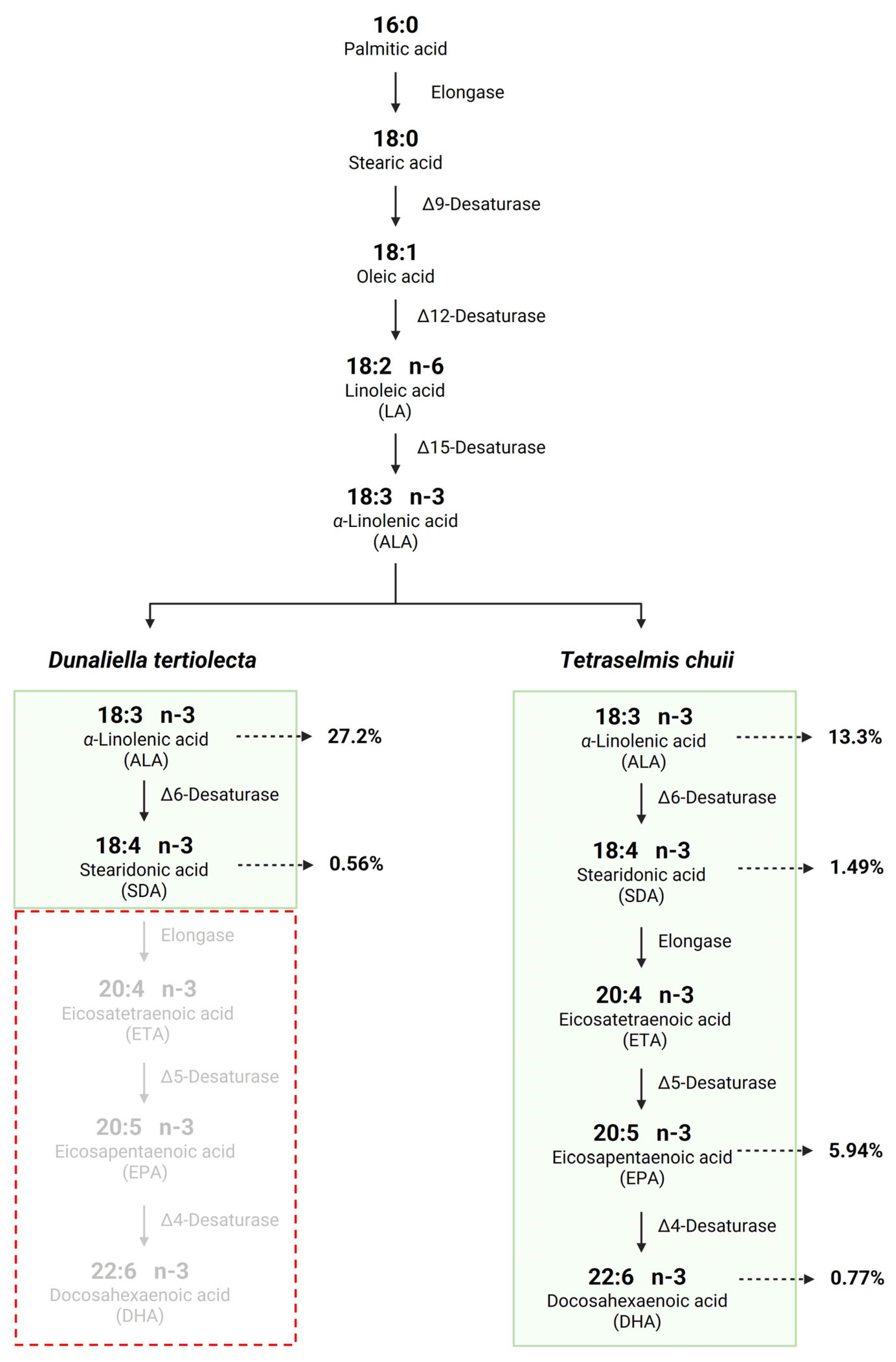
The detected fatty acids were mapped onto the canonical aerobic desaturase/elongase pathway (Figure 1), supporting a pathway-level comparison of metabolic steps associated with C18 precursor accumulation and long-chain PUFA formation in each species [11]. The accumulation of ALA and the absence of downstream metabolites in D. tertiolecta are consistent with a rate-limiting step at the Δ6–desaturase or Δ5–desaturase level [10]. Genomic insights from previous studies suggest that D. tertiolecta lacks a functional Δ5–desaturase and exhibits weak or absent Δ4–desaturase activity, preventing the conversion of ALA into EPA and DHA [10]. T. chuii is consistent with functional Δ6 and Δ5 activities, enabling carbon flux to EPA, but the negligible DHA content implies a downstream limitation in Δ4–desaturase activity or inefficient C22 elongation mediated by elongation of very long-chain fatty acids (ELOVL2 and ELOVL4) [1]. These pathway constraints indicate that differences in MUFA and PUFA proportions may be influenced not only by desaturase and elongase capacity, but also by broader lipid handling processes reported in previous studies, contributing to distinct fatty acid profiles relevant to aquafeed formulation [35].
The n-6/n-3 ratio was 0.48 for D. tertiolecta and 0.58 for T. chuii, both below 1.0, confirming the n-3-favorable character of both biomasses [22]. Despite the lower ratio in D. tertiolecta, its n-3 fraction consists entirely of ALA, which requires endogenous elongation–desaturation to yield EPA and DHA. In contrast, T. chuii supplies preformed EPA and trace DHA directly, making it a more efficient n-3 delivery source for species with limited LC-PUFA biosynthetic capacity. These contrasts highlight that the n-6/n-3 ratio should be interpreted alongside HUFA-specific indices such as the FLQ to adequately assess the functional n-3 value of microalgal ingredients in aquafeed formulation.
Marine fish and shrimp possess a limited capacity (<5–10%) to bioconvert dietary ALA into EPA/DHA (this conversion estimate refers specifically to marine carnivorous and omnivorous aquaculture species with limited or absent Δ4/Δ5 desaturase activity, including gilthead seabream (Sparus aurata), European seabass (Dicentrarchus labrax), Atlantic salmon (Salmo salar, for juvenile/marine stages), yellowtail (Seriola spp.), cobia (Rachycentron canadum), and penaeid shrimp such as Litopenaeus vannamei and Penaeus monodon; freshwater herbivorous/omnivorous species like Nile tilapia (Oreochromis niloticus) and common carp (Cyprinus carpio) typically show higher bioconversion efficiency and are therefore less dependent on preformed EPA/DHA in the diet, implying specific applications for these profiles in aquafeed formulations [1]. D. tertiolecta may be more suitable as a protein-energy source for freshwater species capable of elongation, whereas T. chuii provides preformed EPA required for marine larval development and immune modulation [9]. Regarding bioavailability, EPA and DHA in Tetraselmis are typically distributed in phospholipids and glycolipids rather than triacylglycerols, a trait associated with enhanced tissue deposition efficiency in aquatic organisms [13]. Future research should investigate how modulating nitrogen, salinity, or light intensity affects the SFA: PUFA ratio and influences metabolic flux through the desaturation pathway [11].

3.3. Bioactive Compounds and Antioxidant Activity

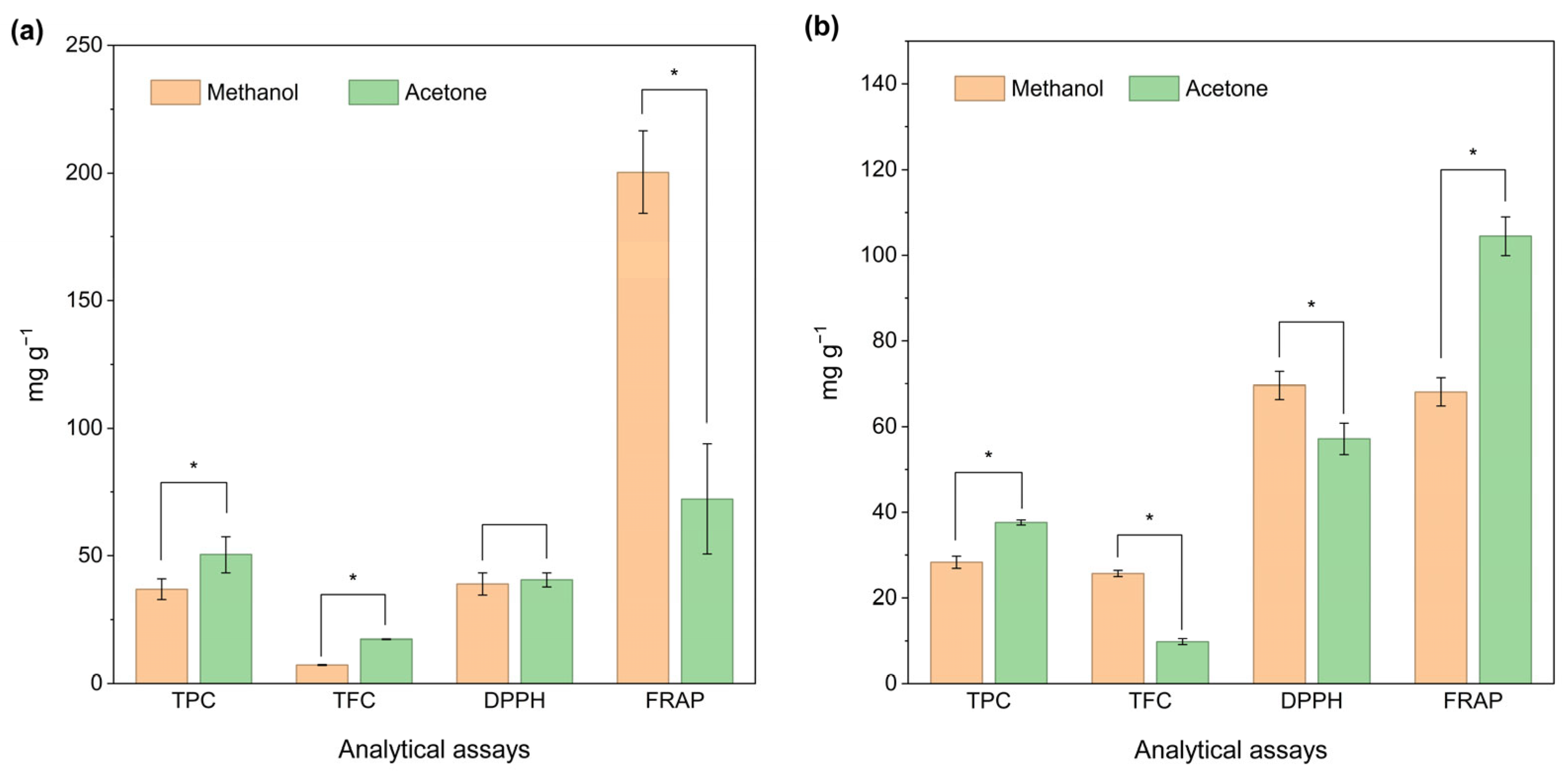
Solvent-dependent differences in antioxidant-related traits were observed in D. tertiolecta and T. chuii (Figure 2). In D. tertiolecta, methanolic extracts showed higher reducing capacity (FRAP: 200.33 mg TE g−1) than acetone extracts (72.26 mg TE g−1), corresponding to an increase of about 177%, while total phenolic and flavonoid contents were lower (Figure 2a). Acetone extraction increased total phenolics (50.46 vs. 36.88 mg GAE g−1; +37%) and flavonoids (17.33 vs. 7.19 mg EEPC g−1; +141%), with only minor changes in DPPH activity. In T. chuii (Figure 2b), acetone extracts showed higher FRAP values (104.45 vs. 68.10 mg TE g−1; +53%) and higher total phenolics, whereas methanolic extracts showed higher flavonoid content (25.73 vs. 9.79 mg EEPC g−1) and DPPH scavenging activity (69.62 vs. 57.13 mg TE g−1). These results suggest that methanol and acetone extracted different antioxidant fractions in each microalga, without a single solvent consistently maximizing all antioxidant responses under measured conditions.
The differences among antioxidant metrics suggest that the two microalgae produce antioxidant responses driven by different types of compounds when used as feed ingredients. Previous studies have shown that low-molecular-weight peptides and thiol-containing residues can enhance the reducing capacity measured by FRAP [36,37], which may explain the higher reducing activity observed in the methanolic extracts of D. tertiolecta. From a formulation perspective, this type of response might be more relevant during feed processing or storage, where reduced capacity is often associated with the oxidative behavior of lipid-rich matrices. Conversely, higher phenolic values combined with lower reducing activity align with reports indicating that the Folin–Ciocalteu assay can detect non-phenolic reducing compounds without directly indicating antioxidant effectiveness [38]. For T. chuii, the antioxidant profile, characterized by higher flavonoid content and radical-scavenging activity, resembles those reported in the literature on LC–PUFA stability [17,39]. At the same time, solvent polarity and interactions with the polysaccharide-rich cell wall may limit extraction efficiency [40]. However, the observed patterns suggest that extraction conditions affect the recovery of specific antioxidant fractions rather than all responses equally. Evidence from simulated gastrointestinal digestion further indicates that the release and bioaccessibility of bound phenolics and bioactive peptides in Tetraselmis may increase after ingestion [13], implying that chemical extraction alone may not fully capture their in vivo antioxidant potential. These antioxidant differences may influence lipid preservation during feed processing and storage, particularly in high-PUFA aquafeed formulations.

3.4. Lipid Quality and Functional Impact

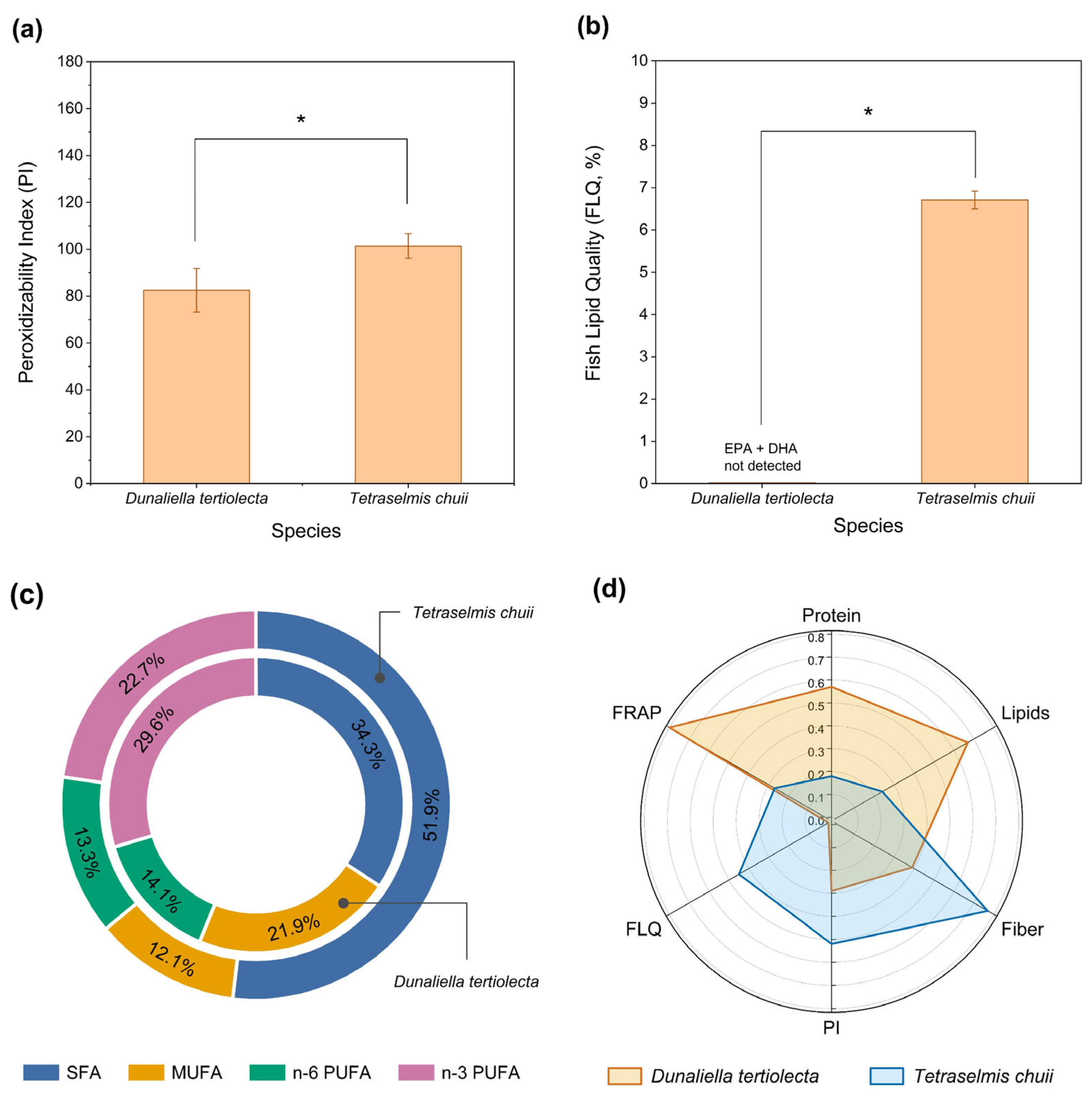
Lipid quality traits relevant to oxidative behavior and n-3 fatty acid contribution differed between two microalgal biomasses (Figure 3). T. chuii showed a higher peroxidizability index than D. tertiolecta (~101 vs. ~82; Figure 3a), indicating a lipid fraction with a larger proportion of highly unsaturated fatty acids. Only T. chuii contributed preformed HUFA, reaching an FLQ of approximately 6.7%, while D. tertiolecta remained near zero (Figure 3b), which aligns with its lack of EPA and DHA, as shown in Section 3.2. The simultaneous presence of higher PI and measurable FLQ in T. chuii, in contrast to the lower PI and negligible FLQ in D. tertiolecta, highlights two different lipid profiles: one characterized by direct HUFA supply and the other by greater lipid stability. Although indices such as PI and FLQ have been somewhat underused for assessing lipid ingredient stability [19], the contrasting profiles observed in this study suggest that they can help predict differences in oxidative sensitivity and handling considerations before processing or feed formulation. The combined interpretation of PI and FLQ provides a practical tool for balancing oxidative stability and HUFA supply, which are often treated independently in aquafeed formulation.
Figure 3c compares the proportions of saturated, monounsaturated, and polyunsaturated fatty acids, linking lipid class distribution to the expected physical behavior of lipid fractions during ingredient handling and feed processing. T. chuii, with a higher saturated fatty acid content (51.9%), exhibits a lipid profile that promotes tighter molecular packing and more rigid lipid matrices [41]. These features have been linked to greater physical stability during feed processing operations like pelleting or extrusion, where lipids are effectively retained within the feed matrix [42]. Under these conditions, lipid fractions with higher SFA content are less likely to exude oil and cause surface greasiness, contributing to drier, more stable pellets. In contrast, D. tertiolecta, with higher MUFA (21.9%) and PUFA levels, shows a more unsaturated lipid profile associated with increased fluidity [43]. During processing, such lipid profiles tend to be more reactive and prone to oil migration, requiring greater reliance on antioxidant protection and processing conditions to preserve stability and product quality [28,44].
Figure 3d integrates lipid quality indices, antioxidant capacity, and proximate traits into a comparative overview of the two microalgal biomasses, highlighting contrasting compositional profiles at the ingredient level. D. tertiolecta is characterized by higher protein and lipid densities, as well as greater reducing capacity. T. chuii is the only biomass providing preformed HUFA and exhibits the highest fiber content. This integrated view shows that no single biomass optimizes all traits simultaneously, reflecting trade-offs across lipid stability, antioxidant capacity, and n-3 fatty acid availability when these attributes are considered jointly at the ingredient level. At the ingredient level, the radar profile visualizes the coexistence of these traits within each biomass, which reflects the need to consider multiple compositional dimensions when defining functional roles in aquafeed formulation [45,46]. These interpretations are compositional in nature and do not imply biological responses, which would require targeted in vivo assessments. Based on the observed traits, D. tertiolecta can be positioned as a stability-oriented ingredient rich in precursors and antioxidants, whereas T. chuii functions as a HUFA-delivery ingredient with higher oxidative sensitivity. Their combined use may allow formulation strategies that balance lipid stability and essential fatty acid supply, representing a functional approach beyond single-ingredient optimization. This functional classification may serve as a basis for future formulation models integrating lipid stability, digestibility, and economic cost in aquafeed design.

4. Conclusions

The comparative assessment of D. tertiolecta and T. chuii under a shared analytical and processing framework revealed clear differences in proximate composition, fatty acid profiles, antioxidant capacity, and lipid quality indices. These results highlight contrasting functional traits, with D. tertiolecta characterized by higher protein and lipid densities, precursor-rich n-3 profiles, and stronger reducing capacity, whereas T. chuii provides preformed HUFA (EPA and DHA), higher fiber content, and greater peroxidizability. The integration of compositional, lipid, and antioxidant data allowed a more comprehensive functional interpretation of these biomasses than fatty acid profiles alone, emphasizing trade-offs between oxidative stability and n-3 delivery when used as feed ingredients. Beyond compositional comparison, this study provides an integrative framework for positioning microalgal biomass in aquafeed formulation based on lipid functionality rather than composition alone. The complementary profiles identified suggest that strategic combinations of D. tertiolecta and T. chuii could optimize HUFA delivery while mitigating oxidative risks. Future studies should validate these interactions in vivo and under industrial processing conditions to support practical application.

Author Contributions

Conceptualization, P.M.S.-E. and H.R.-G.; methodology, P.M.S.-E. and H.R.-G.; validation, H.R.-G.; formal analysis, J.P.T.-M. and H.R.-G.; investigation, P.M.S.-E., J.P.T.-M. and H.R.-G.; data curation, M.G.-U. and J.P.T.-M.; writing—original draft preparation, P.M.S.-E. and J.P.T.-M.; writing—review and editing, A.V.-O., M.G.-U., A.E.C.-P., J.P.T.-M. and H.R.-G.; visualization, J.P.T.-M.; supervision, H.R.-G.; project administration, H.R.-G.; funding acquisition, H.R.-G. All authors have read and agreed to the published version of the manuscript.

Funding

This research was supported by the Instituto Politécnico Nacional. Project/Grant: SIP-IPN 20196184; 20201950; 20210281, 20220645, 20231631, 20240704, and 20250109.

Data Availability Statement

The original contributions presented in this study are included in the article. Further inquiries can be directed to the corresponding author.

Acknowledgments

The authors thank the Instituto Politécnico Nacional, COFAA, and EDI for their financial and logistical support. Serrano-Espinosa, Paulina Montserrat is a recipient of a Graduate Studies fellowship from CONACYT and Instituto Politécnico Nacional (BEIFI Grant).

Conflicts of Interest

The authors declare no conflicts of interest.

References

  1. Monroig, O.; Shu-Chien, A.C.; Kabeya, N.; Tocher, D.R.; Castro, L.F.C. Desaturases and Elongases Involved in Long-Chain Polyunsaturated Fatty Acid Biosynthesis in Aquatic Animals: From Genes to Functions. Prog. Lipid Res. 2022, 86, 101157. [Google Scholar] [CrossRef] [Scilit]
  2. Eroldoğan, O.T.; Glencross, B.; Novoveska, L.; Gaudêncio, S.P.; Rinkevich, B.; Varese, G.C.; de Fátima Carvalho, M.; Tasdemir, D.; Safarik, I.; Nielsen, S.L.; et al. From the Sea to Aquafeed: A Perspective Overview. Rev. Aquac. 2023, 15, 1028–1057. [Google Scholar] [CrossRef] [Scilit]
  3. Ende, S.; Henjes, J.; Spiller, M.; Elshobary, M.; Hanelt, D.; Abomohra, A. Recent Advances in Recirculating Aquaculture Systems and Role of Microalgae to Close System Loop. Bioresour. Technol. 2024, 407, 131107. [Google Scholar] [CrossRef] [Scilit] [PubMed]
  4. Tejeda-Miramontes, J.P.; García-Ulloa, M.; Rodríguez-Quiroz, G.; Rodríguez-González, H. Substituting Fishmeal with Extruded Cull Chickpea Meal in Diets for the White Leg Shrimp (Litopenaeus vannamei, Boone): A Preliminary Study of the Effect on Production Parameters. Isr. J. Aquac.-Bamidgeh 2023, 75, 1–8. [Google Scholar] [CrossRef] [Scilit]
  5. Ndebele-Murisa, M.; Mubaya, C.P.; Dekesa, C.H.; Samundengo, A.; Kapute, F.; Yossa, R. Sustainability of Aqua Feeds in Africa: A Narrative Review. Sustainability 2024, 16, 10323. [Google Scholar] [CrossRef] [Scilit]
  6. Su, M.; Bastiaens, L.; Verspreet, J.; Hayes, M. Applications of Microalgae in Foods, Pharma and Feeds and Their Use as Fertilizers and Biostimulants: Legislation and Regulatory Aspects for Consideration. Foods 2023, 12, 3878. [Google Scholar] [CrossRef] [Scilit]
  7. Čmiková, N.; Kowalczewski, P.Ł.; Kmiecik, D.; Tomczak, A.; Drożdżyńska, A.; Ślachciński, M.; Królak, J.; Kačániová, M. Characterization of Selected Microalgae Species as Potential Sources of Nutrients and Antioxidants. Foods 2024, 13, 2160. [Google Scholar] [CrossRef] [Scilit]
  8. Mosibo, O.K.; Ferrentino, G.; Udenigwe, C.C. Microalgae Proteins as Sustainable Ingredients in Novel Foods: Recent Developments and Challenges. Foods 2024, 13, 733. [Google Scholar] [CrossRef] [Scilit]
  9. Paterson, S.; Majchrzak, M.; Alexandru, D.; Di Bella, S.; Fernández-Tomé, S.; Arranz, E.; de la Fuente, M.A.; Gómez-Cortés, P.; Hernández-Ledesma, B. Impact of the Biomass Pretreatment and Simulated Gastrointestinal Digestion on the Digestibility and Antioxidant Activity of Microalgae Chlorella vulgaris and Tetraselmis chuii. Food Chem. 2024, 453, 139686. [Google Scholar] [CrossRef] [Scilit]
  10. Sharma, T.; Das, N.; Mehta Kakkar, P.; Mohapatra, R.K.; Pamidimarri, S.; Singh, R.K.; Kumar, M.; Guldhe, A.; Nayak, M. Microalgae as an Emerging Alternative Raw Material of Docosahexaenoic Acid and Eicosapentaenoic Acid—A Review. Crit. Rev. Food Sci. Nutr. 2025, 65, 7883–7902. [Google Scholar] [CrossRef] [Scilit] [PubMed]
  11. Ren, X.; Liu, Y.; Fan, C.; Hong, H.; Wu, W.; Zhang, W.; Wang, Y. Production, Processing, and Protection of Microalgal n-3 PUFA-Rich Oil. Foods 2022, 11, 1215. [Google Scholar] [CrossRef] [Scilit] [PubMed]
  12. Soto-Sánchez, O.; Hidalgo, P.; González, A.; Oliveira, P.E.; Hernández Arias, A.J.; Dantagnan, P. Microalgae as Raw Materials for Aquafeeds: Growth Kinetics and Improvement Strategies of Polyunsaturated Fatty Acids Production. Aquac. Nutr. 2023, 2023, 5110281. [Google Scholar] [CrossRef] [Scilit]
  13. Paterson, S.; Villanueva-Bermejo, D.; Hernández-Ledesma, B.; Gómez-Cortés, P.; de la Fuente, M.A. Supercritical CO2 Extraction Increases the Recovery Levels of Omega-3 Fatty Acids in Tetraselmis chuii Extracts. Food Chem. 2024, 453, 139692. [Google Scholar] [CrossRef] [Scilit]
  14. Zhang, J.X.; Ran, Z.S.; Xie, H.X.; Kong, F.; Zhang, M.Q.; Zhou, Y.; Li, Y.R.; Liao, K.; Yan, X.J.; Xu, J.L. A Systematic Analysis and Evaluation of Nutritional Composition of 23 Strains of Marine Microalgae Commonly Used in Aquaculture. Algal Res. 2023, 72, 103122. [Google Scholar] [CrossRef] [Scilit]
  15. Paterson, S.; Gómez-Cortés, P.; de la Fuente, M.A.; Hernández-Ledesma, B. Bioactivity and Digestibility of Microalgae Tetraselmis sp. and Nannochloropsis sp. as Basis of Their Potential as Novel Functional Foods. Nutrients 2023, 15, 477. [Google Scholar] [CrossRef] [Scilit] [PubMed]
  16. Verspreet, J.; Soetemans, L.; Gargan, C.; Hayes, M.; Bastiaens, L. Nutritional Profiling and Preliminary Bioactivity Screening of Five Micro-Algae Strains Cultivated in Northwest Europe. Foods 2021, 10, 1516. [Google Scholar] [CrossRef] [Scilit] [PubMed]
  17. Zisis, F.; Kyriakaki, P.; Satolias, F.F.; Mavrommatis, A.; Simitzis, P.E.; Pappas, A.C.; Surai, P.F.; Tsiplakou, E. The Effect of Dietary Inclusion of Microalgae Schizochytrium spp. on Ewes’ Milk Quality and Oxidative Status. Foods 2022, 11, 2950. [Google Scholar] [CrossRef] [Scilit]
  18. Antunes, M.; Neves, M.; Pires, D.; Passos, R.; do Carmo, B.; Tchobanov, C.F.; Forte, S.; Vaz, M.; Baptista, T.; Tecelão, C. Proximate Composition and Fatty Acid Profile of Gilthead Seabream (Sparus aurata) Fed with Pelvetia canaliculata-Supplemented Diets: An Insight towards the Valorization of Seaweed Biomass. Foods 2023, 12, 1810. [Google Scholar] [CrossRef] [Scilit]
  19. Suárez-Medina, M.D.; Sáez-Casado, M.I.; Martínez-Moya, T.; Rincón-Cervera, M.Á. The Effect of Low Temperature Storage on the Lipid Quality of Fish, Either Alone or Combined with Alternative Preservation Technologies. Foods 2024, 13, 1097. [Google Scholar] [CrossRef] [Scilit]
  20. Rahi Roy, D.; Roy, K.; Panserat, S.; Stejskal, V.; Mraz, J.; Turchini, G.M. Long Chain Polyunsaturated Fatty Acid (LC-PUFA) Composition of Fish Sperm: Nexus of Dietary, Evolutionary, and Biomechanical Drivers. Prog. Lipid Res. 2024, 96, 101305. [Google Scholar] [CrossRef] [Scilit]
  21. Biandolino, F.; Prato, E.; Grattagliano, A.; Parlapiano, I. Can Glyphosate and Temperature Affect the Nutritional Lipid Quality in the Mussel Mytilus galloprovincialis? Foods 2023, 12, 1595. [Google Scholar] [CrossRef] [Scilit]
  22. Chen, J.; Liu, H. Nutritional Indices for Assessing Fatty Acids: A Mini-Review. Int. J. Mol. Sci. 2020, 21, 5695. [Google Scholar] [CrossRef] [Scilit] [PubMed]
  23. Patrinou, V.; Daskalaki, A.; Kampantais, D.; Kanakis, D.C.; Economou, C.N.; Bokas, D.; Kotzamanis, Y.; Aggelis, G.; Vayenas, D.V.; Tekerlekopoulou, A.G. Optimization of Cultivation Conditions for Tetraselmis striata and Biomass Quality Evaluation for Fish Feed Production. Water 2022, 14, 3162. [Google Scholar] [CrossRef] [Scilit]
  24. Ahmad, A.; Amin, K.A.; Ashraf, S.S. Biological Effects of Culture Medium on Tetraselmis chuii and Dunaliella tertiolecta: Implications for Emerging Pollutants Degradation. Chemosphere 2024, 363, 142868. [Google Scholar] [CrossRef] [Scilit] [PubMed]
  25. Anye Cho, B.; Villarroel, N.; Radu, T.; Zhang, D.; Wagner, J.L. Bioprocess Modelling Assisted Analysis of Light and Temperature Effects on Dunaliella tertiolecta’s Growth in Bicarbonate/Carbonate Medium for Algae-Based Carbon Capture. J. Environ. Chem. Eng. 2025, 13, 115973. [Google Scholar] [CrossRef] [Scilit]
  26. Hadiyanto, H.; Widayat, W.; Christwardana, M.; Pratiwi, M.E. The Flocculation Process of Chlorella sp. Using Chitosan as a Bio-Flocculant: Optimization of Operating Conditions by Response Surface Methodology. Curr. Res. Green Sustain. Chem. 2022, 5, 100291. [Google Scholar] [CrossRef] [Scilit]
  27. Tzima, S.; Georgiopoulou, I.; Louli, V.; Magoulas, K. Recent Advances in Supercritical CO2 Extraction of Pigments, Lipids and Bioactive Compounds from Microalgae. Molecules 2023, 28, 1410. [Google Scholar] [CrossRef] [Scilit]
  28. Lage, S.; Gentili, F.G. Quantification and Characterisation of Fatty Acid Methyl Esters in Microalgae: Comparison of Pretreatment and Purification Methods. Bioresour. Technol. 2018, 257, 121–128. [Google Scholar] [CrossRef] [Scilit]
  29. Tejeda-Miramontes, J.P.; Espinoza-Paredes, B.C.; Zatarain-Palffy, A.; García-Cayuela, T.; Tejada-Ortigoza, V.; Garcia-Amezquita, L.E. Process Modeling and Convective Drying Optimization of Raspberry Pomace as a Fiber-Rich Functional Ingredient: Effect on Techno-Functional and Bioactive Properties. Foods 2024, 13, 3597. [Google Scholar] [CrossRef] [Scilit]
  30. Ferdous, U.T.; Nurdin, A.; Ismail, S.; Shaari, K.; Norhana Balia Yusof, Z. A Comparative Study on Antioxidant Properties, Total Phenolics, Total Flavonoid Contents, and Cytotoxic Properties of Marine Green Microalgae and Diatoms. J. Genet. Eng. Biotechnol. 2025, 23, 100456. [Google Scholar] [CrossRef] [Scilit]
  31. Tejeda-Miramontes, J.P.; González-Frías, S.E.; Padlon-Manjarrez, S.; García-Cayuela, T.; Tejada-Ortigoza, V.; Garcia-Amezquita, L.E. Obtaining a Fiber-Rich Ingredient from Blueberry Pomace through Convective Drying: Process Modeling and Its Impact on Techno-Functional and Bioactive Properties. LWT 2024, 210, 116862. [Google Scholar] [CrossRef] [Scilit]
  32. Zhou, L.; Duan, X.; Li, K.; Hill, D.R.A.; Martin, G.J.O.; Suleria, H.A.R. Extraction and Characterization of Bioactive Compounds from Diverse Marine Microalgae and Their Potential Antioxidant Activities. Chem. Biodivers. 2023, 20, e202300602. [Google Scholar] [CrossRef] [Scilit] [PubMed]
  33. Liang, M.-H.; Qv, X.-Y.; Chen, H.; Wang, Q.; Jiang, J.-G. Effects of Salt Concentrations and Nitrogen and Phosphorus Starvations on Neutral Lipid Contents in the Green Microalga Dunaliella tertiolecta. J. Agric. Food Chem. 2017, 65, 3190–3197. [Google Scholar] [CrossRef] [Scilit] [PubMed]
  34. Dos Anjo Viagem, L.; Hakizimana, J.N.; Rumisha, C.; Da Silva Cerozi, B.; Misinzo, G. Effect of Soybean and Seaweed-Based Diets on Growth Performance, Feed Utilization, and Gut Microbiota of Tilapia: A Systematic Review and Meta-Analysis. PLoS ONE 2024, 19, e0293775. [Google Scholar] [CrossRef] [Scilit]
  35. Du, F.; Xu, Q.; Li, X.; Hang, Y.; Zhang, D.; Zhang, F.; Ma, W.; Sun, X.; Huang, H. Regulating Triacylglycerol Cycling for High-Efficiency Production of Polyunsaturated Fatty Acids and Derivatives. Nat. Commun. 2025, 16, 4262. [Google Scholar] [CrossRef] [Scilit]
  36. Zhang, J.; Li, M.; Zhang, G.; Tian, Y.; Kong, F.; Xiong, S.; Zhao, S.; Jia, D.; Manyande, A.; Du, H. Identification of Novel Antioxidant Peptides from Snakehead (Channa argus) Soup Generated during Gastrointestinal Digestion and Insights into the Anti-Oxidation Mechanisms. Food Chem. 2021, 337, 127921. [Google Scholar] [CrossRef] [Scilit]
  37. Yesiltas, B.; García-Moreno, P.J.; Gregersen, S.; Olsen, T.H.; Jones, N.C.; Hoffmann, S.V.; Marcatili, P.; Overgaard, M.T.; Hansen, E.B.; Jacobsen, C. Antioxidant Peptides Derived from Potato, Seaweed, Microbial and Spinach Proteins: Oxidative Stability of 5% Fish Oil-in-Water Emulsions. Food Chem. 2022, 385, 132699. [Google Scholar] [CrossRef] [Scilit]
  38. Dominguez-López, I.; Pérez, M.; Lamuela-Raventós, R.M. Total (Poly)Phenol Analysis by the Folin-Ciocalteu Assay as an Anti-Inflammatory Biomarker in Biological Samples. Crit. Rev. Food Sci. Nutr. 2024, 64, 10048–10054. [Google Scholar] [CrossRef] [Scilit]
  39. Biernacki, M.; Conde, T.; Stasiewicz, A.; Surażyński, A.; Domingues, M.R.; Domingues, P.; Skrzydlewska, E. Restorative Effect of Microalgae Nannochloropsis oceanica Lipid Extract on Phospholipid Metabolism in Keratinocytes Exposed to UVB Radiation. Int. J. Mol. Sci. 2023, 24, 14323. [Google Scholar] [CrossRef] [Scilit]
  40. Gil-Martín, E.; Forbes-Hernández, T.; Romero, A.; Cianciosi, D.; Giampieri, F.; Battino, M. Influence of the Extraction Method on the Recovery of Bioactive Phenolic Compounds from Food Industry By-Products. Food Chem. 2022, 378, 131918. [Google Scholar] [CrossRef] [Scilit]
  41. Lee, P.C.; Lai, L.S. Impact of Fatty Acid Types and Microwave Post-Treatment on the Physicochemical Properties of Water Caltrop Starch–Lipid Complexes. Foods 2025, 14, 2254. [Google Scholar] [CrossRef] [Scilit] [PubMed]
  42. Zhang, W.; Hui, B.; Li, X.; Guo, Z.; Ma, J.; Li, J. Effects of Different Soybean and Coconut Oil Additions on the Physicochemical and Sensory Properties of Soy Protein–Wheat Protein Mixture Subjected to High-Moisture Extrusion. Foods 2024, 13, 2263. [Google Scholar] [CrossRef] [Scilit]
  43. Sanders, C.; Dobson, S.; Marangoni, A.G. Effect of Saturated and Unsaturated Fat on the Physical Properties of Plant-Based Cheese. Curr. Res. Food Sci. 2024, 9, 100832. [Google Scholar] [CrossRef] [Scilit]
  44. Tanislav, A.E.; Șandru, B.; Man, S.M.; Pușcaș, A.; Mureșan, A.E.; Păucean, A.; Mureșan, V.; Mudura, E. Investigating the Complete Replacement of Conventional Fat with Oleogel on the Structural Behavior of Five Different Pastry Products. Eur. Food Res. Technol. 2024, 250, 1933–1947. [Google Scholar] [CrossRef] [Scilit]
  45. Becze, A.; Senila, L.; Multescu, M.; Popa, A.; Serbancea, F.; Senila, M. Nutritional Value of Tomato Pomace as a By-Product from the Processing of Several Tomato (Solanum lycopersicum L.) Cultivars. Molecules 2025, 30, 4502. [Google Scholar] [CrossRef] [Scilit]
  46. Chomová, N.; Pavloková, S.; Sondorová, M.; Mudroňová, D.; Fečkaninová, A.; Popelka, P.; Koščová, J.; Žitňan, R.; Franc, A. Development and Evaluation of a Fish Feed Mixture Containing the Probiotic Lactiplantibacillus plantarum Prepared Using an Innovative Pellet Coating Method. Front. Vet. Sci. 2023, 10, 1196884. [Google Scholar] [CrossRef] [Scilit]
Figure 1. n-3 PUFA biosynthetic pathway and detected intermediates in Dunaliella tertiolecta and Tetraselmis chuii. Dashed arrows indicate undetected steps, and the red dashed box denotes the non-detected pathway in Dunaliella tertiolecta.
Phycology 06 00049 g001
Figure 2. Effect of extraction solvent (methanol and acetone) on phytochemical composition and antioxidant activity of microalgae extracts. (a) Dunaliella tertiolecta; (b) Tetraselmis chuii. TPC—total phenolic content (mg GAE g−1); TFC—total flavonoid content (mg EEPC g−1); DPPH—DPPH radical scavenging activity (mg TE g−1); FRAP—ferric-reducing antioxidant power (mg TE g−1). Values are expressed as mean ± SD. Asterisks (*) indicate significant differences between extraction solvents (p < 0.05).
Phycology 06 00049 g002
Figure 3. Lipid quality indices of Dunaliella tertiolecta and Tetraselmis chuii. (a) Peroxidizability index (PI). (b) Fish lipid quality index (FLQ; EPA + DHA, % of total fatty acids). (c) Distribution of SFA, MUFA, n-6 PUFA, and n-3 PUFA (% of total fatty acids). (d) Radar plot showing protein content, total lipids, fiber, FRAP, PI, and FLQ. Values represent mean ± SD (n = 3). Asterisks denote significant differences between species (p < 0.05).
Phycology 06 00049 g003
Table 1. Proximate composition (% dry weight) of crude biomass from Dunaliella tertiolecta and Tetraselmis chuii.
ParametersDunaliella tertiolectaTetraselmis chuii
Moisture (%)5.23 ± 0.18 a4.36 ± 0.16 b
Crude protein (%)37.09 ± 0.47 a25.29 ± 0.52 b
Lipids (%)11.66 ± 0.51 a7.44 ± 0.06 b
Crude fiber (%)4.70 ± 0.35 b9.20 ± 0.19 a
NFE (%)43.58 ± 0.83 b51.71 ± 0.82 a
Ash (%)3.25 ± 0.03 b6.64 ± 0.01 a
Protein: NFE ratio0.850.49
Values are expressed as the mean ± SD (n = 3). NFE—nitrogen-free extract. Protein: NFE ratio was calculated from mean values of crude protein and NFE (% dry weight). Different superscript letters within a row indicate significant differences between species (p < 0.05).
Table 2. Fatty acid composition (% of total fatty acids) of Dunaliella tertiolecta and Tetraselmis chuii.
Fatty AcidDunaliella tertiolecta
(% Total FA)
Tetraselmis chuii
(% Total FA)
Saturated fatty acids (SFA)
C10:0n.d.n.d.
C12:0n.d.n.d.
C14:02.491.75
C15:0n.d.0.52
C16:030.0031.03
C18:01.8118.60
C20:0n.d.n.d.
Total SFA34.3051.91
Monounsaturated fatty acids (MUFA)
C16:1 n-7n.d.0.61
C16:1 n-92.242.41
C18:1 n-913.87n.d.
C18:1 n-75.798.12
C20:1 n-9/n-11n.d.0.93
C20:1 n-7n.d.n.d.
C22:1 n-9/n-11n.d.n.d.
C24:1 n-9n.d.n.d.
Total MUFA21.9112.07
n-6 Polyunsaturated fatty acids (n-6 PUFA)
C18:2 n-610.529.92
C18:3 n-63.630.98
C20:4 n-6n.d.2.40
Total n-6 PUFA14.1513.29
n-3 Polyunsaturated fatty acids (n-3 PUFA)
C16:4 n-31.891.00
C18:3 n-327.1913.32
C18:4 n-30.561.49
C20:5 n-3 (EPA)n.d.5.94
C22:5 n-3 (DPA)n.d.0.21
C22:6 n-3 (DHA)n.d.0.77
Total n-3 PUFA29.6522.73
DHA/EPA ration.d.0.13
n-6/n-3 ratio0.480.58
Total PUFA43.8036.02
Values are expressed as percentages of the total identified fatty acids. Values correspond to the mean of three analytical (instrumental) replicates obtained from a single pooled biomass composite per species. Because biomass from the independent cultures was pooled and homogenized prior to analysis, the three replicates are technical (not biological) replicates; consequently, standard deviations are not reported as replicate SDs. The analytical variability of the GC–FID determination was consistently low (analytical CV < 3% for all major fatty acids). n.d.—not detected (below the detection limit, ≈0.05% of total FA). Fatty acids were grouped by saturation class and PUFA family for clarity.
Disclaimer/Publisher’s Note: The statements, opinions and data contained in all publications are solely those of the individual author(s) and contributor(s) and not of MDPI and/or the editor(s). MDPI and/or the editor(s) disclaim responsibility for any injury to people or property resulting from any ideas, methods, instructions or products referred to in the content.