
Article

Pedagogy in Built Form: A Diachronic Reading of the UPAT

by
Guiomar Martín Domínguez
Department of Architectural Composition, Universidad Politécnica de Madrid, 28040 Madrid, Spain
Architecture 2026, 6(1), 47; https://doi.org/10.3390/architecture6010047
Submission received: 8 January 2026 / Revised: 16 February 2026 / Accepted: 2 March 2026 / Published: 18 March 2026

Abstract

This article examines the Unité Pédagogique d’Architecture in Toulouse (UPAT) as a paradigmatic example of the palimpsestic architectures that characterize many contemporary university campuses. Conceived in the immediate aftermath of May 1968, the school emerged at a moment when pedagogical reform, political commitment, and architectural experimentation became closely intertwined. These conditions gave rise to a singular spatial organization based on a combinatory grid, intended to give architectural form to a democratic ideal of education grounded in openness, flexibility, and collective agency. The study adopts a historical–critical methodology based on the systematic analysis of primary and secondary sources, complemented by original graphic interpretations. This approach makes it possible to read the UPAT simultaneously as a didactic instrument and as an ideological manifesto, one whose ambitions were inherently marked by internal tensions and contradictions. A diachronic examination of subsequent extensions and transformations reveals how these founding intentions were progressively reinterpreted, constrained, or displaced in response to changing institutional, social, and cultural conditions. Taken as a whole, the evolving trajectory of this “manifesto school” illuminates the ways in which architectural ideals—particularly the pursuit of openness—are negotiated over time, offering a critical perspective on the reciprocal shaping of architecture, pedagogy, and institutional identity within the history of university buildings.

1. Introduction: A Profession Bound for Change

The May 1968 uprisings marked a turning point for many professions in France; few, however, experienced such profound introspection as architecture [1,2,3,4]. Until then, architectural education was still firmly embedded in the École Nationale Supérieure des Beaux-Arts (ENSAB) in Paris, structured around academic traditions increasingly at odds with the modernist principles that had already transformed practice across Europe [5,6,7]. From the early 1960s onward, discontented students and teachers began organizing outside official channels. In 1965, the so-called petite réforme promoted by Max Querrien led to the creation of three atelier groups (A, B, C) within the architectural section of the ENSAB [8]. Group C, installed in the Grand Palais, soon gained a reputation for its experimental and dissident character [9]. Among its instructors was the architect Georges Candilis, who since 1963 had been offering external training next to his office on Rue Dauphine. Following the events of May 1968, a decree issued by the Minister of Culture André Malraux enabled the creation of the Unités Pédagogiques d’Architecture (UPAs), formally severing architectural education from the ENSBA and granting the new institutions full curricular autonomy. Many also benefited from sufficient political and financial support to construct purpose-built facilities. This context fostered an exceptional convergence between pedagogical reform and architectural experimentation, often driven by members of the teaching staff or by architects directly involved in the national reform process. The resulting buildings were conceived not merely as teaching facilities, but as built manifestos: spaces meant to embody a renewed professional ethos while simultaneously operating as laboratories for alternative, collective modes of learning [10,11].
Notably, among the first eight UPAs completed between 1968 and 1978, at least six relied on modular grids or other aggregative systems as their primary ordering principle. This recurrence cannot be reduced to stylistic fashion alone; it reflects a deeper and at the same time broader alignment between educational reform and contemporary interests in open, combinatory spatial structures [12,13]. Yet the subsequent fate of many of these buildings—often heavily transformed, partially erased, or demolished—show that their reception over the medium and long term was far from self-evident, revealing the fragility of such ambitions and pointing to a gap in their critical reassessment. Revisiting these projects today, with the perspective afforded by time, allows their ambitions and contradictions to be examined not as distant curiosities, but as sources of unresolved questions that continue to resonate within architectural discourse and the built realities of our university campuses.
Against this background, the present text focuses on the Unité Pédagogique d’Architecture de Toulouse (UPAT), designed and built between 1969 and 1971 by Georges Candilis, assisted by Raymond Malebranche and Paul Desgrez, from this local office. As in Paris, pedagogical reform in Toulouse unfolded with particular intensity [14]. The only provincial branch of Atelier C was established there in 1965—and formally recognized in 1967—by a coalition of dissident teachers, students, and architects, many of whom were directly involved in the development of Le Mirail [15], the vast new ZUP then under construction under the direction of Candilis–Josic–Woods. Following Malraux’s decree, the UPAT was finally assigned a site in the northern sector of Le Mirail by the city mayor Louis Bazerque. There, in the summer of 1969, after intense collective work by the local milieu, Candilis received the commission to translate the ambitions of post-1968 reform into architectural form. Conceived as a full-scale experimental ground, the UPAT brought together pedagogical innovation, political commitment, constructive radicality, and geometric rigor in what can be read as perhaps the most explicit architectural manifesto of all the UPAs, only perhaps rivaled by Jacques Kalisz and Roger Salem’s UPA in Nanterre or Roland Simounet’s in Grenoble [16].
Through a detailed analysis of its conception, spatial logic, and subsequent transformations, this paper examines the tensions that underpinned this experiment from its very outset. In doing so, it argues that the UPAT should be read less as a failed utopia than as a critical case study for understanding the limits—and enduring relevance—of architectural form as a vehicle for pedagogical and political ambition.

2. Materials and Methodology

This study adopts a mixed methodological approach combining archival research, critical analysis of primary sources, and a targeted review of historical and contemporary literature. Rather than treating the UPAT as a closed object of stylistic analysis, the study approaches it as a processual artifact whose form, meaning, and reception evolved in close relation to shifting pedagogical, political, and disciplinary frameworks.
Primary sources include original drawings, technical documents, and photographs from the late 1960s and early 1970s, consulted at the Cité de l’Architecture et du Patrimoine (Paris) and the Archives Municipales de Toulouse. Archival findings were cross-referenced with oral sources and expert input, including exchanges with historians and architects familiar with the UPAT. This was complemented by a focused literature review on French pedagogical reform [1,2,3,4,5,6,7,8,9,10,11,13,14,15,16], debates on so-called architecture proliférante, structuralist architecture and mat-buildings [17,18,19,20,21,22,23,24,25,26,27], and critical studies on Candilis–Josic–Woods [28,29,30,31]. The confrontation of archival evidence and theoretical discourse aims at situating the project both within its immediate operational context and within longer genealogies of architectural thought.
A key component of the research consists of a series of diagrams and spatial analyses produced by the author. Moving beyond what conventional representations convey, these drawings aim to decipher the project’s underlying logics, especially in its original form, with all its potentials, sources of tension and contradiction. Introduced alongside the written analysis, they function as critical instruments in their own right, making visible aspects that remain implicit or obscured in textual descriptions alone.
The text is structured in three stages. First, it establishes a genealogical framework by tracing the role of grids and modular systems in the work of Candilis–Josic–Woods. Second, it undertakes a detailed analysis of the original 1969–1971 project, focusing on its spatial organization, constructive logic, and programmatic strategies. Finally, it adopts a diachronic perspective to examine the school’s subsequent extensions and alterations. This longitudinal reading—already original as it has never been made before—is not intended to be exhaustive, but rather to highlight how changing institutional priorities, cultural attitudes, and disciplinary concerns progressively reinterpreted—and in some cases neutralized—the radical ambitions embedded in the original design.

3. Dissecting the UPAT: Precedents and Evolution

3.1. Ideologies and Genealogies Behind the UPAT’s Grid

Georges Candilis—together with Alexis Josic and Shadrach Woods—consistently championed grids as the most emblematic tools of their time, capable of addressing the challenges of mass society and the constraints imposed by modern industry [32,33]. Yet these devices were not merely pragmatic expedients for handling large scales, complex programs, or accelerated production logics; they were also ideological artifacts, laden with aspirations that exceeded their instrumental role. From the designer’s perspective, grids offered a renewed way of conceiving the creative process: iterative and open-ended, they resonated with a broader cultural sensibility that embraced growth, transformation, and uncertainty as intrinsic values of artistic creation—what Umberto Eco theorized as Opera aperta [34]. At the same time, from the user’s point of view, they promised the possibility of negotiating space, projecting a political horizon in which design would deliberately stop short of completion, thus fulfilling what Candilis overtly claimed as the architect’s ultimate responsibility: “to prepare the ‘habitat’ only to the point at which man can take over” [35] (p. 76).
Evidently, this outlook did not emerge in isolation but was shaped by a constellation of influences. Among them, Michel Ecochard’s ethnographically informed approach—particularly the 8 × 8 grid encountered by Candilis and Woods in North Africa in the early 1950s—left a lasting imprint on their thinking. Equally decisive were the sociological critiques of modernist urbanism articulated by figures such as Chombart de Lauwe and Henri Lefebvre, with whom the team was especially familiar. Together, these “foreign” perspectives—anthropological, philosophical, sociological, political—contributed to a broader epistemological shift in architectural discourse shared by many members of Team X, who became convinced of the need to place everyday spatial practices at the very core of their thinking, transforming them into “the frame, substance, and goal of architecture and urban design” [30] (p. 76).
Whether driven by pragmatism or ideological conviction, personal intuition or unconscious episteme, grids eventually became a persistent line of inquiry for Candilis–Josic–Woods—and even more emphatically for Candilis in his independent work, regardless of scale, program, or context. The repeated manipulation of square patterns—through combining, rotating, scaling, and superposing—reveals a deliberately abstract approach to architectural order, one that engages with timeless disciplinary concerns about form generation but also with issues specific to its historical moment. Among the latter stands a longed-for departure from academic compositional dogmas still lingering at the ENSAB, as well as a critical reaction to the increasingly frozen, object-like character that modernist architecture was beginning to be accused of in the postwar years.
Within this framework, the grid of the UPAT finds a direct precedent in Candilis’ work at the tourist complex of Barcarès–Leucate (1968–1970), where it was extended to the scale of public space as an application of the idea of the stem theorized by Woods in 1959 [36]. Over a basic pattern of swastika-like squares—with clear echoes of Piet Blom’s project presented by Aldo van Eyck at Royaumont—Candilis superimposed a secondary grid of alternating diagonal squares intended to introduce a greater degree of freedom into the plan. The resulting pattern materialized as a structural framework of columns and beams, a minimal skeleton that aspired not only to colonize the territory upon which it was laid, but also to be appropriated by diverse, evolving—and unpredictable—public and collective activities. Situated halfway between architecture and urbanism, between infrastructural scale and that of urban furniture, this urban chassis was seen as a “promise of cohesion” [37] (p. 151), seeking to provide urban legibility to the allegedly empty voids of the modern city (Figure 1).
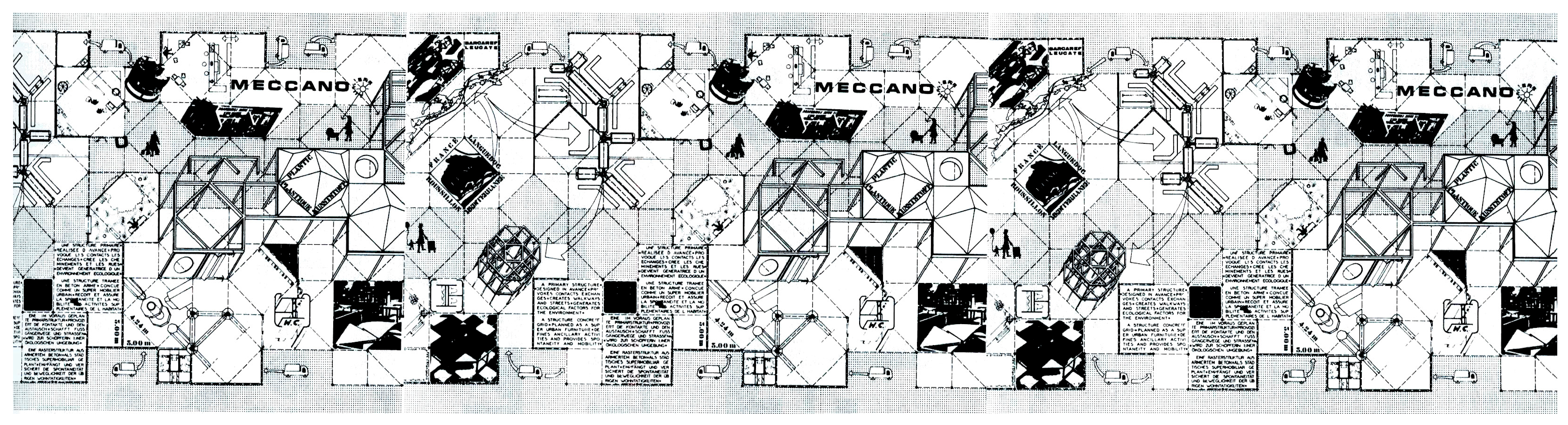
In L’Architecture d’Aujourd’hui no. 144 (1969) Candilis reformulated this proposal in generic terms under the name of the Meccano system [33]. This project consisted of a building prototype made of prefabricated concrete beams and columns connected by metal joints. To accommodate beams potentially arriving from eight different directions, the column adopted an octagonal section, hollowed out to house services, while beams were tapered at their ends to avoid collision. Enclosure elements were conceived as lightweight panels that could be distributed freely, with no regulation other than their modular coupling to the existing frames. Moreover, in its graphic formulation, the plan of the Meccano system resembled some kind of children’s game board, populated by users, furniture, and objects moving from square to square, “leaving to users the initiative of the infill” [33] (Figure 2). This implied an apparently innocuous yet radical transformation of the modernist free plan: from non-directional freedom in the articulation of space to a combinatory game subordinated to an omnipresent tectonic trace and governed by precise geometric rules, one that carefully “orients” possible distributions and actions, trying to preserve overall legibility amid the otherwise overwhelming manifoldness of various, temporary occupations.

3.2. An Architectural Manifesto: Inner Logics and Contradictions

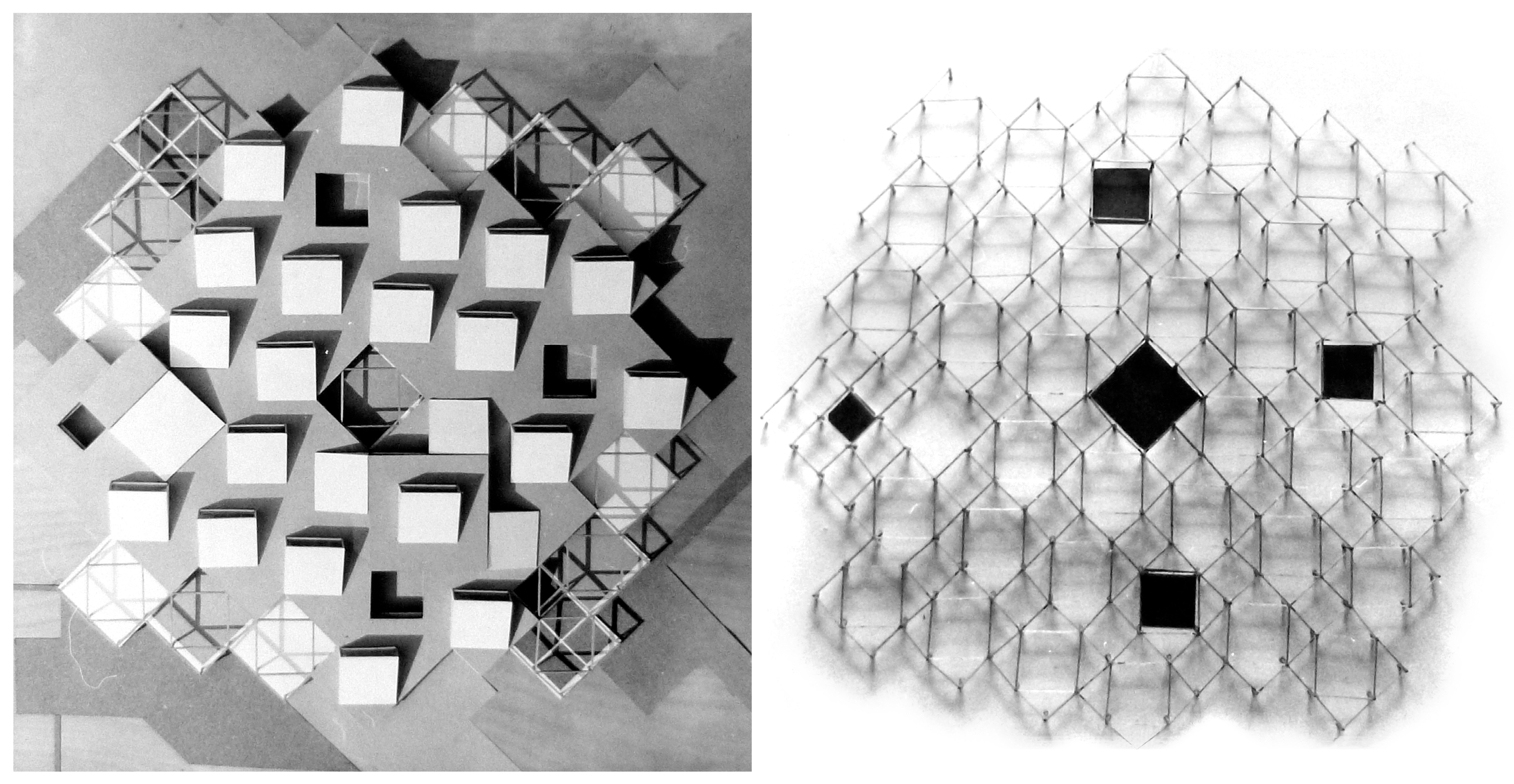
The publication of the Meccano prototype coincided with Candilis’ commission for the UPAT, making the affinity between the two far from accidental. The school can indeed be read as a full-scale trial of the generic organizational principles formulated in L’Architecture d’Aujourd’hui, previously tested at Barcarès–Leucate through a linear, branched configuration and here condensed into a compact, freestanding, single-story building for 370 students inscribed within an 80 m-diameter circle (Figure 3).
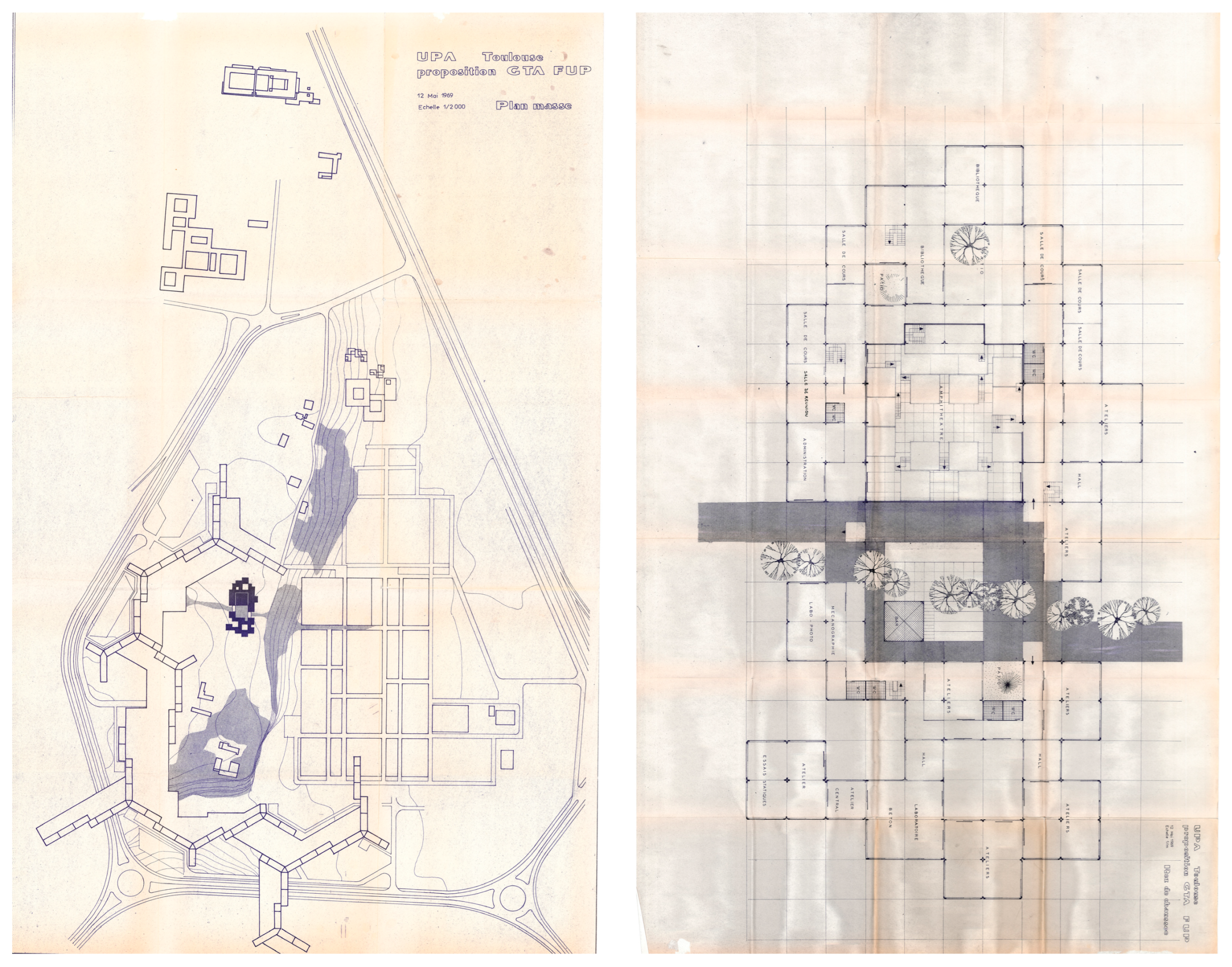
This outcome, however, did not result from a straightforward application on Candilis’ side, but from “a process associating a larger number of protagonists” [38]. As the director of the school reminded to the Ministry of Cultural Affairs in January 1969: “it is the students […] who are charged with designing the entirety of the premises in accordance with the needs required by the overhaul of teaching and pedagogy” [11]. During the spring of 1969, the Groupe de Travail Architecture Future UP (GTAFutUP)—under the leadership of Raymond Malebranche—worked on spatial proposals for the new school based on prefabricated systems that weighed the possibility of a provisional implementation. After intense political negotiations, the project was finally granted a site for permanent construction in the last area to be developed in Le Mirail, on an open plain whose nearest neighbors were a small seventeenth-century palatial structure over half a kilometer to the south and the future Faculty of Letters at a similar distance to the southwest. Within this indeterminate setting, the GTAFutUP proposed a preliminary scheme based on an orthogonal grid and traversed by a public street linking the Faculty of Letters to the residential area beyond (Figure 4). This scheme served as Candilis’ initial point of departure when he was appointed official architect that very summer [15]. Although momentarily tested as a scaled-down version of the Faculty of Letters—itself conceived by Candilis–Josic–Woods as a step beyond the Berlin Free University model [39]—this orthogonal approach was however soon set aside in favor of the greater geometric complexity of the Meccano system, now redeployed as a compact organism of striking geometric purity.
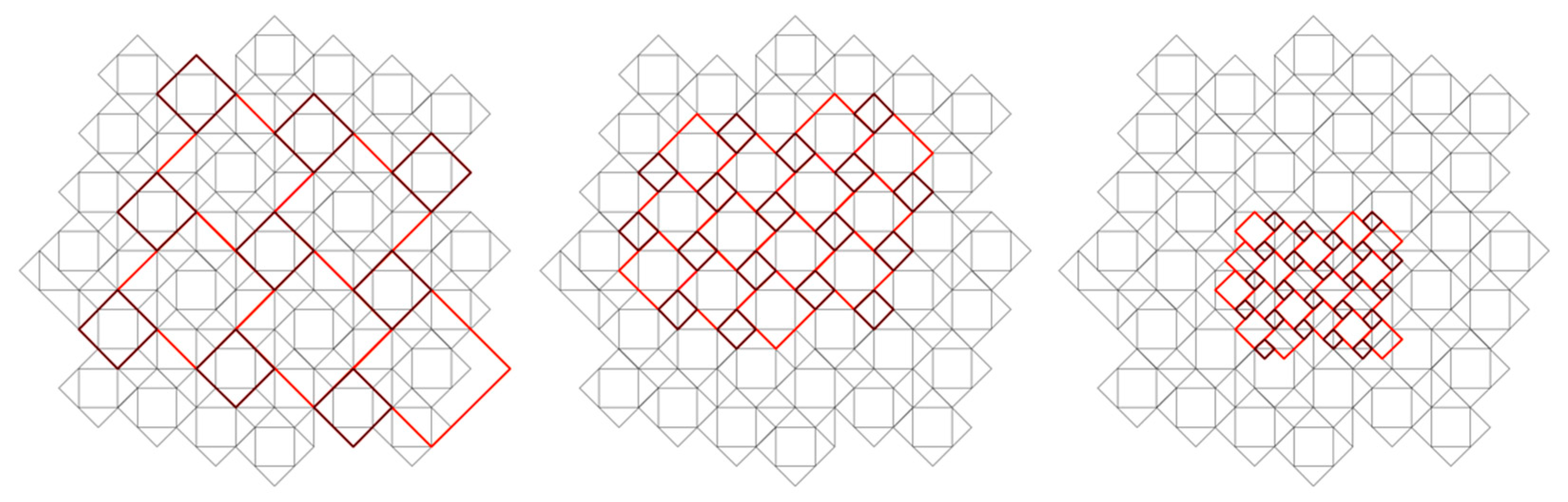
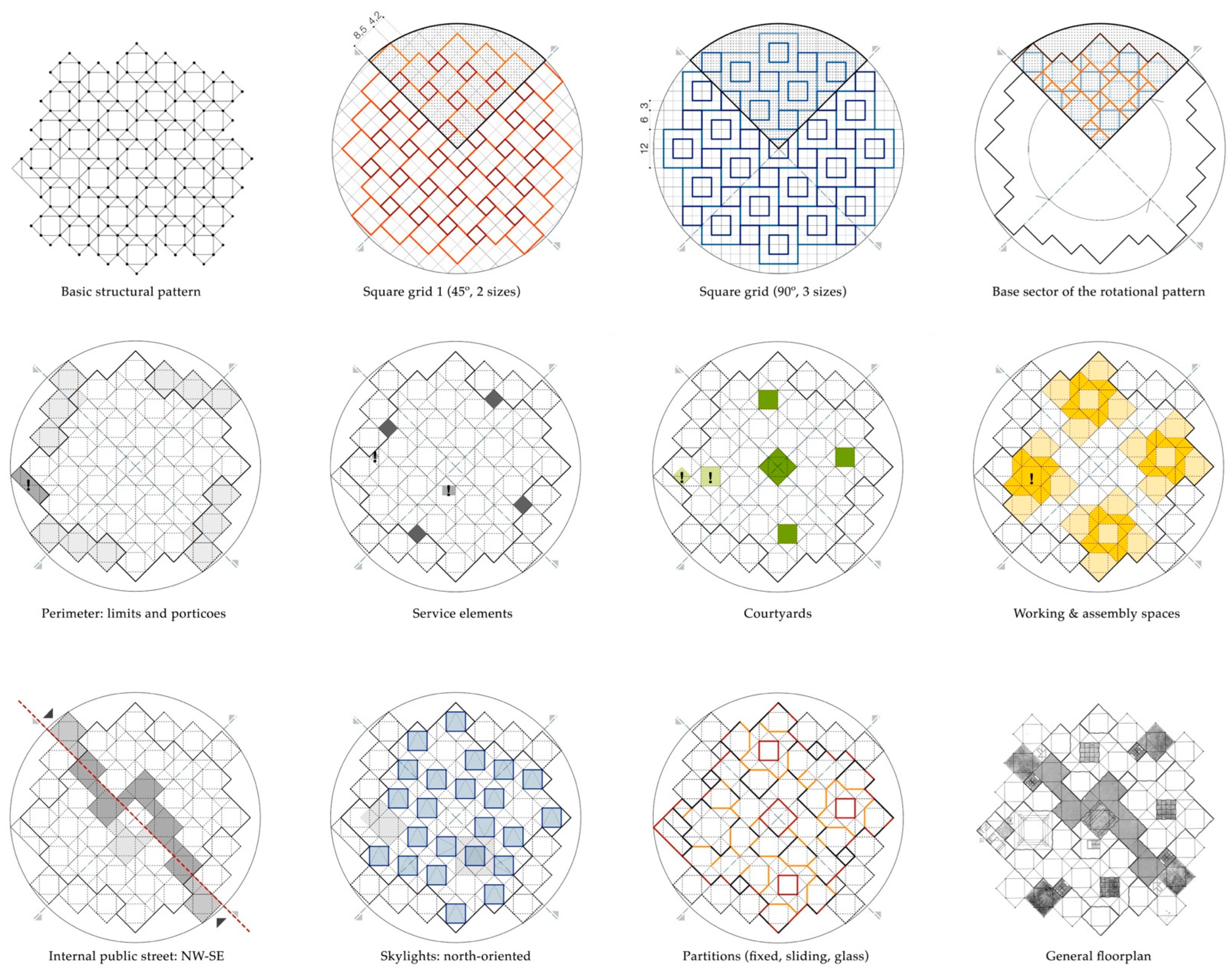
Despite Candilis’ outspoken criticism of academic composition, the degree to which his final proposal for the UPAT relies on devices traditionally associated with Beaux-Arts—grids, modular repetition, symmetry, rotation—cannot be overlooked. These mechanisms, however, are radically reinterpreted through a renewed conception of order and aesthetic language. To begin with, rather than adopting a simple tartan grid reminiscent of Durand, Candilis combined 90- and 45-degree non-continuous grids, generating a multidirectional pattern endowed with fractal properties (Figure 5). Perhaps the largest irony of this choice lies in the centralized symmetry emerging from this pattern to shape the building’s overall silhouette—an uncommon strategy for the time, when iterative systems were typically employed to dissolve boundaries and suggest open-ended growth.
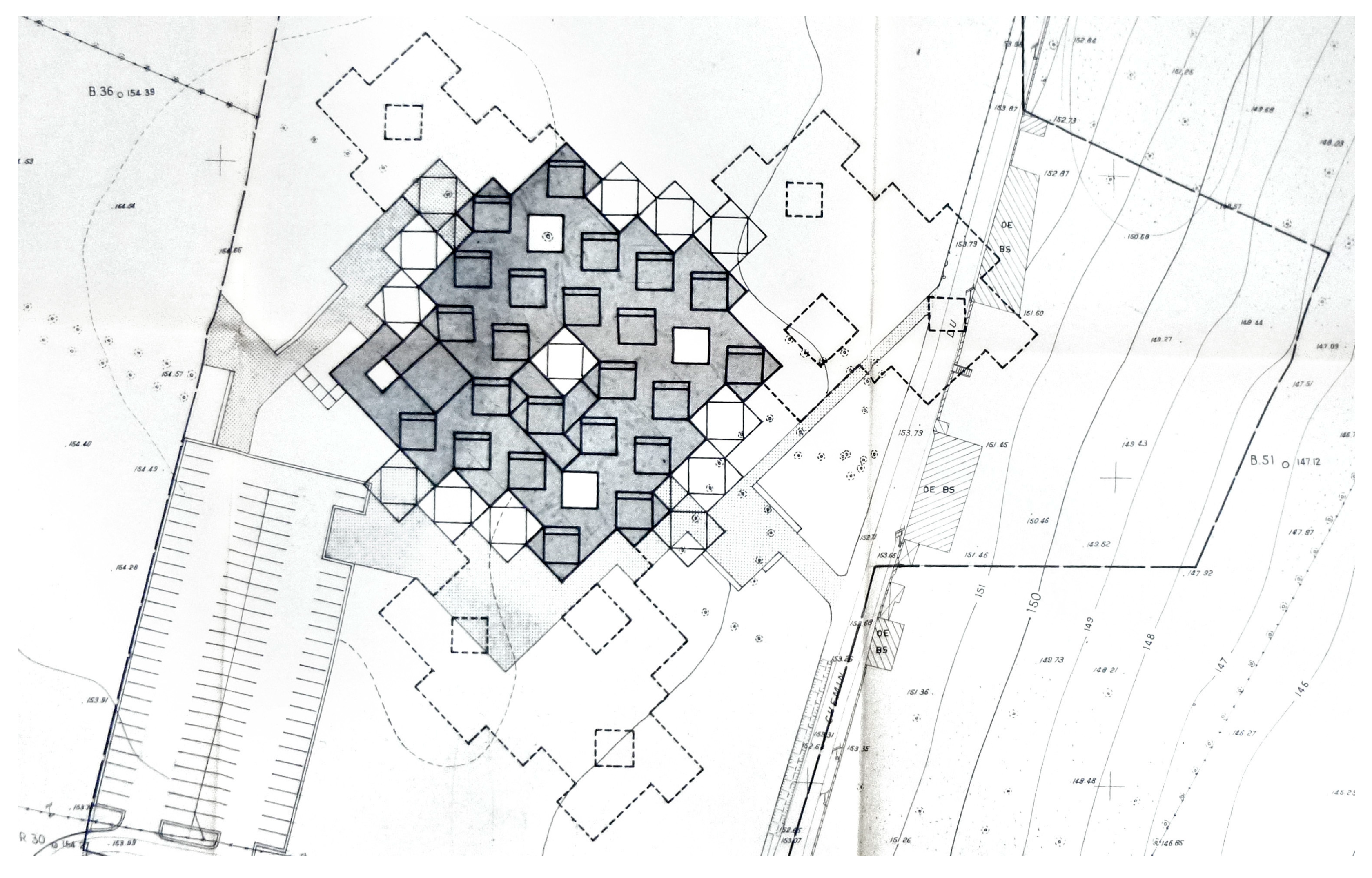
It is true that such potential growth was acknowledged by Candilis as an intrinsic condition of his proposal, reflected early project versions such as that from July 1969, where asymmetrical extensions are suggested around the central core (Figure 6). Yet, it equally striking how in its basic built form, the project asserts itself as a remarkably compact, self-contained figure. This ‘closure’ is nonetheless undermined by the rejection of radial symmetry in favor of a rotational logic: the plan operates as a pin-wheel—also rather common within Team X circles—that structures both the perimeter and the internal disposition. The geometrical procedure is straightforward: a fragment of the grid is assigned to each programmatic element and then rotated around the center of the figure until completing 360 degrees in four successive turns, resulting in a rotational symmetry of order four (Figure 7).
In any case, to counterbalance the idealization of his non-directional, centralized scheme, Candilis feels obliged to further introduce a series of “corrective”—in the sense of disruptive—strategies. Some operate locally, through minor variations within the initial pattern—natural adaptations of the system to specific programmatic requirements, such as the caretaker’s dwelling or the inclusion of an assembly amphitheater. Others introduce more explicit directional cues. The consistent northward orientation of all skylights, for instance, constitutes a logical climatic adjustment that subtly disrupts the system’s centrifugal logics. At the urban scale, contextual concerns prompted the insertion of a northwest–southeast internal street, cutting diagonally through the building to connect the Faculty of Letters with the so-called dalle of Le Mirail, as already suggested by the GTAFutUP’s preliminary project. Although this axis also follows a rotational logic—this time of order two—it nonetheless helps to temper the strict rotational character of the plan (Figure 7).
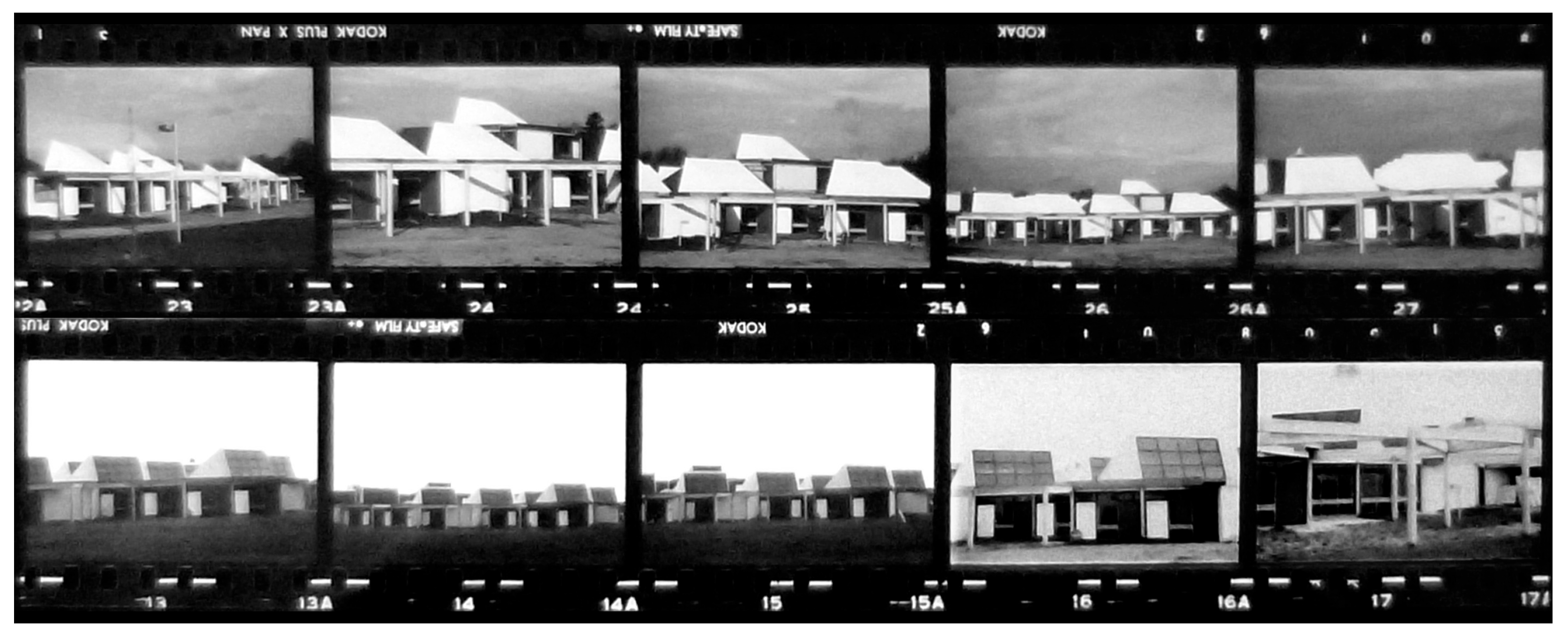
At ground level, however, despite these nuances, the building remains largely de-hierarchized, equivalent from all sides and devoid of any dominant façade (Figure 8). This stance resonates both with the persistent rejection of monumentality characteristic of Candilis–Josic–Woods’s work and with the broader cultural climate of the 1960s, marked by the democratization of higher education and the desacralization of public institutions. Likewise, it can be read as an implicit critique of the ENSBA’s representational conventions, which, in Candilis’ view, privileged façades over plans and sections, and appearance over content [1] (p. 285).
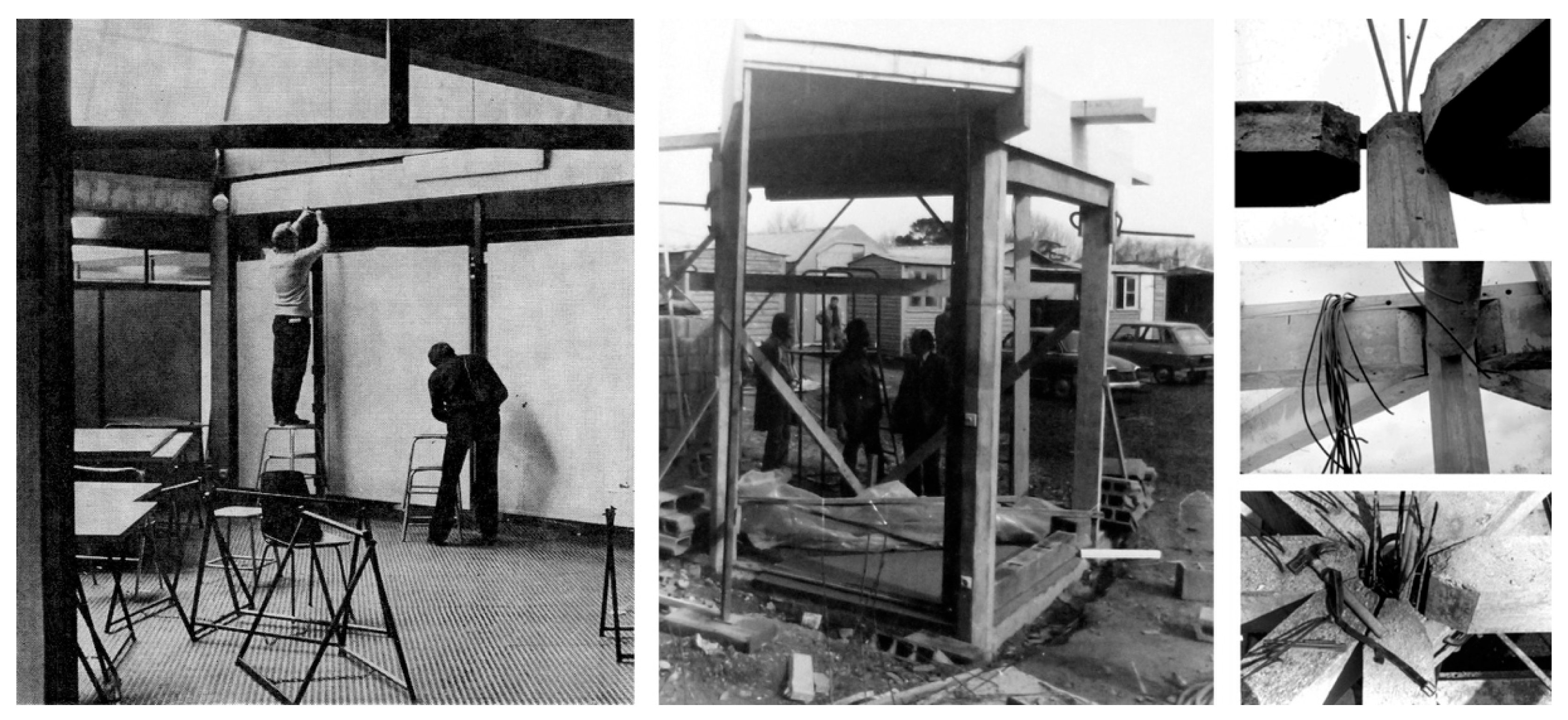
Internally, non-load-bearing partitions are also deployed to dissolve the symmetrical purity of the initial scheme. Respecting the base grid and the rhythmic presence of top-lit spaces, Candilis proposed an initial distribution in which more permanent partitions were aligned exclusively with the 45-degree grid, while movable elements could follow both directions (Figure 7). Thus rule, of course, was expected to be transformed by the inhabitants’ evolving demands, as Candilis put it: “The conception of this school aims to enable its crystallization by teachers and students and as the evolution of its teaching occurs” [40] (p. 102). To make this possible, prefabricated beams arrived on site with anchoring points every forty centimeters along their underside, enabling dry connections for metal frame partitions that Candilis had already tested in Bellefontaine [38] (p. 190). The load-bearing structure also integrated the electrical network, embedding switches and sockets within the columns and thus reinforcing the provisional and changeable character of internal divisions (Figure 9). All these strategies aligned with the principles of so-called “open industrialization” promoted by public authorities at the time, which sought to move beyond the rigidity of heavy prefabrication prevalent in earlier decades, not only in public buildings but, above all, in housing [41,42].
At UPAT, the result of this spatial game board was a sequence of irregularly bounded areas in which individual privacy was sacrificed in favor of a fluid, ramified continuous atelier without corridors or conventional classrooms. The regular rhythm of skylights, evenly distributed across the entire building, reinforced the equivalence between workspaces and circulation as places of learning. Rather than a finished object, the UPAT was thus conceived as an open field of possibilities, constantly awaiting occupation, modification, and reinterpretation: “at once a school, a construction site, and a factory”, in Candilis’ own words [43]. Once again, this vision extended well beyond pedagogical concerns, aligning closely with the period’s broader celebration of openness, indeterminacy, and users’ spatial practice as a form of political action.

3.3. From Manifesto to Palimpsest: Extensions and Shifting Paradigms

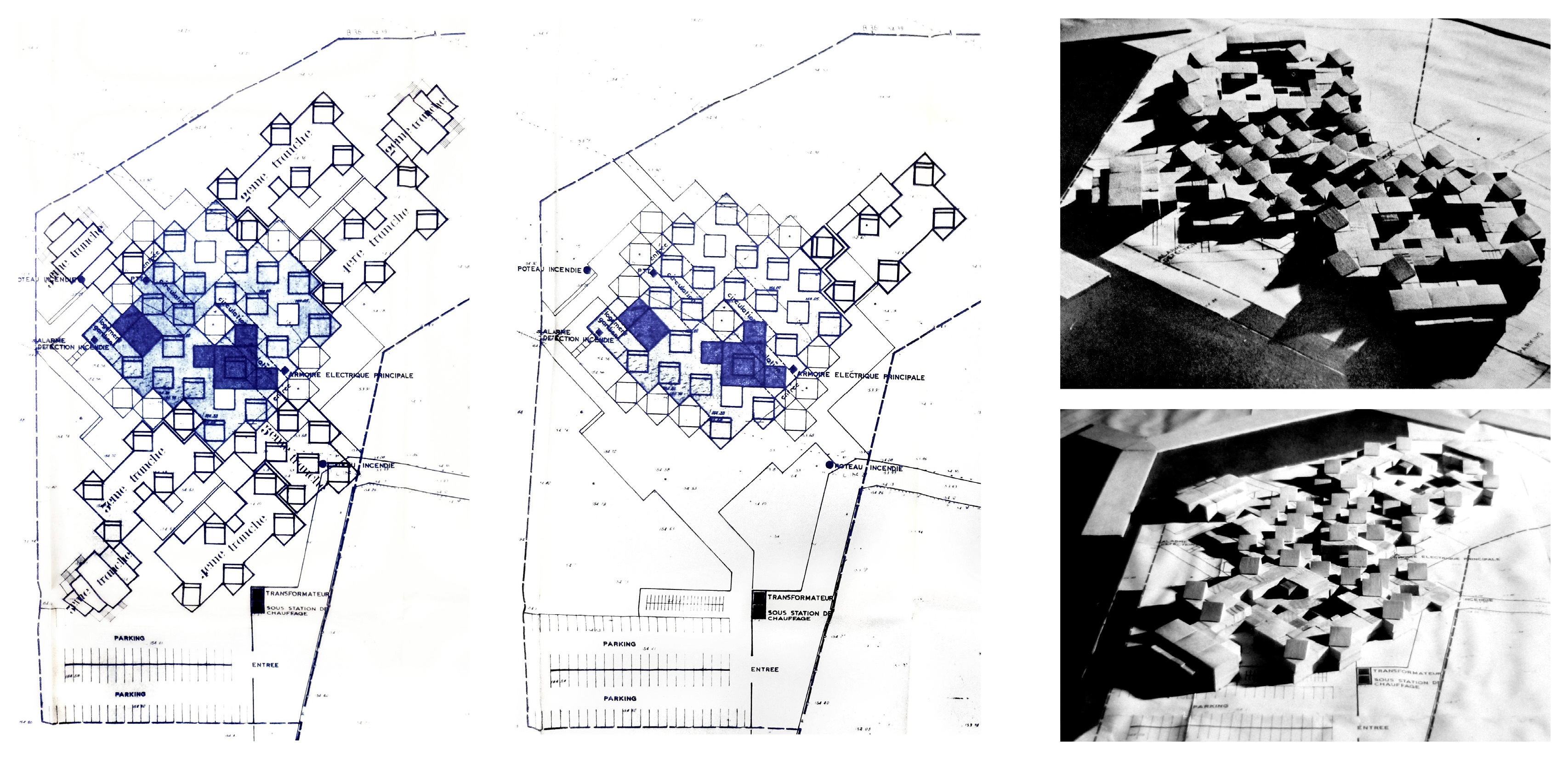
By the autumn of 1972, barely two years after the first students had entered the school, Candilis’ local office had already been commissioned to design an extension, now mainly assumed by Raymond Malebranche and Paul Desgrez. That same year saw the completion in the Netherlands of Central Beheer, one of the great icons of so-called structuralist architecture. In France, meanwhile, the proliférant impulse continued unabated, although its earlier critical spirit against functionalist architecture had already begun to degenerate into a fashionable formal repertoire sustained by the award criteria of influential national competitions such as the PAN or Modèles innovation [17,18,19,20,21]. Within this context, the first extension of the UPAT was conceived as a natural continuation of the original project’s spatial rules, to be carried out in four successive construction phases—of which only one was realized due to lack of funding (Figure 10).
Despite its declared continuity with the 1969 project, the new game board progressively lost much of its original radicality and ideological charge, prompting Desgrez to become disillusioned and abandon the project. Confronted with a sudden and massive influx of students, building as many classrooms as possible became the overriding priority. This led to an increasingly dense compartmentalization of the plan and to the introduction of conventional corridors, some so convoluted that the underlying pattern was no longer respected. The Meccano board was interrupted at some points by partitions cutting across half-modules and inconvenient columns were strategically eliminated. Although never realized, the proposal to attach a series of stepped amphitheaters with their own formal logics to the perimeter of the building further accentuated this departure. Equally problematic was the decision to develop the extension over two superimposed floors with no clear connection between them. Skylights were confined to the upper level, their role fundamentally altered: since the building depth was reduced and lighting relied now, primarily, on lateral façades, they were diminished to a largely formal motif. All considered, the greatest irony of this extension lies in how, within just a few years, the consolidation of pedagogical reform ended up neutralizing its original spatial ambitions, rapidly translating an architecture of “self-organization” into conventional and hierarchical arrangements, those that the 1968 rebellion had overtly rejected.
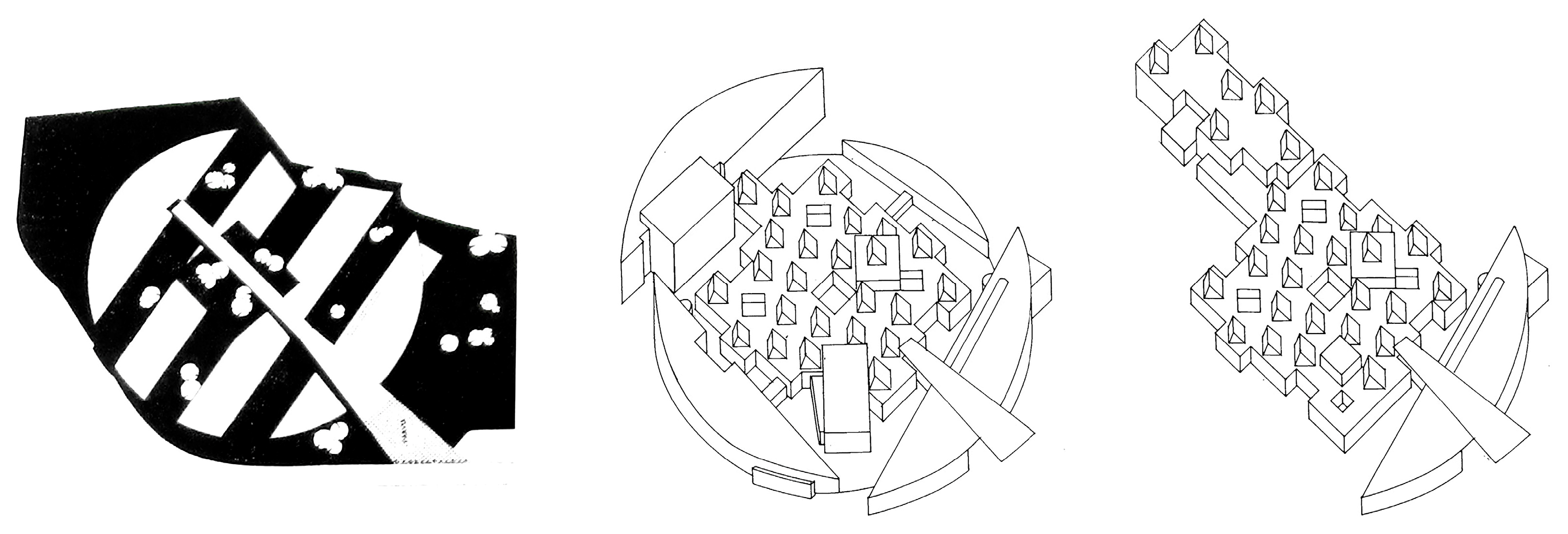
In 1989, amid rising social exclusion and urban insecurity in Le Mirail, a competition was launched for a two-phase extension of the UPAT. The brief called for research offices, an amphitheater, and a more legible entrance for the complex. By this time, Candilis’ projects in Toulouse had undergone significant physical and symbolic decline; the architecture school, the university campus, and the surrounding housing estates had become emblematic of the socio-political tensions inherent in large-scale modern planning within the French banlieues. Consequently, the winning proposal by Joseph Almudever and Christian Lefebvre marked a clear break with all that the original project represented. Rejecting the 1969 generative rules, the competition entry flirted with the total dismantling of the existing structures before ultimately proposing to encircle the 1969 building with a fragmented circular composition. This arrangement of four curved volumes wavered between an impulse to contain the original core and a tacit assumption of its eventual obsolescence [44]. In the end, only one segment was realized: a two-story semicircular volume on the southwest side, featuring a deliberately monumental entrance and a new internal street leading toward the Malebranche extension, which effectively rendered the original diagonal street obsolete (Figure 11).
Beyond its specific aesthetics—echoing the high-tech and deconstructivist tendencies of the time—the intervention reflects broader cultural shifts that extended well beyond pedagogical concerns: from the growing disillusionment with the 1960s optimistic belief in architecture’s capacity to reform human behavior, alongside a renewed demand for urban presence and representational clarity in public institutions, long suppressed under the banner of anti-monumentalism. These were years of outright rejection of mat-buildings, proliferating and structuralist architectures in all Europe, increasingly criticized for their perceived indifference to place, lack of legibility, and association with monotony and authoritarian order—ironically reversing their original emancipatory ambitions [45,46,47,48].
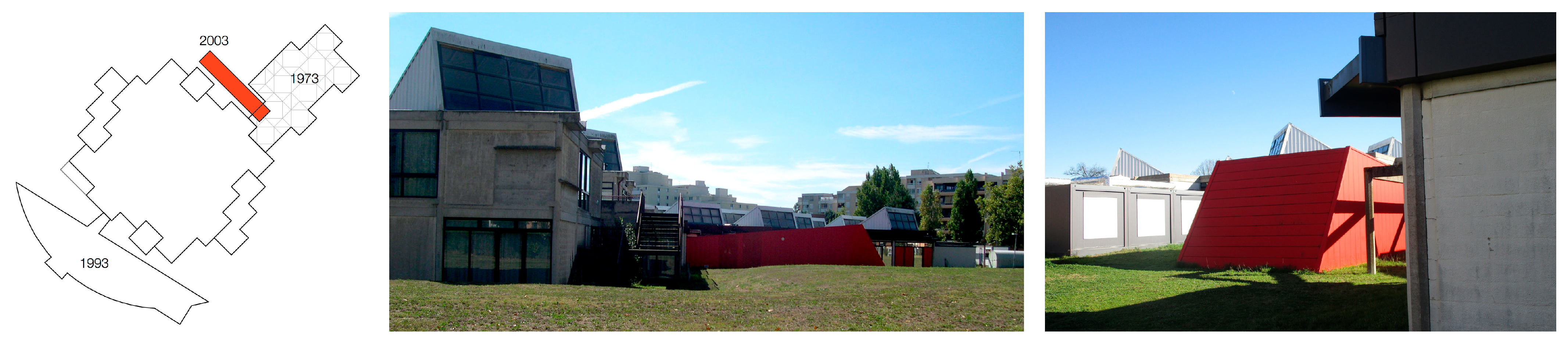
A smaller extension was carried out in 2003 to house a new computing facility. Known as the “boucherie”(Figure 12), this intervention completed the internal street initiated by the late-1980s project. More significantly, however, its form was a result of a renewed interest in mat-building strategies that emerged within architectural discourse at the turn of the century [49,50], one increasingly attentive to the tension between the open-ended nature of such systems and the imposition of global mechanisms of formal control—such as sharply defined perimeters—or intrusive elements external to the system’s iterative logic, like in Norman Foster’s intervention for the Free University of Berlin. Within this framework, the new extension adopted the logic of a parasite: a simple red metal prism inserted into an interstice of the grid and emerging above the roofline, echoing the inclined gesture of Candilis’s skylights while reinforcing, through contrast, the original project’s repetitive essence.
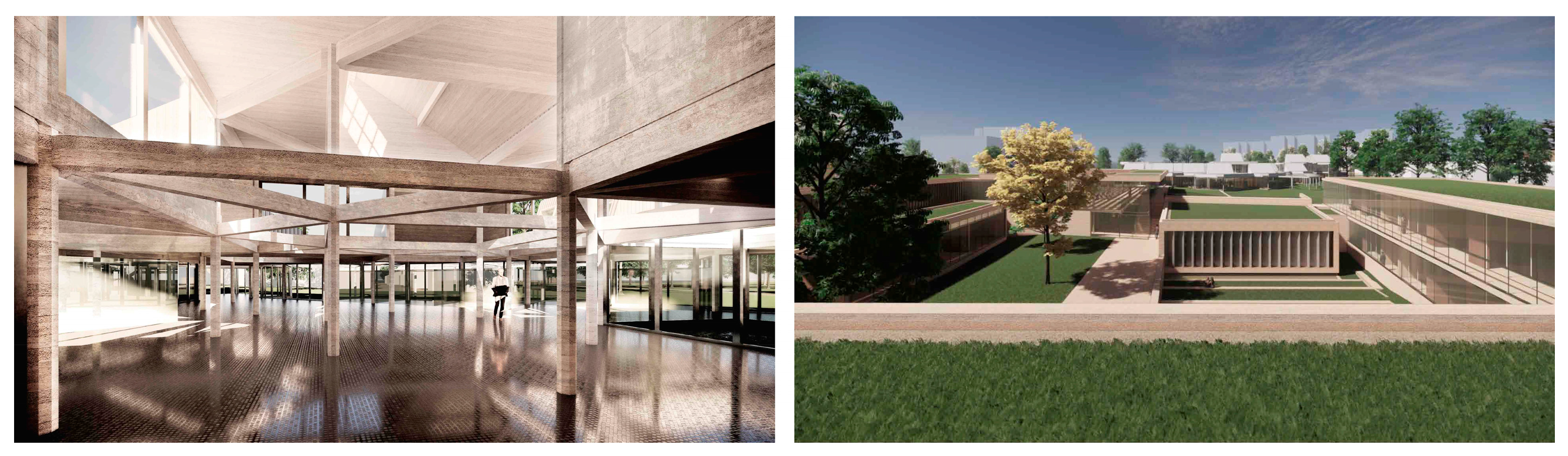
In 2019, the trajectory of the UPAT entered a decisive new phase. After years of uncertainty—marked by recurrent proposals for demolition and relocation—the attribution to the Candilis–Malebranche buildings of the label Architecture contemporaine remarquable marked a turning point. With demolition ruled out for a century, the question shifted from survival to reinterpretation. The competition that followed, won by Pierre-Louis Faloci, engaged this condition through an explicitly “archaeological” stance. The project proposes to strip back the 1969–1973 buildings, allowing structure, light, and spatial rhythm to re-emerge, as if uncovering the latent order beneath decades of accretions. The 1990s extension is neither denied nor celebrated: partially dismantled, it is reinterpreted as an excavated void, absorbing new functions while preserving its role as a connective hinge. On the other side of this hinge, the new construction avoids objecthood not through proliferation but as a landscaped topography that attempts to respond to broader strategies for the overall urban renewal of Le Mirail. Energy performance and environmental responsibility now dominate the discourse, accompanied by an almost “phenomenological” valorization of the UPAT’s denuded structural skeleton—celebrated for its poetics of tectonic nudity, an unfinished framework permanently awaiting occupation (Figure 13). Yet construction has yet to begin due to unresolved funding [51]; once again, the UPAT stands suspended between promise and postponement.

4. Conclusions: The Paradox of Open Order

Revisited from the present, the original UPAT emerges as a singular condensation of the aspirations, contradictions, and unresolved tensions that shaped post-1968 French culture. Conceived at the intersection of pedagogical reform, political engagement, and architectural experimentation, the project’s reliance on modular and combinatory logics cannot be reduced to matters of aesthetics or technique. Rather, it embodied a fundamental wager: that certain architectural forms might be inherently predisposed to openness—remaining deliberately unfinished and receptive to reinterpretation while preserving coherence, legibility, and a recognizable identity over time.
The Meccano system, as deployed at the UPAT, crystallized this ambition with particular clarity—but also revealed its internal contradictions. By condensing a potentially infinite, proliferating grid into a compact and centralized figure, Candilis implicitly acknowledged the risks of unbounded formal growth. The UPAT thus sought a paradoxical balance between openness and limit control, dynamic appearance and geometric rigor, indeterminacy and spatial intelligibility. While rejecting academic compositional hierarchies and monumentality, it nonetheless relied on highly disciplined geometric operations, never fully relinquishing the fundamental instruments of architectural order it aimed to contest.
Further tensions emerge when considering the freedom of occupation promised by Candilis’ grid. Presented as a tectonic framework permanently awaiting colonization, the UPAT not only enabled but also compelled user action. While it undoubtedly facilitated appropriation—by making spatial modification technically accessible—it did so less as an option than as an implicit moral obligation. Architectural incompleteness functioned not simply as an invitation, but as a call to civic engagement grounded in a reformist ethos. Yet this call was far from open-ended: user choices were strictly guided by the system itself, a clear set of syntactic rules governing spans, geometries, dimensions, and spatial relationships. Moreover, this architectural syntax was far from neutral: rather than supporting all possible modes of occupation, it actively favored the creation of informal and loosely bounded learning environments, while rendering enclosed and conventional classrooms difficult to accommodate. Optimistically conceived as radically open, Candilis’ grid paradoxically enforced a selective form of openness, shaping not only how space could be transformed, but also how learning itself was expected to take place.
The later history of the UPAT reveals the fragility of such conception, once the political, institutional, and cultural conditions that sustained it were no longer in place. The extension of the early 1970s already signaled a displacement of the founding ethos: under pressures of expansion and administrative pragmatism, the grid was progressively normalized and instrumentalized. In a telling irony, the effective democratization of higher education ended up undermining the very spatial and pedagogical ideals through which it had initially sought to define itself. The late 1980s intervention marked an explicit departure from the unfinished, anti-monumental logic of the original project, replacing it with a more legible architectural form intended to restore institutional visibility. This rupture coincided with a broader discrediting of mat-buildings and structuralist paradigms within architectural discourse, increasingly criticized for their perceived lack of urban presence and symbolic weight. At the same time, it was shaped by growing social tensions and processes of urban stigmatization affecting Le Mirail, which strongly influenced public perception and institutional decision-making, and directly impacted the reception of the Candilis–Josic–Woods legacy. More broadly and ultimately, this episode is symptomatic of the persistent difficulty faced by modern architecture in achieving long-term cultural recognition. The small parasitic intervention completed in 2003, although conceived as the final phase of the previous extension, already signaled a more nuanced engagement with the project’s legacy, addressing the original grid through contrast rather than through mere instrumentalization or outright rejection. The most recent project, initiated after the attribution of the Architecture contemporaine remarquable label in 2019, marks a further shift toward a conscious—if still fragile—form of heritage recognition.
This belated acknowledgment situates the UPAT within broader contemporary debates on the original values and reception of university campuses built between 1945 and 1975, in France and beyond [12,52,53,54,55,56]. Today, these ensembles are confronted not only with pressing imperatives of adaptation—driven by the massification of higher education, evolving pedagogical models, urban growth, constructive and regulatory constraints, etc., but also with the growing awareness that they constitute a fragile yet significant component of twentieth-century architectural heritage. In this sense, the challenges faced by postwar campuses are symptomatic of a wider condition affecting modern architecture as a whole. As Maristella Casciato noted in 2008, the modern legacy “offers historians and designers a platform of confrontation rich with contradictions” [57]. This perspective implies that conservation cannot aim at restoring buildings to an illusory or mythical original state, but must instead accept transformation as a working condition for preserving their architectural and historical values. Seen in this light, Faloci’s proposal stands an attempted response to this challenge, treating the UPAT’s denuded structure both as a living memory to be acknowledged and displayed, and as a spatial framework whose capacity for interaction and resignification remains operative.
Half a century on, the UPAT thus survives as a palimpsest of ideals, compromises, and reinterpretations. Beyond its specificity, this case demonstrates that the architectural radical innovations of the 1960s cannot be approached either as design systems to be indefinitely extended or as ideological models to be nostalgically restored. Instead, they should be understood as critical reminders that architecture’s promises of participation, adaptability, and emancipation cannot be secured by form alone, but must be continually renegotiated within shifting institutional, cultural, and urban realities.

Funding

This work has been supported by the Madrid Government (Comunidad de Madrid-Spain) under the Multiannual Agreement 2023–2026 with Universidad Politécnica de Madrid in the Line A, Emerging PhD researchers. Project: BAAD-HIS.

Institutional Review Board Statement

Not applicable.

Informed Consent Statement

Not applicable.

Data Availability Statement

No new data were created or analyzed in this study. Data sharing is not applicable to this article.

Acknowledgments

Thank you to Damien Renault, Tom Avermaete, and Jean-Henri Fabre for their generous support and fruitful exchanges along the years on, respectively, the relationship between combinatory architecture and pedagogical ideals, the broader work of Candilis–Josic–Woods, and the specific history of the UPAT. I would also like to thank the Centre d’Archives d’Architecture Contemporaine and Drina Candilis-Huisman for their help with archival research and for authorizing the publication of Candilis’ images. During the preparation of this manuscript, the author used ChatGPT 5.3 (OpenAI) for language assistance, including grammar correction, structuring and stylistic improvements in English. The author reviewed and edited all outputs and takes full responsibility for the content and originality of the publication.

Conflicts of Interest

The author declares no conflict of interest.

Abbreviations

The following abbreviations are used in this manuscript:
UPATUnité Pédagogique d’Architecture in Toulouse
ENSABÉcole Nationale Supérieure des Beaux-Arts
GTAFutUP Groupe de Travail Architecture Future UP

References

  1. Candilis, G. Bâtir la vie: Un architecte témoin de son temps; Infolio: Gollion, Switzerland, 2011; Volume 287. [Google Scholar]
  2. Violeau, J.L. Les architectes et Mai 68; Éditions Recherches: Paris, France, 2005. [Google Scholar]
  3. Maniaque, C.; Marantz, M.; Violeau, J.L. Mai 68. L’architecture aussi! La Société Editions B2: Paris, France, 2018. [Google Scholar]
  4. Maniaque, C. (Ed.) Les années 68 et la formation des architectes; Point de Vues: Paris, France, 2018. [Google Scholar]
  5. Drexler, A. The Architecture of the École Des Beaux-Arts; MIT Press: Cambridge, MA, USA, 1977. [Google Scholar]
  6. Diener, A. Enseigner l’architecture aux Beaux-Arts (1863–1968): Entre réformes et traditions; Presses Universitaires de Rennes: Rennes, France, 2022. [Google Scholar]
  7. Lucan, J. La fin de l’École de Beaux Arts. In France, architecture 1965–1988; Electa: Paris, France, 1989; pp. 24–34. [Google Scholar]
  8. Rénier, A. La petite réforme de 1965. In Propos sur L’enseignement de l’architecture: Histoire, institutions, partenaires; Ministère de l’Équipement, des transports et du tourisme: Paris, France, 1993. [Google Scholar]
  9. Diener, A. Du groupe C aux unités pédagogiques: la ‘réforme expérimentale’ de l’enseignement de l’architecture au Grand Palais (1962–1980). Politiques de la culture 2018, 5, 42–47. [Google Scholar] [CrossRef]
  10. Lambert, G.; Marantz, E. (Eds.) Architectures manifestes. Les écoles d’architecture en France depuis 1950; MétisPresses: Genève, Switzerland, 2018. [Google Scholar]
  11. Marantz, E. L’école d’architecture dans le texte. Une Ambition Architecturale au Prisme des Discours (1963–1978). Politiques de la culture 2018. [Google Scholar] [CrossRef]
  12. Castellanos, R.; Domingo, D.; Torres, J. Los mat-buildings y las universidades de los 60. DPA 2011, 27–28, 46–51. [Google Scholar]
  13. Renault, D.; Kalisz, J. Roger Salem et l’École d’architecture de Nanterre. In Combinatoire et réforme de l’enseignement. En: Architectures manifestes; Lambert, G., Marantz, E., Eds.; MétisPresses: Genève, Switzerland, 2018; pp. 119–136. [Google Scholar]
  14. Fabre, J.H. L’enseignement de l’architecture à Toulouse dans les années soixante. In Toulouse 45–75, architecture et urbanisme: La ville mise à jour; Marfaing, J.L., Ed.; Loubatières: Portet-sur-Garonne, France, 2009. [Google Scholar]
  15. Fabre, J.H. Le Groupe de Travail Architecture Future UP. Unpublished manuscript, personal archive of J.-H. Fabre.
  16. Chaljub, B. Construire une école d’architecture après 1968: Refus de faire œuvre? Politiques de la culture 2018. [Google Scholar] [CrossRef]
  17. Lucan, J. Architecture ‘proliférante’. In L’Architecture en France (1940–2000): Histoire et Theories; Le Moniteur: Paris, France, 2001; pp. 224–240. [Google Scholar]
  18. Monnier, G.; Klein, R. (Eds.) Les années ZUP. Architectures de la croissance 1960–1973; A & J Picard: París, France, 2002. [Google Scholar]
  19. Monnier, G. (Ed.) L’architecture moderne en France de 1889 a nos jours; Vol 3: Du chaos à la croissance 1940–1976; Picard: París, France, 2000. [Google Scholar]
  20. Klein, R.; Bauer, C. Modèles Innovation. Les derniers modernes; Editions du patrimoine: Paris, France, 2023. [Google Scholar]
  21. Abram, J. L’architecture Moderne en France de 1889 a nos jours. II: Du chaos à la croissance 1940–1976; Picard: París, France, 2000. [Google Scholar]
  22. Marchand, B. La nature organique des forms de la croissance. Le cas particulier des structures nappes horizontales. Matières 2006, 8, 20–34. [Google Scholar]
  23. Violeau, J.L. Team 10 and Structuralism: Analogies and Discrepancies. In In Search of a Utopia of the Present; NAi: Rotterdam, The Netherlands, 2005. [Google Scholar]
  24. Valena, T.; Avermaete, T.; Vrachliotis, G. (Eds.) Structuralism Reloaded? Rule-Based Design in Architecture & Urbanism; Axel Menges: Stuttgart, Germany; London, UK, 2011. [Google Scholar]
  25. Frausto, S.; van den Heuvel, D. Open Structures. An Introductory Dossier on Dutch Structuralism. Volume (Archis) 2013, 35, 65–93. [Google Scholar]
  26. Álvarez, L.N. Mat Building. La promesa de asociación espacial. RA Revista Arquitectura 2010, 12, 53–60. [Google Scholar]
  27. Domingo, D.; Castellanos, R.; Ábalos, A. The Strategies of Mat-building. Architectural Review 2013, CCXXXIV 1398, 83–91. [Google Scholar]
  28. Huet, B.G.; Candilis, A.; Josic, S. Woods, le mariage de la casbah et du meccano. L’Architecture d’Aujourd’hui 1975, 234, 44–53. [Google Scholar]
  29. Cortés, J.A. El árbol y el tapiz. Georges Candilis, 1913–1995. Arquitectura Viva 1995, 43, 70–71. [Google Scholar]
  30. Avermaete, T. Another Modern: The Post-War Architecture and Urbanism of Candilis-Josic-Woods; NAi: Rotterdam, The Netherlands, 2005. [Google Scholar]
  31. Chaljub, B. Candilis, Josic, Woods; Infolio: Gollion, Switzerland, 2010. [Google Scholar]
  32. Candilis, G. L’esprit du plan de masse de l’habitat. L’Architecture d’Aujourd’hui 1969, 57, 2–7. [Google Scholar]
  33. Candilis, G. Les trames directionelles et leur utilization. L’Architecture d’Aujourd’hui 1969, 144, 62–63. [Google Scholar]
  34. Eco, U. Opera Aperta: Forma e indeterminazione nelle poetiche contemporanee; Bompiani: Milan, Italy, 1962. [Google Scholar]
  35. Smithson, A. (Ed.) Team 10 Primer; Studio Vista: London, UK, 1968. [Google Scholar]
  36. Woods, S. Stem. Architectural Design 1960, 5, 181. [Google Scholar]
  37. Castellanos, R.; Domingo, D. Meccano: El juego de la construcción, la arquitectura del comercio. Dearq 2015, 1, 146–159. [Google Scholar] [CrossRef]
  38. Fabre, J.F. Origines et genèse de l’Unité pédagogique d’architecture de Toulouse (1968–1974). In Architecture manifestes; Lambert, G., Marantz, E., Eds.; MétisPresses: Genève, Switzerland, 2018; pp. 179–194. [Google Scholar]
  39. Collet, P. Changer les bâtiments pour changer l’enseignement. Le projet de l’université Toulouse Le Mirail dans les années 1960. Les Cahiers de la recherche architecturale, urbaine et paysagère 2022, 16. [Google Scholar] [CrossRef]
  40. Candilis, G.; Woods, S.; Josic, A. Toulouse le Mirail. El nacimiento de una ciudad nueva; Gustavo Gili: Barcelona, Spain, 1976. [Google Scholar]
  41. Gotman, A.; Léger, J.M. Innovation technique, technique de l’habiter? Les Annales de la recherche urbaine 1983, 20, 101–120. [Google Scholar] [CrossRef]
  42. Grezes, D.; Charon, J.P. Industrialisation ouverte. Recherche et expérimentation 1971–1983; Plan Construction et Architecture: París, France, 1983. [Google Scholar]
  43. Candilis, G. Unité pédagogique d’Architecture de Toulouse-Le Mirail. Techniques & Architecture 1974, 298, 105–107. [Google Scholar]
  44. École d’architecture de Toulouse. Techniques & Architecture 1990, 392, 114.
  45. Huet, B.; Girard, E. Enfin libres et soumis. L’Architecture d’Aujourd’hui 1974, 174, 10–17. [Google Scholar]
  46. Lucan, J. L’antimonumentalisme: Des trames aux proliferants. In France, architecture 1965–1988; Electa: Paris, France, 1989; pp. 52–75. [Google Scholar]
  47. Van Dijk, H. The Demise of Structuralism. In Architecture in the Netherlands Yearbook 1988–1989; NAi Uitgevers: Rotterdam, The Netherlands, 1989; pp. 6–10. [Google Scholar]
  48. Koolhaas, R. Structuralism (Dutch Parliament competition entry). International Architect 1980, 1, 48–50. [Google Scholar]
  49. Sarkis, H. (Ed.) Case: Le Corbusier’s Venice Hospital and the Mat Building Revival; Prestel: Munich, Germany, 2001. [Google Scholar]
  50. Scalbert, I. Putting the 60s into the 90s. Forms and Prejudice. In Europan 4: European Results: Constructing the Town upon the Town; Europan: Paris, France, 1997; pp. 147–151. [Google Scholar]
  51. Girard, B. Pourquoi la rénovation-extension de l’école d’architecture de Toulouse s’enlise. Le Moniteur. Available online: https://www.lemoniteur.fr/article/a-toulouse-la-renovation-extension-de-l-ecole-nationale-d-architecture-en-sursis.2343007 (accessed on 14 March 2025).
  52. Compain-Gajac, C. (Ed.) Les campus universitaires. Architecture et urbanisme, histoire et sociologie, état des lieux et perspectives; Presses Universitaires: Perpignan, France, 2014. [Google Scholar] [CrossRef]
  53. Delanes, S. L’architecture universitaire en France, des années de croissance aux temps de crise (1960–1980). Labyrinthe 1999, 4, 122–124. [Google Scholar] [CrossRef]
  54. Poirrier, P. (Ed.) Paysages des campus: urbanisme, architecture et patrimoine; Éditions Universitaires: Dijon, France, 2009. [Google Scholar]
  55. Barr, J. 1960s University Buildings: The Golden Age of British Modern Architecture; Lund Humphries: London, UK, 2025. [Google Scholar]
  56. Castellanos, R. Hic Et Ubique Terrarum. La arquitectura radical de la universidad italiana de los setenta. EN BLANCO. Revista de Arquiectura 2021, 13, 130–142. [Google Scholar] [CrossRef]
  57. Casciato, M. Modern Architecture is Durable: Using Change to Preserve. In The Challenge of Change. Dealing with the Legacy of Modern Movement. Proceedings of the 10th International Docomomo Conference; Van den, H., Ed.; Delft University Press: Delft, The Netherlands, 2008. [Google Scholar]
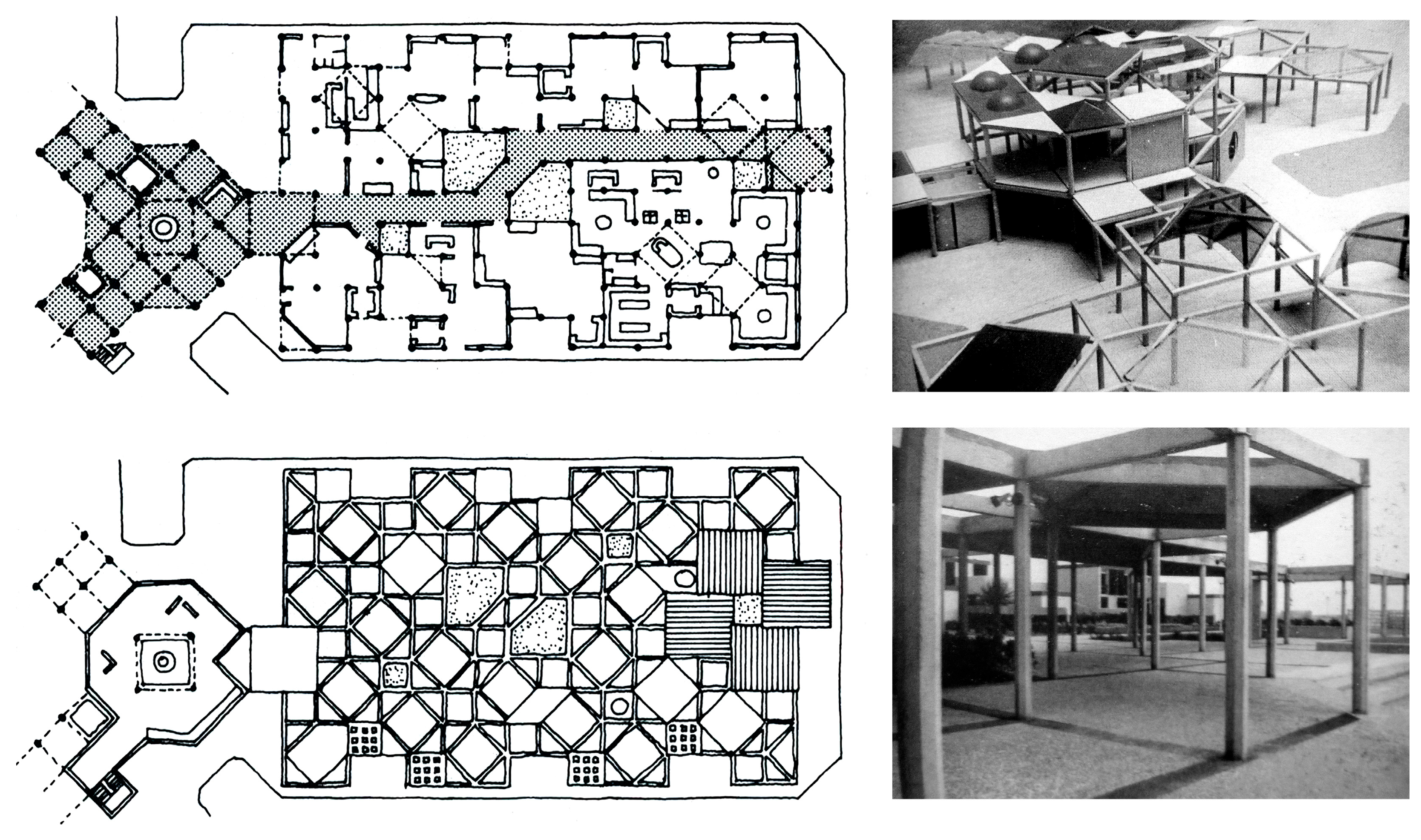
Figure 1. Barcarès–Leucate, commercial area. (Left): structural scheme and overall floor plan; (upper right): model view; (lower right): view of the built porticoes. Source: plans and photograph from Candilis, G. Recherches sur l’architecture des loisirs. Éditions Eyrolles: Paris, 1973; model: Fonds Candilis SIAF/Cité de l’architecture et du patrimoine/Archives d’architecture contemporaine (CANGE-G-67-1: 236 IFA 624/3); originals © Drina Candilis-Huisman.
Architecture 06 00047 g001
Figure 2. Meccano system, published in L’Architecture d’Aujourd’hui 1969, 144; original from Fonds Candilis SIAF/Cité de l’architecture et du patrimoine/Archives d’architecture contemporaine, © Drina Candilis-Huisman.
Architecture 06 00047 g002
Figure 3. Working models for the UPAT. Source: Fonds Candilis SIAF/Cité de l’architecture et du patrimoine/Archives d’architecture contemporaine (CANGE-F-69-2: 236 IFA 604/2), © Drina Candilis-Huisman.
Architecture 06 00047 g003
Figure 4. Preliminary project for the UPAT by GTAFutUP, 1969. Courtesy of J.H. Fabre (personal archive).
Architecture 06 00047 g004
Figure 5. Fractal properties of UPATs’ geometrical pattern. Drawing by the author.
Architecture 06 00047 g005
Figure 6. Preliminary project by Candilis’ office, dated 4/07/1969. Source: Fonds Candilis SIAF/Cité de l’architecture et du patrimoine/Archives d’architecture contemporaine (CANGE-F-69-2: 236 IFA 321/1), © Drina Candilis-Huisman.
Architecture 06 00047 g006
Figure 7. Decoding the UPAT’s geometry: From top to bottom, by rows: initial fourfold rotational symmetry; relationship between the rotational pattern and functional layers (with local ruptures); disruptions of the pattern’s symmetry through directionality/irregularity. Drawings by the author.
Architecture 06 00047 g007
Figure 8. Street-level photographs taken from multiple viewpoints. Source: Fonds Candilis SIAF/Cité de l’architecture et du patrimoine/Archives d’architecture contemporaine (CANGE-F-69-2: 236 IFA 604/2), © Drina Candilis-Huisman.
Architecture 06 00047 g008
Figure 9. Construction system. (Left): two students dismantling panel partitions; (center): structural prototype, with Candilis, Malebranche and Degrez; (right): structural details of the hollow columns. Sources: (left): Techniques et Arquitecture, 298, 1974; (center): Fonds Candilis SIAF/Cité de l’architecture et du patrimoine/Archives d’architecture contemporaine (CANGE-F-69-2: 236 IFA 604/2); (right): J.H. Fabre personal archive; originals © Drina Candilis-Huisman.
Architecture 06 00047 g009
Figure 10. Malebranche’s extension, 1972–1973. Left to right: overall phasing plan (up to four stages); general plan of the first phase (the only one built); model photographs. Source: Fonds Candilis SIAF/Cité de l’architecture et du patrimoine/Archives d’architecture contemporaine (CANGE-F-69-2: 236 IFA 439/1; 604/2), © Drina Candilis-Huisman.
Architecture 06 00047 g010
Figure 11. Almudever-Lefebvre extension, 1989. (Left): initial proposal; (middle): final proposal; (right): real execution of only one quarter of the project. Series made by the author out of documents courtesy of J.H. Fabre (personal archive).
Architecture 06 00047 g011
Figure 12. Computing facility extension (La boucherie), 2003–2004. Sources: scheme by the author; photographs courtesy of J.H. Fabre (personal archive).
Architecture 06 00047 g012
Figure 13. Pierre-Louis Faloci’s project for the UPAT (2020). (Left): interior of 1969 building; (right): proposed extension in continuation with the urban park of Le Mirail © Pierre-Louis Faloci, courtesy of J.H. Fabre (personal archive).
Architecture 06 00047 g013
Disclaimer/Publisher’s Note: The statements, opinions and data contained in all publications are solely those of the individual author(s) and contributor(s) and not of MDPI and/or the editor(s). MDPI and/or the editor(s) disclaim responsibility for any injury to people or property resulting from any ideas, methods, instructions or products referred to in the content.