1. Introduction
In Australia, architects have a professional responsibility to advocate for communities and minority occupants [
1], i.e., to design with social justice. This implies that designers understand multiple building occupants sufficiently well to integrate their needs into the building while also satisfying commercial responsibilities to clients procuring the building work, together with providing original creative design outcomes. This process requires broad understanding of complex and competing needs and the ability to strategically respond with appropriate design outcomes.
Addressing client and occupant needs may involve consultation or co-design processes. Understanding what occupants want and need has been previously championed using activities such as consultation [
2] (pp. 28–37) or co-design [
3]. Yet, others have identified co-design as being problematic due to political influences within groups as well as privileging people processes over design outcomes [
4] (p. 119). Furthermore, consultation is not always possible because project governance structures may limit access for commercial reasons, or designers may not have access to occupants because they are transient (e.g., hospital patients) or vulnerable (e.g., school students, aged care residents with cognitive decline). Lack of access may also occur during design education.
In lieu of consultation or co-design, designers must seek knowledge about the occupants from alternative sources. Complex client and occupant needs may require evidence-based design for specific measurable outcomes, or, more typically, research-informed design that aims to translate multi-disciplinary evidence-based knowledge from other disciplines into spatial design practices [
5,
6]. There are three interconnecting complexities in this process. First, architectural practice is already broad, interdisciplinary, and flexible [
7]. Designers have specialist design skills and knowledge [
8,
9,
10] and use multiple knowledges from a variety of sources [
11,
12] to, pragmatically and strategically, solve complex built environment design problems. Similarly, working closely with the architecture profession, interior design is described as a broad ‘amorphous’ profession [
13] (p. 204) performing all design apart from that associated with structural aspects [
14] (p. 4). The outcome is a highly pragmatic research process relying on heuristics and design-polemical theory [
15] (pp. 109–120).
The second complexity follows on from the first. Architectural and interior design (AID) sits at the junction of humanities, arts, social sciences (HASS) and science, technology, engineering and mathematics (STEM) knowledges and uses both in design outcomes, i.e., research-informed design is mixed methods, yet it is not always clear how to select and integrate appropriate scholarship beyond AID disciplines for research translation [
15] (p. 66). The third complexity is the unknown effect of systemic and unconscious bias present in Australian architectural practice [
16] on both selecting appropriate knowledge, including personal design knowledge, when undertaking research-informed design for social justice outcomes.
For more holistic understanding of buildings as social and cultural products, systems perspectives have been applied to occupant–building interactions: early adaptive design systems [
17]; STS and ‘design-use relations’ [
18]; ecologies [
19,
20,
21]; networks [
22]; and socio-technical elements [
23]. While general systems theory [
24] approaches offer a useful metaphor for understanding complex design problems, or ‘wicked’ problems, in practice design outcomes will always be contingent on the problem definition and any simplifications used [
25] (pp. 24–27), i.e., the systems will be biassed. The designer must have the skills, knowledge, time, and funds to explicitly review and mitigate bias.
Inclusion and social justice require understanding of human variety in building occupants. For design for disability, there are ‘multiple occupancies’ with ‘entangled relationships’ with buildings [
26] (p. 2). Multiple occupancies might also be extended to cultures and socioeconomic status. For AID practitioners working under commercial constraints, occupancy variety is easy to overlook in taken-for-granted normative occupant–building systems. One option is to use a critically reflexive process in design praxis as continuous explicit questioning of practical knowledge, its context and its application [
25] (pp. 39–44). In practice, rigorous and critical reflexivity into underlying structures of power and claims to authority [
27] (p. 273) may be difficult due to organisational cultures, commercial and time limits on projects, or insufficient personal reflectivity skills.
The aim of this paper is to develop a simple, yet flexible, framework for critically interpreting the reciprocity between buildings and their occupants for inclusive strategic decision-making in AID practice, by individuals and teams operating under commercial constraints. The resulting theoretical framework contributes to the architectural literature by adding an integrative framework describing the occupant–building system that can guide research in professional design practice and architectural and interior scholarship. This paper restricts its scope to architecture and interior design disciplines due to their close association while designing complex buildings, such as health, civic, education, or other public buildings, and the impact their design work has on occupancies. The scope was also limited due to the author’s professional and academic practice disciplines.
To develop a useful framework, this paper uses a deductive approach to enhance existing theory of social practices. This approach is taken from strategic management studies [
28] whereby the practice of development of theory is separated from the testing of theory, which affords, first, a nuanced discussion of the theory development and, second, early access to the theory for testing by other researchers. This approach is justified by considering AID practice as a commercial business with strategic corporate and business actions, and, hence, management studies may inform AID research. The framework developed here is intended as an ‘informal theory’ for broad strategic decisions rather than a well-defined model of a formal theory for specialist audiences [
29]. It is intended for ‘sensemaking’ by design practitioners, where sensemaking is the process of developing sufficient understanding of the meaning of a problem in ‘flux’ for the purpose of taking action [
30], with action and meaning recursively interconnected [
31], and making the effort to understand a problem is worthwhile in and of itself [
32]. Social practice theory (SPT) is positioned as part of a group of practice theories within sociology [
33]. This paper draws from one operationalisation that makes explicit the recursive influence with material (non-sentient artefacts) and social aspects [
34], and integrates affective spaces [
35] into the operationalisation for AID. This paper develops the social practice of occupancy, and the social practice of designing for occupancy, as cultural production. It takes the position that AID practitioners have a role in stabilising or evolving culture, and, furthermore, that they have a responsibility to make informed decisions about how best to proceed. The outcome is both an explanatory and a guidance framework for interpreting spatial design for multiple occupancies.
This paper develops the SPT framework for AID by introducing the foundational SPT literature in the next section. The following section logically enhances existing theory to deductively develop an informal theory that can be applied to sensemaking in architecture and interior design practice. Examples showing flexible application are provided, and contribution, limitations and future research are discussed.
2. Foundational Social Practice Theory
Architecture, as a grand material form, may be considered a sociological material symbol [
36] with certain political freedom to influence culture [
37]. In addressing the more domestic social element of AID, design scholarship borrows the anthropological term ‘material culture’ to imply the social and cultural construction of design artefacts, but without defining this term specifically, e.g., [
38]. Elsewhere, material culture is described as ‘diffuse and relatively uncharted interdisciplinary field of study in which a concept of materiality provides both the starting point and the justification’ [
39] (p. 1). This ambiguity makes material culture a useful flexible term to infer social influence in design outcomes, yet difficult to operationalise for the design process. Furthermore, it privileges material over people.
Space as a social product has been long argued [
40]. Sociology and specifically Gidden’s structuration offers insight into how buildings manifest social structures that enable or reduce the spatial agency of occupants [
41,
42]. Awan proposes that to design for spatial agency of occupants, designers require spatial judgement, mutual knowledge, and critical awareness [
41] (p. 33), i.e., a combination of specific design expertise but also knowledge of the multiple occupancies, and the reflexive honesty to critique responses. Yet, without appropriate research, and in resource-restricted commercial projects where consultation is limited due to time or fee constraints, spatial agency may be difficult to achieve.
Returning to Giddens’ structuration, Shove et al. note that structure and actor are recursively related as a social practice, so, rather than understanding these as separate phenomena, a social practice can be viewed as the unit of analysis and operationalised for interpretation [
34] (p. 3). Theories of social practice interpret repetitive social phenomena. Social practices are performed using non-human material, are transmitted over time and distance, and stabilise (or change) a particular culture [
34] (p. 13). Originating in sociology and philosophy [
43,
44,
45], practice theory has been operationalised [
33,
34] and used in built environment research to explain occupant–building interactions such as building energy use, e.g., [
46,
47,
48]. This offers a precedent for applying SPT to architecture and interior design to make sense of its recursive relationship with occupants.
Shove et al.’s [
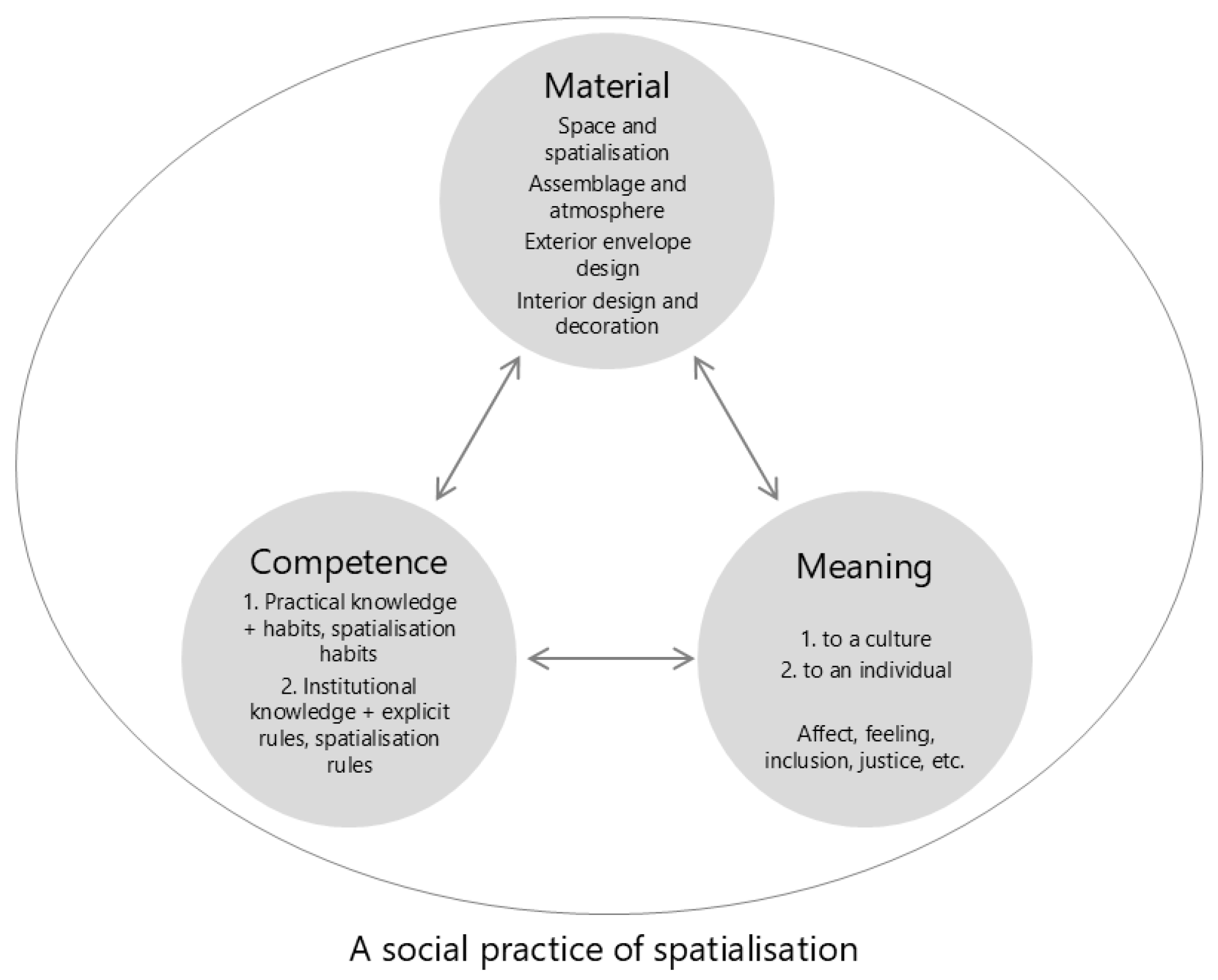
34] (pp. 21–25) operationalisation framework divides a social practice into three elements: material (all ‘objects, infrastructure, tools, hardware and the body itself’), competences (‘multiple forms of understanding and practical knowledgeability’) and meaning (‘social and symbolic significance of participation at any one moment’). These elements, and their linkages, form social practices. Studying how social practices are performed and transmitted (taught or dispersed), together with studying elements, reveals the nuance of a social practice. Studying changes in elements, performance, or transmission reveals evolution in social practices.
Applying SPT to AID, from the perspective of the designer in commercial operations, there are two social practices of interest. First, the social practice of building occupancy is a key outcome for a building. However, there is never a single occupancy. Building occupants are varied so there are multiple social practices of building occupancies both simultaneously and dynamically over the lifespan of the building, such as through adaptive reuse design practices [
49]. The second social practice of interest is the social practice of design for these multiple dynamic occupancies.
Social practices are not isolated. Different social practices may share elements [
34] (p. 37) to create a nexus of practices [
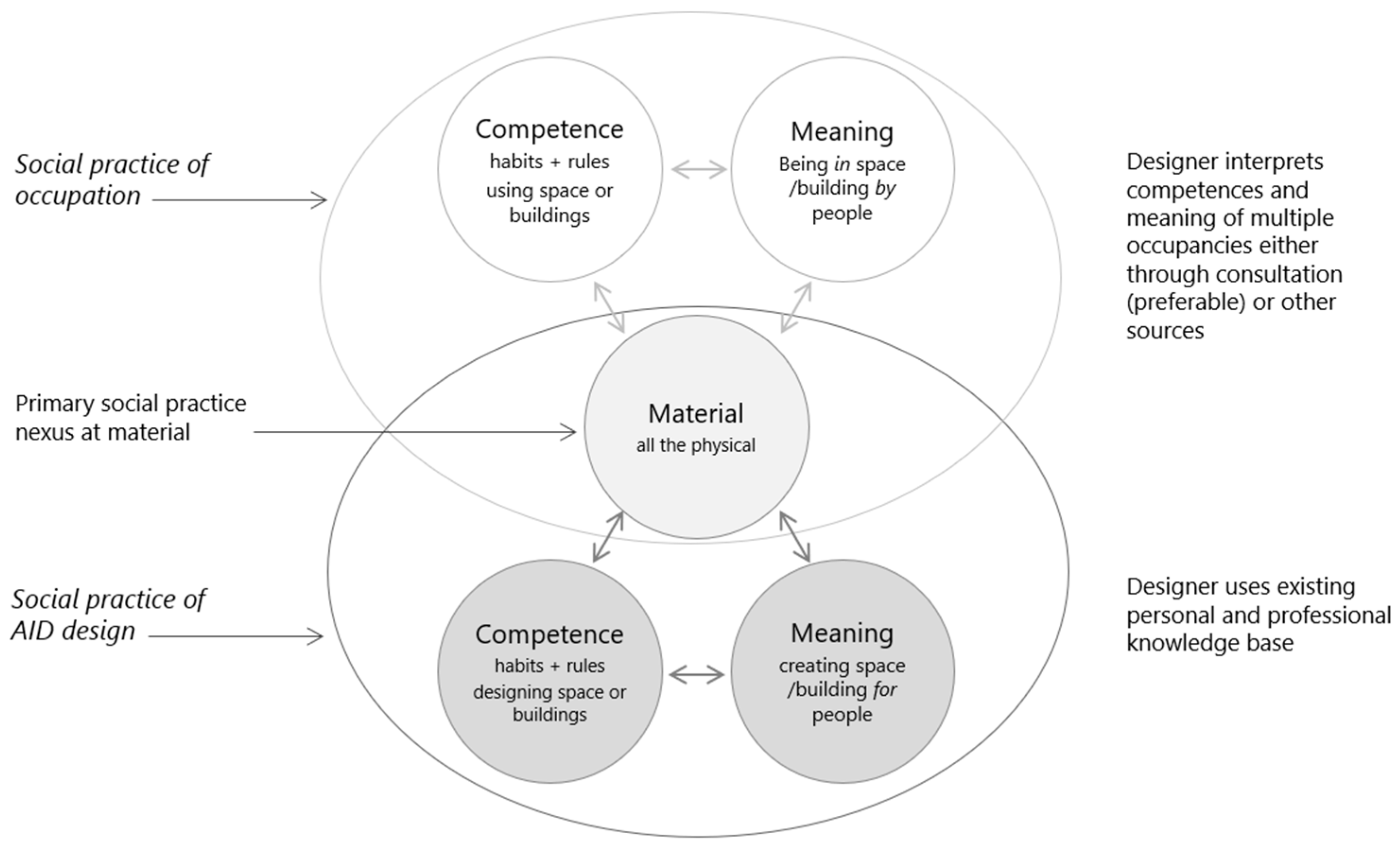
33]. In AID, the principal nexus of interest is the junction at the material element, where the social practice of occupation meets the social practice of design praxis.
In defining ‘material’ Shove et al. refer to buildings as containers of different, yet associated, social practices [
34] (p. 84). Furthermore, they argue that space is not part of their model because ‘they [spaces] do not circulate in their own right, nor are they shared and stored in the same way [as materiality, meaning and competence]’; rather ‘they act like elements in that they constitute media of aggregation and storage, holding the traces of past practice in place in ways that are relevant for the future, and for the perpetuation of unequal patterns of access’ [
34] (pp. 132–134). At that point in SPT development, space was loosely defined and seemed to overlook the human effort behind spatial design in the explication of a high order social theory.
Reckwitz addresses space in the argument for affective cultures [
35]. Since a practice (with bodies and objects) always occurs in a physical context, space should also be included in the ‘material’ of a social practice. That space spatialises a practice using spatial-affective atmospheres, i.e., spaces designed for specific arrangements and affects associated with a social practice. Affective cultures are a network of bodied agents, embedded affect patterns, and physical material, such that cultures can be performed or transmitted as social practices [
35] (pp. 251–252).
Spatialisation is relative to a body that senses the space, and the space is integral to a social practice because it causes affects specific to the social practice and the body has the tacit knowledge to sense and understand this:
‘In modern societies, this spatialising often results in built, architectural spaces that are made for and correspond with specific practices. Economic, political, private and educational practices are connected with particular built spaces, which the practices handle and which in turn influence these very same practices. Apart from internal divisions in rooms, halls etc., these spaces include an arrangement of further objects, for instance furniture, lights, windows etc. … All these spaces are practically appropriated in everyday life and are experienced through perceptions and sensations; not exclusively visual ones, but also, for instance, auditory or tactile sensations involving sounds or routinely touched materials that partake in a practice/space-complex’
Reckwitz’s description of the recursive interaction between space and occupant as ‘atmosphere’ appears to describe AID practice outcomes. These spatial-affective atmospheres depend on the ‘interobjectivity’ networks between humans and patterns of the arrangement of objects, in specific spaces, required for a social practice. This is familiar to designers through phenomenological design theory [
50,
51].
The replication of spaces contributes to the stabilisation of affective culture, as demonstrated by ‘churches, squares, office buildings, palaces or prisons’ [
35] (p. 255). Since AID practitioners work on these public and commercial building projects, this implies that designers contribute significantly to stabilising affective culture. As a practice nexus with their client, an AID practitioner must anticipate the affective culture they design to manifest the appropriate spatial-affective atmosphere for the social practice of the client for specific occupants. As a corollary to this, AID practitioners also contribute to evolving affective cultures through their ability to creatively reimagine spatial-affective atmospheres, i.e., AID practice carries power and responsibilities.
Reckwitz provides a dual interpretation of humans as ‘bodied agents’ (emphasis in original) in social practices, such that they are both agents of spatial structuration and physical, yet sensing, objects responding and contributing to the spatialisation of the affective culture. As physical objects, body numbers and repetitive movement contribute to the spatialisation and atmosphere of a social practice. Reckwitz describes what might be a spatial planning task when highlighting the importance of arrangement of bodies, including number and density in social practices [
35] (p. 254). For AID practitioners this is a reminder that design is not solely physical non-sentient material, but also people as physical objects assembled in space. As agents there is taken-for-granted knowledge about how to assemble in a space and respond to the atmosphere, i.e., a shared culture of ‘practice-specific sensuality and perceptiveness’ [
35] (p. 246). All perceptions and sensations (hearing and touch as well as vision) are used in appropriation of space, i.e., spatial delight is equally important to agency in movement and function. Designing space for bodied agents to move through, communicate, and respond to atmosphere is part of AID practice.
The acknowledgement of affect in spaces elevates human response to spaces beyond the functional purpose of the space, i.e., delight in occupancy is as important as the function of shelter. The existence of AID commercial design services, which include creative and aesthetic design, suggests that affect has value. The material/competence/meaning operationalisation fits well with design practice when intentional design of atmosphere is acknowledged as part of the practice and that this is done intentionally for social practices of occupation.
3. The SPT AID Framework
Using the foundation theory in the previous section, this section proposes a framework for use in AID practice. The next section describes how the foundation theory is further operationalised. The following section develops four SPT explanations for specific application to AID. The final section provides examples of how SPT may be applied for sensemaking.
3.1. Theory Development for a Sensemaking Framework
Through the SPT lens, an occupancy of a building may be thought of as a social practice. This is performed as a recursive interaction between people and their buildings and can be transmitted to others, i.e., other people can learn about the social practice of occupancy without performing that occupancy.
An AID practitioner, designing for the social practice of occupation, may have also performed the social practice of a similar occupant–building type as an occupant but their performance will be biassed, i.e., not representative of a range of occupancies and not necessarily specific to the design they are designing for. Rather than relying solely on their own performance experiences, designers also rely on research that transmits other ways of occupying a building, together with their professional design skills and knowledge. The proposed SPT AID framework aims to guide sensemaking through: holistically describing and explaining the occupant–building system; guiding critical and reflexive interpretation of building occupancy research and knowledge; and enabling, as required, informed evolution facilitated by design, by identifying elements to change, and the effects of those changes.
The SPT AID framework follows the foundation literature closely (
Figure 1). It adapts the simplicity of [
34] to AID by extending ‘material’ to include space through previous arguments about affective space and the reciprocity of spatial typologies with occupancy [
35].
‘Material’ retains its SPT theory name and is used here in the sociological sense. It refers to the physical items that AID practitioners design, select and assemble: the space, its boundaries, and any elements in the boundaries (walls, roof, floor, windows, doors); the fixtures and fittings; furniture; decorative items, materials, colour, and other finishes; any other objects, artefacts, or stuff required, including designed allowance for items supplied by occupants, to spatialise an occupancy social practice.
Not all material is visible to occupants, and clients and occupants may not have full knowledge of built environment material nor the skills to assemble these. AID practitioners are engaged for their professional knowledge about the material and their skill in resolving spatialisation using material. It is noted that in buildings there are also structural, services items, and other specialist design, such as acoustics, that are integrated into spaces. While these are not designed by AID practitioners, they are coordinated with AID, resulting in an integrated material set. For expediency this paper omits the nexus with the remainder of the design team in this first instance of presenting the SPT AID framework.
Competences refer to the know-how to participate in a social practice, so, for occupancy, this refers to the ability to participate in the occupancy of space, including spatialisation of affective cultures. While appropriate as used by Shove et al. [
34] for a general description, the term ‘competences’ may, in commercial design practice, be understood as being related to human resources. Gram-Hanssen [
52] offers a useful comparison of SPT elements from theorists, which Bartiaux et al. [
46] apply to expand ‘competence’ to ‘institutionalised knowledge and explicit rules’ and ‘know-how and habits.’ In the current discussion, this is revised as occupancy rules and habits, and design rules and habits.
Occupancy rules are regarded here as more explicit than occupancy habits. They may be formally recorded and possibly governed by statutory legislation, such as workplace health and safety laws. Occupancy habits are taken-for-granted knowledge about how to use a space for a specific social practice, such as how to wait in medical waiting room, how to use a lecture theatre, or how to read a building exterior to know that it is a church or a prison.
Design rules refer here to explicit instructions such as statutory construction codes, national standards, facilities guidelines, other enforced contractual design directives, or instruction from professional organisations. The latter might include competencies, codes of conduct, professional design and project guidelines. Design rules tend to be written down and are issued and tracked, so as to capture and embed social and cultural occupancy rules. While the intention may be uniformity and efficiency, the ‘one size fits all’ approach may not be appropriate for all occupancy cohorts.
Design habits are less explicit. Habits are implicit requirements that are not necessarily written down but evolve through peer learning or practical experience of how ‘best’ to design a space. Design habits are normative practice-based knowledge that is diffused via education and professional networks. Typically developed for design efficiency, they likely include the bias of the design industry precedents together with bias of any individual responsible for educating new designers.
Meaning uses Shove et al.’s broad and pragmatic interpretation [
34] (p. 21), allowing it to be interrogated at the relevant cultural level, such as an organisational or group culture, in addition to an individual level. This allows multiple meanings to be identified, including non-normative meanings of occupancy and design for multiple occupancies. The social practice of spatial occupation (and designing for spatial occupation) will differ due to different and complex meanings associated with spatial typologies (e.g., schools, health settings, justice) and this can reveal different associations with material (space and objects), where associations may be proxies for meaning, such as feelings, or sense of justice.
3.2. Application to a Design Problem
To apply the SPT AID framework,
Table 1 proposes general questions to ask about occupancy and design to reveal the elements of the social practice of occupancies under review, and guide the inquirer to better understand the material within its social context. The inquirer in a resource-constrained project is more likely to be the designer and immediate client, but this could be extended to occupants where access is available. This process of asking questions about SPT elements and their linkages is sensemaking of a complex problem and is done to better understand the problem [
32] so that appropriate action may be taken [
31].
These questions are based on logical application of SPT, professional practice experience, and use of SPT in teaching design briefing. These questions are intended to be typology-neutral and may be applied to all unfamiliar typologies or occupancies, with likely application during consultation activities, or use in desktop research where there is no access to occupants. Asking questions for each SPT element may identify missing knowledge for a social practice and aid integration of knowledge from outside of the AID disciplines for use in research-informed design.
All questions are intended to broaden understanding of why AID outcomes appear as they do at the time of the inquiry and to question whether this is appropriate for required multiple occupancies. Asking questions about the practice as an entity is intended to look at the occupancy as a transmitted social practice, such as with precedents and history of previous design. Asking questions about the practice as performance is to consider and, where possible, witness the social practice of occupancy to understand nuance and consider how a specific cohort may adapt the social practice to their needs. Asking who performs the practice will reveal multiple occupancies, including those who are excluded.
Asking questions about materials identifies specific objects, spatialisation, and atmospheres that are needed for the social practice of occupation; They should identify where materials may be different to AID current understanding, recognize possible sensitivities exits, and establish were material creativity is possible.
Questions about the spatialisation rules of occupancies identify restraining forces that may be beyond modification by AID practitioners, whereas asking questions about occupancy habits will reveal taken-for-granted or normative spatialisation within both occupants and AID designers, thus offering another pathway for negotiated AID creativity.
The questions about meanings, particularly for occupants previously excluded from normative occupancy, will reveal multiple meanings. This should also trigger a review of competences and reveal that different design rules and habits are needed, i.e., further critically review of former responses, such as identifying precedents that may not be best practice and more innovative approaches or additional research is needed.
3.3. Four Explanations Through the SPT Lens for AID
When interpreting the answers to
Table 1, the following proposes that SPT offers four explanations for revealing rich interpretations of the social practice of occupancy and the role of architecture and interior design in designing for occupancy.
3.3.1. Social Practice as Alternative Unit of Analysis for AID
Because this framework changes the unit of analysis from the material of occupation to the social practice of occupation, it embeds the social into design research and design outcomes, offering broader sensemaking. Elevating the social to equal status of material reinforces the recursive relationship between material and the social, both informing and being informed by the other. For designers, it offers a reminder of context for their design. For occupants, it fortifies their claim on agency of occupation.
Using the SPT AID framework to interpret different meanings of spaces, including the meaning of affect, may reveal alternative social practices that a purely utilitarian interpretation may miss. Combined with critical reflection on taken-for-granted design habits this immediately moves design beyond normative design that may privilege certain occupants at the expense of others. Here the objective would be to reveal the excluded occupants, i.e., multiple occupancies, to designers so that the latter can advocate through design for occupants’ needs. Closely aligned to this process, designers can review their personal view of occupancy to mitigate against stereotypical assumptions and unconscious bias. Explicitly describing the building–occupant system, including spatialisation and affect, also offers more detail about where social, functional, and economic value is located within the system.
3.3.2. Nexus of Different Social Practices as Source of Knowledge
The nexus between social practices is useful to AID because it makes explicit that buildings are not the same for all people. Furthermore, it offers guidance for where there may be junctions (and conflicts) between different cohorts, as demonstrated by four nexus types.
First, because AID practice exists, at a most basic level, to solve spatial design problems, there is a nexus between the social practice of design and the social practice of occupancy, i.e., as a nexus between designers and occupants via the material element (
Figure 2). By typically not being the ultimate occupants, designers anticipate social practices of occupancy, including occupancy competences and meanings. The success of anticipating social practices of occupancy will depend on designers’ skills, knowledge, and opportunity for research about occupants. This nexus is strengthened using various methods such as consultation and co-design. Where this is not possible, the SPT AID framework guides design research, including critical reflection.
The second nexus between different occupant groups also occurs at the material element. Occupants are not a uniform cohort. They vary in bodies, preference, social and cultural background, activities, and expectations for the buildings.
Professional built environment design involves multiple designers creating a third nexus. Taking architecture and interior design as separate professions, the nexus occurs, again, at the material element, particularly indoor space, but also in the design rules component of the competences element where both must comply with statutory requirements of relevant construction codes and national standards. Meaning and design habits may differ due to different discipline backgrounds and different design tasks, such as envelope design vs. spatial planning.
Where knowledge gaps are identified and designers require advanced input through peer-reviewed knowledge or specialist consultants, a fourth nexus forms between knowledge from outside the design domain and design professionals. Here, research may be guided by the SPT AID framework to target specific discipline knowledges beyond design, and may include both HASS and STEM knowledge domains, such as for research-informed design for complex projects such as health or education settings. This nexus results in research translation from broad evidence-based knowledge to specific design practice.
In applying the principles of the SPT nexus as a sensemaking tool during consultation, the process can start with any element. It is anticipated that material would be the starting point for designers, whereas occupants may describe how they use space and what it means to them. Using the framework to guide discussions allows conversations to meet at some point on the social process, and as a guide to discuss remaining elements. This can also identify common gaps in knowledge needing further inquiry.
Looking for similarities in the social process rather than an element may also be useful where this is an initial conflict of occupancies. Similarly, the client may not always know about strategic possibilities, opportunities and challenges in their initial design ideas, so using a framework for discussions may diplomatically reveal more appropriate directions by first relating back to the client nexus.
3.3.3. The Duality of Bodies in Space
Reckwitz’s duality of bodies in space as both physical objects and sources of affective response offers a reminder for designers to design for the occupants as both physical and sentient. As physical objects, bodies take up space. Strictly, AID practitioners design structures, visible from the public domain, with volumes that contain fixed non-sentient objects. The remaining voids offer space for moveable objects: non-sentient objects (furniture, decoration, other objects specific to a social practice) and occupants as moveable self-organising bodies. This posits ‘relatively stable’ spatialisation as ‘…a process of ‘positioning’, of ‘placing’ things and bodies which then constitute a specific space, while also implying tacit knowledge and schemes of interpretation by means of which spaces are understood and interpreted’ [
35] (p. 252). However, without explicit appraisal, the individual physical body is simplified at best, or overlooked at worst, in the design of physical material assemblage. Relying on client directives, existing design patterns, or design precedents as contemporary best practice, may inadvertently propagate design for ‘normal’ bodies and omit the body variety and movement capabilities (self-propelled or aided) in the assemblage. The concern here is that precedents diffuse uncritically without explicit inquiry into exclusion.
Bodies as sources of affective responses to spaces, and objects within spaces, means they respond to designed atmospheres, not just functional structuration. Engaging with body senses is already implicit in creative AID. AID designers respond to this need by designing in the volume to create interior, exterior, and liminal spaces, to both prompt responses in occupants for specific spatialisation types. Bodies and their affective response are not uniform and may have varied sense responses and preferences, allowing designers to differentiate spaces using different designed atmospheres.
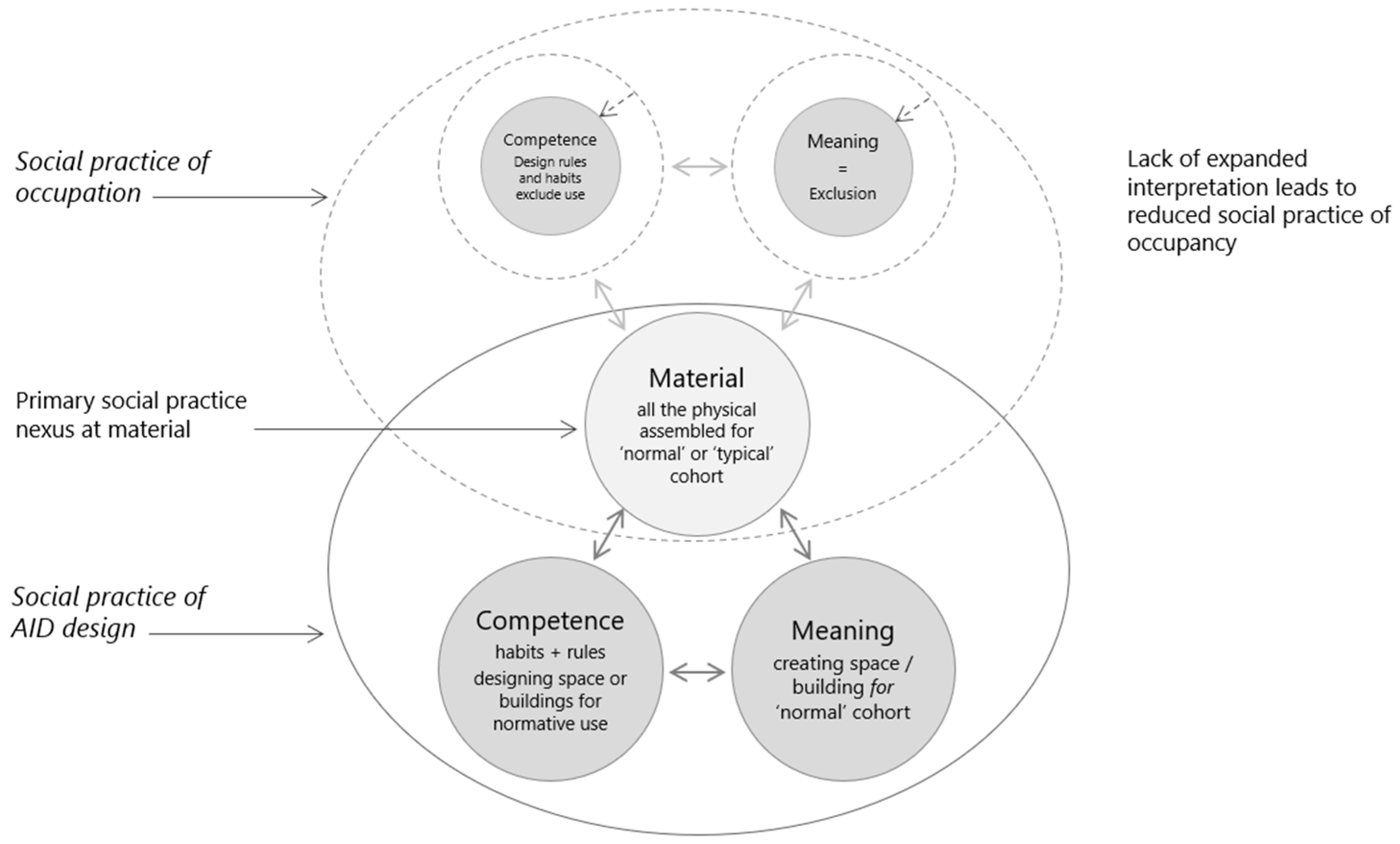
Explicitly engaging with body as both a physical element and a source of affect may also reduce exclusion, diagrammed as a material nexus in
Figure 3. This perspective asks AID practitioners to interrogate the effect of different body types in space and how normalised spatialisation may exclude some bodies because they are ‘different’ in their senses, their movement, and the way they inhabit space, yet also ensure that the resulting design provides appropriate practice-specific sensuality. Knowledge of this may prompt justification for change, or evolution, of design practice.
3.3.4. The Role of Architectural and Interior Design in Stabilising or Innovating Affective Cultures
Social practices change over time. AID practitioners, as significant carriers and propagators of spatialisation knowledge for spatial-affective cultures, must respond to occupancy needs by making sense of spatial history and the pressures for spatialisation stability or changes. Following contemporary rules and habits for spatial environments, without evolution, may be appropriate for two reasons. First, it may be important to the client to accurately reproduce a specific affective culture with minimal innovation. Second, project constraints may limit research so stabilisation may be more prudent than poorly researched spatial evolution. However, lack of reflexivity in the design of affective cultures may be a missed opportunity for adaptations to correct errors that have been perpetuated as inappropriate design habits or material.
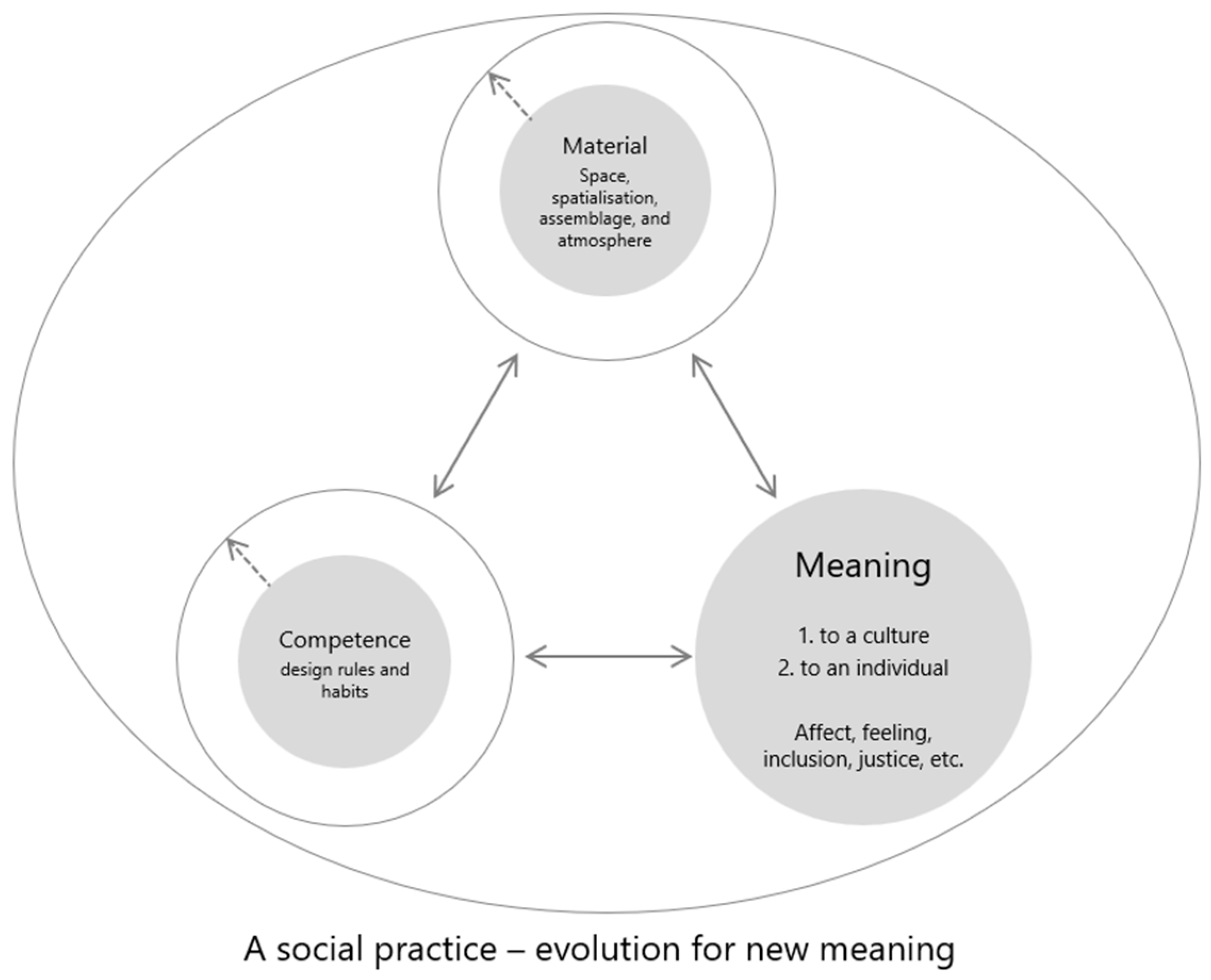
With more nuanced understanding of complex design problems, AID practitioners can make explicit choices in how to respond: either to replicate existing spatialisation and stabilise a social practice or to change the spatialisation to evolve a social practice.
Figure 4 suggests a process where a change in meaning of a space may require AID designers to change both spatialisation rules and habits and materials. When evolving the spatialisation, which includes atmospheres, the AID SPT framework offers a clear explanation for why the spatialisation is changed and how that change in material may impact other elements in the social practice, i.e., to predict outcomes for multiple occupancies.
3.4. Interpretation Through the SPT AID Framework: Three Examples
To illustrate the application of AID SPT, three scenarios are offered for interpretation. These are contemporary to Australia and are included as general illustrations of using the framework. These are informed by exploratory use in teaching research-informed spatial design.
3.4.1. Sensemaking of Architecture as Cultural Reproduction—Religious Buildings
Reckwitz [
35] uses churches as an example of stabilised affective cultures. The material, church buildings, are spaces designed to facilitate arrangement of bodies (religious leaders vs. congregations) and have consistent assemblages of non-human artefacts, all with the intention to create specific religious atmospheres, as cultural reproduction of specific religions. Church buildings communicate this to both occupants and the wider community.
Interrogating this further, religious buildings in Australia offer nuance in cultural reproduction of religious social practices. As a British settler colony, Australia clearly demonstrates the transmission of a variety of Christian sects and their associated buildings. In the 19th century (post-first settler arrival in the late 18th century) churches were built to cater to a variety of mainstream and non-conformist religions [
53,
54]. In addition to worship, early churches provided ‘…a centre of visible religion…’ in all areas using Church of England churches as symbols of English continuity [
55], provided alternative mainstream religions such as Catholic Churches [
53,
56], and imposed hierarchy on First Nations people forced to locate to missions and training facilities, e.g., [
57]. As part of settlement culture, the material of the Christian religious built environment had meanings of both belonging and community, and difference and exclusion, both associated with the social practice. Australia was also multicultural from early colonisation, so other religious architecture has also been imported for use in religious social practices for non-Christians [
53,
58].
Globally, church architecture has moved from replicated ‘authoritative buildings’ to having more variety in response to local contexts [
59]. Australia has seen evolution in buildings and internal spatial planning, such as the mid-20th Century Liturgical Movement. Intersecting influences of Vatican II liturgical changes and the Modern Movement of Architecture saw significant changes in Catholic church architectural and interior design, particularly the removal of barriers between religious leaders and congregation to generate more sense of community and participation rather than observation [
53,
56,
60].
Interpreting through the SPT AID framework, the material has changed due to changes in rules and habits of religious social practices. These changes were transmitted internationally and resulted in sensing bodies being rearranged, thus changing the atmosphere and evolving the practice, at least from those participating. For non-participants, religious buildings offer place-making landmark status—or not, such as when the other more recent non-Anglo occupancies attempt to transmit other religious buildings (material) into Australia for their own social practice of religious worship and their attempts to bring in new social practices are rejected [
61], i.e., there is poor nexus between Anglo-Celtic settlers and non-Christian migrants, such as a need to, ‘…express their right as citizens to participate in and belong to the wider civil sphere by building their own places into the urban landscapes…’ [
58]. Here, the social practice of worship has been rejected as an appropriate social practice to transmit into Australia through rejection for new material forms. While Reckwitz’s stabilization example is useful point of departure, a more nuanced interpretation is possible in AID.
3.4.2. Sensemaking of Social Change—All-Gender Sanitary Design in Public Buildings
Sanitary design in Australia must comply with the National Construction Code in both numbers of pans, urinals, and basins, and, until recently, binary gender divisions in public buildings. Social changes around gender have prompted the Australian Building Codes Board to review and adapt sanitary provisions to offer the choice to provide all-gender sanitary facilities in addition to binary gender spaces [
62]. In SPT terminology, there are specific design rules for sanitary design. Furthermore, while not a rule, sanitary facilities tend to be grouped with other facilities requiring sewer waste and water supply for hydraulic efficiency.
In this scenario, social changes are prompting evolution of the social practice of occupation of sanitary facilities. The interpretation of gender has expanded its meaning beyond gender binaries. When applied to public sanitary facilities this is prompting changes in design rules, i.e., changing the competence of the material (sanitary facilities) for more inclusion. While the material objects of pans, urinals, and basins remain the same, the spatialisation of pans, urinals, and basins, changes to evolve the social practice, i.e., this change in design must respond to the social practice as unit of analysis, not just the physical arrangement of elements.
While all-gender sanitary facilities are seen as beneficial [
63,
64], there are circumstances when a change to purely all-gender sanitary facilities is not appropriate such as communities under stress of natural disasters [
65]. In this case, through SPT, all-gender sanitary facilities are unsafe, changing the affective response and meaning of occupancy.
Communities with strict binary gender structures also remain, such as First Nations communities in the Northern Territory, Australia. These require designers to ensure they understand and act ‘…to maximise the wellbeing and preferred expressions of sociospatial relations… and minimise stress caused by uncomfortable juxtapositions of unwanted relationships of avoidance’ [
66] (p. 193). Here, the social practice of sanitary facilities has a nexus at the urinals, pans, and basins, but the gender spatialisation should not implement all-gender facilities in this community, i.e., the design should be stabilised. However, the efficiency practice of locating different gender sanitary facilities adjacent to each for the purpose of plumbing and sewer efficiency should evolve to ensure gender avoidance is fully spatialised.
These examples might be interpreted as expressions of different cultural and personal values. For a design practitioner, engaging in conflicting values may be difficult so, to make sense of the nuance social changes, a designer can apply SPT to: first, reveal why the need for change has developed and reflect on their personal bias; second, reveal multiple occupancies at the community level and how they might respond to the changes; third, use design research and research translation to design appropriately for specific occupants; and, fourth, use design advocacy power to inform others about how and why design should be stabilised or evolved through design change.
3.4.3. Sensemaking of Disability—Designing for Non-Normative Bodies
This third example uses the SPT AID framework to interpret social practice of occupancy with disability. An AID practitioner in Australia will be familiar with the Australian Standard AS 1428.1:2021 Design for access and mobility, Part 1: General requirements for access—New building work [
67]. This standard provides various rules about designing ramps, stairs, sanitary, door handles, etc., for ‘people with disabilities’. Buildings must comply with this standard to comply with the National Construction Code. In doing this, design for disability is outsourced to agreed rules, relieving the designer of individual skills to design for disability.
Boys raises the problem of the social practice of designing for disability as a retrofit to normative design and asks designers to reconsider their social practice of stereotyping disability in ‘commonsense conceptual frameworks’ [
26] (pp. 1–3), i.e., design rules and habits. She identifies the forgetting of bodies in architecture as ‘invisibility work’:
‘This concerns both the amount of unnoticed effort that goes into making disability as a concept and disabled people as a constituency invisible; and the very invisibility of abled-ness that allows ‘normal’ bodies to be seen as nothing much, as not worth talking about.’
With active forgetting of bodies and their variety, ‘design theories and methods do not need to critically or creatively engage with their own normativity’ [
68] (p. 271) and this leads to disabled people having to take on the responsibility to counteract invisibility and advocate for multiple occupancies.
To share the reveal of invisibility work of disability, the SPT AID framework offers a structure for personal reflexive review and placing disability as the starting point of design. Using Boys’ ‘some implications of having a body’ [
68] (p. 273), taken-for-granted design habits assume that occupants have bodies that can move independently, easily adjust to slippery or uneven surfaces, quickly take in and assess the planned journey, interpret and negotiate hazards, deal with highly stimulated senses, and can do all this with sufficient energy to go from start to finish of the required journey, i.e., there is an assumed competence in using the space.
Applying SPT raises the unit of analysis from material to social practice of occupancy and prompts reflection on multiple occupancies that may occur in a single space. While this may be obvious for an aged care facility, normative workplaces such as offices or retail may need explicit inquiry into the designer’s own ‘invisibility of abled-ness’ and what the meaning of the workplace might be for someone with a non-normative body.
Placing disability as central to design reintroduces bodies, and their different affective responses, back into the design assemblage, revealing that social practice of occupancy is not the same for all bodies. Rather, there is a nexus at the materials element with different competences and meanings. Designers may then make explicit choices about whether to design to stabilise current affective cultures and maintain contemporary spatialisation or evolve these to place disability at the centre of design. For example, this might mean selecting materials that reduce slips, providing wide spaces for passing, including multiple wayfinding strategies, selecting aesthetic finishes that are less stimulating, and providing rest points along main circulation, all using sophisticated architectural and interior design that appropriately spatialises the required design, e.g., a sophisticated and delightful contemporary workplace, rather than just design for compliance with basic accessibility rules.
4. Discussion
As an initial theoretical exercise, this paper extended existing operationalised versions of social practice theory [
33,
34,
46,
52] for application in architecture and interior design. Because AID practitioners design spaces, including the envelope fabric and assemblages of furniture, fixtures, lighting, colours, textures, atmosphere, and more, and these provide both function and delight, it conscripts Reckwitz’s argument for affective spaces [
35] to include space as a component of social practices. Four theoretical aspects of SPT were found to be useful for interpreting buildings: social practice of occupancy as unit of analysis; the nexus between different social practices, particularly between the social practice of building occupation and social practice of design for building occupation; the duality of bodies in space and their contribution to both material and social space; and the option to stabilise or evolve affective cultures through spatialisation.
The SPT AID framework employs the social practice lens to reveal different occupancies through analysis guided by the SPT elements (material, competences, and meaning), to pragmatically develop a more holistic knowledge about spatial design, i.e., sensemaking. It proposes that interpreting an architecture and interior design problem through this framework will increase opportunity for criticality of the response and challenge unconscious bias in design response particularly when designing under time- and resource-limited contractual obligations. The proposed framework is demonstrated using three examples: churches as examples of generally stabilised affective cultures; interpreting the effect of social changes on sanitary design in public buildings and effects of evolution of design for some occupancies; and revealing multiple occupancies due to bodies with different abilities.
4.1. Theoretical Contribution
The main theoretical contribution is the extension of Shove et al.’s [
34] operationalisation of social practices theory to architecture and interior design by using Reckwitz’s affective spaces [
35] to argue that space is part of the material element. The attraction of Shove et al. [
34] is the simplicity and adaptability of the three-element model of social practices to explain reciprocal relationships between objects and people. Extending this to include space, and its construction or assemblage, offers a framework for applying sociology approaches to AID without the need for advanced scholarly understanding of sociology. For AID tasks such as briefing, which is acknowledged as a particularly ‘fuzzy’ process at the beginning of a project [
2] (p. 5), the simplicity of this operative approach (material, competences/rules and habits, and meaning) offers initial clarity, or sensemaking, for working through design problems while also being inclusive of people and their variability.
For AID practice the typical theory pathways to link the social with material is via Gidden’s structuration and spatial agency [
41], Latour’s actor-network-theory (ANT) and its useful thought experiment about the material–human hybrids [
35,
69], and Lefebvre’s production of space [
40]. This pathway continues with key social practice theory sources [
34,
35] and while these offer robust advanced discussion [
35,
45,
70], operationalising [
33,
34], and application [
46], this scholarship is likely beyond the needs of AID professional practice. Yet the integration of social theory into AID practice offers a useful scholarly foundation for interpreting the recursive relationship between buildings and occupants while still being accessible to the non-scholar.
This framework is not intended as a design theory, i.e., as a polemical creative theory [
15] (pp. 190–120), as theory for theorists [
71], or as theory to solve specific problems [
72]. Rather it offers parallel sensemaking about the outcome that might accompany AID design theory and then identify issues through the design process, such as missing knowledge and design risks, and to make informed decisions about whether to stabilise or evolve spatialisation through the material element.
This paper has approached the use of SPT from the perspective of professional AID practice, i.e., as organisations operating in macro-environment contexts with commercial imperatives. This position enables the introduction of pragmatic concepts from business studies such as general strategic theory development [
28,
29] and sensemaking, where taking time to understand complex problems is useful in and of itself to ‘see more clearly’ before commencing a solution [
73]. The latter is not directly comparable to Grayling’s for, into/about, through design research typology [
12] (pp. 95–97) since actions for sensemaking need not be limited to any design research stage. Rather, it is intended here as a framework, or tool, to ask questions through all design stages and guide outcomes, and may use all skills and knowledge of design, including spatial exploration and representation.
When considering the occupant–building system, this method aims to prompt critical reflection about the relationships between the social and material with the intention to reveal hidden connections and tacit knowledge. To avoid ‘…the designer’s own forestructures of understanding…’ in hermeneutic interpretation [
74] (p. 47), the framework offers a guided interpretation through examining SPT elements individually and their linkages as a set framework for the practice.
The SPT AID framework provides four useful social practice theoretical outcomes to AID practice for holistic sensemaking. This change in unit of analysis is particularly useful for material-focused disciplines such as architecture and interior design because applying this higher order unit of analysis to occupancy ensures human occupants must be considered as equal contributors to a designed space, as are the socially constructed rules and habits of occupied space, and its design. This acknowledges the recursive systems of AID [
4,
18] (p. 41) using a repeatable high-level framework rather than ad hoc project-specific frameworks. It makes the role of people in building occupation explicit and moves the conversation beyond ‘material culture’ [
39] (p. 1).
The application of the same framework to different cohorts is useful to make explicit a nexus between social practices. This is particularly useful to reveal to designers that their perspectives of space may be very different to future occupants. This invokes spatial agency of occupants following the arguments of Gidden’s structuration [
41,
42], but also provides a tool for reflexive inquiry beyond the general spatial agency intentions. Here, explicitly identifying different meanings of AID material offers nuance to solve design problems that come from taken-for-granted assumptions that meaning is the same for designer and occupant groups, i.e., starting from acknowledged difference as an opening to inclusion, such as for disability [
68] or for other cultural needs [
66].
The recognition of the duality of bodies in space prompts two changes when interpreting AID. First, it makes explicit the physical presence of bodies in the assemblage of space. Here spaces empty of people are incomplete space because the reason for the space existing, including the envelope architecture and interior spatial design, is omitted from the designed volume. Returning bodies in all their variety may prompt more inclusivity in design. Second, the recognition of bodies as sensing, with affects caused by buildings, elevates the aesthetic or atmospheric design as important and equal to the design for functional use. While noting that architectural theory does provide various erudite interpretations of space architecture, and interior design using social theory and philosophy, e.g., [
75,
76,
77,
78], it can be too specialised to provide accessible arguments for non-AID practitioners in commercial projects. Engaging with senses and the physical body offers an understandable nexus, as demonstrated by the examples presented here. Given that AID practitioners work to create both aesthetic and functional outcomes, this implicitly acknowledges the creative work, i.e., the poetry of space that occupants respond to, as equally important to functional design.
Taking a social practice perspective asks AID practitioners to take responsibility for their role in stabilising or evolving affective cultures. This role is already explicit in professional architectural practice [
1], with imperatives such as regenerative design [
79] or design for spatial agency [
41] or spatial justice [
80], imploring designers to make informed decisions. The SPT AID framework offers a companion framework for doing this, particularly when working with complex or ‘wicked’ problems [
25] (pp. 24–27).
4.2. Practical Contribution
As demonstrated by the three examples, this flexible framework can be used as a sensemaking tool to review both past and future design.
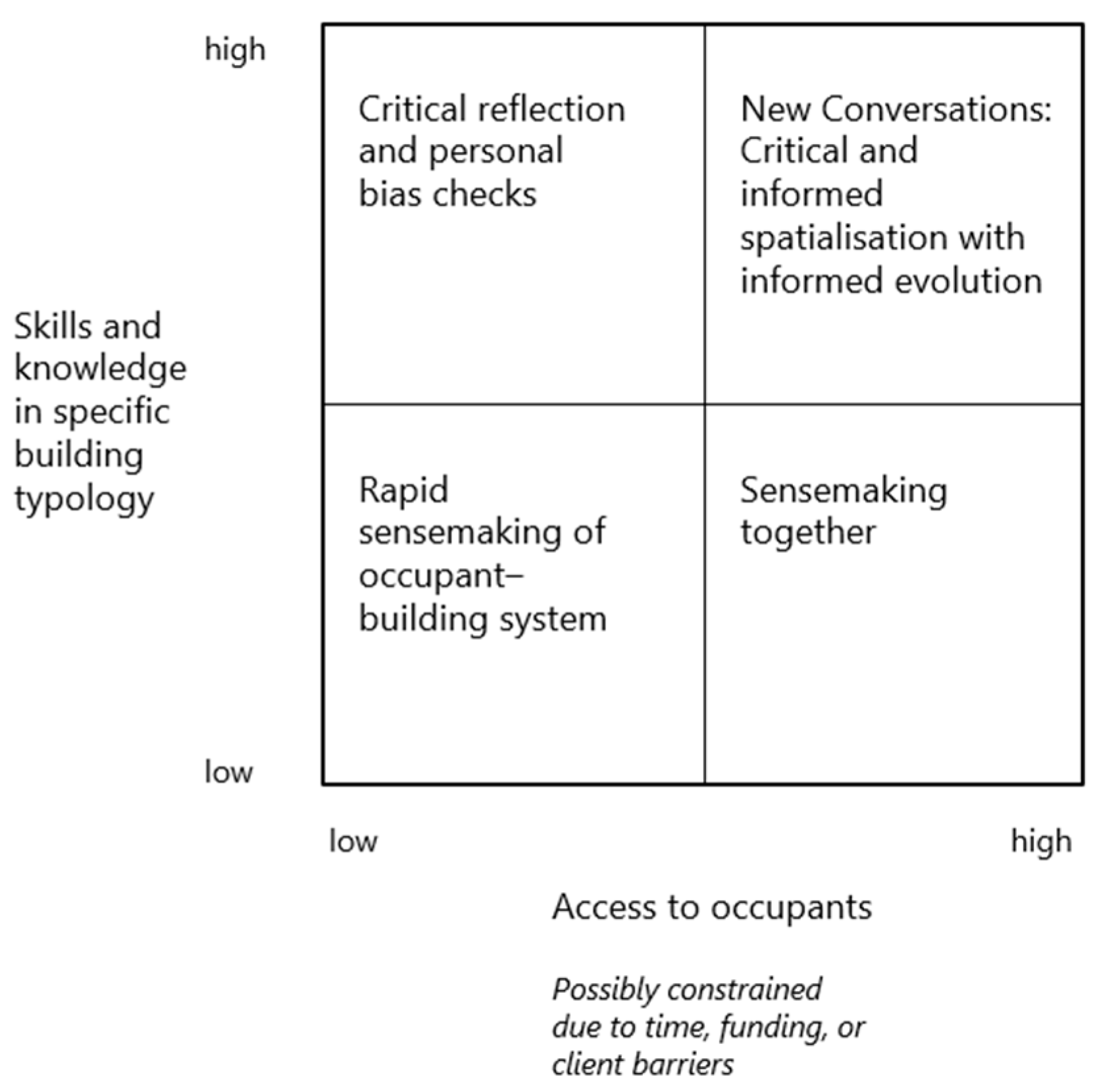
Figure 5 suggests different applications depending on the access to occupants for consultation and the skills and knowledge of the individual or team in the relevant building typology. There are four immediate practical use cases for this framework.
The first use case is for designing where there are commercial project constraints such as time or funding. How it is used will depend on whether designers have access to occupants for consultation. Where consultation with occupants is available it can be used to guide discussions with clients and occupants to reveal and confirm required functions and occupancies and resolve conflicts early in the process. If consultation is not available at pre-briefing and briefing stages, an internal SPT framework analysis may identify overlooked occupancies and this could be used to alert the client to missing project resources such as specialist consultants (disability, cultural, or other) or the need for co-design. Alternatively, architects, under professional obligation, can identify missing occupancies and attempt to advocate to design for these within limited project funds. More strategically, it can used throughout the project as a project governance and quality assurance tool to review team understanding and compliance.
The second use case is as a tool for research-informed design for unfamiliar or ambiguous complex spatial problems such as health settings design. Here, the application of the SPT framework is proposed to rapidly review unfamiliar spatial typologies and identify and integrate non-design knowledge as needed. By using SPT, with social theory origins, it positions AID as having a social/human purpose, as compared to more functionalist outcomes or creative artistic outcomes. It facilitates moving beyond material culture to operate at the junction of HASS/STEM knowledge claims, which then aids working towards research-informed design that can address multiple meanings and occupancies. Where there is good access to occupants, sensemaking will be an interdisciplinary project for joint sensemaking or new conversations.
The third use case is as a framework for self-directed sensemaking and critical reflection for established AID practitioners to review their personal social practice of design and unconscious bias. By explicitly interrogating personal design habits, and the normative thinking behind those design habits, it offers insights into designer roles in stabilising affective cultures or evolving them to be more inclusive through new spatialisations.
Within project teams, this framework can be used to identify knowledge and skills within staff resources. This review process may also highlight staff needing additional training in competencies for designing for multiple occupancies such that tailored guidance is provided to integrate meaning and design rules and habits into the design. Staff with more design experience will have more formed design habits and personal biases and may need training in adapting these for new occupancies.
The fourth use case is to prompt new conversations. Here, the SPT AID framework may be used as a structured ‘nexus check’ to inform decisions through explicit evaluation of SPT elements (material, competences/rules and habits, meanings) and the spatial-affective atmospheres required. It may identify conflicts in assumptions about occupancies between designers and occupants and reframe or resolve those conflicts. Initially, the three key junctions of interest are: different occupancies; occupants vs. designers; functional vs. affective design. This is also likely to be particularly useful during design teaching to prompt younger design learners to engage constructively with perceived conflicts in occupant needs with creative design.
Another conversation it may prompt is about value of the built environment. Here the social practice unit of analysis makes the relationship to the physical, its use, and its meaning to the user, providing a pathway for narrative specificity or cost–benefit analysis. It is envisaged that all use use cases are applicable to all project sizes. For example, application in a small residential project, particularly engaging with the meaning of the building to the occupant, may reveal points of delight and tension for consideration. In a large project, making meaning explicit may provide coherence for all stakeholders.
4.3. Limitations and Future Research
This paper has presented an initial statement of interest for an SPT AID framework and has identified contributions to practice. It is limited by the theoretical method and further work is required to empirically research the applicability of this theory to practice. Practice includes education, and this framework is currently being applied in design education to teach research-informed design briefing and placemaking, with outcomes forthcoming. It is also limited to the author’s disciplines of architecture and interior design, and further work is needed to extend the framework to other built environment disciplines, regulation, and development of public policy related to the built environment.
Future research is planned to test this framework in a pilot case study for professional practice briefing of a complex design project with a strong social justice need, as part of the directed sensemaking process during briefing consultation [
2], aid resolution of issues in architectural programming processes [
81] and test-informed decision-making for affective culture evolution. There is also ambition to translate this framework to new professional services, such as scenario planning [
82] for strategic infrastructure design decisions in dynamic systems, such as designing in adaptability to extend building life.
Future AID scholarship might apply this framework as a model for either a qualitative explanation of occupancy or use quantitative approaches. Qualitative approaches could use this framework to research occupancies that are treated as other, such as in scholarly established post-occupancy evaluation. Qualitative approaches may also be used to identify the scope of emotional attachment and meaning of buildings, as demonstrated by the emotional community identification for historic places [
83], but as a social practice of both occupation and design. To develop this framework for quantitative research, further research is needed to reliably select and quantise measures of each SPT element.
As a relational representation, SPT has previously been visualised as a network [
22]. It is anticipated that this may be useful for representing building–occupant system when using ‘big data’ methods to identify SPT element patterns from multiple sources and multiple data types. This would be of interest in both sociology and built environment domains to reveal relational patterns and complementarities between physical and social for different occupancies. Given concerns with bias in unsupervised machine learning, numerical models that are able to represent nuanced and multiple occupancies in building simulation would be useful for checking bias in artificial intelligence entering design practice [
84].
5. Conclusions
When solving complex building design problems, architecture and interior design practitioners have multiple responsibilities including, but not limited to, responding to the needs of clients, the environment, and multiple types of occupants. When working within commercial constraints, particularly when occupant consultation is limited or not possible, designing for occupant inclusion may be difficult, and pragmatic approaches are needed to guide research-informed design and reflexive appraisal of design decisions to ensure social justice. This paper is intended as an opening paper to further operationalise social practice theory for use in architecture and interior design professional practice and scholarly research as a framework for sensemaking about complex design problems. The built environment is inherently social. Social practice theory makes this explicit by changing the unit of analysis from the physical material to explicitly include the social via occupancy competences (rules and habits) and meaning. The result is a framework for explaining a design problem as an occupant–building system beyond material culture. Furthermore, it acknowledges the importance of spatial-affective atmospheres as integral to the social practice, i.e., functionalism should not supersede atmosphere—rather, good spatial design can do both and both are valued.
This framework is flexible. It may be used to rapidly review existing architectural spatialisation - to interrogate social pressures for spatialisation change, to guide critical reflection on spatial inclusion, and to inform decisions to evolve spatialisation. It is also anticipated that it may be applied to research-informed design, particularly for selecting appropriate HASS/STEM knowledges for use in mixed method case study research for specific project outcomes. It is anticipated that this framework is useful for education and professional practice, particularly for design problem definition and client briefing, with further research planned to confirm this. There is also scope for application in scholarly research for both qualitative research and translation to quantitative models.
As generative artificial intelligence bestows an inflection point on architecture and interior design processes, engaging strategically with the social will become more important for AID practitioners. This framework offers a sanity check to better respond to diverse needs, particularly needs beyond a personal knowledge base, and improve inclusion and social justice without devaluing architecture and interior design’s creative delight.